
Grain projects now shape distillery contracting in India
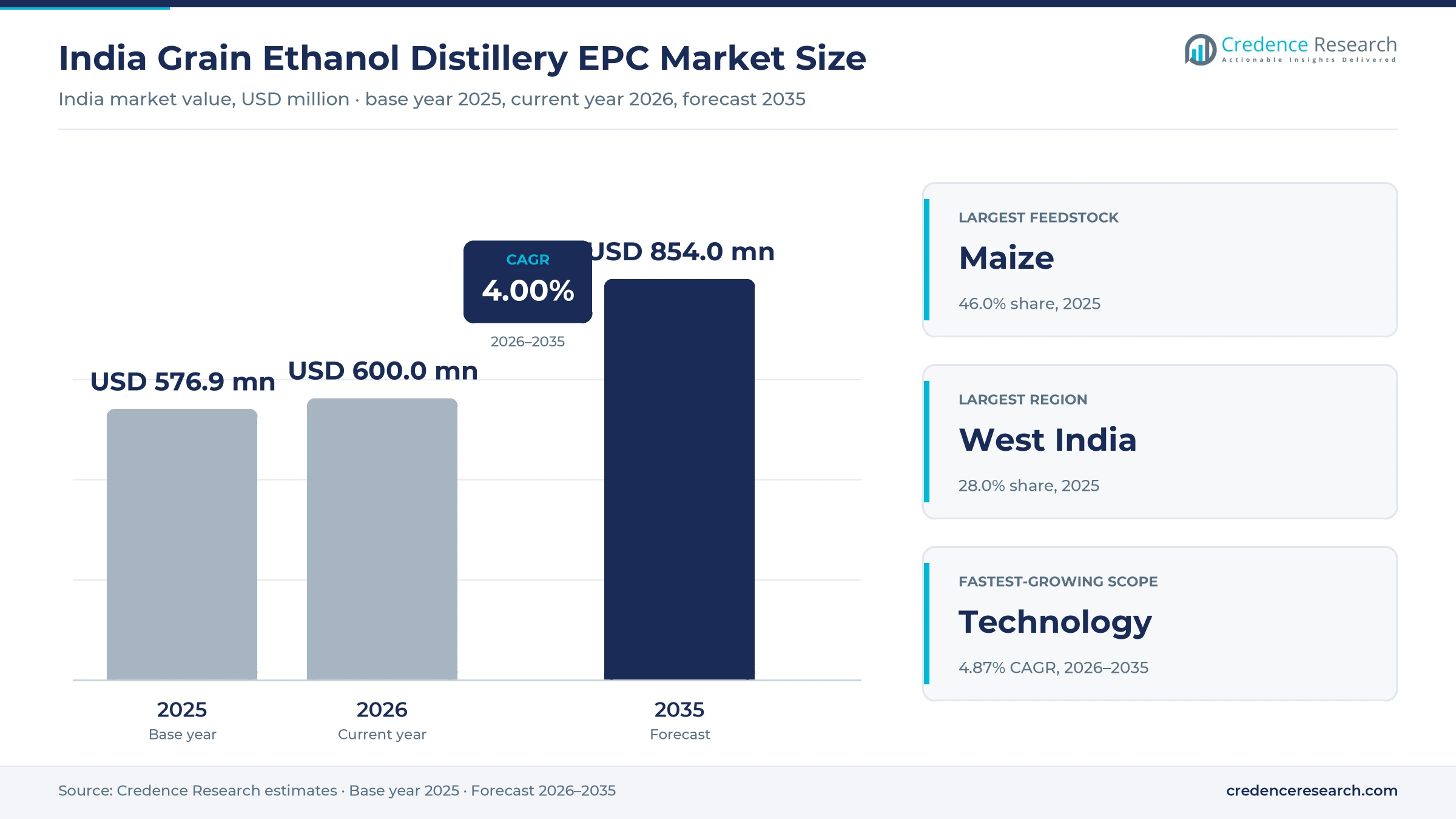
The India grain ethanol distillery EPC market was valued at USD 576.9 million in 2025 and is projected to increase from USD 600.0 million in 2026 to USD 854.0 million by 2035, registering a CAGR of 4.00% during 2026–2035. Demand comes from distillers that need mills, fermenters, columns, dehydration, evaporation and captive steam to supply oil marketing companies under the Ethanol Blended Petrol program. West India held the largest regional share, 28.0% in 2025, because Maharashtra alone hosts 145 plants. Central India is the fastest-growing region at 4.58% a year as maize-belt projects in Madhya Pradesh come forward. The market has also changed character since nationwide E20 blending began in December 2025. Installed capacity now exceeds offtake, so contractors are moving from new greenfield sites toward grain add-on modules, efficiency upgrades and corn oil recovery at existing plants. Grain supplied about 70% of ethanol delivered through August 2026, which keeps grain-handling and liquefaction packages at the center of project budgets.
What does the distillery contracting market in India include?
The market counts engineering, procurement and construction contracts, process technology packages and utility packages for fuel ethanol distilleries in India, including grain plants and the multi-feed plants that combine grain with cane juice or B-heavy molasses. Buyers include sugar groups, standalone grain distillers and public sector refiners, and they usually purchase through lump-sum turnkey contracts or a separate licensor and balance-of-plant structure.
The estimate excludes ethanol sales, feedstock purchases, plant operation and potable-alcohol blending lines. Value flows from process licensors and equipment fabricators through civil, erection and commissioning contractors to the distillery owner, with boilers, cogeneration and effluent treatment often bought as separate packages.
India Grain Ethanol Distillery EPC Market Insights
- The market grows from USD 576.9 million in 2025 to USD 854.0 million by 2035 at a 4.00% CAGR, a moderate pace that reflects installed capacity already ahead of E20 offtake.
- West India held 28.0% of 2025 value, supported by 145 plants and 389 crore liters of annual capacity in Maharashtra alone.
- Maize led feedstock spending with 46.0% in 2025, matching its position as the largest allocated ethanol feedstock in the 2025-26 supply year.
- Praj Industries reported in its fiscal 2026 results that overcapacity had slowed greenfield projects, while enquiries for operating-cost reduction and corn oil modules stayed strong.
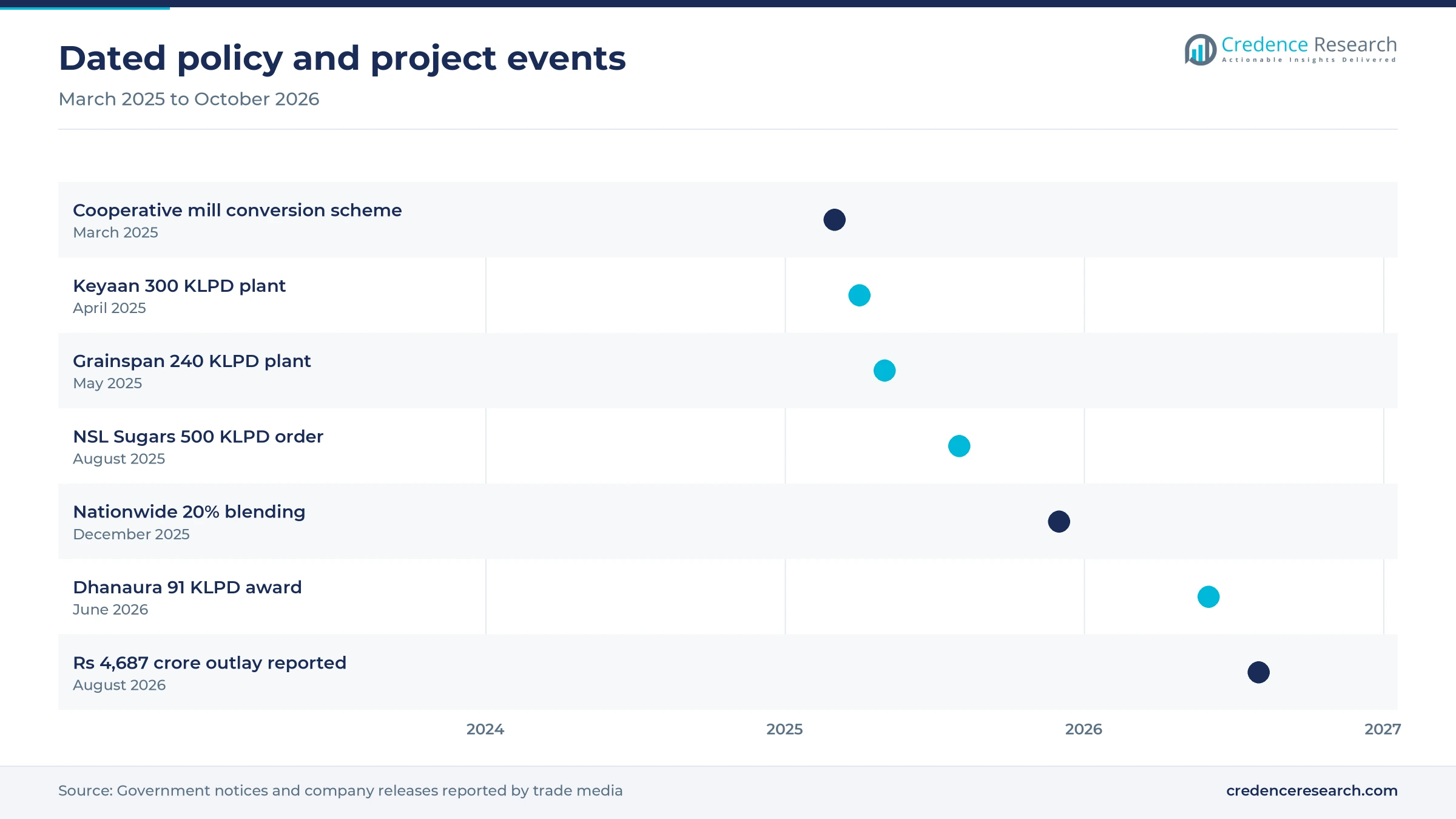
- The March 2025 cooperative mill scheme offers interest support to convert cane-based plants to maize and damaged grain, giving contractors a brownfield pipeline beyond new sites.
Maize, turnkey delivery and mid-size plants lead spending
Why maize dominates feedstock-linked spending
Based on feedstock, the market is categorized into maize, FCI rice, damaged grain and cane juice/B-heavy projects. Maize led with 46.0% of 2025 value because oil marketing companies assigned maize 45.68% of the 1,048 crore liters allocated for the 2025-26 supply year, according to Petroleum Planning & Analysis Cell data reported by ChiniMandi. FCI Rice grows fastest at 4.75% a year as the 2026-27 tender allows up to 7.2 million metric tons of FCI rice, or 3.24 billion liters, compared with about 233 crore liters allocated a year earlier. Keyaan Distilleries in Uttar Pradesh was accordingly built to process both broken rice and maize.
Turnkey contracts remain the largest scope of work
Based on scope, the market is categorized into EPC, technology and utilities packages. EPC led with 58.0% of 2025 value because owners still favor single-point delivery, as ISGEC's turnkey order for 500 KLPD syrup and 100 KLPD grain plants at Panchganga Sugar and Power, reported by Business Standard in February 2023, showed. Technology grows fastest at 4.87% a year as Praj Industries said its fiscal 2026 enquiries centered on operating-cost reduction and corn oil modules. Utility packages remain sizable too, because Thermax lists cogeneration projects at 18 or more distilleries ranging from 60 to 400 KLPD.
Mid-size plants lead while larger sites gain ground
Based on size, the market is categorized into plants below 200 KLPD and plants above 200 KLPD. Below 200 KLPD led with 57.0% of 2025 value because the 38 subsidized distilleries expected to start up in government data of August 2025 averaged about 4.4 crore liters a year, or roughly 135 KLPD on a 330-day calendar. Above 200 KLPD grows fastest at 4.51% a year as owners order larger single sites, including the 500 KLPD NSL Sugars plant at Mazalgaon and the Keyaan unit, which starts at 300 KLPD and can scale to 500 KLPD.
| Segment Group | Leading Sub-segment | Share, 2025 | Fastest-growing Sub-segment | CAGR, 2026–2035 |
|---|---|---|---|---|
| By Feedstock | Maize | 46.0% | FCI Rice | 4.75% |
| By Scope | EPC | 58.0% | Technology | 4.87% |
| By Size | Below 200 KLPD | 57.0% | Above 200 KLPD | 4.51% |
Request a Free Sample
Fill in your details and we'll send you a free sample report.
- Sample data tables & charts
- Research methodology
Blending policy and grain supply sustain project work
Blending policy supports distillery capacity investment
India's blending mandate remains the anchor for distillery capital spending, even after capacity moved ahead of offtake. Public sector oil marketing companies have blended 20% ethanol in petrol nationwide since December 2025, and the government has approved Rs 4,687 crore for interest subvention, with Rs 2,075 crore released to NABARD through July 2026, according to a Rajya Sabha reply. Installed capacity has reached 478 plants and 2,019 crore liters a year, compared with 421 crore liters through 2013, according to a Department of Food and Public Distribution official quoted by PTI. The petroleum ministry also said on July 10 that reverting to E10 would jeopardize nearly Rs 1 lakh crore a year of bank-financed investment. In the Credence Research model this adds about 1.80 percentage points to annual growth to 2035.
Grain feedstock diversification expands project scope
Grain has moved from a supplement to the main feedstock, and that shift widens each contract to include silos, milling, liquefaction and dryer sections. Grain accounted for 624 of the 895 crore liters supplied through August 2026, led by maize at 345 crore liters and FCI rice at 214 crore liters, according to All India Distillers' Association data reported by Autocar Professional. Installed grain capacity had already passed molasses capacity by mid-2025, at 858 crore liters against 816 crore liters, according to PTI. A U.S. Department of Agriculture Foreign Agricultural Service report had earlier counted nearly 200 grain facilities agreed in principle since January 2021, worth a potential 8.59 billion liters a year. In the Credence Research model this adds about 1.00 percentage point to annual growth to 2035.
Efficiency retrofits and integration add EPC demand
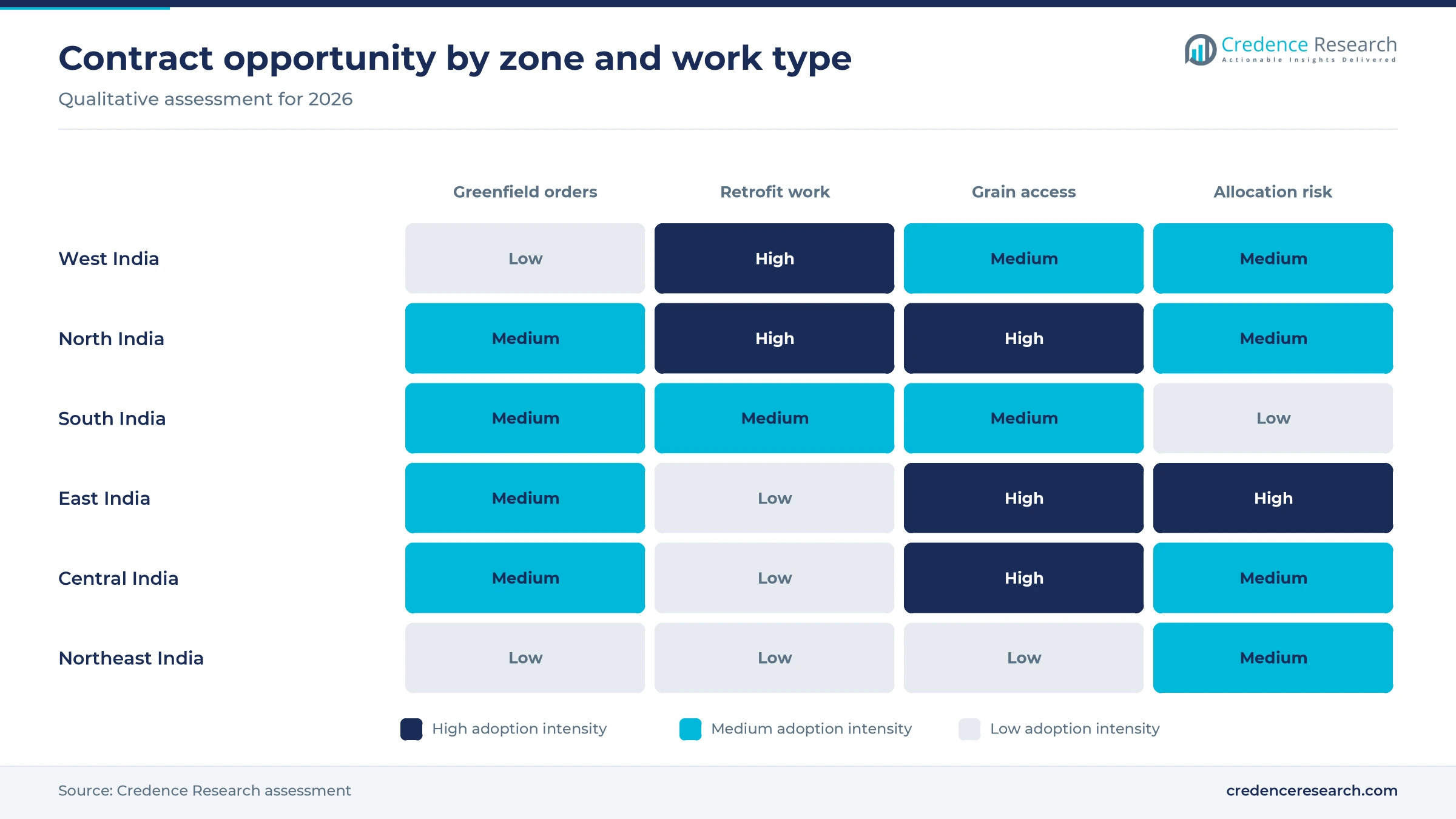
Owners running below nameplate capacity now spend on lowering cost per liter, which creates contract work at existing sites. Praj Industries states in its distillery upgrade brochure that evaporative distillation and mechanical vapor recompression can cut fuel use by 20% to 35% and freshwater use by 30% to 40%, with payback typically within one to three years. The same brochure claims capacity gains as high as 50% within existing boilers and utilities, an attractive alternative to a new site. Brownfield work was about a fifth of the Praj ethanol book in August 2025, and its management said on the first-quarter fiscal 2027 results that it expects brownfield growth. In the Credence Research model this adds about 0.64 percentage point to annual growth to 2035.
Higher-blend fuel standards keep a second wave possible
Fuel standards beyond E20 give owners a reason to keep design margin in new plants, although no mandate has yet been set. The Bureau of Indian Standards has notified specifications for E22, E25, E27 and E30 petrol as well as E85 and E100, according to the fourth-quarter fiscal 2026 Praj Industries presentation, which also cites a government roadmap for E85 and E100 infrastructure. Oil companies received 1,003.1 crore liters in the 2024-25 supply year, according to Petroleum Planning & Analysis Cell data, and the 2026-27 joint tender seeks around 11 billion liters. Praj managing director Ashish Gaikwad said in August 2025 that blending up to E30 faces no technical barrier, leaving policy timing as the constraint.
Brownfield work and co-products reshape contractor pipelines
Shift from greenfield orders toward brownfield work
The clearest change in contractor pipelines is the shift from new sites to work at running plants. Praj Industries attributed a slowdown in greenfield projects to ethanol overcapacity in its fiscal 2026 results, and its finance chief, Sachin Raole, had warned in August 2025 that there would be very few greenfield orders without new mandates. The company put its ethanol book at about four-fifths greenfield and the rest brownfield at that time, so the mix has room to move. Its first-quarter fiscal 2027 commentary in August 2026 again expected domestic greenfield work to stay slow until higher mandates arrive. Order backlog nevertheless stood at INR 43.05 billion at the end of fiscal 2026, with 66% domestic, according to the Praj presentation, which suggests contractors can carry the transition while Technology grows at 4.87% a year.
Rise of co-product modules at grain plants
Co-products are becoming a standard request because grain distillers face a tighter margin between corn and ethanol prices. Domestic corn rose to around Rs 27 per kilogram from Rs 17 to Rs 18 a year earlier, while the latest effective maize ethanol rate fell to Rs 68.86 per liter, according to S&P Global Energy in October 2026. Praj Industries said in August 2025 that existing producers were showing interest in distillers corn oil and rice protein add-ons, and its fiscal 2026 presentation reported strong enquiries for corn oil modules. These packages are small compared with a new plant, yet they suit owners who already have mills and dryers. Maize remains the largest feedstock base for such work at 46.0% of 2025 value.
Opening in second-generation plants under PM JI-VAN
Second-generation plants offer a real opening for contractors because public funding covers a meaningful part of first commercial units. PM JI-VAN Yojana provides up to Rs 150 crore per commercial project, and Spray Engineering Devices secured that amount in June 2026 for a 91 KLPD plant at Dhanaura in Uttar Pradesh, according to Indian Chemical News. The design combines biomass gasification with LanzaTech gas fermentation and could later feed sustainable aviation fuel intermediates. In Assam, the Numaligarh Refinery joint venture produced fuel grade ethanol of 99.7% purity from bamboo in trial runs on Sept. 3, 2025, according to Biofuels Digest. These projects carry larger scopes than a first-generation grain line and require gasification, pretreatment and integration skills.
Opening to convert cane-based mills to multi-feed
Sugar mills offer an accessible opening because their cane-based plants sit idle outside the crushing season. The Department of Food and Public Distribution notified a scheme in March 2025 that supports conversion to maize and damaged grain, with interest subvention of 6% or half the lender's rate for five years, according to Rural Voice. Rajesh Tope estimated at a Praj Industries workshop in Pune on March 28, 2025, that a grain module could raise margins by Rs 300 to Rs 400 per ton of cane crushed. Praj said in August 2025 that this interest had not yet produced a meaningful order book. S&P Global Energy reported in October 2026 that India has barred ethanol from sugarcane juice and B-heavy molasses for the 2026-27 supply year, which could lift grain to about 90% of supply.
Overcapacity and corn costs test owner budgets
Surplus capacity delays final investment decisions
Surplus capacity is the largest brake on new contracts because owners cannot secure enough offtake to justify another plant. Producers offered 1,776 crore liters against a 1,050 crore liter tender for the 2025-26 supply year, and oil companies allocated about 1,048 crore liters, according to ChiniMandi. Bihar Industries Minister Dilip Jaiswal said in January 2026 that plants in the state were on the verge of shutdown. Contractors respond by bidding for upgrades and export work until allocation improves.
Corn costs squeeze the owners who fund upgrades
Feedstock inflation weakens the balance sheets that pay for projects and upgrades. The All India Distillers' Association said on Oct. 27, 2026, that grain distillers want about Rs 75 per liter for maize ethanol, roughly 9% above the Rs 68.86 effective rate, after corn reached around Rs 27 per kilogram. Standalone grain plants feel this most because they have no sugar income, so they often defer discretionary packages. Contractors can respond with shorter-payback efficiency work that lowers steam and water use per liter.
Local opposition adds clearance and design risk
Community resistance can stop construction after contracts are signed, which leaves contractors with idle crews and disputed milestones. The Nirmal district collector in Telangana halted work on an ethanol factory at Dilawarpur on Nov. 27, 2024, after local protests, according to Lokmat Times, and the state said it would review the permission. Effluent concerns usually drive such disputes, so owners increasingly specify zero liquid discharge systems, as KBK Chem-Engineering did at its 200 KLPD Nakshatra Biofuels grain project in Madhya Pradesh.
Reduced subsidy access raises the cost of new plants
Fading access to subsidized debt raises the financial hurdle for later entrants. Grainspan Nutrients built its first 110 KLPD Gujarat plant with central interest support and a Rs 120 crore loan, whereas its Rs 360 crore, 240 KLPD second plant commissioned in May 2025 carried no such subsidy, according to Outlook Business. Newer owners therefore carry heavier interest costs at a time of weak utilization. Contractors may need phased delivery and vendor financing to keep these projects moving through financial close.
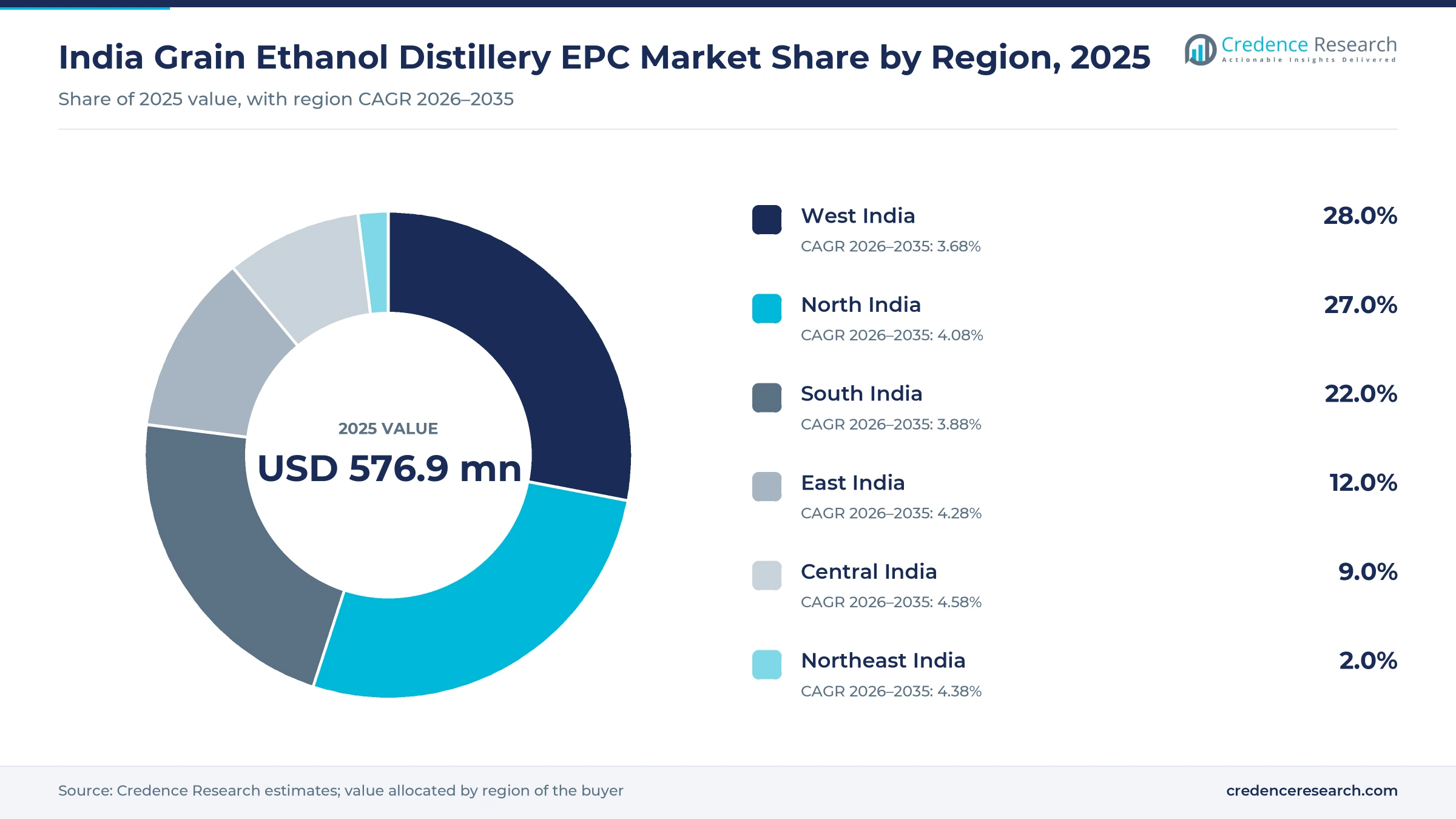
Central India grows fastest while West India leads
| Region | Value, 2025 (USD million) | Share, 2025 | CAGR, 2026–2035 |
|---|---|---|---|
| West India | 161.5 | 28.0% | 3.68% |
| North India | 155.8 | 27.0% | 4.08% |
| South India | 126.9 | 22.0% | 3.88% |
| East India | 69.2 | 12.0% | 4.28% |
| Central India | 51.9 | 9.0% | 4.58% |
| Northeast India | 11.5 | 2.0% | 4.38% |
West India holds the largest installed base
West India held a 28.0% share of 2025 value and grows at 3.68% a year, the slowest zonal pace because the base is already large. Maharashtra alone has 145 distilleries and 389 crore liters of annual capacity, according to the August 2026 Rajya Sabha reply, and it hosts the 500 KLPD NSL Sugars plant at Mazalgaon. Gujarat adds new grain capacity through Grainspan Nutrients at Bhamsara near Ahmedabad. As a result, the zone offers more conversion and upgrade work than new greenfield sites.
North India pairs scale with a strong pipeline
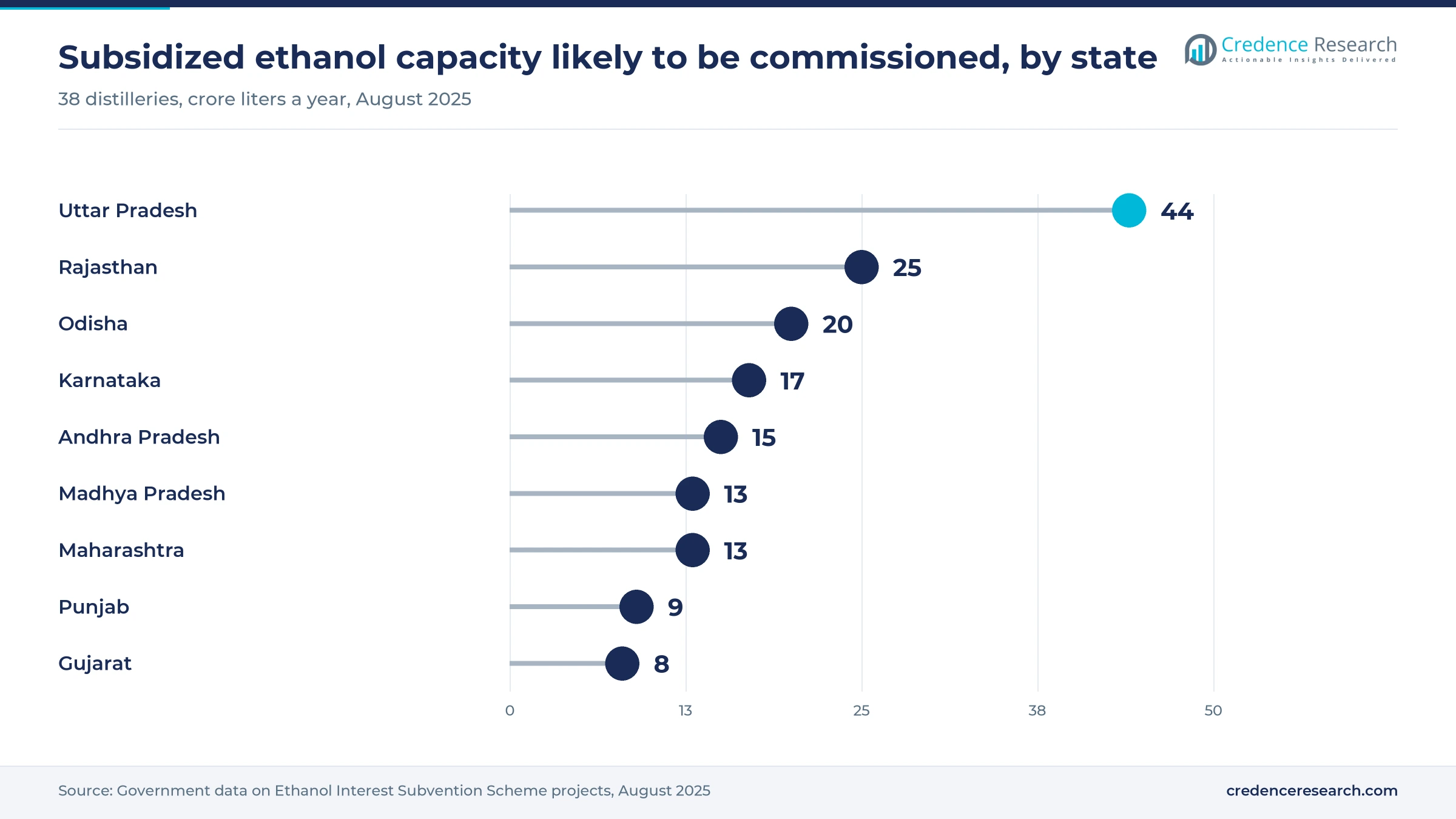
North India held a 27.0% share of 2025 value and grows at 4.08% a year, supported by Uttar Pradesh's 79 plants and 344 crore liters of capacity. Government data from August 2025 showed Uttar Pradesh leading the subsidized commissioning pipeline with 44 crore liters, ahead of Rajasthan at 25 crore liters and Punjab at 9 crore liters. Keyaan Distilleries' 300 KLPD grain plant and the planned Dhanaura second-generation unit show that both first-generation and advanced projects are moving forward in the zone.
South India combines large plants with supply gaps
South India held a 22.0% share of 2025 value and grows at 3.88% a year, with Karnataka carrying 50 plants and 321 crore liters of capacity. That implies an average plant much larger than Maharashtra's, which favors bigger turnkey packages. The August 2025 pipeline listed 17 crore liters in Karnataka and 15 crore liters in Andhra Pradesh, and Thermax lists a 400 KLPD cogeneration reference at Visakhapatnam. However, the Telangana protests at Dilawarpur show that clearances can be harder to secure across the zone.
Odisha plants lift East India while Bihar struggles
East India held a 12.0% share of 2025 value and grows at 4.28% a year, although conditions differ sharply by state. Odisha had the third-largest subsidized pipeline in August 2025 at 20 crore liters, compared with 3 crore liters in West Bengal and 2 crore liters in Bihar. Thermax lists references at Bankura, Malda and Nalanda from 250 to 400 KLPD, which shows that large plants already operate here. The Bihar allocation shortfall reported in January 2026 nonetheless limits fresh orders in that state.
Central India is the fastest-growing zone
Central India held a 9.0% share of 2025 value and grows at 4.58% a year, the fastest pace among the zones, from a smaller base than the leading regions. Madhya Pradesh listed three distilleries and 13 crore liters in the August 2025 pipeline. KBK Chem-Engineering lists grain projects with zero wastewater discharge at Nakshatra Biofuels at 200 KLPD and Betul Biofuel at 100 KLPD, while Thermax cites a 120 KLPD Ecofora Biofuels reference at Raipur. Together these projects show a growing contractor presence in the zone.
Northeast India remains small and advanced-feedstock led
Northeast India held a 2.0% share of 2025 value and grows at 4.38% a year from the smallest base in the country. Its most visible project is the Assam Bio Ethanol venture of Numaligarh Refinery, Chempolis and Fortum in Golaghat district, which sent its first bamboo-based ethanol consignment to the refinery on Sept. 9, 2025, according to Biofuels Digest. Grain work in this zone remains limited because no northeastern state appeared in the August 2025 subsidized pipeline, so advanced feedstock projects are likely to set the pace here.
Conversions and large multi-feed plants mark 2025 and 2026
| Development | Status and market relevance |
|---|---|
| In March 2025, the Department of Food and Public Distribution notified a scheme for cooperative sugar mills to convert cane-based ethanol plants to multi-feed operation with maize and damaged grain. | Notified; it opens a brownfield conversion pipeline for contractors. |
| In April 2025, Praj Industries completed design, engineering and commissioning of the 300 KLPD grain plant of Keyaan Distilleries in Uttar Pradesh, which can scale to 500 KLPD. | Inaugurated; it is a reference for large single-site grain plants. |
| In August 2025, MEDAS EnggDesign won the technology, engineering and equipment role for the 500 KLPD sugar and grain plant of NSL Sugars at Mazalgaon in Maharashtra. | Contract announced; low-pressure distillation and sugar vapor integration feature in the design. |
| In June 2026, Spray Engineering Devices secured Rs 150 crore under PM JI-VAN Yojana for a 91 KLPD second-generation plant at Dhanaura in Uttar Pradesh. | Funded; it extends contractor scope into gasification and gas fermentation. |
| In August 2026, the Minister of State for Petroleum told the Rajya Sabha that India had 478 ethanol plants and an approved interest subvention outlay of Rs 4,687 crore. | Reported to Parliament; it confirms the size of the installed base. |
Efficiency and flexibility define new plant specifications
- Multi-feed process design allows one site to run grain alongside syrup or molasses, as in the NSL Sugars plant at Mazalgaon that MEDAS EnggDesign is equipping for 500 KLPD.
- Vapor recompression and evaporative distillation reduce fuel use by 20% to 35%, according to Praj Industries, which makes them central to brownfield proposals.
- Molecular sieve dehydration delivers fuel ethanol of up to 99.8% purity from vapor fed directly from distillation, according to KBK Chem-Engineering reference material.
- Captive cogeneration covers steam and power through industrial boilers and turbines, with Thermax listing 72 to 78 ton per hour units at 400 KLPD sites.
Need a Custom Version of This Report?
Tailor the scope, geography, or segments to your exact requirements.
- Custom geography or segment scope
- Direct access to our analyst team
Technology licensors and turnkey builders share the field
Distillery EPC competition divides between process licensors, integrated engineering groups and utility specialists. Praj Industries competes on process technology and references such as the Keyaan Distilleries plant it commissioned in 2025, while KBK Chem-Engineering emphasizes lump-sum grain projects with zero wastewater discharge and lists more than 180 projects across five continents. ISGEC brings heavy fabrication and turnkey execution, as the Panchganga Sugar and Power order it announced in 2023 showed. Thermax competes in cogeneration and multi-fuel boilers rather than in distillation, and Spray Engineering Devices announced its second-generation position through a PM JI-VAN award in 2026. New entrants such as Sona Machinery, which said in December 2022 that it makes 90% of its grain handling equipment in-house, and MEDAS EnggDesign add pressure on price. Buyers usually compare steam use per liter, guaranteed yield, delivery time and access to fermentation equipment from local fabricators.
Companies profiled and their roles in this market
| Company | Type | Role in the market |
|---|---|---|
| Praj Industries | Process licensor and contractor | Designed, engineered and commissioned the 300 KLPD Keyaan Distilleries grain plant in Uttar Pradesh |
| KBK Chem-Engineering | Process engineering and turnkey contractor | Lists grain references at Nakshatra Biofuels and Betul Biofuel with zero wastewater discharge |
| Spray Engineering Devices | Technology and project developer | Secured PM JI-VAN support for a 91 KLPD second-generation plant at Dhanaura |
| Thermax | Utility EPC contractor | Lists cogeneration EPC work at 18 or more distilleries from 60 to 400 KLPD |
| ISGEC | Turnkey EPC contractor | Won turnkey syrup and grain plant orders from Panchganga Sugar and Power in 2023 |
Retrofit skills will separate contractors after E20
Credence Research's view is that the distillery EPC market has entered a slower but more skilled phase. Greenfield work will stay limited until a mandate beyond E20 appears, so contractor growth to 2035 depends on conversion, efficiency and co-product work at the existing base of 478 plants. Companies with proven mechanical vapor recompression, corn oil recovery and multi-feed references will hold an advantage over those that only execute balance-of-plant packages. The most assumption-heavy element is the timing of higher blending, and an earlier mandate would lift large-plant orders well above the current path.
How Credence Research built this market estimate
The report uses 2025 as the base year and 2026 to 2035 as the forecast period. Distillery EPC values come from the Credence Research model, checked against installed capacity additions, published plant costs and contractor order commentary. Segment and regional shares in the report are Credence Research estimates from those inputs. Sources are parliamentary replies, government scheme notices, industry association data reported by trade media, company presentations and project references. No interviews or surveys were conducted for this edition of the report.
Next blending mandate decides the pace of new orders
The distillery EPC market is projected to reach USD 854.0 million by 2035 at a 4.00% CAGR, with growth weighted toward the later years if policy moves beyond E20. Near-term work should come from cooperative mill conversions, grain add-on modules and efficiency upgrades, because surplus capacity discourages new sites. A notified higher blend would revive orders for plants above 200 KLPD, whereas a continued E20 ceiling would keep spending focused on cost reduction. Rice availability, corn prices and allocation policy will decide which feedstock designs owners choose over the period.
Frequently Asked Questions
How big is the India grain ethanol distillery EPC market?
Which region leads the market?
Which region grows fastest?
Which feedstock leads project spending?
Why have greenfield distillery orders slowed?
What retrofit work is available to contractors?
What policy could lift new orders?
Who are the main companies in this market?
Table of Content
Chapter 1 Market Segmentation
- 1.1 Segmentation Framework
- 1.1.1 Product and Service Classification
- 1.1.2 Application and End-Use Classification
- 1.1.3 Technology and Solution Classification
- 1.1.4 Customer and Distribution Channel Classification
- 1.1.5 Geographic Segmentation
- 1.1.6 Market Segment Definitions and Boundaries
- 1.2 By Feedstock
- 1.2.1 Maize
- 1.2.2 FCI Rice
- 1.2.3 Damaged Grain
- 1.2.4 Cane Juice/B-Heavy
- 1.3 By Scope
- 1.3.1 EPC
- 1.3.2 Technology
- 1.3.3 Utilities
- 1.4 By Size
- 1.4.1 Below 200 KLPD
- 1.4.2 Above 200 KLPD
Chapter 2 Introduction
- 2.1 Report Objectives and Scope
- 2.2 Product Definition and Industry Terminology
- 2.3 Market Inclusions and Exclusions
- 2.4 Research Process
- 2.4.1 Primary Research and Expert Interviews
- 2.4.2 Secondary Research and Source Review
- 2.4.3 Top-Down and Bottom-Up Estimation
- 2.4.4 Data Triangulation and Verification
- 2.5 Market Size Measurement Basis
- 2.5.1 2025: USD 576.9 million → 2035: USD 854.0 million
- 2.6 Historical and Forecast Reference Periods
- 2.6.1 Historical Period: 2018-2025
- 2.6.2 Base Year: 2025
- 2.6.3 Forecast Period: 2025-2035
- 2.7 Research Assumptions and Limitations
Chapter 3 Executive Summary
- 3.1 Market Snapshot and Key Findings
- 3.2 Base-Year Market Size, 2025
- 3.3 Forecast Market Size, 2035
- 3.4 Revenue and Volume Growth Outlook
- 3.5 Key Demand and Supply Indicators
- 3.6 Leading Market Segments
- 3.7 Fastest-Growing Market Opportunities
- 3.8 Regional Performance Highlights
- 3.9 Technology and Industry Transformation
- 3.10 Competitive Landscape Summary
- 3.11 Analyst View and Strategic Implications
Chapter 4 India Grain Ethanol Distillery EPC Market Trends and Developments
- 4.1 Historical Industry Development, 2018-2025
- 4.2 Recent Market Trends and Developments
- 4.3 Demand and Customer Behavior Trends
- 4.4 Technology and Product Innovation
- 4.5 Artificial Intelligence, Automation and Digitalization
- 4.6 Local Manufacturing and Supply Chain Realignment
- 4.7 Industry Partnerships, Mergers and Acquisitions
- 4.8 Sustainability and Circular Economy Developments
- 4.9 Government and Private Sector Investment Trends
- 4.10 Emerging Business Models and Commercialization
- 4.11 Industry Developments and Announcements
Chapter 5 India Grain Ethanol Distillery EPC Market Production, Supply and Demand Analysis
- 5.1 Demand Trend and Consumption Analysis, 2018-2025
- 5.2 Demand Forecast, 2025-2035
- 5.3 Production and Output Trend, 2018-2025
- 5.4 Production and Output Forecast, 2025-2035
- 5.5 Installed Capacity and Capacity Utilization
- 5.6 Company-Wise Production Plants and Statistics
- 5.6.1 Installed Production Capacity
- 5.6.2 Actual Production
- 5.6.3 Planned Capacity and Expansion Targets
- 5.7 Supply Chain Structure and Procurement Trends
- 5.8 Supply-Demand Gap and Bottlenecks
- 5.9 Import Dependence and Sourcing Structure
- 5.10 Contract Manufacturing and Outsourcing
- 5.11 Regional Supply and Demand Concentration
Chapter 6 India Grain Ethanol Distillery EPC Market Pricing Analysis
- 6.1 Pricing Structure and Measurement
- 6.2 Historical Pricing Trends, 2018-2025
- 6.3 Pricing Outlook, 2025-2035
- 6.4 Average Selling Price and Unit Economics
- 6.5 Pricing by Product and Market Segment
- 6.6 Geographic Pricing Differences
- 6.7 Key Input, Energy, Labor and Logistics Costs
- 6.8 Contract Pricing and Purchasing Models
- 6.9 Pricing Sensitivity and Competitive Positioning
- 6.10 Price, Margin and Profitability Implications
Chapter 7 India Grain Ethanol Distillery EPC Market Dynamics
- 7.1 Market Growth Drivers
- 7.1.1 Demand-Side Drivers
- 7.1.2 Technology and Innovation Drivers
- 7.1.3 Infrastructure and Investment Drivers
- 7.1.4 Regulatory and Policy Drivers
- 7.2 Market Restraints
- 7.2.1 Cost and Affordability Constraints
- 7.2.2 Technology and Adoption Barriers
- 7.2.3 Supply Chain and Operational Constraints
- 7.3 Market Challenges
- 7.3.1 Competitive Pressure and Margin Erosion
- 7.3.2 Skills, Infrastructure and Implementation Gaps
- 7.4 Emerging Market Opportunities
- 7.5 Market Dynamics Impact and Time-Horizon Assessment
Chapter 8 India Grain Ethanol Distillery EPC Value Chain Analysis
- 8.1 Industry Value Chain Overview
- 8.2 Upstream Suppliers and Critical Inputs
- 8.3 Technology and Component Providers
- 8.4 Manufacturing or Service Delivery
- 8.5 Distribution, Channel Partners and Integrators
- 8.6 Downstream Applications and End Users
- 8.7 Value Addition and Profit Pools
- 8.8 Vertical Integration and Outsourcing
- 8.9 Supplier Concentration and Risk
- 8.10 Supply Chain Localization and Resilience
Chapter 9 India Grain Ethanol Distillery EPC Market Regulations and Policies
- 9.1 Relevant Laws, Standards and Compliance Frameworks
- 9.2 Product, Service, Safety and Quality Requirements
- 9.3 Government Policies, Incentives and Subsidies
- 9.4 Imports, Exports and Trade Barriers
- 9.5 Public Procurement and Local Content Requirements
- 9.6 Environmental and Sustainability Compliance
- 9.7 Upcoming Policy Changes and Market Implications
Chapter 10 India Grain Ethanol Distillery EPC Market Hotspots and Opportunities
- 10.1 Market Opportunity Mapping and Growth Hotspots
- 10.2 High-Growth Applications and Customer Groups
- 10.3 Underserved Markets and White-Space Opportunities
- 10.4 Emerging Technology and Product Opportunities
- 10.5 New Capacity and Investment Hotspots
- 10.6 Market Entry and Expansion Opportunities
- 10.7 Distribution and Partnership Opportunities
- 10.8 Near-Term and Long-Term Commercial Potential
- 10.9 Opportunity Attractiveness and Execution Risks
Chapter 11 India Grain Ethanol Distillery EPC Market Outlook, 2025-2035
- 11.1 Market Size and Analysis
- 11.1.1 Revenue (Market Measurement: 2025: USD 576.9 million → 2035: USD 854.0 million)
- 11.1.2 Market Volume and Quantity Sold
- 11.1.3 Historical Market Size, 2018-2025
- 11.1.4 Base-Year Market Size, 2025
- 11.2 Market Forecast, 2025-2035
- 11.2.1 Revenue Forecast to 2035
- 11.2.2 Volume Forecast to 2035
- 11.2.3 CAGR and Year-on-Year Growth
- 11.2.4 Incremental Revenue Opportunity
- 11.3 Forecast Assumptions and Scenario Analysis
- 11.3.1 Base-Case Forecast
- 11.3.2 Optimistic and Conservative Scenarios
- 11.3.3 Technology, Pricing and Policy Sensitivities
- 11.4 Market Attractiveness and Growth Outlook
Chapter 12 India Grain Ethanol Distillery EPC Market Segmentation and Outlook
- 12.1 Segmentation Summary and Market Shares, 2025
- 12.2 Largest and Fastest-Growing Segments
- 12.3 By Feedstock - Market Size and Forecast, 2025-2035
- 12.3.1 Segment Definition and Scope
- 12.3.2 Historical Market Size, 2018-2025
- 12.3.3 Revenue Forecast, 2025-2035
- 12.3.4 Volume Forecast, 2025-2035
- 12.3.5 Base-Year Market Share, 2025
- 12.3.6 Segment CAGR and Growth Drivers
- 12.3.7 Subsegment Market Size and Forecast
- 12.3.7.1 Maize
- 12.3.7.2 FCI Rice
- 12.3.7.3 Damaged Grain
- 12.3.7.4 Cane Juice/B-Heavy
- 12.3.8 Subsegment Pricing and Adoption Trends
- 12.3.9 Leading Suppliers and Competition
- 12.3.10 Regional Demand and Opportunities
- 12.4 By Scope - Market Size and Forecast, 2025-2035
- 12.4.1 Segment Definition and Scope
- 12.4.2 Historical Market Size, 2018-2025
- 12.4.3 Revenue Forecast, 2025-2035
- 12.4.4 Volume Forecast, 2025-2035
- 12.4.5 Base-Year Market Share, 2025
- 12.4.6 Segment CAGR and Growth Drivers
- 12.4.7 Subsegment Market Size and Forecast
- 12.4.7.1 EPC
- 12.4.7.2 Technology
- 12.4.7.3 Utilities
- 12.4.8 Subsegment Pricing and Adoption Trends
- 12.4.9 Leading Suppliers and Competition
- 12.4.10 Regional Demand and Opportunities
- 12.5 By Size - Market Size and Forecast, 2025-2035
- 12.5.1 Segment Definition and Scope
- 12.5.2 Historical Market Size, 2018-2025
- 12.5.3 Revenue Forecast, 2025-2035
- 12.5.4 Volume Forecast, 2025-2035
- 12.5.5 Base-Year Market Share, 2025
- 12.5.6 Segment CAGR and Growth Drivers
- 12.5.7 Subsegment Market Size and Forecast
- 12.5.7.1 Below 200 KLPD
- 12.5.7.2 Above 200 KLPD
- 12.5.8 Subsegment Pricing and Adoption Trends
- 12.5.9 Leading Suppliers and Competition
- 12.5.10 Regional Demand and Opportunities
- 12.6 Segment Growth Comparison
- 12.7 Segment Attractiveness and Priority Matrix
Chapter 13 India Grain Ethanol Distillery EPC Geographic Market Outlook, 2025-2035
- 13.1 Domestic Market Distribution and Demand Clusters
- 13.2 State- or Province-Wise Market Size and Forecast, 2025-2035
- 13.3 City and Metropolitan Market Outlook
- 13.4 Industrial, Manufacturing and Commercial Clusters
- 13.5 Geographic Concentration of Key End Users
- 13.6 Local Pricing and Purchasing Differences
- 13.7 Domestic Production Facilities and Capacity Map
- 13.8 Local Infrastructure and Project Pipeline
- 13.9 State-Level Policy and Incentive Differences
- 13.10 Subnational Investment Hotspots and Opportunities
- 13.11 Distribution and Logistics Networks
- 13.12 Domestic Competitive Footprint
Chapter 14 India Grain Ethanol Distillery EPC Technology, Innovation and Sustainability Outlook
- 14.1 Technology Landscape and Maturity
- 14.2 Product, Process and Service Innovation
- 14.3 AI, Automation and Digital Tools in the Industry
- 14.4 Technology Adoption and Performance Benchmarking
- 14.5 Innovation Pipeline and R&D Investment
- 14.6 Patent and Intellectual Property Trends
- 14.7 Energy Efficiency and Resource Management
- 14.8 Sustainability, Recycling and Circularity
- 14.9 Technology Roadmap, 2025-2035
- 14.10 Risks of Obsolescence and Technology Substitution
Chapter 15 India Grain Ethanol Distillery EPC Market Key Strategic Imperatives
- 15.1 Growth and Market Entry Priorities
- 15.2 High-Return Products and Segments
- 15.3 Pricing, Profitability and Cost Optimization
- 15.4 Technology Investment and Product Differentiation
- 15.5 Supply Chain Localization and Resilience
- 15.6 Distribution and Customer Acquisition
- 15.7 Partnership, Acquisition and Capacity Strategy
- 15.8 Regional Expansion Priorities
- 15.9 Short-, Medium- and Long-Term Actions
Chapter 16 Competition Outlook
- 16.1 Industry Competition Characteristics
- 16.2 Market Structure and Concentration
- 16.3 Market Share and Competitive Positioning, 2025
- 16.4 Company-Wise Revenue and Product Benchmarking
- 16.5 Production and Service Capacity Benchmarking
- 16.6 Technology, Pricing and Differentiation
- 16.7 Regional Footprint and Distribution Strength
- 16.8 Mergers, Acquisitions and Strategic Alliances
- 16.9 New Entrants and Competitive Threats
- 16.10 Porter's Five Forces and Industry Attractiveness
- 16.11 Competitive Outlook, 2025-2035
Chapter 17 Company Profiles
- 17.1 Company Coverage and Selection Criteria
- 17.2 Praj Industries
- 17.2.1 Business Description
- 17.2.2 Company Ownership and Geographic Presence
- 17.2.3 Product and Service Portfolio
- 17.2.4 Manufacturing and Operating Footprint
- 17.2.5 Production Capacity and Expansion Plans
- 17.2.6 Financial Performance and Investment
- 17.2.7 Market Share and Competitive Position
- 17.2.8 Technology and Innovation Capabilities
- 17.2.9 Strategic Alliances or Partnerships
- 17.2.10 Recent Developments
- 17.2.11 Growth Strategy and Outlook
- 17.3 KBK Chem-Engineering
- 17.4 Spray Engineering Devices
- 17.5 Thermax
- 17.6 ISGEC
- 17.7 Other Relevant Market Participants
Note: Every listed company is profiled on the structure shown under the first company. The company list is preliminary and may change based on research findings, market developments, data availability and client requirements.
Chapter 18 Disclaimer
- 18.1 Research and Forecast Disclaimer
- 18.2 Data Source and Estimation Limitations
Note: The depth of individual sections depends on data availability for this market. Volume, capacity, trade and other unit-based metrics are included where applicable.

