
India laundry detergents value sits in powders and bars
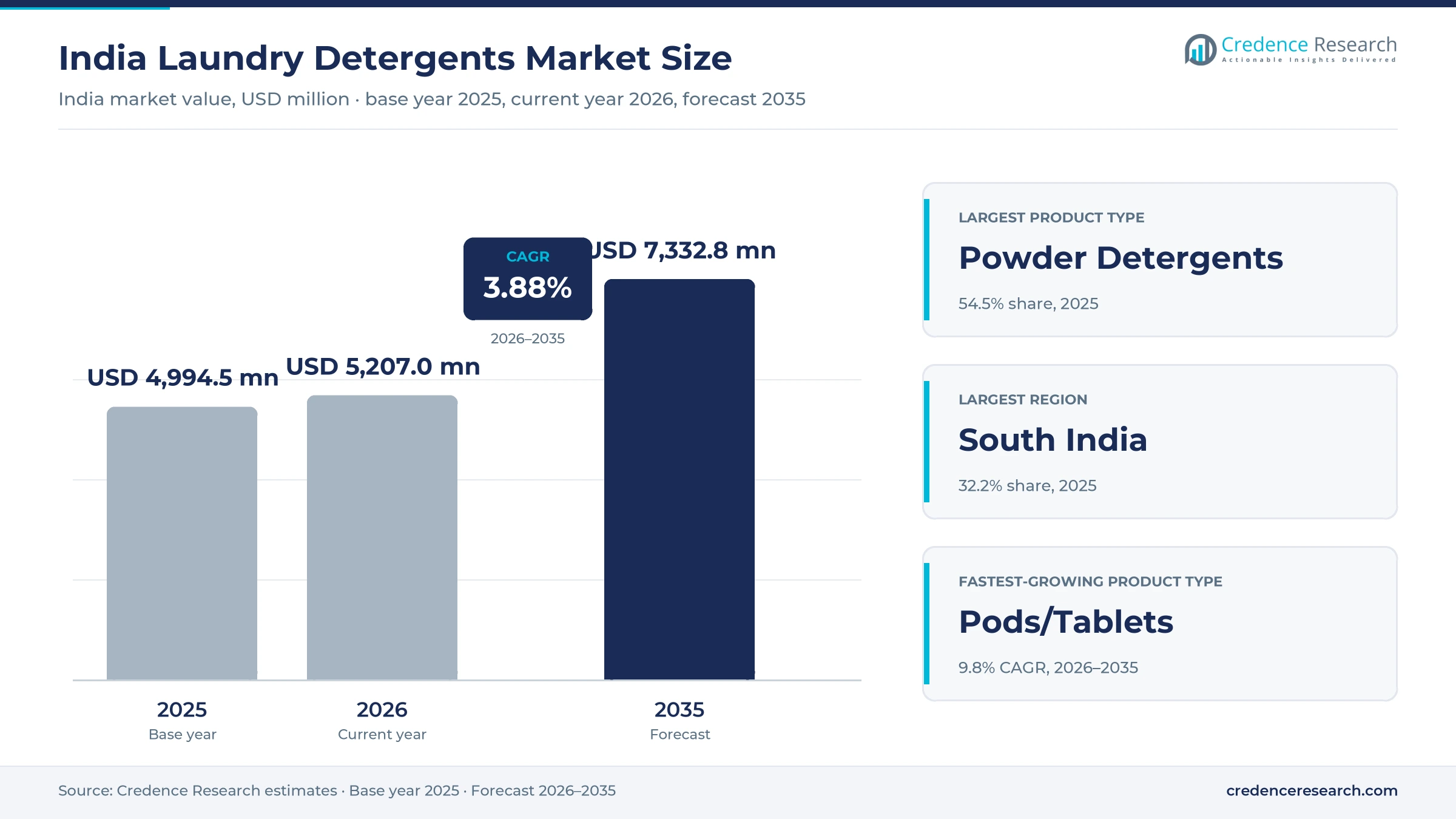
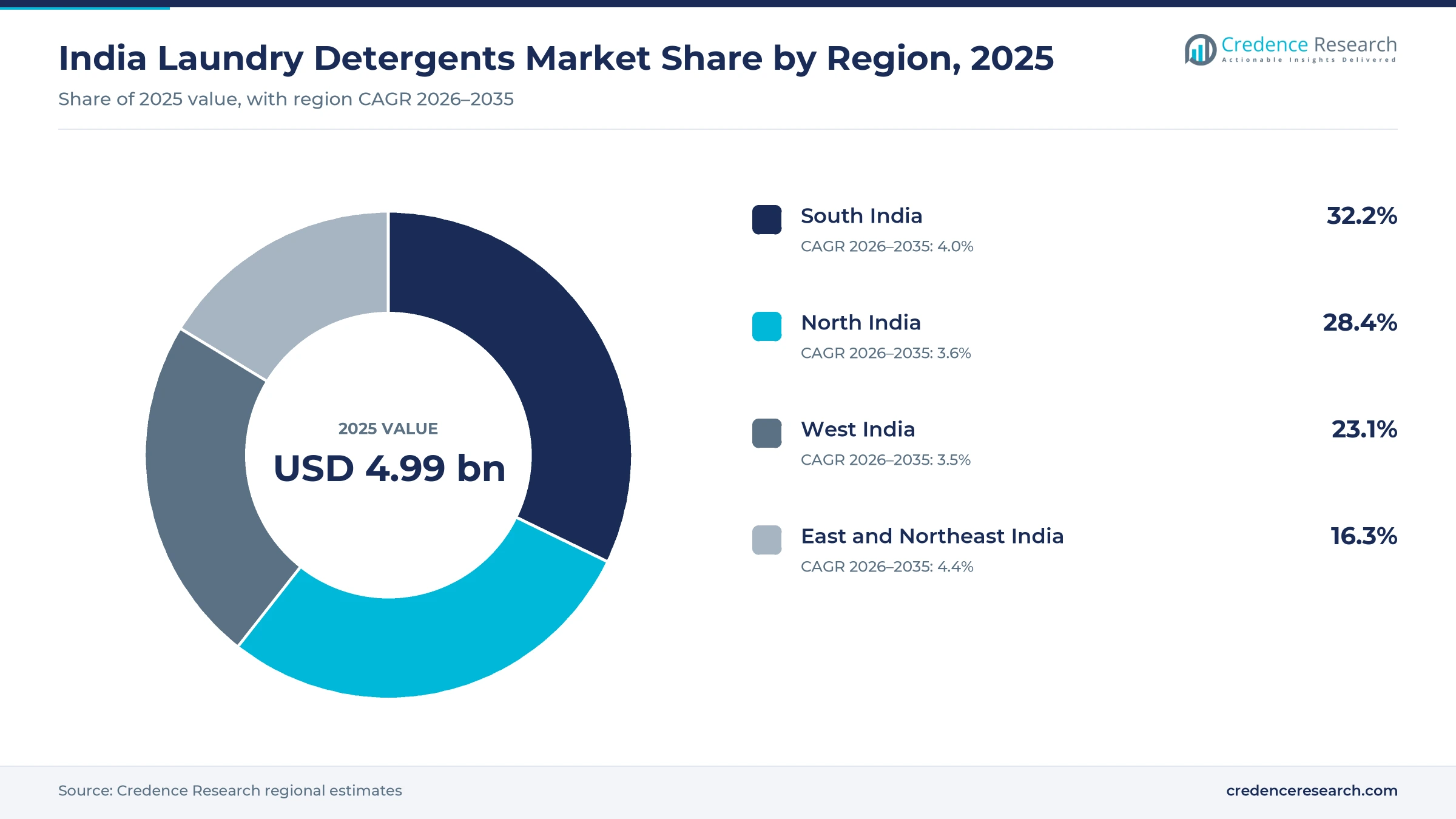
The India laundry detergents market was valued at USD 4.99 billion in 2025 and is projected to increase from USD 5.21 billion in 2026 to USD 7.33 billion by 2035, registering a CAGR of 3.88% during 2026–2035. Demand comes from more than 300 million households that wash clothes by hand or in machines, joined by commercial laundries, hotels and hospitals that buy in bulk. South India held the largest regional share, 32.2% in 2025, because washing machine ownership and liquid use are highest in its cities. East and Northeast India is the fastest-growing region at 4.4% a year, as rural households move from loose and unbranded soap to branded powders and bars. The main commercial change is format, since liquids built for top-load and front-load machines sell at a premium per wash to powder. Input costs remain the main restraint, because surfactant and packaging prices pass quickly into shelf prices that most buyers watch closely.
Powders, bars, liquids and pods bought for hand and machine washing
The market counts the value of powder detergents, liquid detergents, detergent bars and pods or tablets sold in India for washing clothes, at the price paid by households, commercial laundries, hotels, hospitals and institutions. It covers products sold through kirana stores, supermarkets, online marketplaces, quick-commerce apps and direct channels, including small sachets and bulk packs.
Fabric conditioners, stain removers sold alone, dishwashing products, bathing soap and industrial textile processing chemicals are excluded. Value moves from surfactant, soda ash and enzyme suppliers through blending and packing plants to distributors, wholesalers and retailers, and most volume still reaches buyers through neighborhood stores.
India Laundry Detergents Market Insights
- The India laundry detergents market rises from USD 4.99 billion in 2025 to USD 7.33 billion by 2035, a 3.88% CAGR during 2026–2035, as machine washing and liquids add value per wash.
- South India held 32.2% of 2025 value, because its cities combine the highest washing machine ownership with at least 60% of urban consumers in some southern states using liquids at least once a year.
- Powder Detergents led product types with 54.5% of 2025 value, because most households still wash by hand or in semi-automatic machines.
- Liquids were about 10% of the Indian laundry cleaning market in July 2025 and grew more than four times faster than the rest of the category.
- Hindustan Unilever raised prices of Surf Excel, Rin and Wheel packs in November 2026, citing rising input costs, which tests how far buyers will trade down.
Powders and kirana lead while pods and quick commerce climb
Powders lead while pods and tablets grow fastest
Based on product type, the market is categorized into powder detergents, liquid detergents, detergent bars and pods/tablets. Powder Detergents led with 54.5% of 2025 value because one powder works for bucket washing and for most top-load machines, and Hindustan Unilever named premium powders among its fewer, bigger bets in its 2025-26 performance highlights. Pods/Tablets grow fastest at 9.8% a year, as P&G now sells Ariel Matic 3-in-1 pods for both front-load and top-load machines on BigBasket, part of the wider shift to unit-dose pods that removes measuring errors for machine owners.
Hand washing leads while front-load machines grow fastest
Based on application, the market is categorized into hand washing, semi-automatic machine washing, top-load automatic washing and front-load automatic washing. Hand Washing led with 58.0% of 2025 value because most homes still scrub clothes in buckets, and about three in four households own no washing machine, as the household figures in the drivers show. Front-Load Automatic Washing grows fastest at 6.2% a year, as Whirlpool said in August 2025 that its fully automatic front-load and top-load ranges carry an Express Wash program, which suits low-foam formulas sold alongside washing machine sales.
Households lead while hotels grow fastest
Based on end user, the market is categorized into households, commercial laundries, hospitality and healthcare and institutions. Households led with 88.0% of 2025 value because nearly every home buys detergent every month, and toilet articles and other household consumables took 5.2% of rural monthly spending in 2023-24, according to the Household Consumption Expenditure Survey. Hospitality grows fastest at 5.6% a year, as about 20,000 new branded hotel rooms, a rise of roughly 20%, are due over this and the next fiscal year, CRISIL Ratings said in December 2025, and each room adds daily linen loads.
Kirana stores lead while quick commerce grows fastest
Based on distribution channel, the market is categorized into supermarkets and hypermarkets, kirana and convenience stores, online marketplaces and quick-commerce and DTC. Kirana and Convenience Stores led with 78.0% of 2025 value because small packs and credit for regular buyers keep detergent purchases local, and traditional trade absorbed temporary supply and pricing adjustments after GST 2.0 in the October to December 2025 quarter while modern trade gained pace, NielsenIQ reported. Quick-Commerce and DTC grows fastest at 8.9% a year, as quick commerce now accounts for more than three-quarters of online FMCG sales in India, NielsenIQ reported in March 2026, and bulky detergent packs suit doorstep delivery.
| Segment Group | Leading Sub-segment | Share, 2025 | Fastest-growing Sub-segment | CAGR, 2026–2035 |
|---|---|---|---|---|
| By Product Type | Powder Detergents | 54.5% | Pods/Tablets | 9.8% |
| By Application | Hand Washing | 58.0% | Front-Load Automatic Washing | 6.2% |
| By End User | Households | 88.0% | Hospitality | 5.6% |
| By Distribution Channel | Kirana and Convenience Stores | 78.0% | Quick-Commerce and DTC | 8.9% |
Bars and powders cost a fraction of liquid per wash
Detergents in India are priced per pack, from single-wash sachets to 4-liter refills, and most shoppers judge value by the pack price at the kirana counter rather than by cost per wash. Surfactant, soda ash and packaging make up most of the cost, so feedstock moves reach shelf prices within a few months, as the November 2026 revisions show. Liquids and pods carry several times the price per wash of powder, which lifts margins for brands that sell to machine owners. Credence Research finds that economy powders and bars compete on grammage, while premium brands defend price through performance claims.
| Product or pack | Typical price or fee | Basis |
|---|---|---|
| Wheel detergent powder, 1 kg | Rs 93 | Hindustan Unilever revised price, Angel One, November 2026 |
| Surf Excel Easy Wash powder, 1 kg | Rs 172 | Hindustan Unilever revised price, Angel One, November 2026 |
| Surf Excel detergent bar, 250 g | Rs 45 | Hindustan Unilever revised price, Angel One, November 2026 |
| Godrej Fab liquid detergent | Rs 99 per liter | Godrej Consumer Products annual report 2024-25 |
| Surf Excel Matic Top Load liquid, 3 liters | Rs 573 MRP | Blinkit listing, November 2026 |
| Tide Matic 3-in-1 pods, 32 pieces | Rs 825 | BigBasket listing, November 2026 |
Request a Free Sample
Fill in your details and we'll send you a free sample report.
- Sample data tables & charts
- Research methodology
Household budgets, liquids and rural reach carry growth
Rising household spending lifts branded cleaning adoption
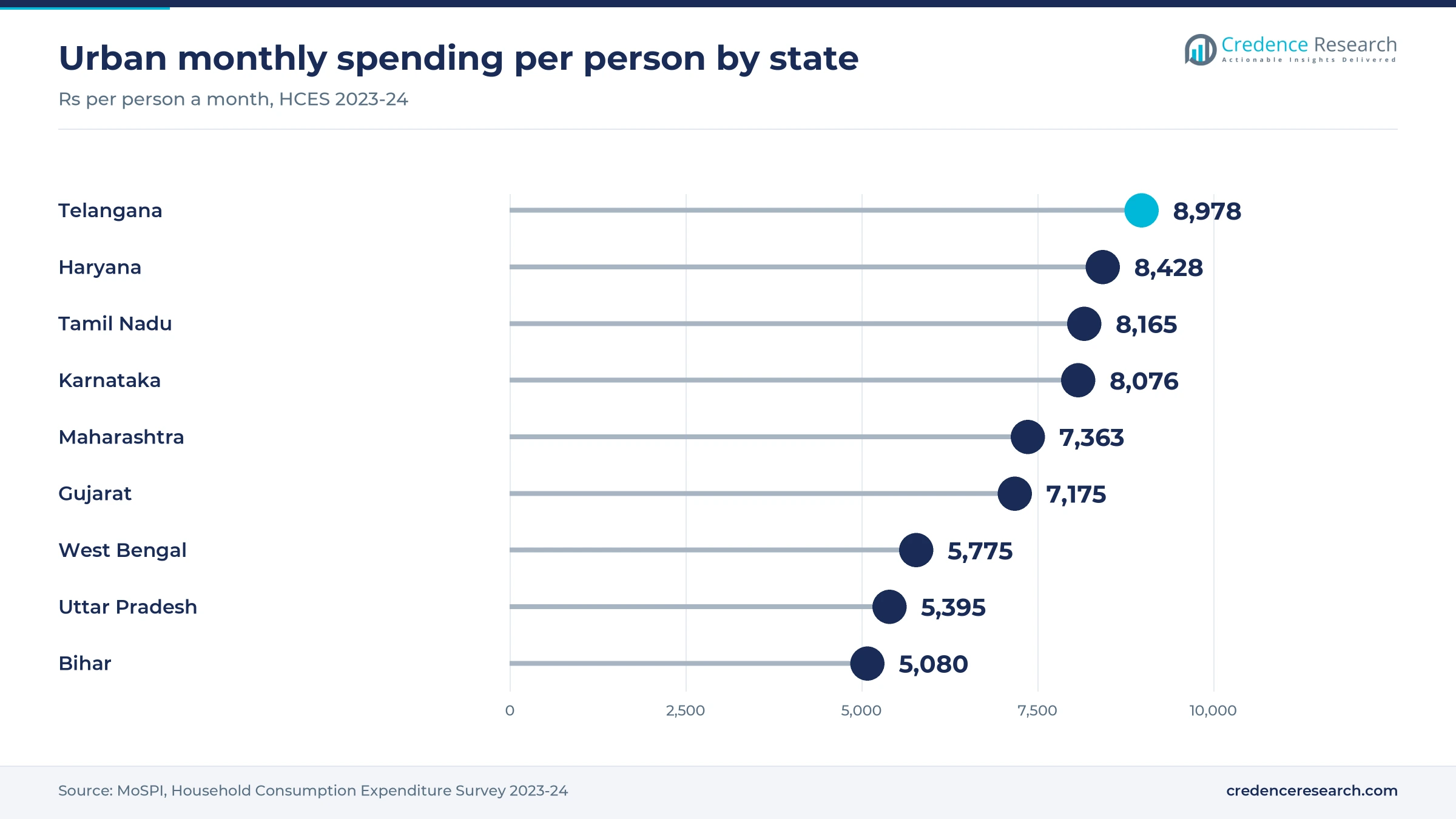
Higher household budgets let families move from loose soap and unbranded powder to branded detergents with better stain removal. Average monthly spending per person rose from Rs 3,773 to Rs 4,122 in rural India and from Rs 6,459 to Rs 6,996 in cities between 2022-23 and 2023-24, according to the Household Consumption Expenditure Survey. Brands are pricing small entry packs to capture that upgrade in rural markets. Rural volume across FMCG still grew 2.9% in the October to December 2025 quarter, according to NielsenIQ. Brands with entry packs priced for a month of washing gain most as these households trade up.
Machine-ready formats raise the value of each wash
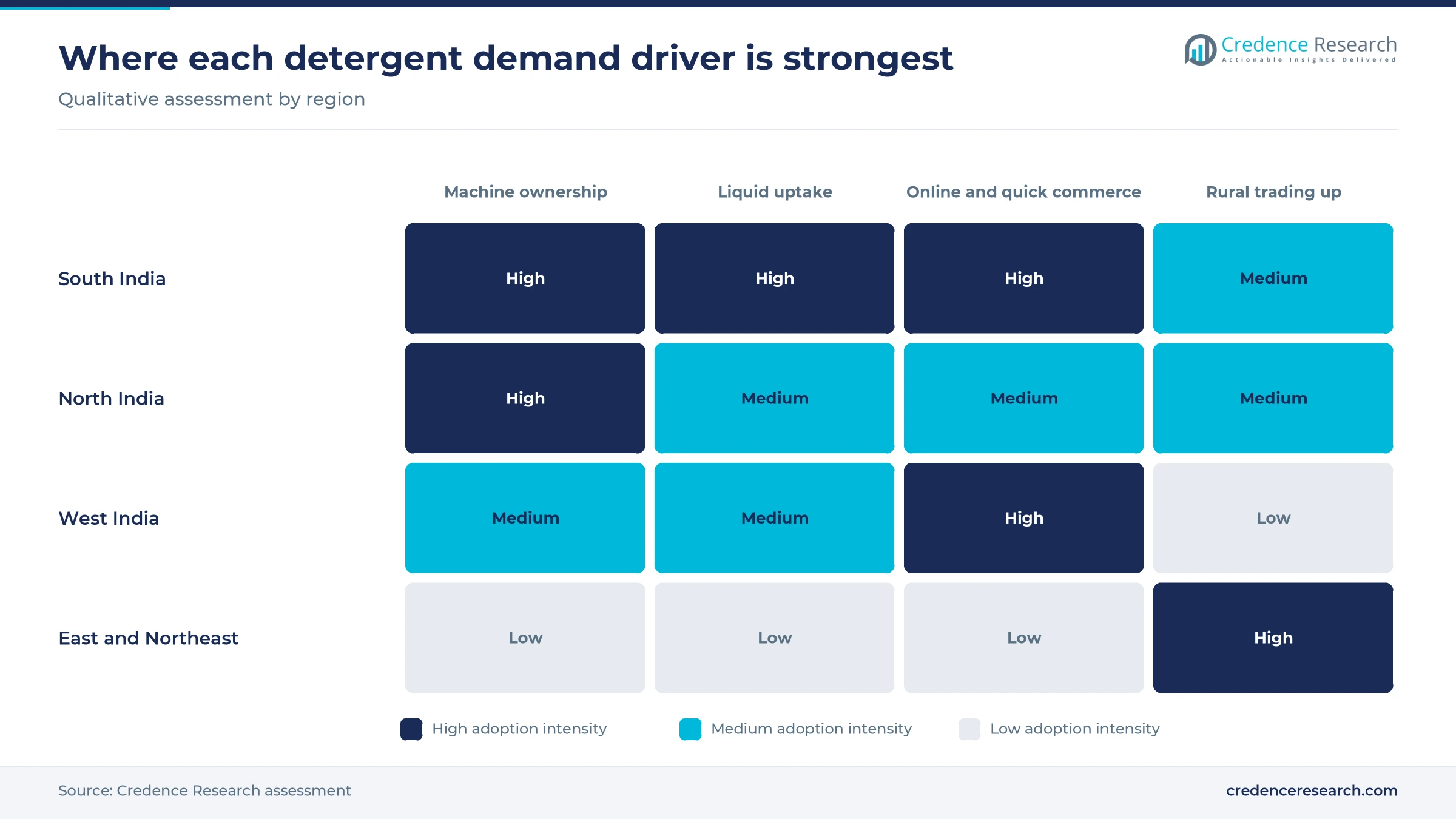
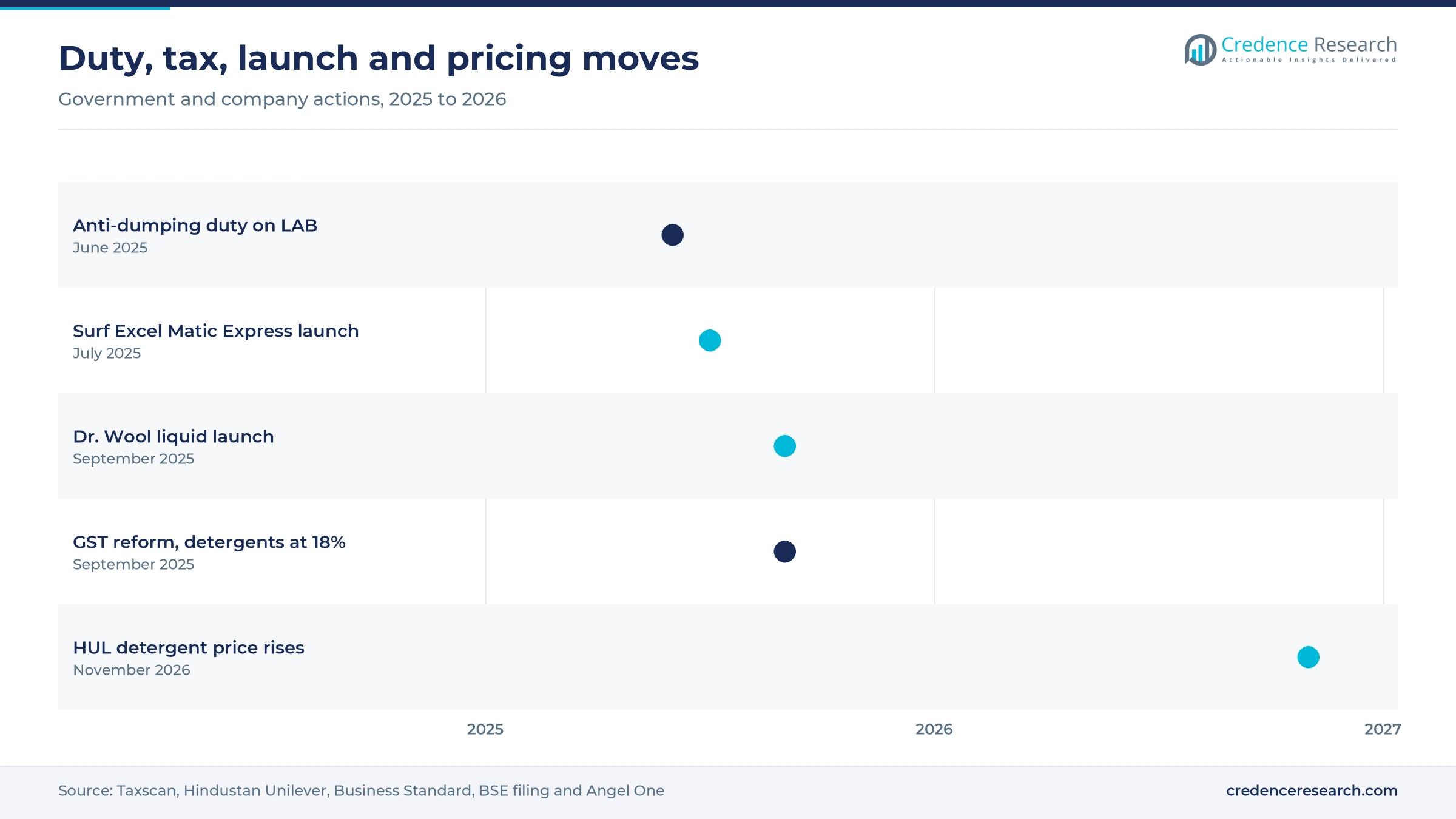
Machine owners need low-foam detergents that dissolve fully in short cycles, which shifts spending toward higher-priced liquids and matic powders. Of India's 304 million households, 68 million own washing machines and 17 million of those use washing liquids, Hindustan Unilever said in July 2025, when liquids made up about 10% of the laundry cleaning market and grew more than four times faster than the rest of the category. The same month it launched Surf Excel Matic Express for 15-minute cycles at a 15% premium to Surf Matic Liquid. Its fabric wash business then grew in double digits in the January to March 2026 quarter as liquids accelerated. Front-Load Automatic Washing gains most from this shift, at 6.2% a year.
Digital commerce and faster retail reach widen premium access
Online and quick-commerce apps put full premium ranges in front of city buyers who would find only a few packs in a neighborhood store. E-commerce reached 6% of FMCG sales in urban India, 18% in the top eight metros and more than 21% in southern metros in the October to December 2025 quarter, NielsenIQ reported, and quick commerce took more than three-quarters of that online value. Jyothy Labs said its fabric care and dishwashing products sustained double-digit growth in modern trade, e-commerce and quick commerce in the September 2025 quarter while general trade stayed under pressure. Quick commerce sales of large FMCG companies rose 50% to 100% in 2024-25, according to IBEF. Brands with liquid and pod ranges benefit most, because these channels sell a richer mix.
Rural distribution reach pulls new buyers into branded packs
Rural buyers still decide much of the category's volume, and the companies with the deepest distribution reach them first. FMCG volume grew 7.7% in rural India, about double the urban pace, in the July to September 2025 quarter, the seventh straight quarter of rural lead, according to NielsenIQ, which also linked faster unit growth to smaller packs. RSPL Group said in June 2026 that its Ghadi brand reaches 32% of Indian households. Fena says it sells through more than 4,500 distributors across 36 states and union territories. Value makers with this reach convert unbranded users into branded powder and bar buyers through small sachets and low price points.
Liquid capacity and low-dose formulas reshape the shelf
Suppliers are shifting capacity and pricing toward liquids
Detergent makers are shifting plants and price points toward liquids, because machine owners are the most profitable buyers to win. P&G opened its first Indian liquid detergent unit at Kothur near Hyderabad in May 2022 with an investment of about Rs 200 crore, and the site makes Ariel and Tide. Godrej Consumer Products launched Godrej Fab liquid at Rs 99 per liter in South India in December 2023, and its 2024-25 annual report says the brand gained share. Jyothy Labs launched Dr. Wool, a liquid detergent for wool and delicates, on Sept. 17, 2025, according to its stock exchange filing. Low entry prices narrow the per-wash gap with powder, which favors brands that can run liquid lines at scale.
Low-dose and enzyme-rich formulas are emerging in machine care
Brands are shifting toward concentrated, enzyme-based formulas that clean at lower doses and shorter cycles, as machine users compare cost per wash rather than cost per pack. Amway India lists its SA8 concentrated liquid at a 20 ml capful for a large machine load, with dual enzymes and a biodegradable formula, and it lists the 200 ml pack at an MRP of Rs 233, a price that only makes sense when buyers count doses rather than liters. P&G sells Tide Matic 3-in-1 pods in packs of 18 and 32 pieces on BigBasket. These formulas raise demand for enzyme ingredient suppliers, and they reward brands that can prove performance in hard water.
Hotels and hospitals offer a bulk supply opening
Bulk buyers such as hotels, hospitals and contract laundries need consistent wash results and predictable cost per kilogram of linen, which few consumer brands serve directly. Corporate hospital chains are likely to expand bed capacity by 35% to 40% over three to five years, CareEdge Ratings said in March 2025, and the hotel room additions noted above add to this linen load. Hyperpure, the restaurant supply platform, lists Active Wheel powder at Rs 87.32 per kilogram, falling to Rs 83.78 for orders of six kilograms or more. Growth in hospital linen outsourcing concentrates this demand with operators that buy on contract. Suppliers offering dosing systems and bulk packs can win these accounts.
Machine owners still using powder are a clear conversion opening
Most machine owners have not yet switched to liquids, which leaves a large base for conversion without new appliance sales. The Hindustan Unilever figures noted above imply about 51 million machine households still washing with powder or bars in 2025. At least 60% of urban consumers in some southern states use liquids at least once a year, Mint reported in the July 2025 article that Hindustan Unilever republished, which shows how far conversion can go once trial starts. Price ladders now span Godrej Fab at Rs 99 per liter and Surf Excel Matic Top Load at Rs 573 for 3 liters on Blinkit, about Rs 191 per liter. Brands that offer sachets and trial sizes for top-load owners can capture this base fastest, starting in northern and western cities.
Input costs, surfactant duties and tax limit price room
Input cost inflation forces price rises on mass packs
Rising input costs are forcing price increases on the packs that mass buyers watch most closely. Hindustan Unilever lifted the Surf Excel 250 g bar from Rs 42 to Rs 45 and Wheel 1 kg from Rs 90 to Rs 93, Angel One reported in November 2026, citing rising input costs. Economy and mass-market buyers face the highest risk from these rises, and some may shift to cheaper regional brands or smaller packs. Brands with their own surfactant supply can hold prices longer.
Surfactant import duties raise costs for smaller makers
Duties on linear alkylbenzene, the base for the main surfactant in powders and bars, raise costs for makers that buy imported feedstock. India imposed five-year anti-dumping duties on linear alkylbenzene from Iran and Qatar under notification 18/2025-Customs (ADD) of June 23, 2025, Taxscan reported. Small regional powder makers without long-term supply contracts carry most of this cost. Many respond by trimming grammage or shifting to domestic suppliers at higher prices.
Detergents missed the GST cut that soaps received
Detergents stayed in the 18% tax slab when bathing soaps and other daily essentials moved to 5% under the reform effective Sept. 22, 2025, Business Standard reported, so laundry brands got no price relief. Hindustan Unilever reported flat underlying sales growth for home care in the September 2025 quarter, and Jyothy Labs cited short-term channel adjustments from the GST change. Brands selling mainly to price-sensitive buyers face the most pressure from this. Grammage offers and smaller packs remain the main response for these brands.
Low machine ownership caps premium format demand
Premium liquids and pods need machines, and most Indian homes still do not own one. About one in five households, or around 60 million, close to the 68 million that Hindustan Unilever cites, owned a washing machine in 2024, and urban homes were about four times more likely to own one than rural homes, according to Data For India analysis of the HCES. The September 2025 tax reform cut rates on dishwashers but not on washing machines, Taxscan reported. Brands betting on liquids face slow conversion outside cities, so they keep powder and bar lines alongside.
South leads value while the east gains volume fastest
| Region | Value, 2025 (USD billion) | Share, 2025 | CAGR, 2026–2035 |
|---|---|---|---|
| South India | 1.61 | 32.2% | 4.0% |
| North India | 1.42 | 28.4% | 3.6% |
| West India | 1.15 | 23.1% | 3.5% |
| East and Northeast India | 0.81 | 16.3% | 4.4% |
Machine ownership and liquid use keep South India ahead
South India held 32.2% of 2025 value and grows at 4.0% a year. Washing machine penetration in the south was about 40% when Godrej launched Fab there in December 2023, Business Standard reported, and urban monthly spending reached Rs 8,978 per person in Telangana and Rs 8,165 in Tamil Nadu in 2023-24. P&G's Kothur liquid unit and Hindustan Unilever's south-first liquid launch noted above place new formats here first. The zone therefore earns the highest value per wash in the country.
Punjab and Haryana ownership keeps North India strong
North India held 28.4% of 2025 value and grows at 3.6% a year. Punjab, Haryana and Delhi had the highest washing machine ownership in both rural and urban areas, according to an EAC-PM working paper of November 2025, and urban spending in Haryana reached Rs 8,428 per person a month. Uttar Pradesh, at Rs 5,395 per person in cities, keeps large demand for bars and economy powder. Kanpur-based RSPL and Delhi-based Fena supply much of that value tier.
Gujarat plants and Maharashtra cities anchor West India
West India held 23.1% of 2025 value and grows at 3.5% a year. Nirma makes its detergent powders at Mandali, Moraiya, Chhatral and Trikampura and its cakes at Alindra, Mandali and Moraiya, all in Gujarat, which gives the zone low-cost local supply. Urban spending reached Rs 7,363 per person a month in Maharashtra and Rs 7,175 in Gujarat in 2023-24, supporting matic powders in city homes. Growth trails other zones, a Credence Research estimate, because low-priced Gujarat powders already hold rural shelves, leaving less room for trading up than in the east.
East and Northeast India grows fastest on first-time buyers
East and Northeast India held 16.3% of 2025 value and grows fastest at 4.4% a year. Urban spending was Rs 5,080 per person a month in Bihar and Rs 5,775 in West Bengal in 2023-24, so the zone has the lowest spending base among the four. No state-level detergent sales data were found, an evidence gap, so faster growth here rests on the Credence Research estimate that first-time branded buyers in Bihar, Odisha and the Northeast add more value than machine conversion. Branded value powders and bars gain most in this zone through 2035.
Duty, tax, launch and pricing moves from 2025 to 2026
| Development | Status and market relevance |
|---|---|
| In June 2025, India imposed five-year anti-dumping duties on linear alkylbenzene imports from Iran and Qatar. | In force; raises surfactant feedstock costs |
| In July 2025, Hindustan Unilever launched Surf Excel Matic Express for 15-minute machine cycles in South India. | Commercial launch; trade outlets in the south, online nationwide |
| In September 2025, the GST reform took effect with detergents kept in the 18% slab while soaps moved to 5%. | In force; no tax relief for laundry products |
| In September 2025, Jyothy Labs launched Dr. Wool, a liquid detergent for wool and delicate fabrics. | Product launch; India rollout first |
| In November 2026, Hindustan Unilever raised prices of Surf Excel, Rin and Wheel packs, citing rising input costs. | Price revision in effect; tests trade-down risk |
Enzymes, short-cycle liquids and unit-dose formats
- Enzyme blends break down protein, starch and oil stains at low temperatures, which lets brands promise results in cold-water machine cycles.
- Short-cycle liquid formulas dissolve fully within 15-minute programs, which suits the express wash settings now common on automatic machines.
- Concentrated liquids cut the dose per load to about 20 ml in a large machine, which lowers packaging and freight cost per wash.
- Unit-dose pods pre-measure detergent and booster in a soluble film, which removes overdosing and suits front-load drums.
Need a Custom Version of This Report?
Tailor the scope, geography, or segments to your exact requirements.
- Custom geography or segment scope
- Direct access to our analyst team
Mass brands, value makers and liquid specialists compete
Competition in the India laundry detergents market runs between two national brand owners, a group of Indian value makers and a set of liquid and direct-selling specialists. Hindustan Unilever spans the ladder with Wheel for mass buyers, Rin for value seekers and Surf Excel at the premium end, and it is pushing liquid conversion with machine-specific variants. P&G sells Ariel and Tide in powder, liquid and pod forms, and its Hyderabad site has made liquids since 2022. Nirma, RSPL with Ghadi and Fena compete in powders and bars on price, grammage and rural reach. Jyothy Labs sells Henko and Ujala and is adding liquids for delicate fabrics. Godrej Consumer Products, Wipro Consumer Care & Lighting with Safewash and Patanjali Foods add mid-priced and herbal options, while Amway India sells concentrated SA8 through direct sellers. Shelf presence in kirana stores and visibility on quick-commerce apps decide share, because kirana and convenience stores carried 78.0% of 2025 demand.
Two national leaders over a long tail of value makers
Supply is concentrated at the top and fragmented below it. Hindustan Unilever and P&G run national brand ladders from economy powder to premium liquids, backed by heavy advertising and distribution into millions of stores. A second tier of Indian value makers, including Nirma, RSPL and Fena, competes on grammage and price in powders and bars, often with plants close to their core markets. Barriers are low for a regional powder brand but high in liquids, where machine-specific claims, packaging and online visibility cost more, so margins sit mainly with premium brand owners.
Suppliers that Indian retailers and buyers shortlist
| Company | Type | Role in the market |
|---|---|---|
| Hindustan Unilever Limited | Full-range brand owner | Sells Surf Excel, Rin and Wheel powders, bars and liquids nationwide |
| RSPL Limited | Value manufacturer | Makes Ghadi detergent powder and bars, reaching 32% of Indian households |
| Procter & Gamble Home Products Private Limited | Full-range brand owner | Sells Ariel and Tide powders, liquids and pods, with a Hyderabad liquid unit |
| Nirma Limited | Value manufacturer | Makes Nirma detergent powders and cakes at plants in Gujarat |
| Jyothy Labs Limited | Specialist brand owner | Sells Henko and Ujala fabric care and Dr. Wool liquid detergent |
| Fena Private Limited | Value manufacturer | Makes Fena powders and cakes, sold through more than 4,500 distributors |
| Godrej Consumer Products Limited | Liquid challenger | Sells Godrej Fab and Genteel liquid detergents |
| Wipro Consumer Care & Lighting | Liquid challenger | Sells Safewash liquid detergents for machine and hand washing |
| Patanjali Foods Limited | Herbal brand owner | Sells Patanjali herbal detergent powder and cakes after taking over the home care business |
| Amway India Enterprises Private Limited | Direct seller | Sells SA8 concentrated liquid laundry detergent through direct sellers |
Value shifts to machine formats but volume stays in powders
Credence Research's view is that value in Indian laundry care will move toward machine formats faster than volume does. Powder Detergents remain the base of the category, but each household that buys a top-load or front-load machine raises spending per wash several times once it moves to liquids or pods. Price rises on mass packs and surfactant duties squeeze value makers first, while premium brands can pass costs on more easily. Brand owners that hold kirana shelves and quick-commerce visibility at the same time hold the strongest position, while regional powder makers without feedstock contracts face the most pressure.
Household spending and category data anchor the estimate
The report uses 2025 as the base year and 2026 to 2035 as the forecast period. Market values come from the Credence Research model, and the regional, product, application, end-user and channel splits are Credence Research estimates informed by public data. The 2025 value was checked against a top-down estimate built from household numbers, HCES spending on household consumables and the reported share of liquids in the category. Regional shares are Credence Research estimates, because no official statistic tracks detergent sales by zone, so they carry wider ranges. Sources include MoSPI, NielsenIQ releases, company disclosures, retailer listings and Indian business press. No interviews or surveys were used to build these estimates.
Liquid conversion and rural reach set the path to 2035
Credence Research expects the market to reach USD 7.33 billion by 2035, rising from USD 5.21 billion in 2026, as machine washing, liquid conversion and rural trading up add value. East and Northeast India should keep the fastest regional pace, while South India remains the largest source of value. Value rises faster from 2025 to 2026 than the decade average, as the price revisions of late 2026 lift pack prices before growth settles toward the long-run rate. Liquid conversion and online reach form the main upside, while input costs and slow machine ownership outside cities are the main restraints.
Liquid conversion and input costs set the range of outcomes
The range to 2035 depends mainly on how fast machine owners switch to liquids and pods, how input costs move, and whether rural buyers keep trading up from loose and unbranded products. The base case assumes steady conversion and moderate surfactant prices. A downside follows if feedstock inflation forces repeated price rises that push buyers into smaller packs. An upside follows if machine ownership spreads faster outside the south and quick commerce carries premium ranges into smaller cities.
| Scenario | CAGR, 2026–2035 | Value, 2035 | What has to hold |
|---|---|---|---|
| Downside | 2.7% | USD 6.61 billion | Surfactant and packaging costs stay high and buyers trade down to bars |
| Base | 3.88% | USD 7.33 billion | Liquid conversion continues and rural buyers keep moving to branded packs |
| Upside | 4.9% | USD 8.00 billion | Machine ownership spreads beyond the south and online channels lift premium mix |
Frequently Asked Questions
How big is the India laundry detergents market?
Which region leads detergent demand in India?
Which region grows fastest?
Which product type holds the largest share?
How large is the liquid detergent share in India?
Which distribution channel grows fastest?
Why did detergent prices rise in 2026?
Which companies supply laundry detergents in India?
Table of Content
Chapter 1 Market Segmentation
- 1.1 Segmentation Framework
- 1.1.1 Product and Service Classification
- 1.1.2 Application and End-Use Classification
- 1.1.3 Technology and Solution Classification
- 1.1.4 Customer and Distribution Channel Classification
- 1.1.5 Geographic Segmentation
- 1.1.6 Market Segment Definitions and Boundaries
- 1.2 By Product Type
- 1.2.1 Powder Detergents
- 1.2.2 Liquid Detergents
- 1.2.3 Detergent Bars
- 1.2.4 Pods/Tablets
- 1.3 By Application
- 1.3.1 Hand Washing
- 1.3.2 Semi-Automatic Machine Washing
- 1.3.3 Top-Load Automatic Washing
- 1.3.4 Front-Load Automatic Washing
- 1.4 By End User
- 1.4.1 Households
- 1.4.2 Commercial Laundries
- 1.4.3 Hospitality
- 1.4.4 Healthcare and Institutions
Chapter 2 Introduction
- 2.1 Report Objectives and Scope
- 2.2 Product Definition and Industry Terminology
- 2.3 Market Inclusions and Exclusions
- 2.4 Research Process
- 2.4.1 Primary Research and Expert Interviews
- 2.4.2 Secondary Research and Source Review
- 2.4.3 Top-Down and Bottom-Up Estimation
- 2.4.4 Data Triangulation and Verification
- 2.5 Market Size Measurement Basis
- 2.5.1 2025: USD 4.99 billion → 2035: USD 7.33 billion
- 2.6 Historical and Forecast Reference Periods
- 2.6.1 Historical Period: 2018-2025
- 2.6.2 Base Year: 2025
- 2.6.3 Forecast Period: 2025-2035
- 2.7 Research Assumptions and Limitations
Chapter 3 Executive Summary
- 3.1 Market Snapshot and Key Findings
- 3.2 Base-Year Market Size, 2025
- 3.3 Forecast Market Size, 2035
- 3.4 Revenue and Volume Growth Outlook
- 3.5 Key Demand and Supply Indicators
- 3.6 Leading Market Segments
- 3.7 Fastest-Growing Market Opportunities
- 3.8 Regional Performance Highlights
- 3.9 Technology and Industry Transformation
- 3.10 Competitive Landscape Summary
- 3.11 Analyst View and Strategic Implications
Chapter 4 India Laundry Detergents Market Trends and Developments
- 4.1 Historical Industry Development, 2018-2025
- 4.2 Recent Market Trends and Developments
- 4.3 Demand and Customer Behavior Trends
- 4.4 Technology and Product Innovation
- 4.5 Artificial Intelligence, Automation and Digitalization
- 4.6 Local Manufacturing and Supply Chain Realignment
- 4.7 Industry Partnerships, Mergers and Acquisitions
- 4.8 Sustainability and Circular Economy Developments
- 4.9 Government and Private Sector Investment Trends
- 4.10 Emerging Business Models and Commercialization
- 4.11 Industry Developments and Announcements
Chapter 5 India Laundry Detergents Market Production, Supply and Demand Analysis
- 5.1 Demand Trend and Consumption Analysis, 2018-2025
- 5.2 Demand Forecast, 2025-2035
- 5.3 Production and Output Trend, 2018-2025
- 5.4 Production and Output Forecast, 2025-2035
- 5.5 Installed Capacity and Capacity Utilization
- 5.6 Company-Wise Production Plants and Statistics
- 5.6.1 Installed Production Capacity
- 5.6.2 Actual Production
- 5.6.3 Planned Capacity and Expansion Targets
- 5.7 Supply Chain Structure and Procurement Trends
- 5.8 Supply-Demand Gap and Bottlenecks
- 5.9 Import Dependence and Sourcing Structure
- 5.10 Contract Manufacturing and Outsourcing
- 5.11 Regional Supply and Demand Concentration
Chapter 6 India Laundry Detergents Market Pricing Analysis
- 6.1 Pricing Structure and Measurement
- 6.2 Historical Pricing Trends, 2018-2025
- 6.3 Pricing Outlook, 2025-2035
- 6.4 Average Selling Price and Unit Economics
- 6.5 Pricing by Product and Market Segment
- 6.6 Geographic Pricing Differences
- 6.7 Key Input, Energy, Labor and Logistics Costs
- 6.8 Contract Pricing and Purchasing Models
- 6.9 Pricing Sensitivity and Competitive Positioning
- 6.10 Price, Margin and Profitability Implications
Chapter 7 India Laundry Detergents Market Dynamics
- 7.1 Market Growth Drivers
- 7.1.1 Demand-Side Drivers
- 7.1.2 Technology and Innovation Drivers
- 7.1.3 Infrastructure and Investment Drivers
- 7.1.4 Regulatory and Policy Drivers
- 7.2 Market Restraints
- 7.2.1 Cost and Affordability Constraints
- 7.2.2 Technology and Adoption Barriers
- 7.2.3 Supply Chain and Operational Constraints
- 7.3 Market Challenges
- 7.3.1 Competitive Pressure and Margin Erosion
- 7.3.2 Skills, Infrastructure and Implementation Gaps
- 7.4 Emerging Market Opportunities
- 7.5 Market Dynamics Impact and Time-Horizon Assessment
Chapter 8 India Laundry Detergents Value Chain Analysis
- 8.1 Industry Value Chain Overview
- 8.2 Upstream Suppliers and Critical Inputs
- 8.3 Technology and Component Providers
- 8.4 Manufacturing or Service Delivery
- 8.5 Distribution, Channel Partners and Integrators
- 8.6 Downstream Applications and End Users
- 8.7 Value Addition and Profit Pools
- 8.8 Vertical Integration and Outsourcing
- 8.9 Supplier Concentration and Risk
- 8.10 Supply Chain Localization and Resilience
Chapter 9 India Laundry Detergents Market Regulations and Policies
- 9.1 Relevant Laws, Standards and Compliance Frameworks
- 9.2 Product, Service, Safety and Quality Requirements
- 9.3 Government Policies, Incentives and Subsidies
- 9.4 Imports, Exports and Trade Barriers
- 9.5 Public Procurement and Local Content Requirements
- 9.6 Environmental and Sustainability Compliance
- 9.7 Upcoming Policy Changes and Market Implications
Chapter 10 India Laundry Detergents Market Hotspots and Opportunities
- 10.1 Market Opportunity Mapping and Growth Hotspots
- 10.2 High-Growth Applications and Customer Groups
- 10.3 Underserved Markets and White-Space Opportunities
- 10.4 Emerging Technology and Product Opportunities
- 10.5 New Capacity and Investment Hotspots
- 10.6 Market Entry and Expansion Opportunities
- 10.7 Distribution and Partnership Opportunities
- 10.8 Near-Term and Long-Term Commercial Potential
- 10.9 Opportunity Attractiveness and Execution Risks
Chapter 11 India Laundry Detergents Market Outlook, 2025-2035
- 11.1 Market Size and Analysis
- 11.1.1 Revenue (Market Measurement: 2025: USD 4.99 billion → 2035: USD 7.33 billion)
- 11.1.2 Market Volume and Quantity Sold
- 11.1.3 Historical Market Size, 2018-2025
- 11.1.4 Base-Year Market Size, 2025
- 11.2 Market Forecast, 2025-2035
- 11.2.1 Revenue Forecast to 2035
- 11.2.2 Volume Forecast to 2035
- 11.2.3 CAGR and Year-on-Year Growth
- 11.2.4 Incremental Revenue Opportunity
- 11.3 Forecast Assumptions and Scenario Analysis
- 11.3.1 Base-Case Forecast
- 11.3.2 Optimistic and Conservative Scenarios
- 11.3.3 Technology, Pricing and Policy Sensitivities
- 11.4 Market Attractiveness and Growth Outlook
Chapter 12 India Laundry Detergents Market Segmentation and Outlook
- 12.1 Segmentation Summary and Market Shares, 2025
- 12.2 Largest and Fastest-Growing Segments
- 12.3 By Product Type - Market Size and Forecast, 2025-2035
- 12.3.1 Segment Definition and Scope
- 12.3.2 Historical Market Size, 2018-2025
- 12.3.3 Revenue Forecast, 2025-2035
- 12.3.4 Volume Forecast, 2025-2035
- 12.3.5 Base-Year Market Share, 2025
- 12.3.6 Segment CAGR and Growth Drivers
- 12.3.7 Subsegment Market Size and Forecast
- 12.3.7.1 Powder Detergents
- 12.3.7.2 Liquid Detergents
- 12.3.7.3 Detergent Bars
- 12.3.7.4 Pods/Tablets
- 12.3.8 Subsegment Pricing and Adoption Trends
- 12.3.9 Leading Suppliers and Competition
- 12.3.10 Regional Demand and Opportunities
- 12.4 By Application - Market Size and Forecast, 2025-2035
- 12.4.1 Segment Definition and Scope
- 12.4.2 Historical Market Size, 2018-2025
- 12.4.3 Revenue Forecast, 2025-2035
- 12.4.4 Volume Forecast, 2025-2035
- 12.4.5 Base-Year Market Share, 2025
- 12.4.6 Segment CAGR and Growth Drivers
- 12.4.7 Subsegment Market Size and Forecast
- 12.4.7.1 Hand Washing
- 12.4.7.2 Semi-Automatic Machine Washing
- 12.4.7.3 Top-Load Automatic Washing
- 12.4.7.4 Front-Load Automatic Washing
- 12.4.8 Subsegment Pricing and Adoption Trends
- 12.4.9 Leading Suppliers and Competition
- 12.4.10 Regional Demand and Opportunities
- 12.5 By End User - Market Size and Forecast, 2025-2035
- 12.5.1 Segment Definition and Scope
- 12.5.2 Historical Market Size, 2018-2025
- 12.5.3 Revenue Forecast, 2025-2035
- 12.5.4 Volume Forecast, 2025-2035
- 12.5.5 Base-Year Market Share, 2025
- 12.5.6 Segment CAGR and Growth Drivers
- 12.5.7 Subsegment Market Size and Forecast
- 12.5.7.1 Households
- 12.5.7.2 Commercial Laundries
- 12.5.7.3 Hospitality
- 12.5.7.4 Healthcare and Institutions
- 12.5.8 Subsegment Pricing and Adoption Trends
- 12.5.9 Leading Suppliers and Competition
- 12.5.10 Regional Demand and Opportunities
- 12.6 Segment Growth Comparison
- 12.7 Segment Attractiveness and Priority Matrix
Chapter 13 India Laundry Detergents End-Use and Application Market Outlook
- 13.1 End-Use Industry and Customer Demand Structure
- 13.2 Leading Applications and Customer Groups
- 13.3 End-Use Market Size, Share and Forecast
- 13.4 Major End-Use Industry Deep Dives
- 13.4.1 Customer Requirements and Use Cases
- 13.4.2 Demand and Replacement Cycles
- 13.4.3 Technical and Regulatory Considerations
- 13.4.4 Purchasing and Procurement Models
- 13.4.5 Leading Vendors and Distribution Channels
- 13.4.6 Forecast and Commercial Opportunities
- 13.5 Emerging Applications and Cross-Segment Demand
- 13.6 End-Use Industry Investment Priorities
Chapter 14 India Laundry Detergents Geographic Market Outlook, 2025-2035
- 14.1 Domestic Market Distribution and Demand Clusters
- 14.2 State- or Province-Wise Market Size and Forecast, 2025-2035
- 14.3 City and Metropolitan Market Outlook
- 14.4 Industrial, Manufacturing and Commercial Clusters
- 14.5 Geographic Concentration of Key End Users
- 14.6 Local Pricing and Purchasing Differences
- 14.7 Domestic Production Facilities and Capacity Map
- 14.8 Local Infrastructure and Project Pipeline
- 14.9 State-Level Policy and Incentive Differences
- 14.10 Subnational Investment Hotspots and Opportunities
- 14.11 Distribution and Logistics Networks
- 14.12 Domestic Competitive Footprint
Chapter 15 India Laundry Detergents Technology, Innovation and Sustainability Outlook
- 15.1 Technology Landscape and Maturity
- 15.2 Product, Process and Service Innovation
- 15.3 AI, Automation and Digital Tools in the Industry
- 15.4 Technology Adoption and Performance Benchmarking
- 15.5 Innovation Pipeline and R&D Investment
- 15.6 Patent and Intellectual Property Trends
- 15.7 Energy Efficiency and Resource Management
- 15.8 Sustainability, Recycling and Circularity
- 15.9 Technology Roadmap, 2025-2035
- 15.10 Risks of Obsolescence and Technology Substitution
Chapter 16 India Laundry Detergents Market Key Strategic Imperatives
- 16.1 Growth and Market Entry Priorities
- 16.2 High-Return Products and Segments
- 16.3 Pricing, Profitability and Cost Optimization
- 16.4 Technology Investment and Product Differentiation
- 16.5 Supply Chain Localization and Resilience
- 16.6 Distribution and Customer Acquisition
- 16.7 Partnership, Acquisition and Capacity Strategy
- 16.8 Regional Expansion Priorities
- 16.9 Short-, Medium- and Long-Term Actions
Chapter 17 Competition Outlook
- 17.1 Industry Competition Characteristics
- 17.2 Market Structure and Concentration
- 17.3 Market Share and Competitive Positioning, 2025
- 17.4 Company-Wise Revenue and Product Benchmarking
- 17.5 Production and Service Capacity Benchmarking
- 17.6 Technology, Pricing and Differentiation
- 17.7 Regional Footprint and Distribution Strength
- 17.8 Mergers, Acquisitions and Strategic Alliances
- 17.9 New Entrants and Competitive Threats
- 17.10 Porter's Five Forces and Industry Attractiveness
- 17.11 Competitive Outlook, 2025-2035
Chapter 18 Company Profiles
- 18.1 Company Coverage and Selection Criteria
- 18.2 Hindustan Unilever Limited
- 18.2.1 Business Description
- 18.2.2 Company Ownership and Geographic Presence
- 18.2.3 Product and Service Portfolio
- 18.2.4 Manufacturing and Operating Footprint
- 18.2.5 Production Capacity and Expansion Plans
- 18.2.6 Financial Performance and Investment
- 18.2.7 Market Share and Competitive Position
- 18.2.8 Technology and Innovation Capabilities
- 18.2.9 Strategic Alliances or Partnerships
- 18.2.10 Recent Developments
- 18.2.11 Growth Strategy and Outlook
- 18.3 RSPL Limited
- 18.4 Procter & Gamble Home Products Private Limited
- 18.5 Nirma Limited
- 18.6 Jyothy Labs Limited
- 18.7 Fena Private Limited
- 18.8 Godrej Consumer Products Limited
- 18.9 Wipro Consumer Care & Lighting
- 18.10 Patanjali Foods Limited
- 18.11 Amway India Enterprises Private Limited
- 18.12 Other Relevant Market Participants
Note: Every listed company is profiled on the structure shown under the first company. The company list is preliminary and may change based on research findings, market developments, data availability and client requirements.
Chapter 19 Disclaimer
- 19.1 Research and Forecast Disclaimer
- 19.2 Data Source and Estimation Limitations
Note: The depth of individual sections depends on data availability for this market. Volume, capacity, trade and other unit-based metrics are included where applicable.

