
Market Overview:
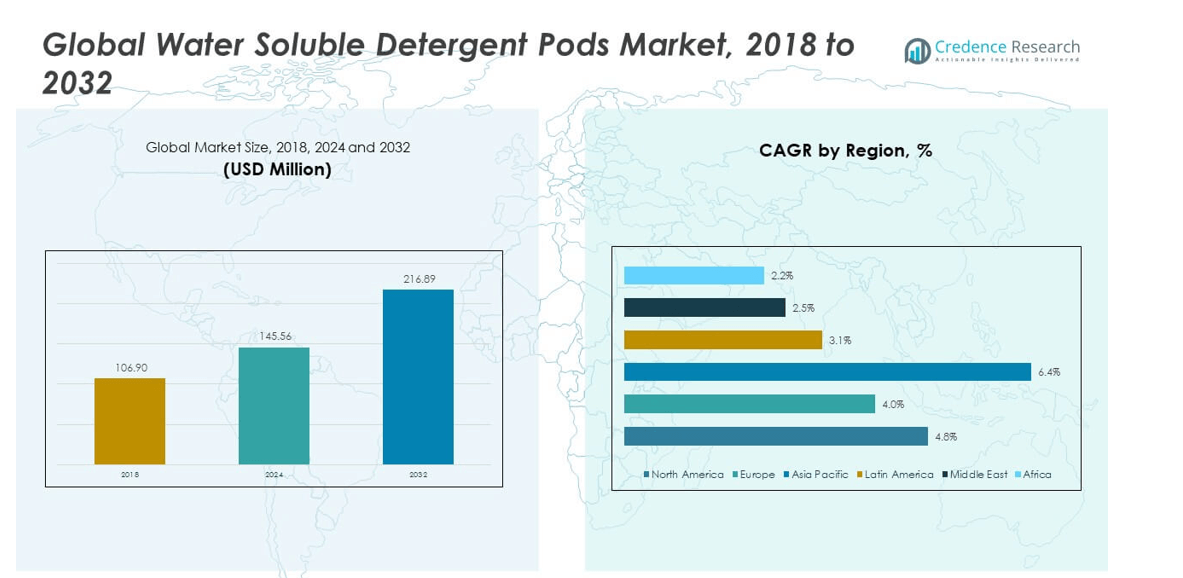
The Global Water Soluble Detergent Pods Market size was valued at USD 106.90 million in 2018 to USD 145.56 million in 2024 and is anticipated to reach USD 216.89 million by 2032, at a CAGR of 4.76% during the forecast period.
| REPORT ATTRIBUTE | DETAILS |
|---|---|
| Historical Period | 2020-2023 |
| Base Year | 2024 |
| Forecast Period | 2025-2032 |
| Water Soluble Detergent Pods Market Size 2024 | USD 145.56 million |
| Water Soluble Detergent Pods Market , CAGR | 4.76% |
| Water Soluble Detergent Pods Market Size 2032 | USD 216.89 million |
Growth in the market is fueled by rising consumer preference for convenient and pre-measured cleaning solutions. Water soluble detergent pods reduce product wastage, save time, and provide consistent cleaning results, making them popular among households and commercial users. Increasing awareness of hygiene, eco-friendly packaging, and the demand for easy-to-use formats also support adoption. Rising innovation in biodegradable film materials and multi-chamber pods further expands product demand across developed and emerging economies.
North America leads the market due to high adoption of premium cleaning products and strong consumer awareness. Europe follows closely, driven by sustainability regulations and widespread household use of eco-friendly cleaning solutions. Asia-Pacific is emerging as the fastest-growing region, supported by urbanization, rising disposable incomes, and rapid acceptance of modern cleaning formats in countries like China and India. Latin America and the Middle East & Africa are gradually expanding markets, aided by growing retail networks and increasing consumer awareness.
Market Insights:
- The Global Water Soluble Detergent Pods Market size was valued at USD 106.90 million in 2018, reached USD 145.56 million in 2024, and is anticipated to achieve USD 216.89 million by 2032, growing at a CAGR of 4.76%.
- North America led with 43.3% share in 2024 due to strong consumer awareness, advanced retail infrastructure, and high adoption of premium cleaning products. Europe followed with 27.1% supported by strict sustainability regulations, while Asia Pacific accounted for 20.4% driven by rising disposable incomes and urbanization.
- Asia Pacific is the fastest-growing region with 6.4% CAGR, fueled by lifestyle changes, e-commerce expansion, and affordable product innovations catering to a wider consumer base.
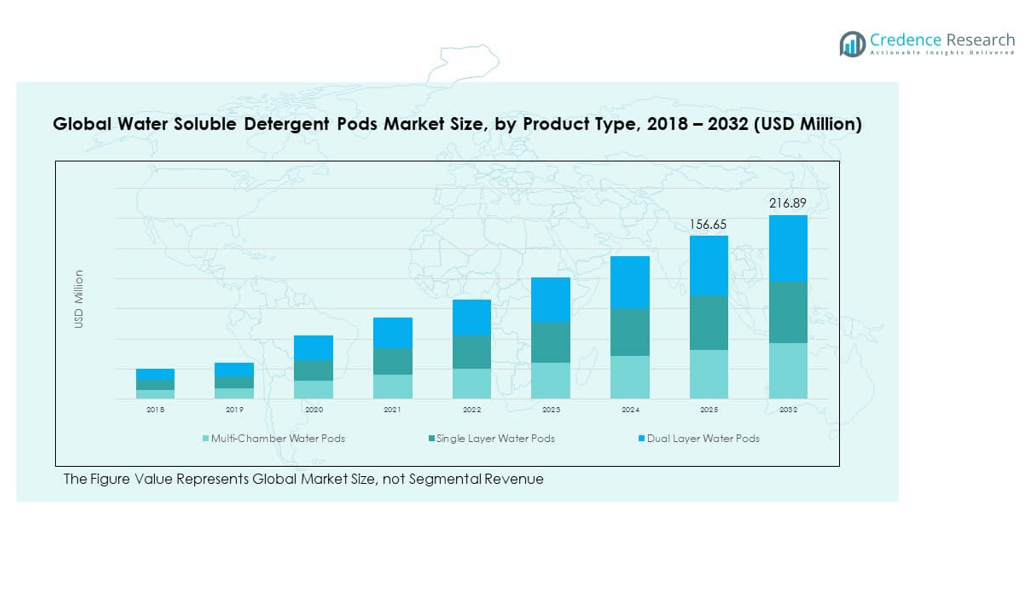
- Multi-chamber pods accounted for the largest share in 2024, dominating the Global Water Soluble Detergent Pods Market with over 50% due to their superior cleaning performance and premium positioning.
- Single layer pods represented around 30% share in 2024, maintaining popularity in price-sensitive markets, while dual layer pods gained nearly 20% share with rising traction in mid-range categories.
Market Drivers:
Growing Consumer Preference for Convenience and Ease of Use
The Global Water Soluble Detergent Pods Market is strongly driven by growing demand for convenient cleaning solutions. Consumers are shifting toward pre-measured pods that save time and ensure consistent cleaning results. It eliminates the need for manual measurement, reducing product wastage and improving user experience. Rising adoption among busy households supports the market’s expansion. Consumers are also drawn to the compact packaging format that is easy to store and handle. This convenience factor continues to strengthen market acceptance across both developed and emerging economies.
- For instance, North America accounted for the largest consumption in 2023, with over 1.8 billion units of detergent pods sold in the U.S., driven by growing household adoption and robust e-commerce channels for brands such as Tide Pods by Procter & Gamble.
Rising Focus on Hygiene and Household Cleaning Standards
Improving awareness about hygiene and sanitation drives steady adoption of water soluble pods across households and commercial spaces. Consumers increasingly prioritize products that deliver effective germ removal and freshness. It helps create demand for pods that combine detergent with antibacterial or disinfecting properties. The market benefits from rising consumer concerns about health and safe cleaning solutions. Strict cleaning standards in institutional and hospitality sectors further support growth. Urbanization and lifestyle changes also boost demand for modern, efficient cleaning formats. This shift positions pods as a preferred choice in global cleaning routines.
- For instance, Finish Quantum pods from Reckitt Benckiser are designed for advanced stain removal and to provide a brilliant shine on dishes, while Persil Sensitive Megaperls by Henkel have been dermatologically tested and are certified allergy-friendly (ECARF Seal) for gentle laundry care.
Sustainability and Shift Toward Eco-Friendly Packaging Materials
Sustainability trends play a vital role in expanding the Global Water Soluble Detergent Pods Market. Consumers favor biodegradable film and reduced plastic packaging that align with eco-conscious lifestyles. It promotes innovation in water soluble film materials that dissolve completely without leaving residue. Growing environmental concerns encourage brands to highlight eco-friendly attributes in marketing strategies. The market gains strength from government regulations supporting sustainable packaging solutions. Green certifications and product labeling further influence purchase decisions. Rising awareness about pollution reduction also drives interest in eco-friendly detergent pods. This emphasis ensures long-term growth potential in the segment.
Innovation in Product Formulations and Multi-Chamber Pods
Advances in formulation technology drive innovation in multi-chamber detergent pods with enhanced performance. The Global Water Soluble Detergent Pods Market benefits from products that combine stain removal, fragrance, and fabric care in a single dose. It strengthens consumer trust in advanced, effective cleaning formats. Manufacturers are investing in research to offer pods compatible with different water types and washing machines. Premiumization trends also influence demand for specialized pods tailored for delicate fabrics or specific applications. Growing interest in fragrance-rich and fabric-softening pods supports diversification. The market leverages these innovations to reach wider consumer segments across global markets.
Market Trends:
Expansion of Online Retail Channels for Household Cleaning Products
The Global Water Soluble Detergent Pods Market is experiencing growth through online retail platforms. Consumers prefer e-commerce for its convenience, product variety, and competitive pricing. It enables easy access to global and local brands across regions. Subscription-based sales models also encourage repeat purchases of detergent pods. Online reviews and digital marketing influence consumer decisions significantly. This channel supports penetration into emerging markets where retail infrastructure is developing. The rise of digital shopping continues to reshape product distribution. It ensures manufacturers focus on strengthening online presence and partnerships with e-commerce platforms.
Premiumization and Increasing Demand for Specialized Formulations
Premium detergent pods are gaining traction among consumers seeking superior cleaning performance. The Global Water Soluble Detergent Pods Market benefits from rising interest in pods with advanced formulations. It includes variants with fragrance boosters, fabric conditioners, or hypoallergenic properties. Consumers are willing to pay more for products delivering added value and convenience. Premium products also appeal to urban professionals with higher disposable incomes. The segment’s expansion reflects lifestyle changes and preference for multi-functional cleaning solutions. Specialized pods for baby clothing, sensitive skin, or delicate fabrics enhance product variety. This trend is expected to drive consistent growth in the premium segment.
- For instance, Persil Sensitive Megaperls by Henkel contain nature-based ingredients and have earned skin and allergy certifications, resulting in proven appeal among consumers with sensitive skin or allergy concerns.
Rising Marketing Investments and Brand Differentiation Strategies
Brand competition drives companies to invest in creative marketing campaigns to build customer loyalty. The Global Water Soluble Detergent Pods Market is influenced by strong advertising across digital and traditional media. It helps companies communicate product benefits and eco-friendly attributes effectively. Collaborations with retailers for in-store promotions also increase consumer awareness. Strong brand positioning encourages repeat purchases and expands the consumer base. Manufacturers focus on differentiating products through innovative design and packaging. The use of celebrity endorsements and lifestyle-driven promotions attracts younger demographics. This trend continues to enhance brand visibility and strengthen market competitiveness.
Integration of Smart Packaging and QR-Based Consumer Engagement
Technological advances influence packaging design in the Global Water Soluble Detergent Pods Market. Brands are incorporating QR codes and smart packaging features for interactive consumer engagement. It allows buyers to access detailed product information and sustainability credentials. Smart packaging also enhances transparency and builds brand trust. Companies use digital tools to track consumer preferences and customize promotions. This innovation appeals to tech-savvy consumers in both developed and emerging regions. It also supports brands in aligning with digital transformation trends in retail. Interactive packaging strategies contribute to long-term customer engagement and loyalty across the global market.
Market Challenges Analysis:
High Cost of Production and Price Sensitivity Among Consumers
The Global Water Soluble Detergent Pods Market faces challenges due to high production costs. Water soluble films and advanced multi-chamber formulations increase manufacturing expenses. It makes pods more expensive than traditional liquid or powder detergents. Price sensitivity among consumers in developing regions restricts adoption rates. Many households continue to prefer cheaper alternatives despite the convenience offered by pods. Manufacturers face difficulty balancing cost efficiency with quality. Fluctuations in raw material prices further complicate pricing strategies. Competitive pressure forces companies to optimize costs while maintaining product performance.
Safety Concerns, Regulatory Pressures, and Environmental Issues
Safety concerns around accidental ingestion by children present a critical challenge in the Global Water Soluble Detergent Pods Market. It has led to stricter packaging regulations and child-resistant design requirements. Growing regulatory scrutiny also affects marketing claims and labeling standards. Some consumers express concern about environmental impact despite advances in biodegradable films. Improper disposal practices may lead to pollution risks in certain regions. Rising expectations for corporate responsibility push companies toward sustainable practices. Counterfeit or low-quality products in informal markets damage consumer trust. These combined factors create hurdles that manufacturers must address to secure long-term market stability.
Market Opportunities:
Rising Demand in Emerging Economies with Expanding Urban Populations
The Global Water Soluble Detergent Pods Market has strong opportunities in emerging economies. Rapid urbanization increases demand for modern cleaning solutions among new households. It supports greater adoption in markets like India, China, and Southeast Asia. Rising disposable incomes make premium cleaning products more accessible. Growing awareness of hygiene also accelerates adoption of innovative formats. Expanding retail infrastructure and e-commerce platforms enhance product availability. International brands can tap into this demand through tailored marketing campaigns. The segment offers high potential for sustained growth in emerging regions.
Product Diversification and Focus on Sustainable Innovations
The Global Water Soluble Detergent Pods Market gains opportunities from continued product diversification. Companies are developing pods with natural ingredients and eco-friendly film technologies. It appeals to consumers concerned about environmental sustainability. Manufacturers can strengthen market presence by introducing region-specific fragrances and cultural preferences. Innovations in multi-functional pods enhance value perception among buyers. Expanding collaborations with appliance manufacturers also create cross-promotional advantages. Brands investing in sustainable packaging solutions gain regulatory and consumer support. This diversification trend ensures competitive advantage and long-term market opportunities globally.
Market Segmentation Analysis:
By Product Type
The Global Water Soluble Detergent Pods Market is segmented into multi-chamber, single layer, and dual layer pods. Multi-chamber pods dominate due to their ability to combine detergents, stain removers, and softeners in a single unit. It improves cleaning efficiency and appeals to households seeking premium convenience. Single layer pods remain popular in price-sensitive regions where affordability influences consumer choices. Dual layer pods gain traction as they balance cost and performance. Rising product innovation supports the overall expansion of these categories across both developed and emerging markets.
- For instance, Kao Corporation launched Attack ZERO liquid detergent with a "one-hand push" dispenser and later introduced Attack ZERO Perfect Stick, a concentrated powder stick detergent wrapped in a water-soluble film, in Japan. Both products were created to offer high cleaning power and measured dosing for increased convenience in modern households.
By Thickness
Segmentation by thickness includes below 30 micrometer, 31–60 micrometer, and above 61 micrometer pods. Below 30 micrometer pods are preferred for faster dissolution and eco-friendly applications. It addresses consumer demand for efficiency and reduced residue in laundry. Pods within 31–60 micrometers hold significant market share due to their durability and balance between cost and performance. Above 61 micrometer pods serve specialized uses where stronger film protection is required. Manufacturers innovate within these ranges to meet consumer expectations across diverse geographies.
- For instance, eco-friendly detergent pod innovations in the market seek to accelerate dissolution while minimizing residue and packaging waste, as shown by environmentally certified detergent pods cited by the U.S. Green Building Council and market reports for institutional cleaning in North America.
By End Use
End use segmentation covers household and commercial applications. Household use represents the largest share, driven by convenience, hygiene awareness, and rising disposable incomes. It benefits from strong penetration in developed regions and growing adoption in urban households globally. Commercial usage, including hotels, laundromats, and institutional facilities, is expanding steadily. The segment gains momentum as businesses seek efficient cleaning formats with reduced wastage. Rising adoption across hospitality and healthcare enhances growth opportunities in the commercial category.
Segmentation:
By Product Type
- Multi-Chamber Water Pods
- Single Layer Water Pods
- Dual Layer Water Pods
By Thickness
- Below 30 Micrometer
- 31–60 Micrometer
- Above 61 Micrometer
By End Use
- Household
- Commercial
By Region
- North America (U.S., Canada, Mexico)
- Europe (UK, France, Germany, Italy, Spain, Russia, Rest of Europe)
- Asia Pacific (China, Japan, South Korea, India, Australia, Southeast Asia, Rest of Asia Pacific)
- Latin America (Brazil, Argentina, Rest of Latin America)
- Middle East (GCC Countries, Israel, Turkey, Rest of Middle East)
- Africa (South Africa, Egypt, Rest of Africa)
Regional Analysis:
North America
The North America Global Water Soluble Detergent Pods Market size was valued at USD 46.85 million in 2018 to USD 63.13 million in 2024 and is anticipated to reach USD 94.32 million by 2032, at a CAGR of 4.8% during the forecast period. North America holds the largest regional share of the market, contributing around 43.3% in 2024. The region leads due to strong consumer awareness, advanced retail distribution, and high adoption of premium cleaning products. It benefits from demand for convenience-driven formats in the U.S., Canada, and Mexico. Manufacturers actively launch multi-chamber pods with advanced cleaning features to appeal to evolving consumer preferences. Strong e-commerce penetration supports product accessibility across urban and suburban areas. Environmental regulations encourage innovations in biodegradable films and sustainable packaging. It ensures that the region maintains dominance with consistent growth prospects.
Europe
The Europe Global Water Soluble Detergent Pods Market size was valued at USD 30.06 million in 2018 to USD 39.45 million in 2024 and is anticipated to reach USD 55.31 million by 2032, at a CAGR of 4.0% during the forecast period. Europe represents 27.1% of the global share in 2024. Growth is driven by strict regulations promoting sustainable packaging and eco-friendly cleaning solutions. Consumers in countries like Germany, France, and the UK display strong interest in biodegradable films and low-waste detergents. The market benefits from advanced retail structures and rising preference for compact, efficient cleaning products. Expansion of private-label brands by supermarkets contributes to affordability and accessibility. Rising adoption of innovative dual and multi-layer pods strengthens market diversity. Strong emphasis on sustainability and compliance supports steady demand. It continues to be a key growth hub in the global landscape.
Asia Pacific
The Asia Pacific Global Water Soluble Detergent Pods Market size was valued at USD 20.12 million in 2018 to USD 29.75 million in 2024 and is anticipated to reach USD 50.32 million by 2032, at a CAGR of 6.4% during the forecast period. Asia Pacific holds 20.4% of the global share in 2024 and represents the fastest-growing regional market. Growth is supported by rapid urbanization, rising disposable incomes, and lifestyle shifts in China, India, and Southeast Asia. Consumers increasingly adopt pods due to convenience and time-saving benefits in fast-paced urban environments. Expansion of modern retail channels and strong e-commerce penetration further boosts accessibility. Rising brand promotions and product education campaigns enhance consumer awareness. Innovation in affordable single layer pods supports adoption in price-sensitive markets. It positions Asia Pacific as a key driver of future global expansion.
Latin America
The Latin America Global Water Soluble Detergent Pods Market size was valued at USD 4.93 million in 2018 to USD 6.63 million in 2024 and is anticipated to reach USD 8.71 million by 2032, at a CAGR of 3.1% during the forecast period. Latin America contributes around 4.5% of the global share in 2024. Brazil and Mexico are the leading countries due to growing middle-class income levels and improving retail infrastructure. Rising adoption of compact and convenient cleaning products supports demand in urban areas. Manufacturers introduce affordable single and dual-layer pods to target cost-sensitive households. Increasing awareness about hygiene and eco-friendly solutions also supports growth. Limited penetration in rural areas poses challenges but e-commerce expansion bridges accessibility gaps. Strategic partnerships with local distributors strengthen market presence. It is positioned for steady growth despite economic fluctuations.
Middle East
The Middle East Global Water Soluble Detergent Pods Market size was valued at USD 3.01 million in 2018 to USD 3.74 million in 2024 and is anticipated to reach USD 4.71 million by 2032, at a CAGR of 2.5% during the forecast period. The region accounts for 2.6% of the global share in 2024. Growth is supported by rising demand for premium cleaning products in urban centers such as UAE and Saudi Arabia. The hospitality and commercial sectors play a vital role in expanding usage. Increasing consumer exposure to international brands through retail and e-commerce enhances adoption. However, limited awareness in rural areas slows market penetration. Sustainability initiatives are gradually gaining importance, influencing product innovation. Strong growth opportunities exist in commercial applications including hotels and institutions. It continues to grow at a modest pace within the global market framework.
Africa
The Africa Global Water Soluble Detergent Pods Market size was valued at USD 1.93 million in 2018 to USD 2.86 million in 2024 and is anticipated to reach USD 3.51 million by 2032, at a CAGR of 2.2% during the forecast period. Africa represents 2.0% of the global share in 2024. Market expansion is limited due to low consumer awareness and affordability issues in several regions. Urban centers such as South Africa and Egypt show stronger adoption driven by modern retail networks. Rising disposable incomes create new opportunities for premium cleaning formats. E-commerce growth is gradually increasing product availability across broader geographies. Manufacturers target the market with affordable single layer pods to build penetration. Institutional demand is expected to support growth in healthcare and hospitality sectors. It maintains gradual growth while remaining an emerging opportunity for global brands.
Key Player Analysis:
- Changzhou Water Soluble Co., Ltd.
- Unilever
- The Procter & Gamble Company
- Unimasses Group
- Guangdong Youkai Technical Co., Ltd.
- Shaoxing Xinkaiji New Material Co., Ltd.
- OceanStar
- Gel Caps
- Ecozone
- Sindhu Ultramarine Chemicals Private Limited
Competitive Analysis:
The Global Water Soluble Detergent Pods Market is highly competitive, shaped by multinational corporations and regional manufacturers. Leading players such as Procter & Gamble, Unilever, and Unimasses Group dominate with extensive product portfolios and strong brand equity. It benefits from consistent product innovation, sustainable packaging advancements, and targeted marketing campaigns. Regional manufacturers, including Changzhou Water Soluble Co., Ltd. and Guangdong Youkai Technical Co., Ltd., strengthen their positions with cost-effective offerings. Companies compete through product differentiation, pricing strategies, and expansion into emerging markets. The market remains dynamic, with players focusing on sustainability, multi-chamber pod innovation, and e-commerce distribution.
Recent Developments:
- In June 2025, Unilever announced the acquisition of the men's personal care brand Dr. Squatch, a move designed to strengthen its offerings in premium and high-growth product segments and expand its reach within the Gen Z demographic. This acquisition underscores Unilever’s commitment to expanding its innovative portfolio and utilizing digital-first and influencer-driven marketing strategies.
- In March 2025, The Procter & Gamble Company (P&G) launched the Always Pocket Flexfoam, targeting increased consumer convenience in period care and debuting as the official period care partner at Coachella 2025.
Report Coverage:
The research report offers an in-depth analysis based on product type and end use. It details leading market players, providing an overview of their business, product offerings, investments, revenue streams, and key applications. Additionally, the report includes insights into the competitive environment, SWOT analysis, current market trends, as well as the primary drivers and constraints. Furthermore, it discusses various factors that have driven market expansion in recent years. The report also explores market dynamics, regulatory scenarios, and technological advancements that are shaping the industry. It assesses the impact of external factors and global economic changes on market growth. Lastly, it provides strategic recommendations for new entrants and established companies to navigate the complexities of the market.
Future Outlook:
- Rising adoption of eco-friendly packaging solutions will drive consumer preference.
- Multi-chamber pods will remain a focal point of innovation.
- E-commerce will strengthen as a primary distribution channel.
- Emerging economies will play a crucial role in future expansion.
- Sustainability regulations will accelerate biodegradable film development.
- Household applications will continue to dominate demand.
- Commercial usage in hospitality and healthcare will steadily rise.
- Brand competition will intensify with heavy marketing investments.
- Technological advances will improve product dissolution and performance.
- Regional players will expand presence through affordability-driven offerings.

Request a Free Sample
Fill in your details and we'll send you a free sample report.
- Sample data tables & charts
- Research methodology
Market Dynamics
Growing Consumer Preference for Convenience and Ease of Use
Consumers are increasingly opting for water soluble detergent pods due to their pre-measured, easy-to-use format that saves time and reduces product wastage. This convenience is especially appealing to busy households and commercial users, driving market growth.
Rising Focus on Hygiene and Household Cleaning Standards
Heightened awareness of hygiene and sanitation is boosting demand for pods that offer effective cleaning and antibacterial properties. This trend is reinforced by stricter cleaning standards in both residential and institutional settings.
Sustainability and Shift Toward Eco-Friendly Packaging Materials
Environmental concerns and regulatory pressures are pushing manufacturers to innovate with biodegradable films and reduced plastic packaging. Eco-friendly attributes are increasingly influencing consumer purchasing decisions and supporting market expansion.
Innovation in Product Formulations and Multi-Chamber Pods
Advancements in multi-chamber pod technology allow for the combination of detergents, stain removers, and fabric softeners in a single dose, delivering superior cleaning performance and appealing to premium market segments.
Expansion of Online Retail and E-Commerce Channels
The growth of digital retail platforms is making detergent pods more accessible, especially in emerging markets. E-commerce enables broader product reach, subscription models, and targeted marketing, further accelerating adoption.
Need a Custom Version of This Report?
Tailor the scope, geography, or segments to your exact requirements.
- Custom geography or segment scope
- Direct access to our analyst team
Frequently Asked Questions
What is the current market size for Global Water Soluble Detergent Pods Market, and what is its projected size in 2032?
At what Compound Annual Growth Rate is the Global Water Soluble Detergent Pods Market projected to grow between 2025 and 2032?
What are the key drivers for the growth of the Water Soluble Detergent Pods market?
Which major therapies segment in Water Soluble Detergent Pods Market?
Which major application segment in Water Soluble Detergent Pods Market?
Table of Content
Chapter 1 Market Segmentation
- 1.1 Segmentation Framework
- 1.1.1 Product and Service Classification
- 1.1.2 Application and End-Use Classification
- 1.1.3 Technology and Solution Classification
- 1.1.4 Customer and Distribution Channel Classification
- 1.1.5 Geographic Segmentation
- 1.1.6 Market Segment Definitions and Boundaries
- 1.2 By End Use
- 1.2.1 Household
- 1.2.2 Commercial
- 1.3 By Thickness
- 1.3.1 Below 30 Micrometer
- 1.3.2 31–60 Micrometer
- 1.3.3 Above 61 Micrometer
- 1.4 By Product Type
- 1.4.1 Multi-Chamber Water Pods
- 1.4.2 Single Layer Water Pods
- 1.4.3 Dual Layer Water Pods
Chapter 2 Introduction
- 2.1 Report Objectives and Scope
- 2.2 Product Definition and Industry Terminology
- 2.3 Market Inclusions and Exclusions
- 2.4 Research Process
- 2.4.1 Primary Research and Expert Interviews
- 2.4.2 Secondary Research and Source Review
- 2.4.3 Top-Down and Bottom-Up Estimation
- 2.4.4 Data Triangulation and Verification
- 2.5 Market Size Measurement Basis
- 2.5.1 2024: USD 145.56 million → 2032: USD 216.89 million
- 2.6 Historical and Forecast Reference Periods
- 2.6.1 Base Year: 2024
- 2.6.2 Forecast Period: 2024-2032
- 2.7 Research Assumptions and Limitations
Chapter 3 Executive Summary
- 3.1 Market Snapshot and Key Findings
- 3.2 Base-Year Market Size, 2024
- 3.3 Forecast Market Size, 2032
- 3.4 Revenue and Volume Growth Outlook
- 3.5 Key Demand and Supply Indicators
- 3.6 Leading Market Segments
- 3.7 Fastest-Growing Market Opportunities
- 3.8 Regional Performance Highlights
- 3.9 Technology and Industry Transformation
- 3.10 Competitive Landscape Summary
- 3.11 Analyst View and Strategic Implications
Chapter 4 Global Water Soluble Detergent Pods Market Trends and Developments
- 4.1 Historical Industry Development
- 4.2 Recent Market Trends and Developments
- 4.3 Demand and Customer Behavior Trends
- 4.4 Technology and Product Innovation
- 4.5 Artificial Intelligence, Automation and Digitalization
- 4.6 Local Manufacturing and Supply Chain Realignment
- 4.7 Industry Partnerships, Mergers and Acquisitions
- 4.8 Sustainability and Circular Economy Developments
- 4.9 Government and Private Sector Investment Trends
- 4.10 Emerging Business Models and Commercialization
- 4.11 Industry Developments and Announcements
Chapter 5 Global Water Soluble Detergent Pods Market Production, Supply and Demand Analysis
- 5.1 Demand Trend and Consumption Analysis
- 5.2 Demand Forecast, 2024-2032
- 5.3 Production and Output Trend
- 5.4 Production and Output Forecast, 2024-2032
- 5.5 Installed Capacity and Capacity Utilization
- 5.6 Company-Wise Production Plants and Statistics
- 5.6.1 Installed Production Capacity
- 5.6.2 Actual Production
- 5.6.3 Planned Capacity and Expansion Targets
- 5.7 Supply Chain Structure and Procurement Trends
- 5.8 Supply-Demand Gap and Bottlenecks
- 5.9 Import Dependence and Sourcing Structure
- 5.10 Contract Manufacturing and Outsourcing
- 5.11 Regional Supply and Demand Concentration
Chapter 6 Global Water Soluble Detergent Pods Market Pricing Analysis
- 6.1 Pricing Structure and Measurement
- 6.2 Historical Pricing Trends
- 6.3 Pricing Outlook, 2024-2032
- 6.4 Average Selling Price and Unit Economics
- 6.5 Pricing by Product and Market Segment
- 6.6 Geographic Pricing Differences
- 6.7 Key Input, Energy, Labor and Logistics Costs
- 6.8 Contract Pricing and Purchasing Models
- 6.9 Pricing Sensitivity and Competitive Positioning
- 6.10 Price, Margin and Profitability Implications
Chapter 7 Global Water Soluble Detergent Pods Market Dynamics
- 7.1 Market Growth Drivers
- 7.1.1 Demand-Side Drivers
- 7.1.2 Technology and Innovation Drivers
- 7.1.3 Infrastructure and Investment Drivers
- 7.1.4 Regulatory and Policy Drivers
- 7.2 Market Restraints
- 7.2.1 Cost and Affordability Constraints
- 7.2.2 Technology and Adoption Barriers
- 7.2.3 Supply Chain and Operational Constraints
- 7.3 Market Challenges
- 7.3.1 Competitive Pressure and Margin Erosion
- 7.3.2 Skills, Infrastructure and Implementation Gaps
- 7.4 Emerging Market Opportunities
- 7.5 Market Dynamics Impact and Time-Horizon Assessment
Chapter 8 Global Water Soluble Detergent Pods Value Chain Analysis
- 8.1 Industry Value Chain Overview
- 8.2 Upstream Suppliers and Critical Inputs
- 8.3 Technology and Component Providers
- 8.4 Manufacturing or Service Delivery
- 8.5 Distribution, Channel Partners and Integrators
- 8.6 Downstream Applications and End Users
- 8.7 Value Addition and Profit Pools
- 8.8 Vertical Integration and Outsourcing
- 8.9 Supplier Concentration and Risk
- 8.10 Supply Chain Localization and Resilience
Chapter 9 Global Water Soluble Detergent Pods Market Regulations and Policies
- 9.1 Relevant Laws, Standards and Compliance Frameworks
- 9.2 Product, Service, Safety and Quality Requirements
- 9.3 Government Policies, Incentives and Subsidies
- 9.4 Imports, Exports and Trade Barriers
- 9.5 Public Procurement and Local Content Requirements
- 9.6 Environmental and Sustainability Compliance
- 9.7 Upcoming Policy Changes and Market Implications
Chapter 10 Global Water Soluble Detergent Pods Market Hotspots and Opportunities
- 10.1 Market Opportunity Mapping and Growth Hotspots
- 10.2 High-Growth Applications and Customer Groups
- 10.3 Underserved Markets and White-Space Opportunities
- 10.4 Emerging Technology and Product Opportunities
- 10.5 New Capacity and Investment Hotspots
- 10.6 Market Entry and Expansion Opportunities
- 10.7 Distribution and Partnership Opportunities
- 10.8 Near-Term and Long-Term Commercial Potential
- 10.9 Opportunity Attractiveness and Execution Risks
Chapter 11 Global Water Soluble Detergent Pods Market Outlook, 2024-2032
- 11.1 Market Size and Analysis
- 11.1.1 Revenue (Market Measurement: 2024: USD 145.56 million → 2032: USD 216.89 million)
- 11.1.2 Market Volume and Quantity Sold
- 11.1.3 Historical Market Size
- 11.1.4 Base-Year Market Size, 2024
- 11.2 Market Forecast, 2024-2032
- 11.2.1 Revenue Forecast to 2032
- 11.2.2 Volume Forecast to 2032
- 11.2.3 CAGR and Year-on-Year Growth
- 11.2.4 Incremental Revenue Opportunity
- 11.3 Forecast Assumptions and Scenario Analysis
- 11.3.1 Base-Case Forecast
- 11.3.2 Optimistic and Conservative Scenarios
- 11.3.3 Technology, Pricing and Policy Sensitivities
- 11.4 Market Attractiveness and Growth Outlook
Chapter 12 Global Water Soluble Detergent Pods Market Segmentation and Outlook
- 12.1 Segmentation Summary and Market Shares, 2024
- 12.2 Largest and Fastest-Growing Segments
- 12.3 By End Use - Market Size and Forecast, 2024-2032
- 12.3.1 Segment Definition and Scope
- 12.3.2 Historical Market Size
- 12.3.3 Revenue Forecast, 2024-2032
- 12.3.4 Volume Forecast, 2024-2032
- 12.3.5 Base-Year Market Share, 2024
- 12.3.6 Segment CAGR and Growth Drivers
- 12.3.7 Subsegment Market Size and Forecast
- 12.3.7.1 Household
- 12.3.7.2 Commercial
- 12.3.8 Subsegment Pricing and Adoption Trends
- 12.3.9 Leading Suppliers and Competition
- 12.3.10 Regional Demand and Opportunities
- 12.4 By Thickness - Market Size and Forecast, 2024-2032
- 12.4.1 Segment Definition and Scope
- 12.4.2 Historical Market Size
- 12.4.3 Revenue Forecast, 2024-2032
- 12.4.4 Volume Forecast, 2024-2032
- 12.4.5 Base-Year Market Share, 2024
- 12.4.6 Segment CAGR and Growth Drivers
- 12.4.7 Subsegment Market Size and Forecast
- 12.4.7.1 Below 30 Micrometer
- 12.4.7.2 31–60 Micrometer
- 12.4.7.3 Above 61 Micrometer
- 12.4.8 Subsegment Pricing and Adoption Trends
- 12.4.9 Leading Suppliers and Competition
- 12.4.10 Regional Demand and Opportunities
- 12.5 By Product Type - Market Size and Forecast, 2024-2032
- 12.5.1 Segment Definition and Scope
- 12.5.2 Historical Market Size
- 12.5.3 Revenue Forecast, 2024-2032
- 12.5.4 Volume Forecast, 2024-2032
- 12.5.5 Base-Year Market Share, 2024
- 12.5.6 Segment CAGR and Growth Drivers
- 12.5.7 Subsegment Market Size and Forecast
- 12.5.7.1 Multi-Chamber Water Pods
- 12.5.7.2 Single Layer Water Pods
- 12.5.7.3 Dual Layer Water Pods
- 12.5.8 Subsegment Pricing and Adoption Trends
- 12.5.9 Leading Suppliers and Competition
- 12.5.10 Regional Demand and Opportunities
- 12.6 Segment Growth Comparison
- 12.7 Segment Attractiveness and Priority Matrix
Chapter 13 Global Water Soluble Detergent Pods End-Use and Application Market Outlook
- 13.1 End-Use Industry and Customer Demand Structure
- 13.2 Leading Applications and Customer Groups
- 13.3 End-Use Market Size, Share and Forecast
- 13.4 Major End-Use Industry Deep Dives
- 13.4.1 Customer Requirements and Use Cases
- 13.4.2 Demand and Replacement Cycles
- 13.4.3 Technical and Regulatory Considerations
- 13.4.4 Purchasing and Procurement Models
- 13.4.5 Leading Vendors and Distribution Channels
- 13.4.6 Forecast and Commercial Opportunities
- 13.5 Emerging Applications and Cross-Segment Demand
- 13.6 End-Use Industry Investment Priorities
Chapter 14 Global Water Soluble Detergent Pods Geographic Market Outlook, 2024-2032
- 14.1 Regional Market Size and Share, 2024
- 14.2 Regional Market Forecast, 2024-2032
- 14.3 Regional Pricing, Production and Demand Differences
- 14.4 North America
- 14.4.1 United States
- 14.4.2 Canada
- 14.4.3 Mexico
- 14.5 Europe
- 14.5.1 Germany
- 14.5.2 France
- 14.5.3 Italy
- 14.5.4 United Kingdom
- 14.5.5 Spain
- 14.5.6 Poland
- 14.5.7 Russia
- 14.5.8 Netherlands
- 14.5.9 Belgium
- 14.5.10 Sweden
- 14.5.11 Denmark
- 14.5.12 Norway
- 14.5.13 Rest of Europe
- 14.6 Asia Pacific
- 14.6.1 China
- 14.6.2 India
- 14.6.3 Japan
- 14.6.4 South Korea
- 14.6.5 Thailand
- 14.6.6 Indonesia
- 14.6.7 Vietnam
- 14.6.8 Malaysia
- 14.6.9 Australia
- 14.6.10 Rest of Asia Pacific
- 14.7 Latin America
- 14.7.1 Brazil
- 14.7.2 Argentina
- 14.7.3 Colombia
- 14.7.4 Chile
- 14.7.5 Rest of Latin America
- 14.8 Middle East
- 14.8.1 Saudi Arabia
- 14.8.2 United Arab Emirates
- 14.8.3 Turkey
- 14.8.4 Israel
- 14.8.5 Iran
- 14.8.6 Rest of the Middle East
- 14.9 Africa
- 14.9.1 South Africa
- 14.9.2 Egypt
- 14.9.3 Nigeria
- 14.9.4 Morocco
- 14.9.5 Rest of Africa
- 14.10 Regional Investment, Policy and Supply Chain Differences
- 14.11 Regional Competitive Landscape
- 14.12 Geographic Growth Hotspots
Chapter 15 Global Water Soluble Detergent Pods Technology, Innovation and Sustainability Outlook
- 15.1 Technology Landscape and Maturity
- 15.2 Product, Process and Service Innovation
- 15.3 AI, Automation and Digital Tools in the Industry
- 15.4 Technology Adoption and Performance Benchmarking
- 15.5 Innovation Pipeline and R&D Investment
- 15.6 Patent and Intellectual Property Trends
- 15.7 Energy Efficiency and Resource Management
- 15.8 Sustainability, Recycling and Circularity
- 15.9 Technology Roadmap, 2024-2032
- 15.10 Risks of Obsolescence and Technology Substitution
Chapter 16 Global Water Soluble Detergent Pods Market Key Strategic Imperatives
- 16.1 Growth and Market Entry Priorities
- 16.2 High-Return Products and Segments
- 16.3 Pricing, Profitability and Cost Optimization
- 16.4 Technology Investment and Product Differentiation
- 16.5 Supply Chain Localization and Resilience
- 16.6 Distribution and Customer Acquisition
- 16.7 Partnership, Acquisition and Capacity Strategy
- 16.8 Regional Expansion Priorities
- 16.9 Short-, Medium- and Long-Term Actions
Chapter 17 Competition Outlook
- 17.1 Industry Competition Characteristics
- 17.2 Market Structure and Concentration
- 17.3 Market Share and Competitive Positioning, 2024
- 17.4 Company-Wise Revenue and Product Benchmarking
- 17.5 Production and Service Capacity Benchmarking
- 17.6 Technology, Pricing and Differentiation
- 17.7 Regional Footprint and Distribution Strength
- 17.8 Mergers, Acquisitions and Strategic Alliances
- 17.9 New Entrants and Competitive Threats
- 17.10 Porter's Five Forces and Industry Attractiveness
- 17.11 Competitive Outlook, 2024-2032
Chapter 18 Company Profiles
- 18.1 Company Coverage and Selection Criteria
- 18.2 The Procter & Gamble Company
- 18.2.1 Business Description
- 18.2.2 Company Ownership and Geographic Presence
- 18.2.3 Product and Service Portfolio
- 18.2.4 Manufacturing and Operating Footprint
- 18.2.5 Production Capacity and Expansion Plans
- 18.2.6 Financial Performance and Investment
- 18.2.7 Market Share and Competitive Position
- 18.2.8 Technology and Innovation Capabilities
- 18.2.9 Strategic Alliances or Partnerships
- 18.2.10 Recent Developments
- 18.2.11 Growth Strategy and Outlook
- 18.3 Unilever
- 18.4 Unimasses Group
- 18.5 Changzhou Water Soluble Co., Ltd.
- 18.6 Guangdong Youkai Technical Co., Ltd.
- 18.7 Shaoxing Xinkaiji New Material Co., Ltd.
- 18.8 Ecozone
- 18.9 OceanStar
- 18.10 Gel Caps
- 18.11 Sindhu Ultramarine Chemicals Private Limited
- 18.12 Other Relevant Market Participants
Note: Every listed company is profiled on the structure shown under the first company. The company list is preliminary and may change based on research findings, market developments, data availability and client requirements.
Chapter 19 Disclaimer
- 19.1 Research and Forecast Disclaimer
- 19.2 Data Source and Estimation Limitations
Note: The depth of individual sections depends on data availability for this market. Volume, capacity, trade and other unit-based metrics are included where applicable.

