
Branded foam beds replace cotton across Indian homes
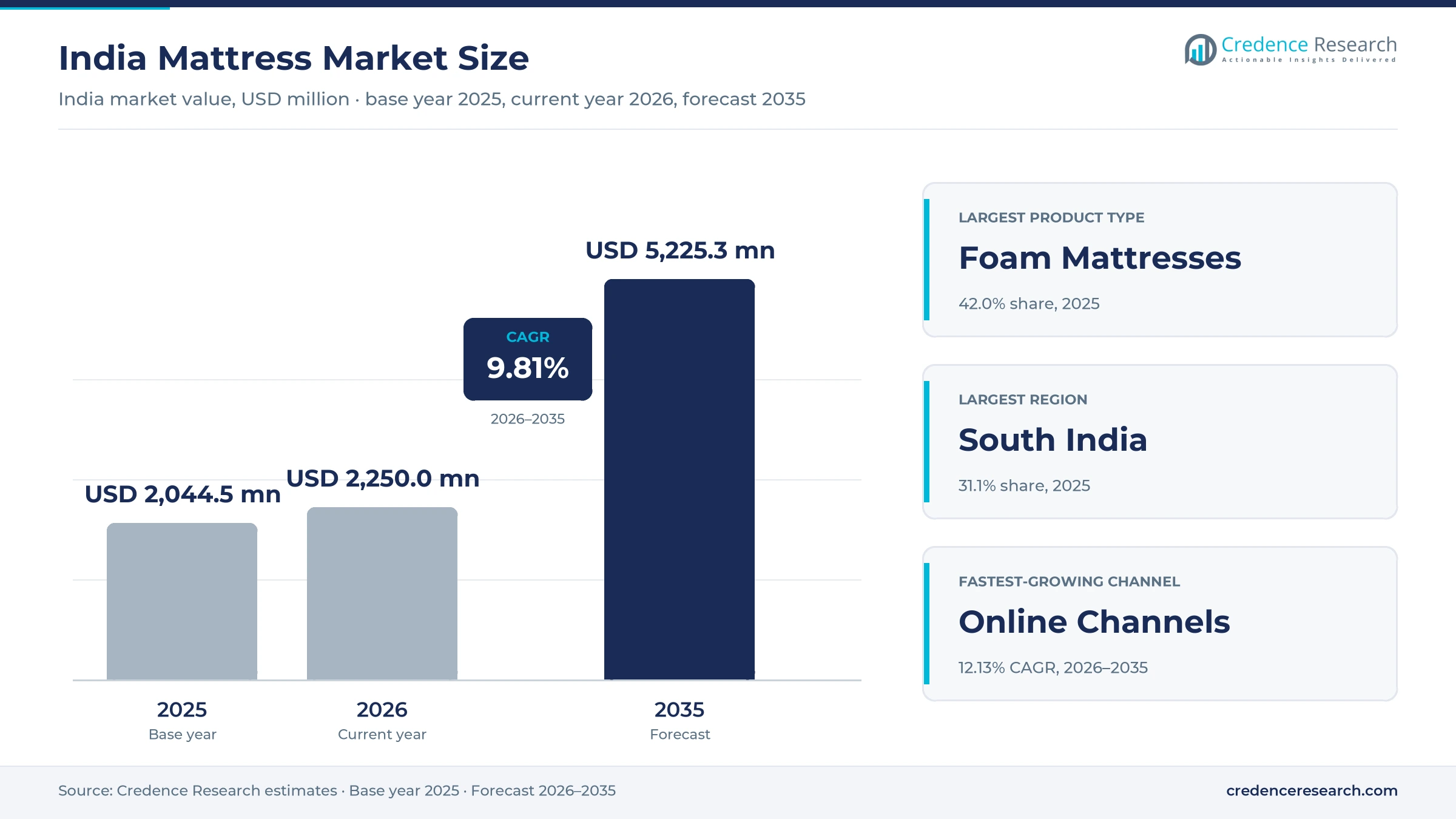
The India mattress market was valued at USD 2.04 billion in 2025 and is projected to increase from USD 2.25 billion in 2026 to USD 5.23 billion by 2035, registering a CAGR of 9.81% during 2026–2035. Demand comes from new household formation, replacement of cotton and coir beds and buyers who now treat sleep as a health purchase. South India held the largest regional share, 31.1% in 2025, because Kerala and Karnataka host many branded factories and a strong coir tradition. East and Central India is the fastest-growing region at 10.39% a year, as rural housing programs and new stores reach smaller towns. Foam products led the product mix, while online and brand-owned channels are gaining share from local shops. Two listings changed the commercial picture, with Wakefit listing on Indian exchanges in December 2025 and Duroflex filing its draft prospectus in October 2025. Mattresses stayed in the 18% GST slab after the September 2025 tax overhaul, which kept prices stable.
Which products and buyers does the sleep surface estimate cover?
The estimate measures retail sales value of finished mattresses sold in India to households, hotels, hospitals and hostels. It covers cotton and traditional coir products, polyurethane and memory foam, pocket and bonnell spring designs, and latex or hybrid constructions. Values are stated in USD million at current prices and include sales through local shops, multi-brand stores, brand showrooms and online platforms.
The estimate excludes pillows, protectors, bed frames, sofa cushions and loose foam blocks sold to furniture makers. It also excludes exports and air or water beds used only in medical care. The value chain runs from chemical and fiber suppliers through foam and spring plants to brand owners, distributors and the dealers who deliver mattresses to homes.
India Mattress Market Insights
- The India mattress market was valued at USD 2.04 billion in 2025 and is projected to reach USD 5.23 billion by 2035, registering a CAGR of 9.81% during 2026–2035.
- South India held 31.1% of 2025 mattress sales, because dense branded manufacturing and coir supply in Kerala and Karnataka keep prices competitive.
- Foam mattresses led with 42.0% of 2025 value, because they offer branded comfort at lower prices than spring or latex designs.
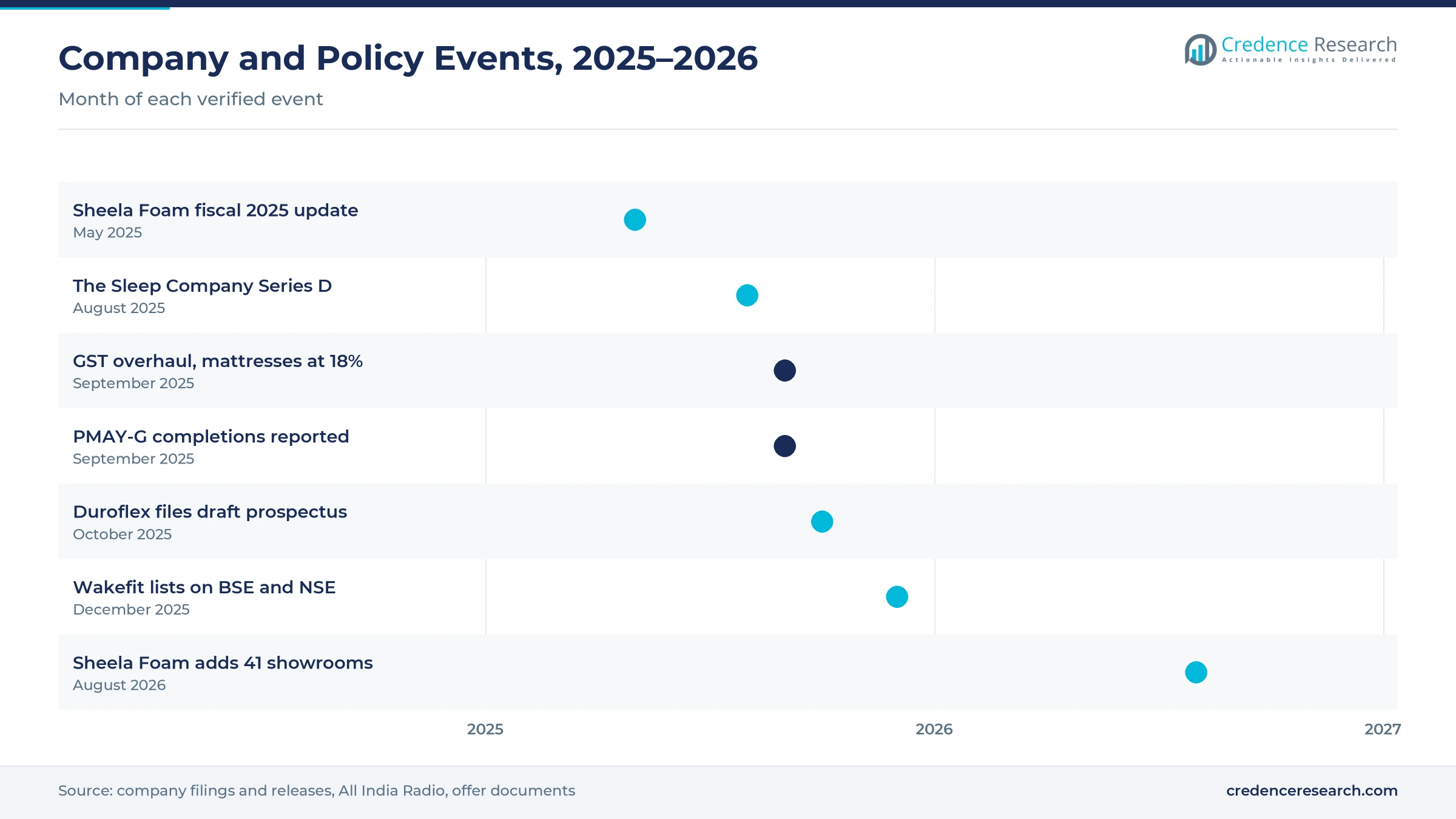
- Wakefit listed on Indian stock exchanges on Dec. 15, 2025, after its issue drew 2.52 times subscription, which signals investor interest in sleep brands.
- Sheela Foam reported 6% mattress volume growth and 23% higher online volume in the June 2026 quarter, while adding 41 net new showrooms.
Foam leads while latex and hybrid designs grow fastest
Why do foam mattresses lead product demand?
Based on product type, the market is categorized into cotton and traditional mattresses, foam mattresses, spring mattresses and latex and hybrid mattresses. Foam Mattresses led with 42.0% of 2025 value, because polyurethane and memory foam give branded comfort at accessible prices and roll-pack easily for delivery. Latex and Hybrid Mattresses grow fastest at 11.80% a year, as urban buyers trade up to natural latex, pocket springs and zoned comfort layers.
How much do hotels and hospitals buy?
Based on customer type, the market is categorized into residential households, hospitality buyers, healthcare buyers and institutional accommodation. Residential Households led with 82.0% of 2025 value, because most mattresses are bought for new homes, marriages and replacement of worn cotton beds. Hospitality Buyers grow fastest at 10.70% a year, as new hotel rooms and refurbishments call for uniform, fire-retardant and contract-grade products.
Which sales channels are gaining share?
Based on distribution channel, the market is categorized into unorganized local retail, organized multi-brand retail, brand-owned stores and online channels. Unorganized Local Retail led with 38.0% of 2025 value, because local shops and custom makers still dominate smaller towns. Online Channels grow fastest at 12.13% a year, as direct-to-consumer brands offer trial periods, doorstep delivery and easy finance.
| Segment Group | Leading Sub-segment | Share, 2025 | Fastest-growing Sub-segment | CAGR, 2026–2035 |
|---|---|---|---|---|
| By Product Type | Foam Mattresses | 42.0% | Latex and Hybrid Mattresses | 11.80% |
| By Customer Type | Residential Households | 82.0% | Hospitality Buyers | 10.70% |
| By Distribution Channel | Unorganized Local Retail | 38.0% | Online Channels | 12.13% |
Request a Free Sample
Fill in your details and we'll send you a free sample report.
- Sample data tables & charts
- Research methodology
New homes, store rollouts and health upgrades lift demand
How do new homes and replacement cycles lift demand?
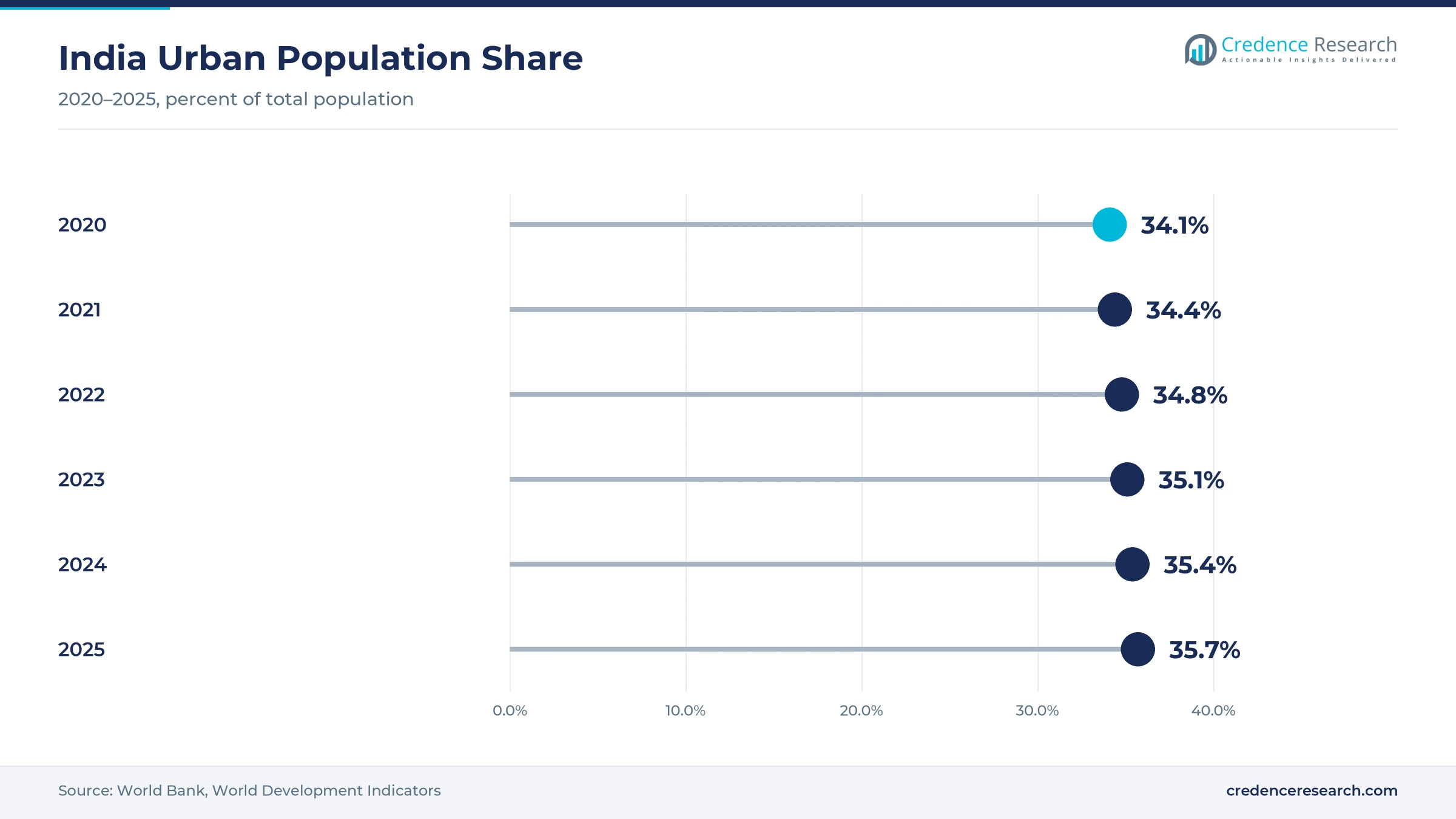
Housing formation and replacement demand form the base of mattress buying, because every new home needs beds and most families replace old cotton mattresses within a decade. More than 2.82 crore rural houses had been completed under PMAY-G by August 2025, against 3.85 crore sanctioned, according to All India Radio. The Union Cabinet also approved PMAY-U 2.0, which supports one crore urban poor and middle-class families to build, buy or rent homes over five years. In turn, India's urban population share rose to 35.7% in 2025 from 34.1% in 2020. Residential households already hold 82.0% of demand, so these programs widen the first-purchase base.
Why does organized retail expansion formalize buying?
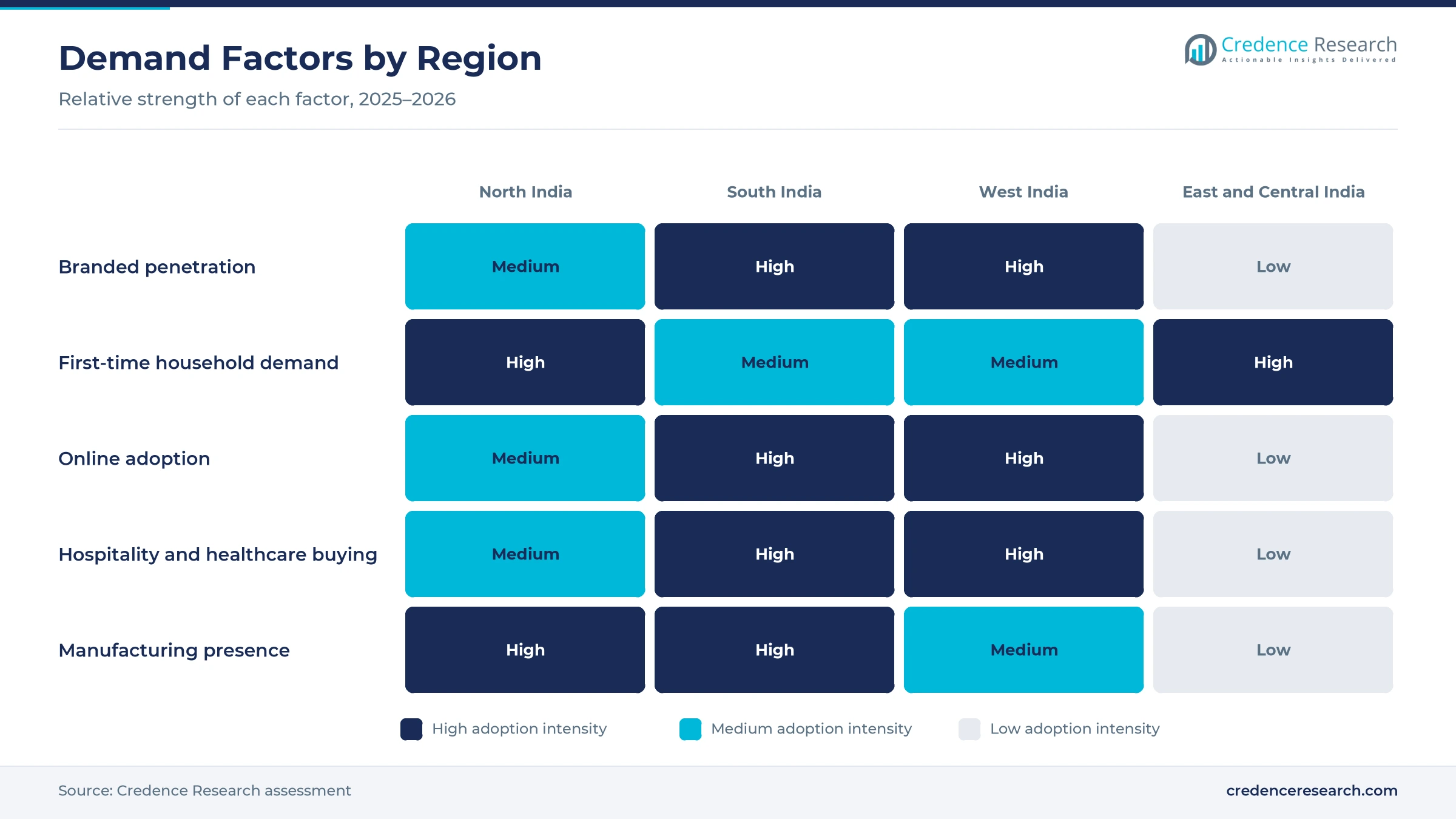
Organized retail and brand formalization move buyers away from local custom makers toward warranted branded products. Wakefit ran 125 stores in 62 cities as of Sept. 30, 2025, and planned 117 new company-owned stores from its listing proceeds. Duroflex operated 73 company-owned stores and more than 5,576 general trade outlets as of June 30, 2025, and plans 120 new stores, according to Business Today. Meanwhile, Sheela Foam's Small Town India program reached more than 5,800 offline touchpoints. As a result, branded penetration rises in North India, which grows at 9.89% a year, as showrooms reach tier 2 and tier 3 cities.
How does the health-oriented product mix raise spending?
Premium materials and health-oriented products raise average selling prices, because buyers increasingly link back pain and sleep quality to mattress choice. The Sleep Company raised Rs 480 crore in a Series D round in August 2025 to scale its patented SmartGRID technology and build new factories, according to exchange4media. Sheela Foam launched Sleepwell Pro FitRest and Kurlon DuoRest during fiscal 2025, both positioned on orthopedic support. In turn, latex and hybrid mattresses grow at 11.80% a year, the fastest product rate, while foam keeps the largest share through 2035 as memory foam layers enter mass-market designs and orthopedic claims move into entry price tiers.
Why does online buying widen the reach of brands?
Online buying widens the reach of national brands, because roll-packed mattresses ship cheaply to districts with no showroom. Wakefit sells across 700 districts in 28 states and six union territories, which shows how far direct delivery now extends. Sheela Foam reported 23% higher e-commerce volume in the June 2026 quarter, well above its 6% mattress volume growth. In addition, e-commerce platforms offer trial nights, easy returns and no-cost finance, which reduce the risk of buying a bed unseen. The Sleep Company and Wakefit both started as online brands before opening showrooms, which shows how digital sales now feed physical retail. Online channels therefore grow at 12.13% a year, the fastest channel rate through 2035.
Listed brands, owned stores and online sales reshape buying
Why is the shift to listed and consolidated brands accelerating?
A shift toward listed and consolidated brands is reshaping competition, because capital markets now fund store rollouts and marketing. Wakefit listed on Dec. 15, 2025, at Rs 194.10 against an issue price of Rs 195, after 2.52 times subscription. Duroflex filed its draft prospectus with the market regulator in October 2025, planning a fresh issue to fund new stores and a manufacturing facility. Meanwhile, Sheela Foam acquired a 94.66% stake in Kurlon Enterprise for Rs 2,150 crore and a 35% stake in Furlenco. As a result, the top branded players are gaining scale advantages in raw material buying, advertising and dealer credit that smaller regional makers struggle to match.
How is the rise of brand-owned showrooms changing retail?
The rise of brand-owned showrooms is changing how buyers test and compare mattresses before purchase. Sheela Foam added 41 net new showrooms in the June 2026 quarter, and The Sleep Company opened its 150th exclusive outlet before its August 2025 round. Wakefit and Duroflex together plan more than 230 new company-owned stores, based on their offer documents. In turn, brands control pricing, display and after-sales service in these stores, which supports premium models. Brand-owned stores therefore grow at double-digit rates in larger metros, as experience centers with trial beds and sleep consultations replace crowded multi-brand shop floors in high-street locations.
Can hotel and hospital refurbishment open a contract channel?
Hotel and hospital refurbishment is an opening for brands, because contract buyers order hundreds of identical mattresses at a time. Hospitality buyers grow at 10.70% a year, faster than households, as new branded rooms open in tier 2 cities. Hospitality, healthcare and institutional buyers together held 18% of 2025 value, based on Credence Research estimates. Hospitals need washable, fluid-resistant covers and pressure-relief foams, which pair with hospital bed linen supplied under the same contracts. In addition, hostels and staff quarters buy replacement mattresses in multi-year cycles. Duroflex already supplies Durofoam to smaller makers, and its 2025 offer document plans a new manufacturing facility, which would add contract capacity. Brands with factories close to demand centers can win these orders because freight and lead time weigh heavily in tenders.
Is there room to grow sales in smaller towns?
Smaller towns offer a large opening, because local custom makers still supply most beds outside the metros. Sheela Foam added more than 1,000 comfort foam dealers in fiscal 2025 and grew mattress volumes by 12%, according to Indian Retailer. Rural housing completions under PMAY-G also create first-time buyers in states that branded firms once ignored, with 2.82 crore homes finished by August 2025. Wakefit also expanded delivery to 700 districts by 2025, which brings branded choice to towns without showrooms. In turn, East and Central India is the fastest-growing region, as dealers and online delivery reach Bihar, Odisha, Chhattisgarh and Madhya Pradesh through 2035.
Unorganized pricing and chemical costs squeeze margins
How does unorganized pricing limit branded growth?
Unorganized pricing remains the largest constraint, because local makers sell cotton and low-density foam beds at a fraction of branded prices. These makers often pay less tax and skip quality testing, which gives them a cost edge in price-sensitive towns. As a result, branded firms must offer entry models and dealer credit, which lowers margins. Unorganized local retail still holds 38.0% of value, so the shift to brands will take more than a decade.
Why do chemical and steel costs squeeze margins?
Raw material volatility squeezes margins, because polyols, TDI, latex and spring steel make up most of a mattress's cost. Prices of these inputs follow global crude oil, rubber and steel markets, which brands cannot control. In turn, makers that raise list prices quickly risk losing volume to cheaper rivals. Larger firms hedge through bulk contracts and in-house flexible polyurethane foam production, which smaller firms rarely afford.
How do returns and logistics raise online costs?
Returns and logistics raise online costs, because bulky products need careful handling and trial-period returns are expensive. Brands that offer 100-night trials must collect, sanitize and resell or scrap returned mattresses, which erodes margins on every lost sale. In addition, delivery to remote districts takes longer and costs more. Therefore, online brands invest in regional warehouses and compressed roll-pack formats to cut freight cost per unit.
Why does product confusion slow premium trading up?
Product confusion slows premium trading up, because many buyers cannot compare foam density, spring counts or latex purity across brands. Claims about orthopedic benefits vary widely, and shoppers often rely on salespeople or online reviews. As a result, some buyers delay upgrades or choose the cheapest option. Brands respond with in-store trial beds, sleep tests and longer warranties to build trust in higher-priced models.
South India leads while East and Central India grows fastest
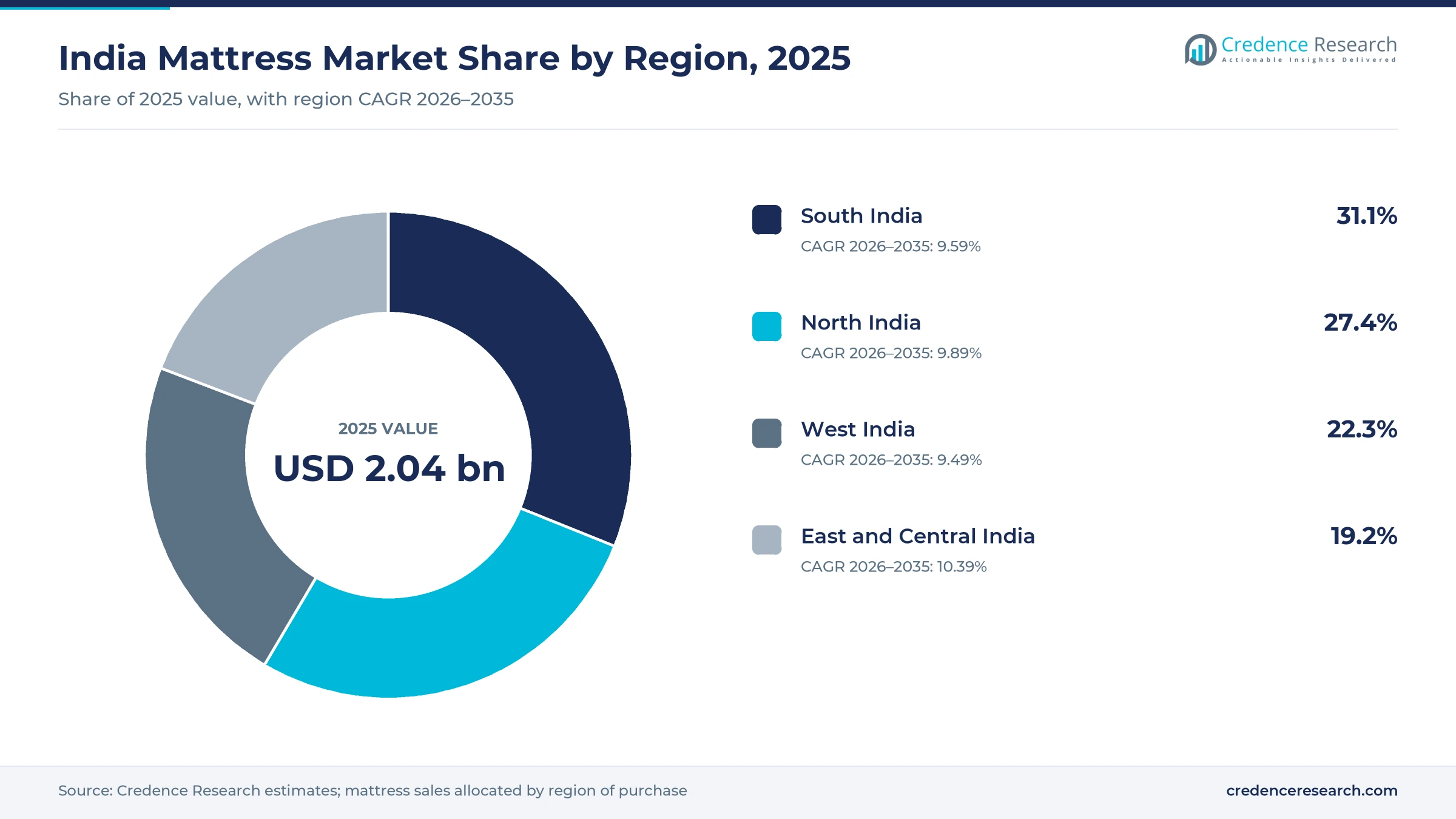
| Region | Value, 2025 (USD billion) | Share, 2025 | CAGR, 2026–2035 |
|---|---|---|---|
| South India | 0.64 | 31.1% | 9.59% |
| North India | 0.56 | 27.4% | 9.89% |
| West India | 0.46 | 22.3% | 9.49% |
| East and Central India | 0.39 | 19.2% | 10.39% |
Why does South India hold the largest share?
South India held 31.1% of 2025 value and grows at 9.59% a year, because Kerala, Karnataka and Tamil Nadu host many branded factories and a long coir mattress tradition. Bengaluru is home to Wakefit and Duroflex, and Hyderabad hosts several regional spring brands. In turn, dense showroom networks, high urban incomes and early online adoption keep branded penetration above the national average, although growth now slows as the region matures.
How does North India balance scale and premium demand?
North India held 27.4% of 2025 value and grows at 9.89% a year, because Delhi NCR, Punjab and Uttar Pradesh combine large populations with rising urban incomes. Sheela Foam is headquartered in Noida, and its Sleepwell dealers cover most district towns in the region. Cold winters in the north also favor thicker foam and spring designs. Housing projects around Delhi NCR and Lucknow add steady first-time demand from new apartment owners.
What drives demand in West India?
West India held 22.3% of 2025 value and grows at 9.49% a year, because Mumbai, Pune and Ahmedabad have mature branded retail and high apartment density. Many buyers replace spring and foam mattresses rather than buying for the first time, which slows unit growth. However, Gujarat and Maharashtra also host many hotels and hospitals, which supports contract demand and premium latex sales in metro areas.
Why is East and Central India growing fastest?
East and Central India held 19.2% of 2025 value and grows fastest at 10.39% a year, because low branded penetration leaves room for formal products. Bihar, Odisha, West Bengal, Madhya Pradesh and Chhattisgarh account for a large part of rural housing completions under PMAY-G. As a result, dealers and online brands are adding coverage in towns where cotton mattresses still dominate, which lifts both volumes and average prices.
IPOs, funding rounds and new showrooms marked 2025 and 2026
| Development | Status and market relevance |
|---|---|
| In May 2025, Sheela Foam reported 12% mattress volume growth for fiscal 2025 and more than 5,800 Small Town India touchpoints. | Shows branded reach extending into smaller towns after the Kurlon integration |
| In August 2025, The Sleep Company raised Rs 480 crore in a Series D round led by ChrysCapital and 360 ONE Asset. | Funds new factories, stores and research on SmartGRID comfort technology |
| In October 2025, Duroflex filed its draft red herring prospectus to fund 120 new company-owned stores. | Adds a second listed-company route for branded store expansion |
| In December 2025, Wakefit Innovations listed on BSE and NSE after a 2.52 times subscribed public issue. | Proceeds support 117 new company-owned stores across India |
| In August 2026, Sheela Foam reported 6% mattress volume growth and 41 net new showrooms for the June 2026 quarter. | Online volume rose 23%, confirming the shift toward digital channels |
Zoned support, smart grids and cooling layers spread
- Zoned pocket springs give different support under shoulders and hips, which lets spring brands compete with memory foam on pressure relief.
- Polymer grid layers such as The Sleep Company's patented SmartGRID spread weight across thousands of air channels and claim cooler sleep than solid foam.
- Roll-pack compression shrinks foam and hybrid mattresses into boxes, which cuts freight cost and enables online delivery to distant districts.
- Natural latex and coir hybrids combine rubber from Kerala with coir fiber, which appeals to buyers seeking firmer, breathable and less chemical-heavy beds.
Need a Custom Version of This Report?
Tailor the scope, geography, or segments to your exact requirements.
- Custom geography or segment scope
- Direct access to our analyst team
Sheela Foam leads a fast-consolidating branded field
Competition is moving from many local makers toward a smaller group of national brands with factories, showrooms and online reach. Sheela Foam leads through Sleepwell and Kurlon after acquiring a 94.66% stake in Kurlon Enterprise, and it also holds a stake in Furlenco. Duroflex sells through Duroflex, Sleepyhead and Perfect Rest brands, supplies Durofoam to smaller makers and filed to list in October 2025. Wakefit built a vertically integrated direct model and listed in December 2025, while The Sleep Company raised Rs 480 crore in August 2025 to expand on patented grid technology. Peps Industries focuses on spring mattresses through Great Sleep Stores and a license with Restonic. Rivals compete on price tiers, trial periods, warranties, store density and dealer credit, while scale in foam production and advertising decides who can expand fastest. Regional brands hold strong positions in specific states, which keeps the market fragmented outside the top tier.
Companies profiled and their roles in this market
| Company | Type | Role in the market |
|---|---|---|
| Sheela Foam Limited | Listed manufacturer | Owns Sleepwell and Kurlon, runs national dealer and showroom networks and a Small Town India program |
| Duroflex Limited | Manufacturer | Sells Duroflex, Sleepyhead and Perfect Rest brands and plans 120 new company-owned stores |
| Wakefit Innovations Limited | Listed D2C brand | Vertically integrated brand with 125 stores in 62 cities as of September 2025 |
| Comfort Grid Technologies Private Limited | D2C brand | Operates The Sleep Company with patented SmartGRID products and 150 exclusive outlets |
| Peps Industries Private Limited | Manufacturer | Spring mattress maker selling through Great Sleep Stores under a Restonic license |
Credence Research view on formalization and pricing
Credence Research's view is that India's mattress demand will grow faster than household income because branded products are replacing cotton and local foam beds. Listed brands now have capital to open showrooms in smaller towns, and online delivery covers districts that once had no branded option. However, price competition from unorganized makers and volatile chemical costs will keep margins under pressure. Firms that combine their own foam production with strong dealer networks and online reach should gain share fastest through 2035.
How the India sleep surface estimate was built
The report uses 2025 as the base year on a calendar basis, and market values come from the Credence Research model. That model combines household and housing data, urbanization from World Bank data, company disclosures on volumes and stores, and typical retail prices by product type. Segment and regional splits are Credence Research estimates, with regional shares set by the client and growth tilts based on housing and retail trends. Sources used are government releases, company filings and offer documents, industry news and statistical databases, and no interviews or surveys were used.
Organized brands gain share through 2035
Mattress sales are expected to reach USD 5.23 billion by 2035, a 9.81% CAGR during 2026–2035, as branded products replace traditional beds across India. Growth should stay strong through 2028 while listed brands open hundreds of new stores and online delivery deepens in smaller towns. After that, replacement demand and premium trading up will carry growth as first-time buying slows in South and West India. Faster rural housing completions would lift this outlook, while sharp raw material price rises would lower it.
Frequently Asked Questions
How big is the India mattress market?
Which product type leads mattress sales in India?
Which region leads the India mattress market?
Which sales channel is growing fastest?
What drives mattress demand in India?
Did GST change mattress prices in 2025?
Who are the leading mattress companies in India?
What are the main challenges for mattress brands?
Table of Content
Chapter 1 Market Segmentation
- 1.1 Segmentation Framework
- 1.1.1 Product and Service Classification
- 1.1.2 Application and End-Use Classification
- 1.1.3 Technology and Solution Classification
- 1.1.4 Customer and Distribution Channel Classification
- 1.1.5 Geographic Segmentation
- 1.1.6 Market Segment Definitions and Boundaries
- 1.2 By Product Type
- 1.2.1 Foam Mattresses
- 1.2.2 Spring Mattresses
- 1.2.3 Cotton and Traditional Mattresses
- 1.2.4 Latex and Hybrid Mattresses
- 1.3 By Customer Type
- 1.3.1 Residential Households
- 1.3.2 Hospitality Buyers
- 1.3.3 Healthcare Buyers
- 1.3.4 Institutional Accommodation
Chapter 2 Introduction
- 2.1 Report Objectives and Scope
- 2.2 Product Definition and Industry Terminology
- 2.3 Market Inclusions and Exclusions
- 2.4 Research Process
- 2.4.1 Primary Research and Expert Interviews
- 2.4.2 Secondary Research and Source Review
- 2.4.3 Top-Down and Bottom-Up Estimation
- 2.4.4 Data Triangulation and Verification
- 2.5 Market Size Measurement Basis
- 2.5.1 2025: USD 2.04 billion → 2035: USD 5.23 billion
- 2.6 Historical and Forecast Reference Periods
- 2.6.1 Historical Period: 2018-2025
- 2.6.2 Base Year: 2025
- 2.6.3 Forecast Period: 2025-2035
- 2.7 Research Assumptions and Limitations
Chapter 3 Executive Summary
- 3.1 Market Snapshot and Key Findings
- 3.2 Base-Year Market Size, 2025
- 3.3 Forecast Market Size, 2035
- 3.4 Revenue and Volume Growth Outlook
- 3.5 Key Demand and Supply Indicators
- 3.6 Leading Market Segments
- 3.7 Fastest-Growing Market Opportunities
- 3.8 Regional Performance Highlights
- 3.9 Technology and Industry Transformation
- 3.10 Competitive Landscape Summary
- 3.11 Analyst View and Strategic Implications
Chapter 4 India Mattress Market Trends and Developments
- 4.1 Historical Industry Development, 2018-2025
- 4.2 Recent Market Trends and Developments
- 4.3 Demand and Customer Behavior Trends
- 4.4 Technology and Product Innovation
- 4.5 Artificial Intelligence, Automation and Digitalization
- 4.6 Local Manufacturing and Supply Chain Realignment
- 4.7 Industry Partnerships, Mergers and Acquisitions
- 4.8 Sustainability and Circular Economy Developments
- 4.9 Government and Private Sector Investment Trends
- 4.10 Emerging Business Models and Commercialization
- 4.11 Industry Developments and Announcements
Chapter 5 India Mattress Market Production, Supply and Demand Analysis
- 5.1 Demand Trend and Consumption Analysis, 2018-2025
- 5.2 Demand Forecast, 2025-2035
- 5.3 Production and Output Trend, 2018-2025
- 5.4 Production and Output Forecast, 2025-2035
- 5.5 Installed Capacity and Capacity Utilization
- 5.6 Company-Wise Production Plants and Statistics
- 5.6.1 Installed Production Capacity
- 5.6.2 Actual Production
- 5.6.3 Planned Capacity and Expansion Targets
- 5.7 Supply Chain Structure and Procurement Trends
- 5.8 Supply-Demand Gap and Bottlenecks
- 5.9 Import Dependence and Sourcing Structure
- 5.10 Contract Manufacturing and Outsourcing
- 5.11 Regional Supply and Demand Concentration
Chapter 6 India Mattress Market Pricing Analysis
- 6.1 Pricing Structure and Measurement
- 6.2 Historical Pricing Trends, 2018-2025
- 6.3 Pricing Outlook, 2025-2035
- 6.4 Average Selling Price and Unit Economics
- 6.5 Pricing by Product and Market Segment
- 6.6 Geographic Pricing Differences
- 6.7 Key Input, Energy, Labor and Logistics Costs
- 6.8 Contract Pricing and Purchasing Models
- 6.9 Pricing Sensitivity and Competitive Positioning
- 6.10 Price, Margin and Profitability Implications
Chapter 7 India Mattress Market Dynamics
- 7.1 Market Growth Drivers
- 7.1.1 Demand-Side Drivers
- 7.1.2 Technology and Innovation Drivers
- 7.1.3 Infrastructure and Investment Drivers
- 7.1.4 Regulatory and Policy Drivers
- 7.2 Market Restraints
- 7.2.1 Cost and Affordability Constraints
- 7.2.2 Technology and Adoption Barriers
- 7.2.3 Supply Chain and Operational Constraints
- 7.3 Market Challenges
- 7.3.1 Competitive Pressure and Margin Erosion
- 7.3.2 Skills, Infrastructure and Implementation Gaps
- 7.4 Emerging Market Opportunities
- 7.5 Market Dynamics Impact and Time-Horizon Assessment
Chapter 8 India Mattress Value Chain Analysis
- 8.1 Industry Value Chain Overview
- 8.2 Upstream Suppliers and Critical Inputs
- 8.3 Technology and Component Providers
- 8.4 Manufacturing or Service Delivery
- 8.5 Distribution, Channel Partners and Integrators
- 8.6 Downstream Applications and End Users
- 8.7 Value Addition and Profit Pools
- 8.8 Vertical Integration and Outsourcing
- 8.9 Supplier Concentration and Risk
- 8.10 Supply Chain Localization and Resilience
Chapter 9 India Mattress Market Regulations and Policies
- 9.1 Relevant Laws, Standards and Compliance Frameworks
- 9.2 Product, Service, Safety and Quality Requirements
- 9.3 Government Policies, Incentives and Subsidies
- 9.4 Imports, Exports and Trade Barriers
- 9.5 Public Procurement and Local Content Requirements
- 9.6 Environmental and Sustainability Compliance
- 9.7 Upcoming Policy Changes and Market Implications
Chapter 10 India Mattress Market Hotspots and Opportunities
- 10.1 Market Opportunity Mapping and Growth Hotspots
- 10.2 High-Growth Applications and Customer Groups
- 10.3 Underserved Markets and White-Space Opportunities
- 10.4 Emerging Technology and Product Opportunities
- 10.5 New Capacity and Investment Hotspots
- 10.6 Market Entry and Expansion Opportunities
- 10.7 Distribution and Partnership Opportunities
- 10.8 Near-Term and Long-Term Commercial Potential
- 10.9 Opportunity Attractiveness and Execution Risks
Chapter 11 India Mattress Market Outlook, 2025-2035
- 11.1 Market Size and Analysis
- 11.1.1 Revenue (Market Measurement: 2025: USD 2.04 billion → 2035: USD 5.23 billion)
- 11.1.2 Market Volume and Quantity Sold
- 11.1.3 Historical Market Size, 2018-2025
- 11.1.4 Base-Year Market Size, 2025
- 11.2 Market Forecast, 2025-2035
- 11.2.1 Revenue Forecast to 2035
- 11.2.2 Volume Forecast to 2035
- 11.2.3 CAGR and Year-on-Year Growth
- 11.2.4 Incremental Revenue Opportunity
- 11.3 Forecast Assumptions and Scenario Analysis
- 11.3.1 Base-Case Forecast
- 11.3.2 Optimistic and Conservative Scenarios
- 11.3.3 Technology, Pricing and Policy Sensitivities
- 11.4 Market Attractiveness and Growth Outlook
Chapter 12 India Mattress Market Segmentation and Outlook
- 12.1 Segmentation Summary and Market Shares, 2025
- 12.2 Largest and Fastest-Growing Segments
- 12.3 By Product Type - Market Size and Forecast, 2025-2035
- 12.3.1 Segment Definition and Scope
- 12.3.2 Historical Market Size, 2018-2025
- 12.3.3 Revenue Forecast, 2025-2035
- 12.3.4 Volume Forecast, 2025-2035
- 12.3.5 Base-Year Market Share, 2025
- 12.3.6 Segment CAGR and Growth Drivers
- 12.3.7 Subsegment Market Size and Forecast
- 12.3.7.1 Foam Mattresses
- 12.3.7.2 Spring Mattresses
- 12.3.7.3 Cotton and Traditional Mattresses
- 12.3.7.4 Latex and Hybrid Mattresses
- 12.3.8 Subsegment Pricing and Adoption Trends
- 12.3.9 Leading Suppliers and Competition
- 12.3.10 Regional Demand and Opportunities
- 12.4 By Customer Type - Market Size and Forecast, 2025-2035
- 12.4.1 Segment Definition and Scope
- 12.4.2 Historical Market Size, 2018-2025
- 12.4.3 Revenue Forecast, 2025-2035
- 12.4.4 Volume Forecast, 2025-2035
- 12.4.5 Base-Year Market Share, 2025
- 12.4.6 Segment CAGR and Growth Drivers
- 12.4.7 Subsegment Market Size and Forecast
- 12.4.7.1 Residential Households
- 12.4.7.2 Hospitality Buyers
- 12.4.7.3 Healthcare Buyers
- 12.4.7.4 Institutional Accommodation
- 12.4.8 Subsegment Pricing and Adoption Trends
- 12.4.9 Leading Suppliers and Competition
- 12.4.10 Regional Demand and Opportunities
- 12.5 Segment Growth Comparison
- 12.6 Segment Attractiveness and Priority Matrix
Chapter 13 India Mattress End-Use and Application Market Outlook
- 13.1 End-Use Industry and Customer Demand Structure
- 13.2 Leading Applications and Customer Groups
- 13.3 End-Use Market Size, Share and Forecast
- 13.4 Major End-Use Industry Deep Dives
- 13.4.1 Customer Requirements and Use Cases
- 13.4.2 Demand and Replacement Cycles
- 13.4.3 Technical and Regulatory Considerations
- 13.4.4 Purchasing and Procurement Models
- 13.4.5 Leading Vendors and Distribution Channels
- 13.4.6 Forecast and Commercial Opportunities
- 13.5 Emerging Applications and Cross-Segment Demand
- 13.6 End-Use Industry Investment Priorities
Chapter 14 India Mattress Geographic Market Outlook, 2025-2035
- 14.1 Regional Market Size and Country-Level Shares, 2025
- 14.2 Country Market Size Comparison, 2025
- 14.3 Country Market Forecasts, 2025-2035
- 14.4 Subregional Industrial and Demand Clusters
- 14.5 Intra-Regional Pricing and Cost Differences
- 14.6 Cross-Border Trade and Supply Networks
- 14.7 Regional Supply and Demand Balances
- 14.8 Country Opportunity Comparison and Prioritization
Note: Every listed country is covered on the structure shown under the first country.
Chapter 15 India Mattress Technology, Innovation and Sustainability Outlook
- 15.1 Technology Landscape and Maturity
- 15.2 Product, Process and Service Innovation
- 15.3 AI, Automation and Digital Tools in the Industry
- 15.4 Technology Adoption and Performance Benchmarking
- 15.5 Innovation Pipeline and R&D Investment
- 15.6 Patent and Intellectual Property Trends
- 15.7 Energy Efficiency and Resource Management
- 15.8 Sustainability, Recycling and Circularity
- 15.9 Technology Roadmap, 2025-2035
- 15.10 Risks of Obsolescence and Technology Substitution
Chapter 16 India Mattress Market Key Strategic Imperatives
- 16.1 Growth and Market Entry Priorities
- 16.2 High-Return Products and Segments
- 16.3 Pricing, Profitability and Cost Optimization
- 16.4 Technology Investment and Product Differentiation
- 16.5 Supply Chain Localization and Resilience
- 16.6 Distribution and Customer Acquisition
- 16.7 Partnership, Acquisition and Capacity Strategy
- 16.8 Regional Expansion Priorities
- 16.9 Short-, Medium- and Long-Term Actions
Chapter 17 Competition Outlook
- 17.1 Industry Competition Characteristics
- 17.2 Market Structure and Concentration
- 17.3 Market Share and Competitive Positioning, 2025
- 17.4 Company-Wise Revenue and Product Benchmarking
- 17.5 Production and Service Capacity Benchmarking
- 17.6 Technology, Pricing and Differentiation
- 17.7 Regional Footprint and Distribution Strength
- 17.8 Mergers, Acquisitions and Strategic Alliances
- 17.9 New Entrants and Competitive Threats
- 17.10 Porter's Five Forces and Industry Attractiveness
- 17.11 Competitive Outlook, 2025-2035
Chapter 18 Company Profiles
- 18.1 Company Coverage and Selection Criteria
- 18.2 Sheela Foam Limited
- 18.2.1 Business Description
- 18.2.2 Company Ownership and Geographic Presence
- 18.2.3 Product and Service Portfolio
- 18.2.4 Manufacturing and Operating Footprint
- 18.2.5 Production Capacity and Expansion Plans
- 18.2.6 Financial Performance and Investment
- 18.2.7 Market Share and Competitive Position
- 18.2.8 Technology and Innovation Capabilities
- 18.2.9 Strategic Alliances or Partnerships
- 18.2.10 Recent Developments
- 18.2.11 Growth Strategy and Outlook
- 18.3 Duroflex Limited
- 18.4 Wakefit Innovations Limited
- 18.5 Peps Industries Private Limited
- 18.6 Comfort Grid Technologies Private Limited
- 18.7 Centuary Fibre Plates Private Limited
- 18.8 Springwel Mattresses Private Limited
- 18.9 Springfit Mattresses
- 18.10 Coirfit Mattress
- 18.11 Nilkamal Sleep
- 18.12 Other Relevant Market Participants
Note: Every listed company is profiled on the structure shown under the first company. The company list is preliminary and may change based on research findings, market developments, data availability and client requirements.
Chapter 19 Disclaimer
- 19.1 Research and Forecast Disclaimer
- 19.2 Data Source and Estimation Limitations
Note: The depth of individual sections depends on data availability for this market. Volume, capacity, trade and other unit-based metrics are included where applicable.

