India Beer and Malt Spirit Equipment Market: USD 241.6 million in 2025, as Brewers and Malt Distillers Add Capacity
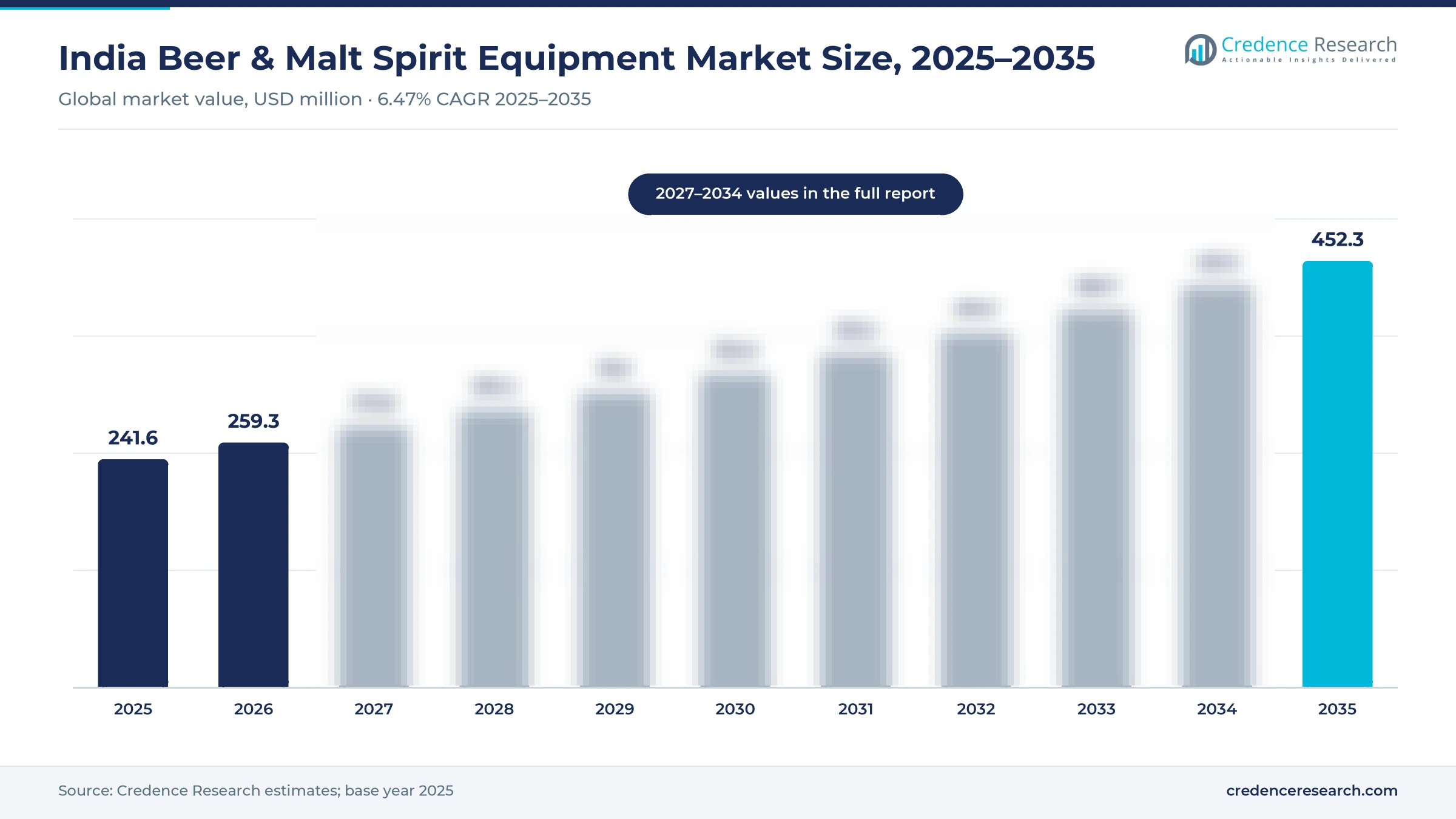
The India beer and malt spirit equipment market was worth USD 241.6 million in 2025, and we forecast USD 452.3 million by 2035, a CAGR of 6.47% over 2025–2035. For 2026, the current year, we estimate USD 259.3 million. New greenfield breweries, a wave of malt whisky distilleries and a steady stream of brewpubs drive the spend.
These are Credence Research estimates, built from company filings, state excise and trade policy documents and equipment pricing. We did not use any other firm's market study.
Our central view: India's process-equipment cycle has turned up after a decade in which large brewers mostly debottlenecked old sites. United Breweries' first new brewery in over a decade, in Uttar Pradesh, and capacity work at Telangana show brewers building again, while Indian single malt makers are adding stills to meet demand at home and abroad. Malt spirit distilleries are the fastest-growing buyers at 8.79% a year.
What equipment falls inside this market?
We count new process equipment installed in India to make beer, malt and malt spirit, valued at the price paid by the brewery, distillery or maltster, whether bought from Indian fabricators or imported.
The scope covers:
- Brewhouse vessels: mash tuns, lauter tuns, mash filters, wort kettles and whirlpools.
- Fermentation and maturation tanks, wort and beer coolers, filtration and bright beer storage.
- Pot stills, column stills and condensers for malt spirit, plus steeping, germination and kilning equipment in maltings.
- Heat exchangers, CIP systems, yeast handling and other auxiliary process units.
Not counted:
- Bottling, canning and kegging lines.
- Grain-neutral-spirit and ethanol distilleries that make no malt spirit.
- Casks, warehouses and buildings.
Why does spend rise faster than beer volumes?
Because India is adding capacity in new places and at higher specification. A greenfield brewery needs a full brewhouse and cellar, not just extra tanks, and malt distilleries use copper pot stills that cost far more per litre of capacity than grain-spirit columns. Distillation equipment, with 17.6% of 2025 value, grows at 9.18% a year, the fastest of any equipment type.
Report Attributes
| Attribute | Details |
|---|---|
| Market size (2025) | USD 241.6 million |
| Market size (2026) | USD 259.3 million |
| Market size (2035) | USD 452.3 million |
| CAGR (2025–2035) | 6.47% |
| Base year | 2025 |
| Historic period | 2018–2024 |
| Forecast period | 2026–2035 |
| Largest equipment type | Fermentation, Cooling, Filtration & Storage (31.8%) |
| Fastest-growing equipment type | Distillation Equipment (9.18% CAGR) |
| Largest application | Large Commercial Breweries (54.2%) |
| Fastest-growing application | Malt Spirit Distilleries (8.79% CAGR) |
| Largest region | South India (34.5%) |
| Fastest-growing region | North India (7.72% CAGR) |
| Segments covered | Equipment Type, Application, Region |
What did we use to size the market?
We combined three views and kept the result only where they lined up:
- Project lens. Announced brewery, malt distillery and malting projects, with their timing, set the new-build pipeline.
- Installed-base lens. Replacement and upgrade spend was estimated from the age of existing brewhouses, cellars and stills.
- Price lens. Equipment prices by type and by Indian or imported origin turned projects into value.
Project lists, prices and value by segment are in the delivered report.
India Beer and Malt Spirit Equipment Market Insights
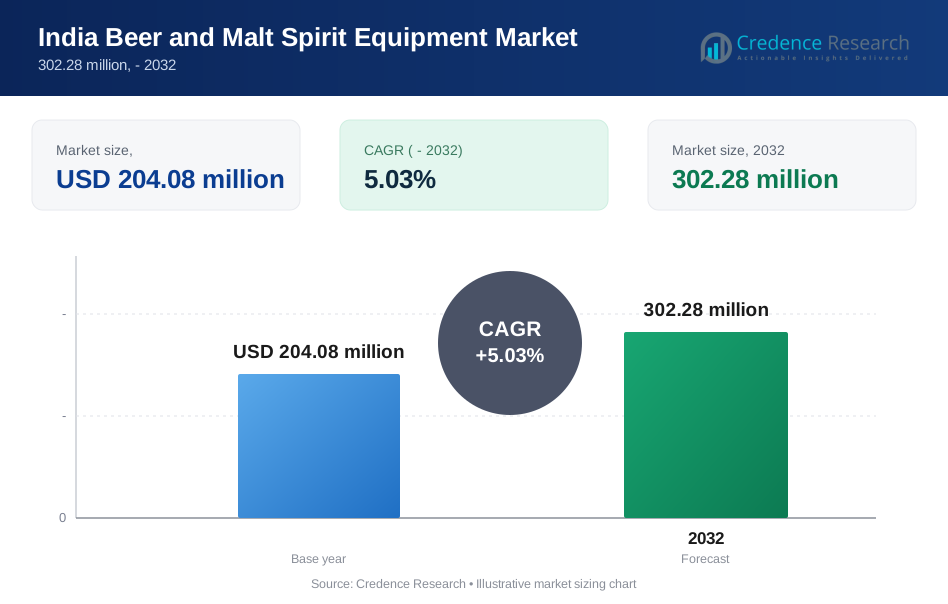
- The India beer and malt spirit equipment market was worth USD 241.6 million in 2025; we forecast USD 452.3 million by 2035, a 6.47% CAGR.
- We estimate the market at USD 259.3 million in 2026.
- Fermentation, cooling, filtration and storage equipment holds 31.8% of 2025 value; distillation equipment grows fastest at 9.18% a year.
- Large commercial breweries buy 54.2% of equipment value; malt spirit distilleries grow fastest at 8.79% a year.
- South India holds a 34.5% share; North India grows fastest at 7.72% a year.
- The India-UK trade agreement, in force from 15 July 2026, halves the Scotch duty to 75%, sharpening competition for Indian malt distillers.
Brewhouses, Cellars and Copper Stills: Where India's Beer and Malt Spirit Equipment Spend Goes
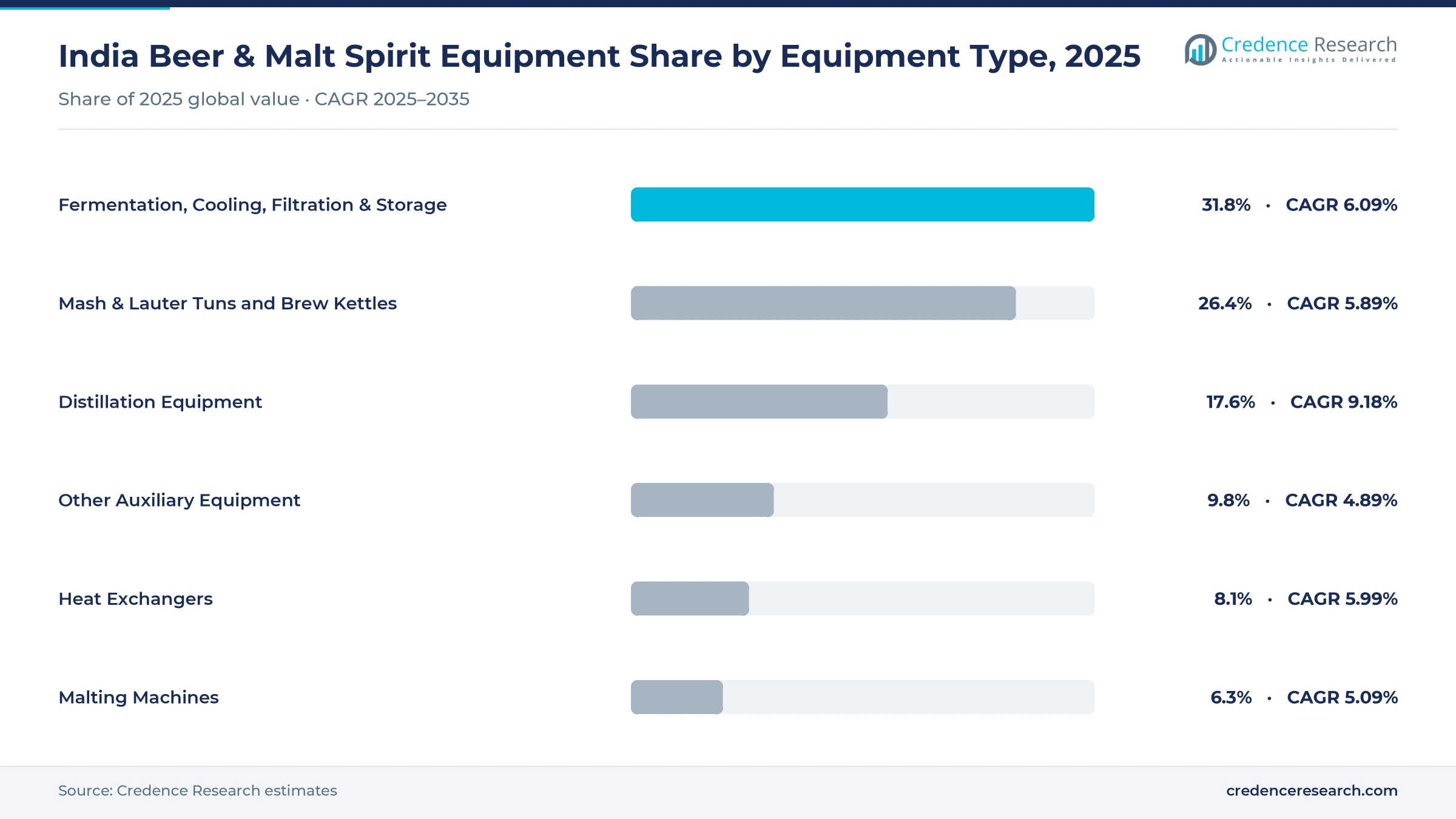
Fermentation, cooling, filtration and storage equipment is the largest type, with 31.8% of 2025 value. Distillation equipment is the fastest-growing at 9.18% a year.
| Equipment type | Share 2025 | CAGR 2025–2035 |
|---|---|---|
| Fermentation, Cooling, Filtration & Storage | 31.8% | 6.09% |
| Mash & Lauter Tuns and Brew Kettles | 26.4% | 5.89% |
| Distillation Equipment | 17.6% | 9.18% |
| Other Auxiliary Equipment | 9.8% | 4.89% |
| Heat Exchangers | 8.1% | 5.99% |
| Malting Machines | 6.3% | 5.09% |
Why do cellar systems take the largest share?
Fermentation, cooling, filtration and storage equipment holds 31.8% and grows at 6.09% a year. Every new litre of beer capacity needs fermenters, maturation tanks and bright beer tanks, and premium beers need longer residence time.
How much goes into the brewhouse?
Mash and lauter tuns and brew kettles hold 26.4% and grow at 5.89% a year, led by greenfield breweries and brewpub systems.
Why is distillation growing fastest?
Distillation equipment holds 17.6% and grows at 9.18% a year, driven by pot stills for Indian single malts and new malt spirit lines.
What do heat exchangers, maltings and auxiliaries add?
Heat exchangers hold 8.1% and grow at 5.99% a year. Malting machines hold 6.3%, and other auxiliary equipment such as CIP, yeast handling and grain handling holds 9.8%.
Who buys the equipment?
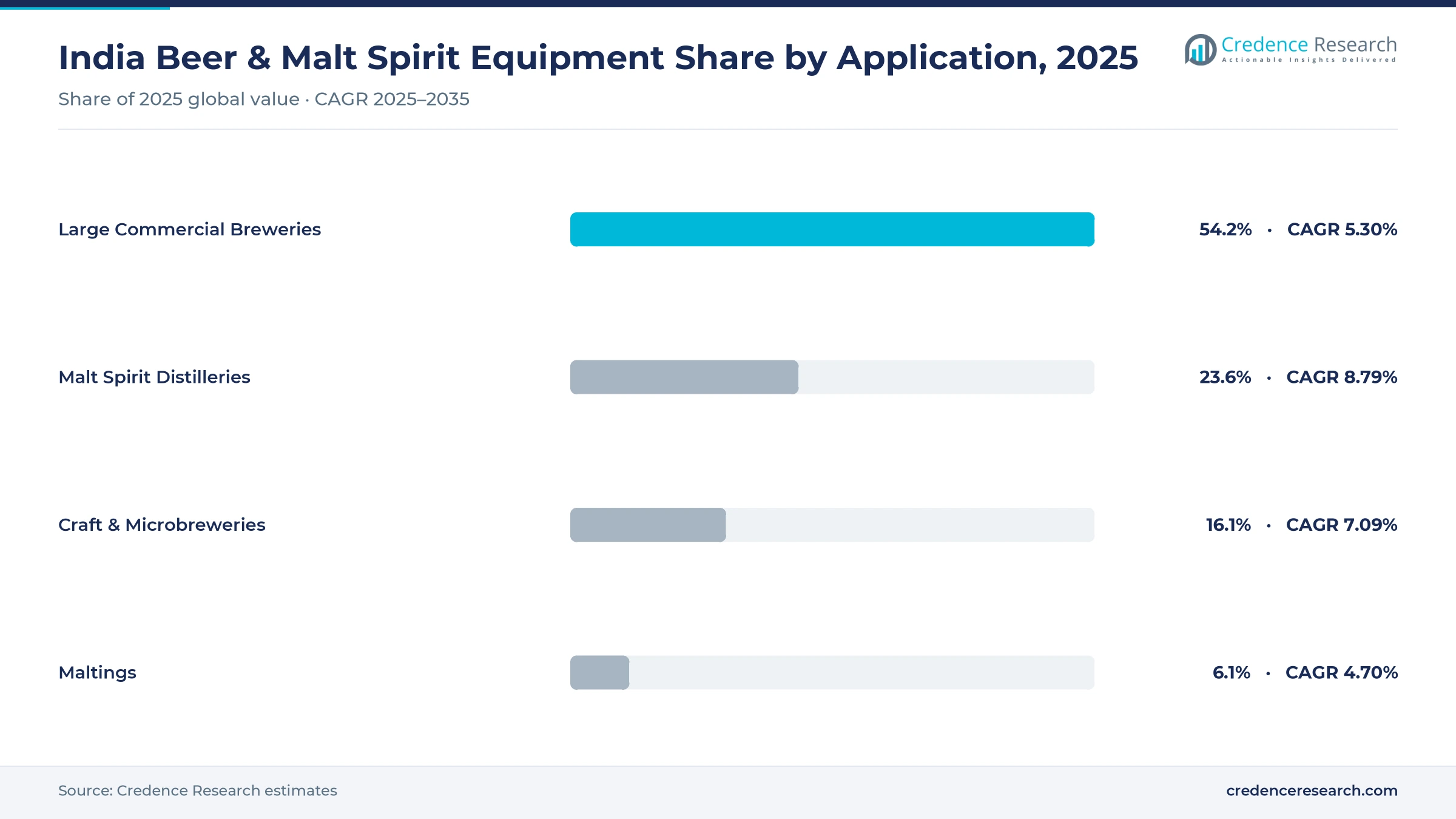
Large commercial breweries are the largest buyers at 54.2% of 2025 value. Malt spirit distilleries are the fastest-growing at 8.79% a year.
| Application | Share 2025 | CAGR 2025–2035 |
|---|---|---|
| Large Commercial Breweries | 54.2% | 5.30% |
| Malt Spirit Distilleries | 23.6% | 8.79% |
| Craft & Microbreweries | 16.1% | 7.09% |
| Maltings | 6.1% | 4.70% |
How much do large breweries spend?
Large commercial breweries hold 54.2% and grow at 5.30% a year, with spending concentrated in a few groups' greenfield and expansion projects.
What do malt distilleries and craft brewers add?
Malt spirit distilleries hold 23.6% and grow at 8.79% a year. Craft and microbreweries hold 16.1% and grow at 7.09% a year, buying many small systems.
Where do maltings fit?
Maltings hold 6.1% and grow at 4.70% a year, adding capacity as brewers and distillers seek local malted barley.
Request a Free Sample
Fill in your details and we'll send you a free sample report.
- Sample data tables & charts
- Research methodology
Why Indian Brewers and Malt Distillers Are Buying Equipment Again
Are large brewers building new plants?
Yes, for the first time in years. On 25 February 2025, United Breweries announced a greenfield brewery in Uttar Pradesh, its first new brewery in over a decade, with operations planned from early 2027. In November 2025 it registered land for the site. A new plant of that kind needs a full brewhouse, cellar and utilities, which is why large commercial breweries buy 54.2% of 2025 equipment value.
Brewers are also expanding at existing sites. In July 2026, United Breweries commissioned work at its Nizam Brewery in Telangana that nearly doubles that site's capacity, in one of India's largest beer markets.
Why are malt distilleries expanding so fast?
Demand for Indian single malts keeps rising at home and abroad, and Indian whisky makers want more malt for premium blends, so distillers are adding stills ahead of growth. Piccadily Agro is expanding its Indri distillery in Haryana and building a malt spirit line at Mahasamund in Chhattisgarh; Radico Khaitan, Amrut, John Distilleries and Diageo India have all added malt capacity. Malt spirit distilleries buy 23.6% of value and are the fastest-growing application at 8.79% a year. Our malt whiskey outlook covers the product side.
How does premiumisation lift spend?
Premium and strong-beer brands, wheat beers and lagers with longer maturation need more tank capacity per litre sold, and premium malt whisky needs copper pot stills rather than columns. Fermentation, cooling, filtration and storage equipment holds 31.8% of 2025 value and grows at 6.09% a year.
What role do brewpubs play?
A large one for the number of systems sold. Bengaluru, Pune, Gurugram, Mumbai and Hyderabad host hundreds of brewpubs, and state rules in Karnataka, Maharashtra and Haryana allow on-site brewing. Craft and microbreweries hold 16.1% of value and grow at 7.09% a year; our craft beer report tracks their output.
Do state policies matter?
Very much. Alcohol is a state subject in India, so excise duty, licensing and permitted locations differ by state. States that ease brewery and microbrewery licences, such as Uttar Pradesh in recent years, attract new plants; North India grows at 7.72% a year in our model.
Greenfield Brewhouses, Copper Pot Stills and Local Fabrication: How Equipment Buying Is Changing
Four trends stand out: greenfield brewery projects, a pot-still boom in malt whisky, more equipment made in India, and automation in brewhouses.
Trend 1: are brewers moving into new states?
Yes. Brewers are building closer to fast-growing beer states to cut freight and excise friction between states. Uttar Pradesh is the clearest example, with United Breweries' greenfield brewery due from early 2027.
Trend 2: why are copper pot stills in demand?
Single malt rules call for pot-still distillation of malted barley, and Indian makers are adding stills to raise output of aged malt. Distillation equipment grows at 9.18% a year. Malting capacity follows, with malting machines growing at 5.09% a year; our specialty malt study covers the malt supply side.
Trend 3: is more equipment made in India?
It is. Indian fabricators now build stainless brewhouses, fermenters and columns that once came mostly from Germany, Italy and China, and engineering groups such as Praj Industries offer complete brewery and distillery projects. Imported equipment still leads in high-end brewhouses, mash filters and centrifuges. UN Comtrade data record only small Indian imports under the dedicated brewery-machinery heading, which supports our view that most vessels are fabricated locally or arrive under other headings such as heat exchangers and filters.
Trend 4: are brewhouses becoming automated?
Yes. New brewhouses ship with recipe-driven automation, energy recovery and CIP control, which raise the value per vessel. Heat exchangers, central to energy recovery, hold 8.1% of 2025 value; our brewery heat exchanger analysis looks at that category worldwide.
What Slows Equipment Spend in Indian Brewing and Malt Distilling
How do state taxes affect investment?
Sharply. Beer and spirits are taxed by each state, and sudden excise increases or pricing changes can stall sales and delay projects. Prohibition in states such as Bihar and Gujarat removes them as markets for local brewing altogether.
Will cheaper Scotch hurt Indian malt distillers?
It adds pressure. The India-UK trade agreement cuts India's tariff on Scotch whisky from 150% to 75%, falling to 40% within 10 years, and it took effect on 15 July 2026. Indian single malts will face stronger imported competition at the premium end, which may slow some planned still investments.
Are imported components costly?
Yes. High-end brewhouse equipment, mash filters, centrifuges and some control systems are still imported, and a weaker rupee raises their cost. Indian buyers often mix imported core equipment with locally fabricated tanks to manage budgets.
Do licensing and water rules delay projects?
They can. New breweries and distilleries need state excise licences, pollution control consent and water allocations, and approvals can take longer than construction.
Where Equipment Suppliers Can Find Growth in India
Which buyers offer the most new demand?
Malt spirit distilleries, growing at 8.79% a year, and greenfield breweries in North and East India. East & Northeast India grows at 5.73% a year from a 12.5% base.
Is there a replacement opportunity?
Yes. Many large breweries run brewhouses installed in the 1990s and 2000s; replacing lauter tuns, kettles and coolers with energy-saving designs pays back through lower steam and water use. Mash and lauter tuns and brew kettles hold 26.4% of 2025 value.
Can Indian fabricators export?
Increasingly. Suppliers who serve Indian craft brewers and distillers now quote for projects in Africa, the Middle East and Southeast Asia, using cost advantages built at home.
South India Leads Spend While North India Builds the New Plants
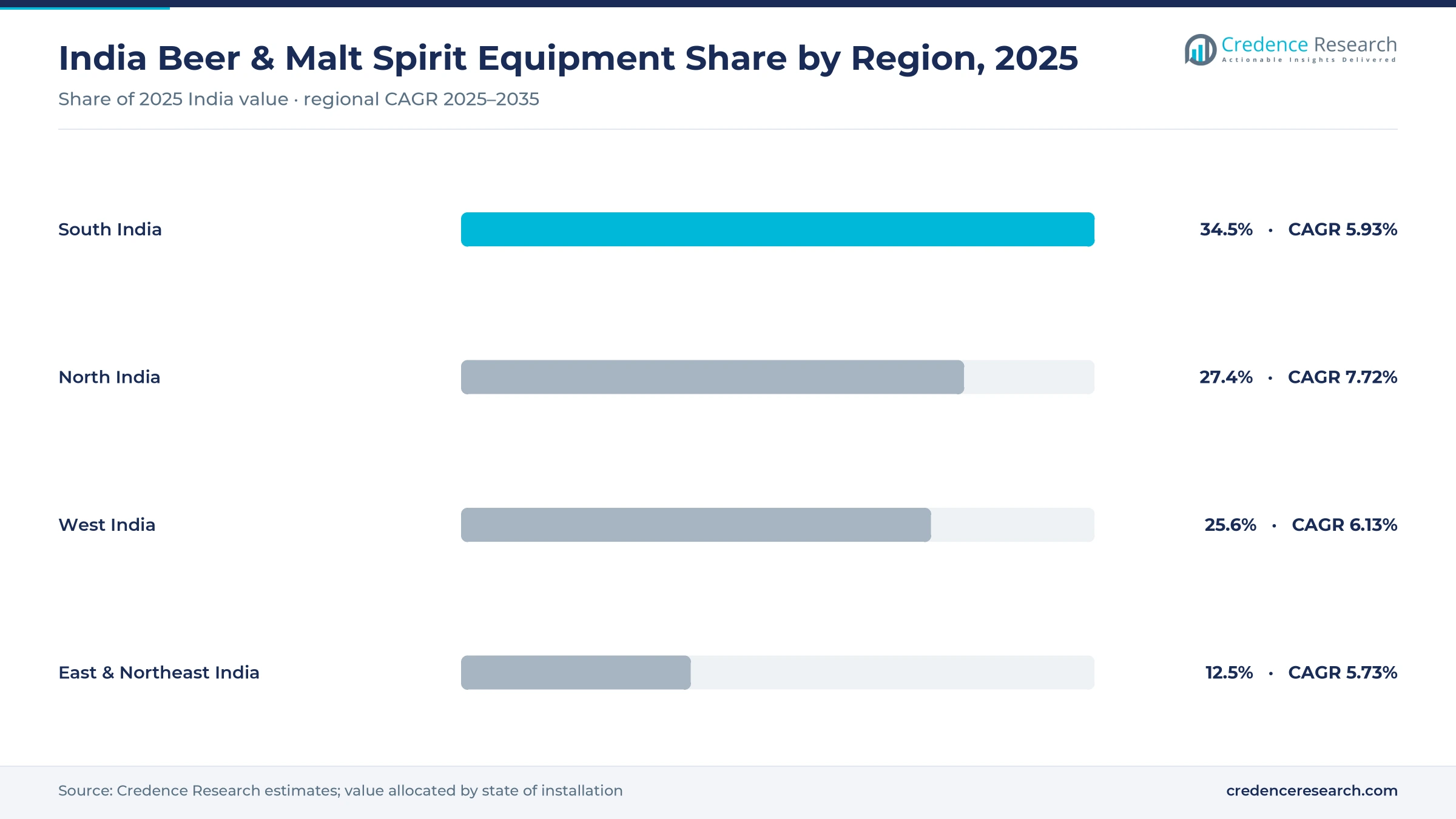
We allocate value to the state where the equipment is installed, grouped into four regions. South India is the largest region, and North India is the fastest-growing at 7.72% a year.
| Region | Share 2025 | CAGR 2025–2035 |
|---|---|---|
| South India | 34.5% | 5.93% |
| North India | 27.4% | 7.72% |
| West India | 25.6% | 6.13% |
| East & Northeast India | 12.5% | 5.73% |
South India: the beer heartland and brewpub capital
South India holds a 34.5% share of 2025 value and grows at 5.93% a year. Karnataka, Telangana and Andhra Pradesh are among India's largest beer markets, Bengaluru has the densest brewpub scene, and Amrut makes single malts in Bengaluru.
North India: where the new brewery and malt projects land
North India holds a 27.4% share and is the fastest-growing region at 7.72% a year. United Breweries' greenfield brewery in Uttar Pradesh, Piccadily Agro's Indri distillery in Haryana and Radico Khaitan's Rampur malt distillery anchor the region.
West India: Maharashtra's breweries and Goa's distillers
West India holds a 25.6% share and grows at 6.13% a year. Maharashtra hosts large breweries and Pune and Mumbai brewpubs, and Goa is home to John Distilleries' Paul John single malt distillery and to craft brewers.
East & Northeast India: the smallest but widening base
East & Northeast India holds a 12.5% share and grows at 5.73% a year. West Bengal and Odisha host breweries, and new projects such as Piccadily Agro's malt spirit line in Chhattisgarh extend investment into central and eastern India.
Global brewery equipment trends are covered in our beer processing study.
New Breweries, Malt Distillery Expansions and Trade Changes, 2025–2026
| Date | Development | Why it matters |
|---|---|---|
| July 2026 | In July 2026, United Breweries commissioned a project at its Nizam Brewery in Telangana that nearly doubles the site's capacity. | Shows brewers expanding existing sites in large beer states. |
| July 2026 | The India-UK Comprehensive Economic and Trade Agreement took effect on 15 July 2026, cutting the Scotch whisky tariff from 150% to 75%. | Raises competition for Indian malt distillers at the premium end. |
| November 2025 | In November 2025, United Breweries registered land for its greenfield brewery in Uttar Pradesh. | Moves the first new UB brewery in over a decade toward construction. |
| July 2025 | On 24 July 2025, India and the UK signed their trade agreement, with Scotch tariffs set to fall to 40% within 10 years. | Sets the long-term tariff path for imported malt whisky. |
| February 2025 | On 25 February 2025, United Breweries announced a greenfield brewery in Uttar Pradesh, planned to start in early 2027. | Signals a new cycle of brewhouse and cellar orders. |
Need a Custom Version of This Report?
Tailor the scope, geography, or segments to your exact requirements.
- Custom geography or segment scope
- Direct access to our analyst team
Global Brewhouse Makers, Indian Engineering Groups and Still Specialists: Who Supplies India
Three supplier groups compete for Indian projects. European engineering groups supply brewhouses and process lines to large brewers. Indian engineering firms and fabricators win a growing share of tanks, stills and complete small plants. Specialist still makers supply the copper heart of malt distilleries.
Who equips large breweries?
- Krones, through its Steinecker brand, supplies brewhouses and process technology to major brewers.
- GEA Group sells brewhouse, fermentation, filtration and centrifuge systems.
- Ziemann Holvrieka builds brewhouses and large stainless tanks.
- Alfa Laval supplies heat exchangers, separators and flow equipment.
Who are the Indian suppliers?
- Praj Industries offers process engineering for breweries and distilleries, including malt spirit plants, alongside its ethanol business.
- Indian stainless fabricators in Pune, Bengaluru and Ahmedabad build fermenters, bright beer tanks and complete brewpub systems for craft brewers.
Who supplies stills?
Forsyths of Scotland and other copper still makers supply pot stills to Indian single malt distillers, while Indian fabricators increasingly build columns and condensers. Buyers include Radico Khaitan, Piccadily Agro, Amrut Distilleries, John Distilleries and Diageo India.
Who are the main buyers?
United Breweries, part of Heineken, is India's largest brewer and the largest single buyer of brewing equipment; AB InBev India and Carlsberg India are the other large brewers.
How concentrated is supply?
Moderately. Global engineering groups dominate large brewhouse orders, but local fabricators supply most tanks and small systems, so no supplier holds a dominant share of total value in our estimate. In our view, suppliers that pair imported core equipment with local fabrication and service will win most of the next decade's greenfield projects.
Frequently Asked Questions
How big is the India beer and malt spirit equipment market?
Which equipment type is largest?
Who buys the most equipment?
Which region of India leads?
Who are the main equipment suppliers?
How does the India-UK trade deal affect the market?
Table of Content
Chapter 1 Market Segmentation
- 1.1 Segmentation Framework
- 1.1.1 Product and Service Classification
- 1.1.2 Application and End-Use Classification
- 1.1.3 Technology and Solution Classification
- 1.1.4 Customer and Distribution Channel Classification
- 1.1.5 Geographic Segmentation
- 1.1.6 Market Segment Definitions and Boundaries
- 1.2 By Equipment Type
- 1.2.1 Fermentation, Cooling, Filtration & Storage
- 1.2.2 Mash & Lauter Tuns and Brew Kettles
- 1.2.3 Distillation Equipment
- 1.2.4 Other Auxiliary Equipment
- 1.2.5 Heat Exchangers
- 1.2.6 Malting Machines
- 1.3 By Application
- 1.3.1 Large Commercial Breweries
- 1.3.2 Malt Spirit Distilleries
- 1.3.3 Craft & Microbreweries
- 1.3.4 Maltings
Chapter 2 Introduction
- 2.1 Report Objectives and Scope
- 2.2 Product Definition and Industry Terminology
- 2.3 Market Inclusions and Exclusions
- 2.4 Research Process
- 2.4.1 Primary Research and Expert Interviews
- 2.4.2 Secondary Research and Source Review
- 2.4.3 Top-Down and Bottom-Up Estimation
- 2.4.4 Data Triangulation and Verification
- 2.5 Market Size Measurement Basis
- 2.5.1 2025: USD 241.6 million → 2035: USD 452.3 million
- 2.6 Historical and Forecast Reference Periods
- 2.6.1 Historical Period: 2018-2025
- 2.6.2 Base Year: 2025
- 2.6.3 Forecast Period: 2025-2035
- 2.7 Research Assumptions and Limitations
Chapter 3 Executive Summary
- 3.1 Market Snapshot and Key Findings
- 3.2 Base-Year Market Size, 2025
- 3.3 Forecast Market Size, 2035
- 3.4 Revenue and Volume Growth Outlook
- 3.5 Key Demand and Supply Indicators
- 3.6 Leading Market Segments
- 3.7 Fastest-Growing Market Opportunities
- 3.8 Regional Performance Highlights
- 3.9 Technology and Industry Transformation
- 3.10 Competitive Landscape Summary
- 3.11 Analyst View and Strategic Implications
Chapter 4 India Beer and Malt Spirit Equipment Market Trends and Developments
- 4.1 Historical Industry Development, 2018-2025
- 4.2 Recent Market Trends and Developments
- 4.3 Demand and Customer Behavior Trends
- 4.4 Technology and Product Innovation
- 4.5 Artificial Intelligence, Automation and Digitalization
- 4.6 Local Manufacturing and Supply Chain Realignment
- 4.7 Industry Partnerships, Mergers and Acquisitions
- 4.8 Sustainability and Circular Economy Developments
- 4.9 Government and Private Sector Investment Trends
- 4.10 Emerging Business Models and Commercialization
- 4.11 Industry Developments and Announcements
Chapter 5 India Beer and Malt Spirit Equipment Market Production, Supply and Demand Analysis
- 5.1 Demand Trend and Consumption Analysis, 2018-2025
- 5.2 Demand Forecast, 2025-2035
- 5.3 Production and Output Trend, 2018-2025
- 5.4 Production and Output Forecast, 2025-2035
- 5.5 Installed Capacity and Capacity Utilization
- 5.6 Company-Wise Production Plants and Statistics
- 5.6.1 Installed Production Capacity
- 5.6.2 Actual Production
- 5.6.3 Planned Capacity and Expansion Targets
- 5.7 Supply Chain Structure and Procurement Trends
- 5.8 Supply-Demand Gap and Bottlenecks
- 5.9 Import Dependence and Sourcing Structure
- 5.10 Contract Manufacturing and Outsourcing
- 5.11 Regional Supply and Demand Concentration
Chapter 6 India Beer and Malt Spirit Equipment Market Pricing Analysis
- 6.1 Pricing Structure and Measurement
- 6.2 Historical Pricing Trends, 2018-2025
- 6.3 Pricing Outlook, 2025-2035
- 6.4 Average Selling Price and Unit Economics
- 6.5 Pricing by Product and Market Segment
- 6.6 Geographic Pricing Differences
- 6.7 Key Input, Energy, Labor and Logistics Costs
- 6.8 Contract Pricing and Purchasing Models
- 6.9 Pricing Sensitivity and Competitive Positioning
- 6.10 Price, Margin and Profitability Implications
Chapter 7 India Beer and Malt Spirit Equipment Market Dynamics
- 7.1 Market Growth Drivers
- 7.1.1 Demand-Side Drivers
- 7.1.2 Technology and Innovation Drivers
- 7.1.3 Infrastructure and Investment Drivers
- 7.1.4 Regulatory and Policy Drivers
- 7.2 Market Restraints
- 7.2.1 Cost and Affordability Constraints
- 7.2.2 Technology and Adoption Barriers
- 7.2.3 Supply Chain and Operational Constraints
- 7.3 Market Challenges
- 7.3.1 Competitive Pressure and Margin Erosion
- 7.3.2 Skills, Infrastructure and Implementation Gaps
- 7.4 Emerging Market Opportunities
- 7.5 Market Dynamics Impact and Time-Horizon Assessment
Chapter 8 India Beer and Malt Spirit Equipment Value Chain Analysis
- 8.1 Industry Value Chain Overview
- 8.2 Upstream Suppliers and Critical Inputs
- 8.3 Technology and Component Providers
- 8.4 Manufacturing or Service Delivery
- 8.5 Distribution, Channel Partners and Integrators
- 8.6 Downstream Applications and End Users
- 8.7 Value Addition and Profit Pools
- 8.8 Vertical Integration and Outsourcing
- 8.9 Supplier Concentration and Risk
- 8.10 Supply Chain Localization and Resilience
Chapter 9 India Beer and Malt Spirit Equipment Market Regulations and Policies
- 9.1 Relevant Laws, Standards and Compliance Frameworks
- 9.2 Product, Service, Safety and Quality Requirements
- 9.3 Government Policies, Incentives and Subsidies
- 9.4 Imports, Exports and Trade Barriers
- 9.5 Public Procurement and Local Content Requirements
- 9.6 Environmental and Sustainability Compliance
- 9.7 Upcoming Policy Changes and Market Implications
Chapter 10 India Beer and Malt Spirit Equipment Market Hotspots and Opportunities
- 10.1 Market Opportunity Mapping and Growth Hotspots
- 10.2 High-Growth Applications and Customer Groups
- 10.3 Underserved Markets and White-Space Opportunities
- 10.4 Emerging Technology and Product Opportunities
- 10.5 New Capacity and Investment Hotspots
- 10.6 Market Entry and Expansion Opportunities
- 10.7 Distribution and Partnership Opportunities
- 10.8 Near-Term and Long-Term Commercial Potential
- 10.9 Opportunity Attractiveness and Execution Risks
Chapter 11 India Beer and Malt Spirit Equipment Market Outlook, 2025-2035
- 11.1 Market Size and Analysis
- 11.1.1 Revenue (Market Measurement: 2025: USD 241.6 million → 2035: USD 452.3 million)
- 11.1.2 Market Volume and Quantity Sold
- 11.1.3 Historical Market Size, 2018-2025
- 11.1.4 Base-Year Market Size, 2025
- 11.2 Market Forecast, 2025-2035
- 11.2.1 Revenue Forecast to 2035
- 11.2.2 Volume Forecast to 2035
- 11.2.3 CAGR and Year-on-Year Growth
- 11.2.4 Incremental Revenue Opportunity
- 11.3 Forecast Assumptions and Scenario Analysis
- 11.3.1 Base-Case Forecast
- 11.3.2 Optimistic and Conservative Scenarios
- 11.3.3 Technology, Pricing and Policy Sensitivities
- 11.4 Market Attractiveness and Growth Outlook
Chapter 12 India Beer and Malt Spirit Equipment Market Segmentation and Outlook
- 12.1 Segmentation Summary and Market Shares, 2025
- 12.2 Largest and Fastest-Growing Segments
- 12.3 By Equipment Type - Market Size and Forecast, 2025-2035
- 12.3.1 Segment Definition and Scope
- 12.3.2 Historical Market Size, 2018-2025
- 12.3.3 Revenue Forecast, 2025-2035
- 12.3.4 Volume Forecast, 2025-2035
- 12.3.5 Base-Year Market Share, 2025
- 12.3.6 Segment CAGR and Growth Drivers
- 12.3.7 Subsegment Market Size and Forecast
- 12.3.7.1 Fermentation, Cooling, Filtration & Storage
- 12.3.7.2 Mash & Lauter Tuns and Brew Kettles
- 12.3.7.3 Distillation Equipment
- 12.3.7.4 Other Auxiliary Equipment
- 12.3.7.5 Heat Exchangers
- 12.3.7.6 Malting Machines
- 12.3.8 Subsegment Pricing and Adoption Trends
- 12.3.9 Leading Suppliers and Competition
- 12.3.10 Regional Demand and Opportunities
- 12.4 By Application - Market Size and Forecast, 2025-2035
- 12.4.1 Segment Definition and Scope
- 12.4.2 Historical Market Size, 2018-2025
- 12.4.3 Revenue Forecast, 2025-2035
- 12.4.4 Volume Forecast, 2025-2035
- 12.4.5 Base-Year Market Share, 2025
- 12.4.6 Segment CAGR and Growth Drivers
- 12.4.7 Subsegment Market Size and Forecast
- 12.4.7.1 Large Commercial Breweries
- 12.4.7.2 Malt Spirit Distilleries
- 12.4.7.3 Craft & Microbreweries
- 12.4.7.4 Maltings
- 12.4.8 Subsegment Pricing and Adoption Trends
- 12.4.9 Leading Suppliers and Competition
- 12.4.10 Regional Demand and Opportunities
- 12.5 Segment Growth Comparison
- 12.6 Segment Attractiveness and Priority Matrix
Chapter 13 India Beer and Malt Spirit Equipment End-Use and Application Market Outlook
- 13.1 End-Use Industry and Customer Demand Structure
- 13.2 Leading Applications and Customer Groups
- 13.3 End-Use Market Size, Share and Forecast
- 13.4 Major End-Use Industry Deep Dives
- 13.4.1 Customer Requirements and Use Cases
- 13.4.2 Demand and Replacement Cycles
- 13.4.3 Technical and Regulatory Considerations
- 13.4.4 Purchasing and Procurement Models
- 13.4.5 Leading Vendors and Distribution Channels
- 13.4.6 Forecast and Commercial Opportunities
- 13.5 Emerging Applications and Cross-Segment Demand
- 13.6 End-Use Industry Investment Priorities
Chapter 14 India Beer and Malt Spirit Equipment Geographic Market Outlook, 2025-2035
- 14.1 Domestic Market Distribution and Demand Clusters
- 14.2 State- or Province-Wise Market Size and Forecast, 2025-2035
- 14.3 City and Metropolitan Market Outlook
- 14.4 Industrial, Manufacturing and Commercial Clusters
- 14.5 Geographic Concentration of Key End Users
- 14.6 Local Pricing and Purchasing Differences
- 14.7 Domestic Production Facilities and Capacity Map
- 14.8 Local Infrastructure and Project Pipeline
- 14.9 State-Level Policy and Incentive Differences
- 14.10 Subnational Investment Hotspots and Opportunities
- 14.11 Distribution and Logistics Networks
- 14.12 Domestic Competitive Footprint
Chapter 15 India Beer and Malt Spirit Equipment Technology, Innovation and Sustainability Outlook
- 15.1 Technology Landscape and Maturity
- 15.2 Product, Process and Service Innovation
- 15.3 AI, Automation and Digital Tools in the Industry
- 15.4 Technology Adoption and Performance Benchmarking
- 15.5 Innovation Pipeline and R&D Investment
- 15.6 Patent and Intellectual Property Trends
- 15.7 Energy Efficiency and Resource Management
- 15.8 Sustainability, Recycling and Circularity
- 15.9 Technology Roadmap, 2025-2035
- 15.10 Risks of Obsolescence and Technology Substitution
Chapter 16 India Beer and Malt Spirit Equipment Market Key Strategic Imperatives
- 16.1 Growth and Market Entry Priorities
- 16.2 High-Return Products and Segments
- 16.3 Pricing, Profitability and Cost Optimization
- 16.4 Technology Investment and Product Differentiation
- 16.5 Supply Chain Localization and Resilience
- 16.6 Distribution and Customer Acquisition
- 16.7 Partnership, Acquisition and Capacity Strategy
- 16.8 Regional Expansion Priorities
- 16.9 Short-, Medium- and Long-Term Actions
Chapter 17 Competition Outlook
- 17.1 Industry Competition Characteristics
- 17.2 Market Structure and Concentration
- 17.3 Market Share and Competitive Positioning, 2025
- 17.4 Company-Wise Revenue and Product Benchmarking
- 17.5 Production and Service Capacity Benchmarking
- 17.6 Technology, Pricing and Differentiation
- 17.7 Regional Footprint and Distribution Strength
- 17.8 Mergers, Acquisitions and Strategic Alliances
- 17.9 New Entrants and Competitive Threats
- 17.10 Porter's Five Forces and Industry Attractiveness
- 17.11 Competitive Outlook, 2025-2035
Chapter 18 Company Profiles
- 18.1 Company Coverage and Selection Criteria
- 18.2 Krones
- 18.2.1 Business Description
- 18.2.2 Company Ownership and Geographic Presence
- 18.2.3 Product and Service Portfolio
- 18.2.4 Manufacturing and Operating Footprint
- 18.2.5 Production Capacity and Expansion Plans
- 18.2.6 Financial Performance and Investment
- 18.2.7 Market Share and Competitive Position
- 18.2.8 Technology and Innovation Capabilities
- 18.2.9 Strategic Alliances or Partnerships
- 18.2.10 Recent Developments
- 18.2.11 Growth Strategy and Outlook
- 18.3 GEA Group
- 18.4 Ziemann Holvrieka
- 18.5 Alfa Laval
- 18.6 Praj Industries
- 18.7 Forsyths
- 18.8 United Breweries
- 18.9 AB InBev India
- 18.10 Carlsberg India
- 18.11 Radico Khaitan
- 18.12 Piccadily Agro Industries
- 18.13 Amrut Distilleries
- 18.14 John Distilleries
- 18.15 Diageo India
- 18.16 Other Relevant Market Participants
Note: Every listed company is profiled on the structure shown under the first company. The company list is preliminary and may change based on research findings, market developments, data availability and client requirements.
Chapter 19 Disclaimer
- 19.1 Research and Forecast Disclaimer
- 19.2 Data Source and Estimation Limitations
Note: The depth of individual sections depends on data availability for this market. Volume, capacity, trade and other unit-based metrics are included where applicable.