
Lower GST and scalp care needs widen hair wash demand
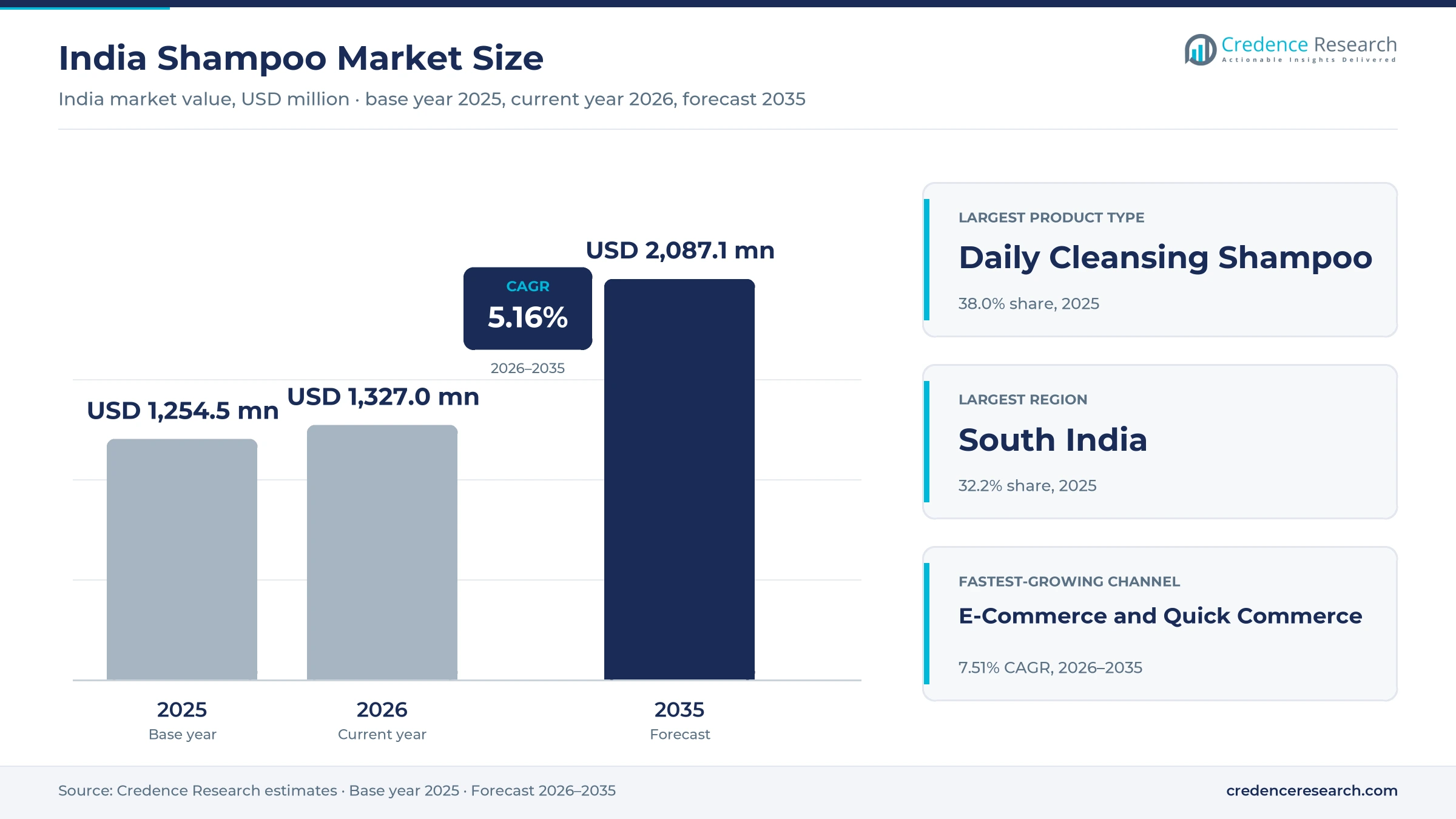
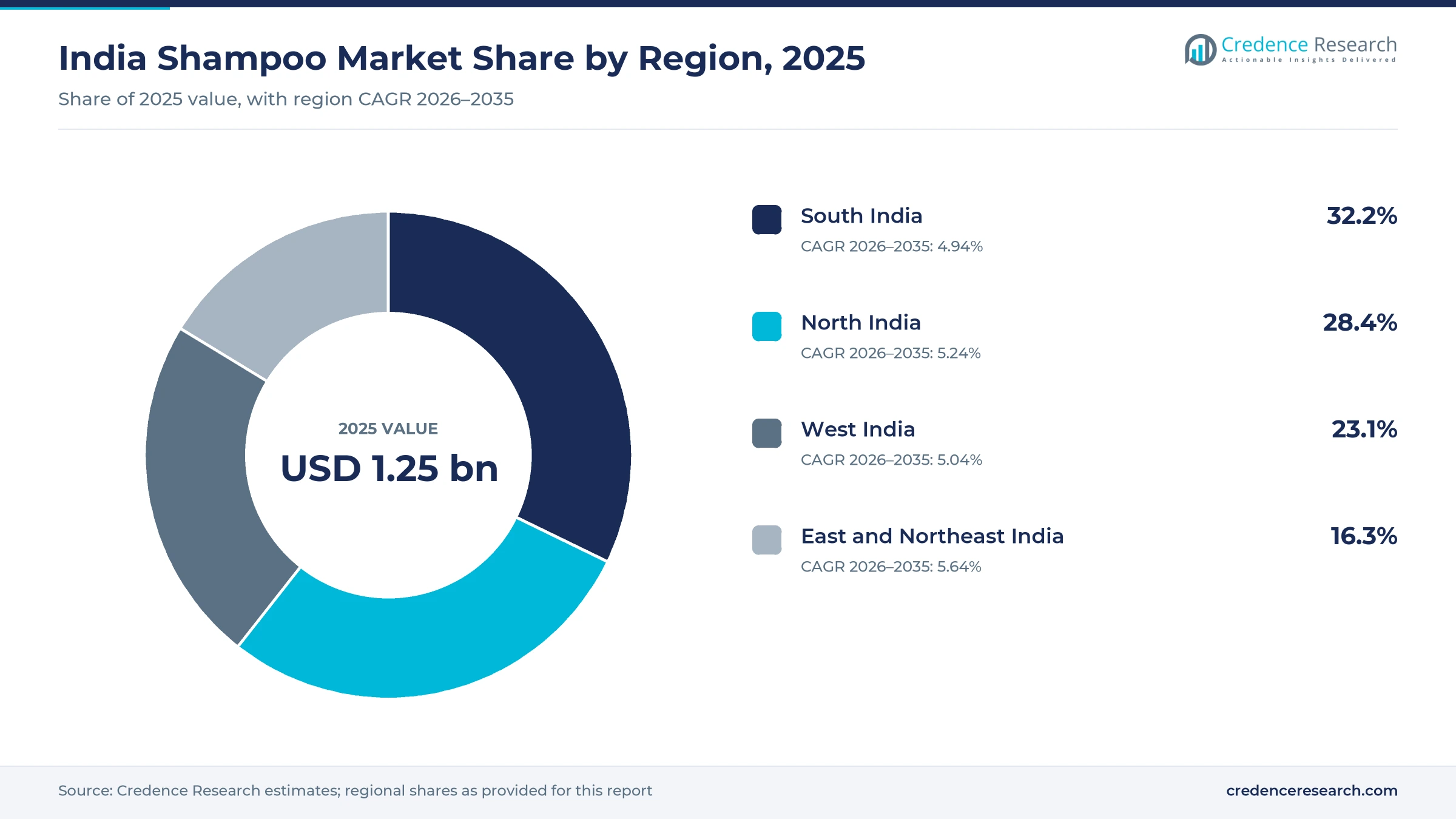
The India shampoo market was valued at USD 1.25 billion in 2025 and is projected to increase from USD 1.33 billion in 2026 to USD 2.09 billion by 2035, registering a CAGR of 5.16% during 2026–2035. Demand comes from family households that wash hair several times a week, rising concern about dandruff and hair fall, and a steady move from single-use sachets to bottles. South India held the largest regional share, 32.2% in 2025, because high urban spending in Tamil Nadu, Karnataka and Kerala supports frequent use and premium variants. East and Northeast India grows fastest at 5.64% a year, as rural households in West Bengal, Bihar and the Northeast move up from economy packs. The GST rate on shampoo fell from 18% to 5% in September 2025, and leading brands passed the cut on through lower shelf prices.
What does the India shampoo estimate cover?
The estimate measures retail sales value of shampoo in India, including daily cleansing, anti-dandruff, hair fall and damage repair, and herbal and ayurvedic variants. It covers sachets, bottles, pump packs and refills sold through grocery stores, modern retail, online marketplaces, quick commerce apps and salons. Values are stated in USD million at current prices, converted from Indian rupees at average annual exchange rates.
The estimate excludes conditioners, hair oils, hair colors, serums and leave-in treatments, along with medicated shampoos sold only on prescription. It also excludes salon service fees charged for washing or treating hair. The value chain runs from surfactant and fragrance suppliers through contract and in-house manufacturers to distributors, retailers and households.
India Shampoo Market Insights
- The India shampoo market was valued at USD 1.25 billion in 2025 and is projected to reach USD 2.09 billion by 2035, registering a CAGR of 5.16% during 2026–2035.
- South India held 32.2% of 2025 value, because higher urban spending in its southern states supports frequent washing and premium variants.
- Daily cleansing shampoo led with 38.0% of 2025 value, since family households buy it for routine hair washing across income groups.
- The GST rate on shampoo fell from 18% to 5% on Sept. 22, 2025, and leading brands lowered retail prices on popular bottles.
- Online and quick commerce channels grow fastest at 7.51% a year during 2026–2035, as more than one billion internet subscribers discover brands digitally.
Daily cleansing and mass packs carry most of the value
Why does daily cleansing shampoo lead sales?
Based on product type, the market is categorized into daily cleansing shampoo, anti-dandruff shampoo, hair fall and damage repair shampoo, and herbal and ayurvedic shampoo. Daily Cleansing Shampoo led with 38.0% of 2025 value, because most family households buy one mild variant for routine washing. Herbal and Ayurvedic Shampoo grows fastest at 6.03% a year, as buyers seek plant-based formulas with bhringraj, amla, reetha and onion extracts.
How do price tiers shape shampoo demand?
Based on price tier, the market is categorized into economy, mass market, masstige and premium products. Mass Market led with 41.0% of 2025 value, because brands such as Clinic Plus, Head and Shoulders and Kesh King sell widely in small bottles and sachets. Premium products grow fastest at 6.71% a year, as urban buyers trade up to scalp-specific and salon-style formulas after the GST cut.
Which channels sell most shampoo in India?
Based on distribution channel, the market is categorized into traditional grocery retail, modern retail, e-commerce and quick commerce, and the salon and professional channel. Traditional Grocery Retail led with 52.0% of 2025 value, because neighborhood stores sell most sachets in towns and villages. E-Commerce and Quick Commerce grows fastest at 7.51% a year, as apps deliver bottles and new launches within minutes in large cities.
| Segment Group | Leading Sub-segment | Share, 2025 | Fastest-growing Sub-segment | CAGR, 2026–2035 |
|---|---|---|---|---|
| By Product Type | Daily Cleansing Shampoo | 38.0% | Herbal and Ayurvedic Shampoo | 6.03% |
| By Price Tier | Mass Market | 41.0% | Premium | 6.71% |
| By Distribution Channel | Traditional Grocery Retail | 52.0% | E-Commerce and Quick Commerce | 7.51% |
Request a Free Sample
Fill in your details and we'll send you a free sample report.
- Sample data tables & charts
- Research methodology
Tax cuts, digital discovery and premium care lift sales
How did lower GST make shampoo more affordable?
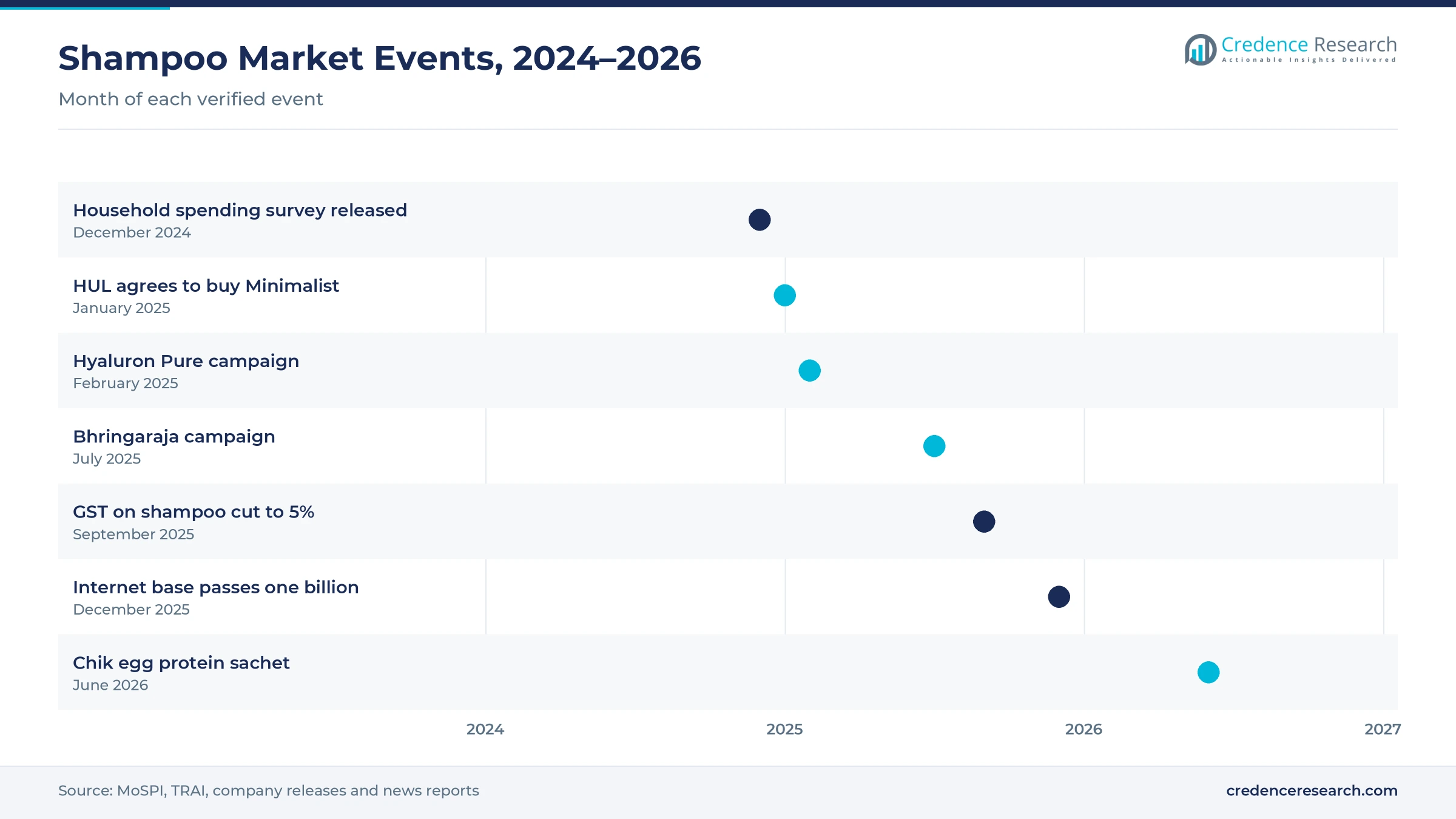
Lower indirect tax made shampoo more affordable and encouraged shoppers to buy larger packs. GST on hair oil, soap, shampoo and toothpaste was cut from 18% to 5%, according to All India Radio, with the new rate effective from Sept. 22, 2025. Procter and Gamble lowered Head and Shoulders Cool Menthol 300 ml from Rs 360 to Rs 320 and Pantene 340 ml from Rs 410 to Rs 355, according to Outlook Business. Hindustan Unilever also cut Dove shampoo 340 ml from Rs 490 to Rs 435. As a result, mass market products held 41.0% of 2025 value while bottle buying gained ground.
Why does digital beauty discovery widen distribution?
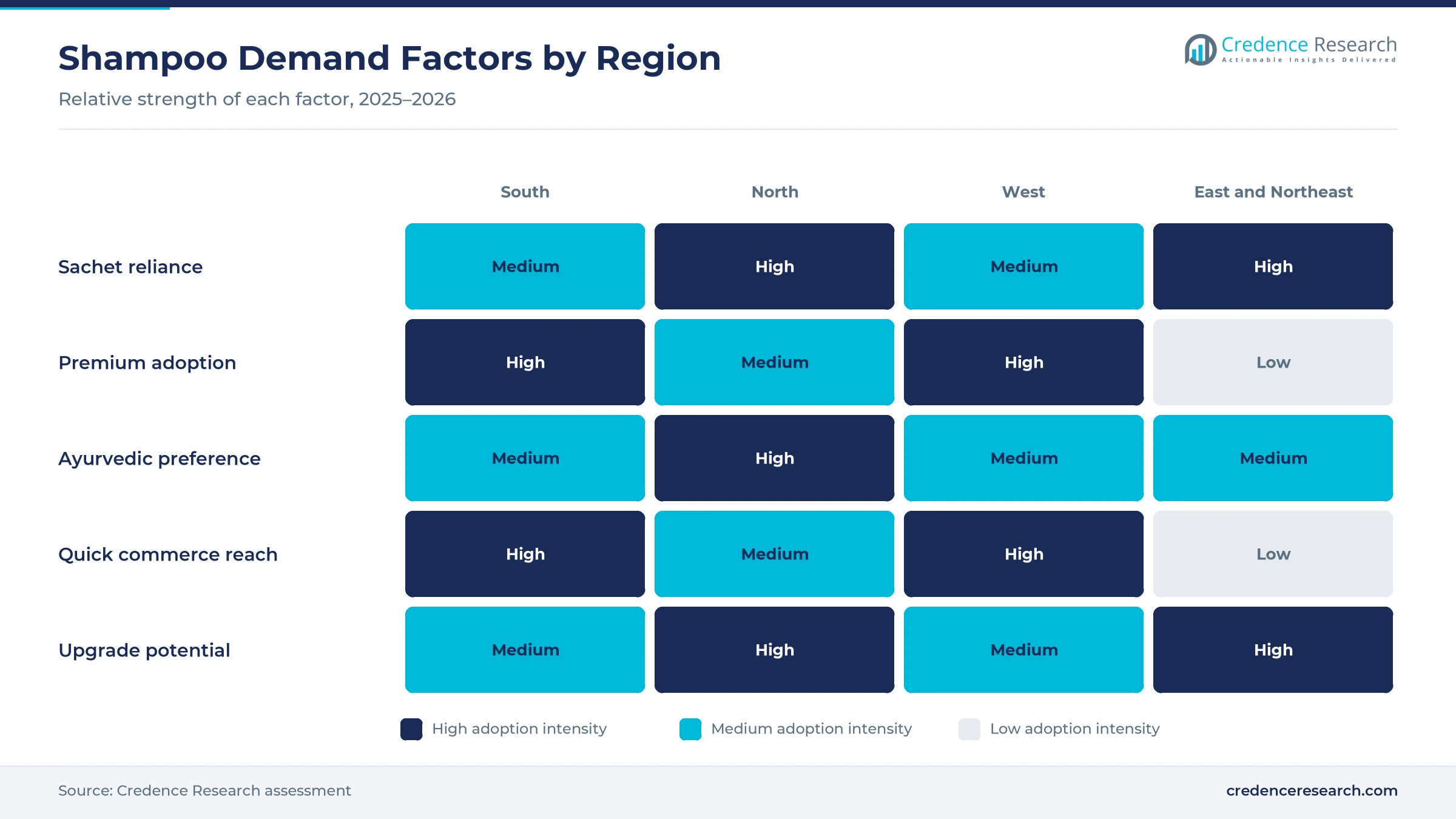
Digital beauty discovery widens distribution, because shoppers now compare scalp claims, ingredients and prices on their phones before buying. India had about 1,028.61 million internet subscribers at the end of December 2025, including 434.27 million in rural areas, according to TRAI. L'Oréal Paris promoted its Hyaluron Pure shampoo for oily scalps in February 2025 through an Instagram reel that drew more than 5.7 million views in under 48 hours. Meanwhile, Hindustan Unilever set up a dedicated organization for quick commerce. Therefore, online and quick commerce channels grow fastest among the four channels, and new launches now reach city buyers online weeks before they reach rural grocery shelves.
How is premiumization lifting scalp-specific demand?
Premiumization lifts demand for scalp-specific shampoo, because buyers now treat dandruff, oiliness and hair fall as separate concerns. Hindustan Unilever reported volume-led double-digit growth in hair care for the quarter ended December 2025, led by Dove and TRESemmé, according to its quarterly results. The company also launched TRESemmé Hydra Matrix in that quarter. L'Oréal Paris markets a shampoo with salicylic acid and hyaluronic acid for oily scalps, which shows how skin care actives move into scalp care. In turn, premium products grow at 6.71% a year through 2035, as urban buyers add a second scalp-specific shampoo to their routine.
Why does rising household spending support upgrades?
Rising household spending supports upgrades from economy sachets to branded bottles, especially in rural India. Average monthly per capita consumption rose from Rs 3,773 to Rs 4,122 in rural areas and from Rs 6,459 to Rs 6,996 in urban areas between 2022-23 and 2023-24, according to the Household Consumption Expenditure Survey. Non-food items made up about 53% of rural and 60% of urban spending in 2023-24. In turn, households can afford more frequent washing and second variants for children or scalp care, which supports volume and value growth. Rural spending rose about 9% in a single year, faster than urban spending, which favors upgrades in smaller towns.
Ingredient-led and ayurvedic claims reshape the shelf
How is the shift to protein and ingredient-led formulas playing out?
Shampoo shelves are shifting toward ingredient-led formulas that name a protein, herb or active on the front of the pack. CavinKare launched Chik Egg Yellow Protein Shampoo in June 2026 in a Re 1 sachet, starting in Andhra Pradesh, Telangana, Karnataka, West Bengal and the Northeast. Honasa Consumer sells Mamaearth Onion Shampoo for hair fall control in sizes up to 650 ml, while Dabur launched its sulfate-free Vatika Select range in March 2021. CavinKare claims the new Chik formula gives 50% smoother hair and five times more conditioning, according to the company. As a result, hair fall and damage repair shampoo grows faster than daily cleansing variants, and even entry-level sachets now carry ingredient claims.
Why is ayurvedic hair fall care rising?
Ayurvedic hair fall care is rising because many Indian buyers trust traditional herbs for scalp health and hair strength. Himalaya Wellness launched a campaign for its Anti-Hair Fall Bhringaraja Shampoo in July 2025, with television in Tamil Nadu, Karnataka, Andhra Pradesh and Telangana and a national digital rollout. Emami markets Kesh King Anti Hair Fall Shampoo as a formula with 21 herbs, including bhringraj and amla, and Patanjali sells Kesh Kanti hair cleanser in Rs 1 sachets. Therefore, herbal and ayurvedic shampoo grows fastest at 6.03% a year through 2035, especially in southern and northern states where traditional remedies are widely used.
Can smaller bottles and refills open a rural upgrade path?
Smaller bottles and refills offer an opening, because rural buyers who used sachets can now afford entry bottles after the tax cut. Emami lists Kesh King Anti Hair Fall Shampoo in an 80 ml pack at about Rs 60 and a 200 ml pack with an MRP of Rs 155. Rural internet subscribers reached about 434 million in December 2025, which lets brands advertise these packs directly. In turn, suppliers of cosmetics packaging can offer lighter bottles and pouches that lower plastic use. Brands that price entry bottles near sachet bundles could win long-term loyalty, because first bottle purchases often set the brand a household keeps for years.
Is there room to grow premium and salon-style lines?
Premium and salon-style lines offer a second opening, because urban buyers want visible results and are willing to pay more per wash. Hindustan Unilever agreed in January 2025 to buy 90.5% of Uprising Science, the owner of Minimalist, a premium actives-led beauty brand. The deal included a Rs 45 crore primary infusion and a plan to buy the remaining 9.5% within two years. This shows that large companies are buying into ingredient-led beauty, where scalp products can follow. Growing demand for salon services in large cities also supports professional brands sold through stylists. Masstige and premium tiers therefore offer higher margins than mass packs, and they reward brands that invest in visible results.
Price wars, imitation packs and claim scrutiny weigh
How do price wars affect brand margins?
Price wars limit margins, because large brands, regional players and private labels compete for the same sachet and small bottle buyers. After the tax cut, companies passed savings on through lower prices rather than keeping them as margin. Prices of leading 300 ml and 340 ml shampoo bottles fell by Rs 40 to Rs 55, which tightened margins. As a result, smaller brands with weaker distribution struggle to fund advertising, while leaders rely on volume. Clear pack-price ladders and new variants help brands protect value. Shampoo demand still grows, but price per wash stays under pressure in the economy tier.
Why do imitation packs hurt trusted brands?
Imitation and counterfeit packs hurt trusted brands, because they copy colors and names in rural markets where shoppers buy quickly. Fake products can irritate the scalp, which damages trust in the original brand and in the category. Consequently, companies invest in packaging security codes, distributor checks and awareness campaigns. Wider modern retail and online buying also reduce the reach of these copies over time, because shoppers buy from verified sellers and authorized stores.
How does claim scrutiny affect product launches?
Scrutiny of product claims affects launches, because many shampoos promise less hair fall, dandruff control or natural ingredients. Brands must hold evidence for each claim and follow labeling rules for cosmetics. In turn, small brands with limited testing face higher risk of complaints or forced changes. Clear claims backed by trials help companies avoid disputes and keep buyer trust. This matters most for hair fall and anti-dandruff variants, which make the strongest promises.
Will raw material and fuel costs squeeze prices?
Raw material and fuel costs can squeeze prices, because surfactants, fragrances and plastic packaging depend on oil and palm-based inputs. When these costs rise, companies either raise prices or reduce pack sizes, which can slow volume growth. Therefore, brands focus on efficient sourcing, local suppliers and lighter packs to protect margins. Stable input costs would support the shift from sachets to bottles and keep shampoo demand growing steadily in every region.
South India leads while the East grows fastest
| Region | Value, 2025 (USD billion) | Share, 2025 | CAGR, 2026–2035 |
|---|---|---|---|
| South India | 0.40 | 32.2% | 4.94% |
| North India | 0.36 | 28.4% | 5.24% |
| West India | 0.29 | 23.1% | 5.04% |
| East and Northeast India | 0.20 | 16.3% | 5.64% |
Why does South India lead shampoo spending?
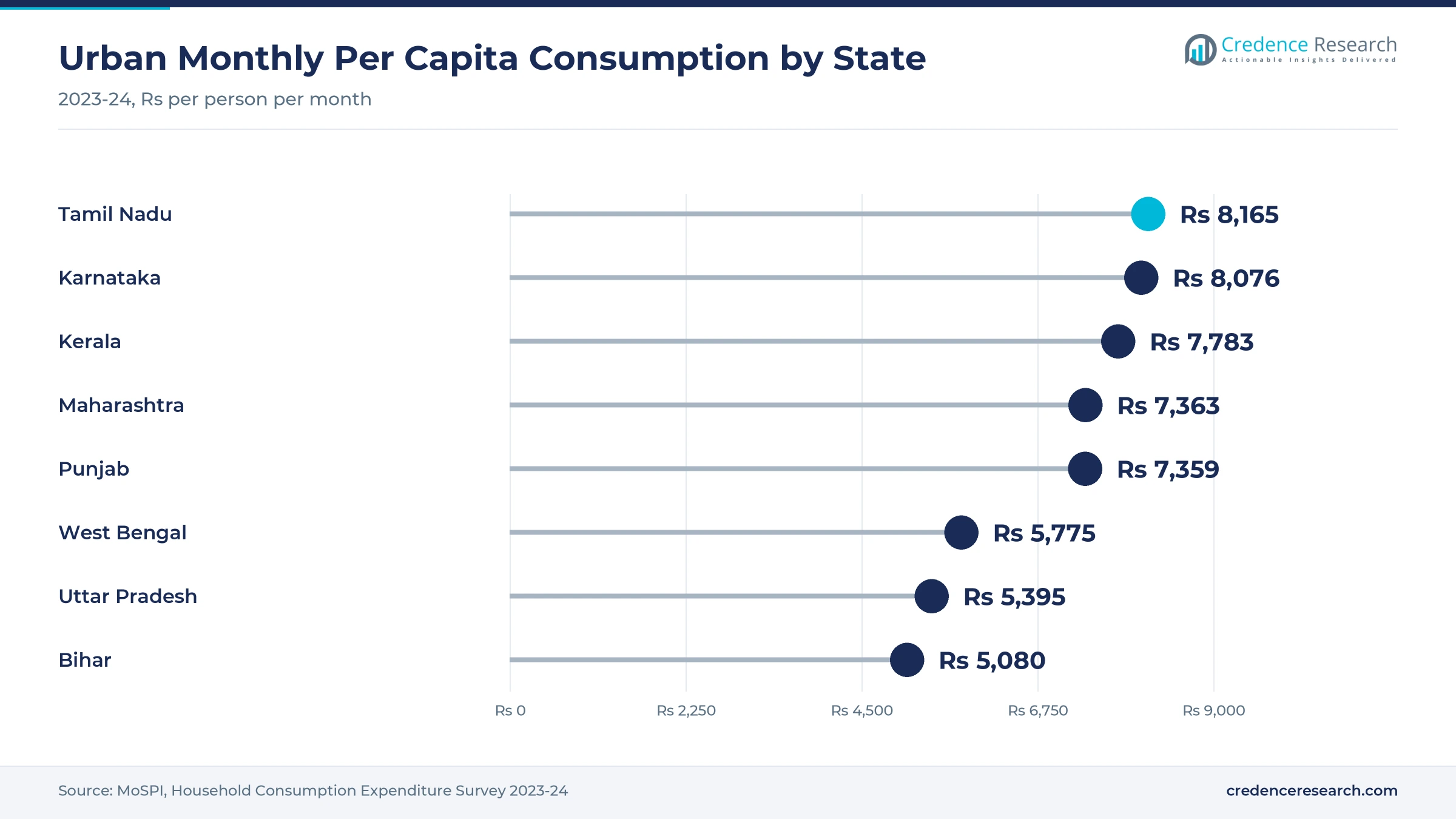
South India held 32.2% of 2025 value and grows at 4.94% a year, because urban monthly spending is among the highest in Tamil Nadu, Karnataka and Kerala. Urban per capita consumption reached Rs 8,165 in Tamil Nadu and Rs 8,076 in Karnataka in 2023-24, which lifts regional demand for bottles. Warm and humid weather in coastal cities also encourages frequent hair washing and steady shampoo demand. Brands such as Chik and Himalaya focus their television campaigns on southern states, which shows how important this region is for launches.
How does North India add volume?
North India held 28.4% of 2025 value and grows at 5.24% a year, because Uttar Pradesh, Punjab, Haryana and Delhi hold a very large population. Urban per capita consumption ranged from Rs 5,395 in Uttar Pradesh to Rs 7,359 in Punjab in 2023-24, which explains the mix of sachets and bottles in North India shampoo demand. Patanjali and Dabur hold strong ayurvedic positions in this region, where herbal claims resonate with family households. Rising rural spending in Uttar Pradesh also supports upgrades from Rs 1 sachets to small bottles.
What drives West India demand?
West India held 23.1% of 2025 value and grows at 5.04% a year, because Maharashtra and Gujarat have large urban populations and dense modern retail. Urban per capita consumption in Maharashtra reached Rs 7,363 in 2023-24, which supports regional demand for premium packs. Mumbai, Pune and Ahmedabad also lead quick commerce adoption, which supports premium and masstige launches. As a result, West India shampoo demand leans toward bottles, pump packs and scalp-specific variants rather than economy sachets.
Why is East and Northeast India growing fastest?
East and Northeast India held 16.3% of 2025 value and grows fastest at 5.64% a year, because rural households in West Bengal, Bihar, Odisha and the Northeast are moving from economy packs to branded bottles. Urban per capita consumption reached Rs 5,775 in West Bengal and Rs 5,080 in Bihar in 2023-24, so regional demand still leans on low-priced packs. CavinKare chose West Bengal and the Northeast for the June 2026 launch of its protein sachet.
Price cuts, launches and deals from 2025 to 2026
| Development | Status and market relevance |
|---|---|
| In January 2025, Hindustan Unilever agreed to acquire 90.5% of Uprising Science, the owner of the Minimalist premium beauty brand. | Strengthens the company in premium actives-led beauty |
| In February 2025, L'Oréal Paris India promoted its Hyaluron Pure shampoo for oily scalps through a digital campaign. | The reel drew more than 5.7 million views in under 48 hours |
| In July 2025, Himalaya Wellness launched a campaign for its Anti-Hair Fall Bhringaraja Shampoo across four southern states and online. | Supports ayurvedic hair fall demand in South India |
| In September 2025, the GST rate on shampoo fell from 18% to 5%, and Procter and Gamble and Hindustan Unilever cut shelf prices. | Lower prices from Sept. 22, 2025 support upgrades to bottles |
| In June 2026, CavinKare launched Chik Egg Yellow Protein Shampoo in a Re 1 sachet in southern and eastern states. | Extends ingredient-led claims to entry-level packs |
Actives, protein blends and refill packs change formats
- Skin care actives such as salicylic acid and hyaluronic acid now appear in shampoo for oily scalps, which supports premium pricing.
- Protein and herbal blends using egg protein, onion, bhringraj and amla give brands clear claims that buyers can compare on the pack.
- Zinc-based and scalp-balancing actives power anti-dandruff formulas, which remain the second-largest product group in India.
- Refills and lighter packs reduce plastic use and lower cost per wash, which helps brands move sachet buyers to larger formats.
Need a Custom Version of This Report?
Tailor the scope, geography, or segments to your exact requirements.
- Custom geography or segment scope
- Direct access to our analyst team
Multinationals and ayurvedic brands share the shelf
Competition is led by multinational consumer goods companies, with strong challenges from ayurvedic and digital-first brands. Hindustan Unilever sells Clinic Plus, Sunsilk, Dove and TRESemmé, while Procter and Gamble sells Head and Shoulders and Pantene. L'Oréal India competes through L'Oréal Paris and Garnier, and CavinKare built Chik on low-priced sachets. Dabur, Himalaya, Patanjali and Emami compete on herbal and ayurvedic claims, while Honasa Consumer sells Mamaearth Onion Shampoo in packs of up to 650 ml for hair fall demand online and in stores. Hindustan Unilever reported volume-led double-digit hair care growth in the quarter ended December 2025, which shows the strength of large portfolios. Brands compete on scalp claims, price per wash, rural reach and digital marketing. Companies with strength across hair care categories can also bundle shampoo with oils and conditioners.
Companies profiled and their roles in this market
| Company | Type | Role in the market |
|---|---|---|
| Hindustan Unilever Limited | Multinational | Sells Clinic Plus, Sunsilk, Dove and TRESemmé; launched TRESemmé Hydra Matrix in late 2025 |
| Procter & Gamble | Multinational | Sells Head and Shoulders and Pantene; cut shelf prices after the September 2025 GST change |
| L'Oréal India | Multinational | Promotes L'Oréal Paris Hyaluron Pure for oily scalps; sells Garnier hair care |
| CavinKare Private Limited | Domestic company | Sells Chik sachets and launched an egg protein shampoo in June 2026 |
| Dabur India Limited | Domestic company | Sells Vatika shampoos, including the sulfate-free Vatika Select range |
| Himalaya Wellness Company | Domestic company | Sells Anti-Hair Fall Bhringaraja Shampoo backed by a 2025 campaign |
| Patanjali Ayurved Limited | Domestic company | Sells Kesh Kanti hair cleansers, including Rs 1 sachets |
| Honasa Consumer Limited | Digital-first company | Sells Mamaearth Onion Shampoo for hair fall control |
| Emami Limited | Domestic company | Sells Kesh King Anti Hair Fall Shampoo with 21 herbs |
Credence Research view on pack upgrades and premium care
Credence Research's view is that Indian shampoo demand will grow steadily through 2035, with value rising faster than volume as buyers move from sachets to bottles. The 2025 GST cut gave brands room to lower bottle prices, which supports this upgrade in rural and small-town markets. The tax cut lowered shelf prices of popular shampoo bottles by about 11% to 13%, which brings bottle prices closer to sachet bundles. Shampoo demand should also benefit from rural per capita spending, which rose from Rs 3,773 to Rs 4,122 a month in one year. However, intense price competition will keep margins tight in economy and mass tiers.
How the hair wash spending estimate was built
The report uses 2025 as the base year, with values in USD million at current prices. Market values come from the Credence Research model, which combines household penetration, washing frequency, pack mix and average prices. Regional shares are those set for this report, and segment splits by product type, price tier and channel are Credence Research estimates. Sources used are government statistics, telecom data, tax notices, company releases and news reports, and no interviews or surveys were used.
Upgrading from sachets sets the path to 2035
The market is expected to reach USD 2.09 billion by 2035, a 5.16% CAGR during 2026–2035, as household spending rises and buyers upgrade pack sizes and product types. Growth should be strongest in East and Northeast India and in online channels, while South India keeps the largest share. Scalp care, hair fall and ayurvedic variants will gain ground. Online and quick commerce channels should capture a larger share of shampoo demand by 2035 as internet subscribers grow beyond 1 billion. In contrast, higher input costs or a return to deep discounting would slow value growth in mass tiers.
Frequently Asked Questions
How big is the India shampoo market?
Which region leads shampoo sales in India?
Which region grows fastest?
How did the GST cut affect shampoo prices?
Which product type holds the largest share?
Which sales channel grows fastest?
Who are the leading shampoo companies in India?
What are the main risks to growth?
Table of Content
Chapter 1 Market Segmentation
- 1.1 Segmentation Framework
- 1.1.1 Product and Service Classification
- 1.1.2 Application and End-Use Classification
- 1.1.3 Technology and Solution Classification
- 1.1.4 Customer and Distribution Channel Classification
- 1.1.5 Geographic Segmentation
- 1.1.6 Market Segment Definitions and Boundaries
- 1.2 By Product Type
- 1.2.1 Daily Cleansing Shampoo
- 1.2.2 Anti-Dandruff Shampoo
- 1.2.3 Hair Fall and Damage Repair Shampoo
- 1.2.4 Herbal and Ayurvedic Shampoo
- 1.3 By Price Tier
- 1.3.1 Mass Market
- 1.3.2 Economy
- 1.3.3 Masstige
- 1.3.4 Premium
Chapter 2 Introduction
- 2.1 Report Objectives and Scope
- 2.2 Product Definition and Industry Terminology
- 2.3 Market Inclusions and Exclusions
- 2.4 Research Process
- 2.4.1 Primary Research and Expert Interviews
- 2.4.2 Secondary Research and Source Review
- 2.4.3 Top-Down and Bottom-Up Estimation
- 2.4.4 Data Triangulation and Verification
- 2.5 Market Size Measurement Basis
- 2.5.1 2025: USD 1.25 billion → 2035: USD 2.09 billion
- 2.6 Historical and Forecast Reference Periods
- 2.6.1 Historical Period: 2018-2025
- 2.6.2 Base Year: 2025
- 2.6.3 Forecast Period: 2025-2035
- 2.7 Research Assumptions and Limitations
Chapter 3 Executive Summary
- 3.1 Market Snapshot and Key Findings
- 3.2 Base-Year Market Size, 2025
- 3.3 Forecast Market Size, 2035
- 3.4 Revenue and Volume Growth Outlook
- 3.5 Key Demand and Supply Indicators
- 3.6 Leading Market Segments
- 3.7 Fastest-Growing Market Opportunities
- 3.8 Regional Performance Highlights
- 3.9 Technology and Industry Transformation
- 3.10 Competitive Landscape Summary
- 3.11 Analyst View and Strategic Implications
Chapter 4 India Shampoo Market Trends and Developments
- 4.1 Historical Industry Development, 2018-2025
- 4.2 Recent Market Trends and Developments
- 4.3 Demand and Customer Behavior Trends
- 4.4 Technology and Product Innovation
- 4.5 Artificial Intelligence, Automation and Digitalization
- 4.6 Local Manufacturing and Supply Chain Realignment
- 4.7 Industry Partnerships, Mergers and Acquisitions
- 4.8 Sustainability and Circular Economy Developments
- 4.9 Government and Private Sector Investment Trends
- 4.10 Emerging Business Models and Commercialization
- 4.11 Industry Developments and Announcements
Chapter 5 India Shampoo Market Production, Supply and Demand Analysis
- 5.1 Demand Trend and Consumption Analysis, 2018-2025
- 5.2 Demand Forecast, 2025-2035
- 5.3 Production and Output Trend, 2018-2025
- 5.4 Production and Output Forecast, 2025-2035
- 5.5 Installed Capacity and Capacity Utilization
- 5.6 Company-Wise Production Plants and Statistics
- 5.6.1 Installed Production Capacity
- 5.6.2 Actual Production
- 5.6.3 Planned Capacity and Expansion Targets
- 5.7 Supply Chain Structure and Procurement Trends
- 5.8 Supply-Demand Gap and Bottlenecks
- 5.9 Import Dependence and Sourcing Structure
- 5.10 Contract Manufacturing and Outsourcing
- 5.11 Regional Supply and Demand Concentration
Chapter 6 India Shampoo Market Pricing Analysis
- 6.1 Pricing Structure and Measurement
- 6.2 Historical Pricing Trends, 2018-2025
- 6.3 Pricing Outlook, 2025-2035
- 6.4 Average Selling Price and Unit Economics
- 6.5 Pricing by Product and Market Segment
- 6.6 Geographic Pricing Differences
- 6.7 Key Input, Energy, Labor and Logistics Costs
- 6.8 Contract Pricing and Purchasing Models
- 6.9 Pricing Sensitivity and Competitive Positioning
- 6.10 Price, Margin and Profitability Implications
Chapter 7 India Shampoo Market Dynamics
- 7.1 Market Growth Drivers
- 7.1.1 Demand-Side Drivers
- 7.1.2 Technology and Innovation Drivers
- 7.1.3 Infrastructure and Investment Drivers
- 7.1.4 Regulatory and Policy Drivers
- 7.2 Market Restraints
- 7.2.1 Cost and Affordability Constraints
- 7.2.2 Technology and Adoption Barriers
- 7.2.3 Supply Chain and Operational Constraints
- 7.3 Market Challenges
- 7.3.1 Competitive Pressure and Margin Erosion
- 7.3.2 Skills, Infrastructure and Implementation Gaps
- 7.4 Emerging Market Opportunities
- 7.5 Market Dynamics Impact and Time-Horizon Assessment
Chapter 8 India Shampoo Value Chain Analysis
- 8.1 Industry Value Chain Overview
- 8.2 Upstream Suppliers and Critical Inputs
- 8.3 Technology and Component Providers
- 8.4 Manufacturing or Service Delivery
- 8.5 Distribution, Channel Partners and Integrators
- 8.6 Downstream Applications and End Users
- 8.7 Value Addition and Profit Pools
- 8.8 Vertical Integration and Outsourcing
- 8.9 Supplier Concentration and Risk
- 8.10 Supply Chain Localization and Resilience
Chapter 9 India Shampoo Market Regulations and Policies
- 9.1 Relevant Laws, Standards and Compliance Frameworks
- 9.2 Product, Service, Safety and Quality Requirements
- 9.3 Government Policies, Incentives and Subsidies
- 9.4 Imports, Exports and Trade Barriers
- 9.5 Public Procurement and Local Content Requirements
- 9.6 Environmental and Sustainability Compliance
- 9.7 Upcoming Policy Changes and Market Implications
Chapter 10 India Shampoo Market Hotspots and Opportunities
- 10.1 Market Opportunity Mapping and Growth Hotspots
- 10.2 High-Growth Applications and Customer Groups
- 10.3 Underserved Markets and White-Space Opportunities
- 10.4 Emerging Technology and Product Opportunities
- 10.5 New Capacity and Investment Hotspots
- 10.6 Market Entry and Expansion Opportunities
- 10.7 Distribution and Partnership Opportunities
- 10.8 Near-Term and Long-Term Commercial Potential
- 10.9 Opportunity Attractiveness and Execution Risks
Chapter 11 India Shampoo Market Outlook, 2025-2035
- 11.1 Market Size and Analysis
- 11.1.1 Revenue (Market Measurement: 2025: USD 1.25 billion → 2035: USD 2.09 billion)
- 11.1.2 Market Volume and Quantity Sold
- 11.1.3 Historical Market Size, 2018-2025
- 11.1.4 Base-Year Market Size, 2025
- 11.2 Market Forecast, 2025-2035
- 11.2.1 Revenue Forecast to 2035
- 11.2.2 Volume Forecast to 2035
- 11.2.3 CAGR and Year-on-Year Growth
- 11.2.4 Incremental Revenue Opportunity
- 11.3 Forecast Assumptions and Scenario Analysis
- 11.3.1 Base-Case Forecast
- 11.3.2 Optimistic and Conservative Scenarios
- 11.3.3 Technology, Pricing and Policy Sensitivities
- 11.4 Market Attractiveness and Growth Outlook
Chapter 12 India Shampoo Market Segmentation and Outlook
- 12.1 Segmentation Summary and Market Shares, 2025
- 12.2 Largest and Fastest-Growing Segments
- 12.3 By Product Type - Market Size and Forecast, 2025-2035
- 12.3.1 Segment Definition and Scope
- 12.3.2 Historical Market Size, 2018-2025
- 12.3.3 Revenue Forecast, 2025-2035
- 12.3.4 Volume Forecast, 2025-2035
- 12.3.5 Base-Year Market Share, 2025
- 12.3.6 Segment CAGR and Growth Drivers
- 12.3.7 Subsegment Market Size and Forecast
- 12.3.7.1 Daily Cleansing Shampoo
- 12.3.7.2 Anti-Dandruff Shampoo
- 12.3.7.3 Hair Fall and Damage Repair Shampoo
- 12.3.7.4 Herbal and Ayurvedic Shampoo
- 12.3.8 Subsegment Pricing and Adoption Trends
- 12.3.9 Leading Suppliers and Competition
- 12.3.10 Regional Demand and Opportunities
- 12.4 By Price Tier - Market Size and Forecast, 2025-2035
- 12.4.1 Segment Definition and Scope
- 12.4.2 Historical Market Size, 2018-2025
- 12.4.3 Revenue Forecast, 2025-2035
- 12.4.4 Volume Forecast, 2025-2035
- 12.4.5 Base-Year Market Share, 2025
- 12.4.6 Segment CAGR and Growth Drivers
- 12.4.7 Subsegment Market Size and Forecast
- 12.4.7.1 Mass Market
- 12.4.7.2 Economy
- 12.4.7.3 Masstige
- 12.4.7.4 Premium
- 12.4.8 Subsegment Pricing and Adoption Trends
- 12.4.9 Leading Suppliers and Competition
- 12.4.10 Regional Demand and Opportunities
- 12.5 Segment Growth Comparison
- 12.6 Segment Attractiveness and Priority Matrix
Chapter 13 India Shampoo Geographic Market Outlook, 2025-2035
- 13.1 Regional Market Size and Country-Level Shares, 2025
- 13.2 Country Market Size Comparison, 2025
- 13.3 Country Market Forecasts, 2025-2035
- 13.4 Subregional Industrial and Demand Clusters
- 13.5 Intra-Regional Pricing and Cost Differences
- 13.6 Cross-Border Trade and Supply Networks
- 13.7 Regional Supply and Demand Balances
- 13.8 Country Opportunity Comparison and Prioritization
Note: Every listed country is covered on the structure shown under the first country.
Chapter 14 India Shampoo Technology, Innovation and Sustainability Outlook
- 14.1 Technology Landscape and Maturity
- 14.2 Product, Process and Service Innovation
- 14.3 AI, Automation and Digital Tools in the Industry
- 14.4 Technology Adoption and Performance Benchmarking
- 14.5 Innovation Pipeline and R&D Investment
- 14.6 Patent and Intellectual Property Trends
- 14.7 Energy Efficiency and Resource Management
- 14.8 Sustainability, Recycling and Circularity
- 14.9 Technology Roadmap, 2025-2035
- 14.10 Risks of Obsolescence and Technology Substitution
Chapter 15 India Shampoo Market Key Strategic Imperatives
- 15.1 Growth and Market Entry Priorities
- 15.2 High-Return Products and Segments
- 15.3 Pricing, Profitability and Cost Optimization
- 15.4 Technology Investment and Product Differentiation
- 15.5 Supply Chain Localization and Resilience
- 15.6 Distribution and Customer Acquisition
- 15.7 Partnership, Acquisition and Capacity Strategy
- 15.8 Regional Expansion Priorities
- 15.9 Short-, Medium- and Long-Term Actions
Chapter 16 Competition Outlook
- 16.1 Industry Competition Characteristics
- 16.2 Market Structure and Concentration
- 16.3 Market Share and Competitive Positioning, 2025
- 16.4 Company-Wise Revenue and Product Benchmarking
- 16.5 Production and Service Capacity Benchmarking
- 16.6 Technology, Pricing and Differentiation
- 16.7 Regional Footprint and Distribution Strength
- 16.8 Mergers, Acquisitions and Strategic Alliances
- 16.9 New Entrants and Competitive Threats
- 16.10 Porter's Five Forces and Industry Attractiveness
- 16.11 Competitive Outlook, 2025-2035
Chapter 17 Company Profiles
- 17.1 Company Coverage and Selection Criteria
- 17.2 Hindustan Unilever Limited
- 17.2.1 Business Description
- 17.2.2 Company Ownership and Geographic Presence
- 17.2.3 Product and Service Portfolio
- 17.2.4 Manufacturing and Operating Footprint
- 17.2.5 Production Capacity and Expansion Plans
- 17.2.6 Financial Performance and Investment
- 17.2.7 Market Share and Competitive Position
- 17.2.8 Technology and Innovation Capabilities
- 17.2.9 Strategic Alliances or Partnerships
- 17.2.10 Recent Developments
- 17.2.11 Growth Strategy and Outlook
- 17.3 Procter & Gamble
- 17.4 L'Oréal India
- 17.5 CavinKare Private Limited
- 17.6 Dabur India Limited
- 17.7 Himalaya Wellness Company
- 17.8 Patanjali Ayurved Limited
- 17.9 Honasa Consumer Limited
- 17.10 Emami Limited
- 17.11 Marico Limited
- 17.12 Other Relevant Market Participants
Note: Every listed company is profiled on the structure shown under the first company. The company list is preliminary and may change based on research findings, market developments, data availability and client requirements.
Chapter 18 Disclaimer
- 18.1 Research and Forecast Disclaimer
- 18.2 Data Source and Estimation Limitations
Note: The depth of individual sections depends on data availability for this market. Volume, capacity, trade and other unit-based metrics are included where applicable.

