
Market Overview
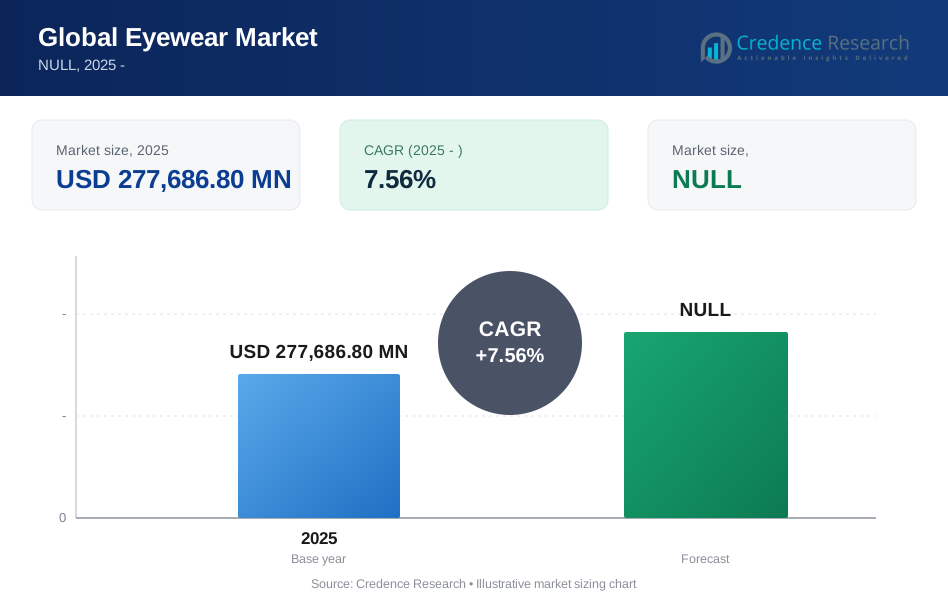
The Global Eyewear Market is projected to grow from USD 277,686.80 MN in 2025 to an estimated USD 518,365.55 MN by 2032, with a CAGR of 7.56% from 2025 to 2032. Market expansion is being driven by rising vision correction needs, growing screen exposure across age groups and stronger consumer spending on premium and fashion-oriented optical products.
North America leads the global market, supported by high diagnosis rates for refractive errors, strong insurance-linked optical purchases and a well-established presence of organized retail chains, optical clinics and omnichannel eyewear brands.
| REPORT ATTRIBUTE | DETAILS |
|---|---|
| Historical Period: | 2020-2023 |
| Base Year | 2025 |
| Forecast Period | 2025-2032 |
| Global Eyewear Market Market Size 2025 | USD 277,686.80 MN |
| Global Eyewear Market CAGR | 7.56% |
| Global Eyewear Market Market Size 2032 | USD 518,365.55 MN |
Market Insights
- North America accounted for 31.4% of global revenue in 2025, making it the leading regional market on the back of high optical retail penetration and strong prescription renewal demand.
- Prescription (RX) Glasses led the product segment in 2025 with an estimated 46.8% share because of sustained correction demand across adult and aging populations.
- EssilorLuxottica, Bausch + Lomb Corporation, CooperVision Limited, Zeiss Group and Fielmann AG remain among the most influential participants shaping global competitive dynamics.
- Brick & Mortar remained the dominant distribution channel in 2025 as consumers continued to prefer in-store eye exams, frame fitting and lens customization.
- One of the strongest market trends is the convergence of vision care, digital retail and fashion branding through smart personalization, omnichannel fulfillment and premium lens upgrades.

Market Segmentation Analysis
By product - Prescription glasses sustain volume leadership through essential vision correction demand
On the basis of product, the market is classified into Contact Lenses, Prescription (RX) Glasses and Sunglasses. Prescription (RX) Glasses held the largest percentage share of 46.8% in 2025. This segment benefits from the recurring need to correct myopia, hyperopia, presbyopia and astigmatism across broad age cohorts.
Growth is further supported by rising digital eye strain, higher eye testing frequency and consumer preference for lightweight lenses, blue-light filtering coatings and fashion-led frames. Premiumization in progressive lenses and anti-reflective treatments also lifts average selling prices. Key companies operating in this segment include EssilorLuxottica, Zeiss Group and Fielmann AG.
By price range - Upto USD 150 segment leads through mass affordability and replacement purchases
On the basis of price range, the market is classified into Upto USD 150, USD 151-300 and Above USD 300. Upto USD 150 held the largest percentage share of 52.4% in 2025. The segment dominates because vision correction remains a high-frequency, necessity-led purchase in price-sensitive consumer groups and emerging markets.
Value-tier prescription glasses, entry sunglasses and basic contact lens packs support strong unit sales. Organized chains and online platforms have widened access to affordable assortments, promotional bundles and private-label products. Replacement buying and family purchases also reinforce volume demand. Key companies operating in this segment include Titan Company Limited, JINS Inc. and Stylrite Optical.
By gender - Female consumers lead with stronger fashion orientation and multi-pair purchasing
On the basis of gender, the market is classified into Male and Female. Female held the largest percentage share of 51.3% in 2025. The segment leads because women show strong demand for eyewear that combines vision correction with fashion, seasonal styling and premium frame design across both sunglasses and prescription categories.
Higher engagement with branded collections, color variation and category crossover into blue-light and sun protection products supports faster basket expansion. Social media influence and celebrity-led styling also shape premium and midrange purchases. Key companies operating in this segment include De Rigo Vision S.p.A., EssilorLuxottica and Delite eyewear.
By distribution channel - Brick & mortar retains leadership through exams, fitting and trust-based conversion
On the basis of distribution channel, the market is classified into E-Commerce and Brick & Mortar. Brick & Mortar held the largest percentage share of 71.6% in 2025. The channel remains dominant because prescription purchases often require eye examinations, frame trials, pupillary distance measurement and in-person lens consultation.
Optical stores, hospitals and branded outlets continue to benefit from immediate service, after-sales adjustment and consumer confidence in fit and authenticity. While digital sales are rising, complex lens prescriptions still favor physical retail conversion. Key companies operating in this segment include Fielmann AG, Lapaire and Titan Company Limited.
Key Growth Drivers
Rising burden of visual impairment and refractive errors
Underlying demand for eyewear continues to rise globally because refractive errors remain among the most widespread health conditions, making prescription glasses and contact lenses essential correction tools for myopia, hyperopia, astigmatism, and age-related presbyopia rather than purely discretionary purchases. This creates recurring replacement behavior across both medical and retail optical channels, while aging populations in developed markets and wider access to screening and basic eye care in emerging economies continue to enlarge the addressable user base for eye exams, lenses, and frames.
The unmet need is especially large, with the World Health Organization stating that at least 2.2 billion people globally live with near or distance vision impairment and that at least 1 billion of these cases could have been prevented or are still unaddressed, highlighting how much correction demand remains structurally embedded in the market. Commercial scale supports that view, as EssilorLuxottica reported 2025 revenue of 28,491 million euros and said its myopia management portfolio grew 22 percent worldwide, showing how large manufacturers continue to benefit from persistent global demand for vision correction solutions.
Screen-intensive lifestyles increase demand for protective and corrective eyewear
Longer exposure to smartphones, computers, and digital learning environments is strengthening demand for eyewear designed to manage digital eye strain and related refractive issues, as the World Health Organization and the International Telecommunication Union state that increasing reliance on digital devices is raising concerns about myopia, digital eye strain, and dry eye disease becoming more prevalent. This is pushing consumers toward blue-light filtering lenses, anti-reflective coatings, and lightweight prescription products that improve comfort during prolonged screen use, especially among students, working adults, and hybrid employees whose visual wellness needs now extend beyond basic correction into day-long performance support.
The trend also helps lift replacement frequency and premium lens attachment, because employers and households are becoming more proactive about preventive eye care and are more willing to pay for feature-rich lenses that reduce glare, enhance contrast, and improve everyday wearability. The commercial signal is visible in innovation-led premiumization, as ZEISS reported 11.896 billion euros in revenue in fiscal 2024 and 2025 and introduced ZEISS DuraVision Gold UV as a new premium-tier lens coating, showing how screen-driven visual needs are creating room for differentiated, higher-value eyewear products.
Premiumization and fashion convergence lift value growth
Eyewear is increasingly positioned at the intersection of healthcare and lifestyle, allowing brands to grow not only through essential vision correction but also through premium design, fashion equity, and product customization that encourages consumers to trade up from basic offerings. Buyers are showing stronger preference for thinner lenses, specialized coatings, polarized sunglasses, and designer frames that reflect personal style while still meeting everyday optical needs, which helps brands lift value through feature-rich prescriptions and branded lens packages rather than volume alone.
This premiumization trend is being reinforced by vertically integrated strategies that connect product development, licensing, and retail distribution, giving leading companies greater control over assortment, pricing, and customer experience across medical and fashion-led purchase occasions. The scale of that model is evident in EssilorLuxottica, which reported 25,395 million euros in revenue in 2023 and said it manages a portfolio of more than 150 renowned brands, showing how premium optics, designer licensing, and broad distribution control can expand category monetization as multi-pair ownership becomes more common worldwide.
Key Trends & Opportunities
Trend -
Omnichannel optical retail reshapes consumer buying behavior
Eyewear retail is shifting toward omnichannel models that blend digital discovery with physical fitting and clinical services. Consumers increasingly browse frames online, compare lens options digitally and complete purchases either through home delivery or in-store pickup. Virtual try-on tools, online prescription uploads and app-based reordering are reducing friction, especially for repeat purchases. At the same time, first-time buyers and complex prescriptions still rely heavily on store visits, making hybrid retail the most effective route to conversion. This trend is supported by broader digital commerce behavior, with global online retail sales surpassing USD 6 trillion in 2024, reinforcing how consumer comfort with digital purchasing can support eyewear growth when paired with service-led fulfillment.
Lens technology and personalization gain traction
Manufacturers in the global eyewear industry are steadily moving into higher-value lens innovation as consumers seek better comfort, stronger visual performance, and more personalized solutions rather than standard corrective products alone. Demand is rising for photochromic lenses, progressive designs, premium coatings, and prescription optimization tools that can improve clarity, durability, and day-to-day wearability, which helps suppliers shift competition away from commodity pricing and toward specification-led differentiation.
This is also raising the importance of consultation-based selling, because advanced lens categories require more precise fitting and clearer explanation of benefits at the point of care. The commercial evidence is clear, as ZEISS reported 11.896 billion euros in revenue in fiscal 2024 and 2025 and expanded its premium-tier portfolio with DuraVision Gold UV, while HOYA said its Life Care business, including eyeglass and contact lenses, reached 151.5 billion yen in the third quarter of 2025 and its visuReal Master can automatically measure parameters such as pupillary distance, corneal vertex distance, pantoscopic tilt, and fitting height, showing how integrated lens design, diagnostics, and retail advisory are supporting premium demand.
Opportunity -
Emerging markets offer large untapped correction demand
Significant opportunity remains in underserved urban and rural populations where vision testing access, affordability and organized optical retail remain limited. In many emerging markets, a large share of consumers either delay correction or rely on low-quality alternatives, creating room for formal brands and clinic-linked providers to expand. Affordable frame collections, financing options and mobile eye screening models can improve penetration without relying solely on premium consumers. Companies that localize assortments, expand regional sourcing and build trust through community-based eye care can unlock high-volume growth. This opportunity is particularly relevant in Africa, South Asia and parts of Latin America, where unmet need and population growth support long-term demand.
Premium sunglasses and lifestyle categories expand addressable spend
Sunglasses and fashion-forward optical products offer an important avenue for revenue expansion beyond basic medical necessity. Rising awareness of UV protection, outdoor recreation and personal styling is increasing demand for premium sun lenses and branded frames. Travel retail, department stores and direct-to-consumer channels are helping eyewear brands reach aspirational buyers who may not need immediate vision correction. Product collaboration with fashion labels, athletes and influencers can accelerate younger consumer engagement and increase multi-pair ownership. As disposable income rises in middle-income markets, brands can capture incremental value by positioning eyewear as a daily accessory rather than an occasional replacement purchase.
Key Challenges
Challenge -
Price pressure and counterfeit products weaken brand realization
Competitive intensity remains high across mass and midpriced eyewear, where private labels, discount chains and online sellers place sustained pressure on pricing. Counterfeit branded sunglasses and frames further dilute value perception, especially in fragmented retail environments and cross-border e-commerce channels. These products can erode trust, reduce brand premium and expose consumers to inferior lens quality and poor UV protection. For legitimate manufacturers, maintaining price discipline while funding innovation, retail support and after-sales service remains difficult.
Clinical complexity and fragmented reimbursement slow conversion
Eyewear purchasing is not always a simple retail decision because prescription accuracy, fitting requirements and follow-up adjustments often require trained professionals. In several markets, reimbursement structures for eye exams, lenses and frames vary widely, which can delay replacement cycles or push consumers toward lower-value options. Contact lenses face added compliance issues related to hygiene and wear schedules. These factors raise service costs and make rapid digital-only conversion harder in prescription-led categories.
Regional Analysis
North America Global Eyewear Market Market Trends
North America accounted for 31.4% of the global Global Eyewear Market revenue in 2025. The region leads because of high diagnosis rates for refractive errors, strong replacement demand and well-developed organized optical retail. Consumers show high uptake of premium lenses, progressive products and branded sunglasses, while insurance-linked vision benefits support recurring eye exams and prescription renewals. Omnichannel retail is advanced, but physical stores remain critical for fitting, exams and lens consultation. Competitive intensity is high as integrated players, optical chains and direct-to-consumer brands compete on speed, customization and premium positioning.
Asia Pacific Global Eyewear Market Market Trends
Asia Pacific accounted for 29.8% of the global Global Eyewear Market revenue in 2025. The region benefits from a large and growing base of myopic consumers, expanding middle-class spending and rising awareness of visual health in urban markets. Prescription glasses dominate volume, though contact lenses and fashion sunglasses are growing in major metropolitan areas. E-commerce adoption is stronger than in many other regions, especially for repeat purchases and value-tier assortments. Regional manufacturing depth also supports cost efficiency, product variety and faster supply response across both domestic and export-oriented markets.
Europe Global Eyewear Market Market Trends
Europe accounted for 24.1% of the global Global Eyewear Market revenue in 2025. Market performance is supported by aging populations, mature optical retail networks and steady demand for high-quality prescription lenses. Consumers in Western Europe show strong preference for branded frames, premium coatings and medically reliable eye care services. Brick-and-mortar optical stores remain influential because professional advice and fitting accuracy are highly valued in purchasing decisions. Sustainability is becoming a stronger product criterion, with growing interest in recyclable materials, durable frames and responsible sourcing across premium collections.
Latin America Global Eyewear Market Market Trends
Latin America accounted for 8.2% of the global Global Eyewear Market revenue in 2025. Regional demand is driven by expanding urban retail access, rising awareness of vision correction and growth in affordable eyewear offerings. Value-oriented prescription glasses represent the largest opportunity because affordability remains a key purchase criterion across a broad consumer base. Independent opticians and local chains continue to shape distribution, although digital channels are gaining traction for sunglasses and replenishment purchases. Market development is uneven across countries because import dependence, pricing volatility and disposable income pressure can affect premium category adoption.
Middle East & Africa Global Eyewear Market Market Trends
Middle East & Africa accounted for 6.5% of the global Global Eyewear Market revenue in 2025. The market is supported by growing urban populations, rising retail formalization and increasing demand for both corrective eyewear and premium sunglasses. Gulf countries contribute disproportionately to branded and luxury purchases, while many African markets present stronger potential in affordable prescription categories and access-led optical expansion. Distribution remains mixed, with modern malls, optical clinics and informal retail all playing roles depending on country maturity. Long-term growth depends on improving access to eye testing, strengthening organized retail and expanding affordable product availability. Regional shares may show minor rounding.
Market Segmentations
- Product
- Contact Lenses
- Prescription (RX) Glasses
- Sunglasses
- Price Range
- Up to USD 150
- USD 151-300
- Above USD 300
- Gender
- Male
- Female
- Distribution Channel
- E-Commerce
- Brick & Mortar
Competitive Landscape
The Global Eyewear Market features a mix of vertically integrated global leaders, specialist lens manufacturers, regional retail chains and value-focused local brands. Competition centers on lens innovation, frame design, brand strength and access to clinical or retail distribution. Leading companies invest in premium lens technologies, blue-light filtering solutions, lighter materials and fashion-oriented collections to widen margins and differentiate assortments.
Distribution strategy remains a critical battleground. Players are expanding through branded stores, optical chain partnerships, e-commerce platforms and clinic-linked sales models to improve customer reach and repeat purchases. Partnerships with designers, retailers and healthcare providers help deepen category penetration across price points. Competitive intensity is high because products span both medical necessity and lifestyle positioning, forcing companies to balance affordability, quality, service and brand appeal across diverse regional markets.
Key Player Analysis
- Stylrite Optical
- Bausch + Lomb Corporation
- Zeiss Group
- Delite eyewear
- CooperVision Limited
- De Rigo Vision S.p.A.
- Fielmann AG
- JINS Inc.
- Titan Company Limited
- EssilorLuxottica
- Lapaire
Recent Developments
- In January 2025, Mondottica made an initial investment to acquire SD Eyes after several years of partnership, bringing together two branded eyewear wholesalers with complementary strengths. The companies said the transaction was meant to build a stronger organization serving retailers across all channels throughout the Americas, making it a meaningful consolidation move in the regional eyewear distribution landscape.
- In May 2025, Warby Parker announced a partnership with Google to develop AI-powered glasses designed for all-day wear. Warby Parker said the partners plan to launch a series of products over time, with the first line scheduled after 2025 and expected to include multimodal AI with both prescription and non-prescription lenses, while Forbes reported Google committed up to $150 million to the partnership and had already invested $75 million toward product development and commercialization. This stood out as a major breakthrough collaboration because it combined Warby Parker’s eyewear design and omnichannel retail strengths with Google’s Android XR and AI technology platform.
- In May 2025, Jonas Paul Eyewear acquired the TOMS Optical and Sunglasses License, expanding its branded presence in the eyewear category. Vision Monday said the deal brought together two brands with closely aligned missions, combining TOMS’ legacy of giving back with every purchase and Jonas Paul Eyewear’s “Buy Sight, Give Sight” initiative. The development was important because it paired portfolio expansion with a cause-driven brand strategy, which remains a strong differentiator in the premium and family eyewear segment.
- In July 2025, Oakley collaborated with Daily Paper to relaunch the Gascan sunglasses model with an updated design for summer 2025. FashionUnited reported that Daily Paper applied its “afrofuturistic lens” to the early-2000s Oakley frame, turning the release into a fashion-led product refresh rather than a routine seasonal update. This launch mattered because it showed how major eyewear brands were using cross-brand collaborations to keep iconic frame lines relevant in global and North American style markets.
Request a Free Sample
Fill in your details and we'll send you a free sample report.
- Sample data tables & charts
- Research methodology
Need a Custom Version of This Report?
Tailor the scope, geography, or segments to your exact requirements.
- Custom geography or segment scope
- Direct access to our analyst team
Frequently Asked Questions
What is the market size of the Global Eyewear Market in 2025?
What is driving growth in the Global Eyewear Market?
What is a key trend in the Global Eyewear Market?
Which segment leads the Global Eyewear Market by product?
Who are the top players in the Global Eyewear Market?
Table of Content
Chapter 1. Report Introduction
- 1.1 Report Description & Purpose
- 1.1.1 Report Title & Market Definition
- 1.1.2 Unique Selling Propositions (USP) & Key Differentiators
- 1.1.3 Value Proposition for Stakeholders
- 1.2 Research Objectives
- 1.2.1 Market Sizing Objectives (Volume & Revenue)
- 1.2.2 Segmentation Objectives
- 1.2.3 Competitive Intelligence Objectives
- 1.2.4 Forecast & Scenario Objectives
- 1.3 Report Scope
- 1.3.1 Global Eyewear Scope – Types & Subtypes Covered
- 1.3.2 Geographic Scope – Regions & Countries Covered
- 1.3.3 Historical Period, Base Year & Forecast Period (2025; forecast to the forecast period)
- 1.3.4 Inclusions & Exclusions
- 1.4 HS Code & Classification Framework
- 1.5 Currency, Units & Pricing Basis
- 1.6 Target Stakeholders
- 1.7 Limitations & Assumptions
Chapter 2. Executive Summary
- 2.1 Global Global Eyewear Market Snapshot
- 2.1.1 Market Size – Historical (2025) & Forecast (the forecast period) (2025: USD 277,686.80 MN → forecast year: NULL)
- 2.1.2 Volume & Revenue – Global Totals
- 2.1.3 Key Market Highlights – Top Five Facts
- 2.2 Global Eyewear Market Segmentation Snapshot
- 2.2.1 Market Split by Region – 2025 vs.
- 2.3 Competitive Snapshot
- 2.3.1 Top 10 Players by Revenue Share – 2025
- 2.3.2 Top 10 Players by Volume Share – 2025
- 2.3.3 Recent Strategic Developments (18-Month Summary)
- 2.4 Key Investment Highlights & Strategic Conclusions
Chapter 3. Global Eyewear Market Dynamics & Industry Analysis
- 3.1 Market Overview & Context
- 3.1.1 Global Eyewear Market Position in the Broader Automotive Value Chain
- 3.1.2 OEM vs. Replacement Market Dynamics
- 3.1.3 Market Maturity & Development Stage by Region
- 3.2 Global Eyewear Market Drivers
- 3.3 Global Eyewear Market Restraints & Challenges
- 3.4 Global Eyewear Market Opportunities
- 3.5 Porter's Five Forces Analysis
- 3.5.1 Threat of New Entrants
- 3.5.2 Bargaining Power of Suppliers
- 3.5.3 Bargaining Power of Buyers
- 3.5.4 Threat of Substitutes
- 3.5.5 Competitive Rivalry – Intensity Assessment
- 3.6 Global Eyewear Value Chain Analysis
- 3.6.1 Upstream – Raw Material/Input Suppliers
- 3.6.1.1 Raw Material/Input 1
- 3.6.1.2 Raw Material/Input 2
- 3.6.1.3 Raw Material/Input 3
- 3.6.2 Midstream – Production/Manufacturing/Service Delivery
- 3.6.2.1 Production/Process Overview
- 3.6.2.2 Key Facility Locations & Capacity by Manufacturer
- 3.6.3 Downstream – Distribution & End Consumer
- 3.6.3.1 Primary Channel – B2B/OEM
- 3.6.3.2 Secondary Channels – Dealer, Retail, Online, Direct
- 3.6.4 Value Chain Profitability Analysis
- 3.6.1 Upstream – Raw Material/Input Suppliers
- 3.7 PESTEL Analysis
- 3.7.1 Political Factors
- 3.7.2 Economic Factors
- 3.7.3 Social Factors
- 3.7.4 Technological Factors
- 3.7.5 Environmental Factors
- 3.7.6 Legal Factors
- 3.8 Global Eyewear Supply Chain Analysis
- 3.8.1 Raw Material/Input Supply Risk Assessment
- 3.8.2 Manufacturing Concentration Risk (Geographic Exposure)
- 3.8.3 Trade Disruption Impact Analysis
- 3.9 Regulatory & Policy Landscape
Note: The regulatory and policy landscape section covers regulations based on their applicability to the market, Global Eyewear category, geography, and scope of the study. Only regulatory frameworks with a material impact on operations, compliance, trade, sustainability, or market access are analyzed in detail.
Chapter 4. Key Investment Pockets & Opportunity Analysis
- 4.1 Global Eyewear Market Attractiveness Analysis
- 4.1.1 By Region – Investment Attractiveness Matrix (Volume × CAGR)
- 4.2 Absolute Revenue Growth Opportunity
- 4.2.1 By Region – Absolute USD Growth Through the forecast period
- 4.3 Incremental Volume Opportunity
- 4.3.1 By Region – Incremental Volume Through the forecast period
- 4.3.2 Segment – Incremental Volume
- 4.4 Emerging Submarket Opportunity Deep Dive (Subject to Applicability)
- 4.5 Emerging Market Opportunity Scorecards
- 4.5.1 United States
- 4.5.2 Europe
- 4.5.3 Asia
- 4.5.4 Middle East & Africa
Note: Emerging Market Opportunity Scorecards will be included based on relevance and strategic importance. Regions listed are indicative and may vary depending on data availability and market dynamics.
Chapter 5. Global Eyewear Import-Export Analysis & Trade Flows
- 5.1 Global Trade Overview
- 5.1.1 Global Export Value by Country (2025)
- 5.1.2 Global Export Volume by Country (2025)
- 5.1.3 Global Import Value by Country (2025)
- 5.1.4 Global Import Volume by Country (2025)
- 5.1.5 Net Trade Balance by Country (2025)
- 5.2 Export Analysis – Segment
- 5.2.1 Type 1 (HS Code)
- 5.2.2 Type 2 (HS Code)
- 5.2.3 Type 3 (HS Code)
- 5.2.4 Type 4 (HS Code)
- 5.2.5 Type 5 (HS Code)
- 5.3 Import Analysis – Segment
- 5.3.1 Type 1 (HS Code)
- 5.3.2 Type 2 (HS Code)
- 5.3.3 Type 3 (HS Code)
- 5.3.4 Type 4 (HS Code)
- 5.3.5 Type 5 (HS Code)
- 5.4 Average Unit Trade Prices
- 5.4.1 Average Export Price – Segment & Country
- 5.4.2 Average Import Price – Segment & Source Country
- 5.4.3 Price Trends (2025)
- 5.5 Key Trade Route Analysis
- 5.5.1 Trade Route 1
- 5.5.2 Trade Route 2
- 5.5.3 Trade Route 3
- 5.5.4 Trade Route 4
- 5.5.5 Trade Route 5
- 5.6 Trade Policy Impact Assessment
- 5.6.1 US Anti-Dumping & Section 301 Tariffs
- 5.6.2 EU Customs Union Impact
- 5.6.3 Major Free Trade Agreements
- 5.6.4 USMCA Rules of Origin
Note: Trade policy analysis will be included only where relevant to the Global Eyewear market.
Chapter 6. Competitive Landscape & Company Benchmarking
- 6.1 Global Eyewear Market Concentration & Structure
- 6.1.1 Herfindahl-Hirschman Index (HHI) – vs. 2025
- 6.1.2 Tier 1, Tier 2 & Tier 3 Market Structure
- 6.1.3 Global, Regional & Local Player Dynamics
- 6.2 Global Eyewear Market Share Analysis – 2025
- 6.2.1 Global Revenue Share by Company
- 6.2.2 Global Volume Share by Company
- 6.2.3 Regional Revenue Share
- 6.2.4 Market Share Evolution ( vs. 2025)
- 6.2.5 OEM Segment Share by Company
- 6.2.6 Replacement Segment Share by Company
- 6.3 Production/Delivery Capacity & Facility Analysis
- 6.3.1 Global Installed Capacity
- 6.3.2 Capacity Utilization Rates
- 6.3.3 Production/Output Volume
- 6.3.4 Facility Locations & Capacity Map
- 6.3.5 Planned Capacity Additions
- 6.4 Global Eyewear Competitive Benchmarking Matrix
- 6.4.1 Revenue, Volume, CAGR & Profitability Comparison
- 6.4.2 Channel Revenue Mix
- 6.4.3 Geographic Revenue Exposure
- 6.4.4 R&D Intensity
- 6.4.5 Sustainability Maturity
- 6.5 Strategic Developments in Global Eyewear (Last 24 Months)
- 6.5.1 Mergers, Acquisitions & Divestments
- 6.5.2 New Global Eyewear Launches
- 6.5.3 Facility Expansions
- 6.5.4 Strategic Alliances, Joint Ventures & Partnerships
- 6.5.5 Distribution Expansion & Market Entry
- 6.5.6 Sustainability & ESG Initiatives
- 6.6 Competitive Strategy Mapping
- 6.6.1 Leader, Challenger, Follower & Niche Classification
- 6.6.2 Pricing Strategy Comparison
- 6.6.3 Channel Strategy Matrix
Note: Strategic developments are included based on their materiality and the availability of reliable information.
Chapter 7. Global Global Eyewear Market – By Distribution Channel
- 7.1 Segment Overview
- 7.1.1 Volume & Revenue Split by Channel (2025 & )
- 7.1.2 Channel Mix Evolution (the forecast period)
Chapter 8. Regional Market Analysis – Global Overview
- 8.1 Global Regional Overview
- 8.1.1 Regional Volume Share
- 8.1.2 Regional Revenue Share
- 8.1.3 Regional Volume by Region
- 8.1.4 Regional Revenue by Region
- 8.1.5 Regional Forecast Through the forecast period
- 8.2 Cross-Regional Segment Analysis
- 8.2.1 By Distribution Channel
- 8.2.2 By Brand/Price Tier
Chapter 9. North America Global Eyewear Market
- 9.1 United States
- 9.2 Canada
- 9.3 Mexico
Chapter 10. Europe Global Eyewear Market
- 10.1 Germany
- 10.2 France
- 10.3 Italy
- 10.4 United Kingdom
- 10.5 Spain
- 10.6 Poland
- 10.7 Russia
- 10.8 Netherlands
- 10.9 Belgium
- 10.10 Sweden
- 10.11 Denmark
- 10.12 Norway
- 10.13 Rest of Europe
Chapter 11. Asia Pacific Global Eyewear Market
- 11.1 China
- 11.2 India
- 11.3 Japan
- 11.4 South Korea
- 11.5 Thailand
- 11.6 Indonesia
- 11.7 Vietnam
- 11.8 Malaysia
- 11.9 Australia
- 11.10 Rest of Asia Pacific
Chapter 12. Latin America Global Eyewear Market
- 12.1 Brazil
- 12.2 Argentina
- 12.3 Colombia
- 12.4 Chile
- 12.5 Rest of Latin America
Chapter 13. Middle East Global Eyewear Market
- 13.1 Saudi Arabia
- 13.2 United Arab Emirates
- 13.3 Turkey
- 13.4 Israel
- 13.5 Iran
- 13.6 Rest of the Middle East
Chapter 14. Africa Global Eyewear Market
- 14.1 South Africa
- 14.2 Egypt
- 14.3 Nigeria
- 14.4 Morocco
- 14.5 Rest of Africa
Chapter 15. Global Eyewear Company Profiles
- 15.1 [Company 01]
- 15.1.1 Company Overview
- 15.1.2 Key Management Personnel
- 15.1.3 Products & Services Portfolio
- 15.1.4 Financial Performance
- 15.1.5 Key Market Focus & Geographic Presence
- 15.1.6 Recent Developments & Strategic Initiatives
Note: The company profile list is preliminary and may change based on research findings, market developments, data availability, and client requirements.
Chapter 16. Appendices
- Appendix A – List of Abbreviations & Acronyms
- Appendix B – Industry Classification Code Reference – Full Series
- Appendix C – Production & Capacity Data Tables
- Appendix D – End-Use & Demand Base Tables
- Appendix E – Consumption & Replacement Rate Assumptions
- Appendix F – ASP Reference Tables
- Appendix G – Manufacturing & Facility Database
- Appendix H – Import-Export Data Tables
- Appendix I – Regulatory Summary Tables
- Appendix J – Primary Research Participant List (Anonymized)
- Appendix K – Primary Research Questionnaire Framework
- Appendix L – Data Sources & Bibliography
- Appendix M – Market Size Divergence & Source Comparison
Chapter 17. Research Methodology
- 17.1 Research Framework & Philosophy
- 17.2 Secondary Research – Sources, Hierarchy & Data Extraction
- 17.3 Data Modeling – Bottom-Up & Top-Down Market Sizing
- 17.4 Primary Research – Stakeholder Framework, LOI & Sample Sizes
- 17.5 Forecast Methodology – Regression, Scenario & Sensitivity Analysis
- 17.6 Quality Control – Four-Layer Validation Framework
- 17.7 Limitations & Standard Assumptions
- 17.8 Disclaimer
