
Entitled universities turn degrees into remote study
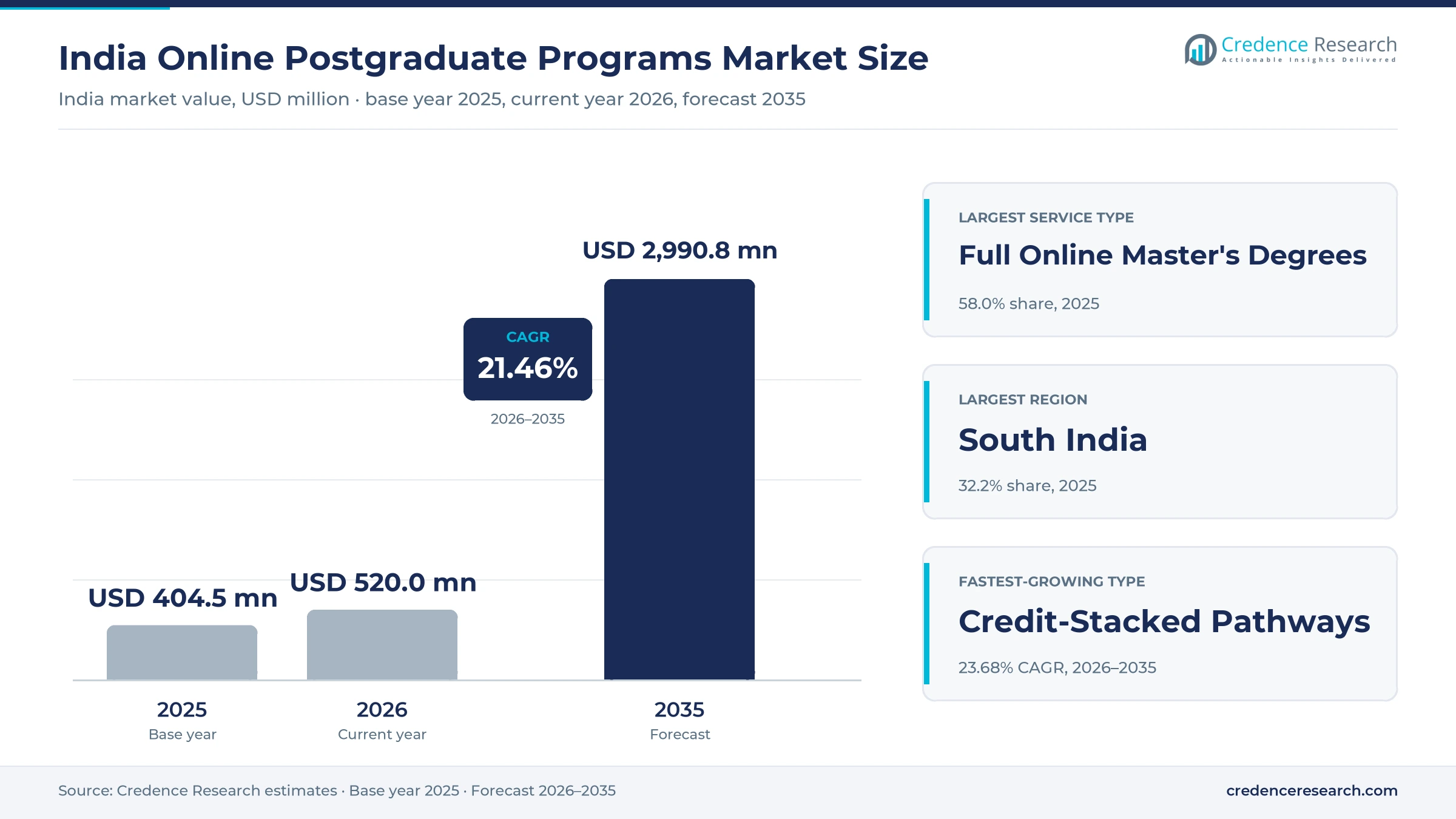
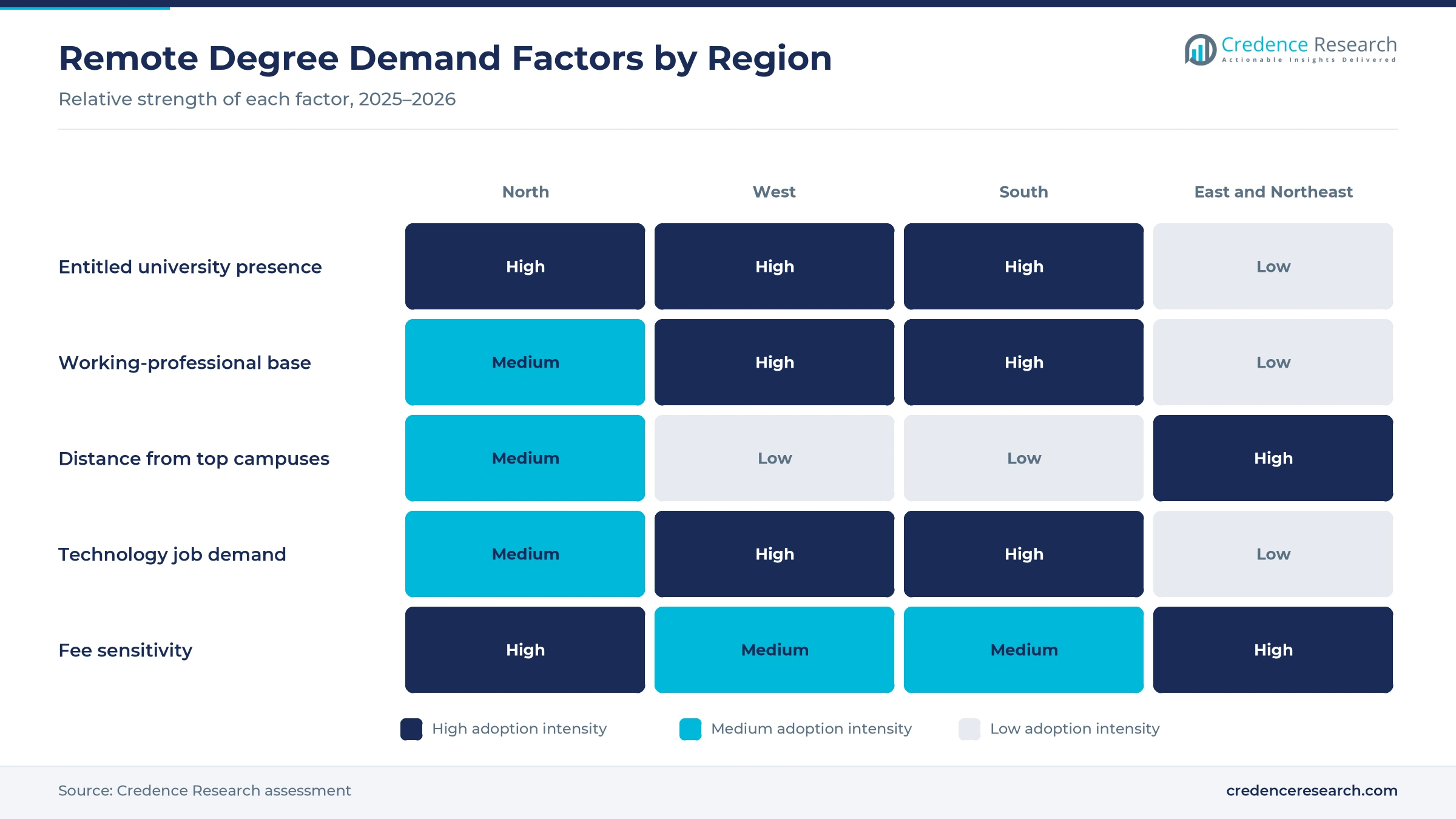
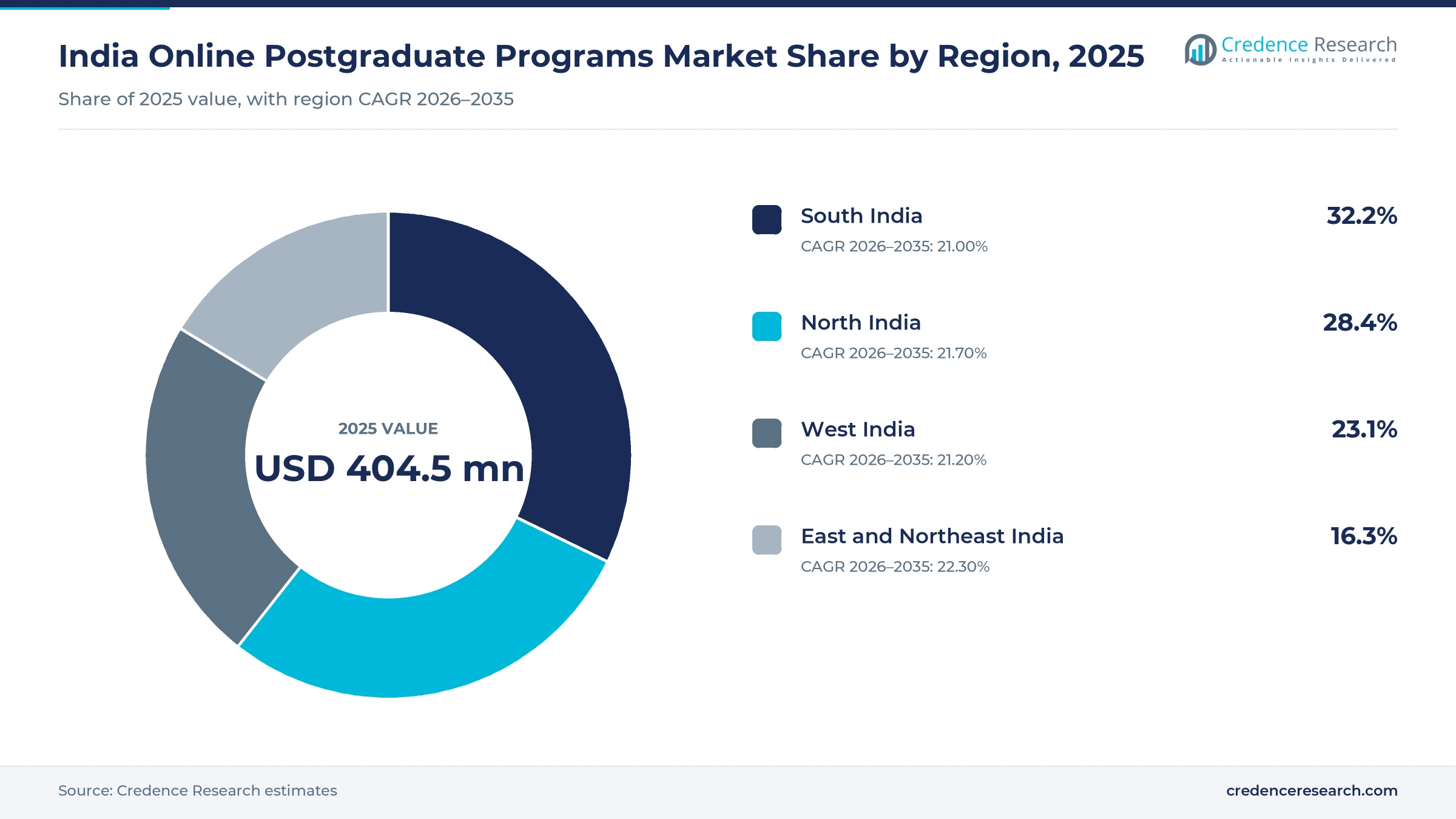
The India online postgraduate programs market was valued at USD 404.5 million in 2025 and is projected to increase from USD 520.0 million in 2026 to USD 2.99 billion by 2035, registering a CAGR of 21.46% during 2026–2035. Demand comes from working professionals who want a recognized master's degree without leaving their jobs, from graduates in smaller towns far from top campuses, and from employers that sponsor staff upskilling. South India held the largest regional share, 32.2% in 2025, because Karnataka and Tamil Nadu host several large entitled universities and dense technology workforces. East and Northeast India is the fastest-growing region at 22.30% a year, as learners there gain access to degrees they could not reach on campus. In turn, the University Grants Commission listed 113 institutions entitled to offer full online programs for the 2025-26 session, which widens choice for learners nationwide.
Which remote master's and diploma courses does the estimate cover?
The estimate measures tuition and fee revenue from fully remote master's degrees, postgraduate diplomas, industry-integrated master's degrees and credit-stacked pathways offered by universities entitled by the University Grants Commission. It covers semester, annual and upfront fees as well as employer-sponsored cohorts.
The estimate excludes open and distance learning by correspondence, undergraduate degrees, short certificates, test preparation and campus programs. The value chain runs from universities and their learning platforms through admission counselors and employers to learners who study, sit proctored exams and receive degrees.
India Online Postgraduate Programs Market Insights
- The market was valued at USD 404.5 million in 2025 and is projected to reach USD 2.99 billion by 2035, registering a CAGR of 21.46% during 2026–2035.
- South India held a 32.2% share of 2025 value, because Karnataka and Tamil Nadu host large entitled universities and technology workforces.
- Full online master's degrees led with a 58.0% share of 2025 value, because employers and public recruiters recognize the full degree.
- The University Grants Commission listed 113 institutions entitled to offer online programs for the July-August 2025 session, 16 more than in February 2025.
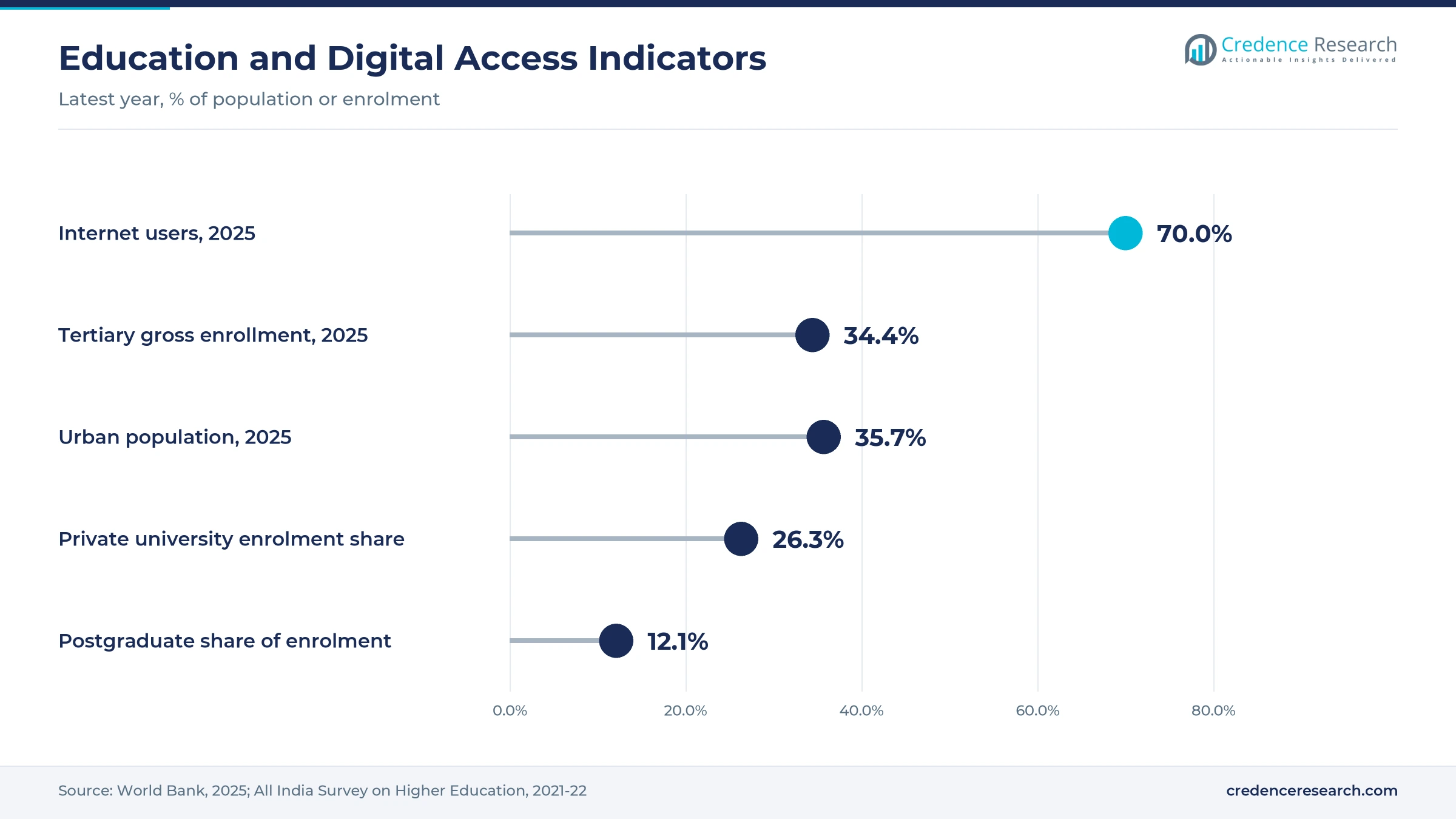
- Postgraduate courses accounted for 12.1% of 4.33 crore higher education enrolments in 2021-22, which shows a large base of master's learners.
Full master's degrees lead as credit pathways grow fastest
What keeps full master's degrees ahead with employers?
Based on service type, the market is categorized into full online master's degrees, online postgraduate diplomas, industry-integrated master's degrees and credit-stacked postgraduate pathways. Full Online Master's Degrees led with a 58.0% share of 2025 value, because employers, promotion boards and public recruiters recognize the full degree. Credit-Stacked Postgraduate Pathways grow fastest at 23.68% a year, as learners bank credits and build a degree in stages.
How large is the working-professional base?
Based on learner segment, the market is categorized into working professionals, recent graduates, career switchers and entrepreneurs and business owners. Working Professionals led with a 62.0% share of 2025 value, because they can pay fees and need degrees for promotion. Career Switchers grow fastest at 22.35% a year, as technology and finance roles reward new qualifications.
Which subjects attract the most enrolments?
Based on program type, the market is categorized into management and business, computer applications and data science, commerce and finance, and arts, humanities and sciences. Management and Business led with a 52.0% share of 2025 value, because online MBA degrees suit managers at every level. Computer Applications and Data Science grows fastest at 22.69% a year, as universities pair degrees with learning management systems and coding labs.
How do private and deemed universities compare?
Based on institution type, the market is categorized into private universities, deemed-to-be universities, state universities and central universities. Private Universities led with a 47.0% share of 2025 value, because they invested early in platforms, marketing and learner support. Central Universities grow fastest at 22.67% a year, as public institutions widen remote access at lower fees.
| Segment Group | Leading Sub-segment | Share, 2025 | Fastest-growing Sub-segment | CAGR, 2026–2035 |
|---|---|---|---|---|
| By Service Type | Full Online Master's Degrees | 58.0% | Credit-Stacked Postgraduate Pathways | 23.68% |
| By Learner Segment | Working Professionals | 62.0% | Career Switchers | 22.35% |
| By Program Type | Management and Business | 52.0% | Computer Applications and Data Science | 22.69% |
| By Institution Type | Private Universities | 47.0% | Central Universities | 22.67% |
Request a Free Sample
Fill in your details and we'll send you a free sample report.
- Sample data tables & charts
- Research methodology
University supply, career goals and credit rails lift demand
How does formal recognition expand university supply?
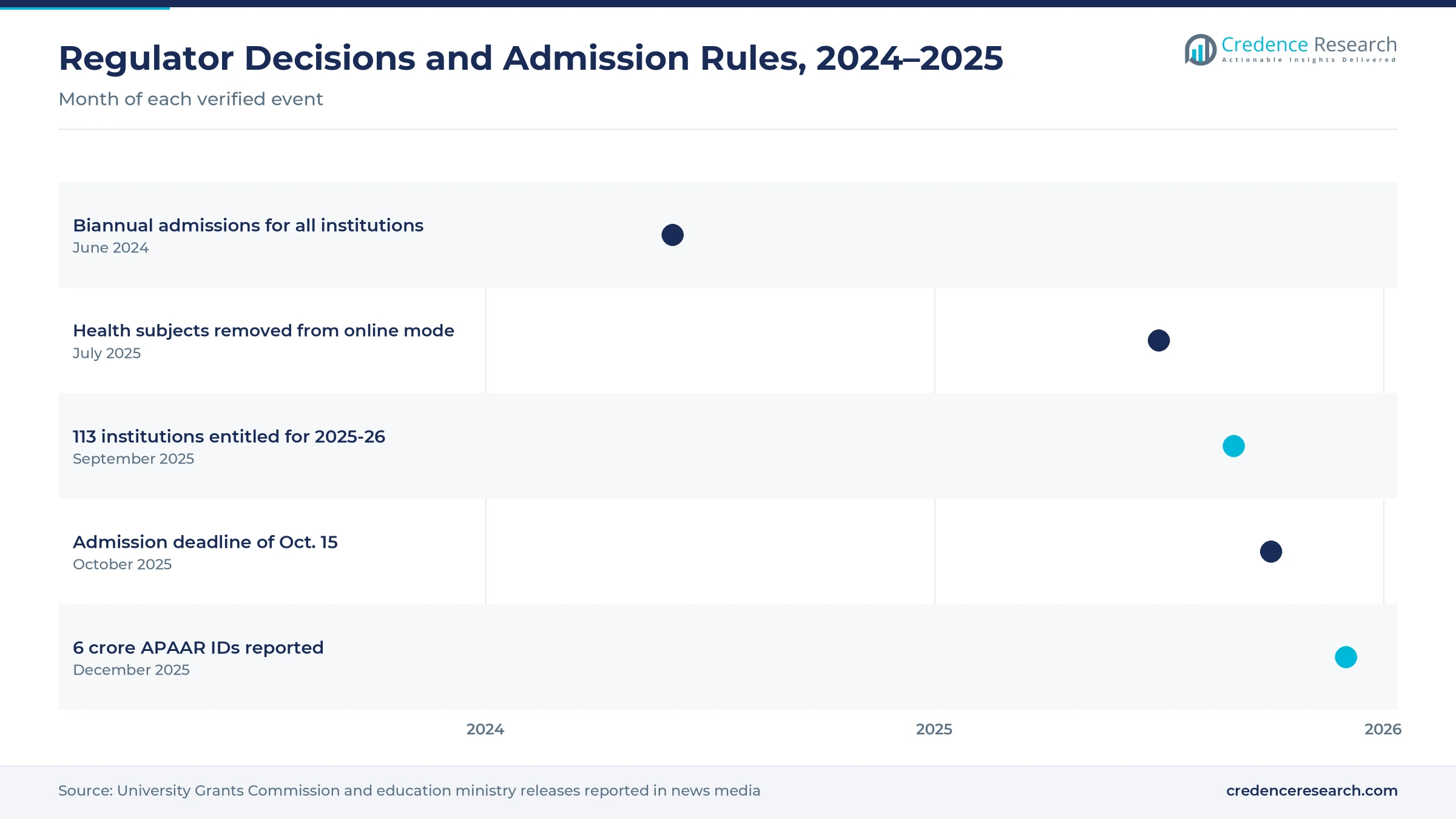
Formal recognition and rapid expansion of university supply lift enrolments, because learners trust degrees from institutions the regulator has entitled. The University Grants Commission listed 113 universities for online courses in the 2025-26 academic session, according to Careers360. The July-August 2025 update added 16 universities compared with the February 2025 session and covered 756 online programs. The rules also require full ownership of each program and forbid franchise arrangements, which protects degree value and gives learners confidence that their qualification will be accepted. As a result, private universities hold 47.0% of 2025 value, while state and central universities widen access at lower fees.
Why do working professionals drive career-led demand?
Working-professional demand and career mobility drive enrolments, because employees want master's degrees for promotion without leaving paid jobs. Postgraduate courses made up 12.1% of the 4.33 crore students in higher education in 2021-22, which shows a large base of master's learners. Online and distance programs enrolled 19,73,056 students in July 2022, and another 4,28,854 joined in January 2023, according to IANS citing the regulator. Many employers also fund corporate training budgets that now cover degree fees. In turn, working professionals hold 62.0% of 2025 value, because they combine steady income with clear promotion goals and can pay semester fees from their salaries.
How do digital public rails normalize credit transfer?
Digital public infrastructure and credit normalization make remote study easier, because learners can store and move credits between universities. More than 6 crore APAAR IDs had been generated across over 2,600 institutions on the Academic Bank of Credits portal by December 2025, the education ministry told Parliament. Over 7 crore academic records had been mapped to those IDs through DigiLocker and the National Academic Depository. Broadband subscribers reached 1.087 billion at the end of June 2026, the telecom regulator said, which brings live classes to smaller towns. As a result, credit-stacked postgraduate pathways grow at 23.68% a year, the fastest service type.
Why does low tertiary participation leave room for growth?
Low tertiary participation leaves room for growth, because many graduates never reached a campus master's course after their first degree. Gross tertiary enrollment stood at 34.4% in 2025, according to the World Bank, well below levels in richer economies. Internet use reached 70% of the population in 2025, up from about 65% in 2024, which widens the pool that can study online. Urban residents made up only about 35.7% of the population in 2025, so most learners live far from top campuses. In turn, East and Northeast India grows faster than other regions, as recognized university education reaches new learners online.
Twice-yearly intakes, tighter rules and credit stacking
How is the shift to twice-yearly intakes changing admissions?
The shift to twice-yearly intakes is changing admissions, because learners no longer wait a full year after missing a July start. The regulator first allowed January and July admissions for online and distance modes, and in June 2024 it extended biannual admissions to all higher education institutions from 2024-25. About 4,28,854 learners joined in January 2023 alone, which the regulator said showed nearly half a million students gaining a second chance. The regulator also set Oct. 15 as the last date to admit learners for the 2025-26 session. As a result, providers now run two marketing and onboarding cycles each year across 2026–2035.
Why is the rise of tighter quality rules significant?
The rise of tighter quality rules is significant, because the regulator is narrowing which subjects can be taught fully online. It decided at its 592nd meeting on July 23, 2025, to stop online and distance programs in psychology, microbiology, food and nutrition science, biotechnology and clinical nutrition, according to SCC Online. Any recognition already granted for those subjects was withdrawn from the July-August 2025 session. Deemed universities also need technical council approval for online management and computer applications degrees. In turn, providers shift capacity toward management, commerce and computing, where management and business keep 52.0% of 2025 value and demand remains steady among working managers.
Can credit stacking open a modular path to degrees?
Credit stacking offers a modular path to degrees, because learners can bank short courses and later convert them into a master's qualification. The national credit framework allows up to 50% of a program's credits to come from skill-based courses under a regulator procedure. More than 6 crore APAAR IDs now link learners to their academic records, and over 7 crore records have been mapped. Broadband reached 1.087 billion subscribers in June 2026, which supports short online modules. As a result, providers that pair e-learning platforms with credit banking can win learners who cannot commit to two years of study and fees upfront.
Is computing and data science an opening for new cohorts?
Computing and data science offer an opening for new cohorts, because employers keep hiring analysts, developers and product managers. Science made up 14.7% of postgraduate enrolment in 2021-22, behind social science at 21.1%, which leaves room for technical degrees to grow. The 756 online programs listed for 2025-26 already include many computer applications degrees at entitled universities. Internet use at 70% of the population in 2025 also widens the pool of remote coding learners. In turn, computer applications and data science grow at 22.69% a year, the fastest program type, as universities add analytics, cloud and artificial intelligence electives to their degrees.
Recognition doubts, dropouts and fee pressure test providers
How do recognition doubts slow enrolment decisions?
Recognition doubts slow enrolment decisions, because some employers and learners still question whether online degrees equal campus degrees. As a result, learners check entitlement lists, accreditation and approval status before paying fees. Unentitled providers and misleading advertisements add to the confusion for many first-time buyers. Universities respond by publishing approval letters, offering campus immersion days and showing alumni placement records that reassure cautious buyers and their employers about degree value.
Why do dropout rates hurt provider economics?
Dropout rates hurt provider economics, because working learners often pause studies when job or family duties rise. In turn, universities lose semester fees and must spend more on counseling and reminders. Recorded self-paced formats see the steepest attrition among busy professionals with long working hours. Providers respond with live cohorts, mentors, flexible exam windows and credit banking that lets learners return later without losing progress or repeating completed courses.
How does fee competition squeeze margins?
Fee competition squeezes margins, because more than one hundred entitled universities now chase the same working learners in large and small cities alike. As a result, providers spend heavily on digital advertising and counselor commissions to win each admission. Smaller universities struggle to match the marketing budgets of large private brands. Providers respond with installment plans, employer partnerships and scholarships that keep fees affordable while protecting revenue per learner over the full course.
Why do subject restrictions narrow course portfolios?
Subject restrictions narrow course portfolios, because the regulator has removed several health and science subjects from online delivery. In turn, universities that built programs in psychology or nutrition must stop new admissions and support enrolled learners to completion. Smaller providers lose a meaningful share of their catalog and admissions quickly. Universities respond by shifting faculty into management, commerce and computing degrees that remain open for remote delivery under current rules.
South India leads while East and Northeast grow fastest
| Region | Value, 2025 (USD million) | Share, 2025 | CAGR, 2026–2035 |
|---|---|---|---|
| South India | 130.2 | 32.2% | 21.00% |
| North India | 114.9 | 28.4% | 21.70% |
| West India | 93.4 | 23.1% | 21.20% |
| East and Northeast India | 65.9 | 16.3% | 22.30% |
What keeps Karnataka and Tamil Nadu ahead in remote study?
South India held a 32.2% share of 2025 value and grows at 21.00% a year, because Karnataka and Tamil Nadu host large technology workforces and several entitled universities. JAIN (Deemed-to-be University) and Manipal Academy of Higher Education in Karnataka and Amrita Vishwa Vidyapeetham in Tamil Nadu appear on the 2025-26 entitlement list. As a result, the region leads demand for management and computing degrees, especially among engineers in Bengaluru, Chennai and other technology hubs.
How does North India build on large private universities?
North India held a 28.4% share of 2025 value and grows at 21.70% a year, because large private universities in Punjab, Uttar Pradesh and Rajasthan run big online catalogs. Lovely Professional University and Chandigarh University in Punjab, Amity University in Uttar Pradesh and Manipal University Jaipur in Rajasthan are all entitled for 2025-26. In turn, the region competes strongly on brand, fees and installment plans, and draws learners from Delhi and nearby states.
Why is West India a hub for management degrees?
West India held a 23.1% share of 2025 value and grows at 21.20% a year, because Mumbai and Pune host financial firms, corporate offices and established business schools. NMIMS, Symbiosis International and DY Patil Vidyapeeth in Pune, all based in Maharashtra, are entitled to offer online degrees for 2025-26. As a result, demand centers on online MBA and executive education formats for managers who want to stay in their current roles.
How are East and Northeast India adding the fastest growth?
East and Northeast India held 16.3% of 2025 value and grow fastest at 22.30% a year, because many learners there live far from top campuses. Sikkim Manipal University in Sikkim is entitled to offer online programs for 2025-26. In turn, rising internet use and broadband coverage bring recognized degrees to towns that previously relied on distance correspondence.
Regulator decisions and admission rules since 2024
| Development | Status and market relevance |
|---|---|
| In June 2024, the University Grants Commission allowed higher education institutions to admit students twice a year from 2024-25. | Extends January intakes beyond online and distance modes |
| In July 2025, the University Grants Commission decided to stop online and distance programs in psychology, nutrition and related health subjects. | Withdraws recognition from the July-August 2025 session |
| In September 2025, the University Grants Commission listed 113 institutions entitled to offer online programs for 2025-26. | Adds 16 universities compared with February 2025 |
| In October 2025, the University Grants Commission set Oct. 15 as the last date to admit online and distance learners for 2025-26. | Tightens admission data reporting |
| In December 2025, the education ministry reported more than 6 crore APAAR IDs across over 2,600 institutions. | Supports credit transfer between universities |
Learning platforms, proctoring and credit records
- Learning platforms host live classes, recorded lectures and assignments, which lets working learners study after office hours on phones or laptops.
- Remote proctoring uses webcams and browser locks during exams, which protects degree credibility and meets regulator expectations.
- Academic credit records link each learner to an APAAR ID and DigiLocker, which makes credits portable between universities.
- Analytics and mentoring tools flag learners who fall behind, which helps universities cut dropouts and keep semester fees flowing.
Need a Custom Version of This Report?
Tailor the scope, geography, or segments to your exact requirements.
- Custom geography or segment scope
- Direct access to our analyst team
Private and deemed universities compete on brand and fees
Competition in online postgraduate programs is led by large private and deemed universities that built online arms early and spend heavily on marketing. Amity University, Manipal University Jaipur, Sikkim Manipal University, Lovely Professional University and Chandigarh University compete on brand, catalog breadth and installment plans. NMIMS, Symbiosis International, JAIN (Deemed-to-be University) and DY Patil Vidyapeeth in Pune compete in management degrees, while Amrita Vishwa Vidyapeetham adds a strong southern presence. All ten appear on the regulator's 2025-26 list of institutions entitled to offer online programs. Rivals compete on fees, accreditation, live teaching, placement support, employer tie-ups and campus immersion. Because the regulator forbids franchise delivery, universities must own platforms and faculty, which favors institutions with scale.
Which universities shape remote master's study?
| Company | Type | Role in the market |
|---|---|---|
| Amity University | Private university | Entitled for online programs in 2025-26 from Uttar Pradesh and Rajasthan |
| Manipal University Jaipur | Private university | Entitled for online programs in 2025-26 from Rajasthan |
| Narsee Monjee Institute of Management Studies | University | Entitled for online programs in 2025-26 from Maharashtra |
| JAIN (Deemed-to-be University) | Deemed university | Entitled for online programs in 2025-26 from Karnataka |
| Sikkim Manipal University | Private university | Entitled for online programs in 2025-26 from Sikkim |
Credence Research view on remote master's study in India
Credence Research's view is that online postgraduate programs in India will grow through more entitled universities, twice-yearly intakes and portable credits rather than through higher fees. Full master's degrees remain the largest value pool, while credit-stacked pathways, computing degrees and East and Northeast India add the fastest growth. Tighter subject rules will narrow some catalogs over the next few years. Universities with strong brands, live teaching and employer partnerships should gain the most, while fee competition keeps pressure on margins.
How the national remote-degree estimate was built
The report uses 2025 as the base year on a calendar basis, and market values come from the Credence Research model. That model combines regulator entitlement lists, higher education survey data, enrolment figures, connectivity data and university releases. Regional shares follow the client zone definitions, while segment splits and growth rates are Credence Research estimates. Sources used are regulator notices, ministry statements, World Bank data and news reports of official releases, and no interviews or surveys were used.
Working learners and credit rails carry growth to 2035
The India online postgraduate programs market is expected to reach USD 2.99 billion by 2035, a 21.46% CAGR during 2026–2035, as entitled universities, twice-yearly intakes and portable credits keep demand rising. Growth should be strongest in credit-stacked pathways, computing and data science, central universities and East and Northeast India, because these areas gain most from wider access and new rules. South India will keep the lead, while recognition doubts and fee competition could slow some providers.
Frequently Asked Questions
How big is the India online postgraduate programs market?
Which service type leads remote master's study in India?
Which region leads the India market?
How many universities can offer online degrees in India?
Can Indian universities admit online learners twice a year?
Which subjects cannot be studied fully online in India?
Who are the leading providers of remote master's degrees in India?
What are the main challenges for remote master's providers in India?
Table of Content
Chapter 1 Market Segmentation
- 1.1 Segmentation Framework
- 1.1.1 Product and Service Classification
- 1.1.2 Application and End-Use Classification
- 1.1.3 Technology and Solution Classification
- 1.1.4 Customer and Distribution Channel Classification
- 1.1.5 Geographic Segmentation
- 1.1.6 Market Segment Definitions and Boundaries
- 1.2 By Service Type
- 1.2.1 Full Online Master's Degrees
- 1.2.2 Online Postgraduate Diplomas
- 1.2.3 Industry-Integrated Master's Degrees
- 1.2.4 Credit-Stacked Postgraduate Pathways
- 1.3 By Learner Segment
- 1.3.1 Working Professionals
- 1.3.2 Recent Graduates
- 1.3.3 Career Switchers
- 1.3.4 Entrepreneurs and Business Owners
- 1.4 By Program Type
- 1.4.1 Management and Business
- 1.4.2 Computer Applications and Data Science
- 1.4.3 Commerce and Finance
- 1.4.4 Arts, Humanities and Sciences
- 1.5 By Institution Type
- 1.5.1 Private Universities
- 1.5.2 Deemed-to-be Universities
- 1.5.3 State Universities
- 1.5.4 Central Universities
Chapter 2 Introduction
- 2.1 Report Objectives and Scope
- 2.2 Product Definition and Industry Terminology
- 2.3 Market Inclusions and Exclusions
- 2.4 Research Process
- 2.4.1 Primary Research and Expert Interviews
- 2.4.2 Secondary Research and Source Review
- 2.4.3 Top-Down and Bottom-Up Estimation
- 2.4.4 Data Triangulation and Verification
- 2.5 Market Size Measurement Basis
- 2.5.1 2025: USD 404.5 million → 2035: USD 2.99 billion
- 2.6 Historical and Forecast Reference Periods
- 2.6.1 Historical Period: 2018-2025
- 2.6.2 Base Year: 2025
- 2.6.3 Forecast Period: 2025-2035
- 2.7 Research Assumptions and Limitations
Chapter 3 Executive Summary
- 3.1 Market Snapshot and Key Findings
- 3.2 Base-Year Market Size, 2025
- 3.3 Forecast Market Size, 2035
- 3.4 Revenue and Volume Growth Outlook
- 3.5 Key Demand and Supply Indicators
- 3.6 Leading Market Segments
- 3.7 Fastest-Growing Market Opportunities
- 3.8 Regional Performance Highlights
- 3.9 Technology and Industry Transformation
- 3.10 Competitive Landscape Summary
- 3.11 Analyst View and Strategic Implications
Chapter 4 India Online Postgraduate Programs Market Trends and Developments
- 4.1 Historical Industry Development, 2018-2025
- 4.2 Recent Market Trends and Developments
- 4.3 Demand and Customer Behavior Trends
- 4.4 Technology and Product Innovation
- 4.5 Artificial Intelligence, Automation and Digitalization
- 4.6 Local Manufacturing and Supply Chain Realignment
- 4.7 Industry Partnerships, Mergers and Acquisitions
- 4.8 Sustainability and Circular Economy Developments
- 4.9 Government and Private Sector Investment Trends
- 4.10 Emerging Business Models and Commercialization
- 4.11 Industry Developments and Announcements
Chapter 5 India Online Postgraduate Programs Market Production, Supply and Demand Analysis
- 5.1 Demand Trend and Consumption Analysis, 2018-2025
- 5.2 Demand Forecast, 2025-2035
- 5.3 Production and Output Trend, 2018-2025
- 5.4 Production and Output Forecast, 2025-2035
- 5.5 Installed Capacity and Capacity Utilization
- 5.6 Company-Wise Production Plants and Statistics
- 5.6.1 Installed Production Capacity
- 5.6.2 Actual Production
- 5.6.3 Planned Capacity and Expansion Targets
- 5.7 Supply Chain Structure and Procurement Trends
- 5.8 Supply-Demand Gap and Bottlenecks
- 5.9 Import Dependence and Sourcing Structure
- 5.10 Contract Manufacturing and Outsourcing
- 5.11 Regional Supply and Demand Concentration
Chapter 6 India Online Postgraduate Programs Market Pricing Analysis
- 6.1 Pricing Structure and Measurement
- 6.2 Historical Pricing Trends, 2018-2025
- 6.3 Pricing Outlook, 2025-2035
- 6.4 Average Selling Price and Unit Economics
- 6.5 Pricing by Product and Market Segment
- 6.6 Geographic Pricing Differences
- 6.7 Key Input, Energy, Labor and Logistics Costs
- 6.8 Contract Pricing and Purchasing Models
- 6.9 Pricing Sensitivity and Competitive Positioning
- 6.10 Price, Margin and Profitability Implications
Chapter 7 India Online Postgraduate Programs Market Dynamics
- 7.1 Market Growth Drivers
- 7.1.1 Demand-Side Drivers
- 7.1.2 Technology and Innovation Drivers
- 7.1.3 Infrastructure and Investment Drivers
- 7.1.4 Regulatory and Policy Drivers
- 7.2 Market Restraints
- 7.2.1 Cost and Affordability Constraints
- 7.2.2 Technology and Adoption Barriers
- 7.2.3 Supply Chain and Operational Constraints
- 7.3 Market Challenges
- 7.3.1 Competitive Pressure and Margin Erosion
- 7.3.2 Skills, Infrastructure and Implementation Gaps
- 7.4 Emerging Market Opportunities
- 7.5 Market Dynamics Impact and Time-Horizon Assessment
Chapter 8 India Online Postgraduate Programs Value Chain Analysis
- 8.1 Industry Value Chain Overview
- 8.2 Upstream Suppliers and Critical Inputs
- 8.3 Technology and Component Providers
- 8.4 Manufacturing or Service Delivery
- 8.5 Distribution, Channel Partners and Integrators
- 8.6 Downstream Applications and End Users
- 8.7 Value Addition and Profit Pools
- 8.8 Vertical Integration and Outsourcing
- 8.9 Supplier Concentration and Risk
- 8.10 Supply Chain Localization and Resilience
Chapter 9 India Online Postgraduate Programs Market Regulations and Policies
- 9.1 Relevant Laws, Standards and Compliance Frameworks
- 9.2 Product, Service, Safety and Quality Requirements
- 9.3 Government Policies, Incentives and Subsidies
- 9.4 Imports, Exports and Trade Barriers
- 9.5 Public Procurement and Local Content Requirements
- 9.6 Environmental and Sustainability Compliance
- 9.7 Data Protection, AI and Cybersecurity Compliance
- 9.8 Upcoming Policy Changes and Market Implications
Chapter 10 India Online Postgraduate Programs Market Hotspots and Opportunities
- 10.1 Market Opportunity Mapping and Growth Hotspots
- 10.2 High-Growth Applications and Customer Groups
- 10.3 Underserved Markets and White-Space Opportunities
- 10.4 Emerging Technology and Product Opportunities
- 10.5 New Capacity and Investment Hotspots
- 10.6 Market Entry and Expansion Opportunities
- 10.7 Distribution and Partnership Opportunities
- 10.8 Near-Term and Long-Term Commercial Potential
- 10.9 Opportunity Attractiveness and Execution Risks
Chapter 11 India Online Postgraduate Programs Market Outlook, 2025-2035
- 11.1 Market Size and Analysis
- 11.1.1 Revenue (Market Measurement: 2025: USD 404.5 million → 2035: USD 2.99 billion)
- 11.1.2 Market Volume and Quantity Sold
- 11.1.3 Historical Market Size, 2018-2025
- 11.1.4 Base-Year Market Size, 2025
- 11.2 Market Forecast, 2025-2035
- 11.2.1 Revenue Forecast to 2035
- 11.2.2 Volume Forecast to 2035
- 11.2.3 CAGR and Year-on-Year Growth
- 11.2.4 Incremental Revenue Opportunity
- 11.3 Forecast Assumptions and Scenario Analysis
- 11.3.1 Base-Case Forecast
- 11.3.2 Optimistic and Conservative Scenarios
- 11.3.3 Technology, Pricing and Policy Sensitivities
- 11.4 Market Attractiveness and Growth Outlook
Chapter 12 India Online Postgraduate Programs Market Segmentation and Outlook
- 12.1 Segmentation Summary and Market Shares, 2025
- 12.2 Largest and Fastest-Growing Segments
- 12.3 By Service Type - Market Size and Forecast, 2025-2035
- 12.3.1 Segment Definition and Scope
- 12.3.2 Historical Market Size, 2018-2025
- 12.3.3 Revenue Forecast, 2025-2035
- 12.3.4 Volume Forecast, 2025-2035
- 12.3.5 Base-Year Market Share, 2025
- 12.3.6 Segment CAGR and Growth Drivers
- 12.3.7 Subsegment Market Size and Forecast
- 12.3.7.1 Full Online Master's Degrees
- 12.3.7.2 Online Postgraduate Diplomas
- 12.3.7.3 Industry-Integrated Master's Degrees
- 12.3.7.4 Credit-Stacked Postgraduate Pathways
- 12.3.8 Subsegment Pricing and Adoption Trends
- 12.3.9 Leading Suppliers and Competition
- 12.3.10 Regional Demand and Opportunities
- 12.4 By Learner Segment - Market Size and Forecast, 2025-2035
- 12.4.1 Segment Definition and Scope
- 12.4.2 Historical Market Size, 2018-2025
- 12.4.3 Revenue Forecast, 2025-2035
- 12.4.4 Volume Forecast, 2025-2035
- 12.4.5 Base-Year Market Share, 2025
- 12.4.6 Segment CAGR and Growth Drivers
- 12.4.7 Subsegment Market Size and Forecast
- 12.4.7.1 Working Professionals
- 12.4.7.2 Recent Graduates
- 12.4.7.3 Career Switchers
- 12.4.7.4 Entrepreneurs and Business Owners
- 12.4.8 Subsegment Pricing and Adoption Trends
- 12.4.9 Leading Suppliers and Competition
- 12.4.10 Regional Demand and Opportunities
- 12.5 By Program Type - Market Size and Forecast, 2025-2035
- 12.5.1 Segment Definition and Scope
- 12.5.2 Historical Market Size, 2018-2025
- 12.5.3 Revenue Forecast, 2025-2035
- 12.5.4 Volume Forecast, 2025-2035
- 12.5.5 Base-Year Market Share, 2025
- 12.5.6 Segment CAGR and Growth Drivers
- 12.5.7 Subsegment Market Size and Forecast
- 12.5.7.1 Management and Business
- 12.5.7.2 Computer Applications and Data Science
- 12.5.7.3 Commerce and Finance
- 12.5.7.4 Arts, Humanities and Sciences
- 12.5.8 Subsegment Pricing and Adoption Trends
- 12.5.9 Leading Suppliers and Competition
- 12.5.10 Regional Demand and Opportunities
- 12.6 By Institution Type - Market Size and Forecast, 2025-2035
- 12.6.1 Segment Definition and Scope
- 12.6.2 Historical Market Size, 2018-2025
- 12.6.3 Revenue Forecast, 2025-2035
- 12.6.4 Volume Forecast, 2025-2035
- 12.6.5 Base-Year Market Share, 2025
- 12.6.6 Segment CAGR and Growth Drivers
- 12.6.7 Subsegment Market Size and Forecast
- 12.6.7.1 Private Universities
- 12.6.7.2 Deemed-to-be Universities
- 12.6.7.3 State Universities
- 12.6.7.4 Central Universities
- 12.6.8 Subsegment Pricing and Adoption Trends
- 12.6.9 Leading Suppliers and Competition
- 12.6.10 Regional Demand and Opportunities
- 12.7 Segment Growth Comparison
- 12.8 Segment Attractiveness and Priority Matrix
Chapter 13 India Online Postgraduate Programs Geographic Market Outlook, 2025-2035
- 13.1 Domestic Market Distribution and Demand Clusters
- 13.2 State- or Province-Wise Market Size and Forecast, 2025-2035
- 13.3 City and Metropolitan Market Outlook
- 13.4 Industrial, Manufacturing and Commercial Clusters
- 13.5 Geographic Concentration of Key End Users
- 13.6 Local Pricing and Purchasing Differences
- 13.7 Domestic Production Facilities and Capacity Map
- 13.8 Local Infrastructure and Project Pipeline
- 13.9 State-Level Policy and Incentive Differences
- 13.10 Subnational Investment Hotspots and Opportunities
- 13.11 Distribution and Logistics Networks
- 13.12 Domestic Competitive Footprint
Chapter 14 India Online Postgraduate Programs Technology, Innovation and Sustainability Outlook
- 14.1 Technology Landscape and Maturity
- 14.2 Product, Process and Service Innovation
- 14.3 AI, Automation and Digital Tools in the Industry
- 14.4 Technology Adoption and Performance Benchmarking
- 14.5 Innovation Pipeline and R&D Investment
- 14.6 Patent and Intellectual Property Trends
- 14.7 Energy Efficiency and Resource Management
- 14.8 Sustainability, Recycling and Circularity
- 14.9 Technology Roadmap, 2025-2035
- 14.10 Risks of Obsolescence and Technology Substitution
Chapter 15 India Online Postgraduate Programs Market Key Strategic Imperatives
- 15.1 Growth and Market Entry Priorities
- 15.2 High-Return Products and Segments
- 15.3 Pricing, Profitability and Cost Optimization
- 15.4 Technology Investment and Product Differentiation
- 15.5 Supply Chain Localization and Resilience
- 15.6 Distribution and Customer Acquisition
- 15.7 Partnership, Acquisition and Capacity Strategy
- 15.8 Regional Expansion Priorities
- 15.9 Short-, Medium- and Long-Term Actions
Chapter 16 Competition Outlook
- 16.1 Industry Competition Characteristics
- 16.2 Market Structure and Concentration
- 16.3 Market Share and Competitive Positioning, 2025
- 16.4 Company-Wise Revenue and Product Benchmarking
- 16.5 Production and Service Capacity Benchmarking
- 16.6 Technology, Pricing and Differentiation
- 16.7 Regional Footprint and Distribution Strength
- 16.8 Mergers, Acquisitions and Strategic Alliances
- 16.9 New Entrants and Competitive Threats
- 16.10 Porter's Five Forces and Industry Attractiveness
- 16.11 Competitive Outlook, 2025-2035
Chapter 17 Company Profiles
- 17.1 Company Coverage and Selection Criteria
- 17.2 Amity University Online
- 17.2.1 Business Description
- 17.2.2 Company Ownership and Geographic Presence
- 17.2.3 Product and Service Portfolio
- 17.2.4 Manufacturing and Operating Footprint
- 17.2.5 Production Capacity and Expansion Plans
- 17.2.6 Financial Performance and Investment
- 17.2.7 Market Share and Competitive Position
- 17.2.8 Technology and Innovation Capabilities
- 17.2.9 Strategic Alliances or Partnerships
- 17.2.10 Recent Developments
- 17.2.11 Growth Strategy and Outlook
- 17.3 Manipal University Jaipur
- 17.4 SVKM's Narsee Monjee Institute of Management Studies
- 17.5 JAIN (Deemed-to-be University)
- 17.6 Lovely Professional University
- 17.7 Chandigarh University
- 17.8 Amrita Vishwa Vidyapeetham
- 17.9 Sikkim Manipal University
- 17.10 Symbiosis International (Deemed University)
- 17.11 Dr. D.Y. Patil Vidyapeeth (Pune)
- 17.12 Other Relevant Market Participants
Note: Every listed company is profiled on the structure shown under the first company. The company list is preliminary and may change based on research findings, market developments, data availability and client requirements.
Chapter 18 Disclaimer
- 18.1 Research and Forecast Disclaimer
- 18.2 Data Source and Estimation Limitations
Note: The depth of individual sections depends on data availability for this market. Volume, capacity, trade and other unit-based metrics are included where applicable.

