
| REPORT ATTRIBUTE | DETAILS |
|---|---|
| Historical Period | 2019-2022 |
| Base Year | 2023 |
| Forecast Period | 2024-2032 |
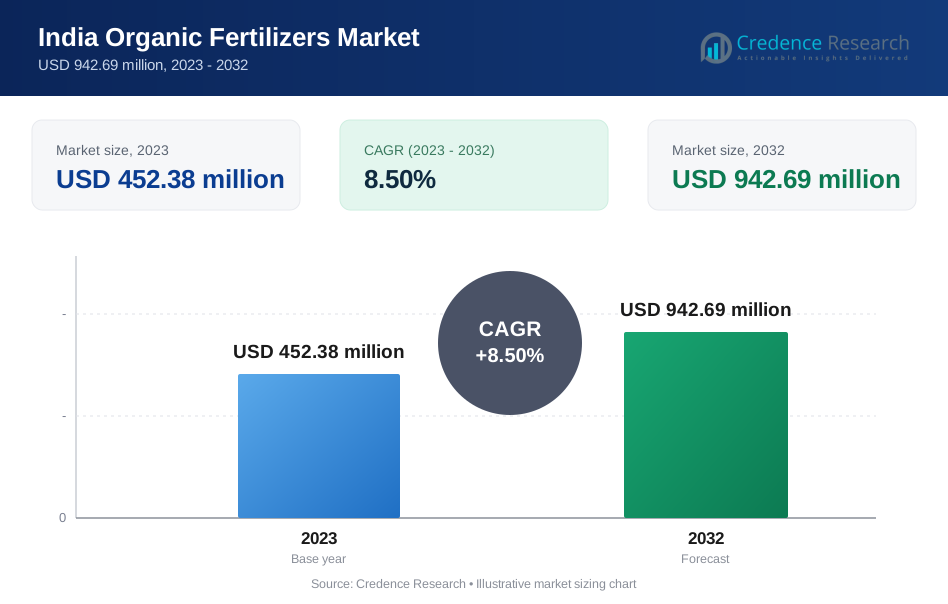
| India Organic Fertilizers Market Size 2023 | USD 452.38 million |
| India Organic Fertilizers Market, CAGR | 8.50% |
| India Organic Fertilizers Market Size 2032 | USD 942.69 million |
Market Overview
The India Organic Fertilizers Market is projected to grow from USD 452.38 million in 2023 to an estimated USD 942.69 million by 2032, with a compound annual growth rate (CAGR) of 8.50% from 2024 to 2032. This robust growth is driven by increasing awareness about the environmental and health benefits of organic farming, which is prompting a shift from conventional chemical fertilizers to organic alternatives. As the government and various non-governmental organizations promote sustainable agriculture practices, the demand for organic fertilizers is expected to witness substantial growth, contributing to the overall market expansion.
Market drivers for the India Organic Fertilizers Market include the rising consumer preference for organic food products, which is fueling the adoption of organic farming practices. Additionally, government initiatives and subsidies aimed at encouraging organic farming are providing a significant boost to the market. The growing environmental concerns regarding soil health and biodiversity preservation are also major factors driving market growth. Trends such as the increasing use of organic waste materials for fertilizer production and advancements in organic fertilizer formulations are further supporting market expansion.
Geographically, the India Organic Fertilizers Market is witnessing significant growth across various regions, with states like Maharashtra, Karnataka, and Tamil Nadu leading the adoption of organic farming practices. The Southern and Western regions of India are emerging as key markets due to favorable climatic conditions and a higher number of organic farms. Key players in the market include Indian Potash Limited, National Fertilizers Limited, and Tata Chemicals Limited, which are focusing on expanding their product portfolios and enhancing distribution networks to cater to the growing demand. Collaborations with agricultural research institutes and investment in R&D for innovative organic fertilizer products are also notable strategies adopted by these companies to maintain their competitive edge.
Market Drivers
Rising Consumer Preference for Organic Products
The increasing consumer awareness and preference for organic products play a pivotal role in driving the demand for organic fertilizers in India. For instance, a survey conducted in 2023 showed that 70% of Indian consumers preferred organic products over conventional ones. Consumers are becoming more health-conscious and are inclined towards consuming food products that are free from harmful chemicals and pesticides. This shift in consumer behavior is encouraging farmers to adopt organic farming practices, thereby boosting the demand for organic fertilizers. The growing middle-class population with higher disposable incomes is also contributing to this trend. As more consumers demand organic food, the agricultural sector is responding by increasing organic farming practices, thus creating a robust demand for organic fertilizers.
Government Initiatives and Subsidies
The Indian government has been actively promoting organic farming through various initiatives and subsidies, significantly driving the organic fertilizers market. For instance, Programs such as the Paramparagat Krishi Vikas Yojana (PKVY) and the National Mission on Sustainable Agriculture (NMSA) aim to encourage farmers to switch to organic farming by providing financial assistance and technical support. These initiatives help in reducing the cost burden on farmers and make organic farming more accessible and attractive. Additionally, the government is offering subsidies on the purchase of organic fertilizers, which is further incentivizing their adoption. The regulatory framework supporting organic certification and the establishment of organic farming clusters are also critical in boosting market growth.
Environmental and Soil Health Concerns
Growing environmental concerns and the deteriorating health of the soil due to the excessive use of chemical fertilizers are driving the shift towards organic fertilizers. For instance, Studies have shown that the use of chemical fertilizers has led to a 40% reduction in soil fertility over the past decade. Chemical fertilizers, while effective in boosting crop yields, have long-term adverse effects on soil health, reducing its fertility and leading to soil degradation. Organic fertilizers, on the other hand, improve soil structure, enhance microbial activity, and increase the soil's nutrient-holding capacity. This ecological advantage is making organic fertilizers a preferred choice among farmers who are increasingly aware of sustainable farming practices. The emphasis on maintaining soil health for future agricultural productivity is a significant driver of the organic fertilizers market in India.
Advancements in Organic Fertilizer Production
Technological advancements and innovations in organic fertilizer production are also driving market growth. The development of new formulations and production techniques is making organic fertilizers more efficient and cost-effective. The use of bio-waste and agricultural residues in the production of organic fertilizers not only addresses waste management issues but also provides a sustainable source of nutrients for crops. Innovations such as liquid organic fertilizers, enriched composts, and bio-fertilizers are gaining popularity due to their ease of application and enhanced efficacy. Companies are investing in research and development to create advanced organic fertilizers that cater to the specific nutrient requirements of different crops, thereby expanding their market reach.
Market Trends
Integration of Advanced Technologies:
The India Organic Fertilizers Market is witnessing the integration of advanced technologies in the production and application processes. For instance, the use of bio-fermentation technology has increased by 25% in the last two years. Technologies such as bio-fermentation and microbial inoculation are being employed to enhance the nutrient content and effectiveness of organic fertilizers. Additionally, precision agriculture tools are being used to optimize the application of organic fertilizers, ensuring that crops receive the right amount of nutrients at the right time, which helps in improving crop yields and reducing wastage.
Increasing Use of Organic Waste Materials:
There is a growing trend towards the utilization of organic waste materials, such as agricultural residues, animal manure, and food waste, in the production of organic fertilizers. For instance, the use of agricultural residues like rice straw and sugarcane bagasse in organic fertilizer production is becoming more common. This not only helps in waste management but also provides a sustainable and cost-effective source of raw materials for fertilizer production. The focus on recycling organic waste into valuable agricultural inputs is gaining traction, driven by both environmental considerations and economic benefits.
Rising Popularity of Liquid Organic Fertilizers:
Liquid organic fertilizers are becoming increasingly popular among farmers due to their ease of application and faster nutrient uptake by plants. For instance, liquid seaweed fertilizers and fish emulsion fertilizers are being widely used due to their high nutrient content and quick absorption by plants. These fertilizers can be applied through fertigation systems and foliar sprays, allowing for more precise nutrient delivery. The convenience and efficiency offered by liquid organic fertilizers are making them a preferred choice, particularly in high-value crops such as fruits and vegetables.
Expansion of Distribution Networks:
Key players in the India Organic Fertilizers Market are focusing on expanding their distribution networks to reach a wider customer base. This includes establishing partnerships with local distributors and retailers, as well as leveraging e-commerce platforms to enhance product availability. For instance, the use of online platforms for the sale of organic fertilizers has seen a significant increase in recent years. The expansion of distribution channels is crucial for ensuring that organic fertilizers are accessible to farmers across different regions of the country.
Growing Demand for Biofertilizers:
Biofertilizers, which contain living microorganisms that enhance soil fertility, are witnessing increased demand as part of the broader organic fertilizer market. These products help in fixing atmospheric nitrogen, solubilizing phosphorus, and decomposing organic matter, thus improving soil health and plant growth. The growing awareness of the benefits of biofertilizers, coupled with government support for their adoption, is driving this trend.
Focus on Sustainable Agriculture Practices:
There is a strong emphasis on sustainable agriculture practices, which is boosting the demand for organic fertilizers. Sustainable farming techniques, such as crop rotation, intercropping, and the use of cover crops, are being promoted to improve soil health and reduce the dependency on chemical inputs. Organic fertilizers play a critical role in these practices by providing essential nutrients while maintaining ecological balance.
Innovations in Product Formulations:
Companies in the India Organic Fertilizers Market are investing in research and development to innovate and improve product formulations. This includes the development of slow-release fertilizers, fortified organic fertilizers with added micronutrients, and specialized products for specific crops. These innovations aim to enhance the effectiveness and efficiency of organic fertilizers, making them more appealing to farmers and contributing to higher crop productivity.
Market Restraints and Challenges
High Production Costs:
One of the significant restraints in the India Organic Fertilizers Market is the high production costs associated with organic fertilizers. The processes involved in the production of organic fertilizers, such as composting and fermentation, are labor-intensive and time-consuming. Additionally, sourcing raw materials like organic waste and maintaining quality standards add to the overall costs. These higher production costs often translate to higher prices for organic fertilizers, making them less affordable for small-scale farmers who constitute a large portion of the agricultural sector in India.
Limited Awareness and Adoption:
Despite the growing popularity of organic farming, there is still limited awareness and adoption of organic fertilizers among many farmers in India. Traditional farming practices and a reliance on chemical fertilizers continue to dominate the agricultural landscape. Many farmers are unaware of the benefits of organic fertilizers or lack the knowledge to effectively integrate them into their farming practices. This lack of awareness and education poses a significant challenge to the widespread adoption of organic fertilizers.
Inconsistent Quality and Standards:
The organic fertilizers market faces challenges related to inconsistent quality and the lack of standardized products. Variability in the nutrient content and effectiveness of organic fertilizers can occur due to differences in raw materials and production methods. This inconsistency can lead to unpredictable results in crop yields, making farmers hesitant to switch from chemical fertilizers to organic alternatives. Establishing and enforcing quality standards for organic fertilizers is crucial to address this challenge and build trust among farmers.
Supply Chain and Distribution Issues:
Supply chain and distribution issues also pose significant challenges to the India Organic Fertilizers Market. Organic fertilizers often have a shorter shelf life compared to chemical fertilizers, requiring efficient and timely distribution to ensure their effectiveness. However, inadequate infrastructure and logistical challenges can hinder the efficient distribution of organic fertilizers, particularly in remote and rural areas. Improving supply chain management and expanding distribution networks are essential to overcome these challenges.
Limited Research and Development:
The organic fertilizers market in India suffers from limited research and development (R&D) activities. Investment in R&D is crucial for developing innovative and effective organic fertilizer products that can compete with chemical fertilizers. However, the R&D efforts in this sector are often constrained by limited funding and resources. Enhancing R&D capabilities and fostering collaborations between research institutions and industry players can drive innovation and address the existing challenges in the market.
Regulatory Hurdles:
Regulatory hurdles and bureaucratic processes can impede the growth of the organic fertilizers market. Obtaining necessary certifications and approvals for organic fertilizers can be a lengthy and complex process, discouraging new entrants and slowing down the market's expansion. Streamlining regulatory procedures and providing clearer guidelines can help in promoting the development and adoption of organic fertilizers.
Market Segmentation Analysis
By Source
Plant-based organic fertilizers, derived from compost, green manure, and seaweed, are rich in essential nutrients and improve soil structure, driving their growing demand due to sustainability and ease of production. Animal-based organic fertilizers, including manure, bone meal, and fish emulsion, are high in nitrogen and other nutrients, promoting robust plant growth and gaining popularity among farmers practicing integrated farming systems. Mineral-based organic fertilizers, made from naturally occurring minerals like rock phosphate and gypsum, provide long-term nutrient supply and enhance soil health, making them particularly valuable in regions with nutrient-deficient soils.
By Crop Type
The India Organic Fertilizers Market sees significant usage across various crop types. In cereals and grains like rice, wheat, and maize, organic fertilizers are increasingly employed to enhance yield and maintain soil fertility. Oilseeds, such as soybean and sunflower, along with pulses like lentils and chickpeas, benefit from organic fertilizers that improve protein content and overall crop health, addressing the rising demand for organic food. Fruits and vegetables, being high-value and perishable, are ideally suited for organic cultivation, which enhances their market appeal and consumer safety. Additionally, other crops such as spices, herbs, and flowers are adopting organic fertilizers due to niche market demand and sustainable farming practices.
By Nutrition Content
Fertilizers with up to 60% organic content are highly nutrient-rich and are ideal for high-value crops and areas needing significant soil amendment. Those with 40% to 60% organic content provide a balanced nutrient supply, making them suitable for a wide range of crops and popular among medium-scale farmers due to their cost-effectiveness. Fertilizers containing 20% to 40% organic content are typically used as supplements to other fertilizers, offering a cost-effective option for farmers seeking incremental improvements in soil health.
By Form
Dry organic fertilizers, including pellets and powders, are widely favored for their ease of storage and application, making them suitable for large-scale farming operations and long-term soil improvement. Meanwhile, liquid organic fertilizers are gaining popularity due to their rapid nutrient delivery and ease of application through irrigation systems, making them particularly beneficial for high-value crops and precision farming practices.
Segments
Based on Source
- Plant-Based Organic Fertilizers
- Animal-Based Organic Fertilizers
- Mineral-Based Organic Fertilizers
Based on Crop Type
- Cereals and Grains
- Oilseeds and Pulses
- Fruits and Vegetables
- Others
Based on Nutrition Content
- Presence of Organic Substance up to 60%
- Presence of Organic Substance from 40% to 60%
- Presence of Organic Substance from 20% to 40%
Based on Form
- Dry Organic Fertilizers
- Liquid Organic Fertilizers
Regional Analysis
Northern Region (25%):
The Northern region of India, including states like Punjab, Haryana, Uttar Pradesh, and Uttarakhand, accounts for approximately 25% of the India Organic Fertilizers Market. This region has a strong agricultural base with extensive cultivation of cereals and grains, particularly wheat and rice. The adoption of organic farming practices is driven by the need to improve soil health and reduce dependency on chemical fertilizers. Government initiatives and subsidies have further promoted the use of organic fertilizers in this region. Additionally, the presence of large agricultural universities and research institutions supports the dissemination of knowledge and best practices related to organic farming.
Western Region (30%):
The Western region, comprising states like Maharashtra, Gujarat, and Rajasthan, holds around 30% of the market share. Maharashtra, in particular, is a significant contributor due to its large area under organic cultivation, including fruits, vegetables, and cash crops like cotton and sugarcane. The state's proactive approach towards sustainable agriculture and organic certification programs has boosted the market. Gujarat and Rajasthan also contribute significantly with the cultivation of diverse crops, leveraging organic fertilizers to enhance productivity and soil fertility. The region's favorable climatic conditions and progressive farmer communities further drive the market growth.
Southern Region (35%):
The Southern region, which includes states like Karnataka, Tamil Nadu, Andhra Pradesh, and Kerala, represents approximately 35% of the India Organic Fertilizers Market, making it the largest contributor. This region is a hub for organic farming, with a strong focus on high-value crops such as spices, coffee, tea, and horticultural produce. Karnataka and Tamil Nadu have been at the forefront of promoting organic agriculture through various state-level initiatives and farmer cooperatives. Kerala's emphasis on sustainable farming practices also supports the widespread use of organic fertilizers. The region's diversified agriculture and higher awareness among farmers about organic farming benefits contribute to its leading position in the market.
Eastern Region (10%):
The Eastern region, including states like West Bengal, Odisha, Bihar, and Jharkhand, accounts for about 10% of the market share. This region has vast agricultural potential but faces challenges related to traditional farming practices and limited awareness of organic fertilizers. However, there is a growing interest in organic farming, especially in West Bengal and Odisha, where state governments are implementing programs to encourage organic cultivation. The region's focus on improving agricultural productivity and sustainability is expected to drive the adoption of organic fertilizers in the coming years.
Key players
- Deepak Fertilisers & Petrochemicals Corp. Ltd
- Gujarat Narmada Valley Fertilizers & Chemicals Ltd
- Southern Petrochemical Industries Corp. Ltd (SPIC)
- Swaroop Agrochemical Industries
- Madras Fertilizers Limited
- Gujarat State Fertilizers & Chemicals Ltd
- Simbhaoli Sugars Ltd
- Eastern Organic Fertilizer Pvt. Limited
- Mangalore Chemicals and Fertilizers Ltd
Competitive Analysis
The India Organic Fertilizers Market is characterized by the presence of several prominent players, each leveraging their strengths to gain a competitive edge. Deepak Fertilisers & Petrochemicals Corp. Ltd and Gujarat Narmada Valley Fertilizers & Chemicals Ltd are leading the market with their extensive product portfolios and strong distribution networks. Southern Petrochemical Industries Corp. Ltd (SPIC) and Madras Fertilizers Limited are focusing on innovative formulations and sustainable practices to attract environmentally conscious farmers. Swaroop Agrochemical Industries and Eastern Organic Fertilizer Pvt. Limited emphasize quality and customized solutions to cater to diverse agricultural needs. Simbhaoli Sugars Ltd integrates organic fertilizer production with their sugar operations, enhancing their sustainability credentials. Gujarat State Fertilizers & Chemicals Ltd and Mangalore Chemicals and Fertilizers Ltd are investing in research and development to introduce advanced products and improve market reach. The competitive landscape is dynamic, with companies continually striving to enhance product efficacy and expand their market presence.
Recent Developments
In March 2023, Coromandel International Ltd announced an investment of ₹1,000 crore to venture into the Contract Development and Manufacturing Organization (CDMO) space, alongside expanding its specialty and industrial chemicals and organic fertilizers segments. This strategic investment aims to broaden the company's business horizons and significantly enhance its production capacities across various product lines. The expansion is part of Coromandel's broader strategy to strengthen its market presence and capitalize on the growing demand for high-quality, sustainable agricultural inputs.
In September 2023, Gujarat State Fertilizers & Chemicals Ltd (GSFC) announced plans to expand its agro-product portfolio by establishing a new manufacturing facility. The new 2×200 MTPD PROM plant will be situated within their existing polymer unit infrastructure. This facility aims to boost GSFC's production capacity for organic fertilizers, supporting the company's objective to meet the increasing demand for sustainable agricultural solutions. The expansion reflects GSFC's commitment to innovation and enhancing its capabilities in the agro-product market.
In July 2023, Yara inaugurated its first water-soluble fertilizer facility in China. This new establishment aligns with Yara China's strategic goal to provide sustainable agricultural solutions tailored to local crop needs. The facility is designed to produce high-quality, water-soluble fertilizers that support efficient nutrient management and enhance crop yields. This development underscores Yara's commitment to sustainability and innovation in the agricultural sector, catering to the specific requirements of Chinese farmers.
In November 2023, K+S Aktiengesellschaft announced a collaboration with Elixir Group to establish a factory for producing crystalline water-soluble monoammonium phosphate (MAP) in Prahovo, eastern Serbia. The factory is designed to produce 50,000 tonnes of MAP annually. This collaboration aims to leverage both companies' strengths to meet the growing demand for high-quality, water-soluble fertilizers. The establishment of this facility marks a significant step in K+S Aktiengesellschaft's efforts to expand its product offerings and strengthen its position in the global fertilizer market.
Market Concentration and Characteristics
The India Organic Fertilizers Market is moderately concentrated, characterized by the presence of both established companies and numerous small to medium-sized enterprises. Major players like Deepak Fertilisers & Petrochemicals Corp. Ltd, Gujarat Narmada Valley Fertilizers & Chemicals Ltd, and Southern Petrochemical Industries Corp. Ltd (SPIC) hold significant market shares due to their extensive distribution networks, advanced production capabilities, and strong brand recognition. The market is marked by high competition, continuous innovation, and a strong focus on sustainable and eco-friendly agricultural practices. The involvement of government initiatives and subsidies further supports market growth, fostering a dynamic and evolving landscape.
Report Coverage
The research report offers an in-depth analysis based on Source, Crop Type, Nutrition Content and Form. It details leading market players, providing an overview of their business, product offerings, investments, revenue streams, and key applications. Additionally, the report includes insights into the competitive environment, SWOT analysis, current market trends, as well as the primary drivers and constraints. Furthermore, it discusses various factors that have driven market expansion in recent years. The report also explores market dynamics, regulatory scenarios, and technological advancements that are shaping the industry. It assesses the impact of external factors and global economic changes on market growth. Lastly, it provides strategic recommendations for new entrants and established companies to navigate the complexities of the market.
Future Outlook
- The India Organic Fertilizers Market is expected to continue its robust growth trajectory, driven by increasing demand for sustainable agricultural practices and organic food products.
- Advances in biotechnology and microbial inoculation techniques will enhance the efficiency and nutrient content of organic fertilizers, making them more competitive with chemical alternatives.
- Ongoing government initiatives, subsidies, and regulatory support will play a crucial role in promoting the adoption of organic fertilizers across the agricultural sector.
- Growing consumer awareness about the health and environmental benefits of organic products will further boost the demand for organically grown crops, thereby driving the market for organic fertilizers.
- Companies will continue to invest in research and development to innovate and improve organic fertilizer formulations, focusing on enhancing soil health and crop productivity.
- Expanding and strengthening distribution networks, including leveraging e-commerce platforms, will ensure greater accessibility of organic fertilizers to farmers across various regions.
- The integration of organic fertilizers into broader sustainable farming practices, such as crop rotation and intercropping, will support long-term soil health and agricultural sustainability.
- The biofertilizer segment is expected to witness significant growth, driven by the benefits of living microorganisms in enhancing soil fertility and promoting healthy plant growth.
- Adoption rates of organic fertilizers will vary by region, with Southern and Western India leading due to higher awareness and favorable farming conditions, while other regions gradually catch up.
- Strategic collaborations and partnerships between key industry players, research institutions, and government bodies will foster innovation and drive market expansion, ensuring a cohesive approach to sustainable agriculture.
Request a Free Sample
Fill in your details and we'll send you a free sample report.
- Sample data tables & charts
- Research methodology
Need a Custom Version of This Report?
Tailor the scope, geography, or segments to your exact requirements.
- Custom geography or segment scope
- Direct access to our analyst team
Frequently Asked Questions
What is the projected growth of the India Organic Fertilizers Market?
What factors are driving the demand for organic fertilizers in India?
Which regions in India are leading in the adoption of organic fertilizers?
How are technological advancements impacting the organic fertilizers market?
Who are the key players in the India Organic Fertilizers Market?
Table of Content
Chapter 1. Report Introduction
- 1.1 Report Description & Purpose
- 1.1.1 Report Title & Market Definition
- 1.1.2 Unique Selling Propositions (USP) & Key Differentiators
- 1.1.3 Value Proposition for Stakeholders
- 1.2 Research Objectives
- 1.2.1 Market Sizing Objectives (Volume & Revenue)
- 1.2.2 Segmentation Objectives
- 1.2.3 Competitive Intelligence Objectives
- 1.2.4 Forecast & Scenario Objectives
- 1.3 Report Scope
- 1.3.1 India Organic Fertilizers Scope – Types & Subtypes Covered
- 1.3.2 Geographic Scope – Regions & Countries Covered
- 1.3.3 Historical Period, Base Year & Forecast Period (2023; forecast to 2032)
- 1.3.4 Inclusions & Exclusions
- 1.4 HS Code & Classification Framework
- 1.5 Currency, Units & Pricing Basis
- 1.6 Target Stakeholders
- 1.7 Limitations & Assumptions
Chapter 2. Executive Summary
- 2.1 Global India Organic Fertilizers Market Snapshot
- 2.1.1 Market Size – Historical (2023) & Forecast (2023-2032) (2023: USD 452.38 million → 2032: USD 942.69 million)
- 2.1.2 Volume & Revenue – Global Totals
- 2.1.3 Key Market Highlights – Top Five Facts
- 2.2 India Organic Fertilizers Market Segmentation Snapshot
- 2.2.1 Market Split by Region – 2023 vs. 2032
- 2.3 Competitive Snapshot
- 2.3.1 Top 10 Players by Revenue Share – 2023
- 2.3.2 Top 10 Players by Volume Share – 2023
- 2.3.3 Recent Strategic Developments (18-Month Summary)
- 2.4 Key Investment Highlights & Strategic Conclusions
Chapter 3. India Organic Fertilizers Market Dynamics & Industry Analysis
- 3.1 Market Overview & Context
- 3.1.1 India Organic Fertilizers Market Position in the Broader Automotive Value Chain
- 3.1.2 OEM vs. Replacement Market Dynamics
- 3.1.3 Market Maturity & Development Stage by Region
- 3.2 India Organic Fertilizers Market Drivers
- 3.3 India Organic Fertilizers Market Restraints & Challenges
- 3.4 India Organic Fertilizers Market Opportunities
- 3.5 Porter's Five Forces Analysis
- 3.5.1 Threat of New Entrants
- 3.5.2 Bargaining Power of Suppliers
- 3.5.3 Bargaining Power of Buyers
- 3.5.4 Threat of Substitutes
- 3.5.5 Competitive Rivalry – Intensity Assessment
- 3.6 India Organic Fertilizers Value Chain Analysis
- 3.6.1 Upstream – Raw Material/Input Suppliers
- 3.6.1.1 Raw Material/Input 1
- 3.6.1.2 Raw Material/Input 2
- 3.6.1.3 Raw Material/Input 3
- 3.6.2 Midstream – Production/Manufacturing/Service Delivery
- 3.6.2.1 Production/Process Overview
- 3.6.2.2 Key Facility Locations & Capacity by Manufacturer
- 3.6.3 Downstream – Distribution & End Consumer
- 3.6.3.1 Primary Channel – B2B/OEM
- 3.6.3.2 Secondary Channels – Dealer, Retail, Online, Direct
- 3.6.4 Value Chain Profitability Analysis
- 3.6.1 Upstream – Raw Material/Input Suppliers
- 3.7 PESTEL Analysis
- 3.7.1 Political Factors
- 3.7.2 Economic Factors
- 3.7.3 Social Factors
- 3.7.4 Technological Factors
- 3.7.5 Environmental Factors
- 3.7.6 Legal Factors
- 3.8 India Organic Fertilizers Supply Chain Analysis
- 3.8.1 Raw Material/Input Supply Risk Assessment
- 3.8.2 Manufacturing Concentration Risk (Geographic Exposure)
- 3.8.3 Trade Disruption Impact Analysis
- 3.9 Regulatory & Policy Landscape
Note: The regulatory and policy landscape section covers regulations based on their applicability to the market, India Organic Fertilizers category, geography, and scope of the study. Only regulatory frameworks with a material impact on operations, compliance, trade, sustainability, or market access are analyzed in detail.
Chapter 4. Key Investment Pockets & Opportunity Analysis
- 4.1 India Organic Fertilizers Market Attractiveness Analysis
- 4.1.1 By Region – Investment Attractiveness Matrix (Volume × CAGR)
- 4.2 Absolute Revenue Growth Opportunity
- 4.2.1 By Region – Absolute USD Growth Through 2032
- 4.3 Incremental Volume Opportunity
- 4.3.1 By Region – Incremental Volume Through 2032
- 4.3.2 Segment – Incremental Volume
- 4.4 Emerging Submarket Opportunity Deep Dive (Subject to Applicability)
- 4.5 Emerging Market Opportunity Scorecards
- 4.5.1 United States
- 4.5.2 Europe
- 4.5.3 Asia
- 4.5.4 Middle East & Africa
Note: Emerging Market Opportunity Scorecards will be included based on relevance and strategic importance. Regions listed are indicative and may vary depending on data availability and market dynamics.
Chapter 5. India Organic Fertilizers Import-Export Analysis & Trade Flows
- 5.1 Global Trade Overview
- 5.1.1 Global Export Value by Country (2023)
- 5.1.2 Global Export Volume by Country (2023)
- 5.1.3 Global Import Value by Country (2023)
- 5.1.4 Global Import Volume by Country (2023)
- 5.1.5 Net Trade Balance by Country (2023)
- 5.2 Export Analysis – Segment
- 5.2.1 Type 1 (HS Code)
- 5.2.2 Type 2 (HS Code)
- 5.2.3 Type 3 (HS Code)
- 5.2.4 Type 4 (HS Code)
- 5.2.5 Type 5 (HS Code)
- 5.3 Import Analysis – Segment
- 5.3.1 Type 1 (HS Code)
- 5.3.2 Type 2 (HS Code)
- 5.3.3 Type 3 (HS Code)
- 5.3.4 Type 4 (HS Code)
- 5.3.5 Type 5 (HS Code)
- 5.4 Average Unit Trade Prices
- 5.4.1 Average Export Price – Segment & Country
- 5.4.2 Average Import Price – Segment & Source Country
- 5.4.3 Price Trends (2023)
- 5.5 Key Trade Route Analysis
- 5.5.1 Trade Route 1
- 5.5.2 Trade Route 2
- 5.5.3 Trade Route 3
- 5.5.4 Trade Route 4
- 5.5.5 Trade Route 5
- 5.6 Trade Policy Impact Assessment
- 5.6.1 US Anti-Dumping & Section 301 Tariffs
- 5.6.2 EU Customs Union Impact
- 5.6.3 Major Free Trade Agreements
- 5.6.4 USMCA Rules of Origin
Note: Trade policy analysis will be included only where relevant to the India Organic Fertilizers market.
Chapter 6. Competitive Landscape & Company Benchmarking
- 6.1 India Organic Fertilizers Market Concentration & Structure
- 6.1.1 Herfindahl-Hirschman Index (HHI) – vs. 2023
- 6.1.2 Tier 1, Tier 2 & Tier 3 Market Structure
- 6.1.3 Global, Regional & Local Player Dynamics
- 6.2 India Organic Fertilizers Market Share Analysis – 2023
- 6.2.1 Global Revenue Share by Company
- 6.2.2 Global Volume Share by Company
- 6.2.3 Regional Revenue Share
- 6.2.4 Market Share Evolution ( vs. 2023)
- 6.2.5 OEM Segment Share by Company
- 6.2.6 Replacement Segment Share by Company
- 6.3 Production/Delivery Capacity & Facility Analysis
- 6.3.1 Global Installed Capacity
- 6.3.2 Capacity Utilization Rates
- 6.3.3 Production/Output Volume
- 6.3.4 Facility Locations & Capacity Map
- 6.3.5 Planned Capacity Additions
- 6.4 India Organic Fertilizers Competitive Benchmarking Matrix
- 6.4.1 Revenue, Volume, CAGR & Profitability Comparison
- 6.4.2 Channel Revenue Mix
- 6.4.3 Geographic Revenue Exposure
- 6.4.4 R&D Intensity
- 6.4.5 Sustainability Maturity
- 6.5 Strategic Developments in India Organic Fertilizers (Last 24 Months)
- 6.5.1 Mergers, Acquisitions & Divestments
- 6.5.2 New India Organic Fertilizers Launches
- 6.5.3 Facility Expansions
- 6.5.4 Strategic Alliances, Joint Ventures & Partnerships
- 6.5.5 Distribution Expansion & Market Entry
- 6.5.6 Sustainability & ESG Initiatives
- 6.6 Competitive Strategy Mapping
- 6.6.1 Leader, Challenger, Follower & Niche Classification
- 6.6.2 Pricing Strategy Comparison
- 6.6.3 Channel Strategy Matrix
Note: Strategic developments are included based on their materiality and the availability of reliable information.
Chapter 7. Global India Organic Fertilizers Market – By Distribution Channel
- 7.1 Segment Overview
- 7.1.1 Volume & Revenue Split by Channel (2023 & 2032)
- 7.1.2 Channel Mix Evolution (2023-2032)
Chapter 8. Regional Market Analysis – Global Overview
- 8.1 Global Regional Overview
- 8.1.1 Regional Volume Share
- 8.1.2 Regional Revenue Share
- 8.1.3 Regional Volume by Region
- 8.1.4 Regional Revenue by Region
- 8.1.5 Regional Forecast Through 2032
- 8.2 Cross-Regional Segment Analysis
- 8.2.1 By Distribution Channel
- 8.2.2 By Brand/Price Tier
Chapter 9. North America India Organic Fertilizers Market
- 9.1 United States
- 9.2 Canada
- 9.3 Mexico
Chapter 10. Europe India Organic Fertilizers Market
- 10.1 Germany
- 10.2 France
- 10.3 Italy
- 10.4 United Kingdom
- 10.5 Spain
- 10.6 Poland
- 10.7 Russia
- 10.8 Netherlands
- 10.9 Belgium
- 10.10 Sweden
- 10.11 Denmark
- 10.12 Norway
- 10.13 Rest of Europe
Chapter 11. Asia Pacific India Organic Fertilizers Market
- 11.1 China
- 11.2 India
- 11.3 Japan
- 11.4 South Korea
- 11.5 Thailand
- 11.6 Indonesia
- 11.7 Vietnam
- 11.8 Malaysia
- 11.9 Australia
- 11.10 Rest of Asia Pacific
Chapter 12. Latin America India Organic Fertilizers Market
- 12.1 Brazil
- 12.2 Argentina
- 12.3 Colombia
- 12.4 Chile
- 12.5 Rest of Latin America
Chapter 13. Middle East India Organic Fertilizers Market
- 13.1 Saudi Arabia
- 13.2 United Arab Emirates
- 13.3 Turkey
- 13.4 Israel
- 13.5 Iran
- 13.6 Rest of the Middle East
Chapter 14. Africa India Organic Fertilizers Market
- 14.1 South Africa
- 14.2 Egypt
- 14.3 Nigeria
- 14.4 Morocco
- 14.5 Rest of Africa
Chapter 15. India Organic Fertilizers Company Profiles
- 15.1 [Company 01]
- 15.1.1 Company Overview
- 15.1.2 Key Management Personnel
- 15.1.3 Products & Services Portfolio
- 15.1.4 Financial Performance
- 15.1.5 Key Market Focus & Geographic Presence
- 15.1.6 Recent Developments & Strategic Initiatives
Note: The company profile list is preliminary and may change based on research findings, market developments, data availability, and client requirements.
Chapter 16. Appendices
- Appendix A – List of Abbreviations & Acronyms
- Appendix B – Industry Classification Code Reference – Full Series
- Appendix C – Production & Capacity Data Tables
- Appendix D – End-Use & Demand Base Tables
- Appendix E – Consumption & Replacement Rate Assumptions
- Appendix F – ASP Reference Tables
- Appendix G – Manufacturing & Facility Database
- Appendix H – Import-Export Data Tables
- Appendix I – Regulatory Summary Tables
- Appendix J – Primary Research Participant List (Anonymized)
- Appendix K – Primary Research Questionnaire Framework
- Appendix L – Data Sources & Bibliography
- Appendix M – Market Size Divergence & Source Comparison
Chapter 17. Research Methodology
- 17.1 Research Framework & Philosophy
- 17.2 Secondary Research – Sources, Hierarchy & Data Extraction
- 17.3 Data Modeling – Bottom-Up & Top-Down Market Sizing
- 17.4 Primary Research – Stakeholder Framework, LOI & Sample Sizes
- 17.5 Forecast Methodology – Regression, Scenario & Sensitivity Analysis
- 17.6 Quality Control – Four-Layer Validation Framework
- 17.7 Limitations & Standard Assumptions
- 17.8 Disclaimer
