Rule changes make paid visa guidance harder to skip
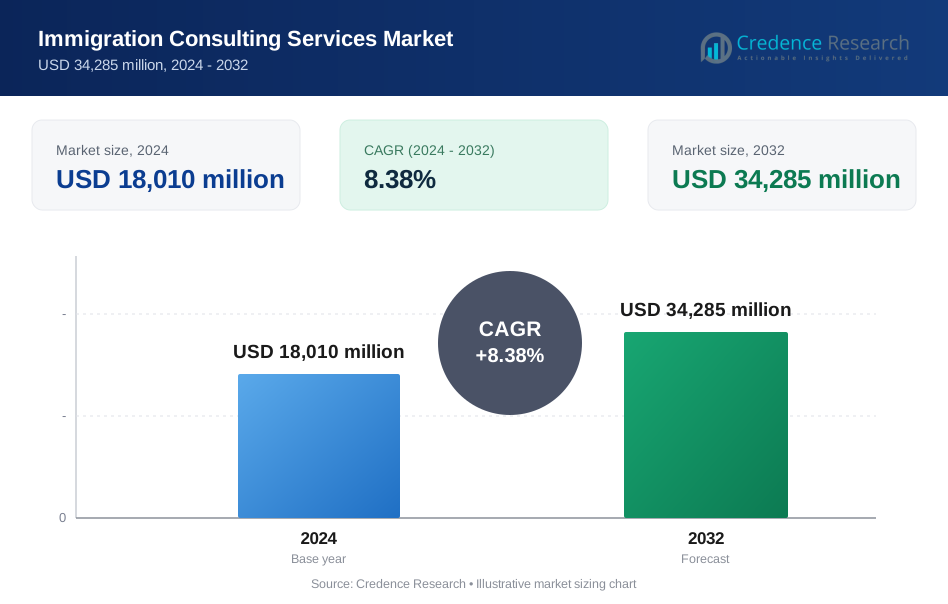
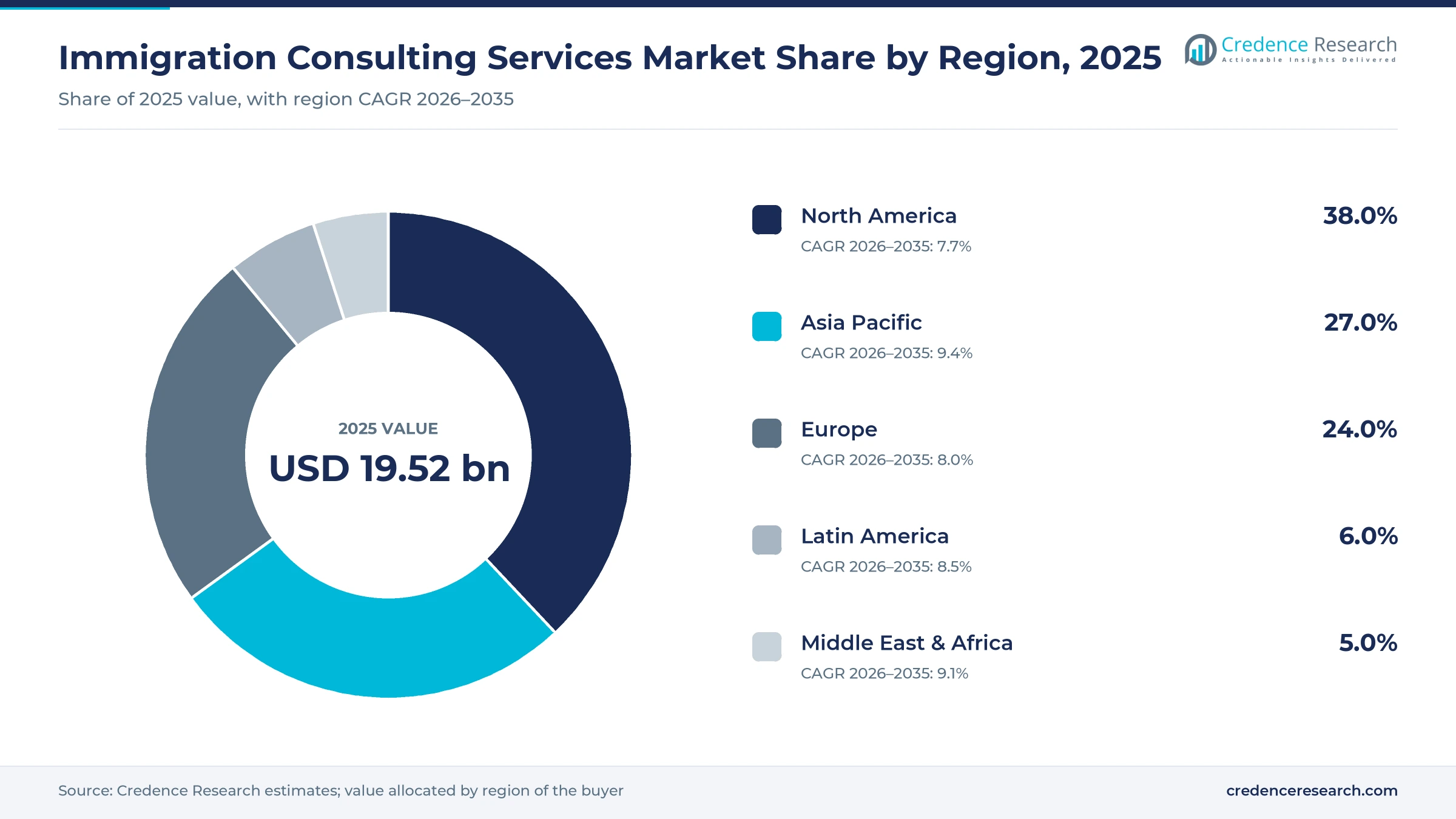
The global immigration consulting services market was valued at USD 19.52 billion in 2025 and is projected to increase from USD 21.15 billion in 2026 to USD 43.65 billion by 2035, registering a CAGR of 8.38% during 2026–2035. Demand comes from employers sponsoring skilled staff, students choosing destinations and families planning residence as rules change more often than applicants can track them. According to OECD figures reported by AMES News, about 6.2 million permanent immigrants entered member countries in 2024, while new international tertiary students fell 13%, so choosing the right route now matters as much as completing the forms. North America held the largest regional share, 38.0% in 2025, because U.S. employers pay for sponsorship and compliance work. Asia Pacific is the fastest-growing region at 9.4% a year, supported by outbound applicants from India, whose U.S. student count reached 363,019 in 2024-25 according to Open Doors. The sharpest recent change is the U.S. $100,000 H-1B fee announced in September 2025.
What do immigration consulting services cover, and how large is the market?
The market counts fees paid to licensed consultants, immigration law firms, corporate mobility advisers and digital filing services for visa strategy, document preparation, submission and compliance. Individuals usually buy one case at a fixed fee, while employers sign multi-year mandates covering many workers and countries. This estimate of global immigration services covers advisory and filing fees, and it excludes the wider cross-border workforce software category.
Government visa charges, relocation logistics, language tests and tuition are excluded, even when one provider bills them together. AI immigration services and platforms are counted within the delivery model split rather than as a separate market, because most still rely on attorneys or licensed consultants to sign and submit filings.
Immigration Consulting Services Market Insights
- The market reaches USD 19.52 billion in 2025 and USD 43.65 billion by 2035, growing at 8.38%, as visa rules change faster than applicants can follow them alone.
- North America held 38.0% of 2025 value, supported by U.S. sponsorship work where USCIS pending cases reached 12.1 million in fiscal 2026.
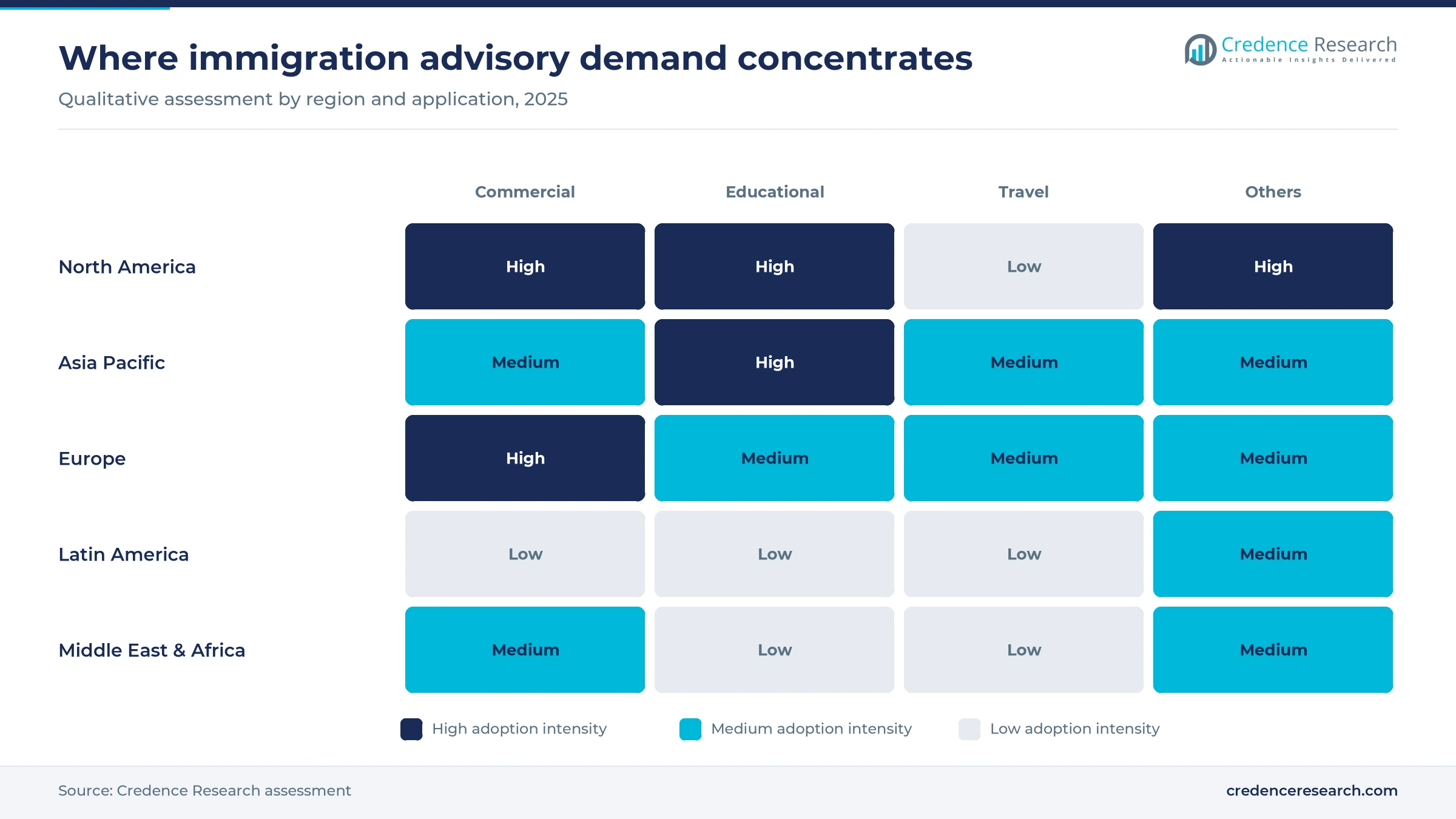
- Commercial Demand led applications with 44.0% in 2025, as employers buy multi-country compliance mandates and face stricter wage-based H-1B selection rules.
- The Feb. 27, 2026, H-1B weighted selection rule moved cap planning from lottery timing toward wage strategy, which raises the value of early legal advice.
- Alma raised $17 million in September 2026 and Casium raised $5 million in October 2025, showing investor interest in AI-assisted immigration filing services.
Employer work visas and temporary permits anchor spending
Temporary permits lead while permanent routes grow faster
Based on type, the market is categorized into temporary residence and permanent residence. Temporary Residence led with 61.0% of 2025 value because work and study permits renew repeatedly, creating repeat fees. According to Eurostat, 3,113,809 of the 4,607,257 single permits the EU issued in 2024 were extensions or status changes. Permanent Residence grows fastest at 8.9% a year as governments favor settled, selected migrants over temporary arrivals. Canada, for example, plans up to 33,000 work permit holders moving to permanent status over 2026 and 2027, according to its Immigration Levels Plan.
Employer mandates outweigh student and travel work
Based on application, the market is categorized into commercial, educational, travel and other demand. Commercial Demand led with 44.0% of 2025 value because employers pay for repeat, multi-country filings and Fragomen reports delivering services in more than 170 countries. Educational work faces a softer base, with Open Doors recording a 17% fall in new U.S. enrollments in fall 2025. Travel Demand grows fastest at 9.0% a year as the EU Entry/Exit System became fully operational on April 10, 2026.
Licensed advisers dominate as AI services scale
Based on delivery model, the market is categorized into attorney- and advisor-led services, hybrid digital platforms and AI-native services. Attorney- and Advisor-Led Services led with 67.0% of 2025 value because licensed sign-off remains essential, and Canada alone counted 11,994 licensed consultants in June 2025, according to the College of Immigration and Citizenship Consultants. AI-Native Services grow fastest at 12.8% a year as venture funding reaches the model. Alma raised a $17 million Series A in September 2026 led by Bling Capital, while Casium raised $5 million in October 2025.
| Segment Group | Leading Sub-segment | Share, 2025 | Fastest-growing Sub-segment | CAGR, 2026–2035 |
|---|---|---|---|---|
| By Type | Temporary Residence | 61.0% | Permanent Residence | 8.9% |
| By Application | Commercial Demand | 44.0% | Travel Demand | 9.0% |
| By Delivery Model | Attorney- and Advisor-Led Services | 67.0% | AI-Native Services | 12.8% |
Request a Free Sample
Fill in your details and we'll send you a free sample report.
- Sample data tables & charts
- Research methodology
Fees, backlogs and quotas push applicants toward advisers
Higher U.S. employer costs make every H-1B filing a strategy decision
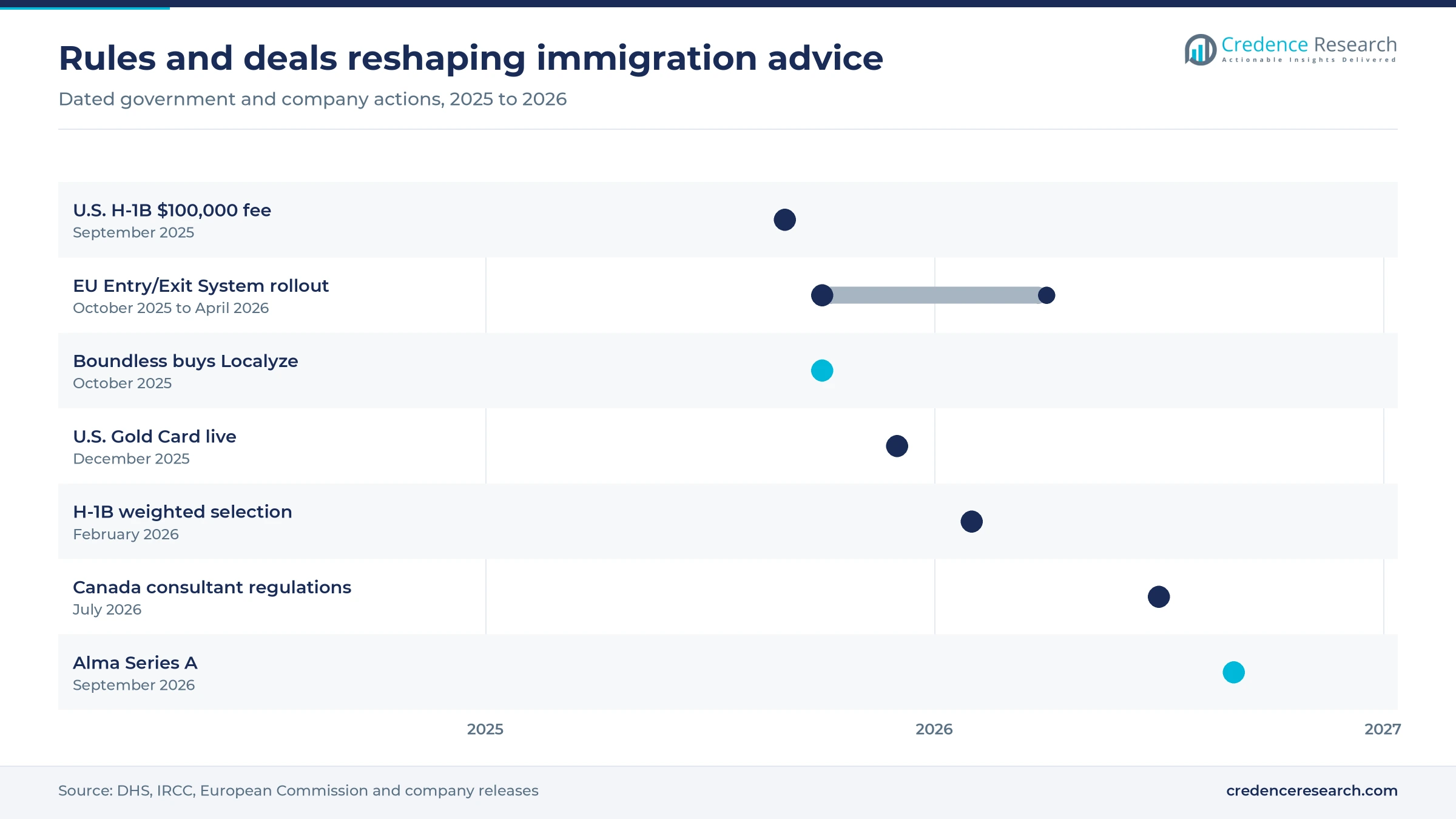
U.S. employers now treat skilled visa sponsorship as a budgeted legal project rather than a routine filing. The Trump administration announced a $100,000 fee on certain H-1B petitions in September 2025, which forces employers to compare sponsorship against overseas hiring. A final Department of Homeland Security rule then replaced the random cap lottery, giving a Level 4 wage four selection entries and a Level 1 wage only one from the fiscal 2027 season. As a result, compensation and visa advice now arrive together, and advisers are hired earlier in recruitment. The change also feeds Commercial Demand, which held 44.0% of 2025 value. Employers often pair this work with recruitment process outsourcing when moving roles abroad.
Record agency backlogs raise the cost of filing errors
Long waits make a rejected or incomplete petition far more expensive, so applicants pay for accuracy. According to the American Immigration Council, USCIS pending cases reached 12.1 million in the second quarter of fiscal 2026, up 7.2% in a year. Backlog clearance time rose to 24.1 months from 12.5 months over the same period, while pending I-129 worker petitions grew 90% to 120,000. Approval rates also narrowed, with EB-1 extraordinary ability petitions falling from 72.7% to 41.7%, and that drop rewards careful evidence preparation. This pressure weighs most on North American applicants and sponsors. Families and employers therefore increasingly buy review services even for categories they once filed themselves.
Selective quotas favor applicants with professional eligibility advice
Destination governments are cutting total intake while steering places toward skilled and economic applicants, which makes eligibility strategy worth paying for. Canada's 2026-2028 Immigration Levels Plan sets permanent admissions at 380,000 a year and lifts the economic category to 64% of the plan by 2027. Australia kept its 2025-26 permanent program at 185,000 places, with 132,200 reserved for skilled migrants, according to SBS News. The U.K. immigration White Paper of May 2025 proposed removing roughly 180 eligible occupations and cutting the graduate stay to 18 months, according to Times Higher Education. Because each route now has tighter scoring, applicants compare several countries before filing, and advisers can charge for that comparison.
Large migration flows keep the applicant pool historically high
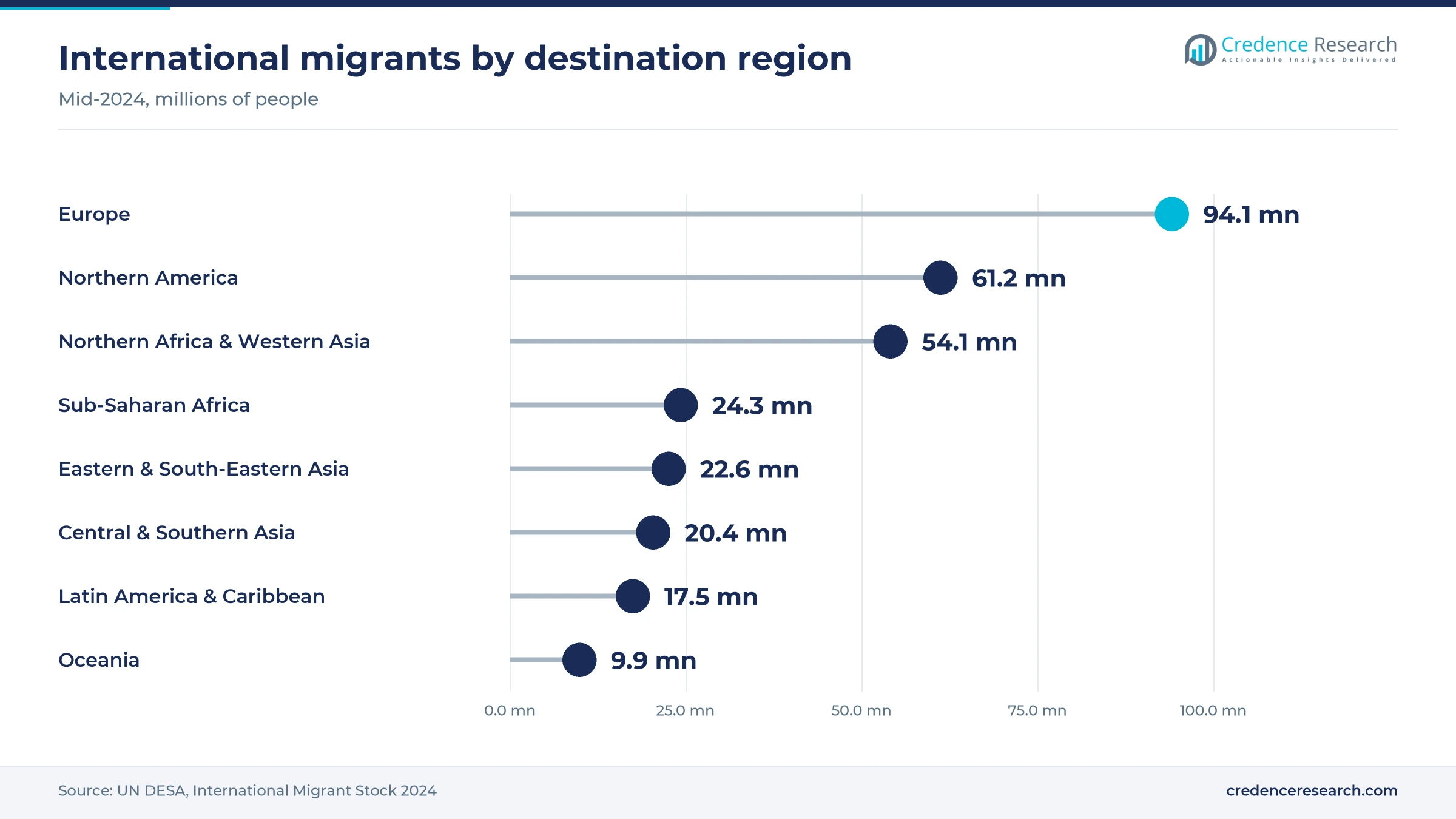
Even after recent cooling, the pool of potential clients remains unusually large. According to the OECD figures reported by AMES News, 6.2 million new permanent immigrants entered member countries in 2024, about 15% above 2019 levels, and temporary labor permits held near 2.3 million. The United Nations counted 304 million international migrants worldwide in mid-2024, about 3.7% of the global population, with 52.4 million in the United States. Eurostat recorded 1,493,448 first-time EU single permits in 2024 as well. This base supports Temporary Residence, which held 61.0% of 2025 value, because each permit eventually needs renewal, status change or an exit plan that often involves paid guidance.
AI filing tools and investor routes reshape the service mix
The rise of AI-assisted immigration services and platforms
AI immigration platforms are moving from intake chatbots toward drafting and case assembly, although attorneys still sign the filings. Alma, founded in 2024, raised a $17 million Series A in September 2026, according to Dealroom, to fund in-house hiring and product development. Casium raised $5 million in October 2025 from Maverick Ventures, and its release describes agentic workflows that learn from attorney feedback. Boundless reports that more than 100,000 individuals have used its services. AI-Native Services therefore post the fastest delivery growth at 12.8% a year, from a small base. Buyers also evaluate these tools alongside wider legal AI software, which pushes suppliers to prove accuracy and audit trails.
A shift toward combined mobility, payroll and compliance contracts
Employers increasingly want immigration status tied to payroll, tax and workforce data rather than handled in a separate file. Fragomen and Papaya Global announced a partnership in May 2026 that places immigration intelligence inside Papaya's country knowledge base, according to Fragomen. Boundless acquired Berlin-based Localyze on Oct. 1, 2025, adding a mobility platform that serves moves to more than 30 countries, according to GeekWire. Papaya itself operates across 180 countries, so the combined reach matches how multinational employers buy. This trend also connects filing work to employee moving programs, and it favors suppliers that can offer one contract covering visas and relocation.
Opportunity in investor and residence-by-contribution routes
Investor routes offer an opening because the sums at stake justify high advisory fees. The U.S. Gold Card went live on Dec. 10, 2025, at $1 million per individual or $2 million for a corporate sponsor, plus a $15,000 vetting fee on Form I-140G, according to Baker Donelson. Saudi Arabia sets its investor residency at a minimum of SAR 7 million with at least ten jobs created, and Mondaq reports an 83.4% rise in inquiries during 2025. The UAE expanded Golden Residency and added a five-year Green Residency, according to BSA Law in January 2025. Advisers with tax and source-of-funds skills can therefore price these cases far above standard visa work.
Opportunity in employer planning for non-U.S. talent hubs
Rising U.S. sponsorship costs create an opening for advisers who help employers place staff in other jurisdictions. Boundless CEO Xiao Wang told GeekWire in October 2025 that employers were increasingly considering international offices to avoid U.S. uncertainty. Germany issued 56,252 of the EU's 78,096 Blue Cards in 2024, according to Eurostat, which gives advisers a clear European destination to package. Canada also plans 385,000 temporary arrivals in 2026, while Australia lifted its student intake target to 295,000 places for 2026, according to SBS News. Advisers that offer multi-country scenario planning can therefore convert one U.S. mandate into several filings, often alongside local employment law counsel.
Fraud, policy swings and thinner approvals test providers
Unlicensed practitioners damage trust in the whole sector
Fraud remains the sector's main reputational problem, and it affects honest firms as well. According to Moving2Canada, Canada's regulator shut down 5,390 websites and social pages run by unauthorized practitioners in its latest year and opened 1,211 conduct cases. In India, Punjab police had registered 15 cases against travel agents by February 2025, according to the Free Press Journal. Licensed firms answer by publishing credentials and fixed fees, which adds compliance cost.
Sudden policy reversals can erase planned caseloads
Providers staff for forecast volumes that governments can change quickly, and that makes revenue hard to predict. The OECD reported that permanent labor migration to member countries fell about 21% in 2024, according to AMES News, while new student arrivals in Canada fell 39%. Consultancies focused on one corridor therefore carry concentration risk, especially in student recruitment. The usual mitigation is to spread caseloads across several destinations and add employer retainers that continue through a downturn.
Tighter regulation raises the cost of operating as a consultant
New supervision protects clients but raises overhead, especially for small practices. Canada's College of Immigration and Citizenship Consultants Regulations took effect July 15, 2026, with stronger discipline powers, and a fuller public register follows in April 2027, according to Canadian HR Reporter. India's draft Overseas Mobility Bill, proposed by the Ministry of External Affairs in 2025, would replace the Emigration Act of 1983. Smaller firms may respond by merging or by sharing compliance services.
Lengthy agency timelines limit how fast firms can bill and close
Advisers cannot control government processing, yet clients often blame them for delays. The American Immigration Council reported that USCIS completions fell 44.5% to 1.5 million in the second quarter of fiscal 2026, which stretches each case and ties up staff. Fixed-fee firms absorb this extra handling time, and that squeezes margins on long-running files. Many providers now use milestone billing and automated status alerts to reduce the burden.
North America leads as Asia Pacific supplies new applicants
| Region | Value, 2025 (USD billion) | Share, 2025 | CAGR, 2026–2035 |
|---|---|---|---|
| North America | 7.42 | 38.0% | 7.7% |
| Asia Pacific | 5.27 | 27.0% | 9.4% |
| Europe | 4.68 | 24.0% | 8.0% |
| Latin America | 1.17 | 6.0% | 8.5% |
| Middle East & Africa | 0.98 | 5.0% | 9.1% |
North America leads on U.S. sponsorship and Canadian selection
North America held 38.0% of 2025 value and grows at 7.7% a year, the slowest pace because the base is mature. The region hosted 61.2 million international migrants in mid-2024, according to the United Nations. U.S. fee and selection changes create high-value employer work, while Canada adds a regulated consultant base of 11,994 licensees. Canadian intake cuts limit volume, however, so growth depends more on complexity than on applicant numbers.
Asia Pacific grows fastest on outbound students and workers
Asia Pacific held 27.0% of 2025 value and is the fastest region at 9.4% a year, because it supplies many paying applicants as well as hosting them. India alone sent 363,019 students to the United States in 2024-25, according to Open Doors. Eastern and South-Eastern Asia to Northern America is a 12 million migrant corridor, according to the United Nations. India's draft Overseas Mobility Bill should also bring more formal rules to recruitment and advice.
Europe grows on employer permits and new border systems
Europe held 24.0% of 2025 value and grows at 8.0% a year, supported by a record 4,607,257 EU single permits in 2024, according to Eurostat. Germany dominates skilled entry, with 72% of EU Blue Cards. The U.K. is tightening its Skilled Worker route under the May 2025 White Paper, which raises demand for sponsor compliance advice. New EU border systems add further questions from short-stay business travelers, though these are lower-fee cases for most advisers.
Latin America depends on the northbound corridor
Latin America held 6.0% of 2025 value and grows at 8.5% a year. The United Nations counted 27 million migrants from Latin America and the Caribbean living in Northern America in 2024, the largest such corridor worldwide. Venezuela and Colombia also ranked among the top origins of asylum applicants to OECD countries in 2024, according to the OECD. Paying capacity is lower here, so firms rely on family and employer cases rather than investor files.
Middle East & Africa gains from new Gulf residency routes
Middle East & Africa held 5.0% of 2025 value and grows at 9.1% a year as Gulf states compete for residents. Saudi Arabia hosted 13.7 million international migrants in mid-2024, according to the United Nations, the third-largest total worldwide. The UAE added a Green Residency and a 120-day job-seeker visa, according to BSA Law, while Saudi Premium Residency offers paid long-term status. These routes create new advisory work beyond traditional sponsored employment contracts.
Deals and rules in 2025 and 2026 reset the field
| Development | Status and market relevance |
|---|---|
| In May 2026, Fragomen and Papaya Global launched a partnership placing immigration intelligence inside Papaya's country knowledge base. | Live; links immigration status to payroll and compliance data for employers. |
| In September 2026, Alma raised a $17 million Series A led by Bling Capital to expand its AI-assisted immigration law firm. | Funded; supports in-house hiring and product development. |
| In October 2025, Boundless Immigration acquired Berlin-based Localyze, adding European mobility coverage to its U.S. business. | Completed; terms were not disclosed. |
| In December 2025, the U.S. launched the Gold Card program with Form I-140G and a $15,000 processing fee. | Live; creates a new premium advisory category. |
| In July 2026, Canada's College of Immigration and Citizenship Consultants Regulations took effect with stronger discipline powers. | In force; a fuller public register follows in April 2027. |
Software now handles intake, drafting and compliance checks
- Agentic case workflows automate routine preparation and learn from attorney corrections, as Casium describes in its October 2025 funding release.
- Wage-level modeling helps employers test how an offered salary affects H-1B selection odds under the four-entry weighted system.
- Country knowledge bases pair immigration requirements with labor, compliance and payroll rules, as the Fragomen and Papaya Global partnership shows.
- Biometric border systems replace passport stamps with digital entry and exit records, which the EU Entry/Exit System has done since October 2025.
Need a Custom Version of This Report?
Tailor the scope, geography, or segments to your exact requirements.
- Custom geography or segment scope
- Direct access to our analyst team
Law firms and platforms compete for employer mandates
Competition splits into global immigration law firms, professional services networks, licensed national consultants and venture-backed digital providers. Fragomen, Berry Appleman & Leiden and Newland Chase focus on employer programs, where long mandates and multi-country coverage favor scale. Deloitte, EY and KPMG sell immigration inside their wider global employer and mobility services alongside reward and tax work, which appeals to buyers who want a single adviser. Vialto Partners, the former PwC mobility business, and Envoy Global compete for employer programs with technology-led case management. Y-Axis serves individual migrants from India with visa and settlement advice for Canada, Australia and Europe. Boundless, which added Localyze in October 2025, and newer entrants Casium and Alma compete on speed, price transparency and software, although each still relies on licensed legal work. Partnerships are becoming a route to distribution, as Fragomen's May 2026 agreement with Papaya Global shows. Buyers increasingly compare accuracy, response time and audit records as well as fees, and smaller national consultants defend their position through language skills and strong corridor knowledge.
Companies profiled and their roles in this market
| Company | Type | Role in the market |
|---|---|---|
| Fragomen | Global immigration firm | Employer programs in more than 170 countries; Papaya Global partnership, May 2026 |
| Berry Appleman & Leiden | Immigration law firm | Global corporate immigration legal work |
| Newland Chase | Immigration services provider | Worldwide corporate immigration services with local expertise |
| Deloitte | Professional services | Immigration within global employer services |
| EY | Professional services | Global Immigration Services and EY Law immigration teams for employers worldwide |
| KPMG | Professional services | Global immigration network and KPMG Law immigration practices for corporate clients |
| Vialto Partners | Global mobility firm | Former PwC mobility business offering immigration services and a U.S. immigration law firm |
| Envoy Global | Tech-enabled immigration provider | Employer immigration platform with partner attorneys for U.S. and global work visas |
| Boundless Immigration | Digital immigration provider | Acquired Localyze on Oct. 1, 2025 |
| Y-Axis | Consumer immigration consultant | Visa and migration advice for Indian applicants moving to Canada, Australia and Europe |
Complexity, not migrant volume, sets the growth pace
Credence Research's view is that policy complexity, rather than migrant volume, now sets the pace of this market. OECD permanent flows fell about 4% in 2024, yet the U.S. fee, the wage-weighted H-1B rule and record USCIS pending cases have all increased the value of expert advice. Providers that depend on student recruitment face the greatest exposure. Those holding employer mandates, investor expertise and auditable software should gain share, particularly if accuracy claims for AI tools hold up under regulatory and client scrutiny.
Model-based values with public migration statistics
The report uses 2025 as the base year and 2035 as the forecast year, with values from the Credence Research market model. The earlier 2024 estimate on this page was carried forward to 2025 and checked against public migration flows. All regional, segment and delivery splits are Credence Research estimates. Sources include OECD, United Nations and Eurostat statistics, government plans in the United States, Canada and Australia, regulator reports, company announcements and news publishers. No interviews or surveys were conducted to prepare this edition.
Employer compliance work should outlast policy cycles
From USD 19.52 billion in 2025, the market is projected to reach USD 43.65 billion by 2035 at an 8.38% CAGR. Employer compliance work should prove the most durable source of fees because permits renew and rules keep changing, while the fiscal 2027 H-1B season gives the first full evidence of wage-based selection. Student advisory work depends on whether new arrivals recover from the declines the OECD recorded in 2024. AI-native services should keep gaining share, although licensing rules and the need for accountable sign-off will probably keep attorneys and regulated consultants at the center.
Frequently Asked Questions
How big is the immigration consulting services market in 2025?
What is the CAGR of the global immigration services market?
How large is the AI immigration services market?
Who competes in AI immigration services and platforms?
Which region leads the immigration consulting services market?
How has the H-1B rule change affected immigration advice?
How does cross-border workforce migration software differ from this market?
What are the main risks for immigration consultants?
Table of Content
Chapter 1 Market Segmentation
- 1.1 Segmentation Framework
- 1.1.1 Product and Service Classification
- 1.1.2 Application and End-Use Classification
- 1.1.3 Technology and Solution Classification
- 1.1.4 Customer and Distribution Channel Classification
- 1.1.5 Geographic Segmentation
- 1.1.6 Market Segment Definitions and Boundaries
- 1.2 By Type
- 1.2.1 Temporary Residence
- 1.2.2 Permanent Residence
- 1.3 By Application
- 1.3.1 Commercial Demand
- 1.3.2 Educational Demand
- 1.3.3 Travel Demand
- 1.3.4 Others
- 1.4 By Delivery Model
- 1.4.1 Attorney- and Advisor-Led Services
- 1.4.2 Hybrid Digital Platforms
- 1.4.3 AI-Native Services
Chapter 2 Introduction
- 2.1 Report Objectives and Scope
- 2.2 Product Definition and Industry Terminology
- 2.3 Market Inclusions and Exclusions
- 2.4 Research Process
- 2.4.1 Primary Research and Expert Interviews
- 2.4.2 Secondary Research and Source Review
- 2.4.3 Top-Down and Bottom-Up Estimation
- 2.4.4 Data Triangulation and Verification
- 2.5 Market Size Measurement Basis
- 2.5.1 2025: USD 19.52 billion → 2035: USD 43.65 billion
- 2.6 Historical and Forecast Reference Periods
- 2.6.1 Historical Period: 2018-2025
- 2.6.2 Base Year: 2025
- 2.6.3 Forecast Period: 2025-2035
- 2.7 Research Assumptions and Limitations
Chapter 3 Executive Summary
- 3.1 Market Snapshot and Key Findings
- 3.2 Base-Year Market Size, 2025
- 3.3 Forecast Market Size, 2035
- 3.4 Revenue and Volume Growth Outlook
- 3.5 Key Demand and Supply Indicators
- 3.6 Leading Market Segments
- 3.7 Fastest-Growing Market Opportunities
- 3.8 Regional Performance Highlights
- 3.9 Technology and Industry Transformation
- 3.10 Competitive Landscape Summary
- 3.11 Analyst View and Strategic Implications
Chapter 4 Global Immigration Consulting Services Market Trends and Developments
- 4.1 Historical Industry Development, 2018-2025
- 4.2 Recent Market Trends and Developments
- 4.3 Demand and Customer Behavior Trends
- 4.4 Technology and Product Innovation
- 4.5 Artificial Intelligence, Automation and Digitalization
- 4.6 Local Manufacturing and Supply Chain Realignment
- 4.7 Industry Partnerships, Mergers and Acquisitions
- 4.8 Sustainability and Circular Economy Developments
- 4.9 Government and Private Sector Investment Trends
- 4.10 Emerging Business Models and Commercialization
- 4.11 Industry Developments and Announcements
Chapter 5 Global Immigration Consulting Services Market Supply and Demand Analysis
- 5.1 Demand Trend and Consumption Analysis, 2018-2025
- 5.2 Demand Forecast, 2025-2035
- 5.3 Supply Chain Structure and Procurement Trends
- 5.4 Supply-Demand Gap and Bottlenecks
- 5.5 Import Dependence and Sourcing Structure
- 5.6 Regional Supply and Demand Concentration
Chapter 6 Global Immigration Consulting Services Market Pricing Analysis
- 6.1 Pricing Structure and Measurement
- 6.2 Historical Pricing Trends, 2018-2025
- 6.3 Pricing Outlook, 2025-2035
- 6.4 Pricing by Product and Market Segment
- 6.5 Geographic Pricing Differences
- 6.6 Key Input, Energy, Labor and Logistics Costs
- 6.7 Contract Pricing and Purchasing Models
- 6.8 Pricing Sensitivity and Competitive Positioning
- 6.9 Price, Margin and Profitability Implications
Chapter 7 Global Immigration Consulting Services Market Dynamics
- 7.1 Market Growth Drivers
- 7.1.1 Demand-Side Drivers
- 7.1.2 Technology and Innovation Drivers
- 7.1.3 Infrastructure and Investment Drivers
- 7.1.4 Regulatory and Policy Drivers
- 7.2 Market Restraints
- 7.2.1 Cost and Affordability Constraints
- 7.2.2 Technology and Adoption Barriers
- 7.2.3 Supply Chain and Operational Constraints
- 7.3 Market Challenges
- 7.3.1 Competitive Pressure and Margin Erosion
- 7.3.2 Skills, Infrastructure and Implementation Gaps
- 7.4 Emerging Market Opportunities
- 7.5 Market Dynamics Impact and Time-Horizon Assessment
Chapter 8 Global Immigration Consulting Services Value Chain Analysis
- 8.1 Industry Value Chain Overview
- 8.2 Upstream Suppliers and Critical Inputs
- 8.3 Technology and Component Providers
- 8.4 Manufacturing or Service Delivery
- 8.5 Distribution, Channel Partners and Integrators
- 8.6 Downstream Applications and End Users
- 8.7 Value Addition and Profit Pools
- 8.8 Vertical Integration and Outsourcing
- 8.9 Supplier Concentration and Risk
- 8.10 Supply Chain Localization and Resilience
Chapter 9 Global Immigration Consulting Services Market Regulations and Policies
- 9.1 Relevant Laws, Standards and Compliance Frameworks
- 9.2 Product, Service, Safety and Quality Requirements
- 9.3 Government Policies, Incentives and Subsidies
- 9.4 Imports, Exports and Trade Barriers
- 9.5 Public Procurement and Local Content Requirements
- 9.6 Data Protection, AI and Cybersecurity Compliance
- 9.7 Upcoming Policy Changes and Market Implications
Chapter 10 Global Immigration Consulting Services Market Hotspots and Opportunities
- 10.1 Market Opportunity Mapping and Growth Hotspots
- 10.2 High-Growth Applications and Customer Groups
- 10.3 Underserved Markets and White-Space Opportunities
- 10.4 Emerging Technology and Product Opportunities
- 10.5 New Capacity and Investment Hotspots
- 10.6 Market Entry and Expansion Opportunities
- 10.7 Distribution and Partnership Opportunities
- 10.8 Near-Term and Long-Term Commercial Potential
- 10.9 Opportunity Attractiveness and Execution Risks
Chapter 11 Global Immigration Consulting Services Market Outlook, 2025-2035
- 11.1 Market Size and Analysis
- 11.1.1 Revenue (Market Measurement: 2025: USD 19.52 billion → 2035: USD 43.65 billion)
- 11.1.2 Historical Market Size, 2018-2025
- 11.1.3 Base-Year Market Size, 2025
- 11.2 Market Forecast, 2025-2035
- 11.2.1 Revenue Forecast to 2035
- 11.2.2 CAGR and Year-on-Year Growth
- 11.2.3 Incremental Revenue Opportunity
- 11.3 Forecast Assumptions and Scenario Analysis
- 11.3.1 Base-Case Forecast
- 11.3.2 Optimistic and Conservative Scenarios
- 11.3.3 Technology, Pricing and Policy Sensitivities
- 11.4 Market Attractiveness and Growth Outlook
Chapter 12 Global Immigration Consulting Services Market Segmentation and Outlook
- 12.1 Segmentation Summary and Market Shares, 2025
- 12.2 Largest and Fastest-Growing Segments
- 12.3 By Type - Market Size and Forecast, 2025-2035
- 12.3.1 Segment Definition and Scope
- 12.3.2 Historical Market Size, 2018-2025
- 12.3.3 Revenue Forecast, 2025-2035
- 12.3.4 Base-Year Market Share, 2025
- 12.3.5 Segment CAGR and Growth Drivers
- 12.3.6 Subsegment Market Size and Forecast
- 12.3.6.1 Temporary Residence
- 12.3.6.2 Permanent Residence
- 12.3.7 Subsegment Pricing and Adoption Trends
- 12.3.8 Leading Suppliers and Competition
- 12.3.9 Regional Demand and Opportunities
- 12.4 By Application - Market Size and Forecast, 2025-2035
- 12.4.1 Segment Definition and Scope
- 12.4.2 Historical Market Size, 2018-2025
- 12.4.3 Revenue Forecast, 2025-2035
- 12.4.4 Base-Year Market Share, 2025
- 12.4.5 Segment CAGR and Growth Drivers
- 12.4.6 Subsegment Market Size and Forecast
- 12.4.6.1 Commercial Demand
- 12.4.6.2 Educational Demand
- 12.4.6.3 Travel Demand
- 12.4.6.4 Others
- 12.4.7 Subsegment Pricing and Adoption Trends
- 12.4.8 Leading Suppliers and Competition
- 12.4.9 Regional Demand and Opportunities
- 12.5 By Delivery Model - Market Size and Forecast, 2025-2035
- 12.5.1 Segment Definition and Scope
- 12.5.2 Historical Market Size, 2018-2025
- 12.5.3 Revenue Forecast, 2025-2035
- 12.5.4 Base-Year Market Share, 2025
- 12.5.5 Segment CAGR and Growth Drivers
- 12.5.6 Subsegment Market Size and Forecast
- 12.5.6.1 Attorney- and Advisor-Led Services
- 12.5.6.2 Hybrid Digital Platforms
- 12.5.6.3 AI-Native Services
- 12.5.7 Subsegment Pricing and Adoption Trends
- 12.5.8 Leading Suppliers and Competition
- 12.5.9 Regional Demand and Opportunities
- 12.6 Segment Growth Comparison
- 12.7 Segment Attractiveness and Priority Matrix
Chapter 13 Global Immigration Consulting Services End-Use and Application Market Outlook
- 13.1 End-Use Industry and Customer Demand Structure
- 13.2 Leading Applications and Customer Groups
- 13.3 End-Use Market Size, Share and Forecast
- 13.4 Major End-Use Industry Deep Dives
- 13.4.1 Customer Requirements and Use Cases
- 13.4.2 Demand and Replacement Cycles
- 13.4.3 Technical and Regulatory Considerations
- 13.4.4 Purchasing and Procurement Models
- 13.4.5 Leading Vendors and Distribution Channels
- 13.4.6 Forecast and Commercial Opportunities
- 13.5 Emerging Applications and Cross-Segment Demand
- 13.6 End-Use Industry Investment Priorities
Chapter 14 Global Immigration Consulting Services Geographic Market Outlook, 2025-2035
- 14.1 Regional Market Size and Share, 2025
- 14.2 Regional Market Forecast, 2025-2035
- 14.3 Regional Pricing, Production and Demand Differences
- 14.4 North America
- 14.4.1 United States
- 14.4.2 Canada
- 14.4.3 Mexico
- 14.5 Europe
- 14.5.1 Germany
- 14.5.2 France
- 14.5.3 Italy
- 14.5.4 United Kingdom
- 14.5.5 Spain
- 14.5.6 Poland
- 14.5.7 Russia
- 14.5.8 Netherlands
- 14.5.9 Belgium
- 14.5.10 Sweden
- 14.5.11 Denmark
- 14.5.12 Norway
- 14.5.13 Rest of Europe
- 14.6 Asia Pacific
- 14.6.1 China
- 14.6.2 India
- 14.6.3 Japan
- 14.6.4 South Korea
- 14.6.5 Thailand
- 14.6.6 Indonesia
- 14.6.7 Vietnam
- 14.6.8 Malaysia
- 14.6.9 Australia
- 14.6.10 Rest of Asia Pacific
- 14.7 Latin America
- 14.7.1 Brazil
- 14.7.2 Argentina
- 14.7.3 Colombia
- 14.7.4 Chile
- 14.7.5 Rest of Latin America
- 14.8 Middle East
- 14.8.1 Saudi Arabia
- 14.8.2 United Arab Emirates
- 14.8.3 Turkey
- 14.8.4 Israel
- 14.8.5 Iran
- 14.8.6 Rest of the Middle East
- 14.9 Africa
- 14.9.1 South Africa
- 14.9.2 Egypt
- 14.9.3 Nigeria
- 14.9.4 Morocco
- 14.9.5 Rest of Africa
- 14.10 Regional Investment, Policy and Supply Chain Differences
- 14.11 Regional Competitive Landscape
- 14.12 Geographic Growth Hotspots
Chapter 15 Global Immigration Consulting Services Technology, Innovation and Sustainability Outlook
- 15.1 Technology Landscape and Maturity
- 15.2 Product, Process and Service Innovation
- 15.3 AI, Automation and Digital Tools in the Industry
- 15.4 Technology Adoption and Performance Benchmarking
- 15.5 Innovation Pipeline and R&D Investment
- 15.6 Energy Efficiency and Resource Management
- 15.7 Sustainability, Recycling and Circularity
- 15.8 Technology Roadmap, 2025-2035
- 15.9 Risks of Obsolescence and Technology Substitution
Chapter 16 Global Immigration Consulting Services Market Key Strategic Imperatives
- 16.1 Growth and Market Entry Priorities
- 16.2 High-Return Products and Segments
- 16.3 Pricing, Profitability and Cost Optimization
- 16.4 Technology Investment and Product Differentiation
- 16.5 Supply Chain Localization and Resilience
- 16.6 Distribution and Customer Acquisition
- 16.7 Partnership, Acquisition and Capacity Strategy
- 16.8 Regional Expansion Priorities
- 16.9 Short-, Medium- and Long-Term Actions
Chapter 17 Competition Outlook
- 17.1 Industry Competition Characteristics
- 17.2 Market Structure and Concentration
- 17.3 Market Share and Competitive Positioning, 2025
- 17.4 Company-Wise Revenue and Product Benchmarking
- 17.5 Production and Service Capacity Benchmarking
- 17.6 Technology, Pricing and Differentiation
- 17.7 Regional Footprint and Distribution Strength
- 17.8 Mergers, Acquisitions and Strategic Alliances
- 17.9 New Entrants and Competitive Threats
- 17.10 Porter's Five Forces and Industry Attractiveness
- 17.11 Competitive Outlook, 2025-2035
Chapter 18 Company Profiles
- 18.1 Company Coverage and Selection Criteria
- 18.2 Fragomen
- 18.2.1 Business Description
- 18.2.2 Company Ownership and Geographic Presence
- 18.2.3 Product and Service Portfolio
- 18.2.4 Manufacturing and Operating Footprint
- 18.2.5 Financial Performance and Investment
- 18.2.6 Market Share and Competitive Position
- 18.2.7 Technology and Innovation Capabilities
- 18.2.8 Strategic Alliances or Partnerships
- 18.2.9 Recent Developments
- 18.2.10 Growth Strategy and Outlook
- 18.3 Berry Appleman & Leiden
- 18.4 Newland Chase
- 18.5 Deloitte
- 18.6 EY
- 18.7 KPMG
- 18.8 Vialto Partners
- 18.9 Envoy Global
- 18.10 Boundless Immigration
- 18.11 Y-Axis
- 18.12 Other Relevant Market Participants
Note: Every listed company is profiled on the structure shown under the first company. The company list is preliminary and may change based on research findings, market developments, data availability and client requirements.
Chapter 19 Disclaimer
- 19.1 Research and Forecast Disclaimer
- 19.2 Data Source and Estimation Limitations
Note: The depth of individual sections depends on data availability for this market. Volume, capacity, trade and other unit-based metrics are included where applicable.