Mango and lime jars anchor a staple condiment habit
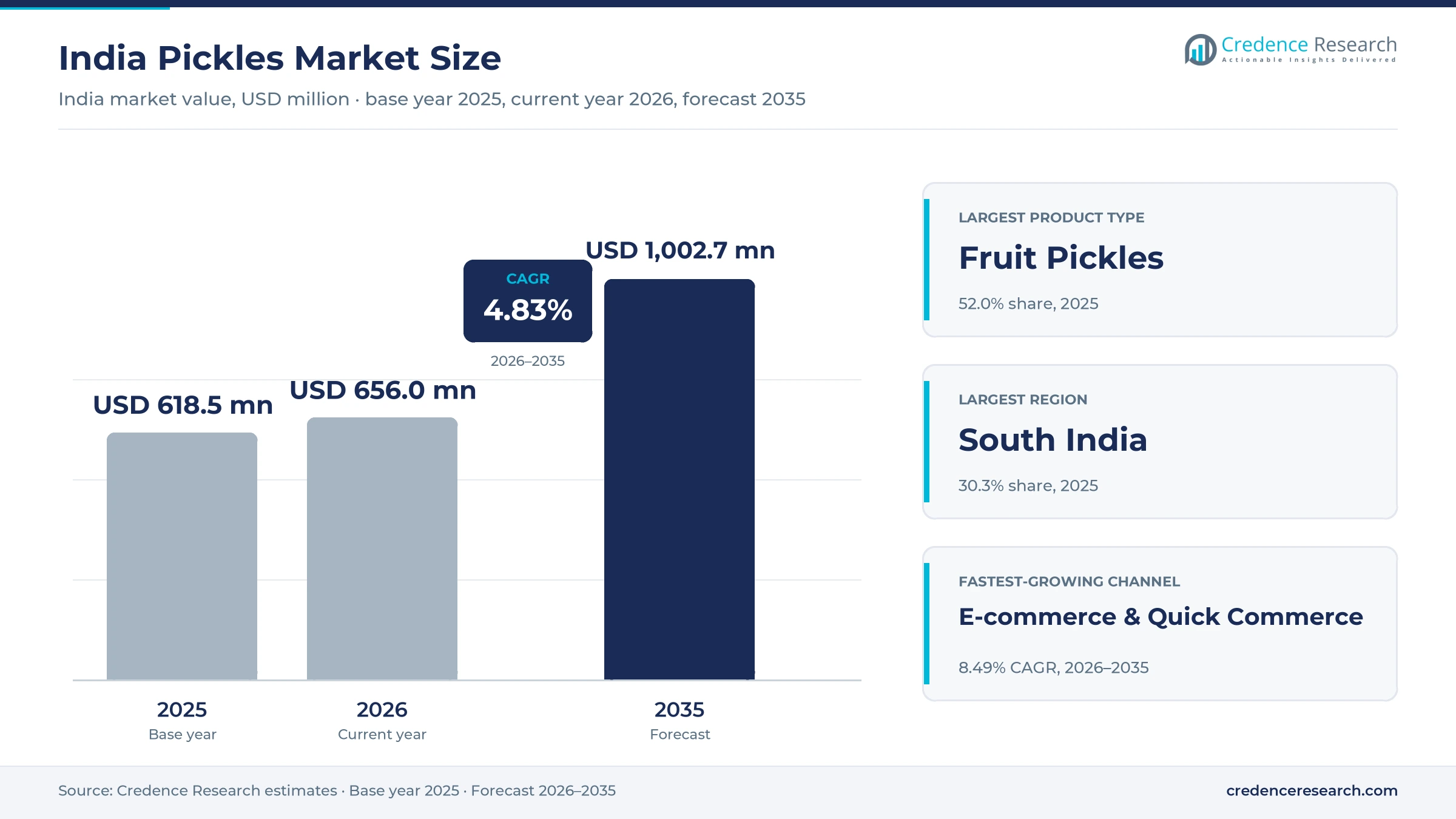
The India pickles market was valued at USD 618.5 million in 2025 and is projected to increase from USD 656.0 million in 2026 to USD 1.00 billion by 2035, registering a CAGR of 4.83% during 2026–2035. Demand comes from households that serve mango, lime, chili and mixed pickles with daily meals, and from restaurants, caterers and gifting buyers who purchase larger packs during festivals and weddings. South India held the largest regional share, 30.3% in 2025, because southern kitchens use pickles such as avakaya and gongura at almost every meal. East & Northeast India is the fastest-growing region at 5.37% a year, as branded jars reach more towns through modern trade and delivery apps. In turn, the GST Council approved lower tax rates on several packaged condiments in September 2025, which eased shelf prices just as quick commerce platforms widened the reach of branded jars.
Which pickle products and sales routes does the estimate cover?
The estimate measures the retail value of packaged fruit, vegetable, mixed and meat and seafood pickles sold to households, restaurants, caterers and gifting buyers in India. It covers branded and private-label products sold through grocery stores, supermarkets, online platforms, brand websites and foodservice suppliers at economy, mid-market, premium and artisanal price points.
The estimate excludes pickles made at home for family use, loose products sold without a label and exports shipped out of the country. The value chain runs from mango, lime, chili and vegetable growers through oil, salt and spice suppliers to processors, packers, distributors and retailers that serve buyers.
India Pickles Market Insights
- The India pickles market was valued at USD 618.5 million in 2025 and is projected to reach USD 1.00 billion by 2035, registering a CAGR of 4.83% during 2026–2035.
- South India held a 30.3% share of 2025 value, because southern households eat pickles with most meals and buy many regional varieties.
- Fruit pickles led with a 52.0% share of 2025 value, because mango and lime remain the most common pickles in Indian kitchens.
- Mother's Recipe began refreshing labels across more than 64 pickle variants in May 2026, highlighting a no preservatives claim on its jars.
- Orkla India, owner of the MTR and Eastern brands, listed on the BSE and NSE on Nov. 6, 2025, after an offer subscribed 48.74 times.
Fruit types lead as meat and seafood jars grow fastest
Why do fruit pickles hold most of the value?
Based on product type, the market is categorized into fruit pickles, vegetable pickles, mixed fruit and vegetable pickles, and meat and seafood pickles. Fruit Pickles led with a 52.0% share of 2025 value, because mango, lime and amla pickles are bought by almost every household. Meat & Seafood Pickles grow fastest at 6.22% a year, as chicken, mutton and prawn pickles from southern makers reach buyers online.
How fast are buyers trading up across price tiers?
Based on price tier, the market is categorized into economy, mid-market, premium and artisanal and specialty products. Mid-Market products led with a 40.0% share of 2025 value, because national brands price their main jars for regular family use. Artisanal & Specialty products grow fastest at 7.75% a year, as small makers sell homemade recipes with clean labels to urban buyers.
Why do neighborhood stores still dominate pickle sales?
Based on distribution channel, the market is categorized into general trade, modern trade, e-commerce and quick commerce, direct-to-consumer and foodservice and institutional channels. General Trade led with a 58.0% share of 2025 value, because neighborhood grocery stores reach most towns and villages. E-commerce & Quick Commerce grows fastest at 8.49% a year, as delivery apps stock more regional jars.
How is packaging shifting from jars to pouches?
Based on packaging format, the market is categorized into PET jars and bottles, glass jars, flexible pouches, sachets and single-serve packs, and bulk foodservice containers. PET Jars & Bottles led with a 46.0% share of 2025 value, because they are light, cheap and hard to break. Flexible Pouches grow fastest at 6.42% a year, as brands sell smaller refill packs for value buyers.
| Segment Group | Leading Sub-segment | Share, 2025 | Fastest-growing Sub-segment | CAGR, 2026–2035 |
|---|---|---|---|---|
| By Product Type | Fruit Pickles | 52.0% | Meat & Seafood Pickles | 6.22% |
| By Price Tier | Mid-Market | 40.0% | Artisanal & Specialty | 7.75% |
| By Distribution Channel | General Trade | 58.0% | E-commerce & Quick Commerce | 8.49% |
| By Packaging Format | PET Jars & Bottles | 46.0% | Flexible Pouches | 6.42% |
Request a Free Sample
Fill in your details and we'll send you a free sample report.
- Sample data tables & charts
- Research methodology
Digital grocery, farm output and formal makers lift demand
How does digital grocery widen access to branded jars?
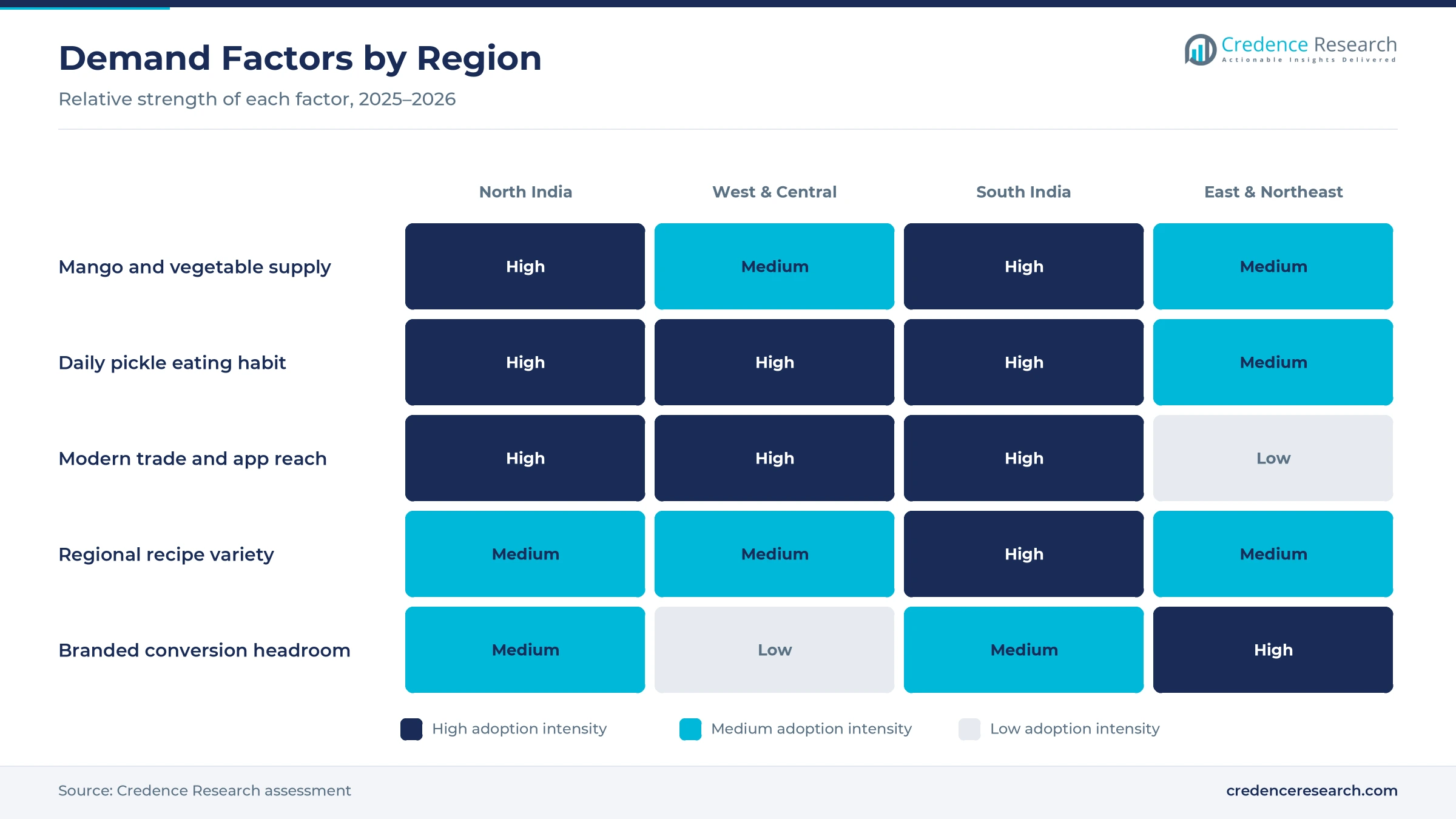
The expansion of digital grocery and organized food retail widens access to branded pickles, because delivery apps and supermarkets stock many more regional varieties than a small corner store. Blinkit reported net order value of Rs 9,203 crore in the first quarter of fiscal 2026, up 127% from a year earlier, according to MediaNama. The same report counted 1,544 dark stores at the end of that quarter, which brings packaged food within minutes of millions of homes. Mother's Recipe said in 2023 that it sells through BigBasket, Amazon and Instamart, alongside modern trade and general trade. As a result, quick commerce and e-commerce grow at 8.49% a year during 2026–2035.
Why does a large farm base keep raw material supply steady?
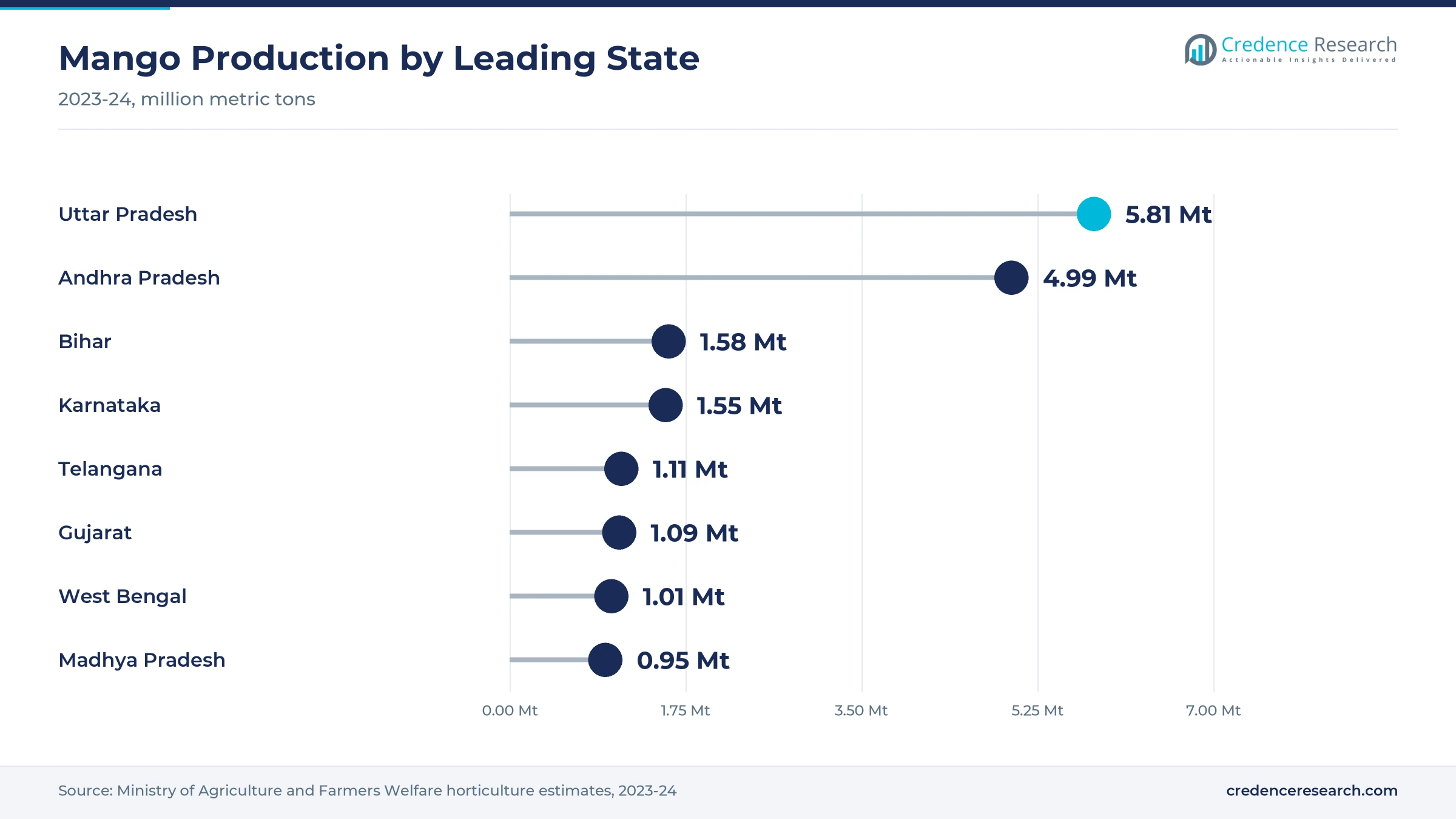
A large horticultural raw-material base keeps pickle makers supplied, because mango, lime, chili, ginger and other vegetables are grown in every region of India. Horticulture output rose 3.66% to 367.72 million metric tons in 2024-25, according to the second advance estimates reported by IANS. Vegetable output was estimated at 219.67 million metric tons, up 6%, while fruit output rose 1.36% to 114.51 million metric tons. Uttar Pradesh alone accounted for 25.76% of mango production in 2023-24, according to APEDA. In turn, fruit pickles hold 52.0% of 2025 value, because mango supply supports large seasonal production runs and stable prices for jars.
How do formal food processors and exports build brands?
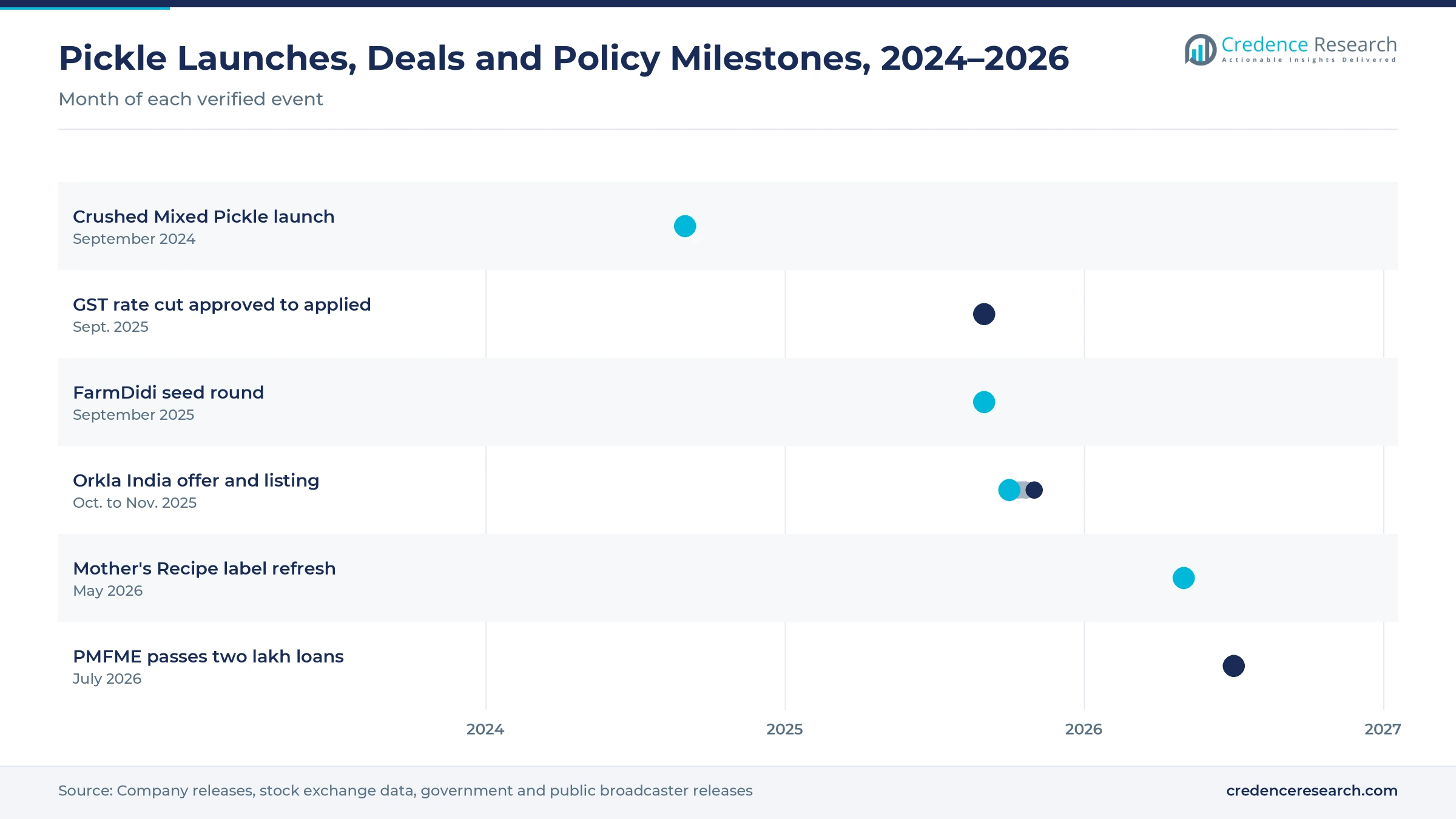
Formalization and export-oriented food processing build stronger brands, because registered makers can borrow, meet hygiene rules and ship to overseas Indian communities. The PMFME scheme crossed loan sanctions for more than two lakh micro food processing enterprises by July 2026, leveraging project investment of over Rs 20,300 crore. The scheme also supports 40 common brands covering nearly 200 products under its One District One Product approach. The U.S. Department of Agriculture notes that food processing in India holds significant growth potential in tier II and III cities and rural areas. As a result, mid-market products hold 40.0% of 2025 value, as formal makers reach smaller towns.
Why do tax cuts and listed capital support pricing?
Tax cuts and listed capital support affordable pricing, because lower taxes reduce shelf prices and listed food groups can invest in larger factories and wider distribution. The GST Council approved rate rationalization on Sept. 3, 2025, and cut the tax on sauces and condiments such as curry paste and mixed condiments from 12% to 5%, according to All India Radio. The new rates applied from Sept. 22, 2025, the first day of Navaratri. Orkla India, which owns MTR and Eastern, listed on Nov. 6, 2025, after a Rs 1,667.54 crore offer for sale. In turn, economy and mid-market jars keep buyers loyal while premium products grow at a faster pace.
Clean labels and regional recipes reshape shelves
How is the shift to clean labels changing pickle jars?
The shift to clean labels is changing pickle jars, because buyers now read ingredient lists and prefer products without artificial preservatives. Mother's Recipe began refreshing the labels of more than 64 pickle variants in May 2026, its first major packaging uplift, and placed a no preservatives claim at the front of each jar. The new labels show the brand line in more than 10 languages, which helps each regional recipe connect with local buyers. FarmDidi raised more than Rs 7 crore in September 2025 to scale homemade pickles made without chemicals. As a result, artisanal and specialty products grow at 7.75% a year, the fastest rate among price tiers.
Why is the rise of regional recipes significant?
The rise of regional recipes is significant, because buyers in large cities now look for pickles from other states, such as Andhra avakaya, Bengali kasundi or Rajasthani chili. Mother's Recipe launched a Crushed Mixed Pickle in September 2024 in a 300 gram pack priced at Rs 105 across Bengaluru, Delhi, Mumbai and Nagpur. The company also acquired Elmac, a Kolkata brand known for kasundi and sauces, and offers 60 pickle varieties. Priya Foods, part of the Ramoji Group, has sold pickles, spice mixes and masalas for more than four decades. In turn, meat and seafood pickles grow at 6.22% a year, as southern recipes travel nationwide.
Can women-led and homemade brands open new demand?
Women-led and homemade brands can open new demand, because they bring farm-fresh recipes and local stories that large factories find hard to copy. FarmDidi raised more than Rs 7 crore in a seed round led by Samved Ventures in September 2025, according to Entrackr. The company works with about 2,000 rural women entrepreneurs and plans to grow that network to more than 5,000. It will use the funds for research, team building and technology-led quality systems at the farmgate. As a result, direct-to-consumer sales gain share during 2026–2035, as buyers order homemade jars through brand websites and social media.
Is overseas demand an opening for export-ready makers?
Overseas demand offers an opening for export-ready makers, because Indian communities abroad buy familiar pickles, chutneys and condiments from home. Mother's Recipe exports to more than 50 countries, with North America, the United Arab Emirates and Australia as its largest markets, and chutneys grow fastest in its export range. India also exported 32,104.09 metric tons of fresh mango worth USD 60.14 million in 2023-24, according to APEDA, which shows strong global interest in Indian fruit. In turn, formal makers that meet export rules build larger and cleaner plants, which helps premium products grow at 6.42% for flexible pouches and other new pack formats.
Oil costs, quality gaps and loose rivals pressure brands
How do oil and spice costs squeeze margins?
Oil, chili and spice costs squeeze margins, because pickles use large amounts of mustard or sesame oil and dried chili whose prices change with each harvest. In turn, makers that sell at fixed price points must absorb cost spikes for months before they can raise prices. Producers respond with smaller packs, forward buying of oil and spices, and recipes that keep taste steady while managing ingredient costs.
Why do quality and shelf-life gaps limit trust?
Quality and shelf-life gaps limit trust, because pickles made in small batches can spoil if salt, oil or acid levels are not controlled. As a result, buyers often return to known brands after a poor experience with a new product. Producers respond with food safety testing, better sealing, clean factories and clear best before dates that help small makers meet hygiene rules and win shelf space in modern retail.
How does unorganized supply pressure branded makers?
Unorganized supply pressures branded makers, because many households still make pickles at home or buy loose products from local sellers at lower prices. In turn, national brands must justify higher prices with taste, hygiene and convenience. Producers respond with value packs, regional recipes and festival offers that persuade buyers to switch from homemade or loose pickles to sealed and labeled jars sold in nearby stores.
Why do health concerns about salt and oil weigh on demand?
Health concerns about salt and oil weigh on demand, because some urban buyers now limit foods high in sodium and fat. As a result, these buyers eat smaller portions or switch to fresh chutneys instead of oil-based pickles. Producers respond with lower-salt recipes, cold-pressed oils and smaller single-serve packs that let buyers enjoy pickles while keeping portions under control at each meal.
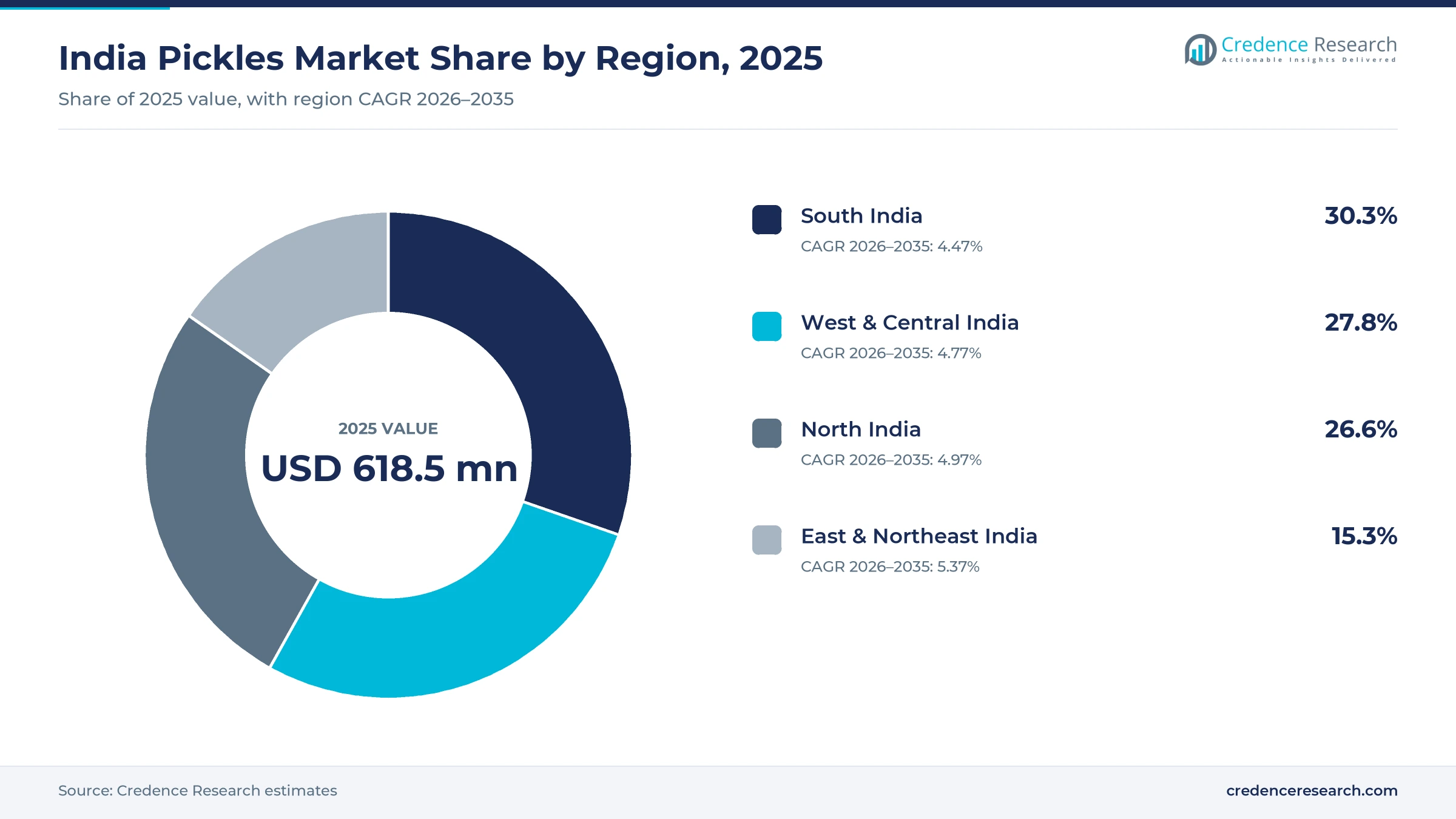
South India leads while the east adds the fastest growth
| Region | Value, 2025 (USD million) | Share, 2025 | CAGR, 2026–2035 |
|---|---|---|---|
| South India | 187.4 | 30.3% | 4.47% |
| West & Central India | 171.9 | 27.8% | 4.77% |
| North India | 164.5 | 26.6% | 4.97% |
| East & Northeast India | 94.6 | 15.3% | 5.37% |
Why do avakaya and gongura keep South India in front?
South India held a 30.3% share of 2025 value and grows at 4.47% a year, because southern households eat avakaya, gongura, lime and meat pickles with most meals. Andhra Pradesh produced about 4.99 million metric tons of mango in 2023-24, the second-highest state total, which supports large seasonal pickle runs. Priya Foods and other southern makers also sell regional recipes across India. As a result, South India remains the largest and most varied regional market.
How does West & Central India balance tradition and retail?
West & Central India held a 27.8% share of 2025 value and grows at 4.77% a year, because Gujarat and Maharashtra have strong traditions of sweet and spicy mango pickles. Mother's Recipe, which is run by Desai Foods, launched its Crushed Mixed Pickle in Mumbai and Nagpur in September 2024. Modern trade is also strong in cities such as Mumbai, Pune and Ahmedabad. In turn, the region leads in premium and branded jar sales.
Why does North India rely on mango and mixed pickles?
North India held a 26.6% share of 2025 value and grows at 4.97% a year, because households serve mango, lime and mixed pickles with parathas and dal. Uttar Pradesh produced about 5.81 million metric tons of mango in 2023-24, the largest output of any state. Delhi was also one of four launch cities for the Mother's Recipe Crushed Mixed Pickle in 2024. As a result, North India remains a large market for economy and mid-market jars.
How fast is East & Northeast India growing?
East & Northeast India held a 15.3% share of 2025 value and grows fastest at 5.37% a year, because branded jars and delivery apps are reaching more towns. Bihar produced about 1.58 million metric tons of mango in 2023-24 and West Bengal about 1.01 million metric tons, which supports local supply. Kasundi and bamboo shoot pickles also give the region a distinct identity. In turn, modern trade and online sales add new buyers each year.
Launches, listings and funding rounds since 2024
| Development | Status and market relevance |
|---|---|
| In September 2024, Mother's Recipe launched a Crushed Mixed Pickle in a 300 gram pack priced at Rs 105 in Bengaluru, Delhi, Mumbai and Nagpur. | Adds a convenient mixed pickle format in four cities |
| In September 2025, the GST Council cut the tax on sauces and mixed condiments from 12% to 5%, effective Sept. 22, 2025. | Lowers shelf prices for packaged condiments |
| In September 2025, FarmDidi raised more than Rs 7 crore in a seed round led by Samved Ventures to scale homemade pickles. | Funds a women-led direct-to-consumer brand |
| In November 2025, Orkla India, owner of the MTR and Eastern brands, listed on the BSE and NSE after an offer subscribed 48.74 times. | Gives a major condiment group listed capital |
| In May 2026, Mother's Recipe began refreshing labels across more than 64 pickle variants with a no preservatives claim. | Strengthens clean-label positioning on shelves |
Packaging, hygiene and shelf-life tools modernize production
- Automated filling and sealing lines fill jars and pouches with exact oil and spice ratios, which reduces leaks and keeps taste the same in every batch.
- Flexible pouch packaging replaces heavier jars for refill and value packs, which lowers freight costs and suits online orders.
- Water activity and acidity testing checks each batch before packing, which helps makers extend shelf life without artificial preservatives.
- Demand planning software links retail and delivery app orders to production plans, which cuts stock-outs during festival seasons.
Need a Custom Version of This Report?
Tailor the scope, geography, or segments to your exact requirements.
- Custom geography or segment scope
- Direct access to our analyst team
Heritage brands and new direct sellers compete on taste
Competition is led by heritage brands with national distribution, alongside regional makers, listed food groups and new direct-to-consumer sellers. Mother's Recipe, run by Desai Foods, competes with more than 60 pickle varieties, regional labels and exports to more than 50 countries. Orkla India competes through its MTR and Eastern brands in spices and convenience foods and listed on Indian exchanges in November 2025. Priya Foods, part of the Ramoji Group, competes on southern recipes and a global presence. Nilon's sells Rajasthani mango, chili and mixed pickles through general trade in PET bottles. FarmDidi competes as a women-led homemade brand that sells online. Rivals compete on taste, recipe authenticity, price packs, shelf reach and clean labels. Because pickles are bought often and in small packs, brands with deep general trade reach and strong delivery app visibility usually win the most repeat buyers.
Which brands shape Indian pickle shelves?
| Company | Type | Role in the market |
|---|---|---|
| Mother's Recipe | Branded processor | Offers more than 60 pickle varieties and refreshed labels in May 2026 |
| Orkla India (MTR) | Listed food group | Owns MTR and Eastern and listed in November 2025 |
| Priya Foods | Branded processor | Ramoji Group brand selling pickles and spice mixes for four decades |
| Nilon's | Branded processor | Sells Rajasthani mango, chili and mixed pickles in PET bottles |
| FarmDidi | Direct-to-consumer brand | Raised more than Rs 7 crore in September 2025 |
Credence Research view on branded condiments in India
Credence Research's view is that the Indian pickle market will grow through steady branded conversion rather than new eating habits, because most households already eat pickles and are slowly moving from homemade or loose products to sealed jars. Fruit pickles remain the largest value pool, while meat and seafood pickles, artisanal products, flexible pouches and quick commerce add the fastest growth. Lower taxes, strong farm output and formal processing will support supply. Brands with regional recipes, clean labels and strong delivery app visibility should gain the most during the forecast period.
How the national condiment estimate was built
The report uses 2025 as the base year on a calendar basis, and market values come from the Credence Research model. That model combines horticulture production statistics, tax rate changes, food processing scheme data, retail platform disclosures and company releases. Regional shares follow the client zone definitions, while segment splits and growth rates are Credence Research estimates. Sources used are official statistics, government and public broadcaster releases, stock exchange filings and company releases reported in trade media, and no interviews or surveys were used.
Branded jars and digital shelves carry growth to 2035
The India pickles market is expected to reach USD 1.00 billion by 2035, a 4.83% CAGR during 2026–2035, as households keep moving to branded jars and makers reach more towns. Growth should be strongest in meat and seafood pickles, artisanal products, flexible pouches and East & Northeast India, because these areas gain most from delivery apps and regional recipes. Lower GST rates and steady farm output will help prices, while oil costs, quality gaps and loose products could slow some brands.
Frequently Asked Questions
How big is the India pickles market?
Which product type leads Indian pickle value?
Which region leads the Indian pickle market?
How did GST changes affect packaged condiments?
Which sales channel is growing fastest?
What recent moves have changed the Indian pickle market?
Who are the leading companies in the Indian pickle market?
What are the main challenges for pickle makers in India?
Table of Content
Chapter 1 Market Segmentation
- 1.1 Segmentation Framework
- 1.1.1 Product and Service Classification
- 1.1.2 Application and End-Use Classification
- 1.1.3 Technology and Solution Classification
- 1.1.4 Customer and Distribution Channel Classification
- 1.1.5 Geographic Segmentation
- 1.1.6 Market Segment Definitions and Boundaries
- 1.2 By Product Type
- 1.2.1 Fruit Pickles
- 1.2.2 Vegetable Pickles
- 1.2.3 Mixed Fruit & Vegetable Pickles
- 1.2.4 Meat & Seafood Pickles
- 1.3 By Price Tier
- 1.3.1 Economy
- 1.3.2 Mid-Market
- 1.3.3 Premium
- 1.3.4 Artisanal & Specialty
- 1.4 By Packaging Format
- 1.4.1 PET Jars & Bottles
- 1.4.2 Glass Jars
- 1.4.3 Flexible Pouches
- 1.4.4 Sachets & Single-Serve Packs
- 1.4.5 Bulk Foodservice Containers
Chapter 2 Introduction
- 2.1 Report Objectives and Scope
- 2.2 Product Definition and Industry Terminology
- 2.3 Market Inclusions and Exclusions
- 2.4 Research Process
- 2.4.1 Primary Research and Expert Interviews
- 2.4.2 Secondary Research and Source Review
- 2.4.3 Top-Down and Bottom-Up Estimation
- 2.4.4 Data Triangulation and Verification
- 2.5 Market Size Measurement Basis
- 2.5.1 2025: USD 618.5 million → 2035: USD 1.00 billion
- 2.6 Historical and Forecast Reference Periods
- 2.6.1 Historical Period: 2018-2025
- 2.6.2 Base Year: 2025
- 2.6.3 Forecast Period: 2025-2035
- 2.7 Research Assumptions and Limitations
Chapter 3 Executive Summary
- 3.1 Market Snapshot and Key Findings
- 3.2 Base-Year Market Size, 2025
- 3.3 Forecast Market Size, 2035
- 3.4 Revenue and Volume Growth Outlook
- 3.5 Key Demand and Supply Indicators
- 3.6 Leading Market Segments
- 3.7 Fastest-Growing Market Opportunities
- 3.8 Regional Performance Highlights
- 3.9 Technology and Industry Transformation
- 3.10 Competitive Landscape Summary
- 3.11 Analyst View and Strategic Implications
Chapter 4 India Pickles Market Trends and Developments
- 4.1 Historical Industry Development, 2018-2025
- 4.2 Recent Market Trends and Developments
- 4.3 Demand and Customer Behavior Trends
- 4.4 Technology and Product Innovation
- 4.5 Artificial Intelligence, Automation and Digitalization
- 4.6 Local Manufacturing and Supply Chain Realignment
- 4.7 Industry Partnerships, Mergers and Acquisitions
- 4.8 Sustainability and Circular Economy Developments
- 4.9 Government and Private Sector Investment Trends
- 4.10 Emerging Business Models and Commercialization
- 4.11 Industry Developments and Announcements
Chapter 5 India Pickles Market Production, Supply and Demand Analysis
- 5.1 Demand Trend and Consumption Analysis, 2018-2025
- 5.2 Demand Forecast, 2025-2035
- 5.3 Production and Output Trend, 2018-2025
- 5.4 Production and Output Forecast, 2025-2035
- 5.5 Installed Capacity and Capacity Utilization
- 5.6 Company-Wise Production Plants and Statistics
- 5.6.1 Installed Production Capacity
- 5.6.2 Actual Production
- 5.6.3 Planned Capacity and Expansion Targets
- 5.7 Supply Chain Structure and Procurement Trends
- 5.8 Supply-Demand Gap and Bottlenecks
- 5.9 Import Dependence and Sourcing Structure
- 5.10 Contract Manufacturing and Outsourcing
- 5.11 Regional Supply and Demand Concentration
Chapter 6 India Pickles Market Pricing Analysis
- 6.1 Pricing Structure and Measurement
- 6.2 Historical Pricing Trends, 2018-2025
- 6.3 Pricing Outlook, 2025-2035
- 6.4 Average Selling Price and Unit Economics
- 6.5 Pricing by Product and Market Segment
- 6.6 Geographic Pricing Differences
- 6.7 Key Input, Energy, Labor and Logistics Costs
- 6.8 Contract Pricing and Purchasing Models
- 6.9 Pricing Sensitivity and Competitive Positioning
- 6.10 Price, Margin and Profitability Implications
Chapter 7 India Pickles Market Dynamics
- 7.1 Market Growth Drivers
- 7.1.1 Demand-Side Drivers
- 7.1.2 Technology and Innovation Drivers
- 7.1.3 Infrastructure and Investment Drivers
- 7.1.4 Regulatory and Policy Drivers
- 7.2 Market Restraints
- 7.2.1 Cost and Affordability Constraints
- 7.2.2 Technology and Adoption Barriers
- 7.2.3 Supply Chain and Operational Constraints
- 7.3 Market Challenges
- 7.3.1 Competitive Pressure and Margin Erosion
- 7.3.2 Skills, Infrastructure and Implementation Gaps
- 7.4 Emerging Market Opportunities
- 7.5 Market Dynamics Impact and Time-Horizon Assessment
Chapter 8 India Pickles Value Chain Analysis
- 8.1 Industry Value Chain Overview
- 8.2 Upstream Suppliers and Critical Inputs
- 8.3 Technology and Component Providers
- 8.4 Manufacturing or Service Delivery
- 8.5 Distribution, Channel Partners and Integrators
- 8.6 Downstream Applications and End Users
- 8.7 Value Addition and Profit Pools
- 8.8 Vertical Integration and Outsourcing
- 8.9 Supplier Concentration and Risk
- 8.10 Supply Chain Localization and Resilience
Chapter 9 India Pickles Market Regulations and Policies
- 9.1 Relevant Laws, Standards and Compliance Frameworks
- 9.2 Product, Service, Safety and Quality Requirements
- 9.3 Government Policies, Incentives and Subsidies
- 9.4 Imports, Exports and Trade Barriers
- 9.5 Public Procurement and Local Content Requirements
- 9.6 Environmental and Sustainability Compliance
- 9.7 Upcoming Policy Changes and Market Implications
Chapter 10 India Pickles Market Hotspots and Opportunities
- 10.1 Market Opportunity Mapping and Growth Hotspots
- 10.2 High-Growth Applications and Customer Groups
- 10.3 Underserved Markets and White-Space Opportunities
- 10.4 Emerging Technology and Product Opportunities
- 10.5 New Capacity and Investment Hotspots
- 10.6 Market Entry and Expansion Opportunities
- 10.7 Distribution and Partnership Opportunities
- 10.8 Near-Term and Long-Term Commercial Potential
- 10.9 Opportunity Attractiveness and Execution Risks
Chapter 11 India Pickles Market Outlook, 2025-2035
- 11.1 Market Size and Analysis
- 11.1.1 Revenue (Market Measurement: 2025: USD 618.5 million → 2035: USD 1.00 billion)
- 11.1.2 Market Volume and Quantity Sold
- 11.1.3 Historical Market Size, 2018-2025
- 11.1.4 Base-Year Market Size, 2025
- 11.2 Market Forecast, 2025-2035
- 11.2.1 Revenue Forecast to 2035
- 11.2.2 Volume Forecast to 2035
- 11.2.3 CAGR and Year-on-Year Growth
- 11.2.4 Incremental Revenue Opportunity
- 11.3 Forecast Assumptions and Scenario Analysis
- 11.3.1 Base-Case Forecast
- 11.3.2 Optimistic and Conservative Scenarios
- 11.3.3 Technology, Pricing and Policy Sensitivities
- 11.4 Market Attractiveness and Growth Outlook
Chapter 12 India Pickles Market Segmentation and Outlook
- 12.1 Segmentation Summary and Market Shares, 2025
- 12.2 Largest and Fastest-Growing Segments
- 12.3 By Product Type - Market Size and Forecast, 2025-2035
- 12.3.1 Segment Definition and Scope
- 12.3.2 Historical Market Size, 2018-2025
- 12.3.3 Revenue Forecast, 2025-2035
- 12.3.4 Volume Forecast, 2025-2035
- 12.3.5 Base-Year Market Share, 2025
- 12.3.6 Segment CAGR and Growth Drivers
- 12.3.7 Subsegment Market Size and Forecast
- 12.3.7.1 Fruit Pickles
- 12.3.7.2 Vegetable Pickles
- 12.3.7.3 Mixed Fruit & Vegetable Pickles
- 12.3.7.4 Meat & Seafood Pickles
- 12.3.8 Subsegment Pricing and Adoption Trends
- 12.3.9 Leading Suppliers and Competition
- 12.3.10 Regional Demand and Opportunities
- 12.4 By Price Tier - Market Size and Forecast, 2025-2035
- 12.4.1 Segment Definition and Scope
- 12.4.2 Historical Market Size, 2018-2025
- 12.4.3 Revenue Forecast, 2025-2035
- 12.4.4 Volume Forecast, 2025-2035
- 12.4.5 Base-Year Market Share, 2025
- 12.4.6 Segment CAGR and Growth Drivers
- 12.4.7 Subsegment Market Size and Forecast
- 12.4.7.1 Economy
- 12.4.7.2 Mid-Market
- 12.4.7.3 Premium
- 12.4.7.4 Artisanal & Specialty
- 12.4.8 Subsegment Pricing and Adoption Trends
- 12.4.9 Leading Suppliers and Competition
- 12.4.10 Regional Demand and Opportunities
- 12.5 By Packaging Format - Market Size and Forecast, 2025-2035
- 12.5.1 Segment Definition and Scope
- 12.5.2 Historical Market Size, 2018-2025
- 12.5.3 Revenue Forecast, 2025-2035
- 12.5.4 Volume Forecast, 2025-2035
- 12.5.5 Base-Year Market Share, 2025
- 12.5.6 Segment CAGR and Growth Drivers
- 12.5.7 Subsegment Market Size and Forecast
- 12.5.7.1 PET Jars & Bottles
- 12.5.7.2 Glass Jars
- 12.5.7.3 Flexible Pouches
- 12.5.7.4 Sachets & Single-Serve Packs
- 12.5.7.5 Bulk Foodservice Containers
- 12.5.8 Subsegment Pricing and Adoption Trends
- 12.5.9 Leading Suppliers and Competition
- 12.5.10 Regional Demand and Opportunities
- 12.6 Segment Growth Comparison
- 12.7 Segment Attractiveness and Priority Matrix
Chapter 13 India Pickles Geographic Market Outlook, 2025-2035
- 13.1 Domestic Market Distribution and Demand Clusters
- 13.2 State- or Province-Wise Market Size and Forecast, 2025-2035
- 13.3 City and Metropolitan Market Outlook
- 13.4 Industrial, Manufacturing and Commercial Clusters
- 13.5 Geographic Concentration of Key End Users
- 13.6 Local Pricing and Purchasing Differences
- 13.7 Domestic Production Facilities and Capacity Map
- 13.8 Local Infrastructure and Project Pipeline
- 13.9 State-Level Policy and Incentive Differences
- 13.10 Subnational Investment Hotspots and Opportunities
- 13.11 Distribution and Logistics Networks
- 13.12 Domestic Competitive Footprint
Chapter 14 India Pickles Technology, Innovation and Sustainability Outlook
- 14.1 Technology Landscape and Maturity
- 14.2 Product, Process and Service Innovation
- 14.3 AI, Automation and Digital Tools in the Industry
- 14.4 Technology Adoption and Performance Benchmarking
- 14.5 Innovation Pipeline and R&D Investment
- 14.6 Patent and Intellectual Property Trends
- 14.7 Energy Efficiency and Resource Management
- 14.8 Sustainability, Recycling and Circularity
- 14.9 Technology Roadmap, 2025-2035
- 14.10 Risks of Obsolescence and Technology Substitution
Chapter 15 India Pickles Market Key Strategic Imperatives
- 15.1 Growth and Market Entry Priorities
- 15.2 High-Return Products and Segments
- 15.3 Pricing, Profitability and Cost Optimization
- 15.4 Technology Investment and Product Differentiation
- 15.5 Supply Chain Localization and Resilience
- 15.6 Distribution and Customer Acquisition
- 15.7 Partnership, Acquisition and Capacity Strategy
- 15.8 Regional Expansion Priorities
- 15.9 Short-, Medium- and Long-Term Actions
Chapter 16 Competition Outlook
- 16.1 Industry Competition Characteristics
- 16.2 Market Structure and Concentration
- 16.3 Market Share and Competitive Positioning, 2025
- 16.4 Company-Wise Revenue and Product Benchmarking
- 16.5 Production and Service Capacity Benchmarking
- 16.6 Technology, Pricing and Differentiation
- 16.7 Regional Footprint and Distribution Strength
- 16.8 Mergers, Acquisitions and Strategic Alliances
- 16.9 New Entrants and Competitive Threats
- 16.10 Porter's Five Forces and Industry Attractiveness
- 16.11 Competitive Outlook, 2025-2035
Chapter 17 Company Profiles
- 17.1 Company Coverage and Selection Criteria
- 17.2 Mother's Recipe
- 17.2.1 Business Description
- 17.2.2 Company Ownership and Geographic Presence
- 17.2.3 Product and Service Portfolio
- 17.2.4 Manufacturing and Operating Footprint
- 17.2.5 Production Capacity and Expansion Plans
- 17.2.6 Financial Performance and Investment
- 17.2.7 Market Share and Competitive Position
- 17.2.8 Technology and Innovation Capabilities
- 17.2.9 Strategic Alliances or Partnerships
- 17.2.10 Recent Developments
- 17.2.11 Growth Strategy and Outlook
- 17.3 Nilon's
- 17.4 Priya Foods
- 17.5 Orkla India (MTR)
- 17.6 Aachi
- 17.7 Pachranga International
- 17.8 G.D. Foods (TOPS)
- 17.9 Pravin Masalewale
- 17.10 V.P. Bedekar & Sons
- 17.11 Patanjali Ayurved
- 17.12 Other Relevant Market Participants
Note: Every listed company is profiled on the structure shown under the first company. The company list is preliminary and may change based on research findings, market developments, data availability and client requirements.
Chapter 18 Disclaimer
- 18.1 Research and Forecast Disclaimer
- 18.2 Data Source and Estimation Limitations
Note: The depth of individual sections depends on data availability for this market. Volume, capacity, trade and other unit-based metrics are included where applicable.