Indian sauces and condiments shift from kitchen to brand
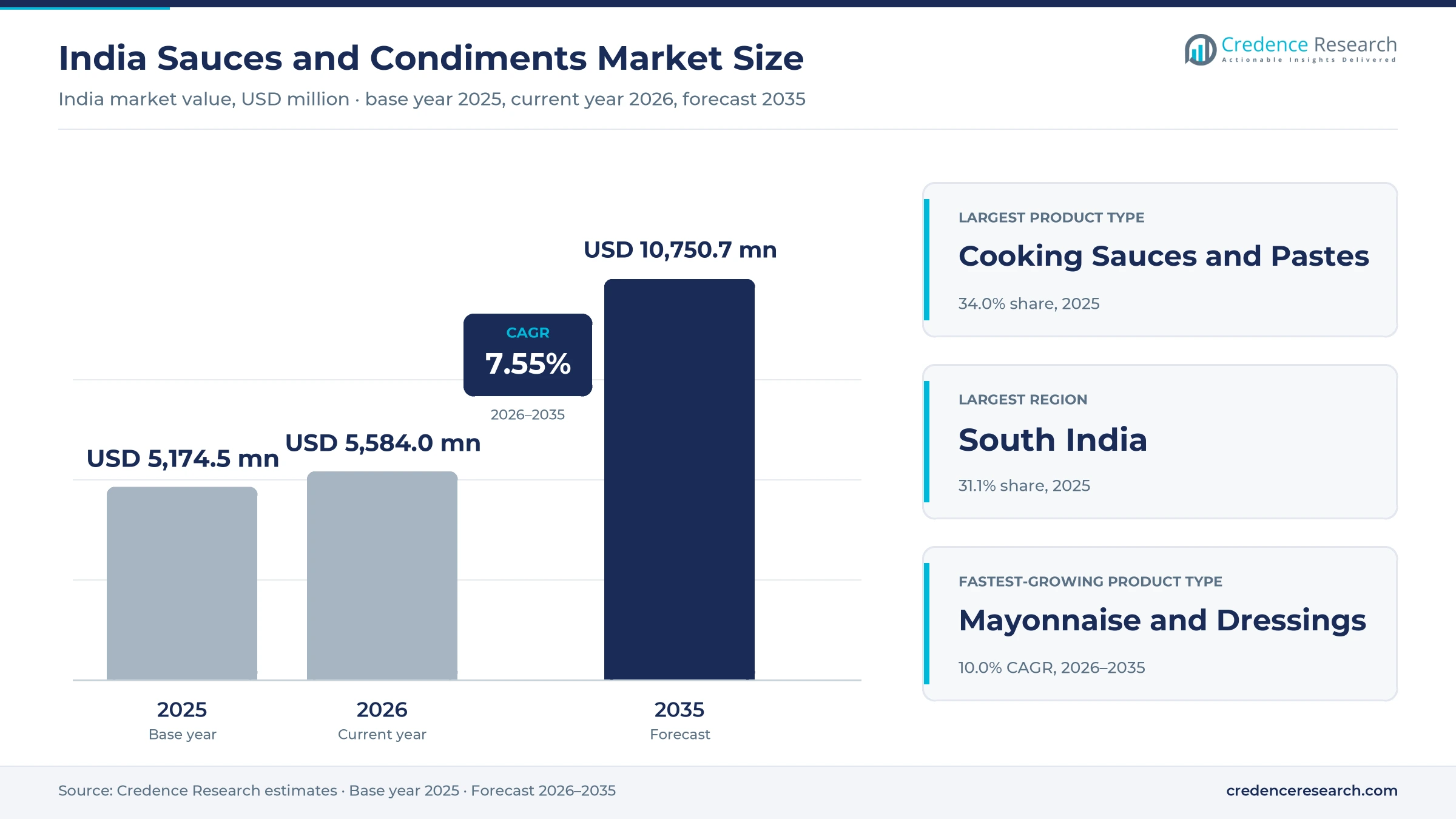
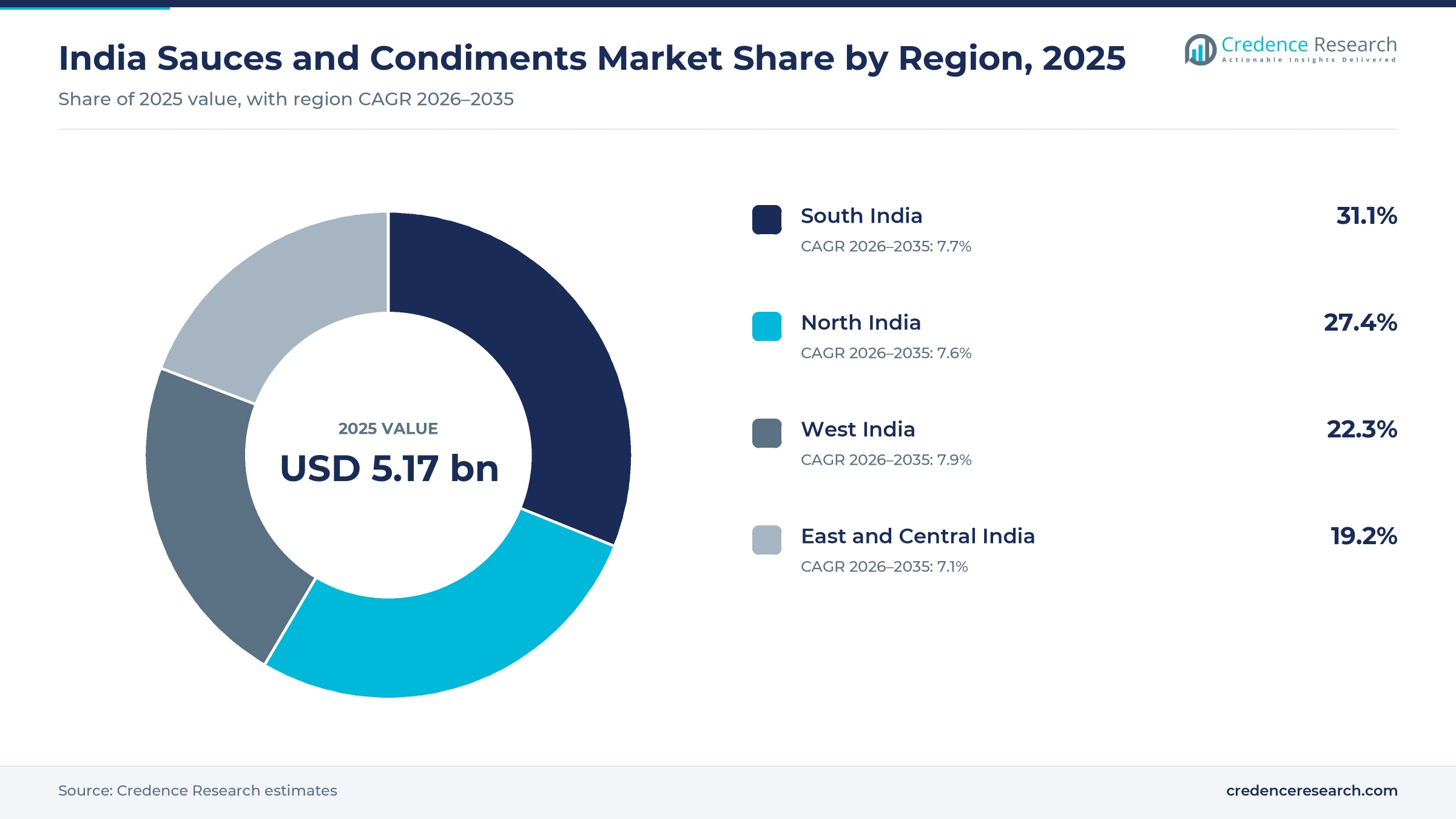
The India sauces and condiments market was valued at USD 5.17 billion in 2025 and is projected to increase from USD 5.58 billion in 2026 to USD 10.75 billion by 2035, registering a CAGR of 7.55% during 2026–2035. Spending grows as urban households buy more ready pastes, ketchup and eggless mayonnaise, as quick-service chains add outlets, and as packaged pickles and chutneys replace part of home preparation. South India held the largest regional share, 31.1% in 2025, supported by high urban household spending in Telangana, Tamil Nadu and Karnataka. West India is the fastest-growing region at 7.8% a year, helped by dense metro retail in Mumbai, Pune and Ahmedabad. Cooking sauces and pastes account for the largest share of value, while mayonnaise and dressings grow fastest. Tax relief also changed the price ladder, since the GST rate on sauces fell to 5% from Sept. 22, 2025, down from 12% or 18% earlier, which lowered shelf prices across the category.
Ketchup, pastes, mayonnaise and pickles bought for daily meals
The market counts the value of cooking sauces and pastes, tomato ketchup and table sauces, mayonnaise and dressings, and pickles, chutneys and relishes sold in India to households, restaurants, caterers and food manufacturers. Value is measured at the price buyers pay, whether through neighborhood stores, supermarkets, online and quick commerce apps, or foodservice distributors.
Dry spice blends, soups, jams and spreads such as peanut butter are outside the scope, as are exports and sauces made in-house by restaurants. The value chain runs from tomato, mango, chili and edible oil supply through processors and contract packers, then to distributors, retailers and foodservice buyers across the four regions.
India Sauces and Condiments Market Insights
- The India sauces and condiments market grows from USD 5.17 billion in 2025 to USD 10.75 billion by 2035 at a 7.55% CAGR, as packaged pastes, sauces and chutneys replace home preparation.
- South India held the largest regional share at 31.1% in 2025, while West India grows fastest at 7.8% a year on metro retail density.
- Cooking sauces and pastes led with 34.0% of 2025 value, while mayonnaise and dressings grow fastest at 10.0% a year.
- The GST rate on sauces fell to 5% from Sept. 22, 2025, and Tamil Nadu banned raw-egg mayonnaise for a year in April 2025, favoring packaged products.
- Tata Consumer Products agreed to buy Capital Foods, owner of Ching's Secret, for INR 5,100 crore in January 2024, the largest recent deal in the category.
Cooking pastes lead while mayonnaise grows fastest
Cooking pastes lead as mayonnaise and dressings grow fastest
Based on product type, the market is categorized into cooking sauces and pastes, tomato ketchup and table sauces, mayonnaise and dressings, and pickles, chutneys and relishes. Cooking Sauces and Pastes led with 34.0% of 2025 value because Indo-Chinese, Italian and curry cooking now starts from a jar, and Tata Consumer Products valued the categories of Capital Foods, including sauces, chutneys and blended masalas, at INR 21,400 crore when it agreed the purchase in January 2024. Mayonnaise and Dressings grow fastest at 10.0% a year as sandwich, wrap and pizza consumption spreads, and Hindustan Unilever reported volume-led gains in ketchup and mayonnaise in the December 2025 quarter.
Households lead while restaurant chains grow fastest
Based on customer type, the market is categorized into household consumers, HoReCa buyers, institutional caterers and food manufacturers. Household Consumers led with 62.0% of 2025 value because pickles, ketchup and pastes sit in most kitchens, and kirana and grocery stores carry most pickle and ketchup jars. HoReCa Buyers grow fastest at 8.8% a year as pizza and burger chains add outlets, and Jubilant FoodWorks ended fiscal 2026 with 2,455 Domino's outlets in India. Caterers and food manufacturers buy on contract, mostly in bulk packs and private formulations.
Kirana stores lead as quick commerce grows fastest
Based on distribution channel, the market is categorized into general trade, modern trade, e-commerce and quick commerce, and foodservice and institutional distribution. General Trade led with 51.0% of 2025 value because neighborhood kirana stores still sell most jars and sachets, and the Orkla India offer document puts modern trade at only 17.0% of packaged food sales in fiscal 2024. E-Commerce and Quick Commerce grows fastest at 12.6% a year as dark stores multiply, since Eternal reported 1,816 Blinkit stores at the end of September 2025 and a target of 3,000 by March 2027.
Bottles and jars lead as pouches gain fastest
Based on packaging format, the market is categorized into bottles and jars, flexible pouches and sachets, single-serve packs and bulk foodservice packs. Bottles and Jars led with 48.0% of 2025 value because pickles, chutneys and mayonnaise are bought in glass and PET jars, such as the 500 g MTR lime pickle and the 250 g Schezwan chutney jar from Ching's Secret. Flexible Pouches and Sachets grow fastest at 8.3% a year as brands move ketchup into cheaper refill packs, and Nestlé India sells Maggi ketchup and chili sauce in its Pichkoo doy pack to reach new buyers.
| Segment Group | Leading Sub-segment | Share, 2025 | Fastest-growing Sub-segment | CAGR, 2026–2035 |
|---|---|---|---|---|
| By Product Type | Cooking Sauces and Pastes | 34.0% | Mayonnaise and Dressings | 10.0% |
| By Customer Type | Household Consumers | 62.0% | HoReCa Buyers | 8.8% |
| By Distribution Channel | General Trade | 51.0% | E-Commerce and Quick Commerce | 12.6% |
| By Packaging Format | Bottles and Jars | 48.0% | Flexible Pouches and Sachets | 8.3% |
Per-kilo prices rise from ketchup to mayonnaise and chutney
Prices are set per pack, but the per-kilo ladder explains margins. Bulk ketchup sells for well under INR 110 a kilo, while mayonnaise and chutney jars sell for INR 340 to 380 a kilo, because oil, emulsifiers and smaller glass packs add cost and brands add a flavor premium. Retail apps discount heavily below the printed price, which narrows the gap to foodservice packs. Restaurant buyers pay the least per kilo, and private labels sold through wholesale apps cap what branded suppliers can charge. The GST cut of September 2025 lowered shelf prices, so cost pressure from tomatoes or edible oil now shows up more directly in pack sizes and promotions.
| Product or pack | Typical price or fee | Basis |
|---|---|---|
| Kissan Fresh Tomato Ketchup, 2 kg | MRP INR 215, listed at INR 176.3 | BigBasket listing, November 2026 |
| Habit tomato ketchup for restaurants, 950 g | INR 72.45 a pack, INR 69.30 for 10 or more | Hyperpure listing, November 2026 |
| Dr. Oetker FunFoods veg mayonnaise, 250 g jar | INR 95, about INR 380 per kg | BigBasket listing, November 2026 |
| Ching's Secret Schezwan Chutney, 250 g jar | MRP INR 85 | BigBasket listing, November 2026 |
| MTR Lime Pickle, 500 g jar | MRP INR 155 | MTR Foods online store, November 2026 |
| GST on sauces | 5% from Sept. 22, 2025, down from 12% or 18% | Press Information Bureau, September 2025 |
Request a Free Sample
Fill in your details and we'll send you a free sample report.
- Sample data tables & charts
- Research methodology
Urban meals, faster shelves and policy relief lift volumes
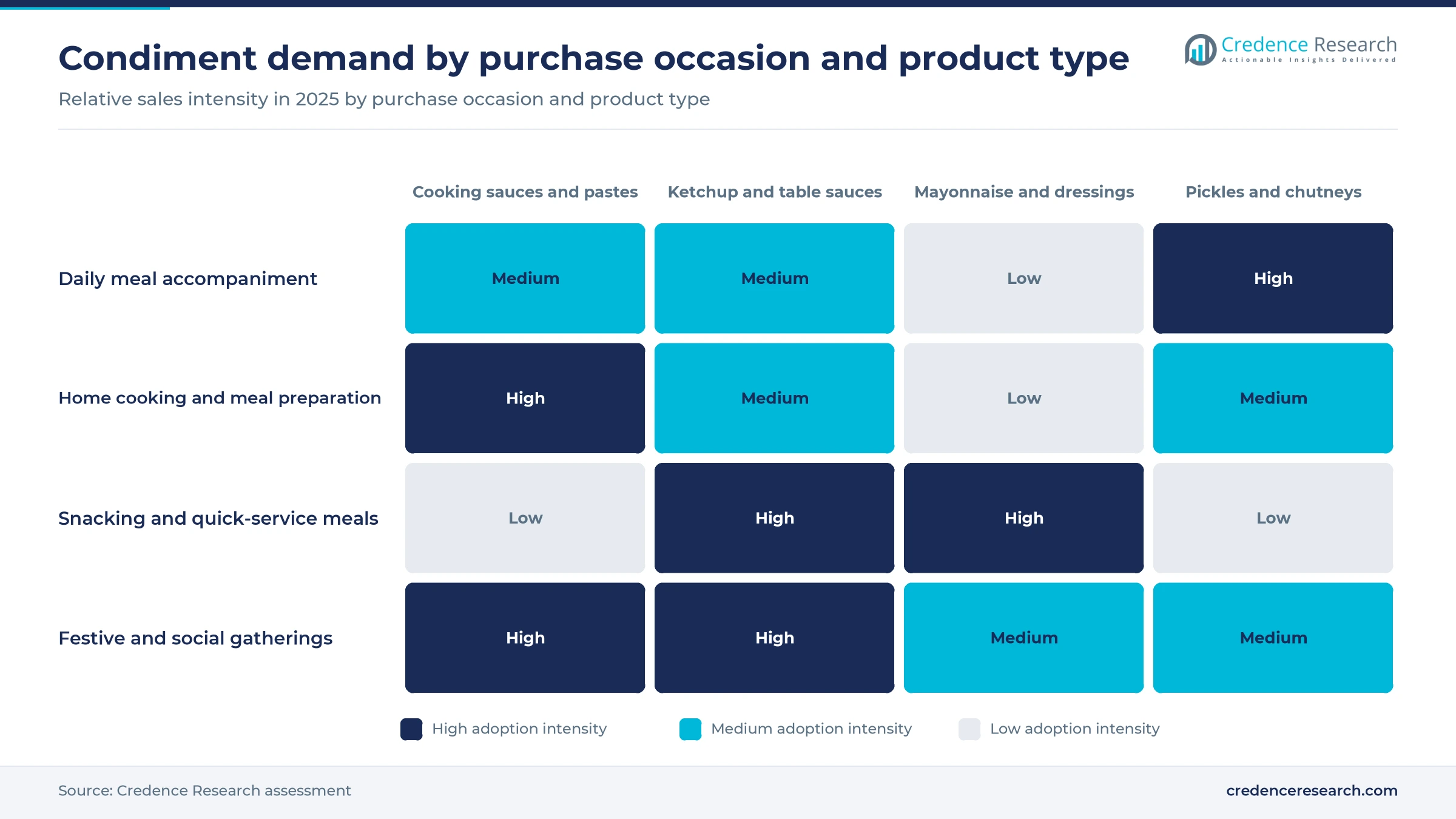
Urban convenience cooking moves meals to the jar
Urban households spend a growing share of their budgets on ready food, a shift that favors time-saving jars and pouches. The Household Consumption Expenditure Survey 2023-24 shows beverages, refreshments and processed food rising to 11.09% of urban monthly spending from 10.64% a year earlier, and to 9.84% in rural areas. The World Bank projects that about 600 million people, or 40% of the population, will live in towns and cities by 2036. Hindustan Unilever said in September 2026 that about 40% of Indian women are now in the workforce and linked this to demand for convenience foods such as chutneys. Cooking sauces and pastes already hold 34.0% of value, so processors with Indian gravy and Indo-Chinese bases gain most.
Organized retail and quick commerce widen availability
Wider shelf access lets smaller and premium brands reach buyers who once saw only one or two ketchup labels. The industry report in the Orkla India offer document puts modern trade at 17.0% and e-commerce and quick commerce at 7.0% of packaged food sales in fiscal 2024, up from 0.6% online in 2019. Eternal expects Blinkit to run 3,000 dark stores by March 2027, about two-thirds more than at the end of September 2025. Tata Consumer Products took Ching's Secret from 3 to 4 lakh stores toward its own network of 18 to 20 lakh after the Capital Foods purchase. E-commerce and quick commerce grow at 12.6% a year, making digital range planning a priority.
Policy support and export-led processing add capacity
Government incentives and tax cuts lower the cost of building and selling processed foods, including sauces and pickles. The Ministry of Food Processing Industries reports that its production-linked incentive scheme, with an outlay of INR 10,900 crore, has drawn INR 9,207 crore of investment from approved food processors. The GST cut on sauces in September 2025, noted above, lowered the tax paid on every branded bottle and pouch. The scheme runs from 2021-22 to 2026-27, so approved processors must fill their new lines within the next year, much of it in the home market. Incentive-backed capacity arriving as GST falls tends to show up as promotions and new pack sizes rather than price increases.
Quick-service chains lift bulk sauce and dip orders
Restaurant chains buy sauces, dips and mayonnaise in bulk, so their expansion adds steady contract volume. Jubilant FoodWorks ended fiscal 2026 with 2,455 Domino's outlets in India, after opening 59 in the March quarter alone. Cremica Food Industries describes itself as a preferred vendor to McDonald's, Pizza Hut, Domino's and Subway, according to FnB News in June 2025. Veeba began as a supplier of emulsion sauces to Domino's and KFC before entering retail in 2016, Outlook Business reported. HoReCa buyers grow at 8.8% a year, and suppliers that hold chain approvals for mayonnaise and dips gain a steady demand base for their retail brands.
Regional chutneys and clean labels redraw the shelf
Rise of regional chutneys under national brands
National brands are moving into regional chutneys that were once made at home or by local producers. Hindustan Unilever launched The Great Indian Chutneys under Kissan on Feb. 18, 2026, with Chilli Peanut Thecha, Chatpati Hari, Teekhi Lehsun and Khatti-Meethi Imli Khajoor. Tata Consumer Products added Ching's Secret Momo Chutney, Schezwan Ketchup and a sriracha sauce after integrating Capital Foods in under 100 days. MTR lists its 500 g lime pickle at INR 155 on its own store, the branded benchmark these new chutneys price against. The shift brings branded quality and pricing to flavors where loose and homemade products still dominate volume.
Shift toward clean-label and better-for-you condiments
Buyers in large cities now pay more for condiments with shorter ingredient lists and functional claims. Mother's Recipe launched Hearty Roots, an Ayurveda-inspired range of seven pickles with no added artificial preservatives, in July 2025 through Zepto, Swiggy Instamart, Amazon Fresh and Bigbasket, starting in five cities. Wingreens World raised INR 120 crore in a Series D round in May 2026, taking its total funding to INR 556 crore, and bought Safe Harvest, which sources from more than 100,000 farmers. Veeba markets its sauces and vege-naises on better-for-you ingredients, which brings clean-label claims onto the mainstream mayonnaise shelf. Clean-label claims help premium brands defend prices above mass ketchup.
Raw-egg bans open a food-safe mayonnaise opportunity
State bans on raw-egg mayonnaise create an opening for packaged eggless and pasteurized products sold to restaurants. Tamil Nadu banned the making, storage and sale of mayonnaise prepared from raw egg for one year in April 2025, citing Salmonella and Listeria risks, according to The News Minute. Kerala and Telangana took similar steps in 2023 and 2024, after a 2022 food-poisoning outbreak in Kasargod sickened at least 58 people. Cremica says it introduced the first vegetarian mayonnaise in India, and a 250 g jar of FunFoods veg mayonnaise now sells for about INR 95 online. Suppliers of shelf-stable dressings can win shawarma and sandwich outlets that previously made their own.
Small packs open rural and first-time buyer demand
Low-priced pouches and sachets give suppliers a route to households that rarely buy a full jar. The Household Consumption Expenditure Survey puts average rural monthly spending at INR 4,122 per person in 2023-24, against INR 6,996 in urban areas, so pack price matters more than price per kilo outside cities. Nestlé India says the Pichkoo doy pack makes Maggi sauces affordable to a new set of consumers. Dr. Oetker sells FunFoods veg mayonnaise in 60 g pouches beside its larger jars. Urban areas still account for 65% to 70% of packaged food demand, according to the Orkla India filing, which leaves room for rural growth in single-serve packs.
Tomato swings, oil duties and plastic rules squeeze margins
Tomato output swings raise paste and ketchup costs
Ketchup and tomato-based sauces depend on a crop with volatile output and prices. The second advance estimates of horticulture crops, released in June 2025, put tomato production at about 20.75 million metric tons in 2024-25, down from 21.32 million metric tons a year earlier. Weather-driven shortfalls push up the cost of fresh tomatoes and paste for processors that buy on the spot market. Larger brands hedge through stored aseptic paste and contract farming, while small processors absorb the swings in their margins.
Plastic recycled-content rules raise packaging costs
New plastic rules raise compliance costs for brands that sell in PET jars, pouches and sachets. The Plastic Waste Management Amendment Rules notified on March 31, 2026, set recycled-content targets for rigid plastic packaging of 30% in 2025-26, rising to 60% from 2028-29, with lower targets for multilayered plastic that double by 2027-28. Food-contact packaging may carry forward unmet 2025-26 targets for up to three years. Small pickle and sauce makers have the least scale to buy recycled resin or redesign packs.
Private labels and deep discounts cap branded pricing
Private labels and app discounts limit how much branded suppliers can raise prices. Hyperpure lists its own Habit tomato ketchup at INR 72.45 for a 950 g pack for restaurants, well below branded retail prices per kilo. BigBasket listed the 2 kg Kissan ketchup at INR 176.3 in November 2026, 18% below its printed price of INR 215. Discounts of this size shift value from brand owners to retailers and apps. Suppliers respond with new flavors and pack sizes that are harder to compare directly.
Edible oil duty swings move mayonnaise costs
Mayonnaise and many dressings are mostly vegetable oil, so import duty changes move their costs quickly. The USDA Foreign Agricultural Service reports that India cut the basic customs duty on crude soybean, sunflower and palm oil from 20% to 10% on May 30, 2025, for an effective rate of 16.5%. Mayonnaise makers buy oil at market prices, so global prices and duty decisions pass straight into emulsion costs. Brands with long-term oil contracts and pricing power recover cost changes faster than small processors.
South India leads while western metros grow fastest
| Region | Value, 2025 (USD billion) | Share, 2025 | CAGR, 2026–2035 |
|---|---|---|---|
| South India | 1.61 | 31.1% | 7.7% |
| North India | 1.42 | 27.4% | 7.5% |
| West India | 1.15 | 22.3% | 7.8% |
| East and Central India | 0.99 | 19.2% | 7.0% |
South India leads on high urban household spending
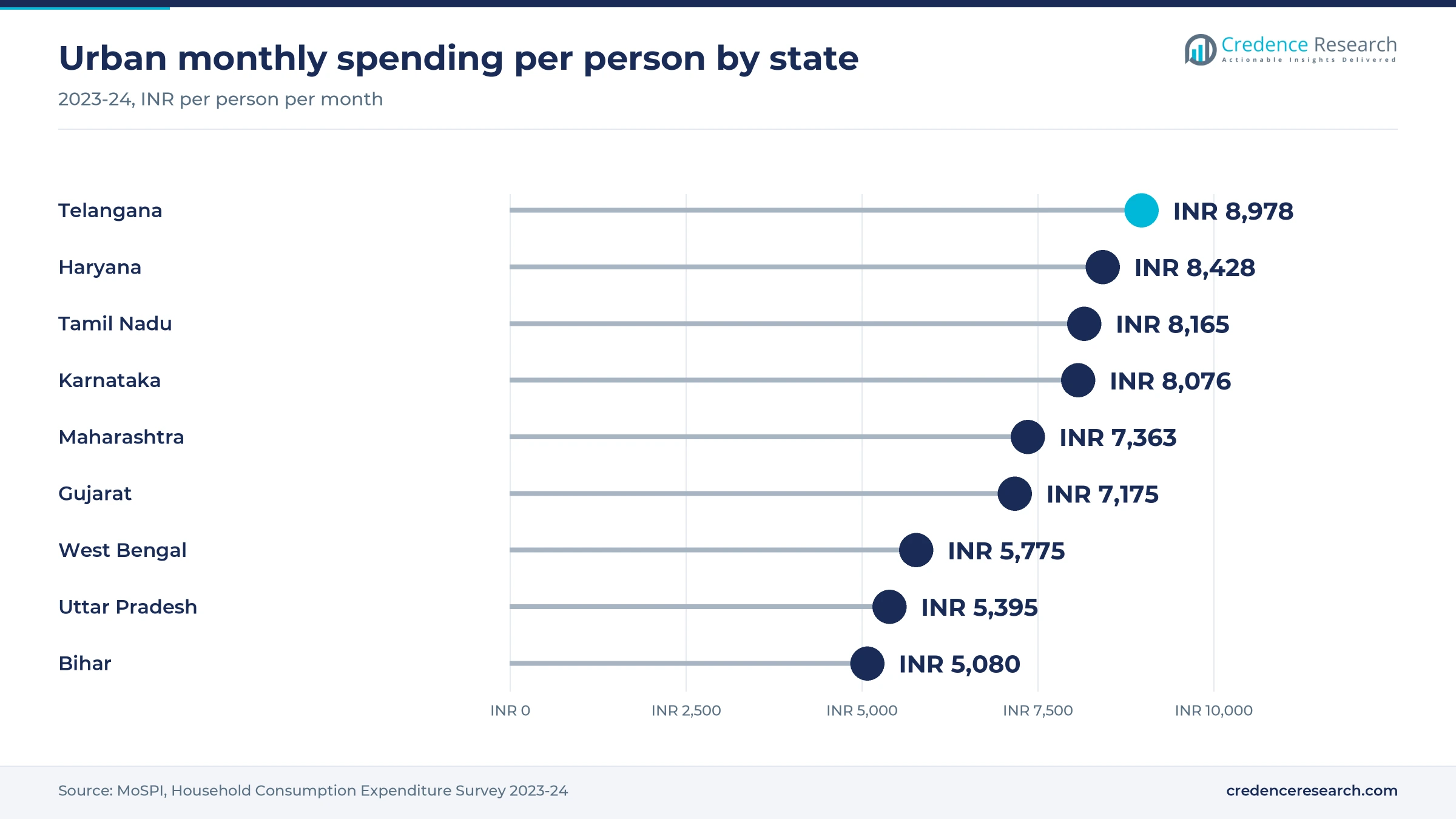
South India held 31.1% of 2025 value and grows at 7.7% a year. Urban monthly spending per person in 2023-24 reached INR 8,978 in Telangana, INR 8,165 in Tamil Nadu and INR 8,076 in Karnataka, among the highest of the major states. Regional brands of mango and lime pickle compete with national labels, and Bengaluru-based Orkla India, owner of MTR and Eastern, listed on the stock exchanges on Nov. 6, 2025. The Tamil Nadu raw-egg mayonnaise ban of 2025 pushed restaurants in the state toward packaged emulsions.
North India pairs high incomes with major sauce plants
North India held 27.4% of 2025 value and grows at 7.5% a year. Urban monthly spending per person reached INR 8,428 in Haryana and INR 7,359 in Punjab in 2023-24, while Uttar Pradesh stood at INR 5,395. The region is also a production base, with Veeba plants at Neemrana and Keshwana in Rajasthan, the Dr. Oetker plant at Kahrani in Rajasthan and the Cremica Mega Food Park at Una in Himachal Pradesh. Haryana's urban spending is the second highest among major states, so Delhi NCR supports premium dips and dressings, while lower spending in Uttar Pradesh keeps most volume in small packs.
West India grows fastest on metro retail and quick commerce
West India held 22.3% of 2025 value and grows at 7.8% a year, the fastest of the four zones. Urban monthly spending per person reached INR 7,363 in Maharashtra and INR 7,175 in Gujarat in 2023-24. Mumbai is home to Capital Foods, the owner of Ching's Secret, and Desai Foods makes Mother's Recipe products near Pune. Mumbai and Pune were among the five cities chosen for the Hearty Roots pickle launch, which points to the weight of quick commerce in western metros.
East and Central India grows from a lower spending base
East and Central India held 19.2% of 2025 value and grows at 7.0% a year. Urban monthly spending per person in 2023-24 was INR 5,775 in West Bengal, INR 5,825 in Odisha, INR 5,538 in Madhya Pradesh and INR 5,080 in Bihar, below the national urban average of INR 6,996. As a result, suppliers reach the zone mainly through sachets and small pouches sold in general trade, which caps value growth at the slowest rate of the four zones.
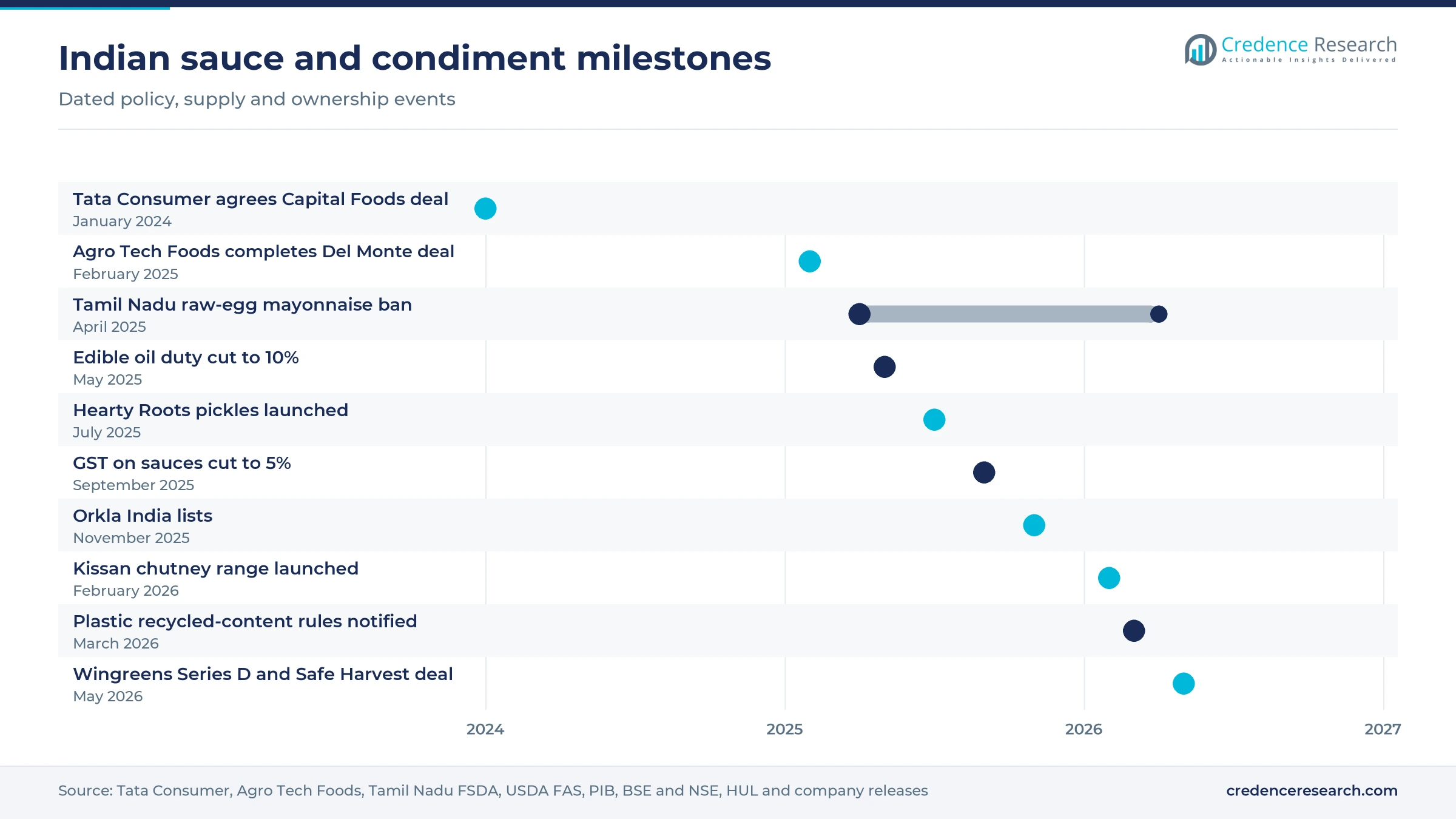
Deals, launches and rule changes from 2024 to 2026
| Development | Status and market relevance |
|---|---|
| In January 2024, Tata Consumer Products agreed to buy Capital Foods, owner of Ching's Secret and Smith & Jones, for INR 5,100 crore. | Completed in phases; Indo-Chinese sauces and chutneys |
| In February 2025, Agro Tech Foods completed its all-stock purchase of Del Monte Foods, formerly FieldFresh Foods. | Completed; ketchup, mayonnaise and Italian foods |
| In April 2025, Tamil Nadu banned mayonnaise made from raw egg for one year. | One-year ban; shifted restaurants to packaged mayonnaise |
| In November 2025, Orkla India, owner of MTR and Eastern, listed on the stock exchanges. | Listed; pickles, spices and ready meals |
| In February 2026, Hindustan Unilever launched The Great Indian Chutneys under Kissan. | Launched; regional chutney range |
Emulsions, aseptic paste and spouted pouches set costs
- Eggless emulsion processing uses milk solids or plant proteins in place of egg, which suits vegetarian buyers and avoids the food-safety risk of raw egg in restaurant kitchens.
- Aseptic tomato paste storage lets processors buy paste at harvest and draw it down through the year, which smooths ketchup costs when fresh tomato prices spike.
- Spouted pouches and doy packs cut packaging weight and cost against glass, which lets brands offer cheaper refill sizes of ketchup and sauces.
- Hot-fill and pasteurization lines extend shelf life without heavy preservatives, which supports clean-label claims on chutneys and cooking pastes sold through ready-to-eat meal channels.
Need a Custom Version of This Report?
Tailor the scope, geography, or segments to your exact requirements.
- Custom geography or segment scope
- Direct access to our analyst team
FMCG majors, sauce specialists and QSR suppliers compete
Competition turns on distribution reach, flavor range and approval as a supplier to restaurant chains. Hindustan Unilever sells ketchup under Kissan and now pushes the brand into chutneys, while Nestlé India competes with Maggi sauces in bottles and doy packs. Tata Consumer Products uses its grocery network to widen the reach of Ching's Secret and Smith & Jones. Veeba, Dr. Oetker with FunFoods, Cremica and Del Monte, the former FieldFresh Foods business now owned by Agro Tech Foods, compete in mayonnaise, dressings and bulk packs for quick-service chains. MTR Foods and Desai Foods with Mother's Recipe lead in pickles and regional pastes, and Wingreens competes in premium dips and sauces online. Multinational brands that already sell ketchup and table dressings worldwide face local rivals that move faster on regional flavors. Investor demand for listed condiment makers is strong, since Business Today reported that the INR 1,667.52 crore Orkla India offer was subscribed 48.73 times before its November 2025 listing.
FMCG majors and specialists sit above a long local tail
The supply side has three distinct layers of competing companies. Diversified food companies such as Hindustan Unilever, Nestlé India and Tata Consumer Products hold the widest distribution and the strongest ketchup and Indo-Chinese brands. Specialists such as Veeba, Dr. Oetker, Cremica and Del Monte compete in mayonnaise, dressings and foodservice packs, often running their own plants. A long tail of regional pickle and chutney makers, plus private labels from retailers and wholesale apps, competes on price. Entry is easy at local scale but hard nationally, because general trade reach and QSR approvals take years to build. Margins sit highest in mayonnaise, chutneys and branded cooking pastes.
Companies profiled and their roles in this market
| Company | Type | Role in the market |
|---|---|---|
| Hindustan Unilever Limited | Diversified FMCG company | Kissan ketchup; launched The Great Indian Chutneys in February 2026 |
| Nestlé India Limited | Diversified food company | Maggi ketchup, Hot & Sweet sauce and Pichkoo doy packs |
| Tata Consumer Products Limited | Diversified food company | Bought Capital Foods; Ching's Secret and Smith & Jones |
| Veeba Food Services Private Limited | Sauce and dressing specialist | Emulsion sauces and vege-naises; began as a supplier to Domino's and KFC |
| Wingreens Farms Private Limited | Premium dips and sauces brand | Raised INR 120 crore Series D and bought Safe Harvest in May 2026 |
| Dr. Oetker India Private Limited | Mayonnaise and dressings specialist | FunFoods mayonnaise; plant at Kahrani, Rajasthan |
| FieldFresh Foods Private Limited | Del Monte licensee, now part of Agro Tech Foods | Ketchup, mayonnaise and Italian foods; Hosur plant |
| Cremica Food Industries Limited | Foodservice and retail sauce maker | Supplies quick-service chains; Una Mega Food Park |
| MTR Foods Private Limited | Packaged food maker owned by Orkla India | Pickles and ready meals; parent listed in November 2025 |
| Desai Foods Private Limited | Pickle and paste maker | Mother's Recipe; launched Hearty Roots pickles in July 2025 |
Distribution reach and recipes decide who gains share
Credence Research's view is that Indian sauce brands will win on reach and recipes rather than on price. Urban households are handing more of the cooking to jars and pouches, quick commerce lets new flavors reach shoppers within weeks, and restaurant chains reward suppliers that pass their audits. Tomato and oil costs will keep pressing margins, which favors brands with contract supply and pricing power. The strongest positions belong to companies that combine national store reach, foodservice approvals and a pipeline of regional flavors. Mayonnaise and dressings, growing at 10.0% a year, offer the fastest value growth, so eggless emulsion capacity is where new plant spending should go first.
Packaged food totals, shelf prices and trade data anchor it
The report uses 2025 as the base year and 2026 to 2035 as the forecast period. Market values come from the Credence Research model, which applies category shares to published packaged food totals and cross-checks them with shelf prices by product and pack size. Segment and regional splits are Credence Research estimates built from Ministry of Statistics and Programme Implementation household spending data, Ministry of Agriculture horticulture estimates, Press Information Bureau releases, company releases and offer documents, and online retail listings. No interviews or primary surveys were conducted for this edition.
Branded jars and pouches take more of the meal by 2035
The India sauces and condiments market is expected to grow from USD 5.58 billion in 2026 to USD 10.75 billion by 2035 at a 7.55% CAGR. Cooking sauces and pastes will keep the largest share, while mayonnaise and dressings grow fastest from a smaller base. Quick commerce and modern trade will take share from kirana stores, and restaurant chains will add bulk volume. South India will remain the largest zone, and West India will add value fastest. Flexible pouches and sachets, growing at 8.3% a year, will carry much of the volume gain outside the metros. By 2035, more Indian meals are likely to start with a branded paste, sauce or chutney.
Tomato costs and quick commerce reach decide the 2035 range
The range of outcomes depends on input costs and on how fast digital and organized retail reach smaller towns. A downside case assumes repeated tomato and oil price spikes that force pack downsizing and slow volume growth. The base case assumes steady growth in urban demand, chain outlets and quick commerce stores. An upside case needs rural households to adopt small packs quickly, and foodservice chains to expand faster than their recent pace.
| Scenario | CAGR, 2026–2035 | Value, 2035 | What has to hold |
|---|---|---|---|
| Downside | 6.0% | USD 9.47 billion | Repeated tomato and edible oil spikes force pack downsizing and slow volume growth |
| Base | 7.55% | USD 10.75 billion | Urban demand, chain outlets and quick commerce stores keep growing at recent rates |
| Upside | 9.1% | USD 12.18 billion | Rural small-pack adoption accelerates and foodservice chains expand faster |
Frequently Asked Questions
How big is the India sauces and condiments market?
Which product type leads Indian sauce and condiment spending?
Which region of India leads the market?
How did the 2025 GST change affect sauces?
Why did Tamil Nadu ban raw-egg mayonnaise?
How fast is quick commerce growing for condiments?
Who are the key companies in the India sauces and condiments market?
What do Indian buyers pay for ketchup and mayonnaise?
Table of Content
Chapter 1 Market Segmentation
- 1.1 Segmentation Framework
- 1.1.1 Product and Service Classification
- 1.1.2 Application and End-Use Classification
- 1.1.3 Technology and Solution Classification
- 1.1.4 Customer and Distribution Channel Classification
- 1.1.5 Geographic Segmentation
- 1.1.6 Market Segment Definitions and Boundaries
- 1.2 By Product Type
- 1.2.1 Cooking Sauces and Pastes
- 1.2.2 Tomato Ketchup and Table Sauces
- 1.2.3 Mayonnaise and Dressings
- 1.2.4 Pickles, Chutneys and Relishes
- 1.3 By Customer Type
- 1.3.1 Household Consumers
- 1.3.2 HoReCa Buyers
- 1.3.3 Institutional Caterers
- 1.3.4 Food Manufacturers
- 1.4 By Packaging Format
- 1.4.1 Bottles and Jars
- 1.4.2 Flexible Pouches and Sachets
- 1.4.3 Single-Serve Packs
- 1.4.4 Bulk Foodservice Packs
Chapter 2 Introduction
- 2.1 Report Objectives and Scope
- 2.2 Product Definition and Industry Terminology
- 2.3 Market Inclusions and Exclusions
- 2.4 Research Process
- 2.4.1 Primary Research and Expert Interviews
- 2.4.2 Secondary Research and Source Review
- 2.4.3 Top-Down and Bottom-Up Estimation
- 2.4.4 Data Triangulation and Verification
- 2.5 Market Size Measurement Basis
- 2.5.1 2025: USD 5.17 billion → 2035: USD 10.75 billion
- 2.6 Historical and Forecast Reference Periods
- 2.6.1 Historical Period: 2018-2025
- 2.6.2 Base Year: 2025
- 2.6.3 Forecast Period: 2025-2035
- 2.7 Research Assumptions and Limitations
Chapter 3 Executive Summary
- 3.1 Market Snapshot and Key Findings
- 3.2 Base-Year Market Size, 2025
- 3.3 Forecast Market Size, 2035
- 3.4 Revenue and Volume Growth Outlook
- 3.5 Key Demand and Supply Indicators
- 3.6 Leading Market Segments
- 3.7 Fastest-Growing Market Opportunities
- 3.8 Regional Performance Highlights
- 3.9 Technology and Industry Transformation
- 3.10 Competitive Landscape Summary
- 3.11 Analyst View and Strategic Implications
Chapter 4 India Sauces and Condiments Market Trends and Developments
- 4.1 Historical Industry Development, 2018-2025
- 4.2 Recent Market Trends and Developments
- 4.3 Demand and Customer Behavior Trends
- 4.4 Technology and Product Innovation
- 4.5 Artificial Intelligence, Automation and Digitalization
- 4.6 Local Manufacturing and Supply Chain Realignment
- 4.7 Industry Partnerships, Mergers and Acquisitions
- 4.8 Sustainability and Circular Economy Developments
- 4.9 Government and Private Sector Investment Trends
- 4.10 Emerging Business Models and Commercialization
- 4.11 Industry Developments and Announcements
Chapter 5 India Sauces and Condiments Market Production, Supply and Demand Analysis
- 5.1 Demand Trend and Consumption Analysis, 2018-2025
- 5.2 Demand Forecast, 2025-2035
- 5.3 Production and Output Trend, 2018-2025
- 5.4 Production and Output Forecast, 2025-2035
- 5.5 Installed Capacity and Capacity Utilization
- 5.6 Company-Wise Production Plants and Statistics
- 5.6.1 Installed Production Capacity
- 5.6.2 Actual Production
- 5.6.3 Planned Capacity and Expansion Targets
- 5.7 Supply Chain Structure and Procurement Trends
- 5.8 Supply-Demand Gap and Bottlenecks
- 5.9 Import Dependence and Sourcing Structure
- 5.10 Contract Manufacturing and Outsourcing
- 5.11 Regional Supply and Demand Concentration
Chapter 6 India Sauces and Condiments Market Pricing Analysis
- 6.1 Pricing Structure and Measurement
- 6.2 Historical Pricing Trends, 2018-2025
- 6.3 Pricing Outlook, 2025-2035
- 6.4 Average Selling Price and Unit Economics
- 6.5 Pricing by Product and Market Segment
- 6.6 Geographic Pricing Differences
- 6.7 Key Input, Energy, Labor and Logistics Costs
- 6.8 Contract Pricing and Purchasing Models
- 6.9 Pricing Sensitivity and Competitive Positioning
- 6.10 Price, Margin and Profitability Implications
Chapter 7 India Sauces and Condiments Market Dynamics
- 7.1 Market Growth Drivers
- 7.1.1 Demand-Side Drivers
- 7.1.2 Technology and Innovation Drivers
- 7.1.3 Infrastructure and Investment Drivers
- 7.1.4 Regulatory and Policy Drivers
- 7.2 Market Restraints
- 7.2.1 Cost and Affordability Constraints
- 7.2.2 Technology and Adoption Barriers
- 7.2.3 Supply Chain and Operational Constraints
- 7.3 Market Challenges
- 7.3.1 Competitive Pressure and Margin Erosion
- 7.3.2 Skills, Infrastructure and Implementation Gaps
- 7.4 Emerging Market Opportunities
- 7.5 Market Dynamics Impact and Time-Horizon Assessment
Chapter 8 India Sauces and Condiments Value Chain Analysis
- 8.1 Industry Value Chain Overview
- 8.2 Upstream Suppliers and Critical Inputs
- 8.3 Technology and Component Providers
- 8.4 Manufacturing or Service Delivery
- 8.5 Distribution, Channel Partners and Integrators
- 8.6 Downstream Applications and End Users
- 8.7 Value Addition and Profit Pools
- 8.8 Vertical Integration and Outsourcing
- 8.9 Supplier Concentration and Risk
- 8.10 Supply Chain Localization and Resilience
Chapter 9 India Sauces and Condiments Market Regulations and Policies
- 9.1 Relevant Laws, Standards and Compliance Frameworks
- 9.2 Product, Service, Safety and Quality Requirements
- 9.3 Government Policies, Incentives and Subsidies
- 9.4 Imports, Exports and Trade Barriers
- 9.5 Public Procurement and Local Content Requirements
- 9.6 Environmental and Sustainability Compliance
- 9.7 Upcoming Policy Changes and Market Implications
Chapter 10 India Sauces and Condiments Market Hotspots and Opportunities
- 10.1 Market Opportunity Mapping and Growth Hotspots
- 10.2 High-Growth Applications and Customer Groups
- 10.3 Underserved Markets and White-Space Opportunities
- 10.4 Emerging Technology and Product Opportunities
- 10.5 New Capacity and Investment Hotspots
- 10.6 Market Entry and Expansion Opportunities
- 10.7 Distribution and Partnership Opportunities
- 10.8 Near-Term and Long-Term Commercial Potential
- 10.9 Opportunity Attractiveness and Execution Risks
Chapter 11 India Sauces and Condiments Market Outlook, 2025-2035
- 11.1 Market Size and Analysis
- 11.1.1 Revenue (Market Measurement: 2025: USD 5.17 billion → 2035: USD 10.75 billion)
- 11.1.2 Market Volume and Quantity Sold
- 11.1.3 Historical Market Size, 2018-2025
- 11.1.4 Base-Year Market Size, 2025
- 11.2 Market Forecast, 2025-2035
- 11.2.1 Revenue Forecast to 2035
- 11.2.2 Volume Forecast to 2035
- 11.2.3 CAGR and Year-on-Year Growth
- 11.2.4 Incremental Revenue Opportunity
- 11.3 Forecast Assumptions and Scenario Analysis
- 11.3.1 Base-Case Forecast
- 11.3.2 Optimistic and Conservative Scenarios
- 11.3.3 Technology, Pricing and Policy Sensitivities
- 11.4 Market Attractiveness and Growth Outlook
Chapter 12 India Sauces and Condiments Market Segmentation and Outlook
- 12.1 Segmentation Summary and Market Shares, 2025
- 12.2 Largest and Fastest-Growing Segments
- 12.3 By Product Type - Market Size and Forecast, 2025-2035
- 12.3.1 Segment Definition and Scope
- 12.3.2 Historical Market Size, 2018-2025
- 12.3.3 Revenue Forecast, 2025-2035
- 12.3.4 Volume Forecast, 2025-2035
- 12.3.5 Base-Year Market Share, 2025
- 12.3.6 Segment CAGR and Growth Drivers
- 12.3.7 Subsegment Market Size and Forecast
- 12.3.7.1 Cooking Sauces and Pastes
- 12.3.7.2 Tomato Ketchup and Table Sauces
- 12.3.7.3 Mayonnaise and Dressings
- 12.3.7.4 Pickles, Chutneys and Relishes
- 12.3.8 Subsegment Pricing and Adoption Trends
- 12.3.9 Leading Suppliers and Competition
- 12.3.10 Regional Demand and Opportunities
- 12.4 By Customer Type - Market Size and Forecast, 2025-2035
- 12.4.1 Segment Definition and Scope
- 12.4.2 Historical Market Size, 2018-2025
- 12.4.3 Revenue Forecast, 2025-2035
- 12.4.4 Volume Forecast, 2025-2035
- 12.4.5 Base-Year Market Share, 2025
- 12.4.6 Segment CAGR and Growth Drivers
- 12.4.7 Subsegment Market Size and Forecast
- 12.4.7.1 Household Consumers
- 12.4.7.2 HoReCa Buyers
- 12.4.7.3 Institutional Caterers
- 12.4.7.4 Food Manufacturers
- 12.4.8 Subsegment Pricing and Adoption Trends
- 12.4.9 Leading Suppliers and Competition
- 12.4.10 Regional Demand and Opportunities
- 12.5 By Packaging Format - Market Size and Forecast, 2025-2035
- 12.5.1 Segment Definition and Scope
- 12.5.2 Historical Market Size, 2018-2025
- 12.5.3 Revenue Forecast, 2025-2035
- 12.5.4 Volume Forecast, 2025-2035
- 12.5.5 Base-Year Market Share, 2025
- 12.5.6 Segment CAGR and Growth Drivers
- 12.5.7 Subsegment Market Size and Forecast
- 12.5.7.1 Bottles and Jars
- 12.5.7.2 Flexible Pouches and Sachets
- 12.5.7.3 Single-Serve Packs
- 12.5.7.4 Bulk Foodservice Packs
- 12.5.8 Subsegment Pricing and Adoption Trends
- 12.5.9 Leading Suppliers and Competition
- 12.5.10 Regional Demand and Opportunities
- 12.6 Segment Growth Comparison
- 12.7 Segment Attractiveness and Priority Matrix
Chapter 13 India Sauces and Condiments End-Use and Application Market Outlook
- 13.1 End-Use Industry and Customer Demand Structure
- 13.2 Leading Applications and Customer Groups
- 13.3 End-Use Market Size, Share and Forecast
- 13.4 Major End-Use Industry Deep Dives
- 13.4.1 Customer Requirements and Use Cases
- 13.4.2 Demand and Replacement Cycles
- 13.4.3 Technical and Regulatory Considerations
- 13.4.4 Purchasing and Procurement Models
- 13.4.5 Leading Vendors and Distribution Channels
- 13.4.6 Forecast and Commercial Opportunities
- 13.5 Emerging Applications and Cross-Segment Demand
- 13.6 End-Use Industry Investment Priorities
Chapter 14 India Sauces and Condiments Geographic Market Outlook, 2025-2035
- 14.1 Domestic Market Distribution and Demand Clusters
- 14.2 State- or Province-Wise Market Size and Forecast, 2025-2035
- 14.3 City and Metropolitan Market Outlook
- 14.4 Industrial, Manufacturing and Commercial Clusters
- 14.5 Geographic Concentration of Key End Users
- 14.6 Local Pricing and Purchasing Differences
- 14.7 Domestic Production Facilities and Capacity Map
- 14.8 Local Infrastructure and Project Pipeline
- 14.9 State-Level Policy and Incentive Differences
- 14.10 Subnational Investment Hotspots and Opportunities
- 14.11 Distribution and Logistics Networks
- 14.12 Domestic Competitive Footprint
Chapter 15 India Sauces and Condiments Technology, Innovation and Sustainability Outlook
- 15.1 Technology Landscape and Maturity
- 15.2 Product, Process and Service Innovation
- 15.3 AI, Automation and Digital Tools in the Industry
- 15.4 Technology Adoption and Performance Benchmarking
- 15.5 Innovation Pipeline and R&D Investment
- 15.6 Patent and Intellectual Property Trends
- 15.7 Energy Efficiency and Resource Management
- 15.8 Sustainability, Recycling and Circularity
- 15.9 Technology Roadmap, 2025-2035
- 15.10 Risks of Obsolescence and Technology Substitution
Chapter 16 India Sauces and Condiments Market Key Strategic Imperatives
- 16.1 Growth and Market Entry Priorities
- 16.2 High-Return Products and Segments
- 16.3 Pricing, Profitability and Cost Optimization
- 16.4 Technology Investment and Product Differentiation
- 16.5 Supply Chain Localization and Resilience
- 16.6 Distribution and Customer Acquisition
- 16.7 Partnership, Acquisition and Capacity Strategy
- 16.8 Regional Expansion Priorities
- 16.9 Short-, Medium- and Long-Term Actions
Chapter 17 Competition Outlook
- 17.1 Industry Competition Characteristics
- 17.2 Market Structure and Concentration
- 17.3 Market Share and Competitive Positioning, 2025
- 17.4 Company-Wise Revenue and Product Benchmarking
- 17.5 Production and Service Capacity Benchmarking
- 17.6 Technology, Pricing and Differentiation
- 17.7 Regional Footprint and Distribution Strength
- 17.8 Mergers, Acquisitions and Strategic Alliances
- 17.9 New Entrants and Competitive Threats
- 17.10 Porter's Five Forces and Industry Attractiveness
- 17.11 Competitive Outlook, 2025-2035
Chapter 18 Company Profiles
- 18.1 Company Coverage and Selection Criteria
- 18.2 Hindustan Unilever Limited
- 18.2.1 Business Description
- 18.2.2 Company Ownership and Geographic Presence
- 18.2.3 Product and Service Portfolio
- 18.2.4 Manufacturing and Operating Footprint
- 18.2.5 Production Capacity and Expansion Plans
- 18.2.6 Financial Performance and Investment
- 18.2.7 Market Share and Competitive Position
- 18.2.8 Technology and Innovation Capabilities
- 18.2.9 Strategic Alliances or Partnerships
- 18.2.10 Recent Developments
- 18.2.11 Growth Strategy and Outlook
- 18.3 Nestlé India Limited
- 18.4 Tata Consumer Products Limited
- 18.5 Veeba Food Services Private Limited
- 18.6 Wingreens Farms Private Limited
- 18.7 Dr. Oetker India Private Limited
- 18.8 FieldFresh Foods Private Limited
- 18.9 Cremica Food Industries Limited
- 18.10 MTR Foods Private Limited
- 18.11 Desai Foods Private Limited
- 18.12 Other Relevant Market Participants
Note: Every listed company is profiled on the structure shown under the first company. The company list is preliminary and may change based on research findings, market developments, data availability and client requirements.
Chapter 19 Disclaimer
- 19.1 Research and Forecast Disclaimer
- 19.2 Data Source and Estimation Limitations
Note: The depth of individual sections depends on data availability for this market. Volume, capacity, trade and other unit-based metrics are included where applicable.