
Filter changes and repair visits anchor contract spend
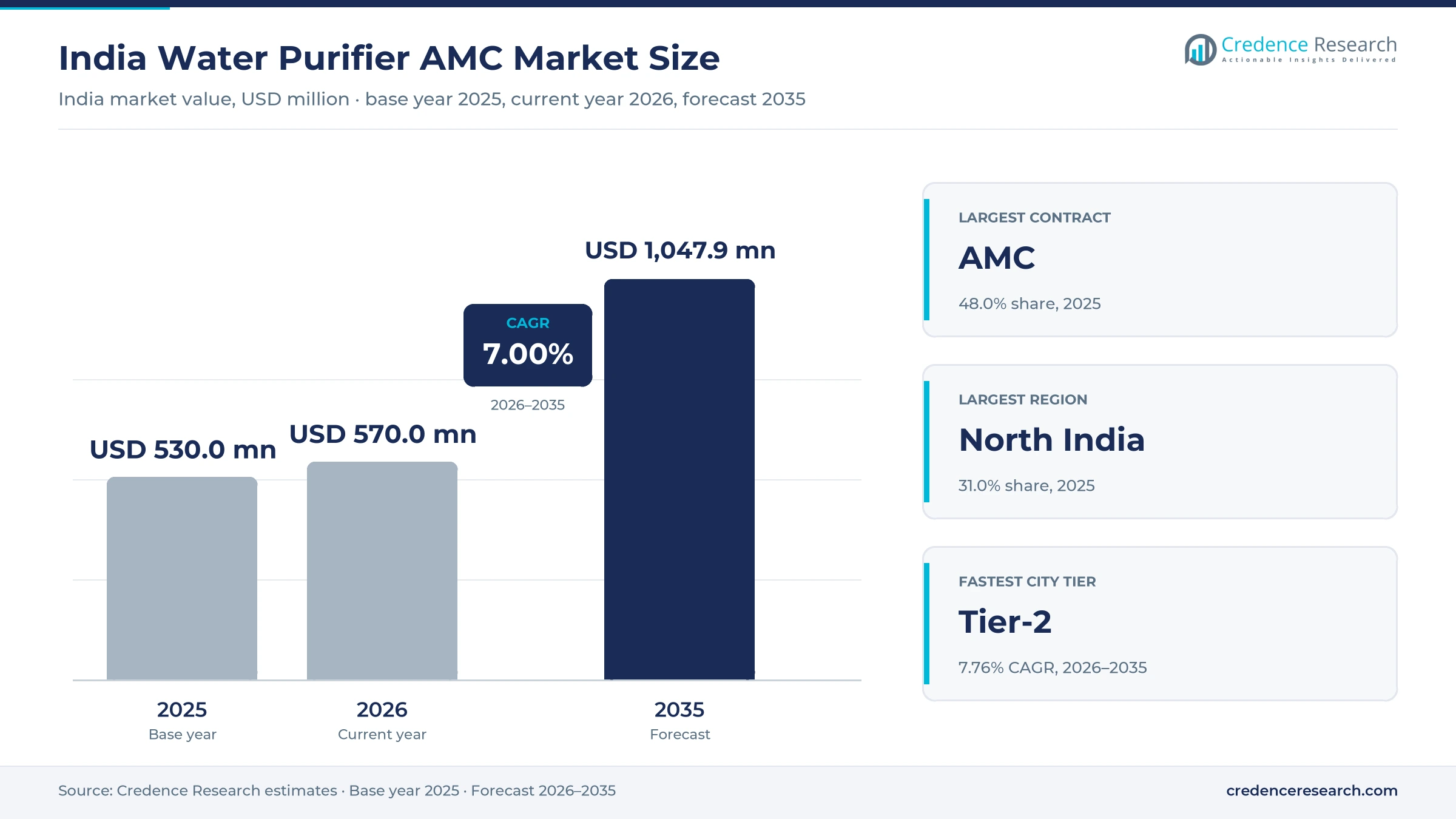
The India water purifier AMC market was valued at USD 530.0 million in 2025 and is projected to increase from USD 570.0 million in 2026 to USD 1.05 billion by 2035, registering a CAGR of 7.00% during 2026–2035. Demand comes from households that pay for annual maintenance contracts, one-off repair and filter visits, and monthly purifier subscriptions sold by brands, franchisees and home-service apps. North India held the largest regional share, 31.0% in 2025, because salinity, fluoride and uranium in Rajasthan, Haryana and Punjab groundwater push owners toward RO units that need frequent filter work. Northeast India is the fastest-growing region at 8.26% a year, starting from a very small base. Contract terms are also changing, since Eureka Forbes launched a four-year unconditional warranty campaign in October 2026 that removes the need for an AMC during that period. Subscriptions keep spreading as well, as Livpure counted about 400,000 subscribers across 26 cities in February 2026.
What do purifier owners pay for after installation?
The market counts fees that households and small offices pay to keep electric RO, UV and RO+UV purifiers running after purchase. It covers annual maintenance contracts sold by brands and service firms, single paid visits for repairs, filter changes and reinstallation, and monthly subscriptions in which the fee bundles the purifier with filters and upkeep.
The market excludes the sale of new purifiers, gravity filters, filters bought over the counter for self-fitting, bottled water and large commercial or industrial treatment plants. Value flows from owners to brands, franchisees and app platforms, which then pay technicians, filter and membrane suppliers and spare-part distributors.
India Water Purifier AMC Market Insights
- Service spend rises from USD 530.0 million in 2025 to USD 1.05 billion by 2035 at a 7.00% CAGR, as millions of RO and UV units need regular filter, membrane and repair work.
- North India held 31.0% of 2025 value, because groundwater in Rajasthan, Haryana, Punjab and Delhi ranks among the most saline in the 2024 CGWB report.
- AMC plans accounted for 48.0% of 2025 value, as Eureka Forbes reported a third straight quarter of double-digit AMC booking growth in late 2025.
- Eureka Forbes promoted a four-year unconditional warranty in October 2026, while Urban Company Native purifiers promise two years without any service visit.
- Livpure had about 400,000 subscribers in 26 cities by February 2026, which shows how bundled subscriptions are taking share from yearly contracts.
RO units and annual contracts lead service spend
Why RO units hold the largest service share
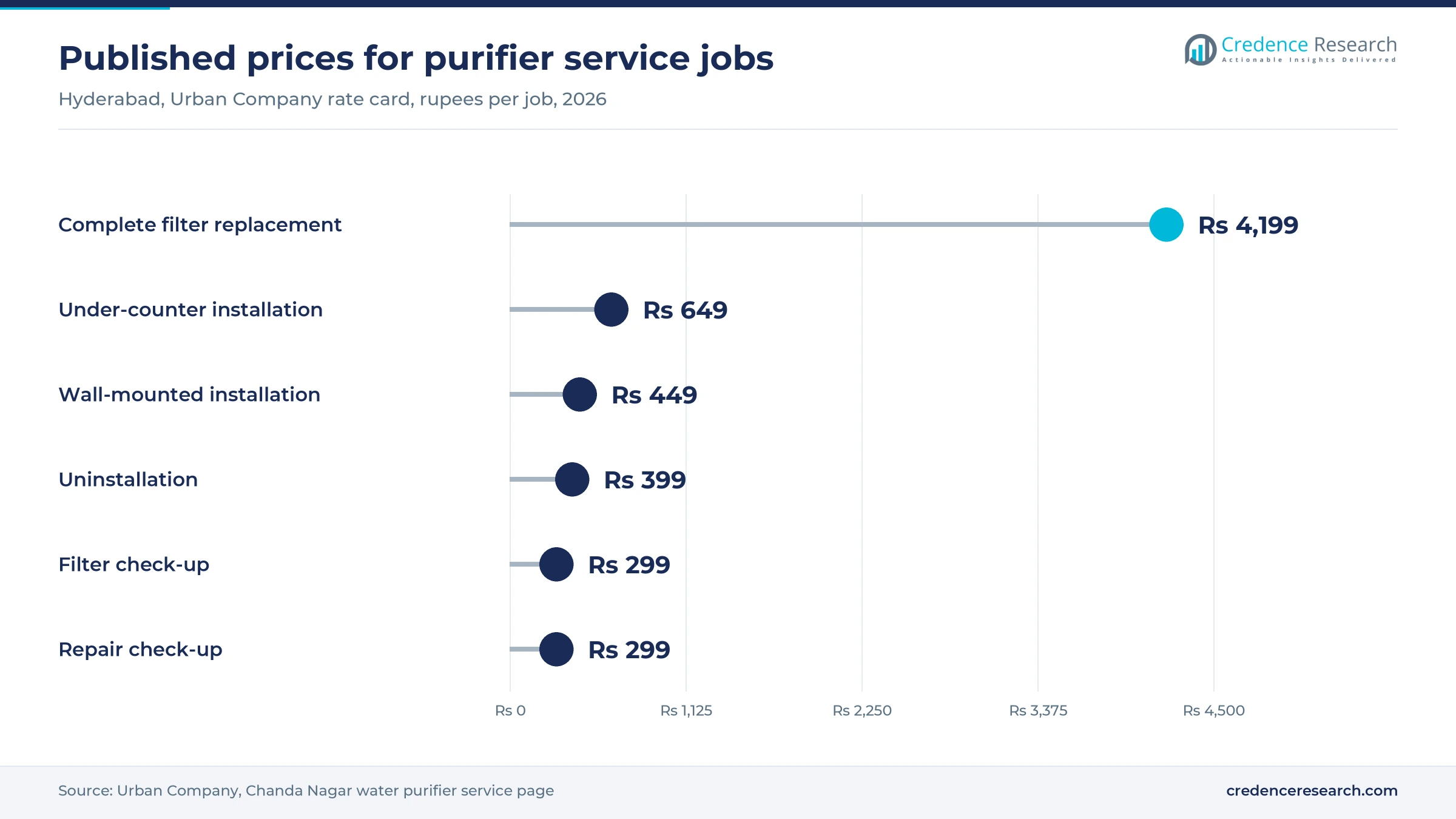
Based on technology, the market is categorized into RO, UV and RO+UV. RO units led with 46.0% of 2025 value because most of the installed base still uses reverse osmosis, and a LocalCircles survey found that 44% of respondents purified drinking water with RO systems. These units need regular membrane and filter work, and Urban Company lists a complete filter replacement at Rs 4,199. RO+UV units grow fastest at 7.85% a year as new models combine both stages, such as the Kent Sapphire launched in June 2026 with RO, UF and UV. UV units suit low-TDS supply, since NGT and CPCB curb RO use below 500 mg/l TDS.
Annual contracts lead as subscriptions grow fastest
Based on contract, the market is categorized into AMC, pay-per-service and filter subscriptions. AMC plans led with 48.0% of 2025 value because brand plans bundle visits, filters and spares, and Eureka Forbes reported a third straight quarter of double-digit AMC booking growth in the December 2025 quarter. Pay-per-service remains common, since Urban Company charges Rs 299 for a repair or filter check-up and Eureka Express Care starts at Rs 349. Filter Subscriptions grow fastest at 8.98% a year as Livpure passed 400,000 subscribers in 26 cities by February 2026 and DrinkPrime served more than 2.5 lakh households.
Metros dominate while tier-2 towns grow faster
Based on city tier, the market is categorized into metro and tier-2. Metro cities led with 64.0% of 2025 value because purifier ownership is concentrated there, and a Deccan Herald survey of 3,101 Bengaluru residents in March 2025 found that 37% used a purifier and 35% relied on RO. Subscription firms also started in large cities, and DrinkPrime operates across eight major metros. Tier-2 cities grow fastest at 7.76% a year as service networks widen, since Eureka Forbes covers more than 19,500 pin codes and Livpure reaches 18,000 pin codes through more than 950 franchisees.
| Segment Group | Leading Sub-segment | Share, 2025 | Fastest-growing Sub-segment | CAGR, 2026–2035 |
|---|---|---|---|---|
| By Technology | RO | 46.0% | RO+UV | 7.85% |
| By Contract | AMC | 48.0% | Filter Subscriptions | 8.98% |
| By City Tier | Metro | 64.0% | Tier-2 | 7.76% |
Request a Free Sample
Fill in your details and we'll send you a free sample report.
- Sample data tables & charts
- Research methodology
Installed units, filter wear and apps lift renewals
Installed purifier base drives recurring contracts
Every electric purifier sold becomes a service account, because RO and UV units need cleaning, filter changes and repairs throughout their working life. Eureka Forbes reports a database of more than 14 million customers, backed by more than 9,000 technicians and about 700,000 customer touch points a month, according to its FY26 annual report. Household use of these machines is already wide, since a LocalCircles survey of more than 22,000 households in 2024 found that 60% used some kind of modern water filtration. Urban Company also said in October 2023 that it had repaired and serviced more than a million water purifiers through its app. Each of these units creates a stream of visits that brands try to lock into annual contracts. In the Credence Research model this adds about 2.59 percentage points to annual growth to 2035.
Filter and membrane wear creates steady service demand
Filters and membranes wear out on a schedule, so replacement work arrives at predictable intervals. Urban Company's water purifier price guide says filters may need replacing every six to 12 months and puts annual RO maintenance at Rs 2,000 to Rs 6,000. Its Hyderabad rate card lists a complete filter replacement at Rs 4,199 and a filter check-up at Rs 299. Contaminated water shortens that cycle, because the Central Ground Water Board found nitrate above the safe limit in about 20% of samples in its 2024 quality report. Livpure launched its 2X Power Filter range in February 2026, rating filters for up to 14,000 liters and pairing them with a Rs 4,990 biennial service plan. In the Credence Research model this adds about 1.89 percentage points to annual growth to 2035.
Branded AMC bundles and service apps lift renewals
Branded contracts and app booking make renewal easier, because owners can compare plans, pay online and track visits without calling a local mechanic. Eureka Forbes sells AMC plans online with discounts of up to 20%, covering one to three maintenance visits a year, filter changes and spare parts based on the plan. Its Express Care visit starts at Rs 349 for owners who prefer to pay per job. Management reported a third straight quarter of double-digit growth in AMC bookings in the December 2025 quarter, according to a Multibagg summary of its results. Urban Company shows a 4.80 rating from 204,000 reviews and 2.4 million bookings on its Hyderabad purifier service page, and the same app also handles air-conditioner servicing jobs. In the Credence Research model this adds about 1.40 percentage points to annual growth to 2035.
Unsafe groundwater keeps households purifying at home
Households keep paying for purification because much of the water reaching homes still falls short of safety norms, even as piped supply expands. World Bank data show that 76.4% of Indians used safely managed drinking water services in 2024, which leaves almost a quarter outside that standard. The Central Ground Water Board tested 15,259 locations for its 2024 report and found fluoride above the limit in 9.04% of samples and arsenic in 3.55%, PTI reported. Piped water alone does not settle trust, since LocalCircles found that only 4% of households received drinking-quality water from local bodies in 2024. The Jal Jeevan Mission had connected about 15 crore rural households by February 2025, and its deadline moved to 2028. Each new tap in a contaminated district adds a household that may need a purifier and its upkeep.
Long-life filters and subscriptions reshape contracts
Shift toward long-life filters and multi-year warranties
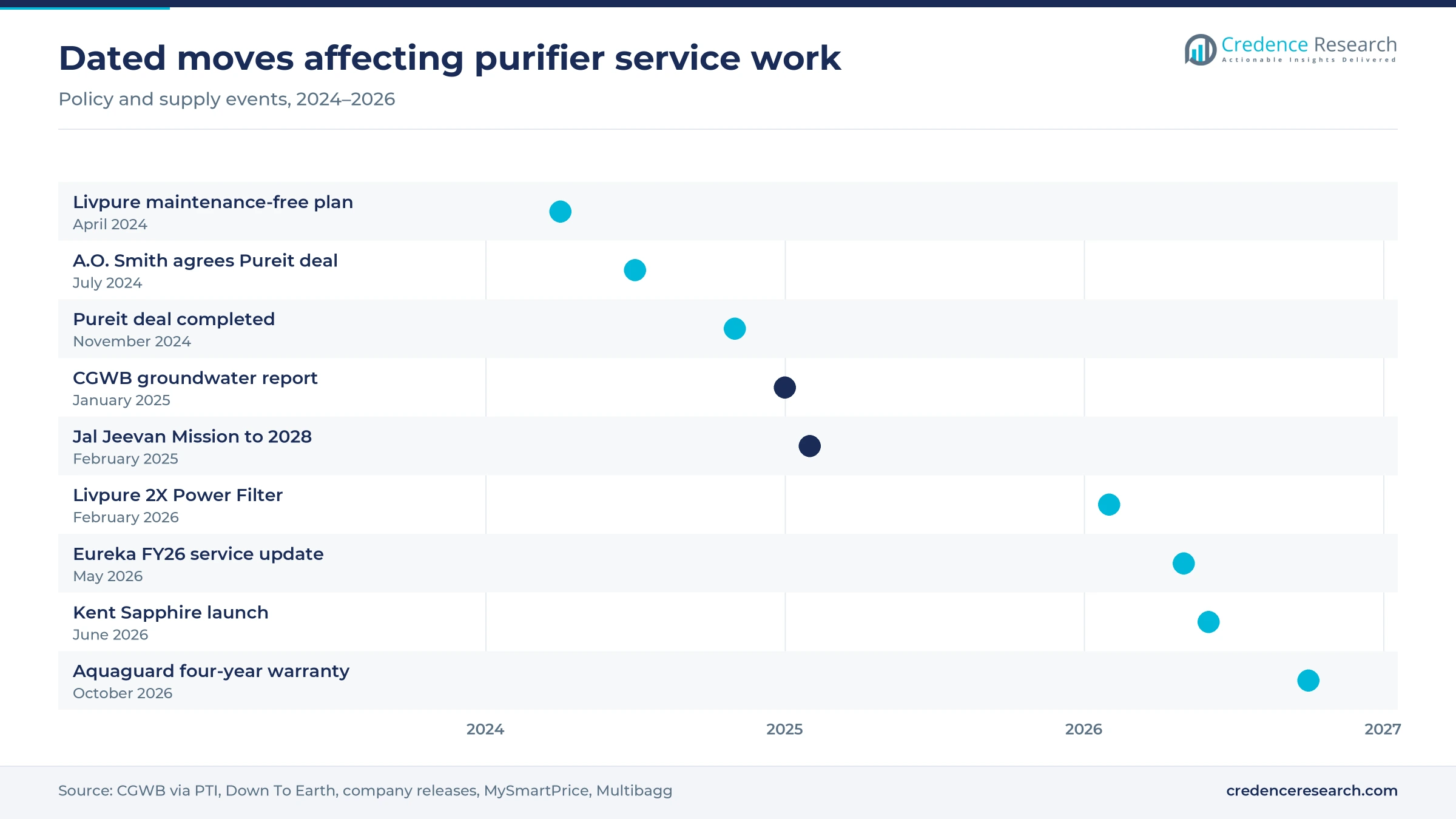
Brands are shifting from yearly filter sales toward long-life cartridges sold with multi-year cover, which changes when paid service begins. Eureka Forbes launched its Four Years Sorted campaign in October 2026 to promote a four-year unconditional warranty that covers filters, spares and service without an AMC purchase. Urban Company launched its Native M1 and M2 purifiers at Rs 13,499 and Rs 17,499, promising no servicing for two years and 12,000 liters without a filter change. Livpure introduced a maintenance-free ownership plan in April 2024 that covers filters and electrical parts for 30 months, according to MySmartPrice. As a result, the first paid contract now often arrives in the third or fifth year of ownership, and it tends to cover more parts when it does.
Rise of water-as-a-service subscriptions in metros
Subscription models are rising as renters and young families choose a monthly fee over buying a purifier and a separate AMC. Livpure had about 400,000 subscribers across 26 cities when it launched its 2X Power Filter range in February 2026, according to Let's Data Science. DrinkPrime serves more than 2.5 lakh households across eight major metros and aims to double that base to 500,000 in 2026, according to a February 2026 profile on Pulse. Its rent-to-own fee covers the purifier, installation, maintenance and relocation, so service value is billed every month instead of once a year. Omidyar Network India said the DrinkPrime subscriber base had grown 330% in a year when it led a Rs 60 crore Series A round. As a result, subscriptions take a growing share of service spend in large cities.
Opening for organized service in tier-2 towns
Tier-2 and smaller towns are an opening for organized providers, because purifier ownership there is low and local mechanics handle most repairs. Livpure puts electric purifier penetration at about 12% in urban India and only about 3% in rural areas. Eureka Forbes says in its FY26 annual report that its service covers more than 19,500 pin codes, and its customer service page lists service centers in more than 800 cities. Livpure covers 18,000 pin codes through more than 950 franchisees and plans about 100 brand outlets by March 2027. LocalCircles drew 30% of its 2024 drinking water survey respondents from tier 2 cities, and it found that the share rating piped water as good fell from 44% in 2023 to 41% in 2024. These networks extend organized service into districts where local mechanics still handle most jobs.
Opening in water-saving membrane upgrades
Water-saving upgrades are an opening, because older RO units waste large volumes in cities that face supply shortages. Down To Earth reported in March 2024 that an average RO purifier wastes about 3 liters for every liter it purifies, while Bengaluru needed 2,600 million liters a day during its supply crisis. Livpure says its high-recovery membranes recover 70% of input water, against a 40% recovery floor that the company cites from BIS. The environment ministry's February 2020 draft rules proposed raising required recovery to 60%, Down To Earth reported. Kent launched its Sapphire purifier in June 2026 with a display that shows filter life and mineral levels, which helps technicians schedule timely visits. Service providers can therefore sell membrane retrofits and recovery checks as paid add-ons within contracts.
Bundled warranties and local mechanics squeeze contracts
Multi-year warranties delay paid contract sales
Long bundled warranties delay the first paid contract, which slows renewal revenue for brands and independent technicians alike. Eureka Forbes said in October 2026 that its four-year unconditional warranty removes the need to buy an AMC during that period. Urban Company's Native range promises two years without service, and Livpure's maintenance-free plan launched in April 2024 runs for 30 months. Service providers therefore wait longer to earn from each new unit. Brands can recover value by pricing post-warranty renewals early and adding membrane upgrades.
Local mechanics undercut brand contract prices
Unorganized technicians undercut brand plans, which puts steady pressure on contract pricing and renewal rates. RO Care India lists basic RO maintenance plans from Rs 999 a year, with filter and membrane cover at Rs 2,500. Kent said in May 2018 that it offered free service to steer buyers away from cheap local providers whose parts and filters can damage purifiers. Owners who switch often lose genuine spares and warranty cover. Brands answer with menu prices, online discounts and app-tracked visits.
Low ownership limits the serviceable base
Low ownership limits the base that service networks can address, especially outside large cities. Livpure estimates electric purifier penetration at about 6% nationally and about 3% in rural India, while NewsX reported a company estimate of 7–8% of households. Many homes still boil water, and 11% of LocalCircles respondents said they relied on boiling. Service providers therefore depend on new unit sales, which track wider consumer appliance spending, to grow the contract pool over time.
RO water waste invites tighter regulation
RO water waste invites regulation that could raise compliance costs for makers and service providers. The National Green Tribunal ordered curbs on RO use in May 2019 where supply already meets standards, and the environment ministry issued draft rules on Feb. 3, 2020. Once final, BIS certification under IS 16240 becomes mandatory, Down To Earth reported, while the NGT sought a ban where TDS is below 500 mg/l. Technicians would then need to test water before installation, and providers that offer recovery upgrades are better placed.
Hard groundwater in the north keeps membranes busy
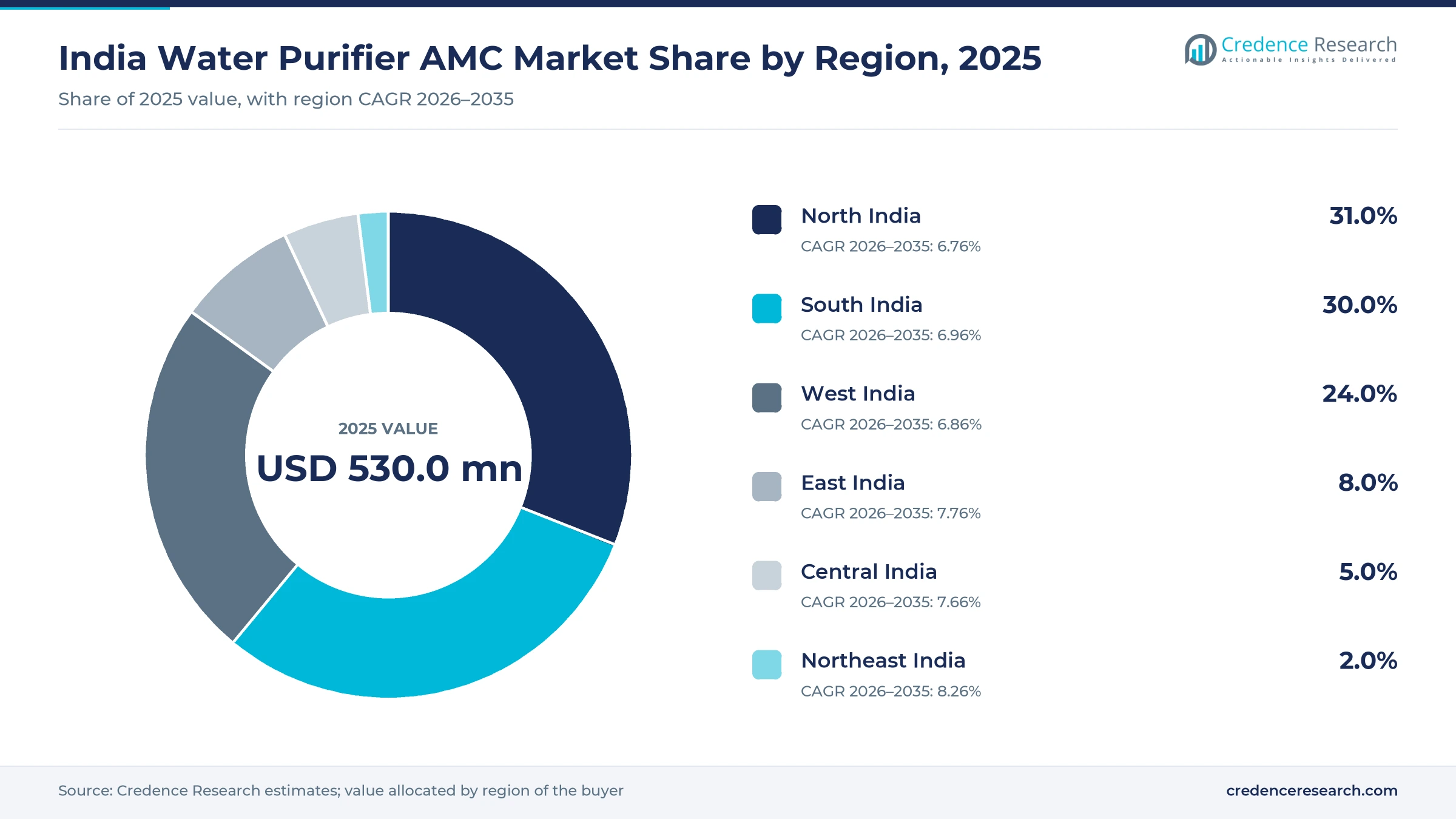
| Region | Value, 2025 (USD million) | Share, 2025 | CAGR, 2026–2035 |
|---|---|---|---|
| North India | 164.3 | 31.0% | 6.76% |
| South India | 159.0 | 30.0% | 6.96% |
| West India | 127.2 | 24.0% | 6.86% |
| East India | 42.4 | 8.0% | 7.76% |
| Central India | 26.5 | 5.0% | 7.66% |
| Northeast India | 10.6 | 2.0% | 8.26% |
North India leads on saline and uranium-heavy groundwater
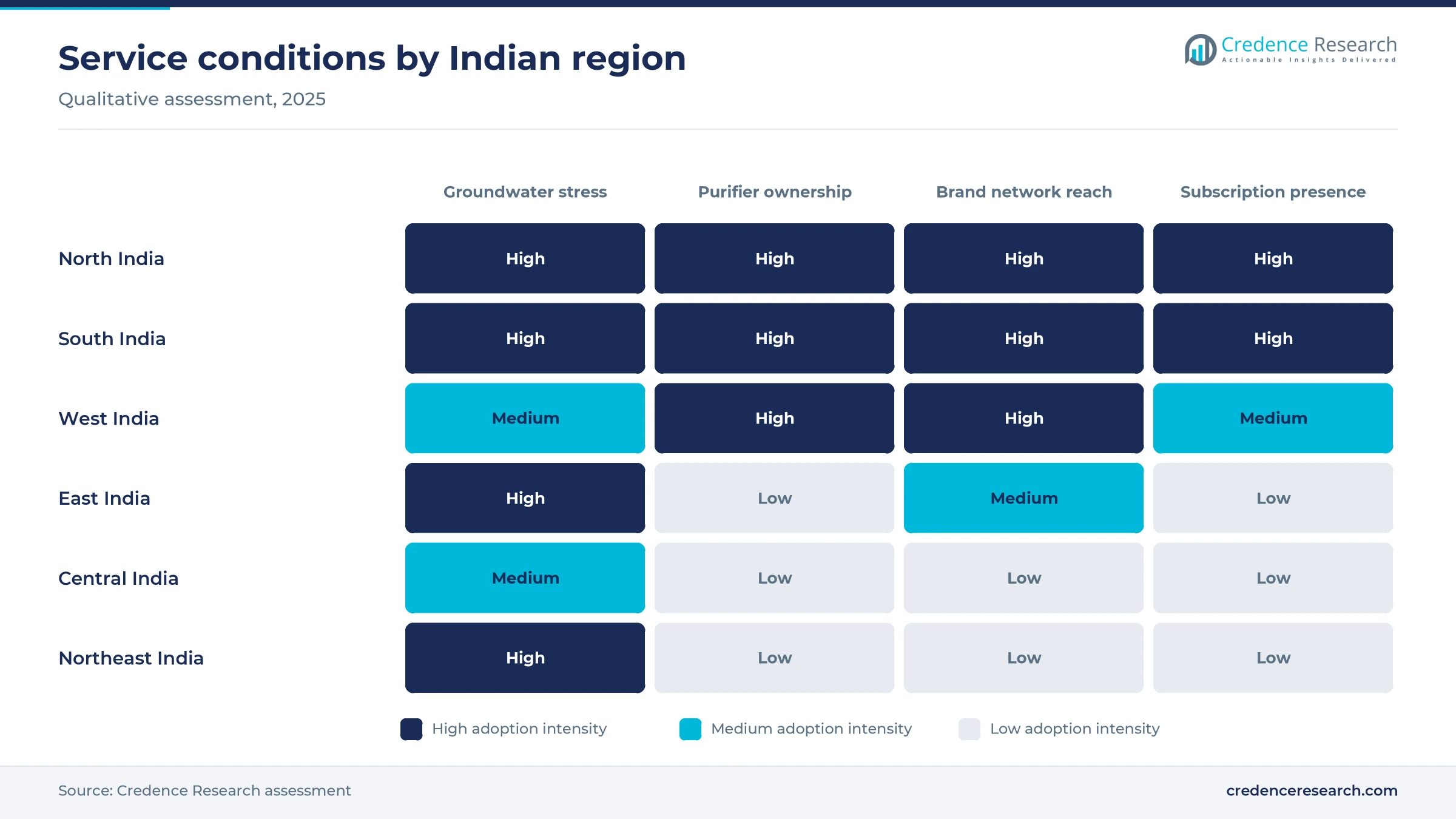
North India held 31.0% of 2025 value and grows at 6.76% a year, the largest zone in the India water purifier AMC market. Groundwater in the zone is hard on membranes, since the Central Ground Water Board ranked Rajasthan, Delhi, Haryana and Punjab among the states worst affected by salinity in its 2024 report. Rajasthan and Punjab also held the largest share of samples with uranium above 100 ppb, at 42% and 30%. These conditions shorten filter life and raise the value of RO contracts in Delhi-NCR, Jaipur and Chandigarh.
South India runs close on nitrate and city shortages
South India held 30.0% of 2025 value and grows at 6.96% a year, close behind the largest zone. Karnataka and Tamil Nadu each had more than 40% of groundwater samples above the nitrate limit in the 2024 CGWB report, while Telangana reached 27.48% and Andhra Pradesh 23.5%. Bengaluru's 2024 supply crisis pushed residents toward tankers and borewells, and a March 2025 Deccan Herald survey found that 35% of residents relied on RO systems. Subscription firms such as DrinkPrime also serve Bengaluru and Hyderabad, according to Omidyar Network India.
West India relies on dense metro apartment demand
West India held 24.0% of 2025 value and grows at 6.86% a year, led by Mumbai, Pune and Ahmedabad. Maharashtra had a 35.74% share of groundwater samples above the nitrate limit in the 2024 CGWB report, and Gujarat was among the states most affected by salinity. Uranium above 30 ppb also clustered in stressed zones of Gujarat, which favors RO units with regular membrane checks. Dense apartment stock in these cities suits app booking and contract renewals, which both brand networks and Urban Company offer.
East India grows on arsenic risk and new installs
East India held 8.0% of 2025 value and grows at 7.76% a year, faster than the national pace. Arsenic above 10 ppb was found in groundwater in West Bengal, Jharkhand and Bihar, according to the 2024 CGWB report, which raises the need for tested and well-maintained purifiers. Ownership remains lower than in western and southern cities, so each new installation in Kolkata, Patna or Bhubaneswar adds a first service account. Brand networks that reach smaller districts, such as the 19,500 pin codes Eureka Forbes cites, are best placed here.
Central India depends on local mechanics
Central India held 5.0% of 2025 value and grows at 7.66% a year from a small base. Madhya Pradesh had a 22.58% share of groundwater samples above the nitrate limit in the 2024 CGWB report, and arsenic was found in Rajnandgaon district in Chhattisgarh. Most service work in Indore, Bhopal and Raipur still goes to local mechanics, and organized coverage grows as franchise networks expand. Livpure's plan to reach about 100 brand outlets by March 2027 points to the retail and service presence these cities lack.
Northeast India grows fastest on iron-heavy water
Northeast India held 2.0% of 2025 value and grows at 8.26% a year, the fastest pace in the model. Iron is the main problem there, since CGWB data reported by The Sentinel showed concentrations of up to 14.92 mg/l in Assam against a 0.3 mg/l limit. Arsenic of 0.1467 mg/l was also recorded at Tipamia in Jorhat district. Iron fouls pre-filters quickly, so owners in Guwahati and nearby towns need frequent cartridge changes once they buy a purifier.
Brand, deal and product moves from 2024 to 2026
| Development | Status and market relevance |
|---|---|
| In April 2024, Livpure introduced a maintenance-free ownership plan covering filters and electrical parts for 30 months. | Launched, shifts upkeep into the sale |
| In November 2024, A.O. Smith completed its acquisition of the Pureit business in India from Hindustan Unilever. | Completed, adds a large owner base to A.O. Smith |
| In February 2026, Livpure launched its 2X Power Filter range with a Rs 4,990 biennial service plan. | Launched, stretches filter intervals |
| In June 2026, Kent launched the Sapphire RO purifier with a display showing filter life and mineral levels. | Launched, supports timely service visits |
| In October 2026, Eureka Forbes launched its Four Years Sorted campaign for a four-year unconditional Aquaguard warranty. | Running, delays paid AMC purchases |
Cartridges, membranes and displays set visit timing
- Multi-stage RO+UV cartridges combine sediment, carbon, membrane and UV stages, so a full replacement visit costs Rs 4,199 on the Urban Company rate card.
- High-recovery membranes recover up to 70% of input water in Livpure units, and they draw on the wider reverse osmosis membrane supply base for upgrades.
- Filter-life displays show remaining cartridge life, tank level and mineral levels on models such as the Kent Sapphire launched in June 2026.
- Long-life filters are rated for 12,000 to 14,000 liters in the Native and Livpure 2X ranges, which stretches the gap between paid visits.
Need a Custom Version of This Report?
Tailor the scope, geography, or segments to your exact requirements.
- Custom geography or segment scope
- Direct access to our analyst team
Brand networks, apps and franchisees chase renewals
The India water purifier AMC market is split between brand service networks, subscription companies, app platforms and thousands of local mechanics. Eureka Forbes runs the widest brand network, with more than 9,000 technicians across more than 19,500 pin codes, and it sells AMC plans online and through its own staff. Kent RO backs its RO range with a national after-sales network and has used free-service offers to keep owners away from non-genuine parts. Pureit moved to AO Smith in November 2024, which placed a large owner base under a water heater and purifier maker. Livpure and DrinkPrime compete on monthly subscriptions that bundle the purifier with filters and visits. Urban Company sells menu-priced visits from Rs 299 and its own Native purifiers, which follow the same app-led model as household RO and UV unit sales. Competition increasingly turns on post-warranty renewal offers and filter pricing.
Companies profiled and their roles in this market
| Company | Type | Role in the market |
|---|---|---|
| Eureka Forbes (Aquaguard) | Brand service network | Sells AMC plans and Express Care visits through more than 9,000 technicians |
| Kent RO | Brand service network | Backs RO purifiers with national after-sales support and launched the Sapphire in June 2026 |
| Livpure | Brand and subscription provider | Serves about 400,000 subscribers across 26 cities |
| Pureit (A.O. Smith) | Brand service network | Services Pureit purifiers under A.O. Smith ownership since November 2024 |
| Urban Company | Service aggregator | Books filter changes, repairs and installations and sells Native purifiers |
Post-warranty renewals will decide service winners
Credence Research's view is that the India water purifier AMC market will reward providers that win the first renewal after long warranties end. The installed base keeps growing, and contaminated groundwater in the north and south keeps filters and membranes under strain. However, four-year and 30-month bundles push paid contracts later, while local mechanics keep basic plan prices near Rs 1,000. Subscriptions are the clearest growth line, because they bill service every month. Brands with dense technician coverage in tier-2 towns and fair renewal pricing are best placed to hold owners after the warranty period. In the Credence Research model, the India water purifier AMC market grows at 7.00% a year from 2026 to 2035.
How the installed-base service model was built
The report uses 2025 as the base year and forecasts to 2035. Market values come from the Credence Research model, checked against the installed base of electric purifiers multiplied by paid service frequency and published visit, filter and contract prices. Segment and regional splits are Credence Research estimates informed by ownership surveys, groundwater quality data, brand network coverage and subscription counts. Sources used include government and statistical data, regulatory notices, published owner surveys, trade press and company announcements. No interviews or surveys were conducted in preparing this report.
A larger purifier base keeps service spend rising
India water purifier AMC revenue is forecast to reach USD 1.05 billion by 2035, with a larger installed base and persistent groundwater contamination doing most of the work. North India should remain the largest region, while Northeast India and East India grow faster as first-time ownership spreads. Filter subscriptions are expected to grow at 8.98% a year, while annual contracts remain the largest payment model. Long-life filters will stretch visit intervals, but each contract should carry more value. Providers that serve tier-2 towns are likely to capture most renewals, and tier-2 demand should benefit as more than 950 Livpure franchisees extend coverage.
Frequently Asked Questions
How big is the India water purifier AMC market?
Which region leads the market?
Which contract type is largest?
How much does purifier upkeep cost?
Why do filter subscriptions grow fastest?
How do long warranties affect the market?
Which companies are active in the market?
What is the biggest risk for the market?
Table of Content
Chapter 1 Market Segmentation
- 1.1 Segmentation Framework
- 1.1.1 Product and Service Classification
- 1.1.2 Application and End-Use Classification
- 1.1.3 Technology and Solution Classification
- 1.1.4 Customer and Distribution Channel Classification
- 1.1.5 Geographic Segmentation
- 1.1.6 Market Segment Definitions and Boundaries
- 1.2 By Technology
- 1.2.1 RO
- 1.2.2 RO+UV
- 1.2.3 UV
- 1.3 By Contract
- 1.3.1 AMC
- 1.3.2 Pay-Per-Service
- 1.3.3 Filter Subscriptions
- 1.4 By City Tier
- 1.4.1 Metro
- 1.4.2 Tier-2
Chapter 2 Introduction
- 2.1 Report Objectives and Scope
- 2.2 Product Definition and Industry Terminology
- 2.3 Market Inclusions and Exclusions
- 2.4 Research Process
- 2.4.1 Primary Research and Expert Interviews
- 2.4.2 Secondary Research and Source Review
- 2.4.3 Top-Down and Bottom-Up Estimation
- 2.4.4 Data Triangulation and Verification
- 2.5 Market Size Measurement Basis
- 2.5.1 2025: USD 530.0 million → 2035: USD 1.05 billion
- 2.6 Historical and Forecast Reference Periods
- 2.6.1 Historical Period: 2018-2025
- 2.6.2 Base Year: 2025
- 2.6.3 Forecast Period: 2025-2035
- 2.7 Research Assumptions and Limitations
Chapter 3 Executive Summary
- 3.1 Market Snapshot and Key Findings
- 3.2 Base-Year Market Size, 2025
- 3.3 Forecast Market Size, 2035
- 3.4 Revenue and Volume Growth Outlook
- 3.5 Key Demand and Supply Indicators
- 3.6 Leading Market Segments
- 3.7 Fastest-Growing Market Opportunities
- 3.8 Regional Performance Highlights
- 3.9 Technology and Industry Transformation
- 3.10 Competitive Landscape Summary
- 3.11 Analyst View and Strategic Implications
Chapter 4 India Water Purifier AMC Market Trends and Developments
- 4.1 Historical Industry Development, 2018-2025
- 4.2 Recent Market Trends and Developments
- 4.3 Demand and Customer Behavior Trends
- 4.4 Technology and Product Innovation
- 4.5 Artificial Intelligence, Automation and Digitalization
- 4.6 Local Manufacturing and Supply Chain Realignment
- 4.7 Industry Partnerships, Mergers and Acquisitions
- 4.8 Sustainability and Circular Economy Developments
- 4.9 Government and Private Sector Investment Trends
- 4.10 Emerging Business Models and Commercialization
- 4.11 Industry Developments and Announcements
Chapter 5 India Water Purifier AMC Market Production, Supply and Demand Analysis
- 5.1 Demand Trend and Consumption Analysis, 2018-2025
- 5.2 Demand Forecast, 2025-2035
- 5.3 Production and Output Trend, 2018-2025
- 5.4 Production and Output Forecast, 2025-2035
- 5.5 Installed Capacity and Capacity Utilization
- 5.6 Company-Wise Production Plants and Statistics
- 5.6.1 Installed Production Capacity
- 5.6.2 Actual Production
- 5.6.3 Planned Capacity and Expansion Targets
- 5.7 Supply Chain Structure and Procurement Trends
- 5.8 Supply-Demand Gap and Bottlenecks
- 5.9 Import Dependence and Sourcing Structure
- 5.10 Contract Manufacturing and Outsourcing
- 5.11 Regional Supply and Demand Concentration
Chapter 6 India Water Purifier AMC Market Pricing Analysis
- 6.1 Pricing Structure and Measurement
- 6.2 Historical Pricing Trends, 2018-2025
- 6.3 Pricing Outlook, 2025-2035
- 6.4 Average Selling Price and Unit Economics
- 6.5 Pricing by Product and Market Segment
- 6.6 Geographic Pricing Differences
- 6.7 Key Input, Energy, Labor and Logistics Costs
- 6.8 Contract Pricing and Purchasing Models
- 6.9 Pricing Sensitivity and Competitive Positioning
- 6.10 Price, Margin and Profitability Implications
Chapter 7 India Water Purifier AMC Market Dynamics
- 7.1 Market Growth Drivers
- 7.1.1 Demand-Side Drivers
- 7.1.2 Technology and Innovation Drivers
- 7.1.3 Infrastructure and Investment Drivers
- 7.1.4 Regulatory and Policy Drivers
- 7.2 Market Restraints
- 7.2.1 Cost and Affordability Constraints
- 7.2.2 Technology and Adoption Barriers
- 7.2.3 Supply Chain and Operational Constraints
- 7.3 Market Challenges
- 7.3.1 Competitive Pressure and Margin Erosion
- 7.3.2 Skills, Infrastructure and Implementation Gaps
- 7.4 Emerging Market Opportunities
- 7.5 Market Dynamics Impact and Time-Horizon Assessment
Chapter 8 India Water Purifier AMC Value Chain Analysis
- 8.1 Industry Value Chain Overview
- 8.2 Upstream Suppliers and Critical Inputs
- 8.3 Technology and Component Providers
- 8.4 Manufacturing or Service Delivery
- 8.5 Distribution, Channel Partners and Integrators
- 8.6 Downstream Applications and End Users
- 8.7 Value Addition and Profit Pools
- 8.8 Vertical Integration and Outsourcing
- 8.9 Supplier Concentration and Risk
- 8.10 Supply Chain Localization and Resilience
Chapter 9 India Water Purifier AMC Market Regulations and Policies
- 9.1 Relevant Laws, Standards and Compliance Frameworks
- 9.2 Product, Service, Safety and Quality Requirements
- 9.3 Government Policies, Incentives and Subsidies
- 9.4 Imports, Exports and Trade Barriers
- 9.5 Public Procurement and Local Content Requirements
- 9.6 Environmental and Sustainability Compliance
- 9.7 Upcoming Policy Changes and Market Implications
Chapter 10 India Water Purifier AMC Market Hotspots and Opportunities
- 10.1 Market Opportunity Mapping and Growth Hotspots
- 10.2 High-Growth Applications and Customer Groups
- 10.3 Underserved Markets and White-Space Opportunities
- 10.4 Emerging Technology and Product Opportunities
- 10.5 New Capacity and Investment Hotspots
- 10.6 Market Entry and Expansion Opportunities
- 10.7 Distribution and Partnership Opportunities
- 10.8 Near-Term and Long-Term Commercial Potential
- 10.9 Opportunity Attractiveness and Execution Risks
Chapter 11 India Water Purifier AMC Market Outlook, 2025-2035
- 11.1 Market Size and Analysis
- 11.1.1 Revenue (Market Measurement: 2025: USD 530.0 million → 2035: USD 1.05 billion)
- 11.1.2 Market Volume and Quantity Sold
- 11.1.3 Historical Market Size, 2018-2025
- 11.1.4 Base-Year Market Size, 2025
- 11.2 Market Forecast, 2025-2035
- 11.2.1 Revenue Forecast to 2035
- 11.2.2 Volume Forecast to 2035
- 11.2.3 CAGR and Year-on-Year Growth
- 11.2.4 Incremental Revenue Opportunity
- 11.3 Forecast Assumptions and Scenario Analysis
- 11.3.1 Base-Case Forecast
- 11.3.2 Optimistic and Conservative Scenarios
- 11.3.3 Technology, Pricing and Policy Sensitivities
- 11.4 Market Attractiveness and Growth Outlook
Chapter 12 India Water Purifier AMC Market Segmentation and Outlook
- 12.1 Segmentation Summary and Market Shares, 2025
- 12.2 Largest and Fastest-Growing Segments
- 12.3 By Technology - Market Size and Forecast, 2025-2035
- 12.3.1 Segment Definition and Scope
- 12.3.2 Historical Market Size, 2018-2025
- 12.3.3 Revenue Forecast, 2025-2035
- 12.3.4 Volume Forecast, 2025-2035
- 12.3.5 Base-Year Market Share, 2025
- 12.3.6 Segment CAGR and Growth Drivers
- 12.3.7 Subsegment Market Size and Forecast
- 12.3.7.1 RO
- 12.3.7.2 RO+UV
- 12.3.7.3 UV
- 12.3.8 Subsegment Pricing and Adoption Trends
- 12.3.9 Leading Suppliers and Competition
- 12.3.10 Regional Demand and Opportunities
- 12.4 By Contract - Market Size and Forecast, 2025-2035
- 12.4.1 Segment Definition and Scope
- 12.4.2 Historical Market Size, 2018-2025
- 12.4.3 Revenue Forecast, 2025-2035
- 12.4.4 Volume Forecast, 2025-2035
- 12.4.5 Base-Year Market Share, 2025
- 12.4.6 Segment CAGR and Growth Drivers
- 12.4.7 Subsegment Market Size and Forecast
- 12.4.7.1 AMC
- 12.4.7.2 Pay-Per-Service
- 12.4.7.3 Filter Subscriptions
- 12.4.8 Subsegment Pricing and Adoption Trends
- 12.4.9 Leading Suppliers and Competition
- 12.4.10 Regional Demand and Opportunities
- 12.5 By City Tier - Market Size and Forecast, 2025-2035
- 12.5.1 Segment Definition and Scope
- 12.5.2 Historical Market Size, 2018-2025
- 12.5.3 Revenue Forecast, 2025-2035
- 12.5.4 Volume Forecast, 2025-2035
- 12.5.5 Base-Year Market Share, 2025
- 12.5.6 Segment CAGR and Growth Drivers
- 12.5.7 Subsegment Market Size and Forecast
- 12.5.7.1 Metro
- 12.5.7.2 Tier-2
- 12.5.8 Subsegment Pricing and Adoption Trends
- 12.5.9 Leading Suppliers and Competition
- 12.5.10 Regional Demand and Opportunities
- 12.6 Segment Growth Comparison
- 12.7 Segment Attractiveness and Priority Matrix
Chapter 13 India Water Purifier AMC Geographic Market Outlook, 2025-2035
- 13.1 Domestic Market Distribution and Demand Clusters
- 13.2 State- or Province-Wise Market Size and Forecast, 2025-2035
- 13.3 City and Metropolitan Market Outlook
- 13.4 Industrial, Manufacturing and Commercial Clusters
- 13.5 Geographic Concentration of Key End Users
- 13.6 Local Pricing and Purchasing Differences
- 13.7 Domestic Production Facilities and Capacity Map
- 13.8 Local Infrastructure and Project Pipeline
- 13.9 State-Level Policy and Incentive Differences
- 13.10 Subnational Investment Hotspots and Opportunities
- 13.11 Distribution and Logistics Networks
- 13.12 Domestic Competitive Footprint
Chapter 14 India Water Purifier AMC Technology, Innovation and Sustainability Outlook
- 14.1 Technology Landscape and Maturity
- 14.2 Product, Process and Service Innovation
- 14.3 AI, Automation and Digital Tools in the Industry
- 14.4 Technology Adoption and Performance Benchmarking
- 14.5 Innovation Pipeline and R&D Investment
- 14.6 Patent and Intellectual Property Trends
- 14.7 Energy Efficiency and Resource Management
- 14.8 Sustainability, Recycling and Circularity
- 14.9 Technology Roadmap, 2025-2035
- 14.10 Risks of Obsolescence and Technology Substitution
Chapter 15 India Water Purifier AMC Market Key Strategic Imperatives
- 15.1 Growth and Market Entry Priorities
- 15.2 High-Return Products and Segments
- 15.3 Pricing, Profitability and Cost Optimization
- 15.4 Technology Investment and Product Differentiation
- 15.5 Supply Chain Localization and Resilience
- 15.6 Distribution and Customer Acquisition
- 15.7 Partnership, Acquisition and Capacity Strategy
- 15.8 Regional Expansion Priorities
- 15.9 Short-, Medium- and Long-Term Actions
Chapter 16 Competition Outlook
- 16.1 Industry Competition Characteristics
- 16.2 Market Structure and Concentration
- 16.3 Market Share and Competitive Positioning, 2025
- 16.4 Company-Wise Revenue and Product Benchmarking
- 16.5 Production and Service Capacity Benchmarking
- 16.6 Technology, Pricing and Differentiation
- 16.7 Regional Footprint and Distribution Strength
- 16.8 Mergers, Acquisitions and Strategic Alliances
- 16.9 New Entrants and Competitive Threats
- 16.10 Porter's Five Forces and Industry Attractiveness
- 16.11 Competitive Outlook, 2025-2035
Chapter 17 Company Profiles
- 17.1 Company Coverage and Selection Criteria
- 17.2 Eureka Forbes (Aquaguard)
- 17.2.1 Business Description
- 17.2.2 Company Ownership and Geographic Presence
- 17.2.3 Product and Service Portfolio
- 17.2.4 Manufacturing and Operating Footprint
- 17.2.5 Production Capacity and Expansion Plans
- 17.2.6 Financial Performance and Investment
- 17.2.7 Market Share and Competitive Position
- 17.2.8 Technology and Innovation Capabilities
- 17.2.9 Strategic Alliances or Partnerships
- 17.2.10 Recent Developments
- 17.2.11 Growth Strategy and Outlook
- 17.3 Kent RO
- 17.4 Livpure
- 17.5 Pureit (A.O. Smith)
- 17.6 Urban Company
- 17.7 Other Relevant Market Participants
Note: Every listed company is profiled on the structure shown under the first company. The company list is preliminary and may change based on research findings, market developments, data availability and client requirements.
Chapter 18 Disclaimer
- 18.1 Research and Forecast Disclaimer
- 18.2 Data Source and Estimation Limitations
Note: The depth of individual sections depends on data availability for this market. Volume, capacity, trade and other unit-based metrics are included where applicable.

