
Low-priced pens and school pencils set the volume base
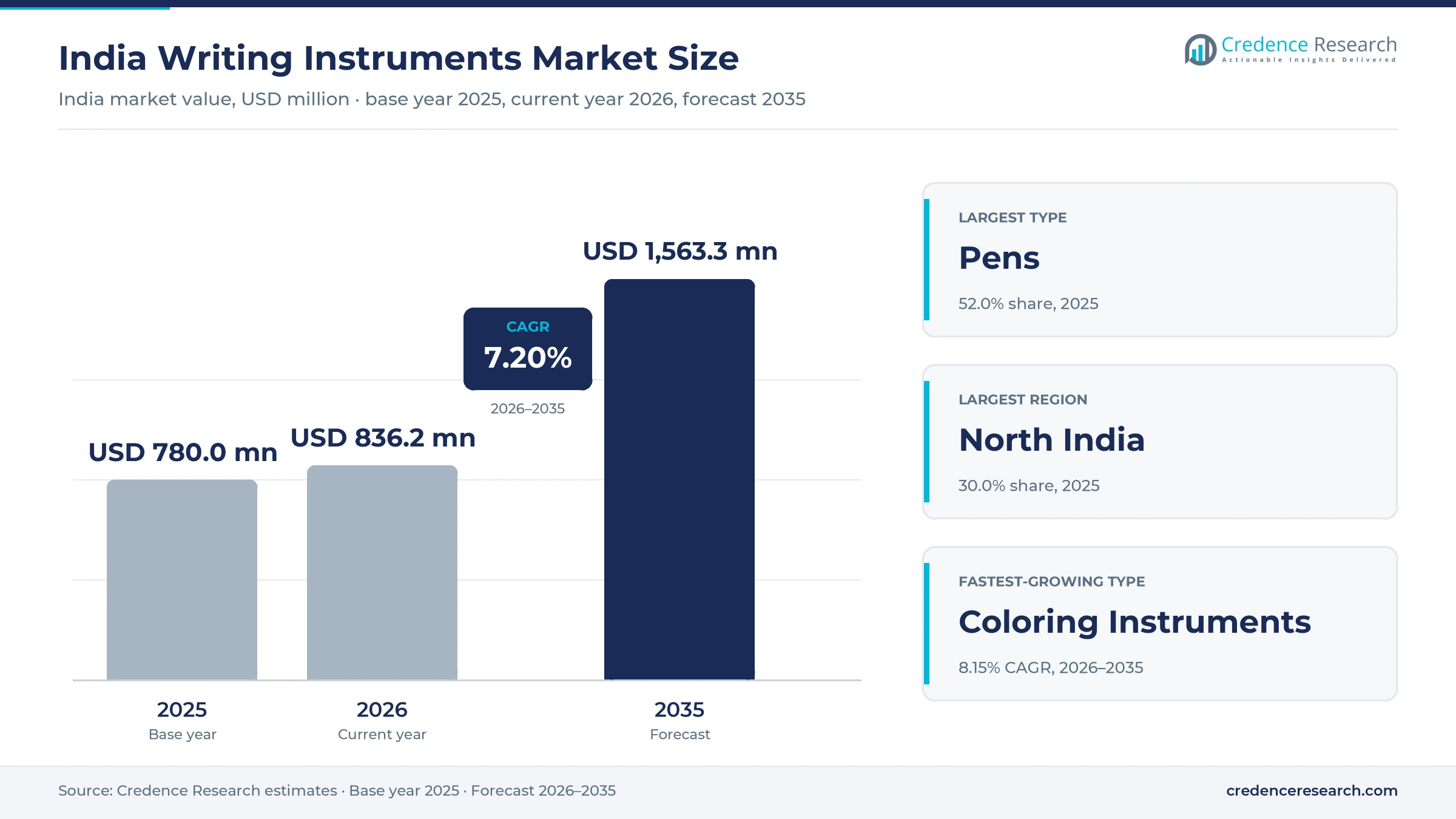
The India writing instruments market was valued at USD 780.0 million in 2025 and is projected to increase from USD 836.2 million in 2026 to USD 1.56 billion by 2035, registering a CAGR of 7.20% during 2026–2035. Demand comes from about 24.68 crore school students, office users and institutional buyers who purchase pens, pencils, color sets and markers mostly through neighborhood stationery shops. North India held the largest regional share, 30.0% in 2025, because Uttar Pradesh alone enrolled 4.28 crore students in 2024-25, the largest state count in the national school census. East India is the fastest-growing region at 7.78% a year, supported by a large Bihar student base and the strong eastern reach of Kolkata-based Linc. India cut GST on pencils, sharpeners and crayons to zero from Sept. 22, 2025, while pens stayed in the 18% slab, which widens the price gap between the two largest product groups.
Which pens, pencils and color products are counted here?
The market counts domestic sales of ballpoint, gel and fountain pens, wooden and mechanical pencils, crayons, color pencils and sketch pens, highlighters and markers, plus refills and similar items. Buyers include students and parents, offices and professionals, and schools or government programs that buy in bulk for classrooms and exams.
The market excludes exports made by Indian factories, notebooks and other paper stationery, art canvases and digital styluses for tablets. Value moves from resin, ink, tip and slat suppliers to brand owners and contract makers, then through distributors, wholesalers and neighborhood retail counters to the final buyer.
India Writing Instruments Market Insights
- Market value rises from USD 780.0 million in 2025 to USD 1.56 billion by 2035 at a 7.20% CAGR, as organized brands win share from local makers and add plants in Gujarat.
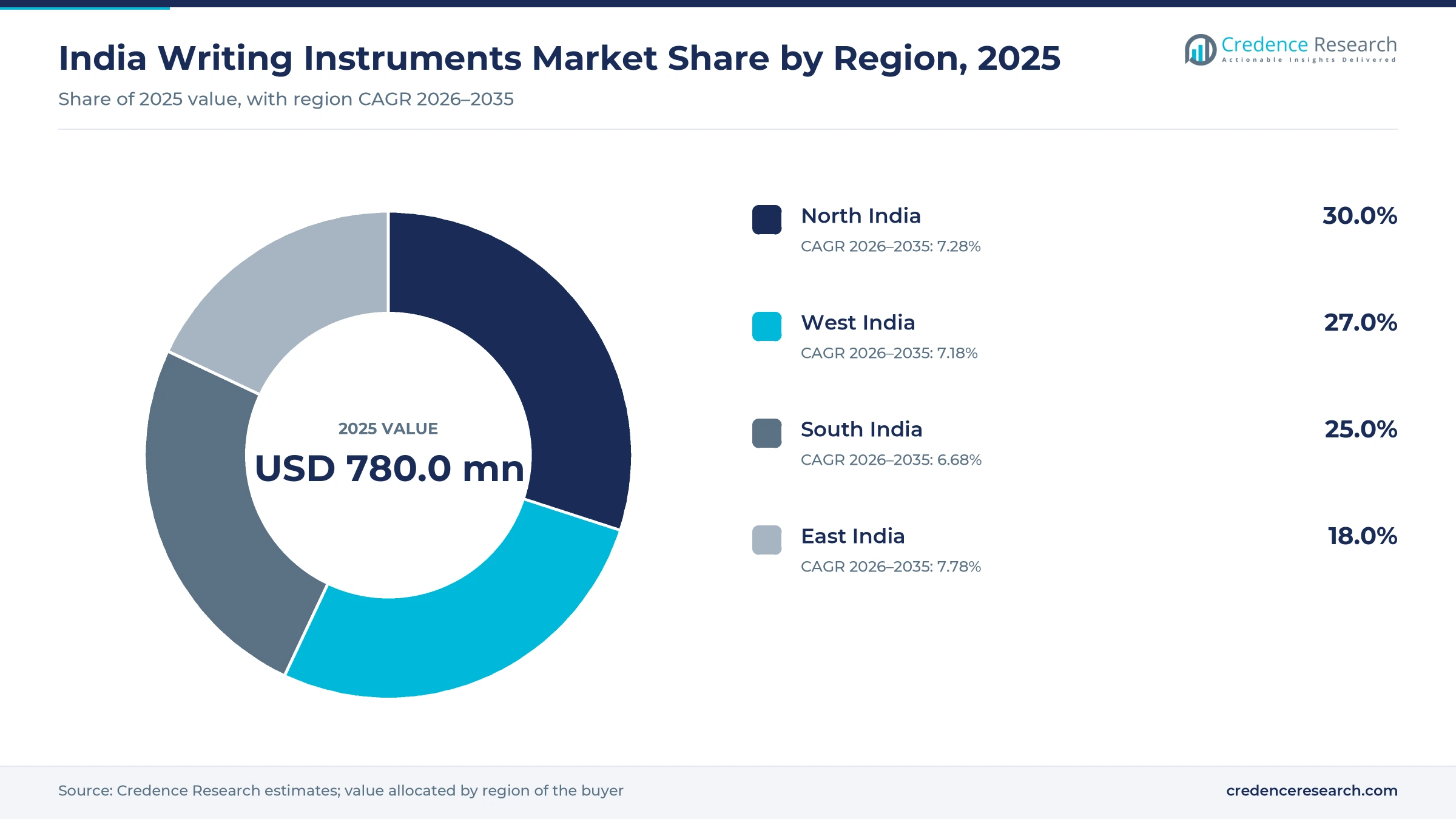
- North India held 30.0% of 2025 value, because Uttar Pradesh enrolled 4.28 crore students in 2024-25 and leads every state on school headcount.
- Pens accounted for 52.0% of 2025 value, since a typical branded ballpoint sells near Rs 10 and is bought repeatedly through the school year.
- GST on pencils, sharpeners and crayons fell to zero from Sept. 22, 2025, while pens remained at 18%, which changes relative shelf prices in school baskets.
- DOMS agreed on June 10, 2026, to buy the Reynolds brand assets in India for Rs 30.71 crore, which consolidates a well-known pen name under a domestic maker.
Pens and students lead while color ranges grow fastest
Why pens lead value while color ranges grow fastest
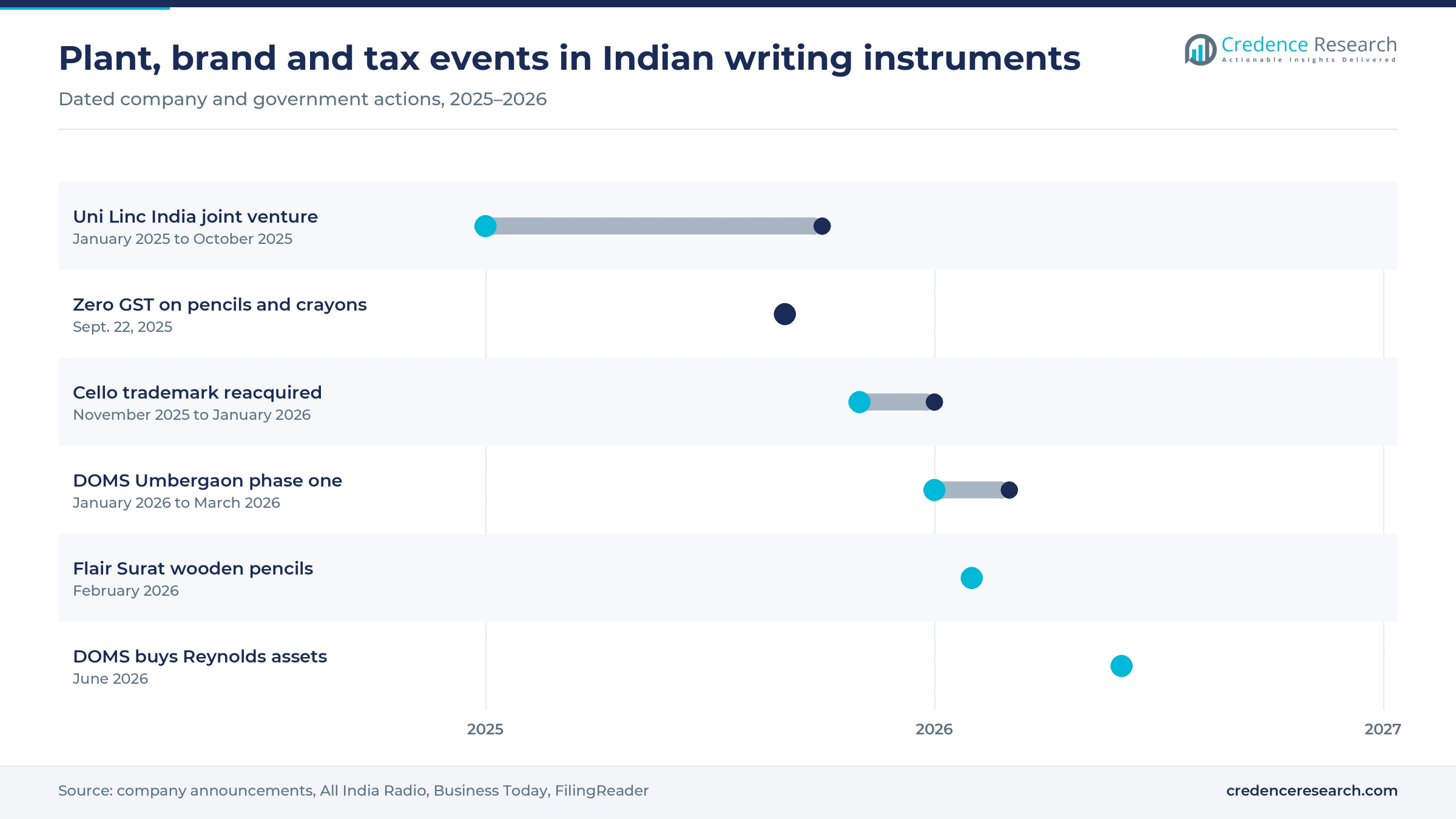
Based on type, the market is categorized into pens, pencils, coloring instruments, highlighters and markers and others. Pens led with 52.0% of 2025 value because volumes run in billions, as Linc alone reported combined capacity above 1 billion units a year in December 2024, according to BizzBuzz. Coloring Instruments grow fastest at 8.15% a year as Flair Writing Industries reported 72% growth in its creative segment during the first nine months of FY26, according to The Machine Maker. Crayons and pastels also became tax-free from Sept. 22, 2025, which lowers the shelf price of school color sets.
Students dominate while institutional buying grows faster
Based on end user, the market is categorized into students, institutions and working professionals. Students led with 61.0% of 2025 value because about 24.68 crore children were enrolled in Indian schools in 2024-25, according to UDISE+ data reported by ThePrint in August 2025. Institutions grow fastest at 7.64% a year as public budgets fund classroom supplies, with Samagra Shiksha allocated Rs 41,250 crore in the 2025-26 Union Budget, Careers360 reported. Telangana also extended free notebooks to more than 8.6 lakh primary students in May 2025, according to NewsMeter, which raises bulk tenders for related school kits.
Neighborhood shops lead while online sales gain ground
Based on distribution channel, the market is categorized into stationery stores, online, hypermarkets/supermarkets and departmental stores. Stationery Stores led with 78.0% of 2025 value because general trade handles about 70% of stationery sales, according to The Daily Brief by Zerodha, and DOMS alone reaches about 145,000 outlets. Online sales grow fastest at 9.19% a year as quick delivery apps add stationery, with metros accounting for about 80% of Blinkit stationery sales, The Captable reported in September 2025. E-commerce held only about 5% of stationery sales on the Zerodha estimate, so the base remains small.
| Segment Group | Leading Sub-segment | Share, 2025 | Fastest-growing Sub-segment | CAGR, 2026–2035 |
|---|---|---|---|---|
| By Type | Pens | 52.0% | Coloring Instruments | 8.15% |
| By End User | Students | 61.0% | Institutions | 7.64% |
| By Distribution Channel | Stationery Stores | 78.0% | Online | 9.19% |
Request a Free Sample
Fill in your details and we'll send you a free sample report.
- Sample data tables & charts
- Research methodology
Large school cohorts and new plants keep volumes rising
A school population near 25 crore sustains daily use
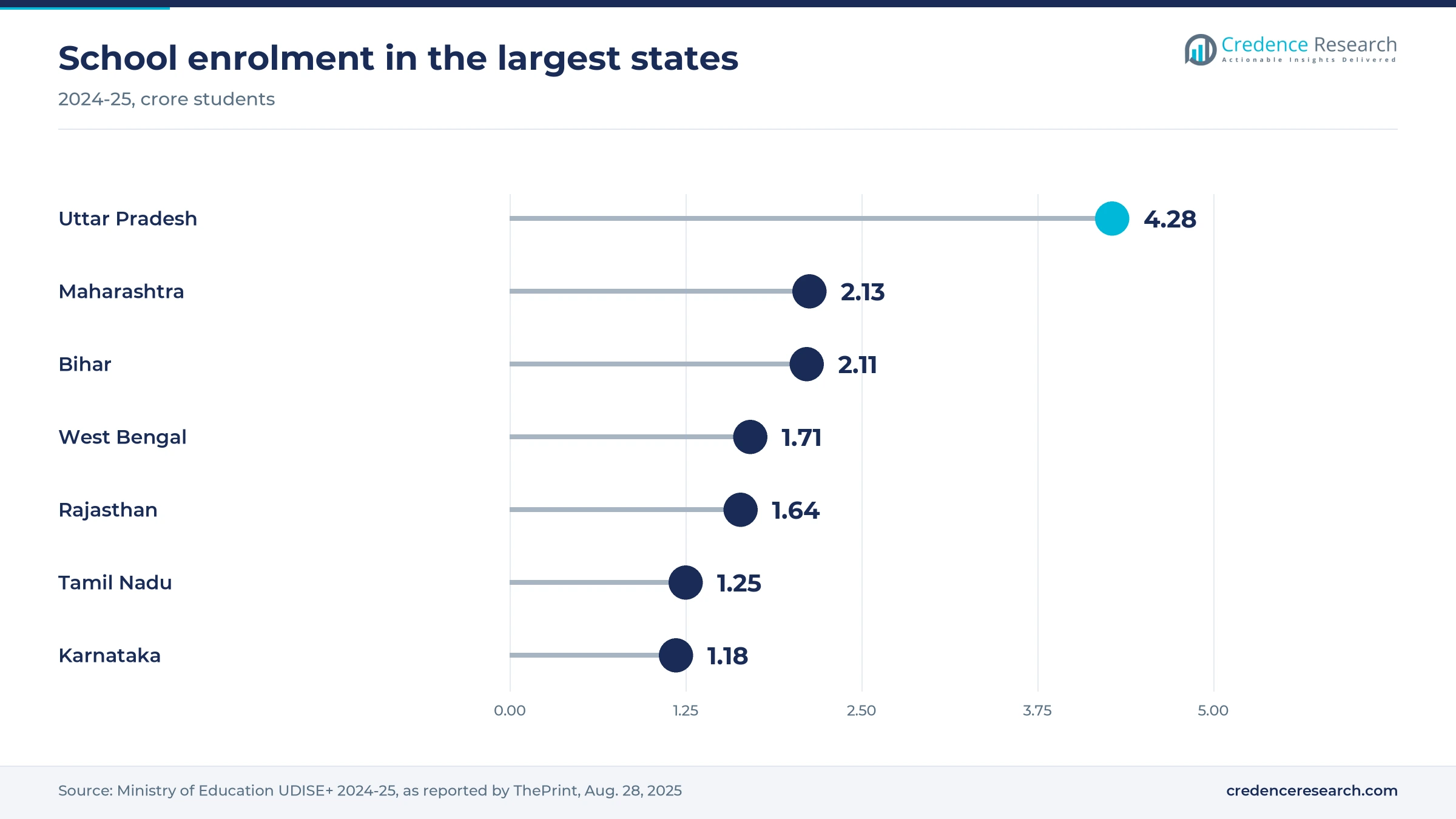
The size of the school system keeps pens and pencils among the most frequently bought household goods in India. UDISE+ counted 24.68 crore enrolled students in 2024-25, ThePrint reported on Aug. 28, 2025, with 4.28 crore in Uttar Pradesh and 2.11 crore in Bihar. Children aged up to 14 made up 24.6% of the population in 2024, according to World Bank population data, which keeps the buyer base wide even as the share eases. Literacy among people aged seven and above reached 80.9% in the 2023-24 Periodic Labour Force Survey, up from 74% in the 2011 census, Millennium Post reported in September 2025. As a result, Students held 61.0% of 2025 value in the Credence Research model.
Organized brands are taking share from local makers
Organized companies are gaining ground because buyers increasingly trust branded tips, inks and consistent quality over loose local pens. Linc estimated that organized brands held about 60% of the industry, BizzBuzz reported in December 2024, and said it grew 10–12% a year against 5–7% for the whole industry. The same report put Linc at about 8% of the national market and about 20% in eastern India. Flair Writing Industries, described by The Machine Maker in February 2026 as the largest pen brand in India, runs 11 plants across five locations. This shift lifts average selling prices, which helps value outgrow unit volume to 2035.
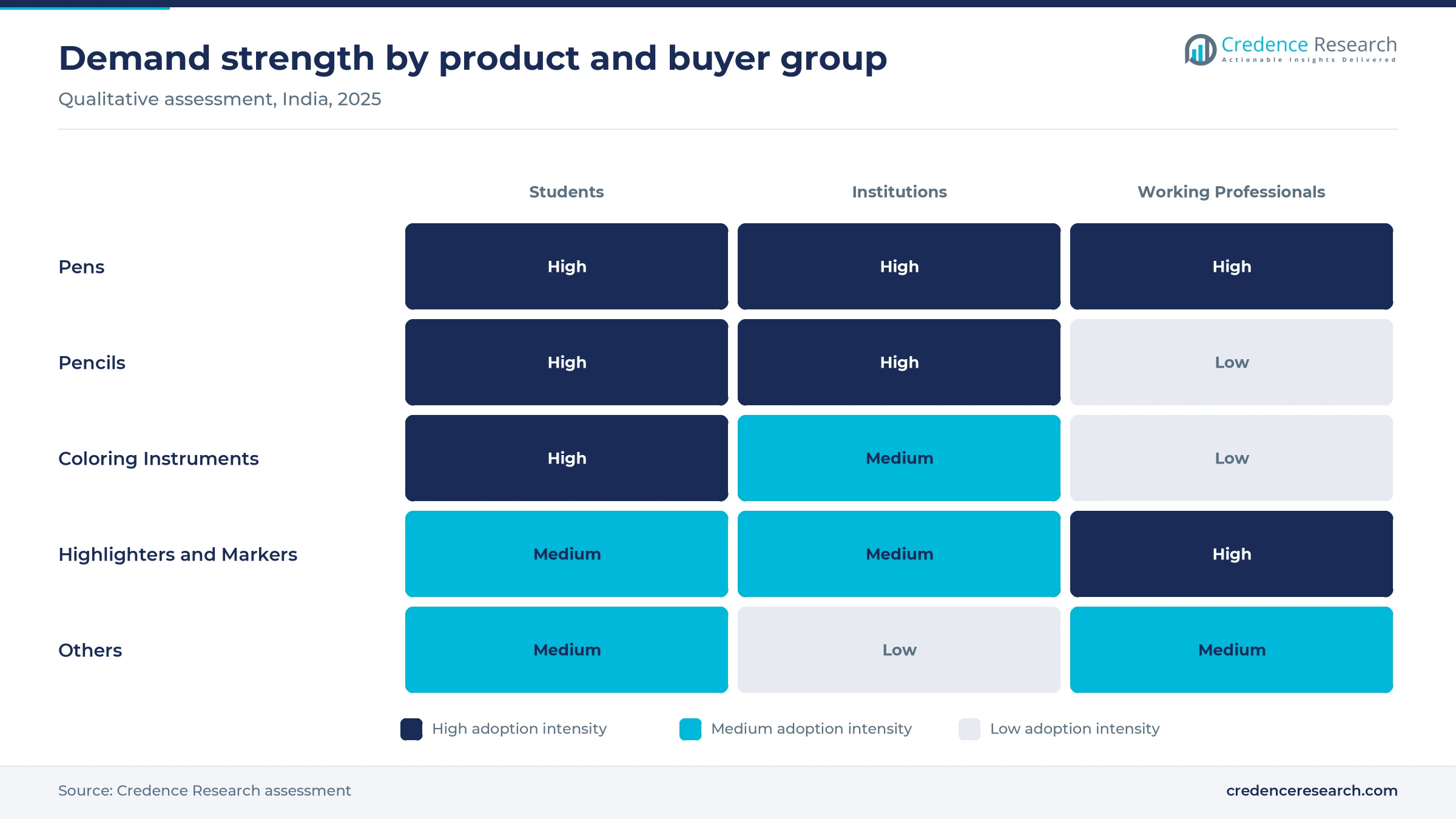
New Gujarat plants raise output of pens and pencils
Fresh capacity in Gujarat is lifting supply because the largest makers were running close to full use of existing lines. DOMS is building a 44-acre greenfield site at Umbergaon, Business Today reported on Dec. 3, 2025, with daily output rising from 5.5 million pencils and 3.25 million pens to 8 million pencils and 6 million pens in the first stage. Uni Linc India, a joint venture of Mitsubishi Pencil and Linc, began ballpoint production in September 2025 and inaugurated its plant on Oct. 1, 2025, according to FilingReader. Flair began wooden pencil production at Surat in February 2026 with about 84 million pieces a year, Whalesbook reported. West India holds 27.0% of 2025 value in the Credence Research model.
Zero GST on pencils and crayons lowers school basket costs
Tax relief on school items is supporting demand because parents buy pencils, erasers and crayons in bulk at the start of each term. The GST Council decided on Sept. 3, 2025, to move pencils, crayons, sharpeners and erasers to a zero rate, All India Radio reported, and the change took effect on Sept. 22, 2025. Most of these items had been taxed at 12% before that change, according to the Free Press Journal. Business Today noted in December 2025 that GST on DOMS stationery fell to zero, which lets brands pass on lower prices or hold margins. As a result, pencil and color sets gain shelf appeal against pens in the Credence Research model.
Tax cuts, brand deals and Japanese partners reshape supply
Shift toward Japanese technology partners in pen making
Japanese pen technology is moving into Indian factories as global brands seek local cost bases for a price-sensitive market. Mitsubishi Pencil holds 51% of Uni Linc India and Linc holds 49%, according to a FilingReader summary of the October 2025 announcement, with capital of INR 200 million. ProjectsToday reported on Oct. 3, 2025, that the Umbergaon plant makes ballpoint pens and will serve as the base for the full Mitsubishi range in India. India imported about USD 83 million of HS 9608 goods in 2023, with Japan supplying 29% and China 50%, according to UN Comtrade data compiled by TrendEconomy. Local production could replace part of those premium imports over the forecast period, which supports value growth to 2035.
Rising consolidation of legacy pen brands under listed makers
Legacy brands are moving to listed domestic makers that can fund molds, marketing and distribution at national scale. DOMS signed an asset purchase agreement on June 10, 2026, to buy Reynolds brand assets, molds and contracts in India for Rs 30.71 crore, Business Today reported. Reynolds debuted in India in the 1980s and began local manufacturing in 1998, according to the same report. Cello World agreed on Nov. 24, 2025, to take back the Cello trademark for writing instruments on a zero-royalty basis, FilingReader reported and planned about Rs 50 crore of manufacturing upgrades over a year. These moves concentrate supply among a few listed firms that already lead Pens in value.
Creative and coloring ranges open a higher-margin category
Color pencils, crayons and sketch pens offer an opening because they sell at higher prices per pack than basic ballpoints. Flair launched its Flair Creative range in FY21, and that segment grew 72% in the first nine months of FY26, The Machine Maker reported in February 2026. Flair also sold about 145 million mechanical pencils in FY26, according to a June 2026 report from the same publisher. Kashmir's Ukhoo village supplies about 90 percent of the wooden slat raw material used by Indian pencil makers, The Statesman reported, which gives local sourcing for new color ranges. In the Credence Research model, color and creative products therefore gain share in the product mix to 2035.
Quick delivery apps open a fast stationery channel
Quick delivery apps open a new route because parents now order last-minute school supplies alongside groceries. The Captable reported in September 2025 that metros account for about 80% of Blinkit stationery sales, with Tier 2 and Tier 3 towns largely untapped. The same report named DOMS, ITC and Uniball as brands benefiting from the category. E-commerce and modern retail each held only about 5% of stationery sales, according to The Daily Brief by Zerodha. Companies that design small, app-friendly packs and keep stock near dense urban pin codes should gain from this channel. In the Credence Research model, Online sales grow at 9.19% a year, the fastest channel rate.
Falling enrolment and costly inputs squeeze pen makers
Falling school enrolment caps unit growth
Student numbers are now shrinking, which limits volume growth in the largest buyer group. UDISE+ enrolment fell to 24.68 crore in 2024-25 from 25.18 crore in 2022-23, a seven-year low, ThePrint reported in August 2025. Tamil Nadu, Kerala and Andhra Pradesh all reported fewer students in that year. Brands therefore depend more on higher-priced gel, color and premium lines to grow value, since each school year now brings fewer new pupils.
Higher tax on pens keeps price pressure high
Pens stayed in the 18% GST slab after the September 2025 changes, The Wire reported on Sept. 19, 2025, while pencils moved to zero. A typical branded pen sells near Rs 10, according to The Daily Brief by Zerodha, so small cost increases are hard to pass on at that fixed price point. Makers respond by changing pack sizes or refill content rather than the shelf price, which narrows margins on the largest product group.
Raw material costs dominate pen and pencil economics
Inputs account for most of the cost of a pen or pencil, so price moves in resin or graphite hit margins quickly. Raw materials made up 60–65% of total cost for Indian writing instrument makers, IBEF reported in October 2023, with polypropylene and pencil lead named as key inputs. Smaller makers without long supply contracts are the most exposed. Larger firms hedge by backward integration, as Flair did when it began making pencils, erasers and sharpeners at Surat in February 2026.
Poplar shortages threaten pencil slat supply
Pencil makers rely on Kashmir poplar for slats, and that supply is under strain. Kashmir Life reported on Aug. 14, 2025, that Ukhoo village supplies around 90 percent of the raw material used by pencil makers nationwide, while heavy felling of poplars and a shift to high-density apple orchards have cut supply. Local industrialists have asked the government to support new planting. Without it, slat prices could rise and pencil makers may need costlier imported wood or graphite substitutes.
North India leads while East India grows fastest
| Region | Value, 2025 (USD million) | Share, 2025 | CAGR, 2026–2035 |
|---|---|---|---|
| North India | 234.0 | 30.0% | 7.28% |
| West India | 210.6 | 27.0% | 7.18% |
| South India | 195.0 | 25.0% | 6.68% |
| East India | 140.4 | 18.0% | 7.78% |
North India leads on the largest student base
North India held 30.0% of 2025 value and grows at 7.28% a year, the largest regional share in the market. Uttar Pradesh enrolled 4.28 crore students in 2024-25, up from 4.17 crore a year earlier, ThePrint reported, while Rajasthan enrolled 1.64 crore. Kashmir also supplies most of the pencil slats used across the country, which places a key raw material inside the zone. Flair also runs a plant at Dehradun, according to The Machine Maker, which shortens supply routes to northern distributors.
West India combines plants with dense urban demand
West India held 27.0% of 2025 value and grows at 7.18% a year, because the zone hosts most new factories and large urban buyers. DOMS, Uni Linc India and Flair all build or run plants in Gujarat at Umbergaon, Valsad or Surat, which lowers freight to nearby markets. Maharashtra enrolled 2.13 crore school students in 2024-25, according to ThePrint. Flair also runs plants at Naigaon and Daman, according to The Machine Maker, which keeps supply close to Mumbai and Gujarat buyers.
South India holds a mature, high-literacy market
South India held 25.0% of 2025 value and grows at 6.68% a year, the slowest pace among the four zones. High literacy supports steady per-student spending, since Kerala recorded 93.91% literacy in the 2011 census, Millennium Post noted. However, enrolment fell in 2024-25 to 1.25 crore in Tamil Nadu and 84.55 lakh in Andhra Pradesh, ThePrint reported. Telangana extended free notebooks to more than 8.6 lakh primary students in May 2025, which supports institutional buying.
East India grows fastest from a wide school base
East India held 18.0% of 2025 value and grows at 7.78% a year, the fastest pace among the four zones. Bihar enrolled 2.11 crore students and West Bengal 1.71 crore in 2024-25, ThePrint reported, while Assam rose to 70.42 lakh. Literacy is still catching up, since Bihar recorded the lowest state rate in the 2011 census at 63.82%. Kolkata-based Linc holds about 20% of the eastern market, BizzBuzz reported, which gives organized brands a strong base for growth.
Plant, brand and tax moves from 2024 to 2026
| Development | Status and market relevance |
|---|---|
| In January 2025, Mitsubishi Pencil and Linc established Uni Linc India in Gujarat, with Mitsubishi Pencil holding 51%, according to FilingReader. | Plant inaugurated Oct. 1, 2025, ballpoint pens first |
| In September 2025, India moved pencils, sharpeners and crayons to zero GST from Sept. 22, 2025, while pens remained at 18%, The Wire reported. | In force, lowers school basket prices |
| In November 2025, Cello World agreed to reacquire the Cello trademark for writing instruments on a zero-royalty basis, FilingReader reported. | Operations under the brand planned from January 2026 |
| In February 2026, Flair Writing Industries began wooden pencil production at its Surat subsidiary with about 84 million pieces a year, Whalesbook reported. | Running, also covers erasers and sharpeners |
| In June 2026, DOMS Industries signed an agreement to buy Reynolds brand assets in India for Rs 30.71 crore, Business Today reported. | Signed June 10, 2026, closing terms not disclosed |
Tip, ink and slat choices decide unit cost
- Tungsten carbide tips remain the standard for ballpoint pens, and Japanese partners such as Mitsubishi Pencil bring tip and ink know-how to the Uni Linc India plant at Umbergaon.
- Gel and low-viscosity inks give smoother writing at slightly higher prices, which helps brands move buyers above the basic Rs 10 ballpoint during exam seasons.
- Poplar slat processing turns Kashmir wood into pencil slats, and Ukhoo units supply about 90 percent of the raw material used by Indian pencil makers.
- Digital writing tools compete for some note-taking time, and digital pens and styluses are counted separately because they are sold with tablets rather than through stationery shops.
Need a Custom Version of This Report?
Tailor the scope, geography, or segments to your exact requirements.
- Custom geography or segment scope
- Direct access to our analyst team
Organized brands compete on Rs 10 pens and reach
The market is led by a handful of organized brands that compete with thousands of small local makers and importers. Linc estimated that organized companies hold about 60% of the industry, and it put its own share near 8% nationally. Flair, Cello, Linc and DOMS compete hardest in pens near the Rs 10 price point, where tip quality, ink flow and shelf presence decide repeat purchase. DOMS and Hindustan Pencils, with its Nataraj and Apsara brands, anchor the pencil category, while Kokuyo Camlin and Faber-Castell are known for color and art ranges. Distribution reach is the main barrier to entry, since general trade still handles about 70% of sales. Recent deals, including DOMS buying the Reynolds brand and Cello World regaining its own name, point to further consolidation among listed firms.
Which companies lead pen and pencil sales in India?
| Company | Type | Role in the market |
|---|---|---|
| Flair Writing Industries | Pen and stationery maker | Runs 11 plants across five locations and sells Flair, Hauser and Pierre Cardin pens |
| DOMS Industries | Pencil and pen maker | Building a 44-acre Umbergaon site and buying the Reynolds brand assets in India |
| Linc Limited | Pen maker | Holds about 8% of the national market and about 20% in eastern India |
| Uni Linc India | Joint venture maker | Mitsubishi Pencil and Linc venture making ballpoint pens at Umbergaon since 2025 |
| Cello World | Brand owner and maker | Regained the Cello trademark for writing instruments in November 2025 |
Scale and creative ranges will matter more than price alone
Credence Research's view is that this market will reward scale and product mix more than headline price cuts. Enrolment fell to 24.68 crore in 2024-25, so growth of 7.20% a year depends on organized brands taking share and on buyers trading up to gel, color and premium lines. New Gujarat capacity from DOMS, Flair and Uni Linc India should lower unit costs, while zero GST on pencils and crayons helps school baskets. Pens remain exposed to a higher tax rate and the Rs 10 price point. Companies with deep rural distribution and strong school stationery supplies ranges are best placed.
How the writing instruments model was built
The report uses 2025 as the base year and forecasts to 2035. Market values come from the Credence Research model, checked against company statements on industry size, national trade data and school enrolment by state. Segment and regional splits are Credence Research estimates informed by UDISE+ enrolment, published channel shares and plant locations. Sources used include government statistics, World Bank data, company filings and announcements, and trade and business press. No interviews or surveys were conducted in preparing this report.
Value nearly doubles as organized share keeps rising
Market value is forecast to reach USD 1.56 billion by 2035, with organized brands and higher-priced ranges doing more of the work than unit growth. North India should remain the largest zone, while East India gains share from a wide school base and rising literacy. Gujarat will become the main manufacturing hub as DOMS, Flair and Uni Linc India add lines. Quick delivery apps and color ranges should grow from small bases, and pens will keep most of the value despite their higher tax rate. By 2035, buyers can expect fewer local brands and a wider choice of mid-priced gel and color products, much as pen and pencil demand worldwide has moved toward premium mixes.
Frequently Asked Questions
How big is the India writing instruments market?
What is the pen market size in India?
How large is pencil production in India?
Which companies hold the largest pen market share in India?
What is the literacy rate in India?
Which region leads the market?
How did GST changes in 2025 affect writing instruments?
Which product group grows fastest?
Table of Content
Chapter 1 Market Segmentation
- 1.1 Segmentation Framework
- 1.1.1 Product and Service Classification
- 1.1.2 Application and End-Use Classification
- 1.1.3 Technology and Solution Classification
- 1.1.4 Customer and Distribution Channel Classification
- 1.1.5 Geographic Segmentation
- 1.1.6 Market Segment Definitions and Boundaries
- 1.2 By Type
- 1.2.1 Pens
- 1.2.2 Pencils
- 1.2.3 Coloring Instruments
- 1.2.4 Highlighters and Markers
- 1.2.5 Others
- 1.3 By End User
- 1.3.1 Students
- 1.3.2 Institutions
- 1.3.3 Working Professionals
Chapter 2 Introduction
- 2.1 Report Objectives and Scope
- 2.2 Product Definition and Industry Terminology
- 2.3 Market Inclusions and Exclusions
- 2.4 Research Process
- 2.4.1 Primary Research and Expert Interviews
- 2.4.2 Secondary Research and Source Review
- 2.4.3 Top-Down and Bottom-Up Estimation
- 2.4.4 Data Triangulation and Verification
- 2.5 Market Size Measurement Basis
- 2.5.1 2025: USD 780.0 million → 2035: USD 1.56 billion
- 2.6 Historical and Forecast Reference Periods
- 2.6.1 Historical Period: 2018-2025
- 2.6.2 Base Year: 2025
- 2.6.3 Forecast Period: 2025-2035
- 2.7 Research Assumptions and Limitations
Chapter 3 Executive Summary
- 3.1 Market Snapshot and Key Findings
- 3.2 Base-Year Market Size, 2025
- 3.3 Forecast Market Size, 2035
- 3.4 Revenue and Volume Growth Outlook
- 3.5 Key Demand and Supply Indicators
- 3.6 Leading Market Segments
- 3.7 Fastest-Growing Market Opportunities
- 3.8 Regional Performance Highlights
- 3.9 Technology and Industry Transformation
- 3.10 Competitive Landscape Summary
- 3.11 Analyst View and Strategic Implications
Chapter 4 India Writing Instruments Market Trends and Developments
- 4.1 Historical Industry Development, 2018-2025
- 4.2 Recent Market Trends and Developments
- 4.3 Demand and Customer Behavior Trends
- 4.4 Technology and Product Innovation
- 4.5 Artificial Intelligence, Automation and Digitalization
- 4.6 Local Manufacturing and Supply Chain Realignment
- 4.7 Industry Partnerships, Mergers and Acquisitions
- 4.8 Sustainability and Circular Economy Developments
- 4.9 Government and Private Sector Investment Trends
- 4.10 Emerging Business Models and Commercialization
- 4.11 Industry Developments and Announcements
Chapter 5 India Writing Instruments Market Production, Supply and Demand Analysis
- 5.1 Demand Trend and Consumption Analysis, 2018-2025
- 5.2 Demand Forecast, 2025-2035
- 5.3 Production and Output Trend, 2018-2025
- 5.4 Production and Output Forecast, 2025-2035
- 5.5 Installed Capacity and Capacity Utilization
- 5.6 Company-Wise Production Plants and Statistics
- 5.6.1 Installed Production Capacity
- 5.6.2 Actual Production
- 5.6.3 Planned Capacity and Expansion Targets
- 5.7 Supply Chain Structure and Procurement Trends
- 5.8 Supply-Demand Gap and Bottlenecks
- 5.9 Import Dependence and Sourcing Structure
- 5.10 Contract Manufacturing and Outsourcing
- 5.11 Regional Supply and Demand Concentration
Chapter 6 India Writing Instruments Market Pricing Analysis
- 6.1 Pricing Structure and Measurement
- 6.2 Historical Pricing Trends, 2018-2025
- 6.3 Pricing Outlook, 2025-2035
- 6.4 Average Selling Price and Unit Economics
- 6.5 Pricing by Product and Market Segment
- 6.6 Geographic Pricing Differences
- 6.7 Key Input, Energy, Labor and Logistics Costs
- 6.8 Contract Pricing and Purchasing Models
- 6.9 Pricing Sensitivity and Competitive Positioning
- 6.10 Price, Margin and Profitability Implications
Chapter 7 India Writing Instruments Market Dynamics
- 7.1 Market Growth Drivers
- 7.1.1 Demand-Side Drivers
- 7.1.2 Technology and Innovation Drivers
- 7.1.3 Infrastructure and Investment Drivers
- 7.1.4 Regulatory and Policy Drivers
- 7.2 Market Restraints
- 7.2.1 Cost and Affordability Constraints
- 7.2.2 Technology and Adoption Barriers
- 7.2.3 Supply Chain and Operational Constraints
- 7.3 Market Challenges
- 7.3.1 Competitive Pressure and Margin Erosion
- 7.3.2 Skills, Infrastructure and Implementation Gaps
- 7.4 Emerging Market Opportunities
- 7.5 Market Dynamics Impact and Time-Horizon Assessment
Chapter 8 India Writing Instruments Value Chain Analysis
- 8.1 Industry Value Chain Overview
- 8.2 Upstream Suppliers and Critical Inputs
- 8.3 Technology and Component Providers
- 8.4 Manufacturing or Service Delivery
- 8.5 Distribution, Channel Partners and Integrators
- 8.6 Downstream Applications and End Users
- 8.7 Value Addition and Profit Pools
- 8.8 Vertical Integration and Outsourcing
- 8.9 Supplier Concentration and Risk
- 8.10 Supply Chain Localization and Resilience
Chapter 9 India Writing Instruments Market Regulations and Policies
- 9.1 Relevant Laws, Standards and Compliance Frameworks
- 9.2 Product, Service, Safety and Quality Requirements
- 9.3 Government Policies, Incentives and Subsidies
- 9.4 Imports, Exports and Trade Barriers
- 9.5 Public Procurement and Local Content Requirements
- 9.6 Environmental and Sustainability Compliance
- 9.7 Upcoming Policy Changes and Market Implications
Chapter 10 India Writing Instruments Market Hotspots and Opportunities
- 10.1 Market Opportunity Mapping and Growth Hotspots
- 10.2 High-Growth Applications and Customer Groups
- 10.3 Underserved Markets and White-Space Opportunities
- 10.4 Emerging Technology and Product Opportunities
- 10.5 New Capacity and Investment Hotspots
- 10.6 Market Entry and Expansion Opportunities
- 10.7 Distribution and Partnership Opportunities
- 10.8 Near-Term and Long-Term Commercial Potential
- 10.9 Opportunity Attractiveness and Execution Risks
Chapter 11 India Writing Instruments Market Outlook, 2025-2035
- 11.1 Market Size and Analysis
- 11.1.1 Revenue (Market Measurement: 2025: USD 780.0 million → 2035: USD 1.56 billion)
- 11.1.2 Market Volume and Quantity Sold
- 11.1.3 Historical Market Size, 2018-2025
- 11.1.4 Base-Year Market Size, 2025
- 11.2 Market Forecast, 2025-2035
- 11.2.1 Revenue Forecast to 2035
- 11.2.2 Volume Forecast to 2035
- 11.2.3 CAGR and Year-on-Year Growth
- 11.2.4 Incremental Revenue Opportunity
- 11.3 Forecast Assumptions and Scenario Analysis
- 11.3.1 Base-Case Forecast
- 11.3.2 Optimistic and Conservative Scenarios
- 11.3.3 Technology, Pricing and Policy Sensitivities
- 11.4 Market Attractiveness and Growth Outlook
Chapter 12 India Writing Instruments Market Segmentation and Outlook
- 12.1 Segmentation Summary and Market Shares, 2025
- 12.2 Largest and Fastest-Growing Segments
- 12.3 By Type - Market Size and Forecast, 2025-2035
- 12.3.1 Segment Definition and Scope
- 12.3.2 Historical Market Size, 2018-2025
- 12.3.3 Revenue Forecast, 2025-2035
- 12.3.4 Volume Forecast, 2025-2035
- 12.3.5 Base-Year Market Share, 2025
- 12.3.6 Segment CAGR and Growth Drivers
- 12.3.7 Subsegment Market Size and Forecast
- 12.3.7.1 Pens
- 12.3.7.2 Pencils
- 12.3.7.3 Coloring Instruments
- 12.3.7.4 Highlighters and Markers
- 12.3.7.5 Others
- 12.3.8 Subsegment Pricing and Adoption Trends
- 12.3.9 Leading Suppliers and Competition
- 12.3.10 Regional Demand and Opportunities
- 12.4 By End User - Market Size and Forecast, 2025-2035
- 12.4.1 Segment Definition and Scope
- 12.4.2 Historical Market Size, 2018-2025
- 12.4.3 Revenue Forecast, 2025-2035
- 12.4.4 Volume Forecast, 2025-2035
- 12.4.5 Base-Year Market Share, 2025
- 12.4.6 Segment CAGR and Growth Drivers
- 12.4.7 Subsegment Market Size and Forecast
- 12.4.7.1 Students
- 12.4.7.2 Institutions
- 12.4.7.3 Working Professionals
- 12.4.8 Subsegment Pricing and Adoption Trends
- 12.4.9 Leading Suppliers and Competition
- 12.4.10 Regional Demand and Opportunities
- 12.5 Segment Growth Comparison
- 12.6 Segment Attractiveness and Priority Matrix
Chapter 13 India Writing Instruments End-Use and Application Market Outlook
- 13.1 End-Use Industry and Customer Demand Structure
- 13.2 Leading Applications and Customer Groups
- 13.3 End-Use Market Size, Share and Forecast
- 13.4 Major End-Use Industry Deep Dives
- 13.4.1 Customer Requirements and Use Cases
- 13.4.2 Demand and Replacement Cycles
- 13.4.3 Technical and Regulatory Considerations
- 13.4.4 Purchasing and Procurement Models
- 13.4.5 Leading Vendors and Distribution Channels
- 13.4.6 Forecast and Commercial Opportunities
- 13.5 Emerging Applications and Cross-Segment Demand
- 13.6 End-Use Industry Investment Priorities
Chapter 14 India Writing Instruments Geographic Market Outlook, 2025-2035
- 14.1 Domestic Market Distribution and Demand Clusters
- 14.2 State- or Province-Wise Market Size and Forecast, 2025-2035
- 14.3 City and Metropolitan Market Outlook
- 14.4 Industrial, Manufacturing and Commercial Clusters
- 14.5 Geographic Concentration of Key End Users
- 14.6 Local Pricing and Purchasing Differences
- 14.7 Domestic Production Facilities and Capacity Map
- 14.8 Local Infrastructure and Project Pipeline
- 14.9 State-Level Policy and Incentive Differences
- 14.10 Subnational Investment Hotspots and Opportunities
- 14.11 Distribution and Logistics Networks
- 14.12 Domestic Competitive Footprint
Chapter 15 India Writing Instruments Technology, Innovation and Sustainability Outlook
- 15.1 Technology Landscape and Maturity
- 15.2 Product, Process and Service Innovation
- 15.3 AI, Automation and Digital Tools in the Industry
- 15.4 Technology Adoption and Performance Benchmarking
- 15.5 Innovation Pipeline and R&D Investment
- 15.6 Patent and Intellectual Property Trends
- 15.7 Energy Efficiency and Resource Management
- 15.8 Sustainability, Recycling and Circularity
- 15.9 Technology Roadmap, 2025-2035
- 15.10 Risks of Obsolescence and Technology Substitution
Chapter 16 India Writing Instruments Market Key Strategic Imperatives
- 16.1 Growth and Market Entry Priorities
- 16.2 High-Return Products and Segments
- 16.3 Pricing, Profitability and Cost Optimization
- 16.4 Technology Investment and Product Differentiation
- 16.5 Supply Chain Localization and Resilience
- 16.6 Distribution and Customer Acquisition
- 16.7 Partnership, Acquisition and Capacity Strategy
- 16.8 Regional Expansion Priorities
- 16.9 Short-, Medium- and Long-Term Actions
Chapter 17 Competition Outlook
- 17.1 Industry Competition Characteristics
- 17.2 Market Structure and Concentration
- 17.3 Market Share and Competitive Positioning, 2025
- 17.4 Company-Wise Revenue and Product Benchmarking
- 17.5 Production and Service Capacity Benchmarking
- 17.6 Technology, Pricing and Differentiation
- 17.7 Regional Footprint and Distribution Strength
- 17.8 Mergers, Acquisitions and Strategic Alliances
- 17.9 New Entrants and Competitive Threats
- 17.10 Porter's Five Forces and Industry Attractiveness
- 17.11 Competitive Outlook, 2025-2035
Chapter 18 Company Profiles
- 18.1 Company Coverage and Selection Criteria
- 18.2 Flair Writing Industries
- 18.2.1 Business Description
- 18.2.2 Company Ownership and Geographic Presence
- 18.2.3 Product and Service Portfolio
- 18.2.4 Manufacturing and Operating Footprint
- 18.2.5 Production Capacity and Expansion Plans
- 18.2.6 Financial Performance and Investment
- 18.2.7 Market Share and Competitive Position
- 18.2.8 Technology and Innovation Capabilities
- 18.2.9 Strategic Alliances or Partnerships
- 18.2.10 Recent Developments
- 18.2.11 Growth Strategy and Outlook
- 18.3 DOMS Industries
- 18.4 Linc Limited
- 18.5 Uni Linc India (Mitsubishi Pencil)
- 18.6 Cello World
- 18.7 Hindustan Pencils
- 18.8 Kokuyo Camlin
- 18.9 Reynolds
- 18.10 Faber-Castell
- 18.11 Other Relevant Market Participants
Note: Every listed company is profiled on the structure shown under the first company. The company list is preliminary and may change based on research findings, market developments, data availability and client requirements.
Chapter 19 Disclaimer
- 19.1 Research and Forecast Disclaimer
- 19.2 Data Source and Estimation Limitations
Note: The depth of individual sections depends on data availability for this market. Volume, capacity, trade and other unit-based metrics are included where applicable.

