
Market Overview:
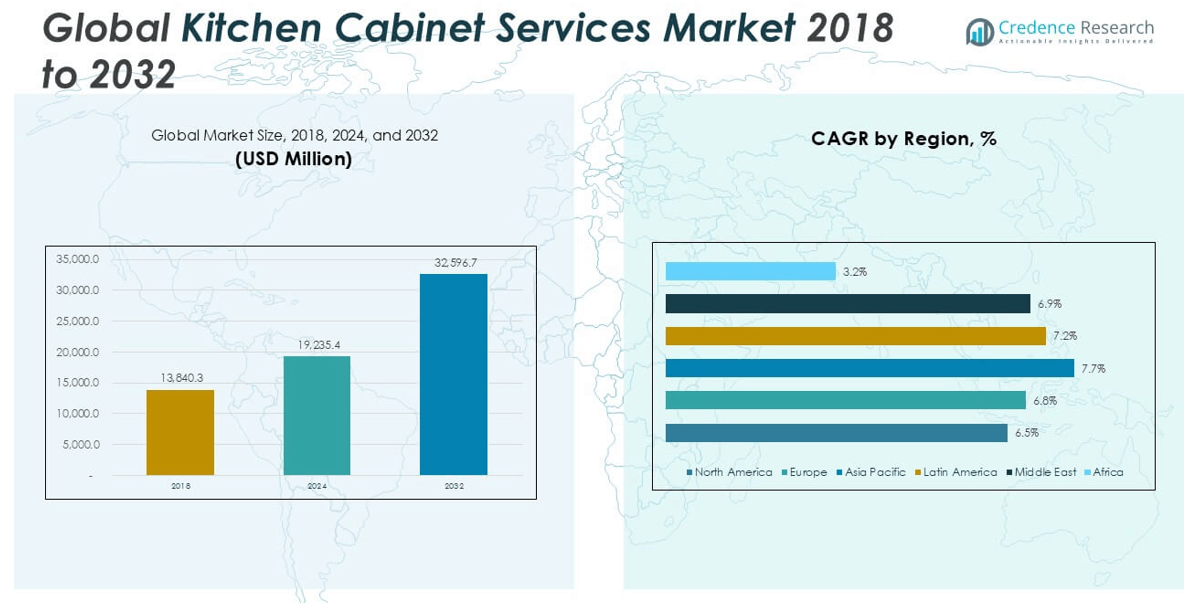
The Kitchen Cabinet Services market size was valued at USD 13,840.3 million in 2018, increased to USD 19,235.4 million in 2024, and is anticipated to reach USD 32,596.7 million by 2032, growing at a CAGR of 6.91% during the forecast period.
| REPORT ATTRIBUTE | DETAILS |
|---|---|
| Historical Period | 2020-2023 |
| Base Year | 2024 |
| Forecast Period | 2025-2032 |
| Kitchen Cabinet Services Market Size 2024 | USD 19,235.4 million |
| Kitchen Cabinet Services Market, CAGR | 6.91% |
| Kitchen Cabinet Services Market Size 2032 | USD 32,596.7 million |
The Kitchen Cabinet Services market is driven by key players such as Masterbrand Cabinets, Masco Corporation, American Woodmark Corporation, Cabinetworks Group, Häcker Küchen, Nobilia Küchen, SieMatic Möbelwerke, and Wren Kitchens. These companies lead the market through extensive product portfolios, customization capabilities, and established distribution networks. North America emerged as the leading regional market, accounting for 32.9% of the global market share in 2024, supported by strong home renovation trends and rising demand for premium cabinetry solutions. Europe followed with 28.6%, driven by eco-friendly materials and modular kitchen innovations. These regions collectively dominate the global landscape due to mature housing markets and high consumer spending on home improvement.
Market Insights
- The Kitchen Cabinet Services market was valued at USD 19,235.4 million in 2024 and is projected to reach USD 32,596.7 million by 2032, growing at a CAGR of 6.91% during the forecast period.
- Rising residential construction, kitchen remodeling projects, and consumer preference for personalized storage solutions are key drivers fueling market demand globally.
- Sustainable cabinet materials, digital visualization tools, and smart kitchen integrations are emerging trends, reshaping design and purchasing behavior.
- Key players such as MasterBrand Cabinets, Masco Corporation, and Häcker Küchen dominate the market, leveraging wide distribution networks and extensive product offerings; however, high customization costs and raw material price fluctuations restrain broader market penetration.
- North America holds the largest market share at 32.9%, followed by Europe at 28.6% and Asia Pacific at 24.2%; by material, wood cabinets lead the segment, while semi-custom cabinets dominate the installation category due to their balance of cost and design flexibility.
Market Segmentation Analysis:
By Material
The Kitchen Cabinet Services market by material is led by wood cabinets, accounting for the largest market share in 2024 due to their durability, aesthetic appeal, and widespread consumer preference for traditional kitchen designs. Wood offers customization flexibility, long-lasting performance, and a premium appearance that aligns well with both classic and contemporary kitchens. Laminate and thermofoil cabinets are also gaining traction, especially in budget-conscious renovations, due to their cost-effectiveness and ease of maintenance. Meanwhile, metal and glass cabinets serve niche markets, particularly in modern, high-end, or industrial-style kitchens, offering sleek designs and easy cleanability.
- For instance, American Woodmark operates 18 manufacturing facilities across North America that collectively produce over 10 million cabinets annually, offering a wide variety of wood-based customization options.
By Design Style
Among the design styles, the modern style dominates the market, holding the highest revenue share in 2024. This is primarily driven by a rising demand for sleek, minimalist aesthetics in urban homes, along with an increasing preference for clean lines and neutral tones. Modern cabinets often incorporate innovative storage solutions, appealing to functionality-focused consumers. Traditional and transitional styles also remain popular, particularly in suburban and luxury residences. Rustic and contemporary styles cater to niche audiences, with the former favored in farmhouse or cottage-style homes, while the latter is preferred for upscale, design-forward kitchen renovations.
- For instance, MasterBrand Cabinets launched its “Diamond Edge” line with over 60 modular design combinations in modern finishes, reflecting rising demand for sleek urban kitchen styles.
By Installation
In terms of installation types, semi-custom cabinets emerged as the dominant sub-segment in 2024, driven by their balance of affordability, design flexibility, and moderate lead times. These cabinets allow homeowners to tailor dimensions, finishes, and hardware without the high cost of full customization. Stock cabinets, though less flexible, continue to perform well in the budget segment due to immediate availability and low pricing. Custom cabinets command a smaller yet premium market share, particularly in luxury construction. Ready-to-assemble cabinets and others are expanding steadily, supported by the growth of e-commerce platforms and DIY home renovation trends.
Market Overview
Rising Residential Construction and Renovation Activities
The surge in residential construction and home renovation projects significantly drives the demand for kitchen cabinet services. Urbanization, increasing disposable income, and a shift toward modern kitchen aesthetics are encouraging homeowners to invest in kitchen upgrades. Additionally, the rise in single-family housing and remodeling trends, particularly in North America and Europe, supports market expansion. Customized cabinetry and functional storage designs are becoming essentials in modern homes, prompting sustained growth for service providers catering to both new constructions and refurbishments.
- For instance, Masco Corporation, through its KraftMaid brand, supplied over 1.2 million kitchen renovations in the U.S. over the past five years, primarily driven by new residential projects.
Growing Demand for Personalized and Custom Cabinet Solutions
Consumer preference is shifting toward customized kitchen cabinetry tailored to specific layouts, materials, and finishes. This trend is driven by the desire for unique kitchen aesthetics and optimal space utilization. Homeowners increasingly seek solutions that align with their lifestyle, integrating smart features and ergonomic designs. As a result, service providers offering semi-custom and fully customized cabinets are experiencing higher demand. This personalized approach enables market players to differentiate their services and build strong customer loyalty, fueling long-term growth across diverse residential and commercial segments.
- For instance, Wren Kitchens offers more than 90 cabinet styles with 1,300 different color combinations, enabling full customization and delivering over 2,000 kitchens per week across the UK and U.S. markets.
Expansion of E-commerce and Digital Visualization Tools
The integration of digital platforms and visualization tools in kitchen design is transforming how consumers approach cabinetry services. Online configurators, 3D renderings, and virtual consultations have simplified the decision-making process, enabling customers to view and modify cabinet designs remotely. This digital transformation not only enhances user experience but also streamlines operations for service providers. The growing use of e-commerce platforms for product selection, consultation, and service booking is expanding market reach, particularly among younger, tech-savvy consumers who prioritize convenience and customization.
Key Trends & Opportunities
Increasing Adoption of Sustainable and Eco-Friendly Materials
Sustainability is emerging as a crucial trend in the kitchen cabinet services market, with consumers showing a strong preference for eco-friendly and low-emission materials. Manufacturers and service providers are responding by offering cabinets made from reclaimed wood, bamboo, and formaldehyde-free components. Green certifications and compliance with environmental standards are becoming important differentiators. This trend presents an opportunity for providers to enhance their brand image and tap into environmentally conscious consumer segments, particularly in North America and Europe where sustainability is a purchasing priority.
- For instance, Häcker Küchen achieved carbon-neutral production in 2020 and uses FSC-certified materials in over 85% of its kitchen cabinet models.
Technological Integration in Kitchen Cabinetry
Smart storage solutions and integrated technologies are reshaping kitchen cabinetry. The market is witnessing increased demand for cabinets with built-in lighting, sensor-based drawers, and soft-close mechanisms. Integration of IoT-enabled features, such as app-controlled lighting or power outlets within cabinets, enhances functionality and convenience. These innovations present a lucrative opportunity for service providers to expand offerings and cater to premium customers seeking modern, tech-driven kitchen environments. As consumer awareness of smart home products grows, this segment is poised for substantial expansion.
- For instance, Poggenpohl introduced its +VENOVO line with integrated LED strips, power sockets, and motion-controlled drawers, selling over 10,000 units globally in the last fiscal year.
Key Challenges
Fluctuating Raw Material Prices and Supply Chain Disruptions
The kitchen cabinet services market faces ongoing challenges from volatile raw material prices, especially for wood, metal, and engineered products. Fluctuations in supply and pricing, often due to geopolitical issues, trade tariffs, or environmental regulations, increase production costs and affect profit margins. Additionally, global supply chain disruptions can lead to project delays, hampering customer satisfaction. To remain competitive, service providers must navigate these uncertainties through strategic sourcing, inventory management, and price adjustment mechanisms.
Skilled Labor Shortages in Installation and Customization Services
The availability of skilled labor remains a persistent issue in the kitchen cabinet services industry, particularly for custom and semi-custom installations. Craftsmanship, precision, and technical knowledge are critical for delivering high-quality service, but labor shortages often result in extended project timelines and inconsistent service quality. The challenge is more pronounced in regions experiencing high construction activity but limited vocational training infrastructure. Companies are increasingly investing in in-house training programs and partnerships with technical institutes to address this workforce gap.
High Cost of Customization Limiting Adoption in Budget Segments
While customized kitchen cabinets are in high demand, their elevated costs often deter middle-income consumers. Customization involves tailored measurements, premium materials, and specialized labor, which collectively increase the overall service cost. As a result, budget-conscious homeowners may opt for stock or ready-to-assemble cabinets instead. This cost sensitivity limits the penetration of high-margin custom solutions in broader market segments. To overcome this challenge, companies must innovate in modular designs and offer cost-effective customization without compromising on quality or aesthetics.
Regional Analysis
North America
North America held a dominant position in the Kitchen Cabinet Services market, accounting for approximately 32.9% of the global market share in 2024. The market size grew from USD 4,660.03 million in 2018 to USD 6,320.75 million in 2024, and is projected to reach USD 10,359.22 million by 2032, expanding at a CAGR of 6.5%. Growth in this region is driven by strong remodeling trends, increasing residential construction, and demand for premium, customized kitchen solutions. The U.S. remains the primary contributor, backed by rising home improvement spending and widespread adoption of digital design services.
Europe
Europe captured around 28.6% of the global market share in 2024, with the market size rising from USD 3,932.03 million in 2018 to USD 5,435.10 million in 2024, and is expected to reach USD 9,143.36 million by 2032. The market is projected to grow at a CAGR of 6.8% during the forecast period. The growth is supported by sustainable design preferences, increasing urban housing renovation, and a strong presence of local cabinetry manufacturers. Germany, the UK, and France are key contributors, with consumers favoring energy-efficient and eco-friendly kitchen cabinet materials.
Asia Pacific
Asia Pacific accounted for approximately 24.2% of the market share in 2024, expanding from USD 3,195.73 million in 2018 to USD 4,663.21 million in 2024, and is projected to reach USD 8,403.42 million by 2032. The region is growing at the fastest CAGR of 7.7%, driven by rapid urbanization, a rising middle class, and increasing investments in residential infrastructure. Countries like China, India, and Southeast Asian nations are witnessing a surge in kitchen remodeling and modular cabinet installations. The growing influence of Western-style interiors and increased disposable incomes continue to fuel regional demand.
Latin America
Latin America represented about 8.6% of the global market share in 2024, with its size rising from USD 1,169.51 million in 2018 to USD 1,652.60 million in 2024, and projected to reach USD 2,861.99 million by 2032 at a CAGR of 7.2%. The market is supported by steady improvements in residential construction and increasing consumer awareness of modern kitchen design. Brazil and Mexico are key growth markets, benefiting from urban expansion and rising adoption of semi-custom and stock kitchen cabinets due to their affordability and faster installation.
Middle East
The Middle East accounted for 4.2% of the global market share in 2024, increasing from USD 585.44 million in 2018 to USD 813.66 million in 2024, and is projected to reach USD 1,378.84 million by 2032, growing at a CAGR of 6.9%. Market growth is fueled by luxury housing developments and the expansion of the hospitality and real estate sectors. The UAE and Saudi Arabia are the leading contributors, driven by high-end residential projects and growing demand for premium kitchen designs. Rising tourism and commercial investments also indirectly support demand for cabinet services.
Africa
Africa held a modest 1.8% share of the global market in 2024, with the market growing from USD 297.57 million in 2018 to USD 350.08 million in 2024, and expected to reach USD 449.83 million by 2032 at a CAGR of 3.2%. The region’s growth remains relatively slow due to limited urban development, lower income levels, and a smaller base of organized cabinet service providers. However, emerging middle-class populations in countries like South Africa, Nigeria, and Kenya are gradually increasing demand for affordable, functional kitchen cabinetry, especially in urban residential projects.
Market Segmentations:
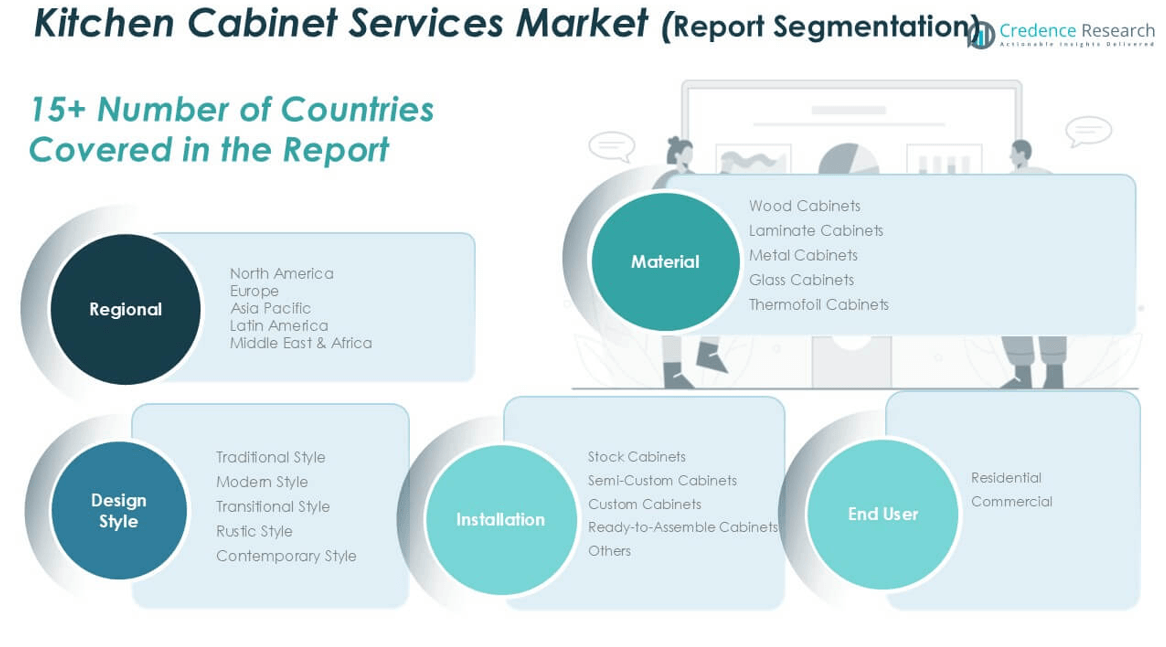
By Material
- Wood Cabinets
- Laminate Cabinets
- Metal Cabinets
- Glass Cabinets
- Thermofoil Cabinets
By Design Style
- Traditional Style
- Modern Style
- Transitional Style
- Rustic Style
- Contemporary Style
By Installation
- Stock Cabinets
- Semi-Custom Cabinets
- Custom Cabinets
- Ready-to-Assemble Cabinets
- Others
By End User Industry
- Residential
- Commercial
By Geography
- North America
- U.S.
- Canada
- Mexico
- Europe
- Germany
- France
- U.K.
- Italy
- Spain
- Rest of Europe
- Asia Pacific
- China
- Japan
- India
- South Korea
- South-east Asia
- Rest of Asia Pacific
- Latin America
- Brazil
- Argentina
- Rest of Latin America
- Middle East & Africa
- GCC Countries
- South Africa
- Rest of the Middle East and Africa
Competitive Landscape
The Kitchen Cabinet Services market is moderately consolidated, with several established players competing on the basis of product variety, customization options, pricing, and distribution reach. Leading companies such as MasterBrand Cabinets, Masco Corporation, and American Woodmark Corporation dominate the North American market through expansive dealer networks and branded showrooms. European manufacturers like Häcker Küchen, Nobilia, and Leicht Küchen emphasize high-end, modular kitchen systems with premium aesthetics and eco-friendly designs. Meanwhile, firms like Wren Kitchens and Howdens Joinery cater to both DIY and professional installation segments, offering integrated design-to-installation services. The growing demand for personalized and smart kitchen solutions is prompting key players to invest in advanced design software, virtual consultations, and sustainable materials. Mergers, acquisitions, and strategic partnerships are increasingly employed to enhance market presence and expand product portfolios. New entrants and regional players continue to challenge incumbents by offering cost-competitive and niche design services tailored to local consumer preferences.
Key Player Analysis
- Masterbrand Cabinets, Inc.
- Masco Corporation
- American Woodmark Corporation
- Cabinetworks Group
- Häcker Küchen GmbH & Co. KG
- Nobilia Küchen GmbH
- SieMatic Möbelwerke GmbH & Co. KG
- Poggenpohl Möbelwerke GmbH
- Leicht Küchen AG
- Wren Kitchens
- Howdens Joinery Group Plc
- Symphony Group Plc
- Alno AG
- Bulthaup GmbH & Co. KG
- Scavolini S.p.A.
Recent Developments
- In September 2024, Masterbrand Cabinets introduced their 2025 Impactful Cabinet Finishes, "Currant" and "Coastline". "Currant" is a bold, dramatic deep red, while "Coastline" is a light and airy finish. This launch signifies a shift towards more personalized and statement-driven kitchen designs.
- In February 2024, Isla Porter, a customized kitchen cupboards brand, announced plans to be officially launched in Spring 2024. The brand will provide advanced features, more than 70 finishes, and 20-door style options.
- In November 2023, Dura Supreme Cabinetry, a U.S.-based kitchen and bathroom cabinets company, officially commenced manufacturing cabinets at its new production plant in Statesville, North Carolina, U.S.
- In October 2023, Cabinets to Go, a U.S.-based specialty cabinet’s retailer, introduces its new kitchen closets line, including the Three spine Click Furniture Technology, which delivers long-lasting results, stability, and precise angles.
- In May 2022, SieMatic, a Germany-based kitchen manufacturer, launched its new luxury kitchen furniturecollection, including cabinets with metallic finish.
Market Concentration & Characteristics
The Kitchen Cabinet Services market demonstrates moderate to high concentration, with a few major players holding significant market shares due to their strong brand recognition, extensive distribution channels, and broad service portfolios. It is characterized by a mix of global manufacturers and regional providers competing on design innovation, customization, material quality, and service efficiency. Companies like Masterbrand Cabinets, Masco Corporation, and American Woodmark lead the market through integrated supply chains and strategic retail partnerships. It continues to attract demand across residential and commercial sectors, driven by evolving consumer preferences toward modern kitchen layouts and functional storage. The market features a strong inclination toward customization, digital design tools, and modular cabinet systems. Product differentiation remains a key competitive factor, with wood-based cabinets and semi-custom installations dominating. It also shows growing alignment with sustainability trends, as eco-conscious consumers influence material and design choices. Regional markets vary in maturity, with North America and Europe leading in value and Asia Pacific showing rapid expansion.
Report Coverage
The research report offers an in-depth analysis based on Material, Design Style, Installation, End User Industry and Geography. It details leading market players, providing an overview of their business, product offerings, investments, revenue streams, and key applications. Additionally, the report includes insights into the competitive environment, SWOT analysis, current market trends, as well as the primary drivers and constraints. Furthermore, it discusses various factors that have driven market expansion in recent years. The report also explores market dynamics, regulatory scenarios, and technological advancements that are shaping the industry. It assesses the impact of external factors and global economic changes on market growth. Lastly, it provides strategic recommendations for new entrants and established companies to navigate the complexities of the market.
Future Outlook
- The market will continue to grow steadily due to increasing demand for home renovation and remodeling projects.
- Consumers will show a rising preference for customized and modular kitchen cabinets that blend style with functionality.
- Technological advancements such as 3D design tools and virtual consultations will enhance customer engagement and satisfaction.
- Sustainable and eco-friendly materials will gain more traction as environmental awareness rises among homeowners.
- Online platforms and e-commerce channels will play a larger role in service booking and product selection.
- The integration of smart storage solutions and space-saving designs will drive innovation in cabinet services.
- Urbanization and rising disposable incomes in emerging economies will open new growth opportunities for service providers.
- Strategic partnerships between cabinet manufacturers and interior design firms will strengthen market reach and service quality.
- High competition will encourage companies to invest in better design aesthetics, installation services, and after-sales support.
- The adoption of AI and automation in manufacturing processes will improve efficiency and reduce lead times for custom orders.

Request a Free Sample
Fill in your details and we'll send you a free sample report.
- Sample data tables & charts
- Research methodology
Market Dynamics
Residential Construction and Renovation Boom
The surge in new residential construction and home renovation projects, especially in North America and Europe, is significantly increasing demand for kitchen cabinet services as homeowners seek to upgrade kitchens with modern, functional cabinetry.
Customization and Personalization Trends
Consumers are increasingly seeking personalized kitchen cabinet solutions tailored to their specific layouts, materials, and finishes, driving growth for providers offering semi-custom and fully customized cabinets.
Sustainability and Eco-Friendly Materials
Growing environmental awareness is pushing manufacturers and service providers to offer cabinets made from sustainable, low-emission, and recycled materials, which is particularly appealing in mature markets like Europe and North America.
Technological Advancements and Digital Tools
The adoption of digital visualization tools, 3D design software, and online configurators is transforming the customer experience, making it easier for consumers to design, customize, and purchase kitchen cabinets remotely.
Smart and Integrated Storage Solutions
Rising demand for smart storage features, such as built-in lighting, sensor-based drawers, and IoT-enabled cabinetry, is driving innovation and attracting premium customers seeking modern, tech-enhanced kitchen environments.
Need a Custom Version of This Report?
Tailor the scope, geography, or segments to your exact requirements.
- Custom geography or segment scope
- Direct access to our analyst team
Frequently Asked Questions
What is the current size of the Kitchen Cabinet Services Market?
What factors are driving the growth of the Kitchen Cabinet Services Market?
What are the key segments within the Kitchen Cabinet Services Market?
Who are the major players in the Kitchen Cabinet Services Market?
Table of Content
Chapter 1 Market Segmentation
- 1.1 Segmentation Framework
- 1.1.1 Product and Service Classification
- 1.1.2 Application and End-Use Classification
- 1.1.3 Technology and Solution Classification
- 1.1.4 Customer and Distribution Channel Classification
- 1.1.5 Geographic Segmentation
- 1.1.6 Market Segment Definitions and Boundaries
- 1.2 By Material
- 1.2.1 Wood Cabinets
- 1.2.2 Laminate Cabinets
- 1.2.3 Metal Cabinets
- 1.2.4 Glass Cabinets
- 1.2.5 Thermofoil Cabinets
- 1.3 By Design Style
- 1.3.1 Traditional Style
- 1.3.2 Modern Style
- 1.3.3 Transitional Style
- 1.3.4 Rustic Style
- 1.3.5 Contemporary Style
- 1.4 By Installation
- 1.4.1 Stock Cabinets
- 1.4.2 Semi-Custom Cabinets
- 1.4.3 Custom Cabinets
- 1.4.4 Ready-to-Assemble Cabinets
- 1.4.5 Others
- 1.5 By End User Industry
- 1.5.1 Residential
- 1.5.2 Commercial
Chapter 2 Introduction
- 2.1 Report Objectives and Scope
- 2.2 Product Definition and Industry Terminology
- 2.3 Market Inclusions and Exclusions
- 2.4 Research Process
- 2.4.1 Primary Research and Expert Interviews
- 2.4.2 Secondary Research and Source Review
- 2.4.3 Top-Down and Bottom-Up Estimation
- 2.4.4 Data Triangulation and Verification
- 2.5 Market Size Measurement Basis
- 2.5.1 2018: USD 19,235.4 million → 2032: USD 32,596.7 million
- 2.6 Historical and Forecast Reference Periods
- 2.6.1 Base Year: 2018
- 2.6.2 Forecast Period: 2018-2032
- 2.7 Research Assumptions and Limitations
Chapter 3 Executive Summary
- 3.1 Market Snapshot and Key Findings
- 3.2 Base-Year Market Size, 2018
- 3.3 Forecast Market Size, 2032
- 3.4 Revenue and Volume Growth Outlook
- 3.5 Key Demand and Supply Indicators
- 3.6 Leading Market Segments
- 3.7 Fastest-Growing Market Opportunities
- 3.8 Regional Performance Highlights
- 3.9 Technology and Industry Transformation
- 3.10 Competitive Landscape Summary
- 3.11 Analyst View and Strategic Implications
Chapter 4 Global Kitchen Cabinet Services Market Trends and Developments
- 4.1 Historical Industry Development
- 4.2 Recent Market Trends and Developments
- 4.3 Demand and Customer Behavior Trends
- 4.4 Technology and Product Innovation
- 4.5 Artificial Intelligence, Automation and Digitalization
- 4.6 Local Manufacturing and Supply Chain Realignment
- 4.7 Industry Partnerships, Mergers and Acquisitions
- 4.8 Sustainability and Circular Economy Developments
- 4.9 Government and Private Sector Investment Trends
- 4.10 Emerging Business Models and Commercialization
- 4.11 Industry Developments and Announcements
Chapter 5 Global Kitchen Cabinet Services Market Supply and Demand Analysis
- 5.1 Demand Trend and Consumption Analysis
- 5.2 Demand Forecast, 2018-2032
- 5.3 Supply Chain Structure and Procurement Trends
- 5.4 Supply-Demand Gap and Bottlenecks
- 5.5 Import Dependence and Sourcing Structure
- 5.6 Regional Supply and Demand Concentration
Chapter 6 Global Kitchen Cabinet Services Market Pricing Analysis
- 6.1 Pricing Structure and Measurement
- 6.2 Historical Pricing Trends
- 6.3 Pricing Outlook, 2018-2032
- 6.4 Pricing by Product and Market Segment
- 6.5 Geographic Pricing Differences
- 6.6 Key Input, Energy, Labor and Logistics Costs
- 6.7 Contract Pricing and Purchasing Models
- 6.8 Pricing Sensitivity and Competitive Positioning
- 6.9 Price, Margin and Profitability Implications
Chapter 7 Global Kitchen Cabinet Services Market Dynamics
- 7.1 Market Growth Drivers
- 7.1.1 Demand-Side Drivers
- 7.1.2 Technology and Innovation Drivers
- 7.1.3 Infrastructure and Investment Drivers
- 7.1.4 Regulatory and Policy Drivers
- 7.2 Market Restraints
- 7.2.1 Cost and Affordability Constraints
- 7.2.2 Technology and Adoption Barriers
- 7.2.3 Supply Chain and Operational Constraints
- 7.3 Market Challenges
- 7.3.1 Competitive Pressure and Margin Erosion
- 7.3.2 Skills, Infrastructure and Implementation Gaps
- 7.4 Emerging Market Opportunities
- 7.5 Market Dynamics Impact and Time-Horizon Assessment
Chapter 8 Global Kitchen Cabinet Services Value Chain Analysis
- 8.1 Industry Value Chain Overview
- 8.2 Upstream Suppliers and Critical Inputs
- 8.3 Technology and Component Providers
- 8.4 Manufacturing or Service Delivery
- 8.5 Distribution, Channel Partners and Integrators
- 8.6 Downstream Applications and End Users
- 8.7 Value Addition and Profit Pools
- 8.8 Vertical Integration and Outsourcing
- 8.9 Supplier Concentration and Risk
- 8.10 Supply Chain Localization and Resilience
Chapter 9 Global Kitchen Cabinet Services Market Regulations and Policies
- 9.1 Relevant Laws, Standards and Compliance Frameworks
- 9.2 Product, Service, Safety and Quality Requirements
- 9.3 Government Policies, Incentives and Subsidies
- 9.4 Imports, Exports and Trade Barriers
- 9.5 Public Procurement and Local Content Requirements
- 9.6 Data Protection, AI and Cybersecurity Compliance
- 9.7 Upcoming Policy Changes and Market Implications
Chapter 10 Global Kitchen Cabinet Services Market Hotspots and Opportunities
- 10.1 Market Opportunity Mapping and Growth Hotspots
- 10.2 High-Growth Applications and Customer Groups
- 10.3 Underserved Markets and White-Space Opportunities
- 10.4 Emerging Technology and Product Opportunities
- 10.5 New Capacity and Investment Hotspots
- 10.6 Market Entry and Expansion Opportunities
- 10.7 Distribution and Partnership Opportunities
- 10.8 Near-Term and Long-Term Commercial Potential
- 10.9 Opportunity Attractiveness and Execution Risks
Chapter 11 Global Kitchen Cabinet Services Market Outlook, 2018-2032
- 11.1 Market Size and Analysis
- 11.1.1 Revenue (Market Measurement: 2018: USD 19,235.4 million → 2032: USD 32,596.7 million)
- 11.1.2 Historical Market Size
- 11.1.3 Base-Year Market Size, 2018
- 11.2 Market Forecast, 2018-2032
- 11.2.1 Revenue Forecast to 2032
- 11.2.2 CAGR and Year-on-Year Growth
- 11.2.3 Incremental Revenue Opportunity
- 11.3 Forecast Assumptions and Scenario Analysis
- 11.3.1 Base-Case Forecast
- 11.3.2 Optimistic and Conservative Scenarios
- 11.3.3 Technology, Pricing and Policy Sensitivities
- 11.4 Market Attractiveness and Growth Outlook
Chapter 12 Global Kitchen Cabinet Services Market Segmentation and Outlook
- 12.1 Segmentation Summary and Market Shares, 2018
- 12.2 Largest and Fastest-Growing Segments
- 12.3 By Material - Market Size and Forecast, 2018-2032
- 12.3.1 Segment Definition and Scope
- 12.3.2 Historical Market Size
- 12.3.3 Revenue Forecast, 2018-2032
- 12.3.4 Base-Year Market Share, 2018
- 12.3.5 Segment CAGR and Growth Drivers
- 12.3.6 Subsegment Market Size and Forecast
- 12.3.6.1 Wood Cabinets
- 12.3.6.2 Laminate Cabinets
- 12.3.6.3 Metal Cabinets
- 12.3.6.4 Glass Cabinets
- 12.3.6.5 Thermofoil Cabinets
- 12.3.7 Subsegment Pricing and Adoption Trends
- 12.3.8 Leading Suppliers and Competition
- 12.3.9 Regional Demand and Opportunities
- 12.4 By Design Style - Market Size and Forecast, 2018-2032
- 12.4.1 Segment Definition and Scope
- 12.4.2 Historical Market Size
- 12.4.3 Revenue Forecast, 2018-2032
- 12.4.4 Base-Year Market Share, 2018
- 12.4.5 Segment CAGR and Growth Drivers
- 12.4.6 Subsegment Market Size and Forecast
- 12.4.6.1 Traditional Style
- 12.4.6.2 Modern Style
- 12.4.6.3 Transitional Style
- 12.4.6.4 Rustic Style
- 12.4.6.5 Contemporary Style
- 12.4.7 Subsegment Pricing and Adoption Trends
- 12.4.8 Leading Suppliers and Competition
- 12.4.9 Regional Demand and Opportunities
- 12.5 By Installation - Market Size and Forecast, 2018-2032
- 12.5.1 Segment Definition and Scope
- 12.5.2 Historical Market Size
- 12.5.3 Revenue Forecast, 2018-2032
- 12.5.4 Base-Year Market Share, 2018
- 12.5.5 Segment CAGR and Growth Drivers
- 12.5.6 Subsegment Market Size and Forecast
- 12.5.6.1 Stock Cabinets
- 12.5.6.2 Semi-Custom Cabinets
- 12.5.6.3 Custom Cabinets
- 12.5.6.4 Ready-to-Assemble Cabinets
- 12.5.6.5 Others
- 12.5.7 Subsegment Pricing and Adoption Trends
- 12.5.8 Leading Suppliers and Competition
- 12.5.9 Regional Demand and Opportunities
- 12.6 By End User Industry - Market Size and Forecast, 2018-2032
- 12.6.1 Segment Definition and Scope
- 12.6.2 Historical Market Size
- 12.6.3 Revenue Forecast, 2018-2032
- 12.6.4 Base-Year Market Share, 2018
- 12.6.5 Segment CAGR and Growth Drivers
- 12.6.6 Subsegment Market Size and Forecast
- 12.6.6.1 Residential
- 12.6.6.2 Commercial
- 12.6.7 Subsegment Pricing and Adoption Trends
- 12.6.8 Leading Suppliers and Competition
- 12.6.9 Regional Demand and Opportunities
- 12.7 Segment Growth Comparison
- 12.8 Segment Attractiveness and Priority Matrix
Chapter 13 Global Kitchen Cabinet Services End-Use and Application Market Outlook
- 13.1 End-Use Industry and Customer Demand Structure
- 13.2 Leading Applications and Customer Groups
- 13.3 End-Use Market Size, Share and Forecast
- 13.4 Major End-Use Industry Deep Dives
- 13.4.1 Customer Requirements and Use Cases
- 13.4.2 Demand and Replacement Cycles
- 13.4.3 Technical and Regulatory Considerations
- 13.4.4 Purchasing and Procurement Models
- 13.4.5 Leading Vendors and Distribution Channels
- 13.4.6 Forecast and Commercial Opportunities
- 13.5 Emerging Applications and Cross-Segment Demand
- 13.6 End-Use Industry Investment Priorities
Chapter 14 Global Kitchen Cabinet Services Geographic Market Outlook, 2018-2032
- 14.1 Regional Market Size and Share, 2018
- 14.2 Regional Market Forecast, 2018-2032
- 14.3 Regional Pricing, Production and Demand Differences
- 14.4 North America
- 14.4.1 United States
- 14.4.2 Canada
- 14.4.3 Mexico
- 14.5 Europe
- 14.5.1 Germany
- 14.5.2 France
- 14.5.3 Italy
- 14.5.4 United Kingdom
- 14.5.5 Spain
- 14.5.6 Poland
- 14.5.7 Russia
- 14.5.8 Netherlands
- 14.5.9 Belgium
- 14.5.10 Sweden
- 14.5.11 Denmark
- 14.5.12 Norway
- 14.5.13 Rest of Europe
- 14.6 Asia Pacific
- 14.6.1 China
- 14.6.2 India
- 14.6.3 Japan
- 14.6.4 South Korea
- 14.6.5 Thailand
- 14.6.6 Indonesia
- 14.6.7 Vietnam
- 14.6.8 Malaysia
- 14.6.9 Australia
- 14.6.10 Rest of Asia Pacific
- 14.7 Latin America
- 14.7.1 Brazil
- 14.7.2 Argentina
- 14.7.3 Colombia
- 14.7.4 Chile
- 14.7.5 Rest of Latin America
- 14.8 Middle East
- 14.8.1 Saudi Arabia
- 14.8.2 United Arab Emirates
- 14.8.3 Turkey
- 14.8.4 Israel
- 14.8.5 Iran
- 14.8.6 Rest of the Middle East
- 14.9 Africa
- 14.9.1 South Africa
- 14.9.2 Egypt
- 14.9.3 Nigeria
- 14.9.4 Morocco
- 14.9.5 Rest of Africa
- 14.10 Regional Investment, Policy and Supply Chain Differences
- 14.11 Regional Competitive Landscape
- 14.12 Geographic Growth Hotspots
Chapter 15 Global Kitchen Cabinet Services Technology, Innovation and Sustainability Outlook
- 15.1 Technology Landscape and Maturity
- 15.2 Product, Process and Service Innovation
- 15.3 AI, Automation and Digital Tools in the Industry
- 15.4 Technology Adoption and Performance Benchmarking
- 15.5 Innovation Pipeline and R&D Investment
- 15.6 Energy Efficiency and Resource Management
- 15.7 Sustainability, Recycling and Circularity
- 15.8 Technology Roadmap, 2018-2032
- 15.9 Risks of Obsolescence and Technology Substitution
Chapter 16 Global Kitchen Cabinet Services Market Key Strategic Imperatives
- 16.1 Growth and Market Entry Priorities
- 16.2 High-Return Products and Segments
- 16.3 Pricing, Profitability and Cost Optimization
- 16.4 Technology Investment and Product Differentiation
- 16.5 Supply Chain Localization and Resilience
- 16.6 Distribution and Customer Acquisition
- 16.7 Partnership, Acquisition and Capacity Strategy
- 16.8 Regional Expansion Priorities
- 16.9 Short-, Medium- and Long-Term Actions
Chapter 17 Competition Outlook
- 17.1 Industry Competition Characteristics
- 17.2 Market Structure and Concentration
- 17.3 Market Share and Competitive Positioning, 2018
- 17.4 Company-Wise Revenue and Product Benchmarking
- 17.5 Production and Service Capacity Benchmarking
- 17.6 Technology, Pricing and Differentiation
- 17.7 Regional Footprint and Distribution Strength
- 17.8 Mergers, Acquisitions and Strategic Alliances
- 17.9 New Entrants and Competitive Threats
- 17.10 Porter's Five Forces and Industry Attractiveness
- 17.11 Competitive Outlook, 2018-2032
Chapter 18 Company Profiles
- 18.1 Company Coverage and Selection Criteria
- 18.2 Masterbrand Cabinets, Inc.
- 18.2.1 Business Description
- 18.2.2 Company Ownership and Geographic Presence
- 18.2.3 Product and Service Portfolio
- 18.2.4 Manufacturing and Operating Footprint
- 18.2.5 Financial Performance and Investment
- 18.2.6 Market Share and Competitive Position
- 18.2.7 Technology and Innovation Capabilities
- 18.2.8 Strategic Alliances or Partnerships
- 18.2.9 Recent Developments
- 18.2.10 Growth Strategy and Outlook
- 18.3 Masco Corporation
- 18.4 American Woodmark Corporation
- 18.5 Cabinetworks Group
- 18.6 Häcker Küchen GmbH & Co. KG
- 18.7 Nobilia Küchen GmbH
- 18.8 SieMatic Möbelwerke GmbH & Co. KG
- 18.9 Poggenpohl Möbelwerke GmbH
- 18.10 Wren Kitchens
- 18.11 Howdens Joinery Group Plc
- 18.12 Other Relevant Market Participants
Note: Every listed company is profiled on the structure shown under the first company. The company list is preliminary and may change based on research findings, market developments, data availability and client requirements.
Chapter 19 Disclaimer
- 19.1 Research and Forecast Disclaimer
- 19.2 Data Source and Estimation Limitations
Note: The depth of individual sections depends on data availability for this market. Volume, capacity, trade and other unit-based metrics are included where applicable.

