
Market Overview
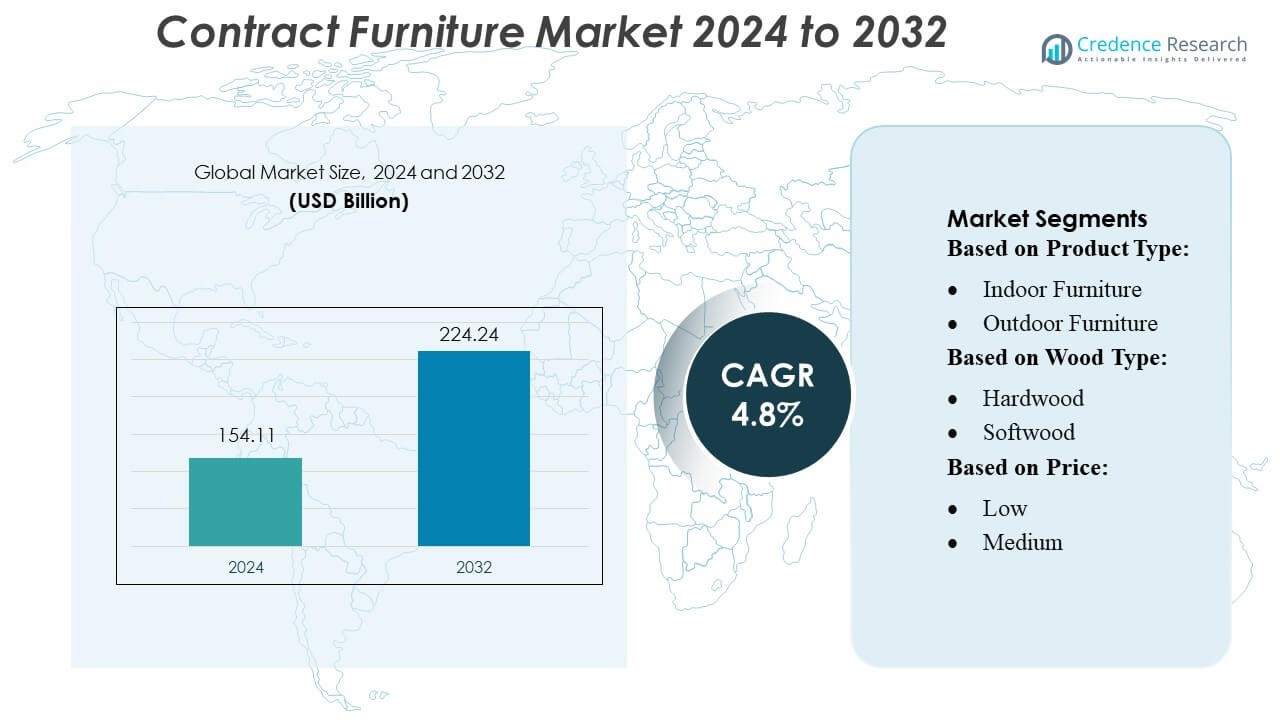
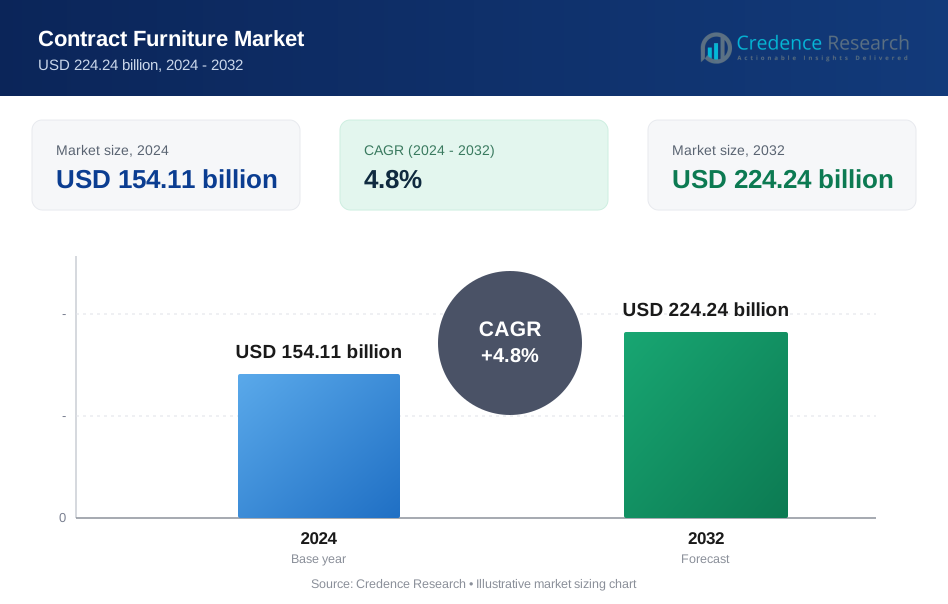
Contract Furniture Market size was valued USD 154.11 billion in 2024 and is anticipated to reach USD 224.24 billion by 2032, at a CAGR of 4.8% during the forecast period.
| REPORT ATTRIBUTE | DETAILS |
|---|---|
| Historical Period | 2020-2023 |
| Base Year | 2024 |
| Forecast Period | 2025-2032 |
| Contract Furniture Market Size 2024 | USD 154.11 Billion |
| Contract Furniture Market, CAGR | 4.8% |
| Contract Furniture Market Size 2032 | USD 224.24 Billion |
The Contract Furniture Market is shaped by major global players such as Haworth Inc., Herman Miller Inc., Steelcase Inc., HNI Corporation, Knoll Inc., Teknion, Kinnarps Group, Global Furniture Group, Sedus Stoll AG, and Martela, all of which compete through innovation in ergonomic design, modular solutions, and sustainability-focused manufacturing. These companies strengthen their market positions through product diversification, digital design tools, and tailored solutions for offices, hospitality, and institutional spaces. Asia Pacific leads the global market with an exact share of 39%, driven by rapid commercial development, strong urbanization, and expanding corporate infrastructure across major economies.
Market Insights
- The Contract Furniture Market was valued at USD 154.11 billion in 2024 and is projected to reach USD 224.24 billion by 2032, growing at a CAGR of 4.8%, supported by rising investments in workspace modernization and commercial infrastructure.
- Market growth is driven by increasing demand for ergonomic, modular, and flexible furniture solutions as organizations redesign offices to support hybrid work models and enhance employee well-being.
- Key trends include rapid adoption of sustainable materials, digital design tools, and customized project-based solutions, with major players innovating in circular design, smart features, and configurable layouts.
- Competitive intensity remains high as global and regional manufacturers expand portfolios, improve manufacturing efficiency, and focus on sustainability, while price pressure and raw-material volatility act as key restraints.
- Asia Pacific leads the market with a 39% share, followed by North America and Europe, while the indoor furniture segment dominates with over 57% share, supported by strong demand across corporate, hospitality, and institutional sectors.
Market Segmentation Analysis:
By Product Type
Indoor furniture is the dominant segment, capturing about 57% of the contract furniture market. Its lead comes from strong demand in offices, hotels, educational spaces, and commercial interiors that require durable and functional pieces year-round. Growth is supported by rising investments in ergonomic designs, modular layouts, and workspace modernization. Outdoor furniture is expanding steadily, but its share remains lower due to seasonal usage and limited application outside hospitality and leisure projects.
- For instance, Martela reported refurbishing over 23,140 pieces of used furniture through its Martela Outlet in 2023, integrating circular economy principles into its indoor offering.
By Wood Type
Hardwood holds the largest share at around 62%, driven by its strength, long lifespan, and premium appearance that appeal to high-traffic commercial environments. Businesses prefer hardwood for its durability and lower long-term maintenance. Softwood remains a smaller segment, chosen mainly for budget-friendly projects where ease of manufacturing and lightweight construction are priorities. However, increasing demand for sustainable and quickly renewable materials supports modest growth in softwood-based contract furniture.
- For instance, Steelcase has published 297 BIFMA LEVEL® certified products, many of which use responsibly sourced hardwood, as disclosed in its 2023 Impact Report.
By Price Range
The medium-price segment leads the market with approximately 52–53% share, as it offers a balanced mix of quality, durability, and affordability suitable for most commercial installations. Companies in corporate, hospitality, and institutional sectors prefer mid-range solutions because they provide reliable performance without the cost premium of high-end furniture. Low-price products attract cost-sensitive buyers for large-scale installations, while high-price furniture is chosen for luxury, boutique, or design-focused projects where aesthetics and customization matter most.
Key Growth Drivers
- Expansion of Commercial and Hospitality Infrastructure Rapid development of commercial spaces-including offices, coworking hubs, hotels, and mixed-use complexes-continues to drive strong demand for contract furniture. Companies increasingly invest in modern, ergonomic, and space-efficient setups to enhance productivity and visitor experience. Hospitality chains also require durable, coordinated furniture solutions for frequent refurbishment cycles. As global urbanization accelerates and developers prioritize quality interiors, demand rises for furniture offering long service life, standardized aesthetics, and compliance with safety norms, making infrastructure expansion a core market growth driver.
- For instance, Kinnarps Group advanced its circular-economy leadership by selling more than 4 million units of its modular 6000/8000/Plus task chairs since the early 1990s, as reported in their 2023 Sustainability Report.
- Rising Demand for Customization and Ergonomic Solutions Organizations are prioritizing customized layouts and ergonomic furniture to support employee well-being and brand-aligned interior design. The shift toward hybrid work models and flexible workspace planning increases demand for modular desks, collaborative seating, and adaptable configurations. Businesses across sectors-corporate, education, and healthcare-prefer solutions tailored to functionality, comfort, and durability. Growing awareness of ergonomics, productivity enhancement, and workplace health & safety standards further strengthens adoption. As companies redesign spaces for versatility and performance, customizable and ergonomic contract furniture experiences sustained market momentum.
- For instance, Global Furniture Group strengthens its technological edge with several verified innovations: for instance, it diverts 7.5 tons of wood and plastic waste every day using its patented wood/polymer molding process.
- Adoption of Sustainable Materials and Green Manufacturing Sustainability has become a major purchasing criterion as organizations commit to environmental certifications and carbon-reduction goals. Contract furniture manufacturers increasingly use certified wood, recycled materials, bio-based composites, and low-VOC finishes to meet regulatory and client expectations. Green manufacturing processes-such as energy-efficient production and responsible sourcing-enhance brand value and procurement eligibility for government and corporate buyers. With global emphasis on circularity, waste reduction, and eco-friendly interiors, sustainability initiatives significantly accelerate demand for environmentally responsible contract furniture solutions.
Key Trends & Opportunities
- Growth of Modular and Flexible Workspace Furniture As companies shift to hybrid and activity-based work models, modular furniture that allows quick reconfiguration is gaining traction. Demand grows for movable partitions, flexible seating, multi-functional desks, and furniture systems that adapt to changing team sizes and space requirements. This trend creates strong opportunities for manufacturers offering scalable, lightweight, and easy-to-assemble products. Educational and hospitality sectors also adopt flexible layouts to enhance space utility. The need for adaptable environments positions modular solutions as a key opportunity for future market expansion.
- For instance, Sedus Stoll AG has innovated with its se:matrix shelving system, which offers three standard modules that can be combined in linear or right-angled configurations, with widths from 400 mm to 2,000 mm and heights up to 2,015 mm.
- Rising Influence of Digital Procurement and Smart Furniture Digital procurement platforms, virtual design tools, and 3D visualization software increasingly influence purchasing behavior in the contract furniture market. Businesses prefer vendors offering digital catalogs, configurators, and online customization tools for faster decision-making. Simultaneously, smart furniture-such as sensor-enabled desks, occupancy-tracking systems, and connected ergonomics solutions-is emerging as a high-value opportunity. These technologies support space optimization and employee wellness strategies. As organizations prioritize data-driven interior planning, digitalization and smart features open new growth pathways for innovative manufacturers.
- For instance, Mirra 2 Chair and Stool now have a carbon footprint reduced by up to 17% compared with earlier versions, by using 100 percent recycled material in the nylon base and spine.
- Expansion in Healthcare and Educational Infrastructure Growing investment in healthcare and educational infrastructure presents substantial opportunities for contract furniture suppliers. Hospitals, clinics, and long-term care centers require resilient, hygienic, and compliant furniture. Meanwhile, universities and learning institutions increasingly adopt collaborative, ergonomic, and technology-integrated solutions to enhance learning environments. With global funding for these sectors rising, the demand for specialized contract furniture-such as medical seating, patient room furniture, lecture hall systems, and multipurpose classroom setups-continues to expand, supporting consistent market growth.
Key Challenges
- High Volatility in Raw Material Prices Fluctuations in the prices of wood, metal, foam, coatings, and polymers significantly impact the cost structure of contract furniture manufacturers. Supply chain disruptions, inflation, and global logistics constraints further amplify pricing instability. This volatility challenges companies in maintaining profit margins-especially in large-scale contracts with fixed pricing. Manufacturers must navigate unpredictable input costs while ensuring product quality and delivery timelines. As a result, the industry faces increasing pressure to adopt strategic sourcing, material optimization, and cost-efficient design practices.
- Intense Competition and Pressure for Price Differentiation The market is highly competitive, with global brands, regional manufacturers, and low-cost suppliers all vying for large enterprise and institutional contracts. Buyers often prioritize price, durability, and delivery timelines, making differentiation difficult for mid-tier manufacturers. Frequent bidding wars and procurement-driven negotiations compress margins. Additionally, the need for continuous design innovation-combined with rising expectations for sustainability and customization-adds operational complexity. This competitive landscape poses a significant challenge for companies aiming to balance affordability, innovation, and long-term profitability.
Regional Analysis
North America
North America holds about 30% of the contract furniture market, supported by strong demand from offices, hospitality, and institutional facilities. Companies continue modernizing workspaces with ergonomic, modular, and sustainable furniture, which drives steady growth. The region benefits from high commercial construction activity and early adoption of workspace trends such as hybrid offices and flexible layouts. Major manufacturers and design-focused companies are also based in the U.S., strengthening regional supply. Rising investments in corporate renovations and green-certified interiors further support North America’s leading position in the market.
Europe
Europe accounts for roughly 30% of global contract furniture sales, driven by high-quality manufacturing, strong design standards, and strict sustainability regulations. Demand is strong in offices, education, and hospitality, especially in Germany, the UK, France, and the Nordic countries. The region’s focus on eco-friendly materials and workplace well-being influences procurement decisions, supporting advanced ergonomic and modular solutions. Renovation of aging commercial infrastructure and increased investment in collaborative and flexible spaces also contribute to growth, keeping Europe a key market with consistent long-term demand.
Asia Pacific
Asia Pacific holds the largest share, around 38–40%, making it the fastest-growing region in the contract furniture market. Rapid urbanization, expanding office spaces, and rising investments in hospitality and commercial buildings drive strong demand. China, India, Japan, and Southeast Asia lead growth due to large-scale real estate development and increasing adoption of affordable modular furniture. Expanding corporate presence and rising middle-class consumption further boost the market. The region also benefits from cost-efficient manufacturing, enabling wide product availability across mid-range and budget segments.
Latin America
Latin America captures around 5–6% of the market, supported by ongoing commercial development in Brazil, Mexico, and Chile. Demand increases as multinational companies expand operations and the hospitality sector grows. Buyers prioritize cost-effective, durable furniture suited for high-use environments. However, economic fluctuations and import dependencies slow overall growth. Local manufacturers and global suppliers are responding with competitively priced modular furniture to meet rising office and institutional needs, helping the region maintain steady but moderate progress.
Middle East & Africa
The Middle East & Africa holds about 4–5% of the contract furniture market, with demand concentrated in Gulf countries such as the UAE and Saudi Arabia. Large-scale commercial, hospitality, and mixed-use developments continue to drive procurement of high-end and customized contract furniture. Government diversification programs and investment in tourism, offices, and educational facilities support market expansion. While the region remains smaller in size, strong construction activity and premium design requirements create solid opportunities for luxury, durable, and project-specific furniture solutions.
Market Segmentations:
By Product Type:
- Indoor Furniture
- Outdoor Furniture
By Wood Type:
- Hardwood
- Softwood
By Price:
- Low
- Medium
By Geography
- North America
- U.S.
- Canada
- Mexico
- Europe
- Germany
- France
- U.K.
- Italy
- Spain
- Rest of Europe
- Asia Pacific
- China
- Japan
- India
- South Korea
- South-east Asia
- Rest of Asia Pacific
- Latin America
- Brazil
- Argentina
- Rest of Latin America
- Middle East & Africa
- GCC Countries
- South Africa
- Rest of the Middle East and Africa
Competitive Landscape
The competitive landscape of the Contract Furniture Market features leading global players such as Martela, Steelcase Inc., Kinnarps Group, Knoll Inc., Global Furniture Group, Sedus Stoll AG, Teknion, Herman Miller Inc., HNI Corporation, and Haworth Inc. The Contract Furniture Market is characterized by strong competition among global and regional manufacturers that focus on design innovation, product durability, and large-scale project capabilities. Companies compete by expanding modular and ergonomic furniture lines that support hybrid work models, flexible layouts, and collaborative spaces. Sustainability has become a major differentiator, with manufacturers integrating certified wood, recycled materials, and low-emission finishes into their portfolios. Digital configurators, rapid customization, and project-specific furnishing solutions strengthen customer engagement and procurement efficiency. Additionally, firms continue investing in automation, global distribution networks, and strategic partnerships to capture demand from offices, hospitality, education, and healthcare sectors.
Key Player Analysis
- Martela
- Steelcase Inc.
- Kinnarps Group
- Knoll Inc.
- Global Furniture Group
- Sedus Stoll AG
- Teknion
- Herman Miller Inc.
- HNI Corporation
- Haworth Inc.
Recent Developments
- In March 2024, Teknion announced a partnership with the UK-based furniture maker Modus. Modus is the first British-based partner with Teknion, and this new venture enabled both parties to expand their global presence and localize their manufacturing capabilities.
- In January 2024, Hooker Furnishings launched two new showrooms at the Las Vegas Market for its Pulaski, Samuel Lawrence Drew & Jonathan Home, and PRI brands to broaden its customer base and support its diversification strategy. The company showcased its brands across a total of four showrooms at the market to reinforce its growth initiatives and market outreach.
- In April 2023, Godrej and Boyce launched i-Report, an app that seeks to better the safety standards in the material handling sector in India. The app provides incident reporting, auditing, training, and consultation as remote and real-time services. Therefore, it fills the gaps of the industry’s safety policies and standards and provides a 360-degree safety solution to clients and partners.
Report Coverage
The research report offers an in-depth analysis based on Product Type, Wood Type, Price and Geography. It details leading market players, providing an overview of their business, product offerings, investments, revenue streams, and key applications. Additionally, the report includes insights into the competitive environment, SWOT analysis, current market trends, as well as the primary drivers and constraints. Furthermore, it discusses various factors that have driven market expansion in recent years. The report also explores market dynamics, regulatory scenarios, and technological advancements that are shaping the industry. It assesses the impact of external factors and global economic changes on market growth. Lastly, it provides strategic recommendations for new entrants and established companies to navigate the complexities of the market.
Future Outlook
- The market will continue expanding as companies redesign workplaces to support hybrid and flexible work models.
- Demand for ergonomic and wellness-focused furniture will rise as organizations prioritize employee comfort and productivity.
- Sustainable materials and circular design practices will become standard requirements across major procurement projects.
- Modular and reconfigurable furniture systems will gain traction due to their adaptability in dynamic commercial spaces.
- Smart furniture with sensors and occupancy-tracking features will see increased adoption in modern offices.
- Hospitality and education sectors will drive new opportunities as institutions invest in modern interior upgrades.
- Manufacturers will strengthen digital tools such as 3D configurators and virtual design platforms to improve client engagement.
- Regional production capabilities will expand as companies reduce supply-chain risks and lead times.
- Customized and project-specific furniture solutions will become more common in large commercial developments.
- Competition will intensify as global and regional players diversify portfolios to address evolving design and sustainability standards.
Request a Free Sample
Fill in your details and we'll send you a free sample report.
- Sample data tables & charts
- Research methodology
Need a Custom Version of This Report?
Tailor the scope, geography, or segments to your exact requirements.
- Custom geography or segment scope
- Direct access to our analyst team
Frequently Asked Questions
What is the current market size for the Contract Furniture Market, and what is its projected size in 2032?
At what Compound Annual Growth Rate is the Contract Furniture Market projected to grow between 2025 and 2032?
Which Contract Furniture Market segment held the largest share in 2024?
What are the primary factors fueling the growth of the Contract Furniture Market?
Who are the leading companies in the Contract Furniture Market?
Which region commanded the largest share of the Contract Furniture Market in 2024?
Table of Content
Chapter 1 Market Segmentation
- 1.1 Segmentation Framework
- 1.1.1 Product and Service Classification
- 1.1.2 Application and End-Use Classification
- 1.1.3 Technology and Solution Classification
- 1.1.4 Customer and Distribution Channel Classification
- 1.1.5 Geographic Segmentation
- 1.1.6 Market Segment Definitions and Boundaries
Chapter 2 Introduction
- 2.1 Report Objectives and Scope
- 2.2 Product Definition and Industry Terminology
- 2.3 Market Inclusions and Exclusions
- 2.4 Research Process
- 2.4.1 Primary Research and Expert Interviews
- 2.4.2 Secondary Research and Source Review
- 2.4.3 Top-Down and Bottom-Up Estimation
- 2.4.4 Data Triangulation and Verification
- 2.5 Market Size Measurement Basis
- 2.5.1 2024: USD 154.11 billion → 2032: USD 224.24 billion
- 2.6 Historical and Forecast Reference Periods
- 2.6.1 Base Year: 2024
- 2.6.2 Forecast Period: 2024-2032
- 2.7 Research Assumptions and Limitations
Chapter 3 Executive Summary
- 3.1 Market Snapshot and Key Findings
- 3.2 Base-Year Market Size, 2024
- 3.3 Forecast Market Size, 2032
- 3.4 Revenue and Volume Growth Outlook
- 3.5 Key Demand and Supply Indicators
- 3.6 Leading Market Segments
- 3.7 Fastest-Growing Market Opportunities
- 3.8 Regional Performance Highlights
- 3.9 Technology and Industry Transformation
- 3.10 Competitive Landscape Summary
- 3.11 Analyst View and Strategic Implications
Chapter 4 Global Contract Furniture Market Trends and Developments
- 4.1 Historical Industry Development
- 4.2 Recent Market Trends and Developments
- 4.3 Demand and Customer Behavior Trends
- 4.4 Technology and Product Innovation
- 4.5 Artificial Intelligence, Automation and Digitalization
- 4.6 Local Manufacturing and Supply Chain Realignment
- 4.7 Industry Partnerships, Mergers and Acquisitions
- 4.8 Sustainability and Circular Economy Developments
- 4.9 Government and Private Sector Investment Trends
- 4.10 Emerging Business Models and Commercialization
- 4.11 Industry Developments and Announcements
Chapter 5 Global Contract Furniture Market Production, Supply and Demand Analysis
- 5.1 Demand Trend and Consumption Analysis
- 5.2 Demand Forecast, 2024-2032
- 5.3 Production and Output Trend
- 5.4 Production and Output Forecast, 2024-2032
- 5.5 Installed Capacity and Capacity Utilization
- 5.6 Company-Wise Production Plants and Statistics
- 5.6.1 Installed Production Capacity
- 5.6.2 Actual Production
- 5.6.3 Planned Capacity and Expansion Targets
- 5.7 Supply Chain Structure and Procurement Trends
- 5.8 Supply-Demand Gap and Bottlenecks
- 5.9 Import Dependence and Sourcing Structure
- 5.10 Contract Manufacturing and Outsourcing
- 5.11 Regional Supply and Demand Concentration
Chapter 6 Global Contract Furniture Market Pricing Analysis
- 6.1 Pricing Structure and Measurement
- 6.2 Historical Pricing Trends
- 6.3 Pricing Outlook, 2024-2032
- 6.4 Average Selling Price and Unit Economics
- 6.5 Pricing by Product and Market Segment
- 6.6 Geographic Pricing Differences
- 6.7 Key Input, Energy, Labor and Logistics Costs
- 6.8 Contract Pricing and Purchasing Models
- 6.9 Pricing Sensitivity and Competitive Positioning
- 6.10 Price, Margin and Profitability Implications
Chapter 7 Global Contract Furniture Market Dynamics
- 7.1 Market Growth Drivers
- 7.1.1 Demand-Side Drivers
- 7.1.2 Technology and Innovation Drivers
- 7.1.3 Infrastructure and Investment Drivers
- 7.1.4 Regulatory and Policy Drivers
- 7.2 Market Restraints
- 7.2.1 Cost and Affordability Constraints
- 7.2.2 Technology and Adoption Barriers
- 7.2.3 Supply Chain and Operational Constraints
- 7.3 Market Challenges
- 7.3.1 Competitive Pressure and Margin Erosion
- 7.3.2 Skills, Infrastructure and Implementation Gaps
- 7.4 Emerging Market Opportunities
- 7.5 Market Dynamics Impact and Time-Horizon Assessment
Chapter 8 Global Contract Furniture Value Chain Analysis
- 8.1 Industry Value Chain Overview
- 8.2 Upstream Suppliers and Critical Inputs
- 8.3 Technology and Component Providers
- 8.4 Manufacturing or Service Delivery
- 8.5 Distribution, Channel Partners and Integrators
- 8.6 Downstream Applications and End Users
- 8.7 Value Addition and Profit Pools
- 8.8 Vertical Integration and Outsourcing
- 8.9 Supplier Concentration and Risk
- 8.10 Supply Chain Localization and Resilience
Chapter 9 Global Contract Furniture Market Regulations and Policies
- 9.1 Relevant Laws, Standards and Compliance Frameworks
- 9.2 Product, Service, Safety and Quality Requirements
- 9.3 Government Policies, Incentives and Subsidies
- 9.4 Imports, Exports and Trade Barriers
- 9.5 Public Procurement and Local Content Requirements
- 9.6 Environmental and Sustainability Compliance
- 9.7 Upcoming Policy Changes and Market Implications
Chapter 10 Global Contract Furniture Market Hotspots and Opportunities
- 10.1 Market Opportunity Mapping and Growth Hotspots
- 10.2 High-Growth Applications and Customer Groups
- 10.3 Underserved Markets and White-Space Opportunities
- 10.4 Emerging Technology and Product Opportunities
- 10.5 New Capacity and Investment Hotspots
- 10.6 Market Entry and Expansion Opportunities
- 10.7 Distribution and Partnership Opportunities
- 10.8 Near-Term and Long-Term Commercial Potential
- 10.9 Opportunity Attractiveness and Execution Risks
Chapter 11 Global Contract Furniture Market Outlook, 2024-2032
- 11.1 Market Size and Analysis
- 11.1.1 Revenue (Market Measurement: 2024: USD 154.11 billion → 2032: USD 224.24 billion)
- 11.1.2 Market Volume and Quantity Sold
- 11.1.3 Historical Market Size
- 11.1.4 Base-Year Market Size, 2024
- 11.2 Market Forecast, 2024-2032
- 11.2.1 Revenue Forecast to 2032
- 11.2.2 Volume Forecast to 2032
- 11.2.3 CAGR and Year-on-Year Growth
- 11.2.4 Incremental Revenue Opportunity
- 11.3 Forecast Assumptions and Scenario Analysis
- 11.3.1 Base-Case Forecast
- 11.3.2 Optimistic and Conservative Scenarios
- 11.3.3 Technology, Pricing and Policy Sensitivities
- 11.4 Market Attractiveness and Growth Outlook
Chapter 12 Global Contract Furniture Market Segmentation and Outlook
- 12.1 Segmentation Summary and Market Shares, 2024
- 12.2 Largest and Fastest-Growing Segments
- 12.3 Segment Growth Comparison
- 12.4 Segment Attractiveness and Priority Matrix
Chapter 13 Global Contract Furniture Geographic Market Outlook, 2024-2032
- 13.1 Regional Market Size and Share, 2024
- 13.2 Regional Market Forecast, 2024-2032
- 13.3 Regional Pricing, Production and Demand Differences
- 13.4 North America
- 13.4.1 United States
- 13.4.2 Canada
- 13.4.3 Mexico
- 13.5 Europe
- 13.5.1 Germany
- 13.5.2 France
- 13.5.3 Italy
- 13.5.4 United Kingdom
- 13.5.5 Spain
- 13.5.6 Poland
- 13.5.7 Russia
- 13.5.8 Netherlands
- 13.5.9 Belgium
- 13.5.10 Sweden
- 13.5.11 Denmark
- 13.5.12 Norway
- 13.5.13 Rest of Europe
- 13.6 Asia Pacific
- 13.6.1 China
- 13.6.2 India
- 13.6.3 Japan
- 13.6.4 South Korea
- 13.6.5 Thailand
- 13.6.6 Indonesia
- 13.6.7 Vietnam
- 13.6.8 Malaysia
- 13.6.9 Australia
- 13.6.10 Rest of Asia Pacific
- 13.7 Latin America
- 13.7.1 Brazil
- 13.7.2 Argentina
- 13.7.3 Colombia
- 13.7.4 Chile
- 13.7.5 Rest of Latin America
- 13.8 Middle East
- 13.8.1 Saudi Arabia
- 13.8.2 United Arab Emirates
- 13.8.3 Turkey
- 13.8.4 Israel
- 13.8.5 Iran
- 13.8.6 Rest of the Middle East
- 13.9 Africa
- 13.9.1 South Africa
- 13.9.2 Egypt
- 13.9.3 Nigeria
- 13.9.4 Morocco
- 13.9.5 Rest of Africa
- 13.10 Regional Investment, Policy and Supply Chain Differences
- 13.11 Regional Competitive Landscape
- 13.12 Geographic Growth Hotspots
Chapter 14 Global Contract Furniture Technology, Innovation and Sustainability Outlook
- 14.1 Technology Landscape and Maturity
- 14.2 Product, Process and Service Innovation
- 14.3 AI, Automation and Digital Tools in the Industry
- 14.4 Technology Adoption and Performance Benchmarking
- 14.5 Innovation Pipeline and R&D Investment
- 14.6 Patent and Intellectual Property Trends
- 14.7 Energy Efficiency and Resource Management
- 14.8 Sustainability, Recycling and Circularity
- 14.9 Technology Roadmap, 2024-2032
- 14.10 Risks of Obsolescence and Technology Substitution
Chapter 15 Global Contract Furniture Market Key Strategic Imperatives
- 15.1 Growth and Market Entry Priorities
- 15.2 High-Return Products and Segments
- 15.3 Pricing, Profitability and Cost Optimization
- 15.4 Technology Investment and Product Differentiation
- 15.5 Supply Chain Localization and Resilience
- 15.6 Distribution and Customer Acquisition
- 15.7 Partnership, Acquisition and Capacity Strategy
- 15.8 Regional Expansion Priorities
- 15.9 Short-, Medium- and Long-Term Actions
Chapter 16 Competition Outlook
- 16.1 Industry Competition Characteristics
- 16.2 Market Structure and Concentration
- 16.3 Market Share and Competitive Positioning, 2024
- 16.4 Company-Wise Revenue and Product Benchmarking
- 16.5 Production and Service Capacity Benchmarking
- 16.6 Technology, Pricing and Differentiation
- 16.7 Regional Footprint and Distribution Strength
- 16.8 Mergers, Acquisitions and Strategic Alliances
- 16.9 New Entrants and Competitive Threats
- 16.10 Porter's Five Forces and Industry Attractiveness
- 16.11 Competitive Outlook, 2024-2032
Chapter 17 Company Profiles
- 17.1 Company Coverage and Selection Criteria
- 17.2 Leading Market Participants – Standard Profile Structure
- 17.2.1 Business Description
- 17.2.2 Company Ownership and Geographic Presence
- 17.2.3 Product and Service Portfolio
- 17.2.4 Manufacturing and Operating Footprint
- 17.2.5 Production Capacity and Expansion Plans
- 17.2.6 Financial Performance and Investment
- 17.2.7 Market Share and Competitive Position
- 17.2.8 Technology and Innovation Capabilities
- 17.2.9 Strategic Alliances or Partnerships
- 17.2.10 Recent Developments
- 17.2.11 Growth Strategy and Outlook
- 17.3 Other Relevant Market Participants
Note: Every listed company is profiled on the structure shown under the first company. The company list is preliminary and may change based on research findings, market developments, data availability and client requirements.
Chapter 18 Disclaimer
- 18.1 Research and Forecast Disclaimer
- 18.2 Data Source and Estimation Limitations
Note: The depth of individual sections depends on data availability for this market. Volume, capacity, trade and other unit-based metrics are included where applicable.
