
| REPORT ATTRIBUTE | DETAILS |
|---|---|
| Historical Period | 2020-2023 |
| Base Year | 2024 |
| Forecast Period | 2025-2032 |
| Linear Guide (Linear Guide Rail) Market Size 2024 | USD 68465.68 million |
| Linear Guide (Linear Guide Rail) Market, CAGR | 7.04% |
| Linear Guide (Linear Guide Rail) Market Size 2032 | USD 117989 million |
Market Overview:
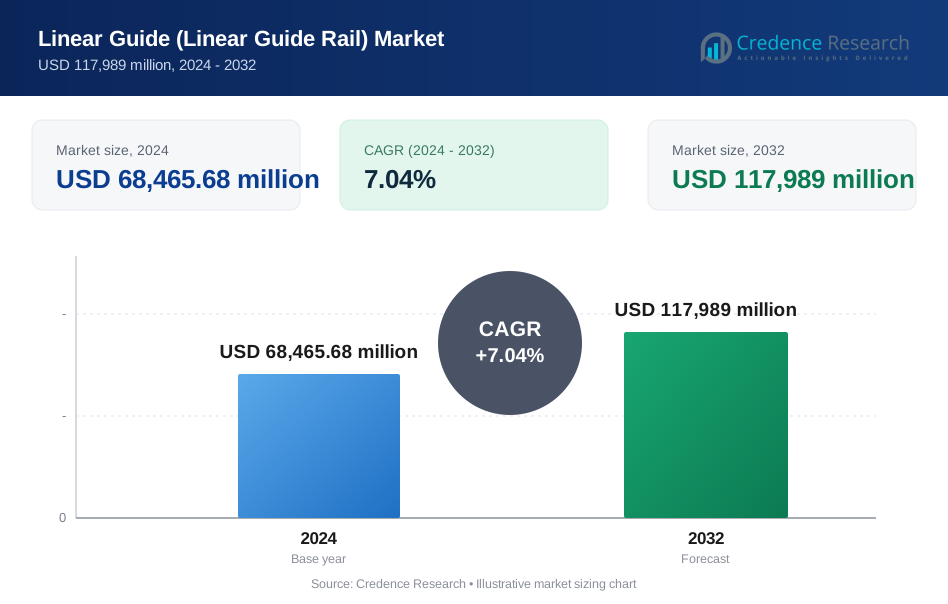
Linear Guide (Linear Guide Rail) Market size was valued at USD 68465.68 million in 2024 and is anticipated to reach USD 117989 million by 2032, at a CAGR of 7.04% during the forecast period (2024-2032).
The market benefits from rising automation in manufacturing processes, where robotic systems, CNC machines, and semiconductor equipment rely heavily on linear motion components for reliable performance. As industries shift toward smart factories and digital transformation, demand for precise and repeatable linear motion solutions continues to rise. Moreover, the growing adoption of advanced technologies in the medical sector-such as diagnostic devices and surgical robots-further boosts demand for compact, low-noise, and high-accuracy linear guides. The increasing focus on efficiency, product quality, and equipment lifespan also drives the replacement and upgrading of conventional motion systems with advanced linear guide rails. Manufacturers are investing in materials innovation and surface treatments to improve guide rail durability and reduce wear. The integration of IoT and predictive maintenance capabilities is also driving the development of intelligent linear guide systems.
Regionally, Asia Pacific dominates the Linear Guide Market, accounting for the largest revenue share due to the presence of manufacturing hubs in China, Japan, South Korea, and Taiwan. The region's strong electronics and automotive industries significantly contribute to market expansion. Government initiatives promoting industrial automation and smart manufacturing further support long-term market growth in the region. Domestic players are also expanding production capacities and entering into partnerships to meet global demand. North America follows, driven by technological innovation, demand for high-performance machinery, and ongoing investments in industrial automation. Europe holds a stable position, supported by its strong engineering base and emphasis on energy-efficient production systems. Emerging markets in Southeast Asia and Latin America also offer promising growth potential, backed by expanding industrial infrastructure and rising investments in automation solutions. Strategic trade policies and favorable foreign direct investment flows are expected to strengthen market penetration in these developing regions.
Market Insights:
- The Linear Guide (Linear Guide Rail) Market was valued at USD 68,465.68 million in 2024 and is projected to reach USD 117,989 million by 2032, registering a CAGR of 7.04% during the forecast period.
- Demand continues to rise with increasing use of CNC machines, robotics, and semiconductor equipment across automated and smart manufacturing environments.
- Technological innovations in coatings, corrosion-resistant alloys, and sensor integration are improving product life, motion precision, and predictive maintenance capabilities.
- The market sees growing application in the healthcare sector, where surgical robots, diagnostic machines, and lab automation require compact, accurate, and low-noise components.
- Electronics and semiconductor industries rely on linear guides for wafer processing, chip inspection, and PCB assembly, driving strong demand for cleanroom-compatible systems.
- High initial costs, custom configuration needs, and susceptibility to dust, moisture, and harsh environments limit adoption, especially in small-scale or rugged settings.
- Asia Pacific leads with 48% market share, followed by North America with 22% and Europe with 18%, supported by strong industrial infrastructure, automation trends, and engineering capabilities.
Market Drivers:
Rapid Industrial Automation Across Key Manufacturing Sectors:
The widespread shift toward automation across automotive, electronics, and heavy machinery sectors fuels strong demand for high-precision linear motion systems. The Linear Guide (Linear Guide Rail) Market benefits directly from the integration of robotic arms, CNC machinery, and automated assembly lines, where precision and reliability are essential. Industries increasingly rely on linear guides for accurate positioning and smooth motion control in high-speed operations. Demand continues to grow with rising adoption of Industry 4.0 practices and smart manufacturing. Linear guides enable reduced operational downtime and improved production output. Their role in enhancing machine tool performance further strengthens their relevance in competitive manufacturing environments.
Technological Advancements in Materials and Design:
Continuous innovation in materials, coatings, and design significantly improves the performance and lifespan of linear guide rails. It now features corrosion-resistant alloys, low-friction surfaces, and compact profiles suited for space-constrained applications. These advancements enhance load-bearing capacity and wear resistance, supporting more demanding industrial uses. Manufacturers focus on improving accuracy, reducing noise, and increasing energy efficiency in motion systems. The Linear Guide (Linear Guide Rail) Market experiences growth from industries seeking durable and maintenance-efficient solutions. Smart linear guides with integrated sensors also support predictive maintenance and real-time diagnostics, improving operational efficiency.
- For instance, THK’s LM Guide series incorporates proprietary ball cage technology for enhanced load capacity and service life, and their OMNIedge IoT-enabled service provides predictive failure detection for linear motion components.
Growth in Medical Equipment and Precision Healthcare Devices:
The rise of advanced medical technologies, such as robotic surgery systems and diagnostic imaging equipment, drives demand for compact and ultra-precise motion components. It plays a vital role in supporting low-vibration, high-stability movement within sensitive medical systems. Hospitals and laboratories require equipment that delivers accurate, repeatable positioning, particularly in imaging and automated diagnostics. The Linear Guide (Linear Guide Rail) Market gains traction in healthcare due to growing focus on hygiene, compact design, and long-term reliability. Increased investment in medical infrastructure globally supports this expansion. Regulatory standards in healthcare also favor high-precision and low-noise components.
- For instance, THK’s LM Guide rails are widely used in medical imaging devices and surgical robots for their precision and reliability.
Rising Demand from Semiconductor and Electronics Manufacturing:
Semiconductor fabrication and electronics assembly require extreme precision, making linear guides indispensable in cleanroom-grade machinery. It supports wafer handling, lithography systems, and chip inspection units where micron-level accuracy is mandatory. The Linear Guide (Linear Guide Rail) Market expands with rising electronics production and miniaturization of components. Equipment used in PCB manufacturing, laser cutting, and SMT placement increasingly incorporates advanced linear guides. Manufacturers prioritize smooth, stable motion in high-speed applications to reduce defect rates. This demand aligns with continuous growth in consumer electronics, telecommunications, and data processing sectors.
Market Trends:
Integration of Smart Technologies and Sensor-Enabled Linear Motion Systems:
The increasing integration of smart technologies into industrial equipment is transforming the linear motion landscape. The Linear Guide (Linear Guide Rail) Market is witnessing strong adoption of sensor-enabled guide rails that provide real-time data on load, position, temperature, and wear conditions. It enables predictive maintenance and reduces unplanned downtimes, supporting higher equipment uptime and operational efficiency. Manufacturers are embedding IoT capabilities and wireless connectivity into linear guides to align with Industry 4.0 frameworks. These advancements help in remote monitoring and control of machinery, especially in high-precision sectors like semiconductor and aerospace. The trend also supports enhanced traceability and system diagnostics across automated production lines.
- For instance, Bosch Rexroth offers linear motion systems with integrated sensors and IoT connectivity for real-time monitoring and predictive maintenance in semiconductor manufacturing environments.
Miniaturization and Customization to Meet Application-Specific Needs:
Demand for compact and lightweight components is pushing manufacturers to develop miniaturized linear guide systems. The Linear Guide (Linear Guide Rail) Market is adapting to this trend by offering slim-profile products for limited-space applications in electronics, medical devices, and laboratory automation. It encourages the development of customized rail and block configurations tailored to industry-specific requirements. Companies focus on offering application-specific features such as high corrosion resistance, cleanroom compatibility, and ultra-smooth motion. The shift toward compact designs supports equipment miniaturization without compromising performance. This trend aligns with the broader push toward efficient, space-saving machinery across industrial and healthcare environments.
- For instance, igus GmbH provides the drylin® TK-01-30-01 linear guide system, which is certified for ISO class 3 cleanroom use and is designed for compact, contamination-sensitive applications in medical and laboratory equipment.
Market Challenges Analysis:
High Initial Costs and Complex Installation Requirements:
The high upfront cost of precision linear guide systems limits adoption, especially among small and medium enterprises. Many applications require custom configurations, which further increase costs related to design, installation, and alignment. The Linear Guide (Linear Guide Rail) Market faces resistance from industries with limited automation budgets or reliance on traditional motion systems. It also requires skilled technicians for accurate setup and periodic maintenance, creating additional resource challenges. Improper installation can lead to premature wear, reduced accuracy, and equipment failure. These factors make cost justification difficult for users operating in low-margin or low-volume production environments.
- For instance, igus has developed cost-effective linear guides that offer a longer service life and reduced maintenance costs, making them accessible and practical for a wide variety of applications, even where budget constraints exist.
Susceptibility to Harsh Environmental Conditions:
Exposure to dust, moisture, temperature extremes, and chemical agents negatively impacts linear guide performance. It requires frequent maintenance or protective modifications when used in heavy industrial, outdoor, or corrosive settings. The Linear Guide (Linear Guide Rail) Market struggles to address the reliability concerns of end-users operating in these environments. Inadequate sealing or lubrication often leads to increased friction and reduced lifespan. Industries such as mining or food processing demand higher durability, which not all standard guide rails can meet. This challenge drives the need for specialized solutions that increase total ownership cost.
Market Opportunities:
Expansion of Industrial Automation in Emerging Economies:
The rapid industrialization of emerging economies offers strong growth potential for motion control technologies. Countries in Asia, Latin America, and Eastern Europe are investing in manufacturing infrastructure and modernizing production processes. The Linear Guide (Linear Guide Rail) Market can capitalize on rising demand for cost-effective, high-precision motion systems in these regions. It supports automation in industries such as packaging, electronics, automotive, and food processing. Government incentives for smart factories and digitalization further accelerate the adoption of linear guide solutions. Growing foreign direct investments and regional manufacturing hubs create a favorable environment for long-term market expansion.
Rising Demand for Compact and Customized Motion Systems:
The shift toward miniaturized and application-specific machinery presents new opportunities for product innovation. It encourages manufacturers to develop linear guide systems tailored for niche uses in medical devices, laboratory automation, and consumer electronics. The Linear Guide (Linear Guide Rail) Market stands to benefit from this trend by offering compact, lightweight, and high-performance systems. Demand for cleanroom-compatible and corrosion-resistant designs also increases across sectors such as pharmaceuticals and biotechnology. Customization capabilities improve product differentiation and enhance value propositions in competitive markets. These evolving needs support sustained innovation and deeper market penetration.
Market Segmentation Analysis:
By Product Type
The Linear Guide (Linear Guide Rail) Market includes ball bearing guides, roller bearing guides, and other types. Ball bearing guides dominate the segment due to their low friction, smooth operation, and compatibility with high-speed, low-load applications. They are widely used in CNC machines and automated assembly lines. Roller bearing guides are preferred in applications requiring high stiffness and load capacity, such as heavy machinery and industrial automation. Demand for specialized coatings and corrosion-resistant materials is increasing across both types. It supports performance in harsh or sensitive environments where durability is essential.
By Application
Key applications include machine tools, material handling equipment, robotics, and semiconductor equipment. Machine tools lead this segment, reflecting their dependence on precise motion control for cutting, milling, and shaping tasks. Robotics is the fastest-growing area due to rising automation across industries, especially in electronics and automotive. The Linear Guide (Linear Guide Rail) Market supports advanced semiconductor manufacturing by enabling micron-level accuracy in wafer processing and inspection systems. Material handling systems, including pick-and-place units and conveyors, also contribute to consistent growth.
By End-User Industry
Major end-user industries include automotive, electronics, healthcare, aerospace, and general manufacturing. Automotive dominates the segment with extensive use in robotic welding, assembly systems, and precision tooling. Electronics follows closely due to growing demand for accuracy in PCB fabrication and microelectronic assembly. The healthcare sector relies on linear guides in diagnostic equipment, laboratory automation, and surgical robotics. It sees increasing deployment in aerospace for test rigs and precision positioning systems. General manufacturing continues to integrate linear motion components to improve speed, consistency, and production quality.
Segmentations:
By Product Type
- Ball Bearing Guides
- Roller Bearing Guides
- Plain Bearing Guides
- Others
By Application
- Machine Tools
- Robotics
- Material Handling Equipment
- Semiconductor Equipment
- Packaging Machinery
- Others
By End-User Industry
- Automotive
- Electronics
- Healthcare
- Aerospace
- General Manufacturing
- Food and Beverage
- Others
By Distribution Channel
- Direct Sales
- Distributors/Dealers
- Online Channels
By Region
- North America
- U.S.
- Canada
- Mexico
- Europe
- UK
- France
- Germany
- Italy
- Spain
- Russia
- Belgium
- Netherlands
- Austria
- Sweden
- Poland
- Denmark
- Switzerland
- Rest of Europe
- Asia Pacific
- China
- Japan
- South Korea
- India
- Australia
- Thailand
- Indonesia
- Vietnam
- Malaysia
- Philippines
- Taiwan
- Rest of Asia Pacific
- Latin America
- Brazil
- Argentina
- Peru
- Chile
- Colombia
- Rest of Latin America
- Middle East
- UAE
- KSA
- Israel
- Turkey
- Iran
- Rest of Middle East
- Africa
- Egypt
- Nigeria
- Algeria
- Morocco
- Rest of Africa
Regional Analysis:
Asia Pacific Leads Market Growth through Manufacturing Strength
Asia Pacific holds 48% of the Linear Guide (Linear Guide Rail) Market, positioning it as the dominant regional player. High manufacturing volumes across China, Japan, South Korea, and Taiwan continue to drive demand for precision motion systems. The region benefits from large-scale deployment in electronics, automotive, and industrial automation sectors. Government policies supporting factory automation and smart manufacturing initiatives fuel further market expansion. China’s investment in domestic machinery production and Japan’s leadership in robotics and semiconductor technologies enhance regional competitiveness. South Korean and Taiwanese suppliers focus on compact, high-accuracy systems to serve export and domestic needs.
North America Drives Demand with Focus on Advanced Technologies
North America accounts for 22% of the global Linear Guide (Linear Guide Rail) Market, supported by high adoption in aerospace, medical, and industrial automation sectors. The United States contributes the most through integration of precision systems in robotics, diagnostic equipment, and manufacturing lines. The region emphasizes high-efficiency and low-maintenance machinery for increased productivity. Investments in digital transformation and smart factory ecosystems continue to strengthen market demand. Manufacturers are incorporating sensor-enabled and IoT-ready solutions to meet industry standards. Strong R&D activity and innovation pipelines support the region’s competitive edge in motion control technologies.
Europe Supports Stable Growth Through Engineering and Sustainability
Europe holds 18% of the Linear Guide (Linear Guide Rail) Market, backed by a solid engineering base and sustainability-driven industrial practices. Germany, Italy, and Switzerland lead regional consumption, driven by demand for precision equipment in automotive, packaging, and clean energy sectors. The market reflects a strong emphasis on energy efficiency, compliance with environmental regulations, and compact system design. European firms focus on product durability and customization for sector-specific requirements. Growth in food processing, pharmaceutical machinery, and machine tools sustains steady adoption. Export-oriented industrial strategies also contribute to market resilience across global value chains.
Key Player Analysis:
- Schneeberger AG
- THK Co., Ltd.
- SKF Group
- NSK Ltd.
- PBC Linear
- HepcoMotion
- Bosch Rexroth AG
- Rollon S.p.A.
- Thomson Industries, Inc.
- IKO International, Inc.
- Nippon Bearing Co., Ltd.
- Hiwin Technologies Corp.
Competitive Analysis:
The Linear Guide (Linear Guide Rail) Market is highly competitive, with several global and regional players focusing on precision, durability, and technological innovation. Leading companies include THK Co., Ltd., NSK Ltd., HIWIN Technologies Corp., Bosch Rexroth AG, and SCHNEEBERGER Group. These firms invest in advanced materials, sensor integration, and low-friction designs to meet evolving industry requirements. It features strong product differentiation based on load capacity, noise reduction, and environmental resistance. Strategic collaborations, product line expansions, and manufacturing automation help companies maintain market position. Emerging players from Asia are strengthening their global presence through cost-competitive solutions and localized production. The market shows increasing focus on customized and compact designs to serve niche applications in medical devices and electronics. Continuous R&D and a robust distribution network remain critical to sustaining growth and addressing specific end-user needs. Competitive intensity is expected to rise with growing demand for smart and efficient linear motion systems.
Recent Developments:
- In May 2025, Schneeberger AG launched new high-performance KCS and KCN cages for linear guides, offering significantly higher load capacity and rigidity.
- In April 2024, THK released the new GK Series LM Guide catalogue and launched the SPH LM Guide with caged ball technology for ultra-low waving in running characteristics.
- In March 2024, Rollon announced the completion of the Nadella Group and Rosa Sistemi acquisitions, significantly broadening its product portfolio and enabling new synergies in linear guides, actuators, ball screws, and rotational units under the Rollon by Timken ecosystem.
Market Concentration & Characteristics:
The Linear Guide (Linear Guide Rail) Market is moderately concentrated, with a few dominant players controlling a significant portion of global sales. It features strong barriers to entry due to high precision requirements, capital investment, and the need for technical expertise. Leading manufacturers maintain competitive advantages through proprietary technologies, established supply chains, and long-term client relationships. The market is characterized by high product customization, consistent demand for durability and accuracy, and steady innovation in smart and energy-efficient solutions. Regional manufacturers compete on price and localized support, while global players focus on expanding product portfolios and enhancing global distribution. The presence of both standardized and application-specific products reflects a balance between volume sales and specialized demand. Rising demand for compact and cleanroom-compatible systems is influencing product development strategies. Increased focus on sustainability and compliance with energy efficiency standards is also shaping competitive dynamics across regions.
Report Coverage:
The research report offers an in-depth analysis based on Product Type, Application, End-User Industry, Distribution Channel and Region. It details leading market players, providing an overview of their business, product offerings, investments, revenue streams, and key applications. Additionally, the report includes insights into the competitive environment, SWOT analysis, current market trends, as well as the primary drivers and constraints. Furthermore, it discusses various factors that have driven market expansion in recent years. The report also explores market dynamics, regulatory scenarios, and technological advancements that are shaping the industry. It assesses the impact of external factors and global economic changes on market growth. Lastly, it provides strategic recommendations for new entrants and established companies to navigate the complexities of the market.
Future Outlook:
- The Linear Guide (Linear Guide Rail) Market will witness strong demand driven by continued automation in manufacturing and precision engineering.
- Adoption of smart linear guides with integrated sensors will increase, supporting predictive maintenance and operational transparency.
- Growth in electric vehicle production will expand applications in battery assembly lines and precision welding systems.
- Demand from the medical sector will rise due to expanding use in diagnostic equipment, robotic surgery platforms, and lab automation tools.
- Manufacturers will prioritize material innovation to develop corrosion-resistant, low-friction, and high-load bearing components.
- Compact and lightweight linear guides will gain traction to support miniaturization trends in electronics and medical devices.
- The market will benefit from investments in semiconductor manufacturing, requiring micron-level accuracy in cleanroom environments.
- Emerging economies will contribute to market expansion through industrial upgrades and increased automation across key sectors.
- Supply chain diversification and regional production strategies will improve market resilience and global reach.
- Companies will intensify R&D efforts to develop application-specific solutions that meet stringent industry standards and environmental requirements.
Request a Free Sample
Fill in your details and we'll send you a free sample report.
- Sample data tables & charts
- Research methodology
Need a Custom Version of This Report?
Tailor the scope, geography, or segments to your exact requirements.
- Custom geography or segment scope
- Direct access to our analyst team
Frequently Asked Questions
What is the current size and future growth of the Linear Guide Market?
What factors are driving the growth of the Linear Guide Market?
Which industries are using linear guides the most?
What are companies doing to improve linear guide systems?
Table of Content
Chapter 1. Report Introduction
- 1.1 Report Description & Purpose
- 1.1.1 Report Title & Market Definition
- 1.1.2 Unique Selling Propositions (USP) & Key Differentiators
- 1.1.3 Value Proposition for Stakeholders
- 1.2 Research Objectives
- 1.2.1 Market Sizing Objectives (Volume & Revenue) (Volume Where Applicable)
- 1.2.2 Segmentation Objectives
- 1.2.3 Competitive Intelligence Objectives
- 1.2.4 Forecast & Scenario Objectives
- 1.3 Report Scope
- 1.3.1 Linear Guide (Linear Guide Rail) Scope – Segments & Subsegments Covered
- 1.3.2 Geographic Scope – Regions & Countries Covered
- 1.3.3 Historical Period, Base Year & Forecast Period (2024; forecast to 2032)
- 1.3.4 Inclusions & Exclusions
- 1.4 Industry Classification & Applicable Codes
- 1.5 Currency, Measurement Units & Valuation Basis
- 1.6 Target Stakeholders
- 1.7 Limitations & Assumptions
Chapter 2. Executive Summary
- 2.1 Global Linear Guide (Linear Guide Rail) Market Snapshot
- 2.1.1 Market Size – Historical (2024) & Forecast (2024-2032) (2024: USD 68,465.68 million → 2032: USD 117,989 million)
- 2.1.2 Volume & Revenue – Global Totals (Volume Where Applicable)
- 2.1.3 Key Market Highlights – Top Five Facts
- 2.2 Linear Guide (Linear Guide Rail) Market Segmentation Snapshot
- 2.2.1 Market Split by Region – 2024 vs. 2032
- 2.3 Competitive Snapshot
- 2.3.1 Top 10 Players by Revenue Share – 2024
- 2.3.2 Top 10 Players by Volume Share – 2024 (Volume Where Applicable)
- 2.3.3 Recent Strategic Developments (18-Month Summary)
- 2.4 Key Investment Highlights & Strategic Conclusions
Chapter 3. Linear Guide (Linear Guide Rail) Market Dynamics & Industry Analysis
- 3.1 Market Overview & Context
- 3.1.1 Linear Guide (Linear Guide Rail) Market Position in the Broader Industry Value Chain
- 3.1.2 Demand Structure & Purchasing Dynamics
- 3.1.3 Market Maturity & Development Stage by Region
- 3.2 Linear Guide (Linear Guide Rail) Market Drivers
- 3.3 Linear Guide (Linear Guide Rail) Market Restraints & Challenges
- 3.4 Linear Guide (Linear Guide Rail) Market Opportunities
- 3.5 Porter's Five Forces Analysis
- 3.5.1 Threat of New Entrants
- 3.5.2 Bargaining Power of Suppliers
- 3.5.3 Bargaining Power of Buyers
- 3.5.4 Threat of Substitutes
- 3.5.5 Competitive Rivalry – Intensity Assessment
- 3.6 Linear Guide (Linear Guide Rail) Value Chain Analysis
- 3.6.1 Upstream – Key Inputs, Resources & Suppliers
- 3.6.1.1 Key Input/Resource 1
- 3.6.1.2 Key Input/Resource 2
- 3.6.1.3 Key Input/Resource 3
- 3.6.2 Midstream – Core Operations & Value Creation
- 3.6.2.1 Operating Model & Process Overview
- 3.6.2.2 Key Operating Locations & Capabilities by Company
- 3.6.3 Downstream – Market Channels & End Users
- 3.6.3.1 Direct Sales & Customer Engagement Channels
- 3.6.3.2 Indirect Sales, Intermediaries & Partner Channels
- 3.6.4 Value Chain Profitability Analysis
- 3.6.1 Upstream – Key Inputs, Resources & Suppliers
- 3.7 PESTEL Analysis
- 3.7.1 Political Factors
- 3.7.2 Economic Factors
- 3.7.3 Social Factors
- 3.7.4 Technological Factors
- 3.7.5 Environmental Factors
- 3.7.6 Legal Factors
- 3.8 Linear Guide (Linear Guide Rail) Supply Chain Analysis
- 3.8.1 Critical Input & Resource Availability Risk Assessment
- 3.8.2 Supplier & Operational Concentration Risk (Geographic Exposure)
- 3.8.3 Supply & Service Disruption Impact Analysis
- 3.9 Regulatory & Policy Landscape
Note: The regulatory and policy landscape section covers regulations based on their applicability to the market, Linear Guide (Linear Guide Rail) category, geography, and scope of the study. Only regulatory frameworks with a material impact on operations, compliance, trade, sustainability, or market access are analyzed in detail.
Chapter 4. Key Investment Pockets & Opportunity Analysis
- 4.1 Linear Guide (Linear Guide Rail) Market Attractiveness Analysis
- 4.1.1 By Region – Investment Attractiveness Matrix (Market Size × CAGR)
- 4.2 Absolute Revenue Growth Opportunity
- 4.2.1 By Region – Absolute Revenue Growth Through 2032
- 4.3 Incremental Demand Opportunity
- 4.3.1 By Region – Incremental Demand Through 2032
- 4.3.2 Segment – Incremental Demand
- 4.4 Emerging Submarket Opportunity Deep Dive (Subject to Applicability)
- 4.5 Priority Market Opportunity Scorecards
- 4.5.1 United States
- 4.5.2 Europe
- 4.5.3 Asia
- 4.5.4 Middle East & Africa
Note: Priority market opportunity scorecards reflect the geographic scope and strategic relevance of the study. Listed markets are indicative and may be adapted to the industry.
Chapter 5. Linear Guide (Linear Guide Rail) Cross-Border Trade & Market Access Analysis
- 5.1 International Trade & Cross-Border Activity Overview
- 5.1.1 Global Export Value by Country (2024)
- 5.1.2 Global Export Volume by Country (2024) (Volume Where Applicable)
- 5.1.3 Global Import Value by Country (2024)
- 5.1.4 Global Import Volume by Country (2024) (Volume Where Applicable)
- 5.1.5 Net Trade Balance by Country (2024)
- 5.2 Export Analysis – Segment
- 5.2.1 Category 1 (Applicable Classification Code)
- 5.2.2 Category 2 (Applicable Classification Code)
- 5.2.3 Category 3 (Applicable Classification Code)
- 5.2.4 Category 4 (Applicable Classification Code)
- 5.2.5 Category 5 (Applicable Classification Code)
- 5.3 Import Analysis – Segment
- 5.3.1 Category 1 (Applicable Classification Code)
- 5.3.2 Category 2 (Applicable Classification Code)
- 5.3.3 Category 3 (Applicable Classification Code)
- 5.3.4 Category 4 (Applicable Classification Code)
- 5.3.5 Category 5 (Applicable Classification Code)
- 5.4 Cross-Border Pricing & Transaction Benchmarks
- 5.4.1 Export Pricing – Segment & Country
- 5.4.2 Import Pricing – Segment & Source Country
- 5.4.3 Price Trends (2024)
- 5.5 Key Cross-Border Trade & Delivery Routes
- 5.5.1 Cross-Border Trade/Delivery Route 1
- 5.5.2 Cross-Border Trade/Delivery Route 2
- 5.5.3 Cross-Border Trade/Delivery Route 3
- 5.5.4 Cross-Border Trade/Delivery Route 4
- 5.5.5 Cross-Border Trade/Delivery Route 5
- 5.6 Trade Policy & Market Access Impact Assessment
- 5.6.1 Tariff & Non-Tariff Barriers
- 5.6.2 Regional Trade & Economic Integration Frameworks
- 5.6.3 Bilateral & Multilateral Trade Agreements
- 5.6.4 Cross-Border Operating, Licensing & Localization Requirements
Note: This chapter applies where cross-border trade or delivery is relevant to Linear Guide (Linear Guide Rail). Goods, services, and digital offerings are assessed using applicable classifications and transaction measures. Import-export volumes, trade balances, and route analyses are included only where meaningful to the market.
Chapter 6. Competitive Landscape & Company Benchmarking
- 6.1 Linear Guide (Linear Guide Rail) Market Concentration & Structure
- 6.1.1 Herfindahl-Hirschman Index (HHI) – vs. 2024
- 6.1.2 Leading, Mid-Sized & Emerging Player Structure
- 6.1.3 Global, Regional & Local Player Dynamics
- 6.2 Linear Guide (Linear Guide Rail) Market Share Analysis – 2024
- 6.2.1 Global Revenue Share by Company
- 6.2.2 Global Volume Share by Company (Volume Where Applicable)
- 6.2.3 Regional Revenue Share
- 6.2.4 Market Share Evolution ( vs. 2024)
- 6.2.5 Company Market Share by Key Segment
- 6.2.6 Company Market Share by Customer Group
- 6.3 Operating Scale, Capacity & Infrastructure Analysis
- 6.3.1 Global Operating Scale & Supply Capacity
- 6.3.2 Resource Utilization & Operating Efficiency
- 6.3.3 Output, Service Delivery & Activity Metrics
- 6.3.4 Operating Footprint & Infrastructure Map
- 6.3.5 Planned Operational & Capacity Expansion
- 6.4 Linear Guide (Linear Guide Rail) Competitive Benchmarking Matrix
- 6.4.1 Revenue, Growth, Profitability & Operating Metric Comparison
- 6.4.2 Channel Revenue Mix
- 6.4.3 Geographic Revenue Exposure
- 6.4.4 R&D Intensity
- 6.4.5 Sustainability Maturity
- 6.5 Strategic Developments in Linear Guide (Linear Guide Rail) (Last 24 Months)
- 6.5.1 Mergers, Acquisitions & Divestments
- 6.5.2 New Products, Services & Solutions in Linear Guide (Linear Guide Rail)
- 6.5.3 Operational & Infrastructure Expansions
- 6.5.4 Strategic Alliances, Joint Ventures & Partnerships
- 6.5.5 Distribution Expansion & Market Entry
- 6.5.6 Sustainability & ESG Initiatives
- 6.6 Competitive Strategy Mapping
- 6.6.1 Leader, Challenger, Follower & Niche Classification
- 6.6.2 Pricing Strategy Comparison
- 6.6.3 Channel Strategy Matrix
Note: Strategic developments are included based on their materiality and the availability of reliable information.
Chapter 7. Global Linear Guide (Linear Guide Rail) Market – By Sales & Delivery Channel
- 7.1 Segment Overview
- 7.1.1 Volume & Revenue Split by Channel (2024 & 2032) (Volume Where Applicable)
- 7.1.2 Channel Mix Evolution (2024-2032)
Chapter 8. Regional Market Analysis – Global Overview
- 8.1 Global Regional Overview
- 8.1.1 Regional Volume Share (Volume Where Applicable)
- 8.1.2 Regional Revenue Share
- 8.1.3 Regional Volume by Region (Volume Where Applicable)
- 8.1.4 Regional Revenue by Region
- 8.1.5 Regional Forecast Through 2032
- 8.2 Cross-Regional Segment Analysis
- 8.2.1 By Sales & Delivery Channel
- 8.2.2 By Competitive Positioning & Price Tier
Chapter 9. North America Linear Guide (Linear Guide Rail) Market
- 9.1 United States
- 9.2 Canada
- 9.3 Mexico
Chapter 10. Europe Linear Guide (Linear Guide Rail) Market
- 10.1 Germany
- 10.2 France
- 10.3 Italy
- 10.4 United Kingdom
- 10.5 Spain
- 10.6 Poland
- 10.7 Russia
- 10.8 Netherlands
- 10.9 Belgium
- 10.10 Sweden
- 10.11 Denmark
- 10.12 Norway
- 10.13 Rest of Europe
Chapter 11. Asia Pacific Linear Guide (Linear Guide Rail) Market
- 11.1 China
- 11.2 India
- 11.3 Japan
- 11.4 South Korea
- 11.5 Thailand
- 11.6 Indonesia
- 11.7 Vietnam
- 11.8 Malaysia
- 11.9 Australia
- 11.10 Rest of Asia Pacific
Chapter 12. Latin America Linear Guide (Linear Guide Rail) Market
- 12.1 Brazil
- 12.2 Argentina
- 12.3 Colombia
- 12.4 Chile
- 12.5 Rest of Latin America
Chapter 13. Middle East Linear Guide (Linear Guide Rail) Market
- 13.1 Saudi Arabia
- 13.2 United Arab Emirates
- 13.3 Turkey
- 13.4 Israel
- 13.5 Iran
- 13.6 Rest of the Middle East
Chapter 14. Africa Linear Guide (Linear Guide Rail) Market
- 14.1 South Africa
- 14.2 Egypt
- 14.3 Nigeria
- 14.4 Morocco
- 14.5 Rest of Africa
Chapter 15. Linear Guide (Linear Guide Rail) Company Profiles
- 15.1 [Company 01]
- 15.1.1 Company Overview
- 15.1.2 Key Management Personnel
- 15.1.3 Products & Services Portfolio
- 15.1.4 Financial Performance
- 15.1.5 Key Market Focus & Geographic Presence
- 15.1.6 Recent Developments & Strategic Initiatives
Note: The company profile list is preliminary and may change based on research findings, market developments, data availability, and client requirements.
Chapter 16. Appendices
- Appendix A – List of Abbreviations & Acronyms
- Appendix B – Industry Classification Code Reference – Full Series
- Appendix C – Supply, Output & Operating Capacity Data Tables
- Appendix D – End-Use & Demand Base Tables
- Appendix E – Demand, Adoption & Usage Assumptions
- Appendix F – Pricing & Revenue Metric Reference Tables
- Appendix G – Company Operations & Infrastructure Database
- Appendix H – Cross-Border Trade & Activity Data Tables (Where Applicable)
- Appendix I – Regulatory Summary Tables
- Appendix J – Primary Research Participant List (Anonymized)
- Appendix K – Primary Research Questionnaire Framework
- Appendix L – Data Sources & Bibliography
- Appendix M – Market Size Divergence & Source Comparison
Chapter 17. Research Methodology
- 17.1 Research Framework & Philosophy
- 17.2 Secondary Research – Sources, Hierarchy & Data Extraction
- 17.3 Data Modeling – Bottom-Up & Top-Down Market Sizing
- 17.4 Primary Research – Stakeholder Framework, LOI & Sample Sizes
- 17.5 Forecast Methodology – Regression, Scenario & Sensitivity Analysis
- 17.6 Quality Control – Four-Layer Validation Framework
- 17.7 Limitations & Standard Assumptions
- 17.8 Disclaimer
