
Market Overview:
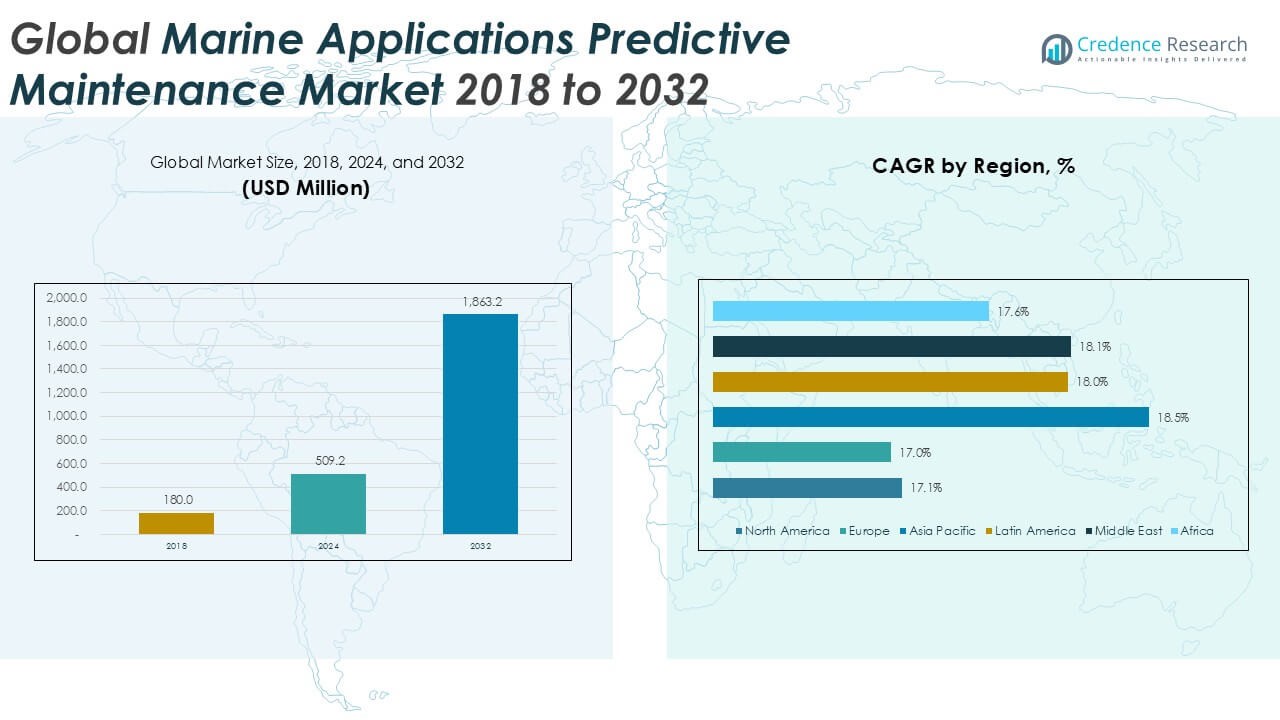
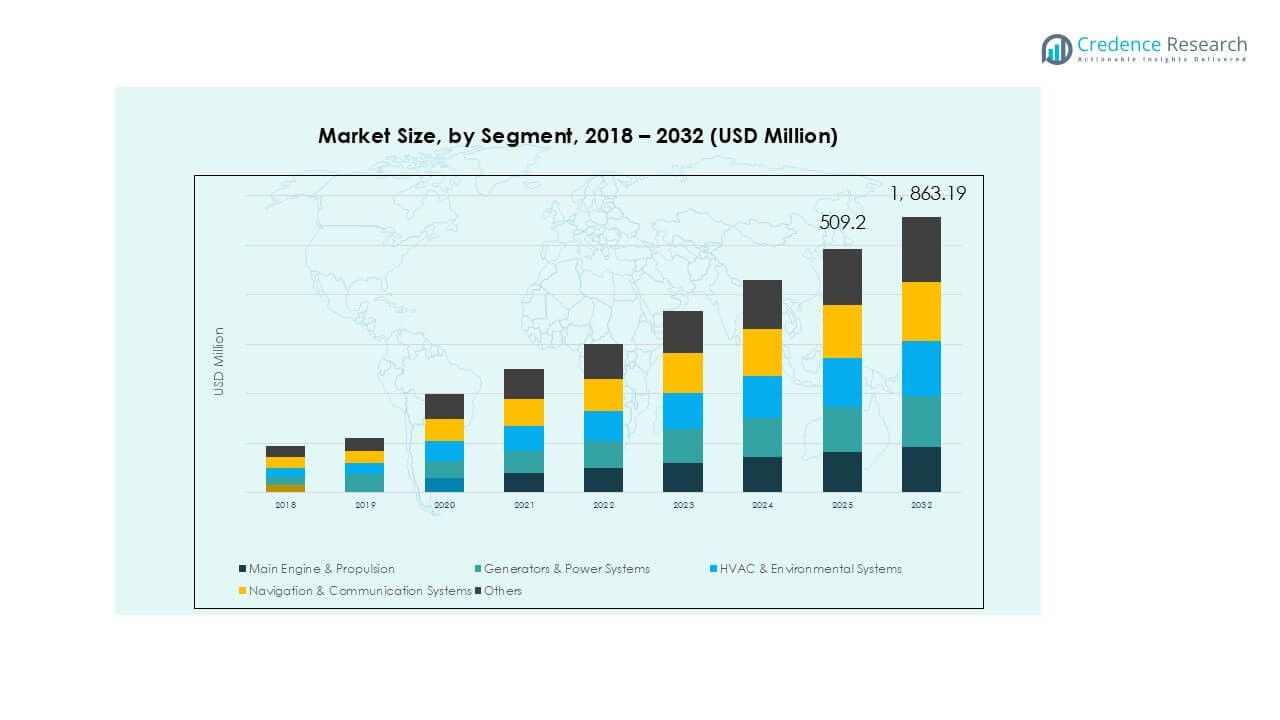
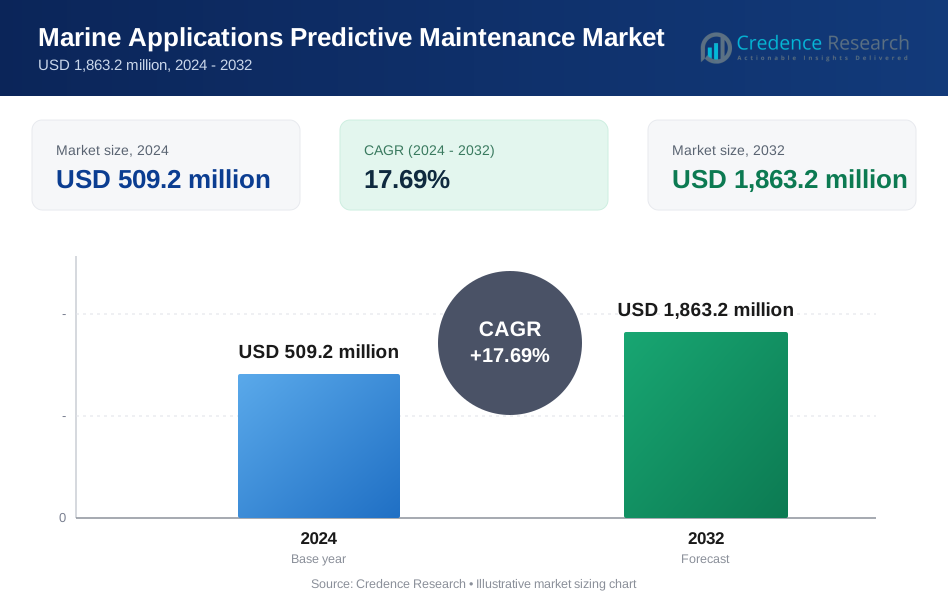
The Global Marine Applications Predictive Maintenance Market size was valued at USD 180.0 million in 2018 to USD 509.2 million in 2024 and is anticipated to reach USD 1,863.2 million by 2032, at a CAGR of 17.69% during the forecast period.
| REPORT ATTRIBUTE | DETAILS |
|---|---|
| Historical Period | 2020-2024 |
| Base Year | 2024 |
| Forecast Period | 2025-2032 |
| Marine Applications Predictive Maintenance Market Size 2024 | USD 509.2 Million |
| Marine Applications Predictive Maintenance Market, CAGR | 17.69% |
| Marine Applications Predictive Maintenance Market Size 2032 | USD 1,863.2 Million |
Rising operational costs and stringent regulatory compliance requirements are compelling shipowners and operators to modernize their maintenance strategies. Predictive maintenance solutions help optimize asset management, enhance fleet reliability, and support regulatory adherence related to emissions and safety standards. As ship sizes increase and marine supply chains become more complex, stakeholders are prioritizing technologies that enable real-time asset monitoring, early fault detection, and data-driven decision-making. Integration of cloud-based platforms and machine learning algorithms is further enabling more accurate failure prediction and proactive maintenance planning.
Regionally, Europe leads the market owing to the presence of major maritime economies and strong regulatory frameworks promoting digitalization in shipping. North America follows closely, supported by advanced technological adoption and investment in maritime logistics. The Asia-Pacific region is witnessing rapid growth, propelled by expanding seaborne trade, increasing fleet sizes, and government initiatives to modernize marine infrastructure. Collaboration between technology providers and maritime operators in these regions is accelerating the deployment of predictive maintenance solutions across commercial and naval fleets.
Market Insights:
- The Global Marine Applications Predictive Maintenance Market reached USD 509.2 million in 2024 and is projected to surpass USD 1,800 million by 2032, reflecting a robust CAGR of 17.69%.
- Rising operational costs and the need for asset optimization are pushing shipowners to adopt predictive maintenance solutions for improved fleet reliability and reduced downtime.
- Regulatory compliance with emissions and safety standards remains a major driver, as maritime operators integrate predictive tools to meet strict global requirements.
- Cloud-based platforms and machine learning algorithms are being leveraged to enable accurate failure prediction and proactive maintenance planning across diverse vessel types.
- Europe leads market share, followed by North America, with both regions benefiting from digitalization, strong regulatory frameworks, and investment in maritime innovation.
- Asia Pacific demonstrates the fastest market growth, fueled by rapid fleet expansion, government support for maritime digitalization, and a dynamic shipbuilding industry.
- Integration complexities, data silos, high upfront costs, and a shortage of skilled professionals are key restraints, while supportive policies and modernization efforts drive adoption across all global regions.
Market Drivers:
Rising Operational Costs and Asset Optimization Necessitate Predictive Maintenance
The escalating costs associated with fuel, labor, and unplanned equipment failures have compelled the marine industry to pursue smarter asset management strategies. The Global Marine Applications Predictive Maintenance Market benefits as shipowners adopt data-driven maintenance to reduce unscheduled downtime and extend asset life. Predictive maintenance platforms empower operators to act on real-time data, improve scheduling, and enhance cost efficiency, making it a vital solution for maintaining competitiveness in today’s volatile market landscape.
- For instance, Rolls-Royce’s latest generation of mtu Series 4000 marine engines now enable operators to achieve up to 96,000 operating hours between major overhauls, allowing some vessels to run continuously for 25 years before a full engine overhaul is required.
Stringent Regulatory Compliance and Focus on Sustainability Fuel Market Expansion
Regulatory bodies continue to enforce strict guidelines on safety, emissions, and environmental performance in marine operations. The market’s growth is driven by solutions that support compliance with global standards, such as IMO 2020. Predictive maintenance enables proactive monitoring of equipment, helping operators avoid penalties, maintain operational licenses, and meet sustainability targets. This alignment with regulatory and environmental demands accelerates the adoption of advanced maintenance systems.
Rapid Digitalization and Technological Integration Accelerate Predictive Maintenance Deployment
Digital transformation in the marine industry has introduced IoT sensors, artificial intelligence, and machine learning to vessel operations. Predictive maintenance leverages these technologies to enable continuous monitoring, early fault detection, and optimized repair scheduling. Cloud-based platforms further support remote diagnostics and seamless collaboration, strengthening the value proposition of predictive maintenance solutions.
- For instance, Rolls-Royce’s predictive analytics platform currently monitors over 10,000 engine parameters in real time on its Pearl engine family, preventing approximately 400 unplanned maintenance events each year across its commercial marine and aviation fleets.
Fleet Complexity and Supply Chain Demands Propel the Shift to Predictive Maintenance
Modern marine fleets are expanding in size and complexity, creating challenges in asset management and logistics. Predictive maintenance addresses these challenges by improving reliability, reducing failure risk, and supporting efficient resource use. This capability helps shipping companies navigate dynamic market conditions while upholding high operational standards.
Market Trends:
Accelerating Adoption of AI-Powered Digital Twins and Edge Computing for Proactive Marine Asset Management
The emergence of digital twin technology is transforming predictive maintenance in the marine sector by enabling virtual replicas of vessels and offshore equipment for real-time simulation and anomaly detection. Advanced machine learning models and sensor integration improve maintenance planning accuracy and help operators identify issues before they cause failures. Edge computing supports immediate data processing at the vessel level, eliminating latency and providing instant insights for on-board crews. This technological shift empowers marine operators to extend equipment life, reduce costly downtimes, and manage assets more effectively. High-accuracy prediction capabilities are gaining operator trust and facilitating adoption across both new and legacy fleets. These advancements position predictive maintenance as a cornerstone of proactive asset management in marine environments.
- For example, Wärtsilä’s Expert Insight system has processed a full year’s worth of engine operational data and successfully flagged equipment anomalies just 15 minutes after their occurrence, enabling timely preemptive action for ship crews.
Growing Focus on Explainable AI and Integration with Subsea IoT to Enhance Trust and Performance
Marine industry stakeholders are emphasizing transparency in predictive maintenance systems by leveraging explainable AI, which allows operators to understand and verify model-driven maintenance recommendations. This builds confidence in automated decision-making and meets increasing safety and compliance demands. Integrating predictive maintenance platforms with subsea IoT networks enables comprehensive condition monitoring, capturing key data such as vibration, temperature, and corrosion from critical underwater systems. These innovations improve reliability, reduce manual workload, and extend asset lifecycles even under harsh marine conditions. The market continues to see rising demand for solutions that deliver actionable insights, support efficient fleet management, and ensure regulatory alignment.
- For instance, CCC Underwater Engineering deployed a Saab Seaeye Leopard ROV equipped with advanced sensors to complete 2,000km of uninterrupted subsea pipeline survey operations in the Arabian Gulf, achieving repeatable baseline measurement accuracy below 0.5m across 316 pipelines in a single project campaign.
Market Challenges Analysis:
Integration Complexities and Data Silos Hinder Predictive Maintenance Implementation
The Global Marine Applications Predictive Maintenance Market faces significant hurdles related to integration of legacy systems and diverse asset types. Many vessels operate with outdated machinery and fragmented IT infrastructure, making seamless connectivity and data aggregation a challenge. Interoperability issues often lead to isolated data silos, restricting the flow of information necessary for effective predictive analytics. It creates barriers for comprehensive fleet-wide deployment and limits the full potential of predictive maintenance platforms. Standardization across manufacturers and fleets remains limited, slowing the adoption of unified solutions.
High Upfront Costs and Skills Gap Limit Market Penetration
The cost of deploying advanced predictive maintenance solutions remains a concern for many marine operators, especially in regions with smaller fleets or limited budgets. Investments in IoT sensors, cloud infrastructure, and software platforms can be substantial, deterring small and mid-sized enterprises. The Global Marine Applications Predictive Maintenance Market also encounters a shortage of skilled professionals capable of managing and interpreting advanced analytics. It leads to slower implementation and limits the ability of organizations to leverage predictive insights for optimal decision-making. These financial and human capital challenges continue to restrain broader market expansion.
Market Opportunities:
Expansion of Smart Ship Technologies and Digital Fleet Management Presents Growth Opportunities
The Global Marine Applications Predictive Maintenance Market stands to benefit from the rapid expansion of smart ship technologies and integrated digital fleet management solutions. Growing investment in IoT-enabled vessels, autonomous systems, and cloud-based analytics platforms is unlocking new possibilities for real-time monitoring and predictive decision-making. It allows operators to move toward condition-based maintenance models that optimize asset utilization and reduce lifecycle costs. The rise of smart shipping drives demand for advanced predictive maintenance tools that ensure operational efficiency, safety, and sustainability.
Government Initiatives and Strategic Partnerships Propel Market Advancement
Supportive government policies and international maritime regulations are fostering digitalization across the marine sector, creating favorable conditions for predictive maintenance adoption. Collaborative efforts between technology providers, shipbuilders, and maritime operators accelerate solution development and deployment. The Global Marine Applications Predictive Maintenance Market can leverage these partnerships to introduce scalable, customizable platforms tailored to diverse vessel types and operational environments. It encourages innovation, helps overcome integration barriers, and positions predictive maintenance as a strategic enabler for future-ready marine fleets.
Market Segmentation Analysis:
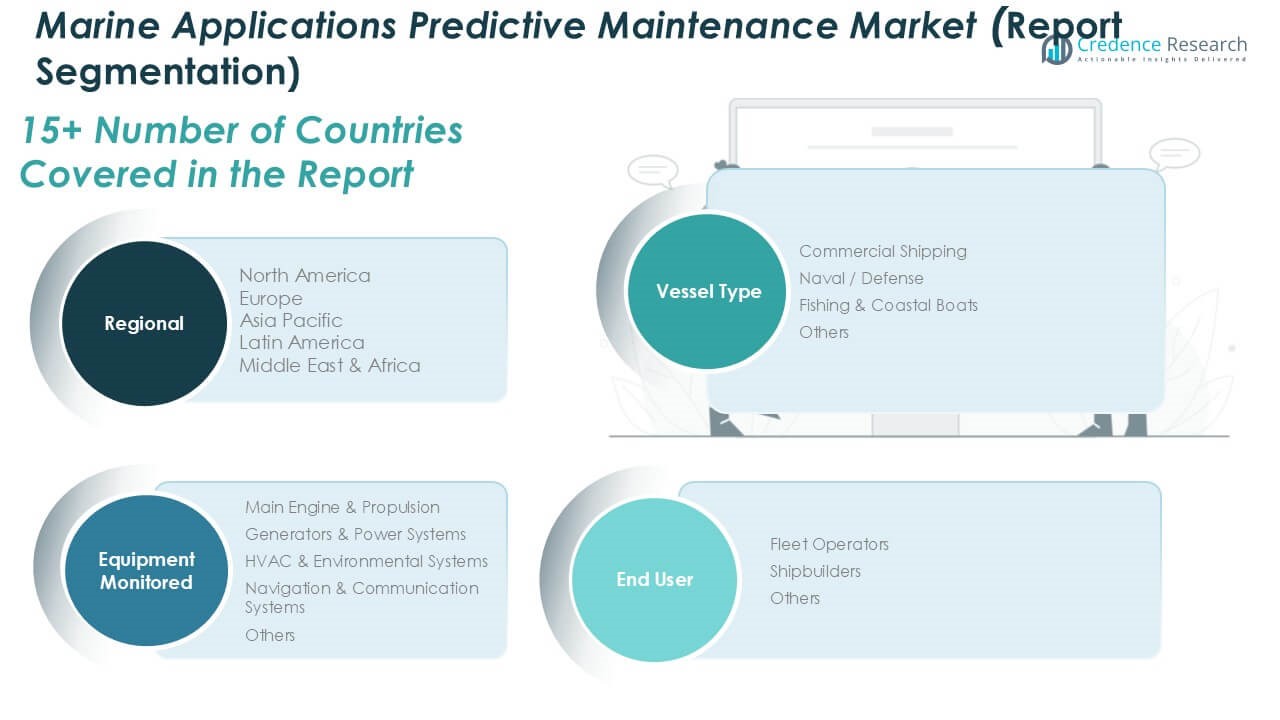
By Vessel Type
The Global Marine Applications Predictive Maintenance Market demonstrates strong adoption across commercial shipping, naval and defense vessels, and fishing or coastal boats. Commercial shipping accounts for the largest share due to extensive fleet sizes and a high focus on operational efficiency. Naval and defense segments leverage predictive maintenance to enhance mission readiness and ensure asset reliability. Fishing and coastal boats are increasingly integrating digital monitoring, reflecting growing awareness of asset management benefits.
- For instance, the U.S. Navy utilized an AI-powered predictive maintenance platform that generated 4.2 million data points for a single naval asset, compared to just 100 data points through traditional inspections, significantly improving their ability to detect faults and schedule repairs proactively.
By Application
Main engine and propulsion systems represent the primary application area, driven by the critical need to prevent unscheduled breakdowns and maximize fuel efficiency. Generators and power systems are another significant segment, with predictive maintenance supporting reliable on-board energy supply. HVAC and environmental systems, along with navigation and communication systems, are gaining traction as vessel operators seek holistic, system-wide reliability. It highlights the market’s shift toward end-to-end predictive monitoring.
- For instance, Wärtsilä dynamic maintenance planning now enables targeted major engine overhauls after 24,000 to 36,000 operating hours, as confirmed by condition-based monitoring on marine fleets.
By End-User
Fleet operators lead market adoption, seeking to minimize downtime and optimize maintenance schedules. Shipbuilders are incorporating predictive maintenance solutions into new builds to enhance value and meet evolving customer demands. Others, including service providers and equipment suppliers, are expanding their offerings to capture emerging opportunities. The market’s segmentation underscores its broad applicability across vessel types, onboard systems, and marine industry stakeholders.
Segmentations:
By Vessel Type
- Commercial Shipping
- Naval / Defense
- Fishing & Coastal Boats
- Others
- Main Engine & Propulsion
- Generators & Power Systems
- HVAC & Environmental Systems
- Navigation & Communication Systems
- Others
- Fleet Operators
- Shipbuilders
- Others
- North America
- U.S.
- Canada
- Mexico
- Europe
- Germany
- France
- U.K.
- Italy
- Spain
- Rest of Europe
- Asia Pacific
- China
- Japan
- India
- South Korea
- South-east Asia
- Rest of Asia Pacific
- Latin America
- Brazil
- Argentina
- Rest of Latin America
- Middle East & Africa
- GCC Countries
- South Africa
- Rest of the Middle East and Africa
Regional Analysis:
North America
The North America Marine Applications Predictive Maintenance size was valued at USD 51.61 million in 2018 to USD 141.74 million in 2024 and is anticipated to reach USD 498.03 million by 2032, at a CAGR of 17.1% during the forecast period. North America holds a major market share, driven by early adoption of advanced maintenance technologies and a mature maritime sector. The United States is the primary contributor, focusing on digital fleet management and integrating IoT, AI, and analytics across commercial and defense fleets.
Europe
The Europe Marine Applications Predictive Maintenance size was valued at USD 46.48 million in 2018 to USD 127.28 million in 2024 and is anticipated to reach USD 445.30 million by 2032, at a CAGR of 17.0% during the forecast period. Europe commands a substantial share, supported by a strong maritime heritage and a focus on sustainability. Countries like Germany, Norway, and the UK are front-runners in adopting predictive analytics and smart shipping solutions.
Asia Pacific
The Asia Pacific Marine Applications Predictive Maintenance size was valued at USD 56.62 million in 2018 to USD 167.40 million in 2024 and is anticipated to reach USD 648.02 million by 2032, at a CAGR of 18.5% during the forecast period. Asia Pacific holds the largest and fastest-growing market share, driven by rapid fleet expansion and robust shipbuilding activities in China, Japan, and South Korea. Government support for maritime digitalization reinforces the region’s leadership.
Latin America
The Latin America Marine Applications Predictive Maintenance size was valued at USD 13.61 million in 2018 to USD 39.21 million in 2024 and is anticipated to reach USD 147.01 million by 2032, at a CAGR of 18.0% during the forecast period. Latin America shows steady market growth, led by Brazil and Mexico upgrading ports and adopting predictive analytics to enhance efficiency and regulatory compliance. Supportive government policies facilitate digital transformation.
Middle East
The Middle East Marine Applications Predictive Maintenance size was valued at USD 8.60 million in 2018 to USD 24.82 million in 2024 and is anticipated to reach USD 93.16 million by 2032, at a CAGR of 18.1% during the forecast period. The Middle East is expanding its market share through major investments in fleet and port modernization, especially in the Gulf region. The adoption of digital fleet management drives asset optimization.
Africa
The Africa Marine Applications Predictive Maintenance size was valued at USD 3.10 million in 2018 to USD 8.71 million in 2024 and is anticipated to reach USD 31.67 million by 2032, at a CAGR of 17.6% during the forecast period. Africa’s market is advancing through targeted investments in port upgrades and digital technologies, with South Africa and Nigeria leading platform adoption. A growing focus on modernization supports Africa’s rising role in the global market.
Key Player Analysis:
- Marine Diagnostics
- Dolphin Monitoring
- Servixon
- VoyageX AI
- Clauger
- Kongsberg Maritime
- ABB Marine & Ports
- MAN PrimeServ
- Siemens
Competitive Analysis:
The Global Marine Applications Predictive Maintenance Market features a competitive landscape shaped by leading technology providers, marine engineering firms, and digital solution specialists. Major players such as Kongsberg Maritime, ABB Marine & Ports, MAN PrimeServ, and Siemens invest in advanced analytics platforms, IoT integration, and machine learning for real-time asset monitoring. The market sees new entrants introducing cloud-based predictive tools and modular solutions to address the needs of diverse vessel types and end users. Strategic partnerships and collaborations with shipbuilders and fleet operators strengthen product portfolios and accelerate innovation. It demands continuous investment in R&D and strong customer support to maintain competitive positioning. The presence of established global brands and agile technology startups fosters a dynamic environment, driving advancements in predictive maintenance capabilities across commercial, naval, and specialized marine vessels.
Recent Developments:
- In June 2025, Marine Diagnosticsannounced the launch of their new Mini Marine Diagnostic Kits.
- In June 2025, VoyageX AI launched a unified ship management platform that uses AI for real-time ship operations optimization, including predictive maintenance and automated crew management.
- In May 2025, Kongsberg Maritimelaunched the TTH Tunnel Thruster series, designed for improved vessel performance and easier maintenance.
Market Concentration & Characteristics:
The Global Marine Applications Predictive Maintenance Market exhibits moderate to high market concentration, with a few key players dominating global revenues. It features a blend of established marine technology firms and innovative digital solution providers, each competing on technological sophistication, reliability, and integration capabilities. The market values long-term partnerships with shipbuilders, fleet operators, and defense organizations, often relying on advanced analytics, IoT platforms, and AI-driven diagnostics. It emphasizes customization, scalability, and regulatory compliance, catering to both large commercial fleets and specialized vessels. Continuous advancements in sensor technology and data analytics drive differentiation, while after-sales service and technical support remain crucial for sustained market leadership.
Report Coverage:
The research report offers an in-depth analysis based on Vessel Type, Application, End-User and Region. It details leading market players, providing an overview of their business, product offerings, investments, revenue streams, and key applications. Additionally, the report includes insights into the competitive environment, SWOT analysis, current market trends, as well as the primary drivers and constraints. Furthermore, it discusses various factors that have driven market expansion in recent years. The report also explores market dynamics, regulatory scenarios, and technological advancements that are shaping the industry. It assesses the impact of external factors and global economic changes on market growth. Lastly, it provides strategic recommendations for new entrants and established companies to navigate the complexities of the market.
Future Outlook:
- Adoption of AI-driven predictive maintenance platforms will accelerate across global shipping fleets to optimize asset utilization and reduce downtime.
- Integration of IoT sensors and real-time analytics will become standard in new vessel builds and retrofit projects.
- Shipbuilders and fleet operators will increasingly prioritize condition-based maintenance strategies to extend asset life and improve operational reliability.
- Strategic partnerships between technology providers and maritime stakeholders will drive innovation in diagnostics and remote monitoring capabilities.
- Regulatory demands for emissions reduction and safety compliance will propel investment in advanced maintenance solutions.
- Digital twin technology will see expanded use, enabling virtual asset simulation and enhanced fault prediction.
- Demand for scalable, cloud-based maintenance systems will rise, supporting both large enterprises and smaller operators.
- Maritime training programs will evolve to equip crews and engineers with advanced data analysis and digital maintenance skills.
- Focus on cybersecurity and data privacy will intensify as more vessel systems connect to digital platforms.
- Growth in emerging regions will accelerate, supported by government initiatives and infrastructure modernization focused on digital transformation of the marine industry.
Request a Free Sample
Fill in your details and we'll send you a free sample report.
- Sample data tables & charts
- Research methodology
Need a Custom Version of This Report?
Tailor the scope, geography, or segments to your exact requirements.
- Custom geography or segment scope
- Direct access to our analyst team
Frequently Asked Questions
What is the current size of the Global Marine Applications Predictive Maintenance Market?
What factors are driving the growth of the Global Marine Applications Predictive Maintenance Market?
What are the key segments within the Global Marine Applications Predictive Maintenance Market?
What are some challenges faced by the Global Marine Applications Predictive Maintenance Market?
Who are the major players in the Global Marine Applications Predictive Maintenance Market?
Which segment is leading the market share?
Table of Content
Chapter 1. Report Introduction
- 1.1 Report Description & Purpose
- 1.1.1 Report Title & Market Definition
- 1.1.2 Unique Selling Propositions (USP) & Key Differentiators
- 1.1.3 Value Proposition for Stakeholders
- 1.2 Research Objectives
- 1.2.1 Market Sizing Objectives (Volume & Revenue)
- 1.2.2 Segmentation Objectives
- 1.2.3 Competitive Intelligence Objectives
- 1.2.4 Forecast & Scenario Objectives
- 1.3 Report Scope
- 1.3.1 Marine Applications Predictive Maintenance Scope – Types & Subtypes Covered
- 1.3.2 Geographic Scope – Regions & Countries Covered
- 1.3.3 Historical Period, Base Year & Forecast Period (2024; forecast to 2032)
- 1.3.4 Inclusions & Exclusions
- 1.4 HS Code & Classification Framework
- 1.5 Currency, Units & Pricing Basis
- 1.6 Target Stakeholders
- 1.7 Limitations & Assumptions
Chapter 2. Executive Summary
- 2.1 Global Marine Applications Predictive Maintenance Market Snapshot
- 2.1.1 Market Size – Historical (2024) & Forecast (2024-2032) (2024: USD 509.2 million → 2032: USD 1,863.2 million)
- 2.1.2 Volume & Revenue – Global Totals
- 2.1.3 Key Market Highlights – Top Five Facts
- 2.2 Marine Applications Predictive Maintenance Market Segmentation Snapshot
- 2.2.1 Market Split by Region – 2024 vs. 2032
- 2.3 Competitive Snapshot
- 2.3.1 Top 10 Players by Revenue Share – 2024
- 2.3.2 Top 10 Players by Volume Share – 2024
- 2.3.3 Recent Strategic Developments (18-Month Summary)
- 2.4 Key Investment Highlights & Strategic Conclusions
Chapter 3. Marine Applications Predictive Maintenance Market Dynamics & Industry Analysis
- 3.1 Market Overview & Context
- 3.1.1 Marine Applications Predictive Maintenance Market Position in the Broader Automotive Value Chain
- 3.1.2 OEM vs. Replacement Market Dynamics
- 3.1.3 Market Maturity & Development Stage by Region
- 3.2 Marine Applications Predictive Maintenance Market Drivers
- 3.3 Marine Applications Predictive Maintenance Market Restraints & Challenges
- 3.4 Marine Applications Predictive Maintenance Market Opportunities
- 3.5 Porter's Five Forces Analysis
- 3.5.1 Threat of New Entrants
- 3.5.2 Bargaining Power of Suppliers
- 3.5.3 Bargaining Power of Buyers
- 3.5.4 Threat of Substitutes
- 3.5.5 Competitive Rivalry – Intensity Assessment
- 3.6 Marine Applications Predictive Maintenance Value Chain Analysis
- 3.6.1 Upstream – Raw Material/Input Suppliers
- 3.6.1.1 Raw Material/Input 1
- 3.6.1.2 Raw Material/Input 2
- 3.6.1.3 Raw Material/Input 3
- 3.6.2 Midstream – Production/Manufacturing/Service Delivery
- 3.6.2.1 Production/Process Overview
- 3.6.2.2 Key Facility Locations & Capacity by Manufacturer
- 3.6.3 Downstream – Distribution & End Consumer
- 3.6.3.1 Primary Channel – B2B/OEM
- 3.6.3.2 Secondary Channels – Dealer, Retail, Online, Direct
- 3.6.4 Value Chain Profitability Analysis
- 3.6.1 Upstream – Raw Material/Input Suppliers
- 3.7 PESTEL Analysis
- 3.7.1 Political Factors
- 3.7.2 Economic Factors
- 3.7.3 Social Factors
- 3.7.4 Technological Factors
- 3.7.5 Environmental Factors
- 3.7.6 Legal Factors
- 3.8 Marine Applications Predictive Maintenance Supply Chain Analysis
- 3.8.1 Raw Material/Input Supply Risk Assessment
- 3.8.2 Manufacturing Concentration Risk (Geographic Exposure)
- 3.8.3 Trade Disruption Impact Analysis
- 3.9 Regulatory & Policy Landscape
Note: The regulatory and policy landscape section covers regulations based on their applicability to the market, Marine Applications Predictive Maintenance category, geography, and scope of the study. Only regulatory frameworks with a material impact on operations, compliance, trade, sustainability, or market access are analyzed in detail.
Chapter 4. Key Investment Pockets & Opportunity Analysis
- 4.1 Marine Applications Predictive Maintenance Market Attractiveness Analysis
- 4.1.1 By Region – Investment Attractiveness Matrix (Volume × CAGR)
- 4.2 Absolute Revenue Growth Opportunity
- 4.2.1 By Region – Absolute USD Growth Through 2032
- 4.3 Incremental Volume Opportunity
- 4.3.1 By Region – Incremental Volume Through 2032
- 4.3.2 Segment – Incremental Volume
- 4.4 Emerging Submarket Opportunity Deep Dive (Subject to Applicability)
- 4.5 Emerging Market Opportunity Scorecards
- 4.5.1 United States
- 4.5.2 Europe
- 4.5.3 Asia
- 4.5.4 Middle East & Africa
Note: Emerging Market Opportunity Scorecards will be included based on relevance and strategic importance. Regions listed are indicative and may vary depending on data availability and market dynamics.
Chapter 5. Marine Applications Predictive Maintenance Import-Export Analysis & Trade Flows
- 5.1 Global Trade Overview
- 5.1.1 Global Export Value by Country (2024)
- 5.1.2 Global Export Volume by Country (2024)
- 5.1.3 Global Import Value by Country (2024)
- 5.1.4 Global Import Volume by Country (2024)
- 5.1.5 Net Trade Balance by Country (2024)
- 5.2 Export Analysis – Segment
- 5.2.1 Type 1 (HS Code)
- 5.2.2 Type 2 (HS Code)
- 5.2.3 Type 3 (HS Code)
- 5.2.4 Type 4 (HS Code)
- 5.2.5 Type 5 (HS Code)
- 5.3 Import Analysis – Segment
- 5.3.1 Type 1 (HS Code)
- 5.3.2 Type 2 (HS Code)
- 5.3.3 Type 3 (HS Code)
- 5.3.4 Type 4 (HS Code)
- 5.3.5 Type 5 (HS Code)
- 5.4 Average Unit Trade Prices
- 5.4.1 Average Export Price – Segment & Country
- 5.4.2 Average Import Price – Segment & Source Country
- 5.4.3 Price Trends (2024)
- 5.5 Key Trade Route Analysis
- 5.5.1 Trade Route 1
- 5.5.2 Trade Route 2
- 5.5.3 Trade Route 3
- 5.5.4 Trade Route 4
- 5.5.5 Trade Route 5
- 5.6 Trade Policy Impact Assessment
- 5.6.1 US Anti-Dumping & Section 301 Tariffs
- 5.6.2 EU Customs Union Impact
- 5.6.3 Major Free Trade Agreements
- 5.6.4 USMCA Rules of Origin
Note: Trade policy analysis will be included only where relevant to the Marine Applications Predictive Maintenance market.
Chapter 6. Competitive Landscape & Company Benchmarking
- 6.1 Marine Applications Predictive Maintenance Market Concentration & Structure
- 6.1.1 Herfindahl-Hirschman Index (HHI) – vs. 2024
- 6.1.2 Tier 1, Tier 2 & Tier 3 Market Structure
- 6.1.3 Global, Regional & Local Player Dynamics
- 6.2 Marine Applications Predictive Maintenance Market Share Analysis – 2024
- 6.2.1 Global Revenue Share by Company
- 6.2.2 Global Volume Share by Company
- 6.2.3 Regional Revenue Share
- 6.2.4 Market Share Evolution ( vs. 2024)
- 6.2.5 OEM Segment Share by Company
- 6.2.6 Replacement Segment Share by Company
- 6.3 Production/Delivery Capacity & Facility Analysis
- 6.3.1 Global Installed Capacity
- 6.3.2 Capacity Utilization Rates
- 6.3.3 Production/Output Volume
- 6.3.4 Facility Locations & Capacity Map
- 6.3.5 Planned Capacity Additions
- 6.4 Marine Applications Predictive Maintenance Competitive Benchmarking Matrix
- 6.4.1 Revenue, Volume, CAGR & Profitability Comparison
- 6.4.2 Channel Revenue Mix
- 6.4.3 Geographic Revenue Exposure
- 6.4.4 R&D Intensity
- 6.4.5 Sustainability Maturity
- 6.5 Strategic Developments in Marine Applications Predictive Maintenance (Last 24 Months)
- 6.5.1 Mergers, Acquisitions & Divestments
- 6.5.2 New Marine Applications Predictive Maintenance Launches
- 6.5.3 Facility Expansions
- 6.5.4 Strategic Alliances, Joint Ventures & Partnerships
- 6.5.5 Distribution Expansion & Market Entry
- 6.5.6 Sustainability & ESG Initiatives
- 6.6 Competitive Strategy Mapping
- 6.6.1 Leader, Challenger, Follower & Niche Classification
- 6.6.2 Pricing Strategy Comparison
- 6.6.3 Channel Strategy Matrix
Note: Strategic developments are included based on their materiality and the availability of reliable information.
Chapter 7. Global Marine Applications Predictive Maintenance Market – By Distribution Channel
- 7.1 Segment Overview
- 7.1.1 Volume & Revenue Split by Channel (2024 & 2032)
- 7.1.2 Channel Mix Evolution (2024-2032)
Chapter 8. Regional Market Analysis – Global Overview
- 8.1 Global Regional Overview
- 8.1.1 Regional Volume Share
- 8.1.2 Regional Revenue Share
- 8.1.3 Regional Volume by Region
- 8.1.4 Regional Revenue by Region
- 8.1.5 Regional Forecast Through 2032
- 8.2 Cross-Regional Segment Analysis
- 8.2.1 By Distribution Channel
- 8.2.2 By Brand/Price Tier
Chapter 9. North America Marine Applications Predictive Maintenance Market
- 9.1 United States
- 9.2 Canada
- 9.3 Mexico
Chapter 10. Europe Marine Applications Predictive Maintenance Market
- 10.1 Germany
- 10.2 France
- 10.3 Italy
- 10.4 United Kingdom
- 10.5 Spain
- 10.6 Poland
- 10.7 Russia
- 10.8 Netherlands
- 10.9 Belgium
- 10.10 Sweden
- 10.11 Denmark
- 10.12 Norway
- 10.13 Rest of Europe
Chapter 11. Asia Pacific Marine Applications Predictive Maintenance Market
- 11.1 China
- 11.2 India
- 11.3 Japan
- 11.4 South Korea
- 11.5 Thailand
- 11.6 Indonesia
- 11.7 Vietnam
- 11.8 Malaysia
- 11.9 Australia
- 11.10 Rest of Asia Pacific
Chapter 12. Latin America Marine Applications Predictive Maintenance Market
- 12.1 Brazil
- 12.2 Argentina
- 12.3 Colombia
- 12.4 Chile
- 12.5 Rest of Latin America
Chapter 13. Middle East Marine Applications Predictive Maintenance Market
- 13.1 Saudi Arabia
- 13.2 United Arab Emirates
- 13.3 Turkey
- 13.4 Israel
- 13.5 Iran
- 13.6 Rest of the Middle East
Chapter 14. Africa Marine Applications Predictive Maintenance Market
- 14.1 South Africa
- 14.2 Egypt
- 14.3 Nigeria
- 14.4 Morocco
- 14.5 Rest of Africa
Chapter 15. Marine Applications Predictive Maintenance Company Profiles
- 15.1 [Company 01]
- 15.1.1 Company Overview
- 15.1.2 Key Management Personnel
- 15.1.3 Products & Services Portfolio
- 15.1.4 Financial Performance
- 15.1.5 Key Market Focus & Geographic Presence
- 15.1.6 Recent Developments & Strategic Initiatives
Note: The company profile list is preliminary and may change based on research findings, market developments, data availability, and client requirements.
Chapter 16. Appendices
- Appendix A – List of Abbreviations & Acronyms
- Appendix B – Industry Classification Code Reference – Full Series
- Appendix C – Production & Capacity Data Tables
- Appendix D – End-Use & Demand Base Tables
- Appendix E – Consumption & Replacement Rate Assumptions
- Appendix F – ASP Reference Tables
- Appendix G – Manufacturing & Facility Database
- Appendix H – Import-Export Data Tables
- Appendix I – Regulatory Summary Tables
- Appendix J – Primary Research Participant List (Anonymized)
- Appendix K – Primary Research Questionnaire Framework
- Appendix L – Data Sources & Bibliography
- Appendix M – Market Size Divergence & Source Comparison
Chapter 17. Research Methodology
- 17.1 Research Framework & Philosophy
- 17.2 Secondary Research – Sources, Hierarchy & Data Extraction
- 17.3 Data Modeling – Bottom-Up & Top-Down Market Sizing
- 17.4 Primary Research – Stakeholder Framework, LOI & Sample Sizes
- 17.5 Forecast Methodology – Regression, Scenario & Sensitivity Analysis
- 17.6 Quality Control – Four-Layer Validation Framework
- 17.7 Limitations & Standard Assumptions
- 17.8 Disclaimer
