
| REPORT ATTRIBUTE | DETAILS |
|---|---|
| Historical Period | 2019-2022 |
| Base Year | 2023 |
| Forecast Period | 2024-2032 |
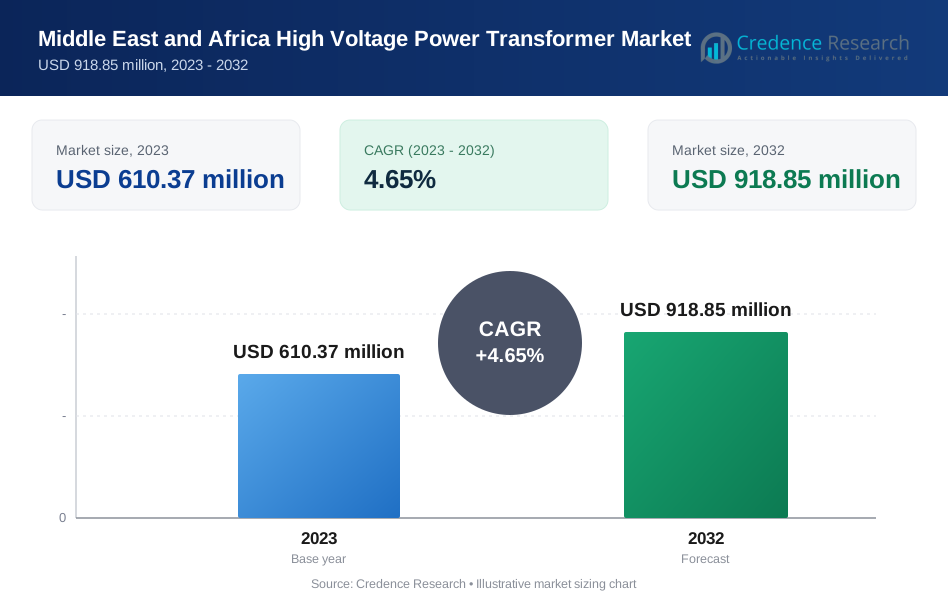
| Middle East and Africa High Voltage Power Transformer Market Size 2023 | USD 610.37 million |
| Middle East and Africa High Voltage Power Transformer Market, CAGR | 4.65% |
| Middle East and Africa High Voltage Power Transformer Market Size 2032 | USD 918.85 million |
Market Overview
The Middle East and Africa High Voltage Power Transformer Market is projected to grow from USD 610.37 million in 2023 to an estimated USD 918.85 million by 2032, with a compound annual growth rate (CAGR) of 4.65% from 2024 to 2032.
This substantial growth is driven by the increasing demand for electricity across the region, coupled with significant investments in power infrastructure projects. As governments and private sectors collaborate to expand the energy grid and ensure a reliable power supply, the market for high-voltage power transformers is poised to experience steady growth. The rising urbanization and industrialization in countries such as Saudi Arabia, UAE, and South Africa are also contributing to the heightened demand for advanced power transmission solutions.
Several key drivers and trends are shaping the growth trajectory of the high voltage power transformer market in the Middle East and Africa. The primary driver is the ongoing infrastructural development aimed at enhancing the region's power generation and distribution capabilities. Moreover, the increasing integration of renewable energy sources, such as solar and wind, into the power grid necessitates the use of high-voltage transformers to manage and distribute the generated power efficiently. Technological advancements, including the development of smart transformers and the implementation of digital monitoring systems, are also propelling market growth. These innovations offer improved efficiency, reliability, and real-time monitoring capabilities, which are crucial for modern power systems.
Geographically, the Middle East and Africa region present diverse market dynamics with varying growth potentials. In the Middle East, countries like Saudi Arabia and the UAE are leading the market due to their extensive investments in power infrastructure and renewable energy projects. These nations are focused on diversifying their energy sources and enhancing grid stability, which drives the demand for high voltage transformers. In Africa, South Africa stands out as a key market player, driven by its efforts to upgrade its aging power infrastructure and address frequent power outages. Key players operating in the region include Siemens AG, ABB Ltd., General Electric Company, and Schneider Electric SE, all of which are leveraging their technological expertise and extensive product portfolios to capture market share and drive innovation in high-voltage power transformers.
Market Drivers
Increasing Demand for Electricity
The burgeoning demand for electricity across the Middle East and Africa is a primary driver of the high voltage power transformer market. For instance, rapid urbanization in cities like Dubai and Johannesburg has led to an increased demand for electricity. Countries in the region are experiencing significant economic growth, leading to increased residential, commercial, and industrial electricity consumption. In particular, the growth of industries such as manufacturing, mining, and oil and gas exploration requires a reliable and efficient power supply. This demand necessitates the expansion and modernization of the power grid, thereby driving the need for high voltage power transformers. These transformers are essential for stepping up and stepping down voltage levels to ensure efficient power transmission over long distances and stable distribution to end-users.
Investment in Power Infrastructure
Significant investments in power infrastructure projects across the Middle East and Africa are fueling the growth of the high voltage power transformer market. Governments and private sector players are allocating substantial resources to develop and upgrade their power grids. For instance, Saudi Arabia's Vision 2030 initiative includes major investments in the energy sector to enhance power generation and distribution capabilities. Similarly, countries like the UAE and Egypt are investing in new power plants, transmission lines, and substations to support economic development and meet the growing energy demand. These infrastructural developments necessitate the deployment of high-voltage power transformers, which are critical for ensuring efficient and reliable power transmission. The focus on building robust and resilient power infrastructure is a key driver of market growth.
Integration of Renewable Energy Sources
The integration of renewable energy sources into the power grid is another significant driver of the high-voltage power transformer market in the Middle East and Africa. For instance, the region is witnessing a rapid increase in renewable energy projects, particularly solar and wind power. Countries like the UAE, Saudi Arabia, and South Africa are leading the way in adopting clean energy solutions to diversify their energy mix and reduce dependence on fossil fuels. High voltage power transformers play a crucial role in integrating these renewable energy sources into the existing power grid. They enable the efficient transmission of power generated from renewable sources to distribution networks and end-users. The push towards sustainable energy solutions and the commitment to reducing carbon emissions are driving the demand for advanced high voltage transformers.
Technological Advancements and Innovations
Technological advancements and innovations in high-voltage power transformers are significantly impacting the market. Manufacturers are developing smart transformers equipped with digital monitoring and control systems. These smart transformers offer enhanced efficiency, reliability, and real-time monitoring capabilities, which are essential for modern power grids. The adoption of advanced materials and designs has improved the performance and lifespan of high-voltage transformers, making them more cost-effective and reliable. Innovations such as the development of eco-friendly transformers with reduced environmental impact are also gaining traction. These technological advancements are meeting the evolving needs of power utilities and grid operators, driving the market for high voltage power transformers. Additionally, the implementation of smart grid technologies and the increasing focus on grid automation are further propelling market growth.
Market Trends
Expansion of Renewable Energy Projects
The Middle East and Africa are witnessing a significant surge in renewable energy projects, particularly in solar and wind power. For instance, the Noor Ouarzazate Solar Complex in Morocco is one of the largest solar power plants in the world. Countries like the UAE, Saudi Arabia, and South Africa are investing heavily in renewable energy to diversify their energy sources and reduce carbon emissions. This trend is driving the demand for high voltage power transformers that can efficiently integrate and transmit renewable energy into the power grid.
Adoption of Smart Grid Technologies
The adoption of smart grid technologies is a major trend in the high voltage power transformer market. For instance, the use of Internet of Things (IoT) devices for real-time monitoring and control of power distribution networks is becoming increasingly common. Smart grids enable real-time monitoring, automation, and control of power distribution networks, enhancing efficiency and reliability. High voltage transformers equipped with advanced digital monitoring systems are essential components of smart grids, offering improved performance and reduced downtime.
Government Initiatives and Policies
Governments across the Middle East and Africa are implementing policies and initiatives to modernize and expand their power infrastructure. These initiatives include substantial investments in new power plants, transmission lines, and substations. For example, Saudi Arabia's Vision 2030 and the UAE's Energy Strategy 2050 are driving investments in the energy sector, boosting the demand for high voltage power transformers.
Technological Advancements
Technological advancements in high voltage power transformers are driving market growth. Manufacturers are focusing on developing transformers with enhanced efficiency, reliability, and environmental sustainability. For instance, the use of nanocrystalline cores in transformers to reduce energy loss and improve efficiency is an emerging trend. Innovations such as the use of eco-friendly insulating materials, advanced cooling systems, and digital monitoring technologies are gaining traction. These advancements are helping to meet the evolving needs of power utilities and industrial users.
Focus on Grid Resilience and Reliability
There is an increasing focus on enhancing grid resilience and reliability in the Middle East and Africa. Frequent power outages and grid instability issues have highlighted the need for robust and reliable power infrastructure. High voltage power transformers play a crucial role in ensuring stable and efficient power transmission, making them essential for improving grid resilience.
Public-Private Partnerships
Public-private partnerships are emerging as a key trend in the development of power infrastructure in the region. Collaborative efforts between governments and private sector players are facilitating the financing and implementation of large-scale power projects. These partnerships are driving investments in high voltage power transformers and other critical components of the power grid.
Growing Industrialization and Urbanization
Rapid industrialization and urbanization in the Middle East and Africa are contributing to the rising demand for electricity. This trend is driving the need for expanded and modernized power transmission and distribution networks. High voltage power transformers are essential for supporting the growing energy needs of industrial, commercial, and residential sectors.
Market Restraints and Challenges
High Initial Costs
One of the primary challenges in the high voltage power transformer market is the significant initial investment required. High voltage transformers are expensive due to their advanced technology, size, and the materials used in their construction. This high cost can be a substantial barrier for many developing countries in the Middle East and Africa, where budget constraints and competing priorities may limit the allocation of funds for such infrastructure projects. The financial burden of purchasing and installing these transformers can delay or deter critical power infrastructure developments.
Infrastructure and Grid Stability Issues
The existing power infrastructure in many parts of the Middle East and Africa is often outdated and lacks the capacity to support new high voltage transformers. Issues such as poor grid stability, frequent power outages, and insufficient maintenance practices pose significant challenges. Integrating high voltage transformers into such an unstable grid can be complex and costly. Upgrading the entire power transmission and distribution network to accommodate new transformers is a substantial undertaking that requires careful planning and significant investment.
Political and Economic Instability
Political and economic instability in several countries within the region poses another major challenge. Uncertain political climates, regulatory inconsistencies, and economic volatility can deter foreign investment and disrupt ongoing projects. In regions experiencing conflict or political upheaval, the focus on infrastructure development, including power transmission projects, often takes a backseat. This instability can lead to project delays, cost overruns, and a lack of long-term strategic planning for energy infrastructure
Supply Chain and Logistics Challenges
The supply chain and logistics involved in the production and distribution of high voltage transformers are complex and often fraught with challenges. Transportation of these large and heavy transformers to remote or underdeveloped areas can be difficult and costly. Additionally, the region's dependence on imported components and materials can lead to supply chain disruptions due to geopolitical tensions, trade restrictions, or global supply shortages. These factors can result in delays, increased costs, and reduced availability of essential transformer components.
Technological and Skill Gaps
The adoption of advanced high voltage transformer technology requires a skilled workforce capable of handling sophisticated equipment and digital monitoring systems. However, there is often a shortage of adequately trained personnel in the Middle East and Africa. The lack of technical expertise can hinder the effective implementation and maintenance of high voltage transformers. Investing in training and capacity-building programs is essential to bridge this skill gap and ensure the efficient operation of modern power infrastructure.
Market Segmentation Analysis
By Power Rating
Small power transformers (SPT ≤ 60 MVA) are primarily used for distribution networks and small-scale industrial applications, driven by the need for efficient power distribution in urban areas and the expansion of local networks. They are ideal for regions with lower power requirements due to their ease of installation and maintenance compared to larger units. In contrast, large power transformers (LPT > 60 MVA) are crucial for high-capacity power transmission over long distances, utilized in major power plants, substations, and large industrial facilities. The growing industrialization and large-scale infrastructure projects in countries like Saudi Arabia and UAE significantly drive the demand for LPTs, which are essential for integrating renewable energy sources into the grid, managing higher power capacities, and ensuring stable transmission.
By Cooling Type
Oil immersed transformers are widely used in high voltage applications due to their high efficiency, superior cooling performance, and longer lifespan. These transformers, commonly found in utilities and large industrial installations, utilize oil for effective insulation and cooling, making them suitable for handling large power loads and ensuring reliable operation under high-stress conditions. In contrast, dry type transformers are gaining popularity for their environmental safety, reduced fire hazard risk, and lower maintenance needs. Ideal for indoor applications, commercial buildings, and environments where oil leakage is a concern, dry type transformers are increasingly demanded in commercial and residential sectors where safety and environmental considerations are paramount.
By End User
The Middle East and Africa High Voltage Power Transformer Market serves three primary end users: utilities, commercial, and industrial sectors. The utility segment, the largest end user, is driven by the need for efficient power transmission and distribution across extensive networks, with governments and utility companies investing heavily in upgrading power grids to meet rising electricity demand, ensuring stable and reliable power for residential and commercial areas. The commercial segment, encompassing office buildings, shopping malls, and other establishments, sees growing demand for high voltage transformers, particularly dry type transformers, which offer safety and low maintenance, to support uninterrupted power in urban areas. The industrial segment, including manufacturing plants, mining operations, and oil and gas facilities, relies on high-capacity transformers for efficient power transmission, with expanding industrial activities in South Africa and Nigeria driving increased demand for large power transformers.
Segments
Based on Power Rating
- Small Power Transformers (SPT ≤ 60 MVA)
- Large Power Transformers (LPT > 60 MVA)
Based on Cooling Type
- Oil Immersed Transformers
- Dry Type Transformers
Based on End User
- Utilities
- Commercial
- Industria
Regional Analysis
Middle East (60%):
The Middle East commands approximately 60% of the high voltage power transformer market in the region, driven by substantial investments in power infrastructure and large-scale energy projects. Leading this growth are Saudi Arabia and the United Arab Emirates (UAE), with Saudi Arabia’s Vision 2030 and the UAE’s Energy Strategy 2050 significantly contributing to the modernization of power grids and integration of renewable energy sources. These strategic initiatives are increasing the demand for high voltage power transformers to meet rising energy needs. Additionally, the region's emphasis on diversifying its energy mix with solar and wind power is further boosting the demand for advanced transformers capable of efficiently managing and distributing renewable energy.
North Africa (20%):
North Africa holds a 20% share of the high voltage power transformer market, led by countries like Egypt and Morocco. These nations are heavily investing in expanding their power generation and transmission capacities to meet the increasing electricity demand driven by population growth and industrial development. Egypt’s ambitious plans to become a regional energy hub, with significant projects in renewable energy, are boosting the demand for high voltage transformers. Similarly, Morocco's extensive renewable energy programs, particularly in solar and wind, are contributing significantly to the market's growth in North Africa.
Key players
- ABB
- Abaft Middle East Transformer
- alfanar Group
- Elsewedy Electric
- Emirates Transformer and Switchgear Ltd
- EUROGULF TRANSFORMERS
- Federal Transformers Company LLC
- General Electric
- Hyosung Heavy Industries
- HD HYUNDAI ELECTRIC CO., LTD.
- Hitachi Energy Ltd
- LS ELECTRIC Co., Ltd
- Matelec Group
- Mitsubishi Electric Corporation
- SGB SMIT
- Siemens Energy
- The Saudi Transformer Co. Ltd.
- Toshiba Energy Systems & Solutions Corporation
Competitive Analysis
The Middle East and Africa high voltage power transformer market is highly competitive, with global and regional players vying for market share. Dominant companies like ABB, General Electric, and Siemens Energy leverage their extensive product portfolios, technological expertise, and strong market presence, investing heavily in research and development to offer innovative and efficient solutions. Regional players such as Elsewedy Electric and alfanar Group use their local market knowledge and strong relationships with utilities and governments to secure significant contracts. Emirates Transformer and Switchgear Ltd and Federal Transformers Company LLC also play crucial roles by providing customized solutions tailored to regional needs. The competitive landscape is marked by strategic collaborations, technological advancements, and a focus on sustainable, energy-efficient solutions, driving continuous innovation and enhancement of offerings.
Recent Developments
In December 2023, Larsen & Toubro (L&T) Construction's power and distribution business secured a significant order in the Middle East. This project involves engineering, supply, construction, installation, testing, and commissioning of a substation in the United Arab Emirates. The substation will include a transformer, reactor, and advanced substation control and monitoring systems. This contract reinforces L&T's presence in the Middle East and highlights its capabilities in delivering comprehensive power infrastructure solutions.
In November 2023, HD Hyundai Electric Co., a subsidiary of South Korea's HD Hyundai Co., secured a $72.3 million deal for city development projects near Diriyah, Saudi Arabia. The agreement includes providing essential power equipment such as power transformers, high-voltage circuit breakers, and reactors. This deal is a significant milestone for HD Hyundai Electric, underscoring its role in advancing Saudi Arabia's infrastructure development and enhancing its power distribution network.
In January 2023, HD Hyundai Electric signed an $8.5 million contract to export power transformers to Oman. The company supplied three 400 kV ultra-high pressure power transformers, each with a capacity of 500 MVA, to the Oman Electricity Transmission Company (OETC). This contract represents a significant advancement in enhancing Oman’s power transmission capabilities and supporting the country’s electricity infrastructure development, marking a notable achievement for HD Hyundai Electric.
In February 2021, Hitachi Energy secured a $20 million contract from TEİAŞ, the Turkish transmission system operator, for a grid expansion project. The contract involved providing various power transformers from Hitachi ABB Power Grids' transformer division, including units rated at 62.5 MVA and 100 MVA, operating at 154 kV. These transformers significantly upgraded Turkey's power infrastructure, improving energy accessibility in remote regions and enhancing the overall reliability of the grid.
Market Concentration and Characteristics
The Middle East and Africa High Voltage Power Transformer Market is characterized by moderate to high market concentration, with several key players dominating the landscape. Major global companies such as Siemens Energy, ABB, and General Electric hold significant market shares due to their extensive product portfolios, technological advancements, and strong regional presence. Additionally, regional players like Elsewedy Electric and alfanar Group leverage their local market knowledge and relationships to compete effectively. The market is marked by a focus on innovation, sustainability, and efficiency, with an increasing emphasis on integrating renewable energy sources and upgrading aging power infrastructure to meet the growing electricity demand.
Report Coverage
The research report offers an in-depth analysis based on Power Rating, Cooling Type and End User. It details leading market players, providing an overview of their business, product offerings, investments, revenue streams, and key applications. Additionally, the report includes insights into the competitive environment, SWOT analysis, current market trends, as well as the primary drivers and constraints. Furthermore, it discusses various factors that have driven market expansion in recent years. The report also explores market dynamics, regulatory scenarios, and technological advancements that are shaping the industry. It assesses the impact of external factors and global economic changes on market growth. Lastly, it provides strategic recommendations for new entrants and established companies to navigate the complexities of the market.
Future Outlook
- The increasing adoption of renewable energy sources will drive the demand for high-voltage transformers, essential for integrating solar and wind power into the grid.
- The implementation of smart grids will enhance efficiency and reliability, boosting the need for advanced high voltage transformers with digital monitoring capabilities.
- Ongoing government initiatives and substantial investments in power infrastructure projects will continue to propel market growth across the region.
- Innovations in transformer technology, such as eco-friendly materials and improved cooling systems, will enhance performance and reduce environmental impact
- Rapid industrialization and urbanization will increase electricity demand, driving the need for robust and efficient high-voltage power transmission solutions.
- The emphasis on energy efficiency and sustainable practices will lead to the development and adoption of transformers with lower energy losses and higher reliability.
- Local manufacturers will expand their capabilities, reducing reliance on imports and fostering regional self-sufficiency in transformer production.
- Enhanced collaboration between governments and private sector entities will facilitate large-scale power projects, promoting market growth and innovation.
- The need to upgrade and modernize aging power infrastructure will drive the replacement and installation of new high voltage transformers.
10. Efforts to improve grid resilience and reliability will boost demand for high-performance transformers capable of supporting stable and uninterrupted power supply.
Request a Free Sample
Fill in your details and we'll send you a free sample report.
- Sample data tables & charts
- Research methodology
Need a Custom Version of This Report?
Tailor the scope, geography, or segments to your exact requirements.
- Custom geography or segment scope
- Direct access to our analyst team
Frequently Asked Questions
What is the projected growth of the Middle East and Africa High Voltage Power Transformer Market?
What are the primary drivers of market growth?
Which countries are leading the market in the Middle East and Africa?
How are technological advancements impacting the market?
What are the main challenges facing the market?
Table of Content
Chapter 1. Report Introduction
- 1.1 Report Description & Purpose
- 1.1.1 Report Title & Market Definition
- 1.1.2 Unique Selling Propositions (USP) & Key Differentiators
- 1.1.3 Value Proposition for Stakeholders
- 1.2 Research Objectives
- 1.2.1 Market Sizing Objectives (Volume & Revenue)
- 1.2.2 Segmentation Objectives
- 1.2.3 Competitive Intelligence Objectives
- 1.2.4 Forecast & Scenario Objectives
- 1.3 Report Scope
- 1.3.1 Middle East and Africa High Voltage Power Transformer Scope – Types & Subtypes Covered
- 1.3.2 Geographic Scope – Regions & Countries Covered
- 1.3.3 Historical Period, Base Year & Forecast Period (2023; forecast to 2032)
- 1.3.4 Inclusions & Exclusions
- 1.4 HS Code & Classification Framework
- 1.5 Currency, Units & Pricing Basis
- 1.6 Target Stakeholders
- 1.7 Limitations & Assumptions
Chapter 2. Executive Summary
- 2.1 Global Middle East and Africa High Voltage Power Transformer Market Snapshot
- 2.1.1 Market Size – Historical (2023) & Forecast (2023-2032) (2023: USD 610.37 million → 2032: USD 918.85 million)
- 2.1.2 Volume & Revenue – Global Totals
- 2.1.3 Key Market Highlights – Top Five Facts
- 2.2 Middle East and Africa High Voltage Power Transformer Market Segmentation Snapshot
- 2.2.1 Market Split by Region – 2023 vs. 2032
- 2.3 Competitive Snapshot
- 2.3.1 Top 10 Players by Revenue Share – 2023
- 2.3.2 Top 10 Players by Volume Share – 2023
- 2.3.3 Recent Strategic Developments (18-Month Summary)
- 2.4 Key Investment Highlights & Strategic Conclusions
Chapter 3. Middle East and Africa High Voltage Power Transformer Market Dynamics & Industry Analysis
- 3.1 Market Overview & Context
- 3.1.1 Middle East and Africa High Voltage Power Transformer Market Position in the Broader Automotive Value Chain
- 3.1.2 OEM vs. Replacement Market Dynamics
- 3.1.3 Market Maturity & Development Stage by Region
- 3.2 Middle East and Africa High Voltage Power Transformer Market Drivers
- 3.3 Middle East and Africa High Voltage Power Transformer Market Restraints & Challenges
- 3.4 Middle East and Africa High Voltage Power Transformer Market Opportunities
- 3.5 Porter's Five Forces Analysis
- 3.5.1 Threat of New Entrants
- 3.5.2 Bargaining Power of Suppliers
- 3.5.3 Bargaining Power of Buyers
- 3.5.4 Threat of Substitutes
- 3.5.5 Competitive Rivalry – Intensity Assessment
- 3.6 Middle East and Africa High Voltage Power Transformer Value Chain Analysis
- 3.6.1 Upstream – Raw Material/Input Suppliers
- 3.6.1.1 Raw Material/Input 1
- 3.6.1.2 Raw Material/Input 2
- 3.6.1.3 Raw Material/Input 3
- 3.6.2 Midstream – Production/Manufacturing/Service Delivery
- 3.6.2.1 Production/Process Overview
- 3.6.2.2 Key Facility Locations & Capacity by Manufacturer
- 3.6.3 Downstream – Distribution & End Consumer
- 3.6.3.1 Primary Channel – B2B/OEM
- 3.6.3.2 Secondary Channels – Dealer, Retail, Online, Direct
- 3.6.4 Value Chain Profitability Analysis
- 3.6.1 Upstream – Raw Material/Input Suppliers
- 3.7 PESTEL Analysis
- 3.7.1 Political Factors
- 3.7.2 Economic Factors
- 3.7.3 Social Factors
- 3.7.4 Technological Factors
- 3.7.5 Environmental Factors
- 3.7.6 Legal Factors
- 3.8 Middle East and Africa High Voltage Power Transformer Supply Chain Analysis
- 3.8.1 Raw Material/Input Supply Risk Assessment
- 3.8.2 Manufacturing Concentration Risk (Geographic Exposure)
- 3.8.3 Trade Disruption Impact Analysis
- 3.9 Regulatory & Policy Landscape
Note: The regulatory and policy landscape section covers regulations based on their applicability to the market, Middle East and Africa High Voltage Power Transformer category, geography, and scope of the study. Only regulatory frameworks with a material impact on operations, compliance, trade, sustainability, or market access are analyzed in detail.
Chapter 4. Key Investment Pockets & Opportunity Analysis
- 4.1 Middle East and Africa High Voltage Power Transformer Market Attractiveness Analysis
- 4.1.1 By Region – Investment Attractiveness Matrix (Volume × CAGR)
- 4.2 Absolute Revenue Growth Opportunity
- 4.2.1 By Region – Absolute USD Growth Through 2032
- 4.3 Incremental Volume Opportunity
- 4.3.1 By Region – Incremental Volume Through 2032
- 4.3.2 Segment – Incremental Volume
- 4.4 Emerging Submarket Opportunity Deep Dive (Subject to Applicability)
- 4.5 Emerging Market Opportunity Scorecards
- 4.5.1 United States
- 4.5.2 Europe
- 4.5.3 Asia
- 4.5.4 Middle East & Africa
Note: Emerging Market Opportunity Scorecards will be included based on relevance and strategic importance. Regions listed are indicative and may vary depending on data availability and market dynamics.
Chapter 5. Middle East and Africa High Voltage Power Transformer Import-Export Analysis & Trade Flows
- 5.1 Global Trade Overview
- 5.1.1 Global Export Value by Country (2023)
- 5.1.2 Global Export Volume by Country (2023)
- 5.1.3 Global Import Value by Country (2023)
- 5.1.4 Global Import Volume by Country (2023)
- 5.1.5 Net Trade Balance by Country (2023)
- 5.2 Export Analysis – Segment
- 5.2.1 Type 1 (HS Code)
- 5.2.2 Type 2 (HS Code)
- 5.2.3 Type 3 (HS Code)
- 5.2.4 Type 4 (HS Code)
- 5.2.5 Type 5 (HS Code)
- 5.3 Import Analysis – Segment
- 5.3.1 Type 1 (HS Code)
- 5.3.2 Type 2 (HS Code)
- 5.3.3 Type 3 (HS Code)
- 5.3.4 Type 4 (HS Code)
- 5.3.5 Type 5 (HS Code)
- 5.4 Average Unit Trade Prices
- 5.4.1 Average Export Price – Segment & Country
- 5.4.2 Average Import Price – Segment & Source Country
- 5.4.3 Price Trends (2023)
- 5.5 Key Trade Route Analysis
- 5.5.1 Trade Route 1
- 5.5.2 Trade Route 2
- 5.5.3 Trade Route 3
- 5.5.4 Trade Route 4
- 5.5.5 Trade Route 5
- 5.6 Trade Policy Impact Assessment
- 5.6.1 US Anti-Dumping & Section 301 Tariffs
- 5.6.2 EU Customs Union Impact
- 5.6.3 Major Free Trade Agreements
- 5.6.4 USMCA Rules of Origin
Note: Trade policy analysis will be included only where relevant to the Middle East and Africa High Voltage Power Transformer market.
Chapter 6. Competitive Landscape & Company Benchmarking
- 6.1 Middle East and Africa High Voltage Power Transformer Market Concentration & Structure
- 6.1.1 Herfindahl-Hirschman Index (HHI) – vs. 2023
- 6.1.2 Tier 1, Tier 2 & Tier 3 Market Structure
- 6.1.3 Global, Regional & Local Player Dynamics
- 6.2 Middle East and Africa High Voltage Power Transformer Market Share Analysis – 2023
- 6.2.1 Global Revenue Share by Company
- 6.2.2 Global Volume Share by Company
- 6.2.3 Regional Revenue Share
- 6.2.4 Market Share Evolution ( vs. 2023)
- 6.2.5 OEM Segment Share by Company
- 6.2.6 Replacement Segment Share by Company
- 6.3 Production/Delivery Capacity & Facility Analysis
- 6.3.1 Global Installed Capacity
- 6.3.2 Capacity Utilization Rates
- 6.3.3 Production/Output Volume
- 6.3.4 Facility Locations & Capacity Map
- 6.3.5 Planned Capacity Additions
- 6.4 Middle East and Africa High Voltage Power Transformer Competitive Benchmarking Matrix
- 6.4.1 Revenue, Volume, CAGR & Profitability Comparison
- 6.4.2 Channel Revenue Mix
- 6.4.3 Geographic Revenue Exposure
- 6.4.4 R&D Intensity
- 6.4.5 Sustainability Maturity
- 6.5 Strategic Developments in Middle East and Africa High Voltage Power Transformer (Last 24 Months)
- 6.5.1 Mergers, Acquisitions & Divestments
- 6.5.2 New Middle East and Africa High Voltage Power Transformer Launches
- 6.5.3 Facility Expansions
- 6.5.4 Strategic Alliances, Joint Ventures & Partnerships
- 6.5.5 Distribution Expansion & Market Entry
- 6.5.6 Sustainability & ESG Initiatives
- 6.6 Competitive Strategy Mapping
- 6.6.1 Leader, Challenger, Follower & Niche Classification
- 6.6.2 Pricing Strategy Comparison
- 6.6.3 Channel Strategy Matrix
Note: Strategic developments are included based on their materiality and the availability of reliable information.
Chapter 7. Global Middle East and Africa High Voltage Power Transformer Market – By Distribution Channel
- 7.1 Segment Overview
- 7.1.1 Volume & Revenue Split by Channel (2023 & 2032)
- 7.1.2 Channel Mix Evolution (2023-2032)
Chapter 8. Regional Market Analysis – Global Overview
- 8.1 Global Regional Overview
- 8.1.1 Regional Volume Share
- 8.1.2 Regional Revenue Share
- 8.1.3 Regional Volume by Region
- 8.1.4 Regional Revenue by Region
- 8.1.5 Regional Forecast Through 2032
- 8.2 Cross-Regional Segment Analysis
- 8.2.1 By Distribution Channel
- 8.2.2 By Brand/Price Tier
Chapter 9. North America Middle East and Africa High Voltage Power Transformer Market
- 9.1 United States
- 9.2 Canada
- 9.3 Mexico
Chapter 10. Europe Middle East and Africa High Voltage Power Transformer Market
- 10.1 Germany
- 10.2 France
- 10.3 Italy
- 10.4 United Kingdom
- 10.5 Spain
- 10.6 Poland
- 10.7 Russia
- 10.8 Netherlands
- 10.9 Belgium
- 10.10 Sweden
- 10.11 Denmark
- 10.12 Norway
- 10.13 Rest of Europe
Chapter 11. Asia Pacific Middle East and Africa High Voltage Power Transformer Market
- 11.1 China
- 11.2 India
- 11.3 Japan
- 11.4 South Korea
- 11.5 Thailand
- 11.6 Indonesia
- 11.7 Vietnam
- 11.8 Malaysia
- 11.9 Australia
- 11.10 Rest of Asia Pacific
Chapter 12. Latin America Middle East and Africa High Voltage Power Transformer Market
- 12.1 Brazil
- 12.2 Argentina
- 12.3 Colombia
- 12.4 Chile
- 12.5 Rest of Latin America
Chapter 13. Middle East Middle East and Africa High Voltage Power Transformer Market
- 13.1 Saudi Arabia
- 13.2 United Arab Emirates
- 13.3 Turkey
- 13.4 Israel
- 13.5 Iran
- 13.6 Rest of the Middle East
Chapter 14. Africa Middle East and Africa High Voltage Power Transformer Market
- 14.1 South Africa
- 14.2 Egypt
- 14.3 Nigeria
- 14.4 Morocco
- 14.5 Rest of Africa
Chapter 15. Middle East and Africa High Voltage Power Transformer Company Profiles
- 15.1 [Company 01]
- 15.1.1 Company Overview
- 15.1.2 Key Management Personnel
- 15.1.3 Products & Services Portfolio
- 15.1.4 Financial Performance
- 15.1.5 Key Market Focus & Geographic Presence
- 15.1.6 Recent Developments & Strategic Initiatives
Note: The company profile list is preliminary and may change based on research findings, market developments, data availability, and client requirements.
Chapter 16. Appendices
- Appendix A – List of Abbreviations & Acronyms
- Appendix B – Industry Classification Code Reference – Full Series
- Appendix C – Production & Capacity Data Tables
- Appendix D – End-Use & Demand Base Tables
- Appendix E – Consumption & Replacement Rate Assumptions
- Appendix F – ASP Reference Tables
- Appendix G – Manufacturing & Facility Database
- Appendix H – Import-Export Data Tables
- Appendix I – Regulatory Summary Tables
- Appendix J – Primary Research Participant List (Anonymized)
- Appendix K – Primary Research Questionnaire Framework
- Appendix L – Data Sources & Bibliography
- Appendix M – Market Size Divergence & Source Comparison
Chapter 17. Research Methodology
- 17.1 Research Framework & Philosophy
- 17.2 Secondary Research – Sources, Hierarchy & Data Extraction
- 17.3 Data Modeling – Bottom-Up & Top-Down Market Sizing
- 17.4 Primary Research – Stakeholder Framework, LOI & Sample Sizes
- 17.5 Forecast Methodology – Regression, Scenario & Sensitivity Analysis
- 17.6 Quality Control – Four-Layer Validation Framework
- 17.7 Limitations & Standard Assumptions
- 17.8 Disclaimer
