
| REPORT ATTRIBUTE | DETAILS |
|---|---|
| Historical Period | 2020-2023 |
| Base Year | 2024 |
| Forecast Period | 2025-2032 |
| Multi-Junction Solar Cell Market Size 2024 | USD 1,991.92 million |
| Multi-Junction Solar Cell Market, CAGR | 15.35% |
| Multi-Junction Solar Cell Market Size 2032 | USD 6,743.74 million |
Market Overview:
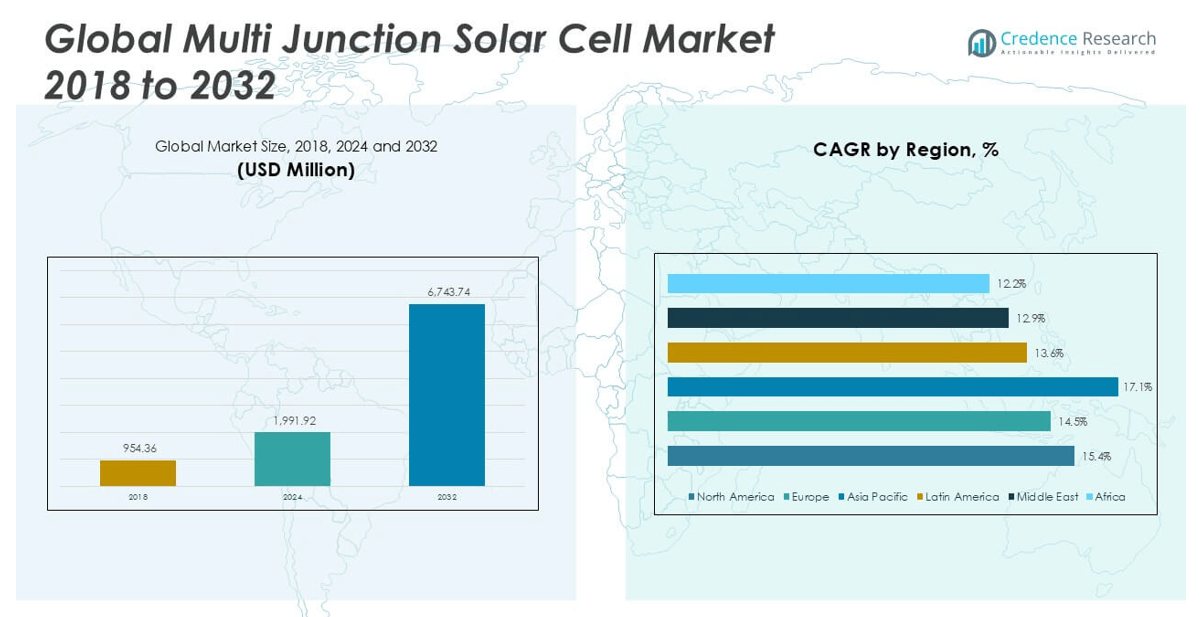
The Multi-Junction Solar Cell market size was valued at USD 954.36 million in 2018, increased to USD 1,991.92 million in 2024, and is anticipated to reach USD 6,743.74 million by 2032, at a CAGR of 15.35% during the forecast period.
The Multi-Junction Solar Cell market is led by key players such as Canadian Solar, Trina Solar, JinkoSolar, Sharp Corporation, Hanwha Q CELLS, AZUR SPACE Solar Power GmbH, Spectrolab (Boeing), SolAero Technologies, Emcore Corporation, and Fraunhofer ISE. These companies focus on high-efficiency solar technologies catering to aerospace, defense, and concentrated photovoltaic applications. North America emerges as the leading region, accounting for 41.5% of the global market share in 2024, driven by significant demand from satellite programs and defense initiatives. Asia Pacific follows, fueled by rapid industrialization, space exploration, and renewable energy projects in China, Japan, and India.
Market Insights
- The Multi-Junction Solar Cell market was valued at USD 1,991.92 million in 2024 and is projected to reach USD 6,743.74 million by 2032, growing at a CAGR of 15.35% during the forecast period.
- High demand for high-efficiency solar technologies in aerospace, defense, and CPV systems is a major growth driver, especially in North America and Asia Pacific.
- Key trends include the integration of multi-junction cells with CPV systems and advancements in layered cell architecture, driving higher efficiency and expanding application scope.
- The market is moderately consolidated, with leading players like Canadian Solar, Trina Solar, Spectrolab (Boeing), and SolAero Technologies dominating through innovation and strategic partnerships.
- High manufacturing costs and limited commercial adoption beyond niche applications remain key restraints; North America held the largest market share in 2024 at 41.5%, followed by Europe at 27.5%, while III-V multi-junction solar cells accounted for over 60% of the type segment share.
Market Segmentation Analysis:
By Type:
The III-V Multi-Junction Solar Cells segment dominates the market, accounting for over 60% of the total market share in 2024. These cells exhibit high efficiency and superior performance under concentrated sunlight, making them ideal for aerospace, satellite, and high-end terrestrial applications. Their ability to capture a broader solar spectrum drives demand across precision-required sectors. II-VI Multi-Junction Solar Cells follow, used in specific optoelectronic and photonic applications. The “Others” segment, though smaller, includes emerging experimental technologies and continues to gain traction with ongoing research into cost-effective alternatives.
- For instance, Spectrolab, a Boeing subsidiary, achieved an independently measured 41.6 efficiency in a triple‑junction GaInP/GaInAs/Ge cell under 484 suns of concentrated illumination, using a single MOVPE growth process, and their production‑grade C3MJ+ cells average 39.2 efficiency at 500 suns in volume manufacturing.
By Material:
Gallium Arsenide (GaAs) holds the leading position among materials, contributing to approximately 45% of the market share in 2024. Its high electron mobility and radiation resistance make it the preferred material in space and defense applications. Indium Gallium Phosphide (InGaP) is also widely used, especially in the top layers of tandem solar cells due to its ability to absorb higher-energy photons. Germanium (Ge), with its role as a base substrate in multi-junction stacks, also holds significant value. The "Others" segment includes newer compound semiconductors under development to improve efficiency and cost balance.
- For instance, AZUR SPACE Solar Power GmbH delivered space‑qualified triple‑junction GaInP/GaAs/Ge cells with a certified beginning‑of‑life efficiency of 30.0 and end‑of‑life in‑orbit output exceeding 27.8 under standard radiation fluence conditions, while reliably delivering over 1.5 million units without any in‑orbit failures.
By End User:
The Industrial segment dominates the end-user landscape, capturing nearly 50% of the market share in 2024. Its dominance is driven by large-scale deployments in satellite power systems, solar concentrators, and military-grade energy solutions requiring high-efficiency and durable cells. The Commercial segment is also growing steadily, fueled by the need for compact, efficient energy systems in smart infrastructure and off-grid applications. Residential adoption remains limited but is expected to rise with decreasing costs. The “Others” category includes research institutions and niche high-tech applications, contributing modestly but steadily to market growth.
Market Overview
Rising Demand for High-Efficiency Solar Technologies
The increasing demand for high-efficiency solar energy solutions is a major growth driver for the multi-junction solar cell market. Unlike conventional silicon-based cells, multi-junction cells offer significantly higher conversion efficiencies by absorbing a broader spectrum of sunlight. This makes them ideal for space applications, concentrated photovoltaics (CPV), and other energy-critical environments. As the global focus shifts toward maximizing solar output per unit area, especially in space-constrained or high-energy-demand sectors, the preference for multi-junction technologies is expected to rise sharply.
- For instance, Spectrolab achieved a record-breaking 41.6% conversion efficiency for a triple-junction GaInP/GaInAs/Ge solar cell, independently verified at NREL, under 484 suns. In their production line, the C3MJ+ series averages 39.2% efficiency under 500 suns. These cells are used in both space and terrestrial applications.
Expansion in Aerospace and Defense Applications
The aerospace and defense sectors continue to play a crucial role in driving multi-junction solar cell adoption. These sectors require energy sources with high power-to-weight ratios and excellent performance in extreme environments-areas where multi-junction cells outperform traditional alternatives. Their radiation resistance and long operational life make them ideal for powering satellites, unmanned aerial vehicles (UAVs), and space missions. With increased investments in space exploration and military satellite programs, this segment remains a consistent and expanding revenue source for manufacturers.
- For instance, AZUR SPACE Solar Power GmbH has supplied more than 1.5 million space-qualified triple-junction cells, all performing within a beginning-of-life efficiency range near 30.0%, and retaining over 27.8% efficiency after extended in-orbit exposure, with zero reported failures.
Government Support for Advanced Photovoltaics
Government initiatives and funding aimed at fostering clean and advanced energy technologies significantly support the growth of multi-junction solar cells. Several countries are providing subsidies, grants, and R&D investments to develop next-generation solar cells with higher efficiencies and long-term reliability. Additionally, defense and space agencies continue to award contracts for high-performance solar panels, boosting market opportunities. These policies not only encourage innovation but also reduce the cost burden on producers and end-users, thus enhancing commercial viability.
Key Trends & Opportunities
Integration with Concentrated Photovoltaic Systems (CPV)
The integration of multi-junction solar cells with concentrated photovoltaic systems presents a high-potential opportunity. CPV systems use lenses or mirrors to focus sunlight onto small, highly efficient multi-junction cells, maximizing power output. This combination is especially suited for high-sunlight regions and utility-scale solar farms. The trend is gaining momentum as energy developers seek ways to reduce the levelized cost of electricity (LCOE) while enhancing performance. As CPV technology matures, its compatibility with multi-junction cells is expected to unlock substantial commercial applications.
- For instance, Azur Space achieved a record triple-junction solar cell efficiency of 41.4% in a CPV system tested under AM1.5d conditions. This achievement highlights the potential of combining CPV technology with multi-junction solar cells for high-efficiency solar energy conversion.
Technological Advancements in Layered Cell Architecture
Ongoing research and innovation in cell architecture, such as the development of four and five-junction configurations, are enabling even higher efficiency levels. Innovations in semiconductor materials and deposition techniques are pushing the theoretical limits of solar conversion. These advancements not only enhance performance but also open doors to broader applications across various sectors. Companies focusing on scalable, cost-effective production methods for these advanced architectures are well-positioned to capitalize on this trend as the demand for cutting-edge solar solutions grows.
- For instance, in collaboration with the National Renewable Energy Laboratory (NREL), Boeing-Spectrolab developed a six-junction III-V solar cell that achieved a record conversion efficiency of 47.1% under 143 suns concentration, verified under standard test conditions, using innovative epitaxial growth and lattice-matched materials.
Key Challenges
High Manufacturing Costs and Complex Fabrication
One of the primary challenges facing the multi-junction solar cell market is the high cost and technical complexity associated with manufacturing. These cells require precision layering of multiple semiconductor materials, often involving costly substrates like gallium arsenide or germanium. The need for advanced cleanroom environments and sophisticated equipment adds to the capital expenditure, making them significantly more expensive than traditional solar technologies. This cost barrier limits their adoption in price-sensitive markets and restricts deployment mainly to premium or mission-critical applications.
Limited Commercial Adoption Beyond Niche Applications
Despite their performance advantages, multi-junction solar cells face limited commercial penetration due to their niche appeal. Their use is largely confined to aerospace, defense, and specialized industrial projects, with minimal adoption in mainstream residential or commercial solar systems. This restricted demand scope hampers large-scale production, keeping costs high and stalling broader market acceptance. Until cost-reduction strategies or breakthroughs in mass production emerge, commercial expansion beyond niche sectors will remain a significant hurdle for market growth.
Regional Analysis
North America
North America held the largest share in the multi-junction solar cell market in 2024, accounting for approximately 41.5% of global revenue. The market was valued at USD 400.10 million in 2018 and reached USD 826.05 million in 2024, with projections to hit USD 2,804.71 million by 2032 at a robust CAGR of 15.4%. This growth is primarily driven by significant investments in aerospace, defense, and satellite-based applications. The U.S. leads regional demand with strong R&D initiatives, government contracts, and advanced solar infrastructure, further solidifying North America's dominance in high-efficiency solar technologies.
Europe
Europe captured a notable 27.5% market share in 2024, with its market growing from USD 272.32 million in 2018 to USD 548.00 million in 2024, and is projected to reach USD 1,747.39 million by 2032, growing at a CAGR of 14.5%. The region's emphasis on sustainability, innovation in renewable technologies, and extensive aerospace research contributes to steady demand for multi-junction solar cells. Countries like Germany and France are leading adopters, supported by EU-backed funding for clean energy initiatives and advanced photovoltaic technologies. This positions Europe as a strong player in the global market landscape.
Asia Pacific
Asia Pacific is emerging as the fastest-growing region, with a projected CAGR of 17.1% and a 22.0% market share in 2024. The market expanded from USD 194.91 million in 2018 to USD 438.95 million in 2024, and is expected to reach USD 1,672.48 million by 2032. The region’s growth is fueled by increasing investments in space technology, rising adoption of CPV systems, and government incentives supporting advanced solar technologies. China, Japan, and India are leading contributors, with expanding space programs and growing emphasis on clean, high-efficiency energy solutions enhancing regional competitiveness.
Latin America
Latin America accounted for approximately 4.7% of the global market share in 2024, growing from USD 44.97 million in 2018 to USD 92.70 million in 2024, with expectations to reach USD 277.68 million by 2032 at a CAGR of 13.6%. The region’s growth is driven by increasing adoption of solar technologies in remote and off-grid areas, along with growing commercial and industrial demand for renewable energy. Countries like Brazil and Chile are investing in solar infrastructure, creating new opportunities for high-efficiency solutions like multi-junction cells, especially in utility-scale projects.
Middle East
The Middle East held a 2.6% share of the market in 2024, growing from USD 26.84 million in 2018 to USD 51.23 million in 2024, and is anticipated to reach USD 146.45 million by 2032, expanding at a CAGR of 12.9%. The region is leveraging its high solar irradiance to deploy advanced solar systems, especially in UAE and Saudi Arabia. While silicon-based cells dominate utility projects, the demand for high-efficiency solutions in defense, aviation, and research is contributing to modest but consistent growth in multi-junction cell adoption across the region.
Africa
Africa accounted for a modest 1.8% share of the global market in 2024, with values increasing from USD 15.22 million in 2018 to USD 35.00 million in 2024, and projected to reach USD 95.03 million by 2032, growing at a CAGR of 12.2%. The market is driven by a growing need for sustainable and decentralized energy solutions, particularly in remote areas. Although cost remains a barrier, government programs and foreign investments targeting renewable electrification in regions like Sub-Saharan Africa are expected to create gradual opportunities for multi-junction technologies in niche and off-grid applications.
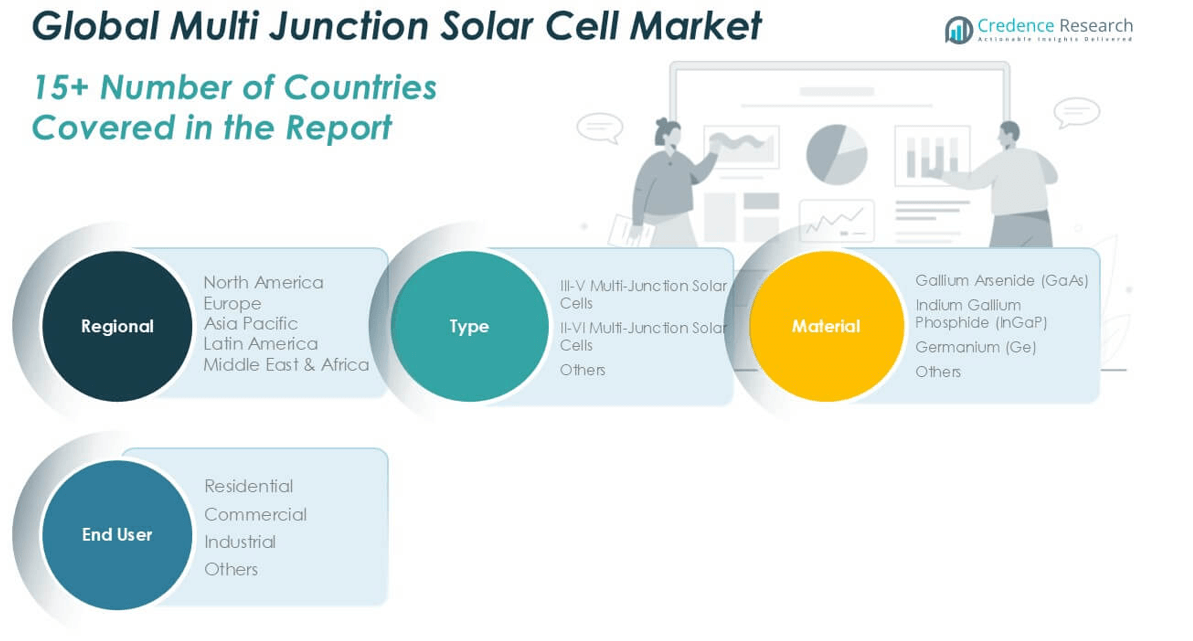
Market Segmentations:
By Type
- III-V Multi-Junction Solar Cells
- II-VI Multi-Junction Solar Cells
- Others
By Material
- Gallium Arsenide (GaAs)
- Indium Gallium Phosphide (InGaP)
- Germanium (Ge)
- Others
By End User
- Residential
- Commercial
- Industrial
- Others
By Geography
- North America
- U.S.
- Canada
- Mexico
- Europe
- Germany
- France
- U.K.
- Italy
- Spain
- Rest of Europe
- Asia Pacific
- China
- Japan
- India
- South Korea
- South-east Asia
- Rest of Asia Pacific
- Latin America
- Brazil
- Argentina
- Rest of Latin America
- Middle East & Africa
- GCC Countries
- South Africa
- Rest of the Middle East and Africa
Competitive Landscape
The competitive landscape of the Multi-Junction Solar Cell market is characterized by a mix of established photovoltaic manufacturers and specialized aerospace and defense-focused companies. Leading players such as Canadian Solar, Trina Solar, and JinkoSolar are expanding their R&D capabilities to develop high-efficiency multi-junction technologies for terrestrial and commercial applications. Niche players like AZUR SPACE Solar Power GmbH, Spectrolab (Boeing), and SolAero Technologies dominate the aerospace segment, supplying radiation-resistant solar cells for satellites and space missions. Companies such as Emcore Corporation and Fraunhofer ISE contribute significantly through technological innovation and research-driven advancements. Strategic partnerships, government contracts, and continuous innovation are key competitive strategies in this market. As demand grows in high-performance and space-based applications, players are focusing on enhancing efficiency, reducing production costs, and scaling up advanced multi-layer architectures. The market remains moderately consolidated, with a few players holding significant shares due to high entry barriers and complex manufacturing requirements.
Key Player Analysis
- Canadian Solar
- Trina Solar
- JinkoSolar
- Sharp Corporation
- Hanwha Q CELLS
- AZUR SPACE Solar Power GmbH
- Spectrolab (Boeing)
- SolAero Technologies
- Emcore Corporation
- Fraunhofer ISE
Recent Developments
- In April 2025, Trina Solar announced the development of the world’s first industrial-standard 800W+ tandem module, signaling a move toward commercializing high-power, multi-junction modules.
- In January 2025, JinkoSolar announced a new world record for N-type TOPCon-based perovskite tandem solar cell efficiency, achieving 33.84%. This result, independently tested by the Shanghai Institute of Microsystem and Information Technology, surpasses their previous record of 33.24% and demonstrates the potential of TOPCon as a mainstream technology for advanced tandem solar cells, according to JinkoSolar.
- In December 2024, Hanwha Q CELLS achieved a world record for tandem solar cell efficiency, reaching 28.6% on a full-area M10-sized perovskite-silicon cell, independently verified by Fraunhofer ISE. This milestone is a significant step towards commercializing high-efficiency tandem solar technology, according to Hanwha Qcells.
- In December 2024, Trina Solar achieved a world-record 27.08% efficiency for its n-type fully passivated heterojunction (HJT) solar cell. This record, verified by the Institute for Solar Energy Research in Hamelin (ISFH), signifies a major advancement in bifacial contact technology and high-efficiency module development.
Market Concentration & Characteristics
The Multi-Junction Solar Cell Market exhibits a moderately concentrated structure, with a handful of specialized companies holding significant market share. It is characterized by high entry barriers due to complex manufacturing processes, capital-intensive infrastructure, and the need for advanced technical expertise. Leading players such as Spectrolab (Boeing), SolAero Technologies, and AZUR SPACE dominate high-efficiency applications in aerospace and defense. The market also includes large photovoltaic firms like Canadian Solar and Trina Solar that invest in R&D to expand their advanced solar cell portfolios. It favors innovation-driven competition, where efficiency, reliability, and radiation resistance determine commercial viability. Government contracts and space agency partnerships often influence vendor positioning. It relies heavily on precision material engineering using substrates like GaAs and Ge, which further limits mass-market scalability. While demand continues to grow in industrial and commercial applications, the market remains specialized due to its technological and cost constraints.
Report Coverage
The research report offers an in-depth analysis based on Type, Material, End User and Geography. It details leading market players, providing an overview of their business, product offerings, investments, revenue streams, and key applications. Additionally, the report includes insights into the competitive environment, SWOT analysis, current market trends, as well as the primary drivers and constraints. Furthermore, it discusses various factors that have driven market expansion in recent years. The report also explores market dynamics, regulatory scenarios, and technological advancements that are shaping the industry. It assesses the impact of external factors and global economic changes on market growth. Lastly, it provides strategic recommendations for new entrants and established companies to navigate the complexities of the market.
Future Outlook
- The multi-junction solar cell market is expected to witness strong growth driven by rising demand for high-efficiency solar technologies.
- Aerospace and defense sectors will continue to be the dominant end users due to the cells’ superior performance in extreme conditions.
- Asia Pacific is projected to emerge as the fastest-growing region with increased investments in advanced solar R&D and satellite programs.
- Technological advancements in layered cell structures will enable efficiency improvements and broader application.
- Integration with concentrated photovoltaic systems will create new opportunities for utility-scale energy generation.
- Falling production costs through manufacturing innovations may enable gradual entry into commercial and residential segments.
- Governments and space agencies are expected to increase funding for high-performance solar technologies.
- Strategic partnerships and acquisitions will play a key role in expanding product portfolios and global reach.
- Continued research into new semiconductor materials will enhance cell durability and energy yield.
- The market will remain innovation-driven, with performance, weight, and radiation resistance shaping future competitiveness.

Request a Free Sample
Fill in your details and we'll send you a free sample report.
- Sample data tables & charts
- Research methodology
Market Dynamics
Rising Demand for High-Efficiency Solar Technologies
Multi-junction solar cells offer significantly higher conversion efficiencies than conventional silicon-based cells, making them ideal for applications where maximizing solar output per unit area is critical, such as in space, defense, and concentrated photovoltaic systems.
Expansion in Aerospace and Defense Applications
The need for lightweight, radiation-resistant, and high-performance power sources in satellites, UAVs, and space missions is driving strong demand for multi-junction solar cells, as these sectors require superior efficiency and durability in extreme environments.
Government Support for Advanced Photovoltaics
Substantial government funding, subsidies, and R&D incentives for next-generation solar technologies are accelerating the development and adoption of multi-junction solar cells, particularly for strategic applications in space and defense.
Integration with Concentrated Photovoltaic Systems (CPV)
The pairing of multi-junction cells with CPV systems enables maximum power output in high-irradiance regions, supporting utility-scale solar farms and reducing the levelized cost of electricity, thus expanding commercial opportunities.
Technological Advancements in Layered Cell Architecture
Continuous innovation in multi-layer cell design, such as four, five, and six-junction configurations, is pushing efficiency boundaries and opening new application areas, making the technology more attractive for high-value industrial and commercial uses.
Need a Custom Version of This Report?
Tailor the scope, geography, or segments to your exact requirements.
- Custom geography or segment scope
- Direct access to our analyst team
Frequently Asked Questions
What is the current size of the Multi-Junction Solar Cell Market?
What are the key segments within the Multi-Junction Solar Cell Market?
What are some challenges faced by the Multi-Junction Solar Cell Market?
Who are the major players in the Multi-Junction Solar Cell Market?
Table of Content
Chapter 1 Market Segmentation
- 1.1 Segmentation Framework
- 1.1.1 Product and Service Classification
- 1.1.2 Application and End-Use Classification
- 1.1.3 Technology and Solution Classification
- 1.1.4 Customer and Distribution Channel Classification
- 1.1.5 Geographic Segmentation
- 1.1.6 Market Segment Definitions and Boundaries
- 1.2 By Type
- 1.2.1 III-V Multi-Junction Solar Cells
- 1.2.2 II-VI Multi-Junction Solar Cells
- 1.2.3 Others
- 1.3 By End User
- 1.3.1 Residential
- 1.3.2 Commercial
- 1.3.3 Industrial
- 1.3.4 Others
- 1.4 By Material
- 1.4.1 Gallium Arsenide (GaAs)
- 1.4.2 Indium Gallium Phosphide (InGaP)
- 1.4.3 Germanium (Ge)
- 1.4.4 Others
Chapter 2 Introduction
- 2.1 Report Objectives and Scope
- 2.2 Product Definition and Industry Terminology
- 2.3 Market Inclusions and Exclusions
- 2.4 Research Process
- 2.4.1 Primary Research and Expert Interviews
- 2.4.2 Secondary Research and Source Review
- 2.4.3 Top-Down and Bottom-Up Estimation
- 2.4.4 Data Triangulation and Verification
- 2.5 Market Size Measurement Basis
- 2.5.1 2024: USD 1,991.92 million → 2032: USD 6,743.74 million
- 2.6 Historical and Forecast Reference Periods
- 2.6.1 Base Year: 2024
- 2.6.2 Forecast Period: 2024-2032
- 2.7 Research Assumptions and Limitations
Chapter 3 Executive Summary
- 3.1 Market Snapshot and Key Findings
- 3.2 Base-Year Market Size, 2024
- 3.3 Forecast Market Size, 2032
- 3.4 Revenue and Volume Growth Outlook
- 3.5 Key Demand and Supply Indicators
- 3.6 Leading Market Segments
- 3.7 Fastest-Growing Market Opportunities
- 3.8 Regional Performance Highlights
- 3.9 Technology and Industry Transformation
- 3.10 Competitive Landscape Summary
- 3.11 Analyst View and Strategic Implications
Chapter 4 Global Multi-Junction Solar Cell Market Trends and Developments
- 4.1 Historical Industry Development
- 4.2 Recent Market Trends and Developments
- 4.3 Demand and Customer Behavior Trends
- 4.4 Technology and Product Innovation
- 4.5 Artificial Intelligence, Automation and Digitalization
- 4.6 Local Manufacturing and Supply Chain Realignment
- 4.7 Industry Partnerships, Mergers and Acquisitions
- 4.8 Sustainability and Circular Economy Developments
- 4.9 Government and Private Sector Investment Trends
- 4.10 Emerging Business Models and Commercialization
- 4.11 Industry Developments and Announcements
Chapter 5 Global Multi-Junction Solar Cell Market Production, Supply and Demand Analysis
- 5.1 Demand Trend and Consumption Analysis
- 5.2 Demand Forecast, 2024-2032
- 5.3 Production and Output Trend
- 5.4 Production and Output Forecast, 2024-2032
- 5.5 Installed Capacity and Capacity Utilization
- 5.6 Company-Wise Production Plants and Statistics
- 5.6.1 Installed Production Capacity
- 5.6.2 Actual Production
- 5.6.3 Planned Capacity and Expansion Targets
- 5.7 Supply Chain Structure and Procurement Trends
- 5.8 Supply-Demand Gap and Bottlenecks
- 5.9 Import Dependence and Sourcing Structure
- 5.10 Contract Manufacturing and Outsourcing
- 5.11 Regional Supply and Demand Concentration
Chapter 6 Global Multi-Junction Solar Cell Market Pricing Analysis
- 6.1 Pricing Structure and Measurement
- 6.2 Historical Pricing Trends
- 6.3 Pricing Outlook, 2024-2032
- 6.4 Average Selling Price and Unit Economics
- 6.5 Pricing by Product and Market Segment
- 6.6 Geographic Pricing Differences
- 6.7 Key Input, Energy, Labor and Logistics Costs
- 6.8 Contract Pricing and Purchasing Models
- 6.9 Pricing Sensitivity and Competitive Positioning
- 6.10 Price, Margin and Profitability Implications
Chapter 7 Global Multi-Junction Solar Cell Market Dynamics
- 7.1 Market Growth Drivers
- 7.1.1 Demand-Side Drivers
- 7.1.2 Technology and Innovation Drivers
- 7.1.3 Infrastructure and Investment Drivers
- 7.1.4 Regulatory and Policy Drivers
- 7.2 Market Restraints
- 7.2.1 Cost and Affordability Constraints
- 7.2.2 Technology and Adoption Barriers
- 7.2.3 Supply Chain and Operational Constraints
- 7.3 Market Challenges
- 7.3.1 Competitive Pressure and Margin Erosion
- 7.3.2 Skills, Infrastructure and Implementation Gaps
- 7.4 Emerging Market Opportunities
- 7.5 Market Dynamics Impact and Time-Horizon Assessment
Chapter 8 Global Multi-Junction Solar Cell Value Chain Analysis
- 8.1 Industry Value Chain Overview
- 8.2 Upstream Suppliers and Critical Inputs
- 8.3 Technology and Component Providers
- 8.4 Manufacturing or Service Delivery
- 8.5 Distribution, Channel Partners and Integrators
- 8.6 Downstream Applications and End Users
- 8.7 Value Addition and Profit Pools
- 8.8 Vertical Integration and Outsourcing
- 8.9 Supplier Concentration and Risk
- 8.10 Supply Chain Localization and Resilience
Chapter 9 Global Multi-Junction Solar Cell Market Regulations and Policies
- 9.1 Relevant Laws, Standards and Compliance Frameworks
- 9.2 Product, Service, Safety and Quality Requirements
- 9.3 Government Policies, Incentives and Subsidies
- 9.4 Imports, Exports and Trade Barriers
- 9.5 Public Procurement and Local Content Requirements
- 9.6 Environmental and Sustainability Compliance
- 9.7 Upcoming Policy Changes and Market Implications
Chapter 10 Global Multi-Junction Solar Cell Market Hotspots and Opportunities
- 10.1 Market Opportunity Mapping and Growth Hotspots
- 10.2 High-Growth Applications and Customer Groups
- 10.3 Underserved Markets and White-Space Opportunities
- 10.4 Emerging Technology and Product Opportunities
- 10.5 New Capacity and Investment Hotspots
- 10.6 Market Entry and Expansion Opportunities
- 10.7 Distribution and Partnership Opportunities
- 10.8 Near-Term and Long-Term Commercial Potential
- 10.9 Opportunity Attractiveness and Execution Risks
Chapter 11 Global Multi-Junction Solar Cell Market Outlook, 2024-2032
- 11.1 Market Size and Analysis
- 11.1.1 Revenue (Market Measurement: 2024: USD 1,991.92 million → 2032: USD 6,743.74 million)
- 11.1.2 Market Volume and Quantity Sold
- 11.1.3 Historical Market Size
- 11.1.4 Base-Year Market Size, 2024
- 11.2 Market Forecast, 2024-2032
- 11.2.1 Revenue Forecast to 2032
- 11.2.2 Volume Forecast to 2032
- 11.2.3 CAGR and Year-on-Year Growth
- 11.2.4 Incremental Revenue Opportunity
- 11.3 Forecast Assumptions and Scenario Analysis
- 11.3.1 Base-Case Forecast
- 11.3.2 Optimistic and Conservative Scenarios
- 11.3.3 Technology, Pricing and Policy Sensitivities
- 11.4 Market Attractiveness and Growth Outlook
Chapter 12 Global Multi-Junction Solar Cell Market Segmentation and Outlook
- 12.1 Segmentation Summary and Market Shares, 2024
- 12.2 Largest and Fastest-Growing Segments
- 12.3 By Type - Market Size and Forecast, 2024-2032
- 12.3.1 Segment Definition and Scope
- 12.3.2 Historical Market Size
- 12.3.3 Revenue Forecast, 2024-2032
- 12.3.4 Volume Forecast, 2024-2032
- 12.3.5 Base-Year Market Share, 2024
- 12.3.6 Segment CAGR and Growth Drivers
- 12.3.7 Subsegment Market Size and Forecast
- 12.3.7.1 III-V Multi-Junction Solar Cells
- 12.3.7.2 II-VI Multi-Junction Solar Cells
- 12.3.7.3 Others
- 12.3.8 Subsegment Pricing and Adoption Trends
- 12.3.9 Leading Suppliers and Competition
- 12.3.10 Regional Demand and Opportunities
- 12.4 By End User - Market Size and Forecast, 2024-2032
- 12.4.1 Segment Definition and Scope
- 12.4.2 Historical Market Size
- 12.4.3 Revenue Forecast, 2024-2032
- 12.4.4 Volume Forecast, 2024-2032
- 12.4.5 Base-Year Market Share, 2024
- 12.4.6 Segment CAGR and Growth Drivers
- 12.4.7 Subsegment Market Size and Forecast
- 12.4.7.1 Residential
- 12.4.7.2 Commercial
- 12.4.7.3 Industrial
- 12.4.7.4 Others
- 12.4.8 Subsegment Pricing and Adoption Trends
- 12.4.9 Leading Suppliers and Competition
- 12.4.10 Regional Demand and Opportunities
- 12.5 By Material - Market Size and Forecast, 2024-2032
- 12.5.1 Segment Definition and Scope
- 12.5.2 Historical Market Size
- 12.5.3 Revenue Forecast, 2024-2032
- 12.5.4 Volume Forecast, 2024-2032
- 12.5.5 Base-Year Market Share, 2024
- 12.5.6 Segment CAGR and Growth Drivers
- 12.5.7 Subsegment Market Size and Forecast
- 12.5.7.1 Gallium Arsenide (GaAs)
- 12.5.7.2 Indium Gallium Phosphide (InGaP)
- 12.5.7.3 Germanium (Ge)
- 12.5.7.4 Others
- 12.5.8 Subsegment Pricing and Adoption Trends
- 12.5.9 Leading Suppliers and Competition
- 12.5.10 Regional Demand and Opportunities
- 12.6 Segment Growth Comparison
- 12.7 Segment Attractiveness and Priority Matrix
Chapter 13 Global Multi-Junction Solar Cell End-Use and Application Market Outlook
- 13.1 End-Use Industry and Customer Demand Structure
- 13.2 Leading Applications and Customer Groups
- 13.3 End-Use Market Size, Share and Forecast
- 13.4 Major End-Use Industry Deep Dives
- 13.4.1 Customer Requirements and Use Cases
- 13.4.2 Demand and Replacement Cycles
- 13.4.3 Technical and Regulatory Considerations
- 13.4.4 Purchasing and Procurement Models
- 13.4.5 Leading Vendors and Distribution Channels
- 13.4.6 Forecast and Commercial Opportunities
- 13.5 Emerging Applications and Cross-Segment Demand
- 13.6 End-Use Industry Investment Priorities
Chapter 14 Global Multi-Junction Solar Cell Geographic Market Outlook, 2024-2032
- 14.1 Regional Market Size and Share, 2024
- 14.2 Regional Market Forecast, 2024-2032
- 14.3 Regional Pricing, Production and Demand Differences
- 14.4 North America
- 14.4.1 United States
- 14.4.2 Canada
- 14.4.3 Mexico
- 14.5 Europe
- 14.5.1 Germany
- 14.5.2 France
- 14.5.3 Italy
- 14.5.4 United Kingdom
- 14.5.5 Spain
- 14.5.6 Poland
- 14.5.7 Russia
- 14.5.8 Netherlands
- 14.5.9 Belgium
- 14.5.10 Sweden
- 14.5.11 Denmark
- 14.5.12 Norway
- 14.5.13 Rest of Europe
- 14.6 Asia Pacific
- 14.6.1 China
- 14.6.2 India
- 14.6.3 Japan
- 14.6.4 South Korea
- 14.6.5 Thailand
- 14.6.6 Indonesia
- 14.6.7 Vietnam
- 14.6.8 Malaysia
- 14.6.9 Australia
- 14.6.10 Rest of Asia Pacific
- 14.7 Latin America
- 14.7.1 Brazil
- 14.7.2 Argentina
- 14.7.3 Colombia
- 14.7.4 Chile
- 14.7.5 Rest of Latin America
- 14.8 Middle East
- 14.8.1 Saudi Arabia
- 14.8.2 United Arab Emirates
- 14.8.3 Turkey
- 14.8.4 Israel
- 14.8.5 Iran
- 14.8.6 Rest of the Middle East
- 14.9 Africa
- 14.9.1 South Africa
- 14.9.2 Egypt
- 14.9.3 Nigeria
- 14.9.4 Morocco
- 14.9.5 Rest of Africa
- 14.10 Regional Investment, Policy and Supply Chain Differences
- 14.11 Regional Competitive Landscape
- 14.12 Geographic Growth Hotspots
Chapter 15 Global Multi-Junction Solar Cell Technology, Innovation and Sustainability Outlook
- 15.1 Technology Landscape and Maturity
- 15.2 Product, Process and Service Innovation
- 15.3 AI, Automation and Digital Tools in the Industry
- 15.4 Technology Adoption and Performance Benchmarking
- 15.5 Innovation Pipeline and R&D Investment
- 15.6 Patent and Intellectual Property Trends
- 15.7 Energy Efficiency and Resource Management
- 15.8 Sustainability, Recycling and Circularity
- 15.9 Technology Roadmap, 2024-2032
- 15.10 Risks of Obsolescence and Technology Substitution
Chapter 16 Global Multi-Junction Solar Cell Market Key Strategic Imperatives
- 16.1 Growth and Market Entry Priorities
- 16.2 High-Return Products and Segments
- 16.3 Pricing, Profitability and Cost Optimization
- 16.4 Technology Investment and Product Differentiation
- 16.5 Supply Chain Localization and Resilience
- 16.6 Distribution and Customer Acquisition
- 16.7 Partnership, Acquisition and Capacity Strategy
- 16.8 Regional Expansion Priorities
- 16.9 Short-, Medium- and Long-Term Actions
Chapter 17 Competition Outlook
- 17.1 Industry Competition Characteristics
- 17.2 Market Structure and Concentration
- 17.3 Market Share and Competitive Positioning, 2024
- 17.4 Company-Wise Revenue and Product Benchmarking
- 17.5 Production and Service Capacity Benchmarking
- 17.6 Technology, Pricing and Differentiation
- 17.7 Regional Footprint and Distribution Strength
- 17.8 Mergers, Acquisitions and Strategic Alliances
- 17.9 New Entrants and Competitive Threats
- 17.10 Porter's Five Forces and Industry Attractiveness
- 17.11 Competitive Outlook, 2024-2032
Chapter 18 Company Profiles
- 18.1 Company Coverage and Selection Criteria
- 18.2 Canadian Solar
- 18.2.1 Business Description
- 18.2.2 Company Ownership and Geographic Presence
- 18.2.3 Product and Service Portfolio
- 18.2.4 Manufacturing and Operating Footprint
- 18.2.5 Production Capacity and Expansion Plans
- 18.2.6 Financial Performance and Investment
- 18.2.7 Market Share and Competitive Position
- 18.2.8 Technology and Innovation Capabilities
- 18.2.9 Strategic Alliances or Partnerships
- 18.2.10 Recent Developments
- 18.2.11 Growth Strategy and Outlook
- 18.3 Trina Solar
- 18.4 JinkoSolar
- 18.5 Sharp Corporation
- 18.6 Hanwha Q CELLS
- 18.7 AZUR SPACE Solar Power GmbH
- 18.8 Spectrolab (Boeing)
- 18.9 SolAero Technologies
- 18.10 Emcore Corporation
- 18.11 Fraunhofer ISE
- 18.12 Other Relevant Market Participants
Note: Every listed company is profiled on the structure shown under the first company. The company list is preliminary and may change based on research findings, market developments, data availability and client requirements.
Chapter 19 Disclaimer
- 19.1 Research and Forecast Disclaimer
- 19.2 Data Source and Estimation Limitations
Note: The depth of individual sections depends on data availability for this market. Volume, capacity, trade and other unit-based metrics are included where applicable.

