
Market Overview
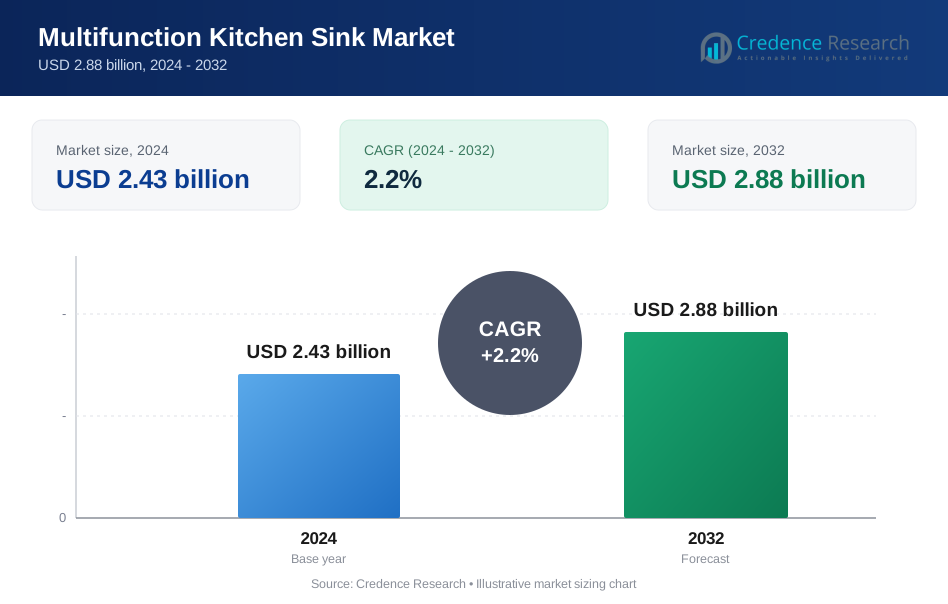
Multifunction Kitchen Sink Market size was valued at USD 2.43 billion in 2024 and is anticipated to reach USD 2.88 billion by 2032, at a CAGR of 2.2% during the forecast period.
| REPORT ATTRIBUTE | DETAILS |
|---|---|
| Historical Period | 2020-2023 |
| Base Year | 2024 |
| Forecast Period | 2025-2032 |
| Multifunction Kitchen Sink Market Size 2024 | USD 2.43 Billion |
| Multifunction Kitchen Sink Market, CAGR | 2.2% |
| Multifunction Kitchen Sink Market Size 2032 | USD 2.88 Billion |
The Multifunction Kitchen Sink Market is driven by rising demand for space-saving solutions, premium kitchen upgrades, and sustainable fixtures. Consumers seek sinks with integrated accessories, smart faucets, and modular designs that enhance both functionality and aesthetics. Growing urbanization and smaller kitchen spaces accelerate adoption in residential projects, while commercial kitchens favor durable, high-capacity models. Trends highlight the shift toward eco-friendly materials, touchless technology, and customizable configurations that align with smart home concepts. It continues to gain momentum as homeowners and businesses prioritize efficiency, style, and sustainability, creating strong opportunities for manufacturers to innovate and expand across global markets.
The Multifunction Kitchen Sink Market shows strong presence across North America, Europe, Asia-Pacific, Latin America, and the Middle East & Africa, with Asia-Pacific holding the largest share due to rapid urbanization and modern housing projects. North America and Europe remain significant markets driven by premium kitchen renovations and sustainability trends. Key players such as Kohler, Franke, Blanco, Moen, Elkay, Duravit, Foster, BONKE, Hafele, and American Standard focus on innovation, premium materials, and smart features to strengthen their global market position.
Market Insights
- The Multifunction Kitchen Sink Market size was valued at USD 2.43 billion in 2024 and is projected to reach USD 2.88 billion by 2032, registering a CAGR of 2.2%.
- Rising demand for space-saving solutions, premium upgrades, and sustainable fixtures drives market growth.
- Consumers prefer sinks with integrated accessories, modular designs, and smart faucets for modern kitchens.
- The market faces restraints from high product costs and limited awareness in price-sensitive regions.
- Trends highlight adoption of eco-friendly materials, touchless technology, and customizable configurations aligned with smart home concepts.
- Asia-Pacific leads the market due to rapid urbanization, while North America and Europe sustain growth through renovations and sustainability initiatives.
- Key players including Kohler, Franke, Blanco, Moen, Elkay, Duravit, Foster, BONKE, Hafele, and American Standard strengthen competitiveness through innovation, premium materials, and expanding global distribution.

Market Drivers
Rising Consumer Preference for Modern and Space-Saving Kitchen Solutions
The growing preference for multifunctional designs in residential kitchens drives the Multifunction Kitchen Sink Market. Homeowners prioritize sinks that integrate chopping boards, drying racks, and waste disposal features. It provides an efficient solution for compact kitchens where counter space is limited. Increasing urbanization and smaller apartment layouts make integrated sink systems highly attractive. Demand rises in both developed and emerging economies as households embrace convenience-focused products. The push toward space optimization continues to strengthen this segment.
- For instance, Blanco UNIT system, and Blanco sinks in general, offer solutions designed for various cabinet sizes, including 600mm base cabinets. The ability to integrate accessories within this footprint optimizes the use of limited space.
Increasing Adoption of Premium and Smart Home Appliances
Consumers invest more in premium kitchen solutions that align with smart home trends. The Multifunction Kitchen Sink Market benefits from this shift, as advanced sinks often feature integrated faucets, touch controls, and water-saving mechanisms. It appeals to homeowners seeking both aesthetics and functionality in one product. Rising disposable income in urban populations boosts willingness to pay for such innovations. Manufacturers respond by launching sleek, technology-driven sink models. The combination of design and technology creates a strong competitive edge.
- For instance, manufacturers have introduced a Multifunctional Digital Display Smart Sink made from 304-grade stainless steel. The sink features a built-in digital thermometer display and waterfall spout, and is available in a single-bowl design.
Expansion of Renovation and Remodeling Activities Worldwide
The surge in kitchen renovation projects strengthens demand for multifunction kitchen sinks. The Multifunction Kitchen Sink Market gains traction from homeowners prioritizing modern upgrades. It plays a critical role in delivering a stylish yet practical centerpiece to kitchen spaces. Growing consumer awareness of innovative fixtures encourages replacement of traditional sinks with multifunctional alternatives. Builders and contractors increasingly recommend these products in premium housing projects. Rising spending on home improvement globally amplifies this trend further.
Growing Focus on Sustainability and Water Efficiency in Kitchen Fixtures
Environmental concerns drive manufacturers to develop eco-friendly multifunction sinks. The Multifunction Kitchen Sink Market benefits from products designed with water-saving taps, filtration systems, and durable materials. It addresses consumer demand for sustainable kitchen solutions without compromising on utility. Stainless steel and composite sinks with recyclable components gain more acceptance. Governments encourage water-efficient solutions, creating favorable conditions for adoption. The sustainability focus ensures long-term demand for multifunction sinks across residential and commercial applications.
Market Trends
Growing Integration of Smart Features and Digital Controls in Kitchen Sinks
The Multifunction Kitchen Sink Market is experiencing a steady trend toward smart integration. Consumers show strong interest in sinks equipped with touchless faucets, LED indicators, and temperature control systems. It offers a blend of convenience and hygiene that aligns with smart home adoption. Voice-activated and app-connected systems are becoming popular among urban households. Manufacturers focus on pairing sinks with advanced filtration units and energy-efficient water systems. The emphasis on technology integration continues to shape product development across the market.
- For instance, Moen Smart Faucet with Motion Control can dispense precise amounts ranging from 1 tablespoon (15 ml) to 15 gallons (56.7 liters), and its LED indicator shifts from blue (cold) to purple (warm) to red (hot).
Rising Popularity of Modular and Customizable Sink Designs
Customization is becoming a key trend as homeowners seek tailored kitchen solutions. The Multifunction Kitchen Sink Market benefits from modular units that adapt to varying counter layouts. It allows consumers to add or remove components such as colanders, racks, and cutting boards. Flexible sink designs meet the growing demand for functional yet stylish kitchen spaces. Premium housing projects increasingly highlight sinks with personalized options to attract buyers. The trend positions modular sinks as an essential feature in modern kitchens.
- For instance, Franke Mythos Modular Sink System as part of its extensive Mythos lineup, Franke offers various single-bowl sink configurations, including those with widths corresponding to approximately 33 inches (840 mm).
Increasing Demand for Sustainable and Eco-Friendly Materials
Sustainability has emerged as a central theme in new sink designs. The Multifunction Kitchen Sink Market is advancing with products crafted from stainless steel, recycled composites, and low-impact coatings. It helps meet regulatory expectations and consumer preference for environmentally responsible fixtures. Eco-certified products are gaining attention from both residential and commercial buyers. Manufacturers emphasize durability and long product lifecycles to reduce waste. The adoption of green materials reinforces market alignment with global sustainability goals.
Expanding Role of Aesthetics and Premium Kitchen Interiors
Design-driven trends influence purchase decisions in modern kitchens. The Multifunction Kitchen Sink Market reflects rising demand for sleek finishes, matte surfaces, and minimalist aesthetics. It appeals to consumers seeking a luxury kitchen experience without compromising function. Black stainless steel, brushed nickel, and stone-inspired designs dominate new launches. Builders and interior designers integrate sinks as statement pieces in high-value projects. The aesthetic emphasis enhances brand positioning and supports demand for premium multifunction sink solutions.
Market Challenges Analysis
High Cost of Advanced Multifunctional Sink Designs Restricting Wider Adoption
The Multifunction Kitchen Sink Market faces a major challenge from high product costs. Premium sinks with integrated faucets, filtration systems, and modular add-ons remain expensive for middle-income households. It limits adoption in price-sensitive regions where consumers prioritize basic functionality. Installation costs also rise, as professional fitting and plumbing adjustments are often required. Many consumers hesitate to invest in advanced sinks when affordable alternatives are available. This price gap creates slower penetration in developing economies despite growing awareness.
Limited Awareness and Compatibility Issues in Emerging Markets
Consumer awareness remains low in several emerging regions, hindering faster growth. The Multifunction Kitchen Sink Market encounters obstacles where traditional sinks still dominate households. It becomes harder to convince buyers to switch without targeted education or demonstration of value. Compatibility issues with older kitchen layouts further reduce replacement rates. Builders in budget housing projects often avoid specifying multifunction sinks due to cost and design constraints. This challenge underscores the need for stronger marketing and training efforts to expand acceptance globally.
Market Opportunities
Expanding Demand for Smart and Premium Kitchen Fixtures Across Urban Households
The Multifunction Kitchen Sink Market holds strong opportunities from the rising demand for smart and premium fixtures. Urban households increasingly favor integrated sinks with advanced water control, touchless operation, and modular accessories. It creates a pathway for manufacturers to capture consumers seeking convenience and aesthetics. Growing disposable income and preference for luxury interiors further strengthen this opportunity. Partnerships with real estate developers and interior designers can enhance visibility in premium housing projects. The demand for advanced sinks in both residential and commercial spaces positions the market for sustained growth.
Growing Focus on Sustainability and Eco-Friendly Kitchen Innovations
Sustainability presents another significant opportunity for manufacturers in this segment. The Multifunction Kitchen Sink Market benefits from increasing preference for eco-friendly sinks made from stainless steel, recycled composites, and water-efficient systems. It aligns with consumer awareness and government regulations supporting green products. Companies investing in recyclable materials and water-saving technologies stand to gain strong competitive advantage. Expansion in eco-conscious regions such as Europe and North America can accelerate adoption. The focus on sustainable innovation ensures long-term relevance and market expansion opportunities.
Market Segmentation Analysis:
By Installation
The Multifunction Kitchen Sink Market offers diverse installation options tailored to consumer preferences and kitchen layouts. Drop-in or top mount sinks remain popular for their ease of installation and compatibility with most countertops. Undermount sinks attract buyers seeking a sleek, seamless look and easier cleaning. Farmhouse or apron-front sinks stand out in premium and modern kitchens due to their aesthetic appeal. It caters to households that value style and functionality in a central kitchen fixture. Other formats, including integrated sinks, are gaining attention in custom-built projects where design flexibility is a priority.
- For instance, Duravit manufactures sinks using its proprietary DuraCeram® material for durability and fine design. The company offers a range of sink sizes such as an 800 mm wide basin from the DuraSquare series.
By Price
Price segmentation plays a significant role in consumer decision-making across the market. Low-priced sinks cater to budget-conscious households and small-scale commercial users. Medium-priced sinks dominate demand, balancing affordability with features such as modular racks and enhanced durability. High-priced sinks attract urban homeowners and commercial buyers prioritizing luxury, smart features, and premium materials. The Multifunction Kitchen Sink Market finds opportunities in the growing willingness of consumers to invest in mid- and high-end solutions. It reflects rising disposable income levels and changing consumer preferences toward modern kitchen experiences.
- For instance, Blanco Zerox series includes stainless steel sinks,Blanco offers sizes that fit into cabinets with widths of up to 800mm or more, which corresponds to approximately 33 inches.
By End User
End-user segmentation highlights distinct adoption patterns across residential and commercial spaces. The residential sector holds the largest share, driven by rising home renovation projects and growing preference for space-saving multifunctional designs. It continues to expand as consumers invest in premium kitchens that combine style with practicality. The commercial segment, including restaurants, cafes, and catering facilities, values multifunction sinks for efficiency and durability. Growing demand in hospitality and foodservice industries underscores their importance in high-use environments. Manufacturers target both segments with tailored designs, ensuring broad adoption across applications.
Segments:
Based on Installation:
- Drop-in or top mount
- Undermount
Based on Price:
- Low
- Medium
Based on End-User:
- Residential
- Commercial
Based on the Geography:
- North America
- U.S.
- Canada
- Mexico
- Europe
- Germany
- France
- U.K.
- Italy
- Spain
- Rest of Europe
- Asia Pacific
- China
- Japan
- India
- South Korea
- South-east Asia
- Rest of Asia Pacific
- Latin America
- Brazil
- Argentina
- Rest of Latin America
- Middle East & Africa
- GCC Countries
- South Africa
- Rest of the Middle East and Africa
Regional Analysis
North America
North America accounts for 37.4 % of the Multifunction Kitchen Sink Market in 2023. The region benefits from strong demand for home renovation and premium kitchen upgrades. Consumers prefer multifunction sinks with modular racks, touchless faucets, and integrated accessories. It records high adoption in both residential and commercial kitchens. Manufacturers introduce technology-driven sinks to meet expectations of convenience and design. Rising disposable income supports long-term growth. North America continues to hold a dominant position in the market.
Europe
Europe represents 20.5 % of the global market share. The region values efficiency, sustainability, and modern design in kitchen fixtures. It attracts consumers who view the kitchen as a centerpiece of the home. Multifunction sinks with stone, composite, and stainless-steel finishes see steady demand. The hospitality and foodservice sectors contribute to adoption. It benefits from government initiatives that promote water-efficient and eco-friendly fixtures. Europe maintains a strong market presence with a focus on premium designs.
Asia-Pacific
Asia-Pacific holds the largest share, ranging between 35 % and 47.6 % depending on industry sources. It benefits from rapid urbanization, rising incomes, and large-scale housing development. Consumers in China, India, and Southeast Asia adopt multifunction sinks to maximize compact kitchen space. It records strong growth from both affordable and luxury segments. Japan and South Korea add momentum with demand for smart home-compatible sinks. Manufacturers expand regional production to meet fast-growing consumer demand. Asia-Pacific is expected to remain the leading market during the forecast period.
Latin America
Latin America holds 4.2 % of the global market. The region shows increasing adoption driven by urbanization and a rising middle class. Consumers in Brazil, Mexico, and Argentina demand affordable multifunction sinks with basic modular features. It benefits from growing e-commerce sales and home renovation projects. Local distributors and international brands compete to expand presence. Hospitality construction adds further opportunities. Latin America demonstrates steady potential for future market penetration.
Middle East & Africa
The Middle East & Africa account for 2.9 % of the global market. Regional demand grows through residential development, premium housing, and tourism-driven hospitality projects. It benefits from government investments in infrastructure and urban housing. Consumers in Gulf countries show interest in premium multifunction sinks with modern finishes. Africa sees growing adoption in urban centers as incomes rise. Manufacturers focus on offering durable and cost-effective sinks for wider acceptance. Though smaller, the region provides strong long-term opportunities for expansion.
Key Player Analysis
Competitive Analysis
The competitive landscape of the Multifunction Kitchen Sink Market players include American Standard, Blanco, BONKE, Duravit, Elkay, Foster, Franke, Hafele, Kohler, and Moen. The competitive landscape of the Multifunction Kitchen Sink Market is shaped by continuous innovation, evolving consumer preferences, and strong emphasis on design. Companies differentiate through premium materials, modular features, and integration of smart technologies such as touchless faucets and water-saving systems. It remains a market where sustainability, durability, and aesthetics strongly influence brand positioning. Growing adoption of e-commerce and partnerships with real estate developers expand product visibility across residential and commercial segments. Competitive intensity increases as global players and regional manufacturers target fast-growing markets, particularly in Asia-Pacific. Success depends on balancing affordability with advanced features while aligning with sustainability goals to capture long-term consumer trust.
Recent Developments
- In April 2025, Thompson introduced the Kintsugi Collection, a premium line of fireclay kitchen sinks inspired by Japanese artistry. Each handcrafted sink features intricate inlays of 23-carat gold, fine silver, or copper, offering a luxurious and customizable focal point for kitchen designs.
- In February 2025, BLANCO introduced the INTEOS workstation sink, designed to serve as a sleek and functional centerpiece for contemporary kitchens. Featuring curated accessories, oven-safe trays, and organized storage solutions, these sinks are engineered to streamline workflow and elevate kitchen aesthetics.
- In March 2024, Zurn Elkay Water Solutions, unveiled new additions to its Elkay Quartz sink line. These updates further elevate both the Quartz Classic and Quartz Luxe collections. Elkay Quartz combines elegance with durability, offering a versatile selection of vibrant hues.
- In February 2024, Kohler introduced its Cairn kitchen sinks in India, marking a significant expansion into the Indian kitchen sinks industry. This strategic move underscored Kohler’s ongoing commitment to innovation and excellence in both bath and kitchen solutions.
Report Coverage
The research report offers an in-depth analysis based on Installation, Price, End-User and Geography. It details leading market players, providing an overview of their business,product offerings, investments, revenue streams, and key applications. Additionally, the reportincludes insights into the competitive environment, SWOT analysis, current market trends, as well as the primary drivers and constraints. Furthermore, it discusses various factors that have driven market expansion in recent years. The report also explores market dynamics, regulatory scenarios, and technological advancements that are shaping the industry. It assesses the impact of external factors and global economic changes on market growth. Lastly, it provides strategic recommendations for new entrants and established companies to navigate the complexities of the market.
Future Outlook
- The market will expand with growing demand for multifunctional and space-saving kitchen solutions.
- Smart sinks with touchless operation and digital controls will see wider adoption.
- Modular and customizable designs will gain traction among residential buyers.
- Premium finishes and stylish aesthetics will remain a strong consumer preference.
- Eco-friendly sinks made from recyclable and sustainable materials will rise in demand.
- Urbanization and housing projects will boost adoption in emerging economies.
- Online retail channels will play a larger role in product distribution.
- Commercial kitchens and hospitality projects will increase investment in multifunction sinks.
- Partnerships with real estate developers will strengthen market presence globally.
- Continuous innovation in water efficiency and integrated features will drive competitiveness.
Request a Free Sample
Fill in your details and we'll send you a free sample report.
- Sample data tables & charts
- Research methodology
Market Dynamics
Preference for Modern and Space-Saving Kitchen Solutions
Urbanization and smaller living spaces are pushing homeowners to seek multifunction kitchen sinks that integrate accessories and maximize utility in compact kitchens, making them highly attractive for both new builds and renovations.
Adoption of Premium and Smart Home Appliances
Rising disposable incomes and the trend toward smart homes are driving consumers to invest in multifunction sinks with integrated smart faucets, touch controls, and water-saving features, blending aesthetics with advanced functionality.
Expansion of Renovation and Remodeling Activities
A global surge in kitchen renovation projects is increasing demand for multifunction sinks as homeowners and builders prioritize stylish, practical upgrades that serve as focal points in modern kitchens.
Focus on Sustainability and Water Efficiency
Environmental concerns and regulatory pressures are encouraging manufacturers to develop sinks with eco-friendly materials, water-saving taps, and filtration systems, aligning with consumer demand for sustainable kitchen solutions.
Growth in Commercial and Hospitality Sectors
Restaurants, hotels, and catering facilities are increasingly adopting multifunction kitchen sinks for their durability, efficiency, and ability to streamline workflow in high-use environments, further expanding market opportunities.
Need a Custom Version of This Report?
Tailor the scope, geography, or segments to your exact requirements.
- Custom geography or segment scope
- Direct access to our analyst team
Frequently Asked Questions
What is the current market size for Multifunction Kitchen Sink Market, and what is its projected size in 2032?
At what Compound Annual Growth Rate is the Multifunction Kitchen Sink Market projected to grow between 2025 and 2032?
Which Multifunction Kitchen Sink Market segment held the largest share in 2024?
What are the primary factors fueling the growth of the Multifunction Kitchen Sink Market?
Who are the leading companies in the Multifunction Kitchen Sink Market?
Which region commanded the largest share of the Multifunction Kitchen Sink Market in 2024?
Table of Content
Chapter 1 Market Segmentation
- 1.1 Segmentation Framework
- 1.1.1 Product and Service Classification
- 1.1.2 Application and End-Use Classification
- 1.1.3 Technology and Solution Classification
- 1.1.4 Customer and Distribution Channel Classification
- 1.1.5 Geographic Segmentation
- 1.1.6 Market Segment Definitions and Boundaries
- 1.2 By Price
- 1.2.1 Low
- 1.2.2 Medium
- 1.2.3 High
- 1.3 By End-User
- 1.3.1 Residential
- 1.3.2 Commercial
- 1.4 By Installation
- 1.4.1 Drop-in or Top Mount
- 1.4.2 Undermount
- 1.4.3 Farmhouse or Apron-Front
- 1.4.4 Integrated
Chapter 2 Introduction
- 2.1 Report Objectives and Scope
- 2.2 Product Definition and Industry Terminology
- 2.3 Market Inclusions and Exclusions
- 2.4 Research Process
- 2.4.1 Primary Research and Expert Interviews
- 2.4.2 Secondary Research and Source Review
- 2.4.3 Top-Down and Bottom-Up Estimation
- 2.4.4 Data Triangulation and Verification
- 2.5 Market Size Measurement Basis
- 2.5.1 2024: USD 2.43 billion → 2032: USD 2.88 billion
- 2.6 Historical and Forecast Reference Periods
- 2.6.1 Base Year: 2024
- 2.6.2 Forecast Period: 2024-2032
- 2.7 Research Assumptions and Limitations
Chapter 3 Executive Summary
- 3.1 Market Snapshot and Key Findings
- 3.2 Base-Year Market Size, 2024
- 3.3 Forecast Market Size, 2032
- 3.4 Revenue and Volume Growth Outlook
- 3.5 Key Demand and Supply Indicators
- 3.6 Leading Market Segments
- 3.7 Fastest-Growing Market Opportunities
- 3.8 Regional Performance Highlights
- 3.9 Technology and Industry Transformation
- 3.10 Competitive Landscape Summary
- 3.11 Analyst View and Strategic Implications
Chapter 4 Global Multifunction Kitchen Sink Market Trends and Developments
- 4.1 Historical Industry Development
- 4.2 Recent Market Trends and Developments
- 4.3 Demand and Customer Behavior Trends
- 4.4 Technology and Product Innovation
- 4.5 Artificial Intelligence, Automation and Digitalization
- 4.6 Local Manufacturing and Supply Chain Realignment
- 4.7 Industry Partnerships, Mergers and Acquisitions
- 4.8 Sustainability and Circular Economy Developments
- 4.9 Government and Private Sector Investment Trends
- 4.10 Emerging Business Models and Commercialization
- 4.11 Industry Developments and Announcements
Chapter 5 Global Multifunction Kitchen Sink Market Production, Supply and Demand Analysis
- 5.1 Demand Trend and Consumption Analysis
- 5.2 Demand Forecast, 2024-2032
- 5.3 Production and Output Trend
- 5.4 Production and Output Forecast, 2024-2032
- 5.5 Installed Capacity and Capacity Utilization
- 5.6 Company-Wise Production Plants and Statistics
- 5.6.1 Installed Production Capacity
- 5.6.2 Actual Production
- 5.6.3 Planned Capacity and Expansion Targets
- 5.7 Supply Chain Structure and Procurement Trends
- 5.8 Supply-Demand Gap and Bottlenecks
- 5.9 Import Dependence and Sourcing Structure
- 5.10 Contract Manufacturing and Outsourcing
- 5.11 Regional Supply and Demand Concentration
Chapter 6 Global Multifunction Kitchen Sink Market Pricing Analysis
- 6.1 Pricing Structure and Measurement
- 6.2 Historical Pricing Trends
- 6.3 Pricing Outlook, 2024-2032
- 6.4 Average Selling Price and Unit Economics
- 6.5 Pricing by Product and Market Segment
- 6.6 Geographic Pricing Differences
- 6.7 Key Input, Energy, Labor and Logistics Costs
- 6.8 Contract Pricing and Purchasing Models
- 6.9 Pricing Sensitivity and Competitive Positioning
- 6.10 Price, Margin and Profitability Implications
Chapter 7 Global Multifunction Kitchen Sink Market Dynamics
- 7.1 Market Growth Drivers
- 7.1.1 Demand-Side Drivers
- 7.1.2 Technology and Innovation Drivers
- 7.1.3 Infrastructure and Investment Drivers
- 7.1.4 Regulatory and Policy Drivers
- 7.2 Market Restraints
- 7.2.1 Cost and Affordability Constraints
- 7.2.2 Technology and Adoption Barriers
- 7.2.3 Supply Chain and Operational Constraints
- 7.3 Market Challenges
- 7.3.1 Competitive Pressure and Margin Erosion
- 7.3.2 Skills, Infrastructure and Implementation Gaps
- 7.4 Emerging Market Opportunities
- 7.5 Market Dynamics Impact and Time-Horizon Assessment
Chapter 8 Global Multifunction Kitchen Sink Value Chain Analysis
- 8.1 Industry Value Chain Overview
- 8.2 Upstream Suppliers and Critical Inputs
- 8.3 Technology and Component Providers
- 8.4 Manufacturing or Service Delivery
- 8.5 Distribution, Channel Partners and Integrators
- 8.6 Downstream Applications and End Users
- 8.7 Value Addition and Profit Pools
- 8.8 Vertical Integration and Outsourcing
- 8.9 Supplier Concentration and Risk
- 8.10 Supply Chain Localization and Resilience
Chapter 9 Global Multifunction Kitchen Sink Market Regulations and Policies
- 9.1 Relevant Laws, Standards and Compliance Frameworks
- 9.2 Product, Service, Safety and Quality Requirements
- 9.3 Government Policies, Incentives and Subsidies
- 9.4 Imports, Exports and Trade Barriers
- 9.5 Public Procurement and Local Content Requirements
- 9.6 Environmental and Sustainability Compliance
- 9.7 Upcoming Policy Changes and Market Implications
Chapter 10 Global Multifunction Kitchen Sink Market Hotspots and Opportunities
- 10.1 Market Opportunity Mapping and Growth Hotspots
- 10.2 High-Growth Applications and Customer Groups
- 10.3 Underserved Markets and White-Space Opportunities
- 10.4 Emerging Technology and Product Opportunities
- 10.5 New Capacity and Investment Hotspots
- 10.6 Market Entry and Expansion Opportunities
- 10.7 Distribution and Partnership Opportunities
- 10.8 Near-Term and Long-Term Commercial Potential
- 10.9 Opportunity Attractiveness and Execution Risks
Chapter 11 Global Multifunction Kitchen Sink Market Outlook, 2024-2032
- 11.1 Market Size and Analysis
- 11.1.1 Revenue (Market Measurement: 2024: USD 2.43 billion → 2032: USD 2.88 billion)
- 11.1.2 Market Volume and Quantity Sold
- 11.1.3 Historical Market Size
- 11.1.4 Base-Year Market Size, 2024
- 11.2 Market Forecast, 2024-2032
- 11.2.1 Revenue Forecast to 2032
- 11.2.2 Volume Forecast to 2032
- 11.2.3 CAGR and Year-on-Year Growth
- 11.2.4 Incremental Revenue Opportunity
- 11.3 Forecast Assumptions and Scenario Analysis
- 11.3.1 Base-Case Forecast
- 11.3.2 Optimistic and Conservative Scenarios
- 11.3.3 Technology, Pricing and Policy Sensitivities
- 11.4 Market Attractiveness and Growth Outlook
Chapter 12 Global Multifunction Kitchen Sink Market Segmentation and Outlook
- 12.1 Segmentation Summary and Market Shares, 2024
- 12.2 Largest and Fastest-Growing Segments
- 12.3 By Price - Market Size and Forecast, 2024-2032
- 12.3.1 Segment Definition and Scope
- 12.3.2 Historical Market Size
- 12.3.3 Revenue Forecast, 2024-2032
- 12.3.4 Volume Forecast, 2024-2032
- 12.3.5 Base-Year Market Share, 2024
- 12.3.6 Segment CAGR and Growth Drivers
- 12.3.7 Subsegment Market Size and Forecast
- 12.3.7.1 Low
- 12.3.7.2 Medium
- 12.3.7.3 High
- 12.3.8 Subsegment Pricing and Adoption Trends
- 12.3.9 Leading Suppliers and Competition
- 12.3.10 Regional Demand and Opportunities
- 12.4 By End-User - Market Size and Forecast, 2024-2032
- 12.4.1 Segment Definition and Scope
- 12.4.2 Historical Market Size
- 12.4.3 Revenue Forecast, 2024-2032
- 12.4.4 Volume Forecast, 2024-2032
- 12.4.5 Base-Year Market Share, 2024
- 12.4.6 Segment CAGR and Growth Drivers
- 12.4.7 Subsegment Market Size and Forecast
- 12.4.7.1 Residential
- 12.4.7.2 Commercial
- 12.4.8 Subsegment Pricing and Adoption Trends
- 12.4.9 Leading Suppliers and Competition
- 12.4.10 Regional Demand and Opportunities
- 12.5 By Installation - Market Size and Forecast, 2024-2032
- 12.5.1 Segment Definition and Scope
- 12.5.2 Historical Market Size
- 12.5.3 Revenue Forecast, 2024-2032
- 12.5.4 Volume Forecast, 2024-2032
- 12.5.5 Base-Year Market Share, 2024
- 12.5.6 Segment CAGR and Growth Drivers
- 12.5.7 Subsegment Market Size and Forecast
- 12.5.7.1 Drop-in or Top Mount
- 12.5.7.2 Undermount
- 12.5.7.3 Farmhouse or Apron-Front
- 12.5.7.4 Integrated
- 12.5.8 Subsegment Pricing and Adoption Trends
- 12.5.9 Leading Suppliers and Competition
- 12.5.10 Regional Demand and Opportunities
- 12.6 Segment Growth Comparison
- 12.7 Segment Attractiveness and Priority Matrix
Chapter 13 Global Multifunction Kitchen Sink End-Use and Application Market Outlook
- 13.1 End-Use Industry and Customer Demand Structure
- 13.2 Leading Applications and Customer Groups
- 13.3 End-Use Market Size, Share and Forecast
- 13.4 Major End-Use Industry Deep Dives
- 13.4.1 Customer Requirements and Use Cases
- 13.4.2 Demand and Replacement Cycles
- 13.4.3 Technical and Regulatory Considerations
- 13.4.4 Purchasing and Procurement Models
- 13.4.5 Leading Vendors and Distribution Channels
- 13.4.6 Forecast and Commercial Opportunities
- 13.5 Emerging Applications and Cross-Segment Demand
- 13.6 End-Use Industry Investment Priorities
Chapter 14 Global Multifunction Kitchen Sink Geographic Market Outlook, 2024-2032
- 14.1 Regional Market Size and Share, 2024
- 14.2 Regional Market Forecast, 2024-2032
- 14.3 Regional Pricing, Production and Demand Differences
- 14.4 North America
- 14.4.1 United States
- 14.4.2 Canada
- 14.4.3 Mexico
- 14.5 Europe
- 14.5.1 Germany
- 14.5.2 France
- 14.5.3 Italy
- 14.5.4 United Kingdom
- 14.5.5 Spain
- 14.5.6 Poland
- 14.5.7 Russia
- 14.5.8 Netherlands
- 14.5.9 Belgium
- 14.5.10 Sweden
- 14.5.11 Denmark
- 14.5.12 Norway
- 14.5.13 Rest of Europe
- 14.6 Asia Pacific
- 14.6.1 China
- 14.6.2 India
- 14.6.3 Japan
- 14.6.4 South Korea
- 14.6.5 Thailand
- 14.6.6 Indonesia
- 14.6.7 Vietnam
- 14.6.8 Malaysia
- 14.6.9 Australia
- 14.6.10 Rest of Asia Pacific
- 14.7 Latin America
- 14.7.1 Brazil
- 14.7.2 Argentina
- 14.7.3 Colombia
- 14.7.4 Chile
- 14.7.5 Rest of Latin America
- 14.8 Middle East
- 14.8.1 Saudi Arabia
- 14.8.2 United Arab Emirates
- 14.8.3 Turkey
- 14.8.4 Israel
- 14.8.5 Iran
- 14.8.6 Rest of the Middle East
- 14.9 Africa
- 14.9.1 South Africa
- 14.9.2 Egypt
- 14.9.3 Nigeria
- 14.9.4 Morocco
- 14.9.5 Rest of Africa
- 14.10 Regional Investment, Policy and Supply Chain Differences
- 14.11 Regional Competitive Landscape
- 14.12 Geographic Growth Hotspots
Chapter 15 Global Multifunction Kitchen Sink Technology, Innovation and Sustainability Outlook
- 15.1 Technology Landscape and Maturity
- 15.2 Product, Process and Service Innovation
- 15.3 AI, Automation and Digital Tools in the Industry
- 15.4 Technology Adoption and Performance Benchmarking
- 15.5 Innovation Pipeline and R&D Investment
- 15.6 Patent and Intellectual Property Trends
- 15.7 Energy Efficiency and Resource Management
- 15.8 Sustainability, Recycling and Circularity
- 15.9 Technology Roadmap, 2024-2032
- 15.10 Risks of Obsolescence and Technology Substitution
Chapter 16 Global Multifunction Kitchen Sink Market Key Strategic Imperatives
- 16.1 Growth and Market Entry Priorities
- 16.2 High-Return Products and Segments
- 16.3 Pricing, Profitability and Cost Optimization
- 16.4 Technology Investment and Product Differentiation
- 16.5 Supply Chain Localization and Resilience
- 16.6 Distribution and Customer Acquisition
- 16.7 Partnership, Acquisition and Capacity Strategy
- 16.8 Regional Expansion Priorities
- 16.9 Short-, Medium- and Long-Term Actions
Chapter 17 Competition Outlook
- 17.1 Industry Competition Characteristics
- 17.2 Market Structure and Concentration
- 17.3 Market Share and Competitive Positioning, 2024
- 17.4 Company-Wise Revenue and Product Benchmarking
- 17.5 Production and Service Capacity Benchmarking
- 17.6 Technology, Pricing and Differentiation
- 17.7 Regional Footprint and Distribution Strength
- 17.8 Mergers, Acquisitions and Strategic Alliances
- 17.9 New Entrants and Competitive Threats
- 17.10 Porter's Five Forces and Industry Attractiveness
- 17.11 Competitive Outlook, 2024-2032
Chapter 18 Company Profiles
- 18.1 Company Coverage and Selection Criteria
- 18.2 Kohler
- 18.2.1 Business Description
- 18.2.2 Company Ownership and Geographic Presence
- 18.2.3 Product and Service Portfolio
- 18.2.4 Manufacturing and Operating Footprint
- 18.2.5 Production Capacity and Expansion Plans
- 18.2.6 Financial Performance and Investment
- 18.2.7 Market Share and Competitive Position
- 18.2.8 Technology and Innovation Capabilities
- 18.2.9 Strategic Alliances or Partnerships
- 18.2.10 Recent Developments
- 18.2.11 Growth Strategy and Outlook
- 18.3 Franke
- 18.4 Blanco
- 18.5 Moen
- 18.6 Elkay
- 18.7 Duravit
- 18.8 Foster
- 18.9 BONKE
- 18.10 Hafele
- 18.11 American Standard
- 18.12 Other Relevant Market Participants
Note: Every listed company is profiled on the structure shown under the first company. The company list is preliminary and may change based on research findings, market developments, data availability and client requirements.
Chapter 19 Disclaimer
- 19.1 Research and Forecast Disclaimer
- 19.2 Data Source and Estimation Limitations
Note: The depth of individual sections depends on data availability for this market. Volume, capacity, trade and other unit-based metrics are included where applicable.

