
| REPORT ATTRIBUTE | DETAILS |
|---|---|
| Historical Period | 2020-2023 |
| Base Year | 2024 |
| Forecast Period | 2025-2032 |
| Multimode Dark Fiber Market Size 2024 | USD 3,652.64 Million |
| Multimode Dark Fiber Market, CAGR | 6.93% |
| Multimode Dark Fiber Market Size 2032 | USD 6,242.00 Million |
Market Overview
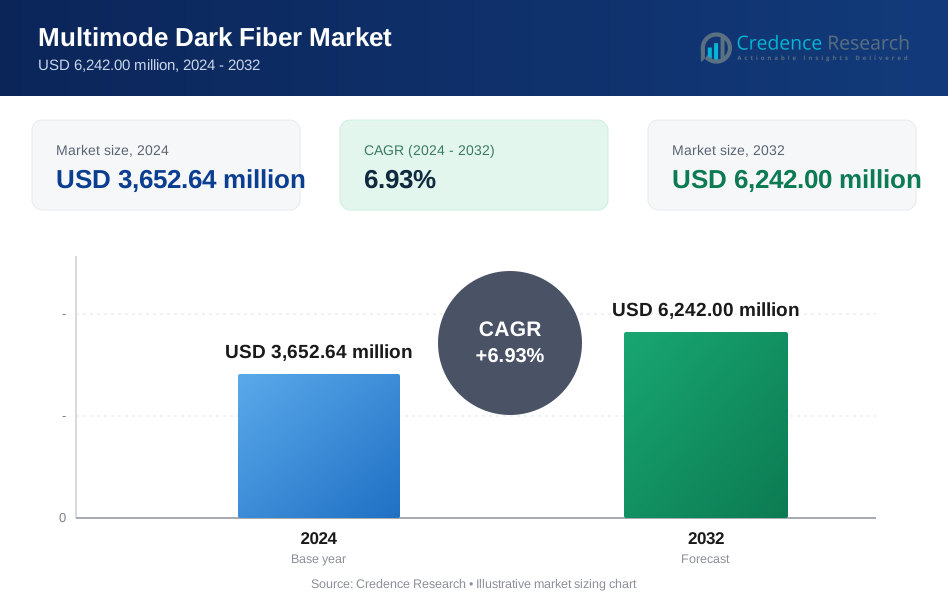
The global Multimode Dark Fiber Market is projected to grow from USD 3,652.64 million in 2024 to an estimated USD 6,242.00 million by 2032, with a compound annual growth rate (CAGR) of 6.93% from 2025 to 2032. The demand for high-bandwidth communication solutions and the expansion of network infrastructure are the key factors driving market growth.
Key drivers of this market include the growing demand for high-speed data transmission, the increasing use of cloud computing, and the rapid expansion of the internet of things (IoT). Additionally, the rise of smart cities, digitalization, and the need for more secure communication channels are accelerating the adoption of multimode dark fiber networks. The market is also experiencing a trend toward network virtualization and a shift to 5G networks, which further support the deployment of dark fiber for greater network efficiency.
Geographically, North America holds a dominant position in the global market, primarily driven by the high demand for reliable communication infrastructure and the presence of major telecom operators. However, the Asia Pacific region is expected to witness the highest growth during the forecast period, driven by the rapid digital transformation in emerging economies such as India and China. Key players in the global multimode dark fiber market include Corning Inc., Prysmian Group, and FiberLight, LLC.
Market Insights
- The Global multimode dark fiber market is expected to grow from USD 3,652.64 million in 2024 to USD 6,242.00 million by 2032, with a CAGR of 6.93% from 2025 to 2032.
- Key drivers include the increasing demand for high-bandwidth communication, the rise of 5G networks, growing IoT adoption, and the expansion of cloud computing services.
- High initial infrastructure costs and the complexity of network management can limit the adoption of multimode dark fiber in certain regions or industries.
- North America leads the market, driven by advanced telecom infrastructure, while Asia Pacific is expected to grow the fastest due to the digital transformation in emerging economies like India and China.
- The market is supported by businesses seeking scalable and efficient connectivity solutions to meet the ever-increasing demand for data transmission.
- Ongoing innovations in fiber-optic technologies, such as improved transmission capabilities and better network integration, are helping to enhance the efficiency of multimode dark fiber solutions.
- The development of smart cities worldwide is accelerating the demand for reliable, high-performance fiber-optic networks, creating further opportunities for multimode dark fiber market growth.
Market Drivers
Expansion of Data Centers and Cloud Computing
As enterprises increasingly adopt cloud computing and move their operations to the cloud, the demand for data centers is experiencing substantial growth. Data centers require vast amounts of bandwidth to support the massive data storage and processing needs of cloud service providers and enterprises. Multimode dark fiber is increasingly being deployed within and between data centers due to its capacity to support high-speed data transfer and its scalability. Unlike traditional leased lines, dark fiber allows data centers to manage their networks independently and optimize them according to specific business requirements, enabling lower operational costs and higher performance. Furthermore, as the cloud computing market continues to expand globally, businesses are placing a greater emphasis on building robust, high-capacity networks. This trend is expected to significantly boost the demand for dark fiber, as it offers the flexibility to meet evolving bandwidth requirements without significant infrastructure overhauls.
Cost-Effective and Future-Proof Network Infrastructure
One of the most compelling reasons driving the adoption of multimode dark fiber is its cost-effectiveness and ability to provide a future-proof network solution. Unlike traditional leased fiber services, dark fiber offers businesses the flexibility to manage their own networks, avoiding recurring leasing fees and gaining full control over their infrastructure. With dark fiber, organizations can scale their networks as needed without facing the limitations of conventional service agreements. The ability to support multiple wavelengths over a single fiber optic strand allows for significant increases in bandwidth without the need for additional physical infrastructure, making it a long-term, cost-efficient solution. As demand for higher data transfer rates and faster speeds continues to rise, organizations are increasingly turning to dark fiber as a way to build a network that can accommodate future needs without frequent upgrades or costly expansions. This scalability, along with the ability to bypass bandwidth limitations imposed by service providers, is a key factor fueling the growth of the multimode dark fiber market.
Increasing Demand for High-Bandwidth Communication
The growing need for high-speed data transmission is one of the primary drivers propelling the global multimode dark fiber market. As digital transformation accelerates, businesses are relying more heavily on internet services, cloud computing, and data-driven applications that require robust, high-capacity networks. For instance, telecom operators globally have reported a 35% increase in data traffic due to the adoption of cloud-based services and IoT devices. Traditional fiber-optic networks often struggle to meet these escalating demands, leading many organizations to opt for dark fiber as a more scalable and flexible solution. Dark fiber offers the ability to support large amounts of data with lower latency, making it an ideal choice for industries such as telecommunications, data centers, and cloud service providers. Furthermore, the advent of 5G technology is placing additional strain on existing networks, necessitating the expansion of fiber-optic infrastructure. For example, 5G networks have been shown to require up to 10 times more bandwidth than previous generations, further fueling the market for multimode dark fiber.
Growth of the Internet of Things (IoT)
The rise of the Internet of Things (IoT) is another key driver of the multimode dark fiber market. IoT refers to the growing network of interconnected devices, ranging from consumer products to industrial equipment, that communicate via the internet. This proliferation of connected devices requires a reliable and high-performance network infrastructure to handle the massive amounts of data being generated. For instance, IoT devices globally are expected to generate over 79 zettabytes of data annually by 2025, highlighting the need for robust network solutions. Multimode dark fiber networks offer a cost-effective solution for managing IoT traffic, as they provide dedicated bandwidth and faster data transfer rates, reducing the risk of network congestion. With billions of IoT devices expected to be connected globally in the coming years, the demand for high-performance, scalable network infrastructure like dark fiber is set to increase. Additionally, IoT deployments in industries such as manufacturing, logistics, healthcare, and automotive will continue to drive the need for robust, low-latency network connections, contributing to the overall growth of the market.
Market Trends
Sustainability and Eco-Friendly Infrastructure
Sustainability has become a significant focus within the telecommunications and data center industries. As organizations strive to reduce their carbon footprint, the demand for energy-efficient and eco-friendly infrastructure has risen. Dark fiber is inherently more sustainable compared to traditional leased lines because it allows for better utilization of existing infrastructure, minimizing the need for physical upgrades or new cables. Moreover, the expansion of green energy initiatives in data centers is boosting the adoption of multimode dark fiber, as it supports the implementation of renewable energy sources and energy-efficient technologies. The growing emphasis on sustainability, coupled with the long-term cost savings associated with dark fiber, is contributing to its increasing adoption across various industries.
Consolidation and Strategic Partnerships
The global multimode dark fiber market is witnessing an increasing trend of consolidation and strategic partnerships between telecom operators, data center providers, and technology companies. These partnerships aim to build and expand fiber-optic networks, particularly in underserved regions and emerging markets. By joining forces, companies can share infrastructure costs, improve network coverage, and create more efficient solutions for customers. Additionally, telecom giants are partnering with cloud service providers to offer integrated dark fiber services that cater to the growing demands of cloud-based applications and enterprise IT infrastructure. These collaborations are helping to accelerate the deployment of multimode dark fiber networks, ensuring that businesses can meet the increasing demand for high-speed, scalable connectivity solutions.
Rise of 5G and Network Virtualization
The rollout of 5G networks is one of the most prominent trends driving the global multimode dark fiber market. 5G technology requires extensive fiber-optic networks to support its high bandwidth and low latency demands. For instance, as of early 2025, there are 619 operators in 184 countries and territories investing in 5G, with 169 operators in 74 countries having launched or soft-launched 5G fixed wireless access services. Mobile network operators and telecom companies are increasingly turning to multimode dark fiber as a key component of their backhaul networks. Dark fiber allows for more flexibility, scalability, and reliability compared to traditional leased lines, which is crucial for meeting the heavy data transfer requirements of 5G. Moreover, as 5G accelerates network virtualization, dark fiber provides the bandwidth necessary for virtualized network functions and dynamic network management, making it an integral part of the network architecture.
Growing Adoption of Edge Computing
Edge computing is rapidly gaining traction as more organizations look to process data closer to where it is generated, rather than relying on centralized cloud data centers. This trend is being driven by the increasing need for low-latency applications, such as autonomous vehicles, smart cities, and real-time analytics. For instance, by 2025, 75% of enterprise-generated data will be created and processed at the edge, up from just 10% in 2018. Multimode dark fiber plays a critical role in the development of edge computing networks by providing a reliable and scalable infrastructure to connect edge data centers and devices. The ability to manage traffic efficiently and reduce latency is vital for edge computing applications, making dark fiber an ideal solution. As edge computing continues to grow, the demand for multimode dark fiber to support these distributed networks is expected to increase significantly.
Market Challenges
High Initial Infrastructure Investment
One of the major challenges facing the global multimode dark fiber market is the high upfront cost associated with building and maintaining fiber-optic infrastructure. For instance, costs for laying fiber-optic cables in rural areas can vary significantly based on factors like terrain, permitting, and labor. In some regions, costs can exceed $100,000 per mile (approximately $62,000 per kilometer) due to challenging conditions. Additionally, network management systems and installation processes can add substantial costs, with some projects requiring millions of dollars in investment. The construction of fiber-optic networks often involves obtaining permits, regulatory approvals, and logistical coordination, which can further increase costs and delays. As a result, telecom providers and enterprises may be hesitant to invest in dark fiber infrastructure, especially in regions where demand is uncertain or where existing network solutions may be deemed sufficient. This high capital expenditure remains a key challenge that could slow the adoption of multimode dark fiber, particularly in emerging markets or areas with less robust demand for high-capacity connectivity.
Complexity in Network Management and Maintenance
Another challenge in the multimode dark fiber market is the complexity involved in managing and maintaining fiber-optic networks. While dark fiber offers significant flexibility by allowing organizations to control their own networks, it also requires a high level of technical expertise for installation, configuration, and ongoing maintenance. Managing a dark fiber network necessitates specialized knowledge of fiber-optic systems, network architecture, and troubleshooting. Additionally, network operators must ensure that the dark fiber infrastructure remains secure, reliable, and free from physical damage, which can result in service disruptions. In regions where expertise is limited, companies may face difficulties in properly managing their dark fiber networks, leading to potential inefficiencies, downtime, or increased operational costs. This complexity in network management and maintenance presents an ongoing challenge for companies, especially those without in-house technical capabilities or those operating in regions with limited access to skilled professionals.
Market Opportunities
Expansion of 5G Networks and Next-Generation Infrastructure
The ongoing global rollout of 5G networks presents a significant market opportunity for the multimode dark fiber market. 5G technology demands high-bandwidth, low-latency, and highly reliable connectivity solutions, which are crucial for supporting the vast number of devices and applications connected to the network. Multimode dark fiber is an ideal solution to meet these requirements, offering scalable infrastructure that can support the heavy data traffic generated by 5G networks. As telecom providers, governments, and enterprises continue to invest in the expansion of 5G infrastructure, the demand for dark fiber to connect base stations, data centers, and core networks will increase. This trend creates a substantial opportunity for companies operating in the dark fiber market to provide the necessary backbone infrastructure to support the next generation of mobile communication services.
Growth in Cloud Computing and Data Center Development
The surge in cloud computing services and the expansion of data centers worldwide offer another significant opportunity for the multimode dark fiber market. As businesses continue to migrate their operations to the cloud, the demand for efficient, high-capacity network solutions to connect data centers will rise. Dark fiber provides a cost-effective and scalable option for linking data centers, enabling them to handle the growing volumes of data processed by cloud-based applications and services. Furthermore, the increasing need for private, secure networks that can offer higher performance and reliability drives the adoption of dark fiber solutions for cloud providers and enterprises. With the continuous growth of cloud services, data centers, and hybrid IT infrastructures, the global multimode dark fiber market is positioned to capitalize on these expanding opportunities in the coming years.
Market Segmentation Analysis
By Fiber Type:
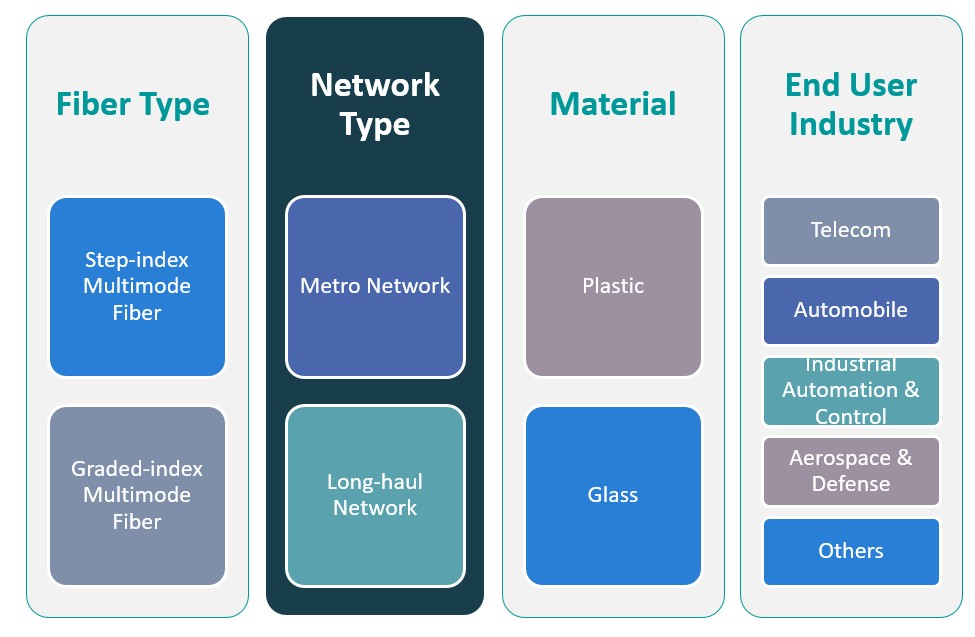
The multimode dark fiber market is primarily divided into two fiber types: step-index multimode fiber and graded-index multimode fiber. Step-index multimode fiber, with a uniform refractive index profile, is widely used for short-distance communication networks. It provides good performance in applications where cost is a key consideration. Graded-index multimode fiber, on the other hand, features a varying refractive index, which allows light to travel at different speeds across the core, reducing signal distortion over longer distances. As a result, graded-index multimode fiber is favored for medium-to-long-range communications, especially in enterprise and data center applications.
By Network Type:
The multimode dark fiber market is also segmented by network type into metro networks and long-haul networks. Metro networks, which are typically confined to a smaller geographic area such as a city or metropolitan region, account for a large share of the market due to their widespread use in telecommunications and data services. Long-haul networks, used for longer-distance communication between regions or countries, require high-capacity fiber-optic cables to handle large amounts of data traffic over long distances. As global connectivity and the demand for fast, reliable internet increase, long-haul networks continue to see significant growth.
Segments
Based on Fiber Type
- Step-index Multimode Fiber
- Graded-index Multimode Fiber
Based on Network Type
- Metro Network
- Long-haul Network
Based on Material Type
- Plastic
- Glass
Based on End User
- Telecom
- Automobile
- Industrial Automation & Control
- Aerospace & Defense
- Others
Based on Region
- North America
- U.S.
- Canada
- Mexico
- Europe
- Germany
- France
- U.K.
- Italy
- Spain
- Rest of Europe
- Asia Pacific
- China
- Japan
- India
- South Korea
- South-east Asia
- Rest of Asia Pacific
- Latin America
- Brazil
- Argentina
- Rest of Latin America
- Middle East & Africa
- GCC Countries
- South Africa
- Rest of the Middle East and Africa
Regional Analysis
North America (35%)
North America holds the largest share of the global multimode dark fiber market, accounting for approximately 35% of the total market. This region benefits from advanced telecom infrastructure, rapid adoption of 5G technology, and high demand for cloud computing services. The United States, in particular, leads in terms of multimode dark fiber deployment due to its large-scale telecom and data center operators. The continuous expansion of fiber-optic networks in urban areas and the increasing need for high-bandwidth applications in industries such as telecommunications, media, and finance are major drivers of growth in this region. Furthermore, the region’s strong focus on technological innovation and network virtualization further contributes to its dominance.
Europe (30%)
Europe holds a significant share of the market, accounting for around 30%. The demand for multimode dark fiber in Europe is driven by the expansion of data centers, increasing reliance on cloud services, and growing telecom infrastructure. Countries like Germany, the UK, and France are key markets, where telecom providers and cloud service providers are investing heavily in fiber-optic networks to meet the rising data demands of industries and consumers. Additionally, the ongoing transition to 5G networks and the focus on digital transformation across European nations contribute to the robust growth of dark fiber networks.
Key players
- AT&T
- Verizon Communications
- NTT Communications
- Lumen Technologies
- BT Group
Competitive Analysis
The global multimode dark fiber market is highly competitive, with major players like AT&T, Verizon Communications, NTT Communications, Lumen Technologies, and BT Group leading the market. AT&T and Verizon are among the largest telecom providers in North America, offering extensive fiber-optic networks that cater to both enterprise and consumer segments. These companies are heavily investing in 5G infrastructure and cloud services, which drive demand for dark fiber solutions. NTT Communications, a prominent player in Asia-Pacific, leverages its extensive global network to provide high-performance dark fiber services to a wide range of industries, particularly in Japan and other growing Asian markets. Lumen Technologies (formerly CenturyLink) focuses on providing scalable, secure, and high-speed connectivity for businesses worldwide, with a particular emphasis on large-scale data centers. BT Group, with a strong presence in Europe, is expanding its dark fiber solutions to meet the increasing demand for high-speed internet and data-driven applications in the region. These companies maintain a competitive edge by focusing on network expansion, strategic partnerships, and innovation in fiber-optic technologies.
Recent Developments
- In June 2024, Telstra InfraCo's intercity fiber network project completed approximately 1,800 kilometers of fiber construction, enhancing connectivity across Australia.
- As of June 2023, TPG Group held a wholesale market share of around 22% of Australian National Broadband Network services.
- As of June 2023, Optus had a wholesale market share of approximately 13% of Australian National Broadband Network residential broadband services.
- In August 2024, Lumen Technologies entered a two-year agreement with Corning Incorporated, securing 10% of Corning’s global fiber capacity to interconnect AI-enabled data centers. This deal is Lumen’s largest cable purchase to date and will more than double its U.S. intercity fiber miles, enhancing capacity for cloud data centers and high-bandwidth applications driven by AI workloads.
- In February 2025, Deutsche Telekom praised T-Systems for its improved performance in FY24, reflecting the company's strategic focus on enhancing its dark fiber services for enterprise customers.
- In December 2024, the GCC Sustainability Innovation Hub, which includes Etisalat, released a white paper outlining pathways for telecom operators to achieve net-zero emissions, drive renewable adoption, and foster regional collaboration.
- In 2024, Claro Argentina reported an operating profit of 706 billion pesos, a 10.1% growth compared to 2023, indicating strong performance in its telecom operations, including dark fiber services.
Market Concentration and Characteristics
The global multimode dark fiber market exhibits moderate concentration, with a few key players dominating the landscape, including AT&T, Verizon Communications, NTT Communications, Lumen Technologies, and BT Group. These companies hold significant market shares due to their extensive fiber-optic networks, strong financial capabilities, and advanced technological infrastructure. However, the market is also characterized by a growing number of regional and local players, which are capitalizing on the increasing demand for high-speed, reliable connectivity solutions. The market is highly dynamic, driven by rapid advancements in telecom infrastructure, the expansion of 5G networks, and the growing need for cloud services and data centers. Competition is intensifying as companies focus on strategic partnerships, network expansion, and innovation to meet the evolving demands of industries like telecommunications, data centers, and IoT.
Report Coverage
The research report offers an in-depth analysis based on Fiber Type, Network Type, Material Type, End User and Region. It details leading market players, providing an overview of their business, product offerings, investments, revenue streams, and key applications. Additionally, the report includes insights into the competitive environment, SWOT analysis, current market trends, as well as the primary drivers and constraints. Furthermore, it discusses various factors that have driven market expansion in recent years. The report also explores market dynamics, regulatory scenarios, and technological advancements that are shaping the industry. It assesses the impact of external factors and global economic changes on market growth. Lastly, it provides strategic recommendations for new entrants and established companies to navigate the complexities of the market.
Future Outlook
- The global shift to 5G will significantly boost the demand for multimode dark fiber as telecom operators require high-bandwidth infrastructure to support faster speeds and lower latency.
- The continuous growth of data centers globally, driven by cloud computing and digital transformation, will fuel the need for dark fiber networks to handle increasing data traffic.
- As the number of connected devices continues to grow, the need for robust and scalable fiber-optic solutions will rise, promoting multimode dark fiber adoption.
- The rise in network virtualization technologies will create new opportunities for multimode dark fiber, offering flexibility and scalability for efficient data transmission.
- Emerging economies, particularly in Asia Pacific and Africa, will see a surge in fiber-optic network installations as demand for digital services and internet connectivity grows.
- Increased government investment in smart cities, broadband infrastructure, and digital transformation projects will provide substantial growth opportunities for the multimode dark fiber market.
- The scalability and cost-effectiveness of dark fiber compared to leased lines will continue to make it an attractive option for enterprises and telecom providers looking to reduce costs.
- As edge computing networks expand, the demand for high-performance, low-latency connectivity will drive further investments in multimode dark fiber for enhanced data processing capabilities.
- Continuous innovations in fiber-optic technology, such as improved fiber designs and better signal transmission, will enhance the efficiency and performance of multimode dark fiber networks.
- Ongoing consolidation and strategic partnerships between telecom companies and cloud providers will accelerate the deployment of multimode dark fiber infrastructure to meet growing bandwidth demands.
Request a Free Sample
Fill in your details and we'll send you a free sample report.
- Sample data tables & charts
- Research methodology
Need a Custom Version of This Report?
Tailor the scope, geography, or segments to your exact requirements.
- Custom geography or segment scope
- Direct access to our analyst team
Frequently Asked Questions
What is the market size of the Global Multimode Dark Fiber Market in 2023, 2032, and its CAGR?
What are the key drivers of the Global Multimode Dark Fiber Market?
Which region is expected to witness the highest growth in the Multimode Dark Fiber Market?
What are the primary applications of Multimode Dark Fiber?
Who are the key players in the Global Multimode Dark Fiber Market?
Table of Content
Chapter 1. Report Introduction
- 1.1 Report Description & Purpose
- 1.1.1 Report Title & Market Definition
- 1.1.2 Unique Selling Propositions (USP) & Key Differentiators
- 1.1.3 Value Proposition for Stakeholders
- 1.2 Research Objectives
- 1.2.1 Market Sizing Objectives (Volume & Revenue)
- 1.2.2 Segmentation Objectives
- 1.2.3 Competitive Intelligence Objectives
- 1.2.4 Forecast & Scenario Objectives
- 1.3 Report Scope
- 1.3.1 Multimode Dark Fiber Scope – Types & Subtypes Covered
- 1.3.2 Geographic Scope – Regions & Countries Covered
- 1.3.3 Historical Period, Base Year & Forecast Period (2024; forecast to 2032)
- 1.3.4 Inclusions & Exclusions
- 1.4 HS Code & Classification Framework
- 1.5 Currency, Units & Pricing Basis
- 1.6 Target Stakeholders
- 1.7 Limitations & Assumptions
Chapter 2. Executive Summary
- 2.1 Global Multimode Dark Fiber Market Snapshot
- 2.1.1 Market Size – Historical (2024) & Forecast (2024-2032) (2024: USD 3,652.64 million → 2032: USD 6,242.00 million)
- 2.1.2 Volume & Revenue – Global Totals
- 2.1.3 Key Market Highlights – Top Five Facts
- 2.2 Multimode Dark Fiber Market Segmentation Snapshot
- 2.2.1 Market Split by Region – 2024 vs. 2032
- 2.3 Competitive Snapshot
- 2.3.1 Top 10 Players by Revenue Share – 2024
- 2.3.2 Top 10 Players by Volume Share – 2024
- 2.3.3 Recent Strategic Developments (18-Month Summary)
- 2.4 Key Investment Highlights & Strategic Conclusions
Chapter 3. Multimode Dark Fiber Market Dynamics & Industry Analysis
- 3.1 Market Overview & Context
- 3.1.1 Multimode Dark Fiber Market Position in the Broader Automotive Value Chain
- 3.1.2 OEM vs. Replacement Market Dynamics
- 3.1.3 Market Maturity & Development Stage by Region
- 3.2 Multimode Dark Fiber Market Drivers
- 3.3 Multimode Dark Fiber Market Restraints & Challenges
- 3.4 Multimode Dark Fiber Market Opportunities
- 3.5 Porter's Five Forces Analysis
- 3.5.1 Threat of New Entrants
- 3.5.2 Bargaining Power of Suppliers
- 3.5.3 Bargaining Power of Buyers
- 3.5.4 Threat of Substitutes
- 3.5.5 Competitive Rivalry – Intensity Assessment
- 3.6 Multimode Dark Fiber Value Chain Analysis
- 3.6.1 Upstream – Raw Material/Input Suppliers
- 3.6.1.1 Raw Material/Input 1
- 3.6.1.2 Raw Material/Input 2
- 3.6.1.3 Raw Material/Input 3
- 3.6.2 Midstream – Production/Manufacturing/Service Delivery
- 3.6.2.1 Production/Process Overview
- 3.6.2.2 Key Facility Locations & Capacity by Manufacturer
- 3.6.3 Downstream – Distribution & End Consumer
- 3.6.3.1 Primary Channel – B2B/OEM
- 3.6.3.2 Secondary Channels – Dealer, Retail, Online, Direct
- 3.6.4 Value Chain Profitability Analysis
- 3.6.1 Upstream – Raw Material/Input Suppliers
- 3.7 PESTEL Analysis
- 3.7.1 Political Factors
- 3.7.2 Economic Factors
- 3.7.3 Social Factors
- 3.7.4 Technological Factors
- 3.7.5 Environmental Factors
- 3.7.6 Legal Factors
- 3.8 Multimode Dark Fiber Supply Chain Analysis
- 3.8.1 Raw Material/Input Supply Risk Assessment
- 3.8.2 Manufacturing Concentration Risk (Geographic Exposure)
- 3.8.3 Trade Disruption Impact Analysis
- 3.9 Regulatory & Policy Landscape
Note: The regulatory and policy landscape section covers regulations based on their applicability to the market, Multimode Dark Fiber category, geography, and scope of the study. Only regulatory frameworks with a material impact on operations, compliance, trade, sustainability, or market access are analyzed in detail.
Chapter 4. Key Investment Pockets & Opportunity Analysis
- 4.1 Multimode Dark Fiber Market Attractiveness Analysis
- 4.1.1 By Region – Investment Attractiveness Matrix (Volume × CAGR)
- 4.2 Absolute Revenue Growth Opportunity
- 4.2.1 By Region – Absolute USD Growth Through 2032
- 4.3 Incremental Volume Opportunity
- 4.3.1 By Region – Incremental Volume Through 2032
- 4.3.2 Segment – Incremental Volume
- 4.4 Emerging Submarket Opportunity Deep Dive (Subject to Applicability)
- 4.5 Emerging Market Opportunity Scorecards
- 4.5.1 United States
- 4.5.2 Europe
- 4.5.3 Asia
- 4.5.4 Middle East & Africa
Note: Emerging Market Opportunity Scorecards will be included based on relevance and strategic importance. Regions listed are indicative and may vary depending on data availability and market dynamics.
Chapter 5. Multimode Dark Fiber Import-Export Analysis & Trade Flows
- 5.1 Global Trade Overview
- 5.1.1 Global Export Value by Country (2024)
- 5.1.2 Global Export Volume by Country (2024)
- 5.1.3 Global Import Value by Country (2024)
- 5.1.4 Global Import Volume by Country (2024)
- 5.1.5 Net Trade Balance by Country (2024)
- 5.2 Export Analysis – Segment
- 5.2.1 Type 1 (HS Code)
- 5.2.2 Type 2 (HS Code)
- 5.2.3 Type 3 (HS Code)
- 5.2.4 Type 4 (HS Code)
- 5.2.5 Type 5 (HS Code)
- 5.3 Import Analysis – Segment
- 5.3.1 Type 1 (HS Code)
- 5.3.2 Type 2 (HS Code)
- 5.3.3 Type 3 (HS Code)
- 5.3.4 Type 4 (HS Code)
- 5.3.5 Type 5 (HS Code)
- 5.4 Average Unit Trade Prices
- 5.4.1 Average Export Price – Segment & Country
- 5.4.2 Average Import Price – Segment & Source Country
- 5.4.3 Price Trends (2024)
- 5.5 Key Trade Route Analysis
- 5.5.1 Trade Route 1
- 5.5.2 Trade Route 2
- 5.5.3 Trade Route 3
- 5.5.4 Trade Route 4
- 5.5.5 Trade Route 5
- 5.6 Trade Policy Impact Assessment
- 5.6.1 US Anti-Dumping & Section 301 Tariffs
- 5.6.2 EU Customs Union Impact
- 5.6.3 Major Free Trade Agreements
- 5.6.4 USMCA Rules of Origin
Note: Trade policy analysis will be included only where relevant to the Multimode Dark Fiber market.
Chapter 6. Competitive Landscape & Company Benchmarking
- 6.1 Multimode Dark Fiber Market Concentration & Structure
- 6.1.1 Herfindahl-Hirschman Index (HHI) – vs. 2024
- 6.1.2 Tier 1, Tier 2 & Tier 3 Market Structure
- 6.1.3 Global, Regional & Local Player Dynamics
- 6.2 Multimode Dark Fiber Market Share Analysis – 2024
- 6.2.1 Global Revenue Share by Company
- 6.2.2 Global Volume Share by Company
- 6.2.3 Regional Revenue Share
- 6.2.4 Market Share Evolution ( vs. 2024)
- 6.2.5 OEM Segment Share by Company
- 6.2.6 Replacement Segment Share by Company
- 6.3 Production/Delivery Capacity & Facility Analysis
- 6.3.1 Global Installed Capacity
- 6.3.2 Capacity Utilization Rates
- 6.3.3 Production/Output Volume
- 6.3.4 Facility Locations & Capacity Map
- 6.3.5 Planned Capacity Additions
- 6.4 Multimode Dark Fiber Competitive Benchmarking Matrix
- 6.4.1 Revenue, Volume, CAGR & Profitability Comparison
- 6.4.2 Channel Revenue Mix
- 6.4.3 Geographic Revenue Exposure
- 6.4.4 R&D Intensity
- 6.4.5 Sustainability Maturity
- 6.5 Strategic Developments in Multimode Dark Fiber (Last 24 Months)
- 6.5.1 Mergers, Acquisitions & Divestments
- 6.5.2 New Multimode Dark Fiber Launches
- 6.5.3 Facility Expansions
- 6.5.4 Strategic Alliances, Joint Ventures & Partnerships
- 6.5.5 Distribution Expansion & Market Entry
- 6.5.6 Sustainability & ESG Initiatives
- 6.6 Competitive Strategy Mapping
- 6.6.1 Leader, Challenger, Follower & Niche Classification
- 6.6.2 Pricing Strategy Comparison
- 6.6.3 Channel Strategy Matrix
Note: Strategic developments are included based on their materiality and the availability of reliable information.
Chapter 7. Global Multimode Dark Fiber Market – By Distribution Channel
- 7.1 Segment Overview
- 7.1.1 Volume & Revenue Split by Channel (2024 & 2032)
- 7.1.2 Channel Mix Evolution (2024-2032)
Chapter 8. Regional Market Analysis – Global Overview
- 8.1 Global Regional Overview
- 8.1.1 Regional Volume Share
- 8.1.2 Regional Revenue Share
- 8.1.3 Regional Volume by Region
- 8.1.4 Regional Revenue by Region
- 8.1.5 Regional Forecast Through 2032
- 8.2 Cross-Regional Segment Analysis
- 8.2.1 By Distribution Channel
- 8.2.2 By Brand/Price Tier
Chapter 9. North America Multimode Dark Fiber Market
- 9.1 United States
- 9.2 Canada
- 9.3 Mexico
Chapter 10. Europe Multimode Dark Fiber Market
- 10.1 Germany
- 10.2 France
- 10.3 Italy
- 10.4 United Kingdom
- 10.5 Spain
- 10.6 Poland
- 10.7 Russia
- 10.8 Netherlands
- 10.9 Belgium
- 10.10 Sweden
- 10.11 Denmark
- 10.12 Norway
- 10.13 Rest of Europe
Chapter 11. Asia Pacific Multimode Dark Fiber Market
- 11.1 China
- 11.2 India
- 11.3 Japan
- 11.4 South Korea
- 11.5 Thailand
- 11.6 Indonesia
- 11.7 Vietnam
- 11.8 Malaysia
- 11.9 Australia
- 11.10 Rest of Asia Pacific
Chapter 12. Latin America Multimode Dark Fiber Market
- 12.1 Brazil
- 12.2 Argentina
- 12.3 Colombia
- 12.4 Chile
- 12.5 Rest of Latin America
Chapter 13. Middle East Multimode Dark Fiber Market
- 13.1 Saudi Arabia
- 13.2 United Arab Emirates
- 13.3 Turkey
- 13.4 Israel
- 13.5 Iran
- 13.6 Rest of the Middle East
Chapter 14. Africa Multimode Dark Fiber Market
- 14.1 South Africa
- 14.2 Egypt
- 14.3 Nigeria
- 14.4 Morocco
- 14.5 Rest of Africa
Chapter 15. Multimode Dark Fiber Company Profiles
- 15.1 [Company 01]
- 15.1.1 Company Overview
- 15.1.2 Key Management Personnel
- 15.1.3 Products & Services Portfolio
- 15.1.4 Financial Performance
- 15.1.5 Key Market Focus & Geographic Presence
- 15.1.6 Recent Developments & Strategic Initiatives
Note: The company profile list is preliminary and may change based on research findings, market developments, data availability, and client requirements.
Chapter 16. Appendices
- Appendix A – List of Abbreviations & Acronyms
- Appendix B – Industry Classification Code Reference – Full Series
- Appendix C – Production & Capacity Data Tables
- Appendix D – End-Use & Demand Base Tables
- Appendix E – Consumption & Replacement Rate Assumptions
- Appendix F – ASP Reference Tables
- Appendix G – Manufacturing & Facility Database
- Appendix H – Import-Export Data Tables
- Appendix I – Regulatory Summary Tables
- Appendix J – Primary Research Participant List (Anonymized)
- Appendix K – Primary Research Questionnaire Framework
- Appendix L – Data Sources & Bibliography
- Appendix M – Market Size Divergence & Source Comparison
Chapter 17. Research Methodology
- 17.1 Research Framework & Philosophy
- 17.2 Secondary Research – Sources, Hierarchy & Data Extraction
- 17.3 Data Modeling – Bottom-Up & Top-Down Market Sizing
- 17.4 Primary Research – Stakeholder Framework, LOI & Sample Sizes
- 17.5 Forecast Methodology – Regression, Scenario & Sensitivity Analysis
- 17.6 Quality Control – Four-Layer Validation Framework
- 17.7 Limitations & Standard Assumptions
- 17.8 Disclaimer
