Market Overview:
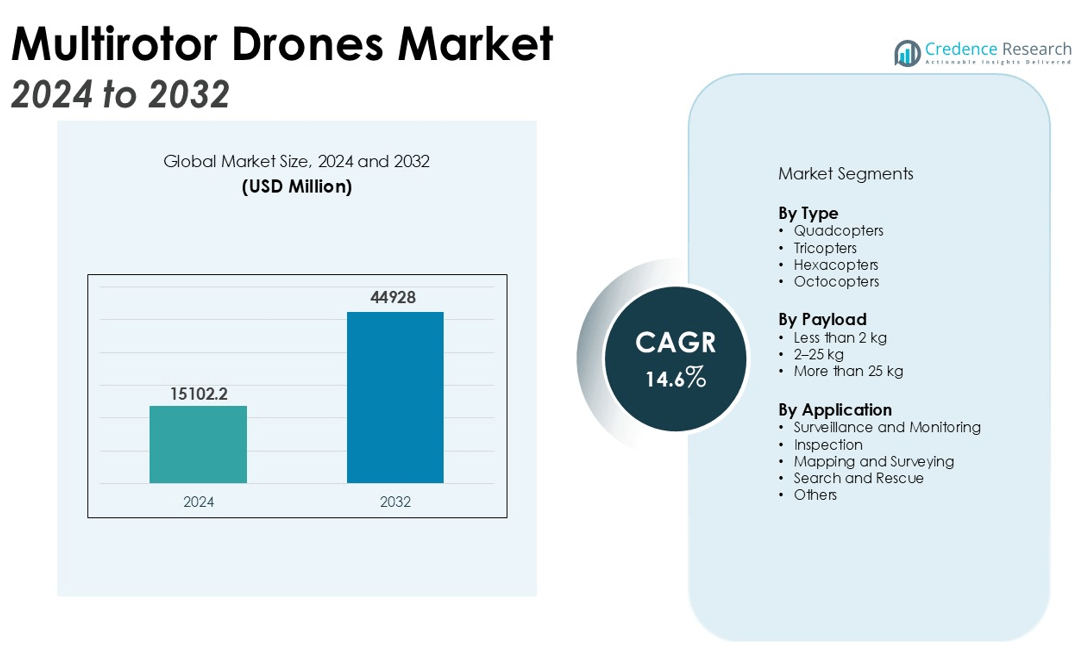
The Multirotor Drones Market size was valued at USD 15102.2 million in 2024 and is anticipated to reach USD 44928 million by 2032, at a CAGR of 14.6% during the forecast period (2024-2032).
| REPORT ATTRIBUTE | DETAILS |
|---|---|
| Historical Period | 2020-2023 |
| Base Year | 2024 |
| Forecast Period | 2025-2032 |
| Multirotor Drones Market Size 2024 | USD 15102.2 million |
| Multirotor Drones Market, CAGR | 14.6% |
| Multirotor Drones Market Size 2032 | USD 44928 million |
Market growth is driven by increasing demand from defense and surveillance sectors, where multirotor drones offer superior stability, vertical take-off and landing capability, and efficient operation in challenging environments. Commercial adoption is also accelerating, particularly in disaster monitoring, infrastructure inspection, aerial photography, precision agriculture, and environmental assessment. Continuous innovation in autonomous flight systems, imaging technology, and battery efficiency further strengthens their market position, enabling new use cases and improving operational efficiency. The growing integration of AI and advanced analytics in drone operations is enhancing real-time decision-making and expanding mission capabilities across sectors.
Asia Pacific leads the global market, supported by industrial expansion, infrastructure development, and rising defense budgets in nations such as China, India, and Japan. North America follows closely, driven by strong adoption in commercial, security, and industrial applications. Europe shows steady growth, backed by favorable regulations and integration in agriculture, logistics, and construction sectors. Emerging markets in the Middle East, Africa, and Latin America are witnessing growing demand, particularly in agriculture, mining, and emergency response operations.
Market Insights:
- The Multirotor Drones Market was valued at USD 15,102.2 million and is projected to reach USD 44,928 million, registering a CAGR of 14.6% during the forecast period, driven by growing defense, surveillance, and commercial applications.
- Defense and security agencies increasingly deploy multirotor drones for surveillance, reconnaissance, and tactical operations, benefiting from their stability, vertical take-off and landing capabilities, and ability to operate in challenging terrains.
- Commercial adoption is expanding in sectors such as infrastructure inspection, precision agriculture, environmental monitoring, and aerial mapping, where drones improve efficiency, safety, and data accuracy.
- Technological advancements, including AI integration, advanced imaging systems, and enhanced battery performance, are improving flight endurance, real-time analytics, and mission efficiency.
- Regulatory restrictions, complex airspace management, and varying international policies remain key operational challenges, while high costs and technical limitations such as limited battery life constrain broader adoption.
- Asia Pacific holds 38% of the market share, leading global adoption through industrial growth, infrastructure projects, and defense investments, followed by North America with 32% and Europe with 21%.
- Emerging markets in the Middle East, Africa, and Latin America present growth opportunities in agriculture, mining, disaster response, and coastal surveillance, supported by improving regulatory frameworks and rising technology adoption.
Market Drivers:
Rising Demand from Defense and Security Applications
The Multirotor Drones Market benefits significantly from increasing defense and security requirements worldwide. Armed forces and law enforcement agencies deploy these drones for surveillance, reconnaissance, and tactical operations due to their superior stability, vertical take-off and landing capabilities, and ability to operate in complex terrains. They offer cost-effective and rapid deployment compared to manned aircraft, reducing operational risks in hostile environments. Governments are investing in advanced unmanned aerial systems to strengthen border security, counter-terrorism measures, and disaster response capabilities.
- For instance, the military-grade UMAR tethered drone from Dragonfly Pictures Inc. is engineered for harsh maritime operations and can function reliably in wind speeds of up to 35 knots.
Expanding Commercial and Industrial Use Cases
It is witnessing robust adoption across commercial and industrial sectors due to its versatility and operational efficiency. Applications include infrastructure inspection, precision agriculture, environmental monitoring, and aerial mapping, where multirotor drones deliver high-resolution imagery and data collection at reduced costs. Construction firms utilize them for project progress tracking, while utility companies employ them for inspecting power lines and pipelines. These capabilities reduce downtime, improve safety, and increase productivity in multiple industries.
- For instance, Firmatek used Skydio drones to inspect 10,000 utility poles in just six days, reducing per-pole inspection time from 15–20 minutes traditionally down to 20–30 seconds per pole, which enhanced record-keeping and inspection data quality.
Technological Advancements Enhancing Capabilities
Continuous improvements in payload capacity, battery performance, and autonomous navigation systems are driving market expansion. The integration of AI, machine learning, and advanced imaging technologies enhances real-time data processing and mission efficiency. Improved flight control systems and obstacle detection sensors enable safer operations in congested or hazardous environments. These innovations expand the potential applications for multirotor drones and make them more accessible to a wider range of users.
Supportive Regulatory Frameworks and Investments
Government initiatives and evolving regulatory frameworks are fostering the adoption of drone technologies across multiple sectors. Many countries have introduced policies that facilitate safe commercial drone operations while ensuring compliance with safety and privacy standards. Public and private sector investments in research and development further stimulate innovation. Incentives, pilot programs, and funding for drone-based solutions are enabling faster integration of multirotor drones into mainstream operations.
Market Trends:
Integration of Artificial Intelligence and Advanced Analytics in Drone Operations
The Multirotor Drones Market is experiencing a significant shift toward AI-enabled capabilities, transforming operational efficiency and decision-making processes. AI-driven navigation, automated flight planning, and real-time data analytics enhance accuracy and reduce the need for manual intervention. Advanced analytics enable predictive maintenance, optimized route planning, and faster post-mission data processing. Industries such as agriculture, construction, and logistics are leveraging these features to improve operational productivity and reduce costs. The incorporation of computer vision and machine learning allows drones to identify objects, detect anomalies, and track assets with greater precision. It is enabling new applications in security, disaster management, and environmental conservation, where rapid, data-driven decisions are critical.
- For instance, Skydio's X10 drone leverages an onboard NVIDIA Jetson Orin GPU to offer real-time obstacle avoidance using six custom navigation lenses that provide 360-degree visibility, ensuring autonomous flight even in GPS-denied environments and nighttime operations.
Shift Toward Specialized and High-Endurance Multirotor Platforms
Demand is increasing for specialized multirotor drones designed for extended flight times, heavier payloads, and extreme environmental conditions. Manufacturers are focusing on improving battery efficiency, integrating hybrid power systems, and using lightweight composite materials to enhance endurance. High-endurance models support longer missions in defense, surveying, and industrial inspection without frequent recharging. The market is also witnessing growth in sector-specific designs, such as waterproof drones for marine research and thermal-equipped units for firefighting and search-and-rescue operations. Customization capabilities are becoming a competitive differentiator, allowing end users to tailor drones for mission-specific requirements. It is positioning multirotor drones as indispensable tools in sectors where reliability, adaptability, and advanced capabilities are critical to success.
- For instance, SwellPro's Fisherman FD1 waterproof drone can lift up to 2 kg of bait and maintains IP67 saltwater-proof rating while operating in winds up to 20 m/s (38 mph).
Market Challenges Analysis:
Regulatory Restrictions and Airspace Management Issues
The Multirotor Drones Market faces operational challenges due to stringent regulatory requirements and complex airspace management protocols. Many countries impose strict licensing, flight restrictions, and operational limitations to ensure safety and privacy. Compliance with varying regional laws can delay deployment and increase operational costs for both commercial and defense applications. Airspace congestion in urban areas further complicates large-scale drone integration, raising concerns over collision risks and interference with manned aviation. Limited harmonization of international drone regulations creates barriers for cross-border operations. It must adapt to evolving legal frameworks while maintaining operational efficiency and safety standards.
Technical Limitations and High Operational Costs
It encounters constraints related to battery life, payload capacity, and resistance to extreme weather conditions. Short flight durations limit operational range, while adverse weather can impair stability and data accuracy. Advanced multirotor models with longer endurance and higher payloads often require significant investment, making them less accessible to small enterprises. Maintenance, spare parts, and skilled operator training add to operational expenses. Rapid technological advancements also shorten product lifecycles, compelling frequent upgrades to remain competitive. The market must address these technical and cost-related challenges to expand adoption across diverse industries.
Market Opportunities:
Expansion into Emerging Commercial Applications
The Multirotor Drones Market has significant potential for growth through new and evolving commercial use cases. Sectors such as precision agriculture, infrastructure inspection, logistics, and environmental monitoring are increasingly adopting multirotor platforms to improve efficiency and reduce operational risks. E-commerce and last-mile delivery services present lucrative opportunities for integrating drones into distribution networks. Advanced imaging and mapping capabilities open pathways for applications in construction, mining, and urban planning. Rising demand for real-time data and aerial analytics creates a favorable environment for drone-based service providers. It can further capitalize on niche applications such as wildlife conservation and coastal surveillance.
Growth Driven by Technological Integration and Smart City Initiatives
Rapid advancements in AI, IoT connectivity, and cloud-based analytics are creating new opportunities for value-added services. Integration with smart city infrastructure enables drones to support traffic management, emergency response, and infrastructure maintenance. Enhanced battery technology and hybrid propulsion systems extend operational endurance, making them viable for long-duration missions. Governments and private organizations are investing in pilot projects to explore scalable drone solutions for public safety and urban planning. Renewable energy sectors also present strong demand for drones in solar panel inspection and wind turbine monitoring. It is positioned to benefit from increasing collaboration between technology developers, service providers, and government agencies.
Market Segmentation Analysis:
By Type
The Multirotor Drones Market is segmented into quadcopters, tricopters, hexacopters, and octocopters. Quadcopters dominate due to their balance between stability, maneuverability, and cost-effectiveness, making them popular across both defense and commercial applications. Hexacopters and octocopters cater to operations requiring higher payload capacity and redundancy for mission-critical tasks. Tricopters serve niche use cases where lightweight design and agile performance are essential.
By Payload
By payload, the market is classified into less than 2 kg, 2–25 kg, and more than 25 kg categories. The 2–25 kg segment holds a significant share, offering versatility for professional photography, surveying, inspection, and medium-scale logistics. Drones with payloads above 25 kg are gaining traction in defense, heavy industrial inspections, and specialized delivery services, where endurance and carrying capacity are critical. Models under 2 kg remain relevant for hobbyist, educational, and small-scale commercial applications.
- For instance, the DJI Agras T25 can carry a spraying payload up to 20kg, supporting precision agriculture and surveying missions with advanced radar and vision systems.
By Application
By application, the market includes surveillance and monitoring, inspection, mapping and surveying, search and rescue, and others. Surveillance and monitoring lead due to strong demand from defense, border security, and law enforcement agencies. Inspection applications in energy, utilities, and infrastructure sectors are expanding rapidly, driven by safety and cost advantages. Mapping and surveying benefit from integration with GIS and photogrammetry tools. Search and rescue operations leverage drones’ ability to access challenging terrains quickly and enhance mission effectiveness.
- For instance, Teledyne FLIR’s Boson+ thermal camera core, now mounted on patrol UAVs, delivers thermal sensitivity of ≤ 20 mK, sharply enhancing long-range detection clarity.
Segmentations:
By Type
- Quadcopters
- Tricopters
- Hexacopters
- Octocopters
By Payload
- Less than 2 kg
- 2–25 kg
- More than 25 kg
By Application
- Surveillance and Monitoring
- Inspection
- Mapping and Surveying
- Search and Rescue
- Others
By Region
- North America
- U.S.
- Canada
- Mexico
- Europe
- UK
- France
- Germany
- Italy
- Spain
- Russia
- Belgium
- Netherlands
- Austria
- Sweden
- Poland
- Denmark
- Switzerland
- Rest of Europe
- Asia Pacific
- China
- Japan
- South Korea
- India
- Australia
- Thailand
- Indonesia
- Vietnam
- Malaysia
- Philippines
- Taiwan
- Rest of Asia Pacific
- Latin America
- Brazil
- Argentina
- Peru
- Chile
- Colombia
- Rest of Latin America
- Middle East
- UAE
- KSA
- Israel
- Turkey
- Iran
- Rest of Middle East
- Africa
- Egypt
- Nigeria
- Algeria
- Morocco
- Rest of Africa
Regional Analysis:
Asia Pacific Dominance Supported by Expanding Industrial and Defense Applications
Asia Pacific accounts for 38% of the Multirotor Drones Market, making it the leading regional contributor to global revenue. The region’s growth is driven by rapid industrialization, infrastructure expansion, and significant defense investments. Countries such as China, India, and Japan are deploying multirotor drones for border surveillance, agricultural monitoring, and construction project management. Supportive government initiatives, including funding for drone startups and favorable pilot programs, enhance adoption rates. Expanding e-commerce and logistics sectors create new opportunities for last-mile delivery applications. It benefits from a large manufacturing base, enabling competitive pricing and faster technological integration.
North America’s Growth Through Innovation and Commercial Integration
North America holds a 32% share of the Multirotor Drones Market, supported by advanced research capabilities and a mature regulatory framework. The United States leads the region with strong demand in defense, public safety, and industrial inspection. Technological innovations, such as AI-driven flight control and autonomous navigation, position regional players competitively in global markets. The integration of drones in agriculture, oil and gas inspection, and disaster management drives continuous expansion. It gains momentum from strategic partnerships between drone manufacturers, software developers, and service providers. Robust venture capital investment supports rapid scaling of drone-based business models.
Europe’s Steady Growth Backed by Regulatory Support and Specialized Applications
Europe accounts for 21% of the Multirotor Drones Market, reflecting steady growth supported by clear regulatory guidelines and targeted sector adoption. Countries such as Germany, France, and the United Kingdom deploy multirotor drones for agriculture, renewable energy inspection, and logistics. The region focuses on high-quality manufacturing standards, integrating advanced imaging and safety technologies. Investments in precision agriculture and offshore wind farm inspection enhance market opportunities. It benefits from collaborative research programs aimed at improving drone endurance and environmental resilience. Emerging applications in cultural heritage preservation and environmental monitoring further diversify regional demand.
Key Player Analysis:
- Walkera
- Intel
- Yuneec
- Garmin
- Sony
- Parrot
- Hubsan
- Ehang
- Horizon Hobby
- FLIR Systems
- Autel Robotics
- DJI
- GoPro
- Qualcomm
- 3DR Robotics
Competitive Analysis:
The Multirotor Drones Market is highly competitive, with global and regional players focusing on innovation, performance enhancement, and application expansion. Leading companies such as DJI, Parrot SA, Yuneec International, AeroVironment Inc., and Autel Robotics dominate with strong product portfolios and advanced technological capabilities. It is witnessing strategic collaborations, mergers, and acquisitions aimed at strengthening market presence and expanding into high-growth sectors such as defense, industrial inspection, and logistics. Manufacturers are investing in AI integration, extended flight endurance, and advanced imaging systems to differentiate products in a crowded market. Competitive strategies also include offering customizable solutions tailored to sector-specific requirements, enhancing after-sales services, and establishing distribution networks in emerging markets. The competitive landscape is shaped by continuous product development, regulatory compliance, and cost optimization to capture a broader customer base while maintaining technological leadership.
Recent Developments:
- In January 2024, Intel announced its agreement to acquire Silicon Mobility SAS, a company focused on AI-driven SoCs for intelligent electric vehicle energy management.
- In June 2025, Parrot launched the ANAFI UKR microdrone for public safety and intelligence, surveillance, and reconnaissance (ISR) missions at the Paris Air Show, building on its advanced AI-powered drone capabilities.
- In July 2025, Parrot Uncle announced a strategic partnership with SKY and unveiled a combined ceiling fan and heater product line schedule for broader release in Q3 2025.
Market Concentration & Characteristics:
The Multirotor Drones Market exhibits moderate to high concentration, with a few dominant manufacturers controlling a significant share of global sales. It is characterized by rapid technological advancements, continuous product innovation, and strong competition among established and emerging players. Leading companies leverage economies of scale, advanced R&D capabilities, and broad distribution networks to maintain market leadership. The industry shows high product differentiation, driven by payload capacity, flight endurance, and integrated AI-enabled features. Demand spans defense, commercial, and industrial applications, creating diverse opportunities for specialized solutions. Regulatory compliance, safety standards, and evolving operational guidelines significantly influence competitive positioning and market entry strategies.
Report Coverage:
The research report offers an in-depth analysis based on Type, Payload, Application and Region. It details leading market players, providing an overview of their business, product offerings, investments, revenue streams, and key applications. Additionally, the report includes insights into the competitive environment, SWOT analysis, current market trends, as well as the primary drivers and constraints. Furthermore, it discusses various factors that have driven market expansion in recent years. The report also explores market dynamics, regulatory scenarios, and technological advancements that are shaping the industry. It assesses the impact of external factors and global economic changes on market growth. Lastly, it provides strategic recommendations for new entrants and established companies to navigate the complexities of the market.
Future Outlook:
- The market will expand its adoption in defense and security operations, supported by advancements in surveillance, reconnaissance, and tactical mission capabilities.
- AI-powered analytics and autonomous navigation will enhance operational efficiency and enable more complex mission execution.
- Demand for drones in precision agriculture will grow as farmers adopt advanced imaging and data analytics to optimize crop yields.
- Infrastructure inspection will see increased adoption, with drones reducing downtime and improving safety in construction, energy, and utilities sectors.
- Search and rescue operations will benefit from thermal imaging, extended flight endurance, and rapid deployment capabilities.
- Integration with smart city frameworks will position drones as tools for traffic monitoring, environmental assessment, and public safety.
- Customization for sector-specific needs will drive growth in industrial, marine, and environmental applications.
- Advances in battery technology and hybrid propulsion will extend flight times and payload capacities.
- Emerging markets in Latin America, the Middle East, and Africa will accelerate adoption through investments in logistics, mining, and agricultural applications.
- Collaboration between manufacturers, technology providers, and regulatory bodies will streamline operational approvals and support broader integration into commercial ecosystems.

Request a Free Sample
Fill in your details and we'll send you a free sample report.
- Sample data tables & charts
- Research methodology
Market Dynamics
Rising Demand from Defense and Security Applications
Defense and security agencies are increasingly deploying multirotor drones for surveillance, reconnaissance, and tactical operations due to their superior stability, vertical take-off and landing capabilities, and ability to operate in challenging terrains, driving significant market growth.
Expanding Commercial and Industrial Use Cases
Multirotor drones are being rapidly adopted in commercial sectors such as infrastructure inspection, precision agriculture, environmental monitoring, and aerial mapping, where they improve efficiency, safety, and data accuracy, fueling broader market expansion.
Technological Advancements in Autonomy and Imaging
Continuous innovation in AI integration, advanced imaging systems, and battery performance is enhancing flight endurance, real-time analytics, and mission efficiency, enabling new applications and improving operational effectiveness across industries.
Supportive Regulatory Frameworks and Investments
Government initiatives and evolving regulatory policies are facilitating the safe integration of drones into commercial and defense operations, while increased public and private investments in R&D are accelerating technological progress and adoption.
Integration with Smart City and Emerging Applications
The growing use of drones in smart city initiatives, logistics, and emergency response, along with sector-specific customization, is opening new revenue streams and expanding the addressable market for multirotor drone solutions.
Need a Custom Version of This Report?
Tailor the scope, geography, or segments to your exact requirements.
- Custom geography or segment scope
- Direct access to our analyst team
Frequently Asked Questions
What is the current market size for Multirotor Drones, and what is its projected size in 2032?
At what Compound Annual Growth Rate is the Multirotor Drones market projected to grow between 2024 and 2032?
What are the primary factors fueling the growth of the Multirotor Drones market?
Who are the leading companies in the Multirotor Drones market?
Table of Content
Chapter 1 Market Segmentation
- 1.1 Segmentation Framework
- 1.1.1 Product and Service Classification
- 1.1.2 Application and End-Use Classification
- 1.1.3 Technology and Solution Classification
- 1.1.4 Customer and Distribution Channel Classification
- 1.1.5 Geographic Segmentation
- 1.1.6 Market Segment Definitions and Boundaries
- 1.2 By Type
- 1.2.1 Quadcopters
- 1.2.2 Tricopters
- 1.2.3 Hexacopters
- 1.2.4 Octocopters
- 1.3 By Payload
- 1.3.1 Less than 2 kg
- 1.3.2 2–25 kg
- 1.3.3 More than 25 kg
- 1.4 By Application
- 1.4.1 Surveillance and Monitoring
- 1.4.2 Inspection
- 1.4.3 Mapping and Surveying
- 1.4.4 Search and Rescue
- 1.4.5 Others
Chapter 2 Introduction
- 2.1 Report Objectives and Scope
- 2.2 Product Definition and Industry Terminology
- 2.3 Market Inclusions and Exclusions
- 2.4 Research Process
- 2.4.1 Primary Research and Expert Interviews
- 2.4.2 Secondary Research and Source Review
- 2.4.3 Top-Down and Bottom-Up Estimation
- 2.4.4 Data Triangulation and Verification
- 2.5 Market Size Measurement Basis
- 2.5.1 2024: USD 15,102.2 million → 2032: USD 44,928 million
- 2.6 Historical and Forecast Reference Periods
- 2.6.1 Base Year: 2024
- 2.6.2 Forecast Period: 2024-2032
- 2.7 Research Assumptions and Limitations
Chapter 3 Executive Summary
- 3.1 Market Snapshot and Key Findings
- 3.2 Base-Year Market Size, 2024
- 3.3 Forecast Market Size, 2032
- 3.4 Revenue and Volume Growth Outlook
- 3.5 Key Demand and Supply Indicators
- 3.6 Leading Market Segments
- 3.7 Fastest-Growing Market Opportunities
- 3.8 Regional Performance Highlights
- 3.9 Technology and Industry Transformation
- 3.10 Competitive Landscape Summary
- 3.11 Analyst View and Strategic Implications
Chapter 4 Global Multirotor Drones Market Trends and Developments
- 4.1 Historical Industry Development
- 4.2 Recent Market Trends and Developments
- 4.3 Demand and Customer Behavior Trends
- 4.4 Technology and Product Innovation
- 4.5 Artificial Intelligence, Automation and Digitalization
- 4.6 Local Manufacturing and Supply Chain Realignment
- 4.7 Industry Partnerships, Mergers and Acquisitions
- 4.8 Sustainability and Circular Economy Developments
- 4.9 Government and Private Sector Investment Trends
- 4.10 Emerging Business Models and Commercialization
- 4.11 Industry Developments and Announcements
Chapter 5 Global Multirotor Drones Market Production, Supply and Demand Analysis
- 5.1 Demand Trend and Consumption Analysis
- 5.2 Demand Forecast, 2024-2032
- 5.3 Production and Output Trend
- 5.4 Production and Output Forecast, 2024-2032
- 5.5 Installed Capacity and Capacity Utilization
- 5.6 Company-Wise Production Plants and Statistics
- 5.6.1 Installed Production Capacity
- 5.6.2 Actual Production
- 5.6.3 Planned Capacity and Expansion Targets
- 5.7 Supply Chain Structure and Procurement Trends
- 5.8 Supply-Demand Gap and Bottlenecks
- 5.9 Import Dependence and Sourcing Structure
- 5.10 Contract Manufacturing and Outsourcing
- 5.11 Regional Supply and Demand Concentration
Chapter 6 Global Multirotor Drones Market Pricing Analysis
- 6.1 Pricing Structure and Measurement
- 6.2 Historical Pricing Trends
- 6.3 Pricing Outlook, 2024-2032
- 6.4 Average Selling Price and Unit Economics
- 6.5 Pricing by Product and Market Segment
- 6.6 Geographic Pricing Differences
- 6.7 Key Input, Energy, Labor and Logistics Costs
- 6.8 Contract Pricing and Purchasing Models
- 6.9 Pricing Sensitivity and Competitive Positioning
- 6.10 Price, Margin and Profitability Implications
Chapter 7 Global Multirotor Drones Market Dynamics
- 7.1 Market Growth Drivers
- 7.1.1 Demand-Side Drivers
- 7.1.2 Technology and Innovation Drivers
- 7.1.3 Infrastructure and Investment Drivers
- 7.1.4 Regulatory and Policy Drivers
- 7.2 Market Restraints
- 7.2.1 Cost and Affordability Constraints
- 7.2.2 Technology and Adoption Barriers
- 7.2.3 Supply Chain and Operational Constraints
- 7.3 Market Challenges
- 7.3.1 Competitive Pressure and Margin Erosion
- 7.3.2 Skills, Infrastructure and Implementation Gaps
- 7.4 Emerging Market Opportunities
- 7.5 Market Dynamics Impact and Time-Horizon Assessment
Chapter 8 Global Multirotor Drones Value Chain Analysis
- 8.1 Industry Value Chain Overview
- 8.2 Upstream Suppliers and Critical Inputs
- 8.3 Technology and Component Providers
- 8.4 Manufacturing or Service Delivery
- 8.5 Distribution, Channel Partners and Integrators
- 8.6 Downstream Applications and End Users
- 8.7 Value Addition and Profit Pools
- 8.8 Vertical Integration and Outsourcing
- 8.9 Supplier Concentration and Risk
- 8.10 Supply Chain Localization and Resilience
Chapter 9 Global Multirotor Drones Market Regulations and Policies
- 9.1 Relevant Laws, Standards and Compliance Frameworks
- 9.2 Product, Service, Safety and Quality Requirements
- 9.3 Government Policies, Incentives and Subsidies
- 9.4 Imports, Exports and Trade Barriers
- 9.5 Public Procurement and Local Content Requirements
- 9.6 Environmental and Sustainability Compliance
- 9.7 Upcoming Policy Changes and Market Implications
Chapter 10 Global Multirotor Drones Market Hotspots and Opportunities
- 10.1 Market Opportunity Mapping and Growth Hotspots
- 10.2 High-Growth Applications and Customer Groups
- 10.3 Underserved Markets and White-Space Opportunities
- 10.4 Emerging Technology and Product Opportunities
- 10.5 New Capacity and Investment Hotspots
- 10.6 Market Entry and Expansion Opportunities
- 10.7 Distribution and Partnership Opportunities
- 10.8 Near-Term and Long-Term Commercial Potential
- 10.9 Opportunity Attractiveness and Execution Risks
Chapter 11 Global Multirotor Drones Market Outlook, 2024-2032
- 11.1 Market Size and Analysis
- 11.1.1 Revenue (Market Measurement: 2024: USD 15,102.2 million → 2032: USD 44,928 million)
- 11.1.2 Market Volume and Quantity Sold
- 11.1.3 Historical Market Size
- 11.1.4 Base-Year Market Size, 2024
- 11.2 Market Forecast, 2024-2032
- 11.2.1 Revenue Forecast to 2032
- 11.2.2 Volume Forecast to 2032
- 11.2.3 CAGR and Year-on-Year Growth
- 11.2.4 Incremental Revenue Opportunity
- 11.3 Forecast Assumptions and Scenario Analysis
- 11.3.1 Base-Case Forecast
- 11.3.2 Optimistic and Conservative Scenarios
- 11.3.3 Technology, Pricing and Policy Sensitivities
- 11.4 Market Attractiveness and Growth Outlook
Chapter 12 Global Multirotor Drones Market Segmentation and Outlook
- 12.1 Segmentation Summary and Market Shares, 2024
- 12.2 Largest and Fastest-Growing Segments
- 12.3 By Type - Market Size and Forecast, 2024-2032
- 12.3.1 Segment Definition and Scope
- 12.3.2 Historical Market Size
- 12.3.3 Revenue Forecast, 2024-2032
- 12.3.4 Volume Forecast, 2024-2032
- 12.3.5 Base-Year Market Share, 2024
- 12.3.6 Segment CAGR and Growth Drivers
- 12.3.7 Subsegment Market Size and Forecast
- 12.3.7.1 Quadcopters
- 12.3.7.2 Tricopters
- 12.3.7.3 Hexacopters
- 12.3.7.4 Octocopters
- 12.3.8 Subsegment Pricing and Adoption Trends
- 12.3.9 Leading Suppliers and Competition
- 12.3.10 Regional Demand and Opportunities
- 12.4 By Payload - Market Size and Forecast, 2024-2032
- 12.4.1 Segment Definition and Scope
- 12.4.2 Historical Market Size
- 12.4.3 Revenue Forecast, 2024-2032
- 12.4.4 Volume Forecast, 2024-2032
- 12.4.5 Base-Year Market Share, 2024
- 12.4.6 Segment CAGR and Growth Drivers
- 12.4.7 Subsegment Market Size and Forecast
- 12.4.7.1 Less than 2 kg
- 12.4.7.2 2–25 kg
- 12.4.7.3 More than 25 kg
- 12.4.8 Subsegment Pricing and Adoption Trends
- 12.4.9 Leading Suppliers and Competition
- 12.4.10 Regional Demand and Opportunities
- 12.5 By Application - Market Size and Forecast, 2024-2032
- 12.5.1 Segment Definition and Scope
- 12.5.2 Historical Market Size
- 12.5.3 Revenue Forecast, 2024-2032
- 12.5.4 Volume Forecast, 2024-2032
- 12.5.5 Base-Year Market Share, 2024
- 12.5.6 Segment CAGR and Growth Drivers
- 12.5.7 Subsegment Market Size and Forecast
- 12.5.7.1 Surveillance and Monitoring
- 12.5.7.2 Inspection
- 12.5.7.3 Mapping and Surveying
- 12.5.7.4 Search and Rescue
- 12.5.7.5 Others
- 12.5.8 Subsegment Pricing and Adoption Trends
- 12.5.9 Leading Suppliers and Competition
- 12.5.10 Regional Demand and Opportunities
- 12.6 Segment Growth Comparison
- 12.7 Segment Attractiveness and Priority Matrix
Chapter 13 Global Multirotor Drones End-Use and Application Market Outlook
- 13.1 End-Use Industry and Customer Demand Structure
- 13.2 Leading Applications and Customer Groups
- 13.3 End-Use Market Size, Share and Forecast
- 13.4 Major End-Use Industry Deep Dives
- 13.4.1 Customer Requirements and Use Cases
- 13.4.2 Demand and Replacement Cycles
- 13.4.3 Technical and Regulatory Considerations
- 13.4.4 Purchasing and Procurement Models
- 13.4.5 Leading Vendors and Distribution Channels
- 13.4.6 Forecast and Commercial Opportunities
- 13.5 Emerging Applications and Cross-Segment Demand
- 13.6 End-Use Industry Investment Priorities
Chapter 14 Global Multirotor Drones Geographic Market Outlook, 2024-2032
- 14.1 Regional Market Size and Share, 2024
- 14.2 Regional Market Forecast, 2024-2032
- 14.3 Regional Pricing, Production and Demand Differences
- 14.4 North America
- 14.4.1 United States
- 14.4.2 Canada
- 14.4.3 Mexico
- 14.5 Europe
- 14.5.1 Germany
- 14.5.2 France
- 14.5.3 Italy
- 14.5.4 United Kingdom
- 14.5.5 Spain
- 14.5.6 Poland
- 14.5.7 Russia
- 14.5.8 Netherlands
- 14.5.9 Belgium
- 14.5.10 Sweden
- 14.5.11 Denmark
- 14.5.12 Norway
- 14.5.13 Rest of Europe
- 14.6 Asia Pacific
- 14.6.1 China
- 14.6.2 India
- 14.6.3 Japan
- 14.6.4 South Korea
- 14.6.5 Thailand
- 14.6.6 Indonesia
- 14.6.7 Vietnam
- 14.6.8 Malaysia
- 14.6.9 Australia
- 14.6.10 Rest of Asia Pacific
- 14.7 Latin America
- 14.7.1 Brazil
- 14.7.2 Argentina
- 14.7.3 Colombia
- 14.7.4 Chile
- 14.7.5 Rest of Latin America
- 14.8 Middle East
- 14.8.1 Saudi Arabia
- 14.8.2 United Arab Emirates
- 14.8.3 Turkey
- 14.8.4 Israel
- 14.8.5 Iran
- 14.8.6 Rest of the Middle East
- 14.9 Africa
- 14.9.1 South Africa
- 14.9.2 Egypt
- 14.9.3 Nigeria
- 14.9.4 Morocco
- 14.9.5 Rest of Africa
- 14.10 Regional Investment, Policy and Supply Chain Differences
- 14.11 Regional Competitive Landscape
- 14.12 Geographic Growth Hotspots
Chapter 15 Global Multirotor Drones Technology, Innovation and Sustainability Outlook
- 15.1 Technology Landscape and Maturity
- 15.2 Product, Process and Service Innovation
- 15.3 AI, Automation and Digital Tools in the Industry
- 15.4 Technology Adoption and Performance Benchmarking
- 15.5 Innovation Pipeline and R&D Investment
- 15.6 Patent and Intellectual Property Trends
- 15.7 Energy Efficiency and Resource Management
- 15.8 Sustainability, Recycling and Circularity
- 15.9 Technology Roadmap, 2024-2032
- 15.10 Risks of Obsolescence and Technology Substitution
Chapter 16 Global Multirotor Drones Market Key Strategic Imperatives
- 16.1 Growth and Market Entry Priorities
- 16.2 High-Return Products and Segments
- 16.3 Pricing, Profitability and Cost Optimization
- 16.4 Technology Investment and Product Differentiation
- 16.5 Supply Chain Localization and Resilience
- 16.6 Distribution and Customer Acquisition
- 16.7 Partnership, Acquisition and Capacity Strategy
- 16.8 Regional Expansion Priorities
- 16.9 Short-, Medium- and Long-Term Actions
Chapter 17 Competition Outlook
- 17.1 Industry Competition Characteristics
- 17.2 Market Structure and Concentration
- 17.3 Market Share and Competitive Positioning, 2024
- 17.4 Company-Wise Revenue and Product Benchmarking
- 17.5 Production and Service Capacity Benchmarking
- 17.6 Technology, Pricing and Differentiation
- 17.7 Regional Footprint and Distribution Strength
- 17.8 Mergers, Acquisitions and Strategic Alliances
- 17.9 New Entrants and Competitive Threats
- 17.10 Porter's Five Forces and Industry Attractiveness
- 17.11 Competitive Outlook, 2024-2032
Chapter 18 Company Profiles
- 18.1 Company Coverage and Selection Criteria
- 18.2 DJI
- 18.2.1 Business Description
- 18.2.2 Company Ownership and Geographic Presence
- 18.2.3 Product and Service Portfolio
- 18.2.4 Manufacturing and Operating Footprint
- 18.2.5 Production Capacity and Expansion Plans
- 18.2.6 Financial Performance and Investment
- 18.2.7 Market Share and Competitive Position
- 18.2.8 Technology and Innovation Capabilities
- 18.2.9 Strategic Alliances or Partnerships
- 18.2.10 Recent Developments
- 18.2.11 Growth Strategy and Outlook
- 18.3 Parrot
- 18.4 Yuneec
- 18.5 Autel Robotics
- 18.6 Intel
- 18.7 Sony
- 18.8 FLIR Systems
- 18.9 Ehang
- 18.10 Walkera
- 18.11 3DR Robotics
- 18.12 Other Relevant Market Participants
Note: Every listed company is profiled on the structure shown under the first company. The company list is preliminary and may change based on research findings, market developments, data availability and client requirements.
Chapter 19 Disclaimer
- 19.1 Research and Forecast Disclaimer
- 19.2 Data Source and Estimation Limitations
Note: The depth of individual sections depends on data availability for this market. Volume, capacity, trade and other unit-based metrics are included where applicable.