
| REPORT ATTRIBUTE | DETAILS |
|---|---|
| Historical Period | 2020-2023 |
| Base Year | 2024 |
| Forecast Period | 2025-2032 |
| AI ASIC Chip market Size 2024 | USD 4,978.08 Million |
| AI ASIC Chip market, CAGR | 18.77 % |
| AI ASIC Chip market Size 2032 | USD 21,582.62 Million |
Market Overview
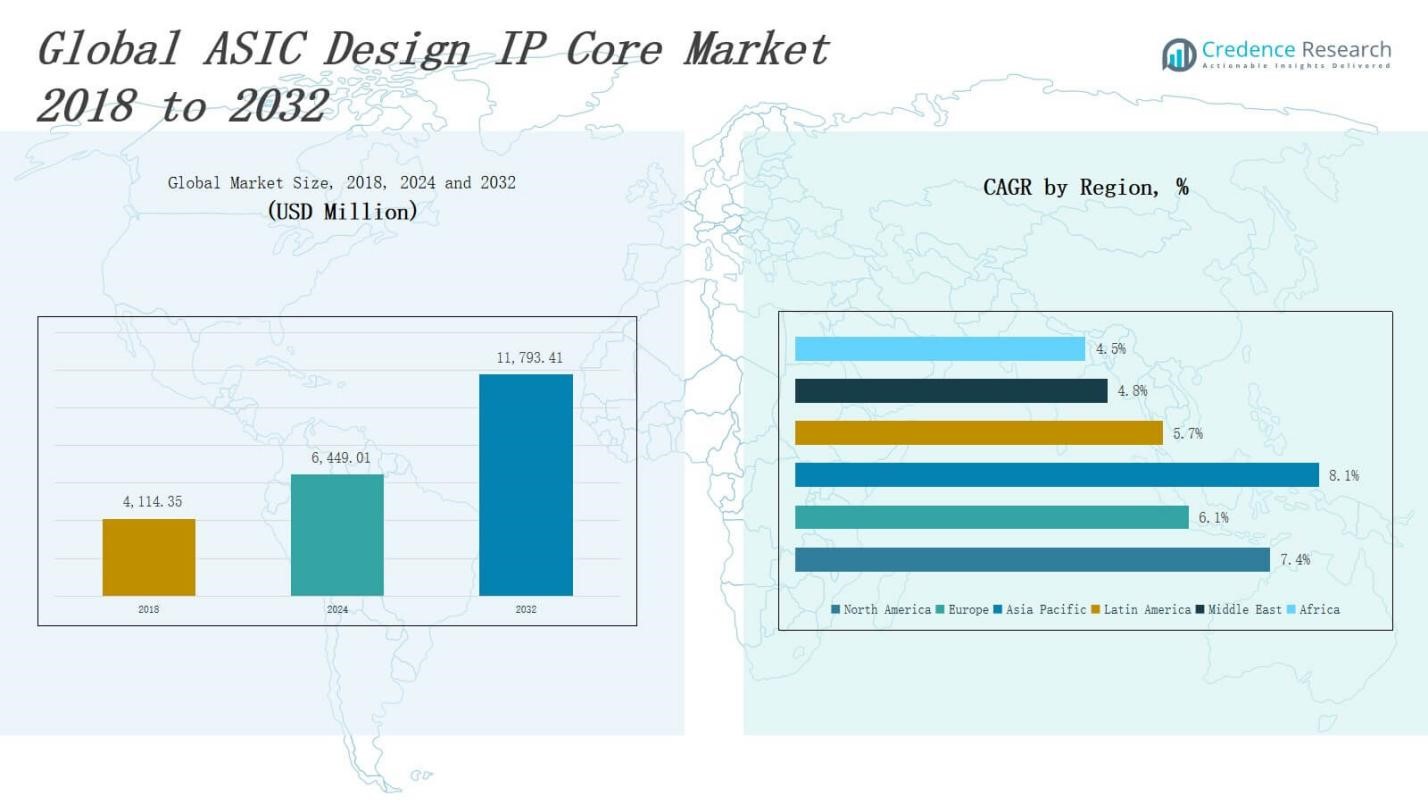
The AI ASIC Chip market size was valued at USD 2,294.90 million in 2018 to USD 4,978.08 million in 2024 and is anticipated to reach USD 21,582.62 million by 2032, at a CAGR of 18.77 % during the forecast period.
The AI ASIC chip market is driven by escalating demand for high-efficiency, low-latency processing in AI-centric applications such as autonomous vehicles, data centers, robotics, and edge computing. OEMs and hyperscalers increasingly adopt ASICs to achieve superior performance-per-watt and minimize power consumption in specialized AI workloads like natural language processing and computer vision. The shift toward edge AI accelerates the deployment of custom chips that support real-time inference with reduced reliance on cloud infrastructure. Integration of AI ASICs in consumer electronics, surveillance systems, and healthcare devices expands use cases beyond enterprise environments. Trends shaping the market include increasing investment in 5nm and 3nm fabrication nodes, growing emphasis on heterogeneous computing, and the emergence of AI-specific SoCs. Leading semiconductor firms are collaborating with cloud providers and OEMs to deliver domain-specific architectures. The market is also witnessing rising demand for open-source hardware frameworks and AI accelerators optimized for training and inference, reinforcing the focus on customization and scalability.
The AI ASIC Chip market shows strong growth across North America, Europe, Asia Pacific, Latin America, the Middle East, and Africa. North America leads in adoption due to the presence of major tech firms and AI infrastructure investments. Europe follows with increased demand for edge AI in automotive and industrial applications. Asia Pacific, led by China, Japan, and South Korea, emerges as a key manufacturing and consumption hub. Latin America and the Middle East are adopting AI ASICs for smart city and telecom deployments, while Africa gradually integrates AI technologies in healthcare and education. Key players shaping the global landscape include NVIDIA, Google (TPU), Intel, AMD, Samsung Electronics, Broadcom, Marvell Technology, Synopsys, Microchip Technology, Faraday Technology, Lattice Semiconductor, and Advanced Micro Devices (AMD), each focusing on domain-specific architectures, energy efficiency, and scalable AI acceleration.
Market Insights
- The AI ASIC Chip market is experiencing strong growth driven by rising demand for high-performance, low-latency processing in AI-intensive applications.
- OEMs and hyperscalers adopt AI ASICs to optimize power efficiency and accelerate specialized tasks like NLP, vision, and deep learning.
- Edge AI is expanding rapidly, with ASICs powering drones, surveillance systems, wearables, and other localized, real-time applications.
- Technological advances in 5nm and 3nm fabrication nodes are enabling compact, high-performance chips with greater customization.
- North America holds the largest market share, driven by established tech firms, cloud infrastructure, and early AI adoption.
- Asia Pacific is a key manufacturing and consumption hub, supported by government investments, AI deployment, and local chip design capabilities.
- Key players including NVIDIA, Intel, AMD, Google, Samsung Electronics, and Broadcom are driving innovation in domain-specific architectures and energy-efficient AI acceleration.
Market Drivers
Rising Demand for High-Efficiency AI Processing
AI ASIC Chip adoption is accelerating due to its unmatched performance and energy efficiency in AI workloads. Industries including automotive, healthcare, and finance deploy these chips to support complex neural networks and real-time decision-making. General-purpose processors fail to deliver the speed and power optimization required by AI models at scale. It enables faster inference and training with lower latency. Enterprises prioritize customized silicon that aligns with their unique computational requirements.
- For instance, JPMorgan Chase utilizes AI ASICs in its fraud detection systems, allowing for high-speed analysis of vast financial transactions to identify anomalies and reduce false positives in real time.
Expansion of Edge AI Applications
The growth of edge computing significantly boosts the AI ASIC Chip market. Devices such as drones, wearables, and surveillance systems need real-time AI capabilities without cloud dependency. It offers localized processing power, ensuring privacy, low power use, and continuous performance in constrained environments. Edge-based AI tasks require chips tailored for minimal energy draw and compact form factors. Businesses leverage ASICs to deliver fast AI responses closer to data sources.
- For instance, Facebook (Meta) has developed PyTorch Mobile, which allows developers to deploy AI models on smartphones, supporting features such as real-time image classification and augmented reality in Messenger and Instagram apps.
Rapid Growth in Data Center Workloads
Cloud service providers and hyperscalers integrate AI ASIC Chip solutions to handle increasing AI training and inference workloads. Data centers demand high-throughput, power-efficient accelerators to optimize machine learning pipelines. It allows them to reduce operating costs while maintaining performance levels. Leading companies use ASICs for deep learning, recommendation engines, and natural language processing. These chips outperform GPUs in specific tasks and offer better thermal management and cost-effectiveness.
Technological Advancements and Customization Needs
Ongoing advances in chip manufacturing and AI architecture fuel demand for the AI ASIC Chip. Foundries now offer 5nm and 3nm nodes, enabling more transistors per die and higher performance. It allows companies to build domain-specific architectures with reduced footprint and increased functionality. Businesses seek greater control over IP, security, and model optimization through ASICs. Custom AI chips support innovation in diverse sectors like robotics, genomics, and autonomous driving.
Market Trends
Integration of AI ASICs into Edge Devices
The shift toward edge computing drives a strong trend of embedding AI ASIC Chip solutions into compact, low-power devices. From smart cameras to industrial robots, companies seek chips that deliver real-time AI capabilities without relying on the cloud. It reduces latency, enhances data privacy, and ensures uninterrupted processing in remote or bandwidth-limited environments. Consumer electronics, automotive systems, and wearable technologies increasingly use ASICs to support applications such as voice recognition, predictive maintenance, and navigation.
- For instance, ADLINK Technology’s NEON-1000-MDX smart camera incorporates the Intel Movidius Myriad X vision processing unit, allowing industrial automation systems to perform machine vision tasks such as defect detection and sorting directly at the edge.
Adoption of Domain-Specific Architectures
Developers and enterprises are moving toward domain-specific architectures to boost AI performance and efficiency. The AI ASIC Chip is purpose-built to accelerate particular AI workloads like convolutional neural networks or transformer models. It reduces unnecessary computational overhead and improves overall throughput. Companies demand chips tailored to their use cases in sectors such as healthcare, finance, and logistics. Domain-focused ASICs outperform general-purpose processors and enable more consistent performance scaling with model complexity.
- For instance, Cerebras Systems developed the Wafer-Scale Engine, the largest AI processor, specifically for deep learning workloads, which has been deployed in research institutions to significantly cut down training times for large transformer models.
Advancement in Semiconductor Process Nodes
The transition to smaller process nodes continues to reshape the AI ASIC Chip landscape. Leading manufacturers now produce 5nm and 3nm chips, increasing transistor density and improving power efficiency. It supports greater model complexity and speeds up both training and inference. These advancements enable smaller chip sizes, making them ideal for compact or embedded systems. The shift also helps reduce thermal output, which benefits both data centers and edge devices by lowering cooling requirements.
Growing Focus on AI Model Optimization and Compression
The demand for optimized AI models is fueling innovations in chip-level support for pruning, quantization, and model compression. The AI ASIC Chip incorporates native support for these techniques, allowing high performance even on constrained hardware. It minimizes memory access, reduces latency, and enhances energy efficiency. Developers design ASICs to accelerate specific model architectures while maintaining precision and speed. This focus aligns with the industry's need for faster, lighter AI implementations across platforms.
Market Challenges Analysis
High Development Costs and Long Design Cycles
Developing an AI ASIC Chip requires substantial financial investment and extended design timelines. Companies must allocate resources for architecture definition, tape-out, verification, and fabrication using advanced process nodes. It creates a barrier for small and mid-sized players lacking capital and technical expertise. Any design error discovered post-production can lead to major losses. Unlike general-purpose chips, ASICs are inflexible after manufacturing, making upfront accuracy and forecasting critical for success.
Rapidly Evolving AI Algorithms and Standards
The fast pace of AI innovation presents a major challenge for the AI ASIC Chip market. New neural network architectures and frameworks frequently emerge, potentially outpacing the hardware’s capabilities. It risks obsolescence for chips designed around specific models or parameters. Maintaining compatibility across evolving AI standards becomes difficult with fixed-function ASICs. This limits long-term viability and may push developers toward more flexible alternatives unless designs account for future-proofing.
Market Opportunities
Expansion Across Emerging AI-Powered Applications
New use cases in robotics, autonomous systems, and medical diagnostics are creating strong opportunities for the AI ASIC Chip market. These applications demand low-latency, high-efficiency processing tailored to specific tasks. It enables precise, real-time decision-making critical for safety and performance. Companies in defense, agriculture, and smart infrastructure increasingly adopt AI at the edge, driving demand for purpose-built chips. The need for compact, energy-efficient solutions supports ASIC deployment in portable and embedded devices.
Government and Industry Investments in AI Infrastructure
Public and private sector initiatives aimed at AI infrastructure development offer growth potential for the AI ASIC Chip market. National AI strategies and industrial automation programs promote the use of high-performance, domain-specific hardware. It supports scalable and secure AI deployments across sectors such as manufacturing, energy, and transportation. Funding for semiconductor R&D and domestic fabrication boosts innovation and supply chain stability. Strategic collaborations with universities and tech firms also accelerate market expansion.
Market Segmentation Analysis:
By Application
The AI ASIC Chip market spans multiple high-growth application areas. Data Center AI Acceleration leads the segment due to growing demand for high-performance training and inference workloads. Edge AI follows with increasing adoption in smart cameras, industrial sensors, and autonomous systems. Consumer Devices use ASICs for voice assistants, AR/VR, and smart wearables. Industrial Automation benefits from real-time analytics and predictive maintenance. Healthcare leverages ASICs for diagnostics, medical imaging, and robotic surgeries. Others include finance, retail, and defense applications.
- For instance, Apple’s A17 Pro chip, built with custom AI accelerators, enables on-device voice recognition and AR features in iPhones and iPads, enhancing user experiences in Siri and augmented reality apps.
By Function
AI ASIC Chips are classified based on their function, with Inference ASICs dominating deployments in edge and mobile environments due to their energy efficiency. Training ASICs are used in data centers where computational intensity is higher. AI Networking ASICs support high-throughput communication and memory management in AI clusters. Vision/Imaging ASICs power object detection and image recognition in automotive, surveillance, and medical imaging systems. Each category addresses different stages of AI workflows across industries.
- For instance, the Murata Type 1WV AI Accelerator Module, built with the Coral Edge TPU, is used in machine vision and industrial safety applications, executing vision models at almost 400 frames per second while maintaining low latency and high energy efficiency.
By End User
The end-user landscape for AI ASIC Chips includes Cloud Providers, Enterprises, OEMs, and Research Institutions. Cloud Providers lead adoption due to massive AI workload requirements and scalability needs. Enterprises across sectors invest in ASICs for use in proprietary applications and analytics. OEMs integrate ASICs into embedded systems and consumer products. Research Institutions deploy these chips for advanced algorithm development, model training, and academic innovation. Each group contributes to the sustained demand for customized AI acceleration.
Segments:
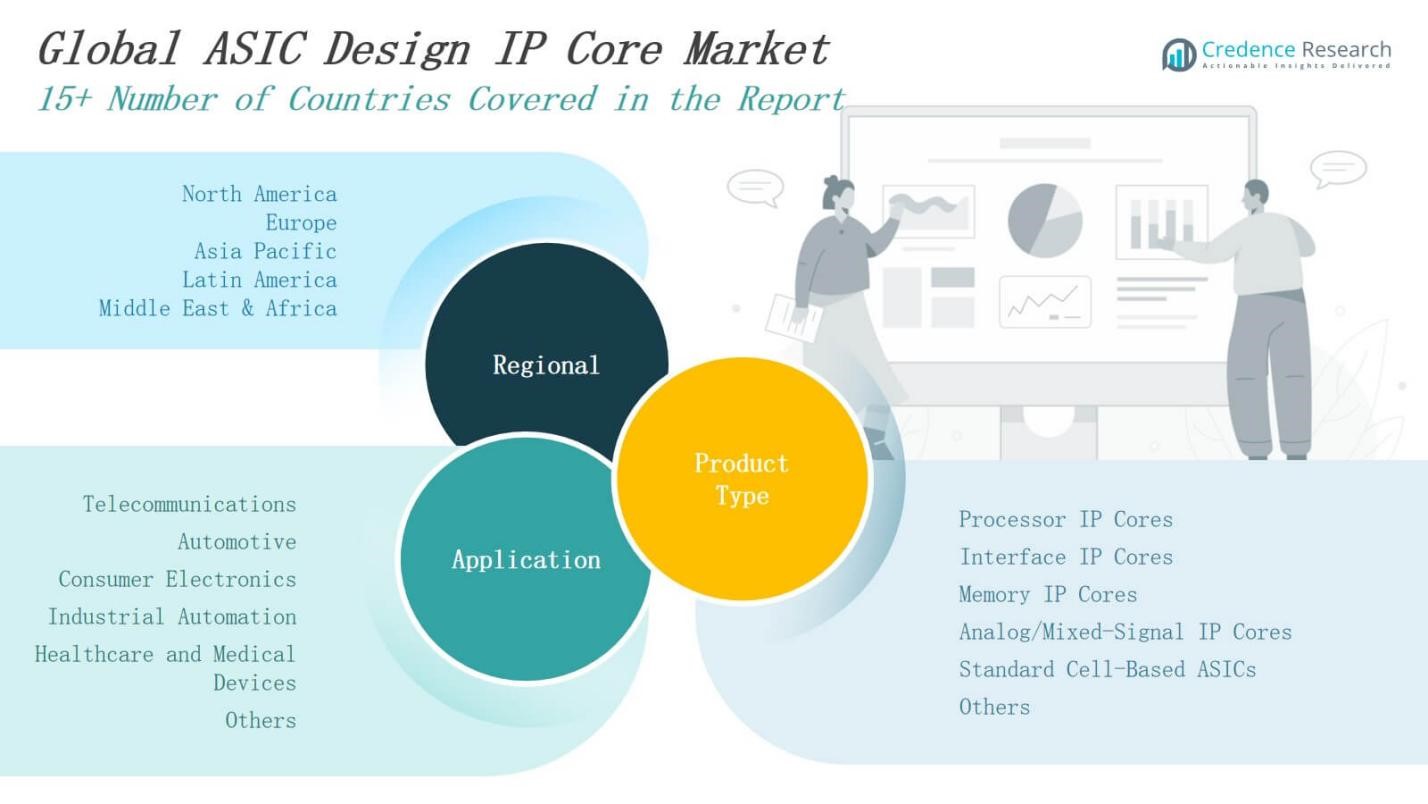
Based on Application
- Data Center AI Acceleration
- Edge AI
- Consumer Devices
- Industrial Automation
- Healthcare
- Others
Based on Function
- Inference ASICs
- Training ASICs
- AI Networking ASICs
- Vision/Imaging ASICs
Based on End User
- Cloud Providers
- Enterprises
- OEMs (Original Equipment Manufacturers)
- Research Institutions
Based on Region
North America
- U.S., Canada, Mexico
Europe
- UK, France, Germany, Italy, Spain, Russia, Rest of Europe
Asia Pacific
- China, Japan, South Korea, India, Australia, Southeast Asia, Rest of Asia Pacific
Latin America
- Brazil, Argentina, Rest of Latin America
Middle East
- GCC Countries, Israel, Turkey, Rest of Middle East
Africa
- South Africa, Egypt, Rest of Africa
Regional Analysis
North America
The North America AI ASIC Chip market size was valued at USD 966.68 million in 2018 to USD 2,074.34 million in 2024 and is anticipated to reach USD 9,019.27 million by 2032, at a CAGR of 18.8% during the forecast period. North America holds the largest market share due to advanced AI infrastructure, high R&D investments, and strong demand from cloud service providers. The United States drives most of the regional growth with established players and deep integration of AI across sectors. Enterprises and OEMs actively deploy AI ASIC solutions in data centers, autonomous vehicles, and edge applications. It benefits from a mature semiconductor ecosystem, strategic public-private partnerships, and early technology adoption. Canada and Mexico also contribute through smart manufacturing and digital transformation initiatives.
Europe
The Europe AI ASIC Chip market size was valued at USD 450.59 million in 2018 to USD 926.51 million in 2024 and is anticipated to reach USD 3,671.59 million by 2032, at a CAGR of 17.4% during the forecast period. Europe captures a significant market share, led by Germany, the UK, and France, where industrial automation and automotive sectors demand low-latency AI computing. The region emphasizes energy-efficient AI solutions supported by EU policy initiatives. It sees strong traction in edge AI, healthcare, and robotics applications. Regional chipmakers and research institutions collaborate on AI hardware design and deployment. Startups and OEMs increasingly adopt ASICs to meet regulatory standards and competitive performance benchmarks.
Asia Pacific
The Asia Pacific AI ASIC Chip market size was valued at USD 659.17 million in 2018 to USD 1,510.20 million in 2024 and is anticipated to reach USD 7,144.04 million by 2032, at a CAGR of 20.1% during the forecast period. Asia Pacific holds a rapidly growing market share driven by China, Japan, South Korea, and India. It benefits from high-volume semiconductor production, rising AI adoption in consumer electronics, and robust government support. The region is a key hub for chip fabrication and deployment in smart devices, automotive systems, and telecom infrastructure. Leading players invest in 3nm node technologies and AI-focused SoCs. Demand for edge AI and affordable AI hardware supports strong regional momentum.
Latin America
The Latin America AI ASIC Chip market size was valued at USD 110.44 million in 2018 to USD 236.64 million in 2024 and is anticipated to reach USD 910.26 million by 2032, at a CAGR of 17.0% during the forecast period. Latin America is an emerging market for AI ASICs, with Brazil and Mexico leading adoption across smart agriculture, finance, and public security. It sees early-stage deployments in healthcare diagnostics and industrial automation. Government-backed digitalization and AI initiatives are creating new growth opportunities. Enterprises invest in edge AI to improve decision-making and operational efficiency. Limited local manufacturing capacity drives imports of advanced ASICs from North America and Asia.
Middle East
The Middle East AI ASIC Chip market size was valued at USD 64.53 million in 2018 to USD 128.00 million in 2024 and is anticipated to reach USD 468.63 million by 2032, at a CAGR of 16.3% during the forecast period. The Middle East is adopting AI ASIC Chips in sectors such as energy, defense, and smart cities. It benefits from government-driven digital transformation efforts and AI policies in countries like the UAE and Saudi Arabia. Investments in cloud infrastructure and data centers boost regional demand. Enterprises deploy ASICs to support advanced surveillance, traffic control, and industrial AI applications. Local collaboration with global chipmakers supports capability expansion and technical skill development.
Africa
The Africa AI ASIC Chip market size was valued at USD 43.48 million in 2018 to USD 102.39 million in 2024 and is anticipated to reach USD 368.83 million by 2032, at a CAGR of 16.0% during the forecast period. Africa holds a smaller share of the global market but shows gradual adoption across education, healthcare, and agriculture. South Africa, Egypt, and Nigeria lead in integrating AI-enabled hardware for localized solutions. It sees rising interest in edge AI to overcome infrastructure challenges. Public and private sector partnerships promote AI innovation and training. ASIC deployment supports smart irrigation, disease detection, and mobile-based AI applications across underserved regions.
Key Player Analysis
- Marvell Technology
- Lattice Semiconductor
- Intel
- Synopsys
- Faraday Technology
- Broadcom
- AMD
- Google (TPU)
- Samsung Electronics
- Microchip Technology
- NVIDIA
- Advanced Micro Devices (AMD)
Competitive Analysis
The AI ASIC Chip market features intense competition driven by rapid innovation and high-performance demands. Leading companies such as NVIDIA, Google (TPU), Intel, and AMD invest heavily in custom silicon to optimize AI workloads. It enables differentiated performance in training and inference, offering a competitive edge in cloud and edge deployments. Broadcom, Marvell Technology, and Synopsys focus on scalable ASIC design and IP integration, supporting enterprise and hyperscale clients. Samsung Electronics and Lattice Semiconductor target power-efficient ASICs for edge and consumer applications. Faraday Technology and Microchip Technology provide cost-effective, application-specific solutions for OEMs. Each player competes on metrics such as processing speed, power efficiency, scalability, and ecosystem integration. The market rewards companies that align silicon development with evolving AI models and application needs. Strategic partnerships with cloud providers, OEMs, and research institutions remain critical for long-term positioning in the AI ASIC Chip landscape.
Recent Developments
- In May 2025, NVIDIA launched the NVLink Fusion semi-custom AI silicon platform, allowing partners such as Marvell, Qualcomm, MediaTek, and Synopsys to develop tailored AI infrastructure using NVIDIA’s NVLink interconnect technology.
- In April 2025, Google introduced its seventh-generation AI ASIC, TPU "Ironwood", featuring 42.5 exaflops per pod and enhanced memory architecture, designed to accelerate large-scale inference workloads.
- In July 2025, Foxconn announced its entry into the AI ASIC chip design segment, marking a strategic expansion beyond manufacturing to compete in the specialized AI semiconductor market.
- In June 2025, Broadcom began sampling its Tomahawk 6 Ethernet switch ASIC, marking a major step in high-throughput AI networking with 102.4‑terabit throughput to support large-scale AI workloads.
Market Concentration & Characteristics
The AI ASIC Chip market shows a moderately concentrated structure, dominated by a few global players with strong design capabilities, proprietary architectures, and extensive fabrication partnerships. Companies such as NVIDIA, Google, and Intel hold significant market share due to their early investments in AI acceleration technologies and vertical integration strategies. It features high entry barriers linked to capital intensity, long design cycles, and specialized engineering talent. Most suppliers differentiate through custom silicon optimized for specific AI models or workloads. The market favors those with strong IP portfolios, access to advanced process nodes, and established customer relationships in cloud, enterprise, and edge segments. Demand for energy-efficient, application-specific chips continues to define competition. The market also reflects rapid technological change, requiring continuous innovation in architecture, memory integration, and software compatibility. Consolidation, co-development partnerships, and strategic investments in AI infrastructure characterize the competitive dynamics within the AI ASIC Chip landscape.
Report Coverage
The research report offers an in-depth analysis based on Application, Function, End-User and Region. It details leading market players, providing an overview of their business, product offerings, investments, revenue streams, and key applications. Additionally, the report includes insights into the competitive environment, SWOT analysis, current market trends, as well as the primary drivers and constraints. Furthermore, it discusses various factors that have driven market expansion in recent years. The report also explores market dynamics, regulatory scenarios, and technological advancements that are shaping the industry. It assesses the impact of external factors and global economic changes on market growth. Lastly, it provides strategic recommendations for new entrants and established companies to navigate the complexities of the market.
Future Outlook
- AI ASIC Chip adoption will expand across edge devices in automotive, healthcare, and consumer electronics.
- Enterprises will prioritize custom ASICs to support proprietary AI models and reduce cloud dependency.
- Data centers will increasingly deploy AI ASICs to improve energy efficiency and processing throughput.
- AI model complexity will drive demand for chips with higher memory bandwidth and parallel processing.
- Semiconductor firms will invest in advanced packaging and 3nm fabrication technologies for better performance.
- Integration of AI ASICs with system-on-chip (SoC) architectures will accelerate across compact devices.
- Governments will fund domestic chip development to reduce supply chain risks and dependency.
- OEMs will adopt AI ASICs to differentiate products with built-in intelligence and faster response times.
- Open-source AI hardware ecosystems will support innovation and lower development barriers.
- Strategic partnerships between chipmakers and cloud providers will shape next-generation AI hardware platforms.

Request a Free Sample
Fill in your details and we'll send you a free sample report.
- Sample data tables & charts
- Research methodology
Market Dynamics
Escalating Demand for High-Efficiency, Low-Latency AI Processing
Industries such as automotive, healthcare, and finance require AI ASIC chips to deliver real-time inference and decision-making with superior energy efficiency, outperforming general-purpose processors in specialized AI workloads.
Expansion of Edge AI Applications
The proliferation of edge devices like drones, surveillance systems, and wearables is driving demand for ASICs that enable localized, real-time AI processing with minimal power consumption and reduced reliance on cloud infrastructure.
Rapid Growth in Data Center AI Workloads
Hyperscalers and cloud providers are integrating AI ASIC chips to accelerate training and inference, optimize power usage, and reduce operational costs, especially for complex machine learning and deep learning tasks.
Technological Advancements in Semiconductor Fabrication
The adoption of advanced 5nm and 3nm process nodes allows for higher transistor density, improved performance, and greater customization, enabling the development of compact, high-performance AI ASICs for diverse applications.
Increasing Customization and Domain-Specific Architectures
Enterprises and OEMs are seeking ASICs tailored to their unique AI models and workloads, driving innovation in domain-specific architectures that deliver optimized performance, scalability, and energy efficiency.
Need a Custom Version of This Report?
Tailor the scope, geography, or segments to your exact requirements.
- Custom geography or segment scope
- Direct access to our analyst team
Frequently Asked Questions
What is the current size of the AI ASIC Chip market?
What factors are driving the growth of the AI ASIC Chip market?
What are the key segments within the AI ASIC Chip market?
What are some challenges faced by the AI ASIC Chip market?
Who are the major players in the AI ASIC Chip market?
Table of Content
Chapter 1 Market Segmentation
- 1.1 Segmentation Framework
- 1.1.1 Product and Service Classification
- 1.1.2 Application and End-Use Classification
- 1.1.3 Technology and Solution Classification
- 1.1.4 Customer and Distribution Channel Classification
- 1.1.5 Geographic Segmentation
- 1.1.6 Market Segment Definitions and Boundaries
- 1.2 By End User
- 1.2.1 Cloud Providers
- 1.2.2 Enterprises
- 1.2.3 OEMs (Original Equipment Manufacturers)
- 1.2.4 Research Institutions
- 1.3 By Function
- 1.3.1 Inference ASICs
- 1.3.2 Training ASICs
- 1.3.3 AI Networking ASICs
- 1.3.4 Vision/Imaging ASICs
- 1.4 By Application
- 1.4.1 Data Center AI Acceleration
- 1.4.2 Edge AI
- 1.4.3 Consumer Devices
- 1.4.4 Industrial Automation
- 1.4.5 Healthcare
- 1.4.6 Others
Chapter 2 Introduction
- 2.1 Report Objectives and Scope
- 2.2 Product Definition and Industry Terminology
- 2.3 Market Inclusions and Exclusions
- 2.4 Research Process
- 2.4.1 Primary Research and Expert Interviews
- 2.4.2 Secondary Research and Source Review
- 2.4.3 Top-Down and Bottom-Up Estimation
- 2.4.4 Data Triangulation and Verification
- 2.5 Market Size Measurement Basis
- 2.5.1 2024: USD 4,978.08 million → 2032: USD 21,582.62 million
- 2.6 Historical and Forecast Reference Periods
- 2.6.1 Base Year: 2024
- 2.6.2 Forecast Period: 2024-2032
- 2.7 Research Assumptions and Limitations
Chapter 3 Executive Summary
- 3.1 Market Snapshot and Key Findings
- 3.2 Base-Year Market Size, 2024
- 3.3 Forecast Market Size, 2032
- 3.4 Revenue and Volume Growth Outlook
- 3.5 Key Demand and Supply Indicators
- 3.6 Leading Market Segments
- 3.7 Fastest-Growing Market Opportunities
- 3.8 Regional Performance Highlights
- 3.9 Technology and Industry Transformation
- 3.10 Competitive Landscape Summary
- 3.11 Analyst View and Strategic Implications
Chapter 4 Global AI ASIC Chip Market Trends and Developments
- 4.1 Historical Industry Development
- 4.2 Recent Market Trends and Developments
- 4.3 Demand and Customer Behavior Trends
- 4.4 Technology and Product Innovation
- 4.5 Artificial Intelligence, Automation and Digitalization
- 4.6 Local Manufacturing and Supply Chain Realignment
- 4.7 Industry Partnerships, Mergers and Acquisitions
- 4.8 Sustainability and Circular Economy Developments
- 4.9 Government and Private Sector Investment Trends
- 4.10 Emerging Business Models and Commercialization
- 4.11 Industry Developments and Announcements
Chapter 5 Global AI ASIC Chip Market Production, Supply and Demand Analysis
- 5.1 Demand Trend and Consumption Analysis
- 5.2 Demand Forecast, 2024-2032
- 5.3 Production and Output Trend
- 5.4 Production and Output Forecast, 2024-2032
- 5.5 Installed Capacity and Capacity Utilization
- 5.6 Company-Wise Production Plants and Statistics
- 5.6.1 Installed Production Capacity
- 5.6.2 Actual Production
- 5.6.3 Planned Capacity and Expansion Targets
- 5.7 Supply Chain Structure and Procurement Trends
- 5.8 Supply-Demand Gap and Bottlenecks
- 5.9 Import Dependence and Sourcing Structure
- 5.10 Contract Manufacturing and Outsourcing
- 5.11 Regional Supply and Demand Concentration
Chapter 6 Global AI ASIC Chip Market Pricing Analysis
- 6.1 Pricing Structure and Measurement
- 6.2 Historical Pricing Trends
- 6.3 Pricing Outlook, 2024-2032
- 6.4 Average Selling Price and Unit Economics
- 6.5 Pricing by Product and Market Segment
- 6.6 Geographic Pricing Differences
- 6.7 Key Input, Energy, Labor and Logistics Costs
- 6.8 Contract Pricing and Purchasing Models
- 6.9 Pricing Sensitivity and Competitive Positioning
- 6.10 Price, Margin and Profitability Implications
Chapter 7 Global AI ASIC Chip Market Dynamics
- 7.1 Market Growth Drivers
- 7.1.1 Demand-Side Drivers
- 7.1.2 Technology and Innovation Drivers
- 7.1.3 Infrastructure and Investment Drivers
- 7.1.4 Regulatory and Policy Drivers
- 7.2 Market Restraints
- 7.2.1 Cost and Affordability Constraints
- 7.2.2 Technology and Adoption Barriers
- 7.2.3 Supply Chain and Operational Constraints
- 7.3 Market Challenges
- 7.3.1 Competitive Pressure and Margin Erosion
- 7.3.2 Skills, Infrastructure and Implementation Gaps
- 7.4 Emerging Market Opportunities
- 7.5 Market Dynamics Impact and Time-Horizon Assessment
Chapter 8 Global AI ASIC Chip Value Chain Analysis
- 8.1 Industry Value Chain Overview
- 8.2 Upstream Suppliers and Critical Inputs
- 8.3 Technology and Component Providers
- 8.4 Manufacturing or Service Delivery
- 8.5 Distribution, Channel Partners and Integrators
- 8.6 Downstream Applications and End Users
- 8.7 Value Addition and Profit Pools
- 8.8 Vertical Integration and Outsourcing
- 8.9 Supplier Concentration and Risk
- 8.10 Supply Chain Localization and Resilience
Chapter 9 Global AI ASIC Chip Market Regulations and Policies
- 9.1 Relevant Laws, Standards and Compliance Frameworks
- 9.2 Product, Service, Safety and Quality Requirements
- 9.3 Government Policies, Incentives and Subsidies
- 9.4 Imports, Exports and Trade Barriers
- 9.5 Public Procurement and Local Content Requirements
- 9.6 Environmental and Sustainability Compliance
- 9.7 Upcoming Policy Changes and Market Implications
Chapter 10 Global AI ASIC Chip Market Hotspots and Opportunities
- 10.1 Market Opportunity Mapping and Growth Hotspots
- 10.2 High-Growth Applications and Customer Groups
- 10.3 Underserved Markets and White-Space Opportunities
- 10.4 Emerging Technology and Product Opportunities
- 10.5 New Capacity and Investment Hotspots
- 10.6 Market Entry and Expansion Opportunities
- 10.7 Distribution and Partnership Opportunities
- 10.8 Near-Term and Long-Term Commercial Potential
- 10.9 Opportunity Attractiveness and Execution Risks
Chapter 11 Global AI ASIC Chip Market Outlook, 2024-2032
- 11.1 Market Size and Analysis
- 11.1.1 Revenue (Market Measurement: 2024: USD 4,978.08 million → 2032: USD 21,582.62 million)
- 11.1.2 Market Volume and Quantity Sold
- 11.1.3 Historical Market Size
- 11.1.4 Base-Year Market Size, 2024
- 11.2 Market Forecast, 2024-2032
- 11.2.1 Revenue Forecast to 2032
- 11.2.2 Volume Forecast to 2032
- 11.2.3 CAGR and Year-on-Year Growth
- 11.2.4 Incremental Revenue Opportunity
- 11.3 Forecast Assumptions and Scenario Analysis
- 11.3.1 Base-Case Forecast
- 11.3.2 Optimistic and Conservative Scenarios
- 11.3.3 Technology, Pricing and Policy Sensitivities
- 11.4 Market Attractiveness and Growth Outlook
Chapter 12 Global AI ASIC Chip Market Segmentation and Outlook
- 12.1 Segmentation Summary and Market Shares, 2024
- 12.2 Largest and Fastest-Growing Segments
- 12.3 By End User - Market Size and Forecast, 2024-2032
- 12.3.1 Segment Definition and Scope
- 12.3.2 Historical Market Size
- 12.3.3 Revenue Forecast, 2024-2032
- 12.3.4 Volume Forecast, 2024-2032
- 12.3.5 Base-Year Market Share, 2024
- 12.3.6 Segment CAGR and Growth Drivers
- 12.3.7 Subsegment Market Size and Forecast
- 12.3.7.1 Cloud Providers
- 12.3.7.2 Enterprises
- 12.3.7.3 OEMs (Original Equipment Manufacturers)
- 12.3.7.4 Research Institutions
- 12.3.8 Subsegment Pricing and Adoption Trends
- 12.3.9 Leading Suppliers and Competition
- 12.3.10 Regional Demand and Opportunities
- 12.4 By Function - Market Size and Forecast, 2024-2032
- 12.4.1 Segment Definition and Scope
- 12.4.2 Historical Market Size
- 12.4.3 Revenue Forecast, 2024-2032
- 12.4.4 Volume Forecast, 2024-2032
- 12.4.5 Base-Year Market Share, 2024
- 12.4.6 Segment CAGR and Growth Drivers
- 12.4.7 Subsegment Market Size and Forecast
- 12.4.7.1 Inference ASICs
- 12.4.7.2 Training ASICs
- 12.4.7.3 AI Networking ASICs
- 12.4.7.4 Vision/Imaging ASICs
- 12.4.8 Subsegment Pricing and Adoption Trends
- 12.4.9 Leading Suppliers and Competition
- 12.4.10 Regional Demand and Opportunities
- 12.5 By Application - Market Size and Forecast, 2024-2032
- 12.5.1 Segment Definition and Scope
- 12.5.2 Historical Market Size
- 12.5.3 Revenue Forecast, 2024-2032
- 12.5.4 Volume Forecast, 2024-2032
- 12.5.5 Base-Year Market Share, 2024
- 12.5.6 Segment CAGR and Growth Drivers
- 12.5.7 Subsegment Market Size and Forecast
- 12.5.7.1 Data Center AI Acceleration
- 12.5.7.2 Edge AI
- 12.5.7.3 Consumer Devices
- 12.5.7.4 Industrial Automation
- 12.5.7.5 Healthcare
- 12.5.7.6 Others
- 12.5.8 Subsegment Pricing and Adoption Trends
- 12.5.9 Leading Suppliers and Competition
- 12.5.10 Regional Demand and Opportunities
- 12.6 Segment Growth Comparison
- 12.7 Segment Attractiveness and Priority Matrix
Chapter 13 Global AI ASIC Chip End-Use and Application Market Outlook
- 13.1 End-Use Industry and Customer Demand Structure
- 13.2 Leading Applications and Customer Groups
- 13.3 End-Use Market Size, Share and Forecast
- 13.4 Major End-Use Industry Deep Dives
- 13.4.1 Customer Requirements and Use Cases
- 13.4.2 Demand and Replacement Cycles
- 13.4.3 Technical and Regulatory Considerations
- 13.4.4 Purchasing and Procurement Models
- 13.4.5 Leading Vendors and Distribution Channels
- 13.4.6 Forecast and Commercial Opportunities
- 13.5 Emerging Applications and Cross-Segment Demand
- 13.6 End-Use Industry Investment Priorities
Chapter 14 Global AI ASIC Chip Geographic Market Outlook, 2024-2032
- 14.1 Regional Market Size and Share, 2024
- 14.2 Regional Market Forecast, 2024-2032
- 14.3 Regional Pricing, Production and Demand Differences
- 14.4 North America
- 14.4.1 United States
- 14.4.2 Canada
- 14.4.3 Mexico
- 14.5 Europe
- 14.5.1 Germany
- 14.5.2 France
- 14.5.3 Italy
- 14.5.4 United Kingdom
- 14.5.5 Spain
- 14.5.6 Poland
- 14.5.7 Russia
- 14.5.8 Netherlands
- 14.5.9 Belgium
- 14.5.10 Sweden
- 14.5.11 Denmark
- 14.5.12 Norway
- 14.5.13 Rest of Europe
- 14.6 Asia Pacific
- 14.6.1 China
- 14.6.2 India
- 14.6.3 Japan
- 14.6.4 South Korea
- 14.6.5 Thailand
- 14.6.6 Indonesia
- 14.6.7 Vietnam
- 14.6.8 Malaysia
- 14.6.9 Australia
- 14.6.10 Rest of Asia Pacific
- 14.7 Latin America
- 14.7.1 Brazil
- 14.7.2 Argentina
- 14.7.3 Colombia
- 14.7.4 Chile
- 14.7.5 Rest of Latin America
- 14.8 Middle East
- 14.8.1 Saudi Arabia
- 14.8.2 United Arab Emirates
- 14.8.3 Turkey
- 14.8.4 Israel
- 14.8.5 Iran
- 14.8.6 Rest of the Middle East
- 14.9 Africa
- 14.9.1 South Africa
- 14.9.2 Egypt
- 14.9.3 Nigeria
- 14.9.4 Morocco
- 14.9.5 Rest of Africa
- 14.10 Regional Investment, Policy and Supply Chain Differences
- 14.11 Regional Competitive Landscape
- 14.12 Geographic Growth Hotspots
Chapter 15 Global AI ASIC Chip Technology, Innovation and Sustainability Outlook
- 15.1 Technology Landscape and Maturity
- 15.2 Product, Process and Service Innovation
- 15.3 AI, Automation and Digital Tools in the Industry
- 15.4 Technology Adoption and Performance Benchmarking
- 15.5 Innovation Pipeline and R&D Investment
- 15.6 Patent and Intellectual Property Trends
- 15.7 Energy Efficiency and Resource Management
- 15.8 Sustainability, Recycling and Circularity
- 15.9 Technology Roadmap, 2024-2032
- 15.10 Risks of Obsolescence and Technology Substitution
Chapter 16 Global AI ASIC Chip Market Key Strategic Imperatives
- 16.1 Growth and Market Entry Priorities
- 16.2 High-Return Products and Segments
- 16.3 Pricing, Profitability and Cost Optimization
- 16.4 Technology Investment and Product Differentiation
- 16.5 Supply Chain Localization and Resilience
- 16.6 Distribution and Customer Acquisition
- 16.7 Partnership, Acquisition and Capacity Strategy
- 16.8 Regional Expansion Priorities
- 16.9 Short-, Medium- and Long-Term Actions
Chapter 17 Competition Outlook
- 17.1 Industry Competition Characteristics
- 17.2 Market Structure and Concentration
- 17.3 Market Share and Competitive Positioning, 2024
- 17.4 Company-Wise Revenue and Product Benchmarking
- 17.5 Production and Service Capacity Benchmarking
- 17.6 Technology, Pricing and Differentiation
- 17.7 Regional Footprint and Distribution Strength
- 17.8 Mergers, Acquisitions and Strategic Alliances
- 17.9 New Entrants and Competitive Threats
- 17.10 Porter's Five Forces and Industry Attractiveness
- 17.11 Competitive Outlook, 2024-2032
Chapter 18 Company Profiles
- 18.1 Company Coverage and Selection Criteria
- 18.2 NVIDIA
- 18.2.1 Business Description
- 18.2.2 Company Ownership and Geographic Presence
- 18.2.3 Product and Service Portfolio
- 18.2.4 Manufacturing and Operating Footprint
- 18.2.5 Production Capacity and Expansion Plans
- 18.2.6 Financial Performance and Investment
- 18.2.7 Market Share and Competitive Position
- 18.2.8 Technology and Innovation Capabilities
- 18.2.9 Strategic Alliances or Partnerships
- 18.2.10 Recent Developments
- 18.2.11 Growth Strategy and Outlook
- 18.3 Google (TPU)
- 18.4 Intel
- 18.5 AMD
- 18.6 Samsung Electronics
- 18.7 Broadcom
- 18.8 Marvell Technology
- 18.9 Synopsys
- 18.10 Lattice Semiconductor
- 18.11 Microchip Technology
- 18.12 Other Relevant Market Participants
Note: Every listed company is profiled on the structure shown under the first company. The company list is preliminary and may change based on research findings, market developments, data availability and client requirements.
Chapter 19 Disclaimer
- 19.1 Research and Forecast Disclaimer
- 19.2 Data Source and Estimation Limitations
Note: The depth of individual sections depends on data availability for this market. Volume, capacity, trade and other unit-based metrics are included where applicable.

