
Market Overview:
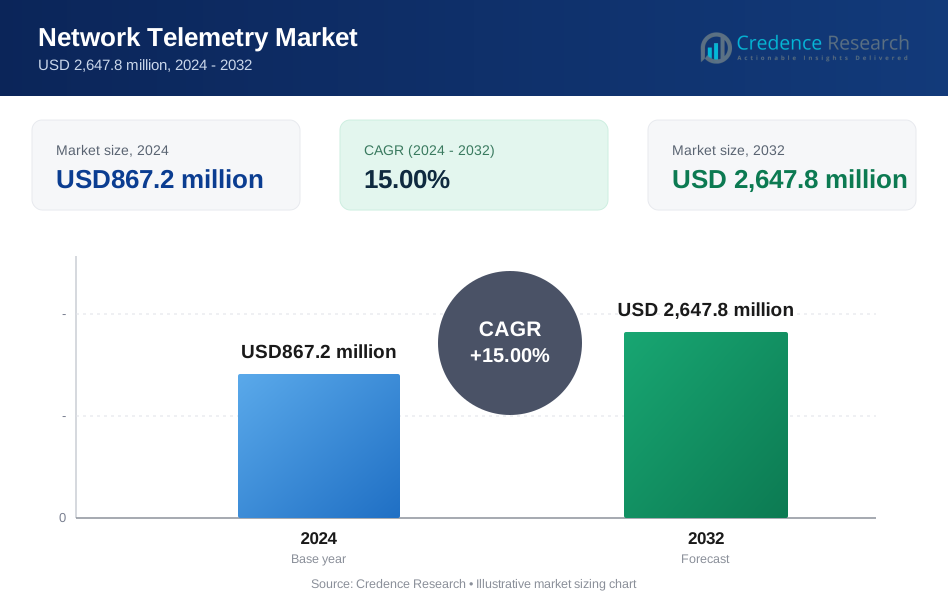
The Network Telemetry Market size was valued at USD 867.2 million in 2024 and is anticipated to reach USD 2647.8 million by 2032, at a CAGR of 15% during the forecast period (2024-2032).
| REPORT ATTRIBUTE | DETAILS |
|---|---|
| Historical Period | 2020-2023 |
| Base Year | 2024 |
| Forecast Period | 2025-2032 |
| Network Telemetry Market Size 2024 | USD 867.2 million |
| Network Telemetry Market, CAGR | 15% |
| Network Telemetry Market Size 2032 | USD 2647.8 million |
Key drivers of the market include the growing complexity of modern networks, the proliferation of connected devices, and the rising need for enhanced cybersecurity measures. Organizations are adopting network telemetry solutions to gain granular visibility into network performance, enabling proactive issue resolution and optimization. Moreover, the integration of artificial intelligence and machine learning into telemetry systems is boosting predictive analytics and automation capabilities, improving network efficiency and security. As a result, businesses can make more informed decisions and ensure the continuous availability of critical network services.
Regionally, North America leads the market, driven by advanced IT infrastructure and early adoption of network telemetry technologies. The Asia-Pacific region is expected to experience the fastest growth due to rapid digitalization, expanding telecommunications infrastructure, and the increasing adoption of cloud-based services. These regional trends indicate a global shift towards more sophisticated and proactive network management approaches, positioning network telemetry as a crucial tool in optimizing network performance and security across the globe.

Market Insights:
- The Network Telemetry Market, valued at USD 867.2 million in 2024, is projected to reach USD 2,647.8 million by 2032, growing at a CAGR of 15%.
- The market is driven by the increasing complexity of networks, the rise of connected devices, and the growing need for cybersecurity measures.
- The proliferation of IoT, edge computing, and 5G networks is pushing demand for telemetry solutions to manage vast amounts of data and optimize network performance.
- Network telemetry solutions help address cybersecurity risks by providing real-time insights into network vulnerabilities and enabling quicker threat mitigation.
- The integration of AI and machine learning into telemetry systems enhances predictive analytics, automates tasks, and improves overall network efficiency.
- North America leads the market with 40% of global revenue, while Asia-Pacific and Europe follow with 30% and 20%, respectively, driven by regional digital transformation.
- Data privacy concerns and integration challenges with legacy systems hinder market adoption and require robust security measures and strategic planning.
Market Drivers:
Increasing Complexity of Modern Networks
The Network Telemetry Market is significantly driven by the growing complexity of modern networks. With the rapid expansion of digital transformation, organizations are facing more intricate network infrastructures that require real-time monitoring and data analytics. These networks need constant optimization to maintain high performance and ensure uptime. As a result, telemetry solutions that provide detailed visibility into network activities are becoming crucial for businesses to address performance bottlenecks, security risks, and other operational issues efficiently.
Proliferation of Connected Devices
The increasing number of connected devices is another key factor fueling the Network Telemetry Market. The rise of Internet of Things (IoT) devices, edge computing, and 5G technology is expanding network infrastructure. With millions of devices transmitting large volumes of data, companies need reliable telemetry solutions to monitor performance, manage resources, and optimize network bandwidth. Network telemetry enables organizations to track device behavior and network traffic patterns, allowing for swift problem identification and resolution.
Demand for Enhanced Cybersecurity
Cybersecurity concerns are accelerating the demand for advanced network telemetry solutions. As cyber threats grow more sophisticated, businesses are adopting telemetry systems to gain real-time insights into network vulnerabilities and anomalies. Network telemetry helps in detecting unusual activity that may indicate potential threats, providing organizations with the necessary information to mitigate risks promptly. It supports faster incident response and fortifies the overall security posture of enterprises.
- For instance, Fortinet’s FortiNDR Cloud retains rich network metadata for 365 days, enabling extensive retrospective threat hunting and investigations.
Integration of Artificial Intelligence and Automation
The integration of artificial intelligence (AI) and machine learning (ML) into network telemetry systems is enhancing their predictive and automation capabilities. These technologies help in analyzing vast amounts of network data to predict potential failures or inefficiencies. By automating routine tasks and providing actionable insights, AI and ML integration allows businesses to proactively manage their networks. This drives efficiency, reduces downtime, and enhances overall network reliability.Top of Form
- For instance, Juniper Networks’ Mist AI platform, powered by the Marvis AI Assistant, processes over one million digital experience twins to automate network issue detection and resolution.
Market Trends:
Growing Adoption of Cloud-Based Network Telemetry Solutions
The Network Telemetry Market is witnessing a growing shift towards cloud-based solutions, driven by the increasing demand for scalable and cost-effective network management tools. Cloud technologies provide businesses with flexible, on-demand access to real-time telemetry data without the need for extensive on-premise infrastructure. This trend is especially prevalent in industries with distributed networks and global operations, where cloud solutions enable seamless data integration and analysis. By adopting cloud-based telemetry systems, organizations can enhance their network monitoring capabilities while reducing operational costs. The ability to scale as needed and the reduced reliance on physical hardware make cloud solutions a preferred choice for many enterprises. Furthermore, the ease of integrating these solutions with other cloud services, such as AI and machine learning platforms, boosts network efficiency and security.
- For instance, Cisco Nexus 9000 switches support streaming telemetry with a message size capacity exceeding 4 MB per gRPC message, enabling high-frequency and high-volume data transfer for real-time AI-driven network management.
Increased Focus on Real-Time Data Analytics and Predictive Insights
Real-time data analytics and predictive insights are becoming significant trends in the Network Telemetry Market. Organizations are increasingly relying on real-time telemetry data to monitor network performance and detect issues proactively. The integration of AI and machine learning into telemetry systems allows for more accurate predictions of potential network failures, enabling businesses to address problems before they escalate. Predictive insights also enhance decision-making processes, allowing companies to optimize network resources more efficiently. This focus on real-time monitoring and predictive analytics empowers organizations to improve network reliability, minimize downtime, and ensure high service levels. As network complexity increases, the demand for these advanced capabilities will continue to grow, driving further innovation in the market.
- For instance, Ciena’s WaveLogic Ai coherent optical chipset collects and updates key real-time telemetry measurements every 10 milliseconds, including optical power and error rates, enabling precise network capacity management and optimization.
Market Challenges Analysis:
Data Privacy and Security Concerns
One of the key challenges in the Network Telemetry Market is addressing data privacy and security concerns. As network telemetry solutions collect and analyze sensitive data, organizations must ensure robust security measures to protect against cyber threats. Unauthorized access to telemetry data could lead to significant security breaches, compromising both operational integrity and customer trust. Implementing secure data storage, encryption, and access controls is crucial for businesses to comply with stringent data protection regulations. While telemetry systems offer real-time monitoring capabilities, ensuring they do not expose sensitive network information remains a critical challenge for many organizations.
Integration with Existing Infrastructure
Another challenge facing the Network Telemetry Market is the seamless integration of new telemetry systems with existing network infrastructure. Many organizations rely on legacy systems that may not be fully compatible with modern telemetry solutions. Integrating these systems requires significant time and resources, and businesses often encounter difficulties when migrating data or aligning new tools with existing network configurations. This complexity can delay the adoption of telemetry solutions and increase implementation costs. Successful integration demands careful planning, skilled personnel, and the right technical expertise to ensure smooth transitions and maintain operational continuity.
Market Opportunities:
Expansion in Emerging Markets
The Network Telemetry Market presents significant growth opportunities in emerging markets, where increasing digitalization and network infrastructure development are driving demand for advanced network monitoring solutions. Countries in Asia-Pacific, Africa, and Latin America are witnessing rapid adoption of IoT devices and cloud-based solutions, creating a need for more efficient and scalable network management systems. With expanding telecommunications and IT infrastructures, businesses in these regions are looking to optimize their networks for better performance and security. This trend offers a promising opportunity for vendors to introduce tailored telemetry solutions that address the unique needs of these fast-growing markets.
Advancements in Artificial Intelligence and Machine Learning
Advancements in artificial intelligence (AI) and machine learning (ML) technologies are creating new opportunities in the Network Telemetry Market. The integration of AI and ML into telemetry systems enhances predictive analytics, enabling businesses to anticipate and resolve network issues before they occur. These technologies improve the accuracy of anomaly detection and automate routine network management tasks, increasing efficiency. As organizations continue to seek ways to optimize their network performance and reduce downtime, the demand for AI-powered telemetry solutions will rise. This opportunity is particularly relevant for companies looking to capitalize on the growing interest in smart and self-healing networks.
Market Segmentation Analysis:
By Component
The Network Telemetry Market is divided into hardware and software components. The software segment holds the largest share due to the growing demand for network monitoring, management, and optimization tools. Software solutions offer advanced analytics, predictive capabilities, and integration with other IT systems, which enhances network efficiency. Hardware solutions, though essential, are gaining traction in industries that require specialized equipment for monitoring complex networks.
- For instance, Microsoft's software-based, real-time telemetry platform streams data from network devices at 60-second intervals, enabling engineers to save at least 1 hour of work for every network incident.
By Enterprise Type
The market is segmented by enterprise type into small and medium-sized enterprises (SMEs) and large enterprises. Large enterprises account for the majority of the market share due to their need for robust network management tools to handle complex infrastructures. These businesses adopt network telemetry solutions to ensure optimal performance, security, and scalability. SMEs are increasingly adopting these solutions as they expand digital operations and require cost-effective, scalable solutions.
By Vertical
The Network Telemetry Market also spans multiple verticals, including IT and telecommunications, BFSI, healthcare, and manufacturing. The IT and telecommunications sector leads the market, driven by the growing complexity of networks and the need for constant monitoring. Healthcare and BFSI sectors are also adopting network telemetry solutions to safeguard sensitive data and ensure operational continuity. Manufacturing and other industrial sectors follow as they adopt telemetry solutions for predictive maintenance and real-time monitoring.
- For instance, in healthcare, Juniper Networks provides AI-driven telemetry that uses a patented virtual Bluetooth LE (vBLE) antenna array with 16 integrated elements to deliver precise indoor location services for tracking medical assets.
Segmentations:
By Component
- Hardware
- Software
By Enterprise Type
- Small and Medium-sized Enterprises (SMEs)
- Large Enterprises
By Vertical
- IT and Telecommunications
- Banking, Financial Services, and Insurance (BFSI)
- Healthcare
- Manufacturing
- Energy and Utilities
- Retail
- Government
By Region
- North America
- U.S.
- Canada
- Mexico
- Europe
- UK
- France
- Germany
- Italy
- Spain
- Russia
- Belgium
- Netherlands
- Austria
- Sweden
- Poland
- Denmark
- Switzerland
- Rest of Europe
- Asia Pacific
- China
- Japan
- South Korea
- India
- Australia
- Thailand
- Indonesia
- Vietnam
- Malaysia
- Philippines
- Taiwan
- Rest of Asia Pacific
- Latin America
- Brazil
- Argentina
- Peru
- Chile
- Colombia
- Rest of Latin America
- Middle East
- UAE
- KSA
- Israel
- Turkey
- Iran
- Rest of Middle East
- Africa
- Egypt
- Nigeria
- Algeria
- Morocco
- Rest of Africa
Regional Analysis:
North America: Market Leadership Driven by Advanced IT Infrastructure
North America holds the largest share of the Network Telemetry Market, accounting for 40% of global revenue. The region’s advanced IT infrastructure and early adoption of cutting-edge technologies position it as a leader in telemetry solutions. Companies in the United States and Canada are increasingly investing in network optimization to handle the growing complexity of digital services and interconnected systems. The robust cybersecurity landscape also contributes to the high demand for telemetry solutions to enhance network performance and security. With substantial investments in AI and machine learning, North America is expected to continue driving market growth.
Asia-Pacific: Rapid Growth and Digital Transformation
Asia-Pacific accounts for 30% of the global market share, experiencing the fastest growth due to rapid digital transformation. Countries like China, India, and Japan are leading the charge, with rising internet penetration, IoT device deployment, and the expansion of 5G networks. These developments require more sophisticated network management solutions to handle large data volumes and ensure seamless connectivity. The growing reliance on cloud-based services and the digitization of industries further fuel the market’s expansion in the region. This significant growth is driven by demand for scalable and efficient network monitoring solutions.
Europe: Steady Growth Driven by Regulatory Support and Innovation
Europe holds 20% of the global share in the Network Telemetry Market, showing steady growth due to strong regulatory frameworks and innovation in network technologies. The region's commitment to energy-efficient solutions and digital transformation initiatives encourages organizations to adopt advanced network monitoring tools. Countries such as Germany, France, and the UK are at the forefront of integrating telemetry systems to optimize performance and ensure compliance with strict data privacy regulations. Europe’s emphasis on sustainability and green technologies aligns with the increased adoption of telemetry solutions designed for efficient network management.
Key Player Analysis:
- Hewlett Packard Enterprise (HPE) (U.S.)
- IBM Corporation (U.S.)
- Cisco Systems Inc. (U.S.)
- Juniper Networks Inc. (U.S.)
- Ixia (a Keysight business) (U.S.)
- Accedian Networks Inc. (Canada)
- Nokia Corporation (Finland)
- Viavi Solutions Inc. (U.S.)
- Big Switch Networks Inc. (U.S.)
- Colasoft Co. Ltd (China)
Competitive Analysis:
The Network Telemetry Market is highly competitive, with major players like Cisco Systems, Juniper Networks, Arista Networks, and Mellanox Technologies leading the market. These companies leverage strong brand recognition, extensive portfolios, and established customer bases to maintain dominance. Emerging players such as Pluribus Networks and Solarflare Communications focus on specialized solutions for niche segments like edge computing and IoT, allowing them to innovate quickly and address specific industry needs. Strategic partnerships, such as Juniper Networks’ collaboration with Telefonica UK, enable companies to expand their technological capabilities and market reach. The market is driven by increasing demand for real-time network monitoring, predictive analytics, and AI-driven automation, with companies offering scalable, secure, and intelligent solutions poised to capitalize on the growing need for enhanced network visibility and performance optimization.
Recent Developments:
- In September 2025, Cisco announced the Cisco Secure AI Factory in partnership with NVIDIA, offering an integrated solution to facilitate the development of enterprise AI infrastructure.
- In September 2025, Nokia formed a strategic partnership with Supermicro to provide integrated, AI-optimized data center networking solutions to clients such as cloud providers and enterprises.
- In June 2025, HPE announced at its Discover 2025 event an expansion of its ProLiant Gen12 compute portfolio with the new AMD EPYC-powered ProLiant DL325 and DL345 Gen12 servers.
Report Coverage:
The research report offers an in-depth analysis based on Component, Enterprise Type, Vertical and Region. It details leading market players, providing an overview of their business, product offerings, investments, revenue streams, and key applications. Additionally, the report includes insights into the competitive environment, SWOT analysis, current market trends, as well as the primary drivers and constraints. Furthermore, it discusses various factors that have driven market expansion in recent years. The report also explores market dynamics, regulatory scenarios, and technological advancements that are shaping the industry. It assesses the impact of external factors and global economic changes on market growth. Lastly, it provides strategic recommendations for new entrants and established companies to navigate the complexities of the market.
Future Outlook:
- The Network Telemetry Market will continue to expand as organizations require advanced solutions to manage increasingly complex networks.
- Real-time monitoring and predictive analytics will become more critical as businesses prioritize proactive network performance management.
- Integration of AI and machine learning technologies will drive further innovation, enhancing automation and decision-making capabilities.
- Increased adoption of 5G and IoT will lead to a surge in network traffic, further fueling the demand for telemetry solutions.
- Cloud-based network telemetry solutions will see widespread adoption due to their scalability, flexibility, and cost-effectiveness.
- Edge computing will create new opportunities for telemetry solutions, enabling businesses to manage data closer to the source for real-time insights.
- Growing concerns over cybersecurity will drive businesses to invest in telemetry solutions for better threat detection and risk management.
- The healthcare and BFSI sectors will increasingly adopt network telemetry to secure sensitive data and ensure operational continuity.
- As the global digital transformation accelerates, demand for network telemetry solutions will grow across various industries, including manufacturing and retail.
- Vendors will focus on developing more intuitive, user-friendly platforms to cater to small and medium-sized enterprises seeking affordable network monitoring solutions.
Request a Free Sample
Fill in your details and we'll send you a free sample report.
- Sample data tables & charts
- Research methodology
Market Dynamics
Increasing Complexity of Modern Networks
As organizations undergo digital transformation, their network infrastructures become more intricate, requiring advanced telemetry solutions for real-time monitoring, analytics, and optimization to ensure high performance and uptime.
Proliferation of Connected Devices and IoT
The rapid growth of IoT, edge computing, and 5G networks is expanding the number of connected devices, generating vast amounts of data that necessitate robust telemetry solutions for effective network management and bandwidth optimization.
Demand for Enhanced Cybersecurity
With cyber threats becoming more sophisticated, businesses are leveraging network telemetry to gain real-time insights into vulnerabilities and anomalies, enabling quicker threat detection and mitigation to protect sensitive data and maintain operational integrity.
Integration of Artificial Intelligence and Automation
The adoption of AI and machine learning in telemetry systems is enhancing predictive analytics and automating network management tasks, allowing organizations to proactively address issues, reduce downtime, and improve overall network efficiency.
Shift Toward Cloud-Based Telemetry Solutions
The need for scalable, flexible, and cost-effective network management is driving the adoption of cloud-based telemetry solutions, which offer real-time data access, seamless integration with other cloud services, and reduced reliance on physical infrastructure.
Need a Custom Version of This Report?
Tailor the scope, geography, or segments to your exact requirements.
- Custom geography or segment scope
- Direct access to our analyst team
Frequently Asked Questions
What is the current market size for Network Telemetry, and what is its projected size in 2032?
Which Network Telemetry market segment held the largest share in 2024?
What are the primary factors fueling the growth of the Network Telemetry market?
Who are the leading companies in the Network Telemetry market?
Table of Content
Chapter 1 Market Segmentation
- 1.1 Segmentation Framework
- 1.1.1 Product and Service Classification
- 1.1.2 Application and End-Use Classification
- 1.1.3 Technology and Solution Classification
- 1.1.4 Customer and Distribution Channel Classification
- 1.1.5 Geographic Segmentation
- 1.1.6 Market Segment Definitions and Boundaries
- 1.2 By Vertical
- 1.2.1 IT and Telecommunications
- 1.2.2 Banking, Financial Services, and Insurance (BFSI)
- 1.2.3 Healthcare
- 1.2.4 Manufacturing
- 1.2.5 Energy and Utilities
- 1.2.6 Retail
- 1.2.7 Government
- 1.3 By Component
- 1.3.1 Hardware
- 1.3.2 Software
- 1.4 By Enterprise Type
- 1.4.1 Small and Medium-sized Enterprises (SMEs)
- 1.4.2 Large Enterprises
Chapter 2 Introduction
- 2.1 Report Objectives and Scope
- 2.2 Product Definition and Industry Terminology
- 2.3 Market Inclusions and Exclusions
- 2.4 Research Process
- 2.4.1 Primary Research and Expert Interviews
- 2.4.2 Secondary Research and Source Review
- 2.4.3 Top-Down and Bottom-Up Estimation
- 2.4.4 Data Triangulation and Verification
- 2.5 Market Size Measurement Basis
- 2.5.1 2024: USD867.2 million → 2032: USD 2,647.8 million
- 2.6 Historical and Forecast Reference Periods
- 2.6.1 Base Year: 2024
- 2.6.2 Forecast Period: 2024-2032
- 2.7 Research Assumptions and Limitations
Chapter 3 Executive Summary
- 3.1 Market Snapshot and Key Findings
- 3.2 Base-Year Market Size, 2024
- 3.3 Forecast Market Size, 2032
- 3.4 Revenue and Volume Growth Outlook
- 3.5 Key Demand and Supply Indicators
- 3.6 Leading Market Segments
- 3.7 Fastest-Growing Market Opportunities
- 3.8 Regional Performance Highlights
- 3.9 Technology and Industry Transformation
- 3.10 Competitive Landscape Summary
- 3.11 Analyst View and Strategic Implications
Chapter 4 Global Network Telemetry Market Trends and Developments
- 4.1 Historical Industry Development
- 4.2 Recent Market Trends and Developments
- 4.3 Demand and Customer Behavior Trends
- 4.4 Technology and Product Innovation
- 4.5 Artificial Intelligence, Automation and Digitalization
- 4.6 Local Manufacturing and Supply Chain Realignment
- 4.7 Industry Partnerships, Mergers and Acquisitions
- 4.8 Sustainability and Circular Economy Developments
- 4.9 Government and Private Sector Investment Trends
- 4.10 Emerging Business Models and Commercialization
- 4.11 Industry Developments and Announcements
Chapter 5 Global Network Telemetry Market Production, Supply and Demand Analysis
- 5.1 Demand Trend and Consumption Analysis
- 5.2 Demand Forecast, 2024-2032
- 5.3 Production and Output Trend
- 5.4 Production and Output Forecast, 2024-2032
- 5.5 Installed Capacity and Capacity Utilization
- 5.6 Company-Wise Production Plants and Statistics
- 5.6.1 Installed Production Capacity
- 5.6.2 Actual Production
- 5.6.3 Planned Capacity and Expansion Targets
- 5.7 Supply Chain Structure and Procurement Trends
- 5.8 Supply-Demand Gap and Bottlenecks
- 5.9 Import Dependence and Sourcing Structure
- 5.10 Contract Manufacturing and Outsourcing
- 5.11 Regional Supply and Demand Concentration
Chapter 6 Global Network Telemetry Market Pricing Analysis
- 6.1 Pricing Structure and Measurement
- 6.2 Historical Pricing Trends
- 6.3 Pricing Outlook, 2024-2032
- 6.4 Average Selling Price and Unit Economics
- 6.5 Pricing by Product and Market Segment
- 6.6 Geographic Pricing Differences
- 6.7 Key Input, Energy, Labor and Logistics Costs
- 6.8 Contract Pricing and Purchasing Models
- 6.9 Pricing Sensitivity and Competitive Positioning
- 6.10 Price, Margin and Profitability Implications
Chapter 7 Global Network Telemetry Market Dynamics
- 7.1 Market Growth Drivers
- 7.1.1 Demand-Side Drivers
- 7.1.2 Technology and Innovation Drivers
- 7.1.3 Infrastructure and Investment Drivers
- 7.1.4 Regulatory and Policy Drivers
- 7.2 Market Restraints
- 7.2.1 Cost and Affordability Constraints
- 7.2.2 Technology and Adoption Barriers
- 7.2.3 Supply Chain and Operational Constraints
- 7.3 Market Challenges
- 7.3.1 Competitive Pressure and Margin Erosion
- 7.3.2 Skills, Infrastructure and Implementation Gaps
- 7.4 Emerging Market Opportunities
- 7.5 Market Dynamics Impact and Time-Horizon Assessment
Chapter 8 Global Network Telemetry Value Chain Analysis
- 8.1 Industry Value Chain Overview
- 8.2 Upstream Suppliers and Critical Inputs
- 8.3 Technology and Component Providers
- 8.4 Manufacturing or Service Delivery
- 8.5 Distribution, Channel Partners and Integrators
- 8.6 Downstream Applications and End Users
- 8.7 Value Addition and Profit Pools
- 8.8 Vertical Integration and Outsourcing
- 8.9 Supplier Concentration and Risk
- 8.10 Supply Chain Localization and Resilience
Chapter 9 Global Network Telemetry Market Regulations and Policies
- 9.1 Relevant Laws, Standards and Compliance Frameworks
- 9.2 Product, Service, Safety and Quality Requirements
- 9.3 Government Policies, Incentives and Subsidies
- 9.4 Imports, Exports and Trade Barriers
- 9.5 Public Procurement and Local Content Requirements
- 9.6 Environmental and Sustainability Compliance
- 9.7 Data Protection, AI and Cybersecurity Compliance
- 9.8 Upcoming Policy Changes and Market Implications
Chapter 10 Global Network Telemetry Market Hotspots and Opportunities
- 10.1 Market Opportunity Mapping and Growth Hotspots
- 10.2 High-Growth Applications and Customer Groups
- 10.3 Underserved Markets and White-Space Opportunities
- 10.4 Emerging Technology and Product Opportunities
- 10.5 New Capacity and Investment Hotspots
- 10.6 Market Entry and Expansion Opportunities
- 10.7 Distribution and Partnership Opportunities
- 10.8 Near-Term and Long-Term Commercial Potential
- 10.9 Opportunity Attractiveness and Execution Risks
Chapter 11 Global Network Telemetry Market Outlook, 2024-2032
- 11.1 Market Size and Analysis
- 11.1.1 Revenue (Market Measurement: 2024: USD867.2 million → 2032: USD 2,647.8 million)
- 11.1.2 Market Volume and Quantity Sold
- 11.1.3 Historical Market Size
- 11.1.4 Base-Year Market Size, 2024
- 11.2 Market Forecast, 2024-2032
- 11.2.1 Revenue Forecast to 2032
- 11.2.2 Volume Forecast to 2032
- 11.2.3 CAGR and Year-on-Year Growth
- 11.2.4 Incremental Revenue Opportunity
- 11.3 Forecast Assumptions and Scenario Analysis
- 11.3.1 Base-Case Forecast
- 11.3.2 Optimistic and Conservative Scenarios
- 11.3.3 Technology, Pricing and Policy Sensitivities
- 11.4 Market Attractiveness and Growth Outlook
Chapter 12 Global Network Telemetry Market Segmentation and Outlook
- 12.1 Segmentation Summary and Market Shares, 2024
- 12.2 Largest and Fastest-Growing Segments
- 12.3 By Vertical - Market Size and Forecast, 2024-2032
- 12.3.1 Segment Definition and Scope
- 12.3.2 Historical Market Size
- 12.3.3 Revenue Forecast, 2024-2032
- 12.3.4 Volume Forecast, 2024-2032
- 12.3.5 Base-Year Market Share, 2024
- 12.3.6 Segment CAGR and Growth Drivers
- 12.3.7 Subsegment Market Size and Forecast
- 12.3.7.1 IT and Telecommunications
- 12.3.7.2 Banking, Financial Services, and Insurance (BFSI)
- 12.3.7.3 Healthcare
- 12.3.7.4 Manufacturing
- 12.3.7.5 Energy and Utilities
- 12.3.7.6 Retail
- 12.3.7.7 Government
- 12.3.8 Subsegment Pricing and Adoption Trends
- 12.3.9 Leading Suppliers and Competition
- 12.3.10 Regional Demand and Opportunities
- 12.4 By Component - Market Size and Forecast, 2024-2032
- 12.4.1 Segment Definition and Scope
- 12.4.2 Historical Market Size
- 12.4.3 Revenue Forecast, 2024-2032
- 12.4.4 Volume Forecast, 2024-2032
- 12.4.5 Base-Year Market Share, 2024
- 12.4.6 Segment CAGR and Growth Drivers
- 12.4.7 Subsegment Market Size and Forecast
- 12.4.7.1 Hardware
- 12.4.7.2 Software
- 12.4.8 Subsegment Pricing and Adoption Trends
- 12.4.9 Leading Suppliers and Competition
- 12.4.10 Regional Demand and Opportunities
- 12.5 By Enterprise Type - Market Size and Forecast, 2024-2032
- 12.5.1 Segment Definition and Scope
- 12.5.2 Historical Market Size
- 12.5.3 Revenue Forecast, 2024-2032
- 12.5.4 Volume Forecast, 2024-2032
- 12.5.5 Base-Year Market Share, 2024
- 12.5.6 Segment CAGR and Growth Drivers
- 12.5.7 Subsegment Market Size and Forecast
- 12.5.7.1 Small and Medium-sized Enterprises (SMEs)
- 12.5.7.2 Large Enterprises
- 12.5.8 Subsegment Pricing and Adoption Trends
- 12.5.9 Leading Suppliers and Competition
- 12.5.10 Regional Demand and Opportunities
- 12.6 Segment Growth Comparison
- 12.7 Segment Attractiveness and Priority Matrix
Chapter 13 Global Network Telemetry End-Use and Application Market Outlook
- 13.1 End-Use Industry and Customer Demand Structure
- 13.2 Leading Applications and Customer Groups
- 13.3 End-Use Market Size, Share and Forecast
- 13.4 Major End-Use Industry Deep Dives
- 13.4.1 Customer Requirements and Use Cases
- 13.4.2 Demand and Replacement Cycles
- 13.4.3 Technical and Regulatory Considerations
- 13.4.4 Purchasing and Procurement Models
- 13.4.5 Leading Vendors and Distribution Channels
- 13.4.6 Forecast and Commercial Opportunities
- 13.5 Emerging Applications and Cross-Segment Demand
- 13.6 End-Use Industry Investment Priorities
Chapter 14 Global Network Telemetry Geographic Market Outlook, 2024-2032
- 14.1 Regional Market Size and Share, 2024
- 14.2 Regional Market Forecast, 2024-2032
- 14.3 Regional Pricing, Production and Demand Differences
- 14.4 North America
- 14.4.1 United States
- 14.4.2 Canada
- 14.4.3 Mexico
- 14.5 Europe
- 14.5.1 Germany
- 14.5.2 France
- 14.5.3 Italy
- 14.5.4 United Kingdom
- 14.5.5 Spain
- 14.5.6 Poland
- 14.5.7 Russia
- 14.5.8 Netherlands
- 14.5.9 Belgium
- 14.5.10 Sweden
- 14.5.11 Denmark
- 14.5.12 Norway
- 14.5.13 Rest of Europe
- 14.6 Asia Pacific
- 14.6.1 China
- 14.6.2 India
- 14.6.3 Japan
- 14.6.4 South Korea
- 14.6.5 Thailand
- 14.6.6 Indonesia
- 14.6.7 Vietnam
- 14.6.8 Malaysia
- 14.6.9 Australia
- 14.6.10 Rest of Asia Pacific
- 14.7 Latin America
- 14.7.1 Brazil
- 14.7.2 Argentina
- 14.7.3 Colombia
- 14.7.4 Chile
- 14.7.5 Rest of Latin America
- 14.8 Middle East
- 14.8.1 Saudi Arabia
- 14.8.2 United Arab Emirates
- 14.8.3 Turkey
- 14.8.4 Israel
- 14.8.5 Iran
- 14.8.6 Rest of the Middle East
- 14.9 Africa
- 14.9.1 South Africa
- 14.9.2 Egypt
- 14.9.3 Nigeria
- 14.9.4 Morocco
- 14.9.5 Rest of Africa
- 14.10 Regional Investment, Policy and Supply Chain Differences
- 14.11 Regional Competitive Landscape
- 14.12 Geographic Growth Hotspots
Chapter 15 Global Network Telemetry Technology, Innovation and Sustainability Outlook
- 15.1 Technology Landscape and Maturity
- 15.2 Product, Process and Service Innovation
- 15.3 AI, Automation and Digital Tools in the Industry
- 15.4 Technology Adoption and Performance Benchmarking
- 15.5 Innovation Pipeline and R&D Investment
- 15.6 Patent and Intellectual Property Trends
- 15.7 Energy Efficiency and Resource Management
- 15.8 Sustainability, Recycling and Circularity
- 15.9 Technology Roadmap, 2024-2032
- 15.10 Risks of Obsolescence and Technology Substitution
Chapter 16 Global Network Telemetry Market Key Strategic Imperatives
- 16.1 Growth and Market Entry Priorities
- 16.2 High-Return Products and Segments
- 16.3 Pricing, Profitability and Cost Optimization
- 16.4 Technology Investment and Product Differentiation
- 16.5 Supply Chain Localization and Resilience
- 16.6 Distribution and Customer Acquisition
- 16.7 Partnership, Acquisition and Capacity Strategy
- 16.8 Regional Expansion Priorities
- 16.9 Short-, Medium- and Long-Term Actions
Chapter 17 Competition Outlook
- 17.1 Industry Competition Characteristics
- 17.2 Market Structure and Concentration
- 17.3 Market Share and Competitive Positioning, 2024
- 17.4 Company-Wise Revenue and Product Benchmarking
- 17.5 Production and Service Capacity Benchmarking
- 17.6 Technology, Pricing and Differentiation
- 17.7 Regional Footprint and Distribution Strength
- 17.8 Mergers, Acquisitions and Strategic Alliances
- 17.9 New Entrants and Competitive Threats
- 17.10 Porter's Five Forces and Industry Attractiveness
- 17.11 Competitive Outlook, 2024-2032
Chapter 18 Company Profiles
- 18.1 Company Coverage and Selection Criteria
- 18.2 Cisco Systems Inc.
- 18.2.1 Business Description
- 18.2.2 Company Ownership and Geographic Presence
- 18.2.3 Product and Service Portfolio
- 18.2.4 Manufacturing and Operating Footprint
- 18.2.5 Production Capacity and Expansion Plans
- 18.2.6 Financial Performance and Investment
- 18.2.7 Market Share and Competitive Position
- 18.2.8 Technology and Innovation Capabilities
- 18.2.9 Strategic Alliances or Partnerships
- 18.2.10 Recent Developments
- 18.2.11 Growth Strategy and Outlook
- 18.3 Juniper Networks Inc.
- 18.4 Hewlett Packard Enterprise (HPE)
- 18.5 IBM Corporation
- 18.6 Nokia Corporation
- 18.7 Viavi Solutions Inc.
- 18.8 Accedian Networks Inc.
- 18.9 Ixia (a Keysight business)
- 18.10 Big Switch Networks Inc.
- 18.11 Colasoft Co. Ltd
- 18.12 Other Relevant Market Participants
Note: Every listed company is profiled on the structure shown under the first company. The company list is preliminary and may change based on research findings, market developments, data availability and client requirements.
Chapter 19 Disclaimer
- 19.1 Research and Forecast Disclaimer
- 19.2 Data Source and Estimation Limitations
Note: The depth of individual sections depends on data availability for this market. Volume, capacity, trade and other unit-based metrics are included where applicable.

