
Market Overview:
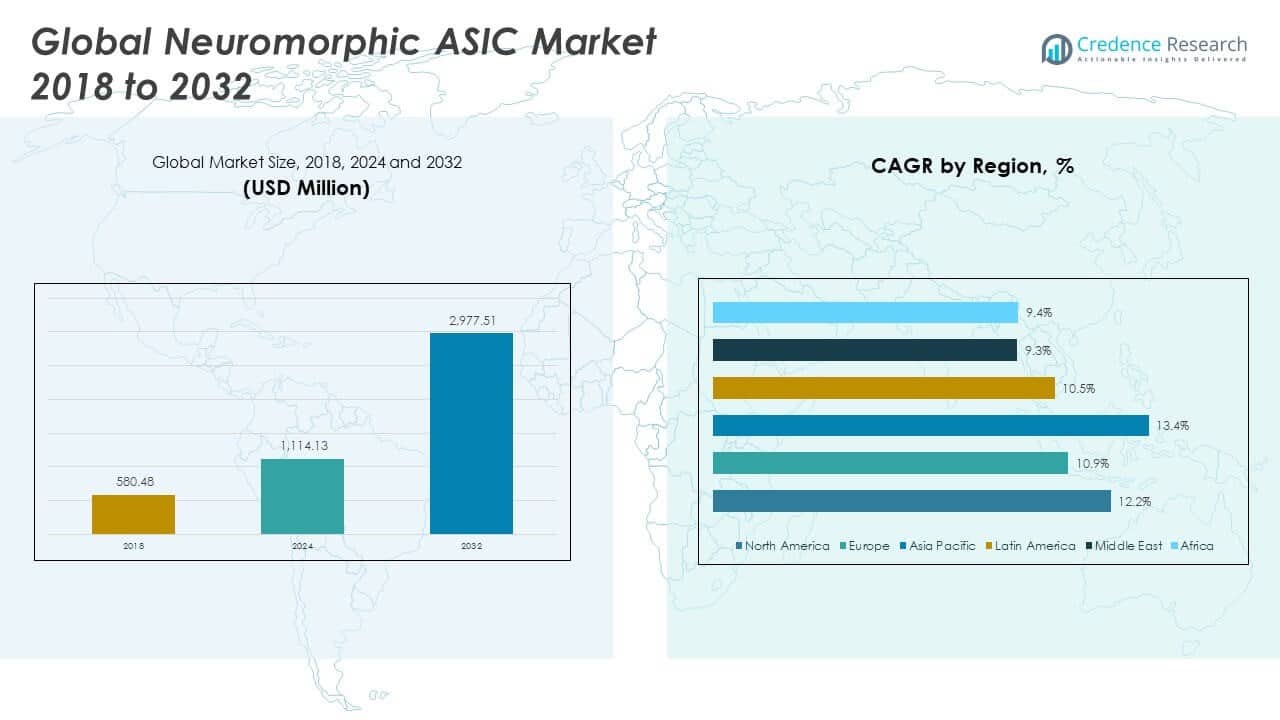
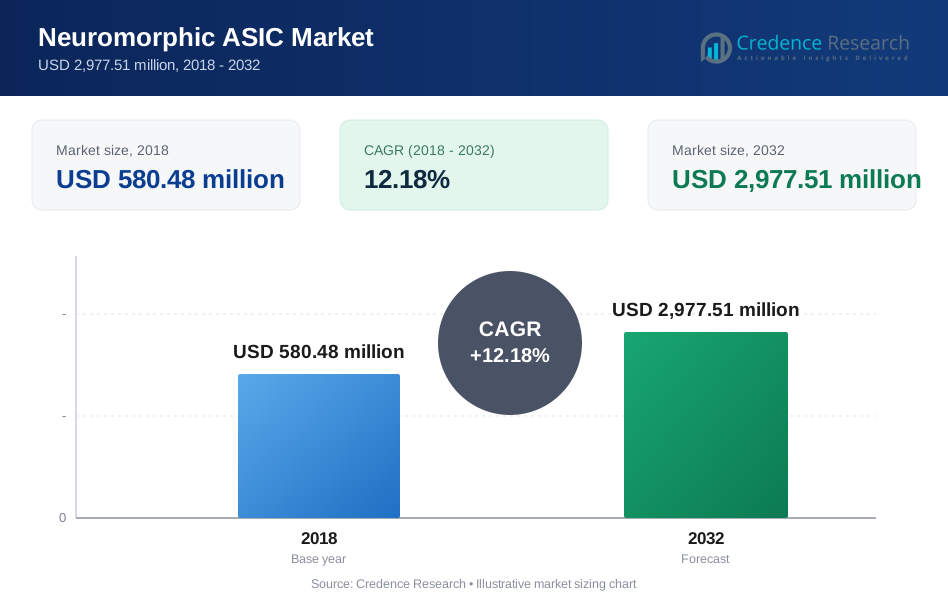
The Global Neuromorphic ASIC Market size was valued at USD 580.48 million in 2018 to USD 1,114.13 million in 2024 and is anticipated to reach USD 2,977.51 million by 2032, at a CAGR of 12.18% during the forecast period.
| REPORT ATTRIBUTE | DETAILS |
|---|---|
| Historical Period | 2020-2024 |
| Base Year | 2024 |
| Forecast Period | 2025-2032 |
| Neuromorphic ASIC Market Size 2024 | USD 1,114.13 Million |
| Neuromorphic ASIC Market, CAGR | 12.18% |
| Neuromorphic ASIC Market Size 2032 | USD 2,977.51 Million |
Neuromorphic ASICs are gaining traction due to their ability to mimic human brain function, enabling faster data processing, lower energy consumption, and enhanced real-time decision-making. The growing demand for edge AI, brain-inspired computing, and low-power hardware across sectors such as automotive, healthcare, and consumer electronics is driving growth. Companies are increasingly integrating neuromorphic solutions into IoT devices, robotics, and smart sensors, fostering market expansion. Rapid digital transformation and the proliferation of smart infrastructure amplify this momentum.
North America holds a dominant position in the market, driven by strong R&D investments and early adoption of neuromorphic technologies. Asia Pacific is expected to register the fastest growth due to rising investments in AI infrastructure, especially in countries like China, Japan, and South Korea. Europe also remains a key region supported by academic research and industrial collaboration in neuromorphic chip development. These regions are likely to see increased collaboration between industry and government to scale adoption.
Market Insights:
- The Global Neuromorphic ASIC Market size was valued at USD 580.48 million in 2018 to USD 1,114.13 million in 2024 and is anticipated to reach USD 2,977.51 million by 2032, at a CAGR of 12.18% during the forecast period.
- Rising demand for edge AI and cognitive computing is accelerating the adoption of neuromorphic chips.
- North America dominates the market due to early R&D investments, while APAC is growing at the fastest pace.
- Robotics and autonomous vehicles are key application areas driving commercialization.
- Energy efficiency and low-latency performance are key value propositions of neuromorphic hardware.
- Market participants face challenges related to high design costs and ecosystem immaturity.
- Collaborations between industry and academia are fostering breakthroughs in neuromorphic architecture.
Market Drivers:
Edge AI Integration
The rising demand for real-time processing at the edge is driving the adoption of neuromorphic chips. Devices like smart cameras and wearables need ultra-efficient hardware that can infer and respond quickly without cloud reliance. The Global Neuromorphic ASIC Market addresses this by offering brain-inspired processors that minimize latency and power usage. These chips enable cognitive capabilities in compact, energy-constrained environments. Applications in autonomous vehicles, IoT, and healthcare are rapidly expanding. The combination of edge AI software and neuromorphic hardware is propelling market penetration across sectors.
- For example, BrainChip’s Akida neuromorphic chip delivers standout technical metrics for edge AI. Akida’s architecture enables real-time inference and one-shot learning, consuming just 1-10 milliwatts in typical edge tasks up to 1000x less than traditional solutions. The chip can process raw sensor data directly, achieving low latency suitable for applications such as smart cameras and wearable health devices.
Advancements in Robotics
Neuromorphic ASICs are playing a pivotal role in the evolution of robotics by enabling real-time learning and decision-making. Robots equipped with these chips can interpret sensory data efficiently and react autonomously in changing environments. The Global Neuromorphic ASIC Market supports industrial, service, and medical robots seeking low-latency intelligence. Robotics firms are moving away from rigid, rule-based systems toward adaptive platforms powered by neuromorphic hardware. These chips help reduce energy use while boosting responsiveness. The shift toward intelligent autonomy is fueling investment in neuromorphic-enabled robotics.
- For example, the Loihi platform’s brain-inspired architecture allows robots to learn and adapt in real time. For industrial robots, Loihi has facilitated closed-loop adaptive control at 300 microsecond cycle times, with system power consumption as low as 60 milliwatts for complex feedback-driven tasks.
Low Power AI Demand
Industries face increasing pressure to reduce power consumption in AI applications without sacrificing performance. The Global Neuromorphic ASIC Market provides a solution with chips that activate only when needed, mimicking how neurons operate. This approach significantly reduces energy demands in devices like wearables, sensors, and embedded AI systems. Demand is growing across sectors prioritizing sustainability, including defense and telecom. Neuromorphic designs are ideal for environments where battery life, heat, and cost efficiency are critical. Their growing relevance reflects the need for green and scalable AI solutions.
Innovation in Cognitive AI
As AI systems evolve, there is a clear shift toward hardware that supports learning and contextual awareness. The Global Neuromorphic ASIC Market delivers on this need by enabling online learning and flexible decision-making. These chips help machines process sensory input and adapt behavior in real-time. Industries are using them in areas such as autonomous navigation, personalized interfaces, and diagnostics. Unlike traditional hardware, neuromorphic ASICs can handle dynamic tasks with minimal retraining. Their role is expanding as AI moves closer to human-like cognition in machines.
Market Trends:
Integration in Smart Devices
Neuromorphic ASICs are increasingly integrated into smart devices to support real-time sensory processing and adaptive learning. These chips allow smartphones, smart home systems, and AR/VR headsets to interpret data with improved accuracy and reduced energy usage. Their ability to process visual and audio inputs locally makes them ideal for next-gen consumer electronics. As companies prioritize user-centric AI, the use of neuromorphic computing in intuitive smart interfaces is accelerating, redefining.
Adoption in Autonomous MobilityThe automotive sector is embracing neuromorphic ASICs to enhance autonomous driving capabilities. These chips excel in pattern recognition and decision-making under uncertainty, aligning with the needs of self-driving systems. Automakers and suppliers are collaborating with chipmakers to deploy neuromorphic solutions in ADAS, LiDAR interpretation, and in-vehicle infotainment. The focus on safety, latency, and power efficiency makes this trend critical to long-term vehicle innovation.
- For example, Mercedes-Benz is collaborating with Intel to integrate the Loihi 2 chip in automotive radar. The Naomi4radar project cites preliminary tests where Loihi 2-based event-driven radar systems reduce energy consumption for sensor data processing by up to 90% compared to traditional digital approaches, with sub-5ms system response times for dynamic obstacle detection
Expansion into Industrial Automation
Industries are leveraging neuromorphic computing to enable intelligent automation in manufacturing and logistics. Neuromorphic ASICs offer real-time decision-making for robots, predictive maintenance systems, and intelligent vision solutions. Their efficiency enables deployment in environments with strict power budgets. As factories become smarter and demand grows for flexible automation, this trend is shaping the evolution of Industry 4.0.
Growth of AI Research EcosystemThe research community plays a key role in advancing neuromorphic ASIC design. Universities, startups, and labs are developing spiking neural network models and novel chip architectures. Initiatives like DARPA’s SyNAPSE and EU’s Human Brain Project contribute to knowledge sharing and innovation. The growing collaboration between academia and industry continues to spur breakthroughs and set the stage for broader commercialization.
- For instance, IBM’s TrueNorth (product of DARPA SyNAPSE) delivers 1 million neurons and 256 million synapses, operating on 70mW, and is accessible to academic and industrial partners for co-development of new spiking neural applications ranging from real-time language translation to adaptive robotics.
Market Challenges Analysis:
High Development Costs and Commercialization Barriers
The Global Neuromorphic ASIC Market faces significant challenges due to the high costs associated with chip development and fabrication. Designing neuromorphic architectures requires advanced manufacturing processes, specialized engineering expertise, and long development cycles. These factors limit participation to well-funded companies and research institutions, making it difficult for new entrants to compete. Commercialization is also hindered by low initial volumes, which prevent economies of scale and keep per-unit costs high. Limited compatibility with existing digital infrastructure slows deployment across industries. The complexity of integrating neuromorphic systems with traditional processors further increases adoption costs and technical risks.
Lack of Standardization and Software Ecosystem
The absence of standardized architectures and mature software support remains a major barrier in the Global Neuromorphic ASIC Market. Unlike conventional AI hardware, neuromorphic chips rely on event-driven computation and spiking neural networks, which are not widely supported by mainstream development tools. Developers face a steep learning curve due to fragmented toolchains and limited simulation platforms. This restricts innovation, slows application development, and reduces confidence among system integrators. Lack of interoperability between different neuromorphic solutions also affects scalability. Without a robust ecosystem, users are less likely to invest in custom solutions with uncertain long-term support. Standardization efforts are underway but progress remains gradual.
Market Opportunities:
IoT Expansion and Edge Intelligence
The proliferation of connected devices presents a significant opportunity for neuromorphic ASIC integration. Their ultra-low power consumption and real-time learning capabilities suit edge AI scenarios in smart homes, agriculture, and logistics. As IoT grows, demand for context-aware, self-learning chips is rising. Neuromorphic ASICs can empower devices to process and act on data locally, reducing reliance on cloud infrastructure and improving responsiveness. This shift is crucial for latency-sensitive applications where immediate decision-making is vital, such as autonomous vehicles and wearable health monitors.
Defense and Aerospace Applications
Advanced defense systems are exploring neuromorphic ASICs for cognitive surveillance, autonomous drones, and sensory fusion. Their fast response and pattern detection make them valuable in mission-critical operations. Aerospace applications benefit from the chips’ resilience and adaptability in challenging environments. Governments and defense agencies are investing in neuromorphic R&D, opening new avenues for chipmakers and defense integrators. Additionally, the ability of neuromorphic systems to function efficiently in extreme thermal and radiation conditions enhances their utility in satellite and high-altitude defense systems.
Market Segmentation Analysis:
By Technology
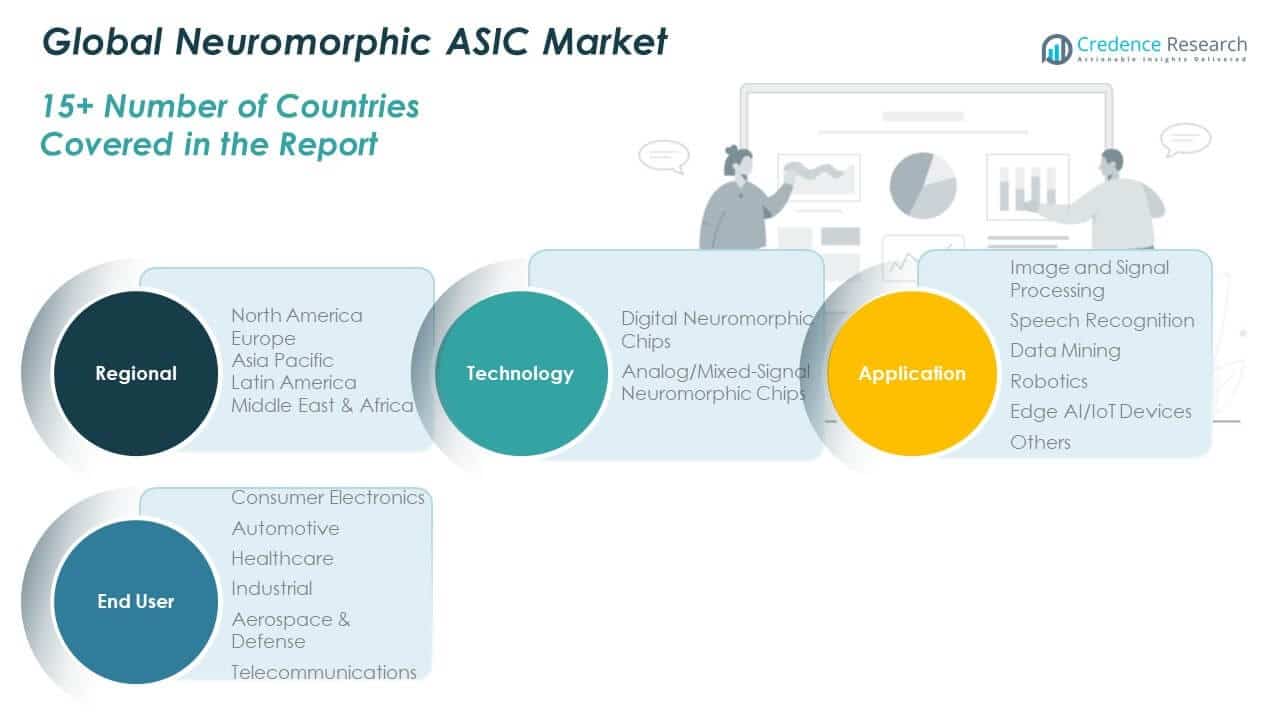
The Neuromorphic ASIC Market includes Digital Neuromorphic Chips and Analog/Mixed-Signal Neuromorphic Chips. Digital chips offer compatibility with conventional computing systems and are easier to scale using current semiconductor fabrication technologies. Analog and mixed-signal chips, meanwhile, excel in mimicking biological neurons with superior energy efficiency and real-time performance. Each technology serves distinct needs in applications ranging from industrial automation to defense. Neuromorphic ASIC solutions based on analog models are gaining traction in power-constrained environments such as mobile and IoT platforms.
- For example, in smart cameras, Akida enables always-on object detection with year-long battery life, as demonstrated in BrainChip’s case studies and technical briefs.
By Application
Neuromorphic ASICs are used in diverse applications such as Image and Signal Processing, Speech Recognition, Data Mining, Robotics, Edge AI/IoT Devices, and others. In imaging and signal processing, these chips enable faster and more contextual interpretation of real-time data streams. Robotics benefits from rapid learning and decision-making capabilities that are difficult to achieve using conventional hardware. Edge AI devices use Neuromorphic ASICs to process sensory inputs without relying on cloud connectivity. The wide application spectrum demonstrates their role in enabling intelligent systems across verticals.
- For example, Prophesee’s neuromorphic vision sensors, paired with Sony’s IMX500 stacked CMOS image sensor, process visual data at up to 10,000 frames per second with ultra-low latency. These sensors detect changes in the scene (event-based vision), enabling real-time object tracking and gesture recognition while consuming less than 3 milliwatts—orders of magnitude less than conventional frame-based cameras.
By End User
End users of Neuromorphic ASIC solutions span across Consumer Electronics, Automotive, Healthcare, Industrial, Aerospace & Defense, and Telecommunications sectors. In consumer electronics, they power features like gesture recognition and voice interfaces. The automotive industry employs neuromorphic chips in autonomous driving and driver assistance systems. Healthcare uses include patient monitoring and adaptive prosthetics, while defense relies on them for sensory fusion in mission-critical environments. Telecommunications integrates these chips for adaptive network optimization and edge inference.
Segmentation:
By Technology:
- Digital Neuromorphic Chips
- Analog/Mixed-Signal Neuromorphic Chips
By Application:
- Image and Signal Processing
- Speech Recognition
- Data Mining
- Robotics
- Edge AI/IoT Devices
- Others
By End User:
- Consumer Electronics
- Automotive
- Healthcare
- Industrial
- Aerospace & Defense
- Telecommunications
Regional Analysis:
North America
The North America Global Neuromorphic ASIC Market size was valued at USD 248.06 million in 2018 to USD 471.06 million in 2024 and is anticipated to reach USD 1,262.49 million by 2032, at a CAGR of 12.2% during the forecast period. The region leads due to early investments in neuromorphic R&D, high technology adoption rates, and a strong presence of key players such as Intel and IBM. Growth is driven by the integration of neuromorphic processors in defense systems, autonomous vehicles, and edge AI platforms. Strategic government funding and university-industry collaborations further strengthen the innovation ecosystem. The North America Global Neuromorphic ASIC Market accounted for 36.4% of the global market in 2024.
Europe
The Europe Global Neuromorphic ASIC Market size was valued at USD 113.97 million in 2018 to USD 207.35 million in 2024 and is anticipated to reach USD 506.51 million by 2032, at a CAGR of 10.9% during the forecast period. Europe benefits from strong academic research in neuromorphic computing, particularly in Germany, France, and the UK. Companies are integrating these chips in industrial robotics, medical imaging, and smart automation systems. EU-funded projects continue to support long-term chip innovation. The Europe Global Neuromorphic ASIC Market represented 16.0% of the global market in 2024.
Asia Pacific
The Asia Pacific Global Neuromorphic ASIC Market size was valued at USD 166.21 million in 2018 to USD 337.00 million in 2024 and is anticipated to reach USD 982.92 million by 2032, at a CAGR of 13.4% during the forecast period. The region is experiencing rapid expansion due to large-scale AI initiatives, especially in China, Japan, South Korea, and India. Demand is growing across smart manufacturing, surveillance, and consumer electronics. Companies in this region are investing in edge-based neuromorphic solutions for mobile and embedded devices. The Asia Pacific Global Neuromorphic ASIC Market held a 26.0% share of the global market in 2024.
Latin America
The Latin America Global Neuromorphic ASIC Market size was valued at USD 28.00 million in 2018 to USD 53.08 million in 2024 and is anticipated to reach USD 125.91 million by 2032, at a CAGR of 10.5% during the forecast period. Adoption is being driven by emerging applications in smart cities, transportation infrastructure, and public safety systems. Brazil and Mexico are leading investment in neuromorphic technologies through public-private initiatives. The Latin America Global Neuromorphic ASIC Market contributed 4.1% to the global market in 2024.
Middle East
The Middle East Global Neuromorphic ASIC Market size was valued at USD 14.07 million in 2018 to USD 24.32 million in 2024 and is anticipated to reach USD 53.08 million by 2032, at a CAGR of 9.3% during the forecast period. Demand is emerging from smart defense systems, surveillance, and edge AI in energy management. Countries like the UAE and Saudi Arabia are advancing AI strategies that include next-gen hardware platforms. The Middle East Global Neuromorphic ASIC Market captured 1.9% of the global share in 2024.
Africa
The Africa Global Neuromorphic ASIC Market size was valued at USD 10.16 million in 2018 to USD 21.31 million in 2024 and is anticipated to reach USD 46.59 million by 2032, at a CAGR of 9.4% during the forecast period. Growth is being observed in education, healthcare innovation, and agriculture digitization. Governments and institutions are exploring neuromorphic applications for energy efficiency and AI access in rural settings. The Africa Global Neuromorphic ASIC Market accounted for 1.6% of the global share in 2024.
Key Player Analysis:
- IBM Corporation
- Intel Corporation
- BrainChip Holdings Ltd.
- Qualcomm
- General Vision
- Samsung Electronics
- HRL Laboratories
- SynSense (formerly aiCTX)
- Innatera Nanosystems
Competitive Analysis:
The Global Neuromorphic ASIC Market is moderately consolidated, with leading players driving innovation through proprietary technologies and strategic collaborations. Key companies such as IBM, Intel, BrainChip Holdings, and Qualcomm hold significant positions owing to their early investments in neuromorphic architectures and research alliances. These firms focus on spiking neural networks and event-driven processing models that differentiate their products from traditional AI accelerators. Strategic initiatives include the launch of advanced neuromorphic processors, partnerships with academic institutions, and expansion into high-growth regions like Asia Pacific. The evolving regulatory environment and rising demand for explainable, real-time AI further influence strategy formulation. The Global Neuromorphic ASIC Market is expected to witness increased competition as new entrants seek to commercialize academic breakthroughs and established players broaden their application footprint across automotive, defense, consumer electronics, and healthcare sectors.
Recent Developments:
- In March 2025, BrainChip Holdings Ltd. announced a strategic partnership with Information Systems Laboratories, Inc. to jointly develop and promote neuromorphic radar research solutions powered by BrainChip’s Akida™ event-driven neural processor.
- In April 2025, BrainChip Holdings Ltd. partnered with Raytheon Company (an RTX subsidiary) after securing a $1.8 million contract from the U.S. Air Force Research Laboratory. This partnership focuses on mapping complex sensor signal processing—especially micro-Doppler radar signature analysis—onto neuromorphic chips, underscoring Akida’s suitability for high-performance, energy-efficient defense applications
Market Concentration & Characteristics:
The Neuromorphic ASIC Market is moderately concentrated, with a few key players such as Intel, IBM, and BrainChip leading development through proprietary chip designs and collaborative innovation. These companies invest heavily in R&D to maintain a technological edge and drive early adoption across automotive, defense, and consumer electronics. The market is characterized by high entry barriers due to complex fabrication processes, limited standardization, and the need for specialized software ecosystems. Innovation centers on spiking neural networks and low-power, event-driven computation models that differentiate neuromorphic ASICs from traditional processors. Strategic partnerships with academic institutions and government agencies further define the competitive landscape. The market remains in a nascent yet dynamic phase, where product differentiation and application-specific integration play a critical role in shaping long-term growth.
Future Outlook:
- The Global Neuromorphic ASIC Market will witness rapid acceleration as industries prioritize energy-efficient AI hardware for real-time processing and edge deployment.
- Increased funding in neuroscience-inspired computing will lead to advanced chip architectures that mimic brain synapses more accurately and operate at ultra-low power.
- Expansion of autonomous vehicles and robotic systems will create demand for Neuromorphic ASICs that can process complex sensory inputs with low latency and high adaptability.
- Cross-disciplinary collaborations between semiconductor firms and AI research labs will accelerate innovation in spiking neural networks and event-based computation.
- Asia Pacific is expected to outpace other regions in market growth, driven by government-backed AI initiatives and rapid infrastructure digitization.
- As AI moves into mission-critical and wearable applications, the reliability and fault tolerance of neuromorphic chips will become a major differentiator.
- Development of comprehensive neuromorphic software toolchains will lower entry barriers for developers and unlock wider adoption across industries.
- Healthcare will emerge as a high-potential sector as neuromorphic processors enable real-time analysis in diagnostic imaging and neuroprosthetics.
- Defense agencies will increasingly invest in neuromorphic technology for surveillance drones, situational awareness systems, and unmanned navigation.
- The rise of AIoT ecosystems will reinforce the relevance of Neuromorphic ASICs in supporting smart, adaptive, and decentralized decision-making at the edge.
Report Coverage:
The research report offers an in-depth analysis based on Technology, Application and End User. It details leading market players, providing an overview of their business, product offerings, investments, revenue streams, and key applications. Additionally, the report includes insights into the competitive environment, SWOT analysis, current market trends, as well as the primary drivers and constraints. Furthermore, it discusses various factors that have driven market expansion in recent years. The report also explores market dynamics, regulatory scenarios, and technological advancements that are shaping the industry. It assesses the impact of external factors and global economic changes on market growth. Lastly, it provides strategic recommendations for new entrants and established companies to navigate the complexities of the market.
Request a Free Sample
Fill in your details and we'll send you a free sample report.
- Sample data tables & charts
- Research methodology
Need a Custom Version of This Report?
Tailor the scope, geography, or segments to your exact requirements.
- Custom geography or segment scope
- Direct access to our analyst team
Frequently Asked Questions
What is the current size of the Global Neuromorphic ASIC Market?
What factors are driving the growth of the Global Neuromorphic ASIC Market?
What are the key segments within the Global Neuromorphic ASIC Market?
What are some challenges faced by the Global Neuromorphic ASIC Market?
Table of Content
Chapter 1. Report Introduction
- 1.1 Report Description & Purpose
- 1.1.1 Report Title & Market Definition
- 1.1.2 Unique Selling Propositions (USP) & Key Differentiators
- 1.1.3 Value Proposition for Stakeholders
- 1.2 Research Objectives
- 1.2.1 Market Sizing Objectives (Volume & Revenue)
- 1.2.2 Segmentation Objectives
- 1.2.3 Competitive Intelligence Objectives
- 1.2.4 Forecast & Scenario Objectives
- 1.3 Report Scope
- 1.3.1 Neuromorphic ASIC Scope – Types & Subtypes Covered
- 1.3.2 Geographic Scope – Regions & Countries Covered
- 1.3.3 Historical Period, Base Year & Forecast Period (2018; forecast to 2032)
- 1.3.4 Inclusions & Exclusions
- 1.4 HS Code & Classification Framework
- 1.5 Currency, Units & Pricing Basis
- 1.6 Target Stakeholders
- 1.7 Limitations & Assumptions
Chapter 2. Executive Summary
- 2.1 Global Neuromorphic ASIC Market Snapshot
- 2.1.1 Market Size – Historical (2018) & Forecast (2018-2032) (2018: USD 580.48 million → 2032: USD 2,977.51 million)
- 2.1.2 Volume & Revenue – Global Totals
- 2.1.3 Key Market Highlights – Top Five Facts
- 2.2 Neuromorphic ASIC Market Segmentation Snapshot
- 2.2.1 Market Split by Region – 2018 vs. 2032
- 2.3 Competitive Snapshot
- 2.3.1 Top 10 Players by Revenue Share – 2018
- 2.3.2 Top 10 Players by Volume Share – 2018
- 2.3.3 Recent Strategic Developments (18-Month Summary)
- 2.4 Key Investment Highlights & Strategic Conclusions
Chapter 3. Neuromorphic ASIC Market Dynamics & Industry Analysis
- 3.1 Market Overview & Context
- 3.1.1 Neuromorphic ASIC Market Position in the Broader Automotive Value Chain
- 3.1.2 OEM vs. Replacement Market Dynamics
- 3.1.3 Market Maturity & Development Stage by Region
- 3.2 Neuromorphic ASIC Market Drivers
- 3.3 Neuromorphic ASIC Market Restraints & Challenges
- 3.4 Neuromorphic ASIC Market Opportunities
- 3.5 Porter's Five Forces Analysis
- 3.5.1 Threat of New Entrants
- 3.5.2 Bargaining Power of Suppliers
- 3.5.3 Bargaining Power of Buyers
- 3.5.4 Threat of Substitutes
- 3.5.5 Competitive Rivalry – Intensity Assessment
- 3.6 Neuromorphic ASIC Value Chain Analysis
- 3.6.1 Upstream – Raw Material/Input Suppliers
- 3.6.1.1 Raw Material/Input 1
- 3.6.1.2 Raw Material/Input 2
- 3.6.1.3 Raw Material/Input 3
- 3.6.2 Midstream – Production/Manufacturing/Service Delivery
- 3.6.2.1 Production/Process Overview
- 3.6.2.2 Key Facility Locations & Capacity by Manufacturer
- 3.6.3 Downstream – Distribution & End Consumer
- 3.6.3.1 Primary Channel – B2B/OEM
- 3.6.3.2 Secondary Channels – Dealer, Retail, Online, Direct
- 3.6.4 Value Chain Profitability Analysis
- 3.6.1 Upstream – Raw Material/Input Suppliers
- 3.7 PESTEL Analysis
- 3.7.1 Political Factors
- 3.7.2 Economic Factors
- 3.7.3 Social Factors
- 3.7.4 Technological Factors
- 3.7.5 Environmental Factors
- 3.7.6 Legal Factors
- 3.8 Neuromorphic ASIC Supply Chain Analysis
- 3.8.1 Raw Material/Input Supply Risk Assessment
- 3.8.2 Manufacturing Concentration Risk (Geographic Exposure)
- 3.8.3 Trade Disruption Impact Analysis
- 3.9 Regulatory & Policy Landscape
Note: The regulatory and policy landscape section covers regulations based on their applicability to the market, Neuromorphic ASIC category, geography, and scope of the study. Only regulatory frameworks with a material impact on operations, compliance, trade, sustainability, or market access are analyzed in detail.
Chapter 4. Key Investment Pockets & Opportunity Analysis
- 4.1 Neuromorphic ASIC Market Attractiveness Analysis
- 4.1.1 By Region – Investment Attractiveness Matrix (Volume × CAGR)
- 4.2 Absolute Revenue Growth Opportunity
- 4.2.1 By Region – Absolute USD Growth Through 2032
- 4.3 Incremental Volume Opportunity
- 4.3.1 By Region – Incremental Volume Through 2032
- 4.3.2 Segment – Incremental Volume
- 4.4 Emerging Submarket Opportunity Deep Dive (Subject to Applicability)
- 4.5 Emerging Market Opportunity Scorecards
- 4.5.1 United States
- 4.5.2 Europe
- 4.5.3 Asia
- 4.5.4 Middle East & Africa
Note: Emerging Market Opportunity Scorecards will be included based on relevance and strategic importance. Regions listed are indicative and may vary depending on data availability and market dynamics.
Chapter 5. Neuromorphic ASIC Import-Export Analysis & Trade Flows
- 5.1 Global Trade Overview
- 5.1.1 Global Export Value by Country (2018)
- 5.1.2 Global Export Volume by Country (2018)
- 5.1.3 Global Import Value by Country (2018)
- 5.1.4 Global Import Volume by Country (2018)
- 5.1.5 Net Trade Balance by Country (2018)
- 5.2 Export Analysis – Segment
- 5.2.1 Type 1 (HS Code)
- 5.2.2 Type 2 (HS Code)
- 5.2.3 Type 3 (HS Code)
- 5.2.4 Type 4 (HS Code)
- 5.2.5 Type 5 (HS Code)
- 5.3 Import Analysis – Segment
- 5.3.1 Type 1 (HS Code)
- 5.3.2 Type 2 (HS Code)
- 5.3.3 Type 3 (HS Code)
- 5.3.4 Type 4 (HS Code)
- 5.3.5 Type 5 (HS Code)
- 5.4 Average Unit Trade Prices
- 5.4.1 Average Export Price – Segment & Country
- 5.4.2 Average Import Price – Segment & Source Country
- 5.4.3 Price Trends (2018)
- 5.5 Key Trade Route Analysis
- 5.5.1 Trade Route 1
- 5.5.2 Trade Route 2
- 5.5.3 Trade Route 3
- 5.5.4 Trade Route 4
- 5.5.5 Trade Route 5
- 5.6 Trade Policy Impact Assessment
- 5.6.1 US Anti-Dumping & Section 301 Tariffs
- 5.6.2 EU Customs Union Impact
- 5.6.3 Major Free Trade Agreements
- 5.6.4 USMCA Rules of Origin
Note: Trade policy analysis will be included only where relevant to the Neuromorphic ASIC market.
Chapter 6. Competitive Landscape & Company Benchmarking
- 6.1 Neuromorphic ASIC Market Concentration & Structure
- 6.1.1 Herfindahl-Hirschman Index (HHI) – vs. 2018
- 6.1.2 Tier 1, Tier 2 & Tier 3 Market Structure
- 6.1.3 Global, Regional & Local Player Dynamics
- 6.2 Neuromorphic ASIC Market Share Analysis – 2018
- 6.2.1 Global Revenue Share by Company
- 6.2.2 Global Volume Share by Company
- 6.2.3 Regional Revenue Share
- 6.2.4 Market Share Evolution ( vs. 2018)
- 6.2.5 OEM Segment Share by Company
- 6.2.6 Replacement Segment Share by Company
- 6.3 Production/Delivery Capacity & Facility Analysis
- 6.3.1 Global Installed Capacity
- 6.3.2 Capacity Utilization Rates
- 6.3.3 Production/Output Volume
- 6.3.4 Facility Locations & Capacity Map
- 6.3.5 Planned Capacity Additions
- 6.4 Neuromorphic ASIC Competitive Benchmarking Matrix
- 6.4.1 Revenue, Volume, CAGR & Profitability Comparison
- 6.4.2 Channel Revenue Mix
- 6.4.3 Geographic Revenue Exposure
- 6.4.4 R&D Intensity
- 6.4.5 Sustainability Maturity
- 6.5 Strategic Developments in Neuromorphic ASIC (Last 24 Months)
- 6.5.1 Mergers, Acquisitions & Divestments
- 6.5.2 New Neuromorphic ASIC Launches
- 6.5.3 Facility Expansions
- 6.5.4 Strategic Alliances, Joint Ventures & Partnerships
- 6.5.5 Distribution Expansion & Market Entry
- 6.5.6 Sustainability & ESG Initiatives
- 6.6 Competitive Strategy Mapping
- 6.6.1 Leader, Challenger, Follower & Niche Classification
- 6.6.2 Pricing Strategy Comparison
- 6.6.3 Channel Strategy Matrix
Note: Strategic developments are included based on their materiality and the availability of reliable information.
Chapter 7. Global Neuromorphic ASIC Market – By Distribution Channel
- 7.1 Segment Overview
- 7.1.1 Volume & Revenue Split by Channel (2018 & 2032)
- 7.1.2 Channel Mix Evolution (2018-2032)
Chapter 8. Regional Market Analysis – Global Overview
- 8.1 Global Regional Overview
- 8.1.1 Regional Volume Share
- 8.1.2 Regional Revenue Share
- 8.1.3 Regional Volume by Region
- 8.1.4 Regional Revenue by Region
- 8.1.5 Regional Forecast Through 2032
- 8.2 Cross-Regional Segment Analysis
- 8.2.1 By Distribution Channel
- 8.2.2 By Brand/Price Tier
Chapter 9. North America Neuromorphic ASIC Market
- 9.1 United States
- 9.2 Canada
- 9.3 Mexico
Chapter 10. Europe Neuromorphic ASIC Market
- 10.1 Germany
- 10.2 France
- 10.3 Italy
- 10.4 United Kingdom
- 10.5 Spain
- 10.6 Poland
- 10.7 Russia
- 10.8 Netherlands
- 10.9 Belgium
- 10.10 Sweden
- 10.11 Denmark
- 10.12 Norway
- 10.13 Rest of Europe
Chapter 11. Asia Pacific Neuromorphic ASIC Market
- 11.1 China
- 11.2 India
- 11.3 Japan
- 11.4 South Korea
- 11.5 Thailand
- 11.6 Indonesia
- 11.7 Vietnam
- 11.8 Malaysia
- 11.9 Australia
- 11.10 Rest of Asia Pacific
Chapter 12. Latin America Neuromorphic ASIC Market
- 12.1 Brazil
- 12.2 Argentina
- 12.3 Colombia
- 12.4 Chile
- 12.5 Rest of Latin America
Chapter 13. Middle East Neuromorphic ASIC Market
- 13.1 Saudi Arabia
- 13.2 United Arab Emirates
- 13.3 Turkey
- 13.4 Israel
- 13.5 Iran
- 13.6 Rest of the Middle East
Chapter 14. Africa Neuromorphic ASIC Market
- 14.1 South Africa
- 14.2 Egypt
- 14.3 Nigeria
- 14.4 Morocco
- 14.5 Rest of Africa
Chapter 15. Neuromorphic ASIC Company Profiles
- 15.1 [Company 01]
- 15.1.1 Company Overview
- 15.1.2 Key Management Personnel
- 15.1.3 Products & Services Portfolio
- 15.1.4 Financial Performance
- 15.1.5 Key Market Focus & Geographic Presence
- 15.1.6 Recent Developments & Strategic Initiatives
Note: The company profile list is preliminary and may change based on research findings, market developments, data availability, and client requirements.
Chapter 16. Appendices
- Appendix A – List of Abbreviations & Acronyms
- Appendix B – Industry Classification Code Reference – Full Series
- Appendix C – Production & Capacity Data Tables
- Appendix D – End-Use & Demand Base Tables
- Appendix E – Consumption & Replacement Rate Assumptions
- Appendix F – ASP Reference Tables
- Appendix G – Manufacturing & Facility Database
- Appendix H – Import-Export Data Tables
- Appendix I – Regulatory Summary Tables
- Appendix J – Primary Research Participant List (Anonymized)
- Appendix K – Primary Research Questionnaire Framework
- Appendix L – Data Sources & Bibliography
- Appendix M – Market Size Divergence & Source Comparison
Chapter 17. Research Methodology
- 17.1 Research Framework & Philosophy
- 17.2 Secondary Research – Sources, Hierarchy & Data Extraction
- 17.3 Data Modeling – Bottom-Up & Top-Down Market Sizing
- 17.4 Primary Research – Stakeholder Framework, LOI & Sample Sizes
- 17.5 Forecast Methodology – Regression, Scenario & Sensitivity Analysis
- 17.6 Quality Control – Four-Layer Validation Framework
- 17.7 Limitations & Standard Assumptions
- 17.8 Disclaimer
