
Melt-focused recipes and pizza menus shape buying decisions
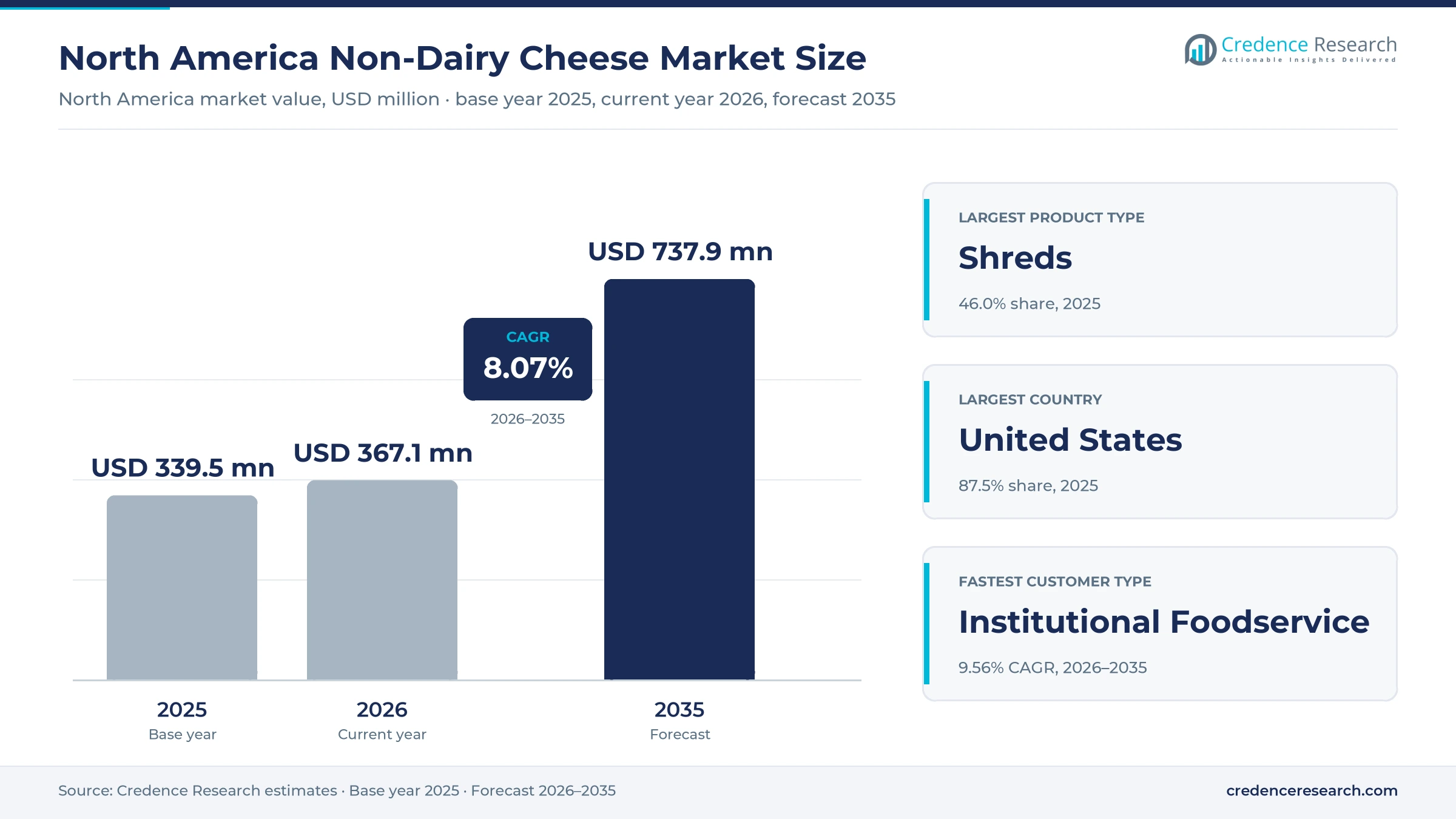
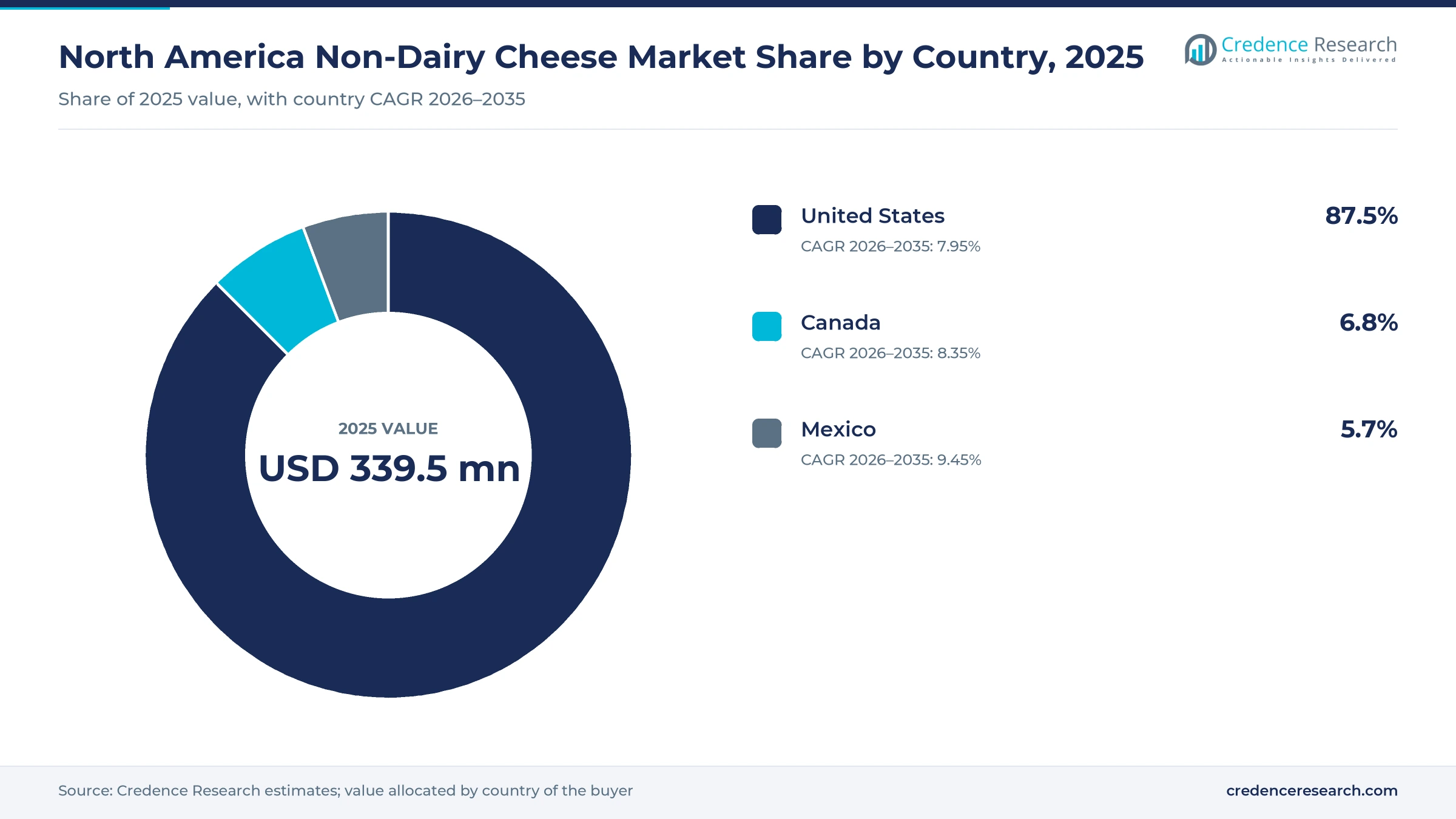
The North America non-dairy cheese market was valued at USD 339.5 million in 2025 and is projected to increase from USD 367.1 million in 2026 to USD 737.9 million by 2035, registering a CAGR of 8.07% during 2026–2035. Demand comes from households avoiding dairy for digestive or allergy reasons and from pizza operators that need a cheese substitute that melts well. United States held the largest country share, 87.5% in 2025, because tracked retail sales and the main brands are concentrated there. Mexico is the fastest-growing country at 9.45% a year, helped by wider retail availability since Violife entered in April 2024. The main commercial change is recipe based, as Daiya moved its range to a fermented oat cream base in December 2023 and carried it into foodservice shreds during May 2024. However, retail sales fell in 2024 and 2025, so the forecast depends on repeat purchases recovering and on restaurant menus adding plant-based options.
What does non-dairy cheese include in North America?
The market counts shreds, slices, blocks, wedges, soft spreads and pourable sauces made without milk, sold in the United States, Canada and Mexico. Households buy mostly through grocery stores, while restaurants and caterers order 5-pound bags and cases through foodservice distributors. Values are measured at manufacturer and brand sales to these channels across retail and foodservice formats.
The scope excludes dairy cheese, lactose-free dairy cheese and frozen meals where the cheese is only one ingredient. The value chain runs from oil, starch and oat or nut suppliers through recipe owners and co-manufacturers to grocery chains, distributors and pizza operators, with brand owners controlling the formulas.
North America Non-Dairy Cheese Market Insights
- The North America non-dairy cheese market rises from USD 339.5 million in 2025 to USD 737.9 million by 2035, an 8.07% CAGR that assumes recovery from a falling retail base.
- The United States held 87.5% of 2025 regional value, while Mexico leads growth at 9.45% a year after Violife entered Mexican retail in April 2024.
- Shreds led product value with 46.0% in 2025, supported by pizza use and by 5-pound Daiya foodservice bags on sale since May 2024.
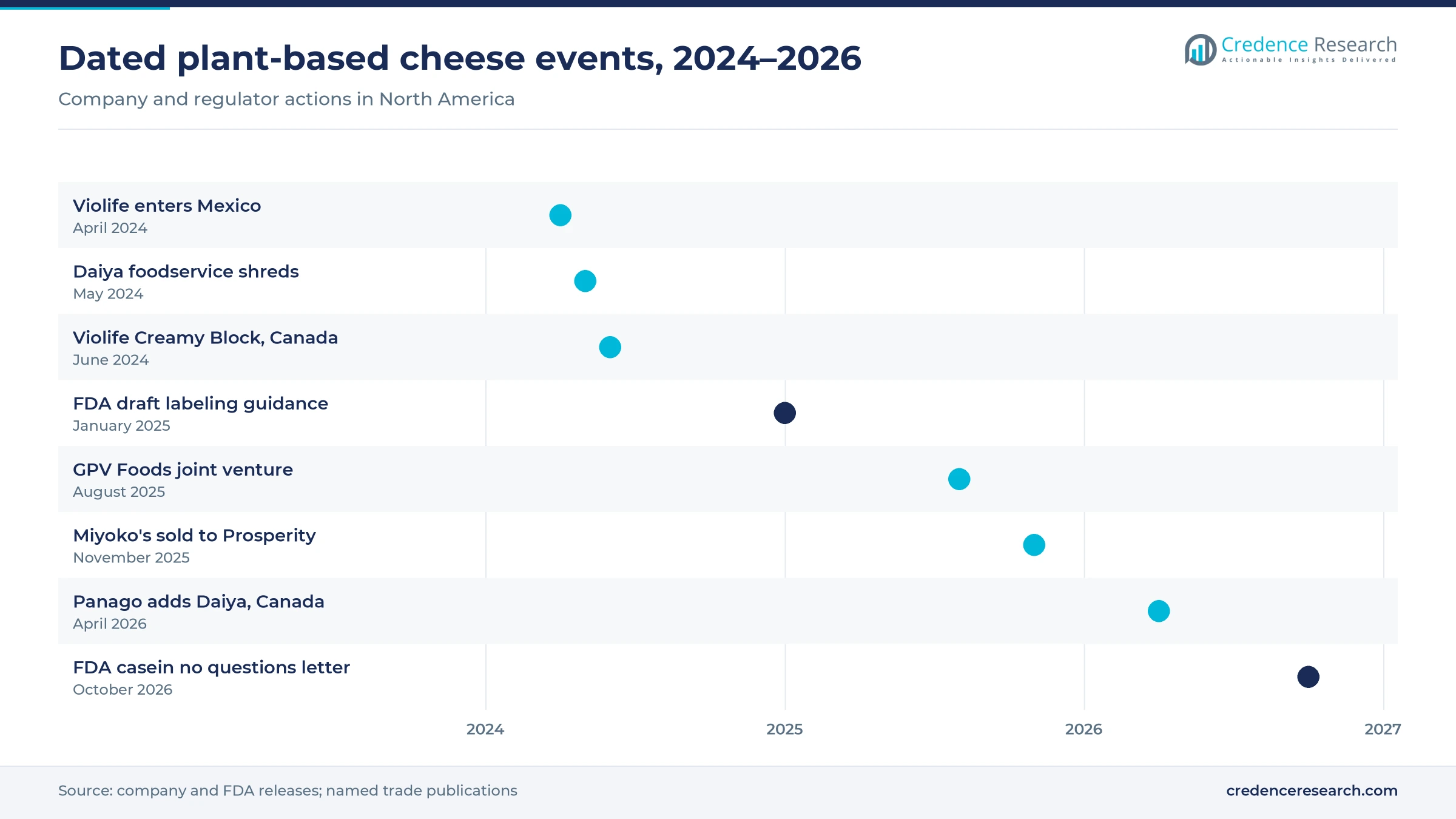
- The FDA issued draft labeling guidance on Jan. 6, 2025, recommending that plant-based cheese names disclose the plant source, such as dairy-free soy-based cheddar cheese.
- Ownership is shifting quickly, as Schuman Cheese and GOOD PLANeT Foods formed GPV Foods in August 2025 and Prosperity Organic Foods bought Miyoko's in November 2025.
Shreds, pizza and grocery lead plant-based cheese value
Why shreds lead and soft formats grow fastest
Based on product type, the market is categorized into shreds, slices, blocks and wedges, and soft and pourable cheese. Shreds led with 46.0% of 2025 value because pizza and hot sandwiches need a format that melts evenly, and Daiya sells mozzarella and cheddar shreds in 5-pound foodservice bags that replace dairy cheese one for one. Soft and Pourable Cheese grows fastest at 8.96% a year, as Violife held a 29.4% dollar share of Canadian dairy-free cream cheese in Nielsen data to January 2025 and Miyoko's cream cheeses were scheduled to return to U.S. shelves in May 2026, according to AgFunderNews.
Pizza sets the performance standard for the category
Based on application, the market is categorized into pizza and baked meals, sandwiches and burgers, snacking and cheeseboards, and cooking and finishing. Pizza and Baked Meals led with 44.0% of 2025 value because chains such as Papa Murphy's, with more than 1,300 locations, offered Violife on all pizzas from May 2022, according to vegconomist, while frozen pizza adds further retail use. Cooking and Finishing grows fastest at 8.79% a year, as Violife launched its Creamy Block for whipping, spreading and baking in Canada in June 2024, and Daiya extended powdered macaroni and cheese to Walmart in April 2024, according to The Plant Base.
Households buy most while institutions add new volume
Based on customer type, the market is categorized into households, restaurants and caterers, and institutional foodservice. Households led with 68.0% of 2025 value because grocery remains the main route to buyers, with Daiya alone sold in more than 25,000 U.S. and Canadian stores, according to the company in May 2025. Institutional Foodservice grows fastest at 9.56% a year, as the Good Food Institute reported expanded 2024 plant-based protein sales to healthcare, business and government operators, and Aramark committed in October 2022 to 44% plant-based residential dining menus at more than 250 campuses by 2025.
Grocery leads as distributors widen foodservice access
Based on distribution channel, the market is categorized into grocery retail, foodservice distribution and direct consumer retail. Grocery Retail led with 66.0% of 2025 value because Save-On-Foods, Longo's and Loblaws banners carried Violife Creamy Block at its Canadian launch in June 2024. Foodservice Distribution grows fastest at 8.93% a year, as Daiya began selling foodservice shreds through major distributors in May 2024 and the GPV Foods venture of August 2025 paired Vevan foodservice experience with GOOD PLANeT grocery placement. Direct consumer retail stays small, since brands such as Nuts For Cheese built reach through Whole Foods and co-ops.
| Segment Group | Leading Sub-segment | Share, 2025 | Fastest-growing Sub-segment | CAGR, 2026–2035 |
|---|---|---|---|---|
| By Product Type | Shreds | 46.0% | Soft and Pourable Cheese | 8.96% |
| By Application | Pizza and Baked Meals | 44.0% | Cooking and Finishing | 8.79% |
| By Customer Type | Households | 68.0% | Institutional Foodservice | 9.56% |
| By Distribution Channel | Grocery Retail | 66.0% | Foodservice Distribution | 8.93% |
Request a Free Sample
Fill in your details and we'll send you a free sample report.
- Sample data tables & charts
- Research methodology
Oat cream recipes and allergy needs lift purchases
Product performance reformulation wins back trial buyers
Recipe improvement is the strongest lever because taste has been the main reason shoppers do not return. A March 2023 Plant Based Foods Association report found that 73% of the most engaged plant-based shoppers in Kroger's 60 million-household customer database wanted better plant-based cheese, citing taste, melt and grainy texture, according to VegNews. Daiya responded with a multimillion-dollar fermentation investment at Burnaby, British Columbia, announced in March 2023, then replaced its chickpea protein base with fermented oat cream that December at the same shelf price. As a result, the company extended that base to Chipotle Cheddar Shreds and Pepper Jack Slices in May 2025. Shreds kept 46.0% of 2025 value, which shows how much of the category rests on that format.
Persistent dairy avoidance gives brands a stable buyer base
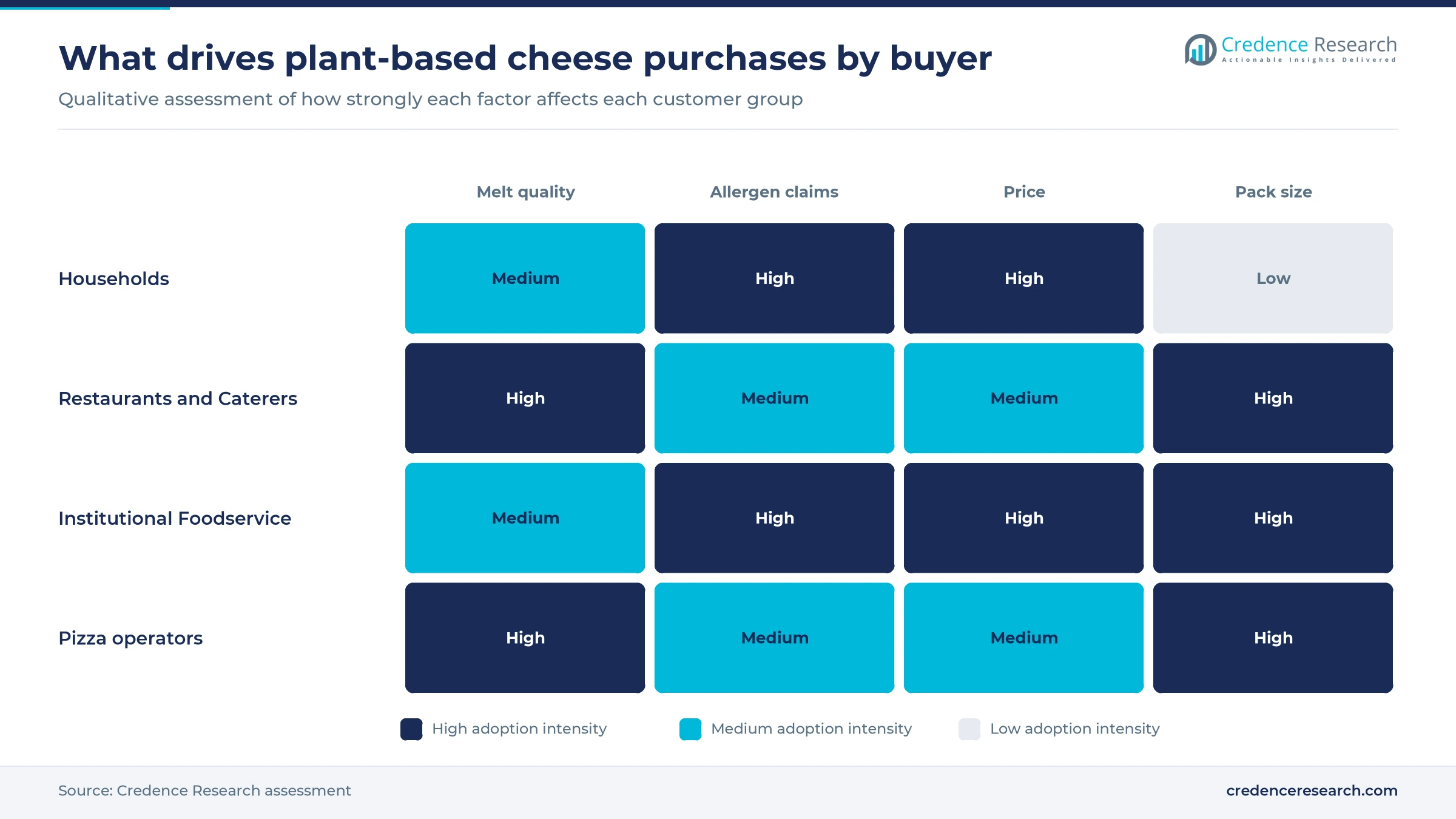
Dairy avoidance gives the category a buyer group that does not depend on food fashion. The National Institute of Diabetes and Digestive and Kidney Diseases states that about 36 percent of people in the United States have lactose malabsorption, and it lists African Americans and Hispanics or Latinos among the groups more likely to have it. In Mexico, a 2020 review in Revista de Gastroenterología de México reported that almost half of adults described discomfort from dairy. Food in Canada reported that Violife recipes are free of nuts, soy, gluten and lactose, which widens use for households managing several allergies. This need supports the 68.0% household share recorded in 2025.
Foodservice application fit opens pizza and catering volume
Foodservice matters because operators buy by the case and introduce the product to diners who would not try it at home. The Good Food Institute reported that 4.5% of U.S. menus carried a plant-based cheese item in 2022, which leaves wide room for additions. Daiya launched 5-pound foodservice shreds for May 2024 and showed them at the International Pizza Expo in Las Vegas, where a plant-based category joined the International Pizza Challenge. Panago said in April 2026 that Daiya cheese was available at no additional cost across its 170 Canadian locations. In turn, Cooking and Finishing grows at 8.79% a year as menu use broadens.
Local plants shorten supply across the continent
Regional manufacturing supports growth because refrigerated cheese alternatives move better from nearby plants, and buyers want dependable supply. Food in Canada reported that Upfield began producing Violife at Brantford, Ontario, in 2021 to supply both Canada and the United States. Daiya announced its fermentation site at Burnaby in March 2023, and the company describes it as the largest dedicated plant-based site of its type on the continent. Follow Your Heart brought Danone a solar-powered Los Angeles facility through the Earth Island purchase announced on Feb. 19, 2021. Schuman Cheese adds 3 Wisconsin production facilities, including capacity dedicated to plant-based products, to the GPV Foods venture announced in August 2025, according to Perishable News. Together, these plants keep supply close to demand from the more than 25,000 stores that Daiya alone reports serving.
Cultured bases, new owners and protein reshape supply
Shift from coconut-only recipes to cultured plant bases
Brands are moving from simple oil and starch recipes toward cultured bases that add flavor before any seasoning is applied. Daiya ferments its oat cream for 10 to 20 hours before further aging, according to research director Jamie Siu, quoted by Green Queen, though coconut oil remains the second listed ingredient. Nuts For Cheese built its range on organic cashews with traditional aging and reported placement in more than 45 U.S. states in April 2022, through Whole Foods and National Co-op Grocers. The shift matters because household penetration fell in 2024, so brands need a recipe that earns a second purchase instead of only a first trial.
Rise of new owners and shared manufacturing platforms
A round of ownership change is moving brands onto shared production. Miyoko's Creamery entered an assignment for the benefit of creditors in 2025, and Prosperity Organic Foods won the brand over a bid from its founder, according to vegconomist in November 2025. AgFunderNews reported in April 2026 that production moved to co-manufacturers already serving Melt Organic, with a Canadian launch planned. Schuman Cheese and GOOD PLANeT Foods combined retail and foodservice brands under GPV Foods in August 2025. Danone also closed a 25-year-old New Jersey plant-based dairy factory, cutting 114 jobs, as U.S. plant-based milk sales slipped about 2% in 2025, according to Green Queen in May 2026. Production scale now matters more than the number of brands on the shelf.
Protein-enhanced recipes offer an opening for nutrition claims
Protein is a clear opening because most cheese alternatives deliver little of it. Violife launched Supreme Cheddarton in the United Kingdom in June 2025 with 9.5 grams of lentil protein per 100 grams, against 1.3 grams in its Epic Cheddar block, according to FoodBev. This report found no equivalent launch in North America at that protein level. The FDA then issued a no questions letter to Formo and Those Vegan Cowboys in October 2026, covering animal-free casein in cheese alternatives at up to 25% inclusion, according to Green Queen. Those Vegan Cowboys expects first U.S. products in 2027, which gives label-conscious brands a route toward better melt and nutrition.
Mexican retail offers an opening beyond the core markets
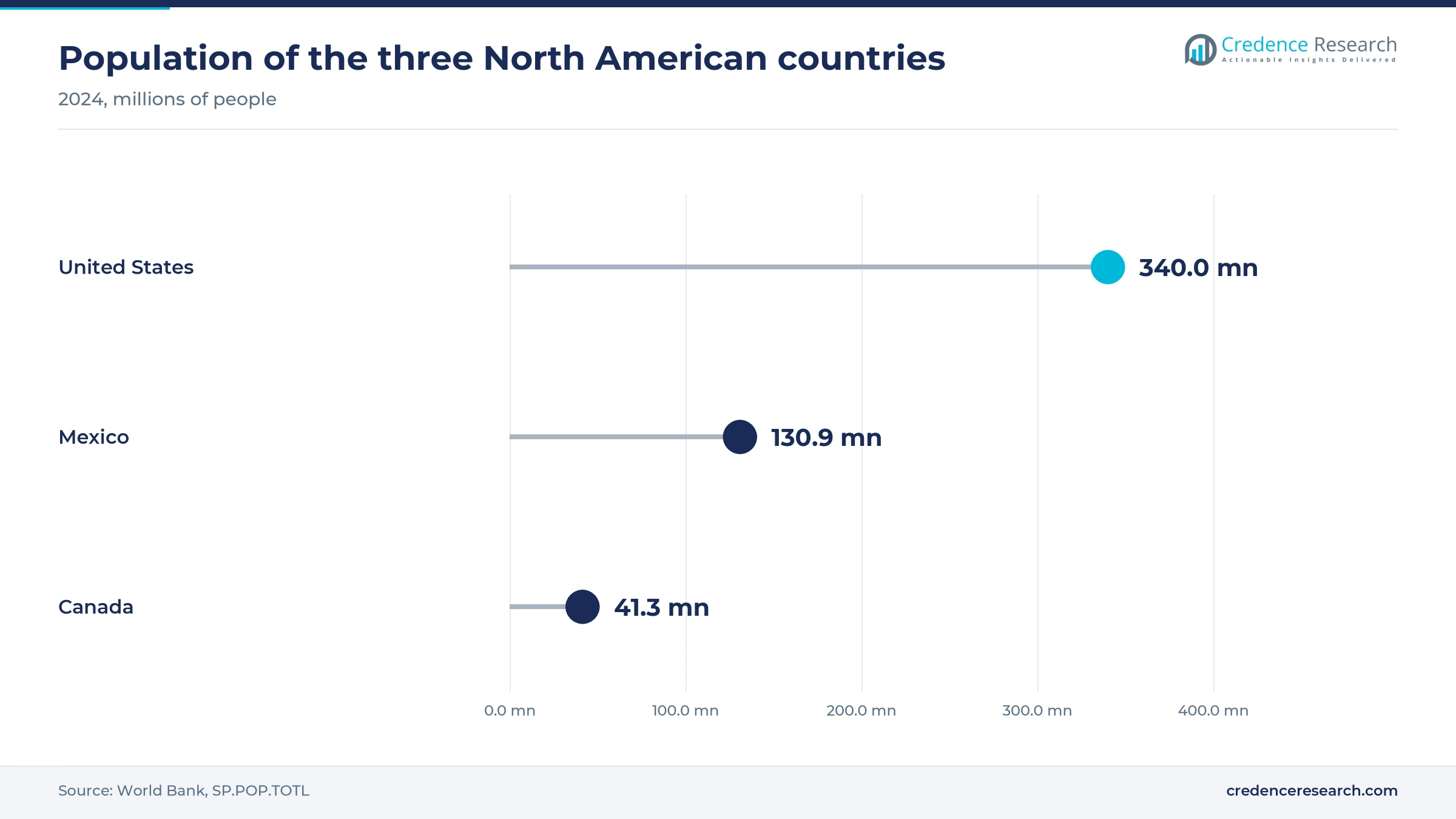
Mexico is an opening because a large population is served by few branded entrants with a dated public launch. World Bank data put Mexico at 130.9 million people in 2024, about three times the Canadian total, yet Mexico holds only 5.7% of regional value in 2025. Upfield introduced Violife to Mexican shoppers in April 2024, promoting it for pizza, quesadillas and pasta, according to The Food Tech. That report also cited Fundación UNAM, which said about 30% of the Mexican population has a problem related to lactose intolerance. Brands that price for local incomes and fit quesadilla use can therefore capture the fastest growth in the region.
Weak repeat buying and costly coconut oil squeeze brands
Falling retail sales and weak repeat buying
Retail weakness is the largest risk to the forecast because shoppers try the products and then leave. Supermarket Perimeter reported in September 2025 that plant-based cheese dollars fell 4% in 2024 while household penetration dropped from 7% to 4%, citing the Good Food Institute. The Economist's 1843 magazine then reported a 10% sales decline for 2025. Brands therefore face higher trade costs to hold shelf space. Better recipes and foodservice sampling are the main responses available to them.
Melt and flavor still trail dairy for many buyers
The taste gap persists because plant proteins cannot copy the way casein stretches and melts, as The Economist's 1843 magazine explained in May 2026. This holds category share near 1% of U.S. retail cheese dollars, according to Supermarket Perimeter, even as Americans ate a record 42.3 pounds of cheese per person in 2023. Pizza operators feel the gap first, because poor melt draws complaints. Fermented bases and animal-free casein may narrow it, although casein remains costly and adds new labeling questions.
Coconut oil prices squeeze recipe margins
Ingredient cost is a direct margin problem, since Violife and Daiya both use coconut oil as a core recipe input. BusinessWorld reported in January 2026 that World Bank data put the 2025 average at $2,480 a metric ton, up 63.27% from a year earlier. Value brands suffer most because they cannot easily raise prices against dairy shreds. Producers may respond with blended oils or smaller packs, although recipe changes risk the melt that buyers expect.
FDA labeling advice may force package changes
Labeling is a cost and marketing risk, because the FDA draft guidance of Jan. 6, 2025, asks firms to name the plant source in the product name. The FDA Law Blog noted the example of Dairy-Free Soy-Based Cheddar Cheese in place of Plant-Based Cheddar Cheese, with comments due by May 7, 2025. Multi-source recipes must list the predominant plant first by weight. The advice is not yet final, so brands should plan artwork changes in stages to limit reprint costs.
The United States dominates while Mexico grows fastest
| Country | Value, 2025 (USD million) | Share, 2025 | CAGR, 2026–2035 |
|---|---|---|---|
| United States | 297.1 | 87.5% | 7.95% |
| Canada | 23.1 | 6.8% | 8.35% |
| Mexico | 19.4 | 5.7% | 9.45% |
United States holds the bulk of value through scale
The United States held 87.5% of 2025 value and grows at 7.95% a year, slightly below the regional rate because its retail base is mature and currently shrinking. Scale still dominates, as World Bank data show 340.0 million residents in 2024 and national chains such as Papa Murphy's already offer the products. The Good Food Institute counted 47 million retail units sold in 2022. Growth depends on foodservice distributors and on campus programs, including those run by Aramark.
Canada pairs local production with a strong home brand
Canada held 6.8% of 2025 value and grows at 8.35% a year, supported by two local manufacturing sites at Brantford and Burnaby. Violife reported a 31.1% dollar share of the alternative cheese category in Nielsen data for the 12 weeks ending Jan. 25, 2025, with suggested prices of Cdn$5.99 to Cdn$7.99 a package. Panago added Daiya at all 170 locations in April 2026, and Prosperity Organic Foods plans to bring Miyoko's to Canada through Melt Organic channels.
Mexico starts small but posts the fastest growth
Mexico held 5.7% of 2025 value and grows at 9.45% a year, the highest rate in the region, from a low retail base. The Food Tech reported Upfield's Violife introduction in April 2024, which remains the clearest dated branded entry found for this report. Lactose problems are common, as Revista de Gastroenterología de México and Fundación UNAM both document, yet incomes limit premium purchases, since World Bank data put GDP per capita at $13,988 in 2024 against $55,016 in Canada.
Launches, deals and FDA actions from 2024 to 2026
| Development | Status and market relevance |
|---|---|
| In May 2024, Daiya Foods began selling 5-pound Mozzarella and Cheddar foodservice shreds through major distributors in North America. | Launched, moves the oat cream recipe into pizza kitchens |
| In June 2024, Violife launched its Creamy Block in Canada at Save-On-Foods and Longo's, with Loblaws banners following that summer. | Launched, broadens the soft format range |
| In January 2025, the FDA issued draft guidance recommending that plant-based cheese names disclose the plant source. | Draft, comment period closed May 7, 2025 |
| In August 2025, Schuman Cheese and GOOD PLANeT Foods formed the GPV Foods joint venture, combining Vevan with GOOD PLANeT retail business. | Announced, adds manufacturing scale |
| In November 2025, Prosperity Organic Foods acquired the Miyoko's Creamery brand after an assignment for the benefit of creditors. | Completed, relaunch planned for May 2026 on butters and cream cheeses |
Oil, culture and protein systems decide melt and nutrition
- Starch and oil structuring remains the base of value products, because coconut oil supplies fat and starch sets the texture, as Violife recipes made at Brantford show, though the method delivers little protein.
- Cultured plant matrices add flavor through fermentation, as in the Daiya oat cream made with vegan cultures and enzymes over 10 to 20 hours, and they also suit cashew brands such as Nuts For Cheese.
- Protein-enhanced formulation raises nutrition values with ingredients such as lentil protein, and Violife Supreme Cheddarton reached 9.5 grams per 100 grams in Britain, which sets a benchmark for North American recipes.
- Animal-free casein offers a route to real stretch through precision fermentation, and the FDA no questions letter of October 2026 covers up to 25% inclusion in cheese alternatives, with first U.S. products expected in 2027.
Need a Custom Version of This Report?
Tailor the scope, geography, or segments to your exact requirements.
- Custom geography or segment scope
- Direct access to our analyst team
Five brands compete on melt, reach and foodservice packs
Competition centers on melt quality, store reach and foodservice packaging rather than on discounting. Daiya reports more than 25,000 U.S. and Canadian stores, and it has moved its cheese range to oat cream. Violife, a Flora Food Group brand, leads Canadian alternative cheese by reported dollar share and sells shred, block and cream formats, with Canadian production at Brantford. Follow Your Heart, which Danone agreed to buy through the Earth Island deal announced in 2021, offers shredded, sliced and grated products. Miyoko's Creamery is rebuilding after its 2025 insolvency under Prosperity Organic Foods, with production at co-manufacturers. GOOD PLANeT Foods now shares scale with Schuman Cheese through GPV Foods, which pairs nationwide grocery placement with Vevan foodservice experience. Smaller cultured brands such as Nuts For Cheese compete at premium prices in natural stores, and buyers increasingly compare all of them on melt tests and on allergen statements.
Companies profiled and their roles in this market
| Company | Type | Role in the market |
|---|---|---|
| Violife | Flora Food Group brand | Coconut oil based shreds, slices, blocks and Creamy Block, made at Brantford, Ontario, for Canada and the United States |
| Daiya Foods | Canadian manufacturer | Oat cream shreds, slices and blocks, with 5-pound foodservice bags and fermentation at Burnaby, British Columbia |
| Follow Your Heart | Earth Island brand acquired by Danone | Shredded, sliced and parmesan-style products made through the Earth Island business in Los Angeles |
| Miyoko's Creamery | Prosperity Organic Foods brand | Cream cheeses and butters relaunched from May 2026 through co-manufacturers, with Canada planned |
| GOOD PLANeT Foods | GPV Foods joint venture brand | Grocery cheese alternatives, now paired with the Vevan foodservice business of Schuman Cheese |
Foodservice, not retail, carries the recovery case
Credence Research's view is that non-dairy cheese is a recovery case, not a momentum story, because tracked U.S. retail sales fell again in 2024 and 2025. Growth through 2035 depends on foodservice, which suits one-for-one shreds and needs fewer repeat decisions by individual shoppers. Buyers should test melt performance before listing, since recipes changed widely after 2023. Investors should watch whether oat cream and casein recipes lift household penetration above the level recorded for 2024, because that single measure will show whether shoppers are returning.
How Credence Research built this estimate
The report uses 2025 as the base year and 2035 as the forecast year, with market values from the Credence Research model. Country and segment splits are Credence Research estimates informed by public data, including Good Food Institute and SPINS retail data, Nielsen figures published by Violife, World Bank population and income statistics, FDA and Federal Register documents, company releases and named trade publications. No interviews or surveys were conducted for this edition of the report. Retail scanner data cover only part of the channel, so foodservice values carry the widest uncertainty in this estimate.
Taste parity and restaurant reach set the pace to 2035
The non-dairy cheese market is expected to reach USD 737.9 million by 2035, growing at an 8.07% rate from USD 367.1 million in 2026. Early years should stay slower, as retail recovers from the declines of 2024 and 2025, and later years should benefit from improved recipes and wider menu use. Institutional Foodservice grows fastest at 9.56% a year, though from a small base. Mexico should gain share gradually, while the United States keeps most value. The largest upside would come from animal-free casein reaching U.S. shelves on schedule in 2027 at acceptable prices.
Frequently Asked Questions
How big is the North America non-dairy cheese market?
Which country leads the regional market?
Which country grows fastest?
Which product type holds the largest share?
Why did retail sales decline recently?
How does FDA guidance affect these products?
What is changing in recipes?
Who are the main companies?
Table of Content
Chapter 1 Market Segmentation
- 1.1 Segmentation Framework
- 1.1.1 Product and Service Classification
- 1.1.2 Application and End-Use Classification
- 1.1.3 Technology and Solution Classification
- 1.1.4 Customer and Distribution Channel Classification
- 1.1.5 Geographic Segmentation
- 1.1.6 Market Segment Definitions and Boundaries
- 1.2 By Product Type
- 1.2.1 Shreds
- 1.2.2 Slices
- 1.2.3 Blocks and Wedges
- 1.2.4 Soft and Pourable Cheese
- 1.3 By Application
- 1.3.1 Pizza and Baked Meals
- 1.3.2 Sandwiches and Burgers
- 1.3.3 Snacking and Cheeseboards
- 1.3.4 Cooking and Finishing
- 1.4 By Customer Type
- 1.4.1 Households
- 1.4.2 Restaurants and Caterers
- 1.4.3 Institutional Foodservice
- 1.5 By Country
- 1.5.1 United States
- 1.5.2 Canada
- 1.5.3 Mexico
Chapter 2 Introduction
- 2.1 Report Objectives and Scope
- 2.2 Product Definition and Industry Terminology
- 2.3 Market Inclusions and Exclusions
- 2.4 Research Process
- 2.4.1 Primary Research and Expert Interviews
- 2.4.2 Secondary Research and Source Review
- 2.4.3 Top-Down and Bottom-Up Estimation
- 2.4.4 Data Triangulation and Verification
- 2.5 Market Size Measurement Basis
- 2.5.1 2025: USD 339.5 million → 2035: USD 737.9 million
- 2.6 Historical and Forecast Reference Periods
- 2.6.1 Historical Period: 2018-2025
- 2.6.2 Base Year: 2025
- 2.6.3 Forecast Period: 2025-2035
- 2.7 Research Assumptions and Limitations
Chapter 3 Executive Summary
- 3.1 Market Snapshot and Key Findings
- 3.2 Base-Year Market Size, 2025
- 3.3 Forecast Market Size, 2035
- 3.4 Revenue and Volume Growth Outlook
- 3.5 Key Demand and Supply Indicators
- 3.6 Leading Market Segments
- 3.7 Fastest-Growing Market Opportunities
- 3.8 Regional Performance Highlights
- 3.9 Technology and Industry Transformation
- 3.10 Competitive Landscape Summary
- 3.11 Analyst View and Strategic Implications
Chapter 4 North America Non-Dairy Cheese Market Trends and Developments
- 4.1 Historical Industry Development, 2018-2025
- 4.2 Recent Market Trends and Developments
- 4.3 Demand and Customer Behavior Trends
- 4.4 Technology and Product Innovation
- 4.5 Artificial Intelligence, Automation and Digitalization
- 4.6 Local Manufacturing and Supply Chain Realignment
- 4.7 Industry Partnerships, Mergers and Acquisitions
- 4.8 Sustainability and Circular Economy Developments
- 4.9 Government and Private Sector Investment Trends
- 4.10 Emerging Business Models and Commercialization
- 4.11 Industry Developments and Announcements
Chapter 5 North America Non-Dairy Cheese Market Production, Supply and Demand Analysis
- 5.1 Demand Trend and Consumption Analysis, 2018-2025
- 5.2 Demand Forecast, 2025-2035
- 5.3 Production and Output Trend, 2018-2025
- 5.4 Production and Output Forecast, 2025-2035
- 5.5 Installed Capacity and Capacity Utilization
- 5.6 Company-Wise Production Plants and Statistics
- 5.6.1 Installed Production Capacity
- 5.6.2 Actual Production
- 5.6.3 Planned Capacity and Expansion Targets
- 5.7 Supply Chain Structure and Procurement Trends
- 5.8 Supply-Demand Gap and Bottlenecks
- 5.9 Import Dependence and Sourcing Structure
- 5.10 Contract Manufacturing and Outsourcing
- 5.11 Regional Supply and Demand Concentration
Chapter 6 North America Non-Dairy Cheese Market Pricing Analysis
- 6.1 Pricing Structure and Measurement
- 6.2 Historical Pricing Trends, 2018-2025
- 6.3 Pricing Outlook, 2025-2035
- 6.4 Average Selling Price and Unit Economics
- 6.5 Pricing by Product and Market Segment
- 6.6 Geographic Pricing Differences
- 6.7 Key Input, Energy, Labor and Logistics Costs
- 6.8 Contract Pricing and Purchasing Models
- 6.9 Pricing Sensitivity and Competitive Positioning
- 6.10 Price, Margin and Profitability Implications
Chapter 7 North America Non-Dairy Cheese Market Dynamics
- 7.1 Market Growth Drivers
- 7.1.1 Demand-Side Drivers
- 7.1.2 Technology and Innovation Drivers
- 7.1.3 Infrastructure and Investment Drivers
- 7.1.4 Regulatory and Policy Drivers
- 7.2 Market Restraints
- 7.2.1 Cost and Affordability Constraints
- 7.2.2 Technology and Adoption Barriers
- 7.2.3 Supply Chain and Operational Constraints
- 7.3 Market Challenges
- 7.3.1 Competitive Pressure and Margin Erosion
- 7.3.2 Skills, Infrastructure and Implementation Gaps
- 7.4 Emerging Market Opportunities
- 7.5 Market Dynamics Impact and Time-Horizon Assessment
Chapter 8 North America Non-Dairy Cheese Value Chain Analysis
- 8.1 Industry Value Chain Overview
- 8.2 Upstream Suppliers and Critical Inputs
- 8.3 Technology and Component Providers
- 8.4 Manufacturing or Service Delivery
- 8.5 Distribution, Channel Partners and Integrators
- 8.6 Downstream Applications and End Users
- 8.7 Value Addition and Profit Pools
- 8.8 Vertical Integration and Outsourcing
- 8.9 Supplier Concentration and Risk
- 8.10 Supply Chain Localization and Resilience
Chapter 9 North America Non-Dairy Cheese Market Regulations and Policies
- 9.1 Relevant Laws, Standards and Compliance Frameworks
- 9.2 Product, Service, Safety and Quality Requirements
- 9.3 Government Policies, Incentives and Subsidies
- 9.4 Imports, Exports and Trade Barriers
- 9.5 Public Procurement and Local Content Requirements
- 9.6 Environmental and Sustainability Compliance
- 9.7 Upcoming Policy Changes and Market Implications
Chapter 10 North America Non-Dairy Cheese Market Hotspots and Opportunities
- 10.1 Market Opportunity Mapping and Growth Hotspots
- 10.2 High-Growth Applications and Customer Groups
- 10.3 Underserved Markets and White-Space Opportunities
- 10.4 Emerging Technology and Product Opportunities
- 10.5 New Capacity and Investment Hotspots
- 10.6 Market Entry and Expansion Opportunities
- 10.7 Distribution and Partnership Opportunities
- 10.8 Near-Term and Long-Term Commercial Potential
- 10.9 Opportunity Attractiveness and Execution Risks
Chapter 11 North America Non-Dairy Cheese Market Outlook, 2025-2035
- 11.1 Market Size and Analysis
- 11.1.1 Revenue (Market Measurement: 2025: USD 339.5 million → 2035: USD 737.9 million)
- 11.1.2 Market Volume and Quantity Sold
- 11.1.3 Historical Market Size, 2018-2025
- 11.1.4 Base-Year Market Size, 2025
- 11.2 Market Forecast, 2025-2035
- 11.2.1 Revenue Forecast to 2035
- 11.2.2 Volume Forecast to 2035
- 11.2.3 CAGR and Year-on-Year Growth
- 11.2.4 Incremental Revenue Opportunity
- 11.3 Forecast Assumptions and Scenario Analysis
- 11.3.1 Base-Case Forecast
- 11.3.2 Optimistic and Conservative Scenarios
- 11.3.3 Technology, Pricing and Policy Sensitivities
- 11.4 Market Attractiveness and Growth Outlook
Chapter 12 North America Non-Dairy Cheese Market Segmentation and Outlook
- 12.1 Segmentation Summary and Market Shares, 2025
- 12.2 Largest and Fastest-Growing Segments
- 12.3 By Product Type - Market Size and Forecast, 2025-2035
- 12.3.1 Segment Definition and Scope
- 12.3.2 Historical Market Size, 2018-2025
- 12.3.3 Revenue Forecast, 2025-2035
- 12.3.4 Volume Forecast, 2025-2035
- 12.3.5 Base-Year Market Share, 2025
- 12.3.6 Segment CAGR and Growth Drivers
- 12.3.7 Subsegment Market Size and Forecast
- 12.3.7.1 Shreds
- 12.3.7.2 Slices
- 12.3.7.3 Blocks and Wedges
- 12.3.7.4 Soft and Pourable Cheese
- 12.3.8 Subsegment Pricing and Adoption Trends
- 12.3.9 Leading Suppliers and Competition
- 12.3.10 Regional Demand and Opportunities
- 12.4 By Application - Market Size and Forecast, 2025-2035
- 12.4.1 Segment Definition and Scope
- 12.4.2 Historical Market Size, 2018-2025
- 12.4.3 Revenue Forecast, 2025-2035
- 12.4.4 Volume Forecast, 2025-2035
- 12.4.5 Base-Year Market Share, 2025
- 12.4.6 Segment CAGR and Growth Drivers
- 12.4.7 Subsegment Market Size and Forecast
- 12.4.7.1 Pizza and Baked Meals
- 12.4.7.2 Sandwiches and Burgers
- 12.4.7.3 Snacking and Cheeseboards
- 12.4.7.4 Cooking and Finishing
- 12.4.8 Subsegment Pricing and Adoption Trends
- 12.4.9 Leading Suppliers and Competition
- 12.4.10 Regional Demand and Opportunities
- 12.5 By Customer Type - Market Size and Forecast, 2025-2035
- 12.5.1 Segment Definition and Scope
- 12.5.2 Historical Market Size, 2018-2025
- 12.5.3 Revenue Forecast, 2025-2035
- 12.5.4 Volume Forecast, 2025-2035
- 12.5.5 Base-Year Market Share, 2025
- 12.5.6 Segment CAGR and Growth Drivers
- 12.5.7 Subsegment Market Size and Forecast
- 12.5.7.1 Households
- 12.5.7.2 Restaurants and Caterers
- 12.5.7.3 Institutional Foodservice
- 12.5.8 Subsegment Pricing and Adoption Trends
- 12.5.9 Leading Suppliers and Competition
- 12.5.10 Regional Demand and Opportunities
- 12.6 By Country - Market Size and Forecast, 2025-2035
- 12.6.1 Segment Definition and Scope
- 12.6.2 Historical Market Size, 2018-2025
- 12.6.3 Revenue Forecast, 2025-2035
- 12.6.4 Volume Forecast, 2025-2035
- 12.6.5 Base-Year Market Share, 2025
- 12.6.6 Segment CAGR and Growth Drivers
- 12.6.7 Subsegment Market Size and Forecast
- 12.6.7.1 United States
- 12.6.7.2 Canada
- 12.6.7.3 Mexico
- 12.6.8 Subsegment Pricing and Adoption Trends
- 12.6.9 Leading Suppliers and Competition
- 12.6.10 Regional Demand and Opportunities
- 12.7 Segment Growth Comparison
- 12.8 Segment Attractiveness and Priority Matrix
Chapter 13 North America Non-Dairy Cheese End-Use and Application Market Outlook
- 13.1 End-Use Industry and Customer Demand Structure
- 13.2 Leading Applications and Customer Groups
- 13.3 End-Use Market Size, Share and Forecast
- 13.4 Major End-Use Industry Deep Dives
- 13.4.1 Customer Requirements and Use Cases
- 13.4.2 Demand and Replacement Cycles
- 13.4.3 Technical and Regulatory Considerations
- 13.4.4 Purchasing and Procurement Models
- 13.4.5 Leading Vendors and Distribution Channels
- 13.4.6 Forecast and Commercial Opportunities
- 13.5 Emerging Applications and Cross-Segment Demand
- 13.6 End-Use Industry Investment Priorities
Chapter 14 North America Non-Dairy Cheese Geographic Market Outlook, 2025-2035
- 14.1 Regional Market Size and Country-Level Shares, 2025
- 14.2 Country Market Size Comparison, 2025
- 14.3 Country Market Forecasts, 2025-2035
- 14.4 Subregional Industrial and Demand Clusters
- 14.5 Intra-Regional Pricing and Cost Differences
- 14.6 Cross-Border Trade and Supply Networks
- 14.7 Regional Supply and Demand Balances
- 14.8 Country Opportunity Comparison and Prioritization
Note: Every listed country is covered on the structure shown under the first country.
Chapter 15 North America Non-Dairy Cheese Technology, Innovation and Sustainability Outlook
- 15.1 Technology Landscape and Maturity
- 15.2 Product, Process and Service Innovation
- 15.3 AI, Automation and Digital Tools in the Industry
- 15.4 Technology Adoption and Performance Benchmarking
- 15.5 Innovation Pipeline and R&D Investment
- 15.6 Patent and Intellectual Property Trends
- 15.7 Energy Efficiency and Resource Management
- 15.8 Sustainability, Recycling and Circularity
- 15.9 Technology Roadmap, 2025-2035
- 15.10 Risks of Obsolescence and Technology Substitution
Chapter 16 North America Non-Dairy Cheese Market Key Strategic Imperatives
- 16.1 Growth and Market Entry Priorities
- 16.2 High-Return Products and Segments
- 16.3 Pricing, Profitability and Cost Optimization
- 16.4 Technology Investment and Product Differentiation
- 16.5 Supply Chain Localization and Resilience
- 16.6 Distribution and Customer Acquisition
- 16.7 Partnership, Acquisition and Capacity Strategy
- 16.8 Regional Expansion Priorities
- 16.9 Short-, Medium- and Long-Term Actions
Chapter 17 Competition Outlook
- 17.1 Industry Competition Characteristics
- 17.2 Market Structure and Concentration
- 17.3 Market Share and Competitive Positioning, 2025
- 17.4 Company-Wise Revenue and Product Benchmarking
- 17.5 Production and Service Capacity Benchmarking
- 17.6 Technology, Pricing and Differentiation
- 17.7 Regional Footprint and Distribution Strength
- 17.8 Mergers, Acquisitions and Strategic Alliances
- 17.9 New Entrants and Competitive Threats
- 17.10 Porter's Five Forces and Industry Attractiveness
- 17.11 Competitive Outlook, 2025-2035
Chapter 18 Company Profiles
- 18.1 Company Coverage and Selection Criteria
- 18.2 Violife
- 18.2.1 Business Description
- 18.2.2 Company Ownership and Geographic Presence
- 18.2.3 Product and Service Portfolio
- 18.2.4 Manufacturing and Operating Footprint
- 18.2.5 Production Capacity and Expansion Plans
- 18.2.6 Financial Performance and Investment
- 18.2.7 Market Share and Competitive Position
- 18.2.8 Technology and Innovation Capabilities
- 18.2.9 Strategic Alliances or Partnerships
- 18.2.10 Recent Developments
- 18.2.11 Growth Strategy and Outlook
- 18.3 Daiya Foods
- 18.4 Follow Your Heart
- 18.5 Miyoko's Creamery
- 18.6 GOOD PLANeT Foods
- 18.7 Other Relevant Market Participants
Note: Every listed company is profiled on the structure shown under the first company. The company list is preliminary and may change based on research findings, market developments, data availability and client requirements.
Chapter 19 Disclaimer
- 19.1 Research and Forecast Disclaimer
- 19.2 Data Source and Estimation Limitations
Note: The depth of individual sections depends on data availability for this market. Volume, capacity, trade and other unit-based metrics are included where applicable.

