
Mushroom coffee moves the category into daily routines
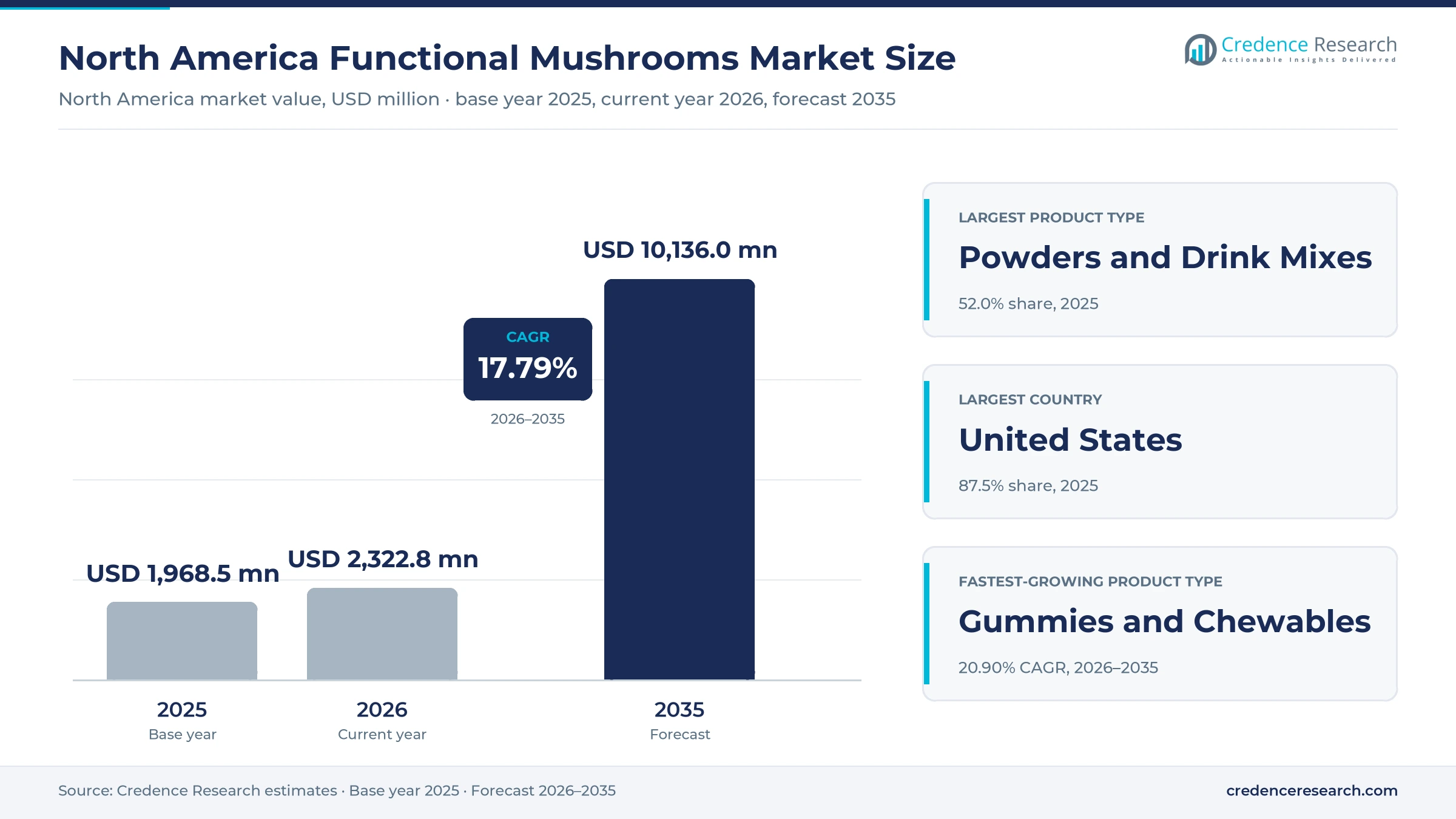
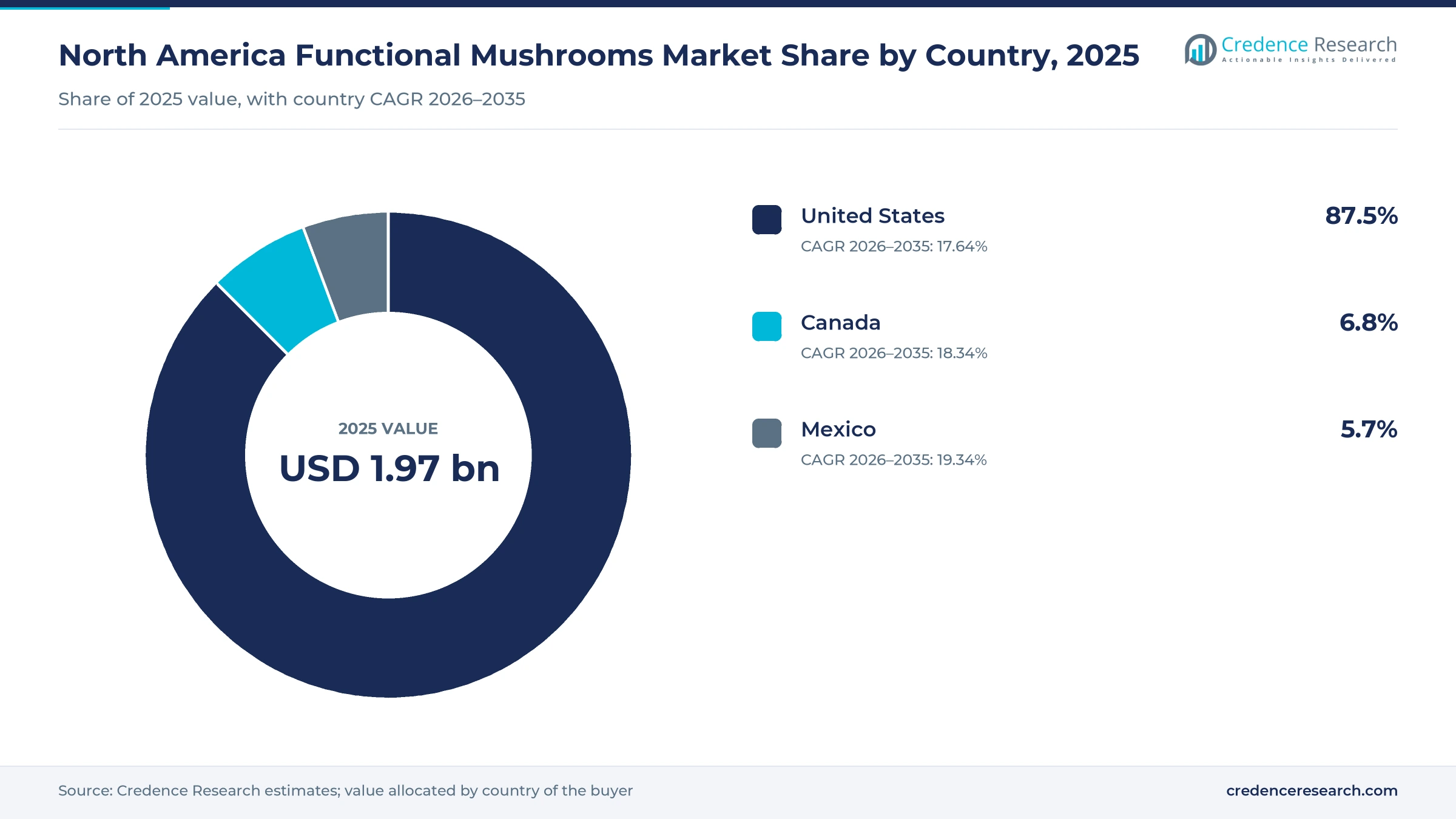
The North America functional mushrooms market was valued at USD 1.97 billion in 2025 and is projected to increase from USD 2.23 billion in 2026 to USD 6.98 billion by 2035, registering a CAGR of 13.50% during 2026–2035. Demand comes from mushroom coffee, powder drink mixes and gummies that fit habits consumers already keep, with lion's mane and cordyceps sold on focus and energy claims. The United States held the largest share, 87.5% in 2025, because national chains and direct online brands are concentrated there. Mexico is the fastest-growing country at 15.05% a year from a small base, given a population of about 131 million. National retail changed the category in January 2026, when RYZE Superfoods entered every Target store in the United States in what it called its first national retail launch. Quality has also become a commercial issue, since a petition before the FDA asks brands to disclose grain substrate in mycelium products.
Which products and purchases count toward this category?
The market counts consumer products sold on the benefits of lion's mane, reishi, cordyceps, chaga, turkey tail and similar species across the United States, Canada and Mexico. It includes mushroom coffees, drink mixes, capsules, gummies, tinctures and shots, whether bought from brand websites, natural grocers, mass chains or club stores. Buyers usually purchase these products as a repeat household item rather than as an occasional remedy, so subscription and replenishment behavior matter to brand economics.
Fresh culinary mushrooms, grow kits and psychedelic products fall outside the count, and bulk extracts appear only through the finished goods that contain them. The value chain runs from cultivators and extract suppliers through contract manufacturers to consumer brands, and Om Mushroom Superfood's parent, M2 Ingredients, owns part of that chain itself.
North America Functional Mushrooms Market Insights
- The market rises from USD 1.97 billion in 2025 to USD 6.98 billion by 2035, a 13.50% CAGR, as mushroom coffee and gummies reach mainstream shoppers.
- The United States held 87.5% of 2025 value, supported by national retail chains and the direct online brands that built the category.
- Powders and Drink Mixes led product types with 52.0% in 2025, since mushroom coffee and lattes depend on an existing daily coffee habit.
- Target became the key mass channel between August 2025 and January 2026, when Everyday Dose and RYZE Superfoods both reached national shelves.
- Scanned sales reached $494.7 million in the 52 weeks to Sept. 6, 2026, rising 23.2%, according to retail scan data reported by NutraIngredients.
Powders and cognitive claims anchor regional demand
Why do powders and drink mixes lead product sales?
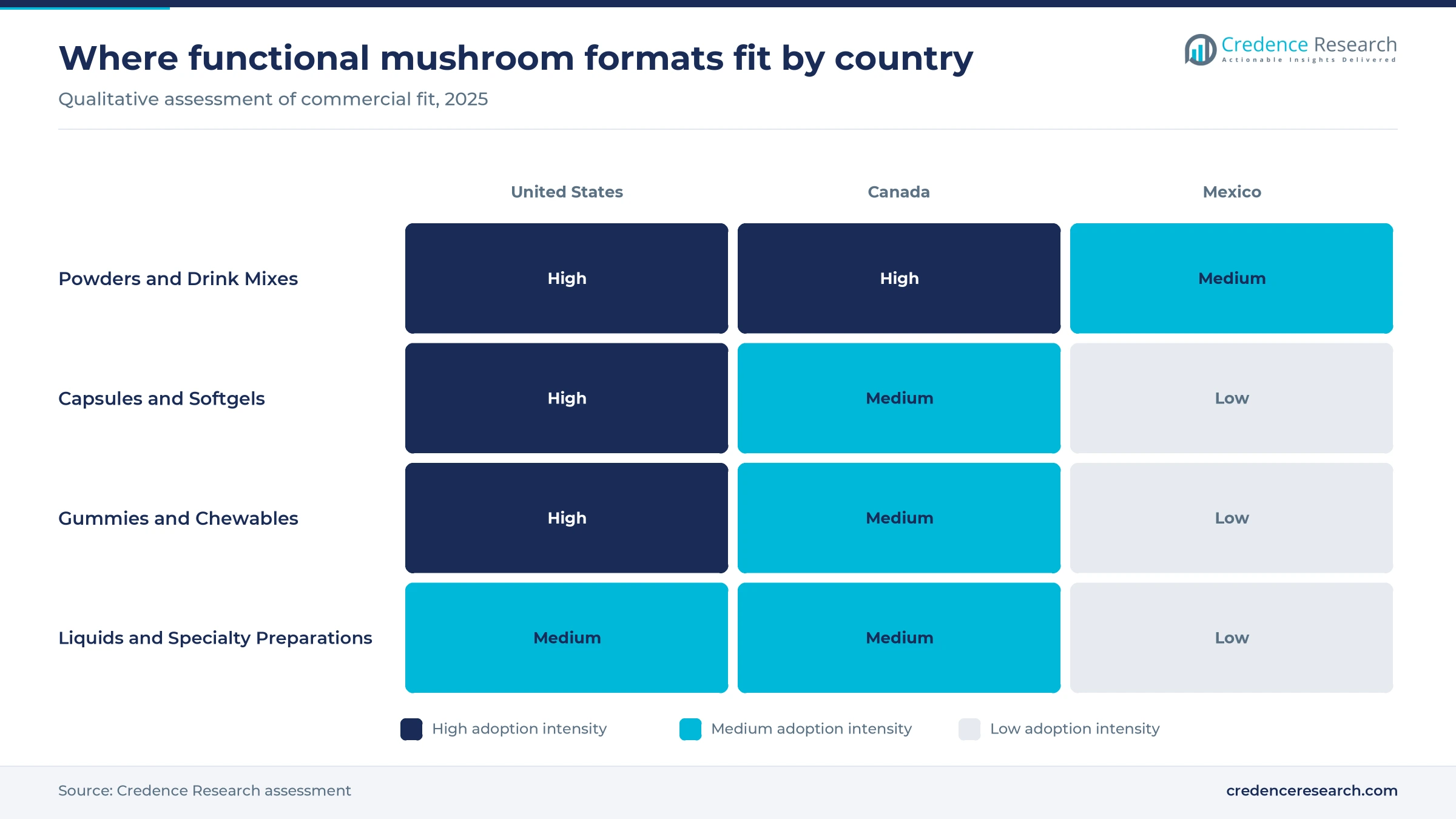
Based on product type, the market is categorized into powders and drink mixes, capsules and softgels, gummies and chewables, and liquids and specialty preparations. Powders and Drink Mixes led with 52.0% of 2025 value because mushroom coffee replaces an existing purchase, and retail scan data for the 52 weeks ended Sept. 6, 2026 show powder as the largest format at $110.8 million. Gummies and Chewables grow fastest at 16.60% a year as the same series recorded gummy dollars up 127.1% and units up 184.9%. Nutritional Outlook reported in March 2025 that gummies attract people who avoid pills or powders.
How do cognitive claims shape application demand?
Based on application, the market is categorized into cognitive support, immune and gut support, energy and performance, and rest and skin wellness. Cognitive Support led with 38.0% of 2025 value because retail scan data placed cognitive-positioned mushroom products at $153.5 million in September 2026, up 33.6%, and lion's mane alone reached $224.3 million. That demand overlaps with brain health supplements, which target the same memory and focus buyers. Rest and Skin Wellness grows fastest at 15.95% a year as the same data measured mushroom sleep-support supplements up 93.3%, although that line starts from a small base.
Which age groups buy functional mushroom products?
Based on end user, the market is categorized into adults aged 18-34, adults aged 35-54, adults aged 55 and above, and users under 18. Adults Aged 35-54 led with 43.0% of 2025 value because CDC data published in May 2026 show 60.3% of adults aged 40-59 took a dietary supplement in the past 30 days, against 46.3% of those aged 20-39. Adults Aged 18-34 grow fastest at 14.58% a year as Mushroom Council president Amy Wood told Supermarket Perimeter that Millennial and Gen Z consumers seeking foods with functional benefits prioritize cognition and brain health. Under-18 use stays small, even though CDC data show 30.1% of those aged 12-19 took a supplement.
Why is mass retail the fastest channel?
Based on distribution channel, the market is categorized into DTC e-commerce, specialty and natural retail, and mass and club retail. DTC E-Commerce led with 70.0% of 2025 value because brand websites and Amazon carry most sales, and RYZE Superfoods described its January 2026 Target rollout as its first national retail launch. Mass and Club Retail grows fastest at 16.57% a year as Athletech News reported Everyday Dose entering more than 1,500 Target stores in August 2025. Natural retail still launches many brands, and Fantastic Fungi entered every Sprouts Farmers Market store from July 20, 2026.
| Segment Group | Leading Sub-segment | Share, 2025 | Fastest-growing Sub-segment | CAGR, 2026–2035 |
|---|---|---|---|---|
| By Product Type | Powders and Drink Mixes | 52.0% | Gummies and Chewables | 16.60% |
| By Application | Cognitive Support | 38.0% | Rest and Skin Wellness | 15.95% |
| By End User | Adults Aged 35-54 | 43.0% | Adults Aged 18-34 | 14.58% |
| By Distribution Channel | DTC E-Commerce | 70.0% | Mass and Club Retail | 16.57% |
Request a Free Sample
Fill in your details and we'll send you a free sample report.
- Sample data tables & charts
- Research methodology
Coffee habits and retail shelves widen the buyer base
Daily beverage rituals give mushrooms a built-in habit
Coffee gives mushroom brands a purchase occasion they did not have to create, which lowers the effort of winning a repeat buyer. Market demand has a large base, since the National Coffee Association found in spring 2026 that 66% of U.S. adults drank coffee in the past day. Of those drinkers, 85% had it at home, the highest level since 2012. The same report put past-week specialty coffee consumption at 58% of adults, so premium cups are already accepted. Brands build directly on that behavior, and Everyday Dose sells mild and medium roasts with 45 mg and 90 mg of caffeine per serving. As a result, Powders and Drink Mixes hold 52.0% of 2025 value across the region.
Format accessibility brings in non-supplement buyers
Formats that taste like food reach shoppers who would never buy a capsule, and this is widening the customer base beyond existing supplement users. NutraIngredients reported that mushroom sales in the grocery department rose 60.1% in the year to Sept. 6, 2026, led by wellness and nutrition bars, while refrigerated products rose 15.7% on functional beverages and shots. Gummies recorded the sharpest format gain at 127.1%, which explains why Gummies and Chewables grow at 16.60% a year in this report. Brand launches follow the same logic, since RYZE Superfoods introduced vanilla, mocha and caramel lattes at $9.99 a carton in January 2026, and MUD\WTR launched a mushroom protein powder with 25 grams of protein in August 2025.
Retail distribution expansion puts brands on national shelves
National shelf placement exposes the category to shoppers who never saw its online advertising, which is why recent Target listings matter so much. Athletech News reported in August 2025 that Everyday Dose had entered more than 1,500 Target stores, and RYZE Superfoods followed in all Target stores on Jan. 8, 2026, with coffee bags at $17.99. Om Mushroom Superfood had earlier announced three Target products for late spring 2025, adding to its Whole Foods Market and Sprouts listings. Natural grocers remain active as well, since Four Sigmatic planned 11 new products for Sprouts and Whole Foods during 2025. In turn, Mass and Club Retail advances at 16.57% a year.
Cognitive and energy positioning gives buyers a clear reason
Specific benefit claims help a shopper understand a mushroom product quickly, and focus and energy now carry much of the sales growth. Retail scan data measured cognitive-positioned products at $153.5 million in the year to September 2026, while cordyceps sales rose 39.6% and lion's mane sales rose 18.8%. Retail scan data also showed general health-superfood products up 161.7% and reishi up 15.9% over the same period. Immune products, by contrast, grew just 0.5% in the natural channel in the year to Oct. 6, 2024, according to Nutritional Outlook. Om Mushroom Superfood also cited a 53% annual rise in online searches for lion's mane in March 2025. This shift keeps Cognitive Support in front with 38.0% of 2025 value, ahead of immune and gut products.
Gummies, U.S.-grown supply and label disputes reshape sales
Shift toward U.S.-grown and traceable mushroom supply
Brands are moving origin to the front of the pack because tariffs and quality concerns have made Chinese extract supply harder to rely on. NutraIngredients reported in May 2025 that M2 Ingredients had launched its first domestically grown extracts from a 155,000-square-foot facility in Vista, California, while citing 145% tariffs on Chinese mushroom extracts at the time. RYZE Superfoods now promotes 1,000 mg of USA-grown organic mushrooms per serving in its September 2026 pumpkin spice latte. The domestic base remains narrow, since USDA counted $95.0 million of specialty mushroom sales in 2024-25 across about 16.3 million pounds. As a result, indoor cultivation capacity is becoming a selling point for premium brands.
Rise of ready-to-drink and caffeine-moderated formats
Products are spreading from the morning mug into cold drinks and lower-caffeine options, which adds occasions without asking consumers to give up coffee. The National Coffee Association found cold brew at 18% among non-espresso cold coffees in early 2026, showing a ready audience for chilled formats. NutraIngredients also pointed to momentum in ready-to-drink products and shots in September 2026. Four Sigmatic planned a half-caffeine ground coffee and pods for 2025, and RYZE Superfoods sells a medium roast with about 50 mg of caffeine per serving. In Canada, Starmount began selling a lion's mane energy drink online on May 15, 2026, at $15.96 for four cans, extending the idea to carbonated formats.
Opportunity in mass-priced entry packs and trial kits
Small packs give retailers an easy way to convert curious shoppers, and the pool of potential buyers is still far larger than the current one. CDC data show 60.3% of adults aged 40-59 took a dietary supplement in the past 30 days, whereas scanned functional mushroom sales reached only $494.7 million in the year to Sept. 6, 2026. Everyday Dose addressed that demand gap with a $14.99 sample kit at Target in August 2025, while RYZE Superfoods offers six-stick cartons for $9.99. Per-serving prices leave room for a tiered range, since RYZE bags work out near $0.90 and a Target listing for MUD\WTR Rise shows about $1.42 on sale. Brands that hold a clear entry price could therefore capture much of the Mass and Club Retail gain.
Opportunity in sleep, skin and older-adult products
Rest, skin and healthy aging remain lightly served compared with focus, yet the available data suggest an opening for brands willing to specialize. Retail scan data recorded mushroom sleep-support supplements up 93.3% in the year to September 2026, and WholeFoods Magazine reported in August 2025 that brands were developing mushroom skincare for hydration and anti-aging, which sits close to beauty supplements. Older adults are an underused audience, since a CDC data brief published in May 2026 found 75.9% of U.S. adults aged 60 and over used a dietary supplement in the past 30 days, against 46.3% of those aged 20-39. As a result, Rest and Skin Wellness can grow at 15.95% a year.
Label disputes, tariffs and Canadian rules raise costs
Grain substrate disputes weaken consumer trust
Disagreement over what counts as a mushroom is now public and unresolved, which makes label claims harder to defend. Nammex has asked the FDA, through petition FDA-2023-P-2340, to require disclosure of grain substrates, while the Functional Mushroom Council disputes its starch testing, as Nutrition Industry Executive reported on Feb. 10, 2026. Nammex tests cited by vegconomist in July 2026 showed starch averaging 35% to 40% in mycelium-on-grain samples. Brands relying on mycelium face reformulation risk unless a shared method emerges.
Safety incidents spill over onto legitimate brands
Mushroom-branded edibles carry a reputational risk that reaches well beyond the companies involved, which raises compliance and communication costs for the whole category. Diamond Shruumz products were recalled nationwide on June 27, 2024, and Food Poisoning Bulletin reported that the FDA counted 180 illnesses, 73 hospitalizations and three potentially associated deaths across 34 states. Gummy brands are most exposed because the recalled line included that format. In response, the Functional Mushroom Council plans to release research on quality standards during 2026.
Tariffs and coffee costs squeeze blended product margins
Two major inputs have become more expensive at once, leaving brands little room when retailers expect stable shelf prices. NutraIngredients cited 145% tariffs on Chinese mushroom extracts in May 2025, and Four Sigmatic founder Tero Isokauppila said in March 2025 that green coffee prices had more than doubled in a year. Mass-priced mushroom coffee is most exposed, as $17.99 for 20 servings leaves limited margin. Brands are responding with domestic sourcing, smaller packs and lower-caffeine blends containing less coffee.
Canadian product rules add cost for cross-border brands
U.S. brands entering Canada face a licensing system built for health products, not a simple notification process. Health Canada has authorized more than 200,000 natural health products since 2004, and a government note gives industry until June 2028 to meet new labelling rules. Its revised fee proposal of March 27, 2024 also remains unfinished, leaving future costs unknown. Smaller exporters may delay entry, although Health Canada says it plans more flexible labelling.
The United States dominates while Mexico grows fastest
| Country | Value, 2025 (USD billion) | Share, 2025 | CAGR, 2026–2035 |
|---|---|---|---|
| United States | 1.72 | 87.5% | 13.35% |
| Canada | 0.13 | 6.8% | 14.05% |
| Mexico | 0.11 | 5.7% | 15.05% |
United States holds the retail and brand base
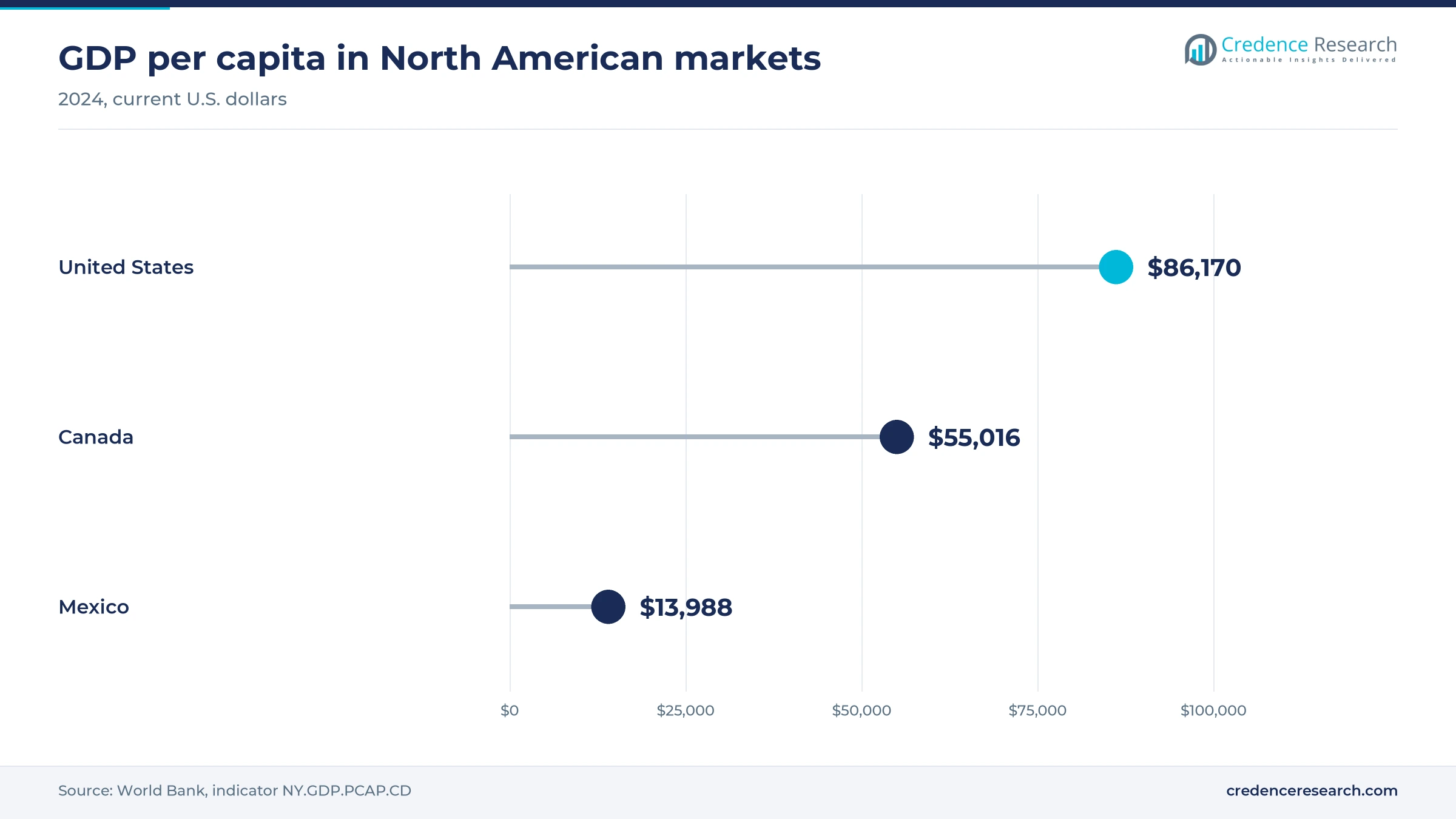
The United States held 87.5% of 2025 value and grows at 13.35% a year, because the leading brands and national retail rollouts are concentrated there. The country had about 340 million residents in 2024 according to the World Bank, and GDP per capita near $86,170 supports premium daily demand. National Coffee Association data show about 195 million adults drink coffee each week, which forms the natural audience. Target, Sprouts and Whole Foods Market now give brands national reach beyond their own websites.
Canada pairs high incomes with a stricter framework
Canada held 6.8% of 2025 value and grows at 14.05% a year, reflecting strong purchasing power within a licensed natural health product system. World Bank data show about 41.3 million residents and GDP per capita near $55,016 in 2024, which anchors demand there. A Health Canada note puts natural health product sales near $13.2 billion in 2021, so the shopper base is well established. Domestic activity is real but modest, as Ontario-based Starmount launched a lion's mane energy drink in May 2026, and British Columbia hosts extract supplier Nammex.
Mexico starts small but offers the fastest growth
Mexico held 5.7% of 2025 value and grows at 15.05% a year, the fastest pace in the region because it starts from a low base. The World Bank counted about 130.9 million residents in 2024, more than three times the population of Canada, although GDP per capita near $13,988 limits premium demand in this market. Freyr Solutions notes that COFEPRIS first assesses a product against the General Health Law definition of a food supplement. Accessible powders therefore look better placed than higher-priced imported ranges there.
Retail rollouts define the 2025 and 2026 calendar
| Development | Status and market relevance |
|---|---|
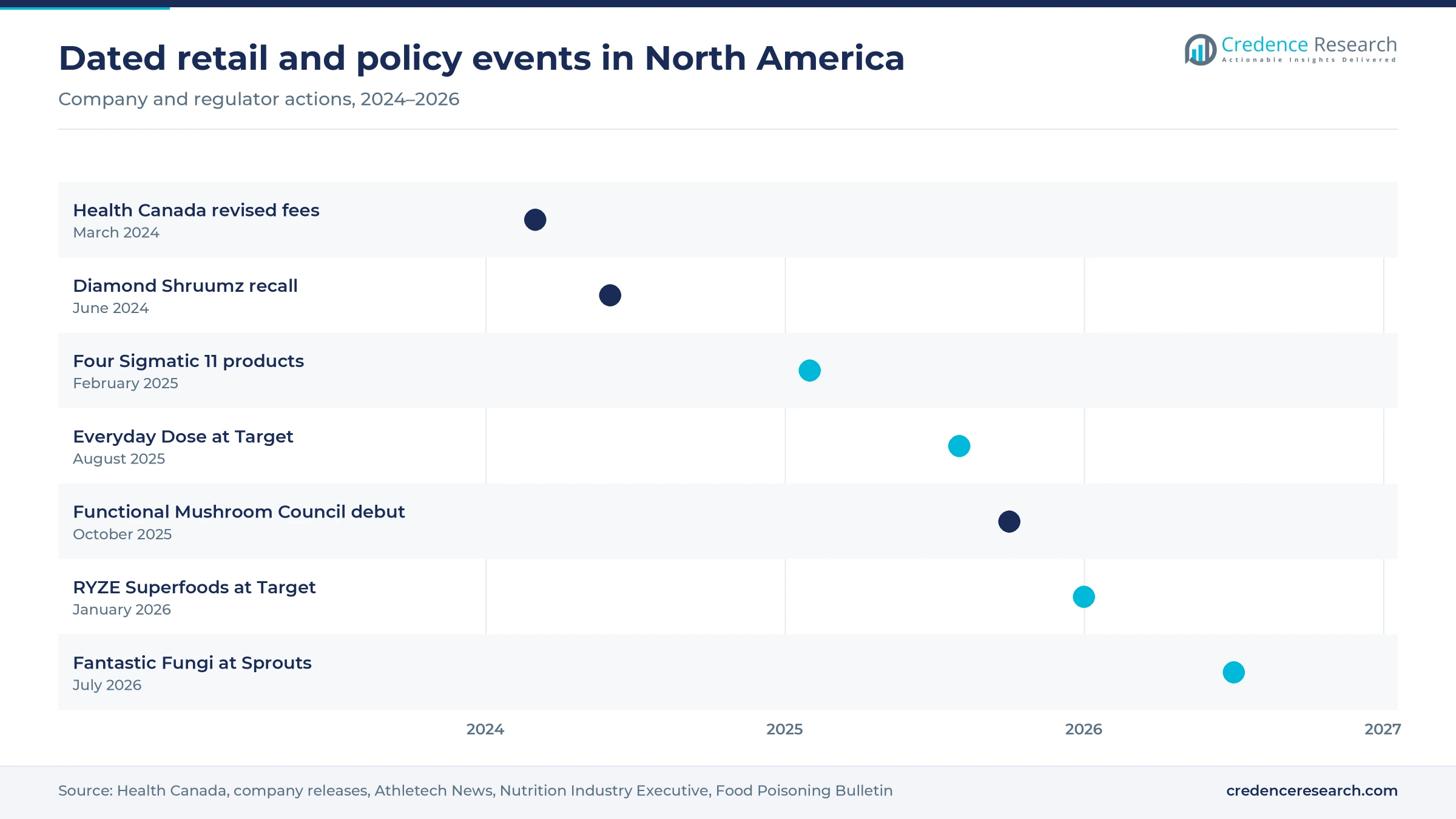
| In February 2025, Four Sigmatic announced 11 new products for Sprouts and Whole Foods, including lattes and half-caffeine ground coffee at $16.99. | Rolled out through summer 2025 and broadened its natural retail range |
| In August 2025, Everyday Dose entered more than 1,500 Target stores with mild and medium roasts and a $14.99 sample kit. | Live nationally in stores and online, adding a large mass retail footprint |
| In October 2025, the Functional Mushroom Council debuted at SupplySide Global with Fungi Perfecti, M2 Ingredients and Monterey Mushrooms among its six founding members. | Active, with research on quality standards planned for 2026 |
| In January 2026, RYZE Superfoods launched in all Target stores with lattes, bags and sticks priced from $9.99 to $17.99. | Live nationally, and described by the company as its first national retail launch |
| In July 2026, Fantastic Fungi began selling capsules and elixirs in every Sprouts Farmers Market store. | Live from July 20, 2026, adding a further brand to natural retail |
Extraction choices separate premium and accessible brands
- Whole biomass powders remain the lowest-cost route and suit blended coffee, although Nammex tests cited by vegconomist in July 2026 found reishi mycelium at 1.06% to 7.3% beta-glucan against 28.1% for whole dried reishi.
- Hot-water extracts concentrate water-soluble polysaccharides for capsules and drink mixes, and a lion's mane hot water extract featured in the Functional Mushroom Council's starch-test video reported in February 2026.
- Dual and specialized extracts add an alcohol stage to capture compounds that water leaves behind, which raises processing cost and places them mainly in the premium price tier of this market.
- Fingerprinting and starch tests are becoming the dispute line itself, since Nammex relies on AOAC method 996.11 while the Functional Mushroom Council favors metabolomics and chemical fingerprinting, according to Nutrition Industry Executive in February 2026.
Need a Custom Version of This Report?
Tailor the scope, geography, or segments to your exact requirements.
- Custom geography or segment scope
- Direct access to our analyst team
Brands built online now compete for national shelves
Competition among functional mushrooms brands in the region turns on repeat purchase more than on ingredient science, because most leading products use a similar group of six to ten species. RYZE Superfoods and Everyday Dose both added Target within the past two years and now compete head to head on its shelves. Four Sigmatic relies on its long retail history and sells at Sprouts, Fresh Thyme and Whole Foods, while MUD\WTR positions itself as a coffee alternative rather than a better coffee. Om Mushroom Superfood differs because its parent, M2 Ingredients, grows mushrooms at its own Vista, California, facility, which gives it supply control and a United States origin story. Price points are close, with the coffee products reviewed for this report between $0.85 and $1.45 per serving, so brands separate themselves through taste, caffeine level and extract disclosure. Interest in adaptogens also brings in beverage and supplement entrants from outside the mushroom category.
Companies profiled and their roles in this market
| Company | Type | Role in the market |
|---|---|---|
| RYZE Superfoods | Consumer brand | Mushroom coffee and lattes sold online, on Amazon and in all Target stores since January 2026 |
| Everyday Dose | Consumer brand | Mushroom coffee in two roasts, in more than 1,500 Target stores since August 2025 |
| Four Sigmatic | Consumer brand | Functional coffee, lattes, cocoa and green tea sold through Sprouts, Fresh Thyme, Whole Foods and Amazon |
| MUD\WTR | Consumer brand | Coffee alternative with lion's mane and reishi, listed at Target, plus a protein powder launched in August 2025 |
| Om Mushroom Superfood | Vertically integrated brand | Powders and gummies from parent M2 Ingredients, sold at Target, Whole Foods Market, Sprouts and Amazon |
Repeat purchase will decide who keeps retail space
Credence Research's view is that the 2025 and 2026 Target listings moved this category into a harder phase, where shelf velocity matters more than online storytelling. Brands now need products that sell without a long explanation, and retail scan unit growth of 34.8% against dollar growth of 23.2% suggests that lower-priced formats are already pulling average prices down. The forecast rests on repeat purchase holding up as trial shoppers arrive. Brands with secure supply and clear label language look best placed, because the FDA petition on grain substrate could quickly change how products are described on shelf.
How the regional estimates were built
The report uses 2025 as the base year and forecasts to 2035. Market values come from the Credence Research model, and country, product, application, end user and channel splits are Credence Research estimates. Supporting evidence comes from published retail scan data, government statistics from CDC, USDA, Health Canada and the World Bank, company releases, trade publications and regulatory documents. No interviews or proprietary surveys were conducted for this report, and values were cross-checked against public sales indicators. Retail scan data covers natural, conventional multi-outlet and Amazon sales only, at $494.7 million in the year to Sept. 6, 2026, so brand websites and unscanned club stores account for the remainder of the estimate.
Mass retail and new formats carry growth through 2035
The market is expected to reach USD 6.98 billion by 2035, with the United States still holding most of the value and Mexico adding share from a low base. Growth in functional mushrooms should depend on how many trial buyers become daily users, since scanned units rose 34.8% in the year to September 2026 while dollars rose 23.2%. Gummies and rest products should gain share, while powders stay the largest format. Label rules could reshape the field if the FDA acts on the Nammex petition, and Canada's June 2028 labelling deadline will also test cross-border brands.
Frequently Asked Questions
How big is the North America functional mushrooms market?
Which country leads the North America functional mushrooms market?
Which country is growing fastest in this market?
Which product type holds the largest share?
Why are gummies growing so quickly?
Which companies are active in this market?
What are the main challenges for brands?
Which sales channel is expanding fastest?
Table of Content
Chapter 1 Market Segmentation
- 1.1 Segmentation Framework
- 1.1.1 Product and Service Classification
- 1.1.2 Application and End-Use Classification
- 1.1.3 Technology and Solution Classification
- 1.1.4 Customer and Distribution Channel Classification
- 1.1.5 Geographic Segmentation
- 1.1.6 Market Segment Definitions and Boundaries
- 1.2 By Product Type
- 1.2.1 Powders and Drink Mixes
- 1.2.2 Capsules and Softgels
- 1.2.3 Gummies and Chewables
- 1.2.4 Liquids and Specialty Preparations
- 1.3 By Application
- 1.3.1 Cognitive Support
- 1.3.2 Immune and Gut Support
- 1.3.3 Energy and Performance
- 1.3.4 Rest and Skin Wellness
- 1.4 By End User
- 1.4.1 Adults Aged 35-54
- 1.4.2 Adults Aged 18-34
- 1.4.3 Adults Aged 55 and Above
- 1.4.4 Users Under 18
- 1.5 By Country
- 1.5.1 United States
- 1.5.2 Canada
- 1.5.3 Mexico
Chapter 2 Introduction
- 2.1 Report Objectives and Scope
- 2.2 Product Definition and Industry Terminology
- 2.3 Market Inclusions and Exclusions
- 2.4 Research Process
- 2.4.1 Primary Research and Expert Interviews
- 2.4.2 Secondary Research and Source Review
- 2.4.3 Top-Down and Bottom-Up Estimation
- 2.4.4 Data Triangulation and Verification
- 2.5 Market Size Measurement Basis
- 2.5.1 2025: USD 1.97 billion → 2035: USD 6.98 billion
- 2.6 Historical and Forecast Reference Periods
- 2.6.1 Historical Period: 2018-2025
- 2.6.2 Base Year: 2025
- 2.6.3 Forecast Period: 2025-2035
- 2.7 Research Assumptions and Limitations
Chapter 3 Executive Summary
- 3.1 Market Snapshot and Key Findings
- 3.2 Base-Year Market Size, 2025
- 3.3 Forecast Market Size, 2035
- 3.4 Revenue and Volume Growth Outlook
- 3.5 Key Demand and Supply Indicators
- 3.6 Leading Market Segments
- 3.7 Fastest-Growing Market Opportunities
- 3.8 Regional Performance Highlights
- 3.9 Technology and Industry Transformation
- 3.10 Competitive Landscape Summary
- 3.11 Analyst View and Strategic Implications
Chapter 4 North America Functional Mushrooms Market Trends and Developments
- 4.1 Historical Industry Development, 2018-2025
- 4.2 Recent Market Trends and Developments
- 4.3 Demand and Customer Behavior Trends
- 4.4 Technology and Product Innovation
- 4.5 Artificial Intelligence, Automation and Digitalization
- 4.6 Local Manufacturing and Supply Chain Realignment
- 4.7 Industry Partnerships, Mergers and Acquisitions
- 4.8 Sustainability and Circular Economy Developments
- 4.9 Government and Private Sector Investment Trends
- 4.10 Emerging Business Models and Commercialization
- 4.11 Industry Developments and Announcements
Chapter 5 North America Functional Mushrooms Market Production, Supply and Demand Analysis
- 5.1 Demand Trend and Consumption Analysis, 2018-2025
- 5.2 Demand Forecast, 2025-2035
- 5.3 Production and Output Trend, 2018-2025
- 5.4 Production and Output Forecast, 2025-2035
- 5.5 Installed Capacity and Capacity Utilization
- 5.6 Company-Wise Production Plants and Statistics
- 5.6.1 Installed Production Capacity
- 5.6.2 Actual Production
- 5.6.3 Planned Capacity and Expansion Targets
- 5.7 Supply Chain Structure and Procurement Trends
- 5.8 Supply-Demand Gap and Bottlenecks
- 5.9 Import Dependence and Sourcing Structure
- 5.10 Contract Manufacturing and Outsourcing
- 5.11 Regional Supply and Demand Concentration
Chapter 6 North America Functional Mushrooms Market Pricing Analysis
- 6.1 Pricing Structure and Measurement
- 6.2 Historical Pricing Trends, 2018-2025
- 6.3 Pricing Outlook, 2025-2035
- 6.4 Average Selling Price and Unit Economics
- 6.5 Pricing by Product and Market Segment
- 6.6 Geographic Pricing Differences
- 6.7 Key Input, Energy, Labor and Logistics Costs
- 6.8 Contract Pricing and Purchasing Models
- 6.9 Pricing Sensitivity and Competitive Positioning
- 6.10 Price, Margin and Profitability Implications
Chapter 7 North America Functional Mushrooms Market Dynamics
- 7.1 Market Growth Drivers
- 7.1.1 Demand-Side Drivers
- 7.1.2 Technology and Innovation Drivers
- 7.1.3 Infrastructure and Investment Drivers
- 7.1.4 Regulatory and Policy Drivers
- 7.2 Market Restraints
- 7.2.1 Cost and Affordability Constraints
- 7.2.2 Technology and Adoption Barriers
- 7.2.3 Supply Chain and Operational Constraints
- 7.3 Market Challenges
- 7.3.1 Competitive Pressure and Margin Erosion
- 7.3.2 Skills, Infrastructure and Implementation Gaps
- 7.4 Emerging Market Opportunities
- 7.5 Market Dynamics Impact and Time-Horizon Assessment
Chapter 8 North America Functional Mushrooms Value Chain Analysis
- 8.1 Industry Value Chain Overview
- 8.2 Upstream Suppliers and Critical Inputs
- 8.3 Technology and Component Providers
- 8.4 Manufacturing or Service Delivery
- 8.5 Distribution, Channel Partners and Integrators
- 8.6 Downstream Applications and End Users
- 8.7 Value Addition and Profit Pools
- 8.8 Vertical Integration and Outsourcing
- 8.9 Supplier Concentration and Risk
- 8.10 Supply Chain Localization and Resilience
Chapter 9 North America Functional Mushrooms Market Regulations and Policies
- 9.1 Relevant Laws, Standards and Compliance Frameworks
- 9.2 Product, Service, Safety and Quality Requirements
- 9.3 Government Policies, Incentives and Subsidies
- 9.4 Imports, Exports and Trade Barriers
- 9.5 Public Procurement and Local Content Requirements
- 9.6 Environmental and Sustainability Compliance
- 9.7 Upcoming Policy Changes and Market Implications
Chapter 10 North America Functional Mushrooms Market Hotspots and Opportunities
- 10.1 Market Opportunity Mapping and Growth Hotspots
- 10.2 High-Growth Applications and Customer Groups
- 10.3 Underserved Markets and White-Space Opportunities
- 10.4 Emerging Technology and Product Opportunities
- 10.5 New Capacity and Investment Hotspots
- 10.6 Market Entry and Expansion Opportunities
- 10.7 Distribution and Partnership Opportunities
- 10.8 Near-Term and Long-Term Commercial Potential
- 10.9 Opportunity Attractiveness and Execution Risks
Chapter 11 North America Functional Mushrooms Market Outlook, 2025-2035
- 11.1 Market Size and Analysis
- 11.1.1 Revenue (Market Measurement: 2025: USD 1.97 billion → 2035: USD 6.98 billion)
- 11.1.2 Market Volume and Quantity Sold
- 11.1.3 Historical Market Size, 2018-2025
- 11.1.4 Base-Year Market Size, 2025
- 11.2 Market Forecast, 2025-2035
- 11.2.1 Revenue Forecast to 2035
- 11.2.2 Volume Forecast to 2035
- 11.2.3 CAGR and Year-on-Year Growth
- 11.2.4 Incremental Revenue Opportunity
- 11.3 Forecast Assumptions and Scenario Analysis
- 11.3.1 Base-Case Forecast
- 11.3.2 Optimistic and Conservative Scenarios
- 11.3.3 Technology, Pricing and Policy Sensitivities
- 11.4 Market Attractiveness and Growth Outlook
Chapter 12 North America Functional Mushrooms Market Segmentation and Outlook
- 12.1 Segmentation Summary and Market Shares, 2025
- 12.2 Largest and Fastest-Growing Segments
- 12.3 By Product Type - Market Size and Forecast, 2025-2035
- 12.3.1 Segment Definition and Scope
- 12.3.2 Historical Market Size, 2018-2025
- 12.3.3 Revenue Forecast, 2025-2035
- 12.3.4 Volume Forecast, 2025-2035
- 12.3.5 Base-Year Market Share, 2025
- 12.3.6 Segment CAGR and Growth Drivers
- 12.3.7 Subsegment Market Size and Forecast
- 12.3.7.1 Powders and Drink Mixes
- 12.3.7.2 Capsules and Softgels
- 12.3.7.3 Gummies and Chewables
- 12.3.7.4 Liquids and Specialty Preparations
- 12.3.8 Subsegment Pricing and Adoption Trends
- 12.3.9 Leading Suppliers and Competition
- 12.3.10 Regional Demand and Opportunities
- 12.4 By Application - Market Size and Forecast, 2025-2035
- 12.4.1 Segment Definition and Scope
- 12.4.2 Historical Market Size, 2018-2025
- 12.4.3 Revenue Forecast, 2025-2035
- 12.4.4 Volume Forecast, 2025-2035
- 12.4.5 Base-Year Market Share, 2025
- 12.4.6 Segment CAGR and Growth Drivers
- 12.4.7 Subsegment Market Size and Forecast
- 12.4.7.1 Cognitive Support
- 12.4.7.2 Immune and Gut Support
- 12.4.7.3 Energy and Performance
- 12.4.7.4 Rest and Skin Wellness
- 12.4.8 Subsegment Pricing and Adoption Trends
- 12.4.9 Leading Suppliers and Competition
- 12.4.10 Regional Demand and Opportunities
- 12.5 By End User - Market Size and Forecast, 2025-2035
- 12.5.1 Segment Definition and Scope
- 12.5.2 Historical Market Size, 2018-2025
- 12.5.3 Revenue Forecast, 2025-2035
- 12.5.4 Volume Forecast, 2025-2035
- 12.5.5 Base-Year Market Share, 2025
- 12.5.6 Segment CAGR and Growth Drivers
- 12.5.7 Subsegment Market Size and Forecast
- 12.5.7.1 Adults Aged 35-54
- 12.5.7.2 Adults Aged 18-34
- 12.5.7.3 Adults Aged 55 and Above
- 12.5.7.4 Users Under 18
- 12.5.8 Subsegment Pricing and Adoption Trends
- 12.5.9 Leading Suppliers and Competition
- 12.5.10 Regional Demand and Opportunities
- 12.6 By Country - Market Size and Forecast, 2025-2035
- 12.6.1 Segment Definition and Scope
- 12.6.2 Historical Market Size, 2018-2025
- 12.6.3 Revenue Forecast, 2025-2035
- 12.6.4 Volume Forecast, 2025-2035
- 12.6.5 Base-Year Market Share, 2025
- 12.6.6 Segment CAGR and Growth Drivers
- 12.6.7 Subsegment Market Size and Forecast
- 12.6.7.1 United States
- 12.6.7.2 Canada
- 12.6.7.3 Mexico
- 12.6.8 Subsegment Pricing and Adoption Trends
- 12.6.9 Leading Suppliers and Competition
- 12.6.10 Regional Demand and Opportunities
- 12.7 Segment Growth Comparison
- 12.8 Segment Attractiveness and Priority Matrix
Chapter 13 North America Functional Mushrooms End-Use and Application Market Outlook
- 13.1 End-Use Industry and Customer Demand Structure
- 13.2 Leading Applications and Customer Groups
- 13.3 End-Use Market Size, Share and Forecast
- 13.4 Major End-Use Industry Deep Dives
- 13.4.1 Customer Requirements and Use Cases
- 13.4.2 Demand and Replacement Cycles
- 13.4.3 Technical and Regulatory Considerations
- 13.4.4 Purchasing and Procurement Models
- 13.4.5 Leading Vendors and Distribution Channels
- 13.4.6 Forecast and Commercial Opportunities
- 13.5 Emerging Applications and Cross-Segment Demand
- 13.6 End-Use Industry Investment Priorities
Chapter 14 North America Functional Mushrooms Geographic Market Outlook, 2025-2035
- 14.1 Regional Market Size and Country-Level Shares, 2025
- 14.2 Country Market Size Comparison, 2025
- 14.3 Country Market Forecasts, 2025-2035
- 14.4 Subregional Industrial and Demand Clusters
- 14.5 Intra-Regional Pricing and Cost Differences
- 14.6 Cross-Border Trade and Supply Networks
- 14.7 Regional Supply and Demand Balances
- 14.8 Country Opportunity Comparison and Prioritization
Note: Every listed country is covered on the structure shown under the first country.
Chapter 15 North America Functional Mushrooms Technology, Innovation and Sustainability Outlook
- 15.1 Technology Landscape and Maturity
- 15.2 Product, Process and Service Innovation
- 15.3 AI, Automation and Digital Tools in the Industry
- 15.4 Technology Adoption and Performance Benchmarking
- 15.5 Innovation Pipeline and R&D Investment
- 15.6 Patent and Intellectual Property Trends
- 15.7 Energy Efficiency and Resource Management
- 15.8 Sustainability, Recycling and Circularity
- 15.9 Technology Roadmap, 2025-2035
- 15.10 Risks of Obsolescence and Technology Substitution
Chapter 16 North America Functional Mushrooms Market Key Strategic Imperatives
- 16.1 Growth and Market Entry Priorities
- 16.2 High-Return Products and Segments
- 16.3 Pricing, Profitability and Cost Optimization
- 16.4 Technology Investment and Product Differentiation
- 16.5 Supply Chain Localization and Resilience
- 16.6 Distribution and Customer Acquisition
- 16.7 Partnership, Acquisition and Capacity Strategy
- 16.8 Regional Expansion Priorities
- 16.9 Short-, Medium- and Long-Term Actions
Chapter 17 Competition Outlook
- 17.1 Industry Competition Characteristics
- 17.2 Market Structure and Concentration
- 17.3 Market Share and Competitive Positioning, 2025
- 17.4 Company-Wise Revenue and Product Benchmarking
- 17.5 Production and Service Capacity Benchmarking
- 17.6 Technology, Pricing and Differentiation
- 17.7 Regional Footprint and Distribution Strength
- 17.8 Mergers, Acquisitions and Strategic Alliances
- 17.9 New Entrants and Competitive Threats
- 17.10 Porter's Five Forces and Industry Attractiveness
- 17.11 Competitive Outlook, 2025-2035
Chapter 18 Company Profiles
- 18.1 Company Coverage and Selection Criteria
- 18.2 RYZE Superfoods
- 18.2.1 Business Description
- 18.2.2 Company Ownership and Geographic Presence
- 18.2.3 Product and Service Portfolio
- 18.2.4 Manufacturing and Operating Footprint
- 18.2.5 Production Capacity and Expansion Plans
- 18.2.6 Financial Performance and Investment
- 18.2.7 Market Share and Competitive Position
- 18.2.8 Technology and Innovation Capabilities
- 18.2.9 Strategic Alliances or Partnerships
- 18.2.10 Recent Developments
- 18.2.11 Growth Strategy and Outlook
- 18.3 Everyday Dose
- 18.4 Four Sigmatic
- 18.5 MUD\WTR
- 18.6 Om Mushroom Superfood
- 18.7 Other Relevant Market Participants
Note: Every listed company is profiled on the structure shown under the first company. The company list is preliminary and may change based on research findings, market developments, data availability and client requirements.
Chapter 19 Disclaimer
- 19.1 Research and Forecast Disclaimer
- 19.2 Data Source and Estimation Limitations
Note: The depth of individual sections depends on data availability for this market. Volume, capacity, trade and other unit-based metrics are included where applicable.

