
Clinic procedures take most of the spend
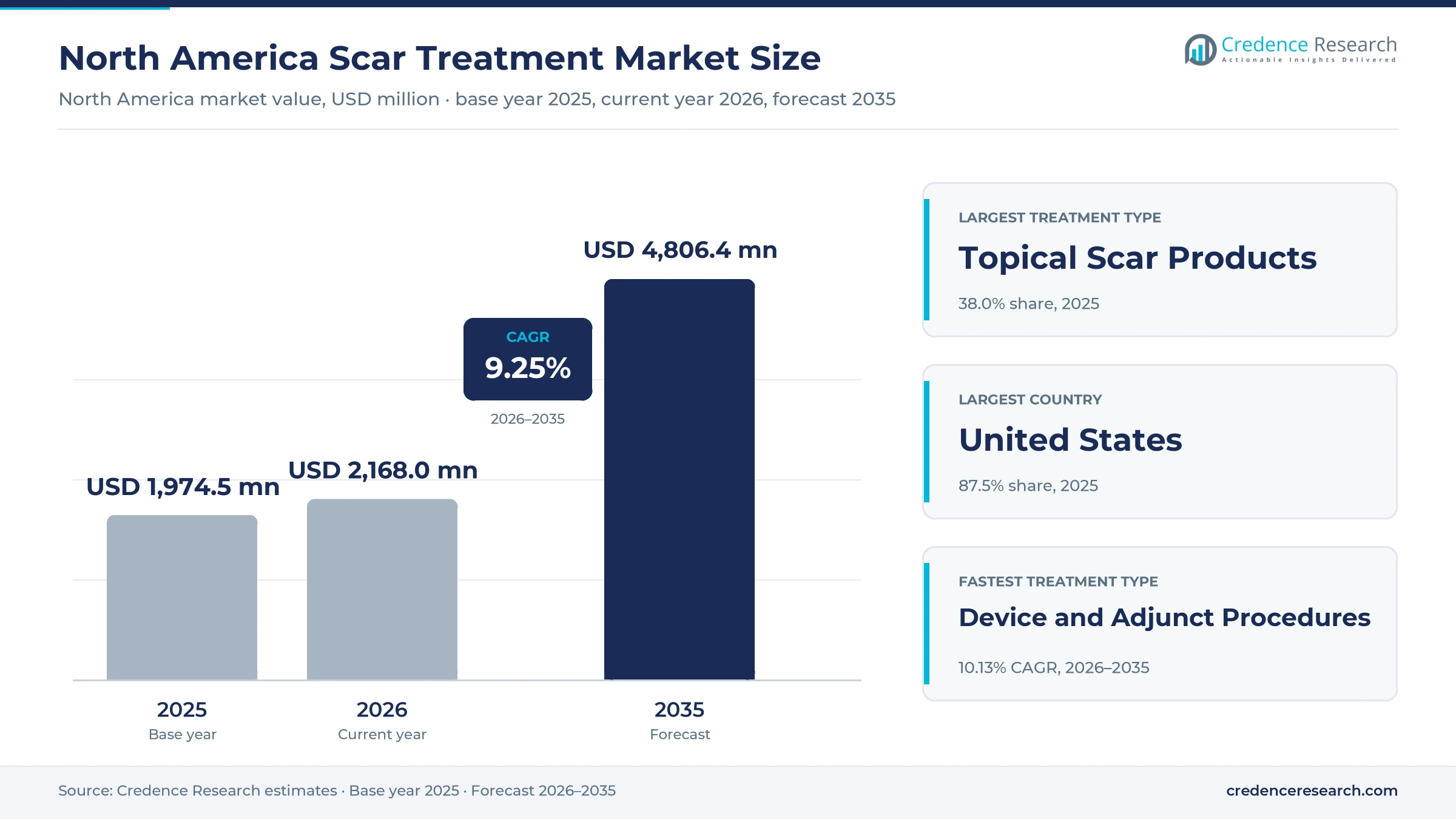
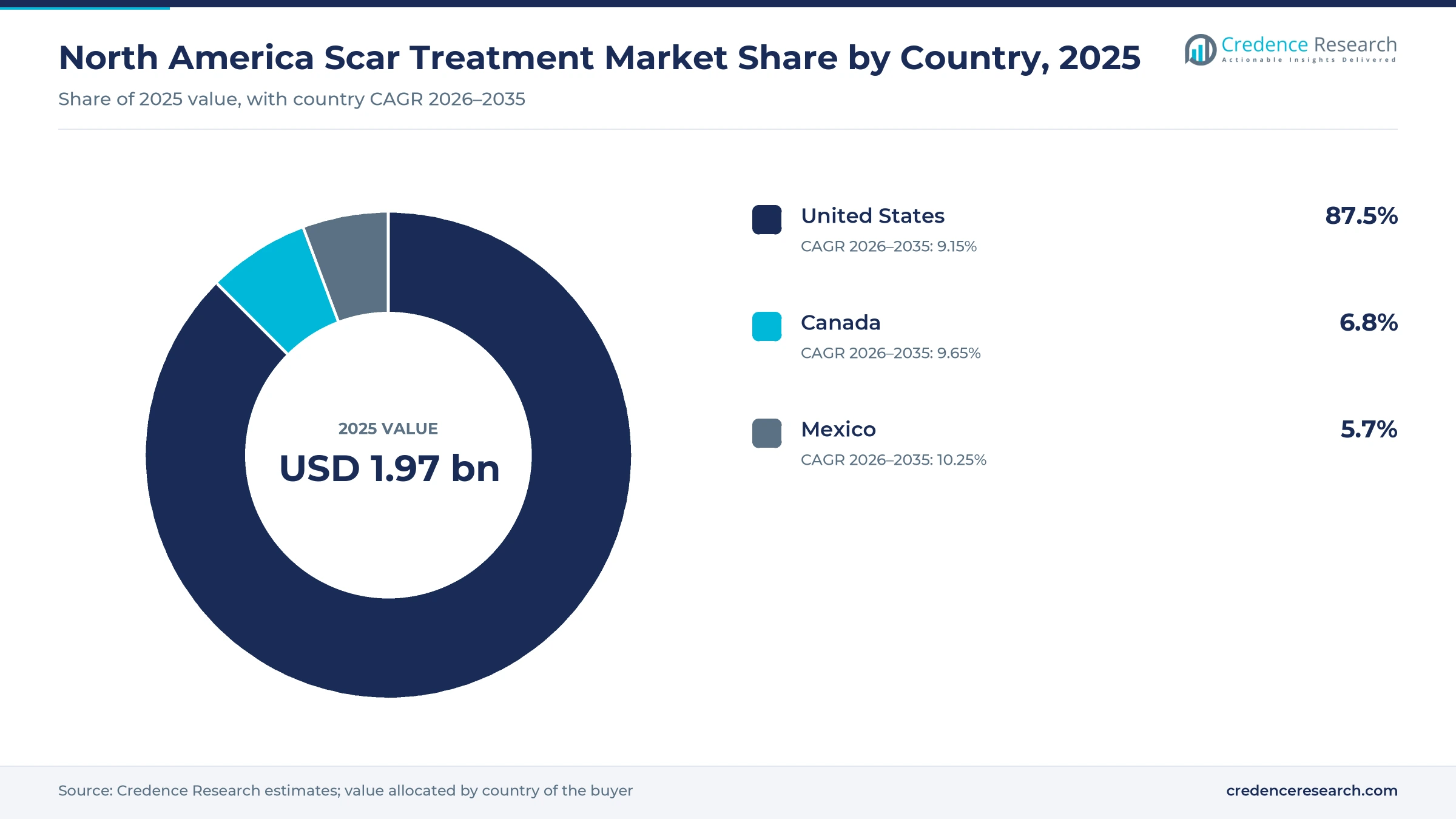
The North America scar treatment market was valued at USD 1.97 billion in 2025 and is projected to increase from USD 2.17 billion in 2026 to USD 4.81 billion by 2035, registering a CAGR of 9.25% during 2026–2035. Demand rests on acne patients seeking scar care, on surgical patients managing incisions, and on burn survivors who need long rehabilitation. The United States held 87.5% of regional value in 2025, reflecting the depth of its dermatology and plastic surgery practices and its large self-pay base. Mexico is the fastest-growing country at 10.25% a year, helped by a large aesthetic surgery workforce and rising specialist burn caseloads. Treatment choice is widening because the FDA cleared a nonablative laser for acne scarring across all Fitzpatrick skin types in April 2025, which widens the group of patients a clinic can treat with one device. However, most appearance-only care remains out of pocket, so pricing and clinic access continue to shape how quickly patients move from topicals to procedures.
What does scar treatment spending in North America include?
The market counts spending on topical silicone and botanical scar products, intralesional injections, surgical scar revision and laser and other energy-based sessions delivered for scars. Patients buy topicals directly from pharmacies and online stores, while procedures are bought through dermatology, plastic surgery and burn care practices. Clinic procedures account for most of the value in the Credence Research model, while topicals serve as the low-cost first step.
General anti-aging aesthetics, tattoo removal and acute wound dressings are excluded unless they are sold or used specifically for scars. The value chain runs from device and consumer brand owners through distributors and retailers to clinics, hospitals and the patients or payers who fund care.
North America Scar Treatment Market Insights
- The market reaches USD 4.81 billion by 2035 from USD 1.97 billion in 2025, a 9.25% CAGR, as acne-scar procedures and post-surgical care expand across the three countries.
- The United States held 87.5% of 2025 regional value, supported by an estimated 7,752 plastic surgeons and a deep private-pay clinic network.
- Device and Adjunct Procedures led with 40.0% of 2025 value because laser and other energy-based sessions are higher-value clinic services, while topical gels remain a low-cost first step.
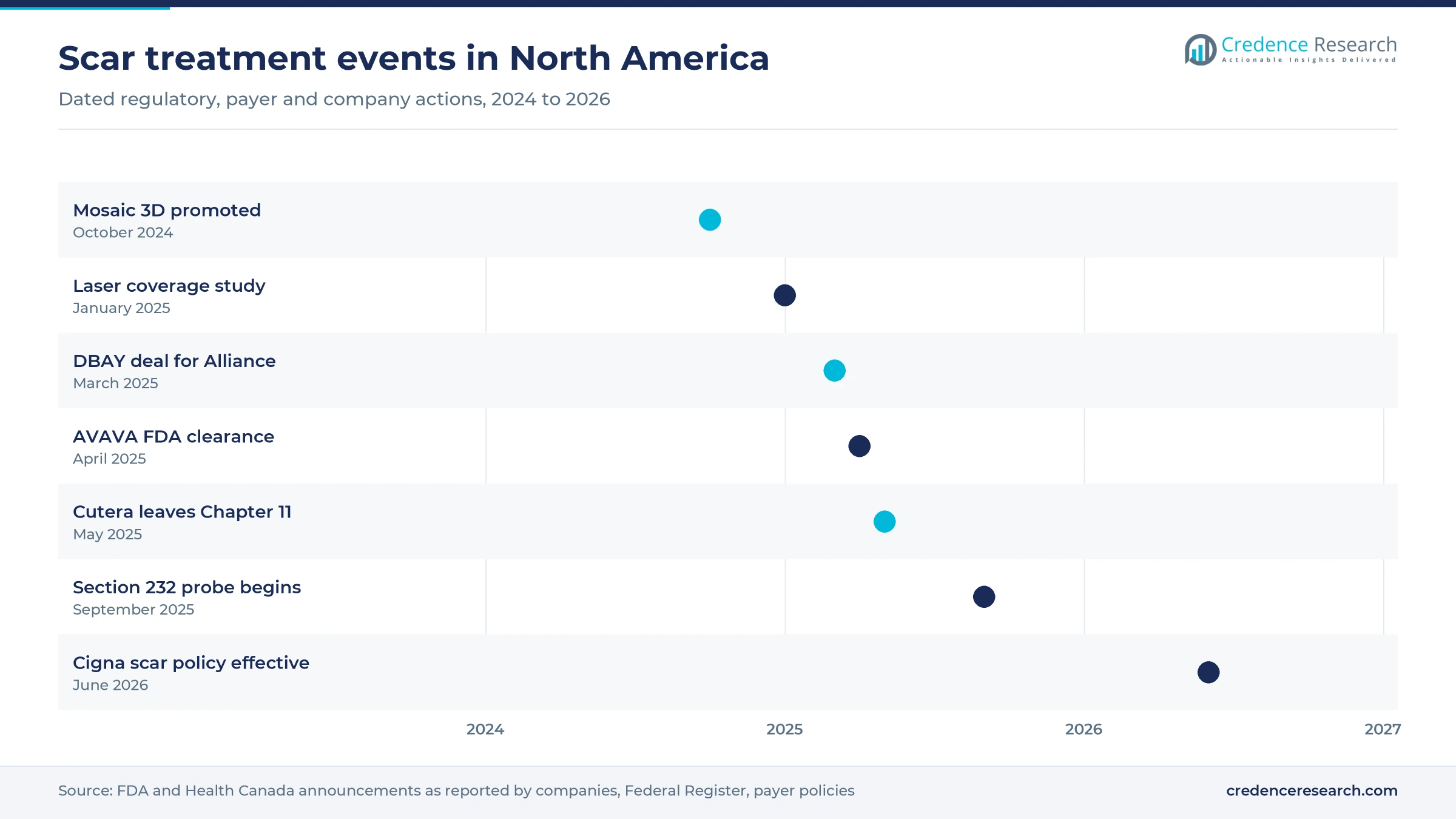
- The April 2025 FDA clearance of AVAVA Focal Point technology across all Fitzpatrick skin types widened the pool of acne-scar patients eligible for laser sessions.
- Ownership changed quickly, with DBAY Advisors agreeing to buy Alliance Pharma in March 2025 and Cutera leaving Chapter 11 as a private company in May 2025.
Device procedures lead value and grow fastest
Why do device procedures lead and grow fastest?
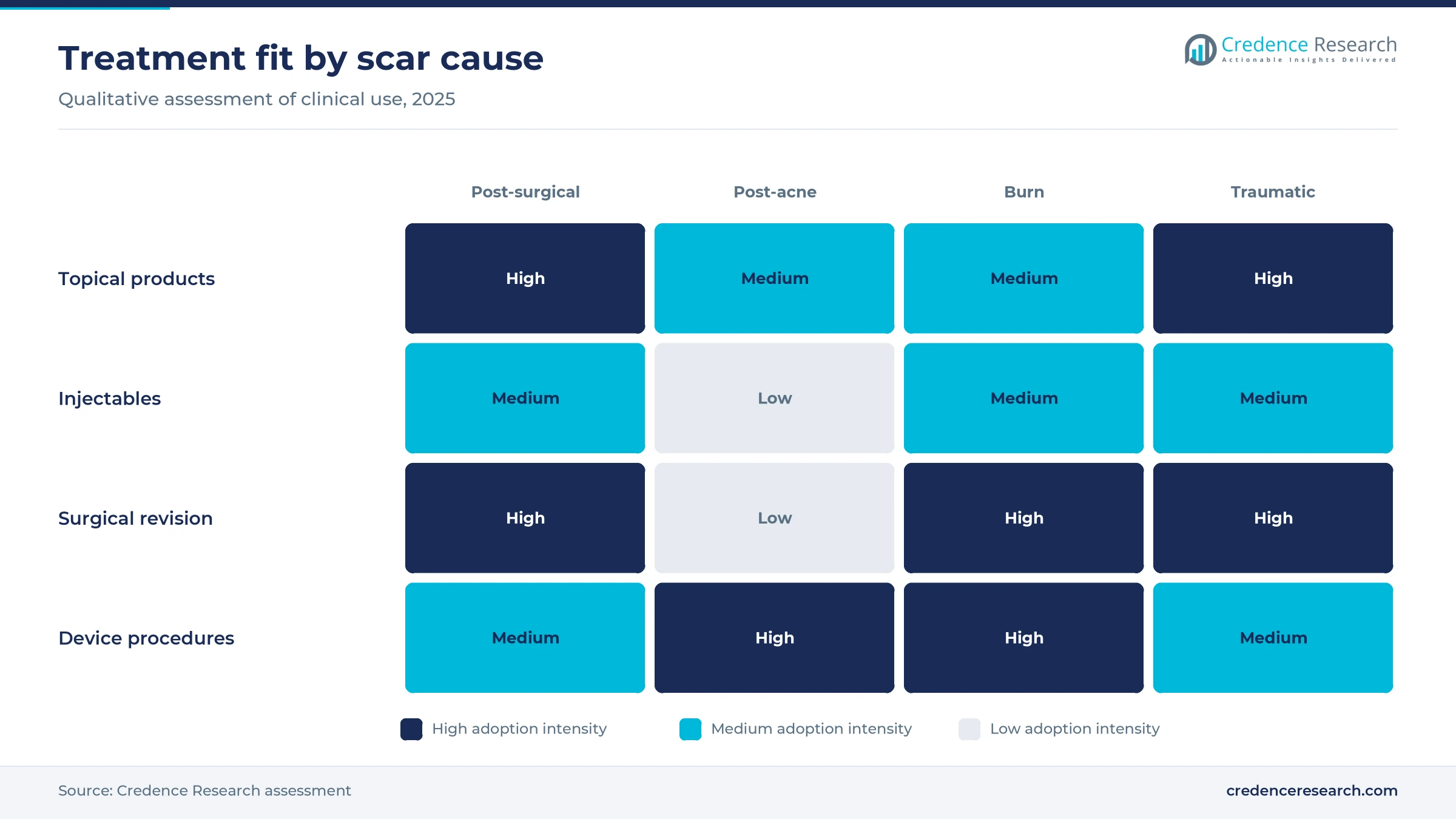
Based on treatment type, the market is categorized into topical scar products, injectable scar treatments, surgical scar revision and device and adjunct procedures. Device and Adjunct Procedures led with 40.0% of 2025 value because laser work is a higher-value clinic service, and the International Society of Aesthetic Plastic Surgery estimated 101,497 full-field ablative procedures in the United States in 2024. Device and Adjunct Procedures also grow fastest at 10.03% a year as clearances widen eligibility, including the April 2025 FDA clearance of AVAVA Focal Point technology for acne scarring in Fitzpatrick skin types I to VI, as reported by MedPath.
Which scar causes generate the most spending?
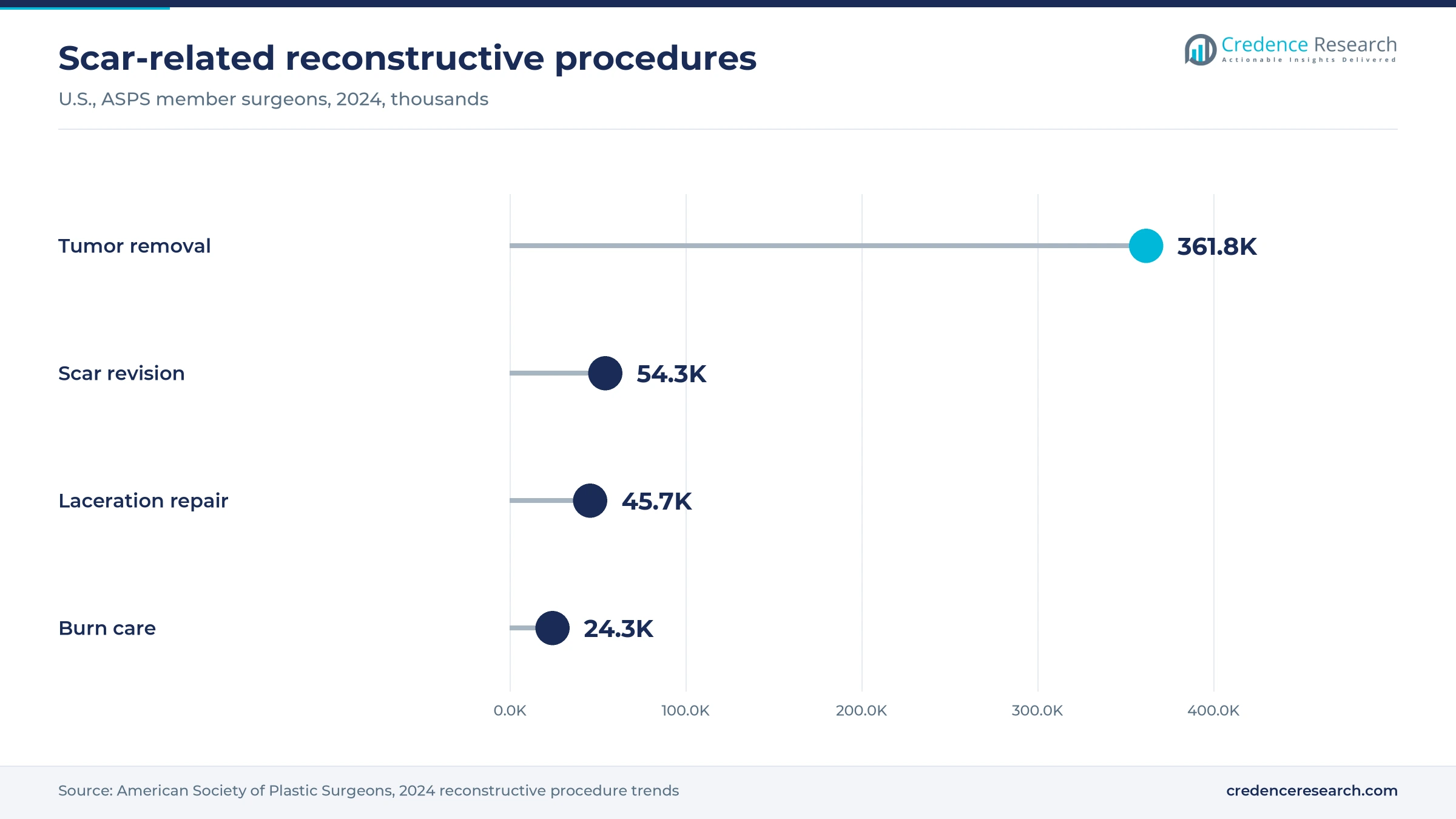
Based on scar etiology, the market is categorized into post-surgical scars, post-acne scars, burn scars and traumatic scars. Post-Surgical Scars led with 42.0% of 2025 value because operative volume gives a steady base, with American Society of Plastic Surgeons members reporting 361,798 tumor removals in 2024. Post-Acne Scars grow fastest at 10.01% a year as the addressable pool is large, since the American Academy of Dermatology counts up to 50 million Americans with acne annually. Burn scars form a smaller but clinically intensive group that depends on specialist centers and long rehabilitation.
Where do patients receive scar care?
Based on care setting, the market is categorized into hospital-based care, specialist outpatient clinics and home-based care. Specialist Outpatient Clinics led with 62.0% of 2025 value because laser sessions are sold by office practices, while hospital scar work is concentrated, with the American Burn Association finding that 94 hospitals handled 81% of burn admissions. Home-Based Care grows fastest at 9.74% a year as Aetna requires a failed trial of silicone or paper tape before covering fractional laser, and Managed Healthcare Executive reported in September 2026 that more than 60% of U.S. counties have no dermatologist.
How do scar products and services reach patients?
Based on distribution channel, the market is categorized into retail pharmacy channels, digital commerce channels and professional care channels. Professional Care Channels led with 80.0% of 2025 value because procedures are only bought through practices, and Stratpharma offered its U.S. silicone gel through physicians when it entered the market in June 2017. Digital Commerce Channels grow fastest at 10.72% a year as online buying spreads, with the U.S. Census Bureau reporting that e-commerce reached 17.1% of retail sales in the second quarter of 2026.
| Segment Group | Leading Sub-segment | Share, 2025 | Fastest-growing Sub-segment | CAGR, 2026–2035 |
|---|---|---|---|---|
| By Treatment Type | Device and Adjunct Procedures | 40.0% | Device and Adjunct Procedures | 10.03% |
| By Scar Etiology | Post-Surgical Scars | 42.0% | Post-Acne Scars | 10.01% |
| By Care Setting | Specialist Outpatient Clinics | 62.0% | Home-Based Care | 9.74% |
| By Distribution Channel | Professional Care Channels | 80.0% | Digital Commerce Channels | 10.72% |
Request a Free Sample
Fill in your details and we'll send you a free sample report.
- Sample data tables & charts
- Research methodology
Acne, surgery and laser capacity set the pace of demand
Acne patients are converting into scar-treatment buyers
Conversion of acne patients into scar-treatment buyers is the largest source of new demand because the pool of potential patients is so large. The American Academy of Dermatology states that acne affects up to 50 million Americans annually, while a 2022 Canadian Skin Patient Alliance survey with 154 responses found 87% reporting scarring, although that sample was not population-representative. Clinical evidence is also easing the decision for darker skin types, since MedPath reported in April 2025 that a 47-subject AVAVA study, in which 75% identified as African American, Asian or Hispanic/Latino, showed a 50% median reduction in scar severity. As a result, Post-Acne Scars are projected to expand at 10.01% a year through 2035.
Post-surgical scar management follows reconstructive volume
Post-surgical scar management grows with the volume of operations, because every incision creates a potential buyer of silicone sheeting or later revision. American Society of Plastic Surgeons data for 2024 show members performing 1,048,534 reconstructive procedures, up 2% from 2023, including 54,280 scar revisions, up 4%. Those counts cover members only, which is why the International Society of Aesthetic Plastic Surgery estimate of 190,854 U.S. surgical scar revisions in 2024 is far higher. Suppliers are positioned for this demand, as Smith+Nephew keeps its Cica-Care silicone gel sheet in U.S. commercial distribution under FDA product code MDA, a category bought alongside advanced wound dressings by surgical practices. In turn, post-surgical scars held 42.0% of 2025 spending in this regional market.
Specialist laser capacity is expanding across the region
Specialist laser capacity lifts spending because scar remodeling can only be sold where trained operators and suitable devices are available. The International Society of Aesthetic Plastic Surgery survey estimated 101,497 full-field ablative procedures in the United States and 15,530 in Mexico during 2024. Device makers are adding to that installed base, as Cynosure Lutronic promoted its 1550 nm Mosaic 3D fractional laser for tone and texture in October 2024 and sells directly in the United States and Canada, and Candela obtained Health Canada licenses in February 2023 for Frax 1550 applicators that treat acne and surgical scars. These platforms are used across other aesthetic energy devices, so a clinic can justify the purchase on several indications. Consequently, Device and Adjunct Procedures are forecast to rise at 10.03% a year.
Burn survivors create long-duration rehabilitation demand
Burn injuries add a smaller but durable stream of demand, because scar care continues well after the acute hospital stay ends. The American Burn Association fact sheet cites 398,000 fire or burn injuries in 2021 and 29,165 U.S. burn admissions a year on 2020 data, with 94 hospitals handling 81% of admissions. Mexico shows similar pressure, since the Mexican Social Security Institute said in May 2026 that pediatric burn cases at its national referral hospital rose from 217 in 2024 to 332 in 2025. Payers also recognize this need more readily than appearance care, as Aetna covers fractional ablative laser for burn scars with documented functional impairment. This keeps specialist burn units and rehabilitation teams as steady buyers.
Nonablative lasers and new ownership reshape supply
A shift toward nonablative lasers for all skin types
Clinics are shifting toward nonablative scar lasers because devices cleared for all skin types with short recovery widen the patient base. MedPath reported that AVAVA gained FDA clearance for Focal Point technology in April 2025 covering Fitzpatrick types I to VI, with an average reported pain score of 3 out of 10 and mild redness typically resolving in one to two days. The same direction appears in Cynosure Lutronic's Mosaic 3D, a 1550 nm erbium glass nonablative fractional laser promoted in October 2024 for tone and texture, and in Candela's Frax Pro platform, licensed by Health Canada in February 2023. As a result, post-acne work is the fastest-growing scar cause in the Credence Research model for this regional market through 2035.
Rising private ownership is reshaping the supplier base
Ownership of leading scar brands and laser makers is moving into private hands, which changes how suppliers fund launches and clinic support. U.K. Investor Magazine reported in March 2022 that Perrigo sold ScarAway to Alliance Pharma, together with U.S. rights to Kelo-cote, for $19.4 million in cash. Alliance itself agreed on March 28, 2025 to a £349.7 million takeover by DBAY Advisors, its largest shareholder, according to Sharecast. Cutera emerged from Chapter 11 in May 2025 as a private company after cutting debt by nearly $400 million and raising $65 million from its lenders, according to its own release. Cynosure and Lutronic had already combined in 2024, so clinic buyers now deal with vendors whose owners and funding have changed.
Opportunity in home-first care where specialists are scarce
Home-first care offers a clear opening because large areas of the region lack a nearby specialist. Managed Healthcare Executive reported in September 2026 that the United States has 3.4 dermatologists per 100,000 people and that only about 10% practice in rural areas. The Canadian Dermatology Association puts Canada at about 1.9 per 100,000 in 2023, with Saskatchewan at 0.7 and a shortfall of 465 against its target ratio. Online buying can close part of this gap, since U.S. Census Bureau data put e-commerce at 17.1% of retail sales in the second quarter of 2026. Brands that pair silicone products with remote guidance could therefore capture patients before any clinic visit, and Digital Commerce Channels are forecast to grow at 10.72% a year.
Opportunity in Mexico's large surgeon and procedure base
Mexico offers an opening for device makers and clinic groups because its aesthetic workforce is large relative to its share of regional value. The International Society of Aesthetic Plastic Surgery estimated 1,294,946 procedures in Mexico in 2024, with 1,991 plastic surgeons and 32,254 surgical scar revisions. Public capacity for severe cases is concentrated, as La Razón reported in September 2025 that the National Rehabilitation Institute burn service has 20 subacute beds and two operating rooms. That concentration leaves room for private outpatient scar programs in other cities. As a result, Mexico is the fastest-growing country in this report, even though it held only 5.7% of 2025 regional value.
Coverage limits and specialist shortages restrain uptake
Insurers limit laser coverage to functional impairment
Limited coverage is the main brake on procedure spending because most patients must pay themselves. A January 2025 study in the Journal of Burn Care & Research found that 37.2% of 60 major U.S. insurers considered laser therapy medically necessary, typically only with documented functional impairment. Cigna's policy effective June 15, 2026 treats revision done solely for appearance as cosmetic. Clinics can respond with package pricing and financing, although patients without savings may remain with lower-cost topicals.
Evidence gaps weaken payer and buyer confidence
Thin evidence makes it harder for clinics and payers to justify higher-priced care. Canada's CADTH concluded in its June 24, 2019 review of fractionated CO2 laser for burn scars that the evidence was of limited quality and found no cost-effectiveness data. Similarly, Aetna's policy reviewed May 28, 2026 lists silicone gel and sheeting as unproven for hypertrophic scars and keloids. Manufacturers can reduce this barrier by funding larger controlled trials with functional outcomes.
Specialist waits delay procedures for many patients
Scarce specialist time delays treatment and caps procedure volume, especially outside large cities. AMN Healthcare found in its 2025 physician survey that dermatology appointments took an average of 36.5 days across 15 metro areas, up 6% since 2022. The strain is sharper in Canada, where the Canadian Dermatology Association reports a shortfall against its target ratio. Practices can offset part of this by delegating device sessions to trained staff under physician supervision, where provincial and state rules allow.
Trade policy could raise imported device and dressing costs
Trade policy adds cost uncertainty because the U.S. review reaches imported products used in scar care. The Commerce Department began a Section 232 investigation on Sept. 2, 2025 covering medical consumables, equipment and devices, with comments due Oct. 17, 2025, and SPS Commerce reported on Oct. 28, 2026 that no report, proclamation or tariff had followed. Any later tariff would fall first on importers and then on clinics buying capital equipment. Suppliers could therefore consider domestic assembly and longer contracts to protect margins and patient prices.
The United States dominates, and Mexico grows quickest
| Country | Value, 2025 (USD billion) | Share, 2025 | CAGR, 2026–2035 |
|---|---|---|---|
| United States | 1.73 | 87.5% | 9.15% |
| Canada | 0.13 | 6.8% | 9.65% |
| Mexico | 0.11 | 5.7% | 10.25% |
United States anchors spending through private-pay clinics
The United States held 87.5% of 2025 value and grows at 9.15% a year because it combines a large clinic base with patients who pay directly for appearance care. The International Society of Aesthetic Plastic Surgery estimated 6,165,173 aesthetic procedures and 7,752 plastic surgeons in this largest regional market in 2024. However, access is uneven, since Managed Healthcare Executive reported an average wait of about 32.3 days to see a dermatologist in September 2026.
Canada grows from a small base with few dermatologists
Canada held 6.8% of 2025 value and grows at 9.65% a year, with demand tied to a thin specialist base of about 750 registered dermatologists in 2023. The Canadian Skin Patient Alliance states that acne affects about 20% of Canadians, which supports a sizable post-acne demand pool. Cynosure Lutronic also gained Health Canada clearance for its XERF skin tightening device in April 2025, four months before its U.S. clearance, which adds to its Canadian clinic offer.
Mexico expands fastest through aesthetic and burn demand
Mexico held 5.7% of 2025 value and grows at 10.25% a year, the fastest pace in the region, because a large surgical workforce is building from a small share of regional spending. The International Society of Aesthetic Plastic Surgery estimated 560,865 nonsurgical aesthetic procedures in Mexico in 2024, which indicates clinic demand beyond surgery. Burn care adds a further need, as the Mexican Social Security Institute reported a sharp rise in specialist pediatric cases in its May 2026 bulletin.
Clearances and restructurings marked 2025
| Development | Status and market relevance |
|---|---|
| In March 2025, DBAY Advisors agreed to buy Alliance Pharma, owner of ScarAway, in a £349.7 million cash deal announced on March 28. | Takeover agreed; moves a U.S. silicone scar brand into private ownership |
| In April 2025, the FDA cleared AVAVA Focal Point technology for acne scarring across Fitzpatrick skin types I to VI, according to MedPath. | Cleared; widens laser eligibility for patients with darker skin |
| In April 2025, Cynosure Lutronic announced Health Canada clearance of its XERF radio frequency device for skin tightening. | Cleared; adjacent to scars, but adds to the company's Canadian clinic offer |
| In May 2025, Cutera completed its restructuring and left Chapter 11 after cutting debt by nearly $400 million. | Completed; now operating as a private company |
Four treatment mechanisms compete for each scar type
- Silicone occlusion places a silicone sheet or gel over the scar, and FDA device records list Smith+Nephew Cica-Care under product code MDA as an elastomer for scar management.
- Pharmacologic therapy uses intralesional corticosteroids or 5-fluorouracil, which Aetna treats as medically necessary for keloids when its removal criteria are met.
- Energy-based remodeling applies laser energy to scar tissue, and Candela states that its Frax 1550 applicators treat acne scars, surgical scars and striae.
- Mechanical revision covers excision and abrasion, although Cigna's 2026 policy treats superficial abrasion for scar revision as not medically necessary.
Need a Custom Version of This Report?
Tailor the scope, geography, or segments to your exact requirements.
- Custom geography or segment scope
- Direct access to our analyst team
Consumer brands and laser makers compete in separate lanes
Competition in the region runs in three commercial lanes that rarely overlap. Consumer and pharmacy brands compete on price, shelf presence and word of mouth, with Perrigo behind Mederma and Alliance Pharma behind ScarAway and U.S. Kelo-cote. Clinical silicone suppliers such as Smith+Nephew, Mölnlycke Health Care, Stratpharma and Newmedical Technology sell through surgeons, hospitals and dermatology practices, where clinical familiarity and supply contracts matter more than advertising. Device makers including Cynosure Lutronic, Candela, Lumenis and Cutera compete for clinic capital budgets, so they stress multi-indication platforms and practice training rather than scars alone. Newer entrants such as AVAVA are pressing on skin-type coverage as a point of difference. Financial structure now also matters, since Cutera's restructuring and the Alliance takeover both changed owners during 2025. Scale in clinic service and training support is likely to decide share among device vendors over the forecast period.
Companies profiled and their roles in this market
| Company | Type | Role in the market |
|---|---|---|
| Perrigo | Consumer brand owner | Markets Mederma scar gel in the United States; sold ScarAway to Alliance Pharma in 2022 |
| Alliance Pharma | Consumer brand owner | Owns ScarAway and holds U.S. rights to Kelo-cote |
| Smith+Nephew | Clinical supplier | Cica-Care silicone gel sheet listed in U.S. commercial distribution |
| Mölnlycke Health Care | Clinical supplier | Lists Mepiform self-adherent silicone scar dressing on its Canadian site |
| Stratpharma | Clinical supplier | Strataderm and Stratamed offered to U.S. patients through physicians since 2017 |
| Newmedical Technology | Clinical supplier | Develops and distributes advanced wound care and scar management products |
| Cynosure Lutronic | Device maker | Direct sales force in the United States and Canada; Mosaic 3D fractional laser |
| Candela | Device maker | Frax Pro and Nordlys licensed by Health Canada in 2023; Vbeam Prima lists scars among its uses |
| Lumenis | Device maker | Promotes scar revision among its aesthetic laser indications |
| Cutera | Device maker | Aesthetic laser maker; Health Canada cleared its AviClear device in 2022 for acne and acne scars; private since 2025 |
Device-led acne care should outrun the topical base
Credence Research's view is that device-led acne care will outrun the topical base through 2035, because new clearances for darker skin types remove a long-standing limit on who can be treated. Even so, topicals keep a lasting role because they remain the cheapest first step and need no appointment. The main risk is that specialist capacity does not keep pace, particularly in Canada and rural U.S. counties. Vendors that combine training with financing for clinics are therefore better placed than those competing on device specifications alone. Growth at 9.25% a year assumes coverage rules stay broadly stable.
Public clinical and procedure data feed the model
The report uses 2025 as the base year and forecasts to 2035. Market values come from the Credence Research model, and segment and country splits are Credence Research estimates checked against public procedure, burn and workforce data. Sources include professional society statistics, U.S. government data, payer policies, company releases and peer-reviewed literature opened during research. No primary interviews or surveys were conducted for this edition.
Procedure access will decide the market through 2035
The market is projected to reach USD 4.81 billion by 2035, with procedure access deciding how far spending moves beyond topicals. Post-acne care should gain the most as nonablative lasers spread into general dermatology practices. Canada will depend on how quickly it trains more dermatologists, while Mexico should keep building private outpatient programs in its larger cities. Trade policy remains the main external unknown for device pricing. As a result, companies that secure clinic relationships and home-care reach early should hold an advantage through the end of the forecast period.
Frequently Asked Questions
How big is the North America scar treatment market?
Which country leads the market?
Which treatment type is the largest?
What is the fastest-growing treatment type?
Why does post-acne scar care matter so much?
Do insurers pay for laser scar treatment?
Why is Mexico the fastest-growing country?
Which companies are active in this market?
Table of Content
Chapter 1 Market Segmentation
- 1.1 Segmentation Framework
- 1.1.1 Product and Service Classification
- 1.1.2 Application and End-Use Classification
- 1.1.3 Technology and Solution Classification
- 1.1.4 Customer and Distribution Channel Classification
- 1.1.5 Geographic Segmentation
- 1.1.6 Market Segment Definitions and Boundaries
- 1.2 By Treatment Type
- 1.2.1 Device and Adjunct Procedures
- 1.2.2 Surgical Scar Revision
- 1.2.3 Topical Scar Products
- 1.2.4 Injectable Scar Treatments
- 1.3 By Scar Etiology
- 1.3.1 Post-Surgical Scars
- 1.3.2 Post-Acne Scars
- 1.3.3 Traumatic Scars
- 1.3.4 Burn Scars
- 1.4 By Care Setting
- 1.4.1 Specialist Outpatient Clinics
- 1.4.2 Home-Based Care
- 1.4.3 Hospital-Based Care
- 1.5 By Country
- 1.5.1 United States
- 1.5.2 Canada
- 1.5.3 Mexico
Chapter 2 Introduction
- 2.1 Report Objectives and Scope
- 2.2 Product Definition and Industry Terminology
- 2.3 Market Inclusions and Exclusions
- 2.4 Research Process
- 2.4.1 Primary Research and Expert Interviews
- 2.4.2 Secondary Research and Source Review
- 2.4.3 Top-Down and Bottom-Up Estimation
- 2.4.4 Data Triangulation and Verification
- 2.5 Market Size Measurement Basis
- 2.5.1 2025: USD 1.97 billion → 2035: USD 4.81 billion
- 2.6 Historical and Forecast Reference Periods
- 2.6.1 Historical Period: 2018-2025
- 2.6.2 Base Year: 2025
- 2.6.3 Forecast Period: 2025-2035
- 2.7 Research Assumptions and Limitations
Chapter 3 Executive Summary
- 3.1 Market Snapshot and Key Findings
- 3.2 Base-Year Market Size, 2025
- 3.3 Forecast Market Size, 2035
- 3.4 Revenue and Volume Growth Outlook
- 3.5 Key Demand and Supply Indicators
- 3.6 Leading Market Segments
- 3.7 Fastest-Growing Market Opportunities
- 3.8 Regional Performance Highlights
- 3.9 Technology and Industry Transformation
- 3.10 Competitive Landscape Summary
- 3.11 Analyst View and Strategic Implications
Chapter 4 North America Scar Treatment Market Trends and Developments
- 4.1 Historical Industry Development, 2018-2025
- 4.2 Recent Market Trends and Developments
- 4.3 Demand and Customer Behavior Trends
- 4.4 Technology and Product Innovation
- 4.5 Artificial Intelligence, Automation and Digitalization
- 4.6 Local Manufacturing and Supply Chain Realignment
- 4.7 Industry Partnerships, Mergers and Acquisitions
- 4.8 Sustainability and Circular Economy Developments
- 4.9 Government and Private Sector Investment Trends
- 4.10 Emerging Business Models and Commercialization
- 4.11 Industry Developments and Announcements
Chapter 5 North America Scar Treatment Market Production, Supply and Demand Analysis
- 5.1 Demand Trend and Consumption Analysis, 2018-2025
- 5.2 Demand Forecast, 2025-2035
- 5.3 Production and Output Trend, 2018-2025
- 5.4 Production and Output Forecast, 2025-2035
- 5.5 Installed Capacity and Capacity Utilization
- 5.6 Company-Wise Production Plants and Statistics
- 5.6.1 Installed Production Capacity
- 5.6.2 Actual Production
- 5.6.3 Planned Capacity and Expansion Targets
- 5.7 Supply Chain Structure and Procurement Trends
- 5.8 Supply-Demand Gap and Bottlenecks
- 5.9 Import Dependence and Sourcing Structure
- 5.10 Contract Manufacturing and Outsourcing
- 5.11 Regional Supply and Demand Concentration
Chapter 6 North America Scar Treatment Market Pricing Analysis
- 6.1 Pricing Structure and Measurement
- 6.2 Historical Pricing Trends, 2018-2025
- 6.3 Pricing Outlook, 2025-2035
- 6.4 Average Selling Price and Unit Economics
- 6.5 Pricing by Product and Market Segment
- 6.6 Geographic Pricing Differences
- 6.7 Key Input, Energy, Labor and Logistics Costs
- 6.8 Contract Pricing and Purchasing Models
- 6.9 Pricing Sensitivity and Competitive Positioning
- 6.10 Price, Margin and Profitability Implications
Chapter 7 North America Scar Treatment Market Dynamics
- 7.1 Market Growth Drivers
- 7.1.1 Demand-Side Drivers
- 7.1.2 Technology and Innovation Drivers
- 7.1.3 Infrastructure and Investment Drivers
- 7.1.4 Regulatory and Policy Drivers
- 7.2 Market Restraints
- 7.2.1 Cost and Affordability Constraints
- 7.2.2 Technology and Adoption Barriers
- 7.2.3 Supply Chain and Operational Constraints
- 7.3 Market Challenges
- 7.3.1 Competitive Pressure and Margin Erosion
- 7.3.2 Skills, Infrastructure and Implementation Gaps
- 7.4 Emerging Market Opportunities
- 7.5 Market Dynamics Impact and Time-Horizon Assessment
Chapter 8 North America Scar Treatment Value Chain Analysis
- 8.1 Industry Value Chain Overview
- 8.2 Upstream Suppliers and Critical Inputs
- 8.3 Technology and Component Providers
- 8.4 Manufacturing or Service Delivery
- 8.5 Distribution, Channel Partners and Integrators
- 8.6 Downstream Applications and End Users
- 8.7 Value Addition and Profit Pools
- 8.8 Vertical Integration and Outsourcing
- 8.9 Supplier Concentration and Risk
- 8.10 Supply Chain Localization and Resilience
Chapter 9 North America Scar Treatment Market Regulations and Policies
- 9.1 Relevant Laws, Standards and Compliance Frameworks
- 9.2 Product, Service, Safety and Quality Requirements
- 9.3 Government Policies, Incentives and Subsidies
- 9.4 Imports, Exports and Trade Barriers
- 9.5 Public Procurement and Local Content Requirements
- 9.6 Environmental and Sustainability Compliance
- 9.7 Upcoming Policy Changes and Market Implications
Chapter 10 North America Scar Treatment Market Hotspots and Opportunities
- 10.1 Market Opportunity Mapping and Growth Hotspots
- 10.2 High-Growth Applications and Customer Groups
- 10.3 Underserved Markets and White-Space Opportunities
- 10.4 Emerging Technology and Product Opportunities
- 10.5 New Capacity and Investment Hotspots
- 10.6 Market Entry and Expansion Opportunities
- 10.7 Distribution and Partnership Opportunities
- 10.8 Near-Term and Long-Term Commercial Potential
- 10.9 Opportunity Attractiveness and Execution Risks
Chapter 11 North America Scar Treatment Market Outlook, 2025-2035
- 11.1 Market Size and Analysis
- 11.1.1 Revenue (Market Measurement: 2025: USD 1.97 billion → 2035: USD 4.81 billion)
- 11.1.2 Market Volume and Quantity Sold
- 11.1.3 Historical Market Size, 2018-2025
- 11.1.4 Base-Year Market Size, 2025
- 11.2 Market Forecast, 2025-2035
- 11.2.1 Revenue Forecast to 2035
- 11.2.2 Volume Forecast to 2035
- 11.2.3 CAGR and Year-on-Year Growth
- 11.2.4 Incremental Revenue Opportunity
- 11.3 Forecast Assumptions and Scenario Analysis
- 11.3.1 Base-Case Forecast
- 11.3.2 Optimistic and Conservative Scenarios
- 11.3.3 Technology, Pricing and Policy Sensitivities
- 11.4 Market Attractiveness and Growth Outlook
Chapter 12 North America Scar Treatment Market Segmentation and Outlook
- 12.1 Segmentation Summary and Market Shares, 2025
- 12.2 Largest and Fastest-Growing Segments
- 12.3 By Treatment Type - Market Size and Forecast, 2025-2035
- 12.3.1 Segment Definition and Scope
- 12.3.2 Historical Market Size, 2018-2025
- 12.3.3 Revenue Forecast, 2025-2035
- 12.3.4 Volume Forecast, 2025-2035
- 12.3.5 Base-Year Market Share, 2025
- 12.3.6 Segment CAGR and Growth Drivers
- 12.3.7 Subsegment Market Size and Forecast
- 12.3.7.1 Device and Adjunct Procedures
- 12.3.7.2 Surgical Scar Revision
- 12.3.7.3 Topical Scar Products
- 12.3.7.4 Injectable Scar Treatments
- 12.3.8 Subsegment Pricing and Adoption Trends
- 12.3.9 Leading Suppliers and Competition
- 12.3.10 Regional Demand and Opportunities
- 12.4 By Scar Etiology - Market Size and Forecast, 2025-2035
- 12.4.1 Segment Definition and Scope
- 12.4.2 Historical Market Size, 2018-2025
- 12.4.3 Revenue Forecast, 2025-2035
- 12.4.4 Volume Forecast, 2025-2035
- 12.4.5 Base-Year Market Share, 2025
- 12.4.6 Segment CAGR and Growth Drivers
- 12.4.7 Subsegment Market Size and Forecast
- 12.4.7.1 Post-Surgical Scars
- 12.4.7.2 Post-Acne Scars
- 12.4.7.3 Traumatic Scars
- 12.4.7.4 Burn Scars
- 12.4.8 Subsegment Pricing and Adoption Trends
- 12.4.9 Leading Suppliers and Competition
- 12.4.10 Regional Demand and Opportunities
- 12.5 By Care Setting - Market Size and Forecast, 2025-2035
- 12.5.1 Segment Definition and Scope
- 12.5.2 Historical Market Size, 2018-2025
- 12.5.3 Revenue Forecast, 2025-2035
- 12.5.4 Volume Forecast, 2025-2035
- 12.5.5 Base-Year Market Share, 2025
- 12.5.6 Segment CAGR and Growth Drivers
- 12.5.7 Subsegment Market Size and Forecast
- 12.5.7.1 Specialist Outpatient Clinics
- 12.5.7.2 Home-Based Care
- 12.5.7.3 Hospital-Based Care
- 12.5.8 Subsegment Pricing and Adoption Trends
- 12.5.9 Leading Suppliers and Competition
- 12.5.10 Regional Demand and Opportunities
- 12.6 By Country - Market Size and Forecast, 2025-2035
- 12.6.1 Segment Definition and Scope
- 12.6.2 Historical Market Size, 2018-2025
- 12.6.3 Revenue Forecast, 2025-2035
- 12.6.4 Volume Forecast, 2025-2035
- 12.6.5 Base-Year Market Share, 2025
- 12.6.6 Segment CAGR and Growth Drivers
- 12.6.7 Subsegment Market Size and Forecast
- 12.6.7.1 United States
- 12.6.7.2 Canada
- 12.6.7.3 Mexico
- 12.6.8 Subsegment Pricing and Adoption Trends
- 12.6.9 Leading Suppliers and Competition
- 12.6.10 Regional Demand and Opportunities
- 12.7 Segment Growth Comparison
- 12.8 Segment Attractiveness and Priority Matrix
Chapter 13 North America Scar Treatment Geographic Market Outlook, 2025-2035
- 13.1 Regional Market Size and Country-Level Shares, 2025
- 13.2 Country Market Size Comparison, 2025
- 13.3 Country Market Forecasts, 2025-2035
- 13.4 Subregional Industrial and Demand Clusters
- 13.5 Intra-Regional Pricing and Cost Differences
- 13.6 Cross-Border Trade and Supply Networks
- 13.7 Regional Supply and Demand Balances
- 13.8 Country Opportunity Comparison and Prioritization
Note: Every listed country is covered on the structure shown under the first country.
Chapter 14 North America Scar Treatment Technology, Innovation and Sustainability Outlook
- 14.1 Technology Landscape and Maturity
- 14.2 Product, Process and Service Innovation
- 14.3 AI, Automation and Digital Tools in the Industry
- 14.4 Technology Adoption and Performance Benchmarking
- 14.5 Innovation Pipeline and R&D Investment
- 14.6 Patent and Intellectual Property Trends
- 14.7 Energy Efficiency and Resource Management
- 14.8 Sustainability, Recycling and Circularity
- 14.9 Technology Roadmap, 2025-2035
- 14.10 Risks of Obsolescence and Technology Substitution
Chapter 15 North America Scar Treatment Market Key Strategic Imperatives
- 15.1 Growth and Market Entry Priorities
- 15.2 High-Return Products and Segments
- 15.3 Pricing, Profitability and Cost Optimization
- 15.4 Technology Investment and Product Differentiation
- 15.5 Supply Chain Localization and Resilience
- 15.6 Distribution and Customer Acquisition
- 15.7 Partnership, Acquisition and Capacity Strategy
- 15.8 Regional Expansion Priorities
- 15.9 Short-, Medium- and Long-Term Actions
Chapter 16 Competition Outlook
- 16.1 Industry Competition Characteristics
- 16.2 Market Structure and Concentration
- 16.3 Market Share and Competitive Positioning, 2025
- 16.4 Company-Wise Revenue and Product Benchmarking
- 16.5 Production and Service Capacity Benchmarking
- 16.6 Technology, Pricing and Differentiation
- 16.7 Regional Footprint and Distribution Strength
- 16.8 Mergers, Acquisitions and Strategic Alliances
- 16.9 New Entrants and Competitive Threats
- 16.10 Porter's Five Forces and Industry Attractiveness
- 16.11 Competitive Outlook, 2025-2035
Chapter 17 Company Profiles
- 17.1 Company Coverage and Selection Criteria
- 17.2 Perrigo
- 17.2.1 Business Description
- 17.2.2 Company Ownership and Geographic Presence
- 17.2.3 Product and Service Portfolio
- 17.2.4 Manufacturing and Operating Footprint
- 17.2.5 Production Capacity and Expansion Plans
- 17.2.6 Financial Performance and Investment
- 17.2.7 Market Share and Competitive Position
- 17.2.8 Technology and Innovation Capabilities
- 17.2.9 Strategic Alliances or Partnerships
- 17.2.10 Recent Developments
- 17.2.11 Growth Strategy and Outlook
- 17.3 Alliance Pharma
- 17.4 Smith+Nephew
- 17.5 Mölnlycke Health Care
- 17.6 Cynosure Lutronic
- 17.7 Lumenis
- 17.8 Candela
- 17.9 Cutera
- 17.10 Stratpharma
- 17.11 Newmedical Technology
- 17.12 Other Relevant Market Participants
Note: Every listed company is profiled on the structure shown under the first company. The company list is preliminary and may change based on research findings, market developments, data availability and client requirements.
Chapter 18 Disclaimer
- 18.1 Research and Forecast Disclaimer
- 18.2 Data Source and Estimation Limitations
Note: The depth of individual sections depends on data availability for this market. Volume, capacity, trade and other unit-based metrics are included where applicable.

