
An older, more diagnosed buyer base is reshaping demand
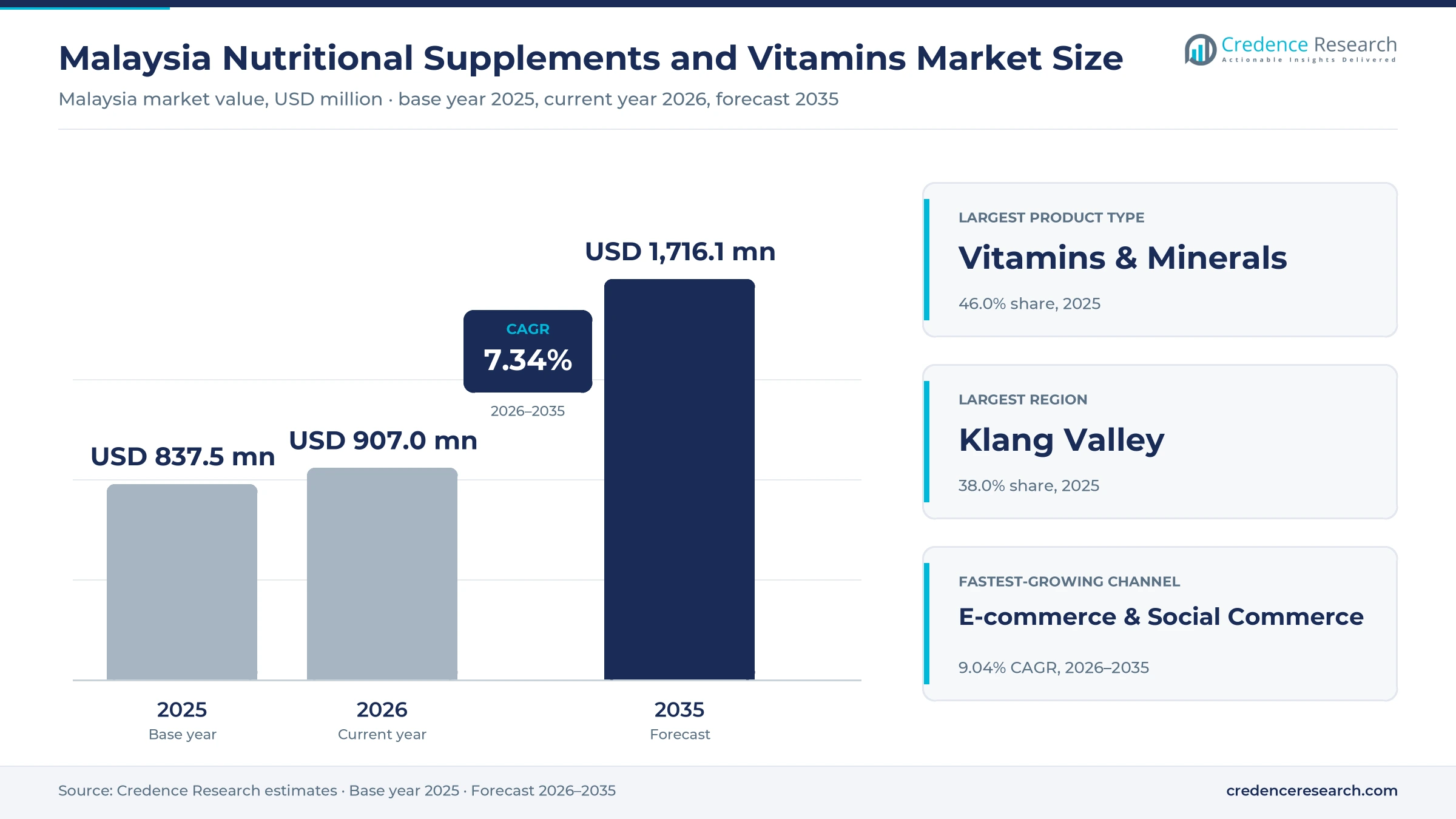
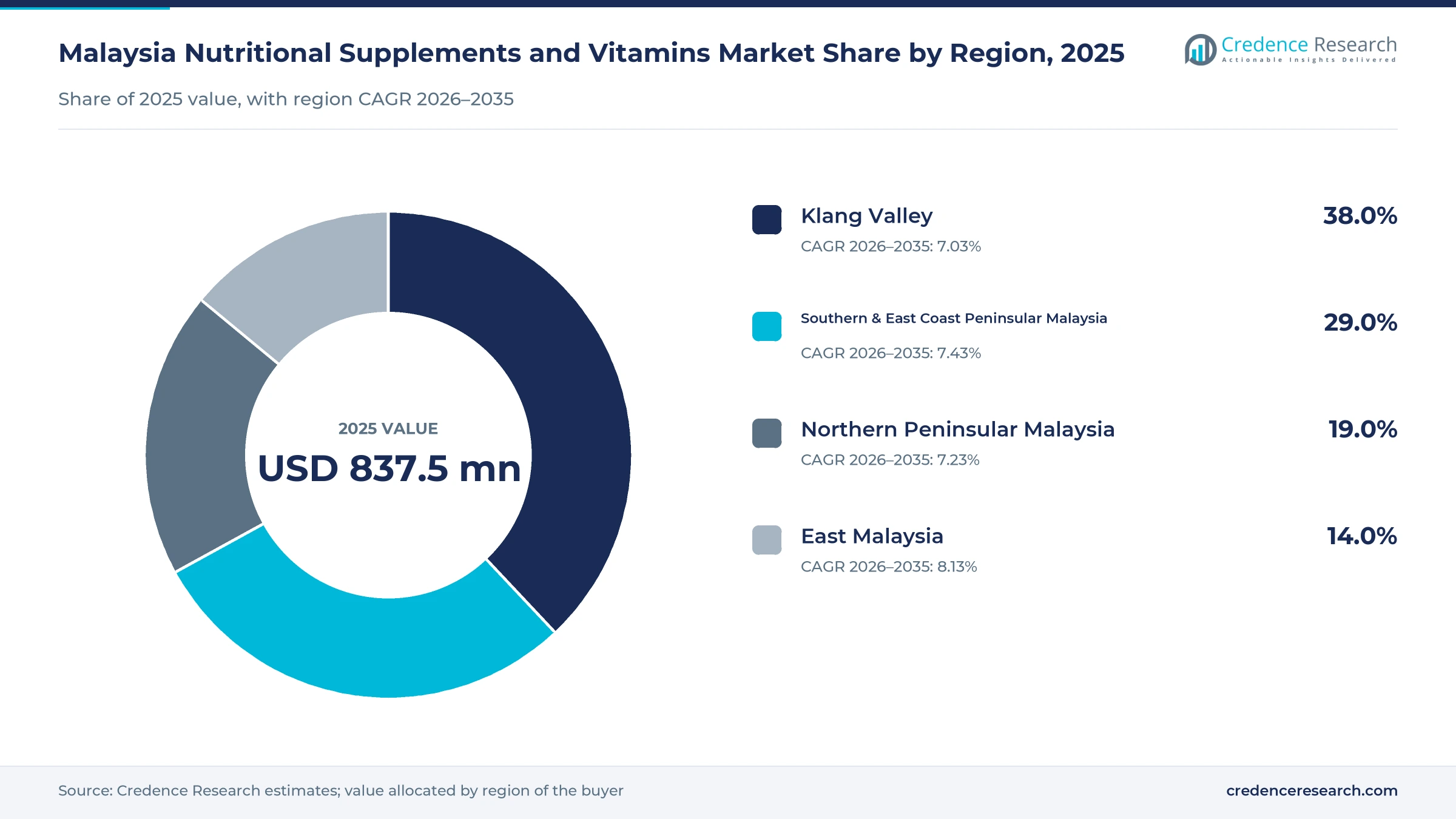
The Malaysia nutritional supplements and vitamins market was valued at USD 837.5 million in 2025 and is projected to increase from USD 907.0 million in 2026 to USD 1.72 billion by 2035, registering a CAGR of 7.34% during 2026–2035. Demand comes from adults managing long-term health conditions, a fast-aging population and a retail system in which pharmacy chains, licensed direct sellers and online stores all compete for the same buyer. Klang Valley held the largest regional share, 38.0% in 2025, because household incomes in Selangor and Kuala Lumpur sit well above the national median. East Malaysia is the fastest-growing region at 8.13% a year as pharmacy chains add outlets in Sabah and Sarawak. Regulation is also changing the competitive field, because the National Pharmaceutical Regulatory Agency brought a revised registration guidance into force on July 31, 2026, with tiered fees and a mandatory vitamin B6 warning on certain products.
What does the Malaysian supplement market count, and how do buyers purchase?
The market counts retail value of vitamins, minerals, herbal products, probiotics, enzymes and specialty nutraceuticals sold to Malaysian consumers as registered health supplements or natural products. Buyers purchase through pharmacy chains, licensed direct sellers, online stores and independent practitioners, and many of them combine a daily multivitamin with a product chosen for one specific condition.
The estimate excludes prescription medicines, infant formula, ordinary fortified foods and exports made by Malaysian manufacturers. The value chain runs from imported ingredients and local herb cultivation through contract and own-brand manufacturing, product registration, halal certification and finally the retail or distributor sale.
Malaysia Nutritional Supplements and Vitamins Market Insights
- The market grows from USD 837.5 million in 2025 to USD 1.72 billion by 2035, a compound rate of 7.34% that outpaces the slow growth of the national population.
- Klang Valley led with 38.0% of value in 2025, while East Malaysia grows fastest at 8.13% a year from a smaller store base.
- Vitamins & Minerals held 46.0% of 2025 value, and Chain Pharmacies & Health Retail held 40.0% of sales across the country.
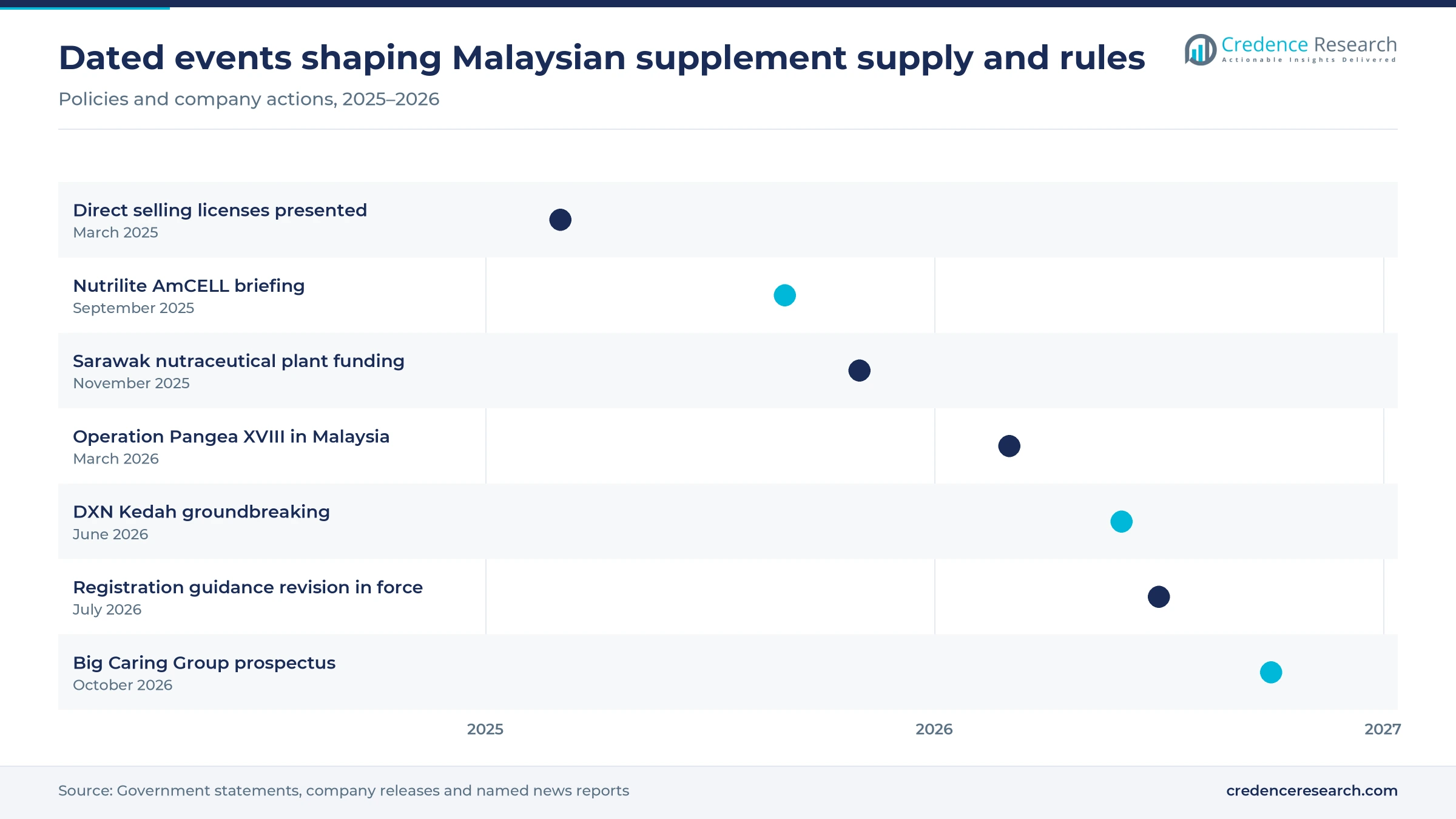
- The revised drug registration guidance took effect on July 31, 2026, adding tiered fees and vitamin B6 warning language for certain health supplements sold in Malaysia.
- DXN broke ground on a RM140 million Kedah complex in June 2026, and Big Caring Group launched its listing prospectus in October 2026 with 668 pharmacy outlets.
Vitamins and pharmacies lead as probiotics gain ground
Vitamins hold the base while probiotics grow from a small start
Based on product type, the market is categorized into vitamins & minerals, botanical & herbal supplements, probiotics & enzymes and specialty nutraceuticals. Vitamins & Minerals led with 46.0% of 2025 value because general health and immunity are the first reason for use, cited by 59% of users in a May 2025 Herbalife survey of 1,000 Malaysians. Regulator data agree, as annual health supplement registrations rose from 315 in 2018 to 451 in 2022 while natural product registrations fell from 738 to 615. Probiotics & Enzymes grow fastest at 8.76% a year as newer gut-health strains reach local shelves, including the 40 billion CFU product Nano Singapore launched in December 2025.
General wellness adults lead, and healthy aging buyers add the growth
Based on customer type, the market is categorized into general wellness adults, healthy aging consumers, active lifestyle consumers and women & family buyers. General Wellness Adults led with 44.0% of 2025 value because supplement use is already routine, with 43% of respondents in the May 2025 Herbalife survey taking a product every day. Healthy Aging Consumers grow fastest at 8.37% a year as the older population widens, since the Department of Statistics Malaysia counts 12 states as aging in 2026. Brands are responding directly, and Amway introduced Nutrilite AmCELL, its first cellular health and healthy aging product, at a Sept. 22, 2025, briefing in Malaysia.
Daily prevention is the habit, and condition-specific use adds value
Based on purchase occasion, the market is categorized into daily preventive health, condition-specific support, immunity & seasonal use and sports & recovery. Daily Preventive Health led with 46.0% of 2025 value because 95% of Malaysian respondents told Herbalife in May 2025 that prevention matters to their well-being. Condition-Specific Support grows fastest at 8.25% a year as more adults live with diagnosed risk, and the National Health and Morbidity Survey 2023 puts high cholesterol at 33.3% of adults. Launches follow that need, including Herbalife TurmeriX 336mg, a joint-health capsule available in Malaysia from Sept. 19, 2025, through distributors and the company website.
Pharmacy chains lead the sale, while online stores gain the most
Based on distribution channel, the market is categorized into chain pharmacies & health retail, direct selling & MLM, e-commerce & social commerce and practitioner & independent specialty. Chain Pharmacies & Health Retail led with 40.0% of 2025 value because physical reach is dense, with Big Caring Group operating 668 outlets at the end of September 2026 and Watsons reporting more than 700 stores in November 2024. E-commerce & Social Commerce grows fastest at 9.04% a year as online buying becomes routine, and the International Trade Administration of the United States described e-commerce platforms in August 2025 as playing a key role in nationwide supplement distribution.
| Segment Group | Leading Sub-segment | Share, 2025 | Fastest-growing Sub-segment | CAGR, 2026–2035 |
|---|---|---|---|---|
| By Product Type | Vitamins & Minerals | 46.0% | Probiotics & Enzymes | 8.76% |
| By Customer Type | General Wellness Adults | 44.0% | Healthy Aging Consumers | 8.37% |
| By Purchase Occasion | Daily Preventive Health | 46.0% | Condition-Specific Support | 8.25% |
| By Distribution Channel | Chain Pharmacies & Health Retail | 40.0% | E-commerce & Social Commerce | 9.04% |
Request a Free Sample
Fill in your details and we'll send you a free sample report.
- Sample data tables & charts
- Research methodology
Aging, chronic disease and online sales lift demand
Aging population expands condition-specific demand
An older population moves spending from general vitamins toward products bought for joints, heart health and energy. World Bank data show the share of Malaysians aged 65 and over rising from 6.27% in 2018 to 8.03% in 2025. The Department of Statistics Malaysia then put that share at 8.4% in 2026, with Perak highest at 10.8%. Its chief statistician also said in October 2025 that all districts in northern Malaysia now qualify as aging districts. Companies are building ranges around this buyer, and Amway says its AmCELL research took six years and screened more than 600 plants. As a result, Healthy Aging Consumers grow at 8.37% a year, ahead of every other customer group in the Credence Research model.
Digital commerce broadens route-to-market
Online selling lets small brands reach buyers without a pharmacy listing, and it lets large brands reach towns with few stores. The Department of Statistics Malaysia reported RM937.5 billion in e-commerce revenue for the first nine months of 2025, up 1.9% from a year earlier. The International Trade Administration of the United States also described e-commerce platforms in August 2025 as playing a key role in nationwide supplement distribution. Foreign entrants use the same route, and Nano Singapore named its Malaysian web store as a primary channel for five products in December 2025. Consequently, E-commerce & Social Commerce grows at 9.04% a year, the fastest rate among the four channels in the Credence Research model.
Premiumization lifts value above volume
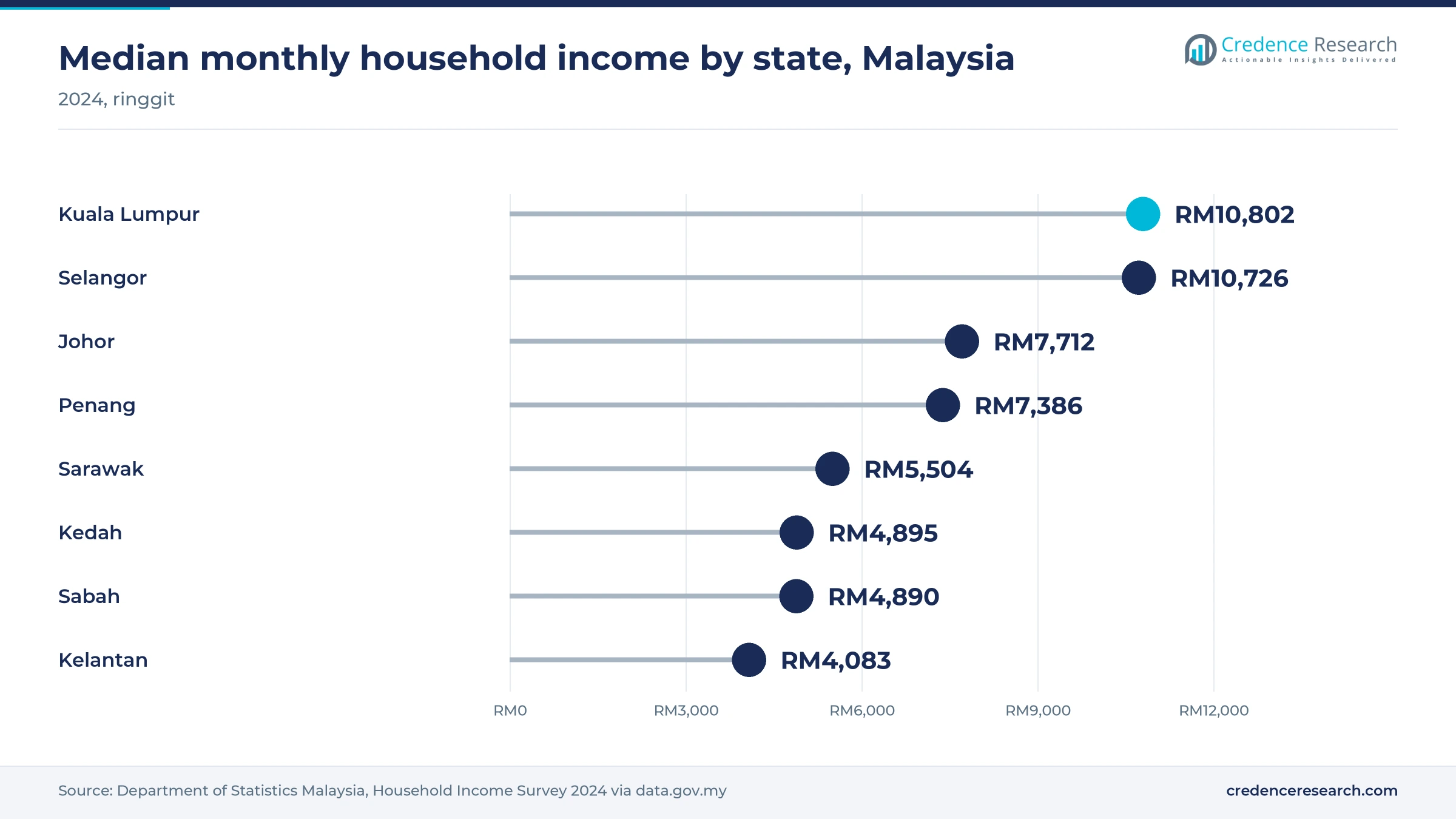
Buyers are paying more for proof of quality, so value grows faster than the number of users. Official state data show 2024 median monthly household income of RM10,802 in Kuala Lumpur and RM10,726 in Selangor, against a national median of RM7,017 reported by the Department of Statistics Malaysia. Spending power also rose at the lower end after the minimum wage moved to RM1,700 on Feb. 1, 2025. Herbalife found that 45% of Malaysian respondents weigh quality certifications when choosing a product, which supports premium pricing for tested formulas. Currency has helped as well, because Bank Negara Malaysia reported that the ringgit gained 10.2% against the U.S. dollar in 2025, easing the landed cost of imported brands.
Chronic disease risk keeps adults buying every year
High rates of metabolic disease turn occasional purchases into long-term routines for many adults. The National Health and Morbidity Survey 2023 found diabetes in about 3.6 million adults, or 15.6%, and hypertension in about 6.7 million adults, or 29.2%. The same survey found that more than two million adults live with three of the four conditions it tracks. Households managing these risks already pay for glucose monitoring equipment, and many add a daily product alongside prescribed treatment. Herbalife reported in September 2025 that 50% of Malaysian respondents act on a healthcare professional recommendation, so pharmacists and doctors shape what they choose. In turn, Condition-Specific Support grows at 8.25% a year in the Credence Research model.
Halal proof, sachets and local herbs are changing the shelf
Halal certification shifts from a label to a sales pitch
Halal status is moving from a compliance detail to the lead message in supplement marketing. VitaHealth and Watsons Malaysia launched the Pilih Halal, Pilih VitaHealth campaign in Kota Bharu, according to The Star in May 2026, promoting JAKIM-certified products at Watsons stores nationwide. The company described halal governance as covering every stage from raw ingredient sourcing through logistics. Bioalpha made a similar case in May 2026, telling Bernama that all of its manufacturing facilities meet halal-certified standards and that 100% of its misai kucing is self-cultivated. VitaHealth, citing more than 70 years of consumer trust, also promotes its Platinum SOBA Best Halal Product Award. Herbalife found in May 2025 that 49% of Malaysian respondents weigh safety and efficacy, which supports demand for certified brands.
Rising use of sachets moves supplements into daily routines
Portable formats are emerging as brands try to raise daily use among younger, busier buyers. VitaHealth launched its VLife on-the-go range in compact sachets on July 3, 2026, in Subang Jaya, covering immunity, energy, calmness, eye health and feminine wellness. The range was sold only at BIG Pharmacy from 2023 and is now extending to CARiNG outlets nationwide, according to The Sun. This shift suits a habit already in place, because Herbalife found 64% of daily users take more than one type. It also gives pharmacies a lower-commitment entry product, which helps convert buyers within General Wellness Adults, the group holding 44.0% of 2025 value in the Credence Research model.
Opportunity in locally grown herbs with traceable supply
Local herbs offer an opening for brands that can prove where their raw material comes from. Bioalpha told Bernama in May 2026 that it cultivates misai kucing on about 12.14 hectares in Pasir Raja and 28.33 hectares in Desaru, and that its export capacity could double from 10 metric tons to 20 metric tons within two years. Sarawak also allocated RM6 million in its 2026 budget, tabled on Nov. 24, 2025, for its first GMP-certified nutraceutical plant using local biological resources. These projects sit alongside demand for botanical formulas with named origins. As a result, herbal brands can gain share from imported vitamins by offering verified origin claims.
Opportunity in East Malaysian towns with few pharmacy chains
East Malaysia offers an opening because store networks there remain thinner than in the peninsula while the customer base is large. The Department of Statistics Malaysia estimates that Sabah alone holds 11% of the 2026 national population. Big Caring Group told The Edge in October 2026 that it plans up to 50 new stores a year in both Peninsular and East Malaysia. Alpro Pharmacy has also added five Bintulu outlets to the 10 it already ran in Kuching, according to a company profile by Wadd. Logistics is improving too, since Pharmaniaga bought a RM26 million Kota Kinabalu property in December 2025 to strengthen distribution. Therefore, East Malaysia remains the fastest-growing zone in the Credence Research model.
Illegal products and new rules test Malaysian sellers
Illegal products undercut registered brands online
Unregistered products take sales from compliant brands and damage trust in the category. The Health Ministry said in May 2025 that it seized 21,571 illegal units worth RM37.5 million in 2024, including 17,630 unregistered supplements, up from RM24.8 million in 2023. Operation Pangea later removed 2,294 Malaysian listings during March 2026, according to The Star. Registered sellers therefore carry compliance costs that illegal rivals avoid, and they respond by promoting registration numbers and pharmacist advice.
New registration rules raise costs for small brands
Revised rules add cost and paperwork, and small brands with long product lists feel this most. The National Pharmaceutical Regulatory Agency issued the 12th revision of its registration guidance on July 16, 2026, effective July 31, according to ChemLinked. It introduces fees tiered by claim type and number of active ingredients, along with vitamin B6 warning language. Brands now need to review labels and formulas across their ranges, and the expanded claims list for zinc and L-carnitine offers partial compensation.
Social selling draws closer enforcement attention
Live selling brings fast sales, but it also exposes sellers and platforms to regulatory action. Deputy Health Minister Lukanisman Awang Sauni warned in Parliament on Nov. 20, 2025, against using TikTok Live to promote unregistered medicines, and he said nearly RM120 million in compounds had been collected. The ministry has also advised platforms to block such activity. Legitimate online brands may face stricter listing checks and slower approvals as a result, so they increasingly rely on verified storefronts.
Income gaps and retail costs limit premium reach
Premium pricing travels poorly outside the richest states, which limits how far imported brands can expand. Official data put 2024 median household income at RM4,083 in Kelantan and RM4,890 in Sabah, against RM10,726 in Selangor. Retailers also absorbed an 8% service tax on retail space rental from July 1, 2025, according to ASEAN Briefing. Chains in lower-income states therefore depend on value tiers and smaller pack sizes, and brands respond with entry-level sachets and promotions.
Klang Valley leads while East Malaysia grows fastest
| Region | Value, 2025 (USD million) | Share, 2025 | CAGR, 2026–2035 |
|---|---|---|---|
| Klang Valley | 318.2 | 38.0% | 7.03% |
| Southern & East Coast Peninsular Malaysia | 242.9 | 29.0% | 7.43% |
| Northern Peninsular Malaysia | 159.1 | 19.0% | 7.23% |
| East Malaysia | 117.2 | 14.0% | 8.13% |
Klang Valley leads on income and store density
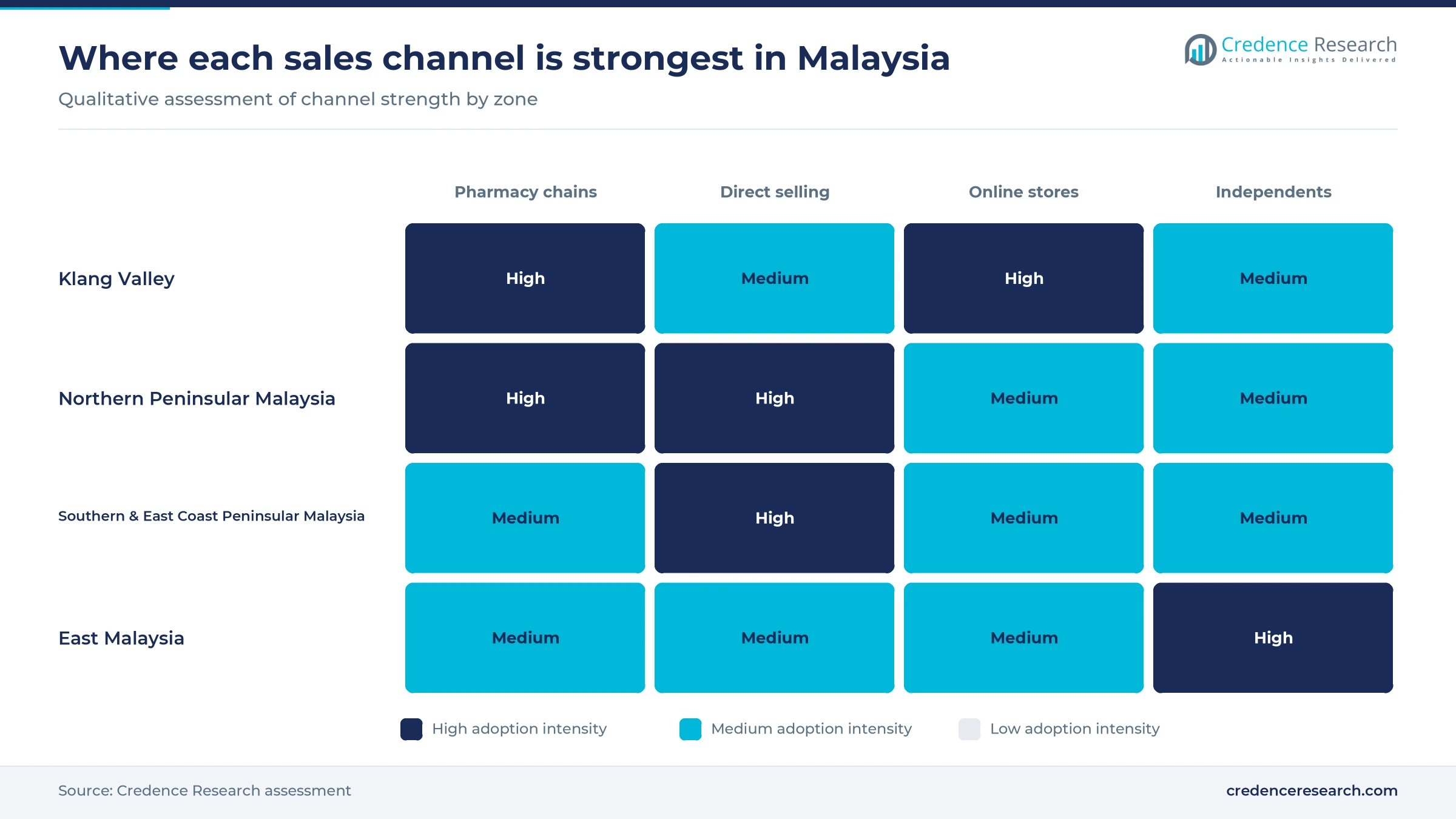
Klang Valley held 38.0% of 2025 value and grows at 7.03% a year. Selangor alone holds 21.7% of the national population, according to the Department of Statistics Malaysia, and its median household income of RM10,726 is far above the national level. This zone also has the most developed pharmacy retail, and Big Caring Group plans a RM30 million distribution center in Klang. Influenza spikes drive quick purchases here as well, since Selangor recorded 43 of 97 national clusters in one October 2025 week.
Southern and east coast states split into two markets
Southern & East Coast Peninsular Malaysia held 29.0% of 2025 value and grows at 7.43% a year. The zone combines Johor, which has 12.3% of the national population and a median income of RM7,712, with lower-income Kelantan at RM4,083. Halal messaging carries weight on the east coast, where VitaHealth chose Kota Bharu to launch its campaign. Herb cultivation is also located here, with Bioalpha fields in Desaru and Pasir Raja feeding its supply chain.
Northern Peninsular Malaysia is older and home to DXN
Northern Peninsular Malaysia held 19.0% of 2025 value and grows at 7.23% a year. The zone includes Perak, which records the highest share of residents aged 65 and over in the country, and that favors joint and heart products. Penang adds income, with a median of RM7,386 that grew the fastest in the country from 2022 to 2024. Kedah adds manufacturing, because DXN is headquartered there and is building its RM140 million complex at Bukit Kayu Hitam.
East Malaysia grows fastest from a thinner network
East Malaysia held 14.0% of 2025 value and grows at 8.13% a year, the fastest of the four zones. Median household income stood at RM5,504 in Sarawak and RM4,890 in Sabah in 2024, so value and mass-market products dominate most baskets. New stores are the main growth lever, as Alpro and Big Caring Group extend their Bornean coverage. Local production may follow, because the Sarawak government set aside RM6 million for a certified nutraceutical plant in its 2026 budget.
Plants, pharmacy listings and new rules define 2025–2026
| Development | Status and market relevance |
|---|---|
| In October 2026, Big Caring Group launched its prospectus to move to the Main Market, reporting 668 outlets and a plan for up to 50 new stores a year. | Listing process underway; proceeds mainly repay debt, while RM30 million funds a Klang distribution center |
| In July 2026, the National Pharmaceutical Regulatory Agency adopted the 12th revision of its registration guidance, effective July 31. | In force; adds tiered fees, vitamin B6 warnings and wider claims for three ingredients |
| In July 2026, VitaHealth launched its VLife sachet range in Subang Jaya and extended it from BIG Pharmacy to CARiNG outlets. | Rolling out nationally through the Big Caring network |
| In June 2026, DXN broke ground on a RM140 million manufacturing complex at Bukit Kayu Hitam in Kedah. | Production is scheduled to start in March 2028 with about 118 product lines |
| In September 2025, Amway presented Nutrilite AmCELL, its first cellular health product, at a briefing in Malaysia. | Linked to the Mission 50K healthy-lifestyle program announced in July 2026 |
Formulation and sourcing methods now separate brands
- Cellular health research gives Amway a scientific claim for its aging range, built on six years of work and screening of more than 600 plants.
- Absorption technology supports premium positioning, and VitaHealth uses its doubleNUTRI method in VLife sachets to promote nutrient uptake.
- Monacolin-K limits show how closely actives are controlled, with registered red yeast rice products capped at 1% and 10 mg a day.
- Good Agricultural Practices certification lets Bioalpha claim traceable supply, because its misai kucing is grown under the MYGAP scheme from its own fields.
Need a Custom Version of This Report?
Tailor the scope, geography, or segments to your exact requirements.
- Custom geography or segment scope
- Direct access to our analyst team
Direct sellers and pharmacy brands compete for trust
Competition in the Malaysia nutritional supplements and vitamins market divides between direct sellers that train networks of distributors and pharmacy brands that rely on shelf presence and pharmacist advice. Amway marked 50 years in Malaysia in 2026 and backs Nutrilite with health programs, while Herbalife sells TurmeriX only through distributors and its website. Direct selling across all product categories earned RM34.4 billion in 2024, according to Deputy Domestic Trade Minister Fuziah Salleh. USANA said in January 2026 that it had led combination products in Malaysia for eight years. DXN builds on ganoderma and spirulina cultivation from its Kedah base. On the pharmacy side, Blackmores offers about 55 local products and won Brand of the Year at a May 2026 awards event with Big Caring Group, and VitaHealth uses halal campaigns with Watsons. Local manufacturers also compete on supply, with Bioalpha offering contract development services alongside its own herbs, and Nova Wellness, which a 2020 profile described as a maker of vitamin, mineral and herbal products.
Companies profiled and their roles in this market
| Company | Type | Role in the market |
|---|---|---|
| Amway (Malaysia) Holdings Berhad / Nutrilite | Direct seller | Nutrilite range including AmCELL; marked 50 years in Malaysia in 2026 |
| Herbalife Products Malaysia Sdn Bhd | Direct seller | Launched TurmeriX 336mg capsules in September 2025 through distributors |
| DXN Holdings Bhd | Direct seller and manufacturer | Kedah-based ganoderma and spirulina products; RM140 million complex under construction |
| USANA Health Sciences Malaysia Sdn Bhd | Direct seller | Combination supplements sold through its Malaysian business |
| Blackmores Malaysia | Pharmacy brand | About 55 local products; strong presence in Watsons and Big Caring stores |
| VitaHealth Malaysia Sdn Bhd | Pharmacy brand | JAKIM-certified range and VLife sachets; part of Vita Life Sciences |
| Nova Wellness Group Berhad | Manufacturer | Described in a 2020 profile as a maker of vitamin, mineral and herbal products |
| Bioalpha Holdings Berhad | Manufacturer | Herb cultivation in Desaru and Pasir Raja; OEM, ODM and CDMO services |
Registered, halal and pharmacist-backed brands should win
Credence Research's view is that nutritional supplements and vitamins will reward proof over promotion during the forecast period. The July 2026 registration revision and the steady rise in seizures make compliance a visible selling point, so registered brands with halal certification and pharmacist support should gain share from unregulated online sellers. Pharmacy consolidation under Big Caring Group also raises the value of a national listing. However, brands that depend on one channel carry more risk, because online rules are tightening and direct selling growth depends on keeping distributors active.
How Credence Research built this Malaysia estimate
The report on nutritional supplements and vitamins uses 2025 as the base year and forecasts values to 2035 in USD million. Market values come from the Credence Research model, and regional, segment and channel splits are Credence Research estimates tested against public data. Sources used include the Department of Statistics Malaysia, the National Health and Morbidity Survey, Bank Negara Malaysia, the World Bank, regulator statements, company releases and named news reports. No interviews or surveys were conducted for this report, and survey figures cited in the text belong to the named company that ran them.
Condition-specific and online sales shape the road to 2035
The Malaysia nutritional supplements and vitamins market is forecast to reach USD 1.72 billion by 2035, and most added value should come from older buyers purchasing for a defined health need. E-commerce & Social Commerce should keep gaining share as long as enforcement removes illegal listings, which would make online buying safer for cautious consumers. Pharmacy chains should remain the largest channel because Big Caring Group and Watsons continue to extend their store networks. East Malaysia and the east coast offer the most room for new stores, although lower household incomes there mean value tiers will continue to matter.
Frequently Asked Questions
How big is the Malaysia nutritional supplements and vitamins market?
Which product type leads the market in Malaysia?
Which region of Malaysia is the largest?
Which region grows fastest during the forecast period?
Why is aging important to demand in Malaysia?
Which sales channel is growing fastest?
How did the July 2026 rule change affect supplement brands?
Who are the main companies in this market?
Table of Content
Chapter 1 Market Segmentation
- 1.1 Segmentation Framework
- 1.1.1 Product and Service Classification
- 1.1.2 Application and End-Use Classification
- 1.1.3 Technology and Solution Classification
- 1.1.4 Customer and Distribution Channel Classification
- 1.1.5 Geographic Segmentation
- 1.1.6 Market Segment Definitions and Boundaries
- 1.2 By Product Type
- 1.2.1 Vitamins & Minerals
- 1.2.2 Botanical & Herbal Supplements
- 1.2.3 Probiotics & Enzymes
- 1.2.4 Specialty Nutraceuticals
- 1.3 By Customer Type
- 1.3.1 General Wellness Adults
- 1.3.2 Healthy Aging Consumers
- 1.3.3 Active Lifestyle Consumers
- 1.3.4 Women & Family Buyers
- 1.4 By Purchase Occasion
- 1.4.1 Daily Preventive Health
- 1.4.2 Condition-Specific Support
- 1.4.3 Immunity & Seasonal Use
- 1.4.4 Sports & Recovery
Chapter 2 Introduction
- 2.1 Report Objectives and Scope
- 2.2 Product Definition and Industry Terminology
- 2.3 Market Inclusions and Exclusions
- 2.4 Research Process
- 2.4.1 Primary Research and Expert Interviews
- 2.4.2 Secondary Research and Source Review
- 2.4.3 Top-Down and Bottom-Up Estimation
- 2.4.4 Data Triangulation and Verification
- 2.5 Market Size Measurement Basis
- 2.5.1 2025: USD 837.5 million → 2035: USD 1.72 billion
- 2.6 Historical and Forecast Reference Periods
- 2.6.1 Historical Period: 2018-2025
- 2.6.2 Base Year: 2025
- 2.6.3 Forecast Period: 2025-2035
- 2.7 Research Assumptions and Limitations
Chapter 3 Executive Summary
- 3.1 Market Snapshot and Key Findings
- 3.2 Base-Year Market Size, 2025
- 3.3 Forecast Market Size, 2035
- 3.4 Revenue and Volume Growth Outlook
- 3.5 Key Demand and Supply Indicators
- 3.6 Leading Market Segments
- 3.7 Fastest-Growing Market Opportunities
- 3.8 Regional Performance Highlights
- 3.9 Technology and Industry Transformation
- 3.10 Competitive Landscape Summary
- 3.11 Analyst View and Strategic Implications
Chapter 4 Malaysia Nutritional Supplements and Vitamins Market Trends and Developments
- 4.1 Historical Industry Development, 2018-2025
- 4.2 Recent Market Trends and Developments
- 4.3 Demand and Customer Behavior Trends
- 4.4 Technology and Product Innovation
- 4.5 Artificial Intelligence, Automation and Digitalization
- 4.6 Local Manufacturing and Supply Chain Realignment
- 4.7 Industry Partnerships, Mergers and Acquisitions
- 4.8 Sustainability and Circular Economy Developments
- 4.9 Government and Private Sector Investment Trends
- 4.10 Emerging Business Models and Commercialization
- 4.11 Industry Developments and Announcements
Chapter 5 Malaysia Nutritional Supplements and Vitamins Market Production, Supply and Demand Analysis
- 5.1 Demand Trend and Consumption Analysis, 2018-2025
- 5.2 Demand Forecast, 2025-2035
- 5.3 Production and Output Trend, 2018-2025
- 5.4 Production and Output Forecast, 2025-2035
- 5.5 Installed Capacity and Capacity Utilization
- 5.6 Company-Wise Production Plants and Statistics
- 5.6.1 Installed Production Capacity
- 5.6.2 Actual Production
- 5.6.3 Planned Capacity and Expansion Targets
- 5.7 Supply Chain Structure and Procurement Trends
- 5.8 Supply-Demand Gap and Bottlenecks
- 5.9 Import Dependence and Sourcing Structure
- 5.10 Contract Manufacturing and Outsourcing
- 5.11 Regional Supply and Demand Concentration
Chapter 6 Malaysia Nutritional Supplements and Vitamins Market Pricing Analysis
- 6.1 Pricing Structure and Measurement
- 6.2 Historical Pricing Trends, 2018-2025
- 6.3 Pricing Outlook, 2025-2035
- 6.4 Average Selling Price and Unit Economics
- 6.5 Pricing by Product and Market Segment
- 6.6 Geographic Pricing Differences
- 6.7 Key Input, Energy, Labor and Logistics Costs
- 6.8 Contract Pricing and Purchasing Models
- 6.9 Pricing Sensitivity and Competitive Positioning
- 6.10 Price, Margin and Profitability Implications
Chapter 7 Malaysia Nutritional Supplements and Vitamins Market Dynamics
- 7.1 Market Growth Drivers
- 7.1.1 Demand-Side Drivers
- 7.1.2 Technology and Innovation Drivers
- 7.1.3 Infrastructure and Investment Drivers
- 7.1.4 Regulatory and Policy Drivers
- 7.2 Market Restraints
- 7.2.1 Cost and Affordability Constraints
- 7.2.2 Technology and Adoption Barriers
- 7.2.3 Supply Chain and Operational Constraints
- 7.3 Market Challenges
- 7.3.1 Competitive Pressure and Margin Erosion
- 7.3.2 Skills, Infrastructure and Implementation Gaps
- 7.4 Emerging Market Opportunities
- 7.5 Market Dynamics Impact and Time-Horizon Assessment
Chapter 8 Malaysia Nutritional Supplements and Vitamins Value Chain Analysis
- 8.1 Industry Value Chain Overview
- 8.2 Upstream Suppliers and Critical Inputs
- 8.3 Technology and Component Providers
- 8.4 Manufacturing or Service Delivery
- 8.5 Distribution, Channel Partners and Integrators
- 8.6 Downstream Applications and End Users
- 8.7 Value Addition and Profit Pools
- 8.8 Vertical Integration and Outsourcing
- 8.9 Supplier Concentration and Risk
- 8.10 Supply Chain Localization and Resilience
Chapter 9 Malaysia Nutritional Supplements and Vitamins Market Regulations and Policies
- 9.1 Relevant Laws, Standards and Compliance Frameworks
- 9.2 Product, Service, Safety and Quality Requirements
- 9.3 Government Policies, Incentives and Subsidies
- 9.4 Imports, Exports and Trade Barriers
- 9.5 Public Procurement and Local Content Requirements
- 9.6 Environmental and Sustainability Compliance
- 9.7 Upcoming Policy Changes and Market Implications
Chapter 10 Malaysia Nutritional Supplements and Vitamins Market Hotspots and Opportunities
- 10.1 Market Opportunity Mapping and Growth Hotspots
- 10.2 High-Growth Applications and Customer Groups
- 10.3 Underserved Markets and White-Space Opportunities
- 10.4 Emerging Technology and Product Opportunities
- 10.5 New Capacity and Investment Hotspots
- 10.6 Market Entry and Expansion Opportunities
- 10.7 Distribution and Partnership Opportunities
- 10.8 Near-Term and Long-Term Commercial Potential
- 10.9 Opportunity Attractiveness and Execution Risks
Chapter 11 Malaysia Nutritional Supplements and Vitamins Market Outlook, 2025-2035
- 11.1 Market Size and Analysis
- 11.1.1 Revenue (Market Measurement: 2025: USD 837.5 million → 2035: USD 1.72 billion)
- 11.1.2 Market Volume and Quantity Sold
- 11.1.3 Historical Market Size, 2018-2025
- 11.1.4 Base-Year Market Size, 2025
- 11.2 Market Forecast, 2025-2035
- 11.2.1 Revenue Forecast to 2035
- 11.2.2 Volume Forecast to 2035
- 11.2.3 CAGR and Year-on-Year Growth
- 11.2.4 Incremental Revenue Opportunity
- 11.3 Forecast Assumptions and Scenario Analysis
- 11.3.1 Base-Case Forecast
- 11.3.2 Optimistic and Conservative Scenarios
- 11.3.3 Technology, Pricing and Policy Sensitivities
- 11.4 Market Attractiveness and Growth Outlook
Chapter 12 Malaysia Nutritional Supplements and Vitamins Market Segmentation and Outlook
- 12.1 Segmentation Summary and Market Shares, 2025
- 12.2 Largest and Fastest-Growing Segments
- 12.3 By Product Type - Market Size and Forecast, 2025-2035
- 12.3.1 Segment Definition and Scope
- 12.3.2 Historical Market Size, 2018-2025
- 12.3.3 Revenue Forecast, 2025-2035
- 12.3.4 Volume Forecast, 2025-2035
- 12.3.5 Base-Year Market Share, 2025
- 12.3.6 Segment CAGR and Growth Drivers
- 12.3.7 Subsegment Market Size and Forecast
- 12.3.7.1 Vitamins & Minerals
- 12.3.7.2 Botanical & Herbal Supplements
- 12.3.7.3 Probiotics & Enzymes
- 12.3.7.4 Specialty Nutraceuticals
- 12.3.8 Subsegment Pricing and Adoption Trends
- 12.3.9 Leading Suppliers and Competition
- 12.3.10 Regional Demand and Opportunities
- 12.4 By Customer Type - Market Size and Forecast, 2025-2035
- 12.4.1 Segment Definition and Scope
- 12.4.2 Historical Market Size, 2018-2025
- 12.4.3 Revenue Forecast, 2025-2035
- 12.4.4 Volume Forecast, 2025-2035
- 12.4.5 Base-Year Market Share, 2025
- 12.4.6 Segment CAGR and Growth Drivers
- 12.4.7 Subsegment Market Size and Forecast
- 12.4.7.1 General Wellness Adults
- 12.4.7.2 Healthy Aging Consumers
- 12.4.7.3 Active Lifestyle Consumers
- 12.4.7.4 Women & Family Buyers
- 12.4.8 Subsegment Pricing and Adoption Trends
- 12.4.9 Leading Suppliers and Competition
- 12.4.10 Regional Demand and Opportunities
- 12.5 By Purchase Occasion - Market Size and Forecast, 2025-2035
- 12.5.1 Segment Definition and Scope
- 12.5.2 Historical Market Size, 2018-2025
- 12.5.3 Revenue Forecast, 2025-2035
- 12.5.4 Volume Forecast, 2025-2035
- 12.5.5 Base-Year Market Share, 2025
- 12.5.6 Segment CAGR and Growth Drivers
- 12.5.7 Subsegment Market Size and Forecast
- 12.5.7.1 Daily Preventive Health
- 12.5.7.2 Condition-Specific Support
- 12.5.7.3 Immunity & Seasonal Use
- 12.5.7.4 Sports & Recovery
- 12.5.8 Subsegment Pricing and Adoption Trends
- 12.5.9 Leading Suppliers and Competition
- 12.5.10 Regional Demand and Opportunities
- 12.6 Segment Growth Comparison
- 12.7 Segment Attractiveness and Priority Matrix
Chapter 13 Malaysia Nutritional Supplements and Vitamins End-Use and Application Market Outlook
- 13.1 End-Use Industry and Customer Demand Structure
- 13.2 Leading Applications and Customer Groups
- 13.3 End-Use Market Size, Share and Forecast
- 13.4 Major End-Use Industry Deep Dives
- 13.4.1 Customer Requirements and Use Cases
- 13.4.2 Demand and Replacement Cycles
- 13.4.3 Technical and Regulatory Considerations
- 13.4.4 Purchasing and Procurement Models
- 13.4.5 Leading Vendors and Distribution Channels
- 13.4.6 Forecast and Commercial Opportunities
- 13.5 Emerging Applications and Cross-Segment Demand
- 13.6 End-Use Industry Investment Priorities
Chapter 14 Malaysia Nutritional Supplements and Vitamins Geographic Market Outlook, 2025-2035
- 14.1 Domestic Market Distribution and Demand Clusters
- 14.2 State- or Province-Wise Market Size and Forecast, 2025-2035
- 14.3 City and Metropolitan Market Outlook
- 14.4 Industrial, Manufacturing and Commercial Clusters
- 14.5 Geographic Concentration of Key End Users
- 14.6 Local Pricing and Purchasing Differences
- 14.7 Domestic Production Facilities and Capacity Map
- 14.8 Local Infrastructure and Project Pipeline
- 14.9 State-Level Policy and Incentive Differences
- 14.10 Subnational Investment Hotspots and Opportunities
- 14.11 Distribution and Logistics Networks
- 14.12 Domestic Competitive Footprint
Chapter 15 Malaysia Nutritional Supplements and Vitamins Technology, Innovation and Sustainability Outlook
- 15.1 Technology Landscape and Maturity
- 15.2 Product, Process and Service Innovation
- 15.3 AI, Automation and Digital Tools in the Industry
- 15.4 Technology Adoption and Performance Benchmarking
- 15.5 Innovation Pipeline and R&D Investment
- 15.6 Patent and Intellectual Property Trends
- 15.7 Energy Efficiency and Resource Management
- 15.8 Sustainability, Recycling and Circularity
- 15.9 Technology Roadmap, 2025-2035
- 15.10 Risks of Obsolescence and Technology Substitution
Chapter 16 Malaysia Nutritional Supplements and Vitamins Market Key Strategic Imperatives
- 16.1 Growth and Market Entry Priorities
- 16.2 High-Return Products and Segments
- 16.3 Pricing, Profitability and Cost Optimization
- 16.4 Technology Investment and Product Differentiation
- 16.5 Supply Chain Localization and Resilience
- 16.6 Distribution and Customer Acquisition
- 16.7 Partnership, Acquisition and Capacity Strategy
- 16.8 Regional Expansion Priorities
- 16.9 Short-, Medium- and Long-Term Actions
Chapter 17 Competition Outlook
- 17.1 Industry Competition Characteristics
- 17.2 Market Structure and Concentration
- 17.3 Market Share and Competitive Positioning, 2025
- 17.4 Company-Wise Revenue and Product Benchmarking
- 17.5 Production and Service Capacity Benchmarking
- 17.6 Technology, Pricing and Differentiation
- 17.7 Regional Footprint and Distribution Strength
- 17.8 Mergers, Acquisitions and Strategic Alliances
- 17.9 New Entrants and Competitive Threats
- 17.10 Porter's Five Forces and Industry Attractiveness
- 17.11 Competitive Outlook, 2025-2035
Chapter 18 Company Profiles
- 18.1 Company Coverage and Selection Criteria
- 18.2 Amway (Malaysia) Holdings Berhad / Nutrilite
- 18.2.1 Business Description
- 18.2.2 Company Ownership and Geographic Presence
- 18.2.3 Product and Service Portfolio
- 18.2.4 Manufacturing and Operating Footprint
- 18.2.5 Production Capacity and Expansion Plans
- 18.2.6 Financial Performance and Investment
- 18.2.7 Market Share and Competitive Position
- 18.2.8 Technology and Innovation Capabilities
- 18.2.9 Strategic Alliances or Partnerships
- 18.2.10 Recent Developments
- 18.2.11 Growth Strategy and Outlook
- 18.3 Herbalife Products Malaysia Sdn Bhd
- 18.4 DXN Holdings Bhd
- 18.5 USANA Health Sciences Malaysia Sdn Bhd
- 18.6 Blackmores Malaysia
- 18.7 VitaHealth Malaysia Sdn Bhd
- 18.8 Cambert (M) Sdn Bhd / Kordel's
- 18.9 Nova Wellness Group Berhad
- 18.10 Bioalpha Holdings Berhad
- 18.11 Zhulian Corporation Berhad
- 18.12 Other Relevant Market Participants
Note: Every listed company is profiled on the structure shown under the first company. The company list is preliminary and may change based on research findings, market developments, data availability and client requirements.
Chapter 19 Disclaimer
- 19.1 Research and Forecast Disclaimer
- 19.2 Data Source and Estimation Limitations
Note: The depth of individual sections depends on data availability for this market. Volume, capacity, trade and other unit-based metrics are included where applicable.

