
Pharmacy-led habits define Spanish supplement spending
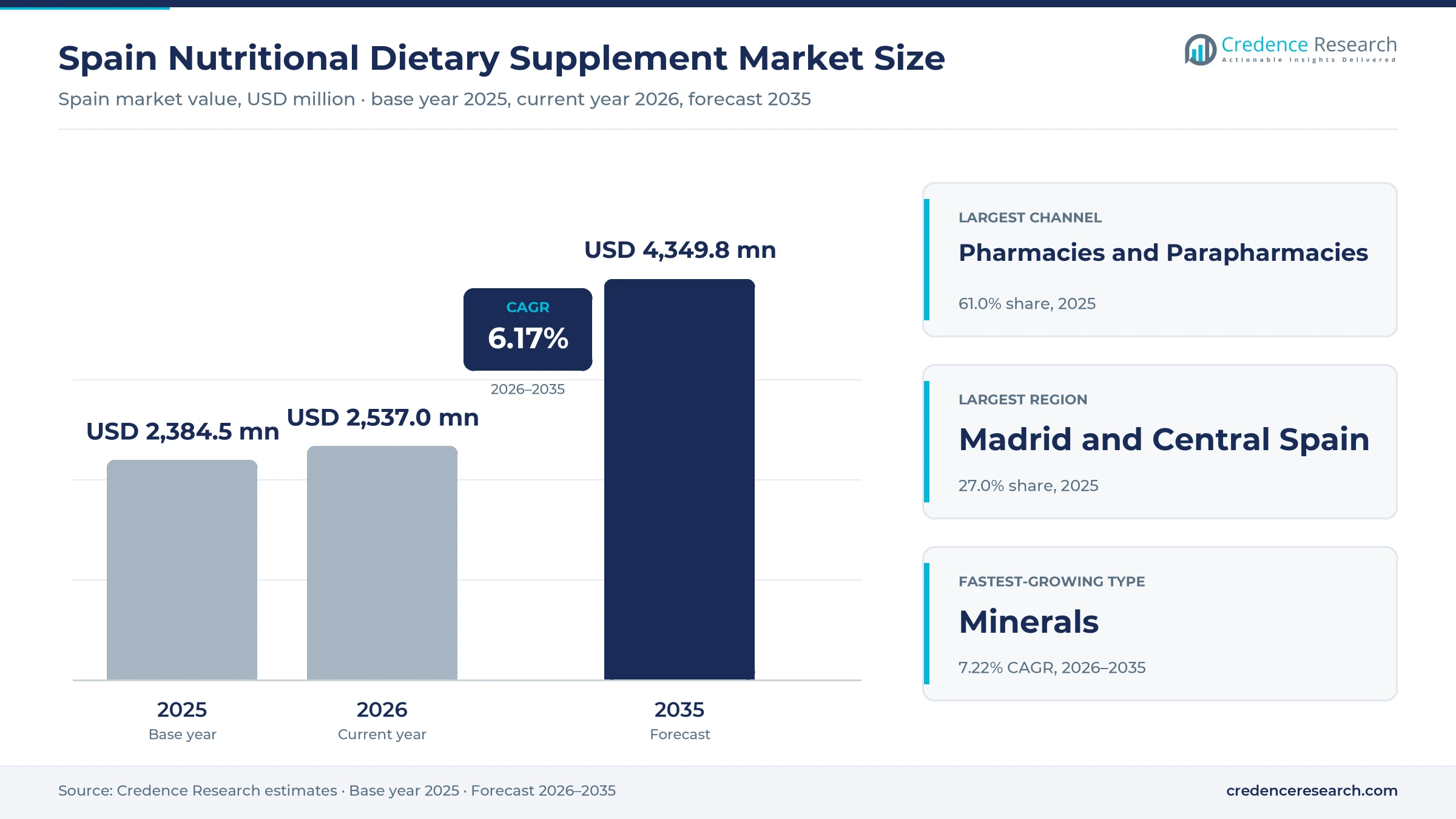
The Spain nutritional dietary supplement market was valued at USD 2.38 billion in 2025 and is projected to increase from USD 2.54 billion in 2026 to USD 4.35 billion by 2035, registering a CAGR of 6.17% during 2026–2035. Demand comes from adults who treat vitamins, minerals and probiotics as a daily health routine, from an older population, and from a dense network of community pharmacies that recommend these products at the counter. Madrid and Central Spain held the largest regional share, 27.0% in 2025, helped by the capital region and its large pharmacy base. The Eastern Mediterranean Coast is the fastest-growing region at 7.14% a year, as resident numbers there rise faster than the national average. Regulation is also changing the sector, because Spain's food safety agency updated its official control guide on supplement labeling and composition on March 12, 2026, which tightens attention on claims, doses and warnings.
What does the Spanish nutritional dietary supplement market include?
The market counts consumer sales of vitamins, minerals, botanical extracts, probiotics, sports and protein supplements and related concentrated nutrients sold in doses such as capsules, tablets, powders, sachets and gummies. Buyers purchase them mainly at pharmacies and parapharmacies, with herbalists, dietetic stores, online stores and supermarkets serving the remainder of demand.
The estimate excludes prescription medicines, ordinary fortified foods, infant formula and enteral nutrition delivered through hospitals. The value chain runs from ingredient makers and contract manufacturers to brand owners, distributors and retailers, while regional health authorities carry out official controls under guidance coordinated at the national level.
Spain Nutritional Dietary Supplement Market Insights
- The market grows from USD 2.38 billion in 2025 to USD 4.35 billion by 2035, a 6.17% CAGR over 2026–2035, supported by routine preventive use among Spanish adults.
- Madrid and Central Spain held 27.0% of 2025 value, ahead of the northern regions and Catalonia, because the capital region concentrates residents, spending power and pharmacy outlets.
- Pharmacies and Parapharmacies held 61.0% of 2025 value, reflecting a purchase pattern in which most Spanish buyers still choose a health professional setting.
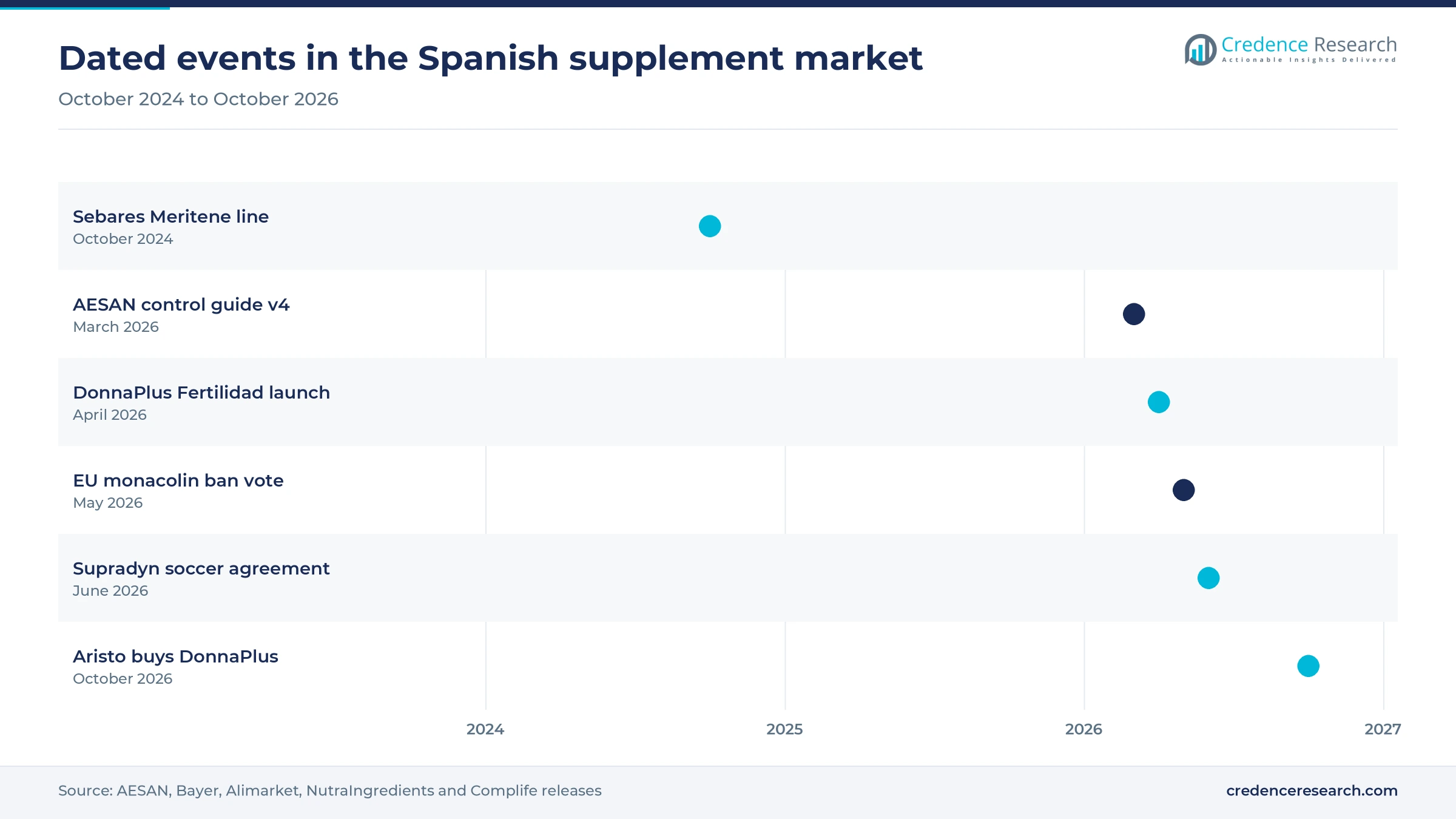
- The food safety agency AESAN approved version four of its official labeling and composition control guide on March 12, 2026, raising compliance attention across brands.
- Aristo Pharma Iberia bought the DonnaPlus brand from Laboratorios Ordesa in October 2026, showing that pharmaceutical companies are buying established women's health brands in Spain.
Vitamins and pharmacies anchor Spanish supplement sales
Why vitamins lead and minerals grow fastest
Based on product type, the market is categorized into vitamins and multivitamins, minerals, botanicals and herbal extracts, probiotics and digestive health, sports and protein supplements, and others. Vitamins and Multivitamins led with 35.0% of 2025 value because a 2022 Afepadi consumer study, reported by Alimarket in November 2024, found vitamin D, vitamin C and multivitamins were the most consumed products. Minerals grow fastest at 7.22% a year, as Alimarket reported double-digit 2025 growth for mineral-based products in April 2026. Probiotics follow consumer interest in gastrointestinal products sold through the same pharmacies.
General health remains the leading reason to buy
Based on application, the market is categorized into general health and immunity, bone, joint and muscle, energy and fatigue, sleep and mental wellbeing, hair, skin and nails, and others. General Health and Immunity led with 38.0% of 2025 value because 70.9% of supplement users cited general health and 26% cited immune support in survey findings published by food industry federation FIAB in February 2024. Sleep and Mental Wellbeing grows fastest at 7.50% a year, as the Spanish Sleep Society reported in September 2023 that chronic insomnia had risen from 6.4% to about 14% of the population over two decades.
Pharmacies dominate while online buying gains ground
Based on distribution channel, the market is categorized into pharmacies and parapharmacies, herbalists and dietetic stores, online stores and marketplaces, and supermarkets and others. Pharmacies and Parapharmacies led with 61.0% of 2025 value because the General Council of Pharmacists counted 22,273 community pharmacies at the end of 2025, and 62% of buyers in the Afepadi study purchased there. Online Stores and Marketplaces grow fastest at 7.75% a year, as a 2022 Food Supplements Europe survey found 20% of Spanish buyers used marketplaces such as Amazon, against an 8% European average.
| Segment Group | Leading Sub-segment | Share, 2025 | Fastest-growing Sub-segment | CAGR, 2026–2035 |
|---|---|---|---|---|
| By Product Type | Vitamins and Multivitamins | 35.0% | Minerals | 7.22% |
| By Application | General Health and Immunity | 38.0% | Sleep and Mental Wellbeing | 7.50% |
| By Distribution Channel | Pharmacies and Parapharmacies | 61.0% | Online Stores and Marketplaces | 7.75% |
Request a Free Sample
Fill in your details and we'll send you a free sample report.
- Sample data tables & charts
- Research methodology
Ageing and daily prevention lift Spanish supplement demand
Preventive health becomes a mainstream consumer routine
Dietary supplement use in Spain has moved from occasional treatment to a regular health habit among most adults. Afepadi's observatory found that 70% to 80% of Spanish adults consumed food supplements in the past year, according to Alimarket in April 2026. The same report put total sector growth at about 7% and ranked Spain as the fourth fastest-growing European Union market over five years. The supplier base is also substantial, with Afepadi representing 155 companies that generate more than 15,000 direct jobs. As a result, General Health and Immunity products hold 38.0% of 2025 value, which shows that buyers mostly seek broad maintenance rather than treatment of a specific condition.
Ageing expands condition-specific nutrition demand
An older population buys more products aimed at bones, joints, energy and healthy aging, and Spain is ageing quickly. The national statistics office INE counted 10,178,625 people over 64 on Jan. 1, 2025, equal to 20.7% of residents and 2.52% more than a year earlier. Its June 2026 projections put the over-65 share at 21.1% today and about 30.9% around 2076. Brands are responding directly to this group, because Haleon has marketed Multicentrum Energía & Vitalidad 50+ for adults over 50 in Spain, according to IM Farmacias. In October 2024, Alimarket reported that Nestlé Health Science invested more than 7 million euros at Sebares, Asturias, in a line for Meritene Drink, a fortified product for adults over 65.
Pharmacy reach supports trust and premium conversion
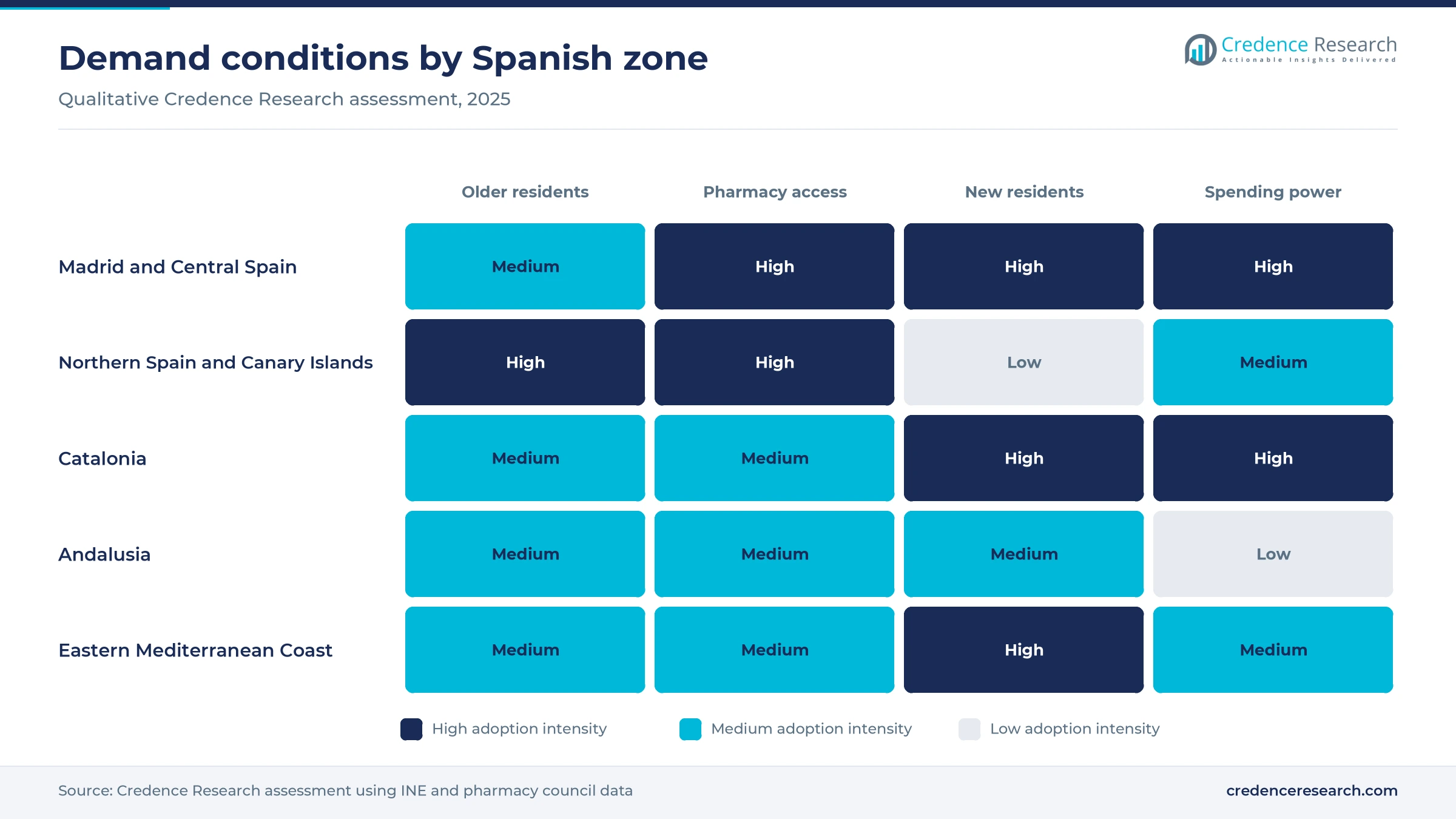
Spain's pharmacy network gives supplement brands a trusted, professional sales point within reach of most households. The General Council of Pharmacists counted 22,273 community pharmacies at the end of 2025, 42 more than a year earlier, or 4.5 for every 10,000 residents. Its report placed 14,371 of them outside provincial capitals, so access does not depend on living in a large city. Advice matters here, because FIAB reported that 51% of consumers start use on a doctor's recommendation and 37% on a pharmacist's. In addition, a 2022 Food Supplements Europe survey found that 88% of Spanish consumers turned to health professionals for recommendations, against 71% globally. These conditions help premium formulas win the sale over cheaper shelf alternatives.
Chronic conditions push consumers toward targeted formulas
Rising self-reported illness gives consumers more specific reasons to buy targeted formulas alongside medical care. The INE health survey for 2025, reported by Vozpópuli in October 2026, found that about two in three people aged 15 or older had a chronic condition, up 8.5 points from 2023. High cholesterol affected 21.1% of that age group, while chronic low back pain affected 17.8%, and menopause-related problems rose 2.3 points in two years. Sleep is another pressure point, because the Spanish Sleep Society said in September 2023 that chronic insomnia had reached about 14% of the population. Consequently, Sleep and Mental Wellbeing formulas lead application growth at 7.50% a year, although labels cannot claim to treat or cure disease.
Minerals, beauty and longevity reshape the product mix
Shift toward minerals, hair care and beauty from within
Spending is shifting from basic vitamins toward targeted minerals and appearance-related products. Alimarket reported in April 2026 that mineral-based products and hair-growth supplements both achieved double-digit growth in 2025, while Afepadi named mental health and rest, nutricosmetics and healthy aging as the growing segments. Pharmacy and parapharmacy sales rose 6% offline and 7% with online included between 2024 and 2025, so these lines grew well ahead of the channel. Launches confirm the direction, because Nestlé's Solgar Prime range, announced in October 2026, includes a Hair Growth Complex with biotin and zinc. This shift leaves Minerals as the fastest product group at 7.22% a year, while Vitamins and Multivitamins keep the largest base.
Rise of gummies and supermarket private labels
Easier formats and grocery shelves are widening the buyer base. Alimarket's 2026 sector report, published in April 2026, called gummies a key format and said supermarkets and hypermarkets are accelerating their development in supplements. The same report said retailer private labels hold the largest share within that channel. BNS, for example, has sold its Vitaldin gummies into retail, while Mercadona's Deliplus brand sells vitamin C effervescent tablets and multivitamin capsules, according to Tododisca. Marketplaces add a second route outside the pharmacy, as a 2022 Food Supplements Europe survey found 20% of Spanish buyers used them, against 8% across Europe, while 62% of buyers in the Afepadi study still used pharmacies. As a result, Pharmacies and Parapharmacies remain dominant, but brands now need separate plans for grocery buyers.
Opportunity in healthy longevity for middle-aged adults
Healthy longevity offers an opening for premium formulas aimed at consumers in midlife, before age-related problems become severe. Nestlé is launching Solgar Prime for middle-aged consumers, and Alimarket reported on Oct. 21, 2026, that the range will reach Spain in the coming months. The range includes Vitality Creatine Complex, which NutraIngredients described as a daily powder for muscle strength, energy, mobility and bone and cartilage health. The potential buyer pool is large, because INE data show more than 10 million residents over 64, with a further wave following behind them. Longevity formulas that also address rest could therefore capture spending from two growing needs, since Afepadi named both healthy aging and rest among its expanding segments.
Opportunity in women's health across life stages
Women's health gives brands a clear opening because female consumers already buy more and new life-stage needs are visible in official data. The Afepadi study reported by Alimarket found that women consume more supplements than men, and consumer group OCU found 46% use among women in May 2021, against 42% overall. The INE 2025 health survey also recorded a 2.3-point rise in menopause-related problems since 2023. Deals and launches support this opening, because Ordesa launched DonnaPlus Fertilidad in April 2026, and Aristo Pharma Iberia bought the DonnaPlus brand in October 2026, citing menopause, menstrual pain and intimate health. Suppliers of nutraceutical ingredients such as inositols and folates therefore gain a focused Spanish customer base.
Adulteration alerts and EU limits test the sector
Adulterated products undermine consumer confidence
Illegal products sold as supplements threaten trust in the wider category, even when reputable brands are not involved. AESAN issued an alert on March 23, 2026, over La Pepa Negra, which contained undeclared sildenafil, and repeated the warning on Oct. 8, 2026, for a product called El toro. Medicines regulator AEMPS ordered both products withdrawn from sale in Spain. Consumers buying outside regulated outlets face higher exposure, while regional authorities must verify removal. Pharmacy distribution and batch traceability give reputable brands a practical defense.
EU limits and botanical reviews raise compliance risk
Formulators face uncertainty because the European Commission states that no EU maximum amounts for vitamins and minerals have been set. NutraIngredients reported in July 2026 that the Commission opened a call for evidence in June 2026, with final adoption scheduled for early 2028, while ashwagandha is under formal safety review. Complife reported that a monacolin ban won Standing Committee approval on May 13, 2026. Brands selling red yeast rice or high-dose formulas must therefore plan reformulation and relabeling well ahead of these deadlines.
Stricter claim control limits marketing freedom
Brands must sell benefits without suggesting a medical effect, and enforcement guidance is now more detailed. The AESAN control guide approved March 12, 2026, bars claims that a product prevents, treats or cures disease and requires doses, warnings and reference values on labels. Regional authorities apply these controls, so a national brand can face scrutiny in every autonomous community. Smaller companies feel this most, since Alimarket estimates 250 to 300 operators in the sector. Early legal review of labels reduces the risk of withdrawn packaging.
Retail competition and unguided buying pressure pharmacy margins
Pharmacy brands face cheaper shelf rivals and consumers who increasingly decide alone. Alimarket said in April 2026 that private labels hold the largest share in supermarkets, while a 2022 Food Supplements Europe survey showed Spanish buyers using marketplaces at more than twice the European rate. Consumer group OCU also found in May 2021 that about a quarter of users started without consulting anyone, and that 38% researched online. Premium pharmacy brands risk losing occasional buyers as a result, so clinical evidence and counter advice become their main defense.
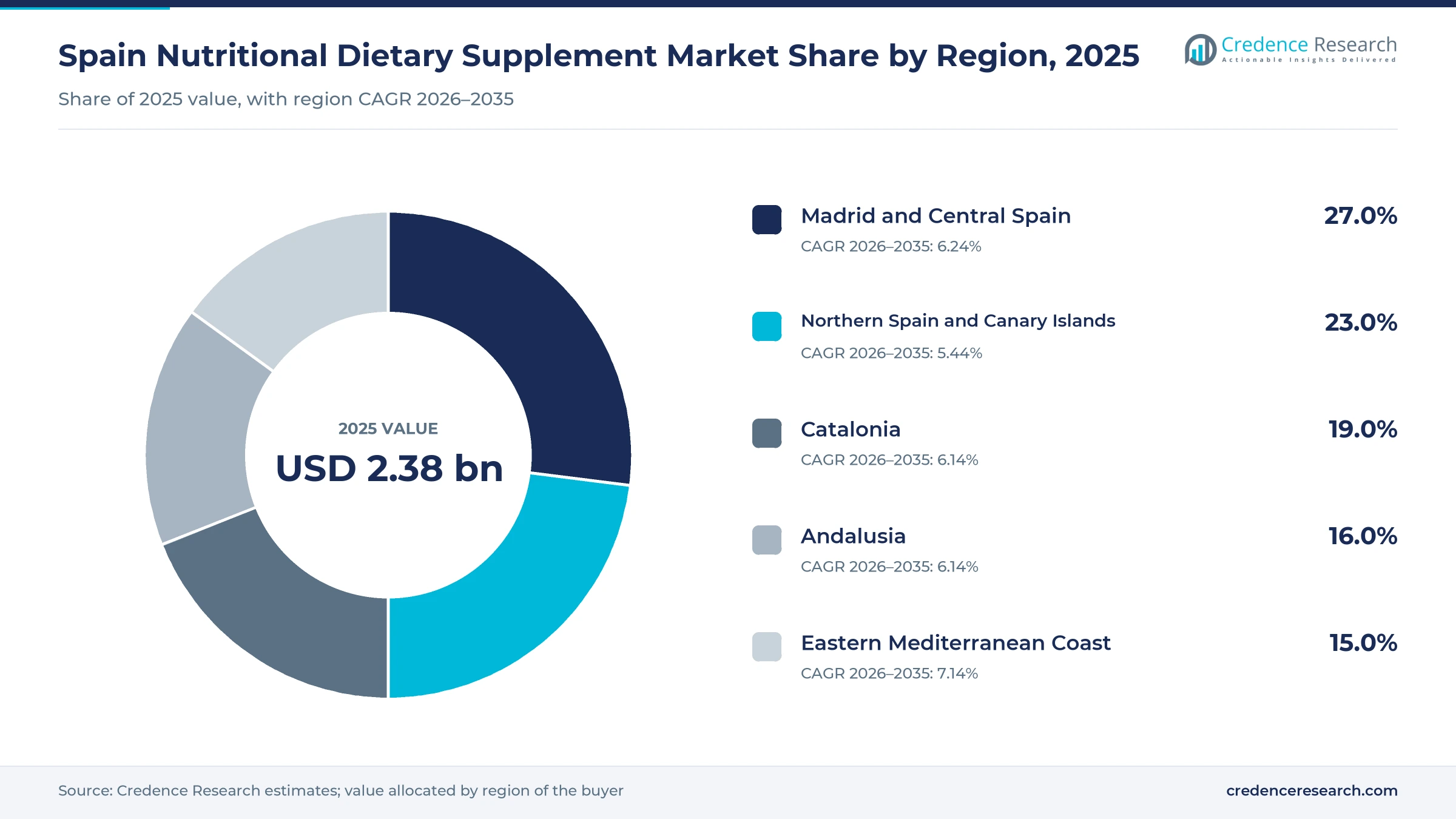
Madrid and the Mediterranean coast shape regional demand
| Region | Value, 2025 (USD billion) | Share, 2025 | CAGR, 2026–2035 |
|---|---|---|---|
| Madrid and Central Spain | 0.64 | 27.0% | 6.24% |
| Northern Spain and Canary Islands | 0.55 | 23.0% | 5.44% |
| Catalonia | 0.45 | 19.0% | 6.14% |
| Andalusia | 0.38 | 16.0% | 6.14% |
| Eastern Mediterranean Coast | 0.36 | 15.0% | 7.14% |
Madrid and Central Spain lead on pharmacy numbers
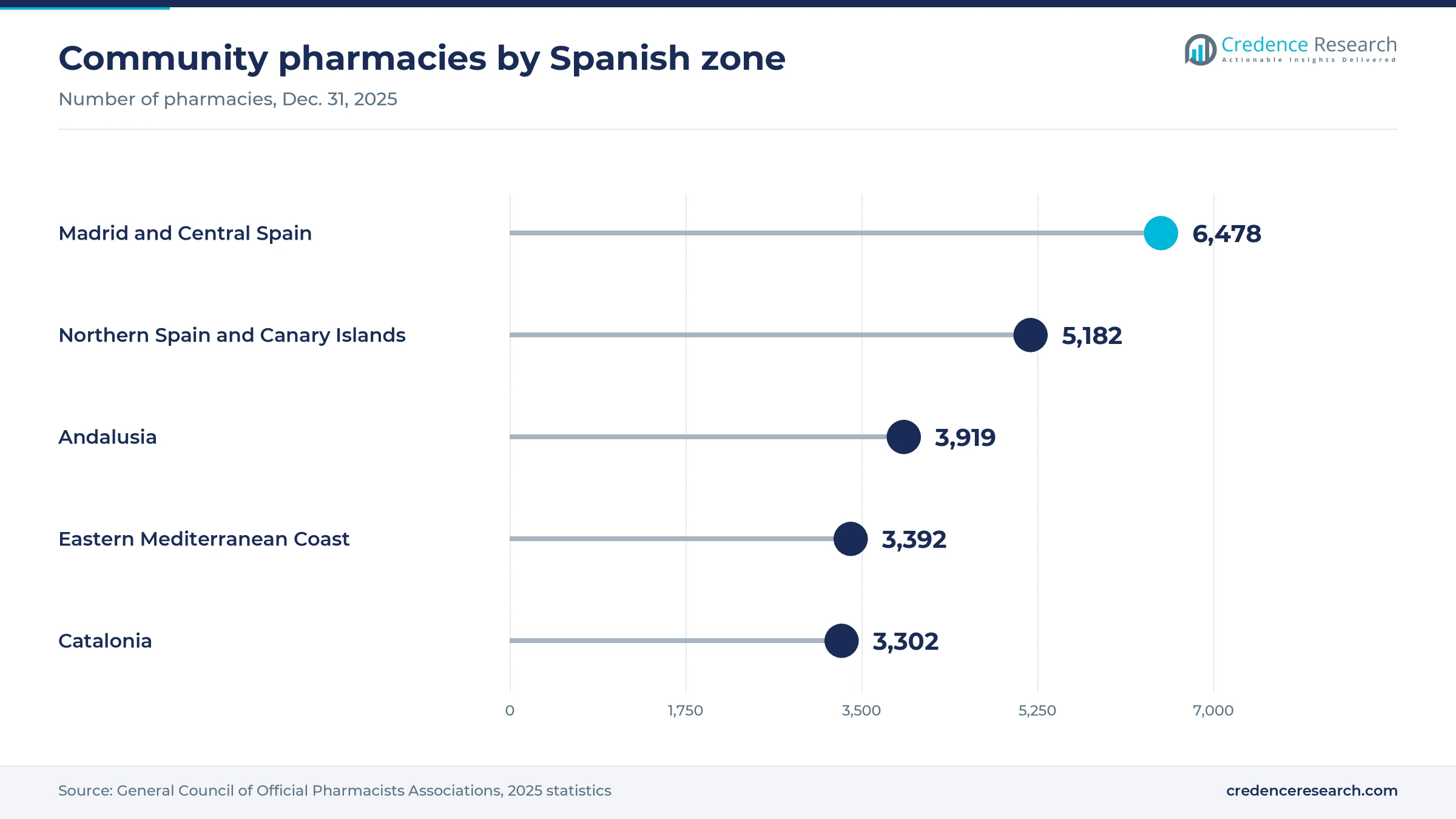
Madrid and Central Spain held 27.0% of 2025 value and grows at 6.24% a year, with Madrid, both Castiles and Extremadura counted together. The zone has 6,478 community pharmacies, according to the General Council of Pharmacists, including 2,948 in the Community of Madrid, whose 7,113,886 residents form its main spending base. INE projects Madrid's population to rise 14.4% over 15 years. Arkopharma España operates from Madrid, which gives the zone commercial weight.
Northern Spain and the Canary Islands carry an older base
Northern Spain and Canary Islands held 23.0% of 2025 value and grows at 5.44% a year, the slowest pace among the five zones. The zone has 5,182 pharmacies across eight communities, and Navarra alone counts 585 outlets. Ageing raises spending per person here, because Asturias has Spain's highest ageing index at 265.3%, according to INE data reported by Time Out in January 2026. However, INE projects Asturias to lose 1.6% of its residents over 15 years, which limits volume growth.
Catalonia combines spending power and industry presence
Catalonia held 19.0% of 2025 value and grows at 6.14% a year, supported by 8,124,126 residents and 3,302 community pharmacies. INE recorded a gain of 111,895 residents in 2024, the largest of any community named in its release. Catalonia's ageing index reached a record 136.9% in 2025, according to Time Out, which supports condition-specific demand. Barcelona also hosts the industry's main European event, with Vitafoods Europe at Fira Gran Via on May 5-7, 2026, and more than 1,600 exhibitors expected by the organizer.
Andalusia offers the largest population in one community
Andalusia held 16.0% of 2025 value and grows at 6.14% a year, counting Ceuta and Melilla within the zone. It is Spain's most populous community at 8,676,713 residents, and its 3,870 pharmacies are the most in any single community. Its share stays below its population weight because Credence Research assumes lower spending per person. However, Modaes reported, citing INE, that Andalusia added 54,248 people in the baby boomer cohort in 2025, the highest of the four largest communities.
Eastern Mediterranean Coast grows fastest on new residents
The Eastern Mediterranean Coast held 15.0% of 2025 value and is the fastest zone at 7.14% a year, covering the Valencian Community, Murcia and the Balearic Islands. INE projects the largest 15-year population gains in Spain for the Valencian Community at 16.4% and the Balearics at 16.2%. The Valencian Community also recorded the highest relative growth in 2024, at 2.0%. The zone has 3,392 pharmacies, and Modaes reported, citing INE, that Torrevieja saw 4.9% growth among residents aged 64 to 79.
Brand deals and regulation reshaped the market in 2026
| Development | Status and market relevance |
|---|---|
| In October 2024, Nestlé Health Science invested more than 7 million euros at its Sebares plant in Asturias in a line able to make 10,000 metric tons a year of Meritene Drink. | Operational; adds Spanish capacity for fortified adult nutrition drinks, reported by Alimarket |
| In March 2026, Spain's food safety agency AESAN approved version four of its official guide for controlling supplement labeling and composition. | In force; applied by regional authorities during official controls |
| In April 2026, Laboratorios Ordesa launched DonnaPlus Fertilidad, a pre-pregnancy supplement with inositols, folates, vitamin D and sustained-release melatonin. | On sale; brand has since moved to Aristo Pharma Iberia |
| In June 2026, Bayer named Supradyn the official multivitamin of Spain's national soccer teams, in an agreement running to 2028 with an option to 2031. | Active; supports mass awareness of a pharmacy multivitamin brand |
| In October 2026, Aristo Pharma Iberia acquired the DonnaPlus brand from Laboratorios Ordesa, with the brand team joining Aristo in Spain. | Completed as reported by Alimarket; financial terms were not disclosed |
New formats reshape daily supplement habits in Spain
- Gummies have become a key format in the Spanish sector, according to Alimarket's 2026 report, and they suit buyers who dislike tablets.
- Sustained-release melatonin appears in Ordesa's patented Melotime ingredient, which the company uses to help reduce the time needed to fall asleep.
- Single-dose bottles were used by Haleon for Multicentrum Energía & Vitalidad 50+, combining vitamin B12, niacin and zinc in a small daily serving, according to IM Farmacias.
- Creatine powders are moving beyond sports use, as Nestlé's Vitality Creatine Complex targets mobility and energy among middle-aged consumers.
Need a Custom Version of This Report?
Tailor the scope, geography, or segments to your exact requirements.
- Custom geography or segment scope
- Direct access to our analyst team
Global health brands compete with Spanish laboratories
Competition combines multinational consumer health groups, Spanish family laboratories, herbal specialists and retailer private labels. Alimarket estimates that 250 to 300 companies operate in manufacturing and distribution, so no single brand controls the dietary supplement category. Nestlé Health Science competes through Solgar and Meritene, and it has local production at Sebares in Asturias. Bayer relies on mass brands such as Supradyn, which gained a national soccer team agreement in June 2026. Haleon sells Multicentrum through pharmacies, while Arkopharma brings plant-based expertise through its Madrid subsidiary and held third place in Spain when Dermapharm completed its purchase in January 2023. Laboratorios Ordesa is refocusing on infant and adult nutrition after selling DonnaPlus to Aristo. Operators are expanding capacity, according to Alimarket's 2026 report, while new entrants without plants can turn to contract manufacturing for production. Plant-based specialists also compete with suppliers of herbal nutraceuticals for herbalist shelf space.
Companies profiled and their roles in this market
| Company | Type | Role in the market |
|---|---|---|
| Nestlé Health Science | Multinational health nutrition group | Owns Solgar and Meritene, and makes Meritene Drink at Sebares in Asturias |
| Haleon | Multinational consumer health group | Sells Multicentrum in Spain, including a 50+ energy formula, through direct local operations |
| Bayer | Multinational consumer health group | Markets Supradyn in Spain, with a national soccer team sponsorship signed in June 2026 that runs to 2028, with an option to 2031 |
| Arkopharma | Herbal and supplement specialist | Operates Arkopharma España in Madrid, as part of the Dermapharm group since January 2023 |
| Laboratorios Ordesa | Spanish nutrition laboratory | Focuses on infant and adult nutrition after selling the DonnaPlus brand to Aristo in October 2026 |
Trust in pharmacists remains the decisive commercial asset
Credence Research's view is that Spanish supplement growth depends more on professional trust than on new consumers, because most adults already use these products. The strongest brands will be those whose evidence satisfies pharmacists and doctors, since FIAB showed that 51% of users start on a doctor's advice and 37% on a pharmacist's. Private labels and marketplaces will take occasional buyers, but they are less suited to condition-specific needs. Companies should therefore prepare for EU maximum levels now, protect their pharmacy relationships, and build separate formats for grocery and online buyers rather than extending a single range everywhere.
How Credence Research estimated the Spanish market
The report uses 2025 as the base year and 2035 as the forecast year. Market values come from the Credence Research model, and they were sense-checked against a top-down view of trade association estimates. Segment and regional shares and growth rates are Credence Research estimates, informed by published consumer surveys, INE population data and pharmacy counts from the General Council of Pharmacists. Sources were public documents from regulators, statistics offices, trade associations, company releases and trade press. No interviews or primary surveys were conducted for this edition, and regional splits should be read as estimates rather than measured sales.
Longevity and online buying will steer growth to 2035
The market is expected to reach USD 4.35 billion by 2035, growing at a 6.17% CAGR from USD 2.54 billion in 2026. Older consumers and midlife longevity buyers should provide the most reliable new demand, because INE projects the over-65 share to keep rising for decades. The Eastern Mediterranean Coast should gain share as residents arrive, while the northern regions rely on higher spending per person. EU maximum levels, scheduled for adoption in early 2028, could force reformulation across multivitamins and minerals. Pharmacies should remain the largest dietary supplement channel throughout the period, although online stores will take a noticeably larger part of repeat purchases.
Frequently Asked Questions
How big is the Spain nutritional dietary supplement market?
What drives supplement demand in Spain?
Which product type leads the Spanish market?
Where do Spanish consumers buy dietary supplements?
Which region of Spain is the largest and which grows fastest?
Who regulates food supplements in Spain?
Which companies are active in the Spanish market?
What are the main challenges for supplement companies in Spain?
Table of Content
Chapter 1 Market Segmentation
- 1.1 Segmentation Framework
- 1.1.1 Product and Service Classification
- 1.1.2 Application and End-Use Classification
- 1.1.3 Technology and Solution Classification
- 1.1.4 Customer and Distribution Channel Classification
- 1.1.5 Geographic Segmentation
- 1.1.6 Market Segment Definitions and Boundaries
- 1.2 By Product Type
- 1.2.1 Vitamins and Multivitamins
- 1.2.2 Minerals
- 1.2.3 Botanicals and Herbal Extracts
- 1.2.4 Probiotics and Digestive Health
- 1.2.5 Sports and Protein Supplements
- 1.2.6 Others
- 1.3 By Application
- 1.3.1 General Health and Immunity
- 1.3.2 Bone, Joint and Muscle
- 1.3.3 Energy and Fatigue
- 1.3.4 Sleep and Mental Wellbeing
- 1.3.5 Hair, Skin and Nails
- 1.3.6 Others
Chapter 2 Introduction
- 2.1 Report Objectives and Scope
- 2.2 Product Definition and Industry Terminology
- 2.3 Market Inclusions and Exclusions
- 2.4 Research Process
- 2.4.1 Primary Research and Expert Interviews
- 2.4.2 Secondary Research and Source Review
- 2.4.3 Top-Down and Bottom-Up Estimation
- 2.4.4 Data Triangulation and Verification
- 2.5 Market Size Measurement Basis
- 2.5.1 2025: USD 2.38 billion → 2035: USD 4.35 billion
- 2.6 Historical and Forecast Reference Periods
- 2.6.1 Historical Period: 2018-2025
- 2.6.2 Base Year: 2025
- 2.6.3 Forecast Period: 2025-2035
- 2.7 Research Assumptions and Limitations
Chapter 3 Executive Summary
- 3.1 Market Snapshot and Key Findings
- 3.2 Base-Year Market Size, 2025
- 3.3 Forecast Market Size, 2035
- 3.4 Revenue and Volume Growth Outlook
- 3.5 Key Demand and Supply Indicators
- 3.6 Leading Market Segments
- 3.7 Fastest-Growing Market Opportunities
- 3.8 Regional Performance Highlights
- 3.9 Technology and Industry Transformation
- 3.10 Competitive Landscape Summary
- 3.11 Analyst View and Strategic Implications
Chapter 4 Spain Nutritional Dietary Supplement Market Trends and Developments
- 4.1 Historical Industry Development, 2018-2025
- 4.2 Recent Market Trends and Developments
- 4.3 Demand and Customer Behavior Trends
- 4.4 Technology and Product Innovation
- 4.5 Artificial Intelligence, Automation and Digitalization
- 4.6 Local Manufacturing and Supply Chain Realignment
- 4.7 Industry Partnerships, Mergers and Acquisitions
- 4.8 Sustainability and Circular Economy Developments
- 4.9 Government and Private Sector Investment Trends
- 4.10 Emerging Business Models and Commercialization
- 4.11 Industry Developments and Announcements
Chapter 5 Spain Nutritional Dietary Supplement Market Production, Supply and Demand Analysis
- 5.1 Demand Trend and Consumption Analysis, 2018-2025
- 5.2 Demand Forecast, 2025-2035
- 5.3 Production and Output Trend, 2018-2025
- 5.4 Production and Output Forecast, 2025-2035
- 5.5 Installed Capacity and Capacity Utilization
- 5.6 Company-Wise Production Plants and Statistics
- 5.6.1 Installed Production Capacity
- 5.6.2 Actual Production
- 5.6.3 Planned Capacity and Expansion Targets
- 5.7 Supply Chain Structure and Procurement Trends
- 5.8 Supply-Demand Gap and Bottlenecks
- 5.9 Import Dependence and Sourcing Structure
- 5.10 Contract Manufacturing and Outsourcing
- 5.11 Regional Supply and Demand Concentration
Chapter 6 Spain Nutritional Dietary Supplement Market Pricing Analysis
- 6.1 Pricing Structure and Measurement
- 6.2 Historical Pricing Trends, 2018-2025
- 6.3 Pricing Outlook, 2025-2035
- 6.4 Average Selling Price and Unit Economics
- 6.5 Pricing by Product and Market Segment
- 6.6 Geographic Pricing Differences
- 6.7 Key Input, Energy, Labor and Logistics Costs
- 6.8 Contract Pricing and Purchasing Models
- 6.9 Pricing Sensitivity and Competitive Positioning
- 6.10 Price, Margin and Profitability Implications
Chapter 7 Spain Nutritional Dietary Supplement Market Dynamics
- 7.1 Market Growth Drivers
- 7.1.1 Demand-Side Drivers
- 7.1.2 Technology and Innovation Drivers
- 7.1.3 Infrastructure and Investment Drivers
- 7.1.4 Regulatory and Policy Drivers
- 7.2 Market Restraints
- 7.2.1 Cost and Affordability Constraints
- 7.2.2 Technology and Adoption Barriers
- 7.2.3 Supply Chain and Operational Constraints
- 7.3 Market Challenges
- 7.3.1 Competitive Pressure and Margin Erosion
- 7.3.2 Skills, Infrastructure and Implementation Gaps
- 7.4 Emerging Market Opportunities
- 7.5 Market Dynamics Impact and Time-Horizon Assessment
Chapter 8 Spain Nutritional Dietary Supplement Value Chain Analysis
- 8.1 Industry Value Chain Overview
- 8.2 Upstream Suppliers and Critical Inputs
- 8.3 Technology and Component Providers
- 8.4 Manufacturing or Service Delivery
- 8.5 Distribution, Channel Partners and Integrators
- 8.6 Downstream Applications and End Users
- 8.7 Value Addition and Profit Pools
- 8.8 Vertical Integration and Outsourcing
- 8.9 Supplier Concentration and Risk
- 8.10 Supply Chain Localization and Resilience
Chapter 9 Spain Nutritional Dietary Supplement Market Regulations and Policies
- 9.1 Relevant Laws, Standards and Compliance Frameworks
- 9.2 Product, Service, Safety and Quality Requirements
- 9.3 Government Policies, Incentives and Subsidies
- 9.4 Imports, Exports and Trade Barriers
- 9.5 Public Procurement and Local Content Requirements
- 9.6 Environmental and Sustainability Compliance
- 9.7 Upcoming Policy Changes and Market Implications
Chapter 10 Spain Nutritional Dietary Supplement Market Hotspots and Opportunities
- 10.1 Market Opportunity Mapping and Growth Hotspots
- 10.2 High-Growth Applications and Customer Groups
- 10.3 Underserved Markets and White-Space Opportunities
- 10.4 Emerging Technology and Product Opportunities
- 10.5 New Capacity and Investment Hotspots
- 10.6 Market Entry and Expansion Opportunities
- 10.7 Distribution and Partnership Opportunities
- 10.8 Near-Term and Long-Term Commercial Potential
- 10.9 Opportunity Attractiveness and Execution Risks
Chapter 11 Spain Nutritional Dietary Supplement Market Outlook, 2025-2035
- 11.1 Market Size and Analysis
- 11.1.1 Revenue (Market Measurement: 2025: USD 2.38 billion → 2035: USD 4.35 billion)
- 11.1.2 Market Volume and Quantity Sold
- 11.1.3 Historical Market Size, 2018-2025
- 11.1.4 Base-Year Market Size, 2025
- 11.2 Market Forecast, 2025-2035
- 11.2.1 Revenue Forecast to 2035
- 11.2.2 Volume Forecast to 2035
- 11.2.3 CAGR and Year-on-Year Growth
- 11.2.4 Incremental Revenue Opportunity
- 11.3 Forecast Assumptions and Scenario Analysis
- 11.3.1 Base-Case Forecast
- 11.3.2 Optimistic and Conservative Scenarios
- 11.3.3 Technology, Pricing and Policy Sensitivities
- 11.4 Market Attractiveness and Growth Outlook
Chapter 12 Spain Nutritional Dietary Supplement Market Segmentation and Outlook
- 12.1 Segmentation Summary and Market Shares, 2025
- 12.2 Largest and Fastest-Growing Segments
- 12.3 By Product Type - Market Size and Forecast, 2025-2035
- 12.3.1 Segment Definition and Scope
- 12.3.2 Historical Market Size, 2018-2025
- 12.3.3 Revenue Forecast, 2025-2035
- 12.3.4 Volume Forecast, 2025-2035
- 12.3.5 Base-Year Market Share, 2025
- 12.3.6 Segment CAGR and Growth Drivers
- 12.3.7 Subsegment Market Size and Forecast
- 12.3.7.1 Vitamins and Multivitamins
- 12.3.7.2 Minerals
- 12.3.7.3 Botanicals and Herbal Extracts
- 12.3.7.4 Probiotics and Digestive Health
- 12.3.7.5 Sports and Protein Supplements
- 12.3.7.6 Others
- 12.3.8 Subsegment Pricing and Adoption Trends
- 12.3.9 Leading Suppliers and Competition
- 12.3.10 Regional Demand and Opportunities
- 12.4 By Application - Market Size and Forecast, 2025-2035
- 12.4.1 Segment Definition and Scope
- 12.4.2 Historical Market Size, 2018-2025
- 12.4.3 Revenue Forecast, 2025-2035
- 12.4.4 Volume Forecast, 2025-2035
- 12.4.5 Base-Year Market Share, 2025
- 12.4.6 Segment CAGR and Growth Drivers
- 12.4.7 Subsegment Market Size and Forecast
- 12.4.7.1 General Health and Immunity
- 12.4.7.2 Bone, Joint and Muscle
- 12.4.7.3 Energy and Fatigue
- 12.4.7.4 Sleep and Mental Wellbeing
- 12.4.7.5 Hair, Skin and Nails
- 12.4.7.6 Others
- 12.4.8 Subsegment Pricing and Adoption Trends
- 12.4.9 Leading Suppliers and Competition
- 12.4.10 Regional Demand and Opportunities
- 12.5 Segment Growth Comparison
- 12.6 Segment Attractiveness and Priority Matrix
Chapter 13 Spain Nutritional Dietary Supplement End-Use and Application Market Outlook
- 13.1 End-Use Industry and Customer Demand Structure
- 13.2 Leading Applications and Customer Groups
- 13.3 End-Use Market Size, Share and Forecast
- 13.4 Major End-Use Industry Deep Dives
- 13.4.1 Customer Requirements and Use Cases
- 13.4.2 Demand and Replacement Cycles
- 13.4.3 Technical and Regulatory Considerations
- 13.4.4 Purchasing and Procurement Models
- 13.4.5 Leading Vendors and Distribution Channels
- 13.4.6 Forecast and Commercial Opportunities
- 13.5 Emerging Applications and Cross-Segment Demand
- 13.6 End-Use Industry Investment Priorities
Chapter 14 Spain Nutritional Dietary Supplement Geographic Market Outlook, 2025-2035
- 14.1 Domestic Market Distribution and Demand Clusters
- 14.2 State- or Province-Wise Market Size and Forecast, 2025-2035
- 14.3 City and Metropolitan Market Outlook
- 14.4 Industrial, Manufacturing and Commercial Clusters
- 14.5 Geographic Concentration of Key End Users
- 14.6 Local Pricing and Purchasing Differences
- 14.7 Domestic Production Facilities and Capacity Map
- 14.8 Local Infrastructure and Project Pipeline
- 14.9 State-Level Policy and Incentive Differences
- 14.10 Subnational Investment Hotspots and Opportunities
- 14.11 Distribution and Logistics Networks
- 14.12 Domestic Competitive Footprint
Chapter 15 Spain Nutritional Dietary Supplement Technology, Innovation and Sustainability Outlook
- 15.1 Technology Landscape and Maturity
- 15.2 Product, Process and Service Innovation
- 15.3 AI, Automation and Digital Tools in the Industry
- 15.4 Technology Adoption and Performance Benchmarking
- 15.5 Innovation Pipeline and R&D Investment
- 15.6 Patent and Intellectual Property Trends
- 15.7 Energy Efficiency and Resource Management
- 15.8 Sustainability, Recycling and Circularity
- 15.9 Technology Roadmap, 2025-2035
- 15.10 Risks of Obsolescence and Technology Substitution
Chapter 16 Spain Nutritional Dietary Supplement Market Key Strategic Imperatives
- 16.1 Growth and Market Entry Priorities
- 16.2 High-Return Products and Segments
- 16.3 Pricing, Profitability and Cost Optimization
- 16.4 Technology Investment and Product Differentiation
- 16.5 Supply Chain Localization and Resilience
- 16.6 Distribution and Customer Acquisition
- 16.7 Partnership, Acquisition and Capacity Strategy
- 16.8 Regional Expansion Priorities
- 16.9 Short-, Medium- and Long-Term Actions
Chapter 17 Competition Outlook
- 17.1 Industry Competition Characteristics
- 17.2 Market Structure and Concentration
- 17.3 Market Share and Competitive Positioning, 2025
- 17.4 Company-Wise Revenue and Product Benchmarking
- 17.5 Production and Service Capacity Benchmarking
- 17.6 Technology, Pricing and Differentiation
- 17.7 Regional Footprint and Distribution Strength
- 17.8 Mergers, Acquisitions and Strategic Alliances
- 17.9 New Entrants and Competitive Threats
- 17.10 Porter's Five Forces and Industry Attractiveness
- 17.11 Competitive Outlook, 2025-2035
Chapter 18 Company Profiles
- 18.1 Company Coverage and Selection Criteria
- 18.2 Nestlé Health Science
- 18.2.1 Business Description
- 18.2.2 Company Ownership and Geographic Presence
- 18.2.3 Product and Service Portfolio
- 18.2.4 Manufacturing and Operating Footprint
- 18.2.5 Production Capacity and Expansion Plans
- 18.2.6 Financial Performance and Investment
- 18.2.7 Market Share and Competitive Position
- 18.2.8 Technology and Innovation Capabilities
- 18.2.9 Strategic Alliances or Partnerships
- 18.2.10 Recent Developments
- 18.2.11 Growth Strategy and Outlook
- 18.3 Haleon
- 18.4 Bayer
- 18.5 Arkopharma
- 18.6 Laboratorios Ordesa
- 18.7 Other Relevant Market Participants
Note: Every listed company is profiled on the structure shown under the first company. The company list is preliminary and may change based on research findings, market developments, data availability and client requirements.
Chapter 19 Disclaimer
- 19.1 Research and Forecast Disclaimer
- 19.2 Data Source and Estimation Limitations
Note: The depth of individual sections depends on data availability for this market. Volume, capacity, trade and other unit-based metrics are included where applicable.

