
North America skin toner moves past the astringent era
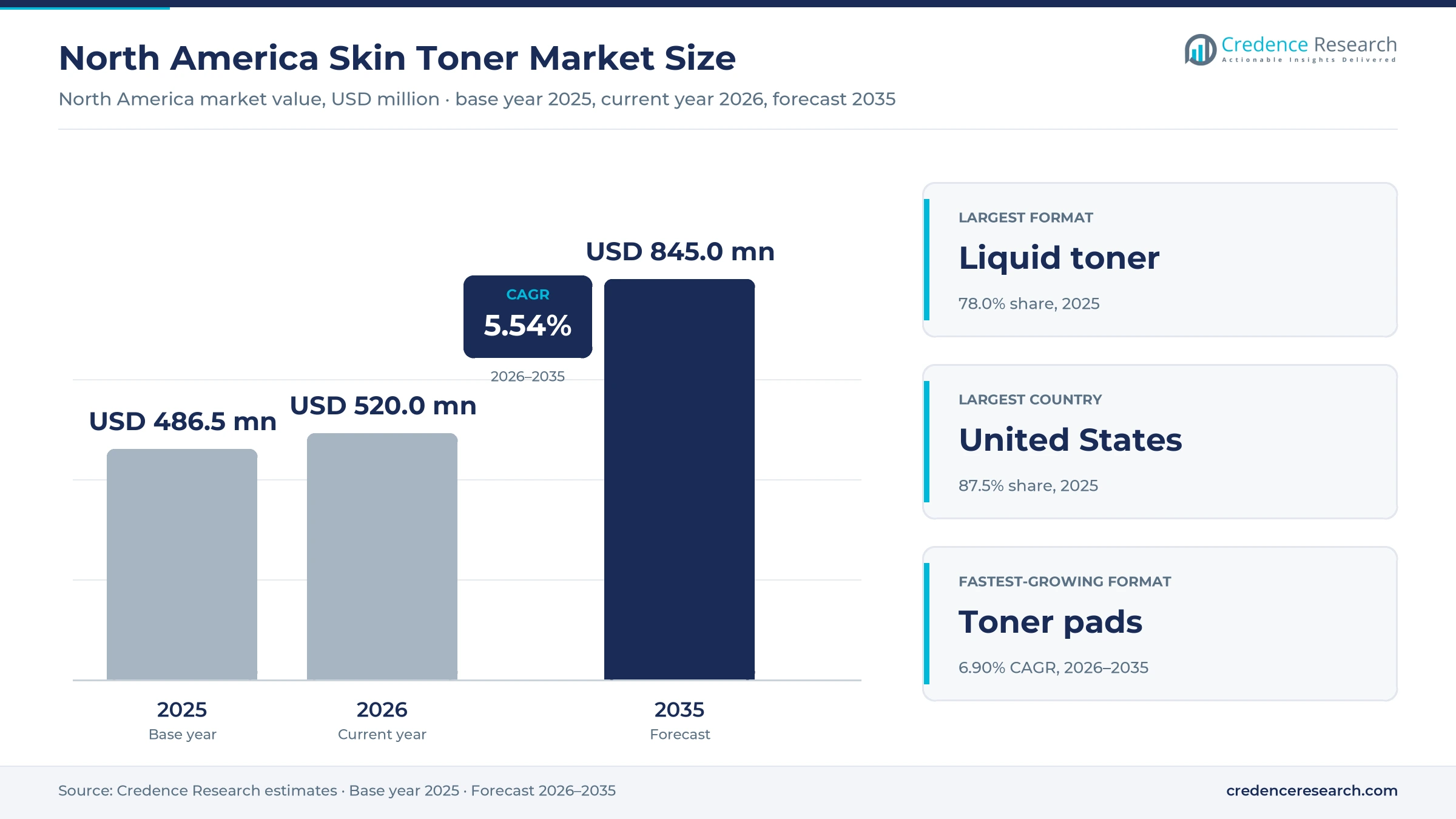
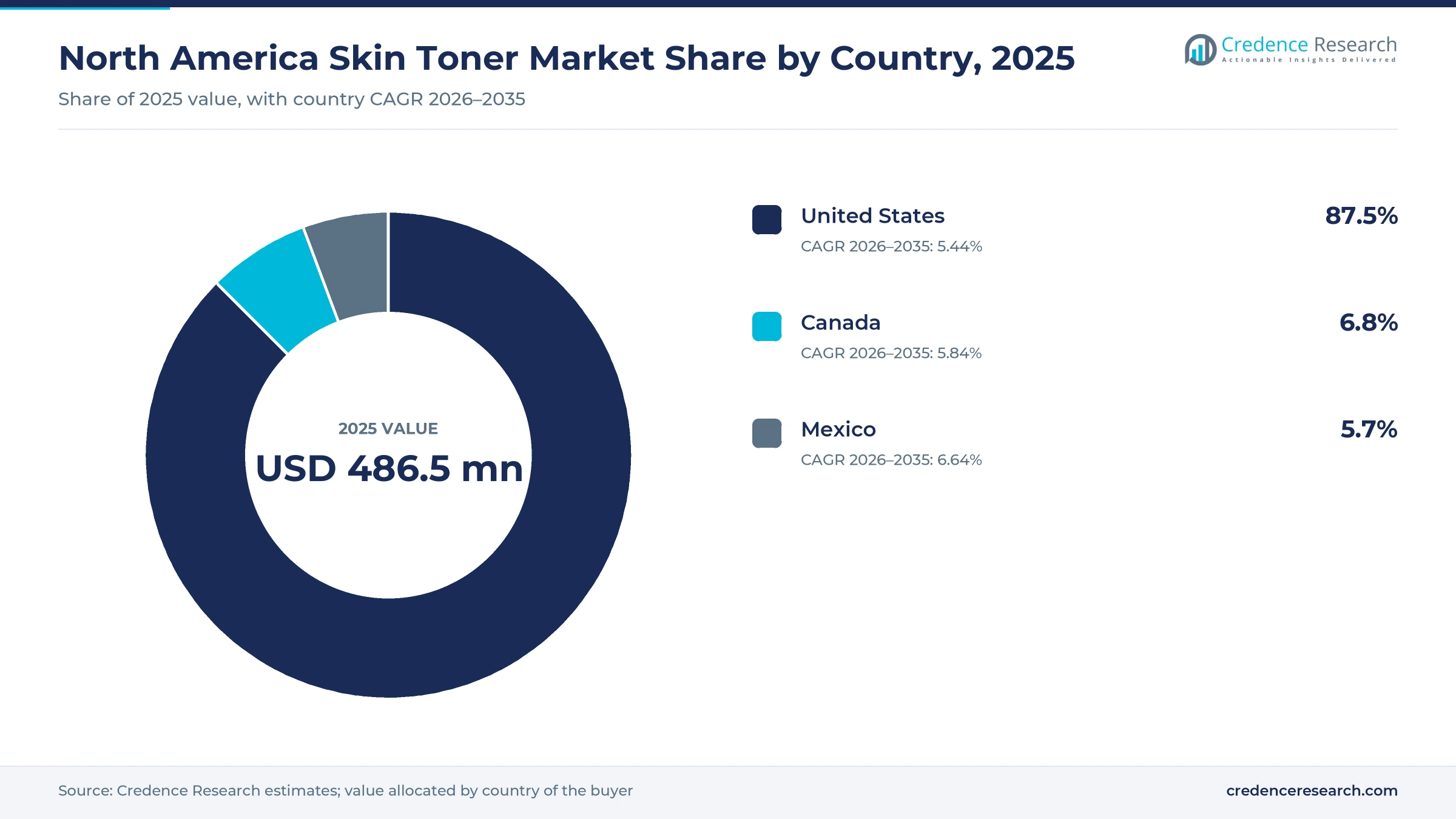
The North America skin toner market was valued at USD 486.5 million in 2025 and is projected to increase from USD 520.0 million in 2026 to USD 845.0 million by 2035, registering a CAGR of 5.54% during 2026–2035. Demand comes from hydrating toners and essences added to established cleanse-and-moisturize routines, from online discovery and from Korean brands now stocked by mainstream beauty chains. The United States held the largest share, 87.5% in 2025, because its specialty beauty chains and prestige counters carry the widest range of formats and price points. Mexico is the fastest-growing country at 6.64% a year as organized beauty retail reaches more of its cities. On the commercial side, the end of the Ulta Beauty shops inside Target stores in August 2026 reopened mass shelf space, while pads and mists gave brands new reasons to bring lapsed users back into the category.
What counts as a skin toner in North America, and how is it bought?
The market counts liquid toners, facial mists sold as toners and pre-soaked toner pads applied after cleansing, at retail value across the United States, Canada and Mexico. Buyers include women and men, who purchase through beauty chains, drugstores, general merchandisers and online stores at price points from value to prestige.
Micellar cleansers, serums, moisturizers and professional in-clinic peels are excluded because they serve a different routine step. The value chain runs from ingredient suppliers and contract fillers through brand owners to retailers, and most brands outsource filling while keeping formulation and marketing in-house.
North America Skin Toner Market Insights
- The market rises from USD 486.5 million in 2025 to USD 845.0 million by 2035, a 5.54% annual pace led by hydrating formats, pads and online discovery.
- The United States held 87.5% of regional value in 2025, because its beauty chains and prestige counters stock the widest toner assortment.
- Liquid toner formats held 78.0% of 2025 value, though pads are the fastest-growing format as brands add low-priced exfoliating options.
- The Ulta Beauty departments inside more than 600 Target stores ended with their agreement in August 2026, which reopened a large block of beauty shelf space.
- Korean cosmetics exports to the United States reached $2.2 billion in 2025, which intensifies competition for L’Oréal, Procter & Gamble and Kenvue brands.
Liquid bottles and prestige formulas hold most of the value
Why do liquid bottles still outsell pads and mists?
Based on product type, the market is categorized into liquid toner, mist toner and toner pads. Liquid toner led with 78.0% of 2025 value because the post-cleanse bottle remains the format most buyers recognize, and WWD reported in April 2024 that U.S. prestige toner sales reached $226.5 million in 2023, up 27%, with Glow Recipe’s Watermelon Glow credited with much of the gain. Toner pads grow fastest at 6.90% a year as Thayers added Exfoliating 2% AHA and Pore Refining pads at $9.99 each through Walmart, Target and Amazon, according to Trend Hunter in February 2026.
Which skin need drives the most toner spending?
Based on application, the market is categorized into hydration, oil balance and exfoliation. Hydration led with 52.0% of 2025 value because milky and essence launches concentrated here, including Byoma Hydrating Milky Toner at $14.99 and Farmacy Honey Milk Hydrating Essence at $34, both listed by WWD in April 2024. Exfoliation grows fastest at 6.21% a year as acid formulas reach mass shelves, with Thayers’ AHA Toner blending glycolic, mandelic and lactic acids in October 2025. Those launches carry a labeling duty, because FDA guidance recommends a Sunburn Alert statement on cosmetics using alpha hydroxy acids.
Where do North American shoppers buy toners?
Based on distribution channel, the market is categorized into online, specialty beauty, drug/pharmacy and general retail. Specialty beauty led with 34.0% of 2025 value because chains carry the broadest assortment, with Ulta Beauty’s March 2026 filing counting 1,505 U.S. stores and Retail Insider recording Sephora’s 144th Canadian store that same month. Online grows fastest at 6.60% a year as GCI Magazine reported in October 2025 that North American online beauty sales were up 21%. Thayers reinforced that shift by selling its Hydrating Milky Mist first on Amazon from May 2026, according to Trend Hunter.
How much of the value sits at prestige prices?
Based on price tier, the market is categorized into value, mass, mid-market and prestige. Prestige led with 50.0% of 2025 value because unit prices run far above the drugstore shelf, as WWD listed Chanel Sublimage La Lotion at $195 and Augustinus Bader The Face Mist at $95 in April 2024. Mass grows fastest at 6.06% a year as BeautyMatter reported mass skincare up 6% in both dollars and units during 2025. Target added to that momentum with more than 3,000 new beauty products for spring 2026, 90% of them under $20, according to Pulse.
| Segment Group | Leading Sub-segment | Share, 2025 | Fastest-growing Sub-segment | CAGR, 2026–2035 |
|---|---|---|---|---|
| By Product Type | Liquid toner | 78.0% | Toner pads | 6.90% |
| By Application | Hydration | 52.0% | Exfoliation | 6.21% |
| By Distribution Channel | Specialty beauty | 34.0% | Online | 6.60% |
| By Price Tier | Prestige | 50.0% | Mass | 6.06% |
Request a Free Sample
Fill in your details and we'll send you a free sample report.
- Sample data tables & charts
- Research methodology
Hydration routines and Korean imports widen the buyer base
Hydration-led routine integration adds a daily step
Hydration has turned the toner from an optional astringent into a daily layering step, which raises both use frequency and average price. WWD reported that prestige category growth jumped from 1% in 2022 to 27% in 2023, and essences from Farmacy, Superegg and Erno Laszlo followed in 2024. Happi reported in August 2026 that U.S. prestige skincare sales rose 9% in the first half of 2026, with units up by double digits, so the wider routine is still expanding. Thayers extended its Milky line with a mist containing 7% glycerin in May 2026, which shows mass brands following the same logic. As a result, Hydration held 52.0% of 2025 value, and brands now build lines around moisture claims rather than oil removal.
Digital discovery and retail assortment expand reach
Online discovery and wider store assortments put more toner brands in front of shoppers, which shortens the path from social content to first purchase. GCI Magazine reported on Oct. 2, 2025, that online beauty sales had grown at nine times the rate of in-store results. Thayers’ mist also began from a DIY recipe that two creators popularized, according to Trend Hunter, before it went on sale first on Amazon. Physical assortment widened as well, with Ulta Beauty opening 63 U.S. stores in fiscal 2025, according to its March 2026 filing. Target replaced its Ulta departments after adding more than 60 new beauty brands for spring 2026, according to Pulse. In turn, Online is the fastest channel at 6.60% a year.
Multifunctional formats give buyers more reasons to use toner
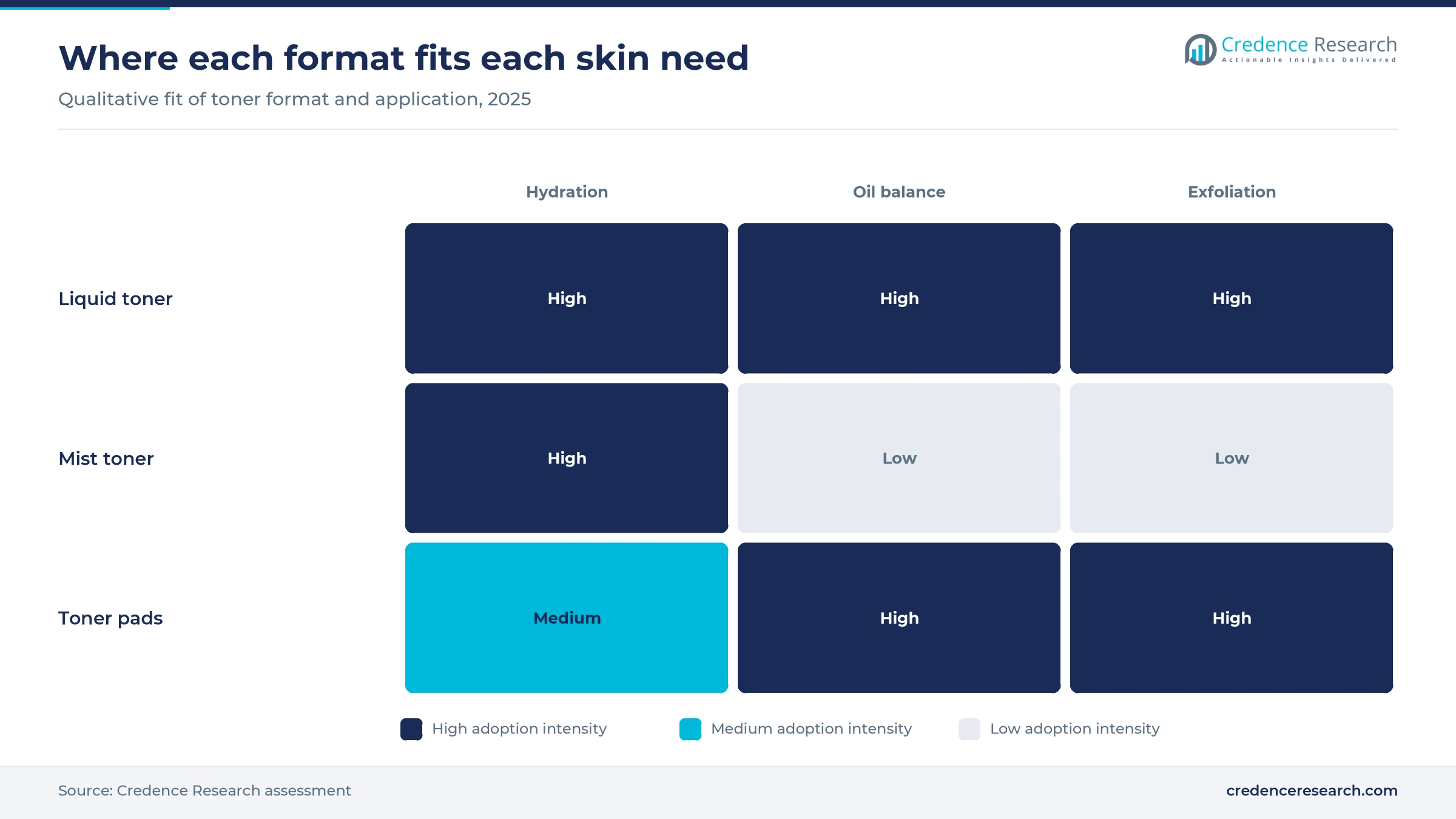
Multifunctional formats combine hydration, exfoliation and pore care in one product, which helps brands justify a separate purchase beyond the cleanser. Thayers launched a 2% AHA Toner in October 2025 that is 96% naturally derived, according to Trend Hunter, and followed in February 2026 with three pad variants at $9.99. Benefit positioned Porefessional Hydro Pop at $76 for combination and acne-prone skin, while Tula sold its Clarifying Tonic at $28 with PHA and lactic acid, WWD reported. These launches also suit consumers who already own micellar water and want a second step with a defined result. Consequently, Toner pads are the fastest format at 6.90% a year, from a small base.
Korean brands raise format and price competition
Korean brands have made toners and essences a familiar part of mainstream shopping, which expands the category while pressuring incumbents on price. Personal Care Magazine reported that Korean cosmetics exports reached a record $11.43 billion in 2025, with skin care at $8.54 billion and the United States the largest destination at $2.2 billion. Personal Care Insights reported in October 2025 that the United States had overtaken China, taking $1.67 billion in the first three quarters, up 18.1%. The same report noted that Laneige, Cosrx and Innisfree hold shelf space at Ulta Beauty and Target. Because these brands reach the same aisles as domestic labels, they influence texture and pad expectations across the United States.
Price spread and ingredient disclosure reshape the shelf
Shift toward a wider price ladder in the same aisle
The category now spans a much wider price ladder, which lets a single routine step serve buyers at very different budgets. WWD’s April 2024 launch list ran from Byoma at $14.99 through Tula at $28, Aesop Immaculate Facial Tonic at $44 and Benefit at $76. At the top of the ladder, these products sit close to luxury cosmetics in pricing and presentation, while pads at $9.99 anchor the entry point. BeautyMatter reported that prestige average selling prices rose 1% in 2025, while prestige units rose 4%, so volume rather than price drove that tier. For brand owners, this spread means Prestige keeps 50.0% of 2025 value even as lower tiers add more shoppers.
Rise of ingredient disclosure in toner formulas
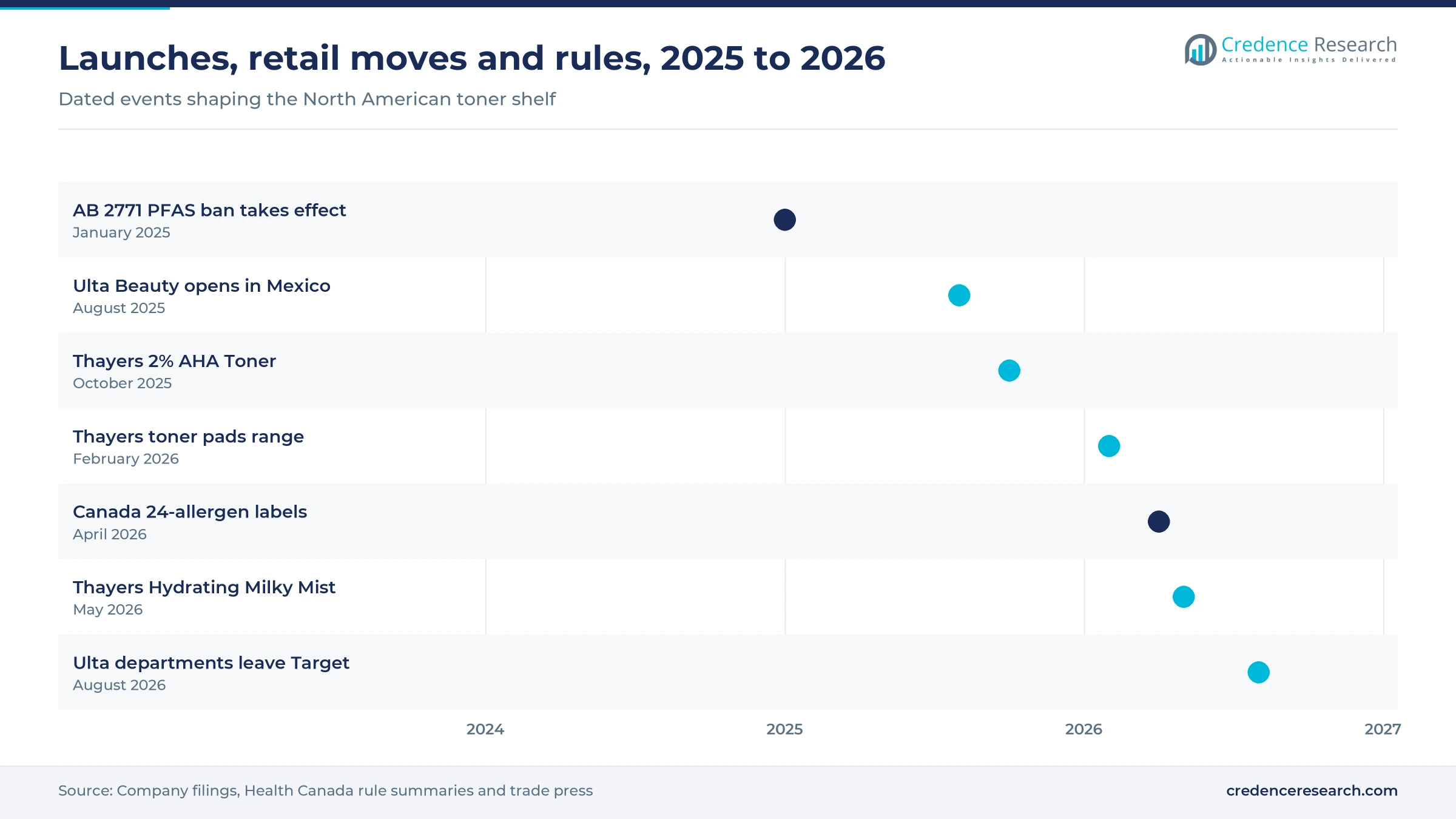
Ingredient disclosure is moving from a marketing choice to a legal baseline, which favors simple formulas and clear labels. Canada began requiring disclosure of 24 fragrance allergens on April 12, 2026, according to CIRS Group, with 81 allergens applying to new products from Aug. 1, 2026. California’s AB 2771 has banned intentionally added PFAS in cosmetics since Jan. 1, 2025, according to the California Air Resources Board. In the United States, ChemLinked reported in July 2026 that FDA expects to publish its proposed fragrance allergen rule in November 2026. Thayers’ 96% naturally derived claim shows how mass brands respond, drawing on positioning long used in natural cosmetics. Alcohol-free and fragrance-free claims should therefore become standard on the shelf.
Opportunity in Mexico’s newly organized beauty retail
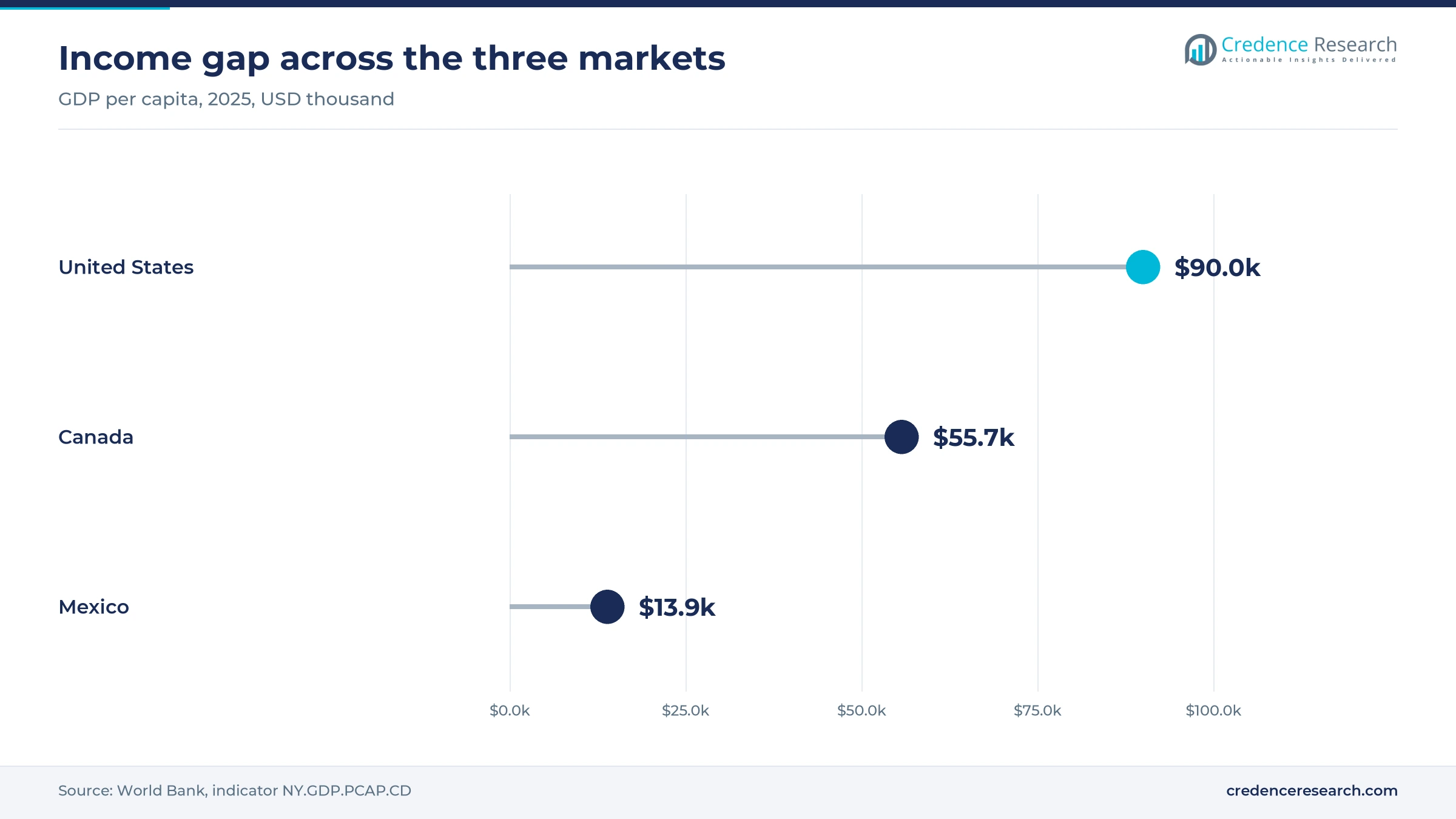
Mexico offers the clearest expansion opening, because organized specialty beauty retail is arriving where toner use remains less developed. Mexico Business News reported that Ulta Beauty and Grupo Axo opened at Antara Fashion Hall on Aug. 21, 2025, and at Galerías Metepec on Aug. 30, 2025, with León, Guadalajara, Tijuana and Monterrey named next. Mexico News Daily, citing INEGI, reported a population of 130.91 million with a median age of 32 in 2025, up from 29 in 2020. World Bank data show 2025 GDP per capita near $13,889, so value and mass packs fit best at first. Brands that enter with Spanish labels and entry prices can secure shelf positions before larger rivals arrive in those cities.
Opportunity in Canada’s secondary-mall beauty stores
Canada offers an opening in smaller cities and neighborhood malls, as prestige retail moves beyond downtown flagships. Retail Insider reported in March 2026 that Sephora’s Erin Mills store was its 144th in Canada, up from 100 in November 2022, with 10 to 15 stores added yearly. The same report said Shoppers Drug Mart runs more than 1,300 locations and holds an estimated 28% to 30% of health and beauty sales, which keeps drugstore distribution important. Statistics Canada counted 41.65 million residents on July 1, 2025, with a median age of 40.6, which favors hydrating and anti-aging claims. Brands that combine Sephora discovery with Shoppers reach can build on Canada’s 6.8% share and 5.84% annual growth.
Tariffs, pharmacy closures and labels squeeze margins
Shifting tariffs cloud the landed cost of Korean imports
Asia Economy reported in August 2025 that the United States confirmed a 15% tariff on Korean cosmetics, up from a provisional 10% in place since April. The Supreme Court struck down those emergency tariffs on Feb. 20, 2026, according to Thompson Coburn, and since July 24, 2026, South Korean goods have faced a 12.5% Section 301 rate net of the MFN rate, according to Dorsey & Whitney. Industry representatives expected companies to trim promotions first, so margins absorb the initial effect. Smaller labels without U.S. inventory feel this most, which pushes them toward local stock and domestic filling.
Pharmacy closures shrink a traditional toner outlet
Drugstores remain important for astringent and value toners, yet their store base is contracting across the United States. ABC7 reported that Rite Aid closed its final 89 stores in October 2025, while Retail TouchPoints reported in June 2025 that CVS planned 271 closures that year. As a result, mass brands lose incidental shelf exposure in neighborhoods. They respond by shifting spending toward Walmart, Target and Amazon, which already carry the Thayers pad range.
Labels and compliance add cost across three countries
Three separate rulebooks increase the cost of selling one formula across the region. Canada’s 81-allergen list reaches all products on Aug. 1, 2028, with a 0.001% threshold for leave-on items, according to CIRS Group. Maven Regulatory Solutions noted in February 2026 that Mexico requires Spanish labels under NOM-141 and good manufacturing practices under NOM-259. Smaller brands carry this burden most heavily, because each change means new cosmetics packaging runs and fresh inventory.
Hit-driven growth makes category demand uneven
Toner growth depends heavily on hit products, which makes planning difficult for retailers and contract fillers. WWD reported in April 2024 that the prestige toner surge rested largely on one Glow Recipe product that reportedly sold every 13 seconds. BeautyMatter reported that 2025 mass skincare growth came mainly from facial cleanser and face moisturizer lines, not toners. Brands therefore risk overstocking after a viral peak, and many now test smaller launch quantities before committing to a full national rollout.
The United States sets volume while Mexico grows fastest
| Country | Value, 2025 (USD million) | Share, 2025 | CAGR, 2026–2035 |
|---|---|---|---|
| United States | 425.7 | 87.5% | 5.44% |
| Canada | 33.1 | 6.8% | 5.84% |
| Mexico | 27.7 | 5.7% | 6.64% |
The United States holds the largest share through specialty beauty scale
The United States held 87.5% of 2025 value and grows at 5.44% a year, because its beauty chains and online platforms set the pace for the region. Ulta Beauty’s March 2026 filing counted 1,505 U.S. stores, with skincare and wellness rising to 24% of net sales in fiscal 2025. Happi reported first-half 2026 prestige retail sales of $17.1 billion and mass retail sales of $39.2 billion, both up 7%. High incomes support prestige essences, and World Bank data show 2025 GDP per capita near $90,027.
Canada blends prestige expansion with strong drugstore reach
Canada held 6.8% of 2025 value and grows at 5.84% a year, as Sephora’s store growth adds prestige access outside major downtown areas. Retail Insider counted 144 Sephora stores in March 2026, alongside more than 1,300 Shoppers Drug Mart locations. Kenvue’s Neutrogena Canada site lists an Alcohol-Free Toner, which shows the drugstore-led mass offer. However, the phased fragrance allergen rule that started on April 12, 2026, requires label changes that smaller importers must absorb. World Bank data place 2025 GDP per capita near $55,698, which supports premium trade-up.
Mexico grows fastest as organized beauty retail spreads
Mexico held 5.7% of 2025 value and is the fastest-growing country at 6.64% a year, because organized beauty retail is expanding from a low base. Ulta Beauty entered with Grupo Axo in August 2025, and its March 2026 filing confirmed the Mexican joint venture. The population of 130.91 million is younger than Canada’s, with a median age of 32, which suits social-led discovery. However, lower incomes keep most volume in value and mass tiers, and importers must meet Spanish labeling rules under NOM-141.
Pads, mists and retail resets marked 2025 and 2026
| Development | Status and market relevance |
|---|---|
| In August 2025, Ulta Beauty and Grupo Axo opened the first Ulta stores in Mexico at Antara Fashion Hall and Galerías Metepec. | Live, with further cities named for expansion |
| In October 2025, Thayers introduced a 2% AHA Toner combining glycolic, mandelic and lactic acids with witch hazel. | On sale, extends the brand into exfoliation |
| In November 2025, Kenvue, owner of Neutrogena, signed a merger agreement with Kimberly-Clark, and shareholders of both companies approved the deal in January 2026. | Pending other closing conditions per the September 2026 quarterly filing |
| In February 2026, Thayers introduced Exfoliating 2% AHA and Pore Refining pads at $9.99 through Walmart, Target and Amazon. | On sale, widens the pad format at entry prices |
| In April 2026, Canada began requiring disclosure of 24 fragrance allergens on cosmetic labels. | In force, with 81 allergens phased in by August 2028 |
Acid blends, pads and milky textures change the category
- Blended acids combine glycolic, mandelic and lactic acids at low levels, as in the Thayers 2% AHA Toner launched in 2025, which spreads the exfoliating action across three acids.
- Pre-soaked pads give a measured dose and a simple routine, which makes them easy to sell at entry prices of $9.99.
- Milky emulsions blend oil and water phases, as Byoma’s oil-based toner shows, so one product can both cleanse residue and hydrate the skin.
- Touch-free mists deliver humectants such as glycerin at 7% in the Thayers mist, which lets users hydrate the skin without touching it.
Need a Custom Version of This Report?
Tailor the scope, geography, or segments to your exact requirements.
- Custom geography or segment scope
- Direct access to our analyst team
Global brand owners face agile Korean and indie labels
Competition splits between global brand owners with broad distribution and younger Korean and independent labels that win on texture and social reach. L’Oréal competes through Thayers, whose Witch Hazel Aloe Vera toner is its best-seller, according to Cosmetics Business, and it has refreshed that brand with pads, acids and mists. In North America skin toner, Procter & Gamble covers both ends of the price ladder, with Olay Magic AA Toner in mass and SK-II Facial Treatment Essence in prestige. Kenvue lists Neutrogena Alcohol-Free Toner in Canada, although the U.S. Neutrogena product page now marks the toner as discontinued, and it is also moving through a merger with Kimberly-Clark. Shiseido sells softeners and balancing lotions directly on its U.S. site. Amorepacific-owned Korean labels Cosrx and Laneige now share Ulta Beauty and Target shelves with these groups, which keeps pressure on pricing and launch speed.
Which companies shape the North American toner shelf?
| Company | Type | Role in the market |
|---|---|---|
| L’Oréal | Brand owner | Thayers witch hazel toners, pads, acid toner and milky mist |
| Procter & Gamble | Brand owner | Olay Magic AA Toner in mass and SK-II Facial Treatment Essence in prestige |
| Kenvue | Brand owner | Neutrogena Alcohol-Free Toner listed in Canada, with a merger into Kimberly-Clark pending |
| Shiseido | Brand owner | Softeners and balancing lotions sold through its U.S. site |
Format innovation matters more than new users
Credence Research’s view is that this category will grow through better formats more than through new users. Toner is already familiar, so pads, mists and acid blends must give existing skin care buyers a clear reason to add or return to the step. The 2023 prestige surge shows how quickly one product can lift the category, and it also shows how uneven that demand can be. Brands should therefore pair hit-seeking launches with dependable drugstore and mass staples. North America skin toner brands should note that Mexico holds only 5.7% of 2025 value today, yet it deserves early attention because shelf positions will be harder to win later.
How the regional and segment estimates were built
The report uses 2025 as the base year and 2035 as the forecast year, and market values come from the Credence Research model. Country, segment and channel splits are Credence Research estimates, informed by retail store counts, tracked category sales published in trade press, population statistics and World Bank income data. Sources include regulators, company filings, company product pages and trade publications. No interviews or surveys were conducted for this edition, and estimates for price tiers and channels carry the most uncertainty.
Steady mid-single-digit growth through 2035
The North America skin toner outlook is steady rather than dramatic, with the market reaching USD 845.0 million by 2035 at a 5.54% annual rate. Hydration should stay the core claim, while pads and low-level acid formats take a rising share of launches. Retail growth should come from online stores, Mexican specialty chains and Canadian neighborhood malls. Tariffs and skin toner labeling rules will likely favor larger groups and brands with local stock, which may prompt further acquisitions of small labels. Winners will combine clear skin benefits, simple ingredient lists and strong placement across both digital and physical shelves.
Frequently Asked Questions
How big is the North America skin toner market?
Which country leads the market?
Which country is growing fastest?
Which product type holds the largest share?
Why are toner pads growing quickly?
What is driving demand for hydrating toners?
How do tariffs affect the category?
Who are the main companies in this market?
Table of Content
Chapter 1 Market Segmentation
- 1.1 Segmentation Framework
- 1.1.1 Product and Service Classification
- 1.1.2 Application and End-Use Classification
- 1.1.3 Technology and Solution Classification
- 1.1.4 Customer and Distribution Channel Classification
- 1.1.5 Geographic Segmentation
- 1.1.6 Market Segment Definitions and Boundaries
- 1.2 By Product Type
- 1.2.1 Liquid toner
- 1.2.2 Mist toner
- 1.2.3 Toner pads
- 1.3 By Application
- 1.3.1 Hydration
- 1.3.2 Oil balance
- 1.3.3 Exfoliation
- 1.4 By Price Tier
- 1.4.1 Prestige
- 1.4.2 Mass
- 1.4.3 Mid-market
- 1.4.4 Value
- 1.5 By Country
- 1.5.1 United States
- 1.5.2 Canada
- 1.5.3 Mexico
Chapter 2 Introduction
- 2.1 Report Objectives and Scope
- 2.2 Product Definition and Industry Terminology
- 2.3 Market Inclusions and Exclusions
- 2.4 Research Process
- 2.4.1 Primary Research and Expert Interviews
- 2.4.2 Secondary Research and Source Review
- 2.4.3 Top-Down and Bottom-Up Estimation
- 2.4.4 Data Triangulation and Verification
- 2.5 Market Size Measurement Basis
- 2.5.1 2025: USD 486.5 million → 2035: USD 845.0 million
- 2.6 Historical and Forecast Reference Periods
- 2.6.1 Historical Period: 2018-2025
- 2.6.2 Base Year: 2025
- 2.6.3 Forecast Period: 2025-2035
- 2.7 Research Assumptions and Limitations
Chapter 3 Executive Summary
- 3.1 Market Snapshot and Key Findings
- 3.2 Base-Year Market Size, 2025
- 3.3 Forecast Market Size, 2035
- 3.4 Revenue and Volume Growth Outlook
- 3.5 Key Demand and Supply Indicators
- 3.6 Leading Market Segments
- 3.7 Fastest-Growing Market Opportunities
- 3.8 Regional Performance Highlights
- 3.9 Technology and Industry Transformation
- 3.10 Competitive Landscape Summary
- 3.11 Analyst View and Strategic Implications
Chapter 4 North America Skin Toner Market Trends and Developments
- 4.1 Historical Industry Development, 2018-2025
- 4.2 Recent Market Trends and Developments
- 4.3 Demand and Customer Behavior Trends
- 4.4 Technology and Product Innovation
- 4.5 Artificial Intelligence, Automation and Digitalization
- 4.6 Local Manufacturing and Supply Chain Realignment
- 4.7 Industry Partnerships, Mergers and Acquisitions
- 4.8 Sustainability and Circular Economy Developments
- 4.9 Government and Private Sector Investment Trends
- 4.10 Emerging Business Models and Commercialization
- 4.11 Industry Developments and Announcements
Chapter 5 North America Skin Toner Market Production, Supply and Demand Analysis
- 5.1 Demand Trend and Consumption Analysis, 2018-2025
- 5.2 Demand Forecast, 2025-2035
- 5.3 Production and Output Trend, 2018-2025
- 5.4 Production and Output Forecast, 2025-2035
- 5.5 Installed Capacity and Capacity Utilization
- 5.6 Company-Wise Production Plants and Statistics
- 5.6.1 Installed Production Capacity
- 5.6.2 Actual Production
- 5.6.3 Planned Capacity and Expansion Targets
- 5.7 Supply Chain Structure and Procurement Trends
- 5.8 Supply-Demand Gap and Bottlenecks
- 5.9 Import Dependence and Sourcing Structure
- 5.10 Contract Manufacturing and Outsourcing
- 5.11 Regional Supply and Demand Concentration
Chapter 6 North America Skin Toner Market Pricing Analysis
- 6.1 Pricing Structure and Measurement
- 6.2 Historical Pricing Trends, 2018-2025
- 6.3 Pricing Outlook, 2025-2035
- 6.4 Average Selling Price and Unit Economics
- 6.5 Pricing by Product and Market Segment
- 6.6 Geographic Pricing Differences
- 6.7 Key Input, Energy, Labor and Logistics Costs
- 6.8 Contract Pricing and Purchasing Models
- 6.9 Pricing Sensitivity and Competitive Positioning
- 6.10 Price, Margin and Profitability Implications
Chapter 7 North America Skin Toner Market Dynamics
- 7.1 Market Growth Drivers
- 7.1.1 Demand-Side Drivers
- 7.1.2 Technology and Innovation Drivers
- 7.1.3 Infrastructure and Investment Drivers
- 7.1.4 Regulatory and Policy Drivers
- 7.2 Market Restraints
- 7.2.1 Cost and Affordability Constraints
- 7.2.2 Technology and Adoption Barriers
- 7.2.3 Supply Chain and Operational Constraints
- 7.3 Market Challenges
- 7.3.1 Competitive Pressure and Margin Erosion
- 7.3.2 Skills, Infrastructure and Implementation Gaps
- 7.4 Emerging Market Opportunities
- 7.5 Market Dynamics Impact and Time-Horizon Assessment
Chapter 8 North America Skin Toner Value Chain Analysis
- 8.1 Industry Value Chain Overview
- 8.2 Upstream Suppliers and Critical Inputs
- 8.3 Technology and Component Providers
- 8.4 Manufacturing or Service Delivery
- 8.5 Distribution, Channel Partners and Integrators
- 8.6 Downstream Applications and End Users
- 8.7 Value Addition and Profit Pools
- 8.8 Vertical Integration and Outsourcing
- 8.9 Supplier Concentration and Risk
- 8.10 Supply Chain Localization and Resilience
Chapter 9 North America Skin Toner Market Regulations and Policies
- 9.1 Relevant Laws, Standards and Compliance Frameworks
- 9.2 Product, Service, Safety and Quality Requirements
- 9.3 Government Policies, Incentives and Subsidies
- 9.4 Imports, Exports and Trade Barriers
- 9.5 Public Procurement and Local Content Requirements
- 9.6 Environmental and Sustainability Compliance
- 9.7 Upcoming Policy Changes and Market Implications
Chapter 10 North America Skin Toner Market Hotspots and Opportunities
- 10.1 Market Opportunity Mapping and Growth Hotspots
- 10.2 High-Growth Applications and Customer Groups
- 10.3 Underserved Markets and White-Space Opportunities
- 10.4 Emerging Technology and Product Opportunities
- 10.5 New Capacity and Investment Hotspots
- 10.6 Market Entry and Expansion Opportunities
- 10.7 Distribution and Partnership Opportunities
- 10.8 Near-Term and Long-Term Commercial Potential
- 10.9 Opportunity Attractiveness and Execution Risks
Chapter 11 North America Skin Toner Market Outlook, 2025-2035
- 11.1 Market Size and Analysis
- 11.1.1 Revenue (Market Measurement: 2025: USD 486.5 million → 2035: USD 845.0 million)
- 11.1.2 Market Volume and Quantity Sold
- 11.1.3 Historical Market Size, 2018-2025
- 11.1.4 Base-Year Market Size, 2025
- 11.2 Market Forecast, 2025-2035
- 11.2.1 Revenue Forecast to 2035
- 11.2.2 Volume Forecast to 2035
- 11.2.3 CAGR and Year-on-Year Growth
- 11.2.4 Incremental Revenue Opportunity
- 11.3 Forecast Assumptions and Scenario Analysis
- 11.3.1 Base-Case Forecast
- 11.3.2 Optimistic and Conservative Scenarios
- 11.3.3 Technology, Pricing and Policy Sensitivities
- 11.4 Market Attractiveness and Growth Outlook
Chapter 12 North America Skin Toner Market Segmentation and Outlook
- 12.1 Segmentation Summary and Market Shares, 2025
- 12.2 Largest and Fastest-Growing Segments
- 12.3 By Product Type - Market Size and Forecast, 2025-2035
- 12.3.1 Segment Definition and Scope
- 12.3.2 Historical Market Size, 2018-2025
- 12.3.3 Revenue Forecast, 2025-2035
- 12.3.4 Volume Forecast, 2025-2035
- 12.3.5 Base-Year Market Share, 2025
- 12.3.6 Segment CAGR and Growth Drivers
- 12.3.7 Subsegment Market Size and Forecast
- 12.3.7.1 Liquid toner
- 12.3.7.2 Mist toner
- 12.3.7.3 Toner pads
- 12.3.8 Subsegment Pricing and Adoption Trends
- 12.3.9 Leading Suppliers and Competition
- 12.3.10 Regional Demand and Opportunities
- 12.4 By Application - Market Size and Forecast, 2025-2035
- 12.4.1 Segment Definition and Scope
- 12.4.2 Historical Market Size, 2018-2025
- 12.4.3 Revenue Forecast, 2025-2035
- 12.4.4 Volume Forecast, 2025-2035
- 12.4.5 Base-Year Market Share, 2025
- 12.4.6 Segment CAGR and Growth Drivers
- 12.4.7 Subsegment Market Size and Forecast
- 12.4.7.1 Hydration
- 12.4.7.2 Oil balance
- 12.4.7.3 Exfoliation
- 12.4.8 Subsegment Pricing and Adoption Trends
- 12.4.9 Leading Suppliers and Competition
- 12.4.10 Regional Demand and Opportunities
- 12.5 By Price Tier - Market Size and Forecast, 2025-2035
- 12.5.1 Segment Definition and Scope
- 12.5.2 Historical Market Size, 2018-2025
- 12.5.3 Revenue Forecast, 2025-2035
- 12.5.4 Volume Forecast, 2025-2035
- 12.5.5 Base-Year Market Share, 2025
- 12.5.6 Segment CAGR and Growth Drivers
- 12.5.7 Subsegment Market Size and Forecast
- 12.5.7.1 Prestige
- 12.5.7.2 Mass
- 12.5.7.3 Mid-market
- 12.5.7.4 Value
- 12.5.8 Subsegment Pricing and Adoption Trends
- 12.5.9 Leading Suppliers and Competition
- 12.5.10 Regional Demand and Opportunities
- 12.6 By Country - Market Size and Forecast, 2025-2035
- 12.6.1 Segment Definition and Scope
- 12.6.2 Historical Market Size, 2018-2025
- 12.6.3 Revenue Forecast, 2025-2035
- 12.6.4 Volume Forecast, 2025-2035
- 12.6.5 Base-Year Market Share, 2025
- 12.6.6 Segment CAGR and Growth Drivers
- 12.6.7 Subsegment Market Size and Forecast
- 12.6.7.1 United States
- 12.6.7.2 Canada
- 12.6.7.3 Mexico
- 12.6.8 Subsegment Pricing and Adoption Trends
- 12.6.9 Leading Suppliers and Competition
- 12.6.10 Regional Demand and Opportunities
- 12.7 Segment Growth Comparison
- 12.8 Segment Attractiveness and Priority Matrix
Chapter 13 North America Skin Toner End-Use and Application Market Outlook
- 13.1 End-Use Industry and Customer Demand Structure
- 13.2 Leading Applications and Customer Groups
- 13.3 End-Use Market Size, Share and Forecast
- 13.4 Major End-Use Industry Deep Dives
- 13.4.1 Customer Requirements and Use Cases
- 13.4.2 Demand and Replacement Cycles
- 13.4.3 Technical and Regulatory Considerations
- 13.4.4 Purchasing and Procurement Models
- 13.4.5 Leading Vendors and Distribution Channels
- 13.4.6 Forecast and Commercial Opportunities
- 13.5 Emerging Applications and Cross-Segment Demand
- 13.6 End-Use Industry Investment Priorities
Chapter 14 North America Skin Toner Geographic Market Outlook, 2025-2035
- 14.1 Regional Market Size and Country-Level Shares, 2025
- 14.2 Country Market Size Comparison, 2025
- 14.3 Country Market Forecasts, 2025-2035
- 14.4 Subregional Industrial and Demand Clusters
- 14.5 Intra-Regional Pricing and Cost Differences
- 14.6 Cross-Border Trade and Supply Networks
- 14.7 Regional Supply and Demand Balances
- 14.8 Country Opportunity Comparison and Prioritization
Note: Every listed country is covered on the structure shown under the first country.
Chapter 15 North America Skin Toner Technology, Innovation and Sustainability Outlook
- 15.1 Technology Landscape and Maturity
- 15.2 Product, Process and Service Innovation
- 15.3 AI, Automation and Digital Tools in the Industry
- 15.4 Technology Adoption and Performance Benchmarking
- 15.5 Innovation Pipeline and R&D Investment
- 15.6 Patent and Intellectual Property Trends
- 15.7 Energy Efficiency and Resource Management
- 15.8 Sustainability, Recycling and Circularity
- 15.9 Technology Roadmap, 2025-2035
- 15.10 Risks of Obsolescence and Technology Substitution
Chapter 16 North America Skin Toner Market Key Strategic Imperatives
- 16.1 Growth and Market Entry Priorities
- 16.2 High-Return Products and Segments
- 16.3 Pricing, Profitability and Cost Optimization
- 16.4 Technology Investment and Product Differentiation
- 16.5 Supply Chain Localization and Resilience
- 16.6 Distribution and Customer Acquisition
- 16.7 Partnership, Acquisition and Capacity Strategy
- 16.8 Regional Expansion Priorities
- 16.9 Short-, Medium- and Long-Term Actions
Chapter 17 Competition Outlook
- 17.1 Industry Competition Characteristics
- 17.2 Market Structure and Concentration
- 17.3 Market Share and Competitive Positioning, 2025
- 17.4 Company-Wise Revenue and Product Benchmarking
- 17.5 Production and Service Capacity Benchmarking
- 17.6 Technology, Pricing and Differentiation
- 17.7 Regional Footprint and Distribution Strength
- 17.8 Mergers, Acquisitions and Strategic Alliances
- 17.9 New Entrants and Competitive Threats
- 17.10 Porter's Five Forces and Industry Attractiveness
- 17.11 Competitive Outlook, 2025-2035
Chapter 18 Company Profiles
- 18.1 Company Coverage and Selection Criteria
- 18.2 L’Oréal
- 18.2.1 Business Description
- 18.2.2 Company Ownership and Geographic Presence
- 18.2.3 Product and Service Portfolio
- 18.2.4 Manufacturing and Operating Footprint
- 18.2.5 Production Capacity and Expansion Plans
- 18.2.6 Financial Performance and Investment
- 18.2.7 Market Share and Competitive Position
- 18.2.8 Technology and Innovation Capabilities
- 18.2.9 Strategic Alliances or Partnerships
- 18.2.10 Recent Developments
- 18.2.11 Growth Strategy and Outlook
- 18.3 Procter & Gamble
- 18.4 Kenvue
- 18.5 Shiseido
- 18.6 Amorepacific
- 18.7 Other Relevant Market Participants
Note: Every listed company is profiled on the structure shown under the first company. The company list is preliminary and may change based on research findings, market developments, data availability and client requirements.
Chapter 19 Disclaimer
- 19.1 Research and Forecast Disclaimer
- 19.2 Data Source and Estimation Limitations
Note: The depth of individual sections depends on data availability for this market. Volume, capacity, trade and other unit-based metrics are included where applicable.

