| REPORT ATTRIBUTE | DETAILS |
|---|---|
| Historical Period | 2020-2023 |
| Base Year | 2024 |
| Forecast Period | 2025-2032 |
| Off-Highway Tires Market Size 2024 | USD 19,020 million |
| Off-Highway Tires Market , CAGR | 4.3% |
| Off-Highway Tires Market Size 2032 | USD 26,636 million |
Market Overview
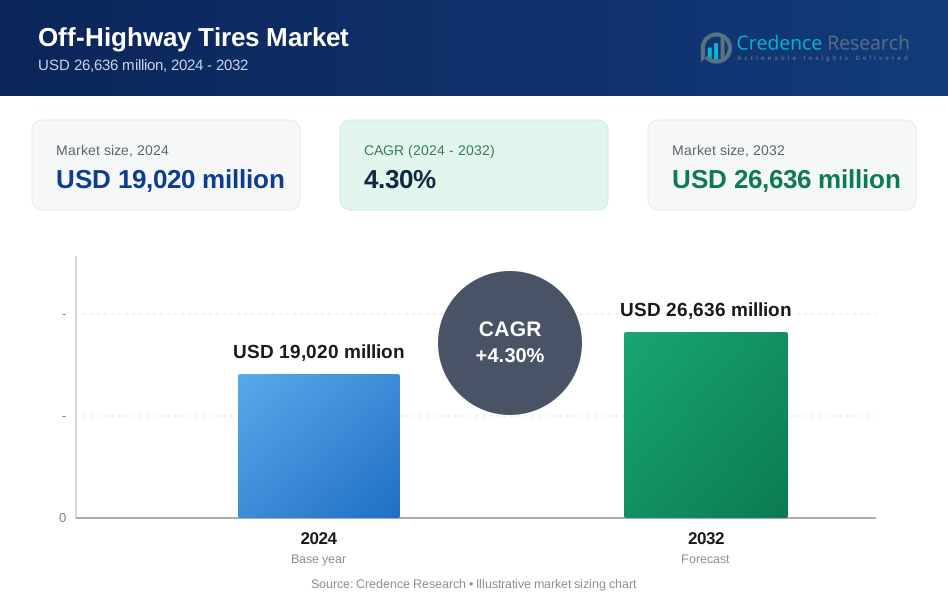
The off-highway tires market is projected to grow from USD 19,020 million in 2024 to USD 26,636 million by 2032, registering a CAGR of 4.3% during the forecast period.
The off-highway tires market is witnessing steady growth driven by rising demand from the construction, agriculture, and mining sectors, fueled by increasing infrastructure projects, mechanized farming practices, and mineral exploration activities globally. Advancements in tire technology-such as radialization, increased use of advanced rubber compounds, and integration of VF (Very High Flexion) and IF (Increased Flexion) technologies-are enhancing load-bearing capacity, durability, and traction, thus meeting the evolving performance needs of heavy-duty applications. Sustainability trends are also shaping the market, with manufacturers focusing on eco-friendly raw materials, fuel-efficient tire designs, and recycling initiatives. The growing adoption of telematics and tire pressure monitoring systems (TPMS) in off-road vehicles is further supporting proactive maintenance and reducing operational downtime. Additionally, strategic partnerships and capacity expansions by key players are enabling regional growth and improved service offerings. As developing economies continue to invest in large-scale projects, the demand for robust and efficient off-highway tires is expected to rise significantly throughout the forecast period.
The off-highway tires market demonstrates strong geographical diversity, with Asia-Pacific leading at 38% market share due to robust infrastructure and agricultural demand in China and India. North America follows with 24%, driven by mechanized farming and construction activity in the U.S. Europe holds 18%, supported by advanced industrial practices and stringent environmental regulations. The Rest of the World, comprising Latin America, the Middle East, and Africa, contributes 20%, with growing investment in infrastructure and mining. Key players shaping the global landscape include Bridgestone Corporation, Michelin, Goodyear Tire & Rubber Company, Continental AG, Pirelli & C. S.p.A., Yokohama Rubber Company, Hankook Tire & Technology Co., Ltd., Trelleborg AB, Apollo Tyres Ltd., Balkrishna Industries Limited (BKT), Titan International, Inc., and Nokian Tyres plc. These companies focus on innovation, localized production, and strategic partnerships to strengthen their presence across diverse regional markets.
Market Insights
- The off-highway tires market is projected to grow from USD 19,020 million in 2024 to USD 26,636 million by 2032, registering a CAGR of 4.3%, driven by rising demand from agriculture, construction, and mining sectors.
- Asia-Pacific leads the market with a 38% share, fueled by industrial growth in China and India, while North America follows with 24%, and Europe accounts for 18%; the Rest of the World contributes 20%.
- Increasing mechanization in agriculture is driving demand for high-performance tires that reduce soil compaction and improve grip across diverse terrains.
- Infrastructure development projects and urbanization in both developed and emerging economies continue to boost demand for durable construction and earthmoving tires.
- Technological advancements such as radialization, VF/IF technology, and smart tire systems support operational efficiency, longer lifespan, and sustainability goals.
- The market faces challenges from volatile raw material prices, supply chain disruptions, and rising pressure for continuous innovation and cost management.
- Key players including Bridgestone, Michelin, Goodyear, Continental, BKT, and others are focusing on R&D, sustainability, and regional expansion to stay competitive.
Market Drivers
Rising Infrastructure and Construction Activities
The off-highway tires market is primarily driven by large-scale infrastructure and construction projects across developing and developed economies. Governments are prioritizing road development, smart cities, mining operations, and energy projects, which significantly increase demand for construction equipment fitted with durable off-highway tires. The expansion of urbanization and industrial zones supports continuous equipment use in demanding environments. It requires tires with higher traction, load capacity, and stability. Manufacturers are responding with specialized product lines to meet these conditions. The market continues to grow with the steady rollout of public and private infrastructure investments.
- For instance, Komatsu’s latest WA900-8 wheel loader, deployed in infrastructure projects like the construction of the Mumbai–Ahmedabad High-Speed Rail, utilizes specialized off-highway tires with enhanced traction and stability to handle heavy loads and rough terrain.
Mechanization of Agriculture and Demand for High-Performance Tires
The modernization of agriculture significantly contributes to the growth of the off-highway tires market. Increasing global food demand is pushing farmers toward mechanized solutions that improve efficiency and yield. Tractors, harvesters, and other agricultural machinery depend on robust tire systems for varied terrain and weather. It drives demand for tires that reduce soil compaction, offer higher flotation, and maintain grip in wet and dry conditions. Companies are focusing on advanced tire designs tailored for field performance. These factors strengthen the role of agricultural mechanization in sustaining tire demand.
- For instance, Michelin has developed Ultraflex (VF) tires that allow farmers to operate at very low inflation pressures, reducing soil compaction and improving crop yields-University of Illinois documented a 4.3% increase in corn yield using Michelin Ultraflex tires compared to standard tires.
Expansion in Mining and Natural Resource Exploration
The off-highway tires market benefits from the expansion of mining operations and natural resource extraction activities. Global demand for metals, coal, and minerals fuels equipment needs in harsh environments, where tire durability is essential. Mining trucks and loaders require tires that withstand extreme loads and abrasive surfaces. The market sees continuous innovation in compound development and tread designs to meet these requirements. Companies also invest in R&D for longer service life and improved safety. It reinforces the critical role of mining in tire consumption trends.
Technological Advancements and Sustainability Focus
Innovation in tire technology significantly boosts the off-highway tires market. Integration of Very High Flexion (VF) and Increased Flexion (IF) technologies enhances load capacity and minimizes equipment wear. Manufacturers are adopting sustainable materials and designs that reduce fuel consumption and environmental impact. Demand for smart tires embedded with sensors is growing, enabling real-time pressure and temperature monitoring. These technologies reduce downtime and increase operational efficiency. It drives a shift toward performance optimization and eco-conscious manufacturing. Sustainability continues to shape strategic decisions in the market.
Market Trends
Adoption of Smart Tires and Digital Monitoring Technologies
Smart tires integrated with sensors and telematics are reshaping the off-highway tires market. These advanced systems provide real-time data on tire pressure, temperature, and overall health, allowing operators to prevent failures and optimize performance. Fleet managers are increasingly using digital monitoring tools to schedule maintenance, reduce downtime, and extend tire lifespan. It supports operational efficiency in sectors such as mining, construction, and agriculture. The trend reflects the industry's shift toward data-driven tire management. Manufacturers are prioritizing connectivity and digital integration in new product development.
- For instance, Continental’s ContiConnect™ Live allows real-time monitoring of tire pressure and temperature, uploading data to a cloud-based system for fleet managers to access detailed vehicle overviews, including location and operating hours.
Growth of Sustainable and Eco-Friendly Tire Solutions
Environmental concerns are driving manufacturers to focus on sustainable practices in the off-highway tires market. Companies are investing in renewable materials, energy-efficient production methods, and recyclable tire components. Demand for low rolling resistance tires is increasing, driven by the need to reduce fuel consumption and emissions in heavy machinery. It encourages innovation in rubber compounds and green design features. Regulatory pressures are also influencing material sourcing and end-of-life tire disposal strategies. Sustainability has become a defining factor in new product development and brand positioning.
- For instance, Michelin employs a range of eco-friendly materials and technologies in its Energy Saver A/S and Energy LX4 tires, which are designed to lower CO₂ emissions, improve fuel efficiency, and extend the tire’s lifespan, supporting the company’s goal of advancing a circular economy.
Rising Demand for Customized and Application-Specific Tires
Customers across agriculture, construction, and mining sectors are seeking tires tailored to specific operating conditions. This trend drives demand for custom tread patterns, compound formulations, and structural reinforcements in the off-highway tires market. It enables enhanced traction, durability, and load distribution under unique working environments. Manufacturers are offering broader product portfolios with application-focused specifications. The shift toward equipment optimization fuels the need for performance-based tire designs. It pushes companies to collaborate closely with OEMs and end users for targeted innovation.
Increased Focus on Radialization and Advanced Tire Construction
The off-highway tires market is witnessing a strong trend toward radial tire adoption across various equipment categories. Radial construction offers better flexibility, reduced heat generation, and longer service life compared to bias-ply designs. It enhances ride comfort and traction, especially in high-speed or heavy-load applications. OEMs and fleet operators are transitioning to radials for operational advantages. It accelerates the shift toward technologically superior tire solutions. Manufacturers are scaling radial production capacity and expanding product availability across global markets.
Market Challenges Analysis
High Raw Material Costs and Supply Chain Disruptions
The off-highway tires market faces significant pressure from volatile raw material prices, particularly natural rubber, synthetic rubber, and carbon black. These inputs form a substantial portion of production costs, and price fluctuations can impact profit margins for manufacturers. Global supply chain disruptions, driven by geopolitical tensions and transportation bottlenecks, further complicate procurement and delivery schedules. It limits the ability of manufacturers to maintain consistent inventory and meet rising demand. Fluctuating currency exchange rates also add financial risk for international players. These challenges demand greater supply chain resilience and cost-management strategies.
Intense Competitive Pressure and Technological Complexity
Rising competition among established tire manufacturers and new entrants creates pricing pressure and demands constant product innovation. The off-highway tires market requires significant investment in R&D to meet evolving performance standards across diverse sectors. It can strain resources for smaller players lacking economies of scale. Increasing adoption of digital technologies and smart tire solutions also introduces technical complexity. Companies must invest in advanced manufacturing capabilities and skilled labor. Navigating these demands while maintaining quality and profitability remains a persistent challenge for market participants.
Market Opportunities
Emerging Markets and Infrastructure Investments
Expanding infrastructure development across emerging economies presents strong growth potential for the off-highway tires market. Countries in Asia-Pacific, Latin America, and Africa are investing heavily in transportation, mining, and agriculture to support economic growth. It creates sustained demand for construction and earthmoving equipment, driving tire consumption. Government-backed rural development and mechanization programs in agriculture offer new avenues for market expansion. Manufacturers have an opportunity to tap into these regions by establishing local production and distribution networks. Tailoring products to regional needs enhances competitive advantage.
Advancements in Tire Technology and Sustainable Innovation
The growing focus on innovation offers a pathway for differentiation in the off-highway tires market. Advanced tire technologies such as airless designs, self-healing materials, and improved wear resistance are gaining interest across industries. It supports enhanced safety, durability, and total cost of ownership. Rising demand for sustainable solutions also encourages the adoption of recyclable materials and fuel-efficient designs. Companies investing in green R&D and digital product offerings can capture new customer segments. These technological shifts align with global sustainability goals and changing end-user expectations.
Market Segmentation Analysis:
By Product Type
The off-highway tires market is segmented into radial and bias tires, with radial tires accounting for a growing share due to their superior durability, fuel efficiency, and ride comfort. Radial designs reduce ground pressure and enhance traction, making them suitable for high-speed and heavy-load applications. Bias tires remain relevant in specific conditions requiring strong sidewall support, especially in rugged terrains. It continues to show demand in cost-sensitive regions and select industrial use cases.
- For instance, the Alliance AGRIFLEX 381, a steel-belted radial flotation tire, is designed for sensitive surfaces that require minimized ground pressure and optimized soil protection, making it suitable for specialized agricultural and construction machinery.
By Application
Construction, mining, agriculture, industrial, and other sectors drive diverse demand across the off-highway tires market. Construction leads in volume due to continuous infrastructure development globally. Mining requires highly durable tires capable of withstanding abrasive surfaces and extreme loads. Agriculture favors tires that reduce soil compaction and enhance flotation. Industrial applications demand stable and high-load capacity tires for forklifts and equipment. It reflects how varying terrains and functions shape product specifications.
- For instance, Bridgestone’s Mastercore tires, specifically designed for mining applications, feature innovative core technology that enhances durability and puncture resistance, supporting heavy loads up to 400 tons in some cases.
By Sales Channel
The market operates through OEM and aftermarket sales channels. OEMs dominate during new equipment production phases, offering integrated tire solutions that match equipment design. The aftermarket plays a vital role in replacement cycles and fleet maintenance. It ensures product availability and service continuity for end users across sectors. Strong aftermarket support is essential for brand loyalty and long-term performance. Companies invest in dealer networks and localized support to enhance reach.
Segments:
Based on Product Type
- Radial
- Bias
Based on Application
- Construction
- Mining
- Agriculture
- Industrial
- Others
Based on Sales Channel
- OEM
- Aftermarket
Based on End-User
- Construction Companies
- Mining Companies
- Agricultural Enterprises
- Industrial Operators
- Others
Based on the Geography:
- North America
- U.S.
- Canada
- Mexico
- Europe
- Germany
- France
- U.K.
- Italy
- Spain
- Rest of Europe
- Asia Pacific
- China
- Japan
- India
- South Korea
- South-east Asia
- Rest of Asia Pacific
- Latin America
- Brazil
- Argentina
- Rest of Latin America
- Middle East & Africa
- GCC Countries
- South Africa
- Rest of the Middle East and Africa
Regional Analysis
North America
North America holds 24% share of the off-highway tires market, driven by strong demand from construction, agriculture, and mining sectors. The United States leads regional consumption due to large-scale infrastructure upgrades and advanced mechanized farming practices. Major manufacturers maintain regional production hubs and distribution networks to meet local requirements. The focus on smart tire technology and sustainable materials aligns with regulatory and environmental expectations. It also benefits from high equipment ownership and strong aftermarket support. Innovation and early adoption of radial and VF tire technologies contribute to market maturity.
Asia-Pacific
Asia-Pacific commands the largest share of the off-highway tires market at 38%, supported by rapid industrialization, infrastructure expansion, and increasing mechanization in agriculture. China and India dominate consumption, with rising investment in construction, mining, and rural development. The presence of large OEMs and low-cost manufacturing enhances regional competitiveness. Demand for bias and radial tires is strong across all key applications. It also sees growing adoption of smart and fuel-efficient tire solutions. Regional policies supporting infrastructure and agri-tech strengthen long-term growth.
Europe
Europe accounts for 18% of the off-highway tires market, with steady demand from the agriculture and industrial sectors. Countries like Germany, France, and Italy contribute significantly to tire consumption through modern farming techniques and a well-established construction industry. The region emphasizes sustainability, driving the adoption of low-emission tire solutions and eco-friendly materials. It features a strong aftermarket supported by extensive dealer networks and service providers. Regulatory compliance and high safety standards influence product innovation. European players focus on premium tire technologies to maintain market competitiveness.
Rest of the World
Latin America, the Middle East, and Africa collectively hold 20% share of the off-highway tires market. These regions are witnessing gradual growth due to increasing infrastructure projects, mechanization in farming, and mining operations. Brazil and South Africa lead consumption in their respective continents. The market is price-sensitive but shows rising interest in advanced tire options. It presents opportunities for regional expansion and partnerships with local distributors. Improving logistics and economic development contribute to market potential.
Key Player Analysis
- Nokian Tyres plc
- Continental AG
- Apollo Tyres Ltd.
- Trelleborg AB
- Michelin
- Balkrishna Industries Limited (BKT)
- Bridgestone Corporation
- Titan International, Inc.
- Pirelli & C. S.p.A.
- Hankook Tire & Technology Co., Ltd.
- Yokohama Rubber Company
- Goodyear Tire & Rubber Company
Competitive Analysis
The off-highway tires market is highly competitive, with global players focusing on product innovation, durability, and application-specific solutions. Leading companies such as Bridgestone, Michelin, Goodyear, and Continental invest heavily in research and development to enhance tire performance, sustainability, and digital integration. It sees strong competition in both OEM and aftermarket segments, where pricing, availability, and customer service play critical roles. Regional players like BKT and Apollo Tyres strengthen their position through cost-effective offerings and expanding distribution networks. Companies are forming strategic partnerships with OEMs and deploying smart tire technologies to meet rising demand for operational efficiency. The market favors manufacturers that combine technical expertise with localized support and a strong brand reputation. Competitive advantage hinges on delivering high-performance tires that align with sector-specific requirements in construction, agriculture, and mining.
Recent Developments
- In January 2024, Goodyear Tire & Rubber Company expanded its Off-the-Road (OTR) portfolio by launching the GP-3E tire line, designed with advanced tread compounds to deliver enhanced abrasion resistance and longer wear life across varied terrains.
- In September 2023, Michelin spotlighted its Magog, Quebec facility, which plays a dual role as the global headquarters for its off-road division-overseeing all off-road mobility service innovations-and as a key R&D center for track and system development.
- In February 2024, MAXAM Tire boosted agricultural efficiency by introducing new VF sizes to its AGILXTRA I-3 implement line. These VF solutions enable higher load capacity at increased speeds while improving grip and minimizing soil compaction.
Market Concentration & Characteristics
The off-highway tires market is moderately concentrated, with a mix of global leaders and regional players competing across various segments. Major companies such as Bridgestone, Michelin, Goodyear, and Continental dominate through strong brand recognition, extensive distribution networks, and continuous investment in R&D. It features high entry barriers due to capital-intensive manufacturing, stringent performance requirements, and established OEM relationships. The market is characterized by product specialization, with firms offering application-specific designs for agriculture, construction, and mining sectors. Technological innovation, such as smart tire systems and sustainable materials, defines the competitive edge. Demand fluctuates with economic cycles tied to infrastructure development, mining activities, and agricultural output. Regional dynamics influence product preferences and pricing strategies, requiring tailored approaches to meet local requirements. Long-term contracts, aftermarket service capabilities, and supply chain resilience remain critical to maintaining market share. The presence of niche suppliers offering cost-effective alternatives increases pressure on established firms to continuously innovate and differentiate.
Report Coverage
The research report offers an in-depth analysis based on Product, Application, Sales Channel, End-User and Geography. It details leading market players, providing an overview of their business, product offerings, investments, revenue streams, and key applications. Additionally, the report includes insights into the competitive environment, SWOT analysis, current market trends, as well as the primary drivers and constraints. Furthermore, it discusses various factors that have driven market expansion in recent years. The report also explores market dynamics, regulatory scenarios, and technological advancements that are shaping the industry. It assesses the impact of external factors and global economic changes on market growth. Lastly, it provides strategic recommendations for new entrants and established companies to navigate the complexities of the market.
Future Outlook
- Demand for off-highway tires will continue to grow with rising construction and infrastructure development across emerging economies.
- Mechanization in agriculture will drive increased adoption of specialized tires for enhanced performance and soil protection.
- Mining sector expansion will support steady demand for durable, high-load capacity tire solutions.
- Manufacturers will focus more on sustainable materials and environmentally friendly production methods.
- Integration of smart technologies like TPMS and telematics will become standard in tire systems.
- Radialization and VF/IF technologies will see broader adoption across equipment categories.
- Regional players will expand through strategic partnerships and distribution enhancements.
- Innovation in tread design and compound formulation will remain a key competitive factor.
- Digital platforms will gain traction in aftermarket sales and tire lifecycle management.
- Regulatory compliance and safety standards will continue to shape product development priorities.
Request a Free Sample
Fill in your details and we'll send you a free sample report.
- Sample data tables & charts
- Research methodology
Market Dynamics
Rising Infrastructure and Construction Activities
Large-scale infrastructure and construction projects in both developed and developing economies are fueling demand for off-highway tires, as heavy equipment requires durable, high-traction tires to operate efficiently in challenging environments.
Mechanization of Agriculture
The shift toward mechanized farming to meet growing food demand is increasing the need for specialized off-highway tires that reduce soil compaction, improve grip, and enhance operational efficiency across diverse terrains.
Expansion in Mining and Natural Resource Exploration
Growing global demand for minerals and resources is driving the expansion of mining operations, which rely on robust, high-load capacity tires capable of withstanding extreme conditions and abrasive surfaces.
Technological Advancements and Sustainability Focus
Innovations such as radialization, VF/IF technologies, and smart tire systems are improving tire performance, durability, and sustainability, while manufacturers' focus on eco-friendly materials and fuel-efficient designs is aligning with regulatory and customer expectations.
Adoption of Smart Tires and Digital Monitoring
The integration of telematics and tire pressure monitoring systems (TPMS) in off-highway vehicles enables proactive maintenance, reduces operational downtime, and supports fleet efficiency, further driving market growth.
Need a Custom Version of This Report?
Tailor the scope, geography, or segments to your exact requirements.
- Custom geography or segment scope
- Direct access to our analyst team
Frequently Asked Questions
What is the current size of the Off-highway tires market
What factors are driving the growth of the Off-highway tires market?
What are some challenges faced by the Off-highway tires market?
Who are the major players in the Off-highway tires market?
Table of Content
Chapter 1 Market Segmentation
- 1.1 Segmentation Framework
- 1.1.1 Product and Service Classification
- 1.1.2 Application and End-Use Classification
- 1.1.3 Technology and Solution Classification
- 1.1.4 Customer and Distribution Channel Classification
- 1.1.5 Geographic Segmentation
- 1.1.6 Market Segment Definitions and Boundaries
- 1.2 By End-User
- 1.2.1 Construction Companies
- 1.2.2 Mining Companies
- 1.2.3 Agricultural Enterprises
- 1.2.4 Industrial Operators
- 1.2.5 Others
- 1.3 By Application
- 1.3.1 Construction
- 1.3.2 Mining
- 1.3.3 Agriculture
- 1.3.4 Industrial
- 1.3.5 Others
- 1.4 By Product Type
- 1.4.1 Radial
- 1.4.2 Bias
- 1.5 By Sales Channel
- 1.5.1 OEM
- 1.5.2 Aftermarket
Chapter 2 Introduction
- 2.1 Report Objectives and Scope
- 2.2 Product Definition and Industry Terminology
- 2.3 Market Inclusions and Exclusions
- 2.4 Research Process
- 2.4.1 Primary Research and Expert Interviews
- 2.4.2 Secondary Research and Source Review
- 2.4.3 Top-Down and Bottom-Up Estimation
- 2.4.4 Data Triangulation and Verification
- 2.5 Market Size Measurement Basis
- 2.5.1 2024: USD 19,020 million → 2032: USD 26,636 million
- 2.6 Historical and Forecast Reference Periods
- 2.6.1 Base Year: 2024
- 2.6.2 Forecast Period: 2024-2032
- 2.7 Research Assumptions and Limitations
Chapter 3 Executive Summary
- 3.1 Market Snapshot and Key Findings
- 3.2 Base-Year Market Size, 2024
- 3.3 Forecast Market Size, 2032
- 3.4 Revenue and Volume Growth Outlook
- 3.5 Key Demand and Supply Indicators
- 3.6 Leading Market Segments
- 3.7 Fastest-Growing Market Opportunities
- 3.8 Regional Performance Highlights
- 3.9 Technology and Industry Transformation
- 3.10 Competitive Landscape Summary
- 3.11 Analyst View and Strategic Implications
Chapter 4 Global Off-Highway Tires Market Trends and Developments
- 4.1 Historical Industry Development
- 4.2 Recent Market Trends and Developments
- 4.3 Demand and Customer Behavior Trends
- 4.4 Technology and Product Innovation
- 4.5 Artificial Intelligence, Automation and Digitalization
- 4.6 Local Manufacturing and Supply Chain Realignment
- 4.7 Industry Partnerships, Mergers and Acquisitions
- 4.8 Sustainability and Circular Economy Developments
- 4.9 Government and Private Sector Investment Trends
- 4.10 Emerging Business Models and Commercialization
- 4.11 Industry Developments and Announcements
Chapter 5 Global Off-Highway Tires Market Production, Supply and Demand Analysis
- 5.1 Demand Trend and Consumption Analysis
- 5.2 Demand Forecast, 2024-2032
- 5.3 Production and Output Trend
- 5.4 Production and Output Forecast, 2024-2032
- 5.5 Installed Capacity and Capacity Utilization
- 5.6 Company-Wise Production Plants and Statistics
- 5.6.1 Installed Production Capacity
- 5.6.2 Actual Production
- 5.6.3 Planned Capacity and Expansion Targets
- 5.7 Supply Chain Structure and Procurement Trends
- 5.8 Supply-Demand Gap and Bottlenecks
- 5.9 Import Dependence and Sourcing Structure
- 5.10 Contract Manufacturing and Outsourcing
- 5.11 Regional Supply and Demand Concentration
Chapter 6 Global Off-Highway Tires Market Pricing Analysis
- 6.1 Pricing Structure and Measurement
- 6.2 Historical Pricing Trends
- 6.3 Pricing Outlook, 2024-2032
- 6.4 Average Selling Price and Unit Economics
- 6.5 Pricing by Product and Market Segment
- 6.6 Geographic Pricing Differences
- 6.7 Key Input, Energy, Labor and Logistics Costs
- 6.8 Contract Pricing and Purchasing Models
- 6.9 Pricing Sensitivity and Competitive Positioning
- 6.10 Price, Margin and Profitability Implications
Chapter 7 Global Off-Highway Tires Market Dynamics
- 7.1 Market Growth Drivers
- 7.1.1 Demand-Side Drivers
- 7.1.2 Technology and Innovation Drivers
- 7.1.3 Infrastructure and Investment Drivers
- 7.1.4 Regulatory and Policy Drivers
- 7.2 Market Restraints
- 7.2.1 Cost and Affordability Constraints
- 7.2.2 Technology and Adoption Barriers
- 7.2.3 Supply Chain and Operational Constraints
- 7.3 Market Challenges
- 7.3.1 Competitive Pressure and Margin Erosion
- 7.3.2 Skills, Infrastructure and Implementation Gaps
- 7.4 Emerging Market Opportunities
- 7.5 Market Dynamics Impact and Time-Horizon Assessment
Chapter 8 Global Off-Highway Tires Value Chain Analysis
- 8.1 Industry Value Chain Overview
- 8.2 Upstream Suppliers and Critical Inputs
- 8.3 Technology and Component Providers
- 8.4 Manufacturing or Service Delivery
- 8.5 Distribution, Channel Partners and Integrators
- 8.6 Downstream Applications and End Users
- 8.7 Value Addition and Profit Pools
- 8.8 Vertical Integration and Outsourcing
- 8.9 Supplier Concentration and Risk
- 8.10 Supply Chain Localization and Resilience
Chapter 9 Global Off-Highway Tires Market Regulations and Policies
- 9.1 Relevant Laws, Standards and Compliance Frameworks
- 9.2 Product, Service, Safety and Quality Requirements
- 9.3 Government Policies, Incentives and Subsidies
- 9.4 Imports, Exports and Trade Barriers
- 9.5 Public Procurement and Local Content Requirements
- 9.6 Environmental and Sustainability Compliance
- 9.7 Upcoming Policy Changes and Market Implications
Chapter 10 Global Off-Highway Tires Market Hotspots and Opportunities
- 10.1 Market Opportunity Mapping and Growth Hotspots
- 10.2 High-Growth Applications and Customer Groups
- 10.3 Underserved Markets and White-Space Opportunities
- 10.4 Emerging Technology and Product Opportunities
- 10.5 New Capacity and Investment Hotspots
- 10.6 Market Entry and Expansion Opportunities
- 10.7 Distribution and Partnership Opportunities
- 10.8 Near-Term and Long-Term Commercial Potential
- 10.9 Opportunity Attractiveness and Execution Risks
Chapter 11 Global Off-Highway Tires Market Outlook, 2024-2032
- 11.1 Market Size and Analysis
- 11.1.1 Revenue (Market Measurement: 2024: USD 19,020 million → 2032: USD 26,636 million)
- 11.1.2 Market Volume and Quantity Sold
- 11.1.3 Historical Market Size
- 11.1.4 Base-Year Market Size, 2024
- 11.2 Market Forecast, 2024-2032
- 11.2.1 Revenue Forecast to 2032
- 11.2.2 Volume Forecast to 2032
- 11.2.3 CAGR and Year-on-Year Growth
- 11.2.4 Incremental Revenue Opportunity
- 11.3 Forecast Assumptions and Scenario Analysis
- 11.3.1 Base-Case Forecast
- 11.3.2 Optimistic and Conservative Scenarios
- 11.3.3 Technology, Pricing and Policy Sensitivities
- 11.4 Market Attractiveness and Growth Outlook
Chapter 12 Global Off-Highway Tires Market Segmentation and Outlook
- 12.1 Segmentation Summary and Market Shares, 2024
- 12.2 Largest and Fastest-Growing Segments
- 12.3 By End-User - Market Size and Forecast, 2024-2032
- 12.3.1 Segment Definition and Scope
- 12.3.2 Historical Market Size
- 12.3.3 Revenue Forecast, 2024-2032
- 12.3.4 Volume Forecast, 2024-2032
- 12.3.5 Base-Year Market Share, 2024
- 12.3.6 Segment CAGR and Growth Drivers
- 12.3.7 Subsegment Market Size and Forecast
- 12.3.7.1 Construction Companies
- 12.3.7.2 Mining Companies
- 12.3.7.3 Agricultural Enterprises
- 12.3.7.4 Industrial Operators
- 12.3.7.5 Others
- 12.3.8 Subsegment Pricing and Adoption Trends
- 12.3.9 Leading Suppliers and Competition
- 12.3.10 Regional Demand and Opportunities
- 12.4 By Application - Market Size and Forecast, 2024-2032
- 12.4.1 Segment Definition and Scope
- 12.4.2 Historical Market Size
- 12.4.3 Revenue Forecast, 2024-2032
- 12.4.4 Volume Forecast, 2024-2032
- 12.4.5 Base-Year Market Share, 2024
- 12.4.6 Segment CAGR and Growth Drivers
- 12.4.7 Subsegment Market Size and Forecast
- 12.4.7.1 Construction
- 12.4.7.2 Mining
- 12.4.7.3 Agriculture
- 12.4.7.4 Industrial
- 12.4.7.5 Others
- 12.4.8 Subsegment Pricing and Adoption Trends
- 12.4.9 Leading Suppliers and Competition
- 12.4.10 Regional Demand and Opportunities
- 12.5 By Product Type - Market Size and Forecast, 2024-2032
- 12.5.1 Segment Definition and Scope
- 12.5.2 Historical Market Size
- 12.5.3 Revenue Forecast, 2024-2032
- 12.5.4 Volume Forecast, 2024-2032
- 12.5.5 Base-Year Market Share, 2024
- 12.5.6 Segment CAGR and Growth Drivers
- 12.5.7 Subsegment Market Size and Forecast
- 12.5.7.1 Radial
- 12.5.7.2 Bias
- 12.5.8 Subsegment Pricing and Adoption Trends
- 12.5.9 Leading Suppliers and Competition
- 12.5.10 Regional Demand and Opportunities
- 12.6 By Sales Channel - Market Size and Forecast, 2024-2032
- 12.6.1 Segment Definition and Scope
- 12.6.2 Historical Market Size
- 12.6.3 Revenue Forecast, 2024-2032
- 12.6.4 Volume Forecast, 2024-2032
- 12.6.5 Base-Year Market Share, 2024
- 12.6.6 Segment CAGR and Growth Drivers
- 12.6.7 Subsegment Market Size and Forecast
- 12.6.7.1 OEM
- 12.6.7.2 Aftermarket
- 12.6.8 Subsegment Pricing and Adoption Trends
- 12.6.9 Leading Suppliers and Competition
- 12.6.10 Regional Demand and Opportunities
- 12.7 Segment Growth Comparison
- 12.8 Segment Attractiveness and Priority Matrix
Chapter 13 Global Off-Highway Tires End-Use and Application Market Outlook
- 13.1 End-Use Industry and Customer Demand Structure
- 13.2 Leading Applications and Customer Groups
- 13.3 End-Use Market Size, Share and Forecast
- 13.4 Major End-Use Industry Deep Dives
- 13.4.1 Customer Requirements and Use Cases
- 13.4.2 Demand and Replacement Cycles
- 13.4.3 Technical and Regulatory Considerations
- 13.4.4 Purchasing and Procurement Models
- 13.4.5 Leading Vendors and Distribution Channels
- 13.4.6 Forecast and Commercial Opportunities
- 13.5 Emerging Applications and Cross-Segment Demand
- 13.6 End-Use Industry Investment Priorities
Chapter 14 Global Off-Highway Tires Geographic Market Outlook, 2024-2032
- 14.1 Regional Market Size and Share, 2024
- 14.2 Regional Market Forecast, 2024-2032
- 14.3 Regional Pricing, Production and Demand Differences
- 14.4 North America
- 14.4.1 United States
- 14.4.2 Canada
- 14.4.3 Mexico
- 14.5 Europe
- 14.5.1 Germany
- 14.5.2 France
- 14.5.3 Italy
- 14.5.4 United Kingdom
- 14.5.5 Spain
- 14.5.6 Poland
- 14.5.7 Russia
- 14.5.8 Netherlands
- 14.5.9 Belgium
- 14.5.10 Sweden
- 14.5.11 Denmark
- 14.5.12 Norway
- 14.5.13 Rest of Europe
- 14.6 Asia Pacific
- 14.6.1 China
- 14.6.2 India
- 14.6.3 Japan
- 14.6.4 South Korea
- 14.6.5 Thailand
- 14.6.6 Indonesia
- 14.6.7 Vietnam
- 14.6.8 Malaysia
- 14.6.9 Australia
- 14.6.10 Rest of Asia Pacific
- 14.7 Latin America
- 14.7.1 Brazil
- 14.7.2 Argentina
- 14.7.3 Colombia
- 14.7.4 Chile
- 14.7.5 Rest of Latin America
- 14.8 Middle East
- 14.8.1 Saudi Arabia
- 14.8.2 United Arab Emirates
- 14.8.3 Turkey
- 14.8.4 Israel
- 14.8.5 Iran
- 14.8.6 Rest of the Middle East
- 14.9 Africa
- 14.9.1 South Africa
- 14.9.2 Egypt
- 14.9.3 Nigeria
- 14.9.4 Morocco
- 14.9.5 Rest of Africa
- 14.10 Regional Investment, Policy and Supply Chain Differences
- 14.11 Regional Competitive Landscape
- 14.12 Geographic Growth Hotspots
Chapter 15 Global Off-Highway Tires Technology, Innovation and Sustainability Outlook
- 15.1 Technology Landscape and Maturity
- 15.2 Product, Process and Service Innovation
- 15.3 AI, Automation and Digital Tools in the Industry
- 15.4 Technology Adoption and Performance Benchmarking
- 15.5 Innovation Pipeline and R&D Investment
- 15.6 Patent and Intellectual Property Trends
- 15.7 Energy Efficiency and Resource Management
- 15.8 Sustainability, Recycling and Circularity
- 15.9 Technology Roadmap, 2024-2032
- 15.10 Risks of Obsolescence and Technology Substitution
Chapter 16 Global Off-Highway Tires Market Key Strategic Imperatives
- 16.1 Growth and Market Entry Priorities
- 16.2 High-Return Products and Segments
- 16.3 Pricing, Profitability and Cost Optimization
- 16.4 Technology Investment and Product Differentiation
- 16.5 Supply Chain Localization and Resilience
- 16.6 Distribution and Customer Acquisition
- 16.7 Partnership, Acquisition and Capacity Strategy
- 16.8 Regional Expansion Priorities
- 16.9 Short-, Medium- and Long-Term Actions
Chapter 17 Competition Outlook
- 17.1 Industry Competition Characteristics
- 17.2 Market Structure and Concentration
- 17.3 Market Share and Competitive Positioning, 2024
- 17.4 Company-Wise Revenue and Product Benchmarking
- 17.5 Production and Service Capacity Benchmarking
- 17.6 Technology, Pricing and Differentiation
- 17.7 Regional Footprint and Distribution Strength
- 17.8 Mergers, Acquisitions and Strategic Alliances
- 17.9 New Entrants and Competitive Threats
- 17.10 Porter's Five Forces and Industry Attractiveness
- 17.11 Competitive Outlook, 2024-2032
Chapter 18 Company Profiles
- 18.1 Company Coverage and Selection Criteria
- 18.2 Bridgestone Corporation
- 18.2.1 Business Description
- 18.2.2 Company Ownership and Geographic Presence
- 18.2.3 Product and Service Portfolio
- 18.2.4 Manufacturing and Operating Footprint
- 18.2.5 Production Capacity and Expansion Plans
- 18.2.6 Financial Performance and Investment
- 18.2.7 Market Share and Competitive Position
- 18.2.8 Technology and Innovation Capabilities
- 18.2.9 Strategic Alliances or Partnerships
- 18.2.10 Recent Developments
- 18.2.11 Growth Strategy and Outlook
- 18.3 Michelin
- 18.4 Goodyear Tire & Rubber Company
- 18.5 Continental AG
- 18.6 Balkrishna Industries Limited (BKT)
- 18.7 Apollo Tyres Ltd.
- 18.8 Trelleborg AB
- 18.9 Yokohama Rubber Company
- 18.10 Titan International, Inc.
- 18.11 Nokian Tyres plc
- 18.12 Other Relevant Market Participants
Note: Every listed company is profiled on the structure shown under the first company. The company list is preliminary and may change based on research findings, market developments, data availability and client requirements.
Chapter 19 Disclaimer
- 19.1 Research and Forecast Disclaimer
- 19.2 Data Source and Estimation Limitations
Note: The depth of individual sections depends on data availability for this market. Volume, capacity, trade and other unit-based metrics are included where applicable.