A 16.7 million vehicle fleet drives replacement buying
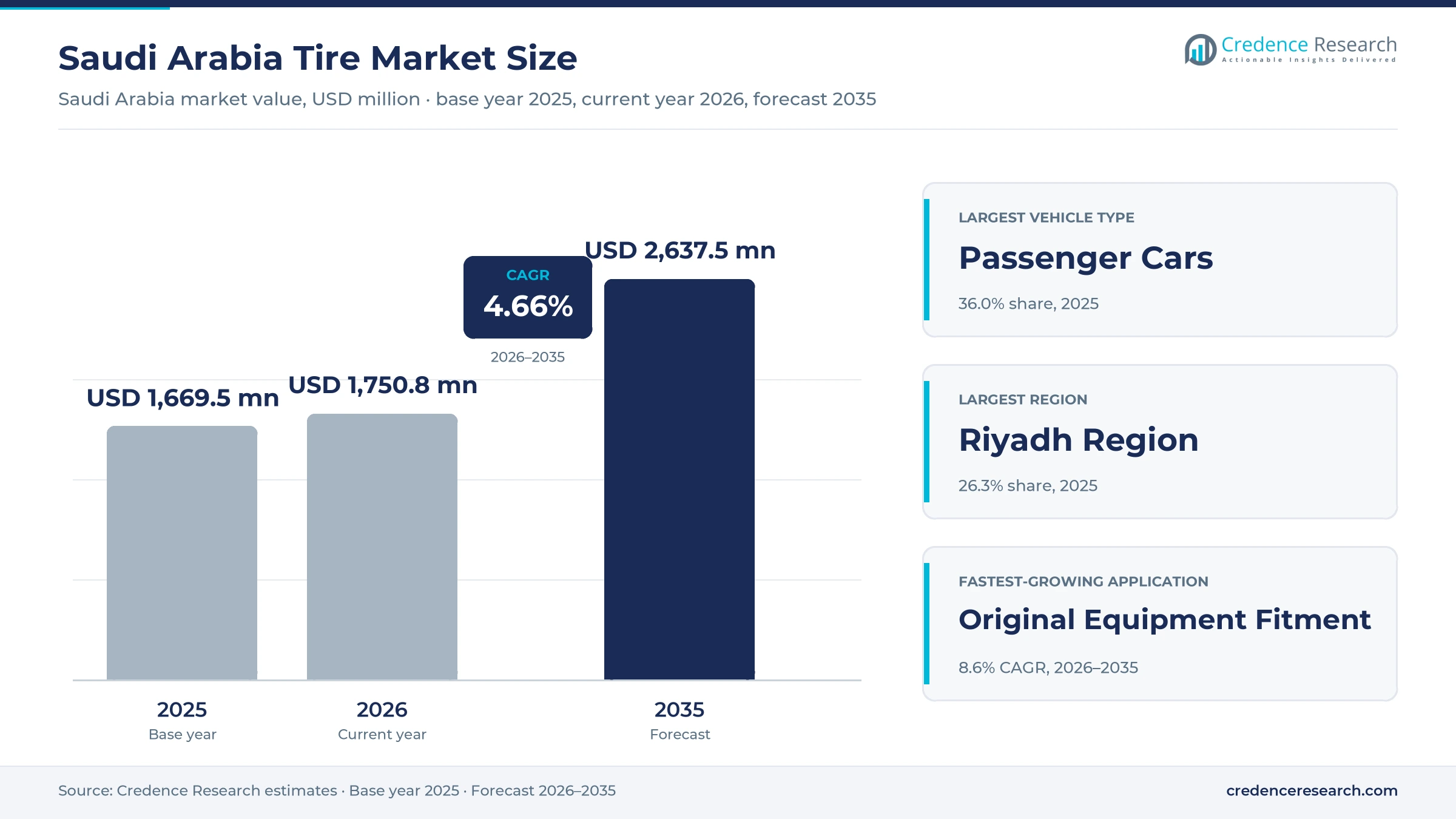
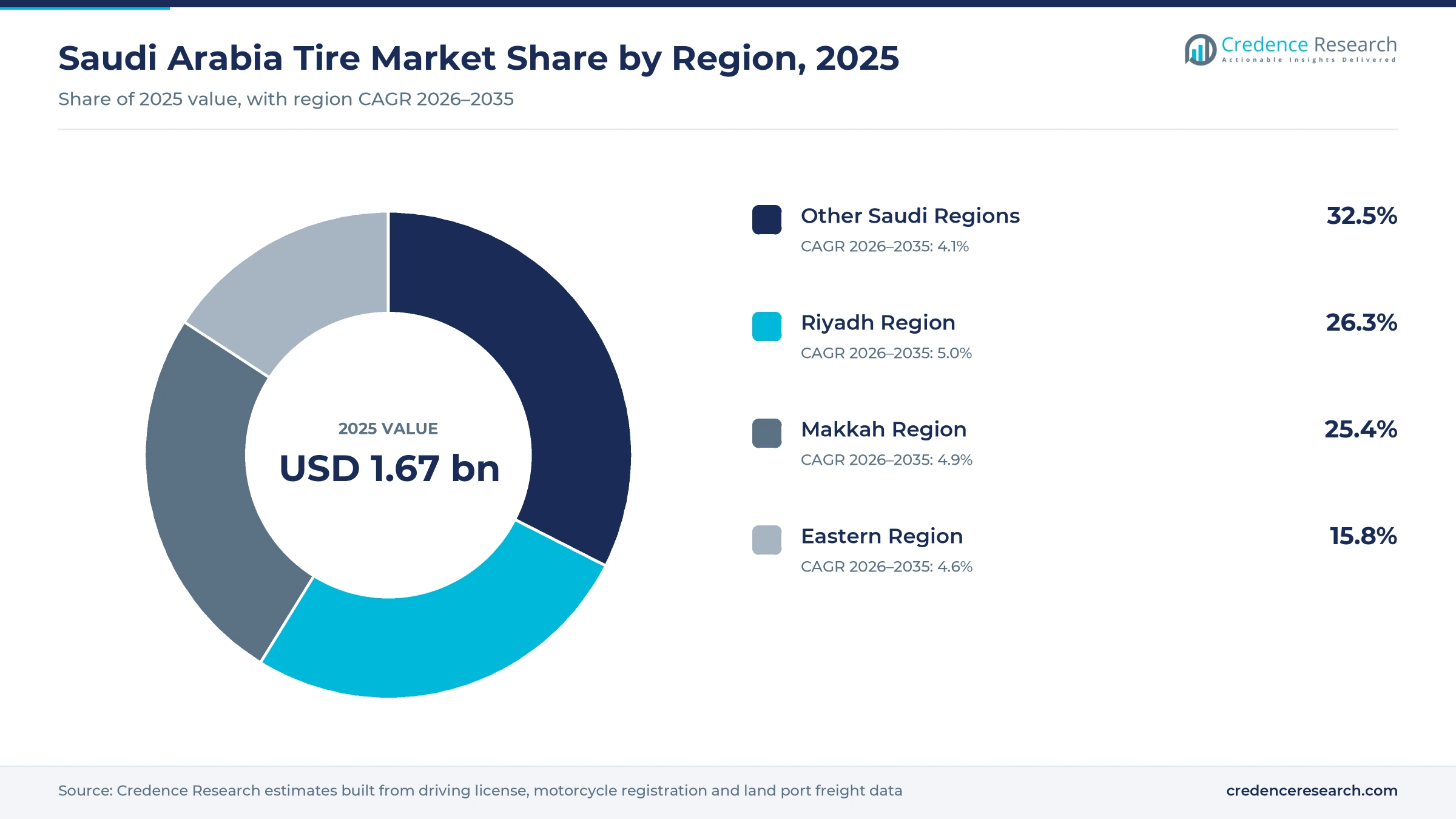
The Saudi Arabia tire market was valued at USD 1.67 billion in 2025 and is projected to increase from USD 1.75 billion in 2026 to USD 2.64 billion by 2035, registering a CAGR of 4.66% during 2026–2035. Demand comes mainly from replacement buying by private motorists and by truck, bus and delivery fleets, since almost every vehicle sold in the country still arrives with tires fitted abroad. The Riyadh Region held the largest share of any single named region, 26.3% in 2025, and is also the fastest-growing region at 5.0% a year, because the capital concentrates new drivers, delivery motorcycles and inland freight. The Makkah Region follows closely through Jeddah and the automotive cluster at King Abdullah Economic City. The main commercial change is local production, with the Public Investment Fund and Pirelli building a passenger tire plant at King Abdullah Economic City, which will sell Pirelli tires alongside a new Saudi brand.
New tires bought in the kingdom, from scooters to haul trucks
The estimate measures the value of new tires sold in Saudi Arabia each year for passenger cars, SUVs, light trucks, heavy trucks and buses, motorcycles and specialty vehicles. It counts tires sold through brand distributors, independent retailers, fleet contracts and online stores, whether bought as replacements, fitted on locally assembled vehicles, used as retread casings or run on construction and off-road equipment.
The estimate excludes used tires, fitting and balancing fees, wheels and tires that arrive already mounted on imported vehicles. The value chain runs from Asian, European and Japanese factories through a small group of exclusive importers to retail shops, fleet service centers and end users in every region.
Saudi Arabia Tire Market Insights
- The Saudi Arabia tire market was valued at USD 1.67 billion in 2025 and is projected to reach USD 2.64 billion by 2035, registering a CAGR of 4.66% during 2026–2035.
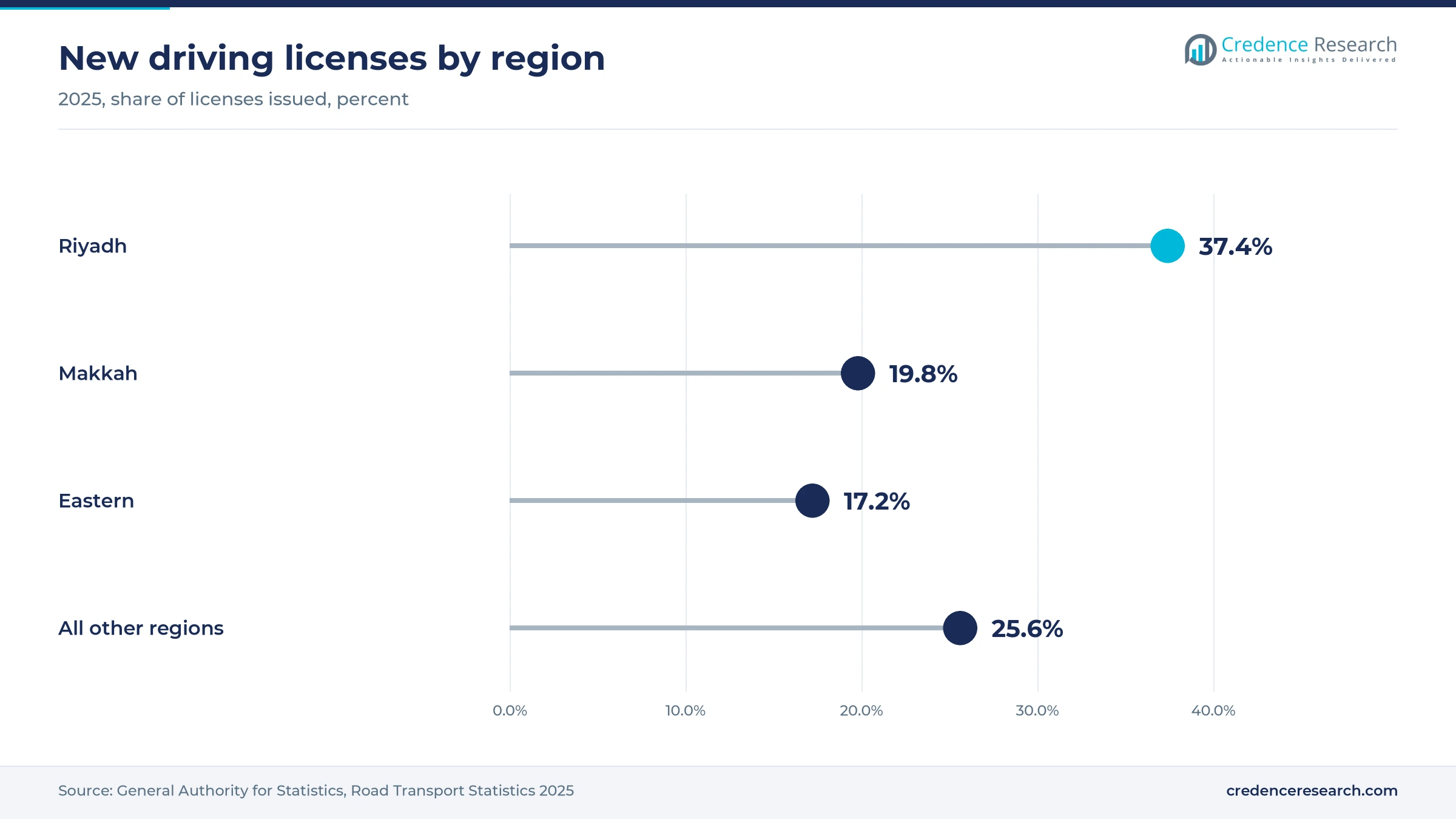
- The Riyadh Region held a 26.3% share of 2025 value, because the capital issued 37.4% of new driving licenses in 2025, according to the General Authority for Statistics.
- Passenger cars led vehicle types with a 36.0% share of 2025 value, as private vehicles made up 71.2% of the registered fleet at the end of 2025.
- The Public Investment Fund and Pirelli are building a 3.5 million tire a year plant at King Abdullah Economic City, with first output now expected in the second half of 2027.
- Original equipment fitment grows fastest by application at 8.6% a year during 2026–2035, as Hyundai, Lucid and Ceer build vehicles inside the kingdom.
Passenger cars lead while local fitment grows fastest
Why do passenger cars still carry the largest share?
Based on vehicle type, the market is categorized into passenger cars, SUVs and light trucks, heavy commercial vehicles and two-wheelers and specialty vehicles. Passenger Cars led with a 36.0% share of 2025 value, because private vehicles made up 71.2% of the registered fleet at the end of 2025, according to the General Authority for Statistics. Two-Wheelers and Specialty Vehicles grow fastest at 6.4% a year, as new motorcycle registrations rose 98% to more than 63,800 in 2024, with 93.4% registered to companies, according to Al-Eqtisadiah. Delivery fleets replace scooter tires several times a year, so this small segment adds volume quickly.
How much of demand is replacement rather than factory fitment?
Based on application, the market is categorized into replacement demand, original equipment fitment, retreading and life extension, and specialty and off-road use. Replacement Demand led with 82.0% of 2025 value, because nearly all of the 857,247 new vehicles sold in 2025 were imported with tires already fitted at foreign plants. Original Equipment Fitment grows fastest at 8.6% a year from a small base, as the Hyundai joint venture at King Abdullah Economic City plans up to 50,000 vehicles a year from the fourth quarter of 2026, according to Argaam. Locally built vehicles open the first sizable fitment business, although most will run on imported tires until the Pirelli plant starts output in 2027.
Why do exclusive brand distributors dominate sales?
Based on sales channel, the market is categorized into authorized brand dealers, independent tire retailers, fleet and institutional procurement, and e-commerce platforms. Authorized Brand Dealers led with 38.0% of 2025 value, because global brands sell through long-standing exclusive importers, such as Al Talayi, which has distributed Bridgestone for more than 75 years from Jeddah with branches in four regions. E-Commerce Platforms grow fastest at 7.6% a year, as online seller Rim Rubber lists Michelin, Bridgestone and Sailun tires with fitting and balancing included in the price for card payments. Price transparency online puts pressure on margins in older shops.
How far do Chinese imports set the price floor?
Based on price tier, the market is categorized into economy, mid-market, premium and ultra-high-performance tires. Economy tires led with 38.0% of 2025 value, because China supplied 53% of the kingdom's new tire imports in 2023, worth $864 million, according to UN Comtrade data compiled by TrendEconomy. Ultra-High-Performance tires grow fastest at 6.1% a year, as Kumho's Ecsta PS71 in 315/35 ZR20 is listed at SAR 937 a tire. Wider wheels on luxury SUVs and sports models keep this tier small but high in value.
| Segment Group | Leading Sub-segment | Share, 2025 | Fastest-growing Sub-segment | CAGR, 2026–2035 |
|---|---|---|---|---|
| By Vehicle Type | Passenger Cars | 36.0% | Two-Wheelers and Specialty Vehicles | 6.4% |
| By Application | Replacement Demand | 82.0% | Original Equipment Fitment | 8.6% |
| By Sales Channel | Authorized Brand Dealers | 38.0% | E-Commerce Platforms | 7.6% |
| By Price Tier | Economy | 38.0% | Ultra-High-Performance | 6.1% |
Shelf prices show a wide gap between brand tiers
Saudi retail prices are quoted per tire with value-added tax and, at most online and chain sellers, with fitting and balancing included. The gap between tiers is wide, as the table shows, and promotions narrow it only partly for buyers who shop around. Exchange rates matter less than in many markets, because the riyal is pegged to the dollar, so prices move mainly with rubber, freight and distributor promotions. Discounts of 12% to 37% on listed Bridgestone tires show how much room distributors keep in their margins.
| Tire or service | Typical price or fee | Basis |
|---|---|---|
| Economy SUV tire, Sailun Terramax CVR 265/65 R17 | SAR 420 to SAR 512 per tire | Rim Rubber online listing, November 2026 |
| Premium passenger tire, Michelin Primacy 5 205/55 R16 | About SAR 622 per tire | Rim Rubber online listing, November 2026 |
| Premium SUV tire, Bridgestone Dueler H005 265/70 R17 | About SAR 977 per tire | Rim Rubber online listing, November 2026 |
| Ultra-high-performance tire, Kumho Ecsta PS71 315/35 ZR20 | About SAR 937 per tire | Rim Rubber online listing, November 2026 |
| Fitting at the customer location | From SAR 100 per visit | Rim Rubber service terms, November 2026 |
Request a Free Sample
Fill in your details and we'll send you a free sample report.
- Sample data tables & charts
- Research methodology
Fleet growth, freight and new Saudi plants lift volumes
Expansion of the active vehicle fleet
A larger fleet on hot, long-distance roads is the base of replacement demand. The kingdom had more than 16.7 million registered and roadworthy vehicles at the end of 2025, up 5.3% in a year, and about 1.1 million vehicles were newly registered, according to the General Authority for Statistics. New vehicle sales reached 857,247 units in 2025, the highest total since 2015, according to Best Selling Cars Blog. Income growth supports this, since the World Bank expects real GDP growth of 3.8% in 2025. Each year's new vehicles enter the replacement cycle within two to three years, so recent sales lift tire demand through the late 2020s.
Freight, construction and fleet utilization
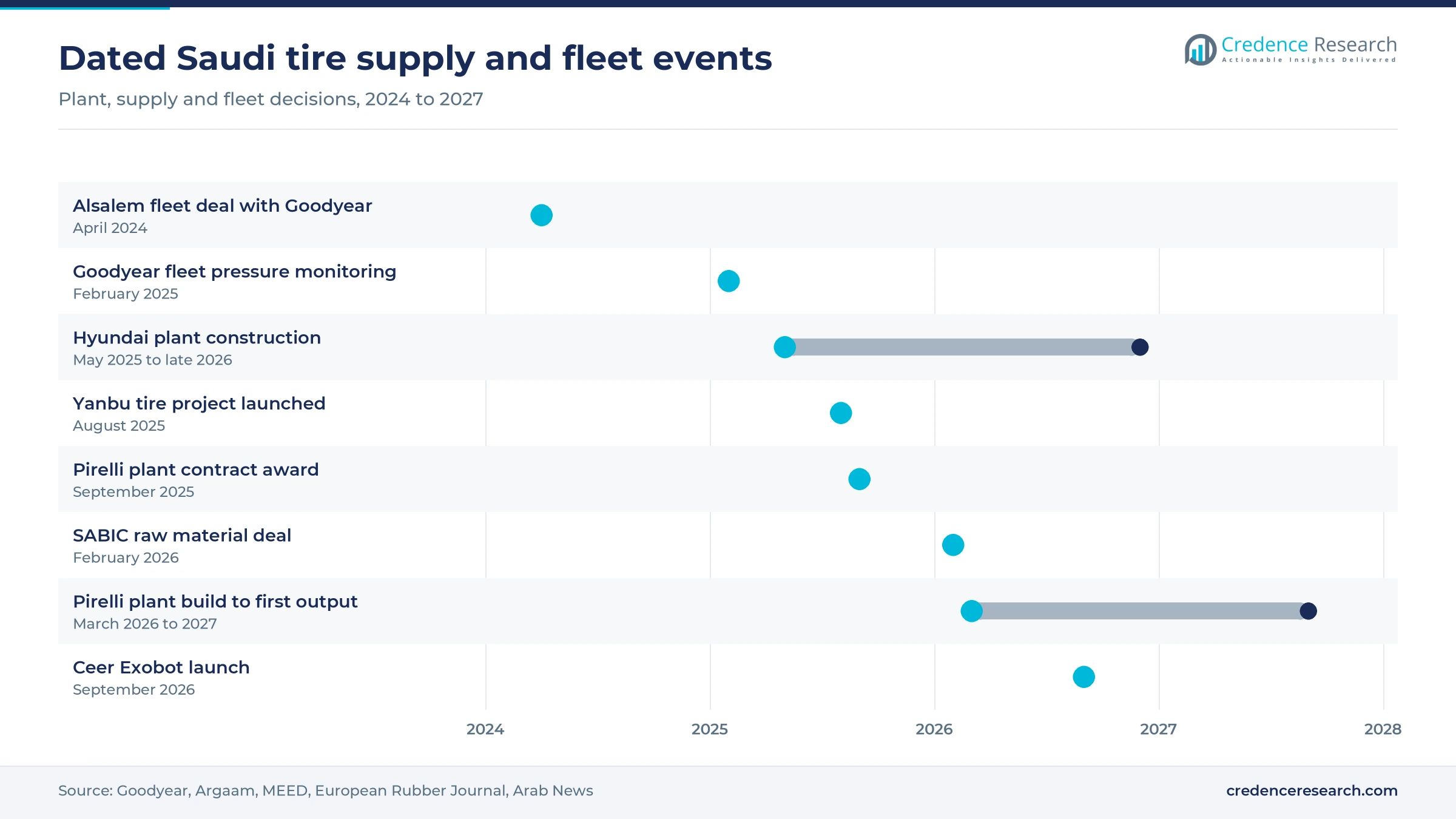
Commercial fleets run long distances and wear tires faster, which makes them the most valuable customers per vehicle. The Transport General Authority said in March 2026 that more than 500,000 trucks and about 18,500 licensed transport and logistics companies serve the kingdom. Cross-border traffic is rising as well, with about 4.7 million trucks and vehicles passing Saudi customs ports in 2025, up 24%, according to the Zakat, Tax and Customs Authority. Bus operators are also signing multi-year deals, such as Alsalem Transportation & Tourism Co., which chose Goodyear tires and inspection tools for its 900 buses in April 2024. Heavy commercial vehicles therefore hold a large share of value despite a smaller unit count.
Localization of automotive and tire manufacturing
Vision 2030 industrial policy is moving tire supply from imports toward domestic plants for the first time at scale. The joint venture of the Public Investment Fund and Pirelli is investing 480 million euros in a plant for 3.5 million passenger car tires a year, according to European Rubber Journal. The fund holds 75% of the operating company, Mena Tyre and Pirelli holds 25%, according to MEED. SABIC agreed in February 2026 to supply the plant with butadiene rubber and carbon black, according to Argaam, which links local petrochemicals to the tire chain. A domestic brand made beside Saudi car plants should win original equipment orders and shorten replacement supply lines.
Fleet safety and tire management programs
Distributors now sell tire management services with the tire, which raises spending per vehicle among fleet buyers. Goodyear launched its tire pressure monitoring system for Saudi logistics and mass transport fleets on Feb. 3, 2025, linking real-time pressure and temperature data to its CheckPoint yard scanners and to wider fleet management platforms. Juffali Michelin, which has represented Michelin in Saudi Arabia since 1961, runs digital tire management programs alongside its TyrePlus and Michelin Truck Service Center franchises. Bridgestone partner MOTOCARE operates more than 10 retail stores and two commercial vehicle service centers, according to Riyadh Daily. These programs favor premium casings that last longer and support retreading.
Asian imports and online fitting reshape how buyers shop
Rise of Asian imports across the price ladder
Asian factories supply most tires sold in the kingdom, and their reach now spans every tier from economy to premium. Saudi imports of new tires reached about $1.61 billion in 2023, with Japan holding 12.2%, South Korea 9.7% and Thailand 9.1% after the Chinese lead noted above, according to TrendEconomy. Passenger car tires made up 47% of that value and bus and truck tires 43%. Chinese brands such as Sailun now list SUV sizes at about half the price of Japanese rivals, so mid-market European and Korean brands face pressure from both sides. Distributors respond by carrying two or three brands across tiers.
Shift to online ordering and mobile fitting
Buyers increasingly compare tires on screens and book fitting rather than visiting a single shop. TireEx, a Saudi digital platform described by TechBullion in March 2026, lets drivers compare brands online and choose a service center or mobile installation. Rim Rubber offers fitting at the customer location from SAR 100, lists 123 Michelin and 80 Bridgestone products on its brand pages and publishes separate pages for Riyadh, Jeddah, Khobar, Medina, Tabuk and Buraidah. Bridgestone told Riyadh Daily in October 2025 that e-commerce last-mile delivery is one of the forces reshaping Gulf mobility. Online sellers grow fastest by channel, and the trend pushes brand distributors to publish prices and stock data.
Original equipment supply for Saudi-built vehicles
Local vehicle assembly opens original equipment business that hardly existed before. Lucid aims to reach capacity of 150,000 vehicles a year at King Abdullah Economic City by 2029, according to Electrek in January 2026. The Ceer brand of the Public Investment Fund and Foxconn launched its first Exobot models on Sept. 21, 2026, from a complex designed for up to 170,000 vehicles a year. The Public Investment Fund also holds 70% of the Hyundai venture, according to Argaam. The Pirelli joint venture plans a dedicated Saudi brand for passenger vehicles and regional automakers, according to Argaam. Tire makers that qualify for these programs early gain fitment contracts that also steer later replacement purchases.
Electric vehicle tires in an early but rising niche
Electric vehicles remain a small share of sales, which gives suppliers time to build a position before volumes rise. Electric models made up less than 2% of new vehicle registrations in 2025, and the kingdom had about 1,200 charging points at the end of the year, according to Arab News. Hankook launched its iON line of EV-dedicated tires with distributor Bin Shihon Group in August 2023, while Bridgestone promotes Turanza EV with ENLITEN technology in the kingdom. EV tires carry higher load ratings and lower rolling resistance, so they sell at premium prices as Saudi-built electric models arrive.
Plant delays, project cuts and upkeep habits slow upgrades
Local tire production arrives later than planned
The first large tire plant has slipped by about a year, which keeps the market dependent on imports for longer. The Pirelli joint venture was first due to operate in 2026, but first output is now expected in the second half of 2027, most probably in the third quarter, according to European Rubber Journal in March 2026. Automakers planning local content must keep importing tires in the meantime. Suppliers with regional stock and bonded warehouses gain from the delay.
Slower construction awards cut truck and off-road demand
Project spending has turned uneven, which reduces tire wear on construction fleets and delays new truck purchases. Construction contract awards fell 31% to $31 billion in 2025 from $45 billion in 2024, according to MEED. Fewer new sites mean fewer haul trucks and loaders running double shifts, so specialty and off-road tire orders soften first. Distributors exposed to contractors need wider fleet customer bases and flexible credit terms.
Poor tire upkeep limits the move to premium products
Many drivers run tires past safe limits, which slows the shift toward premium brands and fleet programs. Bridgestone's tire safety initiative inspected more than 7,000 vehicles in 2023 and found safety-critical issues on 32% of inspected tires, according to Riyadh Daily. Under-inflated tires in summer heat fail early, so buyers judge value by price rather than mileage. Awareness campaigns and pressure monitoring help, but take years to change buying habits.
Certification costs weigh on small importers
Each tire model needs Saudi certification and an energy efficiency card before sale, which raises costs for importers with wide catalogs. The Saudi Standards, Metrology and Quality Organization charges SAR 2,000 to review each tire model registration and SAR 500 for each card, and requires a Gulf conformity certificate and accredited test reports. Importers carrying hundreds of sizes therefore face large upfront fees. Large distributors absorb these costs more easily, which favors consolidation.
Riyadh leads the named regions and grows fastest
| Region | Value, 2025 (USD billion) | Share, 2025 | CAGR, 2026–2035 |
|---|---|---|---|
| Other Saudi Regions | 0.54 | 32.5% | 4.1% |
| Riyadh Region | 0.44 | 26.3% | 5.0% |
| Makkah Region | 0.42 | 25.4% | 4.9% |
| Eastern Region | 0.26 | 15.8% | 4.6% |
Riyadh Region leads on drivers, delivery and inland freight
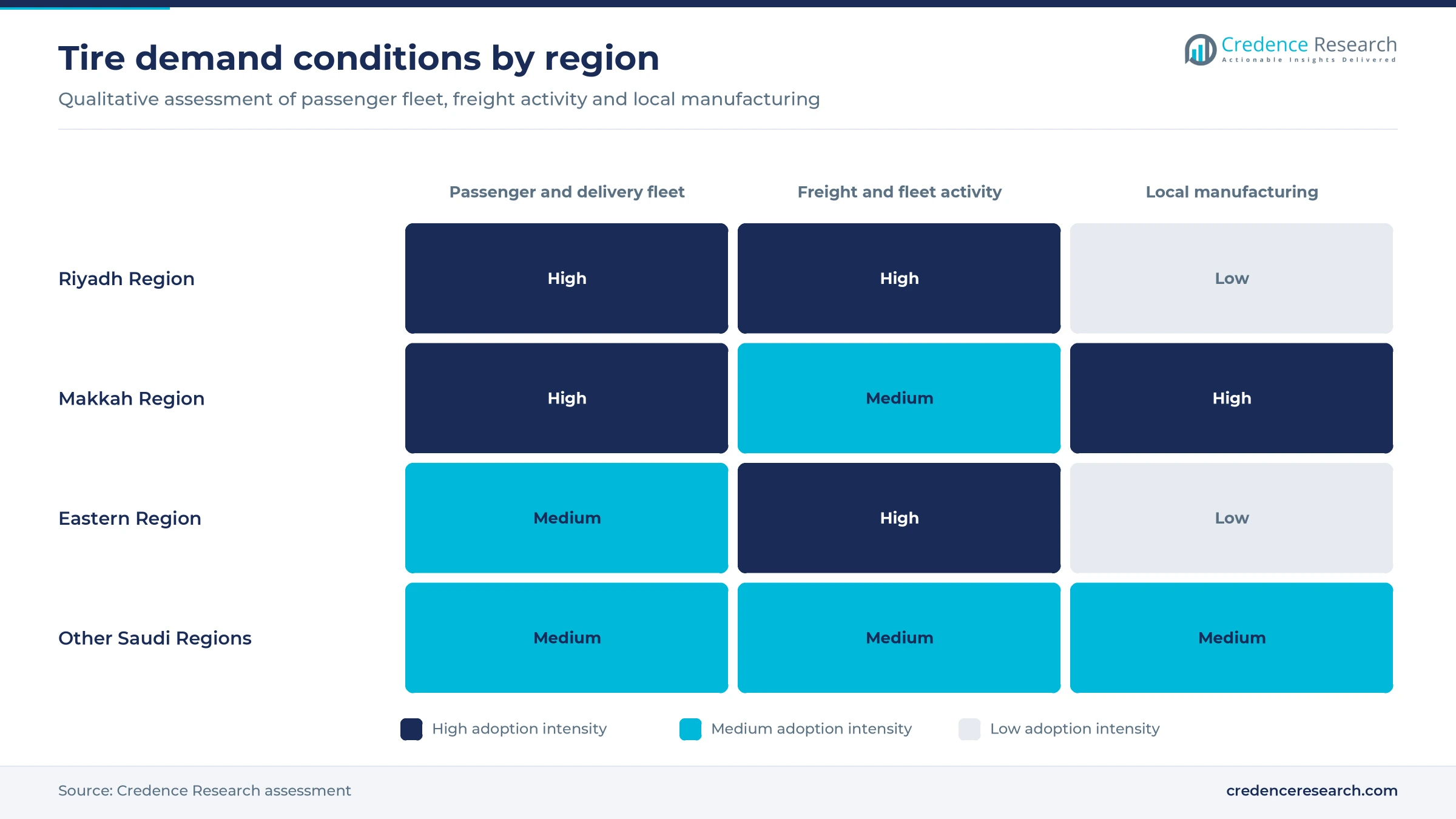
The Riyadh Region held 26.3% of 2025 value and grows at 5.0% a year, the fastest of the four. The region issued 37.4% of new driving licenses in 2025, and Riyadh Dry Port handled 26.0% of land port imports, according to the General Authority for Statistics. Riyadh also registered about 25,000 new motorcycles in 2024, the most of any region. Dense delivery fleets and inland trucking make the capital the main replacement and fleet service market.
Makkah Region gains from the automotive cluster
The Makkah Region held 25.4% of 2025 value and grows at 4.9% a year. King Abdullah Economic City hosts the King Salman Automotive Cluster, where Lucid, Hyundai, Ceer and the Pirelli joint venture are building or running plants. The region issued 19.8% of new driving licenses in 2025 and registered about 20,000 new motorcycles in 2024. Jeddah is also the base of Bridgestone distributor Al Talayi and Juffali Michelin, which supply much of the western market.
Eastern Region carries Gulf trucking and industry
The Eastern Region held 15.8% of 2025 value and grows at 4.6% a year. Al-Batha Port on the border with the UAE handled 27.9% of land exports and 31.9% of land imports in 2025, according to the General Authority for Statistics. The region issued 17.2% of new driving licenses and registered about 15,000 new motorcycles in 2024. Truck tires for Gulf freight and industrial fleets in Dammam and Jubail lift value per vehicle here.
Other Saudi Regions add a tire plant and border freight
Other Saudi Regions held 32.5% of 2025 value and grow at 4.1% a year, the slowest of the four. Saudi Green Sea Co. launched a project in Yanbu in August 2025 to make 5 million tires a year by 2028, half for passenger cars and half for trucks and military vehicles, according to European Rubber Journal. Al-Hadithah Port in Al-Jouf handled 23.2% of land exports in 2025. Long highway distances keep truck tire wear high across these regions.
Fleet deals and plant milestones since 2024
| Development | Status and market relevance |
|---|---|
| In April 2024, Alsalem Transportation & Tourism Co. chose Goodyear premium tires and CheckPoint inspection tools for its 900-bus fleet. | Signed through Goodyear distributor Al Rashed Tires. |
| In February 2025, Goodyear launched its tire pressure monitoring system for Saudi logistics and mass transport fleets. | Launched, combined with CheckPoint yard scanning. |
| In August 2025, Saudi Green Sea Co. started a Yanbu project for 5 million passenger and truck tires a year by 2028. | Announced, with SABIC as raw material supplier. |
| In September 2025, Mena Tyre Company awarded Saudi Amana an estimated SR628 million contract to build the Pirelli joint venture plant. | Awarded, at King Abdullah Economic City. |
| In February 2026, SABIC agreed to supply butadiene rubber and carbon black to the joint venture of the Public Investment Fund and Pirelli. | Signed at the PIF Private Sector Forum 2026. |
Radial, sensor and EV designs set the product mix
- Radial construction dominates passenger and truck sales, because steel-belted casings run cooler on long desert highways than bias designs.
- Retreading gives truck and bus fleets a second life from retreaded casings, and Reviva agreed in October 2023 to recycle 270,000 tons of waste tires with ENRESTEC and Hama Holding.
- Sensor-equipped tires such as Bridgestone SensorTire report temperature, pressure and wear, which suits fleets managing summer heat.
- EV-specific compounds such as Hankook iON and Bridgestone ENLITEN reduce rolling resistance and noise while carrying heavier battery loads.
Need a Custom Version of This Report?
Tailor the scope, geography, or segments to your exact requirements.
- Custom geography or segment scope
- Direct access to our analyst team
Exclusive distributors give global brands their Saudi reach
Competition in the Saudi Arabia tire market is organized through exclusive distributors, so a brand's reach depends on its local partner as much as on its product. Bridgestone works with Al Talayi and its MOTOCARE retail partner, while Michelin operates through Juffali Michelin, a joint venture since 2002. Goodyear sells through Al Rashed Tires and wins fleet deals with digital inspection tools, and Continental opened its first Saudi office in Jeddah as a joint venture with former distributor Almutlak Trade & Industries. Pirelli stands apart as a partner in local production through its 25% stake in Mena Tyre. Hankook sells through Bin Shihon Group and became title sponsor of Al-Ittihad in May 2025, while Apollo Tyres entered in December 2019 with Al-Jomaih Tyres and a target of about 800,000 tires a year. Yokohama, Toyo and Kumho compete in mid-market and performance sizes through independent and online retailers. Linglong signed a national distribution deal with Petromin Auto Care, which runs more than 800 service centers, in January 2026, Tyre News reported.
How is Saudi tire supply organized and where do margins sit?
Supply is built around a few family-owned importers that hold exclusive rights to one or two global brands, with thousands of independent shops below them. Al Talayi distributes Bridgestone, Juffali Michelin handles the Michelin Group brands, Al Rashed Tires carries Goodyear and Al-Jomaih Tyres represents Apollo. Barriers to entry are brand contracts, SASO certification of every model and the working capital to stock hundreds of sizes. Margins sit mainly with importers and fleet service centers, and local sourcing of carbon black for the new plant, noted above, could shift some value upstream.
Tire companies active in Saudi Arabia
| Company | Type | Role in the market |
|---|---|---|
| Bridgestone Corporation | Full-line tire maker | Passenger, SUV and truck tires through exclusive distributor Al Talayi |
| Michelin Group | Full-line tire maker | Michelin, BFGoodrich and Tigar tires through the Juffali Michelin joint venture |
| The Goodyear Tire & Rubber Company | Full-line tire maker | Passenger and fleet tires with pressure monitoring through Al Rashed Tires |
| Continental AG | Full-line tire maker | Passenger and truck tires through a Jeddah joint venture with Almutlak |
| Yokohama Rubber Co., Ltd. | Tire maker | Passenger, SUV and performance tires sold through independent and online retailers |
| Pirelli & C. S.p.A. | Premium tire maker | Premium car tires and a 25% stake in the local plant |
| Hankook Tire & Technology Co., Ltd. | Full-line tire maker | Passenger and iON electric vehicle tires through Bin Shihon Group |
| Toyo Tire Corporation | Tire maker | SUV, light truck and passenger tires sold through Saudi retailers |
| Kumho Tire Co., Inc. | Tire maker | Passenger and ultra-high-performance tires such as the Ecsta PS71 |
| Apollo Tyres Ltd. | Tire maker | Passenger and truck-bus radial tires through Al-Jomaih Tyres |
| Shandong Linglong Tyre Co., Ltd. | Tire maker | Economy and mid-market passenger and truck tires through Petromin Auto Care |
Distribution control matters more than factory location
Credence Research's view is that control of distribution, not factory location, will decide who wins in the Saudi Arabia tire market over the next decade. The Pirelli plant and the Yanbu project will cut import dependence, but most value still moves through a handful of exclusive importers and their fleet service networks. Brands that pair tires with pressure monitoring, retreading and online booking will gain share among fleets and younger drivers. Economy imports will keep a hard price floor, so premium suppliers must prove lower cost per kilometer.
Import, fleet and registration data anchor the model
The report uses 2025 as the base year and forecasts values to 2035. Market values come from the Credence Research model, checked against tire import values from trade statistics and against the size of the registered vehicle and truck fleet. All regional and segment splits are Credence Research estimates built on driving license, motorcycle registration, land port freight and import data. Sources used are government statistics, standards rules, company releases and regional business and trade press. No interviews or surveys were conducted for this report at any stage.
Local production and fleet services shape 2035 demand
Saudi Arabia tire market value is forecast to rise to USD 2.64 billion by 2035 at a 4.66% CAGR, with replacement demand from a growing fleet carrying the base and local vehicle and tire plants adding original equipment business after 2027. The Riyadh Region gains share through delivery fleets and inland freight, while the Makkah Region benefits from the automotive cluster near Jeddah. Online sales and fleet service contracts should grow faster than traditional shop sales. Suppliers that secure local fitment contracts and strong distributor networks are best placed for the period.
Plant timing and fleet spending set the range of outcomes
The range depends mainly on how fast local vehicle and tire plants ramp up and how strongly freight and project fleets keep running. Replacement demand from a growing private fleet protects the base in all three cases. The downside reflects further plant delays and weak construction, while the upside needs Lucid, Hyundai and Ceer to reach planned volumes and the Pirelli plant to run at capacity before 2030.
| Scenario | CAGR, 2026–2035 | Value, 2035 | What has to hold |
|---|---|---|---|
| Downside | 3.4% | USD 2.36 billion | Plant start-ups slip again, construction awards stay low and fleets delay tire upgrades |
| Base | 4.66% | USD 2.64 billion | Pirelli output starts in 2027, the fleet keeps growing and online sales expand steadily |
| Upside | 5.9% | USD 2.92 billion | Local car plants reach planned volumes and Saudi-made tires win regional export orders |
Frequently Asked Questions
How big is the Saudi Arabia tire market?
What growth rate is expected through 2035?
Which vehicle type leads the market?
Which application grows fastest?
Which region holds the largest share?
When will the Pirelli plant in Saudi Arabia start production?
Where do Saudi tire imports come from?
Who are the main companies in this market?
Table of Content
Chapter 1 Market Segmentation
- 1.1 Segmentation Framework
- 1.1.1 Product and Service Classification
- 1.1.2 Application and End-Use Classification
- 1.1.3 Technology and Solution Classification
- 1.1.4 Customer and Distribution Channel Classification
- 1.1.5 Geographic Segmentation
- 1.1.6 Market Segment Definitions and Boundaries
- 1.2 By Vehicle Type
- 1.2.1 Passenger Cars
- 1.2.2 SUVs and Light Trucks
- 1.2.3 Heavy Commercial Vehicles
- 1.2.4 Two-Wheelers and Specialty Vehicles
- 1.3 By Application
- 1.3.1 Replacement Demand
- 1.3.2 Original Equipment Fitment
- 1.3.3 Retreading and Life Extension
- 1.3.4 Specialty and Off-Road Use
- 1.4 By Sales Channel
- 1.4.1 Authorized Brand Dealers
- 1.4.2 Independent Tire Retailers
- 1.4.3 Fleet and Institutional Procurement
- 1.4.4 E-Commerce Platforms
- 1.5 By Price Tier
- 1.5.1 Economy
- 1.5.2 Mid-Market
- 1.5.3 Premium
- 1.5.4 Ultra-High-Performance
Chapter 2 Introduction
- 2.1 Report Objectives and Scope
- 2.2 Product Definition and Industry Terminology
- 2.3 Market Inclusions and Exclusions
- 2.4 Research Process
- 2.4.1 Primary Research and Expert Interviews
- 2.4.2 Secondary Research and Source Review
- 2.4.3 Top-Down and Bottom-Up Estimation
- 2.4.4 Data Triangulation and Verification
- 2.5 Market Size Measurement Basis
- 2.5.1 2025: USD 1.67 billion → 2035: USD 2.64 billion
- 2.6 Historical and Forecast Reference Periods
- 2.6.1 Historical Period: 2018-2025
- 2.6.2 Base Year: 2025
- 2.6.3 Forecast Period: 2025-2035
- 2.7 Research Assumptions and Limitations
Chapter 3 Executive Summary
- 3.1 Market Snapshot and Key Findings
- 3.2 Base-Year Market Size, 2025
- 3.3 Forecast Market Size, 2035
- 3.4 Revenue and Volume Growth Outlook
- 3.5 Key Demand and Supply Indicators
- 3.6 Leading Market Segments
- 3.7 Fastest-Growing Market Opportunities
- 3.8 Regional Performance Highlights
- 3.9 Technology and Industry Transformation
- 3.10 Competitive Landscape Summary
- 3.11 Analyst View and Strategic Implications
Chapter 4 Saudi Arabia Tire Market Trends and Developments
- 4.1 Historical Industry Development, 2018-2025
- 4.2 Recent Market Trends and Developments
- 4.3 Demand and Customer Behavior Trends
- 4.4 Technology and Product Innovation
- 4.5 Artificial Intelligence, Automation and Digitalization
- 4.6 Local Manufacturing and Supply Chain Realignment
- 4.7 Industry Partnerships, Mergers and Acquisitions
- 4.8 Sustainability and Circular Economy Developments
- 4.9 Government and Private Sector Investment Trends
- 4.10 Emerging Business Models and Commercialization
- 4.11 Industry Developments and Announcements
Chapter 5 Saudi Arabia Tire Market Production, Supply and Demand Analysis
- 5.1 Demand Trend and Consumption Analysis, 2018-2025
- 5.2 Demand Forecast, 2025-2035
- 5.3 Production and Output Trend, 2018-2025
- 5.4 Production and Output Forecast, 2025-2035
- 5.5 Installed Capacity and Capacity Utilization
- 5.6 Company-Wise Production Plants and Statistics
- 5.6.1 Installed Production Capacity
- 5.6.2 Actual Production
- 5.6.3 Planned Capacity and Expansion Targets
- 5.7 Supply Chain Structure and Procurement Trends
- 5.8 Supply-Demand Gap and Bottlenecks
- 5.9 Import Dependence and Sourcing Structure
- 5.10 Contract Manufacturing and Outsourcing
- 5.11 Regional Supply and Demand Concentration
Chapter 6 Saudi Arabia Tire Market Pricing Analysis
- 6.1 Pricing Structure and Measurement
- 6.2 Historical Pricing Trends, 2018-2025
- 6.3 Pricing Outlook, 2025-2035
- 6.4 Average Selling Price and Unit Economics
- 6.5 Pricing by Product and Market Segment
- 6.6 Geographic Pricing Differences
- 6.7 Key Input, Energy, Labor and Logistics Costs
- 6.8 Contract Pricing and Purchasing Models
- 6.9 Pricing Sensitivity and Competitive Positioning
- 6.10 Price, Margin and Profitability Implications
Chapter 7 Saudi Arabia Tire Market Dynamics
- 7.1 Market Growth Drivers
- 7.1.1 Demand-Side Drivers
- 7.1.2 Technology and Innovation Drivers
- 7.1.3 Infrastructure and Investment Drivers
- 7.1.4 Regulatory and Policy Drivers
- 7.2 Market Restraints
- 7.2.1 Cost and Affordability Constraints
- 7.2.2 Technology and Adoption Barriers
- 7.2.3 Supply Chain and Operational Constraints
- 7.3 Market Challenges
- 7.3.1 Competitive Pressure and Margin Erosion
- 7.3.2 Skills, Infrastructure and Implementation Gaps
- 7.4 Emerging Market Opportunities
- 7.5 Market Dynamics Impact and Time-Horizon Assessment
Chapter 8 Saudi Arabia Tire Value Chain Analysis
- 8.1 Industry Value Chain Overview
- 8.2 Upstream Suppliers and Critical Inputs
- 8.3 Technology and Component Providers
- 8.4 Manufacturing or Service Delivery
- 8.5 Distribution, Channel Partners and Integrators
- 8.6 Downstream Applications and End Users
- 8.7 Value Addition and Profit Pools
- 8.8 Vertical Integration and Outsourcing
- 8.9 Supplier Concentration and Risk
- 8.10 Supply Chain Localization and Resilience
Chapter 9 Saudi Arabia Tire Market Regulations and Policies
- 9.1 Relevant Laws, Standards and Compliance Frameworks
- 9.2 Product, Service, Safety and Quality Requirements
- 9.3 Government Policies, Incentives and Subsidies
- 9.4 Imports, Exports and Trade Barriers
- 9.5 Public Procurement and Local Content Requirements
- 9.6 Environmental and Sustainability Compliance
- 9.7 Upcoming Policy Changes and Market Implications
Chapter 10 Saudi Arabia Tire Market Hotspots and Opportunities
- 10.1 Market Opportunity Mapping and Growth Hotspots
- 10.2 High-Growth Applications and Customer Groups
- 10.3 Underserved Markets and White-Space Opportunities
- 10.4 Emerging Technology and Product Opportunities
- 10.5 New Capacity and Investment Hotspots
- 10.6 Market Entry and Expansion Opportunities
- 10.7 Distribution and Partnership Opportunities
- 10.8 Near-Term and Long-Term Commercial Potential
- 10.9 Opportunity Attractiveness and Execution Risks
Chapter 11 Saudi Arabia Tire Market Outlook, 2025-2035
- 11.1 Market Size and Analysis
- 11.1.1 Revenue (Market Measurement: 2025: USD 1.67 billion → 2035: USD 2.64 billion)
- 11.1.2 Market Volume and Quantity Sold
- 11.1.3 Historical Market Size, 2018-2025
- 11.1.4 Base-Year Market Size, 2025
- 11.2 Market Forecast, 2025-2035
- 11.2.1 Revenue Forecast to 2035
- 11.2.2 Volume Forecast to 2035
- 11.2.3 CAGR and Year-on-Year Growth
- 11.2.4 Incremental Revenue Opportunity
- 11.3 Forecast Assumptions and Scenario Analysis
- 11.3.1 Base-Case Forecast
- 11.3.2 Optimistic and Conservative Scenarios
- 11.3.3 Technology, Pricing and Policy Sensitivities
- 11.4 Market Attractiveness and Growth Outlook
Chapter 12 Saudi Arabia Tire Market Segmentation and Outlook
- 12.1 Segmentation Summary and Market Shares, 2025
- 12.2 Largest and Fastest-Growing Segments
- 12.3 By Vehicle Type - Market Size and Forecast, 2025-2035
- 12.3.1 Segment Definition and Scope
- 12.3.2 Historical Market Size, 2018-2025
- 12.3.3 Revenue Forecast, 2025-2035
- 12.3.4 Volume Forecast, 2025-2035
- 12.3.5 Base-Year Market Share, 2025
- 12.3.6 Segment CAGR and Growth Drivers
- 12.3.7 Subsegment Market Size and Forecast
- 12.3.7.1 Passenger Cars
- 12.3.7.2 SUVs and Light Trucks
- 12.3.7.3 Heavy Commercial Vehicles
- 12.3.7.4 Two-Wheelers and Specialty Vehicles
- 12.3.8 Subsegment Pricing and Adoption Trends
- 12.3.9 Leading Suppliers and Competition
- 12.3.10 Regional Demand and Opportunities
- 12.4 By Application - Market Size and Forecast, 2025-2035
- 12.4.1 Segment Definition and Scope
- 12.4.2 Historical Market Size, 2018-2025
- 12.4.3 Revenue Forecast, 2025-2035
- 12.4.4 Volume Forecast, 2025-2035
- 12.4.5 Base-Year Market Share, 2025
- 12.4.6 Segment CAGR and Growth Drivers
- 12.4.7 Subsegment Market Size and Forecast
- 12.4.7.1 Replacement Demand
- 12.4.7.2 Original Equipment Fitment
- 12.4.7.3 Retreading and Life Extension
- 12.4.7.4 Specialty and Off-Road Use
- 12.4.8 Subsegment Pricing and Adoption Trends
- 12.4.9 Leading Suppliers and Competition
- 12.4.10 Regional Demand and Opportunities
- 12.5 By Sales Channel - Market Size and Forecast, 2025-2035
- 12.5.1 Segment Definition and Scope
- 12.5.2 Historical Market Size, 2018-2025
- 12.5.3 Revenue Forecast, 2025-2035
- 12.5.4 Volume Forecast, 2025-2035
- 12.5.5 Base-Year Market Share, 2025
- 12.5.6 Segment CAGR and Growth Drivers
- 12.5.7 Subsegment Market Size and Forecast
- 12.5.7.1 Authorized Brand Dealers
- 12.5.7.2 Independent Tire Retailers
- 12.5.7.3 Fleet and Institutional Procurement
- 12.5.7.4 E-Commerce Platforms
- 12.5.8 Subsegment Pricing and Adoption Trends
- 12.5.9 Leading Suppliers and Competition
- 12.5.10 Regional Demand and Opportunities
- 12.6 By Price Tier - Market Size and Forecast, 2025-2035
- 12.6.1 Segment Definition and Scope
- 12.6.2 Historical Market Size, 2018-2025
- 12.6.3 Revenue Forecast, 2025-2035
- 12.6.4 Volume Forecast, 2025-2035
- 12.6.5 Base-Year Market Share, 2025
- 12.6.6 Segment CAGR and Growth Drivers
- 12.6.7 Subsegment Market Size and Forecast
- 12.6.7.1 Economy
- 12.6.7.2 Mid-Market
- 12.6.7.3 Premium
- 12.6.7.4 Ultra-High-Performance
- 12.6.8 Subsegment Pricing and Adoption Trends
- 12.6.9 Leading Suppliers and Competition
- 12.6.10 Regional Demand and Opportunities
- 12.7 Segment Growth Comparison
- 12.8 Segment Attractiveness and Priority Matrix
Chapter 13 Saudi Arabia Tire End-Use and Application Market Outlook
- 13.1 End-Use Industry and Customer Demand Structure
- 13.2 Leading Applications and Customer Groups
- 13.3 End-Use Market Size, Share and Forecast
- 13.4 Major End-Use Industry Deep Dives
- 13.4.1 Customer Requirements and Use Cases
- 13.4.2 Demand and Replacement Cycles
- 13.4.3 Technical and Regulatory Considerations
- 13.4.4 Purchasing and Procurement Models
- 13.4.5 Leading Vendors and Distribution Channels
- 13.4.6 Forecast and Commercial Opportunities
- 13.5 Emerging Applications and Cross-Segment Demand
- 13.6 End-Use Industry Investment Priorities
Chapter 14 Saudi Arabia Tire Geographic Market Outlook, 2025-2035
- 14.1 Domestic Market Distribution and Demand Clusters
- 14.2 State- or Province-Wise Market Size and Forecast, 2025-2035
- 14.3 City and Metropolitan Market Outlook
- 14.4 Industrial, Manufacturing and Commercial Clusters
- 14.5 Geographic Concentration of Key End Users
- 14.6 Local Pricing and Purchasing Differences
- 14.7 Domestic Production Facilities and Capacity Map
- 14.8 Local Infrastructure and Project Pipeline
- 14.9 State-Level Policy and Incentive Differences
- 14.10 Subnational Investment Hotspots and Opportunities
- 14.11 Distribution and Logistics Networks
- 14.12 Domestic Competitive Footprint
Chapter 15 Saudi Arabia Tire Technology, Innovation and Sustainability Outlook
- 15.1 Technology Landscape and Maturity
- 15.2 Product, Process and Service Innovation
- 15.3 AI, Automation and Digital Tools in the Industry
- 15.4 Technology Adoption and Performance Benchmarking
- 15.5 Innovation Pipeline and R&D Investment
- 15.6 Patent and Intellectual Property Trends
- 15.7 Energy Efficiency and Resource Management
- 15.8 Sustainability, Recycling and Circularity
- 15.9 Technology Roadmap, 2025-2035
- 15.10 Risks of Obsolescence and Technology Substitution
Chapter 16 Saudi Arabia Tire Market Key Strategic Imperatives
- 16.1 Growth and Market Entry Priorities
- 16.2 High-Return Products and Segments
- 16.3 Pricing, Profitability and Cost Optimization
- 16.4 Technology Investment and Product Differentiation
- 16.5 Supply Chain Localization and Resilience
- 16.6 Distribution and Customer Acquisition
- 16.7 Partnership, Acquisition and Capacity Strategy
- 16.8 Regional Expansion Priorities
- 16.9 Short-, Medium- and Long-Term Actions
Chapter 17 Competition Outlook
- 17.1 Industry Competition Characteristics
- 17.2 Market Structure and Concentration
- 17.3 Market Share and Competitive Positioning, 2025
- 17.4 Company-Wise Revenue and Product Benchmarking
- 17.5 Production and Service Capacity Benchmarking
- 17.6 Technology, Pricing and Differentiation
- 17.7 Regional Footprint and Distribution Strength
- 17.8 Mergers, Acquisitions and Strategic Alliances
- 17.9 New Entrants and Competitive Threats
- 17.10 Porter's Five Forces and Industry Attractiveness
- 17.11 Competitive Outlook, 2025-2035
Chapter 18 Company Profiles
- 18.1 Company Coverage and Selection Criteria
- 18.2 Bridgestone Corporation
- 18.2.1 Business Description
- 18.2.2 Company Ownership and Geographic Presence
- 18.2.3 Product and Service Portfolio
- 18.2.4 Manufacturing and Operating Footprint
- 18.2.5 Production Capacity and Expansion Plans
- 18.2.6 Financial Performance and Investment
- 18.2.7 Market Share and Competitive Position
- 18.2.8 Technology and Innovation Capabilities
- 18.2.9 Strategic Alliances or Partnerships
- 18.2.10 Recent Developments
- 18.2.11 Growth Strategy and Outlook
- 18.3 Michelin Group
- 18.4 The Goodyear Tire & Rubber Company
- 18.5 Continental AG
- 18.6 Yokohama Rubber Co., Ltd.
- 18.7 Pirelli & C. S.p.A.
- 18.8 Hankook Tire & Technology Co., Ltd.
- 18.9 Toyo Tire Corporation
- 18.10 Kumho Tire Co., Inc.
- 18.11 Apollo Tyres Ltd.
- 18.12 Shandong Linglong Tyre Co., Ltd.
- 18.13 Other Relevant Market Participants
Note: Every listed company is profiled on the structure shown under the first company. The company list is preliminary and may change based on research findings, market developments, data availability and client requirements.
Chapter 19 Disclaimer
- 19.1 Research and Forecast Disclaimer
- 19.2 Data Source and Estimation Limitations
Note: The depth of individual sections depends on data availability for this market. Volume, capacity, trade and other unit-based metrics are included where applicable.