
Market Overview
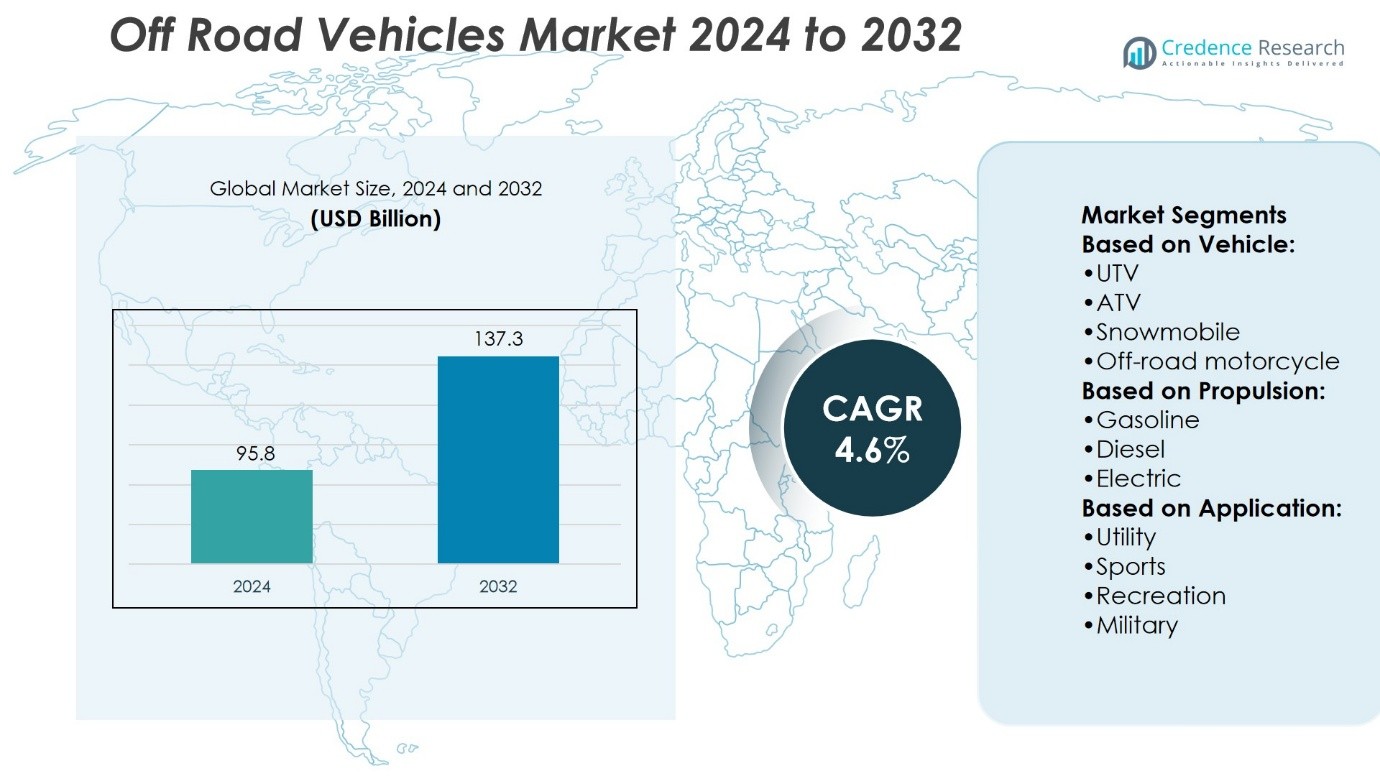
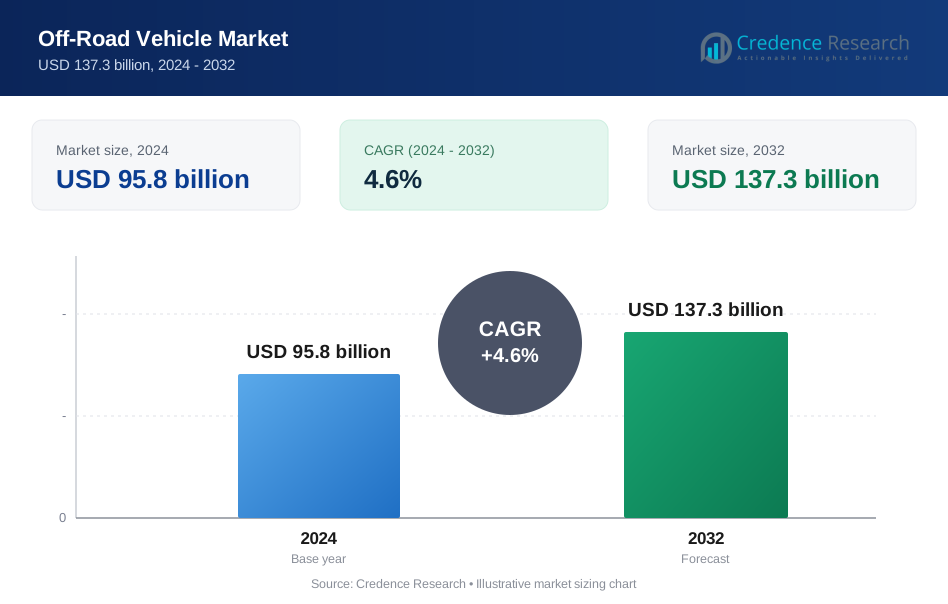
Off-Road Vehicles Market size was valued at USD 95.8 billion in 2024 and is anticipated to reach USD 137.3 billion by 2032, at a CAGR of 4.6% during the forecast period.
| REPORT ATTRIBUTE | DETAILS |
|---|---|
| Historical Period | 2020-2024 |
| Base Year | 2024 |
| Forecast Period | 2025-2032 |
| Off-Road Vehicles Market Size 2024 | USD 95.8 Billion |
| Off-Road Vehicles Market, CAGR | 4.6% |
| Off-Road Vehicles Market Size 2032 | USD 137.3 Billion |
The Off-Road Vehicles Market is driven by rising demand for recreational activities, expanding applications in agriculture, construction, and defense, and growing consumer interest in adventure tourism. It benefits from technological advancements such as advanced suspension systems, fuel-efficient engines, and connectivity features that improve safety and performance. The market also shows a strong trend toward electrification, with hybrid and electric models gaining attention amid sustainability goals. Customization and aftermarket services strengthen consumer engagement, while digital sales platforms and financing options improve accessibility. These drivers and trends collectively shape a dynamic industry with broad opportunities for growth.
The Off-Road Vehicles Market demonstrates strong geographical presence, with North America leading due to high recreational demand, Europe showing steady growth through sustainability-focused innovations, and Asia-Pacific emerging as the fastest-growing region supported by agriculture and adventure tourism. Latin America and the Middle East & Africa hold smaller but steady shares driven by utility and niche applications. Key players shaping the market include Polaris, Yamaha, Honda, BRP, Arctic Cat, Kawasaki, KTM, KYMCO, Hisun, and Zero Motorcycles.
Market Insights
- Off-Road Vehicles Market size was valued at USD 95.8 billion in 2024 and is projected to reach USD 137.3 billion by 2032, growing at a CAGR of 4.6%.
- Rising demand for recreational activities and expansion into agriculture, construction, and defense drive strong adoption.
- Technological advancements in suspension, fuel efficiency, and smart connectivity enhance performance and safety.
- Electrification emerges as a major trend, with hybrid and electric models gaining traction under sustainability goals.
- Competition intensifies with global players focusing on innovation, customization, and digital sales channels.
- High ownership costs, safety risks, and strict regulatory standards act as restraints for wider adoption.
- North America leads market share, Europe shows steady eco-focused growth, Asia-Pacific records fastest expansion, while Latin America and Middle East & Africa reflect smaller yet consistent opportunities.
Market Drivers
Rising Consumer Interest in Adventure and Recreational Activities
The growing enthusiasm for outdoor sports and recreational travel drives consistent demand for the Off-Road Vehicles Market. Consumers engage in activities such as trail riding, desert safaris, hunting, and camping, which require specialized vehicles. It caters to diverse user groups, including young enthusiasts and families seeking leisure activities. Expanding tourism and off-road adventure parks increase accessibility and visibility of such vehicles. Lifestyle changes emphasizing active and outdoor-oriented experiences push steady sales. Demand intensifies in regions with natural terrains suitable for off-road driving.
- For instance, the total number of global UTV (side-by-side) units sold in 2023 was significantly higher than the 210,000 figure that was cited. Market research reports show a much larger market, with sales driven by demand across recreational, agricultural, and commercial sectors.
Technological Advancements Enhancing Vehicle Performance
Continuous innovation in design and engineering supports growth within the market. Manufacturers introduce advanced suspension systems, fuel-efficient engines, and durable drivetrains to improve reliability. It integrates features such as electronic stability control, adaptive traction, and GPS-enabled navigation for safer off-road performance. Lightweight materials improve efficiency without compromising strength. Hybrid and electric models enter the market, aligning with sustainability targets. These innovations attract new buyers who value both performance and environmental responsibility.
- For instance, Toyota introduced its Multi-Terrain Select system in the Land Cruiser 300 series in 2021, which optimizes traction across six driving modes, while Tesla reported a drivetrain efficiency of 92% in its 2023 Model S Plaid.
Expanding Utility in Commercial and Military Applications
The adoption of off-road vehicles extends beyond recreation into commercial and defense applications. Construction firms, mining operators, and agriculture businesses deploy these vehicles for demanding terrain conditions. It provides essential mobility for military operations requiring durability and adaptability. Utility-focused models are designed with load-bearing and towing capabilities to serve professional needs. Emergency and rescue services also rely on these vehicles for accessing remote areas. Rising infrastructure projects and defense modernization programs support long-term demand.
Strong Distribution Networks and Rising Customization Demand
Expanding dealer networks, financing options, and digital sales platforms improve market penetration. It strengthens customer accessibility through online configurators and direct sales channels. Buyers increasingly seek personalized options, including engine modifications, aesthetic upgrades, and safety enhancements. Customization trends create added revenue streams for manufacturers and aftermarket service providers. Growth in social media and digital communities further accelerates awareness and peer-driven purchases. This evolving consumer preference for tailored vehicles sustains steady momentum in the market.
Market Trends
Shift Toward Electrification and Sustainable Models
The Off-Road Vehicles Market experiences a steady transition toward electric and hybrid models. Consumers demand eco-friendly options as environmental awareness increases. It encourages manufacturers to invest in battery efficiency, lightweight materials, and charging infrastructure. Electric ATVs and UTVs are entering trails and recreational zones, offering quieter and emission-free rides. Governments support this shift with policies and incentives that favor sustainable mobility. This trend reshapes product portfolios and influences long-term innovation strategies.
- For instance, Polaris launched its RANGER XP Kinetic in 2022 with a 110-horsepower electric motor and a towing capacity of 1,134 kilograms, showing how electrification enhances both performance and sustainability.
Integration of Smart Features and Connectivity
The market embraces digitalization through advanced connectivity and smart technologies. It incorporates GPS navigation, real-time performance monitoring, and mobile app integration into new models. Features such as driver assistance, automated controls, and AI-based diagnostics improve safety and convenience. Consumers value personalized ride data that enhances performance insights. Connectivity also supports fleet management for commercial users in agriculture and construction. This trend elevates user experience and widens adoption across both recreational and utility segments.
- For instance, KTM offers its Ride-by-Wire electronic throttle system on several motorcycles, including models produced in 2023. The system provides customizable riding modes and automatically adjusts traction control based on real-time sensor inputs, enhancing throttle control and safety. KTM has detailed this technology and its benefits in official documentation.
Growing Popularity of Customization and Lifestyle-Oriented Design
Rising consumer preference for personalized experiences drives strong demand for customized vehicles. The Off-Road Vehicles Market adapts by offering modifications in suspension, lighting, seating, and safety gear. It aligns with lifestyle branding, where vehicles reflect personal identity and adventure spirit. Manufacturers collaborate with aftermarket specialists to expand options for enthusiasts. Social media platforms showcase custom builds, influencing younger demographics to invest in tailored models. This trend creates fresh revenue opportunities and strengthens brand loyalty.
Expansion into Adventure Tourism and Commercial Applications
Adventure tourism growth and professional utility needs fuel wider usage of off-road vehicles. It supports operators in desert safaris, mountain expeditions, and recreational parks. Commercial adoption expands across sectors such as construction, mining, and forestry, where mobility in difficult terrain is critical. Partnerships between tourism providers and vehicle manufacturers promote immersive off-road experiences. Events, rallies, and sporting competitions further enhance visibility and appeal. This trend positions off-road vehicles as both lifestyle products and functional assets.
Market Challenges Analysis
High Ownership Costs and Regulatory Constraints
The Off-Road Vehicles Market faces challenges linked to high acquisition, maintenance, and insurance costs. Premium pricing of advanced models limits adoption among price-sensitive consumers. It requires significant spending on spare parts, specialized servicing, and aftermarket upgrades, creating long-term ownership concerns. Stringent safety and emission regulations increase production costs for manufacturers. Complex certification processes delay product launches and reduce flexibility for smaller brands. Market penetration in developing regions slows due to financial barriers and regulatory hurdles.
Safety Risks and Environmental Concerns
Frequent accidents, rollover incidents, and terrain-related hazards create a perception of safety risks that affect consumer confidence. It demands continuous investment in protective features and driver training programs. Off-road activities also raise environmental concerns, including habitat disruption and soil degradation. Growing pressure from environmental groups and policymakers restricts access to certain trails and recreational zones. Manufacturers struggle to balance performance with sustainability requirements. These factors collectively limit growth potential and demand careful strategic response.
Market Opportunities
Expansion of Electrification and Green Mobility Solutions
The Off-Road Vehicles Market holds strong opportunities through the rise of electric and hybrid vehicle models. Consumers increasingly prefer eco-friendly options that reduce emissions and operating noise. It encourages manufacturers to invest in advanced battery technologies, renewable charging infrastructure, and lightweight composite materials. Partnerships with energy providers can expand charging networks in remote areas, enabling wider adoption. Governments continue to support sustainable transportation with incentives and subsidies, creating favorable conditions for manufacturers. The growth of electric off-road models positions the industry to attract new consumer segments and meet future environmental regulations.
Growth of Adventure Tourism and Specialized Commercial Use
Adventure tourism expansion and demand for professional utility create promising prospects for manufacturers. The market benefits from rising interest in off-road activities such as desert safaris, mountain exploration, and outdoor sports. It enables tourism operators to form collaborations with vehicle brands, offering immersive travel experiences that attract high-value customers. Commercial sectors including agriculture, construction, and mining require reliable mobility solutions in challenging terrains, providing steady demand for utility-focused models. Development of multi-purpose vehicles tailored for both recreational and professional use enhances revenue streams. These opportunities strengthen the industry’s global footprint and broaden customer engagement.
Market Segmentation Analysis:
By Vehicle
The Off-Road Vehicles Market demonstrates strong diversity across vehicle categories including UTVs, ATVs, snowmobiles, and off-road motorcycles. Utility Terrain Vehicles (UTVs) lead in popularity due to their load-bearing capacity, safety features, and adaptability across agriculture, construction, and recreational activities. It finds steady demand from professional users requiring multipurpose solutions. All-Terrain Vehicles (ATVs) maintain a significant share, particularly among sports and recreational enthusiasts, because of their compact size and maneuverability. Snowmobiles dominate demand in colder regions where mobility across snow-covered landscapes is essential. Off-road motorcycles attract a younger demographic interested in competitive racing, trail riding, and adventure sports.
- For instance, Yamaha implemented a Tri-Mode On-Command 4WD system in its 2023 Grizzly 700 ATV. This system allows the driver to switch between 2WD, 4WD, and differential lock modes with the push of a button. The system is known for its seamless and instantaneous engagement, but no specific switching time has been publicly verified by Yamaha.
By Propulsion
Propulsion-based segmentation highlights the transition from conventional fuel engines to alternative options. Gasoline-powered vehicles dominate due to widespread availability and established fueling infrastructure. Diesel variants retain relevance in utility applications where higher torque and endurance are critical. It shows growing momentum in electric models as manufacturers prioritize sustainability, low maintenance, and quieter operation. Advancements in battery efficiency and renewable charging solutions enhance adoption prospects. The rise of hybrid models further bridges consumer preferences between traditional and electric propulsion.
- For instance, the Arcimoto FUV uses two electric motors that produce a combined 57 kW (77 hp). The vehicle is equipped with a 20-kWh lithium-ion battery pack, though a smaller 12 kWh battery was an available option.
By Application
Application-based analysis underlines the versatile use cases of off-road vehicles. Utility applications hold a substantial share, with adoption in sectors such as agriculture, forestry, mining, and construction. It serves as a critical mobility solution in challenging terrains, driving consistent demand from commercial users. Sports applications gain attention through competitive events, racing leagues, and recreational parks. Recreational usage expands globally as consumers seek adventure tourism and outdoor leisure activities. Military applications remain strategically important, with defense organizations investing in durable and adaptable vehicles for tactical mobility and logistical support.
Segments:
Based on Vehicle:
- UTV
- ATV
- Snowmobile
- Off-road motorcycle
Based on Propulsion:
- Gasoline
- Diesel
- Electric
Based on Application:
- Utility
- Sports
- Recreation
- Military
Based on the Geography:
- North America
o U.S.
o Canada
o Mexico
- Europe
o UK
o France
o Germany
o Italy
o Spain
o Russia
o Belgium
o Netherlands
o Austria
o Sweden
o Poland
o Denmark
o Switzerland
o Rest of Europe
- Asia Pacific
o China
o Japan
o South Korea
o India
o Australia
o Thailand
o Indonesia
o Vietnam
o Malaysia
o Philippines
o Taiwan
o Rest of Asia Pacific
- Latin America
o Brazil
o Argentina
o Peru
o Chile
o Colombia
o Rest of Latin America
- Middle East
o UAE
o KSA
o Israel
o Turkey
o Iran
o Rest of Middle East
- Africa
o Egypt
o Nigeria
o Algeria
o Morocco
o Rest of Africa
Regional Analysis
North America
North America dominates the Off-Road Vehicles Market with around 65% share. The U.S. and Canada lead demand due to a strong culture of trail riding, hunting, camping, and motorsports. It benefits from advanced infrastructure, well-established dealerships, and strong aftermarket networks. UTVs and ATVs are widely used for both farming and recreation, supporting steady growth. Sports events, rallies, and outdoor tourism further boost visibility. High disposable income and consumer interest in customization also keep demand strong. North America remains the key revenue hub for global players.
Europe
Europe contributes about 15–20% of the market. Countries like Germany, France, and Nordic nations show high adoption due to forestry, farming, and winter sports. Snowmobiles are especially popular in Nordic countries, while compact ATVs see demand in rural areas. It places a strong focus on sustainability, creating opportunities for hybrid and electric models. Stricter emission rules encourage innovation in cleaner technologies. Off-road tourism in the Alps and other rural destinations adds further demand. Europe remains steady, with growth driven by eco-friendly innovation and lifestyle appeal.
Asia-Pacific
Asia-Pacific holds roughly 15% market share but shows the fastest growth. China and India are leading markets, with off-road vehicles widely used in agriculture, rural mobility, and tourism. Rising disposable incomes and urbanization expand recreational purchases among younger consumers. Off-road motorcycles, UTVs, and ATVs are in high demand for both leisure and utility purposes. Governments are promoting adventure tourism, which further supports adoption. It also shows rising interest in electric models, especially in China. Asia-Pacific is expected to close the gap with mature markets in the coming years.
Latin America
Latin America contributes less than 10% to the global market. Brazil and Mexico lead regional demand, supported by agriculture, mining, and outdoor recreation. ATVs and UTVs are popular for farm use and eco-tourism activities. It benefits from diverse terrains such as rainforests, mountains, and deserts, which create unique demand. Adventure sports and outdoor tourism are slowly expanding, creating growth opportunities. Infrastructure challenges and lower purchasing power limit mass adoption. Still, the region offers steady opportunities for utility-focused models.
Middle East & Africa
The Middle East & Africa also account for less than 10% of the market. Demand comes mainly from desert terrains, oil and gas exploration, construction projects, and defense applications. Gulf countries use off-road vehicles for desert safaris and luxury tourism, supporting niche demand. It also provides utility applications for agriculture and mining across Africa. Limited infrastructure and economic uncertainty restrict large-scale growth. However, specialized demand for rugged, durable vehicles remains consistent. Manufacturers see opportunities in fleet sales and tourism partnerships.
Key Player Analysis
- Hisun
- Arctic Cat
- Zero Motorcycles
- Polaris
- KTM
- Honda
- Yamaha
- BRP
- Kawasaki
- KYMCO
Competitive Analysis
The competitive landscape of the Off-Road Vehicles Market players such as Arctic Cat, BRP, Hisun, Honda, Kawasaki, KTM, KYMCO, Polaris, Yamaha, and Zero Motorcycles. The Off-Road Vehicles Market is defined by continuous innovation, regional expansion, and strong brand positioning. Companies focus on expanding product portfolios across ATVs, UTVs, motorcycles, and snowmobiles to serve both recreational and utility applications. The market places emphasis on electrification, with growing investments in hybrid and electric models that align with sustainability goals. Advanced safety features, smart connectivity, and customization options are increasingly integrated to enhance user experience and build loyalty. Strong dealer networks and aftersales services remain critical to maintaining competitiveness, while digital platforms support direct engagement with consumers. Competition is further shaped by the balance between premium offerings for enthusiasts and affordable models for emerging markets. This creates a dynamic environment where innovation, compliance with regulatory standards, and responsiveness to consumer lifestyle trends determine long-term success.
Recent Developments
- In October 2024, Kawasaki launches new Kawasaki commercial brand. The brand will feature a new line of KT model UTVs designed to meet the needs of government and fleet customers. Its KT model UTVs will be built with the distinct demands of the difficult work environments of government services and fleet operations.
- In August 2023, Honda announced a trio of new ATV models in the United States. Additionally, introducing two of its most popular miniMOTO models, the Monkey and the Super Cub C125.
- In May 2023, Polaris introduced the Xpedition UTV, crafted for outdoor enthusiasts who prioritize comfort in all weather conditions. The Xpedition ADV boasts a fully enclosed cabin, including the cargo area. The two-seat model offers 36 inches of covered cargo space.
- In February 2023, BRP announced its all-new mid-cc Can-Am Outlander ATV recreational and utility models. It is designed and built with the emphasis of improving the rider experience at every touchpoint for both work and play.
Report Coverage
The research report offers an in-depth analysis based on Vehicle, Propulsion, Application and Geography. It details leading market players, providing an overview of their business, product offerings, investments, revenue streams, and key applications. Additionally, the report includes insights into the competitive environment, SWOT analysis, current market trends, as well as the primary drivers and constraints. Furthermore, it discusses various factors that have driven market expansion in recent years. The report also explores market dynamics, regulatory scenarios, and technological advancements that are shaping the industry. It assesses the impact of external factors and global economic changes on market growth. Lastly, it provides strategic recommendations for new entrants and established companies to navigate the complexities of the market.
Future Outlook
- The market will expand steadily with rising demand from recreational and utility applications.
- Electric and hybrid off-road vehicles will gain stronger adoption across key regions.
- Manufacturers will invest more in lightweight materials and advanced safety technologies.
- Adventure tourism will drive higher demand for ATVs, UTVs, and off-road motorcycles.
- Customization and aftermarket services will create new revenue opportunities.
- Military and defense sectors will continue to integrate advanced off-road mobility solutions.
- Digital connectivity and smart features will become standard in new vehicle models.
- Asia-Pacific will emerge as the fastest-growing regional market.
- Stricter emission regulations will accelerate innovation in sustainable propulsion systems.
- Strong dealer networks and online platforms will enhance consumer accessibility worldwide.
Request a Free Sample
Fill in your details and we'll send you a free sample report.
- Sample data tables & charts
- Research methodology
Need a Custom Version of This Report?
Tailor the scope, geography, or segments to your exact requirements.
- Custom geography or segment scope
- Direct access to our analyst team
Frequently Asked Questions
What is the current market size for Off-Road Vehicles Market, and what is its projected size in 2032?
At what Compound Annual Growth Rate is the Off-Road Vehicles Market projected to grow between 2025 and 2032?
Which Off-Road Vehicles Market segment held the largest share in 2024?
What are the primary factors fueling the growth of the Off-Road Vehicles Market?
Who are the leading companies in the Off-Road Vehicles Market?
Which region commanded the largest share of the Off-Road Vehicles Market in 2024?
Table of Content
Chapter 1. Report Introduction
- 1.1 Report Description & Purpose
- 1.1.1 Report Title & Market Definition
- 1.1.2 Unique Selling Propositions (USP) & Key Differentiators
- 1.1.3 Value Proposition for Stakeholders
- 1.2 Research Objectives
- 1.2.1 Market Sizing Objectives (Volume & Revenue) (Volume Where Applicable)
- 1.2.2 Segmentation Objectives
- 1.2.3 Competitive Intelligence Objectives
- 1.2.4 Forecast & Scenario Objectives
- 1.3 Report Scope
- 1.3.1 Off-Road Vehicle Scope – Segments & Subsegments Covered
- 1.3.2 Geographic Scope – Regions & Countries Covered
- 1.3.3 Historical Period, Base Year & Forecast Period (2024; forecast to 2032)
- 1.3.4 Inclusions & Exclusions
- 1.4 Industry Classification & Applicable Codes
- 1.5 Currency, Measurement Units & Valuation Basis
- 1.6 Target Stakeholders
- 1.7 Limitations & Assumptions
Chapter 2. Executive Summary
- 2.1 Global Off-Road Vehicle Market Snapshot
- 2.1.1 Market Size – Historical (2024) & Forecast (2024-2032) (2024: USD 95.8 billion → 2032: USD 137.3 billion)
- 2.1.2 Volume & Revenue – Global Totals (Volume Where Applicable)
- 2.1.3 Key Market Highlights – Top Five Facts
- 2.2 Off-Road Vehicle Market Segmentation Snapshot
- 2.2.1 Market Split by Region – 2024 vs. 2032
- 2.3 Competitive Snapshot
- 2.3.1 Top 10 Players by Revenue Share – 2024
- 2.3.2 Top 10 Players by Volume Share – 2024 (Volume Where Applicable)
- 2.3.3 Recent Strategic Developments (18-Month Summary)
- 2.4 Key Investment Highlights & Strategic Conclusions
Chapter 3. Off-Road Vehicle Market Dynamics & Industry Analysis
- 3.1 Market Overview & Context
- 3.1.1 Off-Road Vehicle Market Position in the Broader Industry Value Chain
- 3.1.2 Demand Structure & Purchasing Dynamics
- 3.1.3 Market Maturity & Development Stage by Region
- 3.2 Off-Road Vehicle Market Drivers
- 3.3 Off-Road Vehicle Market Restraints & Challenges
- 3.4 Off-Road Vehicle Market Opportunities
- 3.5 Porter's Five Forces Analysis
- 3.5.1 Threat of New Entrants
- 3.5.2 Bargaining Power of Suppliers
- 3.5.3 Bargaining Power of Buyers
- 3.5.4 Threat of Substitutes
- 3.5.5 Competitive Rivalry – Intensity Assessment
- 3.6 Off-Road Vehicle Value Chain Analysis
- 3.6.1 Upstream – Key Inputs, Resources & Suppliers
- 3.6.1.1 Key Input/Resource 1
- 3.6.1.2 Key Input/Resource 2
- 3.6.1.3 Key Input/Resource 3
- 3.6.2 Midstream – Core Operations & Value Creation
- 3.6.2.1 Operating Model & Process Overview
- 3.6.2.2 Key Operating Locations & Capabilities by Company
- 3.6.3 Downstream – Market Channels & End Users
- 3.6.3.1 Direct Sales & Customer Engagement Channels
- 3.6.3.2 Indirect Sales, Intermediaries & Partner Channels
- 3.6.4 Value Chain Profitability Analysis
- 3.6.1 Upstream – Key Inputs, Resources & Suppliers
- 3.7 PESTEL Analysis
- 3.7.1 Political Factors
- 3.7.2 Economic Factors
- 3.7.3 Social Factors
- 3.7.4 Technological Factors
- 3.7.5 Environmental Factors
- 3.7.6 Legal Factors
- 3.8 Off-Road Vehicle Supply Chain Analysis
- 3.8.1 Critical Input & Resource Availability Risk Assessment
- 3.8.2 Supplier & Operational Concentration Risk (Geographic Exposure)
- 3.8.3 Supply & Service Disruption Impact Analysis
- 3.9 Regulatory & Policy Landscape
Note: The regulatory and policy landscape section covers regulations based on their applicability to the market, Off-Road Vehicle category, geography, and scope of the study. Only regulatory frameworks with a material impact on operations, compliance, trade, sustainability, or market access are analyzed in detail.
Chapter 4. Key Investment Pockets & Opportunity Analysis
- 4.1 Off-Road Vehicle Market Attractiveness Analysis
- 4.1.1 By Region – Investment Attractiveness Matrix (Market Size × CAGR)
- 4.2 Absolute Revenue Growth Opportunity
- 4.2.1 By Region – Absolute Revenue Growth Through 2032
- 4.3 Incremental Demand Opportunity
- 4.3.1 By Region – Incremental Demand Through 2032
- 4.3.2 Segment – Incremental Demand
- 4.4 Emerging Submarket Opportunity Deep Dive (Subject to Applicability)
- 4.5 Priority Market Opportunity Scorecards
- 4.5.1 United States
- 4.5.2 Europe
- 4.5.3 Asia
- 4.5.4 Middle East & Africa
Note: Priority market opportunity scorecards reflect the geographic scope and strategic relevance of the study. Listed markets are indicative and may be adapted to the industry.
Chapter 5. Off-Road Vehicle Cross-Border Trade & Market Access Analysis
- 5.1 International Trade & Cross-Border Activity Overview
- 5.1.1 Global Export Value by Country (2024)
- 5.1.2 Global Export Volume by Country (2024) (Volume Where Applicable)
- 5.1.3 Global Import Value by Country (2024)
- 5.1.4 Global Import Volume by Country (2024) (Volume Where Applicable)
- 5.1.5 Net Trade Balance by Country (2024)
- 5.2 Export Analysis – Segment
- 5.2.1 Category 1 (Applicable Classification Code)
- 5.2.2 Category 2 (Applicable Classification Code)
- 5.2.3 Category 3 (Applicable Classification Code)
- 5.2.4 Category 4 (Applicable Classification Code)
- 5.2.5 Category 5 (Applicable Classification Code)
- 5.3 Import Analysis – Segment
- 5.3.1 Category 1 (Applicable Classification Code)
- 5.3.2 Category 2 (Applicable Classification Code)
- 5.3.3 Category 3 (Applicable Classification Code)
- 5.3.4 Category 4 (Applicable Classification Code)
- 5.3.5 Category 5 (Applicable Classification Code)
- 5.4 Cross-Border Pricing & Transaction Benchmarks
- 5.4.1 Export Pricing – Segment & Country
- 5.4.2 Import Pricing – Segment & Source Country
- 5.4.3 Price Trends (2024)
- 5.5 Key Cross-Border Trade & Delivery Routes
- 5.5.1 Cross-Border Trade/Delivery Route 1
- 5.5.2 Cross-Border Trade/Delivery Route 2
- 5.5.3 Cross-Border Trade/Delivery Route 3
- 5.5.4 Cross-Border Trade/Delivery Route 4
- 5.5.5 Cross-Border Trade/Delivery Route 5
- 5.6 Trade Policy & Market Access Impact Assessment
- 5.6.1 Tariff & Non-Tariff Barriers
- 5.6.2 Regional Trade & Economic Integration Frameworks
- 5.6.3 Bilateral & Multilateral Trade Agreements
- 5.6.4 Cross-Border Operating, Licensing & Localization Requirements
Note: This chapter applies where cross-border trade or delivery is relevant to Off-Road Vehicle. Goods, services, and digital offerings are assessed using applicable classifications and transaction measures. Import-export volumes, trade balances, and route analyses are included only where meaningful to the market.
Chapter 6. Competitive Landscape & Company Benchmarking
- 6.1 Off-Road Vehicle Market Concentration & Structure
- 6.1.1 Herfindahl-Hirschman Index (HHI) – vs. 2024
- 6.1.2 Leading, Mid-Sized & Emerging Player Structure
- 6.1.3 Global, Regional & Local Player Dynamics
- 6.2 Off-Road Vehicle Market Share Analysis – 2024
- 6.2.1 Global Revenue Share by Company
- 6.2.2 Global Volume Share by Company (Volume Where Applicable)
- 6.2.3 Regional Revenue Share
- 6.2.4 Market Share Evolution ( vs. 2024)
- 6.2.5 Company Market Share by Key Segment
- 6.2.6 Company Market Share by Customer Group
- 6.3 Operating Scale, Capacity & Infrastructure Analysis
- 6.3.1 Global Operating Scale & Supply Capacity
- 6.3.2 Resource Utilization & Operating Efficiency
- 6.3.3 Output, Service Delivery & Activity Metrics
- 6.3.4 Operating Footprint & Infrastructure Map
- 6.3.5 Planned Operational & Capacity Expansion
- 6.4 Off-Road Vehicle Competitive Benchmarking Matrix
- 6.4.1 Revenue, Growth, Profitability & Operating Metric Comparison
- 6.4.2 Channel Revenue Mix
- 6.4.3 Geographic Revenue Exposure
- 6.4.4 R&D Intensity
- 6.4.5 Sustainability Maturity
- 6.5 Strategic Developments in Off-Road Vehicle (Last 24 Months)
- 6.5.1 Mergers, Acquisitions & Divestments
- 6.5.2 New Products, Services & Solutions in Off-Road Vehicle
- 6.5.3 Operational & Infrastructure Expansions
- 6.5.4 Strategic Alliances, Joint Ventures & Partnerships
- 6.5.5 Distribution Expansion & Market Entry
- 6.5.6 Sustainability & ESG Initiatives
- 6.6 Competitive Strategy Mapping
- 6.6.1 Leader, Challenger, Follower & Niche Classification
- 6.6.2 Pricing Strategy Comparison
- 6.6.3 Channel Strategy Matrix
Note: Strategic developments are included based on their materiality and the availability of reliable information.
Chapter 7. Global Off-Road Vehicle Market – By Sales & Delivery Channel
- 7.1 Segment Overview
- 7.1.1 Volume & Revenue Split by Channel (2024 & 2032) (Volume Where Applicable)
- 7.1.2 Channel Mix Evolution (2024-2032)
Chapter 8. Regional Market Analysis – Global Overview
- 8.1 Global Regional Overview
- 8.1.1 Regional Volume Share (Volume Where Applicable)
- 8.1.2 Regional Revenue Share
- 8.1.3 Regional Volume by Region (Volume Where Applicable)
- 8.1.4 Regional Revenue by Region
- 8.1.5 Regional Forecast Through 2032
- 8.2 Cross-Regional Segment Analysis
- 8.2.1 By Sales & Delivery Channel
- 8.2.2 By Competitive Positioning & Price Tier
Chapter 9. North America Off-Road Vehicle Market
- 9.1 United States
- 9.2 Canada
- 9.3 Mexico
Chapter 10. Europe Off-Road Vehicle Market
- 10.1 Germany
- 10.2 France
- 10.3 Italy
- 10.4 United Kingdom
- 10.5 Spain
- 10.6 Poland
- 10.7 Russia
- 10.8 Netherlands
- 10.9 Belgium
- 10.10 Sweden
- 10.11 Denmark
- 10.12 Norway
- 10.13 Rest of Europe
Chapter 11. Asia Pacific Off-Road Vehicle Market
- 11.1 China
- 11.2 India
- 11.3 Japan
- 11.4 South Korea
- 11.5 Thailand
- 11.6 Indonesia
- 11.7 Vietnam
- 11.8 Malaysia
- 11.9 Australia
- 11.10 Rest of Asia Pacific
Chapter 12. Latin America Off-Road Vehicle Market
- 12.1 Brazil
- 12.2 Argentina
- 12.3 Colombia
- 12.4 Chile
- 12.5 Rest of Latin America
Chapter 13. Middle East Off-Road Vehicle Market
- 13.1 Saudi Arabia
- 13.2 United Arab Emirates
- 13.3 Turkey
- 13.4 Israel
- 13.5 Iran
- 13.6 Rest of the Middle East
Chapter 14. Africa Off-Road Vehicle Market
- 14.1 South Africa
- 14.2 Egypt
- 14.3 Nigeria
- 14.4 Morocco
- 14.5 Rest of Africa
Chapter 15. Off-Road Vehicle Company Profiles
- 15.1 [Company 01]
- 15.1.1 Company Overview
- 15.1.2 Key Management Personnel
- 15.1.3 Products & Services Portfolio
- 15.1.4 Financial Performance
- 15.1.5 Key Market Focus & Geographic Presence
- 15.1.6 Recent Developments & Strategic Initiatives
Note: The company profile list is preliminary and may change based on research findings, market developments, data availability, and client requirements.
Chapter 16. Appendices
- Appendix A – List of Abbreviations & Acronyms
- Appendix B – Industry Classification Code Reference – Full Series
- Appendix C – Supply, Output & Operating Capacity Data Tables
- Appendix D – End-Use & Demand Base Tables
- Appendix E – Demand, Adoption & Usage Assumptions
- Appendix F – Pricing & Revenue Metric Reference Tables
- Appendix G – Company Operations & Infrastructure Database
- Appendix H – Cross-Border Trade & Activity Data Tables (Where Applicable)
- Appendix I – Regulatory Summary Tables
- Appendix J – Primary Research Participant List (Anonymized)
- Appendix K – Primary Research Questionnaire Framework
- Appendix L – Data Sources & Bibliography
- Appendix M – Market Size Divergence & Source Comparison
Chapter 17. Research Methodology
- 17.1 Research Framework & Philosophy
- 17.2 Secondary Research – Sources, Hierarchy & Data Extraction
- 17.3 Data Modeling – Bottom-Up & Top-Down Market Sizing
- 17.4 Primary Research – Stakeholder Framework, LOI & Sample Sizes
- 17.5 Forecast Methodology – Regression, Scenario & Sensitivity Analysis
- 17.6 Quality Control – Four-Layer Validation Framework
- 17.7 Limitations & Standard Assumptions
- 17.8 Disclaimer
