Older fleets and higher labor rates carry value growth
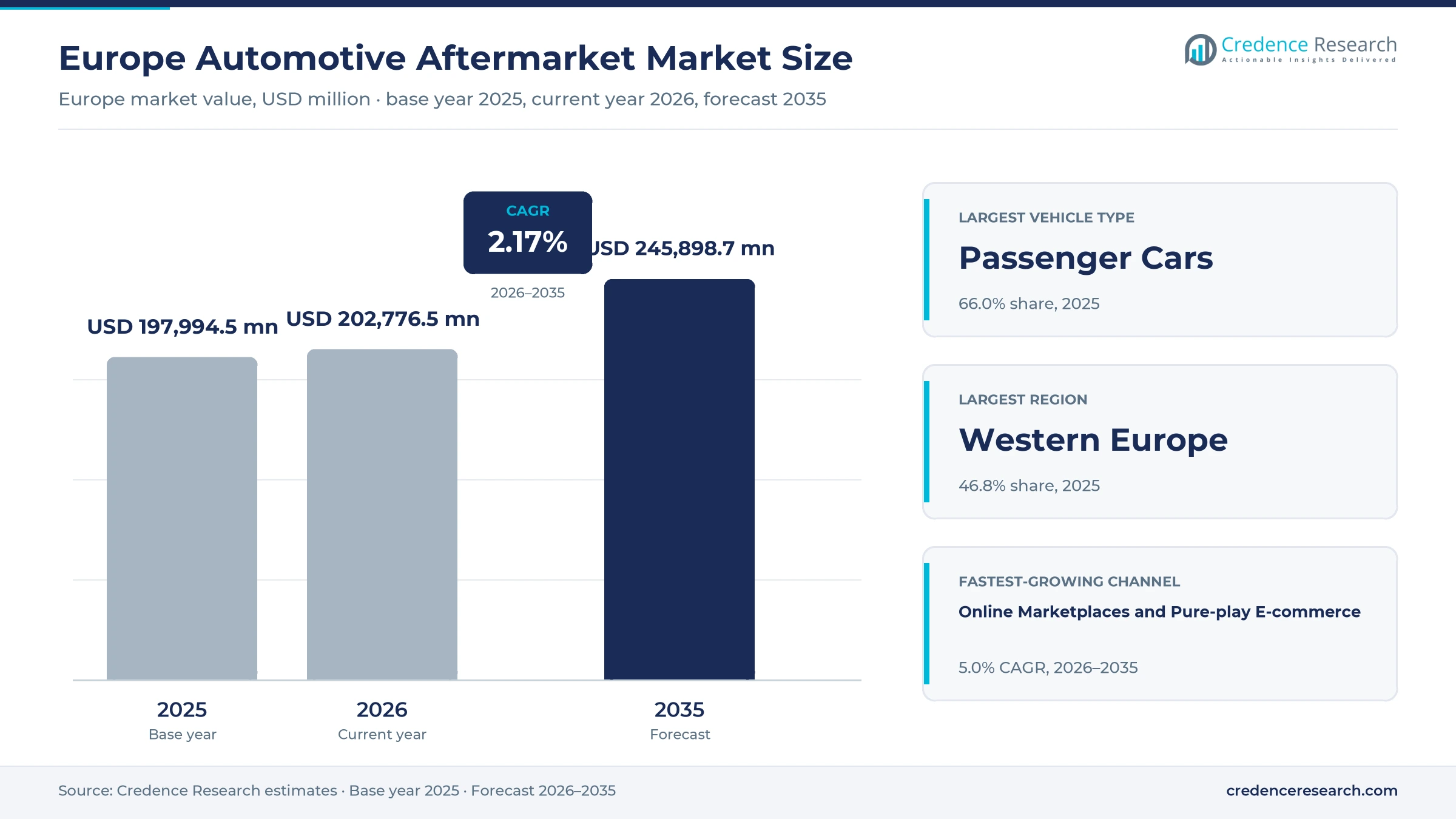
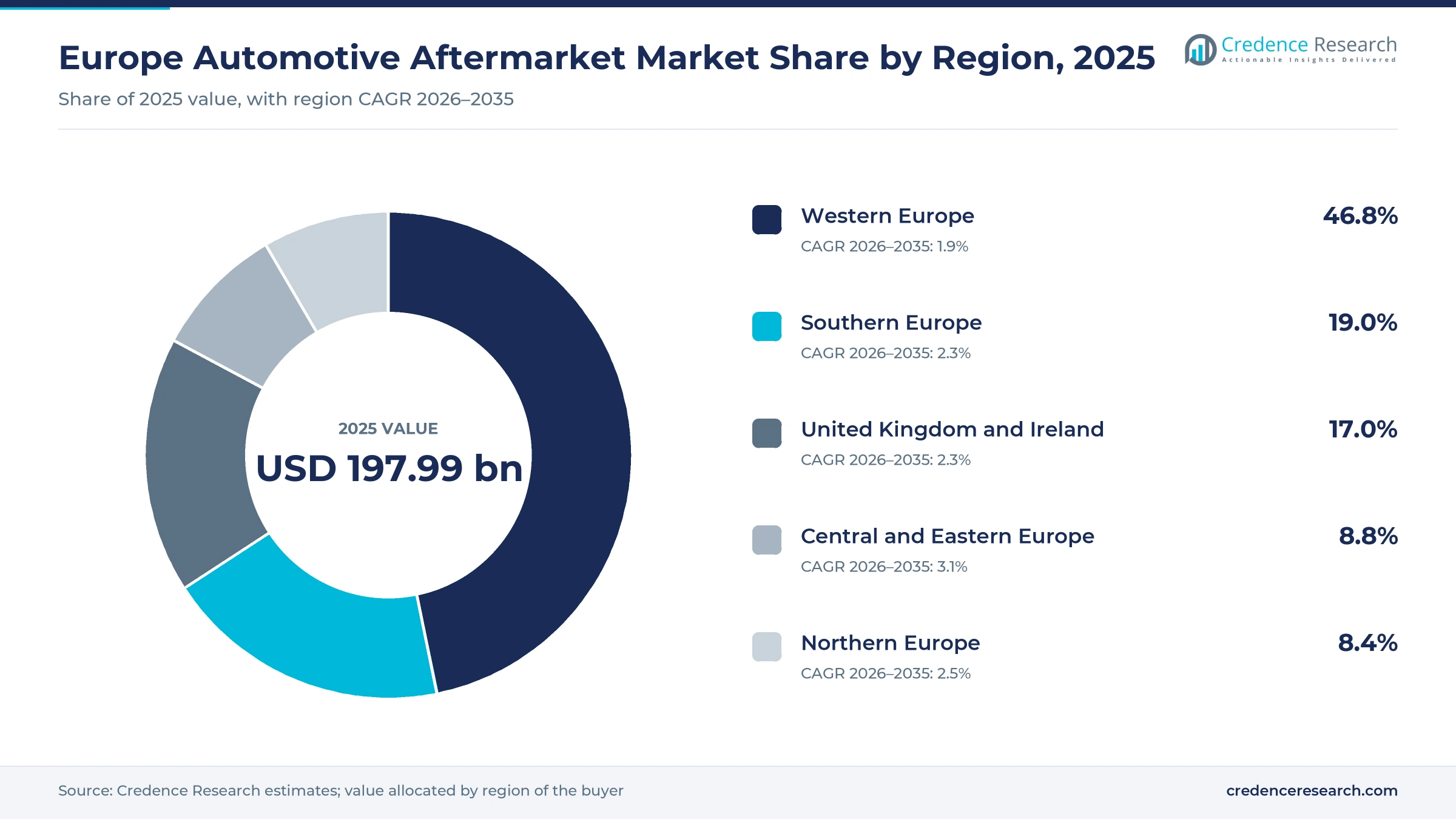
The Europe automotive aftermarket market was valued at USD 197.99 billion in 2025 and is projected to increase from USD 202.78 billion in 2026 to USD 245.90 billion by 2035, registering a CAGR of 2.17% during 2026–2035. Demand rests on a vehicle fleet that keeps getting older, on wear parts and tires that every vehicle needs whatever its powertrain, and on fleet operators that service vans and trucks on fixed cycles. Western Europe held the largest regional share, 46.8% in 2025, because Germany, France and the Benelux combine large fleets with high workshop labor rates and dense distributor networks. Central and Eastern Europe is the fastest-growing region at 3.1% a year, as older cars in Poland, Czechia and Romania need more replacement work. Regulation is also changing the market, since a 2026 EU delegated act sets out how independent workshops may reach diagnostic data behind carmakers' secure gateways, which widens the jobs they can take on.
Which parts, services and vehicles does the market include?
The market counts what owners and fleets pay after the sale of a vehicle for replacement parts, tires, fluids, accessories and the workshop labor to fit them, across cars, vans, trucks and buses in use in Europe. Buyers are private owners, fleet operators, independent workshops and franchised dealers, which buy through distributors, carmaker parts networks, online shops and tire and fast-fit chains.
The estimate excludes parts sold to carmakers for new-vehicle assembly, warranty work paid by carmakers, fuel, insurance premiums and car washing. Value is counted at the final sale, so parts makers, distributors, online retailers and workshops all sit inside the chain that the vehicle owner pays for.
Europe Automotive Aftermarket Market Insights
- The market grows from USD 197.99 billion in 2025 to USD 245.90 billion by 2035, a 2.17% pace that rests on older fleets and higher workshop prices rather than on more vehicles.
- Western Europe held 46.8% of 2025 value, while Central and Eastern Europe grows fastest at 3.1% a year on its older car fleet.
- Passenger Cars held 66.0% of 2025 value, while Light Commercial Vehicles grow fastest at 2.6% a year as delivery fleets expand.
- Germany's average workshop labor rate passed €200 an hour in 2024, according to the German insurance association GDV, which lifts value per job.
- LKQ Europe, Alliance Automotive Group and AUTODOC compete to supply independent workshops as EU rules widen their access to vehicle data.
Cars and wear parts lead as online channels gain fastest
Why do cars lead while light commercial vehicles grow fastest?
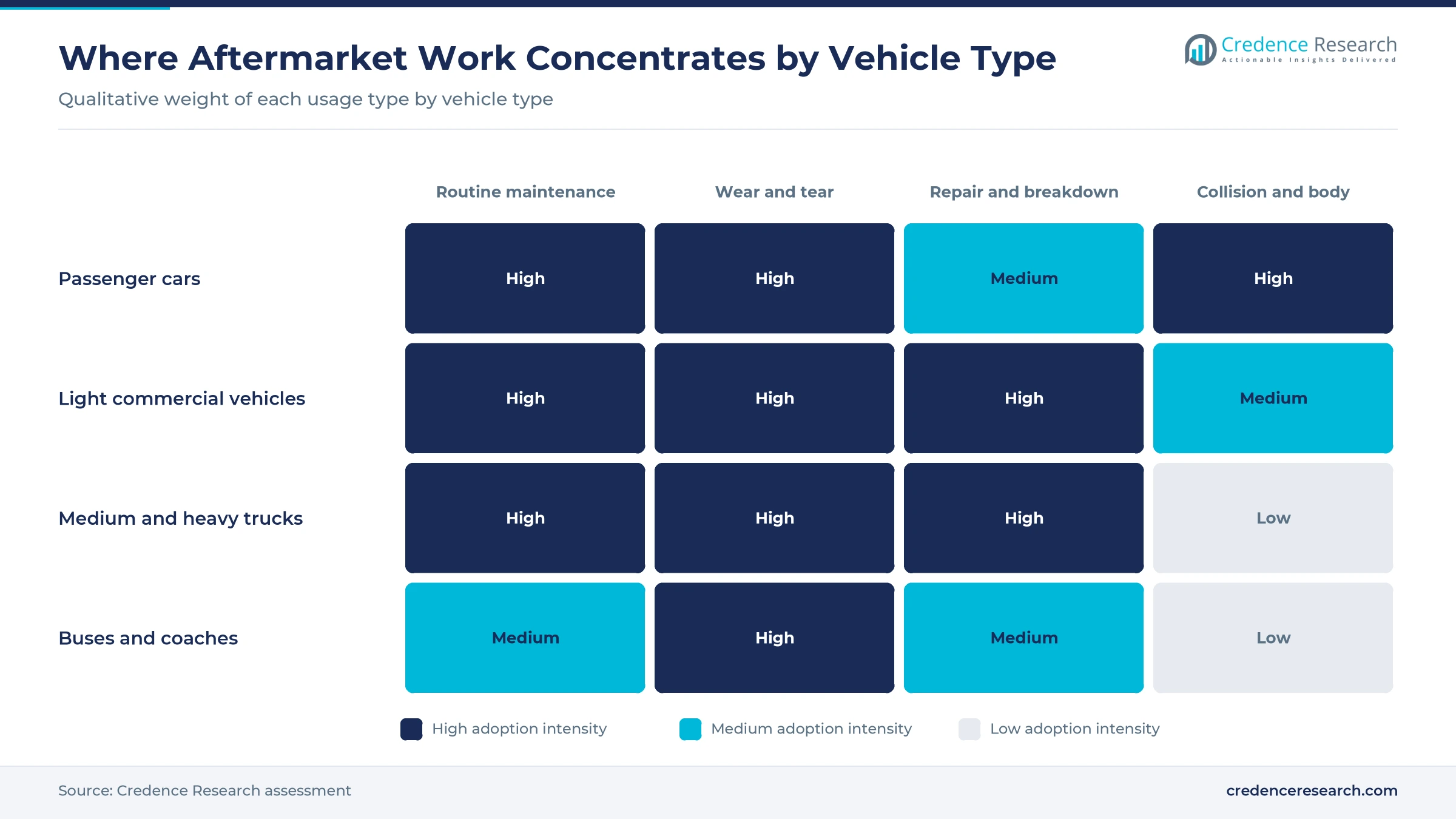
Based on vehicle type, the market is categorized into passenger cars, light commercial vehicles, medium and heavy trucks, and buses and coaches. Passenger Cars led with 66.0% of 2025 value because cars make up most of the parc, with 49.3 million in Germany and 41.3 million in Italy alone, according to ACEA. Light Commercial Vehicles grow fastest at 2.6% a year as the EU van fleet rose 1.9% in 2024 to about 31.1 million, outpacing growth in the car fleet. High-mileage vans wear brakes, clutches and suspension quickly, so fleet contracts reward suppliers that keep stock close to depots.
Why does wear replacement lead while collision repair grows fastest?
Based on usage type, the market is categorized into routine maintenance, wear and tear replacement, repair and breakdown, and collision and body repair. Wear and Tear Replacement led with 38.0% of 2025 value because tires, brakes, filters and wipers need regular replacement, and Tyres Europe counted 224.1 million consumer replacement tires sold in 2025. Collision and Body Repair grows fastest at 2.7% a year as body parts get dearer, with German car spare parts prices up more than 80% since 2015 against about 30% for consumer prices, according to GDV. Bumpers and headlights fitted with sensors and cameras raise the bill on every claim.
Why do independent distributors lead while online sellers grow fastest?
Based on sales channel, the market is categorized into independent distributors and wholesalers, OEM authorized dealer networks, online marketplaces and pure-play e-commerce, and tire and fast-fit chains. Independent Distributors and Wholesalers led with 47.0% of 2025 value because they deliver to workshops several times a day, and LKQ Europe alone runs more than 900 branches serving more than 100,000 workshops. Dealers keep a large share but are losing ground, since brand workshops handled 43% of German workshop jobs in 2024 against 55% in 2017, according to DAT. Online Marketplaces and Pure-play E-commerce grow fastest at 5.0% a year as owners compare prices online.
Why does petrol lead while battery electric vehicles grow fastest?
Based on powertrain, the market is categorized into petrol internal combustion, diesel internal combustion, hybrid electric and battery electric vehicles. Petrol Internal Combustion led with 47.0% of 2025 value because petrol cars made up 49.2% of the EU car fleet in 2024, against 28.4% for diesel, according to ACEA. Diesel still carries a large share because most vans and trucks use it. Battery Electric grows fastest at 9.1% a year from a small base, as electrically chargeable cars reached 3.7% of the EU fleet in 2024, up from 3%. Electric cars need fewer fluids and filters but more tires, thermal parts and high-voltage diagnostics.
| Segment Group | Leading Sub-segment | Share, 2025 | Fastest-growing Sub-segment | CAGR, 2026–2035 |
|---|---|---|---|---|
| By Vehicle Type | Passenger Cars | 66.0% | Light Commercial Vehicles | 2.6% |
| By Usage Type | Wear and Tear Replacement | 38.0% | Collision and Body Repair | 2.7% |
| By Sales Channel | Independent Distributors and Wholesalers | 47.0% | Online Marketplaces and Pure-play E-commerce | 5.0% |
| By Powertrain | Petrol Internal Combustion | 47.0% | Battery Electric | 9.1% |
Labor rates rise faster than inflation on every job
Aftermarket pricing works per job, combining a parts bill with labor hours billed at the workshop's hourly rate. Both parts of that bill are rising faster than inflation, and GDV reports that German workshop prices rose 50% from 2017 to 2024 against 24% for consumer prices. Independent workshops typically charge less per hour than franchised dealers, which is why owners of cars older than the warranty period move to them. Rising access charges for carmaker data add a new fixed cost per job. Suppliers that offer kits and labor-saving repair solutions can win share because they cut the hours a workshop must bill.
| Service or charge | Typical price or fee | Basis |
|---|---|---|
| Routine maintenance service, Germany | About €389 per service, 2024 | DAT Report 2025 |
| Mechanical, electrical and body labor, Germany | €202 an hour on average, 2024 | GDV, October 2025 |
| Paint labor, Germany | €220 an hour on average, 2024 | GDV, October 2025 |
| Average insured mechanical repair claim | About €764 in 2025, up from €718 | CarGarantie repair analysis, 2026 |
| OEM data access fees, U.K. | £10 to connect to a vehicle, £25 per ADAS recalibration | LKQ Europe, September 2025 |
Request a Free Sample
Fill in your details and we'll send you a free sample report.
- Sample data tables & charts
- Research methodology
Aging parc, data access and digital ordering lift spend
Aging vehicle parc extends replacement cycles
Older vehicles need more parts and labor each year, and Europe's fleet keeps getting older because owners hold cars longer. ACEA counted 256 million cars on EU roads in 2024, and their average age reached 12.7 years. Vans averaged 12.9 years and trucks 14 years, so commercial fleets also sit well past the point where clutches, injectors and turbochargers start to fail. Each extra year of age adds items such as shock absorbers, exhaust parts and timing belts to the service bill. A larger share of cars beyond warranty shifts work from dealers to independent repair and maintenance services, which is why Independent Distributors and Wholesalers keep the largest channel share.
Digital procurement expands parts accessibility
Online catalogs and ordering platforms let owners and workshops find the right part faster, which widens choice and speeds up repairs. AUTODOC reported 9.3 million active customers in 2025 and 18.9 million orders from online shops in 27 European countries. A catalog that matches parts to the vehicle identification number lets a private owner order brake pads or filters with little risk of buying the wrong part. Workshops follow the same path through distributor web shops that show local stock and delivery times. Wider access to online parts retail explains why Online Marketplaces and Pure-play E-commerce grow at 5.0% a year, the fastest of any channel.
Data access rules support independent service competition
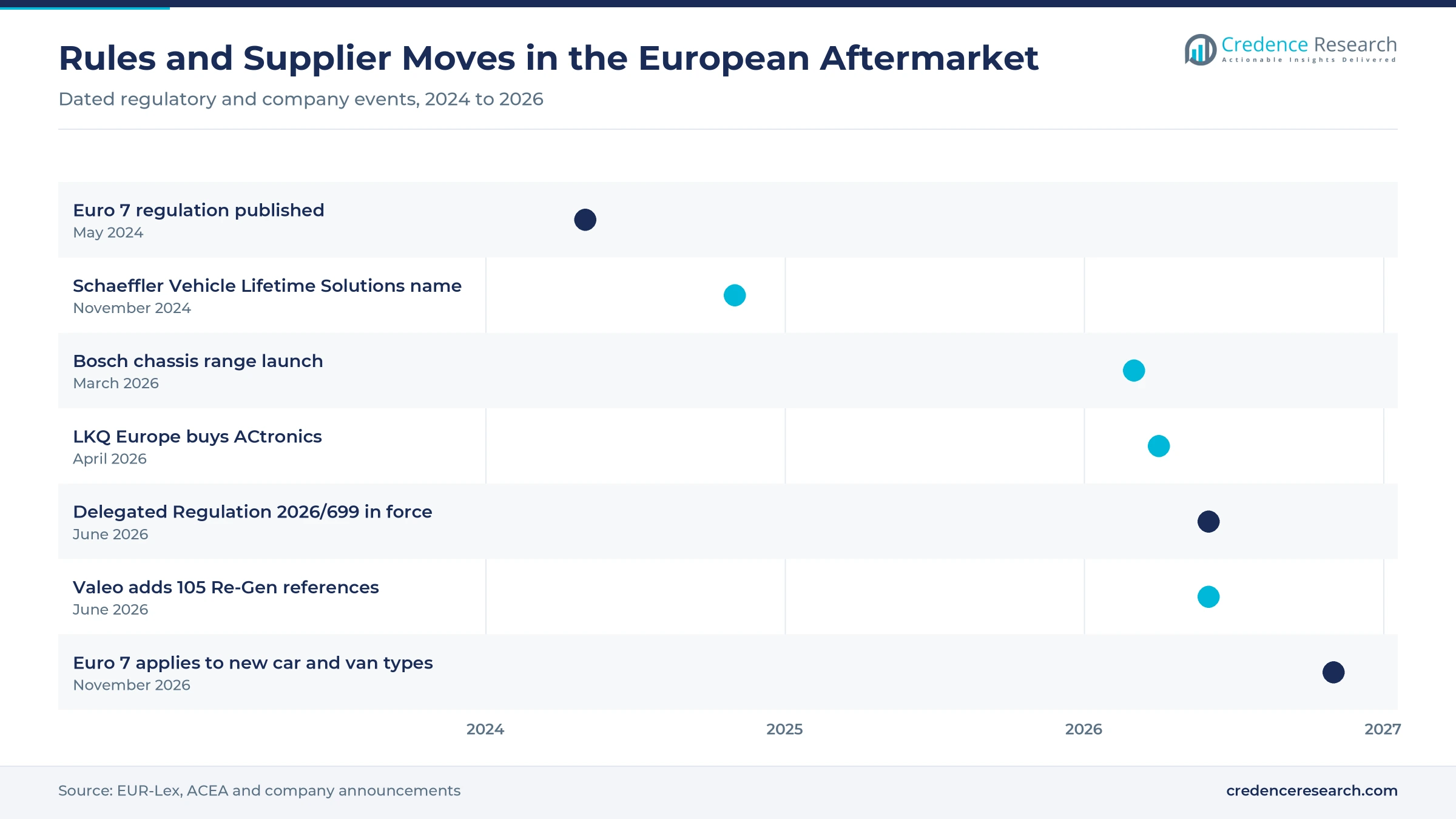
EU rules increasingly guarantee independent workshops the vehicle data they need, which protects their share of repair work on connected cars. The European Commission prolonged its motor vehicle block exemption regulation on April 17, 2023, to May 31, 2028, and its guidelines now treat vehicle-generated data as an essential input for independent repairers. Delegated Regulation (EU) 2026/699 entered into force on June 23, 2026, limiting how carmakers may authenticate tools at the diagnostic port and adding driver assistance and battery repair data to the information they must share. Carmakers must give independent tool makers implementation information by Dec. 23, 2026. These rules keep multi-brand workshops able to service newer cars.
Electronic content raises the value of each repair
Modern vehicles fail more often in their electronics, which pushes up the value of each repair even when the number of jobs falls. CarGarantie reported that the average repair it settled rose to about €764 in 2025 from €718 a year earlier. Electrical faults accounted for 28.8% of failures in new cars, and for the first time they made up the largest share of new-car claim costs, at 19.3%. Bosch says its Esitronic online diagnostics now cover more than 200 electric and hybrid model series, so workshops need paid software as well as tools. This is why repair and breakdown work gains value faster than routine maintenance.
All-season tires and reman electronics reshape demand
Shift to all-season tires in the replacement market
European drivers are moving from seasonal tire changes to all-season tires, which changes the timing and mix of tire demand. Tyres Europe reported that all-season consumer tire sales rose 5% in 2025, the only major car segment to grow, while summer tires fell 7% and winter tires 2%. The move continued in the first quarter of 2026, when all-season sales rose another 5% and winter tires dropped 14%. Fewer seasonal changeovers mean less fitting and storage income for tire chains, but all-season tires carry higher prices per unit. Tire makers that lead in all-season ranges can gain share of replacement tire demand even while total units stay flat.
Rise of remanufactured electronics and rotating parts
Remanufactured parts are moving from engines and starters into control units, which gives workshops a cheaper way to repair expensive electronics. LKQ Europe announced the acquisition of ACtronics on April 2, 2026, adding a Dutch specialist that repairs ABS and ESP units, engine and transmission control units and instrument clusters for workshops and dealers across Europe. Valeo added 105 references to its Re-Gen range on June 19, 2026, taking it beyond 3,100 and covering a further 22 million vehicles. Wider ranges of remanufactured components let distributors offer a second, lower price tier on costly electronic parts.
Opening in low-dust brakes ahead of Euro 7 rules
Euro 7 is the first EU emissions standard to cover brake particles, which opens a new product tier in brakes for suppliers. Regulation (EU) 2024/1257 was published on May 8, 2024, and it applies to new types of cars and vans from Nov. 29, 2026, and to all new cars and vans from Nov. 29, 2027. ZF Aftermarket presented its TRW DTEC brake pads and discs at Automechanika Frankfurt in September 2026, saying they cut PM10 emissions by up to 80% in dynamometer tests against conventional sets. The rule binds new vehicles, yet low-dust parts will soon be needed to replace original equipment on them, so early ranges can command a premium.
Opening in electric vehicle and ADAS service skills
Workshops that can repair high-voltage systems and calibrate driver assistance sensors can capture work that dealers now keep. Valeo brought its Tech Academy program to Italy on July 8, 2026, offering 50 hours of coaching on electric and hybrid vehicles and 25 hours on driver assistance systems, after launches in France, Germany, Poland, Spain and the U.K. LKQ Europe aims to train 24,000 technicians in hybrid and electric maintenance by 2028 through LKQ Academy, and its LKQ Electriq unit repairs batteries and high-voltage parts. Demand for servicing of electric cars will grow as early models leave warranty, rewarding suppliers that bundle training with parts.
Skills gaps, gateway fees and fewer repairs test workshops
Can technician training keep pace with electric cars?
Electric and hybrid cars need technicians certified for high-voltage work, and that pool is growing too slowly. The Institute of the Motor Industry counted 71,942 EV-qualified technicians in the U.K. in the third quarter of 2025, about 26% of the workforce, and warned that demand could exceed supply by more than 44,000 by 2035. Independent workshops are most exposed, because EV skills sit mainly in franchise dealers. Suppliers that fund training can help keep this work in the independent channel.
Will gateway fees raise the cost of independent repairs?
Carmakers increasingly charge independent workshops to unlock diagnostic access, which adds cost to routine jobs. In the U.K., where no mandatory access scheme exists, LKQ Europe cites charges of £10 to connect to a vehicle and £25 for an ADAS recalibration, adding £50 to £60 to some jobs. EU rules limit such charges more tightly, but the U.K. block exemption order expires a year after the EU regulation. Small workshops absorb these fees most painfully, and some may refer jobs back to dealers.
Are fewer repairs per car slowing parts volumes?
Cars are failing less often in their mechanical parts, which caps volume growth even as prices rise. DAT reported that wear and tear repairs fell in 2025 to an all-time low of 0.35 per car in Germany, continuing a six-year decline. Longer service intervals, better materials and electric drivetrains with fewer moving parts all reduce the number of workshop visits. Parts makers that depend on volume face flat unit sales, so growth must come from higher value per job and wider ranges.
Will tire imports keep squeezing local suppliers?
Low-priced imported tires are taking share from European tire makers in the replacement channel. Tyres Europe reported that members' truck and bus replacement sales fell 4% in 2025 to 11.02 million units, while Continental estimated that total European demand for heavy truck replacement tires rose 2%, driven primarily by imports. Michelin also noted high dealer inventories of imported tires in Europe. Premium brands must justify their price through tire life and fuel savings to keep fleet contracts.
Western fleets lead as older cars lift repairs in the east
| Region | Value, 2025 (USD billion) | Share, 2025 | CAGR, 2026–2035 |
|---|---|---|---|
| Western Europe | 92.66 | 46.8% | 1.9% |
| Southern Europe | 37.62 | 19.0% | 2.3% |
| United Kingdom and Ireland | 33.66 | 17.0% | 2.3% |
| Central and Eastern Europe | 17.42 | 8.8% | 3.1% |
| Northern Europe | 16.63 | 8.4% | 2.5% |
Western Europe leads through large fleets and high labor rates
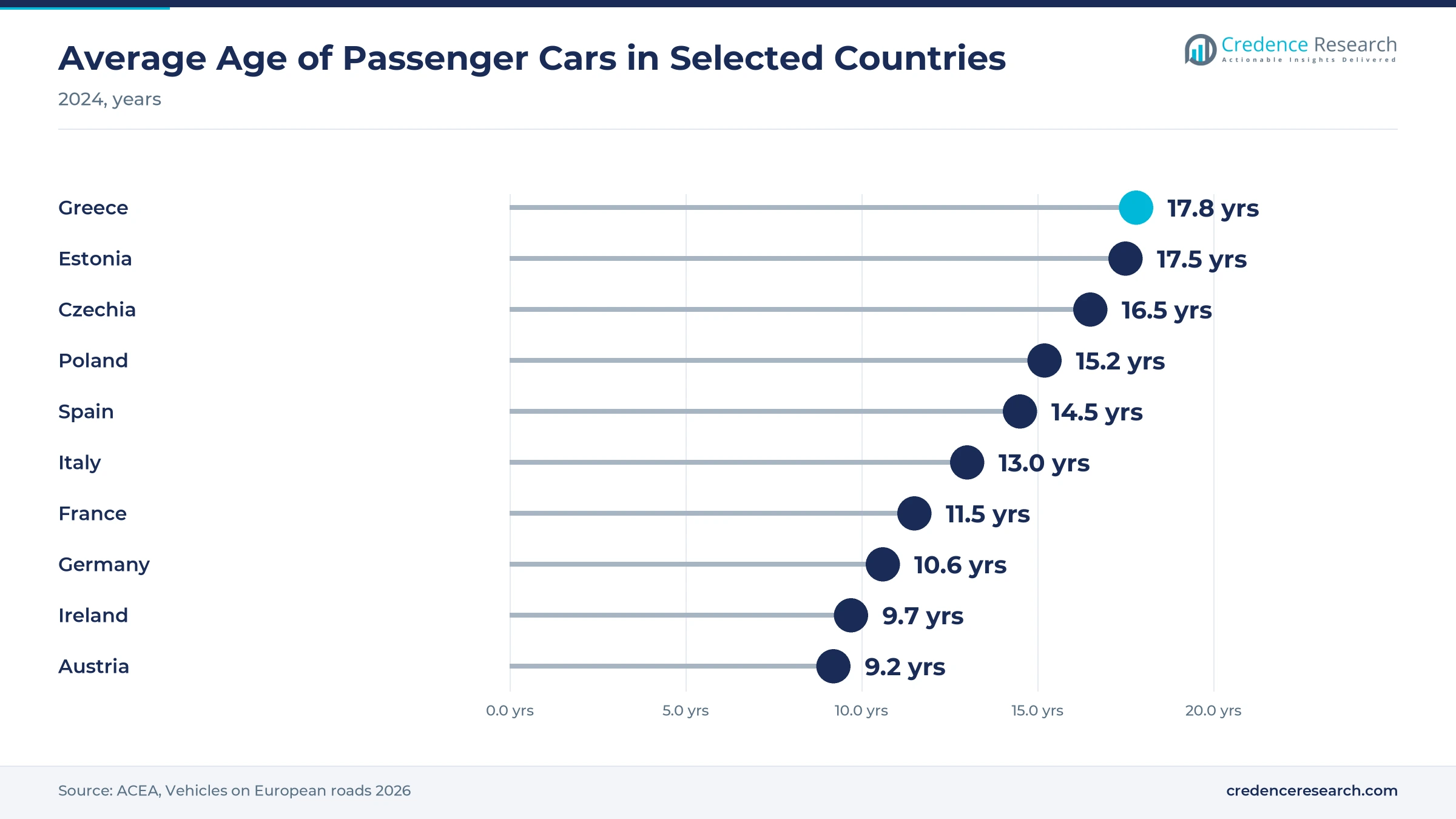
Western Europe held 46.8% of 2025 value and grows at 1.9% a year. Germany and France alone had 89.1 million cars in 2024, according to ACEA, with average ages of 10.6 and 11.5 years. Value per job is high because German labor rates passed €200 an hour, as noted in the pricing section. Bosch launched its new chassis parts range in Germany, Austria and Switzerland in March 2026 before other countries, which shows how suppliers treat the region as the lead market for new ranges.
The United Kingdom and Ireland combine a big parc with fast EV uptake
The United Kingdom and Ireland held 17.0% of 2025 value and grow at 2.3% a year. SMMT counted 36.7 million cars on British roads at the end of 2025, with an average age of 9.7 years, and battery electric cars rose 34.7% to about 1.8 million. Irish cars averaged 9.7 years in 2024, according to ACEA. AUTODOC plans to open a U.K. warehouse in 2026 to shorten delivery times. Faster electric uptake makes the region the earliest test of whether independent workshops can win high-voltage work.
Southern Europe relies on the oldest large car fleets
Southern Europe held 19.0% of 2025 value and grows at 2.3% a year. ACEA data show that cars in Italy averaged 13.0 years in 2024, Spain 14.5 years and Greece 17.8 years, among the oldest fleets in the EU. Vans are older still in both Italy and Spain, where many small firms keep them in service for years. Old fleets keep demand for brakes, clutches and engine parts high, although lower labor rates than in the north hold down value per job.
Central and Eastern Europe grows fastest as cars age further
Central and Eastern Europe held 8.8% of 2025 value and grows fastest at 3.1% a year. Poland had 20.5 million cars in 2024 with an average age of 15.2 years, while Czech cars averaged 16.5 years and Romanian cars 15.6 years, according to ACEA. Older cars need more replacement work each year, so value in the region grows faster than the fleet itself. AUTODOC is automating its logistics center in Cheb, Czechia and Bosch has named Poland among the first markets for its new chassis range.
Northern Europe pairs younger fleets with early electrification
Northern Europe held 8.4% of 2025 value and grows at 2.5% a year. Cars averaged 9.8 years in Denmark, 11.8 years in Sweden and 13.6 years in Finland in 2024, according to ACEA. Battery electric buses already exceed 10% of the bus fleet in Denmark and Sweden, which brings high-voltage service to depot workshops early. LKQ Europe operates LKQ Atracco, a Nordic vehicle recycler, so used parts form a visible price tier in the region.
Acquisitions, range launches and new EU rules in 2024-2026
| Development | Status and market relevance |
|---|---|
| In February 2026, Bosch announced a new range of control arms, stabilizer links and tie rods covering about 80% of vehicles on the German market. | Launched in March 2026; rollout to France, Poland and Türkiye next |
| In March 2026, AUTODOC reported 9.3 million active customers and online shops in 27 European countries for 2025. | Ghent warehouse opened; U.K. warehouse planned |
| In April 2026, LKQ Europe announced the acquisition of ACtronics, a Dutch repairer of automotive electronic units. | Adds electronics repair to its distribution network |
| In June 2026, Delegated Regulation (EU) 2026/699 on diagnostic access and repair information entered into force. | In force; deadlines run to June 2028 |
| In September 2026, ZF Aftermarket presented TRW DTEC low-dust brake pads and discs at Automechanika Frankfurt. | Launched for workshops and fleets |
Gateways, diagnostics and low-dust brakes shape service
- Secure gateway authentication controls who may read or change vehicle software through the diagnostic port, and EU rules now set what carmakers may demand.
- Remote and API-based repair information replaces manual lookups, since vehicle-specific repair data must move to API delivery from June 23, 2027.
- ADAS calibration equipment lets workshops realign cameras and radar after windshield, bumper or suspension work, which adds paid time to collision jobs.
- Low-dust brake materials cut brake particle emissions ahead of Euro 7 and open a premium tier in pads and discs for workshops and fleets.
Need a Custom Version of This Report?
Tailor the scope, geography, or segments to your exact requirements.
- Custom geography or segment scope
- Direct access to our analyst team
Distributors hold the workshop link as brands widen ranges
Competition in the Europe automotive aftermarket centers on range, delivery speed and workshop loyalty rather than on price alone. Distributors LKQ Europe and Alliance Automotive Group, part of Genuine Parts Company, compete for independent workshops through branch networks and garage programs, and Genuine Parts announced on Feb. 17, 2026, a plan to separate its automotive and industrial businesses. AUTODOC sells directly to private owners through online shops across the continent. Parts makers fight for shelf space with wider ranges, such as Bosch in chassis parts, Valeo in remanufactured electrics and DENSO in thermal parts, where its engine cooling technology is fitted as original equipment on almost 25% of European vehicles. Schaeffler renamed its aftermarket business Schaeffler Vehicle Lifetime Solutions in November 2024 after absorbing Vitesco Technologies. Michelin and Continental defend their replacement tire share against lower-priced imports.
How is supply organized, and where do margins sit?
Supply runs in three tiers, from parts and tire makers through distributors to workshops and retailers. Parts makers such as Bosch, ZF, Schaeffler, Valeo and DENSO sell under their own brands, often the same parts they supply to carmakers. Distributors such as LKQ Europe and Alliance Automotive Group hold the stock, the catalogs and the daily delivery runs that independent workshops depend on, and they own workshop networks of their own. Margins sit mostly with distributors and workshops, while entry barriers lie in logistics density, catalog data and access to carmaker diagnostics.
Range and delivery speed decide workshop loyalty
| Company | Type | Role in the market |
|---|---|---|
| Robert Bosch GmbH | Full-line parts supplier | Brakes, filters, chassis parts, diagnostics and Bosch Service workshop concept |
| ZF Friedrichshafen AG (ZF Aftermarket) | Full-line parts supplier | TRW brakes, Lemförder chassis, Sachs suspension and clutches for workshops |
| LKQ Europe (LKQ Corporation) | Distributor and service provider | Parts distribution, garage networks, electronics repair and recycling in 18+ countries |
| Alliance Automotive Group (Genuine Parts Company) | Distributor and service provider | Parts wholesale and workshop networks in France, Germany, the U.K. and Spain |
| AUTODOC SE | Online retailer | Online parts shops and marketplace for owners in 27 European countries |
| Schaeffler Vehicle Lifetime Solutions (Schaeffler AG) | Specialist | LuK clutches, INA engine parts, FAG bearings and repair kits |
| Valeo Service (Valeo) | Full-line parts supplier | Lighting, wipers, thermal, transmission and remanufactured Re-Gen parts |
| Michelin | Tire maker | Replacement car, van and truck tires sold through European dealers |
| Continental AG (Continental Tires) | Tire maker | Replacement car and truck tires, with Europe as its core market |
| DENSO Aftermarket Europe (DENSO Corporation) | Specialist | Thermal, rotating electrics, spark plugs, filters and diesel injector parts |
Independent access to vehicle data will decide share
Credence Research's view is that Europe automotive aftermarket growth will come from value per job rather than from more vehicles or more repairs. Older fleets, dearer labor and more electronic content keep lifting the bill, even as wear repairs per car decline. The decisive question is who controls the data needed to repair newer cars, and the 2026 EU rules give independent workshops a stronger position than they hold in the U.K. Distributors that combine fast delivery with training and diagnostic access should keep the largest share, while Central and Eastern Europe adds the most growth.
Fleet counts and workshop prices anchor the estimate
The report uses 2025 as the base year and forecasts values to 2035. Market values come from the Credence Research model, and segment and regional splits are Credence Research estimates. The size was cross-checked against vehicle fleet counts from ACEA and SMMT, typical annual spend per vehicle drawn from published German service, repair and labor prices, and tire replacement volumes. Evidence comes from EU regulation, trade associations, insurer and warranty data, company announcements and filings, and trade press. No interviews or surveys were conducted for the preparation of this report.
Commercial fleets and electrified cars shift the mix to 2035
Europe automotive aftermarket value should reach USD 245.90 billion by 2035, up from USD 202.78 billion in 2026, as older vehicles and higher workshop prices offset fewer repairs per car. Online sellers should keep gaining share as owners and workshops buy more parts through web shops and ordering platforms. Vans and electrified cars should take a larger share of spending, and low-dust brakes should become a standard range after Euro 7 applies to all new cars in 2027. Central and Eastern Europe should keep the fastest regional growth as its older fleet ages further. The main risk is that data access costs push work back to dealer networks.
What separates the downside, base and upside paths to 2035?
The range of outcomes depends on how fast the fleet ages and electrifies, and on how much repair work stays open to independent workshops. A downside path follows if repair frequency keeps falling, electric cars spread faster than expected and gateway fees push work back to dealers. The base case assumes a slowly aging parc and steady price rises. An upside path needs fleets to keep cars and vans longer and independent workshops to win most electric and driver assistance work.
| Scenario | CAGR, 2026–2035 | Value, 2035 | What has to hold |
|---|---|---|---|
| Downside | 1.2% | USD 225.16 billion | Repair frequency keeps falling, electric cars spread fast and gateway fees raise independent costs |
| Base | 2.17% | USD 245.90 billion | The fleet keeps aging slowly and workshop prices rise in line with recent years |
| Upside | 3.0% | USD 263.88 billion | Owners keep vehicles longer and independent workshops win most electric and ADAS repair work |
Frequently Asked Questions
How big is the Europe automotive aftermarket?
Which region leads the market?
Which region grows fastest?
Which vehicle type holds the largest share?
How old are vehicles on European roads?
How do EU rules protect independent workshops?
What is the biggest challenge for the market?
Which companies are active in the market?
Table of Content
Chapter 1 Market Segmentation
- 1.1 Segmentation Framework
- 1.1.1 Product and Service Classification
- 1.1.2 Application and End-Use Classification
- 1.1.3 Technology and Solution Classification
- 1.1.4 Customer and Distribution Channel Classification
- 1.1.5 Geographic Segmentation
- 1.1.6 Market Segment Definitions and Boundaries
- 1.2 By Vehicle Type
- 1.2.1 Passenger Cars
- 1.2.2 Light Commercial Vehicles
- 1.2.3 Medium and Heavy Trucks
- 1.2.4 Buses and Coaches
- 1.3 By Usage Type
- 1.3.1 Routine Maintenance
- 1.3.2 Wear and Tear Replacement
- 1.3.3 Repair and Breakdown
- 1.3.4 Collision and Body Repair
- 1.4 By Sales Channel
- 1.4.1 Independent Distributors and Wholesalers
- 1.4.2 OEM Authorized Dealer Networks
- 1.4.3 Online Marketplaces and Pure-play E-commerce
- 1.4.4 Tire and Fast-fit Chains
- 1.5 By Powertrain
- 1.5.1 Petrol Internal Combustion
- 1.5.2 Diesel Internal Combustion
- 1.5.3 Hybrid Electric
- 1.5.4 Battery Electric
Chapter 2 Introduction
- 2.1 Report Objectives and Scope
- 2.2 Product Definition and Industry Terminology
- 2.3 Market Inclusions and Exclusions
- 2.4 Research Process
- 2.4.1 Primary Research and Expert Interviews
- 2.4.2 Secondary Research and Source Review
- 2.4.3 Top-Down and Bottom-Up Estimation
- 2.4.4 Data Triangulation and Verification
- 2.5 Market Size Measurement Basis
- 2.5.1 2025: USD 197.99 billion → 2035: USD 245.90 billion
- 2.6 Historical and Forecast Reference Periods
- 2.6.1 Historical Period: 2018-2025
- 2.6.2 Base Year: 2025
- 2.6.3 Forecast Period: 2025-2035
- 2.7 Research Assumptions and Limitations
Chapter 3 Executive Summary
- 3.1 Market Snapshot and Key Findings
- 3.2 Base-Year Market Size, 2025
- 3.3 Forecast Market Size, 2035
- 3.4 Revenue and Volume Growth Outlook
- 3.5 Key Demand and Supply Indicators
- 3.6 Leading Market Segments
- 3.7 Fastest-Growing Market Opportunities
- 3.8 Regional Performance Highlights
- 3.9 Technology and Industry Transformation
- 3.10 Competitive Landscape Summary
- 3.11 Analyst View and Strategic Implications
Chapter 4 Europe Automotive Aftermarket Market Trends and Developments
- 4.1 Historical Industry Development, 2018-2025
- 4.2 Recent Market Trends and Developments
- 4.3 Demand and Customer Behavior Trends
- 4.4 Technology and Product Innovation
- 4.5 Artificial Intelligence, Automation and Digitalization
- 4.6 Local Manufacturing and Supply Chain Realignment
- 4.7 Industry Partnerships, Mergers and Acquisitions
- 4.8 Sustainability and Circular Economy Developments
- 4.9 Government and Private Sector Investment Trends
- 4.10 Emerging Business Models and Commercialization
- 4.11 Industry Developments and Announcements
Chapter 5 Europe Automotive Aftermarket Market Production, Supply and Demand Analysis
- 5.1 Demand Trend and Consumption Analysis, 2018-2025
- 5.2 Demand Forecast, 2025-2035
- 5.3 Production and Output Trend, 2018-2025
- 5.4 Production and Output Forecast, 2025-2035
- 5.5 Installed Capacity and Capacity Utilization
- 5.6 Company-Wise Production Plants and Statistics
- 5.6.1 Installed Production Capacity
- 5.6.2 Actual Production
- 5.6.3 Planned Capacity and Expansion Targets
- 5.7 Supply Chain Structure and Procurement Trends
- 5.8 Supply-Demand Gap and Bottlenecks
- 5.9 Import Dependence and Sourcing Structure
- 5.10 Contract Manufacturing and Outsourcing
- 5.11 Regional Supply and Demand Concentration
Chapter 6 Europe Automotive Aftermarket Market Pricing Analysis
- 6.1 Pricing Structure and Measurement
- 6.2 Historical Pricing Trends, 2018-2025
- 6.3 Pricing Outlook, 2025-2035
- 6.4 Average Selling Price and Unit Economics
- 6.5 Pricing by Product and Market Segment
- 6.6 Geographic Pricing Differences
- 6.7 Key Input, Energy, Labor and Logistics Costs
- 6.8 Contract Pricing and Purchasing Models
- 6.9 Pricing Sensitivity and Competitive Positioning
- 6.10 Price, Margin and Profitability Implications
Chapter 7 Europe Automotive Aftermarket Market Dynamics
- 7.1 Market Growth Drivers
- 7.1.1 Demand-Side Drivers
- 7.1.2 Technology and Innovation Drivers
- 7.1.3 Infrastructure and Investment Drivers
- 7.1.4 Regulatory and Policy Drivers
- 7.2 Market Restraints
- 7.2.1 Cost and Affordability Constraints
- 7.2.2 Technology and Adoption Barriers
- 7.2.3 Supply Chain and Operational Constraints
- 7.3 Market Challenges
- 7.3.1 Competitive Pressure and Margin Erosion
- 7.3.2 Skills, Infrastructure and Implementation Gaps
- 7.4 Emerging Market Opportunities
- 7.5 Market Dynamics Impact and Time-Horizon Assessment
Chapter 8 Europe Automotive Aftermarket Value Chain Analysis
- 8.1 Industry Value Chain Overview
- 8.2 Upstream Suppliers and Critical Inputs
- 8.3 Technology and Component Providers
- 8.4 Manufacturing or Service Delivery
- 8.5 Distribution, Channel Partners and Integrators
- 8.6 Downstream Applications and End Users
- 8.7 Value Addition and Profit Pools
- 8.8 Vertical Integration and Outsourcing
- 8.9 Supplier Concentration and Risk
- 8.10 Supply Chain Localization and Resilience
Chapter 9 Europe Automotive Aftermarket Market Regulations and Policies
- 9.1 Relevant Laws, Standards and Compliance Frameworks
- 9.2 Product, Service, Safety and Quality Requirements
- 9.3 Government Policies, Incentives and Subsidies
- 9.4 Imports, Exports and Trade Barriers
- 9.5 Public Procurement and Local Content Requirements
- 9.6 Environmental and Sustainability Compliance
- 9.7 Upcoming Policy Changes and Market Implications
Chapter 10 Europe Automotive Aftermarket Market Hotspots and Opportunities
- 10.1 Market Opportunity Mapping and Growth Hotspots
- 10.2 High-Growth Applications and Customer Groups
- 10.3 Underserved Markets and White-Space Opportunities
- 10.4 Emerging Technology and Product Opportunities
- 10.5 New Capacity and Investment Hotspots
- 10.6 Market Entry and Expansion Opportunities
- 10.7 Distribution and Partnership Opportunities
- 10.8 Near-Term and Long-Term Commercial Potential
- 10.9 Opportunity Attractiveness and Execution Risks
Chapter 11 Europe Automotive Aftermarket Market Outlook, 2025-2035
- 11.1 Market Size and Analysis
- 11.1.1 Revenue (Market Measurement: 2025: USD 197.99 billion → 2035: USD 245.90 billion)
- 11.1.2 Market Volume and Quantity Sold
- 11.1.3 Historical Market Size, 2018-2025
- 11.1.4 Base-Year Market Size, 2025
- 11.2 Market Forecast, 2025-2035
- 11.2.1 Revenue Forecast to 2035
- 11.2.2 Volume Forecast to 2035
- 11.2.3 CAGR and Year-on-Year Growth
- 11.2.4 Incremental Revenue Opportunity
- 11.3 Forecast Assumptions and Scenario Analysis
- 11.3.1 Base-Case Forecast
- 11.3.2 Optimistic and Conservative Scenarios
- 11.3.3 Technology, Pricing and Policy Sensitivities
- 11.4 Market Attractiveness and Growth Outlook
Chapter 12 Europe Automotive Aftermarket Market Segmentation and Outlook
- 12.1 Segmentation Summary and Market Shares, 2025
- 12.2 Largest and Fastest-Growing Segments
- 12.3 By Vehicle Type - Market Size and Forecast, 2025-2035
- 12.3.1 Segment Definition and Scope
- 12.3.2 Historical Market Size, 2018-2025
- 12.3.3 Revenue Forecast, 2025-2035
- 12.3.4 Volume Forecast, 2025-2035
- 12.3.5 Base-Year Market Share, 2025
- 12.3.6 Segment CAGR and Growth Drivers
- 12.3.7 Subsegment Market Size and Forecast
- 12.3.7.1 Passenger Cars
- 12.3.7.2 Light Commercial Vehicles
- 12.3.7.3 Medium and Heavy Trucks
- 12.3.7.4 Buses and Coaches
- 12.3.8 Subsegment Pricing and Adoption Trends
- 12.3.9 Leading Suppliers and Competition
- 12.3.10 Regional Demand and Opportunities
- 12.4 By Usage Type - Market Size and Forecast, 2025-2035
- 12.4.1 Segment Definition and Scope
- 12.4.2 Historical Market Size, 2018-2025
- 12.4.3 Revenue Forecast, 2025-2035
- 12.4.4 Volume Forecast, 2025-2035
- 12.4.5 Base-Year Market Share, 2025
- 12.4.6 Segment CAGR and Growth Drivers
- 12.4.7 Subsegment Market Size and Forecast
- 12.4.7.1 Routine Maintenance
- 12.4.7.2 Wear and Tear Replacement
- 12.4.7.3 Repair and Breakdown
- 12.4.7.4 Collision and Body Repair
- 12.4.8 Subsegment Pricing and Adoption Trends
- 12.4.9 Leading Suppliers and Competition
- 12.4.10 Regional Demand and Opportunities
- 12.5 By Sales Channel - Market Size and Forecast, 2025-2035
- 12.5.1 Segment Definition and Scope
- 12.5.2 Historical Market Size, 2018-2025
- 12.5.3 Revenue Forecast, 2025-2035
- 12.5.4 Volume Forecast, 2025-2035
- 12.5.5 Base-Year Market Share, 2025
- 12.5.6 Segment CAGR and Growth Drivers
- 12.5.7 Subsegment Market Size and Forecast
- 12.5.7.1 Independent Distributors and Wholesalers
- 12.5.7.2 OEM Authorized Dealer Networks
- 12.5.7.3 Online Marketplaces and Pure-play E-commerce
- 12.5.7.4 Tire and Fast-fit Chains
- 12.5.8 Subsegment Pricing and Adoption Trends
- 12.5.9 Leading Suppliers and Competition
- 12.5.10 Regional Demand and Opportunities
- 12.6 By Powertrain - Market Size and Forecast, 2025-2035
- 12.6.1 Segment Definition and Scope
- 12.6.2 Historical Market Size, 2018-2025
- 12.6.3 Revenue Forecast, 2025-2035
- 12.6.4 Volume Forecast, 2025-2035
- 12.6.5 Base-Year Market Share, 2025
- 12.6.6 Segment CAGR and Growth Drivers
- 12.6.7 Subsegment Market Size and Forecast
- 12.6.7.1 Petrol Internal Combustion
- 12.6.7.2 Diesel Internal Combustion
- 12.6.7.3 Hybrid Electric
- 12.6.7.4 Battery Electric
- 12.6.8 Subsegment Pricing and Adoption Trends
- 12.6.9 Leading Suppliers and Competition
- 12.6.10 Regional Demand and Opportunities
- 12.7 Segment Growth Comparison
- 12.8 Segment Attractiveness and Priority Matrix
Chapter 13 Europe Automotive Aftermarket Geographic Market Outlook, 2025-2035
- 13.1 Regional Market Size and Country-Level Shares, 2025
- 13.2 Country Market Size Comparison, 2025
- 13.3 Country Market Forecasts, 2025-2035
- 13.4 Subregional Industrial and Demand Clusters
- 13.5 Intra-Regional Pricing and Cost Differences
- 13.6 Cross-Border Trade and Supply Networks
- 13.7 Regional Supply and Demand Balances
- 13.8 Country Opportunity Comparison and Prioritization
Note: Every listed country is covered on the structure shown under the first country.
Chapter 14 Europe Automotive Aftermarket Technology, Innovation and Sustainability Outlook
- 14.1 Technology Landscape and Maturity
- 14.2 Product, Process and Service Innovation
- 14.3 AI, Automation and Digital Tools in the Industry
- 14.4 Technology Adoption and Performance Benchmarking
- 14.5 Innovation Pipeline and R&D Investment
- 14.6 Patent and Intellectual Property Trends
- 14.7 Energy Efficiency and Resource Management
- 14.8 Sustainability, Recycling and Circularity
- 14.9 Technology Roadmap, 2025-2035
- 14.10 Risks of Obsolescence and Technology Substitution
Chapter 15 Europe Automotive Aftermarket Market Key Strategic Imperatives
- 15.1 Growth and Market Entry Priorities
- 15.2 High-Return Products and Segments
- 15.3 Pricing, Profitability and Cost Optimization
- 15.4 Technology Investment and Product Differentiation
- 15.5 Supply Chain Localization and Resilience
- 15.6 Distribution and Customer Acquisition
- 15.7 Partnership, Acquisition and Capacity Strategy
- 15.8 Regional Expansion Priorities
- 15.9 Short-, Medium- and Long-Term Actions
Chapter 16 Competition Outlook
- 16.1 Industry Competition Characteristics
- 16.2 Market Structure and Concentration
- 16.3 Market Share and Competitive Positioning, 2025
- 16.4 Company-Wise Revenue and Product Benchmarking
- 16.5 Production and Service Capacity Benchmarking
- 16.6 Technology, Pricing and Differentiation
- 16.7 Regional Footprint and Distribution Strength
- 16.8 Mergers, Acquisitions and Strategic Alliances
- 16.9 New Entrants and Competitive Threats
- 16.10 Porter's Five Forces and Industry Attractiveness
- 16.11 Competitive Outlook, 2025-2035
Chapter 17 Company Profiles
- 17.1 Company Coverage and Selection Criteria
- 17.2 Robert Bosch GmbH
- 17.2.1 Business Description
- 17.2.2 Company Ownership and Geographic Presence
- 17.2.3 Product and Service Portfolio
- 17.2.4 Manufacturing and Operating Footprint
- 17.2.5 Production Capacity and Expansion Plans
- 17.2.6 Financial Performance and Investment
- 17.2.7 Market Share and Competitive Position
- 17.2.8 Technology and Innovation Capabilities
- 17.2.9 Strategic Alliances or Partnerships
- 17.2.10 Recent Developments
- 17.2.11 Growth Strategy and Outlook
- 17.3 ZF Friedrichshafen AG (ZF Aftermarket)
- 17.4 LKQ Europe (LKQ Corporation)
- 17.5 Alliance Automotive Group (Genuine Parts Company)
- 17.6 AUTODOC SE
- 17.7 Schaeffler Vehicle Lifetime Solutions (Schaeffler AG)
- 17.8 Valeo Service (Valeo)
- 17.9 Michelin
- 17.10 Continental AG (Continental Tires)
- 17.11 DENSO Aftermarket Europe (DENSO Corporation)
- 17.12 Other Relevant Market Participants
Note: Every listed company is profiled on the structure shown under the first company. The company list is preliminary and may change based on research findings, market developments, data availability and client requirements.
Chapter 18 Disclaimer
- 18.1 Research and Forecast Disclaimer
- 18.2 Data Source and Estimation Limitations
Note: The depth of individual sections depends on data availability for this market. Volume, capacity, trade and other unit-based metrics are included where applicable.