
Market Overview:
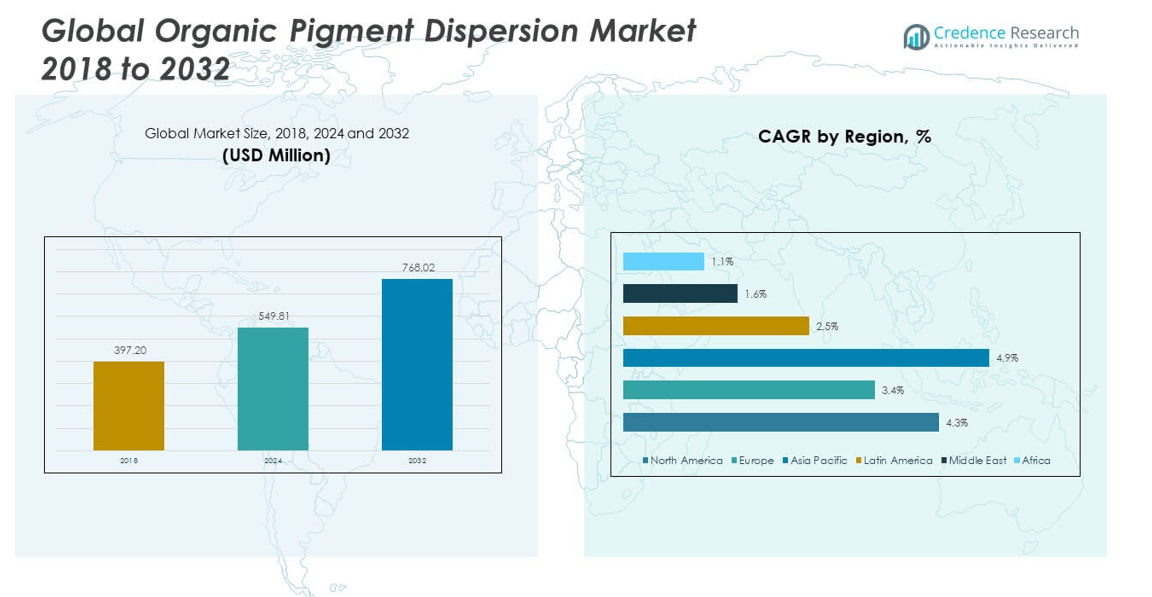
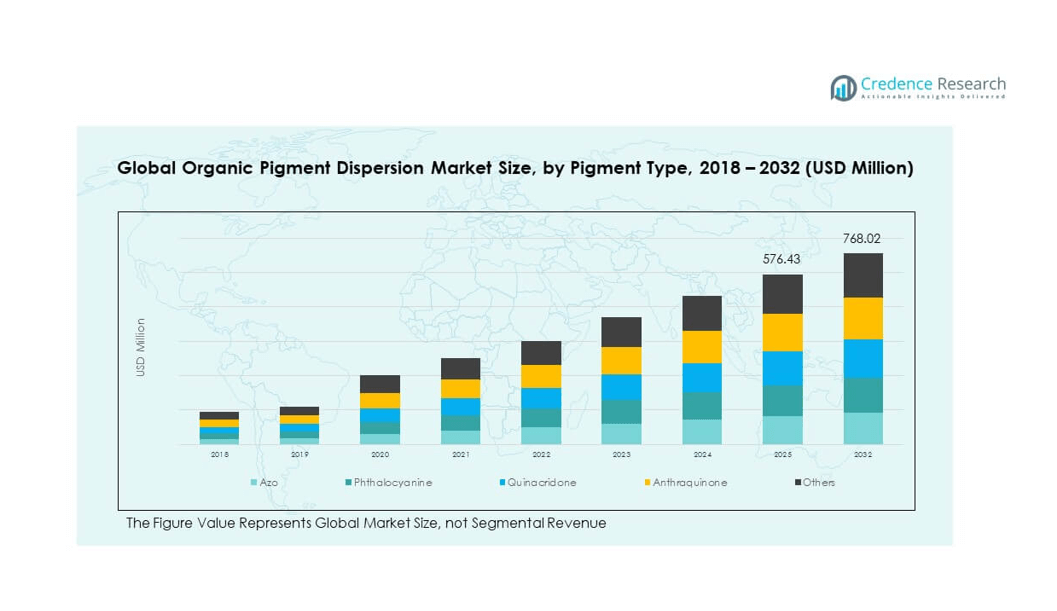
The Global Organic Pigment Dispersion Market size was valued at USD 397.20 million in 2018 to USD 549.81 million in 2024 and is anticipated to reach USD 768.02 million by 2032, at a CAGR of 4.18% during the forecast period.
| REPORT ATTRIBUTE | DETAILS |
|---|---|
| Historical Period | 2020-2023 |
| Base Year | 2024 |
| Forecast Period | 2025-2032 |
| Organic Pigment Dispersion Market Size 2024 | USD 549.81 million |
| Organic Pigment Dispersion Market, CAGR | 4.18% |
| Organic Pigment Dispersion Market Size 2032 | USD 768.02 million |
The market growth is driven by rising demand for environmentally friendly coloring solutions in packaging, automotive coatings, textiles, and printing inks. Increasing regulations on synthetic pigments encourage industries to adopt organic alternatives that reduce environmental impact. Advancements in dispersion technology enhance pigment stability and performance, ensuring consistent color quality across applications. Growing consumer awareness of sustainability, coupled with rising investments in eco-friendly production processes, strengthens the adoption of organic pigment dispersions. The market continues to evolve with innovations in bio-based raw materials and customized pigment formulations tailored for diverse end-use industries.
Regionally, Asia-Pacific leads the market due to strong industrialization, a growing packaging sector, and robust textile production in countries like China and India. Europe follows closely, supported by strict environmental regulations and significant adoption of sustainable pigment solutions. North America maintains steady growth through demand in automotive coatings and printing applications. Emerging markets in Latin America and the Middle East & Africa show potential as infrastructure development and consumer demand expand. Together, these regions shape a diverse landscape where developed economies emphasize compliance and sustainability, while emerging economies focus on growth and industrial applications.
Market Insights:
- The Global Organic Pigment Dispersion Market was valued at USD 397.20 million in 2018, reached USD 549.81 million in 2024, and is projected to attain USD 768.02 million by 2032, growing at a CAGR of 4.18%.
- Asia Pacific held the largest share at 45.72% in 2024, supported by industrialization, packaging, and textile industries. Europe followed with 27.59% share, led by strict environmental regulations and established printing industries. North America captured 18.38% share due to advanced coatings and packaging demand.
- Asia Pacific is the fastest-growing region, holding nearly half of the Global Organic Pigment Dispersion Market in 2024, driven by China, India, and Southeast Asia’s robust demand in packaging, plastics, and textiles.
- By pigment type, azo pigments accounted for around 34% of the market in 2024, maintaining dominance due to cost efficiency and widespread use in printing inks and coatings.
- Phthalocyanine pigments contributed nearly 28% share in 2024, supported by strong performance in plastics, paints, and high-stability applications across industrial sectors.
Market Drivers
Rising Adoption of Eco-Friendly Colorants in Packaging and Consumer Goods
The Global Organic Pigment Dispersion Market grows as industries adopt sustainable colorants across packaging and consumer goods. Regulatory bodies restrict synthetic pigments, encouraging organic alternatives with safer ecological profiles. Packaging manufacturers prefer bio-based dispersions that support recyclability. It provides consistent brightness and durability demanded by premium brands. Consumer awareness of sustainable packaging choices influences market adoption. Companies invest in innovative dispersion processes that enhance pigment stability. Industries value the low toxicity and reduced VOC emissions linked with organic formulations. The packaging sector remains a central contributor to demand expansion.
- For example, in March 2024, DIC Corporation introduced a zero-VOC, water-based ink series for food packaging applications that meets over 15 global food safety standards, including FDA, EFSA, and Japanese Food Sanitation Law.
Increasing Utilization Across Coatings and Automotive Applications Worldwide
The Global Organic Pigment Dispersion Market benefits from demand in coatings and automotive applications. Automakers rely on stable pigment dispersions for vibrant and durable finishes. It supports better weather resistance and longer product life. Industrial coatings use organic dispersions to achieve uniform shades and high dispersion quality. Rising infrastructure projects strengthen usage across protective coatings. The automotive sector demands pigments with better thermal and chemical resistance. Suppliers focus on formulations that meet stringent global quality standards. The combination of performance and eco-compliance secures strong growth in this end-use sector.
Strong Regulatory Support for Safer Alternatives in Multiple End-Use Industries
The Global Organic Pigment Dispersion Market expands through supportive global regulatory frameworks. Authorities limit heavy metals and toxic solvents in pigment formulations. Organic dispersions meet stricter environmental and workplace safety standards. It reduces worker exposure risks and enhances compliance for manufacturers. Personal care and cosmetics industries also prefer safer pigment dispersions. Consumer trust grows when brands demonstrate sustainable raw material sourcing. Food packaging laws demand safe pigment usage for direct and indirect contact. These compliance-driven adoptions ensure long-term integration across multiple industrial sectors.
- For example, Sun Chemical, a subsidiary of DIC Group, became the first pigment manufacturer worldwide to achieve OEKO-TEX ECO PASSPORT certification along with ZDHC Level 3 accreditation, reflecting its leadership in safe pigment dispersions and regulatory compliance.
Advances in Dispersion Technologies Enhancing Performance and Product Consistency
The Global Organic Pigment Dispersion Market advances with continuous innovation in dispersion technologies. Producers introduce advanced milling and grinding methods for improved particle uniformity. Smaller particle sizes enhance color intensity and dispersion stability. It ensures pigments perform consistently in inks, plastics, and coatings. Digital printing benefits from stable dispersion quality in high-speed operations. Industries achieve better processing efficiency with low-viscosity formulations. Technology-driven product quality enhances customer confidence and repeat orders. These advancements create long-term performance reliability across competitive markets.
Market Trends
Shift Toward Customized Pigment Formulations Meeting Industry-Specific Demands
The Global Organic Pigment Dispersion Market records a trend of customized formulations. Packaging, textiles, and inks demand pigments tailored to their performance needs. It drives manufacturers to offer application-specific dispersion solutions. Printing firms seek pigments optimized for digital and offset technologies. Cosmetic brands require dispersions suitable for sensitive skin formulations. Automotive paints emphasize dispersions with superior UV and heat resistance. The trend increases collaboration between pigment producers and end users. Customization enhances product differentiation and supports long-term supplier relationships.
Emergence of Digital Printing as a Major End-Use Segment Globally
The Global Organic Pigment Dispersion Market witnesses growth in digital printing applications. Printing houses prefer organic dispersions for high-resolution, stable outputs. It delivers reliable color strength under varying printing speeds. E-commerce packaging boosts digital printing demand across industries. Publishers shift toward sustainable inks in commercial printing. Textile digital printing expands as fashion brands seek vibrant, eco-friendly options. Consistent dispersion quality reduces downtime during production runs. The trend secures pigment adoption in rapidly evolving printing ecosystems.
Growing Popularity of Natural and Bio-Based Raw Material Sourcing Practices
The Global Organic Pigment Dispersion Market shows a trend toward bio-based raw material sourcing. Manufacturers explore natural inputs to reduce dependency on petrochemical feedstocks. It aligns with global sustainability objectives and circular economy initiatives. Food-grade and cosmetic-grade dispersions increasingly use certified bio-based materials. Firms highlight eco-friendly sourcing as a key marketing advantage. End-use sectors demand higher transparency in raw material supply chains. The trend strengthens innovation in green chemistry processes. Global buyers value certified sourcing as part of procurement standards.
- For instance, in 2024, BASF launched its biomass-balanced coatings across North America under brands such as Glasurit® Eco Balance and R-M® eSense. These coatings use renewable raw materials, and BASF reported that its more than 250 biomass-balanced products helped reduce over 8 million kg of CO₂ emissions globally during 2024, with the North American expansion explicitly confirmed by sustainability managers at BASF Coatings.
Rising Integration of Organic Pigment Dispersions in High-Performance Plastics
The Global Organic Pigment Dispersion Market shows rising integration in high-performance plastics. Producers enhance dispersions to match polymer processing requirements. It supports demand in consumer electronics, appliances, and construction products. Pigment dispersions provide uniform coloration in complex plastic applications. Electronics firms adopt dispersions with better heat resistance and stability. Construction materials demand pigments resistant to UV exposure and chemical contact. Manufacturers market dispersions as solutions for durability and compliance. The trend ensures strong adoption in high-value engineering plastics.
- For example, Clariant produces high-performance quinacridone organic pigments such as Pigment Red 122 and Pigment Violet 19 using bio-succinic acid derived from renewable sugars like corn and sorghum. These pigments meet Clariant’s EcoTain® sustainability criteria, offering high tint strength and durability for automotive, plastics, and coatings.
Market Challenges Analysis
High Production Costs and Limited Availability of Advanced Raw Materials
The Global Organic Pigment Dispersion Market faces challenges linked to production expenses and sourcing. Organic dispersions often require specialized raw materials with higher costs. Limited global availability creates supply chain vulnerabilities. It forces manufacturers to balance pricing against sustainability goals. End users in cost-sensitive regions hesitate to switch from cheaper synthetic pigments. Rising energy and labor costs add further pressure on production margins. Suppliers face difficulties in achieving economies of scale. These barriers slow adoption in markets where price competitiveness dominates purchasing decisions.
Technical Limitations in Achieving Performance Parity with Synthetic Pigments
The Global Organic Pigment Dispersion Market also struggles with technical performance limitations. Synthetic pigments often provide higher opacity, gloss, and durability. Organic dispersions sometimes fall short in extreme weather or chemical resistance. It affects adoption in demanding industrial environments. Automotive and aerospace sectors require pigments with consistent long-term stability. Producers invest in R&D to address these gaps, but improvements take time. Technical trade-offs hinder universal acceptance of organic pigments. Bridging this performance gap remains a key challenge for market expansion.
Market Opportunities
Expansion Potential Through Growing Sustainable Packaging and Cosmetic Applications
The Global Organic Pigment Dispersion Market offers opportunities in sustainable packaging and cosmetics. Packaging firms adopt eco-friendly dispersions to meet recycling standards. Cosmetics brands prefer organic formulations for consumer safety and branding value. It provides consistent shades suitable for sensitive formulations. Rising e-commerce accelerates the demand for printed sustainable packaging. Consumer preference for non-toxic beauty products supports pigment innovation. Suppliers gain from introducing certified safe dispersions for global buyers. Expanding into these segments creates long-term market opportunities.
Innovation in Bio-Based Dispersions and Integration With Advanced Coating Systems
The Global Organic Pigment Dispersion Market benefits from opportunities linked to bio-based innovation. Producers develop dispersions from renewable feedstocks to meet green standards. It creates a competitive edge in regulated industries. Coating industries demand pigments that integrate seamlessly into high-performance systems. Opportunities lie in supplying dispersions that meet specific industrial compliance needs. Companies can expand footprints through partnerships with packaging, textile, and automotive industries. Strong branding around eco-innovation strengthens market leadership. These opportunities highlight long-term growth pathways for producers.
Market Segmentation Analysis:
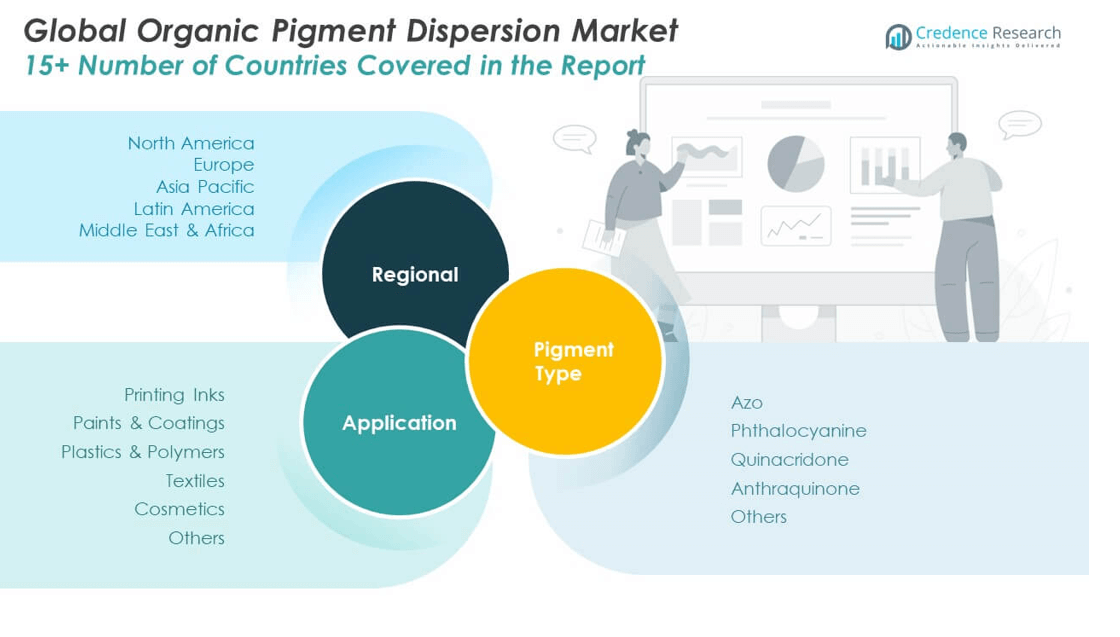
By pigment type, the Global Organic Pigment Dispersion Market is divided into azo, phthalocyanine, quinacridone, anthraquinone, and others. Azo pigments account for a major share due to their wide use in printing inks and coatings, supported by cost-effectiveness and strong color range. Phthalocyanine pigments maintain significant demand for their high stability, lightfastness, and suitability in plastics and paints. Quinacridone pigments expand steadily due to their bright shades and durability in automotive and industrial coatings. Anthraquinone pigments hold a niche role in specialized applications, while other pigments address tailored needs across multiple industries. It reflects a balanced mix of commodity and high-performance products.
- For example, D&C Violet No. 2, an anthraquinone pigment, is FDA-approved for use in externally applied cosmetics in the US (21 CFR Part 74.3602); every batch undergoes FDA batch certification before acceptance for US cosmetics manufacturing.
By application, the Global Organic Pigment Dispersion Market includes printing inks, paints and coatings, plastics and polymers, textiles, cosmetics, and others. Printing inks dominate demand with the growth of packaging and digital printing technologies. Paints and coatings show robust adoption in construction, automotive, and industrial uses. Plastics and polymers integrate dispersions to achieve consistent coloration across consumer and engineering products. Textiles leverage pigments for high-quality printing and dyeing applications. Cosmetics favor organic dispersions for non-toxic, skin-safe formulations. Other applications contribute in specialized sectors, highlighting the diverse end-use scope. It demonstrates broad adoption driven by sustainability and performance requirements.
- For instance, in 2025, AkzoNobel launched its new Sikkens Autowave Optima waterborne automotive basecoat in Europe, confirmed to deliver up to 50% faster process time versus traditional basecoats and achieve up to 60% energy and carbon emissions savings, as officially described in industry and company press releases.
Segmentation:
By Pigment Type
- Azo
- Phthalocyanine
- Quinacridone
- Anthraquinone
- Others
By Application
- Printing Inks
- Paints & Coatings
- Plastics & Polymers
- Textiles
- Cosmetics
- Others
By Region
- North America
- U.S.
- Canada
- Mexico
- Europe
- UK
- France
- Germany
- Italy
- Spain
- Russia
- Belgium
- Netherlands
- Austria
- Sweden
- Poland
- Denmark
- Switzerland
- Rest of Europe
- Asia Pacific
- China
- Japan
- South Korea
- India
- Australia
- Thailand
- Indonesia
- Vietnam
- Malaysia
- Philippines
- Taiwan
- Rest of Asia Pacific
- Latin America
- Brazil
- Argentina
- Peru
- Chile
- Colombia
- Rest of Latin America
- Middle East
- UAE
- KSA
- Israel
- Turkey
- Iran
- Rest of Middle East
- Africa
- Egypt
- Nigeria
- Algeria
- Morocco
- Rest of Africa
Regional Analysis:
North America
The North America Global Organic Pigment Dispersion Market size was valued at USD 74.81 million in 2018 to USD 101.06 million in 2024 and is anticipated to reach USD 142.09 million by 2032, at a CAGR of 4.3% during the forecast period. North America accounts for 18.38% share of the Global Organic Pigment Dispersion Market. North America demonstrates steady growth led by strong demand from printing inks, packaging, and automotive coatings. Stringent environmental policies in the U.S. drive industries toward eco-friendly dispersions. It benefits from advanced research and a mature supply chain supporting product innovations. Canada contributes with rising packaging demand aligned with sustainability goals. Mexico strengthens its role through growing automotive production and exports. Key manufacturers expand regional operations to align with regulatory frameworks. Technological adoption in digital printing enhances dispersion demand across industries. The region sustains its market growth through innovation, compliance, and high-value industrial applications.
Europe
The Europe Global Organic Pigment Dispersion Market size was valued at USD 113.69 million in 2018 to USD 151.75 million in 2024 and is anticipated to reach USD 199.69 million by 2032, at a CAGR of 3.4% during the forecast period. Europe accounts for 27.59% share of the Global Organic Pigment Dispersion Market. urope leads with strong emphasis on environmental regulations and sustainable material adoption. Industries across Germany, France, and the UK prefer eco-compliant dispersions in packaging and coatings. It benefits from established printing and textile industries demanding high-performance pigments. Italy and Spain show growing application in decorative paints and consumer goods. Russia contributes with polymer and plastic production driving dispersion usage. Manufacturers focus on product differentiation to meet diverse market standards. Regional innovation centers promote the development of bio-based and recyclable pigments. Europe secures growth by aligning technology, regulation, and industrial demand.
Asia Pacific
The Asia Pacific Global Organic Pigment Dispersion Market size was valued at USD 175.26 million in 2018 to USD 251.47 million in 2024 and is anticipated to reach USD 372.49 million by 2032, at a CAGR of 4.9% during the forecast period. Asia Pacific accounts for 45.72% share of the Global Organic Pigment Dispersion Market. Asia Pacific dominates through rapid industrialization, large-scale packaging, and extensive textile production. China drives market leadership with strong plastic, printing, and coatings industries. It gains further momentum from India’s expanding packaging and consumer goods markets. Japan and South Korea emphasize high-performance dispersions for electronics and automotive paints. Southeast Asia contributes with rising demand in flexible packaging and textiles. Regional growth is supported by cost-effective production and access to raw materials. Multinational companies expand operations to tap into growing demand. Asia Pacific remains the most dynamic hub shaping long-term market expansion.
Latin America
The Latin America Global Organic Pigment Dispersion Market size was valued at USD 17.92 million in 2018 to USD 24.49 million in 2024 and is anticipated to reach USD 30.09 million by 2032, at a CAGR of 2.5% during the forecast period. Latin America accounts for 4.45% share of the Global Organic Pigment Dispersion Market. Latin America presents gradual growth supported by demand in packaging and printing sectors. Brazil leads with established printing ink and automotive coating applications. It gains support from Argentina’s growing textile and consumer goods industries. Mexico, though more aligned with North America, contributes to regional growth through plastics production. The region faces challenges from limited technology adoption and cost pressures. Multinational firms target the market with sustainable pigment solutions. Local industries show increased interest in eco-friendly dispersions for exports. Latin America’s role strengthens through steady industrial adoption and gradual regulatory alignment.
Middle East
The Middle East Global Organic Pigment Dispersion Market size was valued at USD 9.63 million in 2018 to USD 12.00 million in 2024 and is anticipated to reach USD 13.69 million by 2032, at a CAGR of 1.6% during the forecast period. The Middle East accounts for 2.18% share of the Global Organic Pigment Dispersion Market. The Middle East records moderate demand with applications in construction coatings, packaging, and plastics. GCC countries lead growth supported by infrastructure development and rising consumer goods industries. It faces slower adoption due to reliance on imports and limited local production. Israel and Turkey contribute through expanding packaging and printing segments. The region’s regulatory environment gradually shifts toward sustainable standards. International companies supply dispersions meeting compliance and performance requirements. Market players target niche applications like decorative paints and flexible packaging. Growth remains modest but steady, supported by industrial modernization.
Africa
The Africa Global Organic Pigment Dispersion Market size was valued at USD 5.89 million in 2018 to USD 9.04 million in 2024 and is anticipated to reach USD 9.96 million by 2032, at a CAGR of 1.1% during the forecast period. Africa accounts for 1.68% share of the Global Organic Pigment Dispersion Market. Africa remains a small but gradually developing market with opportunities in packaging and construction. South Africa leads regional demand with printing inks and coatings adoption. It benefits from consumer market growth and rising urbanization trends. Egypt contributes with packaging industries catering to food and beverage exports. Limited infrastructure and high import dependence restrain broader expansion. Local production capabilities remain underdeveloped compared to other regions. International suppliers explore entry through partnerships and distribution networks. The region sustains growth slowly while aligning with industrial and consumer packaging needs.
Key Player Analysis:
- DIC Corporation
- Clariant AG
- BASF SE
- Sun Chemical Corporation
- Huntsman Corporation
- Ferro Corporation
- Orion Engineered Carbons
- Heubach GmbH
- Lanxess AG
- Cabot Corporation
Competitive Analysis:
The Global Organic Pigment Dispersion Market is highly competitive with established multinational corporations and specialized regional players. Leading companies such as DIC Corporation, Clariant AG, BASF SE, and Sun Chemical Corporation dominate through extensive product portfolios and strong distribution networks. It is shaped by continuous innovation, with firms investing in advanced dispersion technologies and bio-based pigment solutions to meet regulatory and sustainability standards. Huntsman Corporation, Ferro Corporation, and Heubach GmbH focus on application-specific developments in coatings, plastics, and printing inks. Regional companies strengthen market presence by offering cost-effective solutions tailored to local needs. Competition also extends to product differentiation, with emphasis on consistent quality, improved performance, and compliance with environmental norms. Strategic initiatives including mergers, acquisitions, and regional expansions drive market consolidation. The competitive landscape remains dynamic, with companies seeking to balance innovation, cost efficiency, and global reach to secure long-term leadership.
Recent Developments:
- In July 2025, Sun Chemical, a wholly owned subsidiary of DIC Corporation, launched a new effect pigment called Chione Electric Amber SB90D, expanding its Chione Electric product line with a shimmering amber hue. This pigment is designed for vegan beauty products in cosmetics, skin, and sun care, offering enhanced chroma, UV stability, and non-staining properties.
- In November 2023, Heubach GmbH expanded its cooperation with TER Chemicals to include inorganic colored pigments, anti-corrosion pigments, and pigment preparations in Germany and Austria. This partnership aims to enhance product availability for coatings and related applications.
Report Coverage:
The research report offers an in-depth analysis based on Pigment Type and Application. It details leading market players, providing an overview of their business, product offerings, investments, revenue streams, and key applications. Additionally, the report includes insights into the competitive environment, SWOT analysis, current market trends, as well as the primary drivers and constraints. Furthermore, it discusses various factors that have driven market expansion in recent years. The report also explores market dynamics, regulatory scenarios, and technological advancements that are shaping the industry. It assesses the impact of external factors and global economic changes on market growth. Lastly, it provides strategic recommendations for new entrants and established companies to navigate the complexities of the market.
Future Outlook:
- The Global Organic Pigment Dispersion Market will expand through stronger demand for sustainable pigments across industries.
- Growth opportunities will emerge in packaging and cosmetics driven by eco-friendly product preferences.
- It will benefit from rising adoption in digital printing technologies requiring stable dispersion quality.
- Expansion in high-performance plastics will support greater integration of advanced dispersions.
- Regulatory frameworks will continue to influence innovation in safer and recyclable pigment solutions.
- Companies will strengthen market presence through mergers, acquisitions, and regional expansion strategies.
- Research in bio-based raw materials will create competitive advantages for manufacturers.
- Growing demand from automotive coatings will drive specialized pigment formulations.
- Emerging economies will contribute significantly through industrialization and rising consumer goods demand.
- The market will evolve with emphasis on compliance, quality consistency, and long-term sustainability.

Request a Free Sample
Fill in your details and we'll send you a free sample report.
- Sample data tables & charts
- Research methodology
Market Dynamics
Adoption of Eco-Friendly Colorants in Packaging and Consumer Goods
Stricter regulations on synthetic pigments and growing consumer awareness of sustainability are pushing packaging and consumer goods manufacturers to switch to organic pigment dispersions, which offer lower toxicity and support recyclability.
Increasing Utilization in Coatings and Automotive Applications
Automotive and industrial coatings sectors require stable, vibrant, and durable color solutions; organic pigment dispersions meet these needs while also complying with global environmental standards, driving their adoption in these high-value applications.
Regulatory Support for Safer Alternatives
Global regulatory frameworks are increasingly limiting the use of heavy metals and toxic solvents in pigments, making organic dispersions the preferred choice for manufacturers seeking compliance and safer workplace environments.
Advances in Dispersion Technology
Continuous innovation in milling and grinding technologies has improved pigment stability, color intensity, and consistency, making organic pigment dispersions more attractive for demanding applications such as digital printing and high-performance plastics.
Growth in Digital Printing and Customization
The rise of digital printing and demand for customized pigment formulations in industries like packaging, textiles, and cosmetics are expanding the market for organic pigment dispersions, as these applications require high-quality, application-specific color solutions.
Need a Custom Version of This Report?
Tailor the scope, geography, or segments to your exact requirements.
- Custom geography or segment scope
- Direct access to our analyst team
Frequently Asked Questions
What is the current market size for Global Organic Pigment Dispersion Market, and what is its projected size in 2032?
Which Global Organic Pigment Dispersion Market segment held the largest share in 2024?
What are the primary factors fueling the growth of the Global Organic Pigment Dispersion Market?
Who are the leading companies in the Global Organic Pigment Dispersion Market?
Table of Content
Chapter 1 Market Segmentation
- 1.1 Segmentation Framework
- 1.1.1 Product and Service Classification
- 1.1.2 Application and End-Use Classification
- 1.1.3 Technology and Solution Classification
- 1.1.4 Customer and Distribution Channel Classification
- 1.1.5 Geographic Segmentation
- 1.1.6 Market Segment Definitions and Boundaries
- 1.2 By Application
- 1.2.1 Printing Inks
- 1.2.2 Paints & Coatings
- 1.2.3 Plastics & Polymers
- 1.2.4 Textiles
- 1.2.5 Cosmetics
- 1.2.6 Others
- 1.3 By Pigment Type
- 1.3.1 Azo
- 1.3.2 Phthalocyanine
- 1.3.3 Quinacridone
- 1.3.4 Anthraquinone
- 1.3.5 Others
Chapter 2 Introduction
- 2.1 Report Objectives and Scope
- 2.2 Product Definition and Industry Terminology
- 2.3 Market Inclusions and Exclusions
- 2.4 Research Process
- 2.4.1 Primary Research and Expert Interviews
- 2.4.2 Secondary Research and Source Review
- 2.4.3 Top-Down and Bottom-Up Estimation
- 2.4.4 Data Triangulation and Verification
- 2.5 Market Size Measurement Basis
- 2.5.1 2024: USD 549.81 million → 2032: USD 768.02 million
- 2.6 Historical and Forecast Reference Periods
- 2.6.1 Base Year: 2024
- 2.6.2 Forecast Period: 2024-2032
- 2.7 Research Assumptions and Limitations
Chapter 3 Executive Summary
- 3.1 Market Snapshot and Key Findings
- 3.2 Base-Year Market Size, 2024
- 3.3 Forecast Market Size, 2032
- 3.4 Revenue and Volume Growth Outlook
- 3.5 Key Demand and Supply Indicators
- 3.6 Leading Market Segments
- 3.7 Fastest-Growing Market Opportunities
- 3.8 Regional Performance Highlights
- 3.9 Technology and Industry Transformation
- 3.10 Competitive Landscape Summary
- 3.11 Analyst View and Strategic Implications
Chapter 4 Global Organic Pigment Dispersion Market Trends and Developments
- 4.1 Historical Industry Development
- 4.2 Recent Market Trends and Developments
- 4.3 Demand and Customer Behavior Trends
- 4.4 Technology and Product Innovation
- 4.5 Artificial Intelligence, Automation and Digitalization
- 4.6 Local Manufacturing and Supply Chain Realignment
- 4.7 Industry Partnerships, Mergers and Acquisitions
- 4.8 Sustainability and Circular Economy Developments
- 4.9 Government and Private Sector Investment Trends
- 4.10 Emerging Business Models and Commercialization
- 4.11 Industry Developments and Announcements
Chapter 5 Global Organic Pigment Dispersion Market Production, Supply and Demand Analysis
- 5.1 Demand Trend and Consumption Analysis
- 5.2 Demand Forecast, 2024-2032
- 5.3 Production and Output Trend
- 5.4 Production and Output Forecast, 2024-2032
- 5.5 Installed Capacity and Capacity Utilization
- 5.6 Company-Wise Production Plants and Statistics
- 5.6.1 Installed Production Capacity
- 5.6.2 Actual Production
- 5.6.3 Planned Capacity and Expansion Targets
- 5.7 Supply Chain Structure and Procurement Trends
- 5.8 Supply-Demand Gap and Bottlenecks
- 5.9 Import Dependence and Sourcing Structure
- 5.10 Contract Manufacturing and Outsourcing
- 5.11 Regional Supply and Demand Concentration
Chapter 6 Global Organic Pigment Dispersion Market Pricing Analysis
- 6.1 Pricing Structure and Measurement
- 6.2 Historical Pricing Trends
- 6.3 Pricing Outlook, 2024-2032
- 6.4 Average Selling Price and Unit Economics
- 6.5 Pricing by Product and Market Segment
- 6.6 Geographic Pricing Differences
- 6.7 Key Input, Energy, Labor and Logistics Costs
- 6.8 Contract Pricing and Purchasing Models
- 6.9 Pricing Sensitivity and Competitive Positioning
- 6.10 Price, Margin and Profitability Implications
Chapter 7 Global Organic Pigment Dispersion Market Dynamics
- 7.1 Market Growth Drivers
- 7.1.1 Demand-Side Drivers
- 7.1.2 Technology and Innovation Drivers
- 7.1.3 Infrastructure and Investment Drivers
- 7.1.4 Regulatory and Policy Drivers
- 7.2 Market Restraints
- 7.2.1 Cost and Affordability Constraints
- 7.2.2 Technology and Adoption Barriers
- 7.2.3 Supply Chain and Operational Constraints
- 7.3 Market Challenges
- 7.3.1 Competitive Pressure and Margin Erosion
- 7.3.2 Skills, Infrastructure and Implementation Gaps
- 7.4 Emerging Market Opportunities
- 7.5 Market Dynamics Impact and Time-Horizon Assessment
Chapter 8 Global Organic Pigment Dispersion Value Chain Analysis
- 8.1 Industry Value Chain Overview
- 8.2 Upstream Suppliers and Critical Inputs
- 8.3 Technology and Component Providers
- 8.4 Manufacturing or Service Delivery
- 8.5 Distribution, Channel Partners and Integrators
- 8.6 Downstream Applications and End Users
- 8.7 Value Addition and Profit Pools
- 8.8 Vertical Integration and Outsourcing
- 8.9 Supplier Concentration and Risk
- 8.10 Supply Chain Localization and Resilience
Chapter 9 Global Organic Pigment Dispersion Market Regulations and Policies
- 9.1 Relevant Laws, Standards and Compliance Frameworks
- 9.2 Product, Service, Safety and Quality Requirements
- 9.3 Government Policies, Incentives and Subsidies
- 9.4 Imports, Exports and Trade Barriers
- 9.5 Public Procurement and Local Content Requirements
- 9.6 Environmental and Sustainability Compliance
- 9.7 Upcoming Policy Changes and Market Implications
Chapter 10 Global Organic Pigment Dispersion Market Hotspots and Opportunities
- 10.1 Market Opportunity Mapping and Growth Hotspots
- 10.2 High-Growth Applications and Customer Groups
- 10.3 Underserved Markets and White-Space Opportunities
- 10.4 Emerging Technology and Product Opportunities
- 10.5 New Capacity and Investment Hotspots
- 10.6 Market Entry and Expansion Opportunities
- 10.7 Distribution and Partnership Opportunities
- 10.8 Near-Term and Long-Term Commercial Potential
- 10.9 Opportunity Attractiveness and Execution Risks
Chapter 11 Global Organic Pigment Dispersion Market Outlook, 2024-2032
- 11.1 Market Size and Analysis
- 11.1.1 Revenue (Market Measurement: 2024: USD 549.81 million → 2032: USD 768.02 million)
- 11.1.2 Market Volume and Quantity Sold
- 11.1.3 Historical Market Size
- 11.1.4 Base-Year Market Size, 2024
- 11.2 Market Forecast, 2024-2032
- 11.2.1 Revenue Forecast to 2032
- 11.2.2 Volume Forecast to 2032
- 11.2.3 CAGR and Year-on-Year Growth
- 11.2.4 Incremental Revenue Opportunity
- 11.3 Forecast Assumptions and Scenario Analysis
- 11.3.1 Base-Case Forecast
- 11.3.2 Optimistic and Conservative Scenarios
- 11.3.3 Technology, Pricing and Policy Sensitivities
- 11.4 Market Attractiveness and Growth Outlook
Chapter 12 Global Organic Pigment Dispersion Market Segmentation and Outlook
- 12.1 Segmentation Summary and Market Shares, 2024
- 12.2 Largest and Fastest-Growing Segments
- 12.3 By Application - Market Size and Forecast, 2024-2032
- 12.3.1 Segment Definition and Scope
- 12.3.2 Historical Market Size
- 12.3.3 Revenue Forecast, 2024-2032
- 12.3.4 Volume Forecast, 2024-2032
- 12.3.5 Base-Year Market Share, 2024
- 12.3.6 Segment CAGR and Growth Drivers
- 12.3.7 Subsegment Market Size and Forecast
- 12.3.7.1 Printing Inks
- 12.3.7.2 Paints & Coatings
- 12.3.7.3 Plastics & Polymers
- 12.3.7.4 Textiles
- 12.3.7.5 Cosmetics
- 12.3.7.6 Others
- 12.3.8 Subsegment Pricing and Adoption Trends
- 12.3.9 Leading Suppliers and Competition
- 12.3.10 Regional Demand and Opportunities
- 12.4 By Pigment Type - Market Size and Forecast, 2024-2032
- 12.4.1 Segment Definition and Scope
- 12.4.2 Historical Market Size
- 12.4.3 Revenue Forecast, 2024-2032
- 12.4.4 Volume Forecast, 2024-2032
- 12.4.5 Base-Year Market Share, 2024
- 12.4.6 Segment CAGR and Growth Drivers
- 12.4.7 Subsegment Market Size and Forecast
- 12.4.7.1 Azo
- 12.4.7.2 Phthalocyanine
- 12.4.7.3 Quinacridone
- 12.4.7.4 Anthraquinone
- 12.4.7.5 Others
- 12.4.8 Subsegment Pricing and Adoption Trends
- 12.4.9 Leading Suppliers and Competition
- 12.4.10 Regional Demand and Opportunities
- 12.5 Segment Growth Comparison
- 12.6 Segment Attractiveness and Priority Matrix
Chapter 13 Global Organic Pigment Dispersion End-Use and Application Market Outlook
- 13.1 End-Use Industry and Customer Demand Structure
- 13.2 Leading Applications and Customer Groups
- 13.3 End-Use Market Size, Share and Forecast
- 13.4 Major End-Use Industry Deep Dives
- 13.4.1 Customer Requirements and Use Cases
- 13.4.2 Demand and Replacement Cycles
- 13.4.3 Technical and Regulatory Considerations
- 13.4.4 Purchasing and Procurement Models
- 13.4.5 Leading Vendors and Distribution Channels
- 13.4.6 Forecast and Commercial Opportunities
- 13.5 Emerging Applications and Cross-Segment Demand
- 13.6 End-Use Industry Investment Priorities
Chapter 14 Global Organic Pigment Dispersion Geographic Market Outlook, 2024-2032
- 14.1 Regional Market Size and Share, 2024
- 14.2 Regional Market Forecast, 2024-2032
- 14.3 Regional Pricing, Production and Demand Differences
- 14.4 North America
- 14.4.1 United States
- 14.4.2 Canada
- 14.4.3 Mexico
- 14.5 Europe
- 14.5.1 Germany
- 14.5.2 France
- 14.5.3 Italy
- 14.5.4 United Kingdom
- 14.5.5 Spain
- 14.5.6 Poland
- 14.5.7 Russia
- 14.5.8 Netherlands
- 14.5.9 Belgium
- 14.5.10 Sweden
- 14.5.11 Denmark
- 14.5.12 Norway
- 14.5.13 Rest of Europe
- 14.6 Asia Pacific
- 14.6.1 China
- 14.6.2 India
- 14.6.3 Japan
- 14.6.4 South Korea
- 14.6.5 Thailand
- 14.6.6 Indonesia
- 14.6.7 Vietnam
- 14.6.8 Malaysia
- 14.6.9 Australia
- 14.6.10 Rest of Asia Pacific
- 14.7 Latin America
- 14.7.1 Brazil
- 14.7.2 Argentina
- 14.7.3 Colombia
- 14.7.4 Chile
- 14.7.5 Rest of Latin America
- 14.8 Middle East
- 14.8.1 Saudi Arabia
- 14.8.2 United Arab Emirates
- 14.8.3 Turkey
- 14.8.4 Israel
- 14.8.5 Iran
- 14.8.6 Rest of the Middle East
- 14.9 Africa
- 14.9.1 South Africa
- 14.9.2 Egypt
- 14.9.3 Nigeria
- 14.9.4 Morocco
- 14.9.5 Rest of Africa
- 14.10 Regional Investment, Policy and Supply Chain Differences
- 14.11 Regional Competitive Landscape
- 14.12 Geographic Growth Hotspots
Chapter 15 Global Organic Pigment Dispersion Technology, Innovation and Sustainability Outlook
- 15.1 Technology Landscape and Maturity
- 15.2 Product, Process and Service Innovation
- 15.3 AI, Automation and Digital Tools in the Industry
- 15.4 Technology Adoption and Performance Benchmarking
- 15.5 Innovation Pipeline and R&D Investment
- 15.6 Patent and Intellectual Property Trends
- 15.7 Energy Efficiency and Resource Management
- 15.8 Sustainability, Recycling and Circularity
- 15.9 Technology Roadmap, 2024-2032
- 15.10 Risks of Obsolescence and Technology Substitution
Chapter 16 Global Organic Pigment Dispersion Market Key Strategic Imperatives
- 16.1 Growth and Market Entry Priorities
- 16.2 High-Return Products and Segments
- 16.3 Pricing, Profitability and Cost Optimization
- 16.4 Technology Investment and Product Differentiation
- 16.5 Supply Chain Localization and Resilience
- 16.6 Distribution and Customer Acquisition
- 16.7 Partnership, Acquisition and Capacity Strategy
- 16.8 Regional Expansion Priorities
- 16.9 Short-, Medium- and Long-Term Actions
Chapter 17 Competition Outlook
- 17.1 Industry Competition Characteristics
- 17.2 Market Structure and Concentration
- 17.3 Market Share and Competitive Positioning, 2024
- 17.4 Company-Wise Revenue and Product Benchmarking
- 17.5 Production and Service Capacity Benchmarking
- 17.6 Technology, Pricing and Differentiation
- 17.7 Regional Footprint and Distribution Strength
- 17.8 Mergers, Acquisitions and Strategic Alliances
- 17.9 New Entrants and Competitive Threats
- 17.10 Porter's Five Forces and Industry Attractiveness
- 17.11 Competitive Outlook, 2024-2032
Chapter 18 Company Profiles
- 18.1 Company Coverage and Selection Criteria
- 18.2 DIC Corporation
- 18.2.1 Business Description
- 18.2.2 Company Ownership and Geographic Presence
- 18.2.3 Product and Service Portfolio
- 18.2.4 Manufacturing and Operating Footprint
- 18.2.5 Production Capacity and Expansion Plans
- 18.2.6 Financial Performance and Investment
- 18.2.7 Market Share and Competitive Position
- 18.2.8 Technology and Innovation Capabilities
- 18.2.9 Strategic Alliances or Partnerships
- 18.2.10 Recent Developments
- 18.2.11 Growth Strategy and Outlook
- 18.3 Clariant AG
- 18.4 BASF SE
- 18.5 Sun Chemical Corporation
- 18.6 Huntsman Corporation
- 18.7 Ferro Corporation
- 18.8 Heubach GmbH
- 18.9 Lanxess AG
- 18.10 Cabot Corporation
- 18.11 Orion Engineered Carbons
- 18.12 Other Relevant Market Participants
Note: Every listed company is profiled on the structure shown under the first company. The company list is preliminary and may change based on research findings, market developments, data availability and client requirements.
Chapter 19 Disclaimer
- 19.1 Research and Forecast Disclaimer
- 19.2 Data Source and Estimation Limitations
Note: The depth of individual sections depends on data availability for this market. Volume, capacity, trade and other unit-based metrics are included where applicable.

