
Market Overview:
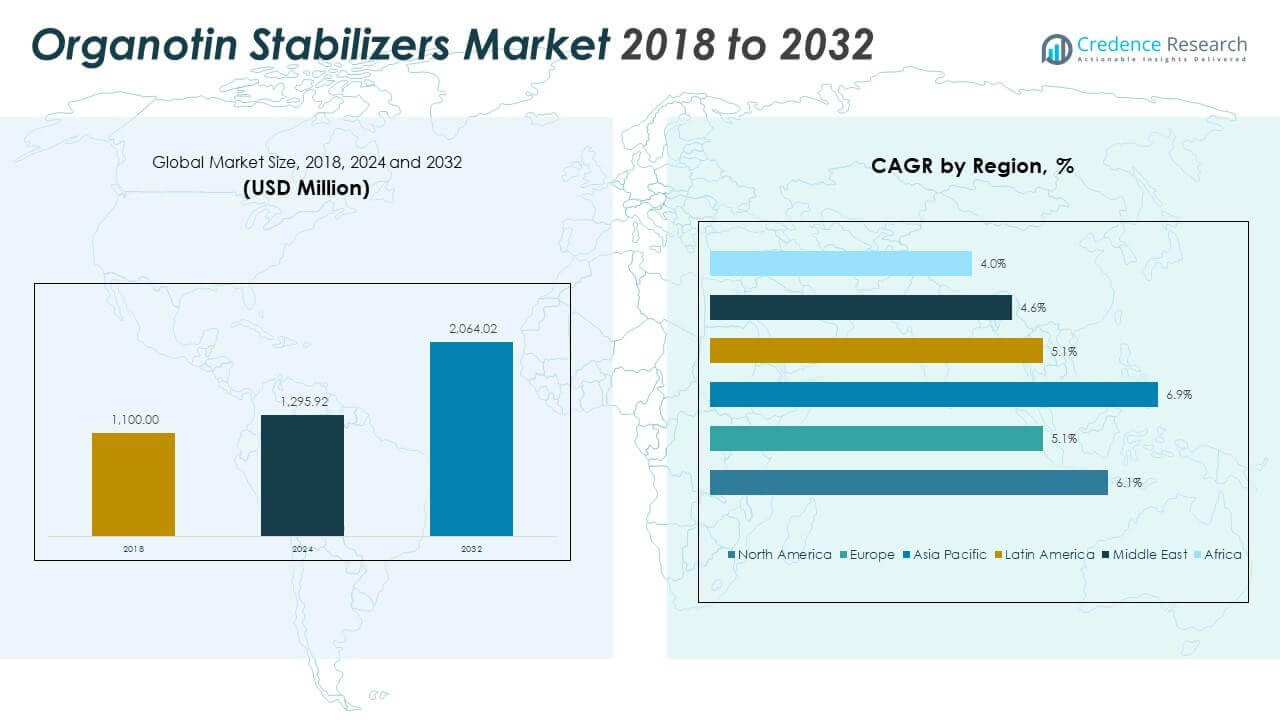
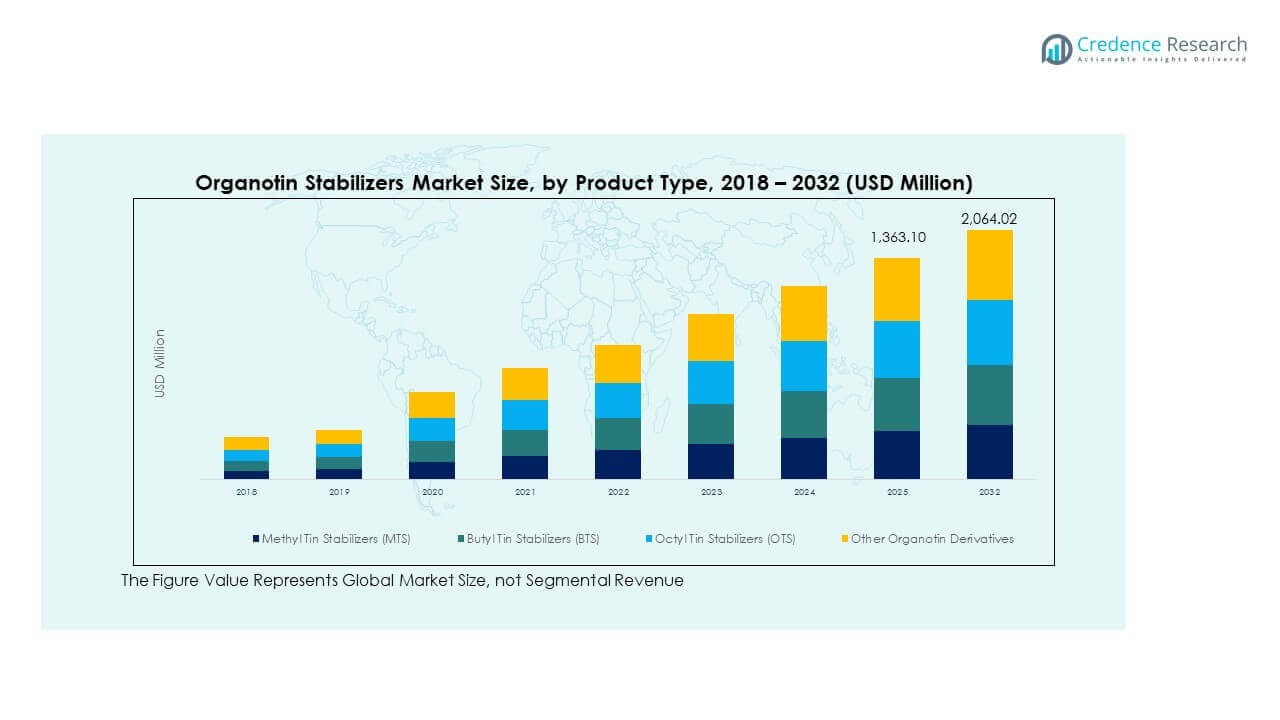
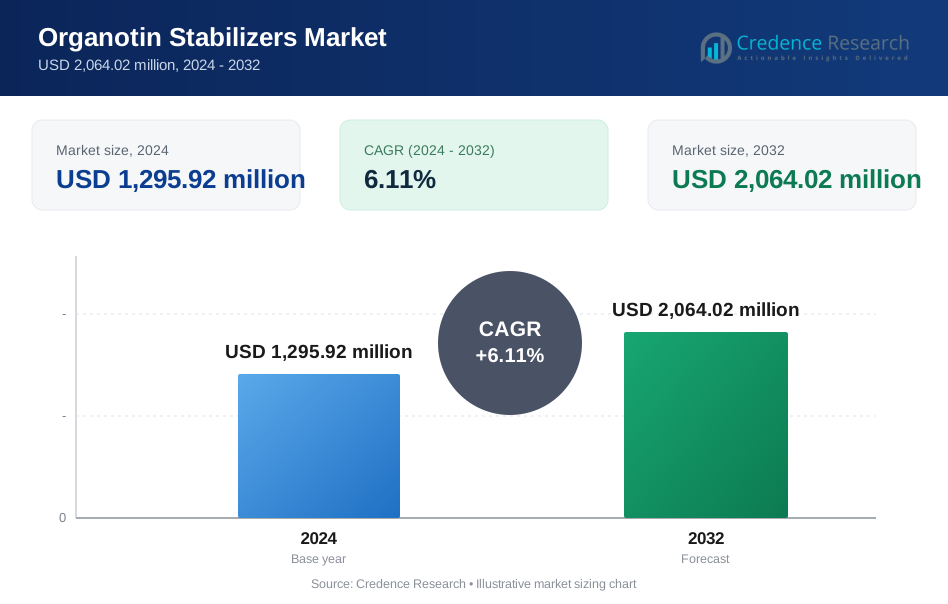
The Organotin Stabilizers Market size was valued at USD 1,100.00 million in 2018 to USD 1,295.92 million in 2024 and is anticipated to reach USD 2,064.02 million by 2032, at a CAGR of 6.11% during the forecast period.
| REPORT ATTRIBUTE | DETAILS |
|---|---|
| Historical Period | 2020-2023 |
| Base Year | 2024 |
| Forecast Period | 2025-2032 |
| Organotin Stabilizer Market Size 2024 | USD 1,295.92 million |
| Organotin Stabilizer Market, CAGR | 6.11% |
| Organotin Stabilizer Market Size 2032 | USD 2,064.02 million |
Market growth is driven by increasing demand for thermal stabilizers in rigid PVC applications. Organotin compounds offer excellent processing stability, clarity, and weather resistance, making them ideal for construction-grade pipes, profiles, and films. Manufacturers prefer these stabilizers for high-speed extrusion and injection molding lines. Their compliance with food-grade and medical-grade regulations boosts usage in transparent packaging and medical devices. Regulatory restrictions on lead-based stabilizers accelerate the shift toward organotin systems. Ongoing infrastructure development in emerging economies supports sustained demand across construction and utility sectors.
Asia Pacific leads the Organotin Stabilizers Market due to strong PVC production and construction activity, especially in China and India. North America shows steady adoption driven by healthcare packaging and industrial-grade applications. Europe supports growth in high-end packaging and medical PVC products under strict regulatory compliance. Latin America and the Middle East are emerging markets, gaining traction through expanding utilities and infrastructure. Africa remains a smaller market but holds long-term potential with urban development and water pipeline installations.
Market Insights:
- The Organotin Stabilizers Market reached USD 1,100.00 million in 2018, rose to USD 1,295.92 million in 2024, and is set to hit USD 2,064.02 million by 2032, growing at a CAGR of 6.11%.
- Asia Pacific leads with about 43.4% share, followed by North America at 22.6% and Europe at 17.4%, driven by strong PVC production, infrastructure activity, and regulated end‑use demand.
- Asia Pacific is also the fastest‑growing region, holding roughly 43.4% share, supported by rapid urbanization, large‑scale construction, and expanding industrial PVC manufacturing.
- By product type, methyl tin stabilizers account for the largest share at around 48%, reflecting high use in rigid and clear PVC requiring thermal stability and clarity.
- By application, PVC pipes and fittings dominate with nearly 42% share, supported by sustained demand from construction, utilities, and infrastructure projects worldwide.
Market Drivers
High Compatibility with Rigid PVC Products in Industrial and Construction Applications
The Organotin Stabilizers Market benefits from widespread use in rigid PVC formulations. Pipes, fittings, and profiles require thermal stability and clarity, both supported by organotin stabilizers. These compounds ensure high processing speeds without degrading resin quality. Their stability under elevated temperatures supports extrusion and injection molding lines. Electrical conduits and cable insulations also use organotin-based systems due to long-term thermal and mechanical performance. Their non-discoloring property improves product aesthetics in exposed applications. Many manufacturers prioritize organotin compounds to meet durability and regulatory needs. The Organotin Stabilizers Market continues to gain traction in PVC-based infrastructure and electrical applications.
- For instance, PMC Organometallix offers Thermolite® and ADVASTAB® organotin stabilizers designed for rigid PVC pipe, profile, and conduit extrusion, showing they suit demanding industrial and construction uses.
Established Performance in Transparent and Food-Contact Grade PVC Products
Organotin stabilizers are widely preferred for transparent PVC due to non-yellowing properties. Applications like medical tubing, food-grade packaging, and clear bottles depend on high optical clarity. Their stability in sterilization and exposure to cleaning chemicals adds reliability. They comply with safety guidelines in many regions for food-contact and pharmaceutical-grade use. The ability to deliver consistent results across transparent applications strengthens adoption. Packaging manufacturers seek performance without compromising regulatory compliance. This behavior drives recurring demand across consumer and healthcare packaging industries. It reinforces the Organotin Stabilizers Market’s relevance in precision and hygiene-sensitive applications.
- For instance, Baerlocher confirms that specific organotin stabilizers in its portfolio offer excellent clarity, color retention, and thermal stability in transparent rigid PVC applications, particularly in medical and packaging films. These grades are designed to meet demanding processing conditions where optical quality is critical.
Increasing Use in Electrical and Industrial Extrusion Applications
Electrical, telecom, and industrial insulation materials rely heavily on stable processing. Organotin stabilizers ensure minimal thermal degradation during prolonged production. High-voltage cable sheathing and fiber optic casings demand stable insulation properties over time. Their use helps meet fire resistance and durability standards for critical applications. Production plants value the low plate-out and high clarity these stabilizers deliver. Their efficiency reduces waste and improves output in long extrusion runs. Industrial usage across oil, gas, and utilities increases demand. This expands the Organotin Stabilizers Market across electrical-grade plastic producers.
Regulatory Shift from Lead-Based Stabilizers Creates a Favorable Replacement Market
Global regulations continue phasing out lead-based PVC stabilizers in favor of safer alternatives. Many manufacturers shift to organotin stabilizers to meet RoHS, REACH, and FDA norms. This transition encourages adoption in markets previously reliant on low-cost lead systems. Organotin options balance performance with compliance and long-term product safety. Their proven track record supports seamless conversion across multiple production formats. The need for stable, approved alternatives fuels long-term demand in regulatory-sensitive regions. The Organotin Stabilizers Market grows as stricter rules reinforce product safety standards globally.
Market Trends
Steady Growth of Transparent PVC Applications in Medical and Packaging Sectors
Demand for high-clarity transparent PVC rises steadily in health and consumer industries. Medical tubing, IV bags, and flexible containers use organotin stabilizers for performance and compliance. Packaging films and containers need clarity and strength without yellowing. Organotin stabilizers enable consistent performance across sterilization and filling processes. Brand owners in pharma and FMCG seek high transparency with safety certification. Supply chain shifts in medical-grade plastics strengthen long-term demand. PVC converters expand clear product lines across healthcare and hygiene markets. The Organotin Stabilizers Market gains support through these clean and compliant applications.
Ongoing Shift Toward High-Speed Processing in Extrusion and Molding Lines
Manufacturers increasingly install high-speed PVC extrusion systems to boost productivity. These systems require stabilizers that prevent thermal degradation at elevated temperatures. Organotin stabilizers offer precise melt flow and thermal consistency for demanding runs. They also reduce scrap and tool maintenance, improving cost-efficiency. Compounders favor them for repeatable performance under continuous operation. PVC sheet and pipe producers benefit from reduced plate-out and better surface finish. Machine reliability and material savings drive stabilizer selection trends. The Organotin Stabilizers Market aligns well with these high-throughput manufacturing goals.
- For instance, Songwon’s Songstabs organotin stabilizers provide thermal stability for PVC extrusion, reducing degradation in high-speed pipe lines as per technical sheets.
Growing Adoption in Asia-Pacific for Infrastructure and Industrial Plastics
The Asia-Pacific region records rising demand for PVC infrastructure products. Construction booms in China, India, Vietnam, and Indonesia fuel PVC consumption. Organotin stabilizers gain favor due to strong compatibility with regional extrusion lines. Domestic producers shift to high-performance stabilizers for pipe and conduit applications. Local regulations in India and ASEAN gradually align with global compliance trends. Organotin-based solutions bridge the gap between cost and certification needs. Regional investment in electrical and plumbing networks boosts stabilizer consumption. These trends support ongoing growth in the Organotin Stabilizers Market across emerging Asian economies.
- For instance, Finolex Industries commissioned a new PVC pipe plant in India, raising its installed PVC pipe capacity, and this expanded production has driven demand for high‑quality thermal stabilizers.
Development of Hybrid Formulations to Address Cost and Regulatory Pressures
Producers invest in hybrid stabilizer blends that balance organotin benefits with cost efficiency. These blends aim to reduce total stabilizer load while maintaining performance. Some applications experiment with partial substitution by calcium-based alternatives. However, organotin blends remain critical in precision applications. Innovation focuses on minimizing environmental footprint while preserving processability. Hybrid options help converters meet evolving eco-label and customer-specific standards. Product development targets better shelf life, lower migration, and broader approval. The Organotin Stabilizers Market sees growing R&D interest in this blended performance space.
Market Challenges Analysis
Regulatory Restrictions on Organotin Use in Specific Applications and Regions
The Organotin Stabilizers Market faces challenges due to tightening global regulatory frameworks. Restrictions on organotin usage in Europe, especially under REACH, impact specific formulations. Environmental agencies limit use in marine coatings and non-PVC sectors due to potential leaching risks. Some food-contact and medical regulations add usage caps or require detailed toxicological testing. These constraints force manufacturers to redesign formulations or shift to approved blends. Market players must invest in compliance testing and reformulation efforts. Smaller producers may struggle to align with complex regional standards. Regulatory pressure narrows addressable markets in select use-cases. It limits expansion into new sensitive applications where alternatives are preferred.
Competitive Pressure from Calcium-Zinc and Other Non-Tin Stabilizer Systems
Calcium-zinc and mixed metal stabilizers increasingly compete in traditional organotin markets. These systems offer a lead-free and tin-free alternative for regulatory-conscious buyers. In flexible PVC and low-temperature applications, non-tin options gain traction. Their lower toxicity and easier disposal appeal to brands with sustainability goals. Organotin stabilizers remain preferred for clarity and high-heat stability, but face price sensitivity. Cost-focused markets in Africa and Latin America adopt alternatives due to economic constraints. Large processors test calcium-zinc systems for performance consistency. This competition limits volume growth potential in basic applications of the Organotin Stabilizers Market.
Market Opportunities
Product Expansion into High-Performance PVC Applications with Long-Term Stability
The Organotin Stabilizers Market holds opportunities in advanced PVC systems needing thermal durability. High-end uses like automotive trims, solar cable jackets, and energy-grade conduits demand stable performance. These applications often reject low-performing stabilizers due to safety or warranty issues. Organotin compounds offer proven stability in these long-lifecycle products. Market players can target OEM partnerships and long-term supply deals. Growth in electric mobility and solar infrastructure may strengthen such demand segments. This creates scope for specialized organotin-based solutions with validated endurance.
Emerging Market Adoption Due to Rapid Urbanization and Industrialization
Emerging economies continue to build urban infrastructure and industrial capacity. PVC pipes, windows, electrical panels, and conduits dominate early-stage utility networks. Organotin stabilizers offer easy processing and reliable service life in these segments. Countries in Asia, Africa, and Latin America show growing acceptance. Local producers adopt compliant and consistent stabilizer systems for exports. Suppliers can leverage cost-effective organotin blends to penetrate these fast-developing regions. The Organotin Stabilizers Market can grow steadily through targeted expansion in underserved geographies.
Market Segmentation Analysis:
By Product Type
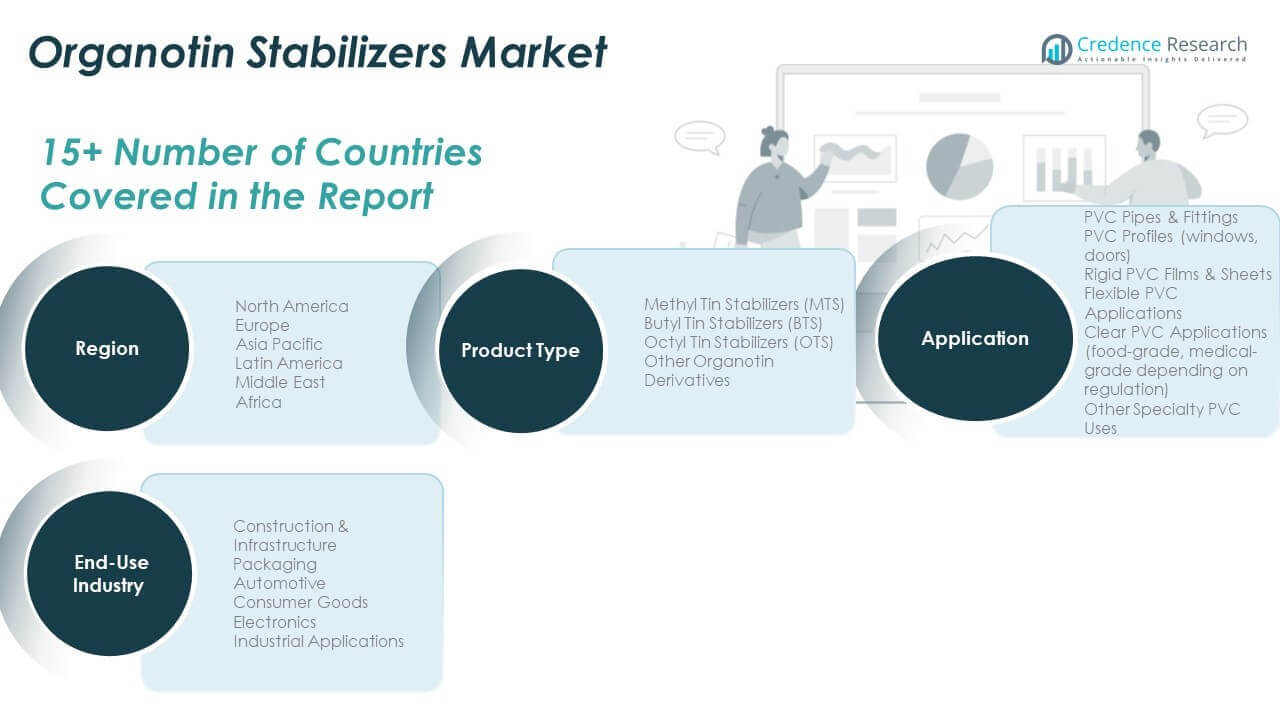
The Organotin Stabilizers Market is segmented into Methyl Tin Stabilizers (MTS), Butyl Tin Stabilizers (BTS), Octyl Tin Stabilizers (OTS), and other organotin derivatives. Methyl tin stabilizers dominate due to their superior thermal stability and optical clarity, especially in rigid PVC products. BTS and OTS serve niche applications, often where specific solubility or compatibility is required. Demand for MTS continues to rise across high-speed extrusion applications in pipes and profiles. OTS stabilizers are gradually being used in flexible applications depending on regional regulations. Emerging markets tend to adopt lower-cost or mixed-metal alternatives, though organotin-based options remain favored in performance-critical applications. Product development focuses on refining heat resistance, clarity, and regulatory compliance. The segment sees steady growth tied to infrastructure and packaging expansion.
- For instance, PMC Organometallix offers butyltin stabilizers such as Thermolite® 31 and Thermolite® 108, which contain approximately 18.5% and 17.5% tin respectively, and are formulated for use in PVC applications requiring high thermal stability and clarity.
By Application
Key applications include PVC pipes and fittings, profiles for windows and doors, rigid PVC sheets and films, flexible PVC products, clear PVC for food or medical use, and specialty PVC items. Pipes and fittings remain the top-consuming application, driven by residential and industrial infrastructure. Window profiles demand high clarity and weather resistance, supported by organotin formulations. Food-grade and medical-grade applications prefer organotin for safety compliance and transparency. Rigid films see growing demand in packaging due to optical and sealing performance. Specialty PVC uses extend into electrical insulation and chemical-resistant linings. Each application’s growth ties closely to construction, healthcare, or packaging dynamics in regional markets.
- For instance, Baerlocher notes that its tin stabilizers deliver strong dynamic thermal stability in rigid PVC extrusion, with Brabender tests at elevated temperatures showing stability times that support continuous pipe production. This performance helps rigid pipe and profile makers achieve consistent extrusion quality and surface finish.
By End-Use Industry
End-use industries include construction and infrastructure, packaging, automotive, consumer goods, electronics, and industrial applications. Construction leads due to widespread PVC use in pipes, profiles, and conduits. Packaging follows, especially in rigid and semi-rigid clear formats. Automotive applications benefit from heat-resistant properties in trims and tubing. Consumer goods and electronics rely on stable and safe materials for insulation, enclosures, and casings. Industrial use spans cable sheathing and fluid transport systems. The Organotin Stabilizers Market aligns closely with sectors demanding durability, thermal integrity, and regulatory-tested materials. Each industry influences stabilizer selection based on performance and compliance needs.
Segmentation:
By Product Type
- Methyl Tin Stabilizers (MTS)
- Butyl Tin Stabilizers (BTS)
- Octyl Tin Stabilizers (OTS)
- Other Organotin Derivatives
By Application
- PVC Pipes & Fittings
- PVC Profiles (windows, doors)
- Rigid PVC Films & Sheets
- Flexible PVC Applications
- Clear PVC Applications (food-grade, medical-grade depending on regulation)
- Other Specialty PVC Uses
By End-Use Industry
- Construction & Infrastructure
- Packaging
- Automotive
- Consumer Goods
- Electronics
- Industrial Applications
By Region
- North America
- U.S.
- Canada
- Mexico
- Europe
- Germany
- France
- U.K.
- Italy
- Spain
- Rest of Europe
- Asia Pacific
- China
- Japan
- India
- South Korea
- South-east Asia
- Rest of Asia Pacific
- Latin America
- Brazil
- Argentina
- Rest of Latin America
- Middle East & Africa
- GCC Countries
- South Africa
- Rest of the Middle East and Africa
Regional Analysis:
North America
The North America Organotin Stabilizers Market size was valued at USD 278.30 million in 2018 to USD 322.16 million in 2024 and is anticipated to reach USD 512.09 million by 2032, at a CAGR of 6.1% during the forecast period. North America accounts for approximately 22.6% of the global market share in 2024. The region benefits from stable demand in construction, medical, and consumer packaging sectors. The U.S. leads consumption due to large-scale PVC pipe use in plumbing, housing, and infrastructure upgrades. Organotin stabilizers are widely used in clear PVC packaging and medical-grade films due to strong FDA oversight. Industrial PVC products in telecom and power sectors sustain base demand. Regulatory clarity supports consistent adoption across applications. Canada follows with demand centered around infrastructure and packaging. The Organotin Stabilizers Market in this region benefits from regulatory compliance and advanced manufacturing capacity.
Europe
The Europe Organotin Stabilizers Market size was valued at USD 221.54 million in 2018 to USD 247.74 million in 2024 and is anticipated to reach USD 365.65 million by 2032, at a CAGR of 5.1% during the forecast period. Europe represents 17.4% of the global market share in 2024. The market is driven by precision-grade PVC products, including transparent films, automotive interiors, and high-performance packaging. Germany, Italy, and France lead demand across food-grade and medical packaging applications. EU regulatory frameworks restrict heavy metals and influence stabilizer choices. Organotin stabilizers maintain share in segments where clarity and thermal stability are essential. European processors favor compliant and consistent additives. Eastern Europe shows moderate growth in industrial and construction PVC use. The Organotin Stabilizers Market in Europe holds strength in niche high-quality applications.
Asia Pacific
The Asia Pacific Organotin Stabilizers Market size was valued at USD 465.30 million in 2018 to USD 562.23 million in 2024 and is anticipated to reach USD 950.07 million by 2032, at a CAGR of 6.9% during the forecast period. Asia Pacific commands the largest share at 43.4% of the global market in 2024. China dominates with extensive PVC production and construction activity. India follows with rising demand for pipes, profiles, and cable insulation in urban infrastructure. Southeast Asia contributes through growth in flexible packaging and consumer goods. Organotin stabilizers see widespread use in clear PVC, industrial conduits, and profiles. Fast-paced industrialization and local manufacturing boost adoption. Regional suppliers also export large PVC volumes using organotin formulations. The Organotin Stabilizers Market in Asia Pacific benefits from cost-effectiveness, regulatory balance, and industrial scale.
Latin America
The Latin America Organotin Stabilizers Market size was valued at USD 68.20 million in 2018 to USD 79.56 million in 2024 and is anticipated to reach USD 117.38 million by 2032, at a CAGR of 5.1% during the forecast period. The region contributes 5.9% to global market share in 2024. Brazil and Mexico are major markets for construction-grade PVC pipes and profiles. Organotin stabilizers are used in rigid applications where weather resistance and longevity are important. Consumer goods packaging and automotive trims support additional demand. Local manufacturers rely on consistent additives with manageable regulatory constraints. Infrastructure upgrades in housing and water supply sustain demand for PVC piping. The Organotin Stabilizers Market in Latin America reflects steady growth driven by utility expansion and construction needs.
Middle East
The Middle East Organotin Stabilizers Market size was valued at USD 38.50 million in 2018 to USD 42.24 million in 2024 and is anticipated to reach USD 60.07 million by 2032, at a CAGR of 4.6% during the forecast period. It holds 3.0% of the global market share in 2024. Saudi Arabia and the UAE lead consumption due to construction megaprojects and industrial development. Rigid PVC pipes and electrical conduits drive stabilizer use. High-temperature environments require materials with thermal stability, favoring organotin usage. Medical-grade and clear packaging segments show gradual uptake. Government regulations remain moderately supportive of tin-based additives. Import dependency influences cost and procurement cycles. The Organotin Stabilizers Market in the Middle East is expanding gradually in line with infrastructure and manufacturing growth.
Africa
The Africa Organotin Stabilizers Market size was valued at USD 28.16 million in 2018 to USD 41.99 million in 2024 and is anticipated to reach USD 58.76 million by 2032, at a CAGR of 4.0% during the forecast period. Africa represents 2.9% of the global market share in 2024. Demand is centered in South Africa, Egypt, and Nigeria, where construction and utilities drive PVC use. Organotin stabilizers are applied in water management pipes, housing profiles, and basic packaging. Market penetration remains low due to limited industrial infrastructure. Affordability and import costs influence product selection. Some regions favor low-cost mixed-metal systems, but organotin is used where compliance and performance are critical. Industrial PVC manufacturing capacity remains limited but growing. The Organotin Stabilizers Market in Africa offers long-term potential as industrialization expands.
Key Player Analysis:
- PMC Organometallix
- Songwon Industrial Co., Ltd.
- Baerlocher Group
- Galata Chemicals
- Valtris Specialty Chemicals
Competitive Analysis:
The competitive landscape of the Organotin Stabilizers Market features a mix of global specialty chemical firms and regional additive suppliers. Leading players focus on product reliability, regulatory compliance, and long-term supply contracts with PVC processors. Established companies leverage broad portfolios that cover methyl, butyl, and octyl tin stabilizers for diverse applications. Strong technical support and formulation expertise help suppliers secure repeat customers in rigid and clear PVC segments. Many firms invest in process optimization to ensure consistent thermal stability and low plate-out performance. Strategic partnerships with compounders and distributors strengthen regional reach. Price discipline and raw material sourcing efficiency influence margin control. Competitive positioning also depends on compliance with food-contact and medical standards. It benefits from proven performance history, which limits rapid substitution. Continuous product refinement and selective capacity expansion shape competitive advantage across regions.
Recent Developments:
- In July 2025, SONGWON Industrial Co., Ltd. strengthened its global distribution network by expanding partnerships with Biesterfeld Spezialchemie GmbH and TCL Hofmann. The company extended its polymer stabilizer distribution in Australia, New Zealand, and Southeastern Europe.
Report Coverage:
The research report offers an in-depth analysis based on Product Type, Application and End-Use Industry. It details leading market players, providing an overview of their business, product offerings, investments, revenue streams, and key applications. Additionally, the report includes insights into the competitive environment, SWOT analysis, current market trends, as well as the primary drivers and constraints. Furthermore, it discusses various factors that have driven market expansion in recent years. The report also explores market dynamics, regulatory scenarios, and technological advancements that are shaping the industry. It assesses the impact of external factors and global economic changes on market growth. Lastly, it provides strategic recommendations for new entrants and established companies to navigate the complexities of the market.
Future Outlook:
- Demand for high-performance PVC in infrastructure and packaging will continue driving stabilizer consumption.
- Asia Pacific will maintain its dominant position due to its industrial scale and construction demand.
- Product development will focus on enhancing thermal stability and minimizing environmental footprint.
- Transparent PVC applications in healthcare and food packaging will increase reliance on organotin systems.
- Market players will expand hybrid stabilizer portfolios to meet regulatory shifts and cost control.
- Construction sector recovery in Latin America and Africa will support moderate regional growth.
- Adoption in electrical conduit and cable insulation will strengthen with power grid upgrades.
- Strategic partnerships with regional compounders will help key players penetrate untapped geographies.
- Compliance with food-grade and medical-grade standards will remain a critical growth lever.
- The Organotin Stabilizers Market will benefit from rising demand for clear, durable, and regulatory-compliant PVC products.
Request a Free Sample
Fill in your details and we'll send you a free sample report.
- Sample data tables & charts
- Research methodology
Need a Custom Version of This Report?
Tailor the scope, geography, or segments to your exact requirements.
- Custom geography or segment scope
- Direct access to our analyst team
Frequently Asked Questions
What is the current market size for Organotin Stabilizers Market, and what is its projected size in 2032?
At what Compound Annual Growth Rate is the Organotin Stabilizers Market projected to grow between 2024 and 2032?
Which Organotin Stabilizers Market segment held the largest share in 2024?
What are the primary factors fueling the growth of the Organotin Stabilizers Market?
Who are the leading companies in the Organotin Stabilizers Market?
Which region commanded the largest share of the Organotin Stabilizers Market in 2024?
Table of Content
Chapter 1. Report Introduction
- 1.1 Report Description & Purpose
- 1.1.1 Report Title & Market Definition
- 1.1.2 Unique Selling Propositions (USP) & Key Differentiators
- 1.1.3 Value Proposition for Stakeholders
- 1.2 Research Objectives
- 1.2.1 Market Sizing Objectives (Volume & Revenue)
- 1.2.2 Segmentation Objectives
- 1.2.3 Competitive Intelligence Objectives
- 1.2.4 Forecast & Scenario Objectives
- 1.3 Report Scope
- 1.3.1 Organotin Stabilizers Scope – Types & Subtypes Covered
- 1.3.2 Geographic Scope – Regions & Countries Covered
- 1.3.3 Historical Period, Base Year & Forecast Period (2024; forecast to 2032)
- 1.3.4 Inclusions & Exclusions
- 1.4 HS Code & Classification Framework
- 1.5 Currency, Units & Pricing Basis
- 1.6 Target Stakeholders
- 1.7 Limitations & Assumptions
Chapter 2. Executive Summary
- 2.1 Global Organotin Stabilizers Market Snapshot
- 2.1.1 Market Size – Historical (2024) & Forecast (2024-2032) (2024: USD 1,295.92 million → 2032: USD 2,064.02 million)
- 2.1.2 Volume & Revenue – Global Totals
- 2.1.3 Key Market Highlights – Top Five Facts
- 2.2 Organotin Stabilizers Market Segmentation Snapshot
- 2.2.1 Market Split by Region – 2024 vs. 2032
- 2.3 Competitive Snapshot
- 2.3.1 Top 10 Players by Revenue Share – 2024
- 2.3.2 Top 10 Players by Volume Share – 2024
- 2.3.3 Recent Strategic Developments (18-Month Summary)
- 2.4 Key Investment Highlights & Strategic Conclusions
Chapter 3. Organotin Stabilizers Market Dynamics & Industry Analysis
- 3.1 Market Overview & Context
- 3.1.1 Organotin Stabilizers Market Position in the Broader Automotive Value Chain
- 3.1.2 OEM vs. Replacement Market Dynamics
- 3.1.3 Market Maturity & Development Stage by Region
- 3.2 Organotin Stabilizers Market Drivers
- 3.3 Organotin Stabilizers Market Restraints & Challenges
- 3.4 Organotin Stabilizers Market Opportunities
- 3.5 Porter's Five Forces Analysis
- 3.5.1 Threat of New Entrants
- 3.5.2 Bargaining Power of Suppliers
- 3.5.3 Bargaining Power of Buyers
- 3.5.4 Threat of Substitutes
- 3.5.5 Competitive Rivalry – Intensity Assessment
- 3.6 Organotin Stabilizers Value Chain Analysis
- 3.6.1 Upstream – Raw Material/Input Suppliers
- 3.6.1.1 Raw Material/Input 1
- 3.6.1.2 Raw Material/Input 2
- 3.6.1.3 Raw Material/Input 3
- 3.6.2 Midstream – Production/Manufacturing/Service Delivery
- 3.6.2.1 Production/Process Overview
- 3.6.2.2 Key Facility Locations & Capacity by Manufacturer
- 3.6.3 Downstream – Distribution & End Consumer
- 3.6.3.1 Primary Channel – B2B/OEM
- 3.6.3.2 Secondary Channels – Dealer, Retail, Online, Direct
- 3.6.4 Value Chain Profitability Analysis
- 3.6.1 Upstream – Raw Material/Input Suppliers
- 3.7 PESTEL Analysis
- 3.7.1 Political Factors
- 3.7.2 Economic Factors
- 3.7.3 Social Factors
- 3.7.4 Technological Factors
- 3.7.5 Environmental Factors
- 3.7.6 Legal Factors
- 3.8 Organotin Stabilizers Supply Chain Analysis
- 3.8.1 Raw Material/Input Supply Risk Assessment
- 3.8.2 Manufacturing Concentration Risk (Geographic Exposure)
- 3.8.3 Trade Disruption Impact Analysis
- 3.9 Regulatory & Policy Landscape
Note: The regulatory and policy landscape section covers regulations based on their applicability to the market, Organotin Stabilizers category, geography, and scope of the study. Only regulatory frameworks with a material impact on operations, compliance, trade, sustainability, or market access are analyzed in detail.
Chapter 4. Key Investment Pockets & Opportunity Analysis
- 4.1 Organotin Stabilizers Market Attractiveness Analysis
- 4.1.1 By Region – Investment Attractiveness Matrix (Volume × CAGR)
- 4.2 Absolute Revenue Growth Opportunity
- 4.2.1 By Region – Absolute USD Growth Through 2032
- 4.3 Incremental Volume Opportunity
- 4.3.1 By Region – Incremental Volume Through 2032
- 4.3.2 Segment – Incremental Volume
- 4.4 Emerging Submarket Opportunity Deep Dive (Subject to Applicability)
- 4.5 Emerging Market Opportunity Scorecards
- 4.5.1 United States
- 4.5.2 Europe
- 4.5.3 Asia
- 4.5.4 Middle East & Africa
Note: Emerging Market Opportunity Scorecards will be included based on relevance and strategic importance. Regions listed are indicative and may vary depending on data availability and market dynamics.
Chapter 5. Organotin Stabilizers Import-Export Analysis & Trade Flows
- 5.1 Global Trade Overview
- 5.1.1 Global Export Value by Country (2024)
- 5.1.2 Global Export Volume by Country (2024)
- 5.1.3 Global Import Value by Country (2024)
- 5.1.4 Global Import Volume by Country (2024)
- 5.1.5 Net Trade Balance by Country (2024)
- 5.2 Export Analysis – Segment
- 5.2.1 Type 1 (HS Code)
- 5.2.2 Type 2 (HS Code)
- 5.2.3 Type 3 (HS Code)
- 5.2.4 Type 4 (HS Code)
- 5.2.5 Type 5 (HS Code)
- 5.3 Import Analysis – Segment
- 5.3.1 Type 1 (HS Code)
- 5.3.2 Type 2 (HS Code)
- 5.3.3 Type 3 (HS Code)
- 5.3.4 Type 4 (HS Code)
- 5.3.5 Type 5 (HS Code)
- 5.4 Average Unit Trade Prices
- 5.4.1 Average Export Price – Segment & Country
- 5.4.2 Average Import Price – Segment & Source Country
- 5.4.3 Price Trends (2024)
- 5.5 Key Trade Route Analysis
- 5.5.1 Trade Route 1
- 5.5.2 Trade Route 2
- 5.5.3 Trade Route 3
- 5.5.4 Trade Route 4
- 5.5.5 Trade Route 5
- 5.6 Trade Policy Impact Assessment
- 5.6.1 US Anti-Dumping & Section 301 Tariffs
- 5.6.2 EU Customs Union Impact
- 5.6.3 Major Free Trade Agreements
- 5.6.4 USMCA Rules of Origin
Note: Trade policy analysis will be included only where relevant to the Organotin Stabilizers market.
Chapter 6. Competitive Landscape & Company Benchmarking
- 6.1 Organotin Stabilizers Market Concentration & Structure
- 6.1.1 Herfindahl-Hirschman Index (HHI) – vs. 2024
- 6.1.2 Tier 1, Tier 2 & Tier 3 Market Structure
- 6.1.3 Global, Regional & Local Player Dynamics
- 6.2 Organotin Stabilizers Market Share Analysis – 2024
- 6.2.1 Global Revenue Share by Company
- 6.2.2 Global Volume Share by Company
- 6.2.3 Regional Revenue Share
- 6.2.4 Market Share Evolution ( vs. 2024)
- 6.2.5 OEM Segment Share by Company
- 6.2.6 Replacement Segment Share by Company
- 6.3 Production/Delivery Capacity & Facility Analysis
- 6.3.1 Global Installed Capacity
- 6.3.2 Capacity Utilization Rates
- 6.3.3 Production/Output Volume
- 6.3.4 Facility Locations & Capacity Map
- 6.3.5 Planned Capacity Additions
- 6.4 Organotin Stabilizers Competitive Benchmarking Matrix
- 6.4.1 Revenue, Volume, CAGR & Profitability Comparison
- 6.4.2 Channel Revenue Mix
- 6.4.3 Geographic Revenue Exposure
- 6.4.4 R&D Intensity
- 6.4.5 Sustainability Maturity
- 6.5 Strategic Developments in Organotin Stabilizers (Last 24 Months)
- 6.5.1 Mergers, Acquisitions & Divestments
- 6.5.2 New Organotin Stabilizers Launches
- 6.5.3 Facility Expansions
- 6.5.4 Strategic Alliances, Joint Ventures & Partnerships
- 6.5.5 Distribution Expansion & Market Entry
- 6.5.6 Sustainability & ESG Initiatives
- 6.6 Competitive Strategy Mapping
- 6.6.1 Leader, Challenger, Follower & Niche Classification
- 6.6.2 Pricing Strategy Comparison
- 6.6.3 Channel Strategy Matrix
Note: Strategic developments are included based on their materiality and the availability of reliable information.
Chapter 7. Global Organotin Stabilizers Market – By Distribution Channel
- 7.1 Segment Overview
- 7.1.1 Volume & Revenue Split by Channel (2024 & 2032)
- 7.1.2 Channel Mix Evolution (2024-2032)
Chapter 8. Regional Market Analysis – Global Overview
- 8.1 Global Regional Overview
- 8.1.1 Regional Volume Share
- 8.1.2 Regional Revenue Share
- 8.1.3 Regional Volume by Region
- 8.1.4 Regional Revenue by Region
- 8.1.5 Regional Forecast Through 2032
- 8.2 Cross-Regional Segment Analysis
- 8.2.1 By Distribution Channel
- 8.2.2 By Brand/Price Tier
Chapter 9. North America Organotin Stabilizers Market
- 9.1 United States
- 9.2 Canada
- 9.3 Mexico
Chapter 10. Europe Organotin Stabilizers Market
- 10.1 Germany
- 10.2 France
- 10.3 Italy
- 10.4 United Kingdom
- 10.5 Spain
- 10.6 Poland
- 10.7 Russia
- 10.8 Netherlands
- 10.9 Belgium
- 10.10 Sweden
- 10.11 Denmark
- 10.12 Norway
- 10.13 Rest of Europe
Chapter 11. Asia Pacific Organotin Stabilizers Market
- 11.1 China
- 11.2 India
- 11.3 Japan
- 11.4 South Korea
- 11.5 Thailand
- 11.6 Indonesia
- 11.7 Vietnam
- 11.8 Malaysia
- 11.9 Australia
- 11.10 Rest of Asia Pacific
Chapter 12. Latin America Organotin Stabilizers Market
- 12.1 Brazil
- 12.2 Argentina
- 12.3 Colombia
- 12.4 Chile
- 12.5 Rest of Latin America
Chapter 13. Middle East Organotin Stabilizers Market
- 13.1 Saudi Arabia
- 13.2 United Arab Emirates
- 13.3 Turkey
- 13.4 Israel
- 13.5 Iran
- 13.6 Rest of the Middle East
Chapter 14. Africa Organotin Stabilizers Market
- 14.1 South Africa
- 14.2 Egypt
- 14.3 Nigeria
- 14.4 Morocco
- 14.5 Rest of Africa
Chapter 15. Organotin Stabilizers Company Profiles
- 15.1 [Company 01]
- 15.1.1 Company Overview
- 15.1.2 Key Management Personnel
- 15.1.3 Products & Services Portfolio
- 15.1.4 Financial Performance
- 15.1.5 Key Market Focus & Geographic Presence
- 15.1.6 Recent Developments & Strategic Initiatives
Note: The company profile list is preliminary and may change based on research findings, market developments, data availability, and client requirements.
Chapter 16. Appendices
- Appendix A – List of Abbreviations & Acronyms
- Appendix B – Industry Classification Code Reference – Full Series
- Appendix C – Production & Capacity Data Tables
- Appendix D – End-Use & Demand Base Tables
- Appendix E – Consumption & Replacement Rate Assumptions
- Appendix F – ASP Reference Tables
- Appendix G – Manufacturing & Facility Database
- Appendix H – Import-Export Data Tables
- Appendix I – Regulatory Summary Tables
- Appendix J – Primary Research Participant List (Anonymized)
- Appendix K – Primary Research Questionnaire Framework
- Appendix L – Data Sources & Bibliography
- Appendix M – Market Size Divergence & Source Comparison
Chapter 17. Research Methodology
- 17.1 Research Framework & Philosophy
- 17.2 Secondary Research – Sources, Hierarchy & Data Extraction
- 17.3 Data Modeling – Bottom-Up & Top-Down Market Sizing
- 17.4 Primary Research – Stakeholder Framework, LOI & Sample Sizes
- 17.5 Forecast Methodology – Regression, Scenario & Sensitivity Analysis
- 17.6 Quality Control – Four-Layer Validation Framework
- 17.7 Limitations & Standard Assumptions
- 17.8 Disclaimer
