Market Overview
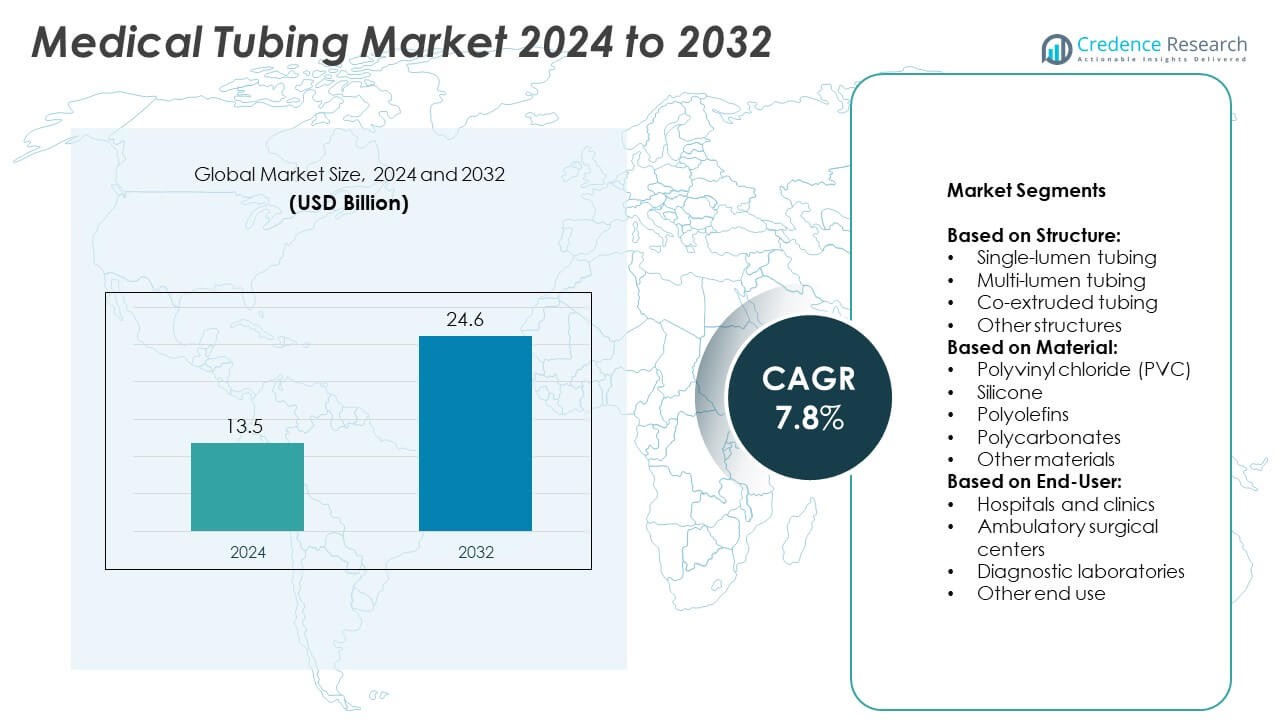
Medical Tubing Market size was valued at USD 13.5 billion in 2024 and is anticipated to reach USD 24.6 billion by 2032, at a CAGR of 7.8% during the forecast period.
| REPORT ATTRIBUTE | DETAILS |
|---|---|
| Historical Period | 2020-2023 |
| Base Year | 2024 |
| Forecast Period | 2025-2032 |
| Medical Tubing Market Size 2024 | USD 13.5 Billion |
| Medical Tubing Market, CAGR | 7.8% |
| Medical Tubing Market Size 2032 | USD 24.6 Billion |
The Medical Tubing market grows due to rising chronic diseases, aging populations, and demand for minimally invasive procedures. Hospitals and homecare settings require tubing for fluid transfer, respiratory support, and diagnostic systems. Trends include adoption of smart tubing with sensors, use of biocompatible materials, and miniaturized designs for portable devices. Manufacturers focus on sustainable polymers and customization for specific medical applications. Continuous innovation in extrusion technologies supports precision tubing for advanced surgical and diagnostic tools across global healthcare systems.
North America leads the Medical Tubing market due to strong healthcare infrastructure and high device adoption. Europe follows with rising demand for advanced tubing in diagnostics and surgical procedures. Asia Pacific shows rapid growth driven by expanding healthcare access and manufacturing capabilities. Latin America and the Middle East & Africa witness growing investments in hospital systems and chronic care. Key players operating across these regions include SAINT-GOBAIN, ZEUS, SPECTRUM, and FREUDENBERG, each focusing on specialized solutions and global distribution networks.
Market Insights
- Medical Tubing market was valued at USD 13.5 billion in 2024 and is projected to reach USD 24.6 billion by 2032, growing at a CAGR of 7.8%.
- Rising cases of chronic illness, surgical procedures, and aging populations drive global demand for safe, durable tubing.
- Trends include the integration of smart tubing with sensors, use of sustainable materials, and rising adoption of homecare devices.
- Leading players focus on extrusion technology, biocompatible materials, and rapid prototyping for OEM partnerships.
- Strict regulatory approvals and material certification processes increase product development timelines and cost burden.
- North America dominates due to advanced healthcare systems and high usage of minimally invasive medical devices.
- Asia Pacific grows rapidly with strong demand from public healthcare expansions and cost-effective local production.
Market Drivers
Rising Demand for Advanced Healthcare Infrastructure and Chronic Disease Management
The growing focus on chronic disease management continues to boost demand for precise, safe, and durable medical tubing. Hospitals and healthcare providers require advanced devices to support long-term therapies such as dialysis, drug infusion, and catheterization. Increasing investments in ICU setups and surgical infrastructure further fuel adoption of high-performance tubing. The Medical Tubing market benefits from rising hospitalization rates and a growing elderly population. Aging individuals often require long-term medical interventions involving catheters, feeding tubes, and IV lines. This growing need for consistent and safe fluid transfer systems supports strong market expansion.
- For instance, Fresenius Medical Care produces and sells dialyzers and other disposable products that are essential components of dialysis treatment. In 2021, the company sold approximately 158 million dialyzers globally. These products include specialized biocompatible tubing systems designed for long-term renal therapies.
Increasing Preference for Minimally Invasive and Home-Based Procedures
Minimally invasive treatments are gaining widespread acceptance due to reduced patient trauma and faster recovery. These procedures often require precision tubing in devices like endoscopes, stents, and laparoscopic instruments. Home healthcare is also expanding, with patients opting for remote drug delivery, oxygen therapy, and fluid management systems. The Medical Tubing market sees growing usage in portable and wearable medical devices. These innovations require flexible and biocompatible tubing solutions that maintain performance outside clinical settings. Home-based care offers comfort and cost savings, driving consistent demand across global markets.
- For instance, BD is a major manufacturer of medical devices, including a wide range of infusion sets and catheters used in healthcare settings, including home-based and minimally invasive care. Its products incorporate features like advanced polymer tubing designed to enhance patient safety and delivery efficiency. The company has made significant investments to boost manufacturing capacity, including an investment of over $2 million in 2024 to increase IV catheter output by more than 40 million units annually.
Rising Use in Diagnostic Applications and Point-of-Care Devices
Growth in diagnostic testing, especially in infectious disease control, supports higher usage of sampling and fluid handling systems. Medical tubing enables precise control and transfer of biological samples in diagnostic devices and lab automation setups. Point-of-care testing kits often use compact tubing systems to deliver reagents and handle microfluidic flows. It helps ensure contamination-free testing and quicker patient results. Rising investments in decentralized diagnostics increase the demand for tubing with tight dimensional tolerances and sterile performance. This trend reinforces tubing adoption in preventive and early detection programs.
Material Advancements and Regulatory Approvals Driving Product Innovation
Technological innovation in tubing materials improves biocompatibility, transparency, and flexibility. Thermoplastics, silicone, and fluoropolymers allow enhanced sterilization and longer shelf life. New product approvals from global regulatory bodies help accelerate market entry and clinical usage. The Medical Tubing market gains from innovations in extrusion technologies and multi-lumen tube designs. These developments enable complex applications in cardiovascular and neurovascular procedures. Medical device OEMs prefer high-performance materials that meet evolving clinical standards and support integration with digital health systems.
Market Trends
Adoption of Biodegradable and Sustainable Tubing Materials Across Medical Applications
The shift toward eco-friendly healthcare solutions is driving interest in biodegradable medical tubing. Manufacturers are developing plant-based and bioresorbable materials to reduce clinical waste and environmental impact. These materials degrade safely inside the body or during disposal, meeting new sustainability goals. Regulatory pressure to cut plastic use supports this trend across hospitals and surgical centers. The Medical Tubing market integrates such innovations into wound drainage, drug delivery, and catheters. It helps healthcare providers align with green procurement policies and environmental compliance standards.
- For instance, In 2022, Saint-Gobain's overall Group sales exceeded €51 billion, with a significant portion of its Life Sciences activity focused on providing components for critical applications that demand tight tolerances and high-quality materials.
Integration of Smart Tubing with Embedded Sensors and Digital Connectivity
Digital healthcare systems now incorporate smart tubing that tracks fluid flow, pressure, and temperature in real time. Embedded sensors enhance performance monitoring in IV therapy, catheters, and respiratory circuits. These systems support early detection of flow blockages or leakage risks, improving patient safety. Demand rises for tubing compatible with wireless communication modules and connected care platforms. The Medical Tubing market supports these advancements in ICU setups and remote monitoring devices. It strengthens the role of tubing in data-driven clinical environments.
- For instance, Freudenberg Medical annually supplies over 80 million custom-molded thermoplastic and silicone parts for in-vitro diagnostics and more than 10 million metal components for minimally invasive devices.
Miniaturization of Tubing for Precision-Based and Microfluidic Applications
Modern procedures in cardiology, neurology, and diagnostics require micro-scale tubing with high accuracy and low internal volume. Micro-extrusion techniques allow manufacturers to produce ultra-thin walls and multi-lumen configurations. This trend supports less invasive procedures and faster sample processing in lab devices. The Medical Tubing market benefits from these developments, especially in pediatric, ophthalmic, and portable medical devices. It ensures compatibility with compact device footprints while maintaining fluid integrity and strength. Demand continues to rise for tubing that enables miniaturized therapeutic and diagnostic systems.
Customization of Tubing Solutions Based on Application-Specific Requirements
Healthcare OEMs are seeking tubing tailored to their exact needs, including color coding, chemical resistance, and bonding compatibility. Customization enables easier device integration, better workflow efficiency, and regulatory compliance. Manufacturers offer application-specific tubing for oncology, cardiology, and wound care segments. The Medical Tubing market supports this shift by providing co-extruded, braided, or lubricated designs. It allows end-users to differentiate their products and improve user experience. This trend creates added value and strengthens supplier relationships across the medical value chain.
Market Challenges Analysis
Strict Regulatory Compliance and Material Certification Hurdles
The medical industry enforces stringent regulations for materials that come into contact with human tissue or fluids. Medical tubing must meet global standards such as USP Class VI, ISO 10993, and FDA requirements. Achieving certification involves time-consuming and costly testing for biocompatibility, toxicity, and extractables. These hurdles limit the speed at which new materials or designs enter the market. The Medical Tubing market must address evolving regulations in different countries, adding complexity for global manufacturers. It creates operational delays and raises development costs for tubing suppliers and device OEMs.
Volatile Raw Material Prices and Supply Chain Instability
Fluctuations in raw material prices impact production budgets for tubing manufacturers, especially for polymers like silicone and thermoplastics. Disruptions in the global supply chain-from resin shortages to freight delays-limit timely product delivery. Lead time inconsistencies affect contract manufacturing and OEM planning cycles. The Medical Tubing market faces added pressure to maintain quality and delivery timelines during supply constraints. It forces companies to hold higher inventory levels or seek alternative sourcing strategies. These challenges increase operational risks and reduce profit margins across the value chain.
Market Opportunities
Expanding Use of Medical Tubing in Wearable and Portable Healthcare Devices
The growing demand for wearable and portable health solutions creates strong opportunities for tubing suppliers. Devices for insulin delivery, pain management, and wound care rely on flexible, kink-resistant tubing. These devices require tubing that supports mobility without compromising fluid flow or safety. Miniaturized systems with integrated tubing appeal to patients managing chronic conditions at home. The Medical Tubing market supports this shift by offering lightweight, customizable, and durable solutions. It aligns with rising investments in home-based care and personalized treatment platforms.
Emerging Markets Driving Demand for Low-Cost, Scalable Tubing Solutions
Healthcare infrastructure in Asia-Pacific, Latin America, and parts of Africa is expanding rapidly. These regions require affordable, high-quality medical tubing for infusion systems, catheters, and respiratory care. Governments and private providers are scaling up public health services, creating demand for mass-produced tubing. Localized production and distribution can reduce costs and improve supply reliability. The Medical Tubing market can grow through partnerships with regional OEMs and healthcare agencies. It opens access to new patient bases and supports broader global health initiatives.
Market Segmentation Analysis:
By Structure:
Single-lumen tubing dominates the market due to its wide usage in intravenous lines, catheters, and feeding tubes. It offers straightforward design, consistent flow, and ease of sterilization, making it suitable for standard clinical use. Multi-lumen tubing supports advanced medical devices by enabling multiple fluid or electrical channels within a single tube. This segment finds increasing use in minimally invasive procedures and cardiovascular treatments. Co-extruded tubing offers advantages in combining material properties like chemical resistance and flexibility, suited for complex applications such as endoscopy. The “other structures” category includes braided and balloon tubing, supporting niche requirements in surgical and diagnostic settings. The Medical Tubing market continues to evolve with structural innovation to meet precision and safety standards.
- For instance, Spectrum Plastics Group, The company has extensive global manufacturing capabilities, including for single-lumen and multi-lumen tubing and complex co-extruded designs. Spectrum was acquired by DuPont in 2023 for $1.75 billion, at which point it had approximately $500 million in annual revenue.
By Material:
Polyvinyl chloride (PVC) leads the market due to cost-effectiveness and versatility across various medical applications. It provides chemical resistance, flexibility, and compatibility with sterilization methods. Silicone tubing holds strong demand in implantable and high-performance applications due to its biocompatibility and heat resistance. Polyolefins such as polyethylene and polypropylene serve as alternatives for those seeking latex-free and low-extractable materials. Polycarbonates offer strength and transparency, often used in connectors and high-pressure tubing segments. The “other materials” segment includes fluoropolymers and thermoplastic elastomers supporting specialty needs in diagnostics and surgical tools. It supports custom development across device platforms.
- For instance, Raumedic, a German manufacturer of polymer-based medical and pharmaceutical products, develops and produces a wide variety of medical-grade tubing, including PVC, silicone, and complex multi-lumen structures designed for applications in infusion, respiratory, and minimally invasive surgery. With over 70 years of experience, the company serves the international medical technology and pharmaceutical sectors.
By End-User:
Hospitals and clinics form the largest segment due to high patient volume and ongoing need for infusion and drainage systems. These settings require tubing for catheters, oxygen delivery, and fluid transfer. Ambulatory surgical centers prefer compact and reliable tubing for outpatient surgeries and day-care procedures. Diagnostic laboratories demand precision tubing in automated systems for sample handling and reagent delivery. The “other end use” segment includes home healthcare providers, specialty clinics, and research institutions. The Medical Tubing market supports all these segments through tailored solutions that meet sterilization, safety, and regulatory demands.
Segments:
Based on Structure:
- Single-lumen tubing
- Multi-lumen tubing
- Co-extruded tubing
- Other structures
Based on Material:
- Polyvinyl chloride (PVC)
- Silicone
- Polyolefins
- Polycarbonates
- Other materials
Based on End-User:
- Hospitals and clinics
- Ambulatory surgical centers
- Diagnostic laboratories
- Other end use
Based on the Geography:
- North America
- U.S.
- Canada
- Mexico
- Europe
- UK
- France
- Germany
- Italy
- Spain
- Russia
- Belgium
- Netherlands
- Austria
- Sweden
- Poland
- Denmark
- Switzerland
- Rest of Europe
- Asia Pacific
- China
- Japan
- South Korea
- India
- Australia
- Thailand
- Indonesia
- Vietnam
- Malaysia
- Philippines
- Taiwan
- Rest of Asia Pacific
- Latin America
- Brazil
- Argentina
- Peru
- Chile
- Colombia
- Rest of Latin America
- Middle East
- UAE
- KSA
- Israel
- Turkey
- Iran
- Rest of Middle East
- Africa
- Egypt
- Nigeria
- Algeria
- Morocco
- Rest of Africa
Regional Analysis
North America
North America held the largest share of the Medical Tubing market, accounting for 38.2% in 2024. The region benefits from advanced healthcare infrastructure and high spending on medical technology. Strong demand for minimally invasive procedures drives the use of specialized tubing in cardiovascular, respiratory, and urology applications. Regulatory clarity from agencies such as the FDA supports innovation in medical device manufacturing. Major companies operate production facilities in the U.S., allowing fast turnaround for custom tubing requirements. The growing elderly population and rising outpatient care usage continue to support the need for IV lines, catheters, and drainage systems. It remains the leading region in both revenue and innovation output.
Europe
Europe accounted for 26.5% of the global Medical Tubing market in 2024. The region emphasizes product safety, eco-compliance, and sustainable material use in medical devices. Countries like Germany, France, and the UK lead in adopting advanced tubing in diagnostic and surgical tools. The demand for single-use medical devices rises with increased attention to infection control and patient safety. Regulatory standards such as MDR (Medical Device Regulation) guide material selection and performance testing. Hospitals and research centers invest in tubing that supports high-precision diagnostics and long-term treatments. It creates sustained demand for both standard and specialty tubing across public and private healthcare systems.
Asia Pacific
Asia Pacific captured 22.1% of the Medical Tubing market in 2024, driven by expanding healthcare infrastructure and growing demand in countries like China, India, and Japan. Government-led health schemes and rising medical tourism support equipment upgrades across public and private hospitals. Local manufacturing hubs supply cost-effective tubing solutions for domestic and export needs. The demand grows for dialysis tubing, respiratory lines, and drug delivery systems to support chronic disease management. Multinational companies are increasing investments in regional partnerships and localized R&D. It helps address unique patient needs and regulatory preferences across the Asia Pacific region.
Latin America
Latin America represented 7.8% of the global Medical Tubing market in 2024. Brazil and Mexico lead in terms of healthcare infrastructure development and medical imports. Rising awareness of non-communicable diseases fuels demand for infusion sets, catheters, and surgical tubing. Hospitals and clinics upgrade their systems to match international care standards. Public and private sector investments in ambulatory care and diagnostics increase the use of sterile tubing. Local suppliers work with global brands to meet supply requirements efficiently. It supports regional growth despite challenges related to reimbursement and import logistics.
Middle East & Africa
Middle East & Africa accounted for 5.4% of the Medical Tubing market in 2024. The region sees increased investment in modern hospitals and specialty clinics, especially in the UAE, Saudi Arabia, and South Africa. Rising demand for cardiac and respiratory treatments drives the need for durable and biocompatible tubing. The use of imported medical devices fuels demand for compatible and approved tubing systems. Donor-backed programs and government partnerships expand access to diagnostic tools and critical care equipment. Manufacturers find opportunities in distributing cost-effective tubing for low-resource settings. It strengthens regional healthcare capabilities while expanding global market presence.
Key Player Analysis
- AngioDynamics
- SAINT-GOBAIN
- GORE
- FREUDENBERG
- POLYZEN
- SPECTRUM
- ZEUS
- Parker
- mdc
- TRELLEBORG
- AdvantaPURE
- Putnam Plastics
- AP Technologies
- Nordson
- raumedic
Competitive Analysis
Key players in the Medical Tubing market include AngioDynamics, SAINT-GOBAIN, GORE, FREUDENBERG, SPECTRUM, ZEUS, Parker, AdvantaPURE, Nordson, Putnam Plastics, POLYZEN, raumedic, AP Technologies, mdc, and TRELLEBORG. These companies compete through material innovation, extrusion technology, and application-specific tubing designs. Market leaders invest in R&D to improve biocompatibility, flexibility, and miniaturization of tubing used in drug delivery, surgical instruments, and diagnostic systems. Some players focus on custom manufacturing for OEMs, while others scale mass production for high-volume disposable medical devices. Strategic collaborations with healthcare device manufacturers allow faster prototyping and regulatory compliance. Global manufacturing presence and strong distribution channels help maintain supply chain resilience and meet regional demand. Players differentiate through proprietary polymer blends, cleanroom production facilities, and sterilization compatibility. The market favors companies that offer traceability, regulatory certification, and fast turnaround for complex configurations. Competitive advantage depends on quality control, material selection, and ability to adapt to evolving healthcare technologies. Strong branding and long-term supplier agreements further support position in hospital procurement chains. Players continue expanding in Asia Pacific and Latin America through local partnerships and production hubs.
Recent Developments
- In 2025, Freudenberg Medical reported continued expansion of global production facilities and investments in precision manufacturing to meet international demands for advanced silicone and thermoplastic tubing
- In 2024, Nordson Corporation held significant market share owing to a diversified product portfolio, large customer base, and geographical presence, with an emphasis on product introductions enhancing fluid transfer technology.
- In November 2024, The Lubrizol Corporation entered into an agreement with Polyhose to manufacture medical tubing and expand production capacity in Chennai, Tamil Nadu.
Report Coverage
The research report offers an in-depth analysis based on Structure, Material, End-User and Geography. It details leading market players, providing an overview of their business, product offerings, investments, revenue streams, and key applications. Additionally, the report includes insights into the competitive environment, SWOT analysis, current market trends, as well as the primary drivers and constraints. Furthermore, it discusses various factors that have driven market expansion in recent years. The report also explores market dynamics, regulatory scenarios, and technological advancements that are shaping the industry. It assesses the impact of external factors and global economic changes on market growth. Lastly, it provides strategic recommendations for new entrants and established companies to navigate the complexities of the market.
Future Outlook
- Demand for medical tubing will grow due to rising chronic diseases and aging populations.
- Wearable and portable medical devices will increase the need for flexible tubing solutions.
- Regulatory focus on biocompatibility will drive material innovation in tubing products.
- Home-based care expansion will support tubing use in drug delivery and oxygen therapy.
- Emerging economies will seek cost-effective, scalable tubing for public healthcare systems.
- Smart tubing with sensors will gain traction in critical care and diagnostic devices.
- Manufacturers will invest in sustainable and recyclable tubing materials to meet green goals.
- Custom extrusion technologies will allow personalized tubing designs for advanced applications.
- Rising demand for single-use devices will push the need for sterile and disposable tubing.
- Strategic collaborations with OEMs will help suppliers expand tubing portfolios and global reach.

Request a Free Sample
Fill in your details and we'll send you a free sample report.
- Sample data tables & charts
- Research methodology
Market Dynamics
Expansion of Advanced Healthcare Infrastructure and Chronic Disease Management
Growing investments in hospitals, ICUs, and surgical facilities, along with the rising prevalence of chronic diseases and an aging population, are increasing the need for durable, biocompatible medical tubing for therapies such as dialysis, infusion, and catheterization.
Rising Preference for Minimally Invasive and Home-Based Procedures
The shift toward minimally invasive surgeries and the expansion of home healthcare are driving demand for precision tubing in devices like endoscopes, infusion sets, and portable drug delivery systems, supporting patient comfort and reducing recovery times.
Material Innovation and Regulatory Approvals
Advancements in tubing materials, such as thermoplastics, silicone, and fluoropolymers, are improving biocompatibility, flexibility, and sterilization, while regulatory approvals accelerate the adoption of new tubing products for advanced medical applications.
Growth in Diagnostic and Point-of-Care Applications
Increased diagnostic testing and the proliferation of point-of-care devices require high-precision tubing for sample handling and reagent delivery, supporting rapid and contamination-free diagnostics in both clinical and decentralized settings.
Adoption of Sustainable and Smart Tubing Solutions
Healthcare providers and manufacturers are increasingly adopting biodegradable, recyclable, and sensor-integrated tubing to meet environmental goals and enable real-time monitoring, enhancing patient safety and aligning with global sustainability initiatives.
Need a Custom Version of This Report?
Tailor the scope, geography, or segments to your exact requirements.
- Custom geography or segment scope
- Direct access to our analyst team
Frequently Asked Questions
What is the current market size for Medical Tubing market, and what is its projected size in 2032?
At what Compound Annual Growth Rate is the Medical Tubing Market projected to grow between 2025 and 2032?
Which Medical Tubing market segment held the largest share in 2024?
What are the primary factors fueling the growth of the Medical Tubing market?
Who are the leading companies in the Medical Tubing Market?
Which region commanded the largest share of the Medical Tubing market in 2024?
Table of Content
Chapter 1 Market Segmentation
- 1.1 Segmentation Framework
- 1.1.1 Product and Service Classification
- 1.1.2 Application and End-Use Classification
- 1.1.3 Technology and Solution Classification
- 1.1.4 Customer and Distribution Channel Classification
- 1.1.5 Geographic Segmentation
- 1.1.6 Market Segment Definitions and Boundaries
- 1.2 By End-User
- 1.2.1 Hospitals and clinics
- 1.2.2 Ambulatory surgical centers
- 1.2.3 Diagnostic laboratories
- 1.2.4 Other end use
- 1.3 By Material
- 1.3.1 Polyvinyl chloride (PVC)
- 1.3.2 Silicone
- 1.3.3 Polyolefins
- 1.3.4 Polycarbonates
- 1.3.5 Other materials
- 1.4 By Structure
- 1.4.1 Single-lumen tubing
- 1.4.2 Multi-lumen tubing
- 1.4.3 Co-extruded tubing
- 1.4.4 Other structures
Chapter 2 Introduction
- 2.1 Report Objectives and Scope
- 2.2 Product Definition and Industry Terminology
- 2.3 Market Inclusions and Exclusions
- 2.4 Research Process
- 2.4.1 Primary Research and Expert Interviews
- 2.4.2 Secondary Research and Source Review
- 2.4.3 Top-Down and Bottom-Up Estimation
- 2.4.4 Data Triangulation and Verification
- 2.5 Market Size Measurement Basis
- 2.5.1 2024: USD 13.5 billion → 2032: USD 24.6 billion
- 2.6 Historical and Forecast Reference Periods
- 2.6.1 Base Year: 2024
- 2.6.2 Forecast Period: 2024-2032
- 2.7 Research Assumptions and Limitations
Chapter 3 Executive Summary
- 3.1 Market Snapshot and Key Findings
- 3.2 Base-Year Market Size, 2024
- 3.3 Forecast Market Size, 2032
- 3.4 Revenue and Volume Growth Outlook
- 3.5 Key Demand and Supply Indicators
- 3.6 Leading Market Segments
- 3.7 Fastest-Growing Market Opportunities
- 3.8 Regional Performance Highlights
- 3.9 Technology and Industry Transformation
- 3.10 Competitive Landscape Summary
- 3.11 Analyst View and Strategic Implications
Chapter 4 Global Medical Tubing Market Trends and Developments
- 4.1 Historical Industry Development
- 4.2 Recent Market Trends and Developments
- 4.3 Demand and Customer Behavior Trends
- 4.4 Technology and Product Innovation
- 4.5 Artificial Intelligence, Automation and Digitalization
- 4.6 Local Manufacturing and Supply Chain Realignment
- 4.7 Industry Partnerships, Mergers and Acquisitions
- 4.8 Sustainability and Circular Economy Developments
- 4.9 Government and Private Sector Investment Trends
- 4.10 Emerging Business Models and Commercialization
- 4.11 Industry Developments and Announcements
Chapter 5 Global Medical Tubing Market Production, Supply and Demand Analysis
- 5.1 Demand Trend and Consumption Analysis
- 5.2 Demand Forecast, 2024-2032
- 5.3 Production and Output Trend
- 5.4 Production and Output Forecast, 2024-2032
- 5.5 Installed Capacity and Capacity Utilization
- 5.6 Company-Wise Production Plants and Statistics
- 5.6.1 Installed Production Capacity
- 5.6.2 Actual Production
- 5.6.3 Planned Capacity and Expansion Targets
- 5.7 Supply Chain Structure and Procurement Trends
- 5.8 Supply-Demand Gap and Bottlenecks
- 5.9 Import Dependence and Sourcing Structure
- 5.10 Contract Manufacturing and Outsourcing
- 5.11 Regional Supply and Demand Concentration
Chapter 6 Global Medical Tubing Market Pricing Analysis
- 6.1 Pricing Structure and Measurement
- 6.2 Historical Pricing Trends
- 6.3 Pricing Outlook, 2024-2032
- 6.4 Average Selling Price and Unit Economics
- 6.5 Pricing by Product and Market Segment
- 6.6 Geographic Pricing Differences
- 6.7 Key Input, Energy, Labor and Logistics Costs
- 6.8 Contract Pricing and Purchasing Models
- 6.9 Pricing Sensitivity and Competitive Positioning
- 6.10 Price, Margin and Profitability Implications
Chapter 7 Global Medical Tubing Market Dynamics
- 7.1 Market Growth Drivers
- 7.1.1 Demand-Side Drivers
- 7.1.2 Technology and Innovation Drivers
- 7.1.3 Infrastructure and Investment Drivers
- 7.1.4 Regulatory and Policy Drivers
- 7.2 Market Restraints
- 7.2.1 Cost and Affordability Constraints
- 7.2.2 Technology and Adoption Barriers
- 7.2.3 Supply Chain and Operational Constraints
- 7.3 Market Challenges
- 7.3.1 Competitive Pressure and Margin Erosion
- 7.3.2 Skills, Infrastructure and Implementation Gaps
- 7.4 Emerging Market Opportunities
- 7.5 Market Dynamics Impact and Time-Horizon Assessment
Chapter 8 Global Medical Tubing Value Chain Analysis
- 8.1 Industry Value Chain Overview
- 8.2 Upstream Suppliers and Critical Inputs
- 8.3 Technology and Component Providers
- 8.4 Manufacturing or Service Delivery
- 8.5 Distribution, Channel Partners and Integrators
- 8.6 Downstream Applications and End Users
- 8.7 Value Addition and Profit Pools
- 8.8 Vertical Integration and Outsourcing
- 8.9 Supplier Concentration and Risk
- 8.10 Supply Chain Localization and Resilience
Chapter 9 Global Medical Tubing Market Regulations and Policies
- 9.1 Relevant Laws, Standards and Compliance Frameworks
- 9.2 Product, Service, Safety and Quality Requirements
- 9.3 Government Policies, Incentives and Subsidies
- 9.4 Imports, Exports and Trade Barriers
- 9.5 Public Procurement and Local Content Requirements
- 9.6 Environmental and Sustainability Compliance
- 9.7 Upcoming Policy Changes and Market Implications
Chapter 10 Global Medical Tubing Market Hotspots and Opportunities
- 10.1 Market Opportunity Mapping and Growth Hotspots
- 10.2 High-Growth Applications and Customer Groups
- 10.3 Underserved Markets and White-Space Opportunities
- 10.4 Emerging Technology and Product Opportunities
- 10.5 New Capacity and Investment Hotspots
- 10.6 Market Entry and Expansion Opportunities
- 10.7 Distribution and Partnership Opportunities
- 10.8 Near-Term and Long-Term Commercial Potential
- 10.9 Opportunity Attractiveness and Execution Risks
Chapter 11 Global Medical Tubing Market Outlook, 2024-2032
- 11.1 Market Size and Analysis
- 11.1.1 Revenue (Market Measurement: 2024: USD 13.5 billion → 2032: USD 24.6 billion)
- 11.1.2 Market Volume and Quantity Sold
- 11.1.3 Historical Market Size
- 11.1.4 Base-Year Market Size, 2024
- 11.2 Market Forecast, 2024-2032
- 11.2.1 Revenue Forecast to 2032
- 11.2.2 Volume Forecast to 2032
- 11.2.3 CAGR and Year-on-Year Growth
- 11.2.4 Incremental Revenue Opportunity
- 11.3 Forecast Assumptions and Scenario Analysis
- 11.3.1 Base-Case Forecast
- 11.3.2 Optimistic and Conservative Scenarios
- 11.3.3 Technology, Pricing and Policy Sensitivities
- 11.4 Market Attractiveness and Growth Outlook
Chapter 12 Global Medical Tubing Market Segmentation and Outlook
- 12.1 Segmentation Summary and Market Shares, 2024
- 12.2 Largest and Fastest-Growing Segments
- 12.3 By End-User - Market Size and Forecast, 2024-2032
- 12.3.1 Segment Definition and Scope
- 12.3.2 Historical Market Size
- 12.3.3 Revenue Forecast, 2024-2032
- 12.3.4 Volume Forecast, 2024-2032
- 12.3.5 Base-Year Market Share, 2024
- 12.3.6 Segment CAGR and Growth Drivers
- 12.3.7 Subsegment Market Size and Forecast
- 12.3.7.1 Hospitals and clinics
- 12.3.7.2 Ambulatory surgical centers
- 12.3.7.3 Diagnostic laboratories
- 12.3.7.4 Other end use
- 12.3.8 Subsegment Pricing and Adoption Trends
- 12.3.9 Leading Suppliers and Competition
- 12.3.10 Regional Demand and Opportunities
- 12.4 By Material - Market Size and Forecast, 2024-2032
- 12.4.1 Segment Definition and Scope
- 12.4.2 Historical Market Size
- 12.4.3 Revenue Forecast, 2024-2032
- 12.4.4 Volume Forecast, 2024-2032
- 12.4.5 Base-Year Market Share, 2024
- 12.4.6 Segment CAGR and Growth Drivers
- 12.4.7 Subsegment Market Size and Forecast
- 12.4.7.1 Polyvinyl chloride (PVC)
- 12.4.7.2 Silicone
- 12.4.7.3 Polyolefins
- 12.4.7.4 Polycarbonates
- 12.4.7.5 Other materials
- 12.4.8 Subsegment Pricing and Adoption Trends
- 12.4.9 Leading Suppliers and Competition
- 12.4.10 Regional Demand and Opportunities
- 12.5 By Structure - Market Size and Forecast, 2024-2032
- 12.5.1 Segment Definition and Scope
- 12.5.2 Historical Market Size
- 12.5.3 Revenue Forecast, 2024-2032
- 12.5.4 Volume Forecast, 2024-2032
- 12.5.5 Base-Year Market Share, 2024
- 12.5.6 Segment CAGR and Growth Drivers
- 12.5.7 Subsegment Market Size and Forecast
- 12.5.7.1 Single-lumen tubing
- 12.5.7.2 Multi-lumen tubing
- 12.5.7.3 Co-extruded tubing
- 12.5.7.4 Other structures
- 12.5.8 Subsegment Pricing and Adoption Trends
- 12.5.9 Leading Suppliers and Competition
- 12.5.10 Regional Demand and Opportunities
- 12.6 Segment Growth Comparison
- 12.7 Segment Attractiveness and Priority Matrix
Chapter 13 Global Medical Tubing End-Use and Application Market Outlook
- 13.1 End-Use Industry and Customer Demand Structure
- 13.2 Leading Applications and Customer Groups
- 13.3 End-Use Market Size, Share and Forecast
- 13.4 Major End-Use Industry Deep Dives
- 13.4.1 Customer Requirements and Use Cases
- 13.4.2 Demand and Replacement Cycles
- 13.4.3 Technical and Regulatory Considerations
- 13.4.4 Purchasing and Procurement Models
- 13.4.5 Leading Vendors and Distribution Channels
- 13.4.6 Forecast and Commercial Opportunities
- 13.5 Emerging Applications and Cross-Segment Demand
- 13.6 End-Use Industry Investment Priorities
Chapter 14 Global Medical Tubing Geographic Market Outlook, 2024-2032
- 14.1 Regional Market Size and Share, 2024
- 14.2 Regional Market Forecast, 2024-2032
- 14.3 Regional Pricing, Production and Demand Differences
- 14.4 North America
- 14.4.1 United States
- 14.4.2 Canada
- 14.4.3 Mexico
- 14.5 Europe
- 14.5.1 Germany
- 14.5.2 France
- 14.5.3 Italy
- 14.5.4 United Kingdom
- 14.5.5 Spain
- 14.5.6 Poland
- 14.5.7 Russia
- 14.5.8 Netherlands
- 14.5.9 Belgium
- 14.5.10 Sweden
- 14.5.11 Denmark
- 14.5.12 Norway
- 14.5.13 Rest of Europe
- 14.6 Asia Pacific
- 14.6.1 China
- 14.6.2 India
- 14.6.3 Japan
- 14.6.4 South Korea
- 14.6.5 Thailand
- 14.6.6 Indonesia
- 14.6.7 Vietnam
- 14.6.8 Malaysia
- 14.6.9 Australia
- 14.6.10 Rest of Asia Pacific
- 14.7 Latin America
- 14.7.1 Brazil
- 14.7.2 Argentina
- 14.7.3 Colombia
- 14.7.4 Chile
- 14.7.5 Rest of Latin America
- 14.8 Middle East
- 14.8.1 Saudi Arabia
- 14.8.2 United Arab Emirates
- 14.8.3 Turkey
- 14.8.4 Israel
- 14.8.5 Iran
- 14.8.6 Rest of the Middle East
- 14.9 Africa
- 14.9.1 South Africa
- 14.9.2 Egypt
- 14.9.3 Nigeria
- 14.9.4 Morocco
- 14.9.5 Rest of Africa
- 14.10 Regional Investment, Policy and Supply Chain Differences
- 14.11 Regional Competitive Landscape
- 14.12 Geographic Growth Hotspots
Chapter 15 Global Medical Tubing Technology, Innovation and Sustainability Outlook
- 15.1 Technology Landscape and Maturity
- 15.2 Product, Process and Service Innovation
- 15.3 AI, Automation and Digital Tools in the Industry
- 15.4 Technology Adoption and Performance Benchmarking
- 15.5 Innovation Pipeline and R&D Investment
- 15.6 Patent and Intellectual Property Trends
- 15.7 Energy Efficiency and Resource Management
- 15.8 Sustainability, Recycling and Circularity
- 15.9 Technology Roadmap, 2024-2032
- 15.10 Risks of Obsolescence and Technology Substitution
Chapter 16 Global Medical Tubing Market Key Strategic Imperatives
- 16.1 Growth and Market Entry Priorities
- 16.2 High-Return Products and Segments
- 16.3 Pricing, Profitability and Cost Optimization
- 16.4 Technology Investment and Product Differentiation
- 16.5 Supply Chain Localization and Resilience
- 16.6 Distribution and Customer Acquisition
- 16.7 Partnership, Acquisition and Capacity Strategy
- 16.8 Regional Expansion Priorities
- 16.9 Short-, Medium- and Long-Term Actions
Chapter 17 Competition Outlook
- 17.1 Industry Competition Characteristics
- 17.2 Market Structure and Concentration
- 17.3 Market Share and Competitive Positioning, 2024
- 17.4 Company-Wise Revenue and Product Benchmarking
- 17.5 Production and Service Capacity Benchmarking
- 17.6 Technology, Pricing and Differentiation
- 17.7 Regional Footprint and Distribution Strength
- 17.8 Mergers, Acquisitions and Strategic Alliances
- 17.9 New Entrants and Competitive Threats
- 17.10 Porter's Five Forces and Industry Attractiveness
- 17.11 Competitive Outlook, 2024-2032
Chapter 18 Company Profiles
- 18.1 Company Coverage and Selection Criteria
- 18.2 SAINT-GOBAIN
- 18.2.1 Business Description
- 18.2.2 Company Ownership and Geographic Presence
- 18.2.3 Product and Service Portfolio
- 18.2.4 Manufacturing and Operating Footprint
- 18.2.5 Production Capacity and Expansion Plans
- 18.2.6 Financial Performance and Investment
- 18.2.7 Market Share and Competitive Position
- 18.2.8 Technology and Innovation Capabilities
- 18.2.9 Strategic Alliances or Partnerships
- 18.2.10 Recent Developments
- 18.2.11 Growth Strategy and Outlook
- 18.3 ZEUS
- 18.4 SPECTRUM
- 18.5 FREUDENBERG
- 18.6 AngioDynamics
- 18.7 GORE
- 18.8 Nordson
- 18.9 Putnam Plastics
- 18.10 raumedic
- 18.11 TRELLEBORG
- 18.12 Other Relevant Market Participants
Note: Every listed company is profiled on the structure shown under the first company. The company list is preliminary and may change based on research findings, market developments, data availability and client requirements.
Chapter 19 Disclaimer
- 19.1 Research and Forecast Disclaimer
- 19.2 Data Source and Estimation Limitations
Note: The depth of individual sections depends on data availability for this market. Volume, capacity, trade and other unit-based metrics are included where applicable.