
Market Overview
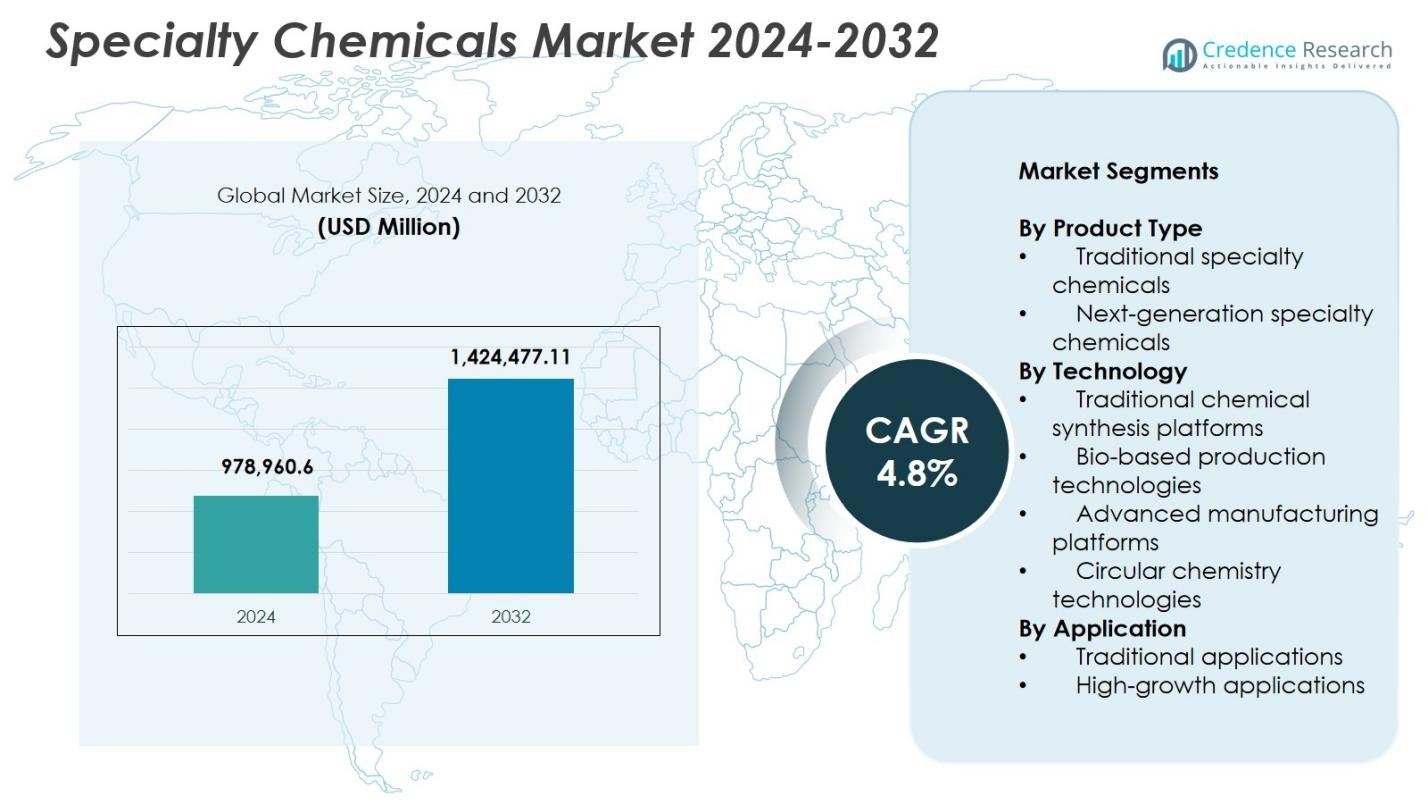
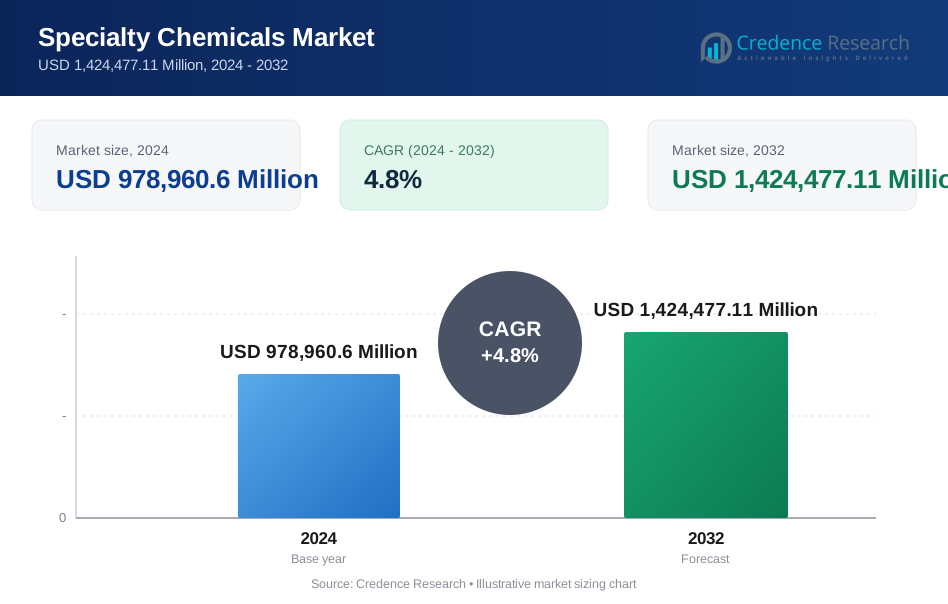
Specialty Chemicals Market size was valued at USD 978,960.6 Million in 2024 and is anticipated to reach USD 1,424,477.11 Million by 2032, at a CAGR of 4.8% during the forecast period.
| REPORT ATTRIBUTE | DETAILS |
|---|---|
| Historical Period | 2020-2023 |
| Base Year | 2024 |
| Forecast Period | 2025-2032 |
| Specialty Chemicals Market Size 2024 | USD 978,960.6 Million |
| Specialty Chemicals Market, CAGR | 4.8% |
| Specialty Chemicals Market Size 2032 | USD 1,424,477.11 Million |
Specialty Chemicals Market is driven by leading producers such as Arkema, Huntsman Corporation, BASF SE, Croda International, LANXESS, Dow Inc., Solvay, Evonik Industries, Ashland, and Clariant AG, all of whom focus on advanced formulations, sustainable materials, and high-performance chemical solutions. These companies strengthen their positions through product innovation, R&D expansion, and increased manufacturing capabilities across high-growth sectors. Regionally, Asia-Pacific leads the market with 38.8% share, supported by rapid industrialization and expansive manufacturing ecosystems. North America follows with 27.6% share, while Europe holds 24.3% share, driven by strong regulations and technological advancements in specialty chemical production.
Market Insights
- The Specialty Chemicals Market reached USD 978,960.6 Million in 2024 and will grow at a CAGR of 4.8% through 2032.
- Rising demand from electronics, automotive, construction, and renewable energy sectors drives the market, with traditional specialty chemicals holding a 62.4% share due to widespread industrial use.
- Key trends include expansion of bio-based solutions, circular chemistry adoption, and strong growth in high-purity chemicals for semiconductors, EV batteries, and advanced manufacturing applications.
- Leading players such as Arkema, BASF SE, Dow Inc., Solvay, LANXESS, and Evonik Industries focus on innovation, sustainability investments, and capacity expansion to strengthen global presence.
- Asia-Pacific leads with 38.8% share, followed by North America at 27.6% and Europe at 24.3%, while Latin America and Middle East & Africa grow steadily; traditional applications dominate with 58.9% share across end-use industries.
Market Segmentation Analysis:
By Product Type:
The Specialty Chemicals Market exhibits strong momentum across product categories, with traditional specialty chemicals dominating with 62.4% share in 2024 due to their extensive use in coatings, construction chemicals, adhesives, agrochemicals, and personal care formulations. Their entrenched industrial relevance, proven performance consistency, and established global supply chains continue to drive large-scale adoption. Meanwhile, next-generation specialty chemicals gain traction as industries shift toward high-performance, sustainable, and functionally advanced materials. Growth in electronics, renewable energy systems, and lightweight composites further accelerates adoption of innovative formulations, offering long-term opportunities in niche, technology-driven applications.
- For instance, BASF's Joncryl 910 acrylic resin enables fast-drying polyurethane coatings for metal and plastic components, achieving VOC levels as low as 3.2 pounds per gallon while offering excellent gloss retention in South Florida weathering tests.
By Technology:
Within technology segmentation, traditional chemical synthesis platforms led the market with 55.7% share in 2024, supported by their scalability, cost efficiency, and widespread deployment across industrial production lines. These platforms remain integral for bulk formulations and legacy product lines. However, bio-based production technologies and circular chemistry platforms are expanding rapidly as manufacturers prioritize decarbonization, waste valorization, and renewable feedstock integration. Advanced manufacturing technologies such as process intensification, continuous flow systems, and AI-enabled optimization enhance precision, yield improvement, and resource efficiency, driving substantial transformation across specialty chemical production ecosystems.
- For instance, Cargill's QIRA bio-BDO plant in Iowa employs a single-step fermentation process using corn-derived sugars for commercial-scale production of this plastic precursor.
By Application:
In the application landscape, traditional applications accounted for 58.9% share in 2024, driven by large-scale consumption in automotive, construction, manufacturing, agriculture, and consumer product industries. Demand is supported by rising urbanization, infrastructure growth, and expanding industrial output. High-growth applications, including electronics materials, battery chemicals, advanced composites, semiconductor-grade chemistries, and performance materials for renewable energy, are witnessing strong acceleration. The surge in electric mobility, miniaturization trends, and high-performance engineering materials boosts adoption, positioning these emerging applications as major contributors to future revenue expansion and technology-driven market diversification.
Key Growth Drivers
Rising Demand from High-Performance and Specialty End-Use Industries
The Specialty Chemicals Market benefits from accelerating demand across high-performance sectors such as electronics, automotive, renewable energy, construction, and advanced manufacturing. Industries increasingly rely on specialty formulations for improved durability, efficiency, precision, and sustainability. Growth in electric vehicles, semiconductor production, lightweight materials, and infrastructure upgrades continues to elevate consumption. Manufacturers prioritize tailored chemical solutions that enhance product functionality and regulatory compliance. This expanding dependence on performance-driven materials strengthens market growth and supports continuous innovation in specialty chemical offerings.
- For instance, Himadri Speciality Chemical partners with Sicona to localize and commercialize SiCx® silicon-carbon anode technology for lithium-ion batteries in electric vehicles. When blended with graphite at 5–20%, SiCx® boosts energy density by 20% and charging speed by 40%.
Shift Toward Sustainable and Bio-Based Chemical Solutions
Global sustainability mandates and stricter environmental regulations drive strong adoption of bio-based and low-emission specialty chemicals. Industries are transitioning toward renewable feedstocks, biodegradable additives, green solvents, and energy-efficient manufacturing platforms to reduce carbon footprints and align with circular economy targets. Government incentives and corporate ESG commitments further accelerate this shift. Companies increasingly invest in bio-catalysis, fermentation technologies, and waste-derived chemistry to create high-value sustainable products. This transition reshapes supply chains, stimulates R&D investments, and opens new opportunities for eco-friendly specialty chemical innovations.
- For instance, LANXESS has transitioned the production of benzoic acid, benzaldehyde, benzyl alcohol, and sodium benzoate at its Botlek site in the Netherlands to low-emission electricity, eliminating fossil fuels and reducing the carbon footprint of these essential ingredients for food, beverages, and personal care products.
Rapid Technological Advancements in Production Platforms
Technological progress in chemical synthesis, process intensification, automation, AI-enabled optimization, and continuous flow manufacturing significantly strengthens market productivity and cost efficiency. These innovations enhance precision, reduce waste, shorten production cycles, and enable scalable customization for niche applications. Advanced manufacturing also improves regulatory compliance by enabling cleaner, safer, and more controlled production environments. Integration of digital twins, predictive maintenance, and data-driven process control further modernizes operations, allowing manufacturers to meet rising quality expectations. These advancements support robust long-term market expansion.
Key Trends & Opportunities
Expansion of Circular Chemistry and Closed-Loop Material Systems
Circular chemistry is emerging as a transformative trend as manufacturers redesign processes to reduce waste, reuse materials, and valorize industrial byproducts. Companies are increasingly evaluating recyclability, energy efficiency, and end-of-life product impacts. Opportunities arise in solvent recovery systems, waste-to-chemical pathways, and depolymerization technologies that support circular plastics and sustainable materials. Adoption of renewable feedstocks and regenerative production cycles enables both cost savings and compliance with global sustainability regulations. This trend positions specialty chemicals at the center of circular value chain innovation.
- For instance, Lonza's Small Molecules Division recycled 35% of solvents used in its Swiss production processes in 2023, with 20% reused directly in API manufacturing via distillation in 10 columns at its Fine Chemical Complex and seven more at a dedicated recovery plant.
Growing Penetration of Advanced Materials in High-Growth Sectors
Demand for advanced materials such as semiconductor chemicals, battery electrolytes, performance coatings, and lightweight composites is accelerating across emerging industries including EVs, aerospace, semiconductors, and renewable energy. These materials enable superior thermal stability, conductivity, energy storage, and structural performance, making them essential for next-generation technologies. Companies investing in ultra-high-purity chemicals, nano-engineered materials, and functional additives gain substantial growth opportunities. This trend expands the market’s technological depth and aligns specialty chemical development with innovation-driven global industries.
- For instance, Mersen's graphite heaters deliver high thermal conductivity and resistance to thermal shock in semiconductor processes like epitaxy and silicon crystal growth, ensuring uniform heating and temperature stability.
Key Challenges
Volatility in Raw Material Prices and Supply Chain Disruptions
The Specialty Chemicals Market faces ongoing challenges due to fluctuating crude oil prices, supply shortages, and geopolitical uncertainties that impact raw material availability. These fluctuations disrupt production planning, inflate operational costs, and pressure margins for manufacturers heavily dependent on petrochemical feedstocks. Global supply chain constraints, logistics delays, and regional trade restrictions further complicate procurement stability. Companies must strengthen supplier diversification, adopt resilient sourcing strategies, and invest in alternative feedstocks to mitigate volatility and maintain consistent market delivery.
Increasing Regulatory Pressure and Compliance Complexity
Stringent environmental regulations, chemical safety standards, and emission control mandates create heavy compliance burdens for specialty chemical manufacturers. Requirements related to REACH, hazardous substance restrictions, green chemistry protocols, and carbon reduction targets drive the need for costly process upgrades and extensive documentation. Meeting regional regulatory variations also complicates global operations and slows product commercialization. These pressures require continuous investment in safer formulations, cleaner production technologies, and rigorous testing procedures, posing substantial challenges to small and medium enterprises in particular.
Regional Analysis
North America
North America held 27.6% share of the Specialty Chemicals Market in 2024, supported by strong demand from automotive, construction, electronics, and oil & gas industries. The region benefits from advanced R&D capabilities, robust manufacturing infrastructure, and rapid adoption of high-performance and sustainable chemical solutions. Growth in EV production, semiconductor investments, and renewable energy expansion further boosts consumption. Regulatory emphasis on cleaner and low-VOC formulations accelerates innovation in bio-based and eco-friendly chemicals. Strategic collaborations and capacity expansions among major producers continue to strengthen the region’s position in specialty materials development.
Europe
Europe accounted for 24.3% share of the Specialty Chemicals Market in 2024, driven by mature industrial ecosystems, stringent environmental regulations, and advanced technological capabilities. The region leads in sustainable specialty chemicals due to strong circular economy mandates and widespread adoption of bio-based production platforms. Demand grows across automotive, packaging, construction, and high-value manufacturing sectors. Increasing investments in green chemistry, recycling technologies, and specialty polymers support long-term market expansion. Continued innovation driven by REACH compliance and carbon reduction targets positions Europe as a key hub for next-generation specialty chemical development.
Asia-Pacific
Asia-Pacific dominated with 38.8% share in 2024, making it the largest regional market for specialty chemicals. Rapid industrialization, expanding manufacturing bases, rising construction activity, and significant growth in electronics, automotive, and consumer goods sectors fuel strong demand. China, India, Japan, and South Korea act as major production and consumption centers. Government initiatives promoting industrial modernization, renewable energy, and advanced materials manufacturing further accelerate market penetration. Increasing investments from global chemical companies in capacity expansion, R&D centers, and technology partnerships reinforce Asia-Pacific’s leadership in specialty chemical production and innovation.
Latin America
Latin America captured 5.4% share of the Specialty Chemicals Market in 2024, supported by growing demand from agriculture, mining, construction, and consumer product industries. Brazil and Mexico drive the majority of consumption due to expanding manufacturing activity and rising investments in infrastructure development. Growth in agrochemicals, performance coatings, and personal care formulations enhances regional opportunities. However, supply chain inefficiencies and economic fluctuations remain challenges. Increasing adoption of sustainable and high-performance specialty chemicals, supported by regional industrial modernization initiatives, contributes to the market’s steady progress across Latin America.
Middle East & Africa
The Middle East & Africa region accounted for 3.9% share in 2024, driven by rising industrial diversification, rapid infrastructure expansion, and strong demand from oil & gas, construction, water treatment, and mining sectors. The region’s petrochemical advantage supports cost-effective specialty chemical production, while increasing adoption of advanced materials in energy, transportation, and manufacturing drives additional growth. Investments in downstream chemical projects, renewable energy infrastructure, and industrial transformation programs, particularly in GCC countries, strengthen market potential. Despite regulatory variations and logistical constraints, the region continues to expand its specialty chemicals footprint.
Market Segmentations:
By Product Type
- Traditional specialty chemicals
- Next-generation specialty chemicals
By Technology
- Traditional chemical synthesis platforms
- Bio-based production technologies
- Advanced manufacturing platforms
- Circular chemistry technologies
By Application
- Traditional applications
- High-growth applications
By Geography
- North America
- U.S.
- Canada
- Mexico
- Europe
- Germany
- France
- U.K.
- Italy
- Spain
- Rest of Europe
- Asia Pacific
- China
- Japan
- India
- South Korea
- South-east Asia
- Rest of Asia Pacific
- Latin America
- Brazil
- Argentina
- Rest of Latin America
- Middle East & Africa
- GCC Countries
- South Africa
- Rest of the Middle East and Africa
Competitive Landscape
Competitive landscape in the Specialty Chemicals Market features major players such as BASF SE, Dow Inc., Clariant AG, Evonik Industries, Solvay, Huntsman Corporation, LANXESS, Ashland, Croda International, and Arkema, each leveraging robust R&D capabilities and global production networks to strengthen their market positions. These companies focus on high-performance formulations, sustainable chemistry, and advanced manufacturing technologies to address evolving industrial demands. Strategic initiatives such as mergers, acquisitions, partnerships, and capacity expansions enable them to enhance portfolios and enter high-growth segments including electronics materials, battery chemicals, bio-based additives, and advanced composites. Increasing emphasis on ESG compliance drives investment in renewable feedstocks, circular chemistry platforms, and low-emission production systems. Players also prioritize digital transformation through AI-enabled process optimization and continuous manufacturing to improve operational efficiency. As end-use industries shift toward lightweight, durable, and environmentally friendly materials, leading manufacturers intensify innovation efforts to maintain technological leadership and long-term growth momentum in specialty chemicals.
Key Player Analysis
- Arkema
- Huntsman Corporation
- BASF SE
- Croda International
- LANXESS
- Dow Inc.
- Solvay
- Evonik Industries
- Ashland
- Clariant AG
Recent Developments
- In October 2025, Bhageria Industries Ltd. launched a new product line of plasticizers and ethoxylates, enhancing polymer properties for diverse applications while expanding its specialty chemicals portfolio through sustainable manufacturing.
- In June 2025, DCM Shriram Ltd. approved the acquisition of Hindusthan Specialty Chemicals Ltd. for Rs 375 crore ($44 million), enabling entry into advanced materials for sectors like renewables, aerospace, and electric vehicles.
- In March 2025, Evonik Industries signed an exclusive U.S. distribution agreement with Sea‑Land Chemical Company for its cleaning solutions, significantly expanding its reach in the American home-care and institutional cleaning markets.
Report Coverage
The research report offers an in-depth analysis based on Product Type, Technology, Application and Geography. It details leading market players, providing an overview of their business, product offerings, investments, revenue streams, and key applications. Additionally, the report includes insights into the competitive environment, SWOT analysis, current market trends, as well as the primary drivers and constraints. Furthermore, it discusses various factors that have driven market expansion in recent years. The report also explores market dynamics, regulatory scenarios, and technological advancements that are shaping the industry. It assesses the impact of external factors and global economic changes on market growth. Lastly, it provides strategic recommendations for new entrants and established companies to navigate the complexities of the market.
Future Outlook
- The market will experience steady growth driven by rising demand for high-performance materials across advanced manufacturing sectors.
- Adoption of bio-based and sustainable specialty chemicals will accelerate as industries align with global decarbonization goals.
- Advanced manufacturing technologies will enhance production efficiency and support high-purity specialty chemical development.
- Circular chemistry practices will expand as companies prioritize recycling, waste reduction, and renewable feedstocks.
- High-growth applications in electronics, EV batteries, semiconductors, and renewable energy will strengthen market momentum.
- Digital transformation will improve process optimization, product customization, and supply chain resilience.
- Regulatory pressure will encourage innovation in low-emission, safe, and environmentally compliant chemical solutions.
- Strategic mergers, acquisitions, and partnerships will increase as companies seek portfolio diversification and global expansion.
- Emerging economies will play a larger role in production and consumption due to rapid industrialization.
- Investment in R&D for novel chemistries and functional additives will intensify to meet evolving industry performance demands.
Request a Free Sample
Fill in your details and we'll send you a free sample report.
- Sample data tables & charts
- Research methodology
Need a Custom Version of This Report?
Tailor the scope, geography, or segments to your exact requirements.
- Custom geography or segment scope
- Direct access to our analyst team
Frequently Asked Questions
What is the current market size for Specialty Chemicals Market, and what is its projected size in 2032?
At what Compound Annual Growth Rate is the Specialty Chemicals Market projected to grow between 2024 and 2032?
Which Specialty Chemicals Market segment held the largest share in 2024?
What are the primary factors fueling the growth of the Specialty Chemicals Market?
Who are the leading companies in the Specialty Chemicals Market?
Which region commanded the largest share of the Specialty Chemicals Market in 2024?
Table of Content
Chapter 1. Report Introduction
- 1.1 Report Description & Purpose
- 1.1.1 Report Title & Market Definition
- 1.1.2 Unique Selling Propositions (USP) & Key Differentiators
- 1.1.3 Value Proposition for Stakeholders
- 1.2 Research Objectives
- 1.2.1 Market Sizing Objectives (Volume & Revenue) (Volume Where Applicable)
- 1.2.2 Segmentation Objectives
- 1.2.3 Competitive Intelligence Objectives
- 1.2.4 Forecast & Scenario Objectives
- 1.3 Report Scope
- 1.3.1 Specialty Chemicals Scope – Segments & Subsegments Covered
- 1.3.2 Geographic Scope – Regions & Countries Covered
- 1.3.3 Historical Period, Base Year & Forecast Period (2024; forecast to 2032)
- 1.3.4 Inclusions & Exclusions
- 1.4 Industry Classification & Applicable Codes
- 1.5 Currency, Measurement Units & Valuation Basis
- 1.6 Target Stakeholders
- 1.7 Limitations & Assumptions
Chapter 2. Executive Summary
- 2.1 Global Specialty Chemicals Market Snapshot
- 2.1.1 Market Size – Historical (2024) & Forecast (2024-2032) (2024: USD 978,960.6 Million → 2032: USD 1,424,477.11 Million)
- 2.1.2 Volume & Revenue – Global Totals (Volume Where Applicable)
- 2.1.3 Key Market Highlights – Top Five Facts
- 2.2 Specialty Chemicals Market Segmentation Snapshot
- 2.2.1 Market Split by Region – 2024 vs. 2032
- 2.3 Competitive Snapshot
- 2.3.1 Top 10 Players by Revenue Share – 2024
- 2.3.2 Top 10 Players by Volume Share – 2024 (Volume Where Applicable)
- 2.3.3 Recent Strategic Developments (18-Month Summary)
- 2.4 Key Investment Highlights & Strategic Conclusions
Chapter 3. Specialty Chemicals Market Dynamics & Industry Analysis
- 3.1 Market Overview & Context
- 3.1.1 Specialty Chemicals Market Position in the Broader Industry Value Chain
- 3.1.2 Demand Structure & Purchasing Dynamics
- 3.1.3 Market Maturity & Development Stage by Region
- 3.2 Specialty Chemicals Market Drivers
- 3.3 Specialty Chemicals Market Restraints & Challenges
- 3.4 Specialty Chemicals Market Opportunities
- 3.5 Porter's Five Forces Analysis
- 3.5.1 Threat of New Entrants
- 3.5.2 Bargaining Power of Suppliers
- 3.5.3 Bargaining Power of Buyers
- 3.5.4 Threat of Substitutes
- 3.5.5 Competitive Rivalry – Intensity Assessment
- 3.6 Specialty Chemicals Value Chain Analysis
- 3.6.1 Upstream – Key Inputs, Resources & Suppliers
- 3.6.1.1 Key Input/Resource 1
- 3.6.1.2 Key Input/Resource 2
- 3.6.1.3 Key Input/Resource 3
- 3.6.2 Midstream – Core Operations & Value Creation
- 3.6.2.1 Operating Model & Process Overview
- 3.6.2.2 Key Operating Locations & Capabilities by Company
- 3.6.3 Downstream – Market Channels & End Users
- 3.6.3.1 Direct Sales & Customer Engagement Channels
- 3.6.3.2 Indirect Sales, Intermediaries & Partner Channels
- 3.6.4 Value Chain Profitability Analysis
- 3.6.1 Upstream – Key Inputs, Resources & Suppliers
- 3.7 PESTEL Analysis
- 3.7.1 Political Factors
- 3.7.2 Economic Factors
- 3.7.3 Social Factors
- 3.7.4 Technological Factors
- 3.7.5 Environmental Factors
- 3.7.6 Legal Factors
- 3.8 Specialty Chemicals Supply Chain Analysis
- 3.8.1 Critical Input & Resource Availability Risk Assessment
- 3.8.2 Supplier & Operational Concentration Risk (Geographic Exposure)
- 3.8.3 Supply & Service Disruption Impact Analysis
- 3.9 Regulatory & Policy Landscape
Note: The regulatory and policy landscape section covers regulations based on their applicability to the market, Specialty Chemicals category, geography, and scope of the study. Only regulatory frameworks with a material impact on operations, compliance, trade, sustainability, or market access are analyzed in detail.
Chapter 4. Key Investment Pockets & Opportunity Analysis
- 4.1 Specialty Chemicals Market Attractiveness Analysis
- 4.1.1 By Region – Investment Attractiveness Matrix (Market Size × CAGR)
- 4.2 Absolute Revenue Growth Opportunity
- 4.2.1 By Region – Absolute Revenue Growth Through 2032
- 4.3 Incremental Demand Opportunity
- 4.3.1 By Region – Incremental Demand Through 2032
- 4.3.2 Segment – Incremental Demand
- 4.4 Emerging Submarket Opportunity Deep Dive (Subject to Applicability)
- 4.5 Priority Market Opportunity Scorecards
- 4.5.1 United States
- 4.5.2 Europe
- 4.5.3 Asia
- 4.5.4 Middle East & Africa
Note: Priority market opportunity scorecards reflect the geographic scope and strategic relevance of the study. Listed markets are indicative and may be adapted to the industry.
Chapter 5. Specialty Chemicals Cross-Border Trade & Market Access Analysis
- 5.1 International Trade & Cross-Border Activity Overview
- 5.1.1 Global Export Value by Country (2024)
- 5.1.2 Global Export Volume by Country (2024) (Volume Where Applicable)
- 5.1.3 Global Import Value by Country (2024)
- 5.1.4 Global Import Volume by Country (2024) (Volume Where Applicable)
- 5.1.5 Net Trade Balance by Country (2024)
- 5.2 Export Analysis – Segment
- 5.2.1 Category 1 (Applicable Classification Code)
- 5.2.2 Category 2 (Applicable Classification Code)
- 5.2.3 Category 3 (Applicable Classification Code)
- 5.2.4 Category 4 (Applicable Classification Code)
- 5.2.5 Category 5 (Applicable Classification Code)
- 5.3 Import Analysis – Segment
- 5.3.1 Category 1 (Applicable Classification Code)
- 5.3.2 Category 2 (Applicable Classification Code)
- 5.3.3 Category 3 (Applicable Classification Code)
- 5.3.4 Category 4 (Applicable Classification Code)
- 5.3.5 Category 5 (Applicable Classification Code)
- 5.4 Cross-Border Pricing & Transaction Benchmarks
- 5.4.1 Export Pricing – Segment & Country
- 5.4.2 Import Pricing – Segment & Source Country
- 5.4.3 Price Trends (2024)
- 5.5 Key Cross-Border Trade & Delivery Routes
- 5.5.1 Cross-Border Trade/Delivery Route 1
- 5.5.2 Cross-Border Trade/Delivery Route 2
- 5.5.3 Cross-Border Trade/Delivery Route 3
- 5.5.4 Cross-Border Trade/Delivery Route 4
- 5.5.5 Cross-Border Trade/Delivery Route 5
- 5.6 Trade Policy & Market Access Impact Assessment
- 5.6.1 Tariff & Non-Tariff Barriers
- 5.6.2 Regional Trade & Economic Integration Frameworks
- 5.6.3 Bilateral & Multilateral Trade Agreements
- 5.6.4 Cross-Border Operating, Licensing & Localization Requirements
Note: This chapter applies where cross-border trade or delivery is relevant to Specialty Chemicals. Goods, services, and digital offerings are assessed using applicable classifications and transaction measures. Import-export volumes, trade balances, and route analyses are included only where meaningful to the market.
Chapter 6. Competitive Landscape & Company Benchmarking
- 6.1 Specialty Chemicals Market Concentration & Structure
- 6.1.1 Herfindahl-Hirschman Index (HHI) – vs. 2024
- 6.1.2 Leading, Mid-Sized & Emerging Player Structure
- 6.1.3 Global, Regional & Local Player Dynamics
- 6.2 Specialty Chemicals Market Share Analysis – 2024
- 6.2.1 Global Revenue Share by Company
- 6.2.2 Global Volume Share by Company (Volume Where Applicable)
- 6.2.3 Regional Revenue Share
- 6.2.4 Market Share Evolution ( vs. 2024)
- 6.2.5 Company Market Share by Key Segment
- 6.2.6 Company Market Share by Customer Group
- 6.3 Operating Scale, Capacity & Infrastructure Analysis
- 6.3.1 Global Operating Scale & Supply Capacity
- 6.3.2 Resource Utilization & Operating Efficiency
- 6.3.3 Output, Service Delivery & Activity Metrics
- 6.3.4 Operating Footprint & Infrastructure Map
- 6.3.5 Planned Operational & Capacity Expansion
- 6.4 Specialty Chemicals Competitive Benchmarking Matrix
- 6.4.1 Revenue, Growth, Profitability & Operating Metric Comparison
- 6.4.2 Channel Revenue Mix
- 6.4.3 Geographic Revenue Exposure
- 6.4.4 R&D Intensity
- 6.4.5 Sustainability Maturity
- 6.5 Strategic Developments in Specialty Chemicals (Last 24 Months)
- 6.5.1 Mergers, Acquisitions & Divestments
- 6.5.2 New Products, Services & Solutions in Specialty Chemicals
- 6.5.3 Operational & Infrastructure Expansions
- 6.5.4 Strategic Alliances, Joint Ventures & Partnerships
- 6.5.5 Distribution Expansion & Market Entry
- 6.5.6 Sustainability & ESG Initiatives
- 6.6 Competitive Strategy Mapping
- 6.6.1 Leader, Challenger, Follower & Niche Classification
- 6.6.2 Pricing Strategy Comparison
- 6.6.3 Channel Strategy Matrix
Note: Strategic developments are included based on their materiality and the availability of reliable information.
Chapter 7. Global Specialty Chemicals Market – By Sales & Delivery Channel
- 7.1 Segment Overview
- 7.1.1 Volume & Revenue Split by Channel (2024 & 2032) (Volume Where Applicable)
- 7.1.2 Channel Mix Evolution (2024-2032)
Chapter 8. Regional Market Analysis – Global Overview
- 8.1 Global Regional Overview
- 8.1.1 Regional Volume Share (Volume Where Applicable)
- 8.1.2 Regional Revenue Share
- 8.1.3 Regional Volume by Region (Volume Where Applicable)
- 8.1.4 Regional Revenue by Region
- 8.1.5 Regional Forecast Through 2032
- 8.2 Cross-Regional Segment Analysis
- 8.2.1 By Sales & Delivery Channel
- 8.2.2 By Competitive Positioning & Price Tier
Chapter 9. North America Specialty Chemicals Market
- 9.1 United States
- 9.2 Canada
- 9.3 Mexico
Chapter 10. Europe Specialty Chemicals Market
- 10.1 Germany
- 10.2 France
- 10.3 Italy
- 10.4 United Kingdom
- 10.5 Spain
- 10.6 Poland
- 10.7 Russia
- 10.8 Netherlands
- 10.9 Belgium
- 10.10 Sweden
- 10.11 Denmark
- 10.12 Norway
- 10.13 Rest of Europe
Chapter 11. Asia Pacific Specialty Chemicals Market
- 11.1 China
- 11.2 India
- 11.3 Japan
- 11.4 South Korea
- 11.5 Thailand
- 11.6 Indonesia
- 11.7 Vietnam
- 11.8 Malaysia
- 11.9 Australia
- 11.10 Rest of Asia Pacific
Chapter 12. Latin America Specialty Chemicals Market
- 12.1 Brazil
- 12.2 Argentina
- 12.3 Colombia
- 12.4 Chile
- 12.5 Rest of Latin America
Chapter 13. Middle East Specialty Chemicals Market
- 13.1 Saudi Arabia
- 13.2 United Arab Emirates
- 13.3 Turkey
- 13.4 Israel
- 13.5 Iran
- 13.6 Rest of the Middle East
Chapter 14. Africa Specialty Chemicals Market
- 14.1 South Africa
- 14.2 Egypt
- 14.3 Nigeria
- 14.4 Morocco
- 14.5 Rest of Africa
Chapter 15. Specialty Chemicals Company Profiles
- 15.1 [Company 01]
- 15.1.1 Company Overview
- 15.1.2 Key Management Personnel
- 15.1.3 Products & Services Portfolio
- 15.1.4 Financial Performance
- 15.1.5 Key Market Focus & Geographic Presence
- 15.1.6 Recent Developments & Strategic Initiatives
Note: The company profile list is preliminary and may change based on research findings, market developments, data availability, and client requirements.
Chapter 16. Appendices
- Appendix A – List of Abbreviations & Acronyms
- Appendix B – Industry Classification Code Reference – Full Series
- Appendix C – Supply, Output & Operating Capacity Data Tables
- Appendix D – End-Use & Demand Base Tables
- Appendix E – Demand, Adoption & Usage Assumptions
- Appendix F – Pricing & Revenue Metric Reference Tables
- Appendix G – Company Operations & Infrastructure Database
- Appendix H – Cross-Border Trade & Activity Data Tables (Where Applicable)
- Appendix I – Regulatory Summary Tables
- Appendix J – Primary Research Participant List (Anonymized)
- Appendix K – Primary Research Questionnaire Framework
- Appendix L – Data Sources & Bibliography
- Appendix M – Market Size Divergence & Source Comparison
Chapter 17. Research Methodology
- 17.1 Research Framework & Philosophy
- 17.2 Secondary Research – Sources, Hierarchy & Data Extraction
- 17.3 Data Modeling – Bottom-Up & Top-Down Market Sizing
- 17.4 Primary Research – Stakeholder Framework, LOI & Sample Sizes
- 17.5 Forecast Methodology – Regression, Scenario & Sensitivity Analysis
- 17.6 Quality Control – Four-Layer Validation Framework
- 17.7 Limitations & Standard Assumptions
- 17.8 Disclaimer
