
| REPORT ATTRIBUTE | DETAILS |
|---|---|
| Historical Period | 2020-2023 |
| Base Year | 2024 |
| Forecast Period | 2025-2032 |
| Oil Storage Terminal Market Size 2024 | USD 2,760.39 Million |
| Oil Storage Terminal Market, CAGR | 2.65% |
| Oil Storage Terminal Market Size 2032 | USD 3,402.66 Million |
Market Overview:
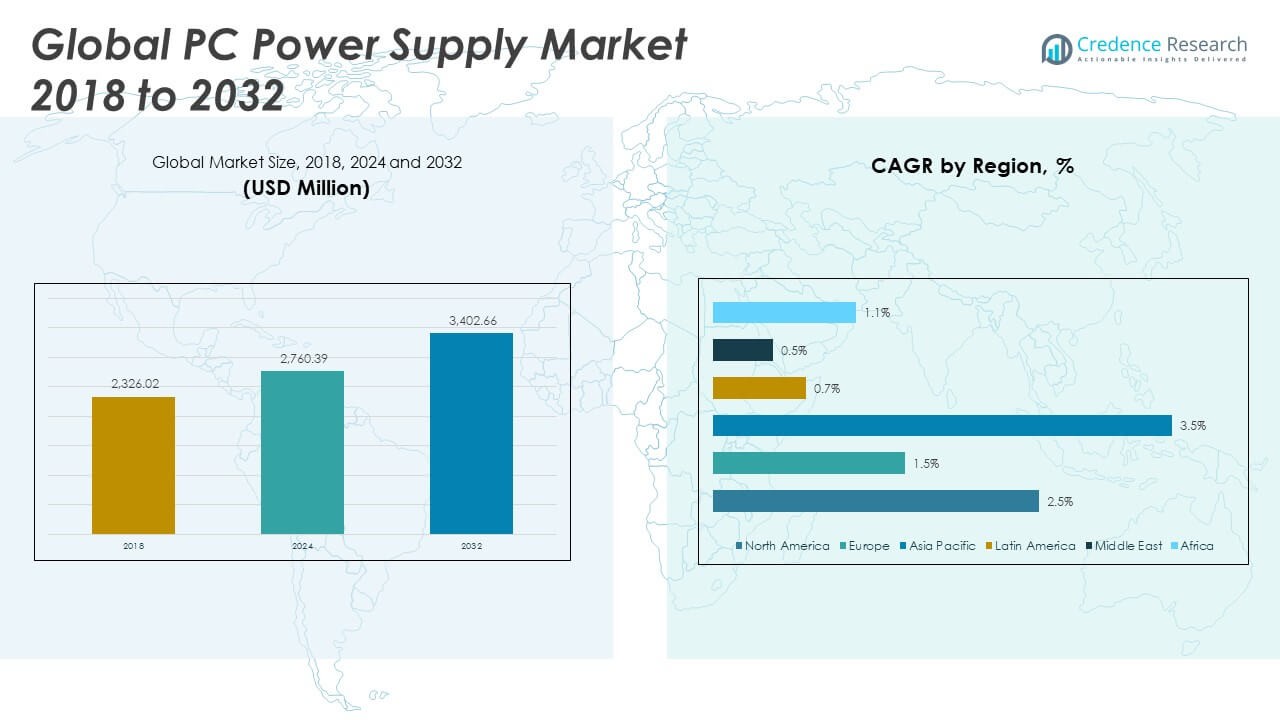
The Global PC Power Supply Market size was valued at USD 2,326.02 million in 2018 to USD 2,760.39 million in 2024 and is anticipated to reach USD 3,402.66 million by 2032, at a CAGR of 2.65% during the forecast period.
Several key factors are contributing to the expansion of the PC power supply market. Firstly, the increasing adoption of cloud-based services necessitates robust and efficient power supplies to support data centers and high-performance computing systems. Secondly, the rise in gaming and eSports has led to a surge in demand for high-wattage, modular, and energy-efficient power supplies that cater to the needs of gaming enthusiasts and professionals. Additionally, the growing emphasis on energy efficiency and the adoption of 80 Plus certification standards are encouraging consumers to invest in power supplies that offer better performance and lower energy consumption. Lastly, technological advancements in power supply design, such as the development of fully modular PSUs, are enhancing user experience by providing greater customization and cable management options.
Regionally, the PC power supply market exhibits varied dynamics influenced by technological advancements, manufacturing capabilities, and consumer preferences. The Asia-Pacific region, particularly countries like China, Japan, and India, holds a significant share of the market due to rapid industrialization, urbanization, and technological development. North America follows closely, with its strong tech industry presence and increasing investments in data centers and IT infrastructure. Europe also plays a crucial role, driven by a focus on energy efficiency and sustainability, which propels demand for innovative power supply solutions. Emerging markets in Latin America and the Middle East are witnessing growth as well, spurred by rising disposable incomes and the expansion of digital infrastructure. However, these regions face challenges such as economic volatility and infrastructure limitations that may impact market growth.
Market Insights:
- The Global PC Power Supply Market grew from USD 2,326.02 million in 2018 to USD 2,760.39 million in 2024 and is expected to reach USD 3,402.66 million by 2032, with a CAGR of 2.65%.
- Increasing adoption of cloud services drives demand for robust, efficient power supplies to support data centers and high-performance computing.
- Growth in gaming and eSports fuels the need for high-wattage, modular, and energy-efficient power supplies tailored to gaming enthusiasts and professionals.
- Energy efficiency standards like 80 Plus certification encourage consumers to prefer power supplies with better performance and reduced energy consumption.
- Technological innovations such as fully modular PSUs and smart monitoring enhance user experience through customization and improved cable management.
- Asia-Pacific leads the market share due to rapid industrialization, urbanization, and technological progress in countries like China, Japan, and India; North America and Europe follow with strong tech sectors and energy efficiency focus.
- Challenges include supply chain disruptions, component standardization issues, and stringent regulatory compliance, which require manufacturers to balance cost, quality, and sustainability efforts.
Market Drivers:
Surging Demand for High-Performance Computing Systems
The rising demand for high-performance computing systems fuels the expansion of the Global PC Power Supply Market. Increased adoption of gaming PCs and workstations that require stable and efficient power delivery creates a strong need for advanced power supply units (PSUs). Consumers and professionals seek power supplies with higher wattage ratings, modular designs, and enhanced cooling features to support resource-intensive applications. The growing popularity of esports and immersive gaming experiences further drives demand for reliable PSUs that maintain system stability during prolonged usage. The surge in remote working and virtual collaboration accelerates the deployment of powerful personal computers, directly impacting PSU consumption. Manufacturers respond by innovating power supplies that balance performance, energy efficiency, and user convenience.
Impact of Energy Efficiency Standards and Environmental Regulations
Energy efficiency standards and environmental regulations play a crucial role in shaping market growth. The Global PC Power Supply Market experiences increasing pressure to conform to certifications such as 80 Plus and ENERGY STAR, which promote reduced power wastage and carbon footprints. Consumers increasingly prioritize eco-friendly products that minimize electricity consumption without compromising performance. Regulatory bodies worldwide enforce stringent energy guidelines, compelling manufacturers to develop power supplies with improved efficiency ratings. These regulations drive research into power supply architectures that reduce heat generation and extend product lifespan. This shift towards sustainability aligns with corporate social responsibility goals and enhances market competitiveness.
Technological Advancements Enhancing Power Supply Performance
Technological advancements in PSU design contribute significantly to market development. Innovations such as fully modular cables, hybrid fan control, and enhanced voltage regulation improve both usability and system reliability. The Global PC Power Supply Market benefits from the integration of smart features like real-time monitoring and customizable settings through software interfaces. These improvements help reduce system noise and optimize power delivery tailored to specific hardware configurations. Manufacturers also experiment with materials and components that increase durability and thermal management. Continuous refinement in PSU technologies supports the increasing complexity of modern computing devices, meeting the expectations of both enthusiasts and enterprise users.
FSP Group, for instance, has launched ATX 3.1-compliant power supplies like the FSP850-50AFB, supporting PCIe Gen5 applications with 12V 2X6 connectors for seamless power delivery in AI edge computing and high-performance servers.
Expansion of Data Centers and Digital Infrastructure
The growth of data centers and cloud computing infrastructure exerts a notable impact on power supply demand. Although the Global PC Power Supply Market primarily focuses on personal computing devices, the trend toward hybrid work environments drives investment in high-efficiency power units for home office setups. Data centers require power solutions that ensure uninterrupted operation and energy optimization, influencing innovations that trickle down to consumer-grade PSUs. The expansion of edge computing and IoT devices also creates opportunities for versatile and compact power supplies. Increasing digitalization across sectors underscores the need for reliable, efficient, and adaptable power delivery solutions to sustain evolving computing demands globally.
A notable example in the data center sector is Texas Instruments' (TI) launch of the TPS1685, the industry’s first 48V integrated hot-swap eFuse with power-path protection, showcased at APEC 2025. This component enables data centers to reach power levels beyond 6kW while maximizing protection and efficiency for high-density AI and HPC workloadsMarket Trends:
Increasing Adoption of Modular and Fully Modular Power Supply Units
The Global PC Power Supply Market demonstrates a clear trend toward modular and fully modular power supply units (PSUs). Users prefer these designs because they provide better cable management, improved airflow, and easier installation or upgrades. Fully modular PSUs allow users to connect only the cables they need, reducing clutter and enhancing system aesthetics. This trend caters specially to gaming enthusiasts, system builders, and professionals who prioritize both performance and neat configurations. Manufacturers continue to innovate by introducing lightweight, compact modular PSUs with enhanced durability and efficient connectors. The shift toward modularity reflects consumer demand for customization and optimized system builds.
Rising Focus on Energy Efficiency and 80 Plus Certification
Energy efficiency remains a critical trend influencing the Global PC Power Supply Market. Power supplies that meet or exceed 80 Plus certification standards gain preference in the market. The certification ensures reduced power loss, lower heat generation, and less energy consumption. It appeals to environmentally conscious consumers and organizations aiming to reduce operational costs. Power supply makers improve internal components and circuit designs to achieve platinum, titanium, or gold efficiency ratings. This trend aligns with stricter energy regulations worldwide and growing awareness about sustainability. Energy-efficient PSUs not only lower electricity bills but also extend the lifespan of computing components by maintaining stable power delivery.
Integration of Smart Features and Advanced Monitoring Technologies
The integration of smart features and real-time monitoring technologies is gaining traction within the Global PC Power Supply Market. Modern PSUs offer software-based interfaces that allow users to monitor voltage, current, temperature, and fan speeds. This real-time data helps optimize system performance and prevent potential hardware damage due to unstable power supply conditions. Some units include customizable fan curves and alerts for abnormal behavior. These advancements appeal to gamers, content creators, and IT professionals who demand granular control over their PC hardware. The ability to fine-tune power delivery contributes to both user convenience and system reliability, reinforcing the trend toward intelligent power solutions.
For instance, the CORSAIR AX1600i Digital ATX Power Supply features intelligent control via CORSAIR iCUE software, providing real-time voltage and performance monitoring, as well as system-wide RGB lighting synchronization. It delivers over 94% efficiency (80 PLUS Titanium) and includes a zero RPM fan mode for silent operation at low to medium loads.Growing Demand for High-Wattage and Gaming-Oriented Power Supplies
The expanding gaming industry significantly impacts the Global PC Power Supply Market with a growing demand for high-wattage PSUs tailored for gaming PCs and workstations. Modern gaming rigs require power supplies that can handle multiple GPUs, high-performance CPUs, and advanced cooling systems. This trend prompts manufacturers to develop PSUs offering wattages above 750W, along with stable and clean power output. Gaming-focused power supplies often incorporate RGB lighting and enhanced aesthetics to align with gaming culture preferences. The rise in esports, streaming, and professional content creation intensifies the need for reliable power delivery under heavy workloads. Consequently, power supply units evolve to meet the power demands and style preferences of gaming enthusiasts worldwide.
For example, EVGA’s SuperNOVA 1000 P5 is a fully modular, 1000W PSU with 80 Plus Platinum certification, Eco Mode for quiet operation, and a 10-year warranty, designed to support high-performance gaming builds and multiple GPUs.Market Challenges Analysis:
Significant Challenges in Component Standardization and Supply Chain Management Affecting the Global PC Power Supply Market
The Global PC Power Supply Market faces considerable challenges related to component standardization and supply chain disruptions. Diverse hardware configurations across different PC builds require power supplies to meet varied technical specifications, complicating universal compatibility. Manufacturers struggle to maintain consistent quality while catering to both high-end and budget segments. Global supply chain issues, including shortages of key electronic components like capacitors and semiconductors, create production delays and increase costs. Fluctuations in raw material prices and logistical constraints also impact timely delivery and inventory management. These factors limit manufacturers’ ability to scale production efficiently, affecting overall market growth and reliability.
Complex Regulatory Compliance and Environmental Concerns Present Ongoing Market Obstacles
Regulatory compliance and environmental considerations impose ongoing challenges on the Global PC Power Supply Market. Power supplies must adhere to evolving energy efficiency standards and safety certifications across multiple regions, requiring continuous product redesigns and testing. Meeting stringent regulations such as RoHS and WEEE demands sustainable material sourcing and proper end-of-life product management. Non-compliance risks market access restrictions and reputational damage. Balancing regulatory demands with cost pressures forces manufacturers to optimize production without compromising performance. Furthermore, growing consumer awareness of electronic waste and sustainability compels companies to develop eco-friendly power supplies and recycling programs. Navigating these complex requirements remains a critical hurdle for market participants.
For instance, all power supply products sold in the European Union must comply with RoHS (Restriction of Hazardous Substances) directives, which restrict the use of ten hazardous materials in electronic equipment and require CE marking for market access.Market Opportunities:
The Global PC Power Supply Market presents promising opportunities through advancements in power supply technologies and customization options. Increasing demand for modular and fully modular PSUs encourages manufacturers to innovate lightweight, efficient designs with improved thermal management. It allows end-users to tailor power solutions to specific system requirements, enhancing overall performance and user experience. Integration of smart monitoring features and software controls also creates avenues for differentiation. These technological enhancements meet the needs of gamers, content creators, and enterprise users seeking reliability and precision in power delivery.
Emerging geographic markets and expanding computing segments offer significant growth potential for the Global PC Power Supply Market. Rising disposable incomes and digital infrastructure development in regions such as Asia-Pacific, Latin America, and the Middle East increase demand for personal computing devices. It also benefits from the growing popularity of remote work, gaming, and eSports in these areas. Moreover, emerging segments like edge computing and Internet of Things (IoT) require compact and efficient power solutions, creating new market niches. Manufacturers that strategically target these opportunities can capitalize on expanding customer bases and evolving technology trends.
Market Segmentation Analysis:
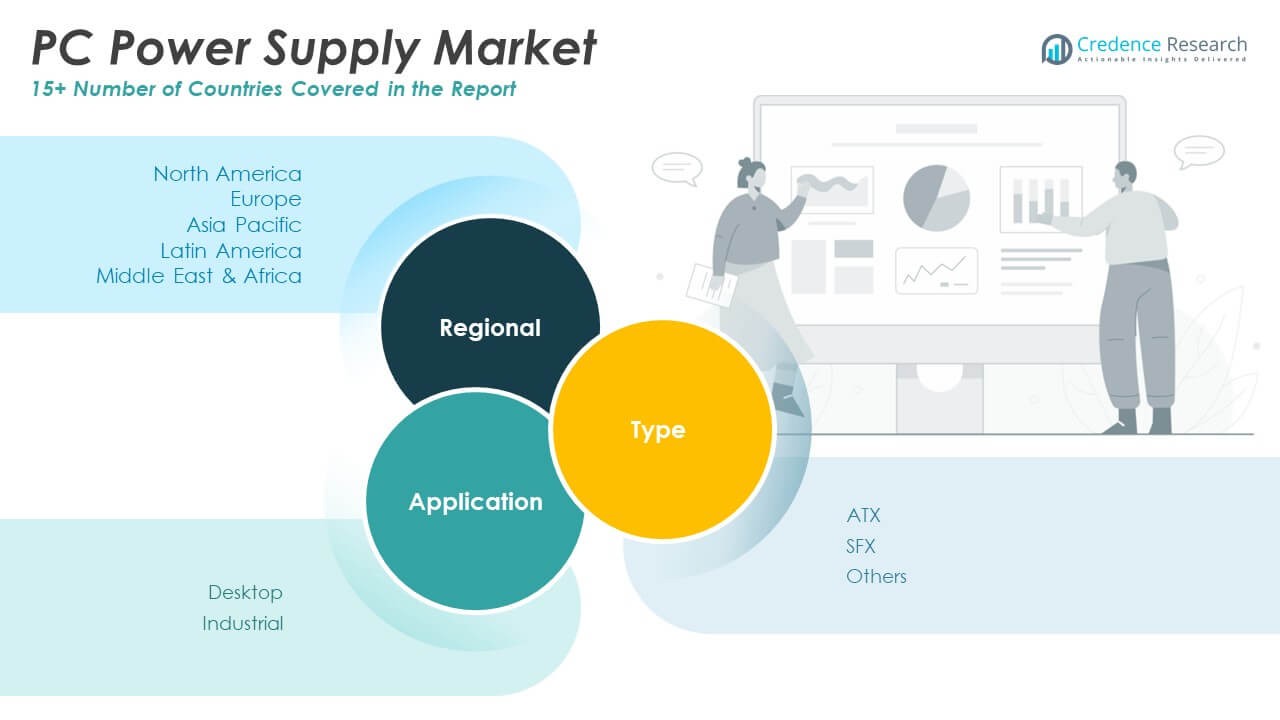
The Global PC Power Supply Market segments
By type primarily include ATX, SFX, and others. Among these, ATX power supplies dominate due to their widespread compatibility with standard desktop computers and their ability to support higher wattage requirements. It remains the preferred choice for both gaming and professional PCs requiring robust power delivery. SFX units cater to compact and small form factor builds, gaining traction with the rise of mini-PCs and space-constrained applications. The "Others" category includes specialized and custom power supply designs tailored for niche requirements, contributing to a smaller yet vital portion of the market.
By application, the Global PC Power Supply Market divides into desktop and industrial segments. The desktop segment represents the largest share, driven by the continuous demand for personal computing, gaming setups, and workstation systems. It focuses on providing efficient, reliable power solutions that match evolving hardware needs. The industrial segment covers power supplies used in manufacturing, automation, and specialized equipment, requiring durable and stable power delivery in demanding environments. Growth in industrial applications reflects broader digitization and automation trends, boosting demand for rugged and reliable power supply units tailored for non-consumer use. Together, these segments define the market’s scope, addressing varied customer needs from everyday computing to specialized industrial use.
Segmentation:
By Type Segment:
- ATX
- SFX
- Others
By Application Segment:
- Desktop
- Industrial
By Region Segment:
- North America
- Europe
- Asia Pacific
- Latin America
- Middle East
- Africa
Regional Analysis:
The North America PC Power Supply Market size was valued at USD 853.10 million in 2018 to USD 999.89 million in 2024 and is anticipated to reach USD 1,236.62 million by 2032, at a CAGR of 2.50% during the forecast period. North America holds a significant market share due to its advanced technology infrastructure and high adoption rate of personal computing devices. It benefits from the presence of major PC and component manufacturers as well as a strong gaming community demanding high-performance power supplies. The region also experiences growth from increased investments in IT infrastructure and remote working solutions. Consumer preference for energy-efficient and modular PSUs further supports market expansion. Continuous innovation and reliable supply chains contribute to maintaining North America’s leading position in the Global PC Power Supply Market.
The Europe PC Power Supply Market size was valued at USD 524.38 million in 2018 to USD 594.08 million in 2024 and is anticipated to reach USD 677.86 million by 2032, at a CAGR of 1.50% during the forecast period. Europe holds a moderate share influenced by stringent energy efficiency regulations and environmental standards. It drives demand for certified and eco-friendly power supplies, pushing manufacturers to innovate in efficiency and sustainability. Mature PC markets across Germany, the UK, and France support steady consumption of power supplies for desktops and industrial applications. The region's cautious economic environment slightly tempers growth, but continued interest in gaming and professional computing sustains demand. Europe’s emphasis on quality and compliance positions it as a critical market in the Global PC Power Supply Market.
The Asia Pacific PC Power Supply Market size was valued at USD 703.47 million in 2018 to USD 879.38 million in 2024 and is anticipated to reach USD 1,178.04 million by 2032, at a CAGR of 3.50% during the forecast period. Asia Pacific commands a growing share driven by rapid urbanization, increasing disposable incomes, and expanding digital infrastructure. Large populations in China, India, and Southeast Asia fuel demand for personal computing devices and gaming equipment. The region also sees significant industrial growth requiring reliable and efficient power supplies. Rising eSports popularity and government initiatives supporting digital transformation further accelerate the market. Competitive manufacturing capabilities and cost advantages attract key PSU manufacturers to the region, reinforcing Asia Pacific’s strong presence in the Global PC Power Supply Market.
The Latin America PC Power Supply Market size was valued at USD 98.98 million in 2018 to USD 115.85 million in 2024 and is anticipated to reach USD 124.56 million by 2032, at a CAGR of 0.70% during the forecast period. Latin America holds a smaller share due to slower technological adoption and economic constraints. It faces challenges such as limited infrastructure and variable consumer spending. However, gradual improvements in digital connectivity and increased demand for desktop and industrial power supplies provide growth potential. Brazil and Argentina lead regional demand driven by expanding gaming communities and enterprise IT upgrades. Localized manufacturing and import dependency influence market dynamics. Latin America remains an emerging market within the Global PC Power Supply Market with opportunities for future expansion.
The Middle East PC Power Supply Market size was valued at USD 69.78 million in 2018 to USD 76.17 million in 2024 and is anticipated to reach USD 80.28 million by 2032, at a CAGR of 0.50% during the forecast period. The Middle East accounts for a modest share supported by increasing adoption of technology and infrastructure development. Government investments in smart cities and data centers contribute to demand for reliable power supplies. It also sees growth from the industrial sector requiring durable power solutions. Political and economic uncertainties limit aggressive expansion. The region’s focus on energy efficiency aligns with global sustainability trends, gradually influencing product requirements. Middle East maintains steady but cautious growth within the Global PC Power Supply Market.
The Africa PC Power Supply Market size was valued at USD 76.30 million in 2018 to USD 95.03 million in 2024 and is anticipated to reach USD 105.29 million by 2032, at a CAGR of 1.10% during the forecast period. Africa holds a relatively small market share, constrained by infrastructure limitations and lower PC penetration. It experiences growth driven by increasing internet access, digital education initiatives, and enterprise IT expansion. South Africa and Egypt emerge as key markets with improving economic conditions. Demand for cost-effective and reliable power supplies in desktop and industrial segments grows gradually. Supply chain challenges and power stability concerns remain obstacles. Africa presents an evolving market opportunity within the Global PC Power Supply Market framework.
Key Player Analysis:
- Delta
- Lite-On
- Chicony
- CWT (Channel Well Technology)
- Acbel
- Great Wall
- FSP
- Huntkey
- Antec
- GIGABYTE
Competitive Analysis:
The Global PC Power Supply Market features intense competition among established manufacturers and emerging players. Leading companies such as Delta, Lite-On, and Chicony maintain strong market positions through continuous innovation, diverse product portfolios, and extensive distribution networks. It faces pressure to differentiate by offering energy-efficient, modular, and technologically advanced power supplies that meet evolving consumer demands. Companies invest heavily in R&D to improve efficiency ratings and integrate smart features. Strategic partnerships and acquisitions enable market expansion and access to new customer segments. Price competitiveness and supply chain optimization remain critical factors influencing market share. Firms that effectively balance quality, innovation, and cost stand to strengthen their presence. The competitive landscape encourages ongoing enhancements in performance and sustainability within the Global PC Power Supply Market.
Recent Developments:
- In May 2025, FSP Group, a prominent global power supply manufacturer, launched its new flagship ATX industrial power supply unit, the FSP850-50AFB. This product is notable for being the world’s first ATX format power supply certified for 80 Plus Titanium (230V EU Internal Non-redundant) efficiency, a standard previously reserved for high-end servers and data center equipment.
- In February 2025, FSP Group also announced its participation in Embedded World 2025, where it showcased a range of cutting-edge power supply innovations. These included ATX 3.1-compliant models like the FSP850-50AFB, designed for PCIe Gen5 applications and high-performance AI edge computing. FSP also highlighted its Titanium and Platinum CRPS series, offering power outputs up to 3200W and up to 96% efficiency, targeting industrial, data center, and edge AI deployments.
- In January 2024, Thermaltake expanded its Toughpower lineup with the launch of the Toughpower TF3 Titanium and Toughpower SFX Platinum Power Supplies. These new models are engineered for high-performance PC builds, offering exceptional efficiency, reliability, and advanced design features to meet the demands of both gamers and professionals seeking robust power solutions
Market Concentration & Characteristics:
The Global PC Power Supply Market exhibits a moderately concentrated structure dominated by a few key players such as Delta, Lite-On, and Chicony, which control a significant share of the market. It features high entry barriers due to the technical complexity and capital-intensive nature of power supply manufacturing. The market demands continuous innovation in efficiency, reliability, and modular design to meet stringent regulatory standards and evolving consumer preferences. It is characterized by rapid technological advancements and strong competition focused on energy-efficient and customizable solutions. The presence of well-established brands with extensive distribution channels limits the scope for smaller players but also drives quality and performance improvements. Market participants emphasize strategic collaborations and product differentiation to maintain competitiveness in this dynamic landscape.
Report Coverage:
The research report offers an in-depth analysis based on type and application. It details leading market players, providing an overview of their business, product offerings, investments, revenue streams, and key applications. Additionally, the report includes insights into the competitive environment, SWOT analysis, current market trends, as well as the primary drivers and constraints. Furthermore, it discusses various factors that have driven market expansion in recent years. The report also explores market dynamics, regulatory scenarios, and technological advancements that are shaping the industry. It assesses the impact of external factors and global economic changes on market growth. Lastly, it provides strategic recommendations for new entrants and established companies to navigate the complexities of the market.
Future Outlook:
- Rising demand for high-performance gaming PCs will continue to drive power supply innovation.
- Energy efficiency regulations will push manufacturers to develop more sustainable PSU designs.
- Modular and fully modular power supplies will gain increased adoption due to user convenience.
- Integration of smart monitoring and control features will enhance power supply functionality.
- Growth in remote work and digital learning will expand the desktop PC market segment.
- Expansion of data centers and edge computing will create niche opportunities for specialized PSUs.
- Emerging markets in Asia Pacific and Latin America will contribute significantly to overall growth.
- Advances in thermal management and noise reduction technologies will improve user experience.
- Strategic partnerships and mergers will shape competitive dynamics and accelerate innovation.
- Increasing consumer focus on brand reliability and warranty services will influence purchasing decisions.

Request a Free Sample
Fill in your details and we'll send you a free sample report.
- Sample data tables & charts
- Research methodology
Market Dynamics
Growth in Gaming and eSports
The surge in gaming and eSports has increased demand for high-wattage, modular, and energy-efficient power supplies, as gaming PCs and workstations require stable and robust power delivery for optimal performance.
Expansion of Cloud Services and Data Centers
The proliferation of cloud-based services and data centers necessitates advanced power supplies to ensure reliable, efficient operation of high-performance computing systems, driving innovation and volume in the PC power supply market.
Rising Energy Efficiency Standards
Stricter global regulations and consumer preference for eco-friendly products are pushing manufacturers to develop power supplies that meet 80 Plus and ENERGY STAR certifications, boosting demand for efficient, low-waste PSUs.
Technological Advancements in PSU Design
Innovations such as fully modular designs, smart monitoring features, and improved thermal management are enhancing user experience and system reliability, encouraging both upgrades and new purchases.
Digital Infrastructure Growth in Emerging Markets
Rapid urbanization, increasing disposable incomes, and expanding digital infrastructure in Asia Pacific, Latin America, and the Middle East are fueling demand for personal computing devices and, consequently, PC power supplies.
Need a Custom Version of This Report?
Tailor the scope, geography, or segments to your exact requirements.
- Custom geography or segment scope
- Direct access to our analyst team
Frequently Asked Questions
What is the current size of the Global PC Power Supply Market?
What factors are driving the growth of the Global PC Power Supply Market?
What are the key segments within the Global PC Power Supply Market?
What are some challenges faced by the Global PC Power Supply Market?
Who are the major players in the Global PC Power Supply Market?
Table of Content
Chapter 1 Market Segmentation
- 1.1 Segmentation Framework
- 1.1.1 Product and Service Classification
- 1.1.2 Application and End-Use Classification
- 1.1.3 Technology and Solution Classification
- 1.1.4 Customer and Distribution Channel Classification
- 1.1.5 Geographic Segmentation
- 1.1.6 Market Segment Definitions and Boundaries
- 1.2 By Type
- 1.2.1 ATX
- 1.2.2 SFX
- 1.2.3 Others
- 1.3 By Application
- 1.3.1 Desktop
- 1.3.2 Industrial
- 1.4 By Efficiency Rating
- 1.4.1 80 Plus Bronze
- 1.4.2 80 Plus Gold
- 1.4.3 80 Plus Platinum/Titanium
- 1.4.4 Standard/Uncertified
Chapter 2 Introduction
- 2.1 Report Objectives and Scope
- 2.2 Product Definition and Industry Terminology
- 2.3 Market Inclusions and Exclusions
- 2.4 Research Process
- 2.4.1 Primary Research and Expert Interviews
- 2.4.2 Secondary Research and Source Review
- 2.4.3 Top-Down and Bottom-Up Estimation
- 2.4.4 Data Triangulation and Verification
- 2.5 Market Size Measurement Basis
- 2.5.1 2024: USD 2,760.39 million → 2032: USD 3,402.66 million
- 2.6 Historical and Forecast Reference Periods
- 2.6.1 Base Year: 2024
- 2.6.2 Forecast Period: 2024-2032
- 2.7 Research Assumptions and Limitations
Chapter 3 Executive Summary
- 3.1 Market Snapshot and Key Findings
- 3.2 Base-Year Market Size, 2024
- 3.3 Forecast Market Size, 2032
- 3.4 Revenue and Volume Growth Outlook
- 3.5 Key Demand and Supply Indicators
- 3.6 Leading Market Segments
- 3.7 Fastest-Growing Market Opportunities
- 3.8 Regional Performance Highlights
- 3.9 Technology and Industry Transformation
- 3.10 Competitive Landscape Summary
- 3.11 Analyst View and Strategic Implications
Chapter 4 Global PC Power Supply Market Trends and Developments
- 4.1 Historical Industry Development
- 4.2 Recent Market Trends and Developments
- 4.3 Demand and Customer Behavior Trends
- 4.4 Technology and Product Innovation
- 4.5 Artificial Intelligence, Automation and Digitalization
- 4.6 Local Manufacturing and Supply Chain Realignment
- 4.7 Industry Partnerships, Mergers and Acquisitions
- 4.8 Sustainability and Circular Economy Developments
- 4.9 Government and Private Sector Investment Trends
- 4.10 Emerging Business Models and Commercialization
- 4.11 Industry Developments and Announcements
Chapter 5 Global PC Power Supply Market Production, Supply and Demand Analysis
- 5.1 Demand Trend and Consumption Analysis
- 5.2 Demand Forecast, 2024-2032
- 5.3 Production and Output Trend
- 5.4 Production and Output Forecast, 2024-2032
- 5.5 Installed Capacity and Capacity Utilization
- 5.6 Company-Wise Production Plants and Statistics
- 5.6.1 Installed Production Capacity
- 5.6.2 Actual Production
- 5.6.3 Planned Capacity and Expansion Targets
- 5.7 Supply Chain Structure and Procurement Trends
- 5.8 Supply-Demand Gap and Bottlenecks
- 5.9 Import Dependence and Sourcing Structure
- 5.10 Contract Manufacturing and Outsourcing
- 5.11 Regional Supply and Demand Concentration
Chapter 6 Global PC Power Supply Market Pricing Analysis
- 6.1 Pricing Structure and Measurement
- 6.2 Historical Pricing Trends
- 6.3 Pricing Outlook, 2024-2032
- 6.4 Average Selling Price and Unit Economics
- 6.5 Pricing by Product and Market Segment
- 6.6 Geographic Pricing Differences
- 6.7 Key Input, Energy, Labor and Logistics Costs
- 6.8 Contract Pricing and Purchasing Models
- 6.9 Pricing Sensitivity and Competitive Positioning
- 6.10 Price, Margin and Profitability Implications
Chapter 7 Global PC Power Supply Market Dynamics
- 7.1 Market Growth Drivers
- 7.1.1 Demand-Side Drivers
- 7.1.2 Technology and Innovation Drivers
- 7.1.3 Infrastructure and Investment Drivers
- 7.1.4 Regulatory and Policy Drivers
- 7.2 Market Restraints
- 7.2.1 Cost and Affordability Constraints
- 7.2.2 Technology and Adoption Barriers
- 7.2.3 Supply Chain and Operational Constraints
- 7.3 Market Challenges
- 7.3.1 Competitive Pressure and Margin Erosion
- 7.3.2 Skills, Infrastructure and Implementation Gaps
- 7.4 Emerging Market Opportunities
- 7.5 Market Dynamics Impact and Time-Horizon Assessment
Chapter 8 Global PC Power Supply Value Chain Analysis
- 8.1 Industry Value Chain Overview
- 8.2 Upstream Suppliers and Critical Inputs
- 8.3 Technology and Component Providers
- 8.4 Manufacturing or Service Delivery
- 8.5 Distribution, Channel Partners and Integrators
- 8.6 Downstream Applications and End Users
- 8.7 Value Addition and Profit Pools
- 8.8 Vertical Integration and Outsourcing
- 8.9 Supplier Concentration and Risk
- 8.10 Supply Chain Localization and Resilience
Chapter 9 Global PC Power Supply Market Regulations and Policies
- 9.1 Relevant Laws, Standards and Compliance Frameworks
- 9.2 Product, Service, Safety and Quality Requirements
- 9.3 Government Policies, Incentives and Subsidies
- 9.4 Imports, Exports and Trade Barriers
- 9.5 Public Procurement and Local Content Requirements
- 9.6 Environmental and Sustainability Compliance
- 9.7 Data Protection, AI and Cybersecurity Compliance
- 9.8 Upcoming Policy Changes and Market Implications
Chapter 10 Global PC Power Supply Market Hotspots and Opportunities
- 10.1 Market Opportunity Mapping and Growth Hotspots
- 10.2 High-Growth Applications and Customer Groups
- 10.3 Underserved Markets and White-Space Opportunities
- 10.4 Emerging Technology and Product Opportunities
- 10.5 New Capacity and Investment Hotspots
- 10.6 Market Entry and Expansion Opportunities
- 10.7 Distribution and Partnership Opportunities
- 10.8 Near-Term and Long-Term Commercial Potential
- 10.9 Opportunity Attractiveness and Execution Risks
Chapter 11 Global PC Power Supply Market Outlook, 2024-2032
- 11.1 Market Size and Analysis
- 11.1.1 Revenue (Market Measurement: 2024: USD 2,760.39 million → 2032: USD 3,402.66 million)
- 11.1.2 Market Volume and Quantity Sold
- 11.1.3 Historical Market Size
- 11.1.4 Base-Year Market Size, 2024
- 11.2 Market Forecast, 2024-2032
- 11.2.1 Revenue Forecast to 2032
- 11.2.2 Volume Forecast to 2032
- 11.2.3 CAGR and Year-on-Year Growth
- 11.2.4 Incremental Revenue Opportunity
- 11.3 Forecast Assumptions and Scenario Analysis
- 11.3.1 Base-Case Forecast
- 11.3.2 Optimistic and Conservative Scenarios
- 11.3.3 Technology, Pricing and Policy Sensitivities
- 11.4 Market Attractiveness and Growth Outlook
Chapter 12 Global PC Power Supply Market Segmentation and Outlook
- 12.1 Segmentation Summary and Market Shares, 2024
- 12.2 Largest and Fastest-Growing Segments
- 12.3 By Type - Market Size and Forecast, 2024-2032
- 12.3.1 Segment Definition and Scope
- 12.3.2 Historical Market Size
- 12.3.3 Revenue Forecast, 2024-2032
- 12.3.4 Volume Forecast, 2024-2032
- 12.3.5 Base-Year Market Share, 2024
- 12.3.6 Segment CAGR and Growth Drivers
- 12.3.7 Subsegment Market Size and Forecast
- 12.3.7.1 ATX
- 12.3.7.2 SFX
- 12.3.7.3 Others
- 12.3.8 Subsegment Pricing and Adoption Trends
- 12.3.9 Leading Suppliers and Competition
- 12.3.10 Regional Demand and Opportunities
- 12.4 By Application - Market Size and Forecast, 2024-2032
- 12.4.1 Segment Definition and Scope
- 12.4.2 Historical Market Size
- 12.4.3 Revenue Forecast, 2024-2032
- 12.4.4 Volume Forecast, 2024-2032
- 12.4.5 Base-Year Market Share, 2024
- 12.4.6 Segment CAGR and Growth Drivers
- 12.4.7 Subsegment Market Size and Forecast
- 12.4.7.1 Desktop
- 12.4.7.2 Industrial
- 12.4.8 Subsegment Pricing and Adoption Trends
- 12.4.9 Leading Suppliers and Competition
- 12.4.10 Regional Demand and Opportunities
- 12.5 By Efficiency Rating - Market Size and Forecast, 2024-2032
- 12.5.1 Segment Definition and Scope
- 12.5.2 Historical Market Size
- 12.5.3 Revenue Forecast, 2024-2032
- 12.5.4 Volume Forecast, 2024-2032
- 12.5.5 Base-Year Market Share, 2024
- 12.5.6 Segment CAGR and Growth Drivers
- 12.5.7 Subsegment Market Size and Forecast
- 12.5.7.1 80 Plus Bronze
- 12.5.7.2 80 Plus Gold
- 12.5.7.3 80 Plus Platinum/Titanium
- 12.5.7.4 Standard/Uncertified
- 12.5.8 Subsegment Pricing and Adoption Trends
- 12.5.9 Leading Suppliers and Competition
- 12.5.10 Regional Demand and Opportunities
- 12.6 Segment Growth Comparison
- 12.7 Segment Attractiveness and Priority Matrix
Chapter 13 Global PC Power Supply End-Use and Application Market Outlook
- 13.1 End-Use Industry and Customer Demand Structure
- 13.2 Leading Applications and Customer Groups
- 13.3 End-Use Market Size, Share and Forecast
- 13.4 Major End-Use Industry Deep Dives
- 13.4.1 Customer Requirements and Use Cases
- 13.4.2 Demand and Replacement Cycles
- 13.4.3 Technical and Regulatory Considerations
- 13.4.4 Purchasing and Procurement Models
- 13.4.5 Leading Vendors and Distribution Channels
- 13.4.6 Forecast and Commercial Opportunities
- 13.5 Emerging Applications and Cross-Segment Demand
- 13.6 End-Use Industry Investment Priorities
Chapter 14 Global PC Power Supply Geographic Market Outlook, 2024-2032
- 14.1 Regional Market Size and Share, 2024
- 14.2 Regional Market Forecast, 2024-2032
- 14.3 Regional Pricing, Production and Demand Differences
- 14.4 North America
- 14.4.1 United States
- 14.4.2 Canada
- 14.4.3 Mexico
- 14.5 Europe
- 14.5.1 Germany
- 14.5.2 France
- 14.5.3 Italy
- 14.5.4 United Kingdom
- 14.5.5 Spain
- 14.5.6 Poland
- 14.5.7 Russia
- 14.5.8 Netherlands
- 14.5.9 Belgium
- 14.5.10 Sweden
- 14.5.11 Denmark
- 14.5.12 Norway
- 14.5.13 Rest of Europe
- 14.6 Asia Pacific
- 14.6.1 China
- 14.6.2 India
- 14.6.3 Japan
- 14.6.4 South Korea
- 14.6.5 Thailand
- 14.6.6 Indonesia
- 14.6.7 Vietnam
- 14.6.8 Malaysia
- 14.6.9 Australia
- 14.6.10 Rest of Asia Pacific
- 14.7 Latin America
- 14.7.1 Brazil
- 14.7.2 Argentina
- 14.7.3 Colombia
- 14.7.4 Chile
- 14.7.5 Rest of Latin America
- 14.8 Middle East
- 14.8.1 Saudi Arabia
- 14.8.2 United Arab Emirates
- 14.8.3 Turkey
- 14.8.4 Israel
- 14.8.5 Iran
- 14.8.6 Rest of the Middle East
- 14.9 Africa
- 14.9.1 South Africa
- 14.9.2 Egypt
- 14.9.3 Nigeria
- 14.9.4 Morocco
- 14.9.5 Rest of Africa
- 14.10 Regional Investment, Policy and Supply Chain Differences
- 14.11 Regional Competitive Landscape
- 14.12 Geographic Growth Hotspots
Chapter 15 Global PC Power Supply Technology, Innovation and Sustainability Outlook
- 15.1 Technology Landscape and Maturity
- 15.2 Product, Process and Service Innovation
- 15.3 AI, Automation and Digital Tools in the Industry
- 15.4 Technology Adoption and Performance Benchmarking
- 15.5 Innovation Pipeline and R&D Investment
- 15.6 Patent and Intellectual Property Trends
- 15.7 Energy Efficiency and Resource Management
- 15.8 Sustainability, Recycling and Circularity
- 15.9 Technology Roadmap, 2024-2032
- 15.10 Risks of Obsolescence and Technology Substitution
Chapter 16 Global PC Power Supply Market Key Strategic Imperatives
- 16.1 Growth and Market Entry Priorities
- 16.2 High-Return Products and Segments
- 16.3 Pricing, Profitability and Cost Optimization
- 16.4 Technology Investment and Product Differentiation
- 16.5 Supply Chain Localization and Resilience
- 16.6 Distribution and Customer Acquisition
- 16.7 Partnership, Acquisition and Capacity Strategy
- 16.8 Regional Expansion Priorities
- 16.9 Short-, Medium- and Long-Term Actions
Chapter 17 Competition Outlook
- 17.1 Industry Competition Characteristics
- 17.2 Market Structure and Concentration
- 17.3 Market Share and Competitive Positioning, 2024
- 17.4 Company-Wise Revenue and Product Benchmarking
- 17.5 Production and Service Capacity Benchmarking
- 17.6 Technology, Pricing and Differentiation
- 17.7 Regional Footprint and Distribution Strength
- 17.8 Mergers, Acquisitions and Strategic Alliances
- 17.9 New Entrants and Competitive Threats
- 17.10 Porter's Five Forces and Industry Attractiveness
- 17.11 Competitive Outlook, 2024-2032
Chapter 18 Company Profiles
- 18.1 Company Coverage and Selection Criteria
- 18.2 Delta
- 18.2.1 Business Description
- 18.2.2 Company Ownership and Geographic Presence
- 18.2.3 Product and Service Portfolio
- 18.2.4 Manufacturing and Operating Footprint
- 18.2.5 Production Capacity and Expansion Plans
- 18.2.6 Financial Performance and Investment
- 18.2.7 Market Share and Competitive Position
- 18.2.8 Technology and Innovation Capabilities
- 18.2.9 Strategic Alliances or Partnerships
- 18.2.10 Recent Developments
- 18.2.11 Growth Strategy and Outlook
- 18.3 Lite-On
- 18.4 Chicony
- 18.5 CWT (Channel Well Technology)
- 18.6 Acbel
- 18.7 Great Wall
- 18.8 FSP
- 18.9 Huntkey
- 18.10 Antec
- 18.11 GIGABYTE
- 18.12 Other Relevant Market Participants
Note: Every listed company is profiled on the structure shown under the first company. The company list is preliminary and may change based on research findings, market developments, data availability and client requirements.
Chapter 19 Disclaimer
- 19.1 Research and Forecast Disclaimer
- 19.2 Data Source and Estimation Limitations
Note: The depth of individual sections depends on data availability for this market. Volume, capacity, trade and other unit-based metrics are included where applicable.

