Personalized Skin Care Products Market Overview:
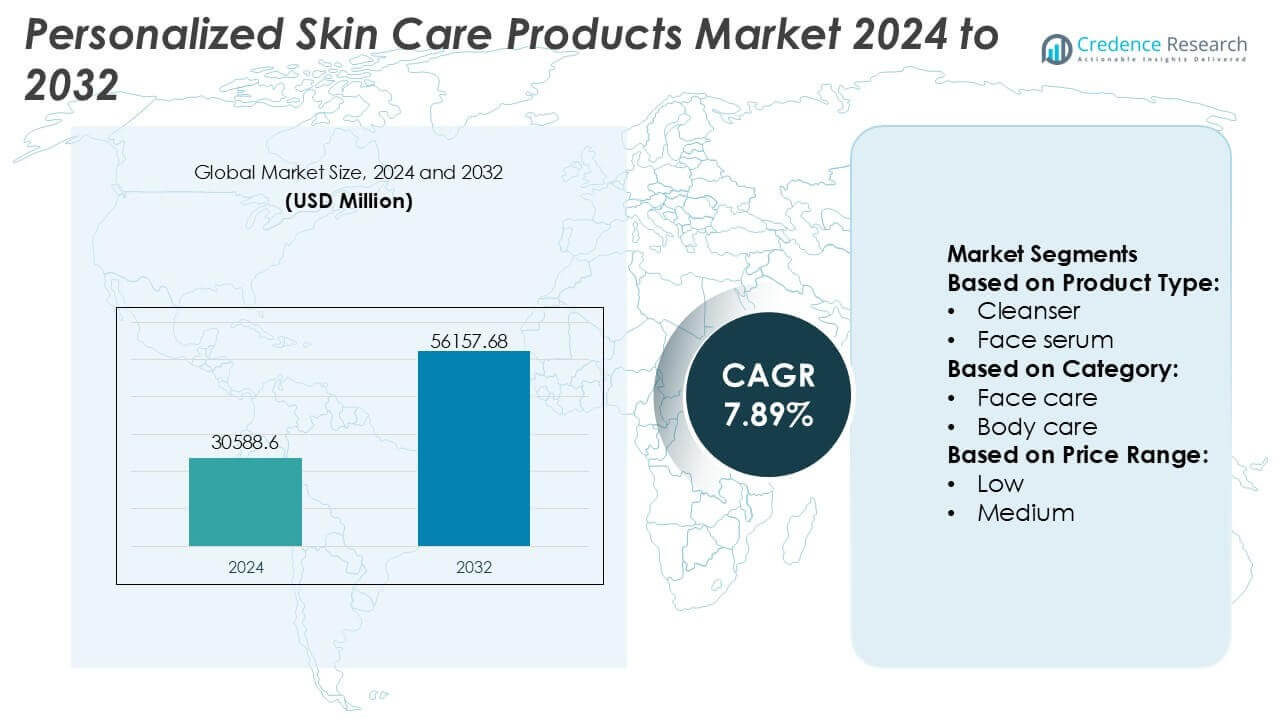
Personalized Skin Care Products Market size was valued USD 30588.6 million in 2024 and is anticipated to reach USD 56157.68 million by 2032, at a CAGR of 7.89% during the forecast period. (Credence Research)
| REPORT ATTRIBUTE | DETAILS |
|---|---|
| Historical Period | 2020-2023 |
| Base Year | 2024 |
| Forecast Period | 2025-2032 |
| Personalized Skin Care Products Market Size 2024 | USD 30588.6 million |
| Personalized Skin Care Products Market, CAGR | 7.89% |
| Personalized Skin Care Products Market Size 2032 | USD 56157.68 million |
Personalized Skin Care Products Market Insights
- Market growth is driven by increasing consumer preference for personalized formulations, AI-enabled skin diagnostics, and data-driven product recommendations, with face care emerging as the dominant segment holding an estimated 58% share due to higher usage frequency and premiumization.
- Key market trends include rapid adoption of direct-to-consumer models, subscription-based replenishment, connected skin analysis devices, and growing integration of clean-label and dermatologically tested ingredients to enhance consumer trust.
- Competitive dynamics are shaped by continuous investments in formulation science, modular product systems, and digital platforms that enable scalable customization and long-term consumer engagement.
- Regionally, North America leads the market with an exact 41% share, driven by advanced digital infrastructure, high awareness of personalized beauty, strong e-commerce penetration, and early adoption of AI-driven skin care technologies.
Personalized Skin Care Products Market Segmentation Analysis:
By Product Type
By product type, face serum emerges as the dominant sub-segment in the personalized skin care products market, accounting for an estimated 34% market share. Its leadership is driven by high active concentration, targeted delivery, and strong compatibility with AI and diagnostic-based personalization platforms. Consumers increasingly prefer customized serums addressing specific concerns such as pigmentation, acne, aging, and sensitivity. Moisturizers follow due to daily-use frequency and formulation flexibility, while cleansers gain traction with pH and microbiome-based customization. Actives and body-focused products show steady adoption, supported by rising interest in full body personalization and regimen-based solutions.
- For instance, Urban Natives Pvt. Ltd. states that its personalization engine evaluates more than 20 skin and lifestyle parameters through a structured digital consultation, translating responses into formulations built from a library of over 40 botanical and dermatologically tested actives, including quantified inputs such as 2–5 milliliters per active batch during custom blending.
By Category
By category, face care dominates the personalized skin care products market with an approximate 68% market share, driven by higher consumer spending, frequent product experimentation, and greater awareness of facial skin conditions. Advanced skin analysis tools, including AI-powered imaging and DNA-based diagnostics, are more widely adopted for facial applications, strengthening this segment’s leadership. Personalized solutions for acne, aging, hyperpigmentation, and hydration fuel sustained demand. Body care follows as personalization expands into concerns such as dryness, sensitivity, and uneven tone, supported by growing wellness trends and increasing availability of customized body lotions and treatment duos.
- For instance, Proven’s Skin Genome Project analyzes over 20,238 unique skincare ingredients, cross-referencing data on more than 100,000 skincare products, over 20 million consumer testimonials, and insights from over 4,000 peer-reviewed scientific publications to generate formulation logic that aligns with a customer’s skin profile.
By Price Range
By price range, the medium-priced segment holds the largest share at nearly 46%, balancing affordability with advanced personalization features. Consumers in this segment value clinically backed formulations, customized ingredient blends, and digital skin assessment tools without premium-level pricing. High-priced products attract affluent consumers seeking DNA-based customization, luxury actives, and dermatologist-developed formulations, while low-priced offerings focus on basic personalization through quizzes and limited ingredient adjustments. The dominance of the medium segment is reinforced by subscription models, improved formulation scalability, and broader accessibility across online and specialty retail channels.
Key Growth Drivers
Rising Demand for Customized, Data-Driven Beauty Solutions
Growing consumer preference for products tailored to individual skin profiles strongly drives the personalized skin care products market. Advances in skin diagnostics, AI-powered analysis, and mobile applications enable brands to assess hydration levels, pigmentation, sensitivity, and aging markers with greater precision. Consumers increasingly associate personalization with higher efficacy, safety, and value, particularly for chronic concerns such as acne, hyperpigmentation, and premature aging. This shift from generic formulations to customized regimens enhances brand loyalty and repeat purchases, while supporting premium pricing strategies and long-term customer engagement across digital and offline channels.
- For instance, YOU·OLOGY 7-Day Vitamin C Treatment incorporates 26 % stabilized vitamin C in its freeze-dried booster beads paired with an activating serum to maximize antioxidant delivery over a defined 7-day cycle per month, optimizing potency retention and dermal absorption through sequential activation steps.
Expansion of Digital Platforms and Direct-to-Consumer Models
The rapid expansion of e-commerce and direct-to-consumer (DTC) channels significantly accelerates market growth. Digital platforms allow brands to collect real-time consumer data, deliver personalized recommendations, and update formulations based on usage feedback. Subscription-based models further support recurring revenue and long-term relationships. Online consultations, virtual skin assessments, and AI chat tools reduce reliance on physical retail while broadening geographic reach. This digital ecosystem lowers entry barriers for emerging brands and enables established players to scale personalization efficiently across global markets.
- For instance, MySkinBuddy platform features LED light therapy with 30 individual bulbs across red (630 nm), blue (460 nm), and green (520 nm) wavelengths, each targeting distinct skin processes such as collagen stimulation, acne-causing bacteria reduction, and pigmentation modulation metrics supported by its listed LED specifications.
Increasing Awareness of Skin Health and Preventive Care
Rising awareness of skin health, ingredient transparency, and preventive dermatology fuels demand for personalized skin care products. Consumers increasingly seek solutions that address early signs of aging, environmental damage, and lifestyle-related skin issues. Personalized formulations align with this preventive approach by targeting specific risk factors rather than offering one-size-fits-all products. The influence of dermatologists, skin experts, and social media education further strengthens consumer trust in customized regimens, supporting sustained market adoption across diverse age groups.
Key Trends & Opportunities
Integration of AI, IoT, and Advanced Skin Diagnostics
Technological integration represents a major trend and opportunity in the personalized skin care products market. AI algorithms, smart skin analyzers, and connected devices enable continuous monitoring of skin conditions and adaptive product recommendations. These technologies improve formulation accuracy and allow brands to evolve products as skin needs change over time. Opportunities are emerging in combining wearable sensors with personalized skincare routines, creating dynamic, data-driven ecosystems that enhance outcomes and differentiate premium offerings.
- For instance, Perso is a compact beauty tech device that measures 6.5 inches in height and weighs approximately 450 grams, integrating a patented three-cartridge motorized dispensing system to blend precise doses of active ingredients such as hyaluronic acid, vitamins, and AHAs based on real-time diagnostics.
Growth of Clean, Sustainable, and Ingredient-Focused Personalization
Consumers increasingly expect personalized skin care to align with clean beauty and sustainability principles. This trend creates opportunities for brands to combine customization with vegan, cruelty-free, and environmentally responsible formulations. Personalized exclusion of allergens, fragrances, or harsh actives enhances safety and appeal for sensitive skin users. Transparency around ingredient sourcing and formulation logic strengthens brand credibility, while sustainable packaging and refill models support differentiation in a competitive market landscape.
- For instance, Custom D.O.S.E uses a production-grade compounder that operates at approximately 1,200 rotations per minute to precisely mix actives selected during a clinician-led assessment, which considers more than 250 distinct skin traits to generate bespoke formulations from a pool of over 24 high-performance ingredients, including exfoliating, brightening, clarifying, and enhancing agents such as glycolic acid, tranexamic acid, niacinamide, and licorice root extract, each calibrated at individualized concentrations per patient need.
Premiumization Through Luxury and Dermatology-Backed Personalization
Personalization is increasingly positioned as a premium feature, creating opportunities in luxury and dermatology-backed segments. High-income consumers are willing to pay more for bespoke regimens supported by clinical insights and professional validation. Brands offering hybrid models combining digital diagnostics with dermatologist oversight can capture higher margins and build trust. This premiumization trend supports expansion in mature markets and strengthens cross-selling of complementary personalized products.
Key Challenges
High Cost and Complexity of Customization at Scale
Scaling personalized skin care presents significant operational and cost challenges. Developing individualized formulations requires advanced manufacturing, flexible supply chains, and strict quality control, increasing production complexity. Maintaining consistency, stability, and regulatory compliance across customized batches can strain operational efficiency. These factors may limit affordability and accessibility, particularly in price-sensitive markets, and pose barriers for smaller players lacking advanced infrastructure.
Data Privacy, Accuracy, and Consumer Trust Concerns
Personalized skin care relies heavily on consumer data, raising concerns around data privacy, accuracy, and ethical use. Inaccurate skin assessments or algorithmic bias can lead to ineffective recommendations, undermining consumer trust. Additionally, compliance with evolving data protection regulations adds complexity to digital personalization models. Brands must invest in robust data security, transparent communication, and validation of diagnostic tools to ensure credibility and sustain long-term adoption.
Regional Analysis
North America
North America leads the personalized skin care products market with an estimated 38% market share, driven by high consumer awareness, strong purchasing power, and rapid adoption of data-driven beauty solutions. The region benefits from advanced digital infrastructure that supports AI-based skin diagnostics, DNA testing, and app-enabled customization platforms. Demand is particularly strong for personalized serums, anti-aging solutions, and dermatologist-backed formulations. Direct-to-consumer business models and subscription services further accelerate uptake. Regulatory clarity, premium brand presence, and a strong culture of preventive skincare continue to reinforce North America’s dominant position in the global personalized skin care landscape.
Europe
Europe accounts for approximately 29% of the global personalized skin care products market, supported by a strong emphasis on skin health, ingredient transparency, and sustainability. Consumers actively seek customized solutions addressing sensitive skin, aging, and environmental stress, driving demand for tailored formulations. Advanced dermatological research, strict cosmetic regulations, and high acceptance of clean and organic products strengthen market credibility. Western Europe leads adoption through premium and dermocosmetic brands, while Central and Eastern Europe show rising penetration. Growth is reinforced by omnichannel retail strategies and increasing integration of digital skin assessment tools across clinics and specialty beauty stores.
Asia-Pacific
Asia-Pacific holds nearly 24% market share and represents the fastest-growing region in the personalized skin care products market. Rapid urbanization, rising disposable incomes, and strong beauty consciousness drive demand, particularly in China, Japan, South Korea, and India. Consumers favor customized solutions for acne, pigmentation, and climate-specific skin concerns. The region benefits from technology-savvy consumers, mobile-first engagement, and strong e-commerce ecosystems. Local brands actively combine AI diagnostics with traditional ingredients, enhancing appeal. Expanding middle-class populations and social-media-driven beauty trends continue to accelerate personalized skincare adoption across the region.
Latin America
Latin America accounts for around 6% of the global market, supported by increasing beauty awareness and growing interest in customized personal care solutions. Brazil and Mexico dominate regional demand due to large urban populations and strong cosmetic consumption cultures. Consumers increasingly seek personalized products addressing climate-related concerns such as humidity, sun exposure, and pigmentation. While price sensitivity remains a constraint, mid-range personalized offerings and digital consultation tools are gaining traction. Expansion of online retail, influencer marketing, and localized formulations tailored to regional skin profiles support steady growth in the personalized skin care segment.
Middle East & Africa
The Middle East & Africa region represents approximately 3% market share, with growth driven by rising disposable incomes, premium beauty consumption, and climate-specific skincare needs. Demand centers on customized solutions for hydration, sun protection, and pigmentation management. The Gulf countries lead adoption due to strong luxury beauty demand and expanding dermatology clinics. In Africa, urbanization and increasing digital penetration gradually support market development. Although overall penetration remains limited, growing awareness of personalized skincare benefits, expanding e-commerce access, and premium brand entry are steadily strengthening the region’s market presence.
Personalized Skin Care Products Market Segmentations:
By Product Type:
- Cleanser
- Face serum
By Category:
- Face care
- Body care
By Price Range:
- Low
- Medium
By Geography
- North America
- U.S.
- Canada
- Mexico
- Europe
- Germany
- France
- U.K.
- Italy
- Spain
- Rest of Europe
- Asia Pacific
- China
- Japan
- India
- South Korea
- South-east Asia
- Rest of Asia Pacific
- Latin America
- Brazil
- Argentina
- Rest of Latin America
- Middle East & Africa
- GCC Countries
- South Africa
- Rest of the Middle East and Africa
Competitive Landscape
The competitive landscape of the personalized skin care products market players such as Skin Inc. My Daily Dose, Urban Natives Pvt. Ltd., Proven Skincare, Johnson & Johnson, Younique Uology, LUMAVERA Custom Blends, L'Oreal Perso, Skin Authority MySkinBuddy, SkinCeuticals Custom D.O.S.E, Kiehl’s Apothecary Preparations. the personalized skin care products market is shaped by continuous innovation in formulation science, digital diagnostics, and consumer data analytics. Market participants compete by enhancing personalization accuracy through skin profiling technologies, algorithm-driven recommendations, and modular product architectures that adapt to changing skin conditions.
Strong emphasis is placed on clinical credibility, ingredient transparency, and efficacy validation to build long-term consumer trust, particularly in premium and dermatologist-influenced segments. Direct-to-consumer platforms and omnichannel strategies play a critical role in strengthening customer engagement, enabling brands to collect real-time feedback and refine formulations rapidly. Additionally, advancements in connected devices, AI-enabled skin analysis, and subscription-based delivery models support recurring revenue and personalization scalability. Sustainability, clean-label formulations, and ethically sourced ingredients increasingly influence competitive positioning, as consumers seek both performance and responsible beauty solutions. Overall, competition intensifies around technological differentiation, data integration capabilities, and the ability to deliver consistent, customized outcomes at scale.
Key Player Analysis
- Skin Inc. My Daily Dose
- Urban Natives Pvt. Ltd.
- Proven Skincare
- Johnson & Johnson
- Younique Uology
- LUMAVERA Custom Blends
- Skin Authority MySkinBuddy
- L'Oreal Perso
- SkinCeuticals Custom D.O.S.E
- Kiehl’s Apothecary Preparations
Recent Developments
- In September 2025, Galderma adopted a subtle and strategic approach in the competitive personal care market by investing in science-backed, educational, and experience-led outreach rather than relying purely on mass-market advertising, glamour, or celebrity endorsement.
- In September 2023, Contentsquare, a global leader in digital experience analytics, on its definitive agreement to acquire Heap, an analytics platform. The financial terms of the agreement have not been disclosed. With deeper and broader insight, the acquisition of Heap expands Contentsquare's platform capabilities.
- In February 2023, Whatfix launched its Product Analytics line to offer businesses a unified dashboard for tracking user behavior, enabling no-code event tracking and data consistency, helping them optimize software experiences, boost workforce proficiency, and prove ROI on digital investments.
Report Coverage
The research report offers an in-depth analysis based on Product Type, Category, Price Range and Geography. It details leading market players, providing an overview of their business, product offerings, investments, revenue streams, and key applications. Additionally, the report includes insights into the competitive environment, SWOT analysis, current market trends, as well as the primary drivers and constraints. Furthermore, it discusses various factors that have driven market expansion in recent years. The report also explores market dynamics, regulatory scenarios, and technological advancements that are shaping the industry. It assesses the impact of external factors and global economic changes on market growth. Lastly, it provides strategic recommendations for new entrants and established companies to navigate the complexities of the market.
Future Outlook
- Personalized formulations will increasingly integrate AI-driven skin diagnostics and real-time data inputs to improve accuracy and consistency of recommendations.
- Demand for device-enabled customization and at-home skin analysis tools will continue to expand as consumers seek professional-grade personalization.
- Subscription-based and refill-oriented delivery models will gain traction by supporting long-term engagement and adaptive skin care routines.
- Clean-label, dermatologically tested, and ingredient-transparent products will become central to brand differentiation and consumer trust.
- Sustainability initiatives will intensify, with greater focus on recyclable packaging, reduced waste, and responsibly sourced ingredients.
- Direct-to-consumer and omnichannel strategies will strengthen, enabling faster feedback loops and more responsive product optimization.
- Advances in biotechnology and active ingredient delivery systems will enhance efficacy in personalized formulations.
- Data privacy, cybersecurity, and ethical use of consumer skin data will emerge as critical strategic priorities.
- Customization will expand beyond facial care into body care, scalp care, and multifunctional skin solutions.
- Strategic partnerships between beauty brands, dermatology platforms, and digital health providers will accelerate innovation and market expansion.

Request a Free Sample
Fill in your details and we'll send you a free sample report.
- Sample data tables & charts
- Research methodology
Need a Custom Version of This Report?
Tailor the scope, geography, or segments to your exact requirements.
- Custom geography or segment scope
- Direct access to our analyst team
Frequently Asked Questions
What is the current market size for the Personalized Skin Care Products Market, and what is its projected size in 2032?
At what Compound Annual Growth Rate is the Personalized Skin Care Products Market projected to grow between 2024 and 2032?
Which Personalized Skin Care Products Market segment held the largest share in 2024?
What are the primary factors fueling the growth of the Personalized Skin Care Products Market?
Who are the leading companies in the Personalized Skin Care Products Market?
Which region commanded the largest share of the Personalized Skin Care Products Market in 2024?
Table of Content
Chapter 1 Market Segmentation
- 1.1 Segmentation Framework
- 1.1.1 Product and Service Classification
- 1.1.2 Application and End-Use Classification
- 1.1.3 Technology and Solution Classification
- 1.1.4 Customer and Distribution Channel Classification
- 1.1.5 Geographic Segmentation
- 1.1.6 Market Segment Definitions and Boundaries
Chapter 2 Introduction
- 2.1 Report Objectives and Scope
- 2.2 Product Definition and Industry Terminology
- 2.3 Market Inclusions and Exclusions
- 2.4 Research Process
- 2.4.1 Primary Research and Expert Interviews
- 2.4.2 Secondary Research and Source Review
- 2.4.3 Top-Down and Bottom-Up Estimation
- 2.4.4 Data Triangulation and Verification
- 2.5 Market Size Measurement Basis
- 2.5.1 2024: USD 30,588.6 million → 2032: USD 56,157.68 million
- 2.6 Historical and Forecast Reference Periods
- 2.6.1 Base Year: 2024
- 2.6.2 Forecast Period: 2024-2032
- 2.7 Research Assumptions and Limitations
Chapter 3 Executive Summary
- 3.1 Market Snapshot and Key Findings
- 3.2 Base-Year Market Size, 2024
- 3.3 Forecast Market Size, 2032
- 3.4 Revenue and Volume Growth Outlook
- 3.5 Key Demand and Supply Indicators
- 3.6 Leading Market Segments
- 3.7 Fastest-Growing Market Opportunities
- 3.8 Regional Performance Highlights
- 3.9 Technology and Industry Transformation
- 3.10 Competitive Landscape Summary
- 3.11 Analyst View and Strategic Implications
Chapter 4 Global Personalized Skin Care Products Market Trends and Developments
- 4.1 Historical Industry Development
- 4.2 Recent Market Trends and Developments
- 4.3 Demand and Customer Behavior Trends
- 4.4 Technology and Product Innovation
- 4.5 Artificial Intelligence, Automation and Digitalization
- 4.6 Local Manufacturing and Supply Chain Realignment
- 4.7 Industry Partnerships, Mergers and Acquisitions
- 4.8 Sustainability and Circular Economy Developments
- 4.9 Government and Private Sector Investment Trends
- 4.10 Emerging Business Models and Commercialization
- 4.11 Industry Developments and Announcements
Chapter 5 Global Personalized Skin Care Products Market Production, Supply and Demand Analysis
- 5.1 Demand Trend and Consumption Analysis
- 5.2 Demand Forecast, 2024-2032
- 5.3 Production and Output Trend
- 5.4 Production and Output Forecast, 2024-2032
- 5.5 Installed Capacity and Capacity Utilization
- 5.6 Company-Wise Production Plants and Statistics
- 5.6.1 Installed Production Capacity
- 5.6.2 Actual Production
- 5.6.3 Planned Capacity and Expansion Targets
- 5.7 Supply Chain Structure and Procurement Trends
- 5.8 Supply-Demand Gap and Bottlenecks
- 5.9 Import Dependence and Sourcing Structure
- 5.10 Contract Manufacturing and Outsourcing
- 5.11 Regional Supply and Demand Concentration
Chapter 6 Global Personalized Skin Care Products Market Pricing Analysis
- 6.1 Pricing Structure and Measurement
- 6.2 Historical Pricing Trends
- 6.3 Pricing Outlook, 2024-2032
- 6.4 Average Selling Price and Unit Economics
- 6.5 Pricing by Product and Market Segment
- 6.6 Geographic Pricing Differences
- 6.7 Key Input, Energy, Labor and Logistics Costs
- 6.8 Contract Pricing and Purchasing Models
- 6.9 Pricing Sensitivity and Competitive Positioning
- 6.10 Price, Margin and Profitability Implications
Chapter 7 Global Personalized Skin Care Products Market Dynamics
- 7.1 Market Growth Drivers
- 7.1.1 Demand-Side Drivers
- 7.1.2 Technology and Innovation Drivers
- 7.1.3 Infrastructure and Investment Drivers
- 7.1.4 Regulatory and Policy Drivers
- 7.2 Market Restraints
- 7.2.1 Cost and Affordability Constraints
- 7.2.2 Technology and Adoption Barriers
- 7.2.3 Supply Chain and Operational Constraints
- 7.3 Market Challenges
- 7.3.1 Competitive Pressure and Margin Erosion
- 7.3.2 Skills, Infrastructure and Implementation Gaps
- 7.4 Emerging Market Opportunities
- 7.5 Market Dynamics Impact and Time-Horizon Assessment
Chapter 8 Global Personalized Skin Care Products Value Chain Analysis
- 8.1 Industry Value Chain Overview
- 8.2 Upstream Suppliers and Critical Inputs
- 8.3 Technology and Component Providers
- 8.4 Manufacturing or Service Delivery
- 8.5 Distribution, Channel Partners and Integrators
- 8.6 Downstream Applications and End Users
- 8.7 Value Addition and Profit Pools
- 8.8 Vertical Integration and Outsourcing
- 8.9 Supplier Concentration and Risk
- 8.10 Supply Chain Localization and Resilience
Chapter 9 Global Personalized Skin Care Products Market Regulations and Policies
- 9.1 Relevant Laws, Standards and Compliance Frameworks
- 9.2 Product, Service, Safety and Quality Requirements
- 9.3 Government Policies, Incentives and Subsidies
- 9.4 Imports, Exports and Trade Barriers
- 9.5 Public Procurement and Local Content Requirements
- 9.6 Environmental and Sustainability Compliance
- 9.7 Upcoming Policy Changes and Market Implications
Chapter 10 Global Personalized Skin Care Products Market Hotspots and Opportunities
- 10.1 Market Opportunity Mapping and Growth Hotspots
- 10.2 High-Growth Applications and Customer Groups
- 10.3 Underserved Markets and White-Space Opportunities
- 10.4 Emerging Technology and Product Opportunities
- 10.5 New Capacity and Investment Hotspots
- 10.6 Market Entry and Expansion Opportunities
- 10.7 Distribution and Partnership Opportunities
- 10.8 Near-Term and Long-Term Commercial Potential
- 10.9 Opportunity Attractiveness and Execution Risks
Chapter 11 Global Personalized Skin Care Products Market Outlook, 2024-2032
- 11.1 Market Size and Analysis
- 11.1.1 Revenue (Market Measurement: 2024: USD 30,588.6 million → 2032: USD 56,157.68 million)
- 11.1.2 Market Volume and Quantity Sold
- 11.1.3 Historical Market Size
- 11.1.4 Base-Year Market Size, 2024
- 11.2 Market Forecast, 2024-2032
- 11.2.1 Revenue Forecast to 2032
- 11.2.2 Volume Forecast to 2032
- 11.2.3 CAGR and Year-on-Year Growth
- 11.2.4 Incremental Revenue Opportunity
- 11.3 Forecast Assumptions and Scenario Analysis
- 11.3.1 Base-Case Forecast
- 11.3.2 Optimistic and Conservative Scenarios
- 11.3.3 Technology, Pricing and Policy Sensitivities
- 11.4 Market Attractiveness and Growth Outlook
Chapter 12 Global Personalized Skin Care Products Market Segmentation and Outlook
- 12.1 Segmentation Summary and Market Shares, 2024
- 12.2 Largest and Fastest-Growing Segments
- 12.3 Segment Growth Comparison
- 12.4 Segment Attractiveness and Priority Matrix
Chapter 13 Global Personalized Skin Care Products Geographic Market Outlook, 2024-2032
- 13.1 Regional Market Size and Share, 2024
- 13.2 Regional Market Forecast, 2024-2032
- 13.3 Regional Pricing, Production and Demand Differences
- 13.4 North America
- 13.4.1 United States
- 13.4.2 Canada
- 13.4.3 Mexico
- 13.5 Europe
- 13.5.1 Germany
- 13.5.2 France
- 13.5.3 Italy
- 13.5.4 United Kingdom
- 13.5.5 Spain
- 13.5.6 Poland
- 13.5.7 Russia
- 13.5.8 Netherlands
- 13.5.9 Belgium
- 13.5.10 Sweden
- 13.5.11 Denmark
- 13.5.12 Norway
- 13.5.13 Rest of Europe
- 13.6 Asia Pacific
- 13.6.1 China
- 13.6.2 India
- 13.6.3 Japan
- 13.6.4 South Korea
- 13.6.5 Thailand
- 13.6.6 Indonesia
- 13.6.7 Vietnam
- 13.6.8 Malaysia
- 13.6.9 Australia
- 13.6.10 Rest of Asia Pacific
- 13.7 Latin America
- 13.7.1 Brazil
- 13.7.2 Argentina
- 13.7.3 Colombia
- 13.7.4 Chile
- 13.7.5 Rest of Latin America
- 13.8 Middle East
- 13.8.1 Saudi Arabia
- 13.8.2 United Arab Emirates
- 13.8.3 Turkey
- 13.8.4 Israel
- 13.8.5 Iran
- 13.8.6 Rest of the Middle East
- 13.9 Africa
- 13.9.1 South Africa
- 13.9.2 Egypt
- 13.9.3 Nigeria
- 13.9.4 Morocco
- 13.9.5 Rest of Africa
- 13.10 Regional Investment, Policy and Supply Chain Differences
- 13.11 Regional Competitive Landscape
- 13.12 Geographic Growth Hotspots
Chapter 14 Global Personalized Skin Care Products Technology, Innovation and Sustainability Outlook
- 14.1 Technology Landscape and Maturity
- 14.2 Product, Process and Service Innovation
- 14.3 AI, Automation and Digital Tools in the Industry
- 14.4 Technology Adoption and Performance Benchmarking
- 14.5 Innovation Pipeline and R&D Investment
- 14.6 Patent and Intellectual Property Trends
- 14.7 Energy Efficiency and Resource Management
- 14.8 Sustainability, Recycling and Circularity
- 14.9 Technology Roadmap, 2024-2032
- 14.10 Risks of Obsolescence and Technology Substitution
Chapter 15 Global Personalized Skin Care Products Market Key Strategic Imperatives
- 15.1 Growth and Market Entry Priorities
- 15.2 High-Return Products and Segments
- 15.3 Pricing, Profitability and Cost Optimization
- 15.4 Technology Investment and Product Differentiation
- 15.5 Supply Chain Localization and Resilience
- 15.6 Distribution and Customer Acquisition
- 15.7 Partnership, Acquisition and Capacity Strategy
- 15.8 Regional Expansion Priorities
- 15.9 Short-, Medium- and Long-Term Actions
Chapter 16 Competition Outlook
- 16.1 Industry Competition Characteristics
- 16.2 Market Structure and Concentration
- 16.3 Market Share and Competitive Positioning, 2024
- 16.4 Company-Wise Revenue and Product Benchmarking
- 16.5 Production and Service Capacity Benchmarking
- 16.6 Technology, Pricing and Differentiation
- 16.7 Regional Footprint and Distribution Strength
- 16.8 Mergers, Acquisitions and Strategic Alliances
- 16.9 New Entrants and Competitive Threats
- 16.10 Porter's Five Forces and Industry Attractiveness
- 16.11 Competitive Outlook, 2024-2032
Chapter 17 Company Profiles
- 17.1 Company Coverage and Selection Criteria
- 17.2 Leading Market Participants – Standard Profile Structure
- 17.2.1 Business Description
- 17.2.2 Company Ownership and Geographic Presence
- 17.2.3 Product and Service Portfolio
- 17.2.4 Manufacturing and Operating Footprint
- 17.2.5 Production Capacity and Expansion Plans
- 17.2.6 Financial Performance and Investment
- 17.2.7 Market Share and Competitive Position
- 17.2.8 Technology and Innovation Capabilities
- 17.2.9 Strategic Alliances or Partnerships
- 17.2.10 Recent Developments
- 17.2.11 Growth Strategy and Outlook
- 17.3 Other Relevant Market Participants
Note: Every listed company is profiled on the structure shown under the first company. The company list is preliminary and may change based on research findings, market developments, data availability and client requirements.
Chapter 18 Disclaimer
- 18.1 Research and Forecast Disclaimer
- 18.2 Data Source and Estimation Limitations
Note: The depth of individual sections depends on data availability for this market. Volume, capacity, trade and other unit-based metrics are included where applicable.