
Key Highlights of the report
How are the prominent segments performing in the pharmaceutical freeze drying market?
- In 2022, the tray-style freezer dryer segment accounted for the largest market share due to increasing demand for pharmaceutical contract manufacturing and contract lyophilization services.
- In 2022, the industrial-scale segment was anticipated to hold a major share of the global pharmaceutical freeze drying market due to the high standard of quality delivered by industrial-scale freeze drying products.
Which region dominated the pharmaceutical freeze drying market?
In 2022, the Asia Pacific was anticipated to hold a major share of the global pharmaceutical freeze drying market. The Asia Pacific region may account for a disproportionate amount of investments, R&D spending, and geographical development of companies that manufacture pharmaceutical freeze drying equipment. Additionally, the presence of significant players in the Asia Pacific region's pharmaceutical freeze drying market and the expansion of the production facilities of top pharmaceutical firms in this region are anticipated to drive the market's growth.
How is the US market performing in the pharmaceutical freeze drying market?
In 2022, the US was anticipated to be the fastest-growing market. The advancements in technology, increasing product approvals, partnerships, and collaborations by key players are helping the market's growth. For instance, in April 2022, NJM launched Dara Pharma Group's Coolvacuum freeze-drying equipment in the US at the Interphex booth. The Coolvacuum product line includes a variety of freeze dryer solutions, from small, standalone freeze dryers for research and development labs to large, fully integrated systems for commercial fill-finish packaging lines.
How is the economy impacting the global pharmaceutical freeze drying growth?
Growth in the number of commercially available vaccines and injectables for various disease conditions and rising demand for contract manufacturing and outsourcing activities in the biopharmaceutical industry are also anticipated to emphasize the development of the global market in the near future. The Alliance for Regenerative Medicine estimates that companies involved in cell and gene therapies garnered approximately USD 23.1 billion in funding worldwide in 2021, an increase of almost 16% over the USD 19.9 billion total for the previous year.
What is the competitive environment of the pharmaceutical freeze drying market?
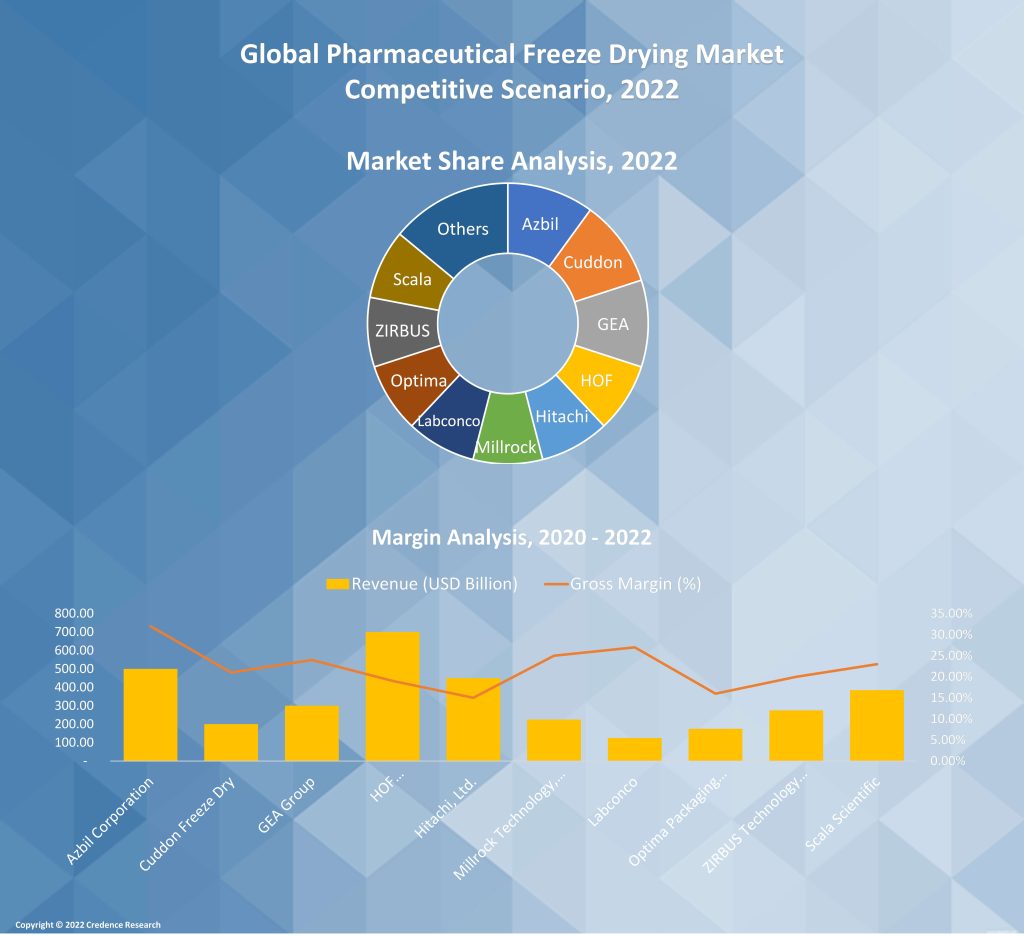
The pharmaceutical freeze drying market share globally, sales and revenues generated in this industry, a summary of the business organization, the introduction of new products, and opportunities for the industrial Pharmaceutical Freeze Drying market are all provided by the pharmaceutical freeze drying market's competitive environment. For instance, in November 2022, Telstar expanded the process laboratory service for freeze-drying and sterilization by incorporating cold sterilization methods for non-compatible medical and pharmaceutical products with conventional high-temperature sterilization.
Executive Summary
What are the key trends in the Pharmaceutical Freeze Drying market?
- Pharmaceutical technologies reduce the cost of preservation by making it possible to store dried samples at room temperature. This considerably simplifies sample storage and dissemination. In order to improve cell viability rates through the use of these technologies, existing protocols must be revised.
- Furthermore, the use of freeze-dried plasma on the battlefield is increasing. Military medical personnel used conventional blood products to treat injured personnel during emergencies. This procedure necessitated the use of refrigerators and other specialized equipment, which added to the time required. Plasma is effectively frozen through freeze-drying and can be used to heal wounds prior to evacuation.
How has COVID-19 impacted the pharmaceutical freeze drying market?
The impact of COVID-19 in its initial phase was profound owing to restrictions on drug production in pharmaceutical and biotech manufacturing sites, which hampered market growth. The demand for pharmaceutical freeze drying and emergency use authorization (EUA) for certain drugs compensated for the market growth in the later stages of the pandemic. For instance, in May 2020, Cipla launched remdesivir under its brand name CIPREMI (remdesivir lyophilized powder for injection, 100 mg). Gilead Sciences Inc. received a EUA from the US FDA to use remdesivir for COVID-19 patients who were hospitalized. The growing demand and approvals for drugs are propelling the use of pharmaceutical freeze drying services and are expected to propel the market during the forecast period.
Which are the key investments by the pharmaceutical freeze drying market players?
Leading players operating in the pharmaceutical freeze drying market are focusing on the development of production capacities for pharmaceutical freeze drying equipment. Players are also concentrating on acquisitions, and collaborations, strategic mergers, in the market to gain a competitive edge. For instance, in May 2022, Optima Pharma Division inaugurated a comprehensive scientific process engineering (CSPE) center in Germany. The company responded to customer requests and expanded the successful CSPE process for fast and safe production start-up of the integrated filling lines with isolators and freeze dryers. The inauguration of the CSPE center is associated with using lyophilization equipment, which will add to market growth.
Some major players in the pharmaceutical freeze drying market are Azbil Corporation; Harvest Right; Hitachi, Ltd.; HOF Sonderanlagenbau GmbH; Labconco; Martin Christ Gefriertrocknungsanlagen GmbH; Millrock Technology, Inc.; Cuddon Freeze Dry; GEA Group; Aktiengesellschaft; Optima Packaging Group GmbH; SP Industries; ZIRBUS Technology GmbH; Shanghai Tofflon Science and Technology Co., Ltd.; Scala Scientific; Freeze Drying Systems Pvt. Ltd.
What are the prominent driving factors for the pharmaceutical freeze drying market?
The widespread use of freeze drying technology to protect biologicals like enzymes, viruses, bacteria, proteins, and penicillin has increased the demand for pharmaceutical freeze drying. Without causing structural harm, freeze drying can be used to dry medications and biologics that are fragile, prone to instability, or sensitive to heat. Because freeze-dried products can be moved easily and quickly in cases where emergency vaccinations and antibodies must be administered right away, there is a demand for them in the market. Furthermore, the government is actively supporting the biotechnology industry through steps to modernize the regulatory environment, enhance approval & reimbursement procedures, and standardize clinical trials. Removing aqueous and solvent solutions from biologics during freeze drying prevents deterioration and maintains the proteins required for their drug delivery mechanism, thus driving the market growth.
What are the major risks for the pharmaceutical freeze drying market?
The major factor that hampers the market growth is difficulty achieving the desired moisture levels and maintaining product quality. The appropriate level of moisture removal is frequently not accomplished during the freeze drying process; products are contaminated due to excessive moisture, which can pose certain risks to patients who are given these products. Furthermore, high operational costs, high energy consumption, and lengthy processing time. Due to pharmaceutical freeze drying systems, capital-intensive pharmaceutical and biotechnology companies are focusing on alternative drying technologies to reduce the global cost of products without compromising their quality.
Which is the key product in the pharmaceutical freeze drying market?
The tray-style freeze dryers held a prominent share in the global pharmaceutical freeze drying market over the forecast period. The growth of surgical procedures is majorly driven by the growth in the geriatric population, the rising prevalence of cancer, and the rise in incidences of chronic diseases. Due to the utilization of freeze-dried platelet-rich plasma (PRP) in surgical procedures, which maintains PRP's efficacy and bioactivity for a longer period, the number of surgical procedures will increase, fueling demand for pharmaceutical freeze drying.
How is the pharmaceutical freeze drying market performing in regions?
North America is expected to witness the fastest growth in the global pharmaceutical freeze drying market during the forecast period. The advancements in technology, increasing product approvals, partnerships, and collaborations by key players are helping the market's growth. For instance, in December 2021, PCI Pharma Services (PCI), a CDMO, reported closing the earlier-notified acquisition of Lyophilization Services of New England, Inc., a CDMO based in Bedford, New Hampshire. This addition is a critical step for PCI, as LSNE will extend PCI's range of services as a global CDMO, creating its expertise in clinical trial supply, specialty manufacturing, and pharmaceutical packaging. PCI can now offer integrated large and small-molecule solutions for its clinical and commercial consumers, including global manufacturing capabilities in high potency, complex formulations, sterile fill-finish, and lyophilization, an important manufacturing process commonly used with injectable and biologic therapies. Such partnerships are projected to boost market growth during the forecast period in this region.
What is the regulatory landscape for the pharmaceutical freeze drying market?
Freeze-drying has become an important formulation and stabilization strategy in the pharmaceutical industry for drugs, vaccines, antibodies, and other biological materials, to improve their long-term stability. For biological products whose storage in an aqueous solution results in instability, freeze-drying prolongs the shelf-life by inhibiting chemical, physical, and microbiological pathways in the presence of moisture.
What is the market size of pharmaceutical freeze drying regarding value?
The global pharmaceutical freeze drying market is expected to grow at a significant CAGR of 8.50% in the upcoming years. The global pharmaceutical freeze drying industry was estimated to be worth USD 5.2 billion in 2022 and was expected to be worth USD 9.20 billion by 2028.
What are the prominent players planning for the future of the pharmaceutical freeze drying market?
Growing regional presence and investment in downstream applications are expected to deliver a competitive edge in the market. For instance, in 2020, Martin Christ Gefriertrocknungsanlagen GmbH (Germany) entered into a collaboration with Elementar Americas (US). In this collaboration, Martin Christ will be the sales, service, and support partner of Elementar Americas and will provide its product portfolio throughout the US.
| REPORT ATTRIBUTE | DETAILS |
|---|---|
| Pharmaceutical Freeze Drying Market by Volume | Yes |
| Pharmaceutical Freeze Drying Market by Value | Yes |
| Pharmaceutical Freeze Drying Market, Tornado Analysis | Yes |
| Pharmaceutical Freeze Drying Market, STAR Analysis | Yes |
| Pharmaceutical Freeze Drying Market, SRC Analysis | Yes |
| Pharmaceutical Freeze Drying Market, Import-Export Data | Yes (On Demand) |
| Pharmaceutical Freeze Drying Market Pricing Analysis | Yes (On Demand) |
| Pharmaceutical Freeze Drying Market Segment Analysis | By Product (Tray Style Freeze Dryers, Manifold Freeze Dryers, and Rotary Freeze Dryers) By Scale of Operation (Bench Top, Pilot Scale, and Industrial Scale) |
| Pharmaceutical Freeze Drying Market, Regional Analysis | North America (US and Canada) Europe (Germany, UK, France, Spain, Italy, and Rest of Europe) Asia Pacific (China, India, South Korea, Japan, South East Asia, and Rest of Asia Pacific) Latin America (Mexico, Brazil, and Rest of Latin America) Middle East and Africa (South Africa, GCC Countries, and Rest of Middle East and Africa) |
| Pharmaceutical Freeze Drying Market Key Companies | Azbil Corporation, Cuddon Freeze Dry, GEA Group, Aktiengesellschaft, Harvest Right, HOF Sonderanlagenbau GmbH, Hitachi, Ltd., Labconco, Millrock Technology, Inc., Optima Packaging Group GmbH, Shanghai Tofflon Science andTechnology Co., Ltd., SP Industries, ZIRBUS Technology GmbH, Scala Scientific, and Freeze Drying Systems Pvt. Ltd. |
| Pharmaceutical Freeze Drying Market Competitive Landscape | Market Share Analysis Competitive Benchmarking Key Players Market Positioning Geographical Presence Analysis Major Strategies Adopted |
Segmentation of Global Pharmaceutical Freeze Drying Market-
Global Pharmaceutical Freeze Drying Market – By Product
- Tray Style Freeze Dryers
- Manifold Freeze Dryers
- Rotary Freeze Dryers
Global Pharmaceutical Freeze Drying Market – By Scale of Operation
- Bench Top
- Pilot Scale
- Industrial Scale
Global Pharmaceutical Freeze Drying Market – By Region
- North America
- U.S.
- Canada
- Europe
- Germany
- France
- U.K.
- Italy
- Spain
- Rest of Europe
- Asia Pacific
- China
- Japan
- India
- South Korea
- South-east Asia
- Rest of Asia Pacific
- Latin America
- Brazil
- Mexico
- Rest of Latin America
- Middle East & Africa
- GCC Countries
- South Africa
- Rest of Middle East and Africa
Request a Free Sample
Fill in your details and we'll send you a free sample report.
- Sample data tables & charts
- Research methodology
Need a Custom Version of This Report?
Tailor the scope, geography, or segments to your exact requirements.
- Custom geography or segment scope
- Direct access to our analyst team
Frequently Asked Questions
How does COVID-19 Impact the global pharmaceutical freeze drying market?
Which is the greatest region of the market for pharmaceutical freeze drying?
What are the major drivers for the growth of the pharmaceutical freeze drying market?
Which is the major segment in the pharmaceutical freeze drying market by product?
Which is the major category in the pharmaceutical freeze drying market by the scale of operation?
Table of Content
Chapter 1. Report Introduction
- 1.1 Report Description & Purpose
- 1.1.1 Report Title & Market Definition
- 1.1.2 Unique Selling Propositions (USP) & Key Differentiators
- 1.1.3 Value Proposition for Stakeholders
- 1.2 Research Objectives
- 1.2.1 Market Sizing Objectives (Volume & Revenue)
- 1.2.2 Segmentation Objectives
- 1.2.3 Competitive Intelligence Objectives
- 1.2.4 Forecast & Scenario Objectives
- 1.3 Report Scope
- 1.3.1 Pharmaceutical Freeze Drying Scope – Types & Subtypes Covered
- 1.3.2 Geographic Scope – Regions & Countries Covered
- 1.3.3 Historical Period, Base Year & Forecast Period (the historical period; forecast to the forecast period)
- 1.3.4 Inclusions & Exclusions
- 1.4 HS Code & Classification Framework
- 1.5 Currency, Units & Pricing Basis
- 1.6 Target Stakeholders
- 1.7 Limitations & Assumptions
Chapter 2. Executive Summary
- 2.1 Global Pharmaceutical Freeze Drying Market Snapshot
- 2.1.1 Market Size – Historical (the historical period) & Forecast (the forecast period) (base year: NULL → forecast year: NULL)
- 2.1.2 Volume & Revenue – Global Totals
- 2.1.3 Key Market Highlights – Top Five Facts
- 2.2 Pharmaceutical Freeze Drying Market Segmentation Snapshot
- 2.2.1 Market Split by Region – vs.
- 2.3 Competitive Snapshot
- 2.3.1 Top 10 Players by Revenue Share –
- 2.3.2 Top 10 Players by Volume Share –
- 2.3.3 Recent Strategic Developments (18-Month Summary)
- 2.4 Key Investment Highlights & Strategic Conclusions
Chapter 3. Pharmaceutical Freeze Drying Market Dynamics & Industry Analysis
- 3.1 Market Overview & Context
- 3.1.1 Pharmaceutical Freeze Drying Market Position in the Broader Automotive Value Chain
- 3.1.2 OEM vs. Replacement Market Dynamics
- 3.1.3 Market Maturity & Development Stage by Region
- 3.2 Pharmaceutical Freeze Drying Market Drivers
- 3.3 Pharmaceutical Freeze Drying Market Restraints & Challenges
- 3.4 Pharmaceutical Freeze Drying Market Opportunities
- 3.5 Porter's Five Forces Analysis
- 3.5.1 Threat of New Entrants
- 3.5.2 Bargaining Power of Suppliers
- 3.5.3 Bargaining Power of Buyers
- 3.5.4 Threat of Substitutes
- 3.5.5 Competitive Rivalry – Intensity Assessment
- 3.6 Pharmaceutical Freeze Drying Value Chain Analysis
- 3.6.1 Upstream – Raw Material/Input Suppliers
- 3.6.1.1 Raw Material/Input 1
- 3.6.1.2 Raw Material/Input 2
- 3.6.1.3 Raw Material/Input 3
- 3.6.2 Midstream – Production/Manufacturing/Service Delivery
- 3.6.2.1 Production/Process Overview
- 3.6.2.2 Key Facility Locations & Capacity by Manufacturer
- 3.6.3 Downstream – Distribution & End Consumer
- 3.6.3.1 Primary Channel – B2B/OEM
- 3.6.3.2 Secondary Channels – Dealer, Retail, Online, Direct
- 3.6.4 Value Chain Profitability Analysis
- 3.6.1 Upstream – Raw Material/Input Suppliers
- 3.7 PESTEL Analysis
- 3.7.1 Political Factors
- 3.7.2 Economic Factors
- 3.7.3 Social Factors
- 3.7.4 Technological Factors
- 3.7.5 Environmental Factors
- 3.7.6 Legal Factors
- 3.8 Pharmaceutical Freeze Drying Supply Chain Analysis
- 3.8.1 Raw Material/Input Supply Risk Assessment
- 3.8.2 Manufacturing Concentration Risk (Geographic Exposure)
- 3.8.3 Trade Disruption Impact Analysis
- 3.9 Regulatory & Policy Landscape
Note: The regulatory and policy landscape section covers regulations based on their applicability to the market, Pharmaceutical Freeze Drying category, geography, and scope of the study. Only regulatory frameworks with a material impact on operations, compliance, trade, sustainability, or market access are analyzed in detail.
Chapter 4. Key Investment Pockets & Opportunity Analysis
- 4.1 Pharmaceutical Freeze Drying Market Attractiveness Analysis
- 4.1.1 By Region – Investment Attractiveness Matrix (Volume × CAGR)
- 4.2 Absolute Revenue Growth Opportunity
- 4.2.1 By Region – Absolute USD Growth Through the forecast period
- 4.3 Incremental Volume Opportunity
- 4.3.1 By Region – Incremental Volume Through the forecast period
- 4.3.2 Segment – Incremental Volume
- 4.4 Emerging Submarket Opportunity Deep Dive (Subject to Applicability)
- 4.5 Emerging Market Opportunity Scorecards
- 4.5.1 United States
- 4.5.2 Europe
- 4.5.3 Asia
- 4.5.4 Middle East & Africa
Note: Emerging Market Opportunity Scorecards will be included based on relevance and strategic importance. Regions listed are indicative and may vary depending on data availability and market dynamics.
Chapter 5. Pharmaceutical Freeze Drying Import-Export Analysis & Trade Flows
- 5.1 Global Trade Overview
- 5.1.1 Global Export Value by Country (the historical period)
- 5.1.2 Global Export Volume by Country (the historical period)
- 5.1.3 Global Import Value by Country (the historical period)
- 5.1.4 Global Import Volume by Country (the historical period)
- 5.1.5 Net Trade Balance by Country (the historical period)
- 5.2 Export Analysis – Segment
- 5.2.1 Type 1 (HS Code)
- 5.2.2 Type 2 (HS Code)
- 5.2.3 Type 3 (HS Code)
- 5.2.4 Type 4 (HS Code)
- 5.2.5 Type 5 (HS Code)
- 5.3 Import Analysis – Segment
- 5.3.1 Type 1 (HS Code)
- 5.3.2 Type 2 (HS Code)
- 5.3.3 Type 3 (HS Code)
- 5.3.4 Type 4 (HS Code)
- 5.3.5 Type 5 (HS Code)
- 5.4 Average Unit Trade Prices
- 5.4.1 Average Export Price – Segment & Country
- 5.4.2 Average Import Price – Segment & Source Country
- 5.4.3 Price Trends (the historical period)
- 5.5 Key Trade Route Analysis
- 5.5.1 Trade Route 1
- 5.5.2 Trade Route 2
- 5.5.3 Trade Route 3
- 5.5.4 Trade Route 4
- 5.5.5 Trade Route 5
- 5.6 Trade Policy Impact Assessment
- 5.6.1 US Anti-Dumping & Section 301 Tariffs
- 5.6.2 EU Customs Union Impact
- 5.6.3 Major Free Trade Agreements
- 5.6.4 USMCA Rules of Origin
Note: Trade policy analysis will be included only where relevant to the Pharmaceutical Freeze Drying market.
Chapter 6. Competitive Landscape & Company Benchmarking
- 6.1 Pharmaceutical Freeze Drying Market Concentration & Structure
- 6.1.1 Herfindahl-Hirschman Index (HHI) – vs.
- 6.1.2 Tier 1, Tier 2 & Tier 3 Market Structure
- 6.1.3 Global, Regional & Local Player Dynamics
- 6.2 Pharmaceutical Freeze Drying Market Share Analysis –
- 6.2.1 Global Revenue Share by Company
- 6.2.2 Global Volume Share by Company
- 6.2.3 Regional Revenue Share
- 6.2.4 Market Share Evolution ( vs. )
- 6.2.5 OEM Segment Share by Company
- 6.2.6 Replacement Segment Share by Company
- 6.3 Production/Delivery Capacity & Facility Analysis
- 6.3.1 Global Installed Capacity
- 6.3.2 Capacity Utilization Rates
- 6.3.3 Production/Output Volume
- 6.3.4 Facility Locations & Capacity Map
- 6.3.5 Planned Capacity Additions
- 6.4 Pharmaceutical Freeze Drying Competitive Benchmarking Matrix
- 6.4.1 Revenue, Volume, CAGR & Profitability Comparison
- 6.4.2 Channel Revenue Mix
- 6.4.3 Geographic Revenue Exposure
- 6.4.4 R&D Intensity
- 6.4.5 Sustainability Maturity
- 6.5 Strategic Developments in Pharmaceutical Freeze Drying (Last 24 Months)
- 6.5.1 Mergers, Acquisitions & Divestments
- 6.5.2 New Pharmaceutical Freeze Drying Launches
- 6.5.3 Facility Expansions
- 6.5.4 Strategic Alliances, Joint Ventures & Partnerships
- 6.5.5 Distribution Expansion & Market Entry
- 6.5.6 Sustainability & ESG Initiatives
- 6.6 Competitive Strategy Mapping
- 6.6.1 Leader, Challenger, Follower & Niche Classification
- 6.6.2 Pricing Strategy Comparison
- 6.6.3 Channel Strategy Matrix
Note: Strategic developments are included based on their materiality and the availability of reliable information.
Chapter 7. Global Pharmaceutical Freeze Drying Market – By Distribution Channel
- 7.1 Segment Overview
- 7.1.1 Volume & Revenue Split by Channel ( & )
- 7.1.2 Channel Mix Evolution (the forecast period)
Chapter 8. Regional Market Analysis – Global Overview
- 8.1 Global Regional Overview
- 8.1.1 Regional Volume Share
- 8.1.2 Regional Revenue Share
- 8.1.3 Regional Volume by Region
- 8.1.4 Regional Revenue by Region
- 8.1.5 Regional Forecast Through the forecast period
- 8.2 Cross-Regional Segment Analysis
- 8.2.1 By Distribution Channel
- 8.2.2 By Brand/Price Tier
Chapter 9. North America Pharmaceutical Freeze Drying Market
- 9.1 United States
- 9.2 Canada
- 9.3 Mexico
Chapter 10. Europe Pharmaceutical Freeze Drying Market
- 10.1 Germany
- 10.2 France
- 10.3 Italy
- 10.4 United Kingdom
- 10.5 Spain
- 10.6 Poland
- 10.7 Russia
- 10.8 Netherlands
- 10.9 Belgium
- 10.10 Sweden
- 10.11 Denmark
- 10.12 Norway
- 10.13 Rest of Europe
Chapter 11. Asia Pacific Pharmaceutical Freeze Drying Market
- 11.1 China
- 11.2 India
- 11.3 Japan
- 11.4 South Korea
- 11.5 Thailand
- 11.6 Indonesia
- 11.7 Vietnam
- 11.8 Malaysia
- 11.9 Australia
- 11.10 Rest of Asia Pacific
Chapter 12. Latin America Pharmaceutical Freeze Drying Market
- 12.1 Brazil
- 12.2 Argentina
- 12.3 Colombia
- 12.4 Chile
- 12.5 Rest of Latin America
Chapter 13. Middle East Pharmaceutical Freeze Drying Market
- 13.1 Saudi Arabia
- 13.2 United Arab Emirates
- 13.3 Turkey
- 13.4 Israel
- 13.5 Iran
- 13.6 Rest of the Middle East
Chapter 14. Africa Pharmaceutical Freeze Drying Market
- 14.1 South Africa
- 14.2 Egypt
- 14.3 Nigeria
- 14.4 Morocco
- 14.5 Rest of Africa
Chapter 15. Pharmaceutical Freeze Drying Company Profiles
- 15.1 [Company 01]
- 15.1.1 Company Overview
- 15.1.2 Key Management Personnel
- 15.1.3 Products & Services Portfolio
- 15.1.4 Financial Performance
- 15.1.5 Key Market Focus & Geographic Presence
- 15.1.6 Recent Developments & Strategic Initiatives
Note: The company profile list is preliminary and may change based on research findings, market developments, data availability, and client requirements.
Chapter 16. Appendices
- Appendix A – List of Abbreviations & Acronyms
- Appendix B – Industry Classification Code Reference – Full Series
- Appendix C – Production & Capacity Data Tables
- Appendix D – End-Use & Demand Base Tables
- Appendix E – Consumption & Replacement Rate Assumptions
- Appendix F – ASP Reference Tables
- Appendix G – Manufacturing & Facility Database
- Appendix H – Import-Export Data Tables
- Appendix I – Regulatory Summary Tables
- Appendix J – Primary Research Participant List (Anonymized)
- Appendix K – Primary Research Questionnaire Framework
- Appendix L – Data Sources & Bibliography
- Appendix M – Market Size Divergence & Source Comparison
Chapter 17. Research Methodology
- 17.1 Research Framework & Philosophy
- 17.2 Secondary Research – Sources, Hierarchy & Data Extraction
- 17.3 Data Modeling – Bottom-Up & Top-Down Market Sizing
- 17.4 Primary Research – Stakeholder Framework, LOI & Sample Sizes
- 17.5 Forecast Methodology – Regression, Scenario & Sensitivity Analysis
- 17.6 Quality Control – Four-Layer Validation Framework
- 17.7 Limitations & Standard Assumptions
- 17.8 Disclaimer
