Cultivated fruiting bodies now anchor global supply
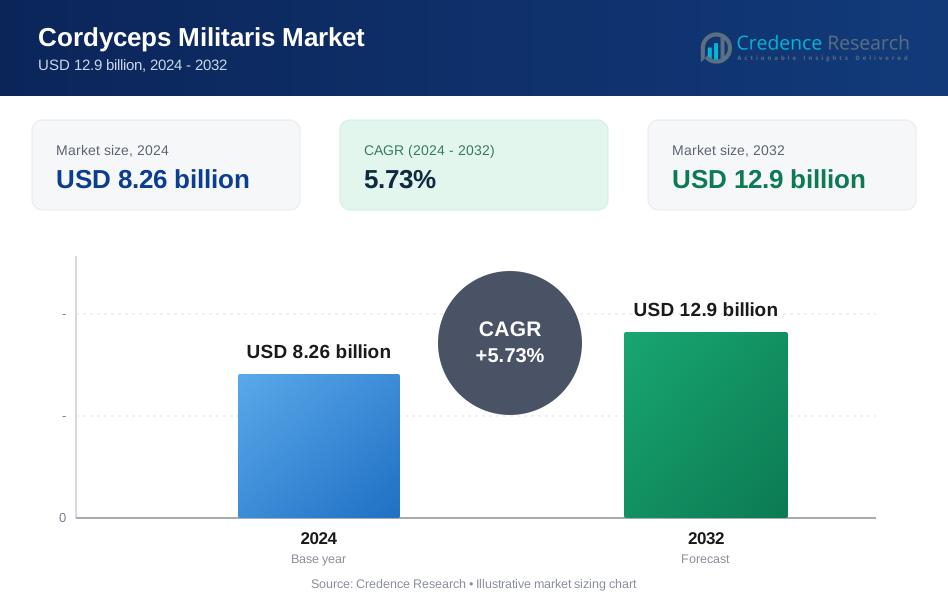
The global cordyceps militaris market was valued at USD 1.63 billion in 2025 and is projected to increase from USD 1.77 billion in 2026 to USD 3.72 billion by 2035, registering a CAGR of 8.60% during 2026–2035. Demand comes from supplement makers, food processors, cosmetic formulators and drug researchers who want a cultivated source of cordycepin and adenosine instead of costly wild caterpillar fungus. Asia Pacific held the largest regional share, 52.0% in 2025, because China alone produces about 4,000 metric tons of dry fruiting bodies a year, according to a 2025 paper in Mushroom Research. Asia Pacific is also the fastest-growing region at 9.04% a year, as growers in India, Vietnam and Thailand add small branded lines. North America follows on supplement use and organic ingredient supply. In commercial terms, the main change came in August 2025, when NutraIngredients reported that this species stayed on the European Union novel food list while two rival cordyceps species were cleared for supplements.
What does the cordyceps militaris market cover and how is it priced?
The market covers cultivated Cordyceps militaris fruiting bodies, fermented mycelium and the powders, extracts, tablets, capsules, drinks and cosmetic actives made from them. Values reflect sales to the final buyer, so a kilogram of bulk material counts for less than the same kilogram sold in capsules. Price therefore depends on form, lot size and proof of identity. No exchange sets a single international price per kg or per pound for this fungus.
Indian growers in a survey by the ICAR-Directorate of Mushroom Research averaged gross returns of about Rs 38,670 per kg of dried product in 2023–24. The value chain runs from culture and grain substrate through fruiting, drying and extraction to brands. Wild Ophiocordyceps sinensis and Samsoniella hepiali are excluded as separate species, although they compete directly for the same supplement buyers.
Cordyceps Militaris Market Insights
- The market reaches USD 3.72 billion by 2035 from USD 1.63 billion in 2025, expanding at 8.60% a year as cultivated supply replaces wild harvests.
- Asia Pacific held 52.0% of 2025 value, with China producing about 4,000 metric tons of dry fruiting bodies each year.
- Dried products led with 74.0% of 2025 value because drying stretches a one-to-two-week fresh shelf life to at least six months.
- In August 2025, NutraIngredients reported that the species remained novel in the European Union, which still blocks routine supplement use there.
- Testing now shapes competition after a Thai survey of 65 cordyceps products found more than half had swapped in cheaper species for the labeled one.
Dried powder sold for food use sets the volume base
Why do dried products outsell fresh cordyceps?
Based on type, the market is categorized into dried and wet cordyceps militaris. Dried led with 74.0% of 2025 value because fresh fruiting bodies often hold moisture above 80% and stay usable for only one to two weeks, while drying extends shelf life to between six and 12 months, according to a July 2025 study in Processes. Wet grows fastest at 8.97% a year as growers sell fresh packs close to the farm. BioFine Cooperative in Hanoi produced about 6,000 boxes of fresh product every three months, Hanoi Times reported in August 2021.
Which formats do manufacturers and buyers prefer?
Based on formulation, the market is categorized into powder, tablets and capsules, and liquid. Powder led with 47.0% of 2025 value because it works as an input for other products, and Nammex sold its organic extract in powder form to North American supplement manufacturers, Nutritional Outlook reported in April 2016. Capsules remain the main finished dose, as a Lindenwood University trial used three a day in 2025. Liquid grows fastest at 9.26% a year as Vietnamese producers add drinks, with Thien An Cordyceps selling cordyceps water and BioFine preparing syrup lines.
Where does food use end and cosmetic use begin?
Based on application, the market is categorized into food and beverages, pharmaceuticals and cosmetics, with dietary supplements counted under food. Food and Beverages led with 54.0% of 2025 value because China approved the species as a new food raw material under Announcement No. 3 of March 2009, and changed the terms in May 2014, according to Herbridge. Cosmetics grows fastest at 9.58% a year as formulators adopt registered ferment ingredients. The CosIng-based inventory lists Cordyceps Militaris Ferment Filtrate as a humectant and skin conditioner, while Prunus mume blends followed in June 2016.
| Segment Group | Leading Sub-segment | Share, 2025 | Fastest-growing Sub-segment | CAGR, 2026–2035 |
|---|---|---|---|---|
| By Type | Dried | 74.0% | Wet | 8.97% |
| By Formulation | Powder | 47.0% | Liquid | 9.26% |
| By Application | Food and Beverages | 54.0% | Cosmetics | 9.58% |
Request a Free Sample
Fill in your details and we'll send you a free sample report.
- Sample data tables & charts
- Research methodology
Grain-grown supply and supplement buyers lift value
Grain-based cultivation makes volume supply reliable
Reliable cultivation is the base of this market because buyers no longer depend on a seasonal wild harvest. China produces about 4,000 metric tons of dry fruiting bodies a year and uses at least 5,000 metric tons of grain substrate, according to a 2025 paper in Mushroom Research. The same Pantnagar trial recorded 15.03 grams of fresh weight per bottle on brown rice, a 75.15% biological efficiency, against 10 grams on tea waste. India's Office of the Principal Scientific Adviser lists a commercial ICAR method that yields 12 to 14 grams per 500-milliliter jar within 35 to 40 days. As a result, new growers can plan output by batch, which keeps most tonnage in Asia Pacific.
High supplement use keeps a broad buyer base in the U.S.
Supplement habits give the fungus a large existing channel, since buyers already accept capsules and powders for energy and immunity. About 75% of Americans used dietary supplements in the Council for Responsible Nutrition survey of 3,194 adults released in October 2024. Brands also have stronger safety evidence, because a Frontiers in Toxicology paper of Oct. 30, 2024, reported a no-adverse-effect level in rats of 2,000 milligrams per kilogram a day for M2 Ingredients' powder. Performance claims are being tested too, with Lindenwood University completing a 32-person placebo-controlled trial of the same strain on Nov. 7, 2025. Together, these points support North America at 22.0% of 2025 value.
Grower returns in India draw new small enterprises
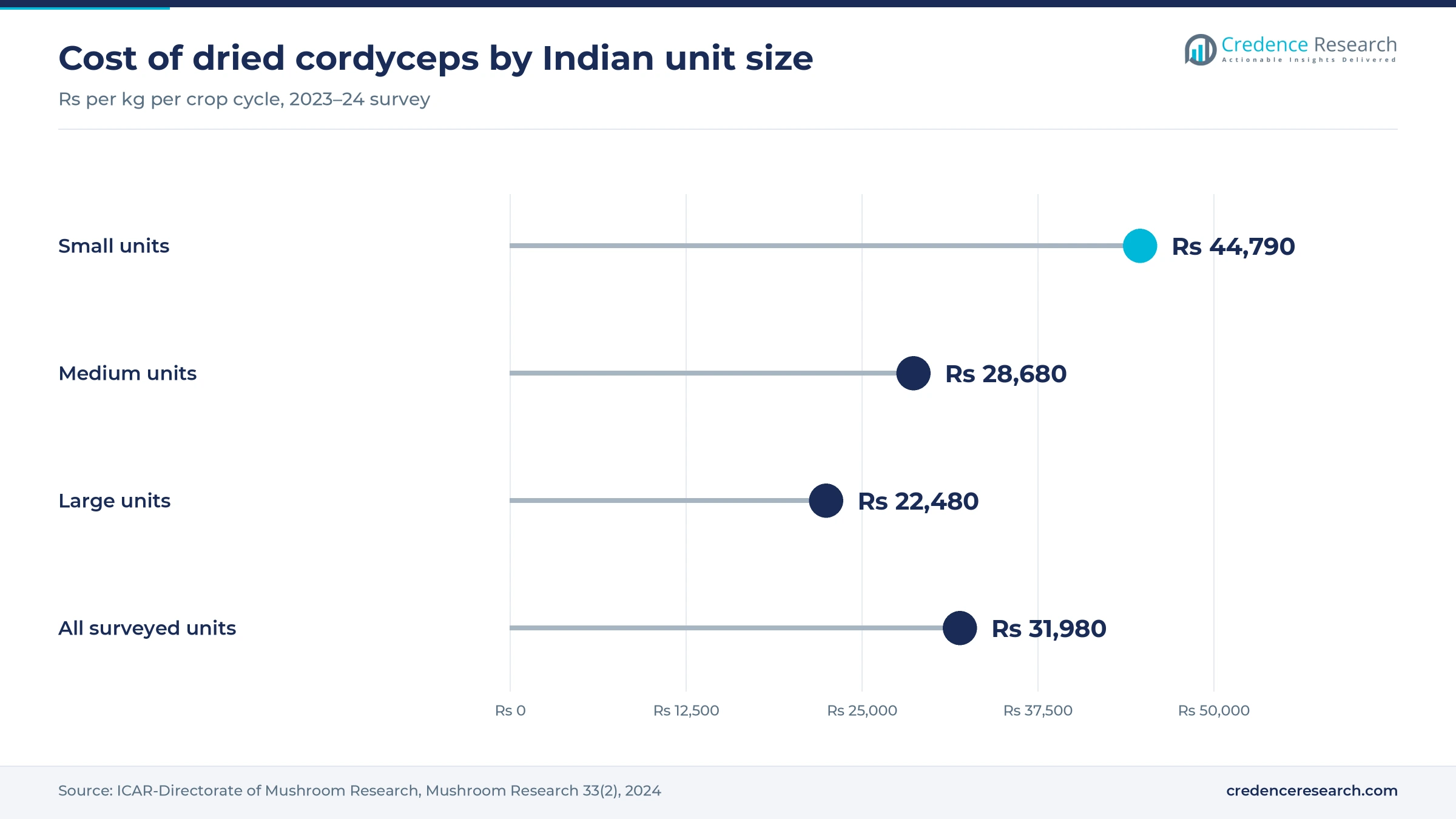
Attractive prices are pulling new growers into production, especially in India, where demand is still small but expanding from a low base. The ICAR-Directorate of Mushroom Research survey of 10 growers found gross returns averaging Rs 38,670 per kg of dried product against average costs of Rs 31,980 in 2023–24. Large units reached a benefit-cost ratio of 4.36, which explains why entrepreneurs keep asking how to grow and sell the crop. Entry is cheap as well, since the directorate at Solan lists its cultivation technology at Rs 30,000 plus tax. Delhi grower OrangeHerb sold at Rs 93,000 per kg in September 2024, according to 30 Stades, showing how far branded small lots can sit above bulk.
Wild cordyceps prices push buyers to cultivated species
The price gap with wild material is a strong reason for substitution, and it keeps this species in many medicinal mushroom formulas. Wild Ophiocordyceps sinensis costs up to $50,000 per kg, NutraIngredients reported in October 2024 when covering the Botanical Adulterants Prevention Program bulletin. That bulletin says cultivated C. militaris and S. hepiali now dominate as lower-cost options. Cordyceps ranked 26th among herbal supplement ingredients in natural-channel sales in 2023, with $5,225,915, according to the American Botanical Council. In turn, ingredient makers can sell a cultivated story at a far lower cost, although the same gap also encourages mislabeling in weaker retail channels.
Lab proof and small local brands reshape competition
Shift toward measured cordycepin and fruiting body claims
Buyers are moving from general mushroom claims to measured actives, which rewards suppliers that publish test data. A Sept. 21, 2022, study in Antioxidants found up to 81.4 milligrams of cordycepin per 100 grams in commercial supplements, while fruiting bodies delivered the highest amounts after simulated digestion, at about 25.9 milligrams. The Botanical Adulterants Prevention Program also warned in October 2024 that some European and North American products use grain-based media with little mycelium. Processing data matter as well, since a July 2025 Processes study measured 640.5 milligrams per kilogram in freeze-dried material. This trend favors Dried formats and buyers of nutraceutical ingredients that demand batch certificates.
Rise of local branded producers in Vietnam
Small branded producers are emerging across Vietnam, where provincial product ratings give them a route to retail shelves. Huy Cuong Cordyceps in Lai Chau averages 3,000 to 4,000 boxes a day against a designed capacity of 10,000, and it sells packs at 200,000 to 400,000 dong per 50 to 100 grams, according to Vietnam Agriculture and Nature in July 2026. A Quang Ninh operator invested 3 billion to 4 billion dong in a production line and holds six OCOP ratings, the same publisher reported in November 2024. Thien An Cordyceps runs 34 growing rooms that each yield 45 to 50 kilograms, VCCI News reported in October 2022. This pattern gives Asia Pacific a wider base of branded sellers beyond Chinese bulk supply.
Opportunity in cordycepin-derived drug development
Drug development offers a higher-value outlet than food, although it remains early and carries clinical risk. NuCana's annual report filed March 19, 2026 describes NUC-7738, which New Atlas identifies as a chemically modified cordycepin, as being in the Phase 1/2 NuTide:701 trial with pembrolizumab for resistant melanoma. Cordycepin itself carried a global price of about $440,000 per kg in 2022, according to a June 2024 review in Frontiers in Microbiology. That same review cites a mutant strain reaching about 14.3 grams per liter, which shows how far yields could improve. However, NuCana does not expect a marketing application soon, so suppliers should treat this opening as research-grade demand for now.
Opportunity in fermented actives for skin care
Skin care gives ingredient suppliers a smaller but better-priced opening than bulk food powder, particularly for fermented extracts. A January 2025 review in Gels reported that hyaluronic acid gels combined with C. militaris extracts raised skin moisture retention by 40%, and that adenosine-enriched gels raised collagen synthesis by 47% over eight weeks. The authors still call for clinical trials and standardization, so formulators need their own claims testing. Registration groundwork exists, because two named ferment ingredients appear in the CosIng-based inventory dating to 2011 and 2016. A Thai technology offer also promotes solvent-free, water-based extraction for cosmeceuticals, which suits clean-label brands. Cosmetics therefore grows at 9.58% a year through the forecast period.
EU status, fake labels and thin grower margins hold it back
Novel food status limits access to Europe
Regulation is the clearest barrier in Europe, where the mycelium and fruiting body of this species remains novel in the Novel Food catalogue, NutraIngredients reported on Aug. 29, 2025. The European Commission had confirmed S. hepiali and C. sinensis as not novel, which hands those rivals easier supplement access. Suppliers must therefore fund an authorization dossier or sell another species. As a result, Europe grows at 7.54% a year, the slowest regional rate in this forecast.
Mislabeling and adulteration damage buyer trust
Product fraud weakens trust, particularly in online channels with light oversight. A Thai survey of 65 products labeled as cordyceps, bought online in 2023, found that more than half had substituted C. militaris for C. sinensis, SupplySide Supplement Journal reported on April 14, 2026. Four of the 65 products contained undeclared corticosteroids and seven were unregistered with the Thai government. Honest suppliers bear the consequence through extra testing costs and lost pricing power, so authenticated strains and third-party certificates are becoming the practical defense.
Small growing units struggle to cover their costs
Scale economics exclude many small entrants, even at attractive selling prices. The ICAR survey put total cost at about Rs 44,790 per kg for small units and Rs 22,480 for large ones, while small units had a benefit-cost ratio of only 0.84. Their margin of safety was negative 64.44%, which means many would not break even. Consolidation is therefore likely, and shared drying or contract growing would be the most useful mitigation for these operators.
Short fresh shelf life raises processing investment
Perishability forces growers to process quickly, which raises the capital needed to compete. Fresh fruiting bodies hold moisture above 80% and last one to two weeks, according to the July 2025 Processes study. A Quang Ninh producer dries at minus 50 to minus 70 degrees Celsius for 24 hours, using about 10 kilograms of fresh product for each kilogram dried, Vietnam Agriculture and Nature reported. Small farms that lack this equipment must sell quickly or accept lower prices.
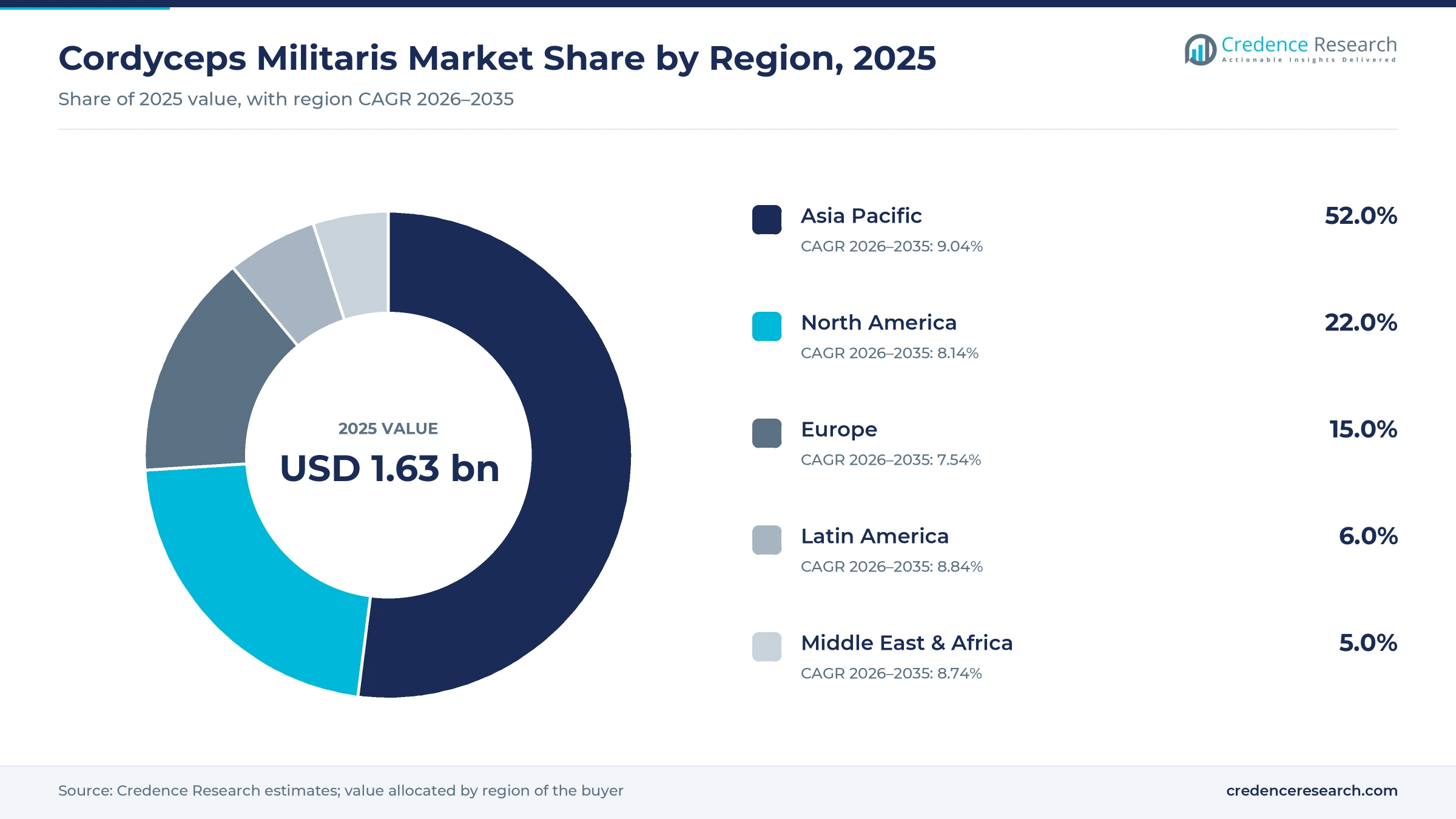
Asia Pacific grows and buys the largest share of output
| Region | Value, 2025 (USD billion) | Share, 2025 | CAGR, 2026–2035 |
|---|---|---|---|
| Asia Pacific | 0.85 | 52.0% | 9.04% |
| North America | 0.36 | 22.0% | 8.14% |
| Europe | 0.24 | 15.0% | 7.54% |
| Latin America | 0.10 | 6.0% | 8.84% |
| Middle East & Africa | 0.08 | 5.0% | 8.74% |
Asia Pacific leads on Chinese output and new Indian growers
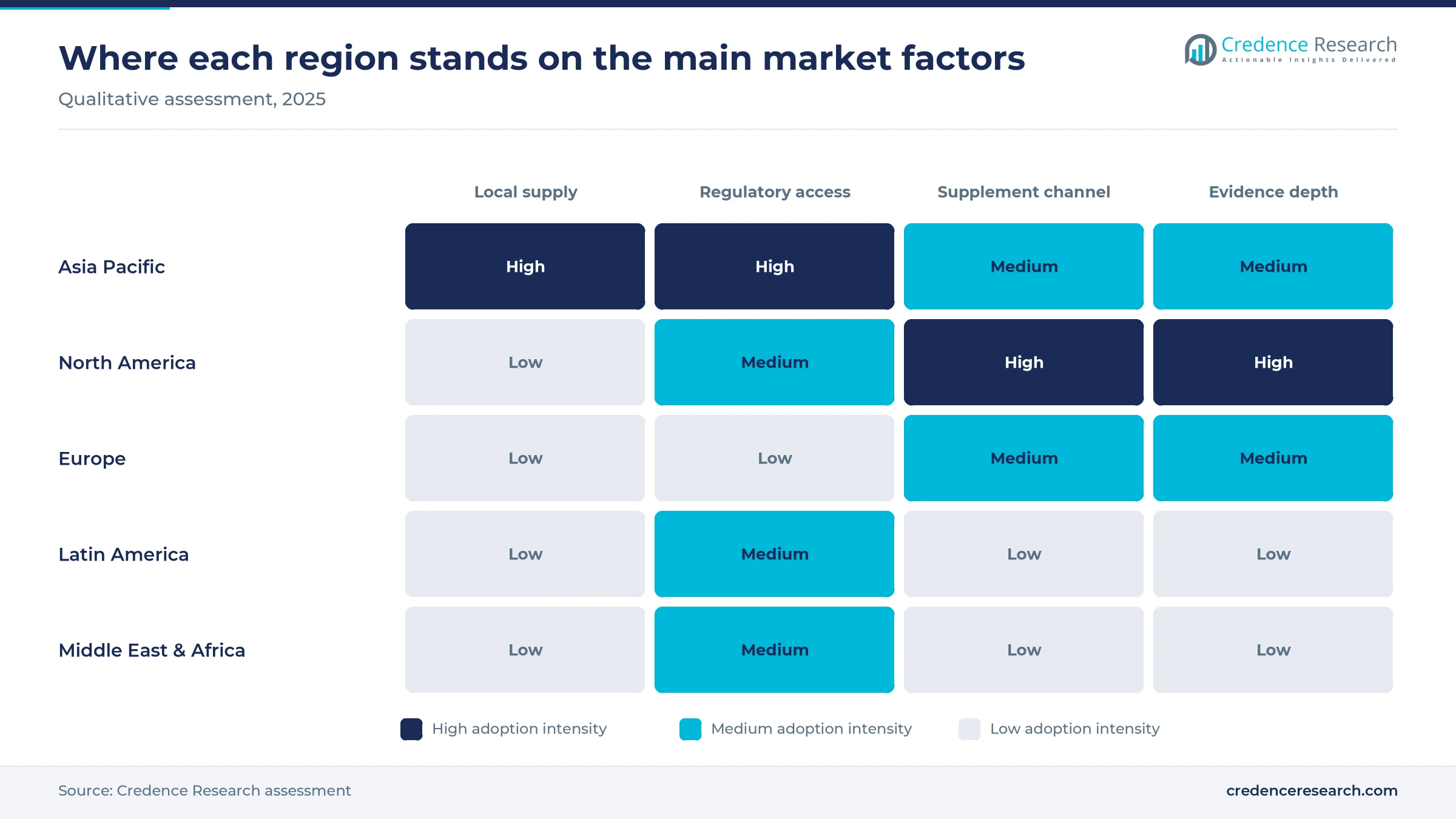
Asia Pacific held 52.0% of 2025 value and grows at 9.04% a year. China anchors the region with about 4,000 metric tons of dry output, and its food rules allow the species as a new raw material. India remains small, with Credence Research placing it near 2% of 2025 global value, or about USD 33 million, as domestic demand builds from growers such as OrangeHerb and FSSAI-licensed Cordymil Myco Biotech. Thailand and Vietnam add products, with a 2024 Journal of Nepal Biotechnology paper calling Thai production a growing large industry.
North America buys on supplement use and organic supply
North America held 22.0% of 2025 value and grows at 8.14% a year. The Council for Responsible Nutrition found about 75% of Americans using supplements in 2024, which gives cultivated cordyceps a ready channel. Supply comes through specialists such as Nammex in British Columbia and M2 Ingredients in Vista, California, whose powder is grown on organic oats. A published rat toxicology study and a completed placebo-controlled trial help these firms support higher prices than bulk imports, although mislabeled products remain a concern for retailers.
Europe grows slowest while novel food status stands
Europe held 15.0% of 2025 value and grows at 7.54% a year, the slowest pace among the five regions. The novel food position is the main reason, because NutraIngredients reported in August 2025 that the species still lacked the clearance given to two rival cordyceps species. Sales therefore lean on cosmetic actives, research uses and products outside supplement rules. Any successful authorization dossier would change this outlook quickly, since suppliers such as Musheez in Estonia already serve the wider cordyceps category.
Latin America depends on imported finished products
Latin America held 6.0% of 2025 value and grows at 8.84% a year. Research for this report found no published national production tonnage or dedicated program for the species in the region, so Credence Research treats it as an import-led market for capsules and powders. Growth should therefore follow retail supplement distribution rather than local farming. That assumption makes this one of the least evidenced regional estimates, and new local cultivation data would improve its accuracy over time.
Middle East and Africa remains a small import market
Middle East & Africa held 5.0% of 2025 value and grows at 8.74% a year. Research for this report found no published cultivation statistics for South Africa or Gulf states, so the estimate assumes import-led sales through pharmacies and online sellers. Buyers in these countries face the same identity risks seen in the Thai survey of 2023 purchases, which makes supplier certificates especially useful. Local cultivation remains possible, given the low cost of jar-based methods, but it is unproven here.
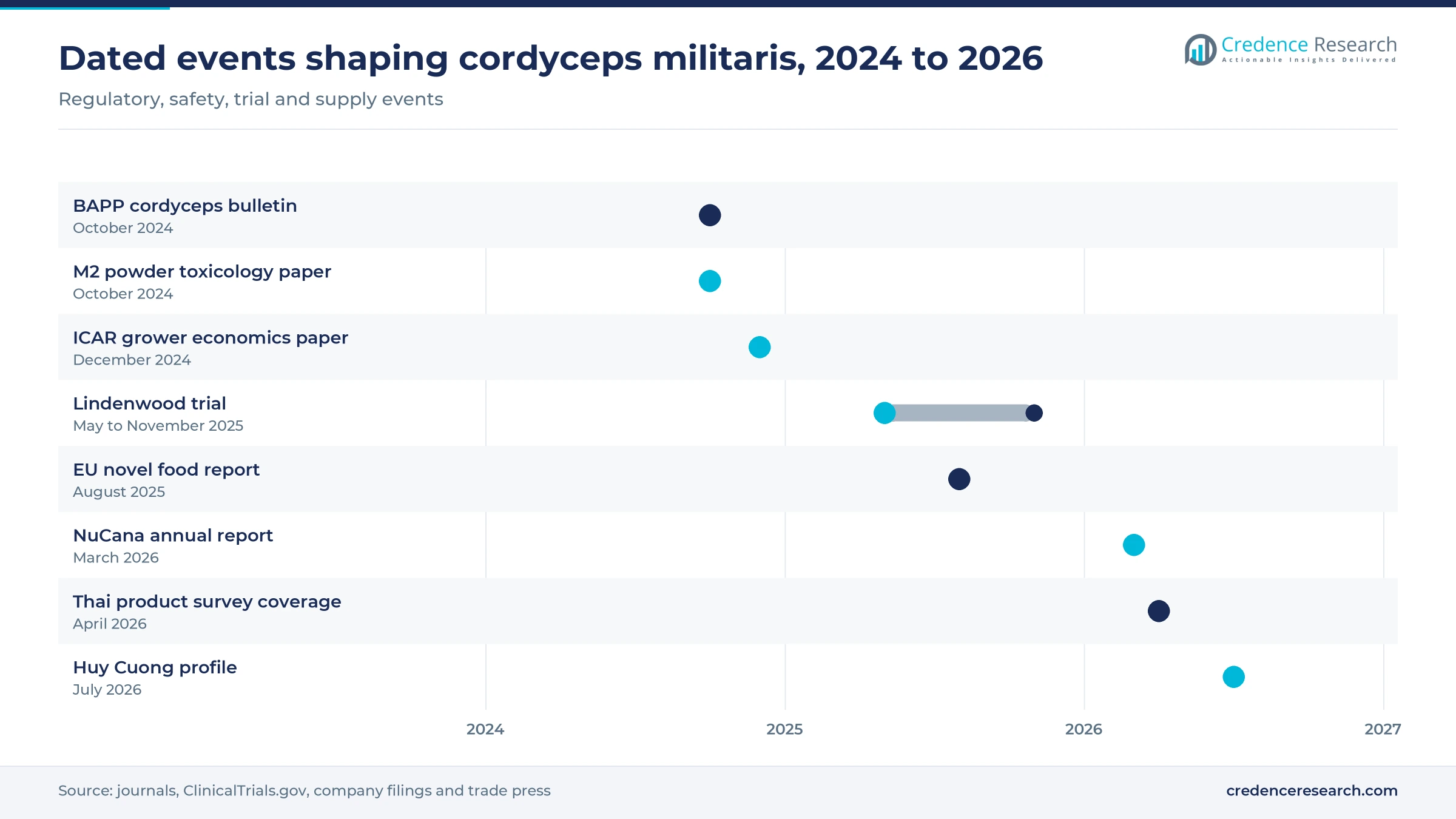
Safety data, EU rulings and trials marked 2024 to 2026
| Development | Status and market relevance |
|---|---|
| In October 2024, the Botanical Adulterants Prevention Program published its first bulletin on a fungal ingredient, covering cordyceps adulteration. | Published, and now a reference point for supplier testing |
| In October 2024, Frontiers in Toxicology published a 90-day safety study of M2 Ingredients' organic C. militaris powder. | Published, reporting no adverse effects in rats at the highest dose tested |
| In August 2025, NutraIngredients reported that the European Commission treated S. hepiali as not novel, leaving C. militaris novel. | Current catalogue position, which restricts supplement use in the European Union |
| In November 2025, Lindenwood University completed a 32-person randomized trial of C. militaris in active adults. | Completed, with registry outcomes covering endurance and VO2max |
| In July 2026, Vietnam Agriculture and Nature profiled Huy Cuong Cordyceps of Lai Chau and its three-star OCOP rating. | Operating below its designed capacity of 10,000 boxes a day |
Drying, strain work and extraction decide product value
- Solid-state cultivation grows fruiting bodies on grain in jars or bottles, and brown rice remains the highest-yield substrate in published Indian trials.
- Freeze-drying brings moisture down to about 7% in the July 2025 Processes study, which gives traders a product that holds for months.
- Strain engineering raises cordycepin titers, with Frontiers in Microbiology citing about 4.36 grams per liter in engineered Yarrowia lipolytica during fed-batch runs.
- Genetic authentication uses next-generation sequencing to confirm species identity, and a Thai technology offer pairs it with water-based extraction for standardized actives.
Need a Custom Version of This Report?
Tailor the scope, geography, or segments to your exact requirements.
- Custom geography or segment scope
- Direct access to our analyst team
Ingredient specialists and local growers split the field
Competition is fragmented because the barrier to growing is low while the barrier to proving quality is higher. Ingredient specialists such as Nammex and M2 Ingredients compete on organic certification and safety evidence, and they sell mainly to supplement brands in North America. Vietnamese producers such as Huy Cuong, BioFine and Thien An compete on local OCOP ratings, fresh formats and gift packs. Indian firms are younger, with OrangeHerb selling direct and Cordymil Myco Biotech offering bulk dried bodies under an FSSAI license. Drug developers sit apart, since NuCana works on a modified cordycepin rather than the fungus itself. Earlier listings of bulk extract companies were not carried forward where this research could not confirm their current activity in this species. Price therefore varies widely, and buyers increasingly choose suppliers by documented identity and lab data.
Which companies are active in cultivated cordyceps?
| Company | Type | Role in the market |
|---|---|---|
| Nammex | Organic ingredient supplier | Based in British Columbia and sells organically certified C. militaris extract powder to North American supplement makers. |
| M2 Ingredients | Organic ingredient supplier | Vista, California, company whose oat-grown powder was tested in the 2024 toxicology paper and the Lindenwood trial. |
| NuCana | Drug developer | Runs the NuTide:701 Phase 1/2 trial of NUC-7738, a modified form of cordycepin. |
| BioFine Cooperative | Grower and brand | Hanoi cooperative with fresh, dried, powdered and honey-soaked products and seven 4-star OCOP products. |
| Huy Cuong Cordyceps | Grower and brand | Lai Chau producer with a three-star OCOP rating and 3,000 to 4,000 boxes a day. |
| Thien An Cordyceps | Grower and processor | Tien Giang firm with 34 growing rooms and products including powder and cordyceps water. |
| Cordymil Myco Biotech | Bulk supplier | West Bengal firm listing bulk dried fruit bodies under an FSSAI license. |
| OrangeHerb | Direct-selling grower | Delhi brand selling at Rs 93,000 per kg with four crops a year in a 200-square-foot lab. |
| Awshad | Prescription wellness brand | New Delhi startup that launched a capsule with 250 milligrams of C. militaris in May 2023. |
Proof of identity will separate winners from sellers
Credence Research's view is that this market will be decided less by farm output than by proof of what is in the bottle. Supply is already easy to expand, as India's jar-based methods and China's tonnage both show. By contrast, the Thai survey and the European Union position both reward firms that can document species, strain and safety. Investors should therefore favor suppliers with toxicology files and batch testing over new growing capacity alone. Cultivators in India and Vietnam can still win locally, but mainly through direct brands that avoid the bulk price.
How the 2025 value and splits were estimated
The report uses 2025 as the base year and 2035 as the forecast year, with market values taken from the Credence Research model. The 2025 value was reset through a bottom-up estimate of dry output, ingredient value and downstream margin, and it replaces the higher value shown on the earlier edition of this page. Segment and regional splits are Credence Research estimates built from public evidence, including journal papers, registry records, company filings and trade press. No interviews or primary surveys were conducted for this edition of the report.
Value should more than double as testing tightens by 2035
Value should reach USD 3.72 billion by 2035, growing at 8.60% a year over 2026–2035, with Asia Pacific keeping the largest share. Volume growth is likely to come from China and new Asian growers, while price growth depends on tested products and fermented actives. A European authorization would be the largest single upside, because it would open a supplement channel now closed to the species. NuCana's clinical program offers a smaller upside that would arrive much later. On the downside, further fraud findings or a bulk price fall could slow value growth even if tonnage continues to rise.
Frequently Asked Questions
How big is the cordyceps militaris market?
What is the cordyceps militaris price per kg?
What is the cordyceps militaris price in the international market?
What is the cordyceps militaris market size in India?
Is demand for cordyceps militaris growing in India?
How does this fit within the cordyceps supplements market?
Which region leads the cordyceps militaris market?
What is the main risk for sellers of this ingredient?
Table of Content
Chapter 1 Market Segmentation
- 1.1 Segmentation Framework
- 1.1.1 Product and Service Classification
- 1.1.2 Application and End-Use Classification
- 1.1.3 Technology and Solution Classification
- 1.1.4 Customer and Distribution Channel Classification
- 1.1.5 Geographic Segmentation
- 1.1.6 Market Segment Definitions and Boundaries
- 1.2 By Type
- 1.2.1 Dried
- 1.2.2 Wet
- 1.3 By Formulation
- 1.3.1 Powder
- 1.3.2 Tablets and Capsules
- 1.3.3 Liquid
- 1.4 By Application
- 1.4.1 Food and Beverages
- 1.4.2 Pharmaceuticals
- 1.4.3 Cosmetics
Chapter 2 Introduction
- 2.1 Report Objectives and Scope
- 2.2 Product Definition and Industry Terminology
- 2.3 Market Inclusions and Exclusions
- 2.4 Research Process
- 2.4.1 Primary Research and Expert Interviews
- 2.4.2 Secondary Research and Source Review
- 2.4.3 Top-Down and Bottom-Up Estimation
- 2.4.4 Data Triangulation and Verification
- 2.5 Market Size Measurement Basis
- 2.5.1 2025: USD 1.63 billion → 2035: USD 3.72 billion
- 2.6 Historical and Forecast Reference Periods
- 2.6.1 Historical Period: 2018-2025
- 2.6.2 Base Year: 2025
- 2.6.3 Forecast Period: 2025-2035
- 2.7 Research Assumptions and Limitations
Chapter 3 Executive Summary
- 3.1 Market Snapshot and Key Findings
- 3.2 Base-Year Market Size, 2025
- 3.3 Forecast Market Size, 2035
- 3.4 Revenue and Volume Growth Outlook
- 3.5 Key Demand and Supply Indicators
- 3.6 Leading Market Segments
- 3.7 Fastest-Growing Market Opportunities
- 3.8 Regional Performance Highlights
- 3.9 Technology and Industry Transformation
- 3.10 Competitive Landscape Summary
- 3.11 Analyst View and Strategic Implications
Chapter 4 Global Cordyceps Militaris Market Trends and Developments
- 4.1 Historical Industry Development, 2018-2025
- 4.2 Recent Market Trends and Developments
- 4.3 Demand and Customer Behavior Trends
- 4.4 Technology and Product Innovation
- 4.5 Artificial Intelligence, Automation and Digitalization
- 4.6 Local Manufacturing and Supply Chain Realignment
- 4.7 Industry Partnerships, Mergers and Acquisitions
- 4.8 Sustainability and Circular Economy Developments
- 4.9 Government and Private Sector Investment Trends
- 4.10 Emerging Business Models and Commercialization
- 4.11 Industry Developments and Announcements
Chapter 5 Global Cordyceps Militaris Market Production, Supply and Demand Analysis
- 5.1 Demand Trend and Consumption Analysis, 2018-2025
- 5.2 Demand Forecast, 2025-2035
- 5.3 Production and Output Trend, 2018-2025
- 5.4 Production and Output Forecast, 2025-2035
- 5.5 Installed Capacity and Capacity Utilization
- 5.6 Company-Wise Production Plants and Statistics
- 5.6.1 Installed Production Capacity
- 5.6.2 Actual Production
- 5.6.3 Planned Capacity and Expansion Targets
- 5.7 Supply Chain Structure and Procurement Trends
- 5.8 Supply-Demand Gap and Bottlenecks
- 5.9 Import Dependence and Sourcing Structure
- 5.10 Contract Manufacturing and Outsourcing
- 5.11 Regional Supply and Demand Concentration
Chapter 6 Global Cordyceps Militaris Market Pricing Analysis
- 6.1 Pricing Structure and Measurement
- 6.2 Historical Pricing Trends, 2018-2025
- 6.3 Pricing Outlook, 2025-2035
- 6.4 Average Selling Price and Unit Economics
- 6.5 Pricing by Product and Market Segment
- 6.6 Geographic Pricing Differences
- 6.7 Key Input, Energy, Labor and Logistics Costs
- 6.8 Contract Pricing and Purchasing Models
- 6.9 Pricing Sensitivity and Competitive Positioning
- 6.10 Price, Margin and Profitability Implications
Chapter 7 Global Cordyceps Militaris Market Dynamics
- 7.1 Market Growth Drivers
- 7.1.1 Demand-Side Drivers
- 7.1.2 Technology and Innovation Drivers
- 7.1.3 Infrastructure and Investment Drivers
- 7.1.4 Regulatory and Policy Drivers
- 7.2 Market Restraints
- 7.2.1 Cost and Affordability Constraints
- 7.2.2 Technology and Adoption Barriers
- 7.2.3 Supply Chain and Operational Constraints
- 7.3 Market Challenges
- 7.3.1 Competitive Pressure and Margin Erosion
- 7.3.2 Skills, Infrastructure and Implementation Gaps
- 7.4 Emerging Market Opportunities
- 7.5 Market Dynamics Impact and Time-Horizon Assessment
Chapter 8 Global Cordyceps Militaris Value Chain Analysis
- 8.1 Industry Value Chain Overview
- 8.2 Upstream Suppliers and Critical Inputs
- 8.3 Technology and Component Providers
- 8.4 Manufacturing or Service Delivery
- 8.5 Distribution, Channel Partners and Integrators
- 8.6 Downstream Applications and End Users
- 8.7 Value Addition and Profit Pools
- 8.8 Vertical Integration and Outsourcing
- 8.9 Supplier Concentration and Risk
- 8.10 Supply Chain Localization and Resilience
Chapter 9 Global Cordyceps Militaris Market Regulations and Policies
- 9.1 Relevant Laws, Standards and Compliance Frameworks
- 9.2 Product, Service, Safety and Quality Requirements
- 9.3 Government Policies, Incentives and Subsidies
- 9.4 Imports, Exports and Trade Barriers
- 9.5 Public Procurement and Local Content Requirements
- 9.6 Environmental and Sustainability Compliance
- 9.7 Upcoming Policy Changes and Market Implications
Chapter 10 Global Cordyceps Militaris Market Hotspots and Opportunities
- 10.1 Market Opportunity Mapping and Growth Hotspots
- 10.2 High-Growth Applications and Customer Groups
- 10.3 Underserved Markets and White-Space Opportunities
- 10.4 Emerging Technology and Product Opportunities
- 10.5 New Capacity and Investment Hotspots
- 10.6 Market Entry and Expansion Opportunities
- 10.7 Distribution and Partnership Opportunities
- 10.8 Near-Term and Long-Term Commercial Potential
- 10.9 Opportunity Attractiveness and Execution Risks
Chapter 11 Global Cordyceps Militaris Market Outlook, 2025-2035
- 11.1 Market Size and Analysis
- 11.1.1 Revenue (Market Measurement: 2025: USD 1.63 billion → 2035: USD 3.72 billion)
- 11.1.2 Market Volume and Quantity Sold
- 11.1.3 Historical Market Size, 2018-2025
- 11.1.4 Base-Year Market Size, 2025
- 11.2 Market Forecast, 2025-2035
- 11.2.1 Revenue Forecast to 2035
- 11.2.2 Volume Forecast to 2035
- 11.2.3 CAGR and Year-on-Year Growth
- 11.2.4 Incremental Revenue Opportunity
- 11.3 Forecast Assumptions and Scenario Analysis
- 11.3.1 Base-Case Forecast
- 11.3.2 Optimistic and Conservative Scenarios
- 11.3.3 Technology, Pricing and Policy Sensitivities
- 11.4 Market Attractiveness and Growth Outlook
Chapter 12 Global Cordyceps Militaris Market Segmentation and Outlook
- 12.1 Segmentation Summary and Market Shares, 2025
- 12.2 Largest and Fastest-Growing Segments
- 12.3 By Type - Market Size and Forecast, 2025-2035
- 12.3.1 Segment Definition and Scope
- 12.3.2 Historical Market Size, 2018-2025
- 12.3.3 Revenue Forecast, 2025-2035
- 12.3.4 Volume Forecast, 2025-2035
- 12.3.5 Base-Year Market Share, 2025
- 12.3.6 Segment CAGR and Growth Drivers
- 12.3.7 Subsegment Market Size and Forecast
- 12.3.7.1 Dried
- 12.3.7.2 Wet
- 12.3.8 Subsegment Pricing and Adoption Trends
- 12.3.9 Leading Suppliers and Competition
- 12.3.10 Regional Demand and Opportunities
- 12.4 By Formulation - Market Size and Forecast, 2025-2035
- 12.4.1 Segment Definition and Scope
- 12.4.2 Historical Market Size, 2018-2025
- 12.4.3 Revenue Forecast, 2025-2035
- 12.4.4 Volume Forecast, 2025-2035
- 12.4.5 Base-Year Market Share, 2025
- 12.4.6 Segment CAGR and Growth Drivers
- 12.4.7 Subsegment Market Size and Forecast
- 12.4.7.1 Powder
- 12.4.7.2 Tablets and Capsules
- 12.4.7.3 Liquid
- 12.4.8 Subsegment Pricing and Adoption Trends
- 12.4.9 Leading Suppliers and Competition
- 12.4.10 Regional Demand and Opportunities
- 12.5 By Application - Market Size and Forecast, 2025-2035
- 12.5.1 Segment Definition and Scope
- 12.5.2 Historical Market Size, 2018-2025
- 12.5.3 Revenue Forecast, 2025-2035
- 12.5.4 Volume Forecast, 2025-2035
- 12.5.5 Base-Year Market Share, 2025
- 12.5.6 Segment CAGR and Growth Drivers
- 12.5.7 Subsegment Market Size and Forecast
- 12.5.7.1 Food and Beverages
- 12.5.7.2 Pharmaceuticals
- 12.5.7.3 Cosmetics
- 12.5.8 Subsegment Pricing and Adoption Trends
- 12.5.9 Leading Suppliers and Competition
- 12.5.10 Regional Demand and Opportunities
- 12.6 Segment Growth Comparison
- 12.7 Segment Attractiveness and Priority Matrix
Chapter 13 Global Cordyceps Militaris End-Use and Application Market Outlook
- 13.1 End-Use Industry and Customer Demand Structure
- 13.2 Leading Applications and Customer Groups
- 13.3 End-Use Market Size, Share and Forecast
- 13.4 Major End-Use Industry Deep Dives
- 13.4.1 Customer Requirements and Use Cases
- 13.4.2 Demand and Replacement Cycles
- 13.4.3 Technical and Regulatory Considerations
- 13.4.4 Purchasing and Procurement Models
- 13.4.5 Leading Vendors and Distribution Channels
- 13.4.6 Forecast and Commercial Opportunities
- 13.5 Emerging Applications and Cross-Segment Demand
- 13.6 End-Use Industry Investment Priorities
Chapter 14 Global Cordyceps Militaris Geographic Market Outlook, 2025-2035
- 14.1 Regional Market Size and Share, 2025
- 14.2 Regional Market Forecast, 2025-2035
- 14.3 Regional Pricing, Production and Demand Differences
- 14.4 North America
- 14.4.1 United States
- 14.4.2 Canada
- 14.4.3 Mexico
- 14.5 Europe
- 14.5.1 Germany
- 14.5.2 France
- 14.5.3 Italy
- 14.5.4 United Kingdom
- 14.5.5 Spain
- 14.5.6 Poland
- 14.5.7 Russia
- 14.5.8 Netherlands
- 14.5.9 Belgium
- 14.5.10 Sweden
- 14.5.11 Denmark
- 14.5.12 Norway
- 14.5.13 Rest of Europe
- 14.6 Asia Pacific
- 14.6.1 China
- 14.6.2 India
- 14.6.3 Japan
- 14.6.4 South Korea
- 14.6.5 Thailand
- 14.6.6 Indonesia
- 14.6.7 Vietnam
- 14.6.8 Malaysia
- 14.6.9 Australia
- 14.6.10 Rest of Asia Pacific
- 14.7 Latin America
- 14.7.1 Brazil
- 14.7.2 Argentina
- 14.7.3 Colombia
- 14.7.4 Chile
- 14.7.5 Rest of Latin America
- 14.8 Middle East
- 14.8.1 Saudi Arabia
- 14.8.2 United Arab Emirates
- 14.8.3 Turkey
- 14.8.4 Israel
- 14.8.5 Iran
- 14.8.6 Rest of the Middle East
- 14.9 Africa
- 14.9.1 South Africa
- 14.9.2 Egypt
- 14.9.3 Nigeria
- 14.9.4 Morocco
- 14.9.5 Rest of Africa
- 14.10 Regional Investment, Policy and Supply Chain Differences
- 14.11 Regional Competitive Landscape
- 14.12 Geographic Growth Hotspots
Chapter 15 Global Cordyceps Militaris Technology, Innovation and Sustainability Outlook
- 15.1 Technology Landscape and Maturity
- 15.2 Product, Process and Service Innovation
- 15.3 AI, Automation and Digital Tools in the Industry
- 15.4 Technology Adoption and Performance Benchmarking
- 15.5 Innovation Pipeline and R&D Investment
- 15.6 Patent and Intellectual Property Trends
- 15.7 Energy Efficiency and Resource Management
- 15.8 Sustainability, Recycling and Circularity
- 15.9 Technology Roadmap, 2025-2035
- 15.10 Risks of Obsolescence and Technology Substitution
Chapter 16 Global Cordyceps Militaris Market Key Strategic Imperatives
- 16.1 Growth and Market Entry Priorities
- 16.2 High-Return Products and Segments
- 16.3 Pricing, Profitability and Cost Optimization
- 16.4 Technology Investment and Product Differentiation
- 16.5 Supply Chain Localization and Resilience
- 16.6 Distribution and Customer Acquisition
- 16.7 Partnership, Acquisition and Capacity Strategy
- 16.8 Regional Expansion Priorities
- 16.9 Short-, Medium- and Long-Term Actions
Chapter 17 Competition Outlook
- 17.1 Industry Competition Characteristics
- 17.2 Market Structure and Concentration
- 17.3 Market Share and Competitive Positioning, 2025
- 17.4 Company-Wise Revenue and Product Benchmarking
- 17.5 Production and Service Capacity Benchmarking
- 17.6 Technology, Pricing and Differentiation
- 17.7 Regional Footprint and Distribution Strength
- 17.8 Mergers, Acquisitions and Strategic Alliances
- 17.9 New Entrants and Competitive Threats
- 17.10 Porter's Five Forces and Industry Attractiveness
- 17.11 Competitive Outlook, 2025-2035
Chapter 18 Company Profiles
- 18.1 Company Coverage and Selection Criteria
- 18.2 Nammex
- 18.2.1 Business Description
- 18.2.2 Company Ownership and Geographic Presence
- 18.2.3 Product and Service Portfolio
- 18.2.4 Manufacturing and Operating Footprint
- 18.2.5 Production Capacity and Expansion Plans
- 18.2.6 Financial Performance and Investment
- 18.2.7 Market Share and Competitive Position
- 18.2.8 Technology and Innovation Capabilities
- 18.2.9 Strategic Alliances or Partnerships
- 18.2.10 Recent Developments
- 18.2.11 Growth Strategy and Outlook
- 18.3 M2 Ingredients
- 18.4 NuCana
- 18.5 BioFine Cooperative
- 18.6 Huy Cuong Cordyceps
- 18.7 Thien An Cordyceps
- 18.8 Cordymil Myco Biotech
- 18.9 OrangeHerb
- 18.10 Awshad
- 18.11 Other Relevant Market Participants
Note: Every listed company is profiled on the structure shown under the first company. The company list is preliminary and may change based on research findings, market developments, data availability and client requirements.
Chapter 19 Disclaimer
- 19.1 Research and Forecast Disclaimer
- 19.2 Data Source and Estimation Limitations
Note: The depth of individual sections depends on data availability for this market. Volume, capacity, trade and other unit-based metrics are included where applicable.