Plastic Drink Stirrer Market Overview:
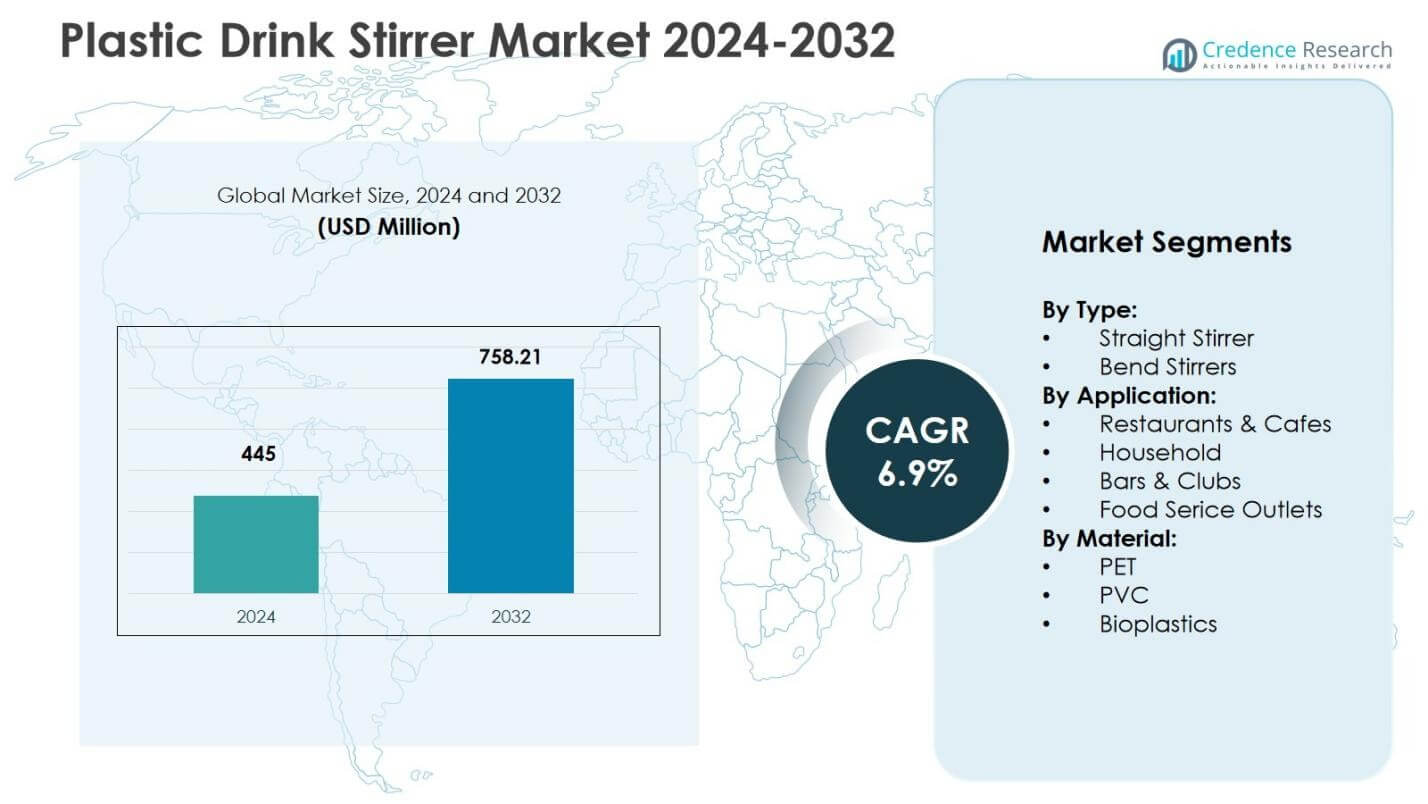
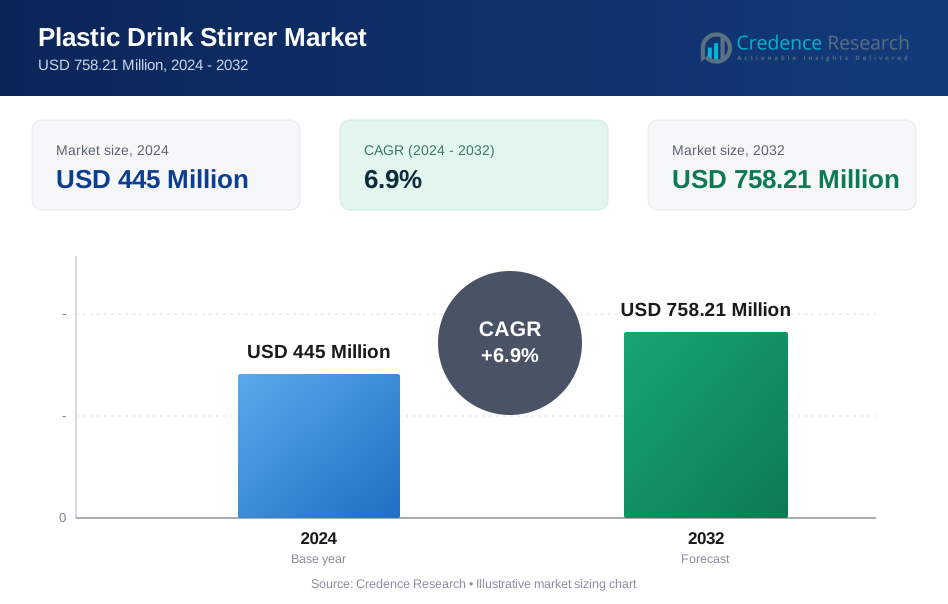
Plastic Drink Stirrer Market size was valued USD 445 Million in 2024 and is anticipated to reach USD 758.21 Million by 2032, at a CAGR of 6.9% during the forecast period.
| REPORT ATTRIBUTE | DETAILS |
|---|---|
| Historical Period | 2020-2023 |
| Base Year | 2024 |
| Forecast Period | 2025-2032 |
| Plastic Drink Stirrer Market Size 2024 | USD 445 million |
| Plastic Drink Stirrer Market, CAGR | 6.9% |
| Plastic Drink Stirrer Market Size 2032 | USD 758.21 million |
Market Insights
- Market growth is driven by rising beverage consumption in cafés, restaurants, and takeaway outlets, with the Straight Stirrers segment leading the market with 64.2% share in 2024 due to high usage in quick-service and café formats.
- Market trends include increasing demand for recyclable PET and bio-based stirrers, along with growing adoption of branded and customized designs across bars, lounges, and specialty cafés to enhance beverage presentation.
- Key players focus on large-scale supply capability, material diversification across PET, PVC, and bioplastics, and cost-efficient bulk production to strengthen procurement partnerships with foodservice chains and hospitality operators.
- Regional analysis shows North America holding 32.8% share in 2024 supported by strong café penetration, Europe accounting for 27.6% share under sustainability-led adoption, and Asia-Pacific capturing 28.4% share driven by rapid growth of urban foodservice networks.
Plastic Drink Stirrer Market Segmentation Analysis:
By Type
The Plastic Drink Stirrer Market by type is led by Straight Stirrers, which accounted for 64.2% share in 2024, driven by their widespread use in quick-service beverages, low unit cost, and higher compatibility with standard drink cups used in cafés and takeaway outlets. Straight stirrers also benefit from strong procurement preference among food-service chains due to simplified packaging and bulk distribution advantages. Bend Stirrers held 35.8% share in 2024, gaining traction in premium bars and specialty cafés where aesthetic presentation and consumer experience remain key purchase drivers supporting steady demand growth.
- For instance, Huhtamaki and Dart Container supply straight stirrers in bulk to franchise cafés, benefiting from simplified palletization and lightweight material handling in logistics.
By Application
By application, Restaurants & Cafes emerged as the dominant sub-segment with 42.6% share in 2024, supported by rising on-premise beverage consumption, expanding café chains, and strong procurement of disposable stirrers for hot and cold drinks. Bars & Clubs accounted for 24.3% share, driven by cocktail culture and presentation-focused serving formats, while Food Service Outlets held 19.8% share due to catering and institutional beverage services. The Household segment captured 13.3% share, primarily influenced by increasing at-home coffee and mocktail preparation, supported by growing online availability and small-pack retail distribution.
- For instance, The Conservatory for Coffee, Tea & Cocoa in Culver City, CA replaced disposable stirrers with reusables and promoted a "Bring Your Own Cup" incentive, achieving $6,899 in annual net cost savings without added labor costs.
By Material
In terms of material, PET dominated the Plastic Drink Stirrer Market with 55.1% share in 2024, driven by its durability, clarity, recyclability compatibility, and strong acceptance among commercial beverage brands. PVC held 27.3% share, supported by its flexibility, heat resistance, and preference in bars and specialty drink environments. Bioplastics accounted for 17.6% share, witnessing rising adoption due to sustainability mandates, eco-labeling initiatives, and growing procurement by environmentally conscious cafés and quick-service restaurants. Increasing regulatory emphasis on greener single-use products continues to accelerate investments in bio-based stirrer manufacturing within the market.
Key Growth Drivers
Rising Expansion of Foodservice and Café Chains
The Plastic Drink Stirrer Market experiences strong growth as global café franchises, quick-service restaurants, and specialty beverage outlets expand across urban and tier-II cities. Increasing consumption of coffee, mocktails, specialty teas, and takeaway beverages boosts the bulk procurement of disposable stirrers for operational efficiency and hygiene compliance. The surge in on-the-go beverage culture, coupled with rising consumer spending on premium drinks, strengthens demand from cafés, bars, and catering services. Large foodservice operators prefer standardized plastic stirrers due to cost efficiency, compatibility with automated dispensing systems, and consistent product quality, supporting sustained volume growth across commercial beverage environments.
- For instance, Dart Container supplies durable plastic products to quick-service restaurants and catering operations, enabling efficient beverage stations with bulk-packed, disposable stirrers. Their foodservice-grade options ensure reliability for hot and cold drinks in busy environments.
Cost Efficiency, Durability, and Operational Convenience
Plastic drink stirrers remain widely adopted due to their strength, heat resistance, and convenience in high-volume beverage service environments such as cafeterias, airlines, institutional catering, and fast-food chains. Their lightweight structure, low manufacturing cost, and compatibility with automated packaging and bulk logistics make them a preferred choice over wooden or metal alternatives in mass-service applications. Consistent performance with both hot and cold beverages further enhances operational reliability. The ability to support custom branding, product differentiation, and standardized procurement across global foodservice networks strengthens long-term utilization and reinforces market growth among commercial end users.
- For instance, Starbucks employed plastic stirrers, such as their green splash sticks, nationwide to minimize spills from sip holes in coffee lids during high-volume service. The reusable design supported custom branding and consistent performance across outlets for both hot and cold drinks.
Product Innovation and Customization in Premium Beverage Presentation
Growing emphasis on beverage aesthetics, brand identity, and customer experience encourages manufacturers to introduce customized plastic stirrers in varied shapes, designs, and color formats tailored for bars, specialty cafés, and themed restaurants. Branded stirrers support premium presentation in cocktails, mocktails, and specialty drinks, contributing to enhanced consumer engagement. Demand for embossed, logo-printed, and uniquely molded stirrers continues to increase among hospitality brands seeking visual differentiation. The trend toward event-based catering, luxury dining, and lifestyle-oriented beverage consumption drives higher preference for visually appealing stirrers, reinforcing product innovation as a key demand-shaping growth driver in the market.
Key Trends & Opportunities
Shift Toward Sustainable and Bio-Based Plastic Stirrer Alternatives
The Plastic Drink Stirrer Market witnesses a growing transition toward recyclable PET and bio-based materials as environmental regulations and corporate sustainability programs gain strength worldwide. Foodservice operators increasingly adopt eco-labeled stirrers to align with waste-reduction goals and consumer expectations for environmentally responsible products. Manufacturers invest in biodegradable and compostable variants designed to balance sustainability with durability and heat stability. This shift opens significant opportunities for product diversification, regulatory-compliant manufacturing, and premium positioning. Collaboration with beverage brands and café chains for green-certified stirrers creates new revenue avenues while supporting circular-economy initiatives across the global disposable beverage accessories ecosystem.
- For instance, BioPak offers 5-inch PLA bioplastic stirrers made from plant-based starch, certified industrially compostable to AS4736 and EN13432 standards for use in hot and cold drinks. Each stirrer weighs 1.468g and comes in sleeves of 100 units per carton of 3,000.
Growth of Online Distribution and Customized Small-Pack Retail Demand
Expanding e-commerce channels, business-to-business procurement portals, and direct-to-consumer platforms create new growth opportunities for plastic drink stirrer manufacturers. Small hospitality businesses, home-cafés, and event organizers increasingly purchase customized and small-pack stirrers online, supporting broader market reach beyond institutional bulk buyers. Digital retail enables tiered pricing, design personalization, and faster order fulfillment. Rising at-home coffee culture, gift-pack beverages, and DIY mocktail trends further expand consumer-side demand. Online customization tools, print-on-demand branding options, and marketplace integration strengthen product accessibility and enable manufacturers to capture emerging niche segments within household and micro-enterprise beverage applications.
- For instance, Hotpack sells plastic clear cocktail stirrers in packs of 2500 pieces directly via its webstore, targeting parties, weddings, and hospitality venues with sleek, translucent designs for hot or cold drinks.
Key Challenges
Stringent Environmental Regulations and Single-Use Plastic Restrictions
The Plastic Drink Stirrer Market faces regulatory pressure as governments implement bans, taxation policies, and extended producer responsibility frameworks targeting single-use plastics. Increasing enforcement of waste-management standards, especially across Europe, North America, and select Asia-Pacific markets, compels manufacturers to redesign product portfolios and shift toward recyclable or bio-based alternatives. Compliance-driven production upgrades increase costs for molding, material sourcing, and certification processes. Foodservice operators also reduce dependency on disposable stirrers through alternative materials or reusable formats, leading to potential demand displacement. Navigating evolving environmental mandates remains a structural challenge influencing investment strategies and long-term market positioning.
Rising Substitution from Wood, Paper, and Reusable Stirrer Alternatives
Growing consumer awareness regarding sustainability and the expanding availability of wood-based, paper-based, and reusable metal or bamboo stirrers present a competitive challenge to plastic variants. Hospitality chains increasingly evaluate alternative materials to improve brand sustainability credentials and comply with eco-procurement guidelines. Although plastic stirrers retain advantages in durability and cost efficiency, perception-driven substitution gradually impacts institutional purchasing behavior in environmentally sensitive markets. Manufacturers must balance pricing, performance, and sustainability innovation to mitigate substitution risks. The shift toward alternative stirring solutions intensifies competition and necessitates product diversification to retain relevance across evolving beverage-service ecosystems.
Regional Analysis
North America
North America held a leading position in the Plastic Drink Stirrer Market with a 32.8% share in 2024, supported by the strong presence of café chains, specialty coffee outlets, quick-service restaurants, and premium bars across the United States and Canada. High consumption of takeaway beverages and cocktails, along with standardized procurement practices in large foodservice networks, drives consistent product demand. Growth in event catering, airline catering, and institutional foodservice further strengthens market adoption. Increasing regulatory scrutiny on single-use plastics encourages gradual shifts toward recyclable PET stirrers, prompting manufacturers to enhance sustainable product lines while maintaining operational efficiency across commercial applications.
Europe
Europe accounted for a 27.6% share in 2024, driven by a mature hospitality ecosystem, strong café culture, and high beverage consumption across countries such as Germany, France, Italy, Spain, and the United Kingdom. Demand is supported by premium beverage presentation requirements in restaurants, hotels, and cocktail bars, particularly in tourism-centric cities. However, stringent EU sustainability directives influence product choices, accelerating the transition toward recyclable and bio-based plastic stirrers. Foodservice operators increasingly adopt eco-labeled variants to comply with regulatory standards while retaining performance reliability, supporting steady but compliance-driven market growth across institutional and commercial beverage-service environments in the region.
Asia-Pacific
Asia-Pacific captured a 28.4% share in 2024, emerging as a rapidly expanding regional market due to the proliferation of urban café chains, quick-service restaurants, and lifestyle-oriented beverage outlets across China, India, Japan, South Korea, and Southeast Asia. Rising disposable incomes, evolving dining culture, and strong growth in on-the-go beverage consumption contribute to high-volume demand from commercial foodservice environments. The region benefits from large-scale manufacturing capabilities and cost-efficient production networks, supporting competitive pricing and export supply. Increasing interest in branded and customized drink stirrers for premium cafés and modern bars further stimulates product innovation and enhances regional market momentum.
Latin America
Latin America accounted for a 6.1% share in 2024, supported by expanding restaurant and bar networks, tourism-driven beverage consumption, and the rising popularity of specialty coffee and cocktail culture across Brazil, Mexico, Argentina, and Chile. Growth in urban café formats and hospitality sector modernization increases procurement of disposable plastic drink stirrers, particularly within quick-service and mid-scale dining environments. Regional manufacturers benefit from cost-effective production and distribution, although sustainability awareness continues to shape material preferences. Gradual adoption of recyclable and branded stirrer variants strengthens demand opportunities while supporting the evolving beverage-service landscape across key metropolitan consumption centers in the region.
Middle East & Africa
The Middle East & Africa region held a 5.1% share in 2024, driven by hospitality sector expansion, premium dining growth, and increasing beverage consumption in tourism hubs such as the UAE, Saudi Arabia, and South Africa. Demand is influenced by upscale cafés, hotel chains, and lounge bars that prioritize beverage presentation and service standardization. Growing investments in foodservice infrastructure and international franchise expansion support steady market penetration. While sustainability regulations remain at an evolving stage, emerging procurement preferences for recyclable PET and branded stirrers create opportunities for product diversification, reinforcing gradual but opportunity-led growth across commercial beverage-service environments.
Plastic Drink Stirrer Market Segmentations:
By Type:
- Straight Stirrer
- Bend Stirrers
By Application:
- Restaurants & Cafes
- Household
- Bars & Clubs
- Food Serice Outlets
By Material:
- PET
- PVC
- Bioplastics
By Geography
- North America
- U.S.
- Canada
- Mexico
- Europe
- Germany
- France
- U.K.
- Italy
- Spain
- Rest of Europe
- Asia Pacific
- China
- Japan
- India
- South Korea
- South-east Asia
- Rest of Asia Pacific
- Latin America
- Brazil
- Argentina
- Rest of Latin America
- Middle East & Africa
- GCC Countries
- South Africa
- Rest of the Middle East and Africa
Competitive Landscape
Competitive landscape analysis in the Plastic Drink Stirrer Market highlights key players such as Eco-Products, PrimeWare by AmerCareRoyal, Royal Paper Products, Soodhalter Plastics Inc., Perfect Stix LLC, BarConic, Plastirun Corporation, Blue Orchards, Great Credentials, and Da Vinci’s Taste. The market remains moderately fragmented, with strong participation from regional manufacturers and private-label suppliers serving cafés, bars, quick-service restaurants, catering networks, and institutional foodservice operators. Leading companies focus on cost-efficient production, bulk distribution capability, and product consistency to strengthen large-volume procurement relationships. Strategic priorities include portfolio diversification across PET, PVC, and emerging bio-based variants, along with customized and branded stirrer designs for premium beverage presentation. Sustainability-aligned innovation and recyclable material integration are gaining prominence due to shifting regulatory expectations and hospitality sector eco-procurement trends. Market participants also emphasize packaging optimization, automated molding efficiency, and B2B e-commerce distribution to enhance reach across international and mid-scale foodservice environments while maintaining competitive pricing and performance reliability.
Key Player Analysis
- Royal Paper Products
- BarConic
- Soodhalter Plastics Inc.
- Great Credentials
- Eco-Products
- PrimeWare by AmerCareRoyal
- Perfect Stix LLC
- Blue Orchards
- Plastirun Corporation
- Da Vinci’s Taste
Recent Developments
- In January 2024, PrimeWare by AmerCareRoyal launched a cellulosic compostable straw product, expanding its sustainable beverage accessory portfolio and reinforcing eco-friendly alternatives to traditional plastic products in foodservice applications.
- In October 2024, Southwest Airlines launched a plastic-free drink stir stick made from 100% FSC-certified birch wood at the same time it introduced new cups made with a pulp blend of bamboo and paper, signaling a shift away from traditional plastic stirrers in in-flight beverage service.
Report Coverage
The research report offers an in-depth analysis based on Type, Application, Material and Geography. It details leading market players, providing an overview of their business, product offerings, investments, revenue streams, and key applications. Additionally, the report includes insights into the competitive environment, SWOT analysis, current market trends, as well as the primary drivers and constraints. Furthermore, it discusses various factors that have driven market expansion in recent years. The report also explores market dynamics, regulatory scenarios, and technological advancements that are shaping the industry. It assesses the impact of external factors and global economic changes on market growth. Lastly, it provides strategic recommendations for new entrants and established companies to navigate the complexities of the market.
Future Outlook
- The market will witness steady demand growth as café chains, quick-service restaurants, and specialty beverage outlets continue expanding across global urban markets.
- Manufacturers will increasingly prioritize recyclable PET and bio-based materials to align with sustainability regulations and eco-procurement policies.
- Custom-designed and branded stirrers will gain traction in premium cafés, cocktail bars, and event-based hospitality environments.
- B2B e-commerce platforms and digital procurement channels will strengthen distribution efficiency and support wider market accessibility.
- Product innovation will focus on durability, heat resistance, and design aesthetics to enhance beverage presentation and user experience.
- Rising at-home coffee culture and small-pack retail demand will create niche growth opportunities in the household segment.
- Automation in molding, packaging, and logistics operations will improve manufacturing efficiency and cost competitiveness.
- Partnerships with foodservice chains will play a key role in long-term supply agreements and volume-based growth strategies.
- Regional sustainability mandates will encourage gradual portfolio shifts toward compostable and low-impact material alternatives.
- Market participants will strengthen export capabilities and cross-regional supply networks to capture emerging hospitality growth markets.
Request a Free Sample
Fill in your details and we'll send you a free sample report.
- Sample data tables & charts
- Research methodology
Need a Custom Version of This Report?
Tailor the scope, geography, or segments to your exact requirements.
- Custom geography or segment scope
- Direct access to our analyst team
Frequently Asked Questions
What is the current market size for the Plastic Drink Stirrer Market, and what is its projected size in 2032?
At what Compound Annual Growth Rate is the Plastic Drink Stirrer Market projected to grow between 2024 and 2032?
Which Plastic Drink Stirrer Market segment held the largest share in 2024?
What are the primary factors fueling the growth of the Plastic Drink Stirrer Market?
Who are the leading companies in the Plastic Drink Stirrer Market?
Which region commanded the largest share of the Plastic Drink Stirrer Market in 2024?
Table of Content
Chapter 1 Market Segmentation
- 1.1 Segmentation Framework
- 1.1.1 Product and Service Classification
- 1.1.2 Application and End-Use Classification
- 1.1.3 Technology and Solution Classification
- 1.1.4 Customer and Distribution Channel Classification
- 1.1.5 Geographic Segmentation
- 1.1.6 Market Segment Definitions and Boundaries
Chapter 2 Introduction
- 2.1 Report Objectives and Scope
- 2.2 Product Definition and Industry Terminology
- 2.3 Market Inclusions and Exclusions
- 2.4 Research Process
- 2.4.1 Primary Research and Expert Interviews
- 2.4.2 Secondary Research and Source Review
- 2.4.3 Top-Down and Bottom-Up Estimation
- 2.4.4 Data Triangulation and Verification
- 2.5 Market Size Measurement Basis
- 2.5.1 2024: USD 445 Million → 2032: USD 758.21 Million
- 2.6 Historical and Forecast Reference Periods
- 2.6.1 Base Year: 2024
- 2.6.2 Forecast Period: 2024-2032
- 2.7 Research Assumptions and Limitations
Chapter 3 Executive Summary
- 3.1 Market Snapshot and Key Findings
- 3.2 Base-Year Market Size, 2024
- 3.3 Forecast Market Size, 2032
- 3.4 Revenue and Volume Growth Outlook
- 3.5 Key Demand and Supply Indicators
- 3.6 Leading Market Segments
- 3.7 Fastest-Growing Market Opportunities
- 3.8 Regional Performance Highlights
- 3.9 Technology and Industry Transformation
- 3.10 Competitive Landscape Summary
- 3.11 Analyst View and Strategic Implications
Chapter 4 Global Plastic Drink Stirrer Market Trends and Developments
- 4.1 Historical Industry Development
- 4.2 Recent Market Trends and Developments
- 4.3 Demand and Customer Behavior Trends
- 4.4 Technology and Product Innovation
- 4.5 Artificial Intelligence, Automation and Digitalization
- 4.6 Local Manufacturing and Supply Chain Realignment
- 4.7 Industry Partnerships, Mergers and Acquisitions
- 4.8 Sustainability and Circular Economy Developments
- 4.9 Government and Private Sector Investment Trends
- 4.10 Emerging Business Models and Commercialization
- 4.11 Industry Developments and Announcements
Chapter 5 Global Plastic Drink Stirrer Market Production, Supply and Demand Analysis
- 5.1 Demand Trend and Consumption Analysis
- 5.2 Demand Forecast, 2024-2032
- 5.3 Production and Output Trend
- 5.4 Production and Output Forecast, 2024-2032
- 5.5 Installed Capacity and Capacity Utilization
- 5.6 Company-Wise Production Plants and Statistics
- 5.6.1 Installed Production Capacity
- 5.6.2 Actual Production
- 5.6.3 Planned Capacity and Expansion Targets
- 5.7 Supply Chain Structure and Procurement Trends
- 5.8 Supply-Demand Gap and Bottlenecks
- 5.9 Import Dependence and Sourcing Structure
- 5.10 Contract Manufacturing and Outsourcing
- 5.11 Regional Supply and Demand Concentration
Chapter 6 Global Plastic Drink Stirrer Market Pricing Analysis
- 6.1 Pricing Structure and Measurement
- 6.2 Historical Pricing Trends
- 6.3 Pricing Outlook, 2024-2032
- 6.4 Average Selling Price and Unit Economics
- 6.5 Pricing by Product and Market Segment
- 6.6 Geographic Pricing Differences
- 6.7 Key Input, Energy, Labor and Logistics Costs
- 6.8 Contract Pricing and Purchasing Models
- 6.9 Pricing Sensitivity and Competitive Positioning
- 6.10 Price, Margin and Profitability Implications
Chapter 7 Global Plastic Drink Stirrer Market Dynamics
- 7.1 Market Growth Drivers
- 7.1.1 Demand-Side Drivers
- 7.1.2 Technology and Innovation Drivers
- 7.1.3 Infrastructure and Investment Drivers
- 7.1.4 Regulatory and Policy Drivers
- 7.2 Market Restraints
- 7.2.1 Cost and Affordability Constraints
- 7.2.2 Technology and Adoption Barriers
- 7.2.3 Supply Chain and Operational Constraints
- 7.3 Market Challenges
- 7.3.1 Competitive Pressure and Margin Erosion
- 7.3.2 Skills, Infrastructure and Implementation Gaps
- 7.4 Emerging Market Opportunities
- 7.5 Market Dynamics Impact and Time-Horizon Assessment
Chapter 8 Global Plastic Drink Stirrer Value Chain Analysis
- 8.1 Industry Value Chain Overview
- 8.2 Upstream Suppliers and Critical Inputs
- 8.3 Technology and Component Providers
- 8.4 Manufacturing or Service Delivery
- 8.5 Distribution, Channel Partners and Integrators
- 8.6 Downstream Applications and End Users
- 8.7 Value Addition and Profit Pools
- 8.8 Vertical Integration and Outsourcing
- 8.9 Supplier Concentration and Risk
- 8.10 Supply Chain Localization and Resilience
Chapter 9 Global Plastic Drink Stirrer Market Regulations and Policies
- 9.1 Relevant Laws, Standards and Compliance Frameworks
- 9.2 Product, Service, Safety and Quality Requirements
- 9.3 Government Policies, Incentives and Subsidies
- 9.4 Imports, Exports and Trade Barriers
- 9.5 Public Procurement and Local Content Requirements
- 9.6 Environmental and Sustainability Compliance
- 9.7 Upcoming Policy Changes and Market Implications
Chapter 10 Global Plastic Drink Stirrer Market Hotspots and Opportunities
- 10.1 Market Opportunity Mapping and Growth Hotspots
- 10.2 High-Growth Applications and Customer Groups
- 10.3 Underserved Markets and White-Space Opportunities
- 10.4 Emerging Technology and Product Opportunities
- 10.5 New Capacity and Investment Hotspots
- 10.6 Market Entry and Expansion Opportunities
- 10.7 Distribution and Partnership Opportunities
- 10.8 Near-Term and Long-Term Commercial Potential
- 10.9 Opportunity Attractiveness and Execution Risks
Chapter 11 Global Plastic Drink Stirrer Market Outlook, 2024-2032
- 11.1 Market Size and Analysis
- 11.1.1 Revenue (Market Measurement: 2024: USD 445 Million → 2032: USD 758.21 Million)
- 11.1.2 Market Volume and Quantity Sold
- 11.1.3 Historical Market Size
- 11.1.4 Base-Year Market Size, 2024
- 11.2 Market Forecast, 2024-2032
- 11.2.1 Revenue Forecast to 2032
- 11.2.2 Volume Forecast to 2032
- 11.2.3 CAGR and Year-on-Year Growth
- 11.2.4 Incremental Revenue Opportunity
- 11.3 Forecast Assumptions and Scenario Analysis
- 11.3.1 Base-Case Forecast
- 11.3.2 Optimistic and Conservative Scenarios
- 11.3.3 Technology, Pricing and Policy Sensitivities
- 11.4 Market Attractiveness and Growth Outlook
Chapter 12 Global Plastic Drink Stirrer Market Segmentation and Outlook
- 12.1 Segmentation Summary and Market Shares, 2024
- 12.2 Largest and Fastest-Growing Segments
- 12.3 Segment Growth Comparison
- 12.4 Segment Attractiveness and Priority Matrix
Chapter 13 Global Plastic Drink Stirrer Geographic Market Outlook, 2024-2032
- 13.1 Regional Market Size and Share, 2024
- 13.2 Regional Market Forecast, 2024-2032
- 13.3 Regional Pricing, Production and Demand Differences
- 13.4 North America
- 13.4.1 United States
- 13.4.2 Canada
- 13.4.3 Mexico
- 13.5 Europe
- 13.5.1 Germany
- 13.5.2 France
- 13.5.3 Italy
- 13.5.4 United Kingdom
- 13.5.5 Spain
- 13.5.6 Poland
- 13.5.7 Russia
- 13.5.8 Netherlands
- 13.5.9 Belgium
- 13.5.10 Sweden
- 13.5.11 Denmark
- 13.5.12 Norway
- 13.5.13 Rest of Europe
- 13.6 Asia Pacific
- 13.6.1 China
- 13.6.2 India
- 13.6.3 Japan
- 13.6.4 South Korea
- 13.6.5 Thailand
- 13.6.6 Indonesia
- 13.6.7 Vietnam
- 13.6.8 Malaysia
- 13.6.9 Australia
- 13.6.10 Rest of Asia Pacific
- 13.7 Latin America
- 13.7.1 Brazil
- 13.7.2 Argentina
- 13.7.3 Colombia
- 13.7.4 Chile
- 13.7.5 Rest of Latin America
- 13.8 Middle East
- 13.8.1 Saudi Arabia
- 13.8.2 United Arab Emirates
- 13.8.3 Turkey
- 13.8.4 Israel
- 13.8.5 Iran
- 13.8.6 Rest of the Middle East
- 13.9 Africa
- 13.9.1 South Africa
- 13.9.2 Egypt
- 13.9.3 Nigeria
- 13.9.4 Morocco
- 13.9.5 Rest of Africa
- 13.10 Regional Investment, Policy and Supply Chain Differences
- 13.11 Regional Competitive Landscape
- 13.12 Geographic Growth Hotspots
Chapter 14 Global Plastic Drink Stirrer Technology, Innovation and Sustainability Outlook
- 14.1 Technology Landscape and Maturity
- 14.2 Product, Process and Service Innovation
- 14.3 AI, Automation and Digital Tools in the Industry
- 14.4 Technology Adoption and Performance Benchmarking
- 14.5 Innovation Pipeline and R&D Investment
- 14.6 Patent and Intellectual Property Trends
- 14.7 Energy Efficiency and Resource Management
- 14.8 Sustainability, Recycling and Circularity
- 14.9 Technology Roadmap, 2024-2032
- 14.10 Risks of Obsolescence and Technology Substitution
Chapter 15 Global Plastic Drink Stirrer Market Key Strategic Imperatives
- 15.1 Growth and Market Entry Priorities
- 15.2 High-Return Products and Segments
- 15.3 Pricing, Profitability and Cost Optimization
- 15.4 Technology Investment and Product Differentiation
- 15.5 Supply Chain Localization and Resilience
- 15.6 Distribution and Customer Acquisition
- 15.7 Partnership, Acquisition and Capacity Strategy
- 15.8 Regional Expansion Priorities
- 15.9 Short-, Medium- and Long-Term Actions
Chapter 16 Competition Outlook
- 16.1 Industry Competition Characteristics
- 16.2 Market Structure and Concentration
- 16.3 Market Share and Competitive Positioning, 2024
- 16.4 Company-Wise Revenue and Product Benchmarking
- 16.5 Production and Service Capacity Benchmarking
- 16.6 Technology, Pricing and Differentiation
- 16.7 Regional Footprint and Distribution Strength
- 16.8 Mergers, Acquisitions and Strategic Alliances
- 16.9 New Entrants and Competitive Threats
- 16.10 Porter's Five Forces and Industry Attractiveness
- 16.11 Competitive Outlook, 2024-2032
Chapter 17 Company Profiles
- 17.1 Company Coverage and Selection Criteria
- 17.2 Leading Market Participants – Standard Profile Structure
- 17.2.1 Business Description
- 17.2.2 Company Ownership and Geographic Presence
- 17.2.3 Product and Service Portfolio
- 17.2.4 Manufacturing and Operating Footprint
- 17.2.5 Production Capacity and Expansion Plans
- 17.2.6 Financial Performance and Investment
- 17.2.7 Market Share and Competitive Position
- 17.2.8 Technology and Innovation Capabilities
- 17.2.9 Strategic Alliances or Partnerships
- 17.2.10 Recent Developments
- 17.2.11 Growth Strategy and Outlook
- 17.3 Other Relevant Market Participants
Note: Every listed company is profiled on the structure shown under the first company. The company list is preliminary and may change based on research findings, market developments, data availability and client requirements.
Chapter 18 Disclaimer
- 18.1 Research and Forecast Disclaimer
- 18.2 Data Source and Estimation Limitations
Note: The depth of individual sections depends on data availability for this market. Volume, capacity, trade and other unit-based metrics are included where applicable.