
Market Overview:
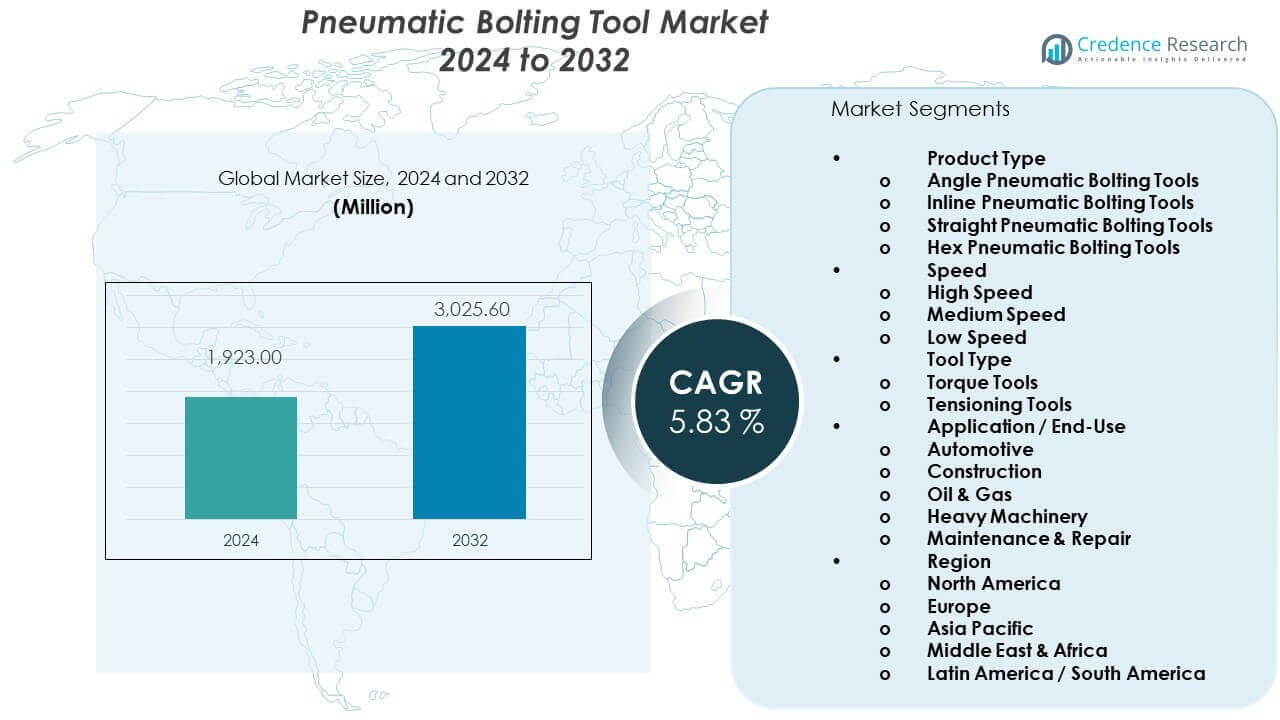
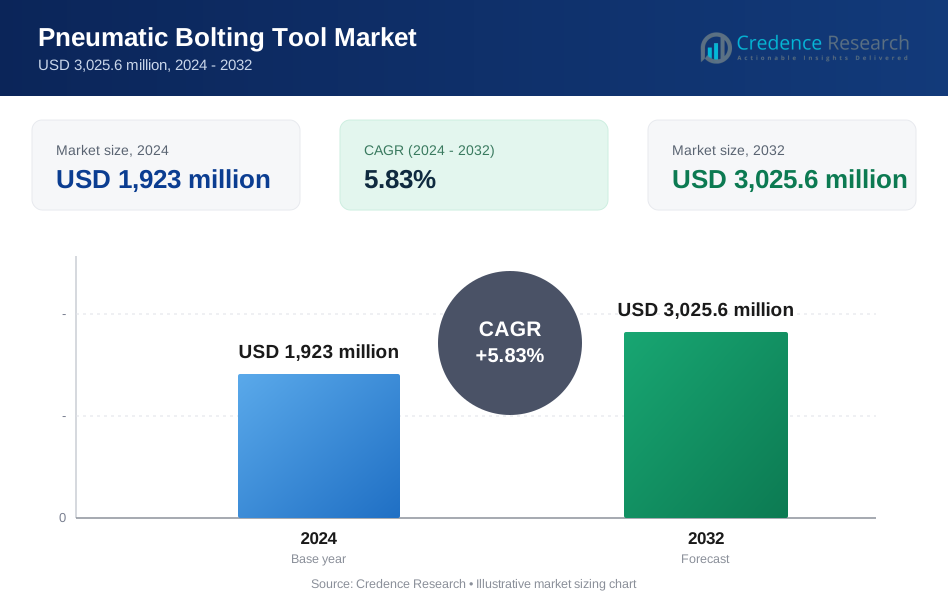
The Pneumatic bolting tool market is projected to grow from USD 1,923 million in 2024 to USD 3,025.6 million by 2032, at a CAGR of 5.83% from 2024 to 2032.
| REPORT ATTRIBUTE | DETAILS |
|---|---|
| Historical Period | 2020-2023 |
| Base Year | 2024 |
| Forecast Period | 2025-2032 |
| Pneumatic Bolting Tool Market Size 2024 | USD 12525 million |
| Pneumatic Bolting Tool Market, CAGR | 5.7% |
| Pneumatic Bolting Tool Market Size 2032 | USD 19515 million |
Market growth is driven by expanding industrial automation and rising infrastructure projects worldwide. Manufacturers prefer pneumatic bolting tools for consistent torque accuracy. Oil and gas facilities rely on these tools for flange connections. Power generation plants use them during turbine and pipeline assembly. Automotive plants adopt pneumatic tools for chassis and engine assembly. Shipbuilding yards depend on high-torque tools for structural joints. Lower tool weight reduces worker fatigue. Reliable air-powered systems suit explosive environments.
North America leads due to strong oil, gas, and industrial maintenance activity. Europe follows with demand from automotive and energy sectors. Germany and the UK support adoption through advanced manufacturing bases. Asia Pacific is the fastest emerging region. China and India benefit from infrastructure expansion and factory investments. Southeast Asia gains from shipbuilding growth. The Middle East sees demand from energy projects. Latin America shows steady uptake in mining and utilities.
Market Insights:
- The Pneumatic bolting tool market is valued at USD 1,923 million in 2024 and is projected to reach USD 3,025.6 million by 2032, growing at a CAGR of 5.83%, supported by steady demand from heavy industrial fastening applications requiring repeatable torque accuracy.
- North America holds the largest share at about 34%, driven by strong oil and gas activity, power generation maintenance, and mature industrial service networks that favor pneumatic tools for hazardous environments.
- Europe accounts for nearly 27% of the market, led by Germany and the UK, where automotive manufacturing, energy infrastructure, and strict safety standards sustain consistent tool adoption.
- Asia Pacific represents around 24% of total share and is the fastest-growing region, supported by rapid industrialization in China and India, infrastructure expansion, and rising factory automation across Southeast Asia.
- By segment distribution, torque tools dominate with approximately 68% share due to wide industrial usage, while oil and gas and heavy machinery together account for about 46% of end-use demand because of critical bolting requirements in high-load applications.
Market Drivers:
Rising Demand From Heavy Industrial Assembly And Maintenance Operations
The Pneumatic bolting tool market benefits from heavy industrial assembly demand across core sectors. Oil and gas facilities require precise torque for flange integrity. Power plants depend on secure fastening for turbines and pressure systems. Steel plants use pneumatic tools for continuous high-load tasks. Shipyards rely on high torque output for structural joints. Mining operations value durability in harsh conditions. Air-powered systems suit long duty cycles without overheating. Safety standards reinforce the need for controlled fastening.
- for instance, HYTORC supplies ATEX-certified pneumatic torque tools that comply with ISO 6789 calibration standards, supporting controlled bolting in hazardous refinery and petrochemical environments.
Expansion Of Infrastructure, Energy, And Utility Construction Projects
The Pneumatic bolting tool market gains traction from infrastructure and utility expansion. Energy projects require accurate bolting for pipelines and equipment mounts. Wind and thermal plants depend on repeatable torque performance. Large pipeline networks use pneumatic tools for uniform joint tightening. Refineries favor air tools in hazardous zones. Urban utility projects demand reliable fastening quality. Contractors prefer tools with minimal downtime. Proven performance supports large project execution.
- for instance, Atlas Copco documents that its pneumatic torque and bolting tools are widely deployed in pipeline and power plant construction due to continuous-duty air motors designed for round-the-clock industrial operation.
Preference For Robust Tools Supporting Continuous Industrial Workloads
The Pneumatic bolting tool market grows with demand for rugged industrial equipment. Manufacturing plants require tools that support long operating hours. Pneumatic designs resist heat buildup during continuous use. Simple mechanical structures enable fast field repairs. Maintenance teams value easy spare part access. Consistent torque output improves assembly quality. High torque capacity supports large fasteners. Reliability influences long-term procurement decisions.
Workplace Safety And Compliance With Industrial Torque Standards
The Pneumatic bolting tool market aligns with strict industrial safety compliance needs. Industries require controlled torque to prevent joint failures. Certified tools support regulatory audits and inspections. Air-powered tools reduce spark risk in volatile environments. Stable torque delivery lowers rework rates. Operators trust predictable mechanical performance. Process engineers rely on repeatable fastening results. Standardized tools ensure consistent project quality.
Market Trends:
Integration Of Torque Monitoring And Calibration Support Systems
The Pneumatic bolting tool market shows rising focus on torque verification support. Users prefer tools compatible with external torque sensors. Calibration traceability supports quality audits. Digital displays improve torque visibility. Data records help validate assembly processes. Plants align tools with smart maintenance systems. Accuracy tracking reduces fastening errors. Quality teams demand measurable performance.
- for instance, ENERPAC specifies that its pneumatic torque tools are factory calibrated and traceable to ISO 6789, enabling documented torque verification for power generation and heavy equipment assembly audits.
Growing Adoption In Shutdown, Turnaround, And Maintenance Activities
The Pneumatic bolting tool market sees wider use during shutdown operations. Maintenance teams need fast and reliable bolting solutions. Turnaround schedules demand quick tool setup. Air tools support repetitive fastening cycles. Portable compressors improve site mobility. Service contractors favor proven pneumatic designs. Reduced setup time boosts productivity. Field crews trust consistent torque output.
- for instance, Ingersoll Rand states that its industrial pneumatic bolting tools are designed for high-cycle maintenance tasks, supporting continuous fastening during refinery and power plant shutdown windows.
Shift Toward Ergonomic And Lightweight Tool Designs
The Pneumatic bolting tool market reflects stronger focus on operator comfort. Manufacturers reduce tool weight without sacrificing torque. Improved grip designs enhance control. Balanced tools reduce arm fatigue. Comfort supports extended work shifts. Ergonomic tools improve job safety. Operators maintain accuracy under physical strain. User preference shapes buying decisions.
Rising Use Across Rental And Industrial Service Models
The Pneumatic bolting tool market expands through rental service adoption. Industrial service firms require durable shared equipment. Rental users favor simple and robust designs. Standard tools reduce training effort. Fleet owners track reliability metrics. Short-term projects drive rental demand. Pneumatic tools suit multi-user environments. Service contracts support recurring use.
Market Challenges Analysis:
Dependence On Compressed Air Infrastructure And Site Readiness
The Pneumatic bolting tool market faces challenges from air supply dependence. Many sites lack stable compressed air systems. Pressure variation affects torque consistency. Remote locations need additional compressors. Compressor maintenance adds operational cost. Air leaks reduce efficiency. Setup complexity affects job timelines. Infrastructure gaps limit adoption.
Competition From Electric And Hydraulic Torque Solutions
The Pneumatic bolting tool market competes with electric and hydraulic options. Battery tools offer higher mobility. Hydraulic systems support very high torque ranges. Electric tools reduce air dependency. Buyers compare energy efficiency closely. Technology shifts influence purchasing behavior. Training needs differ across tool types. Cost comparison impacts final decisions.
Market Opportunities:
Growth In Emerging Industrial Economies And New Manufacturing Hubs
The Pneumatic bolting tool market finds opportunity in emerging economies. New manufacturing hubs require reliable fastening tools. Infrastructure spending supports equipment demand. Local plants adopt cost-effective pneumatic systems. Industrial zones expand tool usage. Skilled labor adapts quickly to air tools. Regional suppliers gain market entry. Long-term industrial growth supports demand.
Rising Demand From Industrial Service Providers And OEM Partnerships
The Pneumatic bolting tool market benefits from growth in service outsourcing. OEMs partner with tool suppliers for standardization. Service contracts drive repeat equipment demand. Maintenance outsourcing expands tool usage. Long-duration projects need durable tools. Training services add value for clients. Aftermarket support strengthens relationships. Partnerships enable steady market expansion.
Market Segmentation Analysis:
Product Type
The Pneumatic bolting tool market shows clear differentiation by product type. Angle pneumatic bolting tools support access in confined joints. Inline pneumatic bolting tools suit straight-line assembly tasks. Straight pneumatic bolting tools deliver stable torque for open work areas. Hex pneumatic bolting tools focus on heavy-duty fastening needs. Each type serves distinct workspace constraints. Tool selection depends on joint position and load needs. Industrial users prioritize fit and control. Product diversity supports broad adoption.
- for instance, Chicago Pneumatic offers angle, inline, and straight pneumatic torque tools engineered for industrial fastening, with designs optimized for confined spaces and continuous production environments.
Speed
Speed segmentation reflects varied operational priorities. High-speed tools support rapid assembly lines. These tools suit automotive and mass production tasks. Medium-speed tools balance control and productivity. Such tools fit mixed industrial workloads. Low-speed tools focus on precision and safety. These tools serve critical joints and large fasteners. Speed choice affects accuracy and operator comfort. Buyers align speed with process demands.
Tool Type
Tool type segmentation separates torque and tensioning needs. Torque tools deliver controlled rotational force. These tools support general industrial fastening. Tensioning tools apply axial load for critical joints. Oil and gas sites rely on tensioning accuracy. Power plants use these tools for flange integrity. Tool choice depends on joint safety requirements. Precision drives procurement decisions. Reliability defines long-term use.
Application / End-Use
End-use segments reflect wide industrial reliance. Automotive plants use tools for chassis assembly. Construction sites apply tools for structural joints. Oil and gas facilities require controlled bolting under pressure. Heavy machinery plants depend on high torque capacity. Maintenance and repair teams value portability and durability. Each sector demands consistent performance. Safety standards guide tool selection. Application diversity sustains steady demand.
Segmentation:
- Product Type
- Angle Pneumatic Bolting Tools
- Inline Pneumatic Bolting Tools
- Straight Pneumatic Bolting Tools
- Hex Pneumatic Bolting Tools
- Speed
- High Speed
- Medium Speed
- Low Speed
- Tool Type
- Torque Tools
- Tensioning Tools
- Application / End-Use
- Automotive
- Construction
- Oil & Gas
- Heavy Machinery
- Maintenance & Repair
- Region
- North America
- U.S.
- Canada
- Mexico
- Europe
- Germany
- France
- U.K.
- Italy
- Spain
- Rest of Europe
- Asia Pacific
- China
- Japan
- India
- South Korea
- South-east Asia
- Rest of Asia Pacific
- Latin America
- Brazil
- Argentina
- Rest of Latin America
- Middle East & Africa
- GCC Countries
- South Africa
- Rest of the Middle East and Africa
- North America
Regional Analysis:
North America Holds Leading Market Share With Strong Industrial Base
North America leads the Pneumatic bolting tool market with the largest share, driven by extensive industrial infrastructure and energy exploration projects. U.S. manufacturing and maintenance sectors demand precise bolting tools for heavy equipment and assembly lines. Canada supports growth through mining and oil applications. Robust safety regulations and adoption of advanced fastening technologies boost demand. Manufacturers invest in service and calibration networks to support regional clients. Industrial contractors in the region prioritize tools with proven reliability under continuous duty. Market players focus on expanding distribution and service support in key states to solidify market position.
Europe Maintains Strong Presence Through Automotive And Energy Sectors
Europe holds a significant share in the Pneumatic bolting tool market with strong contributions from Germany, the UK, and France. The automotive industry in this region uses pneumatic tools for assembly lines and chassis fastening. Renewable energy projects and power utilities favor air-powered bolting equipment for safe operation. Industrial maintenance functions in steel and heavy machinery plants sustain demand. Manufacturers tailor tool configurations for specific regional standards and torque requirements. Tool reliability and after-sales support influence purchasing decisions. Regional growth aligns with modernization of industrial assets and retrofits.
Asia Pacific And Other Regions Show Rapid Growth Potential
Asia Pacific emerges with rising share driven by industrial expansion in China, India, and Southeast Asia. Manufacturing hubs in this region adopt pneumatic bolting solutions for automotive, construction and infrastructure projects. Lower production costs and expanding factory networks support broader tool adoption. Middle East and Africa show moderate share with energy project demand, particularly in oil and gas. Latin America also grows steadily with mining and utilities investment. Tool suppliers target localized service and support networks to capture share in these emerging markets. Market growth aligns with regional industrialization and infrastructure spending.
Key Player Analysis:
- Atlas Copco
- Ingersoll Rand
- Chicago Pneumatic
- Apex Tool Group
- Stanley Black & Decker
- ENERPAC
- HYTORC
Competitive Analysis:
The Pneumatic bolting tool market remains moderately consolidated with strong global and regional players. Leading manufacturers compete on torque accuracy, durability, and safety compliance. Product portfolios cover torque and tensioning tools for heavy industries. Companies focus on industrial-grade reliability and long service life. Strong distributor networks support after-sales service and calibration. Brand reputation influences procurement in critical applications. Technological refinement improves ergonomics and control. Competitive strength depends on customization capability and industry-specific solutions. Strategic partnerships with energy and construction firms reinforce positioning. Continuous product upgrades sustain market presence.
Recent Developments:
- April 20, 2025 Launch of CPS 750-200 MP Air Compressor: Chicago Pneumatic introduced its newest heavy-duty portable air compressor the CPS 750-200 MP designed for rental fleets, oil and gas operations, and large-scale industrial applications. This multi-pressure unit delivers 20 percent more flow than most 150 psi competitors and features innovative design elements including a click-fit oil filter for tool-free changes, a patented separator vessel that reduces maintenance time to under one hour, and a spill-free frame that prevents fluid discharge on job sites. The CPS 750-200 MP complements Chicago Pneumatic's comprehensive mobile compressor lineup and is available for serial production beginning in July 2025, with shipments expected shortly thereafter.
- In 2024, Enerpac introduced its first battery-powered handheld torque wrench as part of its BTW Torque Wrench series, marking a significant entry into the battery-powered fastening tools market. The company also launched cordless pumps the SC and XC2 models integrated with Enerpac Connect wireless connectivity, addressing market demand for cordless, digitally enabled pneumatic solutions. Additionally, Enerpac introduced the 100-ton Lock Grip Puller, 40-ton and 66-ton Pin Pullers, and the Wheeled MRO Kit, expanding its portfolio across multiple fastening and lifting applications.
- September 4, 2024 Acquisition of DTA (The Smart Move, S.A.): Enerpac Tool Group completed its strategic acquisition of Madrid-based DTA, a global leader in industrial heavy loads transportation and mobile robotic solutions, for €24 million plus potential three-year earnout tied to achieving specific financial objectives. This acquisition advances Enerpac's pure-play industrial tools strategy by adding automated on-site horizontal movement products to its Heavy Lifting Technology portfolio, combining Enerpac's vertical lift expertise with DTA's horizontal movement specialization. DTA is projected to generate approximately €20 million in revenue for fiscal 2025 and will benefit from Enerpac's global sales and distribution channels, with particular expansion potential in North America, where DTA previously achieved approximately 90% of sales in Europe.
Report Coverage:
The research report offers an in-depth analysis based on product type, speed, tool type, application, and region. It details leading market players, providing an overview of their business, product offerings, investments, revenue streams, and key applications. Additionally, the report includes insights into the competitive environment, SWOT analysis, current market trends, as well as the primary drivers and constraints. Furthermore, it discusses various factors that have driven market expansion in recent years. The report also explores market dynamics, regulatory scenarios, and technological advancements that are shaping the industry. It assesses the impact of external factors and global economic changes on market growth. Lastly, it provides strategic recommendations for new entrants and established companies to navigate the complexities of the market.
Future Outlook:
- Industrial maintenance demand will support steady tool adoption.
- Energy projects will drive high-torque tool usage.
- Ergonomic improvements will shape new product designs.
- Rental and service models will expand market reach.
- Emerging economies will increase procurement volume.
- Tool calibration services will gain importance.
- Automation alignment will influence product features.
- Safety compliance will remain a purchase priority.
- Distributor networks will drive regional penetration.
- Product customization will strengthen supplier competitiveness.
Request a Free Sample
Fill in your details and we'll send you a free sample report.
- Sample data tables & charts
- Research methodology
Need a Custom Version of This Report?
Tailor the scope, geography, or segments to your exact requirements.
- Custom geography or segment scope
- Direct access to our analyst team
Frequently Asked Questions
What is the current market size for the Pneumatic bolting tool market, and what is its projected size in 2032?
At what Compound Annual Growth Rate is the Pneumatic bolting tool market projected to grow between 2024 and 2032?
What are the primary factors fueling the growth of the Pneumatic bolting tool market?
Who are the leading companies in the Pneumatic bolting tool market?
Which region commanded the largest share of the Pneumatic bolting tool market in 2024?
Table of Content
Chapter 1. Report Introduction
- 1.1 Report Description & Purpose
- 1.1.1 Report Title & Market Definition
- 1.1.2 Unique Selling Propositions (USP) & Key Differentiators
- 1.1.3 Value Proposition for Stakeholders
- 1.2 Research Objectives
- 1.2.1 Market Sizing Objectives (Volume & Revenue)
- 1.2.2 Segmentation Objectives
- 1.2.3 Competitive Intelligence Objectives
- 1.2.4 Forecast & Scenario Objectives
- 1.3 Report Scope
- 1.3.1 Pneumatic Bolting Tool Scope – Types & Subtypes Covered
- 1.3.2 Geographic Scope – Regions & Countries Covered
- 1.3.3 Historical Period, Base Year & Forecast Period (2024; forecast to 2032)
- 1.3.4 Inclusions & Exclusions
- 1.4 HS Code & Classification Framework
- 1.5 Currency, Units & Pricing Basis
- 1.6 Target Stakeholders
- 1.7 Limitations & Assumptions
Chapter 2. Executive Summary
- 2.1 Global Pneumatic Bolting Tool Market Snapshot
- 2.1.1 Market Size – Historical (2024) & Forecast (2024-2032) (2024: USD 1,923 million → 2032: USD 3,025.6 million)
- 2.1.2 Volume & Revenue – Global Totals
- 2.1.3 Key Market Highlights – Top Five Facts
- 2.2 Pneumatic Bolting Tool Market Segmentation Snapshot
- 2.2.1 Market Split by Region – 2024 vs. 2032
- 2.3 Competitive Snapshot
- 2.3.1 Top 10 Players by Revenue Share – 2024
- 2.3.2 Top 10 Players by Volume Share – 2024
- 2.3.3 Recent Strategic Developments (18-Month Summary)
- 2.4 Key Investment Highlights & Strategic Conclusions
Chapter 3. Pneumatic Bolting Tool Market Dynamics & Industry Analysis
- 3.1 Market Overview & Context
- 3.1.1 Pneumatic Bolting Tool Market Position in the Broader Automotive Value Chain
- 3.1.2 OEM vs. Replacement Market Dynamics
- 3.1.3 Market Maturity & Development Stage by Region
- 3.2 Pneumatic Bolting Tool Market Drivers
- 3.3 Pneumatic Bolting Tool Market Restraints & Challenges
- 3.4 Pneumatic Bolting Tool Market Opportunities
- 3.5 Porter's Five Forces Analysis
- 3.5.1 Threat of New Entrants
- 3.5.2 Bargaining Power of Suppliers
- 3.5.3 Bargaining Power of Buyers
- 3.5.4 Threat of Substitutes
- 3.5.5 Competitive Rivalry – Intensity Assessment
- 3.6 Pneumatic Bolting Tool Value Chain Analysis
- 3.6.1 Upstream – Raw Material/Input Suppliers
- 3.6.1.1 Raw Material/Input 1
- 3.6.1.2 Raw Material/Input 2
- 3.6.1.3 Raw Material/Input 3
- 3.6.2 Midstream – Production/Manufacturing/Service Delivery
- 3.6.2.1 Production/Process Overview
- 3.6.2.2 Key Facility Locations & Capacity by Manufacturer
- 3.6.3 Downstream – Distribution & End Consumer
- 3.6.3.1 Primary Channel – B2B/OEM
- 3.6.3.2 Secondary Channels – Dealer, Retail, Online, Direct
- 3.6.4 Value Chain Profitability Analysis
- 3.6.1 Upstream – Raw Material/Input Suppliers
- 3.7 PESTEL Analysis
- 3.7.1 Political Factors
- 3.7.2 Economic Factors
- 3.7.3 Social Factors
- 3.7.4 Technological Factors
- 3.7.5 Environmental Factors
- 3.7.6 Legal Factors
- 3.8 Pneumatic Bolting Tool Supply Chain Analysis
- 3.8.1 Raw Material/Input Supply Risk Assessment
- 3.8.2 Manufacturing Concentration Risk (Geographic Exposure)
- 3.8.3 Trade Disruption Impact Analysis
- 3.9 Regulatory & Policy Landscape
Note: The regulatory and policy landscape section covers regulations based on their applicability to the market, Pneumatic Bolting Tool category, geography, and scope of the study. Only regulatory frameworks with a material impact on operations, compliance, trade, sustainability, or market access are analyzed in detail.
Chapter 4. Key Investment Pockets & Opportunity Analysis
- 4.1 Pneumatic Bolting Tool Market Attractiveness Analysis
- 4.1.1 By Region – Investment Attractiveness Matrix (Volume × CAGR)
- 4.2 Absolute Revenue Growth Opportunity
- 4.2.1 By Region – Absolute USD Growth Through 2032
- 4.3 Incremental Volume Opportunity
- 4.3.1 By Region – Incremental Volume Through 2032
- 4.3.2 Segment – Incremental Volume
- 4.4 Emerging Submarket Opportunity Deep Dive (Subject to Applicability)
- 4.5 Emerging Market Opportunity Scorecards
- 4.5.1 United States
- 4.5.2 Europe
- 4.5.3 Asia
- 4.5.4 Middle East & Africa
Note: Emerging Market Opportunity Scorecards will be included based on relevance and strategic importance. Regions listed are indicative and may vary depending on data availability and market dynamics.
Chapter 5. Pneumatic Bolting Tool Import-Export Analysis & Trade Flows
- 5.1 Global Trade Overview
- 5.1.1 Global Export Value by Country (2024)
- 5.1.2 Global Export Volume by Country (2024)
- 5.1.3 Global Import Value by Country (2024)
- 5.1.4 Global Import Volume by Country (2024)
- 5.1.5 Net Trade Balance by Country (2024)
- 5.2 Export Analysis – Segment
- 5.2.1 Type 1 (HS Code)
- 5.2.2 Type 2 (HS Code)
- 5.2.3 Type 3 (HS Code)
- 5.2.4 Type 4 (HS Code)
- 5.2.5 Type 5 (HS Code)
- 5.3 Import Analysis – Segment
- 5.3.1 Type 1 (HS Code)
- 5.3.2 Type 2 (HS Code)
- 5.3.3 Type 3 (HS Code)
- 5.3.4 Type 4 (HS Code)
- 5.3.5 Type 5 (HS Code)
- 5.4 Average Unit Trade Prices
- 5.4.1 Average Export Price – Segment & Country
- 5.4.2 Average Import Price – Segment & Source Country
- 5.4.3 Price Trends (2024)
- 5.5 Key Trade Route Analysis
- 5.5.1 Trade Route 1
- 5.5.2 Trade Route 2
- 5.5.3 Trade Route 3
- 5.5.4 Trade Route 4
- 5.5.5 Trade Route 5
- 5.6 Trade Policy Impact Assessment
- 5.6.1 US Anti-Dumping & Section 301 Tariffs
- 5.6.2 EU Customs Union Impact
- 5.6.3 Major Free Trade Agreements
- 5.6.4 USMCA Rules of Origin
Note: Trade policy analysis will be included only where relevant to the Pneumatic Bolting Tool market.
Chapter 6. Competitive Landscape & Company Benchmarking
- 6.1 Pneumatic Bolting Tool Market Concentration & Structure
- 6.1.1 Herfindahl-Hirschman Index (HHI) – vs. 2024
- 6.1.2 Tier 1, Tier 2 & Tier 3 Market Structure
- 6.1.3 Global, Regional & Local Player Dynamics
- 6.2 Pneumatic Bolting Tool Market Share Analysis – 2024
- 6.2.1 Global Revenue Share by Company
- 6.2.2 Global Volume Share by Company
- 6.2.3 Regional Revenue Share
- 6.2.4 Market Share Evolution ( vs. 2024)
- 6.2.5 OEM Segment Share by Company
- 6.2.6 Replacement Segment Share by Company
- 6.3 Production/Delivery Capacity & Facility Analysis
- 6.3.1 Global Installed Capacity
- 6.3.2 Capacity Utilization Rates
- 6.3.3 Production/Output Volume
- 6.3.4 Facility Locations & Capacity Map
- 6.3.5 Planned Capacity Additions
- 6.4 Pneumatic Bolting Tool Competitive Benchmarking Matrix
- 6.4.1 Revenue, Volume, CAGR & Profitability Comparison
- 6.4.2 Channel Revenue Mix
- 6.4.3 Geographic Revenue Exposure
- 6.4.4 R&D Intensity
- 6.4.5 Sustainability Maturity
- 6.5 Strategic Developments in Pneumatic Bolting Tool (Last 24 Months)
- 6.5.1 Mergers, Acquisitions & Divestments
- 6.5.2 New Pneumatic Bolting Tool Launches
- 6.5.3 Facility Expansions
- 6.5.4 Strategic Alliances, Joint Ventures & Partnerships
- 6.5.5 Distribution Expansion & Market Entry
- 6.5.6 Sustainability & ESG Initiatives
- 6.6 Competitive Strategy Mapping
- 6.6.1 Leader, Challenger, Follower & Niche Classification
- 6.6.2 Pricing Strategy Comparison
- 6.6.3 Channel Strategy Matrix
Note: Strategic developments are included based on their materiality and the availability of reliable information.
Chapter 7. Global Pneumatic Bolting Tool Market – By Distribution Channel
- 7.1 Segment Overview
- 7.1.1 Volume & Revenue Split by Channel (2024 & 2032)
- 7.1.2 Channel Mix Evolution (2024-2032)
Chapter 8. Regional Market Analysis – Global Overview
- 8.1 Global Regional Overview
- 8.1.1 Regional Volume Share
- 8.1.2 Regional Revenue Share
- 8.1.3 Regional Volume by Region
- 8.1.4 Regional Revenue by Region
- 8.1.5 Regional Forecast Through 2032
- 8.2 Cross-Regional Segment Analysis
- 8.2.1 By Distribution Channel
- 8.2.2 By Brand/Price Tier
Chapter 9. North America Pneumatic Bolting Tool Market
- 9.1 United States
- 9.2 Canada
- 9.3 Mexico
Chapter 10. Europe Pneumatic Bolting Tool Market
- 10.1 Germany
- 10.2 France
- 10.3 Italy
- 10.4 United Kingdom
- 10.5 Spain
- 10.6 Poland
- 10.7 Russia
- 10.8 Netherlands
- 10.9 Belgium
- 10.10 Sweden
- 10.11 Denmark
- 10.12 Norway
- 10.13 Rest of Europe
Chapter 11. Asia Pacific Pneumatic Bolting Tool Market
- 11.1 China
- 11.2 India
- 11.3 Japan
- 11.4 South Korea
- 11.5 Thailand
- 11.6 Indonesia
- 11.7 Vietnam
- 11.8 Malaysia
- 11.9 Australia
- 11.10 Rest of Asia Pacific
Chapter 12. Latin America Pneumatic Bolting Tool Market
- 12.1 Brazil
- 12.2 Argentina
- 12.3 Colombia
- 12.4 Chile
- 12.5 Rest of Latin America
Chapter 13. Middle East Pneumatic Bolting Tool Market
- 13.1 Saudi Arabia
- 13.2 United Arab Emirates
- 13.3 Turkey
- 13.4 Israel
- 13.5 Iran
- 13.6 Rest of the Middle East
Chapter 14. Africa Pneumatic Bolting Tool Market
- 14.1 South Africa
- 14.2 Egypt
- 14.3 Nigeria
- 14.4 Morocco
- 14.5 Rest of Africa
Chapter 15. Pneumatic Bolting Tool Company Profiles
- 15.1 [Company 01]
- 15.1.1 Company Overview
- 15.1.2 Key Management Personnel
- 15.1.3 Products & Services Portfolio
- 15.1.4 Financial Performance
- 15.1.5 Key Market Focus & Geographic Presence
- 15.1.6 Recent Developments & Strategic Initiatives
Note: The company profile list is preliminary and may change based on research findings, market developments, data availability, and client requirements.
Chapter 16. Appendices
- Appendix A – List of Abbreviations & Acronyms
- Appendix B – Industry Classification Code Reference – Full Series
- Appendix C – Production & Capacity Data Tables
- Appendix D – End-Use & Demand Base Tables
- Appendix E – Consumption & Replacement Rate Assumptions
- Appendix F – ASP Reference Tables
- Appendix G – Manufacturing & Facility Database
- Appendix H – Import-Export Data Tables
- Appendix I – Regulatory Summary Tables
- Appendix J – Primary Research Participant List (Anonymized)
- Appendix K – Primary Research Questionnaire Framework
- Appendix L – Data Sources & Bibliography
- Appendix M – Market Size Divergence & Source Comparison
Chapter 17. Research Methodology
- 17.1 Research Framework & Philosophy
- 17.2 Secondary Research – Sources, Hierarchy & Data Extraction
- 17.3 Data Modeling – Bottom-Up & Top-Down Market Sizing
- 17.4 Primary Research – Stakeholder Framework, LOI & Sample Sizes
- 17.5 Forecast Methodology – Regression, Scenario & Sensitivity Analysis
- 17.6 Quality Control – Four-Layer Validation Framework
- 17.7 Limitations & Standard Assumptions
- 17.8 Disclaimer
