
Mobile Robotics Market Overview:
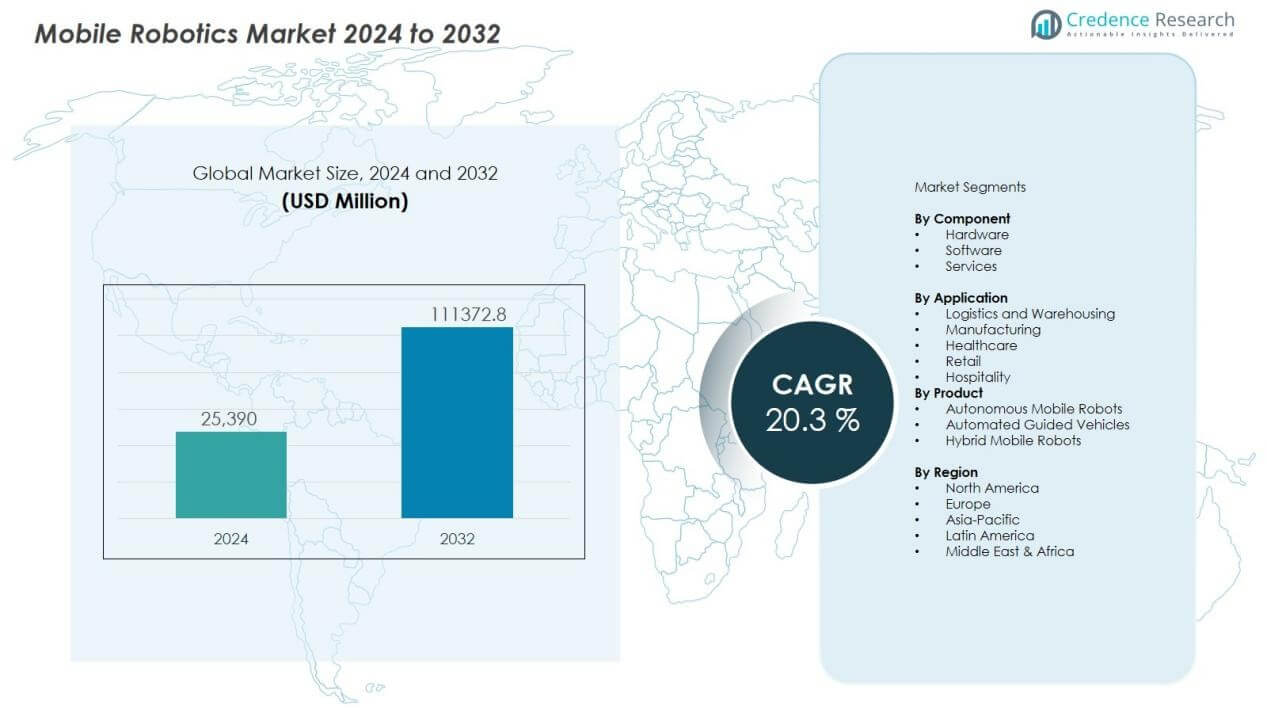
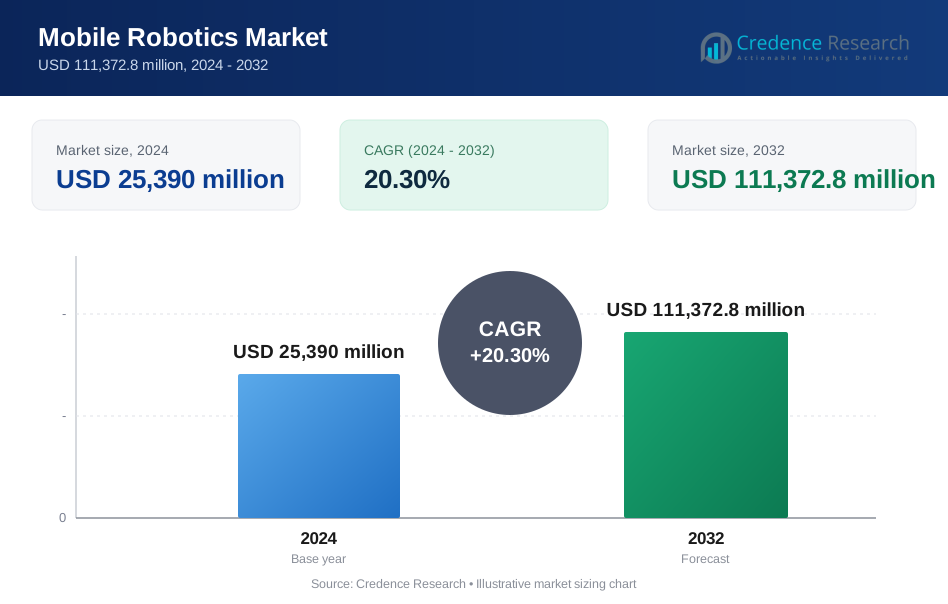
The Mobile Robotics Market size was valued at USD 25,390 million in 2024 and is anticipated to reach USD 111372.8 million by 2032, at a CAGR of 20.3% during the forecast period.
| REPORT ATTRIBUTE | DETAILS |
|---|---|
| Historical Period | 2020-2024 |
| Base Year | 2025 |
| Forecast Period | 2026-2032 |
| Mobile Robotics Market Size 2024 | USD 25,390 million |
| Mobile Robotics Market, CAGR | 20.3 % |
| Mobile Robotics Market Size 2032 | USD 111372.8 million |
Mobile Robotics Market Insights:
- North America (38%), Europe (29%), and Asia-Pacific (26%) represent the top regional shares, supported by early automation adoption, strong industrial investment, and widespread use of warehouse robotics across logistics, manufacturing, and healthcare.
- Asia-Pacific, holding around 26% share, is the fastest-growing region due to large-scale manufacturing expansion, rapid e-commerce growth, and rising automation investments in China, Japan, and South Korea.
- By application, logistics and warehousing account for approximately 45% share, reflecting high material movement frequency and demand for fast, accurate order fulfillment in e-commerce-driven supply chains.
- By product, autonomous mobile robots hold nearly 55% share, supported by dynamic navigation, minimal infrastructure needs, and suitability for flexible and multi-use operational environments.
Mobile Robotics Market Drivers:
Accelerating Demand for Flexible Automation Across Industrial Operations
The Mobile Robotics Market benefits from rising demand for flexible automation across manufacturing and logistics environments. Companies seek adaptable systems that adjust quickly to layout changes and production variability. Mobile robots support material transport, work-in-progress movement, and line-side replenishment with minimal infrastructure. It improves throughput while supporting lean manufacturing objectives. Decision-makers value rapid deployment and scalability without major facility redesign.
- For Instance, Hachidori Robotics' AMRs are designed for 24/7 continuous operation in warehouses using swappable battery technology. These robots automate end-to-end material handling in FMCG production lines, where empirical tests have shown they can improve efficiency by up to 3x (300%) and have been reported by clients to reduce material movement time by nearly 40%.
Labor Constraints and Rising Focus on Workforce Productivity
Persistent labor shortages and rising wage pressure strengthen growth in the Mobile Robotics Market. Organizations adopt robotic fleets to stabilize operations where manual labor availability fluctuates. Mobile robots perform repetitive transport tasks with consistent accuracy and predictable performance. It allows human workers to focus on higher-value activities. Management teams prioritize automation that improves productivity without workforce disruption.
- For instance, Amazon deployed over 750,000 mobile robots in its fulfillment centers by 2023, enabling consistent handling of repetitive transport tasks across fluctuating manual labor availability.
Advancements in Navigation Intelligence and System Reliability
Technological progress drives sustained momentum in the Mobile Robotics Market through improved autonomy and reliability. Vision-based navigation, AI-driven path planning, and real-time obstacle detection enhance operational safety. Battery efficiency and charging solutions extend uptime and reduce maintenance interruptions. It delivers dependable performance across complex indoor environments. System intelligence supports multi-robot coordination at scale.
Expansion of E-Commerce and High-Velocity Fulfillment Networks
Rapid growth of e-commerce accelerates adoption within the Mobile Robotics Market. Fulfillment centers require fast, accurate, and scalable order-handling solutions to meet delivery expectations. Mobile robots enable dynamic picking, sorting, and replenishment without fixed conveyor systems. It supports high order volumes during peak demand cycles. Logistics operators value speed, flexibility, and cost control.
Mobile Robotics Market Trends:
Shift Toward Autonomous, Software-Defined Robotic Fleets Across Facilities
The Mobile Robotics Market shows a clear shift toward autonomous, software-defined fleets that rely less on fixed infrastructure. Enterprises favor robots with vision-based navigation and adaptive path planning over tape- or marker-based systems. Fleet management platforms support centralized control, task prioritization, and performance analytics. It enables faster deployment and easier scaling across multi-site operations. Software updates now deliver capability upgrades without hardware replacement. Vendors focus on interoperability with warehouse management and manufacturing execution systems. Buyers value flexibility, uptime, and long-term upgrade paths.
- For instance, Amazon Robotics deployed over 750,000 vision-guided autonomous mobile robots in its fulfillment centers, enabling dynamic navigation without fixed markers.
Rising Adoption Beyond Warehousing Into Service and Hybrid Environments The Mobile Robotics Market expands beyond warehousing into healthcare, hospitality, retail, and mixed-use industrial settings. Hospitals deploy robots for supply transport, sanitation, and meal delivery to support staff efficiency. Retailers use them for inventory audits and shelf monitoring in live store environments. It supports safe navigation among people through improved perception and compliance features. Compact form factors address space constraints in non-industrial locations. Demand grows for robots that operate across indoor zones with varied layouts. End users favor platforms that support multiple applications through modular payloads.
- For instance, Mobile Industrial Robots (MiR) deployed autonomous units at Zealand University Hospital in Denmark for daily supply delivery across five departments, navigating 190,000 square meters autonomously
Mobile Robotics Market Challenges Analysis:
High Initial Investment and Uncertain Return on Deployment
The Mobile Robotics Market faces challenges linked to high upfront investment for hardware, software, and system integration. Small and mid-sized enterprises assess capital costs with caution due to budget constraints. Integration with legacy systems requires specialized expertise and extended deployment timelines. It complicates cost forecasting and delays value realization. Maintenance contracts, software licensing, and fleet upgrades add long-term expense. Decision-makers demand clear productivity metrics before approval. Financial uncertainty slows adoption in cost-sensitive sectors.
Operational Complexity and Workforce Adaptation Barriers The Mobile Robotics Market encounters resistance related to operational complexity and workforce adaptation. Employees require training to manage robotic fleets and interpret system data. Workflow redesign becomes necessary to align human and robotic tasks. It creates short-term disruption during transition phases. Safety validation and compliance reviews extend implementation schedules. Organizations struggle to standardize processes across varied facility layouts. Change management gaps reduce deployment efficiency.
Mobile Robotics Market Opportunities:
Expansion Into Underserved Small and Mid-Sized Enterprise Automation Segments
The Mobile Robotics Market presents strong opportunities within small and mid-sized enterprises seeking practical automation. Lower-cost robots and subscription-based software reduce entry barriers. Standardized platforms simplify deployment without complex customization. It supports rapid adoption across light manufacturing and regional warehouses. Vendors tailor solutions to space-constrained facilities and variable workloads. Local integrators expand reach through packaged offerings. Growing awareness of productivity gains strengthens demand.
Emergence of Multi-Application and Service-Oriented Robotic Platforms
The Mobile Robotics Market benefits from demand for robots that support multiple applications within one platform. Modular payloads enable use across transport, inspection, sanitation, and inventory tasks. Cloud-based control systems support remote monitoring and performance optimization. It improves utilization rates and lifecycle value. Service robotics adoption rises in healthcare, retail, and hospitality environments. Regulatory clarity in human-robot interaction supports broader deployment. Technology providers capture value through long-term service contracts.
Mobile Robotics Market Segmentation Analysis:
By Component
The Mobile Robotics Market segments by component into hardware, software, and services, with hardware accounting for a substantial share due to high unit value. Sensors, controllers, batteries, and drive systems define performance, durability, and payload capacity. Software plays a critical role through navigation, fleet management, and system integration capabilities. It enables autonomy, task orchestration, and data visibility across operations. Services support deployment, maintenance, and optimization, strengthening lifecycle value. Buyers prioritize balanced component stacks that deliver reliability and scalability.
- For instance, Boston Dynamics' Spot robot integrates advanced LiDAR sensors and electric actuators, achieving a 14 kg payload capacity while navigating 1.6 m/s speeds over rough terrain.
By Application
The Mobile Robotics Market shows broad application across logistics and warehousing, manufacturing, healthcare, retail, and hospitality. Logistics and warehousing lead adoption due to high material movement frequency and demand for fast order fulfillment. Manufacturing uses mobile robots for intralogistics, line feeding, and work-in-progress transport. It supports flexible layouts and mixed-model production. Healthcare adoption rises for internal transport, sanitation, and service delivery. Retail and hospitality apply robots for inventory checks and customer-facing support.
- For Instance, Amazon has deployed more than 1 million robots across its global operations network. While the fleet includes the Proteus autonomous mobile robot, the 75% faster inventory identification and storage speed is a specific achievement of the Sequoia robotic system.
By Product
The Mobile Robotics Market divides by product into autonomous mobile robots and automated guided vehicles, each serving distinct needs. Autonomous mobile robots gain preference for dynamic navigation and minimal infrastructure dependence. Automated guided vehicles retain relevance in structured environments with predictable routes. It allows buyers to match products with operational complexity and safety requirements. Hybrid models combine features to expand use cases. Vendors focus on modular designs to broaden product applicability.
Segmentations:
By Component
- Hardware
- Software
- Services
By Application
- Logistics and Warehousing
- Manufacturing
- Healthcare
- Retail
- Hospitality
By Product
- Autonomous Mobile Robots
- Automated Guided Vehicles
- Hybrid Mobile Robots
By Region
- North America
- U.S.
- Canada
- Mexico
- Europe
- Germany
- France
- U.K.
- Italy
- Spain
- Rest of Europe
- Asia Pacific
- China
- Japan
- India
- South Korea
- South-east Asia
- Rest of Asia Pacific
- Latin America
- Brazil
- Argentina
- Rest of Latin America
- Middle East & Africa
- GCC Countries
- South Africa
- Rest of the Middle East and Africa
Regional Analysis:
North America Driven by Advanced Automation Adoption and Technology Leadership The Mobile Robotics Market in North America reflects strong maturity due to early automation adoption and high capital investment capacity. Enterprises deploy mobile robots across warehousing, manufacturing, and healthcare to improve operational efficiency. Strong presence of technology developers accelerates innovation and system reliability. It benefits from robust digital infrastructure and skilled technical workforce. E-commerce growth sustains demand for flexible fulfillment solutions. Regulatory clarity supports safe human-robot interaction. Large enterprises lead adoption, while mid-sized firms show rising interest.
Europe Supported by Industrial Modernization and Structured Deployment Models The Mobile Robotics Market in Europe expands through industrial modernization and structured automation programs. Automotive, electronics, and pharmaceutical sectors adopt mobile robots to support precision workflows. Government-backed Industry 4.0 initiatives encourage smart factory investments. It aligns well with sustainability goals through energy-efficient automation. High safety standards influence system design and deployment pace. Integrators focus on customized solutions for diverse facility layouts. Western Europe leads adoption, while Eastern Europe records steady growth.
Asia-Pacific Accelerated by Manufacturing Scale and E-Commerce Expansion The Mobile Robotics Market in Asia-Pacific records the fastest expansion due to large-scale manufacturing and rapid logistics growth. China, Japan, and South Korea invest heavily in autonomous systems to address labor constraints. High-volume e-commerce operations drive demand for scalable robotic fleets. It benefits from cost-competitive manufacturing and strong robotics expertise. Government incentives promote automation across industrial clusters. Emerging economies adopt mobile robots for infrastructure modernization. Regional suppliers strengthen global competitiveness through innovation.
Key Player Analysis:
- SoftBank Robotics Group
- UBTECH ROBOTICS CORP LTD
- Northrop Grumman Corporation
- Kongsberg Maritime
- Boston Dynamics, Inc.
- iRobot Corporation
- Honda Motor Co. Ltd.
- Lockheed Martin Corporation.
- Amazon Robotics
- Kuka AG
Competitive Analysis:
The Mobile Robotics Market features strong competition among global automation specialists and focused robotics innovators. Leading players emphasize portfolio breadth, software capability, and integration expertise to secure large enterprise contracts. Companies such as ABB, KUKA, and FANUC leverage deep industrial relationships and global service networks. Pure-play providers including Mobile Industrial Robots and Locus Robotics focus on autonomous platforms with rapid deployment and fleet management software. It rewards vendors that deliver reliability, safety certification, and measurable productivity gains. Strategic partnerships with warehouse management and manufacturing execution system providers strengthen market access. Pricing models shift toward robots-as-a-service to attract mid-market buyers. Continuous innovation in navigation intelligence and interoperability differentiates offerings. Competitive intensity remains high, with consolidation and alliances shaping scale and geographic reach.
Recent Developments:
- In October 2025, SoftBank Robotics Group entered a definitive agreement to acquire ABB's robotics business for $5.4 billion, with board approval in September 2025 and expected closure in mid-to-late 2026.
- In October 2025, Northrop Grumman Corporation partnered with Luminary Cloud, an AI startup, to revolutionize rocket design processes.
Report Coverage:
The research report offers an in-depth analysis based on Component, Application, Product and Region. It details leading Market players, providing an overview of their business, product offerings, investments, revenue streams, and key applications. Additionally, the report includes insights into the competitive environment, SWOT analysis, current Market trends, as well as the primary drivers and constraints. Furthermore, it discusses various factors that have driven Market expansion in recent years. The report also explores Market dynamics, regulatory scenarios, and technological advancements that are shaping the industry. It assesses the impact of external factors and global economic changes on Market growth. Lastly, it provides strategic recommendations for new entrants and established companies to navigate the complexities of the Market.
Future Outlook:
- The Mobile Robotics Market will advance through deeper integration of artificial intelligence that improves autonomy, decision accuracy, and fleet coordination across complex environments.
- Enterprises will prioritize software-centric platforms that allow rapid updates, analytics-driven optimization, and seamless integration with enterprise systems.
- Adoption will expand beyond logistics into healthcare, retail, hospitality, and mixed-use facilities that require safe human-robot collaboration.
- Robots-as-a-service models will gain wider acceptance due to lower upfront costs and predictable operating expenses for end users.
- Manufacturers will focus on modular designs that support multiple applications through interchangeable payloads and configurable software.
- Navigation reliability and safety performance will continue to improve through better perception systems and compliance-focused design.
- Demand will rise from small and mid-sized enterprises seeking scalable automation without complex infrastructure changes.
- Asia-Pacific will strengthen its role as a production and deployment hub due to manufacturing scale and automation investment.
- Sustainability goals will influence product development through energy-efficient systems and longer lifecycle designs.
- Strategic partnerships and selective consolidation will shape competition, supporting global expansion and solution standardization.
Request a Free Sample
Fill in your details and we'll send you a free sample report.
- Sample data tables & charts
- Research methodology
Need a Custom Version of This Report?
Tailor the scope, geography, or segments to your exact requirements.
- Custom geography or segment scope
- Direct access to our analyst team
Frequently Asked Questions
What is the current market size of the Mobile Robotics Market, and what is its projected value by 2032?
What is the projected Compound Annual Growth Rate of the Mobile Robotics Market during the forecast period?
Which segment accounted for the largest share of the Mobile Robotics Market in 2024?
What are the key factors driving growth in the Mobile Robotics Market?
Who are the leading companies operating in the Mobile Robotics Market?
Which region held the largest share of the Mobile Robotics Market in 2024?
Table of Content
Chapter 1. Report Introduction
- 1.1 Report Description & Purpose
- 1.1.1 Report Title & Market Definition
- 1.1.2 Unique Selling Propositions (USP) & Key Differentiators
- 1.1.3 Value Proposition for Stakeholders
- 1.2 Research Objectives
- 1.2.1 Market Sizing Objectives (Volume & Revenue)
- 1.2.2 Segmentation Objectives
- 1.2.3 Competitive Intelligence Objectives
- 1.2.4 Forecast & Scenario Objectives
- 1.3 Report Scope
- 1.3.1 Mobile Robotics Scope – Types & Subtypes Covered
- 1.3.2 Geographic Scope – Regions & Countries Covered
- 1.3.3 Historical Period, Base Year & Forecast Period (2024; forecast to 2032)
- 1.3.4 Inclusions & Exclusions
- 1.4 HS Code & Classification Framework
- 1.5 Currency, Units & Pricing Basis
- 1.6 Target Stakeholders
- 1.7 Limitations & Assumptions
Chapter 2. Executive Summary
- 2.1 Global Mobile Robotics Market Snapshot
- 2.1.1 Market Size – Historical (2024) & Forecast (2024-2032) (2024: USD 25,390 million → 2032: USD 111,372.8 million)
- 2.1.2 Volume & Revenue – Global Totals
- 2.1.3 Key Market Highlights – Top Five Facts
- 2.2 Mobile Robotics Market Segmentation Snapshot
- 2.2.1 Market Split by Region – 2024 vs. 2032
- 2.3 Competitive Snapshot
- 2.3.1 Top 10 Players by Revenue Share – 2024
- 2.3.2 Top 10 Players by Volume Share – 2024
- 2.3.3 Recent Strategic Developments (18-Month Summary)
- 2.4 Key Investment Highlights & Strategic Conclusions
Chapter 3. Mobile Robotics Market Dynamics & Industry Analysis
- 3.1 Market Overview & Context
- 3.1.1 Mobile Robotics Market Position in the Broader Automotive Value Chain
- 3.1.2 OEM vs. Replacement Market Dynamics
- 3.1.3 Market Maturity & Development Stage by Region
- 3.2 Mobile Robotics Market Drivers
- 3.3 Mobile Robotics Market Restraints & Challenges
- 3.4 Mobile Robotics Market Opportunities
- 3.5 Porter's Five Forces Analysis
- 3.5.1 Threat of New Entrants
- 3.5.2 Bargaining Power of Suppliers
- 3.5.3 Bargaining Power of Buyers
- 3.5.4 Threat of Substitutes
- 3.5.5 Competitive Rivalry – Intensity Assessment
- 3.6 Mobile Robotics Value Chain Analysis
- 3.6.1 Upstream – Raw Material/Input Suppliers
- 3.6.1.1 Raw Material/Input 1
- 3.6.1.2 Raw Material/Input 2
- 3.6.1.3 Raw Material/Input 3
- 3.6.2 Midstream – Production/Manufacturing/Service Delivery
- 3.6.2.1 Production/Process Overview
- 3.6.2.2 Key Facility Locations & Capacity by Manufacturer
- 3.6.3 Downstream – Distribution & End Consumer
- 3.6.3.1 Primary Channel – B2B/OEM
- 3.6.3.2 Secondary Channels – Dealer, Retail, Online, Direct
- 3.6.4 Value Chain Profitability Analysis
- 3.6.1 Upstream – Raw Material/Input Suppliers
- 3.7 PESTEL Analysis
- 3.7.1 Political Factors
- 3.7.2 Economic Factors
- 3.7.3 Social Factors
- 3.7.4 Technological Factors
- 3.7.5 Environmental Factors
- 3.7.6 Legal Factors
- 3.8 Mobile Robotics Supply Chain Analysis
- 3.8.1 Raw Material/Input Supply Risk Assessment
- 3.8.2 Manufacturing Concentration Risk (Geographic Exposure)
- 3.8.3 Trade Disruption Impact Analysis
- 3.9 Regulatory & Policy Landscape
Note: The regulatory and policy landscape section covers regulations based on their applicability to the market, Mobile Robotics category, geography, and scope of the study. Only regulatory frameworks with a material impact on operations, compliance, trade, sustainability, or market access are analyzed in detail.
Chapter 4. Key Investment Pockets & Opportunity Analysis
- 4.1 Mobile Robotics Market Attractiveness Analysis
- 4.1.1 By Region – Investment Attractiveness Matrix (Volume × CAGR)
- 4.2 Absolute Revenue Growth Opportunity
- 4.2.1 By Region – Absolute USD Growth Through 2032
- 4.3 Incremental Volume Opportunity
- 4.3.1 By Region – Incremental Volume Through 2032
- 4.3.2 Segment – Incremental Volume
- 4.4 Emerging Submarket Opportunity Deep Dive (Subject to Applicability)
- 4.5 Emerging Market Opportunity Scorecards
- 4.5.1 United States
- 4.5.2 Europe
- 4.5.3 Asia
- 4.5.4 Middle East & Africa
Note: Emerging Market Opportunity Scorecards will be included based on relevance and strategic importance. Regions listed are indicative and may vary depending on data availability and market dynamics.
Chapter 5. Mobile Robotics Import-Export Analysis & Trade Flows
- 5.1 Global Trade Overview
- 5.1.1 Global Export Value by Country (2024)
- 5.1.2 Global Export Volume by Country (2024)
- 5.1.3 Global Import Value by Country (2024)
- 5.1.4 Global Import Volume by Country (2024)
- 5.1.5 Net Trade Balance by Country (2024)
- 5.2 Export Analysis – Segment
- 5.2.1 Type 1 (HS Code)
- 5.2.2 Type 2 (HS Code)
- 5.2.3 Type 3 (HS Code)
- 5.2.4 Type 4 (HS Code)
- 5.2.5 Type 5 (HS Code)
- 5.3 Import Analysis – Segment
- 5.3.1 Type 1 (HS Code)
- 5.3.2 Type 2 (HS Code)
- 5.3.3 Type 3 (HS Code)
- 5.3.4 Type 4 (HS Code)
- 5.3.5 Type 5 (HS Code)
- 5.4 Average Unit Trade Prices
- 5.4.1 Average Export Price – Segment & Country
- 5.4.2 Average Import Price – Segment & Source Country
- 5.4.3 Price Trends (2024)
- 5.5 Key Trade Route Analysis
- 5.5.1 Trade Route 1
- 5.5.2 Trade Route 2
- 5.5.3 Trade Route 3
- 5.5.4 Trade Route 4
- 5.5.5 Trade Route 5
- 5.6 Trade Policy Impact Assessment
- 5.6.1 US Anti-Dumping & Section 301 Tariffs
- 5.6.2 EU Customs Union Impact
- 5.6.3 Major Free Trade Agreements
- 5.6.4 USMCA Rules of Origin
Note: Trade policy analysis will be included only where relevant to the Mobile Robotics market.
Chapter 6. Competitive Landscape & Company Benchmarking
- 6.1 Mobile Robotics Market Concentration & Structure
- 6.1.1 Herfindahl-Hirschman Index (HHI) – vs. 2024
- 6.1.2 Tier 1, Tier 2 & Tier 3 Market Structure
- 6.1.3 Global, Regional & Local Player Dynamics
- 6.2 Mobile Robotics Market Share Analysis – 2024
- 6.2.1 Global Revenue Share by Company
- 6.2.2 Global Volume Share by Company
- 6.2.3 Regional Revenue Share
- 6.2.4 Market Share Evolution ( vs. 2024)
- 6.2.5 OEM Segment Share by Company
- 6.2.6 Replacement Segment Share by Company
- 6.3 Production/Delivery Capacity & Facility Analysis
- 6.3.1 Global Installed Capacity
- 6.3.2 Capacity Utilization Rates
- 6.3.3 Production/Output Volume
- 6.3.4 Facility Locations & Capacity Map
- 6.3.5 Planned Capacity Additions
- 6.4 Mobile Robotics Competitive Benchmarking Matrix
- 6.4.1 Revenue, Volume, CAGR & Profitability Comparison
- 6.4.2 Channel Revenue Mix
- 6.4.3 Geographic Revenue Exposure
- 6.4.4 R&D Intensity
- 6.4.5 Sustainability Maturity
- 6.5 Strategic Developments in Mobile Robotics (Last 24 Months)
- 6.5.1 Mergers, Acquisitions & Divestments
- 6.5.2 New Mobile Robotics Launches
- 6.5.3 Facility Expansions
- 6.5.4 Strategic Alliances, Joint Ventures & Partnerships
- 6.5.5 Distribution Expansion & Market Entry
- 6.5.6 Sustainability & ESG Initiatives
- 6.6 Competitive Strategy Mapping
- 6.6.1 Leader, Challenger, Follower & Niche Classification
- 6.6.2 Pricing Strategy Comparison
- 6.6.3 Channel Strategy Matrix
Note: Strategic developments are included based on their materiality and the availability of reliable information.
Chapter 7. Global Mobile Robotics Market – By Distribution Channel
- 7.1 Segment Overview
- 7.1.1 Volume & Revenue Split by Channel (2024 & 2032)
- 7.1.2 Channel Mix Evolution (2024-2032)
Chapter 8. Regional Market Analysis – Global Overview
- 8.1 Global Regional Overview
- 8.1.1 Regional Volume Share
- 8.1.2 Regional Revenue Share
- 8.1.3 Regional Volume by Region
- 8.1.4 Regional Revenue by Region
- 8.1.5 Regional Forecast Through 2032
- 8.2 Cross-Regional Segment Analysis
- 8.2.1 By Distribution Channel
- 8.2.2 By Brand/Price Tier
Chapter 9. North America Mobile Robotics Market
- 9.1 United States
- 9.2 Canada
- 9.3 Mexico
Chapter 10. Europe Mobile Robotics Market
- 10.1 Germany
- 10.2 France
- 10.3 Italy
- 10.4 United Kingdom
- 10.5 Spain
- 10.6 Poland
- 10.7 Russia
- 10.8 Netherlands
- 10.9 Belgium
- 10.10 Sweden
- 10.11 Denmark
- 10.12 Norway
- 10.13 Rest of Europe
Chapter 11. Asia Pacific Mobile Robotics Market
- 11.1 China
- 11.2 India
- 11.3 Japan
- 11.4 South Korea
- 11.5 Thailand
- 11.6 Indonesia
- 11.7 Vietnam
- 11.8 Malaysia
- 11.9 Australia
- 11.10 Rest of Asia Pacific
Chapter 12. Latin America Mobile Robotics Market
- 12.1 Brazil
- 12.2 Argentina
- 12.3 Colombia
- 12.4 Chile
- 12.5 Rest of Latin America
Chapter 13. Middle East Mobile Robotics Market
- 13.1 Saudi Arabia
- 13.2 United Arab Emirates
- 13.3 Turkey
- 13.4 Israel
- 13.5 Iran
- 13.6 Rest of the Middle East
Chapter 14. Africa Mobile Robotics Market
- 14.1 South Africa
- 14.2 Egypt
- 14.3 Nigeria
- 14.4 Morocco
- 14.5 Rest of Africa
Chapter 15. Mobile Robotics Company Profiles
- 15.1 [Company 01]
- 15.1.1 Company Overview
- 15.1.2 Key Management Personnel
- 15.1.3 Products & Services Portfolio
- 15.1.4 Financial Performance
- 15.1.5 Key Market Focus & Geographic Presence
- 15.1.6 Recent Developments & Strategic Initiatives
Note: The company profile list is preliminary and may change based on research findings, market developments, data availability, and client requirements.
Chapter 16. Appendices
- Appendix A – List of Abbreviations & Acronyms
- Appendix B – Industry Classification Code Reference – Full Series
- Appendix C – Production & Capacity Data Tables
- Appendix D – End-Use & Demand Base Tables
- Appendix E – Consumption & Replacement Rate Assumptions
- Appendix F – ASP Reference Tables
- Appendix G – Manufacturing & Facility Database
- Appendix H – Import-Export Data Tables
- Appendix I – Regulatory Summary Tables
- Appendix J – Primary Research Participant List (Anonymized)
- Appendix K – Primary Research Questionnaire Framework
- Appendix L – Data Sources & Bibliography
- Appendix M – Market Size Divergence & Source Comparison
Chapter 17. Research Methodology
- 17.1 Research Framework & Philosophy
- 17.2 Secondary Research – Sources, Hierarchy & Data Extraction
- 17.3 Data Modeling – Bottom-Up & Top-Down Market Sizing
- 17.4 Primary Research – Stakeholder Framework, LOI & Sample Sizes
- 17.5 Forecast Methodology – Regression, Scenario & Sensitivity Analysis
- 17.6 Quality Control – Four-Layer Validation Framework
- 17.7 Limitations & Standard Assumptions
- 17.8 Disclaimer
