
Market Overview:
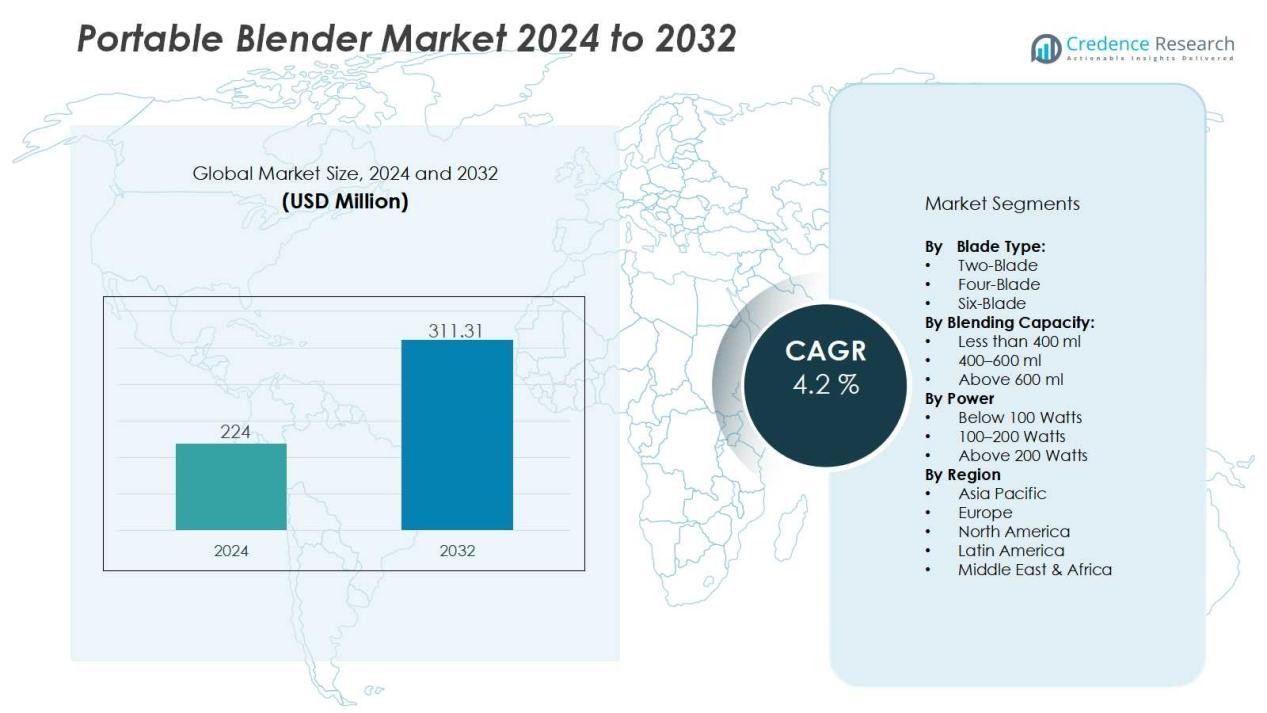
The Portable Blender Market size was valued at USD 224 million in 2024 and is anticipated to reach USD 311.31 million by 2032, at a CAGR of 4.2 % during the forecast period.
| REPORT ATTRIBUTE | DETAILS |
|---|---|
| Historical Period | 2020-2023 |
| Base Year | 2024 |
| Forecast Period | 2025-2032 |
| Portable Blender Market Size 2024 | USD 224 Million |
| Portable Blender Market, CAGR | 4.2 % |
| Portable Blender Market Size 2032 | USD 311.31 Million |
Key drivers include growing awareness of healthy eating habits and the demand for quick meal preparation solutions. The surge in consumption of smoothies, protein shakes, and fresh juices has strengthened demand among fitness enthusiasts and working professionals. Technological advancements, such as rechargeable batteries, USB charging, and multi-functional blade designs, further enhance adoption. Manufacturers are also focusing on eco-friendly materials and improved durability to appeal to sustainability-conscious consumers.
Regionally, North America holds a dominant share due to the strong culture of fitness and the rapid adoption of innovative kitchen appliances. Europe follows closely, with rising demand for premium and sustainable portable blenders. Asia-Pacific is projected to record the fastest growth, driven by urbanization, rising disposable incomes, and expanding online retail channels. This regional balance highlights both established demand and untapped opportunities for market players.
Market Insights:
- The portable blender market was valued at USD 224 million in 2024 and is projected to reach USD 311.31 million by 2032, growing at a CAGR of 4.2%.
- Rising health awareness and the need for quick meal preparation continue to drive strong demand.
- Smoothie, protein shake, and fresh juice consumption among fitness enthusiasts and professionals fuels adoption.
- Technological features such as rechargeable batteries, USB charging, and advanced blades enhance usability.
- North America holds 38% share, supported by fitness culture and rapid adoption of kitchen innovations.
- Europe accounts for 29% share, with demand driven by premium and eco-friendly portable appliances.
- Asia-Pacific represents 24% share and records the fastest growth, fueled by urbanization and online retail expansion.
Market Drivers:
Rising Preference for Healthy and On-the-Go Nutrition:
The portable blender market benefits from increasing consumer focus on healthier lifestyles and convenient food preparation. Busy professionals, students, and fitness enthusiasts prefer compact appliances for preparing smoothies, protein shakes, and juices. The shift toward fresh and natural ingredients drives consistent product adoption. It enables consumers to blend nutritious drinks anytime, supporting broader wellness trends.
- For Instance, The BlendJet 2 utilizes TurboJet technology to blend frozen ingredients in 20 seconds and can provide over 15 blends per charge using a USB-C port for recharging.
Technological Advancements in Product Features:
Continuous innovation strengthens growth in the portable blender market by improving usability and performance. Features such as rechargeable batteries, USB charging, and multi-speed functions enhance consumer satisfaction. Advanced blade technology ensures better blending of fruits, vegetables, and ice. It creates a competitive edge for manufacturers aiming to meet evolving consumer expectations.
- For instance, Ninja Kitchen launched its Ninja Blast Portable Blender in June 2024, offering a rechargeable USB-C battery that provides up to 15 blends per charge and features a patented 18,000 RPM stainless steel blade for efficient ice crushing and smooth blending.
Growing Demand for Compact and Travel-Friendly Appliances:
Portability remains a core driver in the portable blender market, making it attractive to frequent travelers and urban households. The rising need for space-saving solutions in smaller apartments increases product demand. Lightweight and cordless models cater to users seeking convenience without sacrificing performance. It positions portable blenders as essential appliances for flexible, modern living.
Expanding Online Retail and Distribution Channels:
E-commerce platforms play a key role in boosting sales across the portable blender market. Wider product availability, competitive pricing, and customer reviews improve purchase decisions. The ability to customize and access global brands increases consumer engagement. It supports sustained demand by providing easy accessibility across diverse regions.
Market Trends:
Integration of Smart Features and Sustainable Designs:
A key trend shaping the portable blender market is the integration of smart and sustainable features. Manufacturers are introducing products with wireless connectivity, app-based controls, and advanced safety mechanisms to meet consumer expectations. Eco-friendly materials, such as BPA-free plastics and stainless steel, are being prioritized to align with sustainability goals. Compact designs that use energy-efficient rechargeable batteries are gaining traction among environmentally conscious buyers. It demonstrates a shift toward innovation that balances performance with ecological responsibility. Consumers increasingly view portable blenders not only as convenience tools but also as lifestyle products reflecting their values.
- For instance, BlendJet 2 features a 4000 mAh rechargeable battery with USB-C connectivity that provides 15+ blending cycles per charge, while its patented TurboJet technology creates a tornado effect that blasts ingredients 275 times per second.
Rising Popularity of Personalization and Premium Offerings:
Another significant trend in the portable blender market is the demand for personalized and premium options. Consumers seek models available in diverse colors, sizes, and accessories to match their individual preferences. Premium variants with higher blending capacity, advanced blade designs, and longer battery life are capturing attention in urban markets. The growth of social media and fitness culture amplifies this trend by promoting aspirational product use. It encourages manufacturers to invest in unique product aesthetics and value-added features. Rising disposable incomes, particularly in emerging economies, are expected to further accelerate adoption of these premium and customized solutions.
- For instance, NutriBullet launched the Flex™ Portable Blender in September 2025, offering a lightweight 22-ounce vessel, twist-off base, and a removable, dishwasher-safe blade; it is available in 6 vibrant colors and can blend up to 12 smoothies per full battery charge.
Market Challenges Analysis:
Limitations in Power and Durability:
One of the major challenges in the portable blender market is the limitation in blending power and durability compared to traditional countertop models. Many compact designs struggle with crushing ice or handling dense ingredients, which reduces consumer satisfaction. Frequent use often leads to wear and tear, raising concerns about product lifespan. It creates hesitation among buyers who prioritize long-term reliability. Manufacturers must address these technical constraints to strengthen trust and sustain growth in competitive markets.
Intense Competition and Price Sensitivity:
The portable blender market also faces pressure from intense competition and high price sensitivity among consumers. Numerous brands, ranging from global players to local startups, crowd the segment with similar offerings. Price-driven purchasing behavior often limits opportunities for premium models, especially in emerging economies. It forces manufacturers to balance innovation with affordability, which can restrict margins. Distribution challenges in smaller markets further complicate growth. Companies must differentiate through design, branding, and service support to secure long-term market presence.
Market Opportunities:
Expansion into Emerging Economies and Untapped Segments:
The portable blender market holds strong opportunities in emerging economies where rising disposable incomes and urban lifestyles fuel demand. Growing health awareness in Asia-Pacific, Latin America, and the Middle East creates a wider consumer base. Compact and affordable models are well-positioned to attract first-time buyers in these regions. It opens avenues for brands to introduce localized product features that match cultural preferences. Strategic partnerships with regional retailers and online platforms can further enhance penetration. These markets offer significant growth potential due to their young, tech-savvy populations and increasing focus on wellness.
Innovation in Premium and Multi-Functional Designs:
Advancements in technology present opportunities for manufacturers to launch premium and multi-functional models in the portable blender market. Products that blend, grind, or store beverages in one unit can appeal to modern consumers seeking efficiency. Enhanced battery life, improved motor performance, and stylish aesthetics support premium positioning. It allows brands to capture demand among fitness enthusiasts, travelers, and urban professionals. Customizable features and eco-friendly materials also present differentiation opportunities. Companies that focus on combining innovation with sustainable practices are likely to gain a competitive edge in this evolving segment.
Market Segmentation Analysis:
By Blade Type:
The portable blender market is segmented by blade type into two-blade, four-blade, and six-blade designs. Four-blade models dominate demand due to their balance of performance and portability. They provide efficient blending of fruits, vegetables, and soft ice, appealing to everyday users. Six-blade variants are gaining traction among fitness enthusiasts seeking smoother textures and faster blending. Two-blade designs remain popular in entry-level models, offering affordability for first-time buyers. It demonstrates varied consumer needs that drive product diversity.
- For Instance, The nutribullet Portable Blender uses a four-point stainless steel blade system and a USB-C rechargeable battery providing 15 or more blending cycles per charge.
By Blending Capacity:
Segmentation by blending capacity includes less than 400 ml, 400–600 ml, and above 600 ml. The 400–600 ml range holds the largest share, meeting requirements for single servings of smoothies and shakes. Models under 400 ml attract students and travelers seeking lightweight options. Units above 600 ml are expanding demand in households and for shared use, supported by growing interest in family-sized portable solutions. It reflects rising consumer expectations for flexibility in capacity across different lifestyles.
- For instance, a Joyoung high-capacity blender demonstrated strong market performance in China during mid-2025, reflecting a growing consumer preference for large-capacity models suitable for group smoothie preparation.
By Power:
By power, the market is divided into below 100 watts, 100–200 watts, and above 200 watts. The 100–200 watts category leads, providing reliable performance for most daily applications. Below 100 watts models remain significant in budget-friendly and compact devices aimed at casual users. Above 200 watts blenders are witnessing growth among consumers demanding higher speed and stronger blending capability. It highlights the role of power efficiency and performance in shaping purchase preferences across global markets.
Segmentations:
By Blade Type:
- Two-Blade
- Four-Blade
- Six-Blade
By Blending Capacity:
- Less than 400 ml
- 400–600 ml
- Above 600 ml
By Power:
- Below 100 Watts
- 100–200 Watts
- Above 200 Watts
By Region:
- North America
- U.S.
- Canada
- Mexico
- Europe
- Germany
- France
- U.K.
- Italy
- Spain
- Rest of Europe
- Asia Pacific
- China
- Japan
- India
- South Korea
- South-east Asia
- Rest of Asia Pacific
- Latin America
- Brazil
- Argentina
- Rest of Latin America
- Middle East & Africa
- GCC Countries
- South Africa
- Rest of the Middle East and Africa
Regional Analysis:
North America:
North America accounts for 38% market share in the portable blender market, driven by high consumer adoption of innovative kitchen appliances. The region benefits from a well-established culture of health, fitness, and convenience-oriented lifestyles. Demand is reinforced by the popularity of smoothies, protein shakes, and quick meal preparation. It is supported by widespread availability across supermarkets, specialty stores, and e-commerce platforms. Manufacturers in the U.S. and Canada focus on premium models with enhanced features and durability. Strong brand presence and marketing strategies further sustain dominance in this region.
Europe:
Europe holds 29% market share in the portable blender market, supported by consumer interest in sustainable and premium appliances. The region sees increasing demand for eco-friendly designs, including BPA-free materials and energy-efficient rechargeable batteries. Fitness culture and urban living patterns continue to drive sales, particularly in Germany, the UK, and France. It benefits from high purchasing power and preference for quality-focused products. Growing penetration of e-commerce and specialty retail further expands accessibility for consumers. European players emphasize design aesthetics and functionality to align with evolving lifestyle needs.
Asia-Pacific:
Asia-Pacific represents 24% market share in the portable blender market and records the fastest growth rate globally. Rising disposable incomes and rapid urbanization across China, India, and Southeast Asia fuel strong demand. Expanding online retail channels significantly improve product reach among younger, tech-savvy consumers. It is supported by increasing awareness of health and wellness in emerging economies. Local and international brands are actively investing in affordable and mid-range models for broader market coverage. The region’s large population and growing middle class position it as a key growth hub for future expansion.
Key Player Analysis:
- Cuisinart
- Sunbeam Products, Inc.
- BILACA
- PopBabies
- Hamilton Beach Brands, Inc.
- Little Bees
- BlendJet
- Keyton
- nutribullet, LLC
- BLENDi
Competitive Analysis:
The portable blender market is highly competitive, with both global brands and niche players driving innovation. Key participants include Cuisinart, Sunbeam Products, Inc., BILACA, PopBabies, Hamilton Beach Brands, Inc., Little Bees, BlendJet, Keyton, nutribullet, LLC, and BLENDi. Companies compete by focusing on performance, portability, and durability to capture diverse consumer segments. It encourages constant product upgrades, such as improved battery life, multi-functional blades, and eco-friendly designs. Pricing strategies remain important in appealing to both premium and budget-conscious buyers. Strong distribution through e-commerce platforms and retail networks enhances visibility for established and emerging brands. Marketing collaborations with lifestyle influencers and fitness communities further strengthen consumer engagement. This competitive landscape pushes brands to differentiate through technology, design, and sustainability to secure long-term market presence.
Recent Developments:
- In September 2025, Little Bee of Connecticut entered a new collaboration, as highlighted on their official Instagram account.
- In September 2025, Capital Brands Distribution, LLC (nutribullet) opened an innovation lab in Greater Boston to accelerate new product development for small kitchen appliances.
Report Coverage:
The research report offers an in-depth analysis based on Blade Type, Blending Capacity, Power and Region. It details leading Market players, providing an overview of their business, product offerings, investments, revenue streams, and key applications. Additionally, the report includes insights into the competitive environment, SWOT analysis, current Market trends, as well as the primary drivers and constraints. Furthermore, it discusses various factors that have driven Market expansion in recent years. The report also explores Market dynamics, regulatory scenarios, and technological advancements that are shaping the industry. It assesses the impact of external factors and global economic changes on Market growth. Lastly, it provides strategic recommendations for new entrants and established companies to navigate the complexities of the Market.
Future Outlook:
- The portable blender market will see steady growth driven by rising health-conscious lifestyles.
- Manufacturers will focus on integrating advanced features such as app connectivity and safety sensors.
- Eco-friendly materials and sustainable packaging will gain prominence among leading product lines.
- Premium models with higher blending power and longer battery life will attract urban professionals.
- E-commerce platforms will continue to dominate sales, supported by strong digital marketing campaigns.
- Emerging economies will provide significant opportunities with rising disposable incomes and wellness trends.
- Product customization, including multiple colors, sizes, and accessories, will strengthen consumer engagement.
- Brands will emphasize multi-functional designs that combine blending with storage or grinding features.
- Collaborations with fitness influencers and lifestyle brands will expand product visibility and adoption.
- The market will move toward global expansion, with Asia-Pacific expected to lead future demand.

Request a Free Sample
Fill in your details and we'll send you a free sample report.
- Sample data tables & charts
- Research methodology
Market Dynamics
Rising Health Awareness and On-the-Go Nutrition
Increasing consumer focus on healthy lifestyles and the need for convenient meal preparation is driving demand for portable blenders. Busy professionals, students, and fitness enthusiasts prefer these appliances for making smoothies, protein shakes, and juices quickly and easily.
Technological Advancements in Product Features
Innovations such as rechargeable batteries, USB charging, and advanced blade designs are enhancing the usability and performance of portable blenders. These features make the products more appealing to tech-savvy consumers and improve blending efficiency for a variety of ingredients.
Growth of E-commerce and Online Retail Channels
The expansion of online retail platforms has made portable blenders more accessible to a wider audience. E-commerce enables consumers to compare products, read reviews, and access global brands, which boosts market penetration and sales.
Demand for Compact and Travel-Friendly Appliances
Urbanization and smaller living spaces are increasing the need for compact, portable kitchen appliances. Lightweight and cordless portable blenders are especially attractive to travelers and urban households seeking convenience without sacrificing performance.
Preference for Sustainable and Eco-Friendly Products
Consumers are increasingly seeking products made from eco-friendly materials and with energy-efficient features. Manufacturers focusing on BPA-free plastics, stainless steel, and sustainable packaging are capturing the attention of environmentally conscious buyers.
Need a Custom Version of This Report?
Tailor the scope, geography, or segments to your exact requirements.
- Custom geography or segment scope
- Direct access to our analyst team
Frequently Asked Questions
What is the current market size for the portable blender market, and what is its projected size in 2032?
At what Compound Annual Growth Rate is the portable blender market projected to grow between 2024 and 2032?
Which portable blender market segment held the largest share in 2024?
What are the primary factors fueling the growth of the portable blender market?
Who are the leading companies in the portable blender market?
Which region commanded the largest share of the portable blender market in 2024?
Table of Content
Chapter 1 Market Segmentation
- 1.1 Segmentation Framework
- 1.1.1 Product and Service Classification
- 1.1.2 Application and End-Use Classification
- 1.1.3 Technology and Solution Classification
- 1.1.4 Customer and Distribution Channel Classification
- 1.1.5 Geographic Segmentation
- 1.1.6 Market Segment Definitions and Boundaries
- 1.2 By Power
- 1.2.1 Below 100 Watts
- 1.2.2 100–200 Watts
- 1.2.3 Above 200 Watts
- 1.3 By Blade Type
- 1.3.1 Two-Blade
- 1.3.2 Four-Blade
- 1.3.3 Six-Blade
- 1.4 By Blending Capacity
- 1.4.1 Less than 400 ml
- 1.4.2 400–600 ml
- 1.4.3 Above 600 ml
Chapter 2 Introduction
- 2.1 Report Objectives and Scope
- 2.2 Product Definition and Industry Terminology
- 2.3 Market Inclusions and Exclusions
- 2.4 Research Process
- 2.4.1 Primary Research and Expert Interviews
- 2.4.2 Secondary Research and Source Review
- 2.4.3 Top-Down and Bottom-Up Estimation
- 2.4.4 Data Triangulation and Verification
- 2.5 Market Size Measurement Basis
- 2.5.1 2024: USD 224 million → 2032: USD 311.31 million
- 2.6 Historical and Forecast Reference Periods
- 2.6.1 Base Year: 2024
- 2.6.2 Forecast Period: 2024-2032
- 2.7 Research Assumptions and Limitations
Chapter 3 Executive Summary
- 3.1 Market Snapshot and Key Findings
- 3.2 Base-Year Market Size, 2024
- 3.3 Forecast Market Size, 2032
- 3.4 Revenue and Volume Growth Outlook
- 3.5 Key Demand and Supply Indicators
- 3.6 Leading Market Segments
- 3.7 Fastest-Growing Market Opportunities
- 3.8 Regional Performance Highlights
- 3.9 Technology and Industry Transformation
- 3.10 Competitive Landscape Summary
- 3.11 Analyst View and Strategic Implications
Chapter 4 Global Portable Blender Market Trends and Developments
- 4.1 Historical Industry Development
- 4.2 Recent Market Trends and Developments
- 4.3 Demand and Customer Behavior Trends
- 4.4 Technology and Product Innovation
- 4.5 Artificial Intelligence, Automation and Digitalization
- 4.6 Local Manufacturing and Supply Chain Realignment
- 4.7 Industry Partnerships, Mergers and Acquisitions
- 4.8 Sustainability and Circular Economy Developments
- 4.9 Government and Private Sector Investment Trends
- 4.10 Emerging Business Models and Commercialization
- 4.11 Industry Developments and Announcements
Chapter 5 Global Portable Blender Market Production, Supply and Demand Analysis
- 5.1 Demand Trend and Consumption Analysis
- 5.2 Demand Forecast, 2024-2032
- 5.3 Production and Output Trend
- 5.4 Production and Output Forecast, 2024-2032
- 5.5 Installed Capacity and Capacity Utilization
- 5.6 Company-Wise Production Plants and Statistics
- 5.6.1 Installed Production Capacity
- 5.6.2 Actual Production
- 5.6.3 Planned Capacity and Expansion Targets
- 5.7 Supply Chain Structure and Procurement Trends
- 5.8 Supply-Demand Gap and Bottlenecks
- 5.9 Import Dependence and Sourcing Structure
- 5.10 Contract Manufacturing and Outsourcing
- 5.11 Regional Supply and Demand Concentration
Chapter 6 Global Portable Blender Market Pricing Analysis
- 6.1 Pricing Structure and Measurement
- 6.2 Historical Pricing Trends
- 6.3 Pricing Outlook, 2024-2032
- 6.4 Average Selling Price and Unit Economics
- 6.5 Pricing by Product and Market Segment
- 6.6 Geographic Pricing Differences
- 6.7 Key Input, Energy, Labor and Logistics Costs
- 6.8 Contract Pricing and Purchasing Models
- 6.9 Pricing Sensitivity and Competitive Positioning
- 6.10 Price, Margin and Profitability Implications
Chapter 7 Global Portable Blender Market Dynamics
- 7.1 Market Growth Drivers
- 7.1.1 Demand-Side Drivers
- 7.1.2 Technology and Innovation Drivers
- 7.1.3 Infrastructure and Investment Drivers
- 7.1.4 Regulatory and Policy Drivers
- 7.2 Market Restraints
- 7.2.1 Cost and Affordability Constraints
- 7.2.2 Technology and Adoption Barriers
- 7.2.3 Supply Chain and Operational Constraints
- 7.3 Market Challenges
- 7.3.1 Competitive Pressure and Margin Erosion
- 7.3.2 Skills, Infrastructure and Implementation Gaps
- 7.4 Emerging Market Opportunities
- 7.5 Market Dynamics Impact and Time-Horizon Assessment
Chapter 8 Global Portable Blender Value Chain Analysis
- 8.1 Industry Value Chain Overview
- 8.2 Upstream Suppliers and Critical Inputs
- 8.3 Technology and Component Providers
- 8.4 Manufacturing or Service Delivery
- 8.5 Distribution, Channel Partners and Integrators
- 8.6 Downstream Applications and End Users
- 8.7 Value Addition and Profit Pools
- 8.8 Vertical Integration and Outsourcing
- 8.9 Supplier Concentration and Risk
- 8.10 Supply Chain Localization and Resilience
Chapter 9 Global Portable Blender Market Regulations and Policies
- 9.1 Relevant Laws, Standards and Compliance Frameworks
- 9.2 Product, Service, Safety and Quality Requirements
- 9.3 Government Policies, Incentives and Subsidies
- 9.4 Imports, Exports and Trade Barriers
- 9.5 Public Procurement and Local Content Requirements
- 9.6 Environmental and Sustainability Compliance
- 9.7 Upcoming Policy Changes and Market Implications
Chapter 10 Global Portable Blender Market Hotspots and Opportunities
- 10.1 Market Opportunity Mapping and Growth Hotspots
- 10.2 High-Growth Applications and Customer Groups
- 10.3 Underserved Markets and White-Space Opportunities
- 10.4 Emerging Technology and Product Opportunities
- 10.5 New Capacity and Investment Hotspots
- 10.6 Market Entry and Expansion Opportunities
- 10.7 Distribution and Partnership Opportunities
- 10.8 Near-Term and Long-Term Commercial Potential
- 10.9 Opportunity Attractiveness and Execution Risks
Chapter 11 Global Portable Blender Market Outlook, 2024-2032
- 11.1 Market Size and Analysis
- 11.1.1 Revenue (Market Measurement: 2024: USD 224 million → 2032: USD 311.31 million)
- 11.1.2 Market Volume and Quantity Sold
- 11.1.3 Historical Market Size
- 11.1.4 Base-Year Market Size, 2024
- 11.2 Market Forecast, 2024-2032
- 11.2.1 Revenue Forecast to 2032
- 11.2.2 Volume Forecast to 2032
- 11.2.3 CAGR and Year-on-Year Growth
- 11.2.4 Incremental Revenue Opportunity
- 11.3 Forecast Assumptions and Scenario Analysis
- 11.3.1 Base-Case Forecast
- 11.3.2 Optimistic and Conservative Scenarios
- 11.3.3 Technology, Pricing and Policy Sensitivities
- 11.4 Market Attractiveness and Growth Outlook
Chapter 12 Global Portable Blender Market Segmentation and Outlook
- 12.1 Segmentation Summary and Market Shares, 2024
- 12.2 Largest and Fastest-Growing Segments
- 12.3 By Power - Market Size and Forecast, 2024-2032
- 12.3.1 Segment Definition and Scope
- 12.3.2 Historical Market Size
- 12.3.3 Revenue Forecast, 2024-2032
- 12.3.4 Volume Forecast, 2024-2032
- 12.3.5 Base-Year Market Share, 2024
- 12.3.6 Segment CAGR and Growth Drivers
- 12.3.7 Subsegment Market Size and Forecast
- 12.3.7.1 Below 100 Watts
- 12.3.7.2 100–200 Watts
- 12.3.7.3 Above 200 Watts
- 12.3.8 Subsegment Pricing and Adoption Trends
- 12.3.9 Leading Suppliers and Competition
- 12.3.10 Regional Demand and Opportunities
- 12.4 By Blade Type - Market Size and Forecast, 2024-2032
- 12.4.1 Segment Definition and Scope
- 12.4.2 Historical Market Size
- 12.4.3 Revenue Forecast, 2024-2032
- 12.4.4 Volume Forecast, 2024-2032
- 12.4.5 Base-Year Market Share, 2024
- 12.4.6 Segment CAGR and Growth Drivers
- 12.4.7 Subsegment Market Size and Forecast
- 12.4.7.1 Two-Blade
- 12.4.7.2 Four-Blade
- 12.4.7.3 Six-Blade
- 12.4.8 Subsegment Pricing and Adoption Trends
- 12.4.9 Leading Suppliers and Competition
- 12.4.10 Regional Demand and Opportunities
- 12.5 By Blending Capacity - Market Size and Forecast, 2024-2032
- 12.5.1 Segment Definition and Scope
- 12.5.2 Historical Market Size
- 12.5.3 Revenue Forecast, 2024-2032
- 12.5.4 Volume Forecast, 2024-2032
- 12.5.5 Base-Year Market Share, 2024
- 12.5.6 Segment CAGR and Growth Drivers
- 12.5.7 Subsegment Market Size and Forecast
- 12.5.7.1 Less than 400 ml
- 12.5.7.2 400–600 ml
- 12.5.7.3 Above 600 ml
- 12.5.8 Subsegment Pricing and Adoption Trends
- 12.5.9 Leading Suppliers and Competition
- 12.5.10 Regional Demand and Opportunities
- 12.6 Segment Growth Comparison
- 12.7 Segment Attractiveness and Priority Matrix
Chapter 13 Global Portable Blender Geographic Market Outlook, 2024-2032
- 13.1 Regional Market Size and Share, 2024
- 13.2 Regional Market Forecast, 2024-2032
- 13.3 Regional Pricing, Production and Demand Differences
- 13.4 North America
- 13.4.1 United States
- 13.4.2 Canada
- 13.4.3 Mexico
- 13.5 Europe
- 13.5.1 Germany
- 13.5.2 France
- 13.5.3 Italy
- 13.5.4 United Kingdom
- 13.5.5 Spain
- 13.5.6 Poland
- 13.5.7 Russia
- 13.5.8 Netherlands
- 13.5.9 Belgium
- 13.5.10 Sweden
- 13.5.11 Denmark
- 13.5.12 Norway
- 13.5.13 Rest of Europe
- 13.6 Asia Pacific
- 13.6.1 China
- 13.6.2 India
- 13.6.3 Japan
- 13.6.4 South Korea
- 13.6.5 Thailand
- 13.6.6 Indonesia
- 13.6.7 Vietnam
- 13.6.8 Malaysia
- 13.6.9 Australia
- 13.6.10 Rest of Asia Pacific
- 13.7 Latin America
- 13.7.1 Brazil
- 13.7.2 Argentina
- 13.7.3 Colombia
- 13.7.4 Chile
- 13.7.5 Rest of Latin America
- 13.8 Middle East
- 13.8.1 Saudi Arabia
- 13.8.2 United Arab Emirates
- 13.8.3 Turkey
- 13.8.4 Israel
- 13.8.5 Iran
- 13.8.6 Rest of the Middle East
- 13.9 Africa
- 13.9.1 South Africa
- 13.9.2 Egypt
- 13.9.3 Nigeria
- 13.9.4 Morocco
- 13.9.5 Rest of Africa
- 13.10 Regional Investment, Policy and Supply Chain Differences
- 13.11 Regional Competitive Landscape
- 13.12 Geographic Growth Hotspots
Chapter 14 Global Portable Blender Technology, Innovation and Sustainability Outlook
- 14.1 Technology Landscape and Maturity
- 14.2 Product, Process and Service Innovation
- 14.3 AI, Automation and Digital Tools in the Industry
- 14.4 Technology Adoption and Performance Benchmarking
- 14.5 Innovation Pipeline and R&D Investment
- 14.6 Patent and Intellectual Property Trends
- 14.7 Energy Efficiency and Resource Management
- 14.8 Sustainability, Recycling and Circularity
- 14.9 Technology Roadmap, 2024-2032
- 14.10 Risks of Obsolescence and Technology Substitution
Chapter 15 Global Portable Blender Market Key Strategic Imperatives
- 15.1 Growth and Market Entry Priorities
- 15.2 High-Return Products and Segments
- 15.3 Pricing, Profitability and Cost Optimization
- 15.4 Technology Investment and Product Differentiation
- 15.5 Supply Chain Localization and Resilience
- 15.6 Distribution and Customer Acquisition
- 15.7 Partnership, Acquisition and Capacity Strategy
- 15.8 Regional Expansion Priorities
- 15.9 Short-, Medium- and Long-Term Actions
Chapter 16 Competition Outlook
- 16.1 Industry Competition Characteristics
- 16.2 Market Structure and Concentration
- 16.3 Market Share and Competitive Positioning, 2024
- 16.4 Company-Wise Revenue and Product Benchmarking
- 16.5 Production and Service Capacity Benchmarking
- 16.6 Technology, Pricing and Differentiation
- 16.7 Regional Footprint and Distribution Strength
- 16.8 Mergers, Acquisitions and Strategic Alliances
- 16.9 New Entrants and Competitive Threats
- 16.10 Porter's Five Forces and Industry Attractiveness
- 16.11 Competitive Outlook, 2024-2032
Chapter 17 Company Profiles
- 17.1 Company Coverage and Selection Criteria
- 17.2 Cuisinart
- 17.2.1 Business Description
- 17.2.2 Company Ownership and Geographic Presence
- 17.2.3 Product and Service Portfolio
- 17.2.4 Manufacturing and Operating Footprint
- 17.2.5 Production Capacity and Expansion Plans
- 17.2.6 Financial Performance and Investment
- 17.2.7 Market Share and Competitive Position
- 17.2.8 Technology and Innovation Capabilities
- 17.2.9 Strategic Alliances or Partnerships
- 17.2.10 Recent Developments
- 17.2.11 Growth Strategy and Outlook
- 17.3 Sunbeam Products, Inc.
- 17.4 BILACA
- 17.5 PopBabies
- 17.6 Hamilton Beach Brands, Inc.
- 17.7 Little Bees
- 17.8 BlendJet
- 17.9 Keyton
- 17.10 nutribullet, LLC
- 17.11 BLENDi
- 17.12 Other Relevant Market Participants
Note: Every listed company is profiled on the structure shown under the first company. The company list is preliminary and may change based on research findings, market developments, data availability and client requirements.
Chapter 18 Disclaimer
- 18.1 Research and Forecast Disclaimer
- 18.2 Data Source and Estimation Limitations
Note: The depth of individual sections depends on data availability for this market. Volume, capacity, trade and other unit-based metrics are included where applicable.

