
Market Overview:
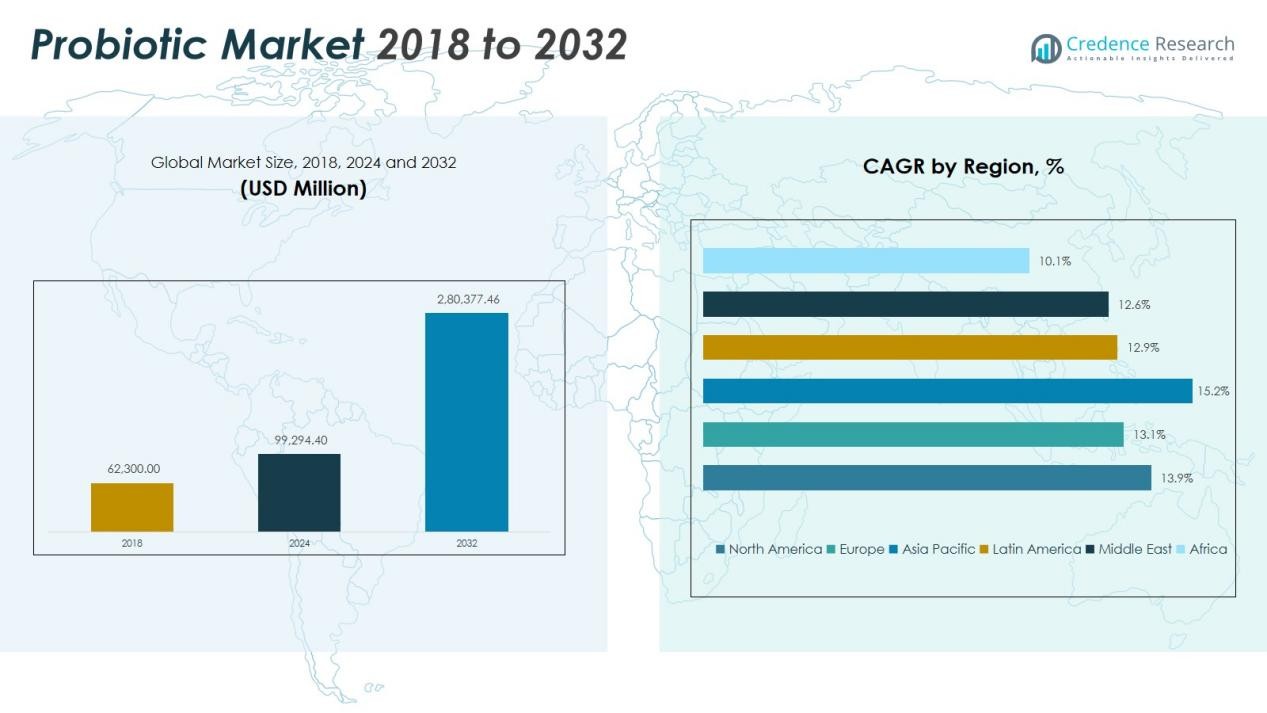
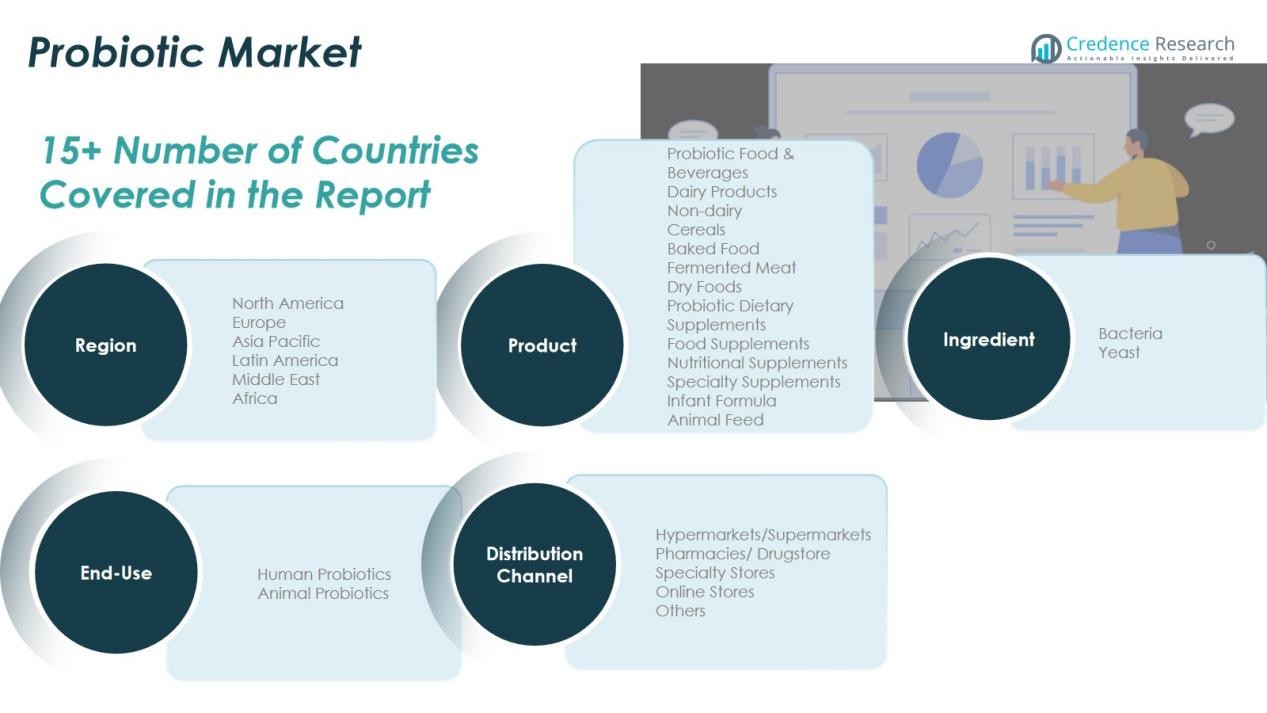
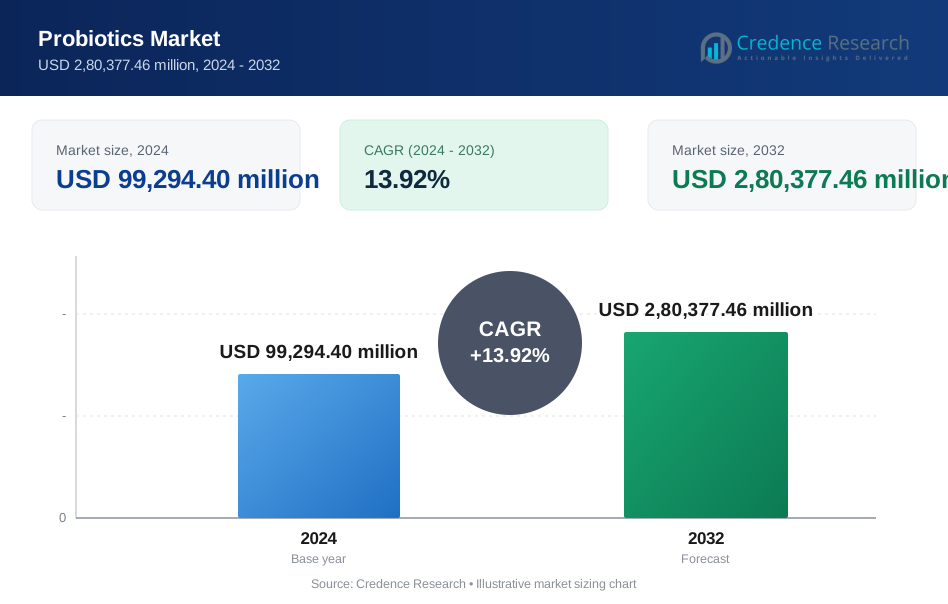
The Global Probiotic Market size was valued at USD 62.3 billion in 2018 to USD 99.29 billion in 2024 and is anticipated to reach USD 280.37 billion by 2032, at a CAGR of 13.92% during the forecast period.
| REPORT ATTRIBUTE | DETAILS |
|---|---|
| Historical Period | 2020-2023 |
| Base Year | 2024 |
| Forecast Period | 2025-2032 |
| Probiotics Market Size 2024 | USD 99.29 billion |
| Probiotics Market, CAGR | 13.92% |
| Probiotics Market Size 2032 | USD 280.37 billion |
The market is primarily driven by growing awareness of gut health, immunity, and digestive wellness. Demand is also supported by rising incidences of gastrointestinal disorders and lifestyle diseases. Food manufacturers are actively integrating probiotic strains into yogurts, drinks, and snacks, while the nutraceutical sector is launching targeted formulations for women’s health, metabolism, and mental well-being.
Regionally, Asia Pacific dominates the global market, accounting for over 40% of revenue in 2024, led by high consumption in Japan, China, and India. Europe follows closely, supported by established probiotic dairy brands and favorable regulatory support. North America remains a key market with rapid adoption of dietary supplements and expanding retail penetration. Latin America and the Middle East are emerging as high-potential regions due to improving health awareness and distribution networks.
Market Insights:
- The Global Probiotic Market was valued at USD 99.29 billion in 2024 and is projected to reach USD 280.37 billion by 2032, growing at a CAGR of 13.92%.
- Growing consumer awareness about gut health, immunity, and preventive nutrition continues to drive market expansion across developed and emerging regions.
- Probiotic food and beverages remain the leading segment, supported by strong demand for yogurts, fermented drinks, and dairy-based products worldwide.
- Asia Pacific leads the market with over 40% share in 2024, driven by high consumption in Japan, China, and India, while Europe and North America follow closely.
- Technological innovation in strain stability, microencapsulation, and personalized formulations is enhancing product diversity and long-term shelf life.
- The dietary supplement segment is witnessing fast growth due to rising use of capsules, gummies, and sachets for immunity and digestion.
- Regulatory inconsistencies and high production costs remain key challenges, though ongoing research and clinical validation continue to strengthen credibility.
- Japan and Germany are among the fastest-growing markets, supported by strong R&D ecosystems, healthcare integration, and consumer trust in functional food innovations.
Market Drivers:
Rising Awareness of Gut Health and Preventive Nutrition
Growing awareness of the link between gut health and overall wellness is a major driver of the Global Probiotic Market. Consumers are recognizing the role of probiotics in improving digestion, immunity, and nutrient absorption. It benefits from a global shift toward preventive healthcare and self-directed wellness routines. The expansion of educational campaigns by health organizations and product labeling emphasizing “live cultures” are further strengthening demand.
- For instance, Yakult Honsha Co., Ltd. reported that its flagship drink, containing at least 6.5 billion Lacticaseibacillus casei strain Shirota bacteria per bottle.
Increasing Demand for Functional Foods and Beverages
Consumers are actively seeking functional foods that offer nutritional and therapeutic value beyond basic sustenance. Probiotic-enriched yogurts, drinks, and snack products have become mainstream choices in both developed and emerging markets. It continues to grow due to strong retail visibility and evolving flavor formats that appeal to younger demographics. The growing alignment between convenience and health is fueling innovation in probiotic-infused dairy, juices, and ready-to-drink beverages.
- For instance, Yakult Honsha Co., Ltd. reported average daily global sales of approximately 28.13 million bottles in March 2025 across 39 countries and regions outside of Japan.
Advancements in Probiotic Strain Development and Formulation
Continuous R&D investments are driving the discovery of new probiotic strains with enhanced stability and health benefits. Manufacturers are focusing on microencapsulation and controlled-release technologies to improve strain survivability. It supports wider applications in non-dairy and shelf-stable products. Expanding research on probiotics for mental health, weight management, and skin care also broadens the market’s therapeutic potential.
Expanding Application in Dietary Supplements and Clinical Nutrition
The dietary supplement segment is witnessing rapid growth due to consumer demand for convenient probiotic delivery forms. Capsules, gummies, and sachets are gaining popularity among adults and children alike. It benefits from growing trust in clinically validated formulations that target immunity, metabolism, and digestive function. Increasing endorsement from healthcare professionals and inclusion in medical nutrition programs further enhances credibility and adoption worldwide.
Market Trends:
Integration of Probiotics in Functional and Non-Dairy Food Categories
The Global Probiotic Market is witnessing a major trend toward the inclusion of probiotics in non-dairy and functional food categories. Manufacturers are introducing probiotic-enriched snacks, plant-based yogurts, juices, and cereals to meet changing dietary preferences. It is driven by rising lactose intolerance, vegan lifestyles, and consumer demand for clean-label products. The integration of probiotics into everyday food formats increases accessibility and broadens appeal beyond traditional supplements. Food brands are focusing on improving flavor stability and strain survivability in varied formulations. The trend aligns with growing awareness of gut health and the link between diet and immunity. Functional beverage innovation remains a key growth area, supported by active product launches from global and regional players.
- For instance, in June 2025, Lifeway Foods introduced its Berry Blast Probiotic Smoothie + Collagen featuring 12 live and active probiotic cultures and 5 grams of hydrolyzed collagen per bottle, recognized by Good Housekeeping’s 2025 Snack Awards for its gut and skin health benefits.
Technological Innovation and Expansion into Personalized Healthcare
The market is evolving through technological innovation in probiotic formulation and delivery systems. Advances in microencapsulation and time-release technologies are improving shelf stability and efficacy of probiotic strains. It supports expansion into new delivery formats such as gummies, oral sprays, and sachets. The growing use of AI and microbiome analytics enables personalized probiotic solutions tailored to individual health profiles. Companies are collaborating with digital health platforms to offer customized recommendations and subscription-based supplements. Clinical research continues to validate the role of specific strains in mental wellness, skin health, and weight management. The combination of biotechnology and personalized healthcare positions probiotics as a cornerstone of future preventive nutrition.
- For Instance, BioGaia Prodentis lozenges contain the probiotic strains L. reuteri DSM 17938 and L. reuteri ATCC PTA 5289. These lozenges are supported by over 200 clinical studies for their use in oral health, demonstrating benefits like improved oral microbiome balance and reduced gum inflammation.
Market Challenges Analysis:
Regulatory Complexity and Product Standardization Issues
The Global Probiotic Market faces significant regulatory challenges due to inconsistent global standards. Countries vary in their definitions, permissible claims, and labeling requirements for probiotics. It limits cross-border product approvals and complicates compliance for manufacturers. The absence of harmonized testing methods often raises questions about strain viability and product efficacy. Small producers struggle to meet documentation and quality control demands. Complex clinical validation procedures also slow the introduction of new strains. These hurdles increase costs and delay innovation in competitive markets.
High Manufacturing Costs and Strain Stability Concerns
Probiotic manufacturing demands precise environmental control and advanced preservation technology. It remains costly to maintain live cultures during processing, storage, and transportation. Temperature fluctuations or exposure to moisture can degrade product quality. Ensuring strain survival in non-dairy or shelf-stable formats requires specialized encapsulation technologies. This raises production expenses and limits scalability for small and mid-size firms. Consumer trust can also decline when advertised bacterial counts fail to match actual content. These technical and financial barriers restrict wider market penetration and pricing flexibility.
Market Opportunities:
Expansion into Personalized Nutrition and Targeted Health Solutions
The Global Probiotic Market is poised to benefit from the growing trend toward personalized nutrition. Advances in microbiome research are enabling customized probiotic formulations tailored to individual gut profiles. It opens opportunities for companies to offer precision-based supplements addressing immunity, digestion, or metabolic health. The integration of AI-driven diagnostics and gut health testing platforms supports this transition. Collaboration between probiotic manufacturers and digital health startups is expanding product differentiation. Demand for customized solutions is particularly strong among urban consumers focused on preventive wellness. This trend strengthens brand loyalty and drives long-term growth potential.
Integration into Non-Dairy and Functional Product Categories
The demand for plant-based and lactose-free probiotic alternatives continues to rise globally. It creates strong growth potential across beverages, cereals, nutrition bars, and skincare formulations. Manufacturers are introducing vegan-friendly and fortified products to meet changing dietary preferences. The growing adoption of probiotics in pet nutrition and sports supplements further diversifies revenue streams. Partnerships with food and cosmetic brands enhance cross-industry expansion opportunities. Technological advancements in strain stabilization enable application in a wider range of products. This broadening of usage supports sustained market growth and consumer reach.
Market Segmentation Analysis:
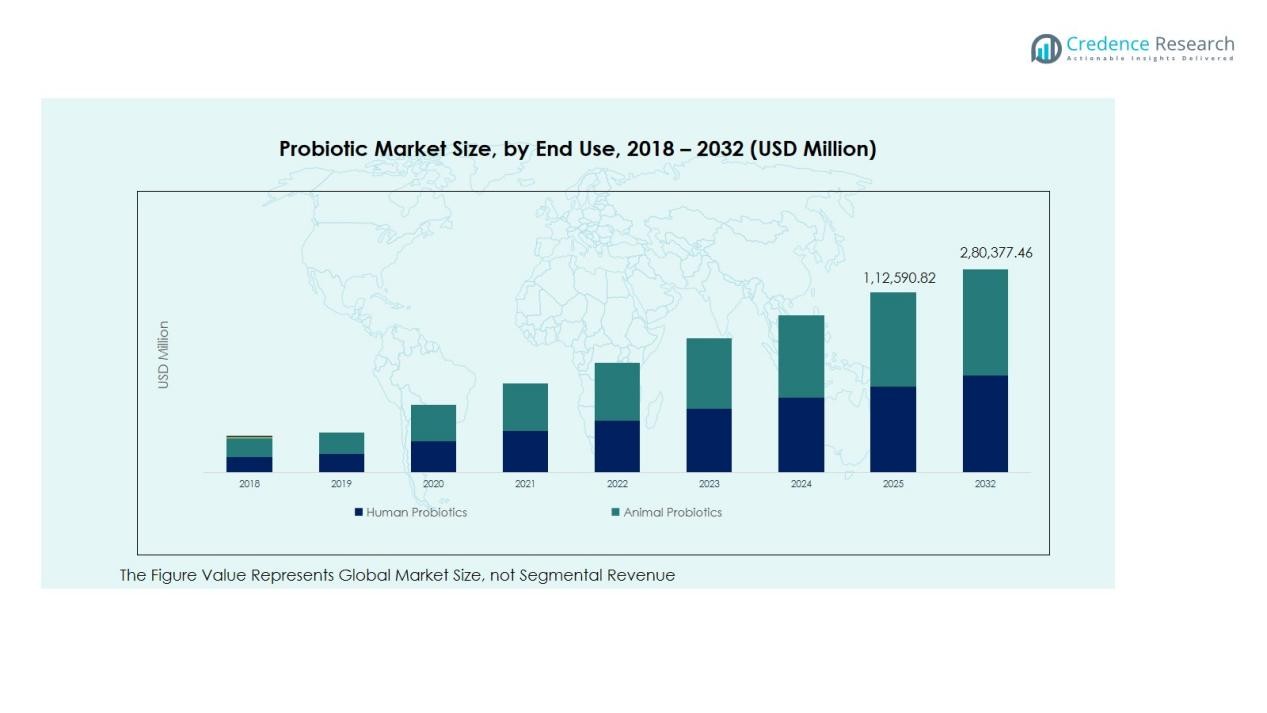
By Type:
Probiotic Food & Beverages
- Dairy Products
- Non-Dairy
- Cereals
- Baked Food
- Fermented Meat
- Dry Foods
Probiotic Dietary Supplements
- Food Supplements
- Nutritional Supplements
- Specialty Supplements
- Infant Formula
- Animal Feed
By Ingredient:
- Bacteria
- Yeast
By End-Use:
- Human Probiotics
- Animal Probiotics
By Distribution Channel:
- Hypermarkets/Supermarkets
- Pharmacies/Drugstores
- Specialty Stores
- Online Stores
- Others
By Region:
- North America
- U.S.
- Canada
- Mexico
- Europe
- UK
- France
- Germany
- Italy
- Spain
- Russia
Rest of Europe
- Asia Pacific
- China
- Japan
- South Korea
- India
- Australia
- Southeast Asia
Rest of Asia Pacific
- Latin America
- Brazil
- Argentina
Rest of Latin America
- Middle East
- GCC Countries
- Israel
- Turkey
Rest of Middle East
- Africa
- South Africa
- Egypt
- Rest of Africa
Segmentations:
By Type
The Global Probiotic Market is segmented by type into food and beverages, dietary supplements, and animal feed. Probiotic food and beverages hold the largest share due to high consumption of yogurts, fermented drinks, and dairy-based products. It benefits from growing demand for functional foods that support digestive and immune health. Dietary supplements are expanding rapidly, driven by the popularity of capsules, powders, and gummies among adults and children. The animal feed segment is also growing due to increased focus on livestock health and antibiotic-free nutrition. Rising innovation across non-dairy and plant-based formats further strengthens category growth.
- For Instance, Chr. Hansen (now part of Novonesis) developed the GalliPro® Fit probiotic, which was introduced to certain markets as early as 2017 and approved for the EU in 2021.
By Ingredient
The market is categorized by ingredient into bacteria and yeast. Bacterial strains such as Lactobacillus and Bifidobacterium dominate due to proven digestive and immunity benefits. It accounts for the majority of product formulations in both food and supplement categories. Yeast-based probiotics, led by Saccharomyces boulardii, are gaining traction for their resistance to antibiotics and heat stability. Manufacturers are focusing on strain diversity and shelf-life enhancement to meet consumer expectations. Continuous R&D in microbial science supports future market expansion.
- For instance, the clinically validated Saccharomyces boulardii CNCM I-745 strain, featured in Florastor products, has been tested in more than 130 clinical trials confirming its stability and digestive efficacy even under heat stress, marking it as one of the most resilient probiotic yeasts available.
By End-Use
By end-use, the market is divided into human probiotics and animal probiotics. Human probiotics dominate the segment, driven by preventive health awareness and clinical validation. It finds strong demand in dietary supplements and functional foods targeting gut and immune health. Animal probiotics are expanding across poultry, cattle, and pet nutrition for improved digestion and disease resistance. Growing adoption of clean-label feed solutions supports steady segment growth.
Regional Analysis:
North America
The North America Probiotic Market size was valued at USD 7,964.27 million in 2018, growing to USD 11,805.52 million in 2024, and is anticipated to reach USD 24,870.19 million by 2032, at a CAGR of 9.65% during the forecast period. The Global Probiotic Market in this region holds 28% share in 2024, supported by strong consumer awareness and widespread availability of probiotic-enriched food and dietary supplements. It benefits from established retail infrastructure and leading functional food brands investing in gut health innovation. The U.S. leads the regional demand with significant growth in yogurt, beverages, and capsule-based supplements. Rising cases of digestive disorders and a shift toward preventive healthcare encourage regular probiotic use. Canada contributes through expanding pharmacy-based probiotic offerings and e-commerce penetration. Strong clinical research and brand credibility sustain long-term market expansion.
United Kingdom
The UK Probiotic Market size was valued at USD 2,039.45 million in 2018 to USD 3,141.38 million in 2024 and is anticipated to reach USD 8,849.18 million by 2032, at a CAGR of 13.82% during the forecast period. The Global Probiotic Market in the UK represents 5% share in 2024, driven by increasing health-conscious behavior and dietary diversification. It gains momentum through the rising popularity of probiotic yogurts, supplements, and fermented beverages. Major retailers are introducing functional food lines with gut-friendly claims. The UK consumer base values transparency and clean-label ingredients, creating opportunities for premium brands. Regulatory clarity from the Food Standards Agency supports safe product claims. The growing vegan population also fuels non-dairy probiotic adoption, strengthening market outlook.
France
The France Probiotic Market size was valued at USD 1,915.85 million in 2018 to USD 2,942.80 million in 2024 and is anticipated to reach USD 8,145.84 million by 2032, at a CAGR of 13.57% during the forecast period. The Global Probiotic Market in France holds 4.5% share in 2024, led by a mature dairy industry and consumer trust in health-promoting products. It benefits from strong local production of probiotic yogurts and fermented milk drinks. French consumers associate probiotics with digestive comfort and immunity support. Pharma and nutraceutical players are expanding portfolios with capsule and powder formulations. Growing emphasis on clinical validation enhances product acceptance among healthcare professionals. The market continues to evolve with innovations in plant-based and lactose-free formats.
Germany
The Germany Probiotic Market size was valued at USD 2,441.16 million in 2018 to USD 3,828.78 million in 2024 and is anticipated to reach USD 11,830.05 million by 2032, at a CAGR of 15.14% during the forecast period. The Global Probiotic Market in Germany contributes 6% share in 2024, supported by a strong pharmaceutical and functional food ecosystem. It experiences growing demand from both consumers and healthcare providers. Germany’s aging population is increasingly adopting probiotics for digestive and immune health. The retail and pharmacy networks play a major role in distribution, enhancing product accessibility. Rising consumer preference for clinically backed formulations promotes innovation among domestic and international brands. Ongoing R&D in microbiome science strengthens long-term market development.
Italy
The Italy Probiotic Market size was valued at USD 1,078.44 million in 2018 to USD 1,640.65 million in 2024 and is anticipated to reach USD 4,082.00 million by 2032, at a CAGR of 12.07% during the forecast period. The Global Probiotic Market in Italy represents 3% share in 2024, driven by high supplement adoption and traditional use of fermented foods. It benefits from consumer trust in natural digestive aids and pharmaceutical-grade probiotic capsules. The presence of strong nutraceutical brands supports domestic consumption. Italian pharmacies remain key distribution hubs for probiotic formulations. Growing awareness of gut-brain health connections fuels innovation in multi-strain products. Expanding collaborations between medical professionals and product developers improve credibility and uptake.
Japan
The Japan Probiotic Market size was valued at USD 2,704.82 million in 2018 to USD 4,428.37 million in 2024 and is anticipated to reach USD 12,601.90 million by 2032, at a CAGR of 13.97% during the forecast period. The Global Probiotic Market in Japan holds 8% share in 2024, supported by a long-established culture of fermented food consumption. It benefits from innovation-led companies integrating probiotics into beverages, dairy, and dietary supplements. The population’s aging profile boosts demand for immune and digestive health products. Government support for functional foods through the FOSHU labeling system encourages consumer confidence. The Japanese market emphasizes scientific validation and advanced strain research. Continuous innovation in ready-to-drink and shelf-stable formats ensures sustained growth.
Australia
The Australia Probiotic Market size was valued at USD 701.25 million in 2018 to USD 1,160.94 million in 2024 and is anticipated to reach USD 3,445.33 million by 2032, at a CAGR of 14.57% during the forecast period. The Global Probiotic Market in Australia accounts for 2% share in 2024, driven by rising preventive healthcare trends. It benefits from strong demand for gut-friendly beverages, powders, and capsules among health-conscious consumers. Expanding e-commerce channels support accessibility for premium probiotic brands. Local manufacturers are emphasizing strain diversity and clean-label certification to meet consumer expectations. Growing awareness among pediatric and elderly populations widens usage scope. Continued product innovation and retail partnerships will sustain robust market expansion.
Key Player Analysis:
- Arla Foods
- BioGaia
- Hansen Holding A/S
- Danone
- DuPont De Nemours, Inc.
- General Mills, Inc.
- i-Health, Inc.
- Lallemand Inc.
- Lifeway Foods Inc.
- Mother Dairy Fruit & Vegetable Pvt. Ltd.
- Kerry Group plc
- Nestlé S.A.
- Probi AB
- Yakult Honsha Co., Ltd.
Competitive Analysis:
The Global Probiotic Market is highly competitive, with key players focusing on innovation, product quality, and strain development to strengthen their positions. Leading companies such as Arla Foods, BioGaia, Chr. Hansen Holding A/S, Danone, DuPont De Nemours, Inc., General Mills, Inc., i-Health, Inc., Lallemand Inc., and Lifeway Foods Inc. dominate the market through diversified portfolios and strong brand presence. It emphasizes research in microbial science to enhance product efficacy and shelf stability. Strategic collaborations with food, pharmaceutical, and biotechnology firms expand application scope across supplements and functional foods. Companies invest heavily in clinical trials and technological advancements to maintain credibility and consumer trust. Growing demand for personalized and non-dairy probiotic solutions is encouraging continuous product expansion and competitive differentiation among global manufacturers.
Recent Developments:
- In October 2025, BioGaia published research on its newly patented probiotic strain Limosilactobacillus reuteri BG-R46®, which exhibits superior bile tolerance and anti-inflammatory properties.
- In October 2025, Danone announced a new partnership with Ahold Delhaize USA and The Nature Conservancy to reduce dairy methane emissions over the next five years, focusing on sustainable farming and regenerative practices across North America.
Report Coverage:
The research report offers an in-depth analysis based on Type, Ingredient, End-Use, Distribution Channel and Region. It details leading market players, providing an overview of their business, product offerings, investments, revenue streams, and key applications. Additionally, the report includes insights into the competitive environment, SWOT analysis, current market trends, as well as the primary drivers and constraints. Furthermore, it discusses various factors that have driven market expansion in recent years. The report also explores market dynamics, regulatory scenarios, and technological advancements that are shaping the industry. It assesses the impact of external factors and global economic changes on market growth. Lastly, it provides strategic recommendations for new entrants and established companies to navigate the complexities of the market.
Future Outlook:
- The Global Probiotic Market will experience strong growth driven by increasing focus on preventive health and immunity enhancement.
- Consumer awareness of gut microbiome balance will continue to influence dietary habits worldwide.
- Technological advances in strain development and encapsulation will improve product stability and effectiveness.
- Expansion of probiotic applications into mental wellness, skin health, and metabolic function will broaden market scope.
- Rising demand for plant-based and lactose-free probiotic products will reshape product innovation strategies.
- E-commerce and direct-to-consumer models will strengthen global distribution and brand accessibility.
- Pharmaceutical and nutraceutical partnerships will enhance clinical research and regulatory acceptance.
- Personalized probiotic supplements supported by AI-driven microbiome testing will gain market traction.
- Probiotic integration into pet nutrition and sports performance products will create new revenue streams.
- Growing investments in sustainable manufacturing and clean-label formulations will define the industry’s next growth phase.
Request a Free Sample
Fill in your details and we'll send you a free sample report.
- Sample data tables & charts
- Research methodology
Need a Custom Version of This Report?
Tailor the scope, geography, or segments to your exact requirements.
- Custom geography or segment scope
- Direct access to our analyst team
Frequently Asked Questions
What is the current market size for the Global Probiotic Market, and what is its projected size in 2032?
At what Compound Annual Growth Rate is the Global Probiotic Market projected to grow between 2024 and 2032?
Which Global Probiotic Market segment held the largest share in 2024?
What are the primary factors fueling the growth of the Global Probiotic Market?
Who are the leading companies in the Global Probiotic Market?
Which region commanded the largest share of the Global Probiotic Market in 2024?
Table of Content
Chapter 1. Report Introduction
- 1.1 Report Description & Purpose
- 1.1.1 Report Title & Market Definition
- 1.1.2 Unique Selling Propositions (USP) & Key Differentiators
- 1.1.3 Value Proposition for Stakeholders
- 1.2 Research Objectives
- 1.2.1 Market Sizing Objectives (Volume & Revenue) (Volume Where Applicable)
- 1.2.2 Segmentation Objectives
- 1.2.3 Competitive Intelligence Objectives
- 1.2.4 Forecast & Scenario Objectives
- 1.3 Report Scope
- 1.3.1 Probiotics Scope – Segments & Subsegments Covered
- 1.3.2 Geographic Scope – Regions & Countries Covered
- 1.3.3 Historical Period, Base Year & Forecast Period (2024; forecast to 2032)
- 1.3.4 Inclusions & Exclusions
- 1.4 Industry Classification & Applicable Codes
- 1.5 Currency, Measurement Units & Valuation Basis
- 1.6 Target Stakeholders
- 1.7 Limitations & Assumptions
Chapter 2. Executive Summary
- 2.1 Global Probiotics Market Snapshot
- 2.1.1 Market Size – Historical (2024) & Forecast (2024-2032) (2024: USD 99,294.40 million → 2032: USD 2,80,377.46 million)
- 2.1.2 Volume & Revenue – Global Totals (Volume Where Applicable)
- 2.1.3 Key Market Highlights – Top Five Facts
- 2.2 Probiotics Market Segmentation Snapshot
- 2.2.1 Market Split by Region – 2024 vs. 2032
- 2.3 Competitive Snapshot
- 2.3.1 Top 10 Players by Revenue Share – 2024
- 2.3.2 Top 10 Players by Volume Share – 2024 (Volume Where Applicable)
- 2.3.3 Recent Strategic Developments (18-Month Summary)
- 2.4 Key Investment Highlights & Strategic Conclusions
Chapter 3. Probiotics Market Dynamics & Industry Analysis
- 3.1 Market Overview & Context
- 3.1.1 Probiotics Market Position in the Broader Industry Value Chain
- 3.1.2 Demand Structure & Purchasing Dynamics
- 3.1.3 Market Maturity & Development Stage by Region
- 3.2 Probiotics Market Drivers
- 3.3 Probiotics Market Restraints & Challenges
- 3.4 Probiotics Market Opportunities
- 3.5 Porter's Five Forces Analysis
- 3.5.1 Threat of New Entrants
- 3.5.2 Bargaining Power of Suppliers
- 3.5.3 Bargaining Power of Buyers
- 3.5.4 Threat of Substitutes
- 3.5.5 Competitive Rivalry – Intensity Assessment
- 3.6 Probiotics Value Chain Analysis
- 3.6.1 Upstream – Key Inputs, Resources & Suppliers
- 3.6.1.1 Key Input/Resource 1
- 3.6.1.2 Key Input/Resource 2
- 3.6.1.3 Key Input/Resource 3
- 3.6.2 Midstream – Core Operations & Value Creation
- 3.6.2.1 Operating Model & Process Overview
- 3.6.2.2 Key Operating Locations & Capabilities by Company
- 3.6.3 Downstream – Market Channels & End Users
- 3.6.3.1 Direct Sales & Customer Engagement Channels
- 3.6.3.2 Indirect Sales, Intermediaries & Partner Channels
- 3.6.4 Value Chain Profitability Analysis
- 3.6.1 Upstream – Key Inputs, Resources & Suppliers
- 3.7 PESTEL Analysis
- 3.7.1 Political Factors
- 3.7.2 Economic Factors
- 3.7.3 Social Factors
- 3.7.4 Technological Factors
- 3.7.5 Environmental Factors
- 3.7.6 Legal Factors
- 3.8 Probiotics Supply Chain Analysis
- 3.8.1 Critical Input & Resource Availability Risk Assessment
- 3.8.2 Supplier & Operational Concentration Risk (Geographic Exposure)
- 3.8.3 Supply & Service Disruption Impact Analysis
- 3.9 Regulatory & Policy Landscape
Note: The regulatory and policy landscape section covers regulations based on their applicability to the market, Probiotics category, geography, and scope of the study. Only regulatory frameworks with a material impact on operations, compliance, trade, sustainability, or market access are analyzed in detail.
Chapter 4. Key Investment Pockets & Opportunity Analysis
- 4.1 Probiotics Market Attractiveness Analysis
- 4.1.1 By Region – Investment Attractiveness Matrix (Market Size × CAGR)
- 4.2 Absolute Revenue Growth Opportunity
- 4.2.1 By Region – Absolute Revenue Growth Through 2032
- 4.3 Incremental Demand Opportunity
- 4.3.1 By Region – Incremental Demand Through 2032
- 4.3.2 Segment – Incremental Demand
- 4.4 Emerging Submarket Opportunity Deep Dive (Subject to Applicability)
- 4.5 Priority Market Opportunity Scorecards
- 4.5.1 United States
- 4.5.2 Europe
- 4.5.3 Asia
- 4.5.4 Middle East & Africa
Note: Priority market opportunity scorecards reflect the geographic scope and strategic relevance of the study. Listed markets are indicative and may be adapted to the industry.
Chapter 5. Probiotics Cross-Border Trade & Market Access Analysis
- 5.1 International Trade & Cross-Border Activity Overview
- 5.1.1 Global Export Value by Country (2024)
- 5.1.2 Global Export Volume by Country (2024) (Volume Where Applicable)
- 5.1.3 Global Import Value by Country (2024)
- 5.1.4 Global Import Volume by Country (2024) (Volume Where Applicable)
- 5.1.5 Net Trade Balance by Country (2024)
- 5.2 Export Analysis – Segment
- 5.2.1 Category 1 (Applicable Classification Code)
- 5.2.2 Category 2 (Applicable Classification Code)
- 5.2.3 Category 3 (Applicable Classification Code)
- 5.2.4 Category 4 (Applicable Classification Code)
- 5.2.5 Category 5 (Applicable Classification Code)
- 5.3 Import Analysis – Segment
- 5.3.1 Category 1 (Applicable Classification Code)
- 5.3.2 Category 2 (Applicable Classification Code)
- 5.3.3 Category 3 (Applicable Classification Code)
- 5.3.4 Category 4 (Applicable Classification Code)
- 5.3.5 Category 5 (Applicable Classification Code)
- 5.4 Cross-Border Pricing & Transaction Benchmarks
- 5.4.1 Export Pricing – Segment & Country
- 5.4.2 Import Pricing – Segment & Source Country
- 5.4.3 Price Trends (2024)
- 5.5 Key Cross-Border Trade & Delivery Routes
- 5.5.1 Cross-Border Trade/Delivery Route 1
- 5.5.2 Cross-Border Trade/Delivery Route 2
- 5.5.3 Cross-Border Trade/Delivery Route 3
- 5.5.4 Cross-Border Trade/Delivery Route 4
- 5.5.5 Cross-Border Trade/Delivery Route 5
- 5.6 Trade Policy & Market Access Impact Assessment
- 5.6.1 Tariff & Non-Tariff Barriers
- 5.6.2 Regional Trade & Economic Integration Frameworks
- 5.6.3 Bilateral & Multilateral Trade Agreements
- 5.6.4 Cross-Border Operating, Licensing & Localization Requirements
Note: This chapter applies where cross-border trade or delivery is relevant to Probiotics. Goods, services, and digital offerings are assessed using applicable classifications and transaction measures. Import-export volumes, trade balances, and route analyses are included only where meaningful to the market.
Chapter 6. Competitive Landscape & Company Benchmarking
- 6.1 Probiotics Market Concentration & Structure
- 6.1.1 Herfindahl-Hirschman Index (HHI) – vs. 2024
- 6.1.2 Leading, Mid-Sized & Emerging Player Structure
- 6.1.3 Global, Regional & Local Player Dynamics
- 6.2 Probiotics Market Share Analysis – 2024
- 6.2.1 Global Revenue Share by Company
- 6.2.2 Global Volume Share by Company (Volume Where Applicable)
- 6.2.3 Regional Revenue Share
- 6.2.4 Market Share Evolution ( vs. 2024)
- 6.2.5 Company Market Share by Key Segment
- 6.2.6 Company Market Share by Customer Group
- 6.3 Operating Scale, Capacity & Infrastructure Analysis
- 6.3.1 Global Operating Scale & Supply Capacity
- 6.3.2 Resource Utilization & Operating Efficiency
- 6.3.3 Output, Service Delivery & Activity Metrics
- 6.3.4 Operating Footprint & Infrastructure Map
- 6.3.5 Planned Operational & Capacity Expansion
- 6.4 Probiotics Competitive Benchmarking Matrix
- 6.4.1 Revenue, Growth, Profitability & Operating Metric Comparison
- 6.4.2 Channel Revenue Mix
- 6.4.3 Geographic Revenue Exposure
- 6.4.4 R&D Intensity
- 6.4.5 Sustainability Maturity
- 6.5 Strategic Developments in Probiotics (Last 24 Months)
- 6.5.1 Mergers, Acquisitions & Divestments
- 6.5.2 New Products, Services & Solutions in Probiotics
- 6.5.3 Operational & Infrastructure Expansions
- 6.5.4 Strategic Alliances, Joint Ventures & Partnerships
- 6.5.5 Distribution Expansion & Market Entry
- 6.5.6 Sustainability & ESG Initiatives
- 6.6 Competitive Strategy Mapping
- 6.6.1 Leader, Challenger, Follower & Niche Classification
- 6.6.2 Pricing Strategy Comparison
- 6.6.3 Channel Strategy Matrix
Note: Strategic developments are included based on their materiality and the availability of reliable information.
Chapter 7. Global Probiotics Market – By Sales & Delivery Channel
- 7.1 Segment Overview
- 7.1.1 Volume & Revenue Split by Channel (2024 & 2032) (Volume Where Applicable)
- 7.1.2 Channel Mix Evolution (2024-2032)
Chapter 8. Regional Market Analysis – Global Overview
- 8.1 Global Regional Overview
- 8.1.1 Regional Volume Share (Volume Where Applicable)
- 8.1.2 Regional Revenue Share
- 8.1.3 Regional Volume by Region (Volume Where Applicable)
- 8.1.4 Regional Revenue by Region
- 8.1.5 Regional Forecast Through 2032
- 8.2 Cross-Regional Segment Analysis
- 8.2.1 By Sales & Delivery Channel
- 8.2.2 By Competitive Positioning & Price Tier
Chapter 9. North America Probiotics Market
- 9.1 United States
- 9.2 Canada
- 9.3 Mexico
Chapter 10. Europe Probiotics Market
- 10.1 Germany
- 10.2 France
- 10.3 Italy
- 10.4 United Kingdom
- 10.5 Spain
- 10.6 Poland
- 10.7 Russia
- 10.8 Netherlands
- 10.9 Belgium
- 10.10 Sweden
- 10.11 Denmark
- 10.12 Norway
- 10.13 Rest of Europe
Chapter 11. Asia Pacific Probiotics Market
- 11.1 China
- 11.2 India
- 11.3 Japan
- 11.4 South Korea
- 11.5 Thailand
- 11.6 Indonesia
- 11.7 Vietnam
- 11.8 Malaysia
- 11.9 Australia
- 11.10 Rest of Asia Pacific
Chapter 12. Latin America Probiotics Market
- 12.1 Brazil
- 12.2 Argentina
- 12.3 Colombia
- 12.4 Chile
- 12.5 Rest of Latin America
Chapter 13. Middle East Probiotics Market
- 13.1 Saudi Arabia
- 13.2 United Arab Emirates
- 13.3 Turkey
- 13.4 Israel
- 13.5 Iran
- 13.6 Rest of the Middle East
Chapter 14. Africa Probiotics Market
- 14.1 South Africa
- 14.2 Egypt
- 14.3 Nigeria
- 14.4 Morocco
- 14.5 Rest of Africa
Chapter 15. Probiotics Company Profiles
- 15.1 [Company 01]
- 15.1.1 Company Overview
- 15.1.2 Key Management Personnel
- 15.1.3 Products & Services Portfolio
- 15.1.4 Financial Performance
- 15.1.5 Key Market Focus & Geographic Presence
- 15.1.6 Recent Developments & Strategic Initiatives
Note: The company profile list is preliminary and may change based on research findings, market developments, data availability, and client requirements.
Chapter 16. Appendices
- Appendix A – List of Abbreviations & Acronyms
- Appendix B – Industry Classification Code Reference – Full Series
- Appendix C – Supply, Output & Operating Capacity Data Tables
- Appendix D – End-Use & Demand Base Tables
- Appendix E – Demand, Adoption & Usage Assumptions
- Appendix F – Pricing & Revenue Metric Reference Tables
- Appendix G – Company Operations & Infrastructure Database
- Appendix H – Cross-Border Trade & Activity Data Tables (Where Applicable)
- Appendix I – Regulatory Summary Tables
- Appendix J – Primary Research Participant List (Anonymized)
- Appendix K – Primary Research Questionnaire Framework
- Appendix L – Data Sources & Bibliography
- Appendix M – Market Size Divergence & Source Comparison
Chapter 17. Research Methodology
- 17.1 Research Framework & Philosophy
- 17.2 Secondary Research – Sources, Hierarchy & Data Extraction
- 17.3 Data Modeling – Bottom-Up & Top-Down Market Sizing
- 17.4 Primary Research – Stakeholder Framework, LOI & Sample Sizes
- 17.5 Forecast Methodology – Regression, Scenario & Sensitivity Analysis
- 17.6 Quality Control – Four-Layer Validation Framework
- 17.7 Limitations & Standard Assumptions
- 17.8 Disclaimer
