Market Overview:
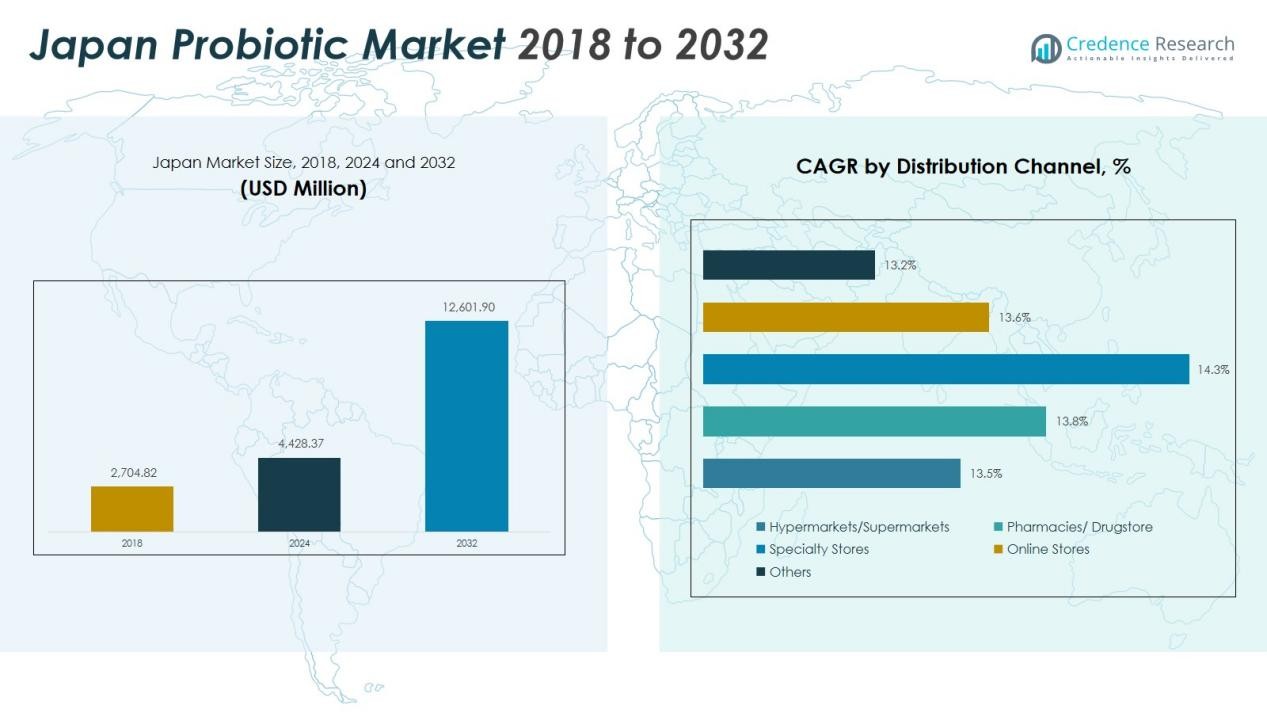
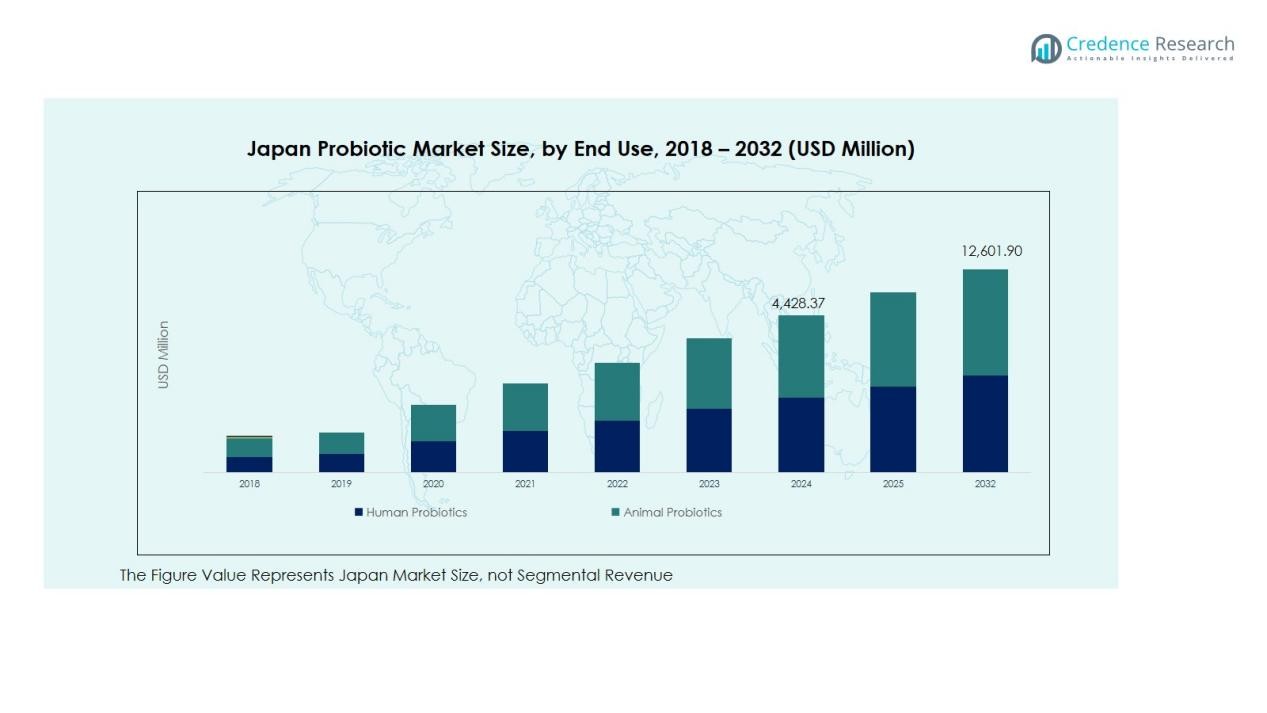
The Japan Probiotic Market size was valued at USD 2,704.82 million in 2018 to USD 4,428.37 million in 2024 and is anticipated to reach USD 12,601.90 million by 2032, at a CAGR of 13.97%during the forecast period.
| REPORT ATTRIBUTE | DETAILS |
|---|---|
| Historical Period | 2020-2023 |
| Base Year | 2024 |
| Forecast Period | 2025-2032 |
| Japan Probiotic Market Size 2024 | USD 4,428.37 Million |
| Japan Probiotic Market , CAGR | 13.97% |
| Japan Probiotic Market Size 2032 | USD 12,601.90 Million |
The market is driven by growing awareness of gut and immune health, the aging population, and innovation in strain technology. Manufacturers are focusing on developing multi-strain formulations with improved stability and shelf life. Demand is also supported by increased clinical research, supportive government health policies, and rising popularity of probiotic-infused dairy and non-dairy alternatives among health-conscious consumers.
Regionally, Kanto dominates the Japan Probiotic Market due to high urbanization, advanced retail infrastructure, and strong presence of key food manufacturers. Kansai follows, driven by a large health-oriented population and wide product availability. Kyushu and Hokkaido are emerging as high-growth regions, supported by expanding distribution channels, online retail penetration, and growing adoption of probiotic supplements in rural and semi-urban areas.
Market Insights:
- The Japan Probiotic Market was valued at USD 2,704.82 million in 2018, reached USD 4,428.37 million in 2024, and is projected to attain USD 12,601.90 million by 2032, growing at a CAGR of 13.97%.
- Kanto holds the largest share of 42% in 2024, supported by high urbanization, advanced retail infrastructure, and a strong presence of food manufacturers. Kansai follows with a 27% share, driven by health-conscious consumers and product diversification.
- Kyushu and Hokkaido together account for 19% of the market, showing rising demand supported by growing online retail and regional health initiatives.
- Probiotic food and beverages dominate the market with a 63% share, fueled by strong consumer preference for yogurt drinks and fermented dairy products.
- Probiotic dietary supplements represent 25% of the market, gaining traction among adults seeking convenient, clinically validated digestive and immune health solutions.
Market Drivers:
Rising Focus on Digestive and Immune Health
Growing consumer awareness of digestive wellness and immunity is driving strong demand for probiotics. The aging population and lifestyle-related disorders have increased interest in gut microbiome health. Probiotic-based supplements and fortified foods are gaining preference due to their proven clinical benefits in improving digestion and immunity. The Japan Probiotic Market benefits from this shift toward functional nutrition, supported by both healthcare professionals and consumer education programs.
- For Instance, In Japan, Yakult Honsha offers the non-carbonated probiotic drink Y1000, which contains 110 billion Lacticaseibacillus paracasei strain Shirota per bottle.
Technological Advancements in Strain Development and Delivery
Innovation in strain engineering and encapsulation technology is improving probiotic stability and bioavailability. Manufacturers are developing multi-strain and shelf-stable formulations that can withstand varying temperature and storage conditions. It enables broader product use across beverages, snacks, and dairy alternatives without compromising efficacy. These advancements enhance consumer confidence and expand market applications in Japan’s competitive health food industry.
- For instance, in 2023, Morinaga Milk Industry developed a high-concentration bifidobacteria powder that maintained live bacterial stability for over 12 months at room temperature and is now supplied to more than 150 neonatal intensive care units (NICUs) in Japan and overseas, marking a major leap in probiotic shelf-life technology.
Strong Influence of Preventive Healthcare and Functional Foods
The Japanese population’s preference for preventive healthcare supports continuous probiotic adoption. Consumers are prioritizing nutrition-based solutions over medication, creating opportunities for fortified food and beverage products. Functional dairy products, probiotic drinks, and capsules are witnessing rapid growth in both retail and e-commerce channels. It strengthens the market’s position in Japan’s evolving healthcare and wellness ecosystem.
Expanding Retail and E-Commerce Distribution Networks
The growing reach of modern retail and digital platforms has significantly improved probiotic accessibility. Supermarkets, convenience stores, and online marketplaces are increasing visibility and consumer engagement. E-commerce platforms promote awareness and enable easy comparison of product efficacy and ingredients. The Japan Probiotic Market gains momentum from these distribution improvements, ensuring strong sales penetration across both urban and regional markets.
Market Trends:
Growing Adoption of Functional and Fortified Food Products
Japanese consumers are increasingly integrating probiotics into everyday diets through functional and fortified foods. Yogurt, fermented beverages, and snack bars enriched with probiotic strains are becoming daily health staples. It reflects the country’s strong emphasis on preventive health and convenience-based nutrition. Food manufacturers are introducing products with targeted benefits such as improved digestion, skin health, and mental well-being. Demand is further supported by product labeling transparency and endorsements from healthcare professionals. The Japan Probiotic Market continues to expand within the food segment, driven by innovation, premiumization, and diversification of probiotic-enriched formulations.
- For instance, in May 2025, Nomura Dairy Products, in collaboration with Probi AB, launched Japan’s first fermented carrot juice drink fortified with the Lactiplantibacillus plantarum LP299V® strain, delivering over 100 billion live probiotics per serving to support digestive wellness and gut balance.
Rising Popularity of Non-Dairy and Plant-Based Probiotics
Shifting dietary preferences toward lactose-free and vegan alternatives are shaping new growth areas for probiotics. Consumers are seeking non-dairy probiotic beverages made from soy, oats, and coconut bases. It aligns with the country’s focus on sustainability and digestive comfort among lactose-intolerant populations. Brands are expanding portfolios with plant-derived formulations that maintain strain stability and taste appeal. Collaborations between biotechnology firms and food producers are accelerating the development of next-generation probiotics. The Japan Probiotic Market is witnessing a strong move toward inclusive and eco-friendly products that cater to both health and ethical consumer values.
- For instance, Silk’s Cherry Plant-based Probiotic Yogurt contains more than 1 billion CFU (\(>10^{9}\)) of Bifidobacterium lactis per serving, offering a smooth coconut-base texture in a refrigerated format.
Market Challenges Analysis:
High Product Costs and Regulatory Complexity
The Japan Probiotic Market faces challenges from high production and regulatory compliance costs. Advanced strain development, encapsulation technologies, and clinical testing increase overall product pricing. Strict labeling and approval standards from health authorities make product registration time-consuming. It limits entry for smaller manufacturers and slows innovation cycles. Price-sensitive consumers may prefer traditional fermented foods over premium probiotic supplements. The need for continuous validation of health claims also adds to the financial burden on producers.
Limited Awareness Beyond Urban Centers
Consumer understanding of probiotics remains concentrated in urban regions such as Tokyo and Osaka. Rural populations show slower adoption due to limited awareness of specific health benefits. It restricts nationwide market penetration and reduces sales potential in less-developed areas. Distribution infrastructure gaps and fewer retail partnerships further weaken accessibility. Companies are investing in education campaigns and online marketing to address this imbalance. Sustained outreach and regional marketing are critical to overcoming this awareness divide.
Market Opportunities:
Expansion into Personalized and Clinical Nutrition
The growing focus on personalized healthcare creates strong potential for tailored probiotic solutions. Advances in microbiome research allow manufacturers to design products that target specific age groups and health conditions. It supports the development of probiotics for gut health, immunity, skin care, and cognitive well-being. Collaborations between nutraceutical companies and medical institutions are strengthening clinical validation. Consumers in Japan are increasingly open to science-driven, customized supplements that reflect individual health needs. The Japan Probiotic Market can capitalize on this demand by integrating AI-driven formulation and DNA-based microbiome testing into product innovation.
Growth in E-Commerce and International Collaboration
E-commerce expansion presents major growth prospects for probiotic brands in Japan. Online platforms enable wider reach, product education, and subscription-based wellness programs. It enhances visibility and allows direct consumer engagement through digital health communities. Strategic partnerships with global biotech firms can introduce advanced strains and patented technologies. Increasing exports of probiotic supplements and beverages also support regional leadership in Asia-Pacific. The Japan Probiotic Market can strengthen its global presence by leveraging digital transformation and international collaboration in product research and commercialization.
Market Segmentation Analysis:
By Type
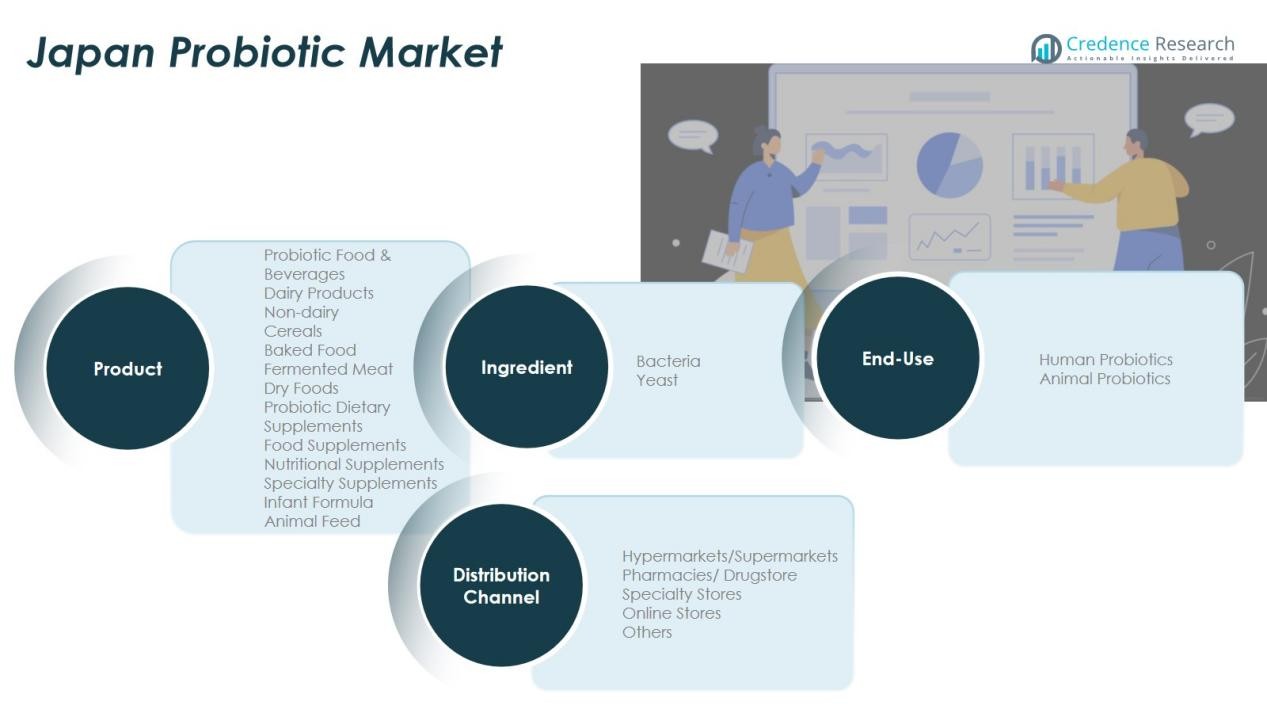
Probiotic food and beverages dominate the Japan Probiotic Market, driven by strong consumer preference for functional dairy and fermented drinks. Yogurt, cultured milk, and probiotic beverages lead sales due to their proven digestive benefits and taste familiarity. It gains momentum through the integration of science-backed strains and expansion of plant-based alternatives. Probiotic dietary supplements, including capsules, powders, and gummies, are growing rapidly among adults seeking immune and gut health support. The animal feed segment shows steady development supported by improved livestock health awareness and the need for antibiotic-free solutions.
- For instance, in May 2025, Nomura Dairy Products partnered with Probi AB to launch My Flora, Japan’s first probiotic-enhanced carrot juice fortified with over 100 billion live Lactiplantibacillus plantarum LP299V® cells per bottle, marking a breakthrough in the country’s plant-based probiotic drink segment.
By Ingredient
Bacterial strains hold the largest market share due to their extensive clinical validation and established use in food and supplement products. Lactobacillus and Bifidobacterium dominate due to their digestive and immune support benefits. It continues to attract investment in R&D for enhanced strain stability and targeted formulations. Yeast-based probiotics are gaining popularity for their heat resistance and suitability in varied applications such as functional foods and pharmaceuticals. Their growing adoption reflects expanding product diversification in Japan’s health and nutrition sector.
- For instance, Yakult Honsha’s Lactobacillus casei strain Shirota achieved a mean fecal viability of 7.5 log CFU/g after an 8-week intervention in 23 healthy subjects.
By End-Use
Human probiotics account for the majority share due to rising health awareness and preference for preventive nutrition. It benefits from aging demographics and the popularity of fortified dairy and beverage options. Animal probiotics are emerging steadily with applications in pet care and livestock feed efficiency. The increasing focus on overall well-being and nutritional innovation supports balanced growth across both end-use segments.
Segmentations:
By Type:
Probiotic Food & Beverages
- Dairy Products
- Non-Dairy
- Cereals
- Baked Food
- Fermented Meat
- Dry Foods
Probiotic Dietary Supplements
- Food Supplements
- Nutritional Supplements
- Specialty Supplements
- Infant Formula
- Animal Feed
By Ingredient:
- Bacteria
- Yeast
By End-Use:
- Human Probiotics
- Animal Probiotics
By Distribution Channel:
- Hypermarkets/Supermarkets
- Pharmacies/Drugstores
- Specialty Stores
- Online Stores
- Others
Regional Analysis:
Kanto Region Leading with Strong Consumer Base and Retail Network
The Kanto region dominates the Japan Probiotic Market due to its dense population, urban lifestyle, and advanced retail infrastructure. Tokyo and surrounding prefectures drive high demand for probiotic supplements and functional foods. Consumers here show strong interest in preventive health and prefer products backed by clinical evidence. It benefits from the presence of major food manufacturers, pharmaceutical companies, and research institutes. The concentration of premium supermarkets and convenience stores further supports product accessibility. Continuous innovation in ready-to-drink probiotic beverages sustains the region’s leadership position.
Kansai Region Showing Steady Demand and Product Diversification
The Kansai region ranks second, supported by its balanced mix of urban and suburban consumers. Cities such as Osaka and Kyoto demonstrate high awareness of digestive and immune health benefits. It shows strong adoption of probiotic-infused dairy, yogurt, and nutraceutical supplements. Local manufacturers are expanding portfolios with functional formulations that address elderly health and dietary preferences. Distribution through convenience stores and e-commerce platforms enhances product reach. The region’s health-conscious population and focus on product quality continue to attract new investments.
Emerging Growth Across Kyushu and Hokkaido Regions
Kyushu and Hokkaido are emerging as high-growth areas due to rising health awareness and improved logistics. Consumers in these regions are increasingly adopting probiotic drinks and capsules supported by digital marketing campaigns. It benefits from expanding retail infrastructure and growing online shopping penetration. Local dairies and beverage companies are introducing affordable probiotic formulations to appeal to broader audiences. Government support for rural healthcare and nutrition initiatives further encourages probiotic consumption. These developments position regional markets for strong future expansion within Japan’s overall probiotic landscape.
Key Player Analysis:
- Yakult Honsha Co., Ltd.
- Danone
- Asahi Group Holdings, Ltd.
- Morinaga Milk Industry Co., Ltd.
- Nestlé Japan Ltd.
- Lonza Group Ltd.
- DSM-Firmenich
- Arla Foods amba (U.K. operations)
- Bayer U.K.
Competitive Analysis:
The Japan Probiotic Market is highly competitive, with companies focusing on innovation, clinical validation, and brand differentiation. Key players include Yakult Honsha Co., Ltd., Danone, Asahi Group Holdings, Ltd., Morinaga Milk Industry Co., Ltd., Nestlé Japan Ltd., and Lonza Group Ltd. It features strong domestic dominance alongside international brand presence, supported by robust distribution networks and advanced research capabilities. Firms are investing in next-generation probiotic strains, plant-based alternatives, and fortified functional foods to capture growing consumer interest. Strategic collaborations between food and biotech companies are expanding product portfolios and strengthening regulatory compliance. Continuous marketing, premiumization, and diversification across supplements and beverages sustain competition intensity in this evolving market.
Recent Developments:
- In September 2025, Yakult Honsha established the Yakult European R&D Center B.V. in the Netherlands to expand global probiotic research and innovation activities.
- In August 2025, Danone overhauled its leadership structure, transitioning from five geographic regions to three (EMEA, Americas, and Asia-Pacific) to enhance organizational agility under its “Renew Danone” transformation.
Report Coverage:
The research report offers an in-depth analysis based on Type, Ingredient, End-Use and Distribution Channel. It details leading market players, providing an overview of their business, product offerings, investments, revenue streams, and key applications. Additionally, the report includes insights into the competitive environment, SWOT analysis, current market trends, as well as the primary drivers and constraints. Furthermore, it discusses various factors that have driven market expansion in recent years. The report also explores market dynamics, regulatory scenarios, and technological advancements that are shaping the industry. It assesses the impact of external factors and global economic changes on market growth. Lastly, it provides strategic recommendations for new entrants and established companies to navigate the complexities of the market.
Future Outlook:
- Growing consumer preference for preventive health will continue to strengthen probiotic product adoption across Japan.
- Innovation in strain technology and encapsulation will enhance stability and expand application in food and supplements.
- Rising interest in microbiome science will drive collaborations between research institutions and probiotic manufacturers.
- E-commerce growth will enable greater access to personalized probiotic solutions and subscription-based health programs.
- Demand for plant-based and lactose-free probiotic alternatives will rise due to dietary diversification and sustainability awareness.
- Clinical validation and transparent labeling will become key differentiators influencing consumer trust and purchase behavior.
- Integration of probiotics into beauty and skin health products will create new cross-sector opportunities.
- Partnerships between local firms and global biotech companies will accelerate advanced strain development.
- Increasing awareness among rural populations will support broader market penetration beyond urban regions.
- The Japan Probiotic Market will evolve toward a science-driven, digitally connected ecosystem focused on personalized wellness and long-term digestive health.

Request a Free Sample
Fill in your details and we'll send you a free sample report.
- Sample data tables & charts
- Research methodology
Market Dynamics
Rising Focus on Digestive and Immune Health
Increasing consumer awareness of the benefits of probiotics for digestive wellness and immune support is fueling demand, especially among Japan's aging population and those with lifestyle-related health concerns. This is leading to greater adoption of probiotic-enriched foods and supplements.
Technological Advancements in Strain Development and Delivery
Innovations in strain engineering and encapsulation are improving probiotic stability and bioavailability, enabling broader application in both dairy and non-dairy products. These advancements are expanding product offerings and enhancing consumer trust in efficacy.
Expansion of Retail and E-Commerce Distribution
The proliferation of modern retail outlets and online platforms has made probiotics more accessible across urban and regional markets in Japan. E-commerce, in particular, is driving awareness, product education, and direct-to-consumer engagement.
Shift Toward Functional and Fortified Foods
Japanese consumers are increasingly integrating probiotics into daily diets through functional foods such as yogurt drinks, fermented beverages, and plant-based alternatives. This trend is supported by product innovation, transparent labeling, and endorsements from healthcare professionals.
Supportive Government Health Policies and Clinical Research
Government initiatives promoting preventive healthcare and increased clinical validation of probiotic benefits are encouraging both consumer adoption and manufacturer investment in new product development.
Need a Custom Version of This Report?
Tailor the scope, geography, or segments to your exact requirements.
- Custom geography or segment scope
- Direct access to our analyst team
Frequently Asked Questions
What is the current market size for the Japan Probiotic Market, and what is its projected size in 2032?
At what Compound Annual Growth Rate is the Japan Probiotic Market projected to grow between 2024 and 2032?
Which segment held the largest share of the Japan Probiotic Market in 2024?
What are the primary factors fueling the growth of the Japan Probiotic Market?
Who are the leading companies in the Japan Probiotic Market?
Which region commanded the largest share of the Japan Probiotic Market in 2024?
Table of Content
Chapter 1 Market Segmentation
- 1.1 Segmentation Framework
- 1.1.1 Product and Service Classification
- 1.1.2 Application and End-Use Classification
- 1.1.3 Technology and Solution Classification
- 1.1.4 Customer and Distribution Channel Classification
- 1.1.5 Geographic Segmentation
- 1.1.6 Market Segment Definitions and Boundaries
- 1.2 By Type
- 1.2.1 Probiotic Food & Beverages
- 1.2.2 Probiotic Dietary Supplements
- 1.2.3 Animal Feed
- 1.3 By End-Use
- 1.3.1 Human Probiotics
- 1.3.2 Animal Probiotics
- 1.4 By Ingredient
- 1.4.1 Bacteria
- 1.4.2 Yeast
Chapter 2 Introduction
- 2.1 Report Objectives and Scope
- 2.2 Product Definition and Industry Terminology
- 2.3 Market Inclusions and Exclusions
- 2.4 Research Process
- 2.4.1 Primary Research and Expert Interviews
- 2.4.2 Secondary Research and Source Review
- 2.4.3 Top-Down and Bottom-Up Estimation
- 2.4.4 Data Triangulation and Verification
- 2.5 Market Size Measurement Basis
- 2.5.1 2018: USD 2,704.82 million → 2032: USD 12,601.90 million
- 2.6 Historical and Forecast Reference Periods
- 2.6.1 Base Year: 2018
- 2.6.2 Forecast Period: 2018-2032
- 2.7 Research Assumptions and Limitations
Chapter 3 Executive Summary
- 3.1 Market Snapshot and Key Findings
- 3.2 Base-Year Market Size, 2018
- 3.3 Forecast Market Size, 2032
- 3.4 Revenue and Volume Growth Outlook
- 3.5 Key Demand and Supply Indicators
- 3.6 Leading Market Segments
- 3.7 Fastest-Growing Market Opportunities
- 3.8 Regional Performance Highlights
- 3.9 Technology and Industry Transformation
- 3.10 Competitive Landscape Summary
- 3.11 Analyst View and Strategic Implications
Chapter 4 Japan Probiotics Market Trends and Developments
- 4.1 Historical Industry Development
- 4.2 Recent Market Trends and Developments
- 4.3 Demand and Customer Behavior Trends
- 4.4 Technology and Product Innovation
- 4.5 Artificial Intelligence, Automation and Digitalization
- 4.6 Local Manufacturing and Supply Chain Realignment
- 4.7 Industry Partnerships, Mergers and Acquisitions
- 4.8 Sustainability and Circular Economy Developments
- 4.9 Government and Private Sector Investment Trends
- 4.10 Emerging Business Models and Commercialization
- 4.11 Industry Developments and Announcements
Chapter 5 Japan Probiotics Market Production, Supply and Demand Analysis
- 5.1 Demand Trend and Consumption Analysis
- 5.2 Demand Forecast, 2018-2032
- 5.3 Production and Output Trend
- 5.4 Production and Output Forecast, 2018-2032
- 5.5 Installed Capacity and Capacity Utilization
- 5.6 Company-Wise Production Plants and Statistics
- 5.6.1 Installed Production Capacity
- 5.6.2 Actual Production
- 5.6.3 Planned Capacity and Expansion Targets
- 5.7 Supply Chain Structure and Procurement Trends
- 5.8 Supply-Demand Gap and Bottlenecks
- 5.9 Import Dependence and Sourcing Structure
- 5.10 Contract Manufacturing and Outsourcing
- 5.11 Regional Supply and Demand Concentration
Chapter 6 Japan Probiotics Market Pricing Analysis
- 6.1 Pricing Structure and Measurement
- 6.2 Historical Pricing Trends
- 6.3 Pricing Outlook, 2018-2032
- 6.4 Average Selling Price and Unit Economics
- 6.5 Pricing by Product and Market Segment
- 6.6 Geographic Pricing Differences
- 6.7 Key Input, Energy, Labor and Logistics Costs
- 6.8 Contract Pricing and Purchasing Models
- 6.9 Pricing Sensitivity and Competitive Positioning
- 6.10 Price, Margin and Profitability Implications
Chapter 7 Japan Probiotics Market Dynamics
- 7.1 Market Growth Drivers
- 7.1.1 Demand-Side Drivers
- 7.1.2 Technology and Innovation Drivers
- 7.1.3 Infrastructure and Investment Drivers
- 7.1.4 Regulatory and Policy Drivers
- 7.2 Market Restraints
- 7.2.1 Cost and Affordability Constraints
- 7.2.2 Technology and Adoption Barriers
- 7.2.3 Supply Chain and Operational Constraints
- 7.3 Market Challenges
- 7.3.1 Competitive Pressure and Margin Erosion
- 7.3.2 Skills, Infrastructure and Implementation Gaps
- 7.4 Emerging Market Opportunities
- 7.5 Market Dynamics Impact and Time-Horizon Assessment
Chapter 8 Japan Probiotics Value Chain Analysis
- 8.1 Industry Value Chain Overview
- 8.2 Upstream Suppliers and Critical Inputs
- 8.3 Technology and Component Providers
- 8.4 Manufacturing or Service Delivery
- 8.5 Distribution, Channel Partners and Integrators
- 8.6 Downstream Applications and End Users
- 8.7 Value Addition and Profit Pools
- 8.8 Vertical Integration and Outsourcing
- 8.9 Supplier Concentration and Risk
- 8.10 Supply Chain Localization and Resilience
Chapter 9 Japan Probiotics Market Regulations and Policies
- 9.1 Relevant Laws, Standards and Compliance Frameworks
- 9.2 Product, Service, Safety and Quality Requirements
- 9.3 Government Policies, Incentives and Subsidies
- 9.4 Imports, Exports and Trade Barriers
- 9.5 Public Procurement and Local Content Requirements
- 9.6 Environmental and Sustainability Compliance
- 9.7 Upcoming Policy Changes and Market Implications
Chapter 10 Japan Probiotics Market Hotspots and Opportunities
- 10.1 Market Opportunity Mapping and Growth Hotspots
- 10.2 High-Growth Applications and Customer Groups
- 10.3 Underserved Markets and White-Space Opportunities
- 10.4 Emerging Technology and Product Opportunities
- 10.5 New Capacity and Investment Hotspots
- 10.6 Market Entry and Expansion Opportunities
- 10.7 Distribution and Partnership Opportunities
- 10.8 Near-Term and Long-Term Commercial Potential
- 10.9 Opportunity Attractiveness and Execution Risks
Chapter 11 Japan Probiotics Market Outlook, 2018-2032
- 11.1 Market Size and Analysis
- 11.1.1 Revenue (Market Measurement: 2018: USD 2,704.82 million → 2032: USD 12,601.90 million)
- 11.1.2 Market Volume and Quantity Sold
- 11.1.3 Historical Market Size
- 11.1.4 Base-Year Market Size, 2018
- 11.2 Market Forecast, 2018-2032
- 11.2.1 Revenue Forecast to 2032
- 11.2.2 Volume Forecast to 2032
- 11.2.3 CAGR and Year-on-Year Growth
- 11.2.4 Incremental Revenue Opportunity
- 11.3 Forecast Assumptions and Scenario Analysis
- 11.3.1 Base-Case Forecast
- 11.3.2 Optimistic and Conservative Scenarios
- 11.3.3 Technology, Pricing and Policy Sensitivities
- 11.4 Market Attractiveness and Growth Outlook
Chapter 12 Japan Probiotics Market Segmentation and Outlook
- 12.1 Segmentation Summary and Market Shares, 2018
- 12.2 Largest and Fastest-Growing Segments
- 12.3 By Type - Market Size and Forecast, 2018-2032
- 12.3.1 Segment Definition and Scope
- 12.3.2 Historical Market Size
- 12.3.3 Revenue Forecast, 2018-2032
- 12.3.4 Volume Forecast, 2018-2032
- 12.3.5 Base-Year Market Share, 2018
- 12.3.6 Segment CAGR and Growth Drivers
- 12.3.7 Subsegment Market Size and Forecast
- 12.3.7.1 Probiotic Food & Beverages
- 12.3.7.2 Probiotic Dietary Supplements
- 12.3.7.3 Animal Feed
- 12.3.8 Subsegment Pricing and Adoption Trends
- 12.3.9 Leading Suppliers and Competition
- 12.3.10 Regional Demand and Opportunities
- 12.4 By End-Use - Market Size and Forecast, 2018-2032
- 12.4.1 Segment Definition and Scope
- 12.4.2 Historical Market Size
- 12.4.3 Revenue Forecast, 2018-2032
- 12.4.4 Volume Forecast, 2018-2032
- 12.4.5 Base-Year Market Share, 2018
- 12.4.6 Segment CAGR and Growth Drivers
- 12.4.7 Subsegment Market Size and Forecast
- 12.4.7.1 Human Probiotics
- 12.4.7.2 Animal Probiotics
- 12.4.8 Subsegment Pricing and Adoption Trends
- 12.4.9 Leading Suppliers and Competition
- 12.4.10 Regional Demand and Opportunities
- 12.5 By Ingredient - Market Size and Forecast, 2018-2032
- 12.5.1 Segment Definition and Scope
- 12.5.2 Historical Market Size
- 12.5.3 Revenue Forecast, 2018-2032
- 12.5.4 Volume Forecast, 2018-2032
- 12.5.5 Base-Year Market Share, 2018
- 12.5.6 Segment CAGR and Growth Drivers
- 12.5.7 Subsegment Market Size and Forecast
- 12.5.7.1 Bacteria
- 12.5.7.2 Yeast
- 12.5.8 Subsegment Pricing and Adoption Trends
- 12.5.9 Leading Suppliers and Competition
- 12.5.10 Regional Demand and Opportunities
- 12.6 Segment Growth Comparison
- 12.7 Segment Attractiveness and Priority Matrix
Chapter 13 Japan Probiotics End-Use and Application Market Outlook
- 13.1 End-Use Industry and Customer Demand Structure
- 13.2 Leading Applications and Customer Groups
- 13.3 End-Use Market Size, Share and Forecast
- 13.4 Major End-Use Industry Deep Dives
- 13.4.1 Customer Requirements and Use Cases
- 13.4.2 Demand and Replacement Cycles
- 13.4.3 Technical and Regulatory Considerations
- 13.4.4 Purchasing and Procurement Models
- 13.4.5 Leading Vendors and Distribution Channels
- 13.4.6 Forecast and Commercial Opportunities
- 13.5 Emerging Applications and Cross-Segment Demand
- 13.6 End-Use Industry Investment Priorities
Chapter 14 Japan Probiotics Geographic Market Outlook, 2018-2032
- 14.1 Domestic Market Distribution and Demand Clusters
- 14.2 State- or Province-Wise Market Size and Forecast, 2018-2032
- 14.3 City and Metropolitan Market Outlook
- 14.4 Industrial, Manufacturing and Commercial Clusters
- 14.5 Geographic Concentration of Key End Users
- 14.6 Local Pricing and Purchasing Differences
- 14.7 Domestic Production Facilities and Capacity Map
- 14.8 Local Infrastructure and Project Pipeline
- 14.9 State-Level Policy and Incentive Differences
- 14.10 Subnational Investment Hotspots and Opportunities
- 14.11 Distribution and Logistics Networks
- 14.12 Domestic Competitive Footprint
Chapter 15 Japan Probiotics Technology, Innovation and Sustainability Outlook
- 15.1 Technology Landscape and Maturity
- 15.2 Product, Process and Service Innovation
- 15.3 AI, Automation and Digital Tools in the Industry
- 15.4 Technology Adoption and Performance Benchmarking
- 15.5 Innovation Pipeline and R&D Investment
- 15.6 Patent and Intellectual Property Trends
- 15.7 Energy Efficiency and Resource Management
- 15.8 Sustainability, Recycling and Circularity
- 15.9 Technology Roadmap, 2018-2032
- 15.10 Risks of Obsolescence and Technology Substitution
Chapter 16 Japan Probiotics Market Key Strategic Imperatives
- 16.1 Growth and Market Entry Priorities
- 16.2 High-Return Products and Segments
- 16.3 Pricing, Profitability and Cost Optimization
- 16.4 Technology Investment and Product Differentiation
- 16.5 Supply Chain Localization and Resilience
- 16.6 Distribution and Customer Acquisition
- 16.7 Partnership, Acquisition and Capacity Strategy
- 16.8 Regional Expansion Priorities
- 16.9 Short-, Medium- and Long-Term Actions
Chapter 17 Competition Outlook
- 17.1 Industry Competition Characteristics
- 17.2 Market Structure and Concentration
- 17.3 Market Share and Competitive Positioning, 2018
- 17.4 Company-Wise Revenue and Product Benchmarking
- 17.5 Production and Service Capacity Benchmarking
- 17.6 Technology, Pricing and Differentiation
- 17.7 Regional Footprint and Distribution Strength
- 17.8 Mergers, Acquisitions and Strategic Alliances
- 17.9 New Entrants and Competitive Threats
- 17.10 Porter's Five Forces and Industry Attractiveness
- 17.11 Competitive Outlook, 2018-2032
Chapter 18 Company Profiles
- 18.1 Company Coverage and Selection Criteria
- 18.2 Yakult Honsha Co., Ltd.
- 18.2.1 Business Description
- 18.2.2 Company Ownership and Geographic Presence
- 18.2.3 Product and Service Portfolio
- 18.2.4 Manufacturing and Operating Footprint
- 18.2.5 Production Capacity and Expansion Plans
- 18.2.6 Financial Performance and Investment
- 18.2.7 Market Share and Competitive Position
- 18.2.8 Technology and Innovation Capabilities
- 18.2.9 Strategic Alliances or Partnerships
- 18.2.10 Recent Developments
- 18.2.11 Growth Strategy and Outlook
- 18.3 Danone
- 18.4 Asahi Group Holdings, Ltd.
- 18.5 Morinaga Milk Industry Co., Ltd.
- 18.6 Nestlé Japan Ltd.
- 18.7 Lonza Group Ltd.
- 18.8 DSM-Firmenich
- 18.9 Arla Foods amba
- 18.10 Bayer U.K.
- 18.11 Other Relevant Market Participants
Note: Every listed company is profiled on the structure shown under the first company. The company list is preliminary and may change based on research findings, market developments, data availability and client requirements.
Chapter 19 Disclaimer
- 19.1 Research and Forecast Disclaimer
- 19.2 Data Source and Estimation Limitations
Note: The depth of individual sections depends on data availability for this market. Volume, capacity, trade and other unit-based metrics are included where applicable.